
Submitted:
19 April 2026
Posted:
21 April 2026
You are already at the latest version
Abstract
Copulas, as a new tool for statistical analysis, are studied in depth. One of the most notable aspects of this study is the geometric perspective, particularly the concept of regeneration via extreme points and the well-known result in functional analysis: the Krein-Milman theorem. The practical value of such a theoretical study is highlighted by a very interesting application in biomedical analysis. Computer implementations have demonstrated the effectiveness of the adopted approach.
Keywords:
copulas
; convexity
; Krein-Milman theorem
; extreme points
; statistics
; concordance
; cardio-vascular-system
1. Introduction
In many scientific domains, mainly in oceanography (see among others [3] and [4]), in biology, medicine ([5]) and more broadly in the life sciences, the study of multivariate phenomena requires a nuanced understanding of relationships dependence between several variables. Classical models based on linear correlation are often inadequate: they fail to capture nonlinearity, asymmetry, or the concentration of dependence at the extremes, even though these behaviors contain essential information about the critical states of a biological system. Hence the need to invoke a new mathematical tool capable of capturing non-linear dependencies. The most appropriate tool for this purpose is obviously and naturally Copulas (see among others [10,13] and [20]). These offer a theoretical framework well-suited to this problem, allowing us to describe the dependency structure independently of marginal laws and faithfully representing extreme interactions. We would like to use this efficient statistical tool to undersatand some biological phenomena. Here we consider a typical application, which will be developed at the end of this paper. It is provided by the cardio-respiratory system. The functioning of the heart, blood vessels, and lungs is intimately linked to blood pressure, heart rate, and oxygen saturation never vary independently. We aim to explore this link using copulas. Under normal conditions, an oxygenation imbalance is compensated by an increased heart rate, while a drop in blood pressure triggers reflex mechanisms designed to preserve organ perfusion. These variables are therefore correlated, but according to a strongly non-linear, asymmetrical relationship, particularly pronounced in clinical extremes (severe hypoxia, circulatory shock, acute stress). The linear correlation can then be misleading: it can remain weak or moderate even when the relationship is very strong in critical areas. Indeed, a slight drop in oxygen has almost no effect on heart rate, while severe hypoxia () almost always leads to marked tachycardia and a drop in blood pressure. Thus, the dependence is mainly concentrated in the tails of the distribution, and the relationship is not symmetrical: tachycardia can occur with normal oxygenation (stress), but a drop in SpO2 almost always causes a rapid heartbeat. Copulas are precisely designed to capture these extreme and asymmetrical behaviors. Several families are well-suited to this context: the multivariate t-copula models the codependency in both tails and handles outliers; the Clayton copula highlights the codependency in low values (hypotension + hypoxia + tachycardia); and the Gumbel copula reveals the dependence in high values (exertion, stress, physical activity). When each pair of variables exhibits different behavior, vine copulas (C-vine, D-vine, R-vine) allow us to assign a specific model to each interaction.
However, limiting ourselves to a single copula would amount to imposing a single physiological model, whereas the cardiorespiratory system can function according to several distinct regimes: rest, exertion, acute stress, hypoxia, or circulatory shock. Therefore, we simultaneously model the dependence between blood pressure , heart rate , and oxygenation using several copulas , and then consider the convex hull
which encompasses all the dependence structures compatible with clinical observations. Identifying the maximum of this hull (in the sense of a specific point) allows us to pinpoint the strongest achievable positive dependence within this family, that is, the most severe clinical scenario, where hypotension, hypoxia, and tachycardia occur simultaneously. This maximum then provides an upper bound for cardiorespiratory co-dependence and a conservative tool for the early detection of failures, the assessment of physiological risk, and the modeling of critical situations.
Let us comme back to the theory of copulas which provides one of the most elegant tools in modern probability and statistics to separate marginal behavior from dependence structure. Fréchet was the first to question the possibility of generating a joint distribution from the margin (see [8]) in 1951. A few years later (1959), Sklar [9] gave a convincing answer using copulas. In the current paper, we pursue analytical point of view of the set of regular copulas (i.e continuous ones) and hope to complete the study with an algebraic treatment, mixed, as far as possible, with a geometrical vision. This investment is a natuarl continuation of the recent results on copulas in [13,16,18,19]. The interest of this is undeniable, especially after the spectacular applications in economics [7,15] and artificial intelligence (AI) [11], education [21], biology [5] and lifetimes problems [14].
A copula is, by definition, a multivariate distribution function with standard uniform margins. More formally, we recall the definition, adapted from [10]:
Definition 1.
A function is a d-dimensional copula if it satisfies the following boundary conditions:
- a.
- whenever one coordinate is zero.
- b.
- It has uniform marginals: ().
- c.
-
It isd-increasing, meaning that every signed volume defined on a hyper-rectangle is non negative: for any hyper-rectangle it holds thatwhere stands for the vertices of and. Here denotes the cardinality of the set A.
A central result is Sklar’s theorem (1959). It gives the bridge between the margin distributions and the joint law in a table of contingency. It states that
Theorem 1.
For any multivariate distribution function with marginals , there exists a copula C such that
The uniqueness of the above copula is not warranted in general, but if, in addition, the marginals are continuous, the copula is unique. Conversely, any choice of marginals together with any copula yields a valid joint distribution. This separation of margins and dependence is the cornerstone of copula modeling. Recent developments on asymmetry and tail dependence play central role in machine learning and modeling[1].
This paper is organized as follows:
In the preliminary section, we recall the mathematical and statistical ingredients needed to ensure rapid familiarization with the content of the article. We recall mainly the well-known Krein-Milman Theorem.
We hope, in the first part of this current paper, deepen the study of the set of all copulas in a geometrical point of view. The set of copulas is convex: convex combination of copulas remain copula. The Krein–Milman’s theorem provides a functional analytic foundation for studying such convex sets.
The second section is devoted to a sufficiently developed and rich overview of the natural order on copulas. The aim is to highlight the structure, hitherto misunderstood, of the extreme points of the set of all continuous copulas.
Finally, we conclude with a practical example illustrating how to determine the extrema of a subset of copulas using an intelligent system. In order to examine the robustness of our approach, we will test the efficiency of the results by applying the algorithm on the well-known set of comprehensive copulas(see [10][page15, Exercise 2.4]. We conclude with an application, admittedly modest but promising in biology.
2. Preliminaries
2.1. Krein-Milman’s Theorem
We start by the fundamental theorem (Krein-Milman’s one) in optmization theory and functional analysis. It states that:
Theorem 2.
Let K be a nonempty compact convex subset of a locally convex topological vector space. Then
where denotes the set of extreme points of K.
To illustrate this situation in finite dimension and elementary probability calculus, a simple example is the probability simplex: its extreme points are Dirac measures. Any discrete distribution is a convex combination of Dirac’s ones. For copulas, extreme copulas form the fundamental building blocks of the convex set of all copulas.
We come back to construction methods of copulas mainly :
- Algebraic / parametric families: Gaussian, t, Archimedean families (Clayton, Gumbel, Frank, etc.).
- Geometric constructions: prescribing diagonals, sections, supports, shuffle of M, etc.
- Transformational / mixture methods: convex combinations, perturbations, symmetrization.
- Stochastic representations: latent variables, vines, and factor copula models.
For all these methods of construction of copulas, a classical question is symmetry or/and asymmetry property. Each method offers trade-offs between tractability, flexibility, and the ability to model asymmetry. As mentioned above, another interesting point is the symmetry and asymmetry of copulas. Symmetric copulas satisfy in the bivariate case. Many classical families are symmetric, but real-world data often display asymmetric dependence. Asymmetric copulas allow modeling situations where the direction of dependence matters, for instance in tail dependence in finance or hydrology.
Now we come back to the set of copulas and its elementary properties.
2.2. Some Topological Properties of the Set of Copulas
Here we present a structured study of the set of copulas: definitions, convexity, closed-ness and compactness properties.
Proposition 1
(Convexity of the set of copulas). The set of copulas is convex.
Proof.
Let and . Define the convex combination
We check that is a copula.
First, we examine Marginal conditions:
and similarly . Also
and likewise .
Second, we establish 2-increasingness: For any rectangle ,
since . Thus , proving convexity. □
Proposition 2
(Closedness of the set of copulas). The set is closed in the space of continuous functions endowed with pointwise convergence (and therefore with uniform convergence).
Proof.
Let be a sequence converging pointwise to a function C on . We show . It is enough to check the two following properties
Marginal conditions: The equalities , , , are preserved in the limit.
2-increasingness: For any rectangle ,
for all n. Passing to the limit gives , hence C is 2-increasing.
Thus C satisfies the copula conditions. Continuity follows from these properties. □
The most useful theorem in functional analysis to state compactness in function spaces is certainly the Arzelà–Ascoli Theorem that stipulate:
Theorem 3
(Arzelà–Ascoli). Let K be a compact subset of . A sequence has a uniformly convergent subsequence if and only if the family is uniformly bounded and equicontinuous.
Proposition 3.
The set of copulas is compact in equipped with the uniform topology.
Proof.
1. is closed for uniform convergence (hence closed in ).
- 2.
- is uniformly bounded: all copulas take values in .
- 3.
-
is equicontinuous: each copula is Lipschitz with constant 1 in the senseThis is a classical inequality (see among others [10]). Hence the family is equicontinuous.
By Arzelà–Ascoli, is relatively compact; being closed, it is compact. □
3. Extreme Points of
Let us start by the question of existence. In other words does the maximum for a convex subset of copulas exist? Here we consider the set of copulas equipped with the concordance order (pointwise order)
we ask: Does a convex subset admit a maximum?
Remark 1.
The set has a minimum and a maximum However, since the order is not global (total) on , nor on any convex subset S, the existence of a maximum of a general subset S is not guaranteed in general. To be convinced, it is enough to consider the following elementary counterexamples:
Counterexample 1: The case of a convex subset
Consider
- S is convex (indeed, a convex half-line).
- For , we have (since ).
Therefore, the pointwise upper bound is
But (since was excluded).
Conclusion. S has no maximum (even though exists and equals M, which lies outside S).
Counterexample 2: The case of a closed convex subset
Let (comonotonic copula), (countermonotonic copula), (independence copula), , and Consider the convex hull
which is a convex and closed subset of the set of copulas endowed with the uniform norm (when it is seen as a subset of ).
Assume that S admits a maximum with respect to the pointwise order. By definition, and for every . In particular, and
Since , there exists such that
However, and are incomparable: there exist and such that
Thus we obtain simultaneously and , which is impossible.
Conclusion : is convex, closed, and admits no maximum for the pointwise order.
Proposition 4
(Necessary and Sufficient Criterion). Let be nonempty, convex, and closed. Then S admits a maximum for ≤ if and only if the pointwise supremum
belongs to S. In this case, F is the greatest element of S (the maximum).
Proof.
The function exists pointwise whenever . If a maximum exists, then for all we have , thus is a copula and . Conversely, if F is a copula belonging to S, then F dominates every pointwise, hence F is the maximum. □
Remark 2.
Useful facts:
- 1.
- We recall that endowed with the supremum norm is a compact subset of
- 2.
- Pointwise attainment if S is compact.For fixed , the evaluation map is continuous on . If S is compact (e.g., closed convex subset of ), then is attained at some . Thus, for each , there exists C such that .
- 3.
-
Structural properties of F.For any :
- and F is non-decreasing in each variable.
- Boundary conditions: , , , .
- Regularity: F is generally lower semi-continuous, but not necessarily continuous.
- 4.
- F is not necessarily a copula.The missing property can be 2-increasingness: the pointwise supremum of copulas may break 2-increasingness on some rectangles. Hence, F is at best aquasi-copula.
Definition 2
(Extreme copulas). A copula C is calledextremeif it cannot be written as convex combination of two distinct copulas:
Lemma 1.(Maximality implies extremality). If is a maximum of S with respect to the concordance order ≤, then is an extreme point of S.
Proof.
If with , then the domination forces the equality . □
Example 1.
The Fréchet–Hoeffding bounds W and M are extreme copulas.
Theorem 4
(Krein–Milman for copulas). Let be a closed convex subset (hence compact). Then S is the convex hull of its extreme points. i.e.,
where denotes the set of extreme points of S.
Proof.
This follows from the classical Krein–Milman theorem, applied to S, which is a compact convex subset of the locally convex space endowed with the norm as recalled at the preliminary □
Remark 3.
By Krein–Milman’s theorem that is, every copula can be approximated (in the uniform norm) by convex combinations of extreme copulas.
Proposition 5
(Reduction to extreme points). Let be a closed convex subset. Then for every ,
Proof.
The Krein–Milman theorem ensures that Let and . By the definition of the convex closure, there exists a finite convex combination
such that
By continuity and affinity of the evaluation map ,
Letting , we obtain
Since this holds for every , we deduce
The reverse inequality is immediate since □
Theorem 5.
Let be a closed convex subset and define
Then S admits a maximum with respect to the concordance order ≤ if and only if there exists such that
In this case, is the maximum of S.
Proof.
If there exists such that , then , hence S admits a maximum.
Conversely, if a maximum exists, it is an extreme point (Lemma 3). Therefore, there exists such that . □
Proposition 6.
Let be copulas and let Then for every ,
Moreover, S admits a maximum if and only if there exists such that
Proof.
Since the set is finite, we have
Hence S is a closed convex set and The previous theorem ensures that a maximum exists if and only if there exists such that □
Remark 4.
Unlike finite families, where the existence of a maximum is equivalent to the fact that one of the generating copulas dominates all the others, in the countably infinite case this equivalence no longer holds. The maximum may well exist without being realized by a particular copula of the family, nor even by a finite convex combination. For example, consider the family
The maximum of is the comonotonic copula since
and M is an upper bound of S. However, no copula in the family is equal to M. Thus the maximum exists in theclosureof the family, but it is not attained by anyone of its elements.
In the following, we present a numerical approach to test the effective existence of this maximum in the case of a finite family and a infinite countable family of copulas.
4. Numerical Approach to the Existence of a Maximum in the Convex Hull of a Finite Family of Copulas
In this section, we present a numerical approach for studying the existence of a maximum in the convex hull of a finite family of copulas. This method is then applied to the analysis of the dependence between oxygen saturation () and heart rate (HR) as a function of altitude.
Principle of the numerical algorithm
Consider copulas and their convex hull . We aim to determine whether S admits a maximum. From a theoretical point of view, the existence of a maximum is equivalent to the fact that one of the generating copulas dominates all the others on .
From a numerical perspective, only a discrete approximation is available. We therefore propose an algorithm based on pairwise comparisons performed on a discrete grid . A maximal candidate is first initialized as , and then successively compared with the other copulas in the family: any copula that strictly exceeds at some point of the grid becomes the new candidate. In the case of numerical indistinguishability between two copulas, the grid is refined in order to resolve the ambiguity.
The resulting candidate is then compared with the discrete supremum of the family on the grid, which allows us to conclude whether a maximum exists or not.
Inputs:
- –
- The finite family ;
- –
- The grid ;
- –
- A numerical tolerance .
Algorithm Steps:
- 1.
- Initialization: Set .
- 2.
-
Sequential Comparison: For each , compare with on the grid G:
- –
- If strictly exceeds at at least one point of G (i.e., if there exists such that ), then update ;
- –
- Otherwise, remains unchanged;
- –
- If and are numerically indistinguishable on G (that is, for all ), the grid resolution is refined and the comparison is restarted from this step to remove ambiguity.
- 3.
- Intermediate Result: After the sequential comparisons, is the candidate for the maximal copula on the grid G.
- 4.
-
Verification of the Maximum: Compute the discrete supremum:and then evaluate the uniform deviation:
- –
- If , then the maximum exists and is realized by ;
- –
- Otherwise, the supremum does not belong to the family S: no maximum exists.
Application 1: Numerical illustration of the algorithm
To illustrate the algorithm, consider a finite family of heterogeneous dependence models defined as:
This family includes:
- several Archimedean copulas exhibiting various dependence behaviors: FGM (symmetric and weak), Frank (centered), Gumbel and Joe (upper tail dependence), Clayton (lower tail dependence), and BB1 (a mixture of both behaviors);
- one elliptical copula, the Gaussian copula (), representing symmetric correlation;
- and finally, the comonotonic copula , which represents perfect increasing dependence and acts as the upper Fréchet bound.
The inclusion of the comonotonic copula (i.e copula M) guarantees the existence of a maximum
. The algorithm is then applied on a restricted grid
(This choice is explained by the boundary conditions satisfied by all copulas.) with , yielding the following numerical results.
Figure 1.
Numerical detection of the maximal copula in Family A.
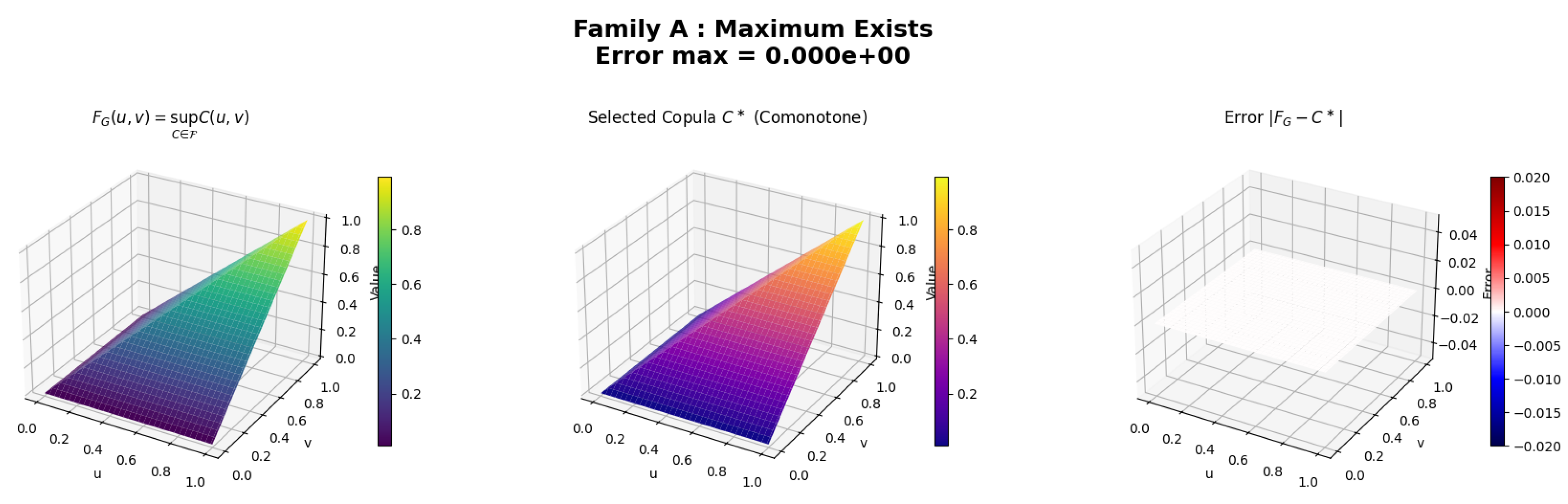
The surface coincides numerically with the comonotonic copula, and the absolute error is below throughout the entire domain. These results confirm that the pointwise supremum is attained within the family, and therefore the set admits a maximum in the sense of the partial order of copulas. We now consider the family
This family is obtained from by removing the comonotonic copula. In this case, no single element globally dominates all others. Applying the same algorithm with identical parameters yields the following results:
Figure 2.
Numerical detection of the maximal copula in Family B.
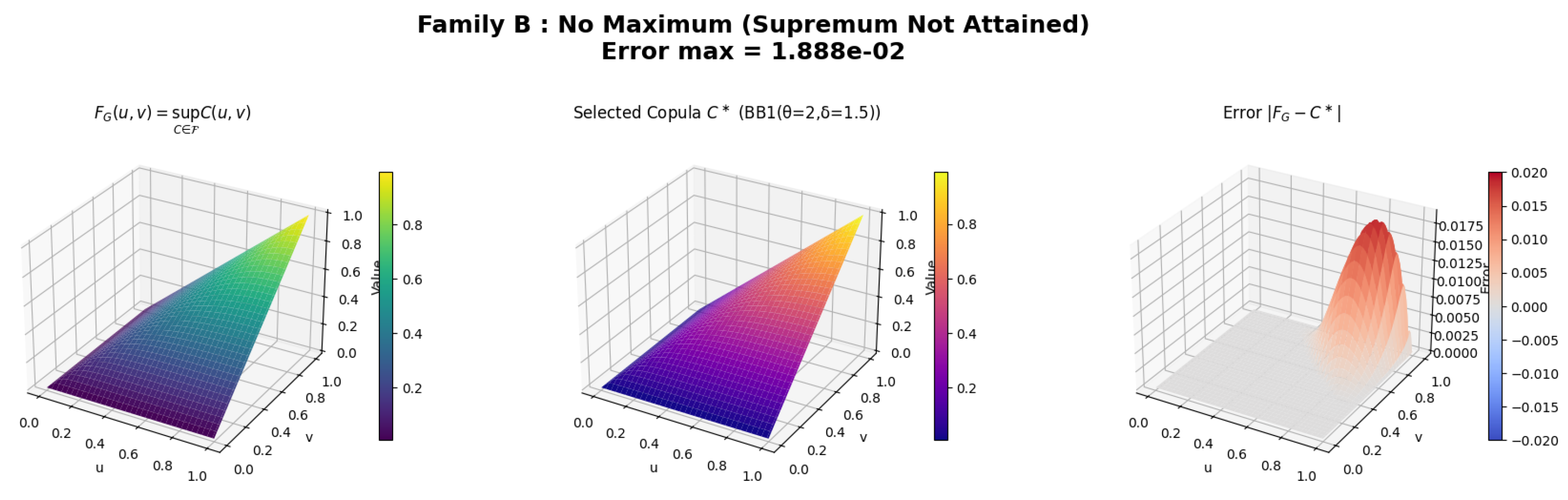
We observe that the surface is close to, but not identical to, the copula , which is selected by the algorithm as the dominant candidate.
The absolute deviation shows a slight localized increase (on the order of ) in the region , indicating that the pointwise supremum is not exactly attained.
Hence, although provides the strongest dependence among the considered elements, the maximum of does not exist, since no copula, except M, dominates all others on .
Application 2: Copula analysis of the –HR dependence under simulated hypoxia
In this section, we propose an application of the copula-based approach to the study of cardio-respiratory dynamics in a hypoxic environment using the High-Altitude Pilot Physiological Monitoring Dataset. The data were collected from twenty healthy volunteers (aged 18–40 years) placed in a hypobaric chamber simulating different altitudes, with precise control of the inspired oxygen concentration. Approximately 44 hours of continuous recordings of peripheral oxygen saturation () and heart rate (HR) were obtained, providing a relevant experimental framework for analyzing hypoxia thresholds in aviation. The objective is to analyze the evolution of the dependence between these two variables as a function of altitude [2] and [6].
To this end, the observations of each subject are segmented into altitude bands of 500 m, and an empirical copula is estimated for each band in order to characterize the dependence structure associated with each exposure level. This approach makes it possible to overcome the limitations of classical linear correlation measures and to explore nonlinear and asymmetric dependence between oxygen desaturation and the compensatory cardiac response. An essential intermediate step consists in approximating each empirical copula by an optimal convex combination of the fundamental Fréchet–Hoeffding copulas ,
which provides a continuous and regular representation that attenuates measurement noise while preserving the dominant dependence structure of each block. We then consider the convex hull of the resulting copulas,
This envelope gathers all dependence structures compatible with the physiological observations. Studying its pointwise maximum makes it possible to determine whether a critical physiological regime is actually reached, namely a hypoxic situation in which sympathetic co-activation and cardiac acceleration exhibit a maximal level of synchronization.
Figure 3.
Copula-based analysis of the -HR dependence at altitude (Dataset 0610b).
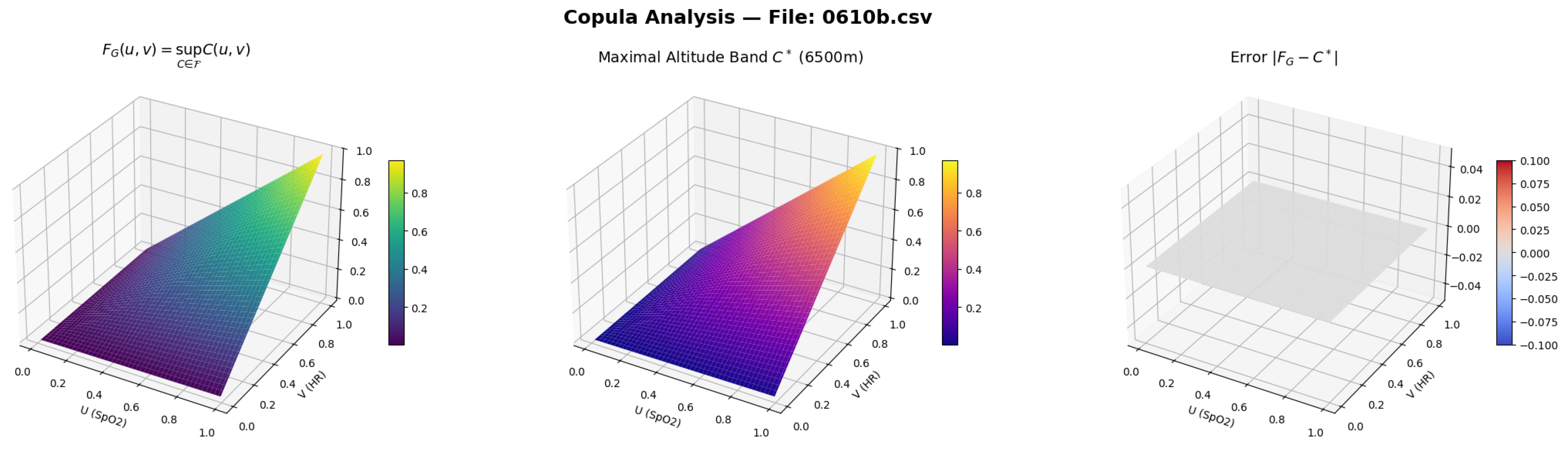
Figure 4.
Copula-based analysis of the -HR dependence at altitude (Dataset 0623a).
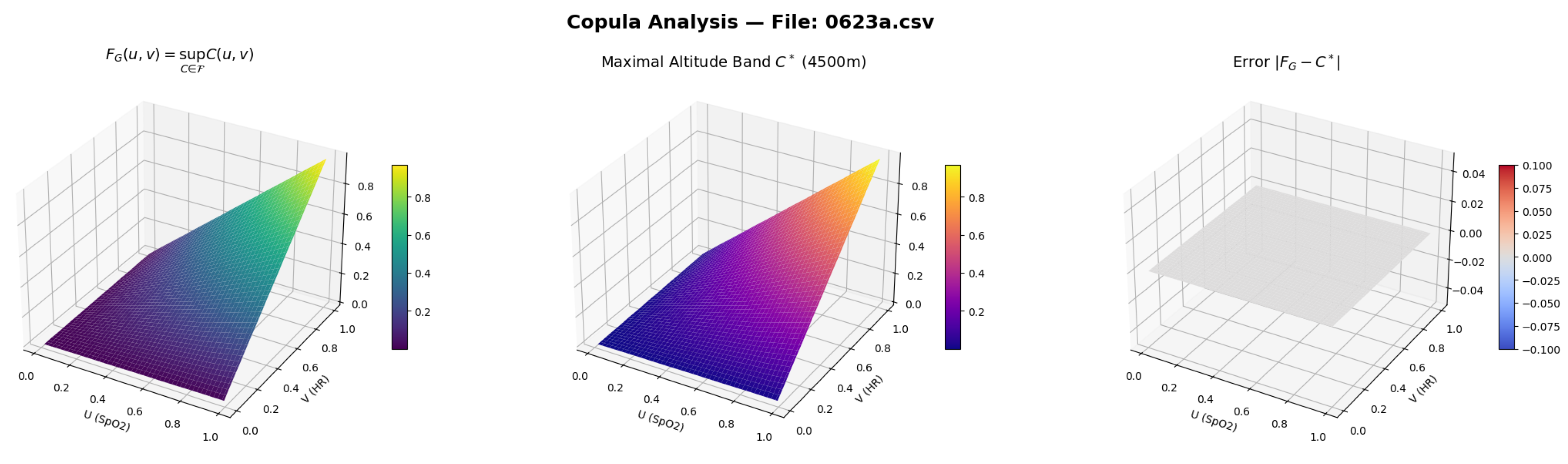
Figure 5.
Copula-based analysis of the -HR dependence at altitude (Dataset 0717b).
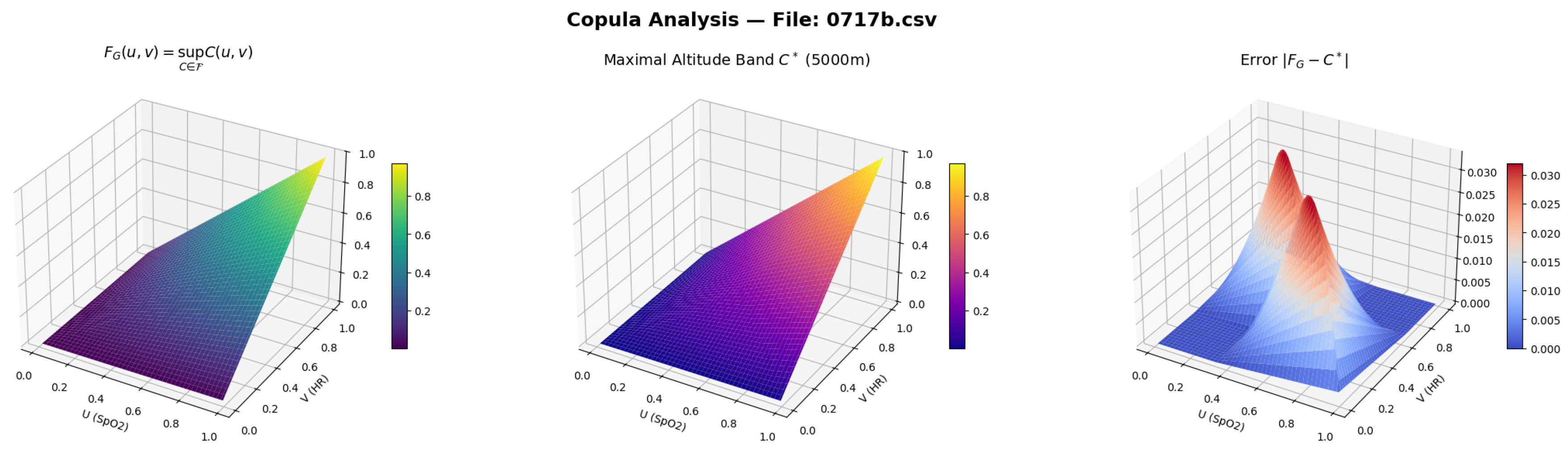
Figure 6.
Copula-based analysis of the -HR dependence at altitude (Dataset 0721b).
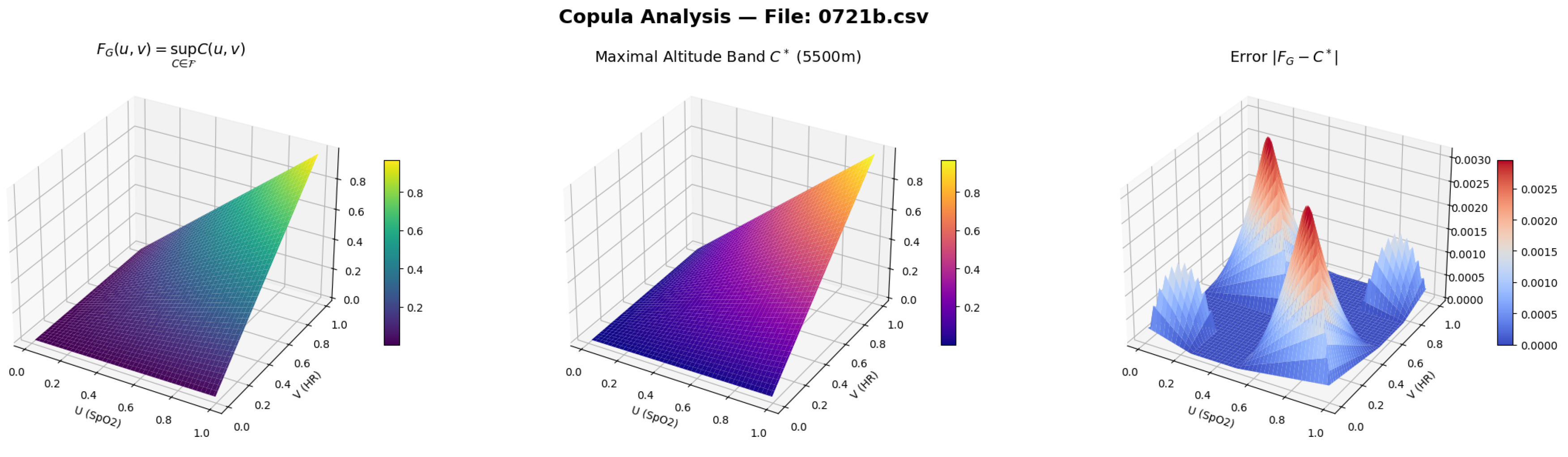
Figure 7.
Maximum detection results and winning altitude bands for each dataset.
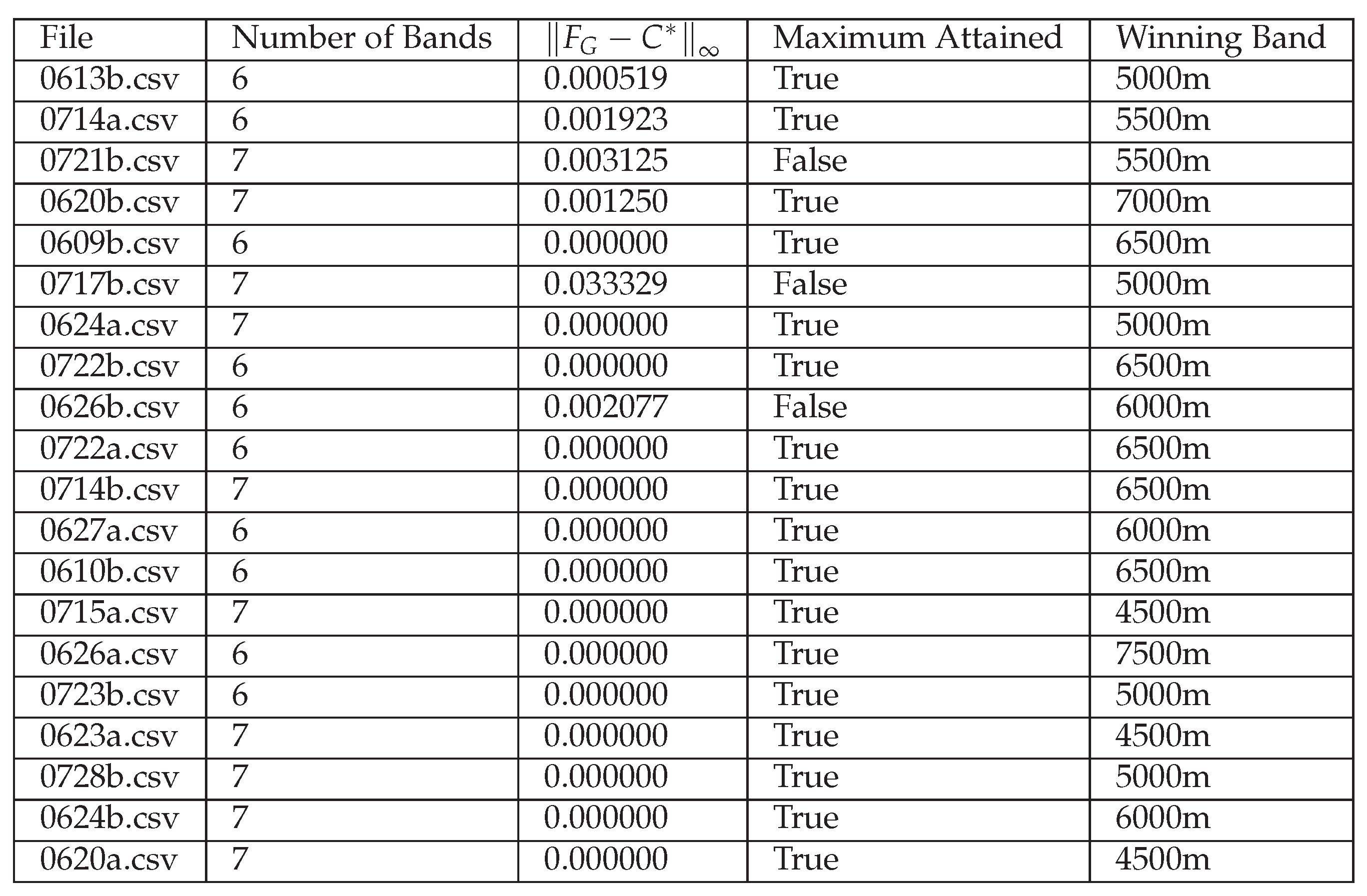
The results show that the dependence between oxygen saturation () and heart rate reaches a well-defined maximum for the majority of experimental sessions. In 17 out of 20 cases, the maximum of the copula envelope is effectively attained, with deviations equal to zero or very small, indicating the existence of an identifiable critical physiological regime. The winning altitude bands are mainly concentrated between 5000 m and 6500 m, an interval corresponding to moderate to severe hypoxia where the compensatory cardiac response becomes strongly coupled with oxygen desaturation. The few cases in which the maximum is not attained reflect inter-individual variability and a more gradual transition of the dependence on altitude. Overall, the analysis highlights a critical altitude threshold characterized by maximal synchronization between heart rate and tachycardia, confirming the applicability of the copule approach for identifying physiological states in hypoxic environments.
5. Numerical Search for the Maximum of the Convex Hull of a Countable Family of Copulas
As we have already emphasized, the situation differs markedly between the finite and countable cases. For a finite family of copulas, the existence of a maximum is equivalent to the fact that one of the generating copulas dominates all the others. By contrast, for a countably infinite family, this equivalence no longer holds: a maximum with respect to the point-wise order may exist without being attained by any element of the family, nor even by any finite convex combination.
In what follows, we establish a necessary and sufficient condition characterizing the existence of the maximum of the closed convex hull of a countable family of copulas. We also present a numerical approach that allows one to effectively test the existence (or absence) of this maximum.
Lemma 2.
Let be a countable family of copulas, and let Then, for every ,
Proof.
For the inequality “≤”. Any finite convex combination satisfies
. Passing to the limit along sequences approximating any , this inequality is preserved. Hence,
The inequality “≥” is immediate, since each . □
Proposition 7.
Let be a countable family of copulas and let . For every , define
Then S admits a maximum if and only if F belongs to S. Moreover, in this case, the maximum is equal to F.
Proposition 8.
For a finite grid , its fill distance is defined by
Let F and D be two copulas. If then
Proof.
For any , choose such that . Since F and D are copulas, we have and . Therefore,
□
Remark 5.
● In the case of a regular grid, each point of the unit square belongs to a cell of size . The point farthest from a grid node is the center of the cell. Hence,
- If the approximation error on G satisfies then
Theorem 6
(Approximate characterization of via grids). Let be a countable family of copulas and let Define
If F is a copula, then the following two statements are equivalent:
- 1.
- (that is, F is the maximum of S);
- 2.
-
For every , for every finite grid whose fill distancesatisfies , there exist an integer and weights such that , and the convex combinationsatisfiesIn this case, one automatically has
Proof. (1) ⇒ (2)
Assume that . By definition of the closure with respect to the uniform norm, for every there exists a finite convex combination
such that
For any grid G satisfying , we then have
(2) ⇒ (1)
Assume that (2) holds. For each , set . There then exists a grid with and a finite convex combination
such that
Hence,
Therefore, uniformly. Since each belongs to , it follows that .
□
Remark 6.
The approximate characterization theorem shows that, if the pointwise supremum F is a copula, then the fact that F belongs to the closed convex hull S can be verified numerically on a fine grid of .
In other words, for every , there exists a finite convex combination
such that
Thus, the membership of F in S can be tested in a discrete manner through the following two conditions:
The algorithm described below implements this principle in three phases:
- Phase A:construction of the discrete supremum and identification of a truncation index ;
- Phase B:verification of the discrete 2-increasing property of (copula compatibility test);
- Phase C:approximate convex membership test via a single-layer neural network.
If Phases B and C are validated, the discrete supremum is accepted as anumerical approximation of the maximumof S.
Algorithm
Input data
- A countable family of copulas that can be evaluated numerically.
- A finite grid
-
Three numerical tolerances:
- : saturation threshold for the supremum;
- : threshold for discrete 2-increasingness;
- : threshold for convex approximation.
Phase A – Construction of the discrete supremum and determination of
Objective. Approximate the pointwise supremum
by a discrete version on the grid G, and determine the index beyond which additional copulas do not provide a significant improvement.
Algorithm.
- 1.
- Initialization:
- 2.
-
For :
- Evaluate on the grid.
- Update:
- Compute the variation:
- If for several consecutive iterations, stop.
- 3.
- Set and retain
Interpretation. is the numerical approximation of the supremum, and is the last relevant index before saturation.
Phase B – Discrete 2-increasingness test (copula test)
Objective. Verify that satisfies the discrete 2-increasing property.
For each elementary rectangle , compute
The maximal violation is defined by
Decision.
- If , then is 2-increasing up to the prescribed tolerance.
- Otherwise, one concludes that S does not admit a maximum (even the discrete supremum is not copula-like).
Phase C – Approximate convex membership test via a neural network
Objective. Verify whether can be uniformly approximated on the grid by a convex combination of
Definition of the network .We define as a single-layer softmax neural network:
The coefficients are positive and sum to one, ensuring a convex combination.
The network output is
and, on the grid,
Loss function. Define the positive gap
and the global quantities
The loss function is then
The minimization of by gradient descent yields an optimal parameter and optimal weights .
Final decision
- Yes: S admits a maximum (on the grid) if
- No: otherwise.
Application
Application 1: The maximum is an element of the family.
We test the procedure on the mixed family
where is the comonotonic copula, is the counter-comonotonic copula, and converges to the product copula as . This family is particularly interesting because it combines the two extreme elements of the concordance order ( and ) together with a sequence of intermediate copulas whose dependence gradually decreases. The objective is to determine whether the closed convex hull
admits a maximum.
In this numerical experiment, Phase A uses a dense grid of points to approximate the discrete supremum , with the exploration limited to copulas (a value that can be increased if necessary) and a strict tolerance . Phase B checks the 2-increasing property on all elementary rectangles of the grid; a violation smaller than is interpreted as numerical evidence that is indeed a copula. Finally, Phase C attempts to reconstruct as a finite convex combination via a neural network whose weights are optimized using Adam (learning rate , up to 10000 iterations and 5 restarts). If the final approximation satisfies
the supremum is considered numerically attainable in the closed convex hull.
Obtained results:
Figure 8.
Numerical detection of the maximal copula in Family 1.
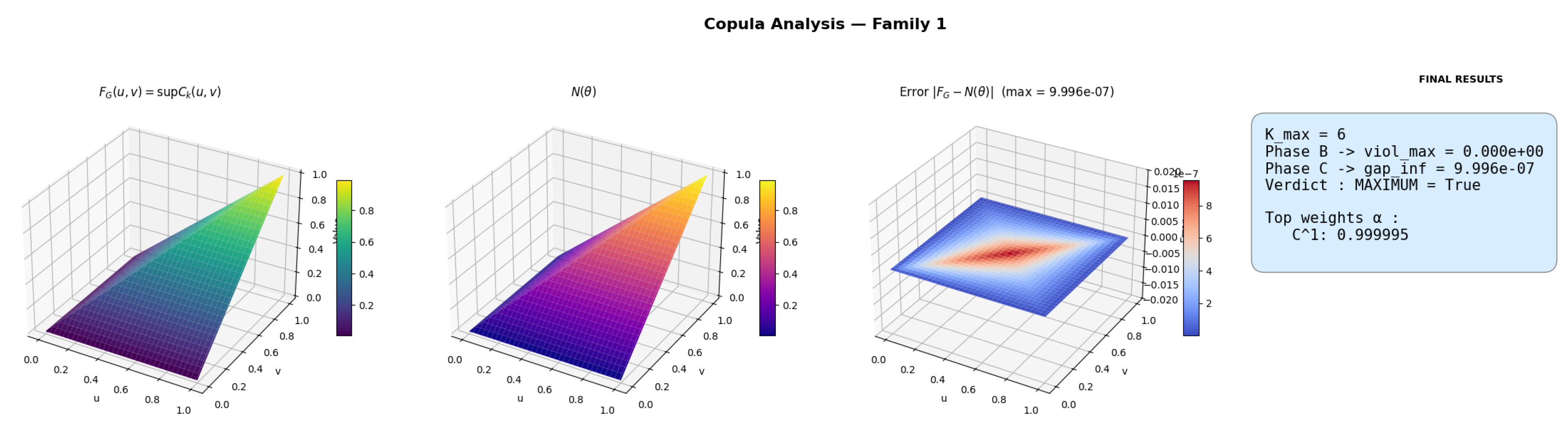
The numerical results clearly show that the closed convex hull admits a maximum with respect to the pointwise order. Phase A indicates that the discrete supremum is reached very rapidly, after only copulas have been explored, with no further improvement observed thereafter. Phase B confirms that is indeed a numerical copula, since no violation of the 2-increasing property is detected. Phase C then successfully reconstructs as a finite convex combination, with an extremely small uniform error
well below the prescribed threshold . Moreover, the distribution of the convex weights shows that almost all the mass is carried by , with a coefficient , which numerically indicates that the maximum of S is the comonotonic copula.
This conclusion was expected. Indeed, the comonotonic copula is the upper bound of the set of all copulas with respect to the pointwise order. It is therefore theoretically unavoidable that is the maximum of , and the algorithm confirms this property with numerical accuracy on the order of one part in a million.
Application 2: Absence of a maximum in the closed convex hull.
We test the procedure on the countable family
This family alternates Clayton copulas with parameters decreasing to 0 and Gumbel copulas with parameters decreasing to 1. All Clayton copulas are dominated by , and all Gumbel copulas are dominated by . Therefore, if a maximum of were to exist, it would necessarily coincide with the maximum of
However, these two extreme copulas are not comparable with respect to the pointwise order: the Clayton copula dominates the Gumbel copula on part of the domain, while the reverse inequality holds elsewhere. Consequently, no copula in the convex hull can simultaneously dominate both, and the closed convex set
does not admit a maximum.
In this numerical experiment, the algorithm is executed with parameters ensuring high accuracy while remaining computationally feasible. Phase A employs a fine grid of points to approximate the discrete supremum , with the exploration limited to copulas (a value that can be increased if necessary) and a strict tolerance . Phase B checks the 2-increasing property on all elementary rectangles; a violation below is regarded as numerical evidence that is a copula. Finally, Phase C attempts to reconstruct as a finite convex combination via a network optimized using Adam (learning rate , up to 10000 iterations and five restarts). If the uniform error satisfies
the supremum is considered numerically attainable. Altogether, these parameters ensure a reliable verdict on the existence or absence of a maximum in at the scale of one part in a million.
Obtained results:
Figure 9.
Numerical detection of the maximal copula in Family 2.
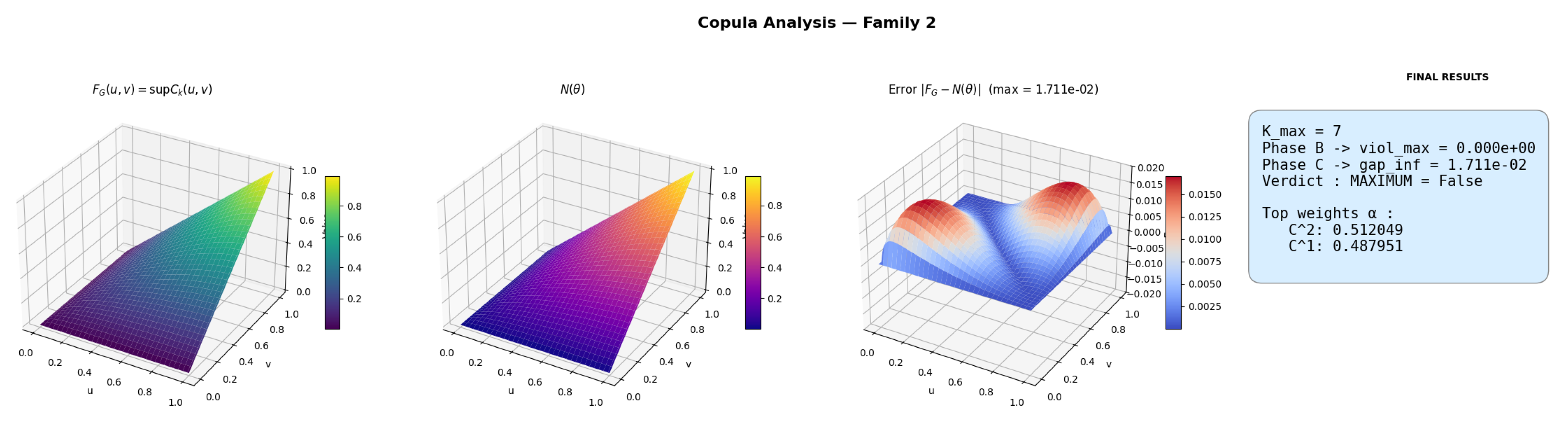
The numerical results confirm the absence of a maximum in . Phase B shows that the discrete supremum is indeed a numerical copula, since no violation of the 2-increasing property is detected. However, Phase C fails to reconstruct this supremum as a finite convex combination: the uniform error remains on the order of , well above the required threshold . The error surface clearly illustrates this discrepancy, which persists far from the diagonal . The obtained convex weights involve only the first two copulas of the family, corresponding to the convex hull
Nevertheless, even this optimal mixture fails to attain , confirming that no copula in the closed convex hull is able to dominate all the others. The algorithm therefore correctly concludes that does not admit a maximum.
Application 3 : Maximum in the closed convex hull
In order to experimentally test the ability of our algorithm to detect the existence of a maximum in a countable convex closure, we consider the family of Farlie–Gumbel–Morgenstern copulas
This sequence of parameters alternates in sign and converges to the extreme values , so that the family simultaneously approaches the two limiting copulas and without ever attaining them. Since the mapping is increasing with respect to the pointwise order, the pointwise supremum of is formally the limiting copula . Therefore, if the closed convex hull admits a maximum, it must necessarily coincide with .
From a numerical standpoint, Phase A employs a fine grid of points to approximate the discrete supremum , with a sweep up to copulas and a strict tolerance . Phase B checks the 2-increasing property on all elementary rectangles of the grid; a violation below is interpreted as numerical evidence that is indeed a copula. Finally, Phase C attempts to reconstruct as a finite convex combination using a network optimized with Adam (learning rate , up to iterations and five restarts). If the uniform error satisfies
we consider the supremum to be numerically attainable.
Obtained results
Figure 10.
Numerical detection of the maximal copula in Family 3.
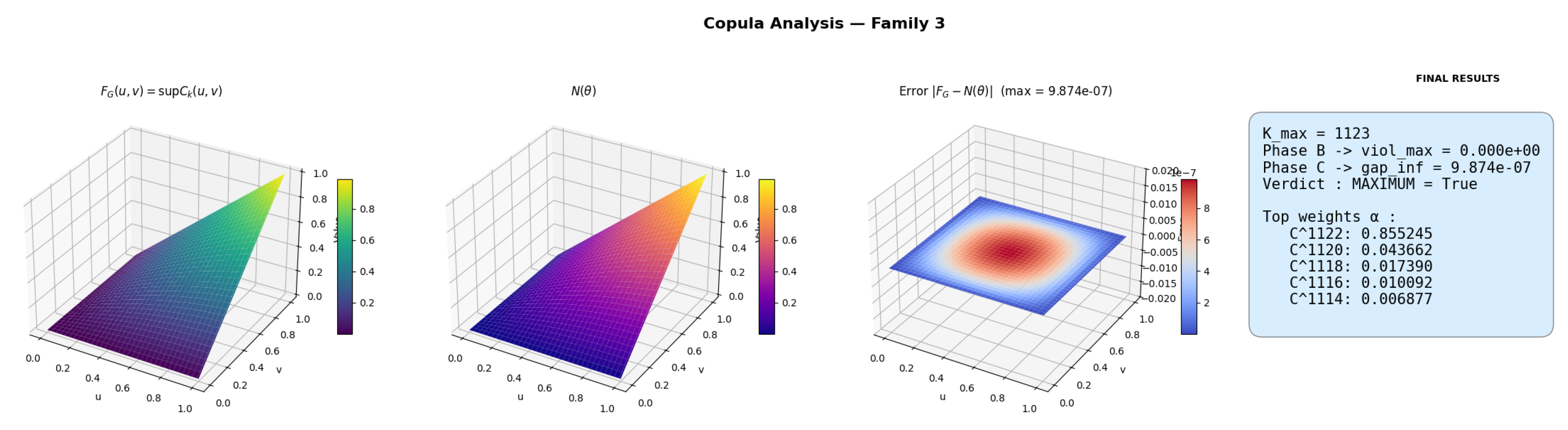
The numerical experiment shows that the closed convex hull
admits a maximum with respect to the pointwise order. The discrete supremum , computed on a grid, is validated as a copula by Phase B, since no violation of the 2-increasing property is detected. Phase C then reconstructs by means of a finite convex combination with a uniform error
which is below the prescribed threshold . The distribution of the convex weights shows that the maximum is essentially carried by the last elements of the sequence, which is consistent with the convergence .
This numerical behavior is in perfect agreement with the theoretical analysis. Indeed, the limiting copula of the supremum is , and
which confirms that the copulas corresponding to large values of k are already extremely close to the theoretical maximum. The algorithm therefore correctly identifies the existence of a maximum in , with numerical accuracy on the order of one part in a million.
Remark 7.
A natural improvement of the algorithm consists in drastically reducing the number of copulas used in Phase C. At present, the program stores all copulas encountered during the construction of the discrete supremum. However, one can do much better: for each grid point, it suffices to retain only the copulas that attain the maximum at that point. In other words, one constructs a set consisting of the “champions” of the grid, namely the copulas that win at least once on the grid, and discards all the others. In practice, this subset remains very small, even when the initial family contains several hundred elements.
Author Contributions
The first author drafted the manuscript, the second one has implemented numerical methods and the third one has checked the functional analysis of the problem.
The authors declare no conflicts of interest.
Abbreviations
The following abbreviations are used in this manuscript:
| SpO2 | Peripheral oxygen saturation |
| HR | Heart rate |
| FGM | Farlie-Gumbel-Morgenstern |
References
- Vilfroy, S. Et.al, Conformal prediction for regression models with asymmetrically distributed errors: application to aircraft navigation during landing maneuver. Vol.:(0123456789). Machine Learning. [CrossRef]
- Ishimura, N.; Yoshizaqa, Yasokazu. On time dependent copulas, Graduate school of economics. Preprint 2016. [Google Scholar]
- De Michele, C.; Salvadori, G.; Passoni, G.; Vezzoli, R. A multivariate model of sea storms using copulas. Coastal Engineering 2007, Volume 54(Issue 10), Pages 734–751. [Google Scholar] [CrossRef]
- Kaemo, Matheo. Construction of a Statistical Framework Using Copula Modeling to Assess Sea Level Rise in New-Caledonia, Pacific Ocean. Polytechnique Montréal. 2021. Available online: https://publications.polymtl.ca/9903/.
- Risca, G.; et al. Archimedean Copulas: A Useful Approach in Biomedical Data—A Review with an Application in Pediatrics. Stats 2025, 8(3), 69. [Google Scholar] [CrossRef]
- Yoshizawa, Y.; Ishimura, N. Evolution of bivariate copulas in discrete processes. JSIAM Letters 2011, 77–80. [Google Scholar] [CrossRef]
- Swanepoel, J. W. H. Construction of bivariate symmetric and asymmetric copulas and its relationship to ratios of conditional hazard rate functions. Communications in Statistics- Theory and Methods 2023, 53(14), 5280–5296. [Google Scholar] [CrossRef]
- Frechet, M. Sur les tableaux de correlation dont les marges sont données. Ann. Univ. Lyon 1951, 9 Sec. A, 53–77. [Google Scholar]
- Sklar. Fonctions de répartition à n dimensions et leurs marges. Publ. Inst. Statist. Univ. Paris. 1959, 229–231. [Google Scholar]
- Roger B. Nelsen, An Introduction to Copulas, Springer Series in Statistics, 2nd edition; Springer Science+Business Media, Inc, New York, 2006.
- Almasri, F. Exploring the Impact of Artificial Intelligence in Teaching and Learning of Science: A Systematic Review of Empirical Research. In Res Sci Educ; 2024. [Google Scholar] [CrossRef]
- El maazouz, M.; Sani, A. New asymmetric perturbations of FGM bivariate copulas and concordance preserving problems. Moroccan Journal of Pure and Applied Analysis 2023, 9(1), 111–126. [Google Scholar] [CrossRef]
- Elamrani, O.; Sani, A. A Procedure of Perturbation Leading to a New Class of Asymmetric Copulas. Mathematics 2026, 14(7), 1093. [Google Scholar] [CrossRef]
- Pellerey, F. On univariate and bivariate aging for dependent lifetimes with archimedean survival copulas. In Kybernetika — Volume 44; 2008; Volume Num 6, pp. 795–806. [Google Scholar]
- Spreeuw, J. Relationships Between Archimedean Copulas and Morgenstern Utility Functions. Paper presented at the Copula Theory and Its Applications, 2009; pp. Warsaw 25–26 September. [Google Scholar]
- Siburg. An order of asymmetry in copulas, and implications for risk management. Insurance: Mathematics and Economics. Volume 2016, Volume 68, 247–251. [Google Scholar] [CrossRef]
- Sani, A.; El-maazouz, M. Stability of copulas under survival transform. Volume Available online at. Volume 10(Issue 2), Pages 115–123 July 2022. [CrossRef]
- Chesneau, C. Three-Dimensional Copulas: A Generalized Convex Mixture Copulas Strategy’. Computational Journal of Mathematical and Statistical Sciences 2024, 3(2), 240–257. [Google Scholar] [CrossRef]
- Chesneau, C. Extensions of Two Bivariate Strict Archimedean Copulas. Computational Journal of Mathematical and Statistical Sciences 2023, 2(2), 159–180. [Google Scholar] [CrossRef]
- Longla, M. Copulas, m-dependence, and Markov chains; TEST, 2026. [Google Scholar] [CrossRef]
- Taani, O.; Alabidi, S. ChatGPT in education: benefits and challenges of ChatGPT for mathematics and science teaching practices. International Journal of Mathematical Education in Science and Technology 2024, 1–30. [Google Scholar] [CrossRef]
Disclaimer/Publisher’s Note: The statements, opinions and data contained in all publications are solely those of the individual author(s) and contributor(s) and not of MDPI and/or the editor(s). MDPI and/or the editor(s) disclaim responsibility for any injury to people or property resulting from any ideas, methods, instructions or products referred to in the content. |
© 2026 by the authors. Licensee MDPI, Basel, Switzerland. This article is an open access article distributed under the terms and conditions of the Creative Commons Attribution (CC BY) license (http://creativecommons.org/licenses/by/4.0/).
Copyright: This open access article is published under a Creative Commons CC BY 4.0 license, which permit the free download, distribution, and reuse, provided that the author and preprint are cited in any reuse.


