
Submitted:
18 April 2026
Posted:
20 April 2026
You are already at the latest version
Abstract
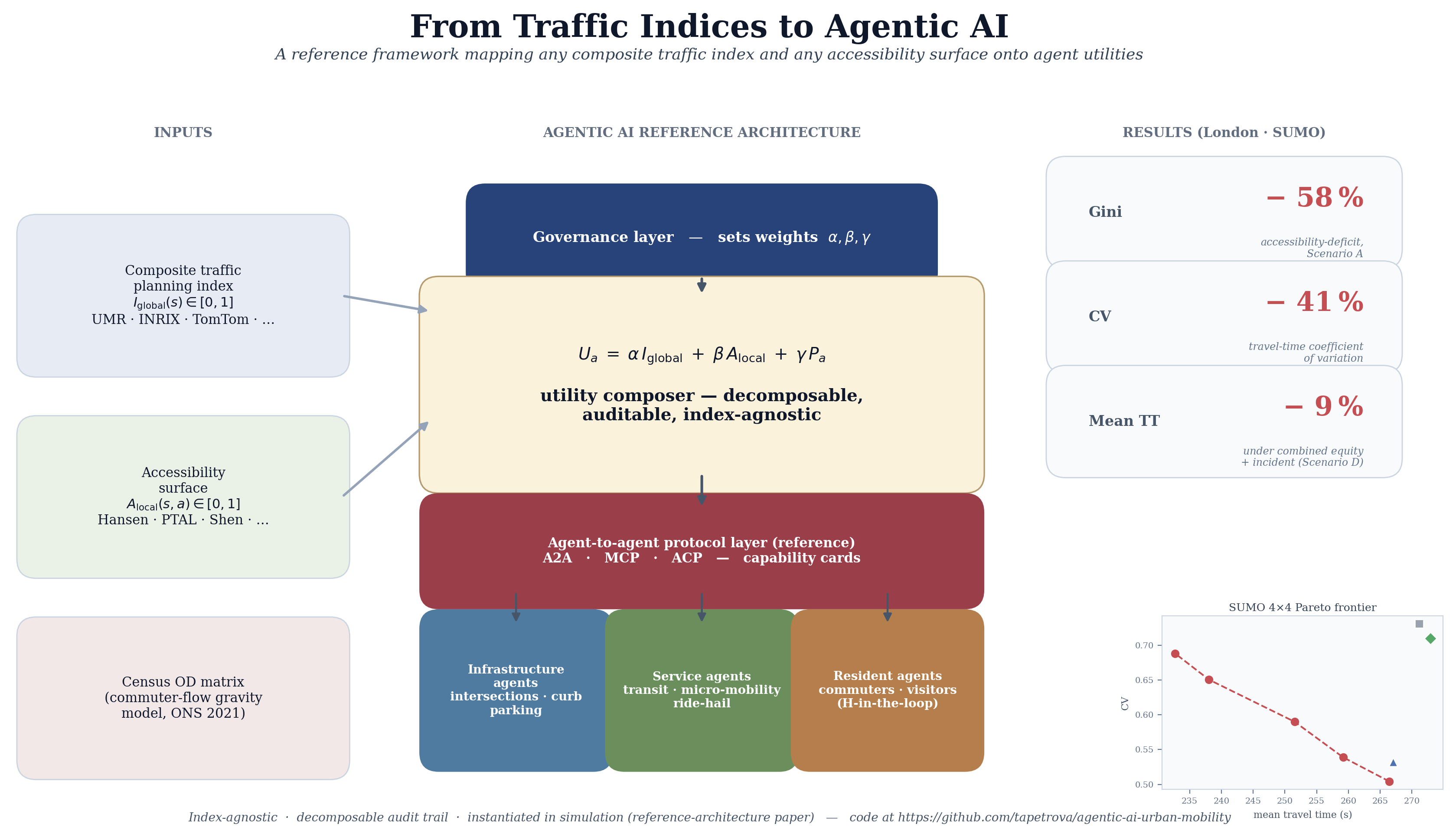
Megacity mobility research has long relied on aggregate statistical indicators — composite traffic-planning indices and accessibility surfaces — that capture the system at rest but are disconnected from the operational decisions shaping mobility minute to minute. In parallel, Agentic AI, articulated in the Web of Agents narrative of [28], offers a reference paradigm of semantically interoperable autonomous agents that negotiate and coordinate across open networks. We propose a unifying Agentic AI reference architecture for urban transportation that maps any composite traffic index and any accessibility surface onto agent utility functions, negotiation-protocol primitives, and shared semantic ontologies. The architecture is instantiated in simulation only: no live A2A/MCP endpoints, no runtime LLMs, no cross-organisation interoperability experiment; these are explicitly listed as next steps.A 12-borough London case study, evaluated over N = 30 seeds on an origin-destination matrix calibrated to the 2021 UK Census commuter-flow aggregates [24], benchmarks four regimes (historic, adaptive, MaxPressure, and our Agentic policy) across four scenarios covering equity, corridor prioritisation, incident response, and their combination. The Agentic regime reduces the accessibility-deficit Gini coefficient by 23–58 %, travel-time CV by up to 41 % and mean travel time by 4–9 % relative to the historic baseline, and is the one regime in our four-way comparison that sits near the per-column best on all three objectives simultaneously when equity and incident-response interact. A microscopic SUMO testbed on a 4×4 signalised grid (120 runs across three demand regimes and five peripheral-boost values) traces an explicit equity–efficiency Pareto frontier on which the agentic policy matches or beats a SCOOT-style adaptive controller on mean travel time and throughput at every operating point, while reducing travel-time variance by up to a third.
Keywords:
Agentic AI
; multi-agent systems
; reference architecture
; urban mobility
; transport accessibility
; PTAL
; composite traffic index
; smart cities
; London
Copyright: This open access article is published under a Creative Commons CC BY 4.0 license, which permit the free download, distribution, and reuse, provided that the author and preprint are cited in any reuse.


