

Submitted:
17 April 2026
Posted:
20 April 2026
You are already at the latest version
Abstract
To date, many studies on the Nazi Special Courts have focused on the individuals involved in passing judgement or in the prosecution process in general, as well as on their political significance. For our study, we undertake a re-evaluation and computational ‘upcycling’ of an archive catalogue from the 1970s containing around 10,000 legal cases from the Munich Special Court (1933–1945). Although this was not an entirely new phenomenon–they were originally introduced by the Weimar Republic–, the special courts were unique in that they brought together general criminal law and ‘crimes’ in the form of non-conformity with National Socialist ideology under a single jurisdiction.
Keywords:
computational history
; national socialism
; penal law
1. Summary
“Volk” was probably the most central notion in National Socialist legal ideology. Nazism deeply despised ‘positive’ law (“gesetztes Recht”) in the sense of a modern, enlightened legal and constitutional state. Nevertheless, the NS regime avowedly1 (ab)used the institutions and affiliated functional elites of the German state structure that had evolved until 1933 right from the beginning of its “Seizure of Power” (“Machtergreifung”). The transformation of German society that the National Socialist Regime pursued in its own interests contained integrally the terror against their ‘enemies’ within and outside the “Third Reich” (cf. Figure 1).
Thereby, the “Volksgemeinschaft” as the not only ideal end but even more a “social practice on the ground”2 that gave “refuge to those weary and worn out by the hassle, confusion and conflict of everyday life”, as the then Communist and later in times of the Federal Republic of Western Germany leading Social Democratic German politician Herbert Wehner (1906–1990) stated in exile in Sweden in 1942.3 Theory and practice of this issue are exemplified in a unique way through the extra-regular penal law instances of the Special Courts (“Sondergerichte”) and the special criminal law ordinances enacted for them by the National Socialist regime–as well as, conversely, the influence of National Socialist ideology on lawmaking and the procedural and sentencing practice of the penal justice system. Set up in March 1933 at each Higher Regional Court (“Oberlandesgericht”, OLG), the Special Courts were not only important means for the phase of the formation of the regime, but even more for the war period. In contrast to the National Socialist “People’s Court” (“Volksgerichtshof”, VGH), proceedings before the National Socialist Special Courts were conducted against the population in its entirety, i.e. against German “Volksgenossen” as well as against those Germans who, from the National Socialist ideology’s point of view, did not (or no longer) belong to the “Volksgemeinschaft” due to their origin or actions, as well as against foreigners located on Reich territory–even before 1939. At the same time, however, Special Courts also served to discipline and, if necessary, ‘segregate’ people from the ‘own ranks’, “Pg”s or Members of SA and SS. Both new and old elites stood before this kind of court, as did labourers from Germany and abroad (cf. chapter 4.b). Simultaneously to the quantitative breadth and heterogeneity of those prosecuted before the Special Courts, the legal basis of their proceedings was characterized by a large number and a plenty of legal historical variety. This represents a further difference to the Nazi People’s Court, before which only offences of high treason and treason against the state were tried. This is another reason why the following data-based investigation into the procedural and sentencing practice of a National Socialist Special Court can also offer a scientific gain in knowledge compared to existing recent data studies on the People’s Court undertaken by US and Australian economic historians4.
2. State of the Research
Research on National Socialist Special Courts has actually been quite extensive–although so far almost exclusively in German-language sciences–especially on the basis of case studies on single Special Courts, of which there were 26 in the territory of the “Altreich”5 , or to specific victim groups such as Jehovah’s Witnesses6 or Roman Catholic spirituals7. However, there are two aspects of National Socialist special judiciary that can be seen as still more or less as a major desiderate: first, the theoretical-historical background in the context of National Socialist ideology and legal history as a whole.8 Secondly, there has not yet been any Big Data exploration of the procedural practices of a Special Court.9 The Munich Special Court is a particularly suitable example in both cases. Almost all of the court files have been preserved,10 and in the 1970s, a so-called “Archive Inventory” (“Archivinventar”)11 was created on behalf of the Bavarian State Ministry of Education and Cultural Affairs. It records essential metadata on each trial and was facilitated by a team of historians in the form of around 10,000 file records (“Aktenregesten”). This is an extraordinarily connectable basis for digital “upcycling”12 to the end of computational historical and macroscopic data exploration. Additionally, the Bavarian capital of Munich was, glorified as the Nazi “capital of the movement” and as headquarters of the NSDAP from the party’s foundation right until the downfall, a central site of National Socialist ideology – including legal ideology. The 1970’s “Archive Inventory” itself can be seen a milestone in the history of the Federal Republic of Germany’s successively coming to terms with its National Socialist past: It represents, e.g., the turn from National Socialist history as an elite history13 to everyday history (“Geschichte von unten”).14
3. The Location of Munich Nazi Special Court in Intellectual, Legal, and Social History
Special Courts as complementary facilities of the regular criminal justice system in 20th century German History were no genuine invention of National Socialism. In their specific institutional formation, they had been introduced in August 1932 by the Weimar Republic15 on the legal basis of Article 48 of its Constitution.16 In this phase of state crisis and civil war-like conditions especially between the extreme fringes, these Special Courts were not least meant to serve as a penal instrument against violent attacks on the Republic, i.e., against Nazis and their thug squads SA and SS in particular. As part of this “escalation of violence”, 8,248 people were killed or wounded in politically motivated acts in the German Reich in alone 1931.17 For the first time, one of the Weimar Special Courts handed down a sentence on 22 August 1932: The Special Court of Beuthen (Bytom) imposed the death penalty on five SA members who had brutally murdered the worker Konrad Pietrzuch in the Silesian village of Potempa (Potępa).18 „The defendants reacted with shouts of ‘Heil Hitler!’ and ‘Down with the justice system’”19 , which performatively anticipated the National Socialists’ later approach to the rule of law.
A precursor of the Special Courts in the declining Weimar Republic as well as the “Third Reich” was the so called “People‘s Court” (”Volksgericht”) established in Bavaria in the course of 1918 revolution until 1924. This institution was different in terms of legal history but comparable in terms of ideas.20 Its acting also related to the prosecution of political riots from both the left and the right, i.e., also of the early National Socialists. Two trials before the Munich “People’s Court” made history: one against Anton Count Arco-Valley (1897-1945) in 1920, the murderer of the first post-monarchic Bavarian Prime Minister Kurt Eisner (1867-1919), whose far-left independent social democratic government21 had initially introduced the “People’s Court”; secondly, the trial of the Munich “Beer Hall Putsch” (“Hitlerputsch”), which had failed on 9 November 1923, in spring 1924.22 This kind of jurisdiction was, however, a Bavarian special path which at least in its final phase violated the prevalent Weimar Constitution–in very contrast to the Special Courts of 1932 and 1933-45.23 The “Hitler trial” of 1924 was in itself even a definitely illegal procedure for the offence committed by Hitler and his combatants of November 1923–namely high treason–would clearly have been the responsibility of the “Reich Supreme Court” (“Reichsgericht”) in Leipzig.24
There25 was a remarkable line of personal continuity in the legal elite between the Bavarian “People’s Court” of 1919-24 and the Munich Special Court of 1933-45. The presiding judge of the 1924 “People’s Court” trial against Hitler who handed down a very benevolent sentence against the future German dictator in view of his own right-wing convictions, Georg Neithardt (1871-1941), would be appointed President of the Munich “Higher Regional Court” (Oberlandesgericht, OLG) in 1933.26 The Munich OLG was the very instance of the regular judiciary to which the National Socialist Special Court of Munich was officially assigned to. The Bavarian Minister of Justice in office at the time, Franz Gürtner (1881-1941), who had in 1924 “ensured [...] that Hitler was not transferred to the [Leipzig] State Court for his attempted coup d’etat of November 1923, but was tried before the illegal Munich People’s Court”27 , advanced to the position of the Reich Minister of Justice in June 1932 as a representative of the German National People’s Party (“Deutschnationale Volkspartei”, DNVP). Although probably not a Nazi in the strict ideological sense himself, he was nevertheless confirmed in office as an ‘expert’ by the NS regime and held it until his death. Gürtner was one of the authoritative technocrats who “put supra-legal National Socialist legal thinking into juridically correct forms”28. As Reich Minister of Justice before and after 1933, he played a decisive role in launching the Special Courts of 1932 and 1933-45 both times.
The lenient sentence Hitler received from the Bavarian “People’s Court” in 1924 paved the way for the further rise of the Nazi movement. Hitler used the privileged imprisonment (“Ehrenhaft”) in the south-Bavarian city of Landsberg upon Lech, from which he was to be released at the end of 1924, to write his programmatic “Mein Kampf”29 , in which he also presented his ideas of law and state30 and, in almost endless rants, Hitler also outlined the later special jurisdiction for ideological enemies31.
A specific idea of law and state was of central importance of the political and racial (“völkische”) ideology of National Socialism. The Parisian historian Johann Chapoutot traces this quite conclusively in his study on “la loi du sang”32. A very fundamental aspect here is to distinguish conceptually between the German words “Recht” and “Gesetz”. Typical of National Socialist legal ideology was the radical rejection of law as a ‘positive law’ (“gesetztes Recht”), which for the Nazi was something thoroughly ‘un-Germanic’. They regarded “laws” (“Gesetze”) as something genuinely Jewish,33 starting with Moses and the Torah to the fact that by far the most important contemporary theorist of positive law, Hans Kelsen (1881-1973), was of Jewish origin and utterly despised by the Nazis–Kelsen, of Bohemian origin and after a scientific and juridicial career in late Danube Monarchy, the interwar period-First Austrian Republic as well as the First Czechoslowak Republic, and after his emigration to the U.S., would attach great importance to the facts throughout his life, “to be the first professor to be dismissed by Hitler” in spring 193334 . The same was true for the main architect of the Weimar Constitution, Hugo Preuß (1860-1925). At the same time, National Socialist ideology also rejected academic Roman law, which in their view was no longer the original heritage of the ancient Romans held in high esteem by National Socialism. Rather, Nazi found it was a decadent reconstruction of the ancient Roman heritage that had taken place since the 15th century. This ‘falsification’, which could be classified optionally as late antique or late medieval, as well as the modern, enlightened “state” that emerged from it, was especially in the German context an import [...] via the Catholic Church35 , i.e., at the same time influenced by Judaism.
The “(positive) law” rejected in this way was opposed by National Socialist ideology, that based on alleged Germanic models in antiquity and the Early and High Middle Ages and referred above all to nature and “the people” (“das Volk”, i.e. the “nordic race”) as the main points of their idea of a supra-legal “Recht”. Simultaneously, the “(Third) Reich” superseded the Western enlightened “state”. Instead, the ideal goal of National Socialist ideology was the German “Volksgemeinschaft”. Reinhard Höhn (1904-2000), who was after 1945 to become a formative player in the west German economy, was the leading36 ideologue of this concept not only among lawyers,37 a professor at the University of Berlin since winter term 1935/36, was also a law faculty colleague of Carl Schmitt and, as a member of the SS (since 1932) and the Security Service of the “Reichsführer SS” (SD), a close collaborator of Reinhard Heydrich as head of department in the SD Main Office, who gave his lectures in SS uniform.38
Instead of legal experts in the sense of academic positive law, Nazi ideology propagated the idea of the “guardian of the law” (“Rechtswahrer”).39 Judges were to decide less according to the printed letter of the law and more according to “common sense” (“gesundes Volksempfinden”). In the NS “Führerstaat”, meanwhile, Hitler was given the role of “the German people’s supreme court ruler” (“des deutschen Volkes oberster Gerichtsherr”)–as he stylised himself in July 1934 in a speech to the Reichstag after the “Night of the Long Knives” (“Röhmputsch”) and to which he was also officially appointed by the same parliament at its very last session on 26 April 1942.40 This of course also means that in the “Third Reich” there was basically no independent judiciary in the sense of modern separation of powers in the sense of Montesquieu (1689–1755)41 . For example, Hitler himself influenced Special Court verdicts that had already been handed down and ordered new, harsher sentences, e.g. 1942 against an Oldenburg Special Court judgement.42 The Reich Supreme Court, and the Reich Ministry of Justice could also de facto overturn Special Court judgements of their own accord and exacerbate them if necessary–contrary to the procedural rules of the Special Courts, whose judgements were actually excluded from the legal process (cf. Figure 2). But there are only a few examples of the constant disregard for the usual legal principles of procedure in the National Socialist special penal jurisdiction, such as ‘ne bis in idem’ or the separation of powers.
In addition to “Volk”, the emphasis on nature and the assumption of a state of nature was therefore central to National Socialist legal ideology43 –in terms of German history, this specifically meant the “old Germanic” (“altergermanische”) period before the implementation of early modern “princely states” (“Fürstenstaaten”) of the Romanesque type,44 a biologistic “organologic state thinking” based on a romantic and clarified (not enlightened) reception of the Middle Ages.45 In contrast, National Socialism attributed something decadent, sick, to the “community aliens” (“Gemeinschaftsfremde”)46 and even more to the “enemies” of this ideal, beginning with linguistics, in the form of a number of semantic neologisms, as the term “Volksschädlinge” clearly shows. In the face of the sheer need in which the German people supposedly found itself in the fight against its ‘enemies’, Nazi ideology interpreted penal law as a weapon for the “eradication” (“Ausmerze”) of them. The biologistic and bellicose reinterpretation and configuration of penal law should become even more plausible for the National Socialist regime after World War II had begun.47
The quality and quantity in which the National Socialist regime implemented the special criminal jurisdiction in its system of repression and persecution right from the beginning of the “seizure of power” process illustrates the historically and ideologically quite complex relationship between gradually grown institutions of the modern, constitutional, and legal state on the one hand and Nazi ideology on the other.
Firstly, the “Third Reich’s” Special Courts showed right from spring 1933 onwards, how National Socialists attempted to complement and undermine regular institutions by different, primarily ideologically based, organs or to replace them. NS Special Courts were a manifestation of the extensive rejection of an enlightened “Rechtsstaat” and of “positive” law alone in this respect as their specific legal basis was not the regular codified criminal law, i.e. the “Reich Penal Law Code” of 1871 (“Reichsstrafgesetzbuch”, RStGB)48 , but a whole series of special criminal law decrees and ordinances that stood contrary to the division of powers and that therefore were mostly enacted by the executive power and not the legislature. First of all, the so called “Insidiousness Ordinance” (“Heimtückeverordnung”), issued in 1933/34 via again Article 48 of the Weimar Constitution – as already was the case with the democratic Special Courts of 1932 (cf. above, chapter 1.a) –, criminalised any criticism of or resistance against the Nazi regime. This ordinance would be almost the only source of law applied at the Munich Special Court until 1938 but should subsequently also be extensively based on. Its first version was enacted on the same day the Special Courts were revived–on 21 March 1933, so both happened exactly on the symbol loaded “Day of Potsdam”. This simultaneity of time may not be a coincidence. It shows that in the course of the “seizure of power”, the establishing of Special Courts parallel to the existing regular courts or as a substitute for them can be lined up with the replacement or dissolution of existing public institutions in other branches of the legal and constitutional state or the civil society by new organs more in line with NS ideology. Incidentally, the oldest of these Nazi special criminal law decrees was the so-called “Reichstag Fire Decree” (“Reichstagsbrandverordnung”), enacted on 28 February 1933. According to Karl Dietrich Bracher (1922-2016), this and related special ordinances can be seen as “the fundamental exceptional law on which the National Socialist dictatorship was primarily based until its collapse”49.
It should be noted that the National Socialists–unlike the Weimar Republic–did not dissolve the Special Courts again after a short time, for example as they could have done after the regime had to a certain extent established itself. This aspect is also very characteristic of the regime and its understanding of the rule of law and justice. “The sovereign is the one who decides on the state of emergency”, as Carl Schmitt (1888–1985) had formulated his perhaps most notorious sentence in 192250 not primarily from a NS ideological point of view, but rather in a constitutional law tradition–although Schmitt clearly distances himself here from the “ignoring of the exceptional case in the doctrine of the liberal constitutional state”51.
4. The Peculiarity of Special Courts in the Structure of the National Socialist “Dual State”
The National Socialist Special Courts of penal justice, “Sondergerichte”, were in the original historical sense of the term only one of several non-regular judicial authorities that the Nazi regime institutionalised during its dictatorship or to which it could already have recourse when it came to power (such as military courts). But “Sondergerichte” were the oldest and quantitatively the most far-reaching among the general population as well as qualitatively the most exemplary for the functioning of the Nazi tyranny. From a terminological point of view, the term “Exceptional Courts” (“Ausnahmegerichte”) would not be suitable as a generic notion here, since the National Socialist legal ideologists for their part strictly distinguished between those and the penal “Special Courts” (“Sondergerichte”) on the other side.52
Just as very different ‘offences’ were successively tried within the Special Court system and traditional and newly enacted legal bases applied, the various types of non-regular prosecution authorities created by the Nazi within and outside the judiciary were also intermingled in an overarching sense.53 Such authorities were military tribunals, the “Hereditary Health Courts” (“Erbgesundheitsgerichte”, E.G.G.),54 the Gestapo and other stakeholders in the executive branch who were responsible for issuing “protective custody orders” (“Schutzhaftbefehle”) as well as party-internal sanctioning bodies within the Nazi movement.55 This exemplifies the close intertwining of the special courts with other institutions of the “dual state”, as Ernst Fraenkel (1898–1975) characterized the peculiarity of National Socialist tyranny,56 or its parallel structures and the typical conflicts of competences of various authorities–older ones and those newly institutionalised by the Nazi regime. For the practical implementation of Nazi ideology, this meant that the Special Courts also took part in the systematic persecution of the European Jews–even though Jewish people were officially excluded from judicial prosecution at all in 1943.57 Nevertheless, 67 cases identify the accused as Jewish. This, too, can be traced in the “Archive Inventory” on the Munich Special Court, because a metadate of the file regests refers to stays suffered by Special Court defendants in concentration camps before or after Special Court trials.
However, this becomes particularly clear when we try to classify all the different types of trial outcomes that took place at the Munich Special Court. The following overview illustrates that in the criminal prosecution practice of the National Socialist Special Courts, every possible outcome of proceedings according to ‘regular’, i.e. pre-30 January 1933, codified law, would be supplement by newly ‘created’ outcomes of proceedings defined in accordance with its primarily ideologically motivated new special criminal law ordinances, or such types of outcomes that – sometimes bizarre – that can only be understood in terms of the course of the war that the Nazi regime had caused (e.g. “The trial files were destroyed by enemy action before the main hearing”).
And indeed, in the course of the Nazi dictatorship, new, ideologically defined configurations or ‘new types of punishment’ were created for all ‘classic’ types of punishment provided for by historically developed criminal law, i.e. custodial sentence (“Freiheitsstrafe”), fines (“Geldstrafe”), secondary penalties (“Nebenstrafen”) and even the death penalty, either in addition to ‘regular’ types of punishment or, under certain circumstances, even replacing them entirely. In the case of the death penalty, for example, a triple or quadruple death penalty imposed once by the Munich Special Court–in both cases against young Polish forced labourers in the agricultural sector who had both been charged with fornication or sexual offences (cf. below, chapter 5).
-
Conviction
- –
-
Death penalty
- *
- According to the regular Reich Penal Code
- *
- NS-specific
- –
- Triple death penalty
- –
- Quadruple death penalty
- –
-
Custodial sentence ("Freiheitsstrafe")
- *
-
According to the regular Reich Penal Code
- ·
- Prison ("Gefängnis")58
- ·
- Youth Detention Center ("Jugendgefängnis")
- ·
- Penitentiary ("Zuchthaus")
- ·
- Preventive detention ("Sicherheitsverwahrung")
- *
-
NS-specific
- ·
- Labour Education Camp ("Arbeitserziehungslager")
- ·
- Tougher Punishment Camp ("Verschärftes Straflager")
- ·
- Protective Custody ("Schutzhaft") and internment in a concentration camp represent a special case in the present context–repressive measures of the regime which were not imposed by Special Courts
- –
-
Fine ("Geldstrafe")
- *
-
According to the regular Reich Penal Code
- ·
- "Only" Fine
- ·
- "x. – Reichsmark Fine or y days in Prison"
- ·
- "x. – Reichsmark Fine or y days in Penitentiary"
- *
-
NS-specific
- ·
- "Discharge of x. – Reichsmark Additional Revenue" ("Abführung von x. – RM Mehrerlös") for war-related economic crimes
- –
-
Secondary penalties ("Nebenstrafen")
- *
-
According to the regular Reich Penal Code
- ·
- "Loss of honor" ("Ehrverlust") or "Loss of civil rights" ("Verlust der bürgerlichen Ehrenrechte"), limited in time or for life
- ·
- "Professional ban" ("Berufsverbot") (§ 70 StGB)
- ·
- "Placement in a sanatorium and care centre" ("Unterbringung in einer Heil- und Pflegeanstalt") (§ 42b StGB)
- *
-
NS-specific
- ·
- "Unworthiness for military service" ("Wehrunwürdigkeit")
- ·
- "Loss of German citizenship" ("Verlust der deutschen Staatsangehörigkeit")
- ·
- "Publishing of the judgement" ("Veröffentlichung des Urteils"), cf., e.g., below, Figure 3.
- –
-
Procedural failure of a judgement to become final
- *
-
According to the regular Criminal procedural law
- ·
- "Opening of the main hearing rejected" ("Eröffnung der Hauptverhandlung abgelehnt")
- ·
- "Transmission to another court" ("Weiterleitung an ein anderes Gericht")
- ·
- Annulment of the judgement of the Munich Special Court by another court
- *
-
NS-specific
- ·
- Annulment of the judgement of the Munich Special Court by another authority–contrary to the separation of powers
- ·
- Termination of proceedings because proceedings are already pending before another/higher court, e.g. in the case of resistance fighter Emma Hutzelmann59
- –
-
War-related outcome of proceedings
- *
- "Main hearing did not take place because of the war" ("Hauptverhandlung fand wegen des Krieges nicht statt")
- *
- "Main hearing cancelled, not concluded due to the events of the war" ("Hauptverhandlung abgebrochen, wegen der Kriegsereignisse nicht abgeschlossen")60
- *
- "The trial files were destroyed by enemy action before the main hearing." ("Die Prozessakten wurden vor der Hauptverhandlung durch Feindeinwirkung vernichtet")61
- –
- –
- Defendant dies before the end of the trial, e.g. by suicide
- –
- Acquittal (“Freispruch”)
- –
-
Termination of the proceeding (“Verfahren eingestellt”)
- *
- Due to amnesty
- *
- for other reasons not specified in the “Archive Inventory”
This finding, which is also new in research on NS Special Courts in particular and NS ideology in general, can already be called a ‘digital history approach’ that has not yet been tackled in previous ‘conventional’ research on NS special jurisdiction–because it is only the ‘data processing’ and classification of the judgement practice common here at the Munich Special Court that makes clear, the extent to which the regular, actually rationally based criminal law of pre-1933 and the ideologically prefigured NS-specific criminal law became intertwined in the institution of the Special Courts in the course of the Nazi era.
Penal Special Courts in the narrower sense (“Sondergerichte”) are so revealing for the topic of ‘NS ideology and law/justice’ because with them – unlike, for example, protective custody orders or ‘criminal prosecution’ by the Gestapo (both in disregard of the separation of powers) – the illusion of integration into processes under the rule of law, also in the sense of the rule of law that had developed before 1933, as well as separation of powers was maintained in purely formal terms. The quality of a “pseudo-legal state” (“Schein-Rechtsstaat”), as Lena Haase has called it,64 was cast into the form of a single institution with the Special Courts. Furthermore, the contemporary academic legal “literature” places great emphasis on the formal legality of penal “Special Courts” as distinct from “courts of exception”65. And the probably best-known NS Special Court, namely the one at the Reich Supreme Court in Leipzig–that is, the VGH–was officially declared an ordinary court in 1936. The most important argument: that Special Courts do not, like the courts of exception, “become applicable by generally applicable (abstract) rule for disputes of one and the same – according to the nature of the subject matter of the dispute, the position of the disputing persons or otherwise – characterised category, but by concrete order (injunction) for a certain individual case (or what is equivalent to it) for a plurality of cases limited in a certain way”66. This definition from the Weimar period was also followed by the NS regime. In fact, every Special Court procedure and judgement was based on at least one concrete legal basis. However, first and foremost, special penal decrees issued by the NS regime and – at least until about 1938 – not the regular positive law. The fact that this changed since then shows, to a certain extent, the implementation of positive law in exceptional justice and vice versa: In most trials since 1939, both genuinely NS special penal ordinances as well as the RStGB were then used as legal bases. This development can only be vividly demonstrated through digital datafication.67
Of course, the outwardly suggested preservation of a pretence of the rule of law was downright cynical when one considers the essential differences between Special Court trials and regular trials: For example, a defendant had no right to know the indictment, the taking of evidence could be waived, judgments became immediately final, no legal remedies (appeals, etc.) could be filed.68 This was exactly what the legal “masterminds” of the configuration or, as Martin Broszat (1926-1989), the later initiator of the “Archive Inventory” on the Munich Special Court, called it as early as 1958,69 the “perversion” of penal law under National Socialism intended: The penal law amendment of 28 June 1935 propagated “nullum crimen sine poena” as the new principle of criminal justice instead of the enlightened principle of “nulla poena sine lege”70. Rather than an allegedly “slavish” commitment of procedures and judgements to concrete legal bases, the “common sense of the people” and the Führer principle were to take precedence.
The question of the extent to which a judge’s latitude was greater than in regular court proceedings, also due to the abundance of possible legal bases for indictments and sentences during the Nazi era, is disputed in research.71 Nevertheless, in the case of certain offences in connection with certain socio-cultural backgrounds of the accused, a certain type of punishment and a certain sentence was probable (cf. correspondence analysis in next section). In addition, certain individual Special Courts were considered particularly draconian in their sentencing practice, e.g., the Special Court of Nuremberg.72 But there was also arbitrariness in the opposite sense in the National Socialism Special Courts, e.g., through amnesties. In 761 cases the proceedings were discontinued because of amnesty–this corresponds to approximately 8 % of all cases. However, the events of the war did not have any mitigating effects on special court trials: Even in the worst agony of the Reich shortly before its downfall, German penal justice functioned smoothly.73
In this way as well as through the successive amalgamation of primarily politically or ideologically defined ‘offences’, which were only criminalised in the sense of the NS regime and through its special penal ordinances, with ‘regular’ offences and crimes according to the pre-1933 RStGB, the Special Courts represent in themselves, to a certain extent, an exemplification of the “dual state” character of the “Third Reich”–even independently of their interconnectedness with other organs of repression.
5. A Computational Historical Macroscope on Repression and Ideology in National Socialism: Big Data Analyses of Munich Special Court’s Judgement Practice
5.1. The Data Corpus’ and the Analyses’ Making Of
Many studies on the National Socialist Special Courts have so far focused on the people involved in the sentencing or prosecution and their political significance.74 The “Archive Inventory” compiled for the court files from the 1970s dealing with around 10,000 legal cases from the Munich Special Court (1933-1945) allows through a digital ‘upcycling’ another, makroscopic approach.75 From the perspective of history and information theory, the holdings represent a semi-structured store of knowledge that, in its digital transformation, poses challenges. The digitization described here can be separated into four stages: scanning, preprocessing, optical character recognition (OCR) and post-processing. Meticulous care must be taken in every step of digitization, because errors introduced in an early stage both have an amplifying effect on the error rate in successive steps and, ultimately, on the overall error rate; and require higher amounts of post-processing. Even worse, once introduced, errors can hardly be undone, but only mitigated. For example, if the page images produced during scanning show warping, the OCR error rate will increase significantly, and the results of parsing text during post-processing will degrade even more. The first step in scanning is sighting the source material and deciding on a scanning method. The inventory volumes prepared in the 1970s consist of seven volumes, each comprising around 200 pages. Each page is 28.85 centimetres tall and 19.4 centimetres wide. During scanning, the hard-bound covers make it impossible to hold the pages completely flat, both using a V-shaped overhead book scanner, and a reproduction camera mount with glass plates to weight down the pages. Thus, after some experimentation, the volumes were unbound, scanned at 600 DPI using a sheet-fed scanner, and bound again76. This way, page warping is avoided almost completely. Also, the volumes have been produced using typewriters in the 1970, and it can be seen clearly when the in ribbons began to run out of ink, because there are stretches of pages where the print is getting weaker with every page – until an empty ink ribbon has been replaced with a new one. In the next step, pre-processing, page borders are removed by trimming all pages and pages containing two colums are split into single columns, using scripts and the Python library scikit-image77. Additionally, all files are converted to PNG format and renamed using the template DHUP_NSJ_<SEQ>_Band_<VOL>_Sondergericht_München_Teil_<N>_<FROM>_bis_<TO>_<PAGE>.png, e.g. DHUP_NSJ_00034_Band_3_Sondergericht_München_Teil_1_1933_bis_1937_00010.png. With the images ready, tesseract78 is used to perform OCR. The output is stored both in hOCR format79, for post-processing, and, auxiliary, in searchable PDF format, to be able to quickly search through the material. For each image file, representing a single page, a corresponding hOCR file is generated. Finally, in post-processing, the text from successive pages is first split into individual records, before parsing and extracting information from each entry. As can be seen in Figure 2, the formalized structure of a record, together with layout information provided by the hOCR format, helps to locate and extract certain fields. For example, the case number in parentheses is always located at the top-left corner. Other information, such as the names and occupations of the people accused is difficult to extract, because the position of such information is arbitrary within the main block of text, and the content, wording and use of abbreviations varies across records. Finally, the information extracted from each record gets stored in a structured format, JSON, for further processing. Figure 4 below shows the information extracted from the image shown in Figure 2, in JSON format. Out of 9955 records contained in the “Archive Inventory”, we extracted N=9634 (96.79%) records; the missing records were not processable, mostly because the print on some pages has been too weak. Note that not all fields of all records have been extracted and some fields may contain errors, for several reasons: errors in the input data, OCR errors, errors made during parsing the text records, unreadable pages due to pale print, etc.
Processed as a whole, the source potentially provides us with information on the geographical distribution and ‘hotspots’ of prosecution, on changes in charges and the severity of outcomes over time, or on how the group of delinquents relates to the population as a whole in terms of occupation and other social characteristics.
During the first DHd conference in Passau 2014 Manfred Thaller already stated that “By digital humanities we mean all types of research in the humanities that attempt to use modern information technologies or tools derived from computer science to achieve content-related results that would either not be achievable at all without the use of these tools or only at a low level of intersubjective verifiability.”80 Exemplification and epistemological verification of the Thaller hypothesis through explorative quantitative data studies on the archive inventories of the Munich Special Court show promising initial results and help in confirming as well as refuting working hypotheses. Quantitative methods have the potential for developing theories on the social and cultural history of repression and resistance under National Socialism and also of an intersubjective examination of (hypo)theses which are oftentimes ‘only’ formulated on a hermeneutically basis.
Statistical methods of analysis can, e.g., show evidence of the ‘nervousness’ of repression in the “Third Reich”. There is a significant increase in the number of trials since 1939 – over two third of all cases were tried in the second half of the relevant period. At the same time – as already described in previous sections of the text –, numerous new, war-related special criminal law decrees (e.g., “Volksschädlingsverordnung” of 5 September 1939) were issued. A gradual increase in the trial of ‘regular’ offences, i.e., offences not first criminalised by the Nazi regime for ideological reasons, and their sentencing based on the regular criminal code, but in some cases with simultaneous recourse to the “Heimtückegesetz” and other Nazi special criminal law decrees are also an indicator for the increasing repression. In addition to the increase in the number of court cases being dealt with, sentences are also becoming more severe from 1939 onwards. Within the types of punishment there is for example an increase in death sentences which were not passed until the end of 1938 at all and peak in 1942/43 with 119.81 Sentencing of offenders under the Criminal Code of 1871 testifies to the characteristic perfidy of the regime in bringing some of the most serious criminal offences and political offences criminalised by the regime before the same special court.
5.2. Repression of the “Volk” in Its Entirety: Professional Backgrounds of Those Prosecuted by the Munich Special Court
After extracting structured information from all records, we proceed to analyse the occupations of the ones accused, with the goal of showing, whether certain professional categories have been accused more frequently than others. In doing so, we are focusing only on such cases where a single person has been accused, i.e. out of 9634 records we are selecting N=6816 (70.74%) elements, representing an individual each. Out of the selected records, 517 (7.58%) cases concerned women without an explicitly specified occupation. Rather, as has been common back then, the occupation of the husband is shown, for example “Hilfsarbeitersehefrau” (laborer’s wife) or “Friseursgattin” (hairdresser’s spouse). For these cases, we proceeded with the occupation stated in the record, i.e. the occupation of the womens’ husbands’. We justify this decision by the assumption that, for these cases, the husband has been the sole contributor of funds to the household and, consequently, the husband’s occupation has determined the socioeconomic status of the women as well. In the next step, we apply OccCANINE82, a transformer model converting occupational strings into HISCO83 codes. The model produced a HISCO code for 6333 (92,91%) out of 6816 occupation strings. We verified the correctness of the classification by manually tagging A occupation strings with HISCO codes, and found that the margin of error lies at B%, with p95 confidence. HISO codes define a hierarchy and consist of 5 numbers, where more significant numbers to the left represent higher-level categories; the most significant digit is called HISCO1, followed by HISCO2, and so on. In the present work, we use HISCO1 and HISCO2 only. We obtained the following occupation statistics for HISCO1; see Table A1 and Table reftabab for the complete table showing numbers for both HISCO1 and HISCO2.

Table 1.
Occupation statistics for HISCO1, showing absolute and relative numbers. Refer to Table A1 and Table A2 for more detailed statistics, on both HISCO1 and HISCO2.
| HISCO1 | Category | abs | rel |
|---|---|---|---|
| 0 | Professional, technical and related workers | 178 | 2,61 |
| 1 | Professional, technical and related workers | 300 | 4,40 |
| 2 | Administrative and managerial workers | 254 | 3,73 |
| 3 | Clerical and related workers | 519 | 7,61 |
| 4 | Sales workers | 495 | 7,26 |
| 5 | Service workers | 725 | 10,63 |
| 6 | Agricultural, animal husbandry and forestry workers, fishermen and hunters | 972 | 14,26 |
| 7 | Production and related workers, transport equipment operators and labourers | 519 | 7,61 |
| 8 | Production and related workers, transport equipment operators and labourers | 811 | 11,89 |
| 9 | Production and related workers, transport equipment operators and labourers | 1560 | 22,88 |
| 6333 | 92.91 |
Finally, we compare the figures determined above with contemporary data and historical records regarding occupational backgrounds. If all occupation groups were prosecuted equally, we would expect to see almost identical numbers in our statistics and the statistics from the Nazi era. If the number of a certain group is higher in our statistics, we may conclude that members of this group are over-represented, i.e. they have been prosecuted more often. On the other hand, if the count for a group is lower in our statistics, we may assume that members of this group have been prosecuted less frequently.
First, one cannot overlook the disproportionate representation of members of occupational groups that require a high level of formal education and training, including university graduates. These include occupational groups 0, 1, 2, and 3, which together account for 2.61% + 4.4% + 3.73% + 7.61% = 18.35% of the people against whom special court proceedings were brought. This figure is undoubtedly significantly higher than the proportion of highly qualified professionals, let alone academics, within the total population of the German Reich at that time. Admittedly, the first German democracy had since 1919 managed to increase the proportion of female students in secondary schools and universities during the 1920s–though by no means to the extent that the Federal Republic, and not least the GDR, would later achieve starting at least in the mid-1960s. However, this initial democratization of higher education under the Weimar Republic had already collapsed almost entirely even before the National Socialists’ “seizure of power,” in the wake of the economic crisis that began in late 1929. Thus, the percentage of 13-year-olds attending secondary schools remained at roughly 10–11% between 1932 and 1952.84 In the year 1931, 6.2% of the population in Germany had obtained a high school diploma; in 1938, the figure was 5.5%.85
Given the significant role that previous, predominantly qualitative research on repression and resistance under National Socialism has attributed to clergy,86 it is surprising that, among actors with an academic background, one group does not stand out statistically: theologians. Together, occupational groups 14 (Workers in Religion) and 30 (Clerical and Related Workers, Specialization Unknown) account for 2.14% + 0.04% = 2.18% of all those affected by the special court’s proceedings, as mentioned, with 18.35% of all those affected holding a college degree.
Those with theological training thus accounted for 11.88% of the academically and/or highly qualified victims of the Munich Special Court. On the one hand, this figure is considerably higher than the number of theology students during the “Third Reich,” which in 1939/40, sank to a historic low87–not only considering World War II, but also due to the Nazi regime’s closure of ecclesiastical colleges and Catholic theology departments at state universities, particularly at the University of Munich.88 Apart from the First World War and the crisis year of 1923, the proportion of theology students among the total number of German students remained consistently stable at between at least 5 and over 10 percent.89
Bavaria is often–and mistakenly90–said to have been an “agrarian” state until it developed into a high-tech hub, that is, well after World War II. A look at the “Statistical Yearbook” for Bavaria, published regularly since 1894, puts this narrative into perspective, at least in terms of numbers, for the period relevant to the proceedings of the Munich Special Court. In that year, it was not agriculture but “industry and crafts” that constituted the largest occupational group in the Free State of Bavaria. 33.6% of the population was employed in industry and crafts, whereas only 31.5% worked in agriculture. It is noteworthy that HISCO occupational group 6–Agricultural, animal husbandry, and forestry workers, fishermen, and hunters–accounted for only 14.26% of all those prosecuted by the Munich Nazi Special Court. While it can be assumed that a certain portion of occupational group 99 “Workers not elsewhere classified” were unskilled laborers in agriculture, at the same time a significant portion of occupational group 99 must be classified as foreign forced laborers–a distant-reading analysis of the archive inventory for the Munich Special Court thus cannot substantiate any particular resistance of genuinely Bavarian agriculture against the Nazi regime.
5.3. Socio-Cultural Backgrounds and Their Influence on Judgements: Descriptive Statistical Approaches
For the purposes of a descriptive statistical analysis of the procedural practices of the Munich Special Court, the data on the duration of prison sentences was first automatically converted into months. This represents an important standardization for computational analysis, as the archive inventory records prison sentences of twelve months or more in the following format: ‘1 year and six months’. A calculation was then carried out to determine the average length of prison and penal servitude sentences, as well as sentences to penal labor camps, for selected socio-cultural groups in relation to specific categories of offences. The result is shown in Table 2 and continues in Table 3. The categories 0–9 used here for the offences convicted by the Munich Special Court correspond to the categories developed in the study “Categorizing Legal Records” by Marlene Ernst, Sebastian Gassner, Markus Gerstmeier and Malte Rehbein as part of the “Pragmatic-Explorative Approach” (## 24–28).
In the offence category ‘bodily harm and morality’, 52 out of 155 male offenders were sentenced to death, compared with four out of 12 female offenders; the ratio is therefore roughly equal here. However, when it comes to the prison or penal servitude sentences handed down in this offence category, a statistically harsher punishment for women can be observed: Whilst the accused men were sentenced to an average of 27.6 months’ imprisonment, the women received an average of 33.3 months’ imprisonment. This difference is even more pronounced in the category of long-term imprisonment: the accused women received an average of 76.5 months’ long-term imprisonment, compared with 65.5 months for the men alone.
In Category 4, ‘war-related economic crimes’, of the 222 men charged, the 120 who were sentenced to prison received an average sentence of 25.6 months, whilst of the 36 women charged in this category, the 17 who were sent to prison received an average sentence of just 18.2 months. The 17 women sentenced to prison terms in this category received an average sentence of 40.6 months, whereas the 120 men sentenced to prison terms in the ‘war-related economic crimes’ category received an average of only 31.7 months.
Sentences for women and men are balanced in Category 5, ‘prisoners of war-related crimes’. Not only is the number of defendants roughly equal–192 men and 198 women–The sentences are also roughly equivalent (an average of 13 months’ imprisonment and 20.2 months’ imprisonment for men, and 13.6 months’ imprisonment and 22.1 months’ imprisonment for women).
Whilst in offence category 8, ‘negative remarks and hearsay’, the average sentences for imprisonment and penal servitude for men and women are roughly equal (8.5 months’ imprisonment and 30 months’ penal servitude for men, 8.5 months’ imprisonment and 33 months’ penal servitude for women), in offence category 9, ‘person-related remarks’, women are again found to receive significantly harsher sentences. Here, the accused men received an average of 11.5 months’ imprisonment and 17 months’ penal servitude, whereas the accused women received an average of 30 months’ imprisonment and 35 months’ penal servitude. The fact that, in category 9, a prison sentence was imposed only twice for both women and men suggests that the Special Court’s sentencing practice was still comparatively lenient in its early phase91.
Category 4, ‘war-related economic crimes’, points to another result of the data analysis of the Special Court’s sentencing practice that is, in some respects, surprising. Among the total of 258 defendants in this category of offences were five members of the NSDAP, and with an average prison sentence of 44.4 months, they received prison terms more than twice as long as the 21.9 months received by the average offender (male/female). This phenomenon is even more pronounced in offence category 2, “fraud”, at least as far as the length of the prison sentences imposed is concerned: Whilst the average of all 87 prison sentences imposed for fraud was 15.05 months, nine of the 12 NSDAP party members charged in this category were sentenced to prison, with an average sentence of 80.3 months. Admittedly, in the ‘fraud’ category, the two NSDAP members sentenced to prison terms received a significantly shorter sentence of 25.5 months on average than the 87 individuals sentenced to prison terms for this offence overall (43 months on average). Nevertheless, of the seven SA members convicted of fraud by the Special Court, two received prison terms of 52 months, which was above the overall average. This suggests that the Nazi regime did not pull any punches even against people from within its own ranks, at least when it came to types of offences that the National Socialists regarded as particularly reprehensible in ‘moral’ terms. Fraud certainly counts among them.
However, this should not obscure the fact that, all things considered, the Special Court was also an instrument of the regime designed, in particular, to (1.) persecute, punish and, where there was a particularly grave degree of guilt in ideological terms and/or no prospect of the offender’s place within the ‘people’s community’, exclude German ‘fellow citizens’ who had become deviant–in the sense of Nazi ideology–intimidated, punished and, where there was a particularly grave degree of guilt in ideological terms and/or no prospect of the offender having a place within the ‘national community’, were to be weeded out (“ausgesondert”); (2.) to ensure that persons who, from the ideological perspective of National Socialism, did not belong to the ‘national community’ from the outset, were to be punished particularly severely or ‘eradicated’ (“ausgemerzt”) in the event of misconduct. This can also be demonstrated based on the present data analysis. For instance, among the 56 defendants in offence category 1, ‘bodily harm and morality’, who were sentenced to death, 20 were Poles. Whilst the ratio of women to men among the 56 sentenced to death can probably be explained by the fact that the Special Court also had jurisdiction over murder offences and–then as now–most suspects in murder cases in Germany were and are male. Thus, the proportion of women among these defendants in Germany between 2014 and 2024 averaged 13.71%92. This also means that this figure is considerably higher than the 7.74% that woman accounted for among defendants in Category 1, ‘bodily harm and morality’.
The historical fact that the Nazi special courts also conducted trials in which the charges were murder, manslaughter, robbery and fraud–in other words, offences that were considered crimes under the regular Criminal Code before 1933, after 1945, and indeed during the ‘Third Reich’–represents a further peculiarity of the Janus-faced nature of this criminal court. When judges imposed the death penalty for murder, this was–beyond all Nazi ideology–the punishment prescribed for such offences under regular German criminal law prior to 1933; even after liberation from Nazi tyranny, Section 211(1) of the German Criminal Code (StGB), which mandatorily prescribed the death penalty for murder, continued to apply throughout Germany; the Criminal Code provided for no other penalty except ‘in special exceptional cases’, namely life imprisonment (‘If, in special exceptional cases, the death penalty is not appropriate, the penalty shall be life imprisonment’)93. Whilst the GDR, founded in October 1949, did not officially abolish the death penalty until July 1987–it was de facto carried out on 166 people there until 1981–in West Germany the Basic Law abolished the death penalty as early as 1949 (article 102). If, therefore, in none of the other categories underlying the present data analysis were as many death sentences imposed by the Munich Special Court as in the category of ‘bodily harm and morality’–namely 52–one could conclude, on the one hand, that the special court, which was also entrusted with the prosecution of murder, manslaughter, rape, etc., was acting quite ‘normally’ for the time. This is also why, in section 4.4 of this paper, we have included the charge of ‘murder’ alongside various socio-cultural contexts and placed it on the same level as these (cf. Figure 6 and 7). The interpretation of the spatial position of ‘Murder’ and the type of punishment ‘Death’ in the correspondence analysis, as shown in Figure 6, confirms the fact that the Munich Special Court did indeed impose the death penalty in murder cases with a very high probability.
On the other hand–again characteristic of the nature of National Socialist special jurisdiction–a more complex picture emerges when one considers that 20 of the 52 people sentenced to death in Category 1 were Polish. This complexity is primarily linked to the nature of the underlying data modelling. According to Herbert Stachowiak, one of the peculiarities of data modelling is the reduction of complexity, which is why Category 1 subsumes not only murder but also rape, grievous bodily harm, etc. Furthermore, ideology comes into play here once again, as many judges at the Nazi special courts were guided more by this than by enlightened, codified criminal law. At this point, certain limitations of computational distant reading become apparent from a historical-theoretical perspective. As Chapter 5 of this essay will demonstrate, using the example of two Polish forced laborers sentenced to death by the Munich Special Court, the death penalty was imposed in their case not for murder, but for sexual harassment.
The complementary close-reading approach to the Munich Special Court’s sentencing practice, to be undertaken in Chapter 5, will demonstrate the extent to which National Socialist ideology was directed with draconian severity against certain socio-cultural groups–in this instance, against male Polish forced laborers. This is a finding that can, however, also be quantified from a historical perspective, as the data analysis carried out here demonstrates. It can be clearly seen that Polish defendants were sentenced to death by the Munich Special Court far more frequently than any other group. Furthermore, we observe that a particular type of sentence affected almost exclusively Polish convicts–namely ‘penal labor camps’. This has a specific legal-historical basis in the special criminal legislation directed against this ethnic group.
To facilitate a systematic quantitative analysis of cases tried before the Munich Special Court the generated semi-structured data must be processed further. The workflow combines data transformation, rule-based text classification, and manual validation to convert semi-structured historical source material into a reproducible analytical dataset.94 For data transformation and corpus construction the initially created JSON-files, each containing 100 individual court cases, were processed. The files were transformed into a structured relational database to standardise variable formats, consolidate metadata, and enable a systematic querying. As part of corpus construction, the dataset was restricted to cases involving a single defendant: This step functioned as a methodological control to reduce structural heterogeneity introduced by multi-defendant proceedings and to ensure comparability across observations.
Additionally, key analytical variables were operationalised through a rule-based classification scheme. Categories were defined conceptually prior to analysis and translated into observable textual indicators using keyword sets. The classification procedure thus represents a form of dictionary-based content analysis and represents one way of structuring such a large corpus.95 An automated pragmatic-explorative approach was implemented using a formula-based pattern matching. Each variable corresponds to a theoretically defined construct. The binary gender classification (male/female) is derived from textual indicators. The political or organisational affiliation, like memberships in NSDAP, SS, SA, SPD, KPD etc.) is identified through explicit references in the source text.
One central category deals with the reason(s) for charges. The cases are clustered in nine categories (see table below), each based on different extracted thematic keywords and representing different types of criminalisation and historically specific modes of repression. 15.3% of the overall 6098 cases remain uncategorised, mainly because of poor legibility of certain text passages.
Categories percentage of cases (out of the sample of single defendants, n=6098) E-1 bodily harm and morality (e.g. murder, manslaughter) 3.1% E-2 fraud 3.9% E-3 theft and bribery 9.3% E-4 war-related economic crimes 5% E-5 prisoners of war-related crimes 6.8% E-6 regime criticism including religious and political persecution 2.7% E-7 conspiracy and protest 6.3% E-8 negative remarks and hearsay 29.3% E-9 person-related remarks 18.3%
Another marker deals with religious affiliation (Protestant, Catholic, Jehovah’s Witnesses, Jewish) and is based on institutional and linguistic markers. A national or territorial classification is derived from ethnolinguistic references in the text which in most cases reference countries (e.g. Poland, Italy, Austria, Russia etc.). Outcome categories include acquittal, monetary fine, prison sentence, penitentiary (Zuchthaus), penal camp, death sentence, rejected trial, and discontinued proceedings. The “penal camp” category required manual annotation due to inconsistent textual representation.
Not only in this case but all automatically generated annotations were manually reviewed because rule-based keyword classification is sensitive to ambiguity, polysemy, and OCR or transcription inconsistencies. Identified misclassifications were corrected to improve internal validity and coding reliability. This hybrid approach combines computational scalability with human interpretive control.
The structured and validated dataset produced through the above-described transformation and classification procedures provides the empirical foundation for further analysis. By converting semi-structured historical court records into systematically coded variables, qualitative source material becomes amenable to quantitative examination while preserving historically meaningful categories of prosecution and repression.
Rather than treating the dataset as a purely quantitative abstraction, the analysis remains grounded in the historically specific context of National Socialist legal repression. The statistical results are therefore interpreted not only as numerical distributions but as indicators of broader mechanisms of social control, criminalisation, and political persecution.
The following section presents the empirical findings of the study, beginning with an overview of charge distributions, followed by cross-tabulations of defendant characteristics and judicial outcomes, and concluding with an interpretation of the observed patterns within the historical and institutional context of the special court.
The descriptive analysis indicates that prosecutions were not evenly distributed across offence types. A substantial proportion of cases falls within the spectrum of political and speech-related offences, including negative remarks related to the leading elite, denunciation, and expressions interpreted as hostile to the regime. These categories form one of the most prominent clusters in the dataset, reflecting the central role of political surveillance and repression in the special court’s activity.
In addition to explicitly political accusations, a significant number of cases relate to wartime social control, including economic offences, interactions with prisoners of war, and behaviour framed as undermining wartime order. Conventional criminal offences such as theft, fraud, and violent or morality-related crimes are also present, though their relative weight appears lower compared to politically framed prosecutions. The coexistence of political and conventional offences illustrates the dual function of the special court as both an instrument of ideological repression and a body of accelerated criminal justice.
In terms of sentencing, the distribution of verdicts demonstrates a clear predominance of custodial punishments. Prison sentences and penitentiary terms constitute the most frequent outcomes, indicating a strong reliance on incarceration as a mechanism of repression and discipline. Financial penalties and acquittals occur comparatively less often, while severe punishments–including penal camp confinement and death sentences–appear in a smaller but historically significant portion of cases. The sentencing structure suggests a graduated punitive system in which perceived political or ideological threats were frequently met with harsher penalties. The presence of extreme punishments, even if limited in absolute numbers, underscores the coercive function of the court within the broader repressive apparatus of the regime.
Cross-tabulation of charge categories with defendant characteristics reveals differentiated patterns of prosecution. Political and ideological accusations appear more frequently among defendants identified through markers of dissent, including religious nonconformity and political non-alignment. Cases involving members of marginalised or monitored groups–such as religious minorities or foreign nationals–show distinct distributions of charges and sentencing outcomes, suggesting selective enforcement shaped by ideological and social hierarchies.
Gender-based comparison indicates that male defendants constitute most cases, reflecting broader structural patterns in both criminal prosecution and political surveillance. Female defendants appear less frequently and are more often associated with specific categories of offences (e.g. when women helped or socially interacted with prisoners of war), though the overall distribution remains influenced by the gendered structure of recorded legal activity.
Taken together, the statistical patterns demonstrate that the court functioned not merely as a judicial body addressing conventional criminality but as a key institutional mechanism of political and social control. The prominence of offences related to uttered statements and ideological accusations highlights the criminalisation of dissent and everyday expression, while sentencing practices reflect the integration of judicial punishment into a broader system of repression. The quantitative findings thus point to a structured pattern of prosecution shaped by political priorities, wartime conditions, and social categorisation. Rather than representing neutral legal enforcement, the observed distributions reveal how judicial practice contributed to the regulation of behaviour, suppression of opposition, and enforcement of ideological conformity.
5.4. Correspondence Analyses of the Cases at Munich Special Court
(i) Another possibility to examine the relationship between the socio-cultural characteristics of defendants and judicial outcomes offers the statistical method of correspondence analysis (CA). This exploratory multivariate technique allows the visualisation of associations between categorical variables by mapping them into a shared geometric space. Categories located in proximity are more strongly associated, while distance from the origin indicates greater discriminatory contribution to the structure of the dataset. In this way, the analysis identifies clusters of social groups and sentencing practices that tend to co-occur, revealing structural patterns in the operation of the court rather than individual case dynamics.96
Figure 5.
Correspondence analysis of sentences (red) and socio-cultural backgrounds (blue) created with R.
Figure 5.
Correspondence analysis of sentences (red) and socio-cultural backgrounds (blue) created with R.
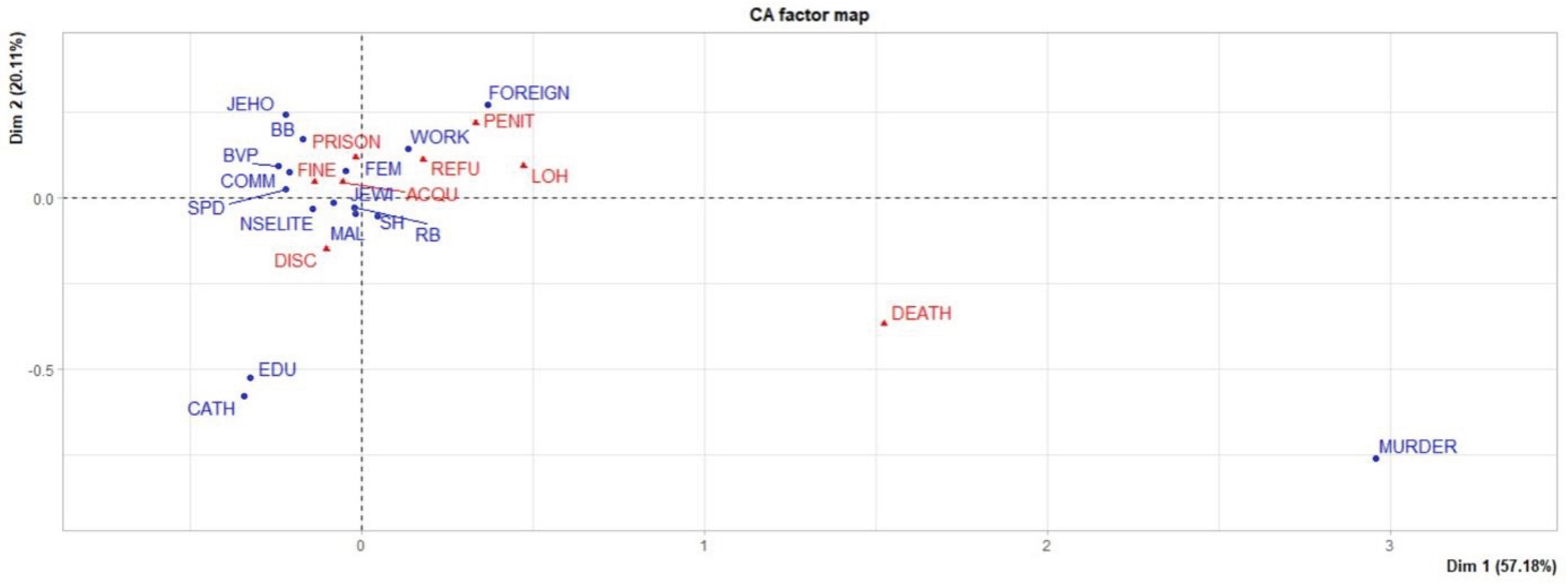
As an exploratory geometric technique, CA does not establish causal relationships but reveals systematic associations by positioning categories according to their statistical co-occurrence. Categories located in proximity are more strongly associated, while distance from the origin indicates greater discriminatory contribution to the structure of the dataset.
The first dimension (Dim. 1 = 57.18%) captures the dominant axis of differentiation and appears to separate conventional criminal charges from politically and socially structured sentencing patterns. The second dimension (Dim. 2 = 20.11%) introduces a secondary axis related to social status and institutional alignment, though with weaker explanatory power.
The figure shows that the most severe punishments–particularly death sentences (DEATH) and penitentiary terms (PENIT)–are positioned far from the origin, indicating strong discriminatory weight. The DEATH category is clearly isolated from most other sentencing outcomes, suggesting that capital punishment was structurally associated with a relatively narrow and distinct subset of cases rather than broadly distributed across offence types. The variable MURDER appears as a strong outlier on the far right of Dimension 1, confirming that homicide-related charges formed a statistically distinct category. Its distance from most socio-cultural markers indicates that, unlike politically or socially mediated offences, these cases were primarily structured by the nature of the criminal charge itself. At the same time, the relative proximity of DEATH to this region suggests a strong–but not exclusive–association between capital punishment and severe violent crime.
More complex patterns emerge in the central-left region of the map, where most socio-cultural indicators are located. Categories representing political opposition and religious nonconformity–including Communists (COMM), Social Democrats (SPD), and Jehovah’s Witnesses (JEHO)–cluster in relative proximity to custodial punishments such as PRISON and, to a lesser degree FINE, indicating a structural relationship between ideological deviance and judicial sanctioning, though typically not at the extreme end of punishment severity.
A distinct configuration appears around the category FOREIGN, which lies closer to PENIT and the region of harsher sentencing. This spatial relation suggests that foreign defendants were more frequently associated with severe custodial punishments. The additional proximity of WORK indicates that most foreign defendants belonged to the labouring population, forming a socio-economically and legally differentiated group within the dataset.
This pattern is consistent with the known hierarchical structuring of legal repression in the National Socialist system, where nationality and perceived racial status shaped judicial outcomes. The map does not directly display nationality subcategories, but the positioning of FOREIGN relative to severe punishments supports the interpretation that foreign defendants were disproportionately exposed to harsher sentencing regimes.
The correspondence structure also reflects the southern Bavarian social landscape. The category CATH is in a relatively distinct position along Dimension 2, suggesting a moderate but identifiable association with specific judicial patterns. While not strongly connected to the most severe punishments, its separation from the central cluster indicates that Catholic affiliation formed a socially meaningful category within the special court’s prosecutorial environment. This observation is compatible with historiographical accounts describing tensions between Catholic social milieus and National Socialist authority, though the statistical evidence suggests differentiation rather than uniform repression.
Jehovah’s Witnesses (JEHO), by contrast, appear positioned closer to custodial punishments, reflecting their well-documented status as a persecuted religious minority subjected to systematic legal repression.
Taken together, the correspondence analysis suggests that sentencing patterns were shaped not only by the type of offence but also by overlapping socio-cultural factors. Political opposition, religious dissent, nationality, and social status intersected to produce differentiated patterns of judicial treatment.
While correspondence analysis cannot establish direct causal mechanisms, the relational geometry of the dataset indicates that social categorisation played a meaningful role in shaping judicial outcomes. The findings therefore support the interpretation of the court as both a penal institution and a mechanism of socio-political control embedded within the broader hierarchy of National Socialist rule.
Figure 6.
Interactive MCA on the individual proceedings of the Munich Special Court
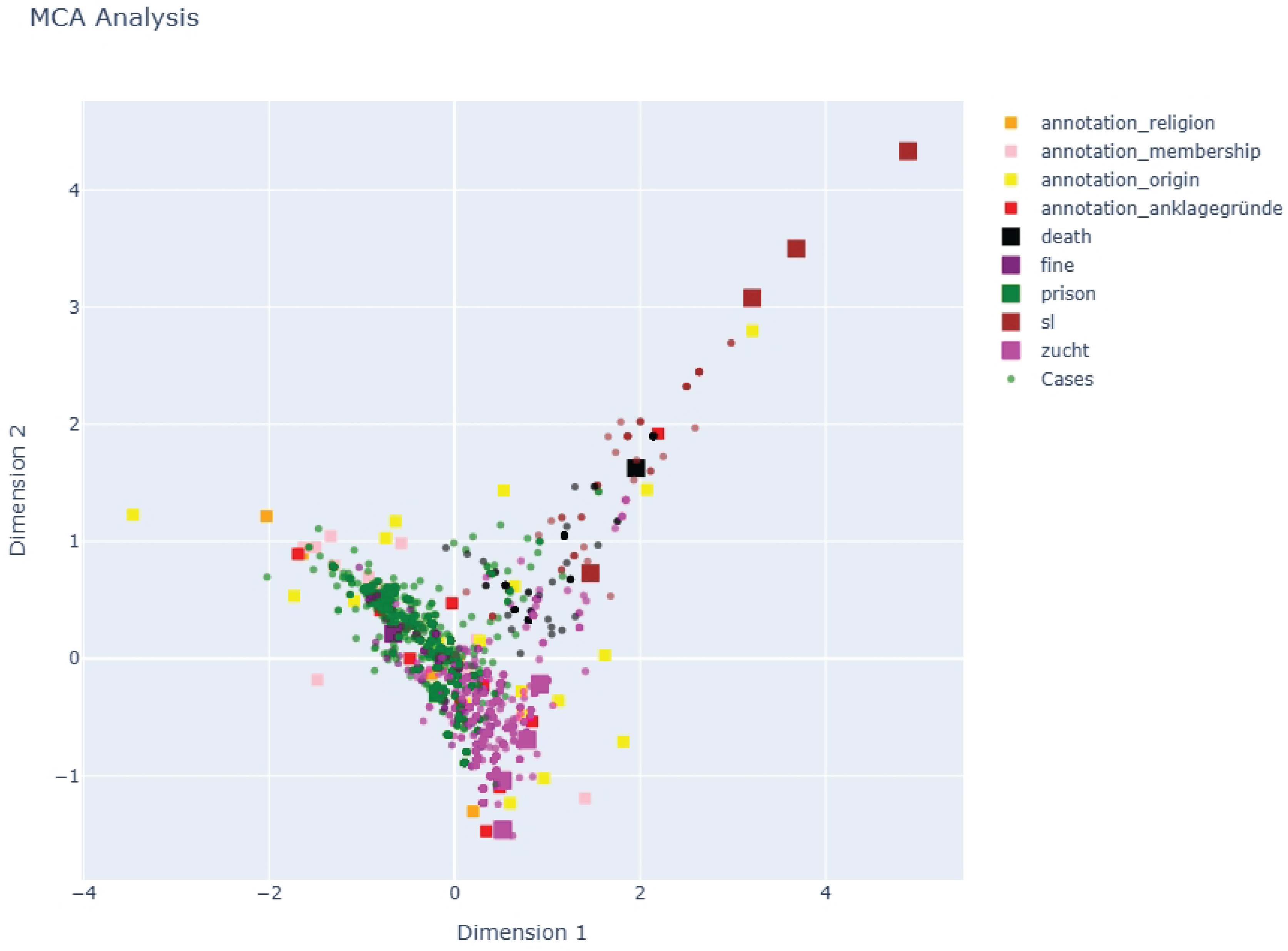
Figure 7.
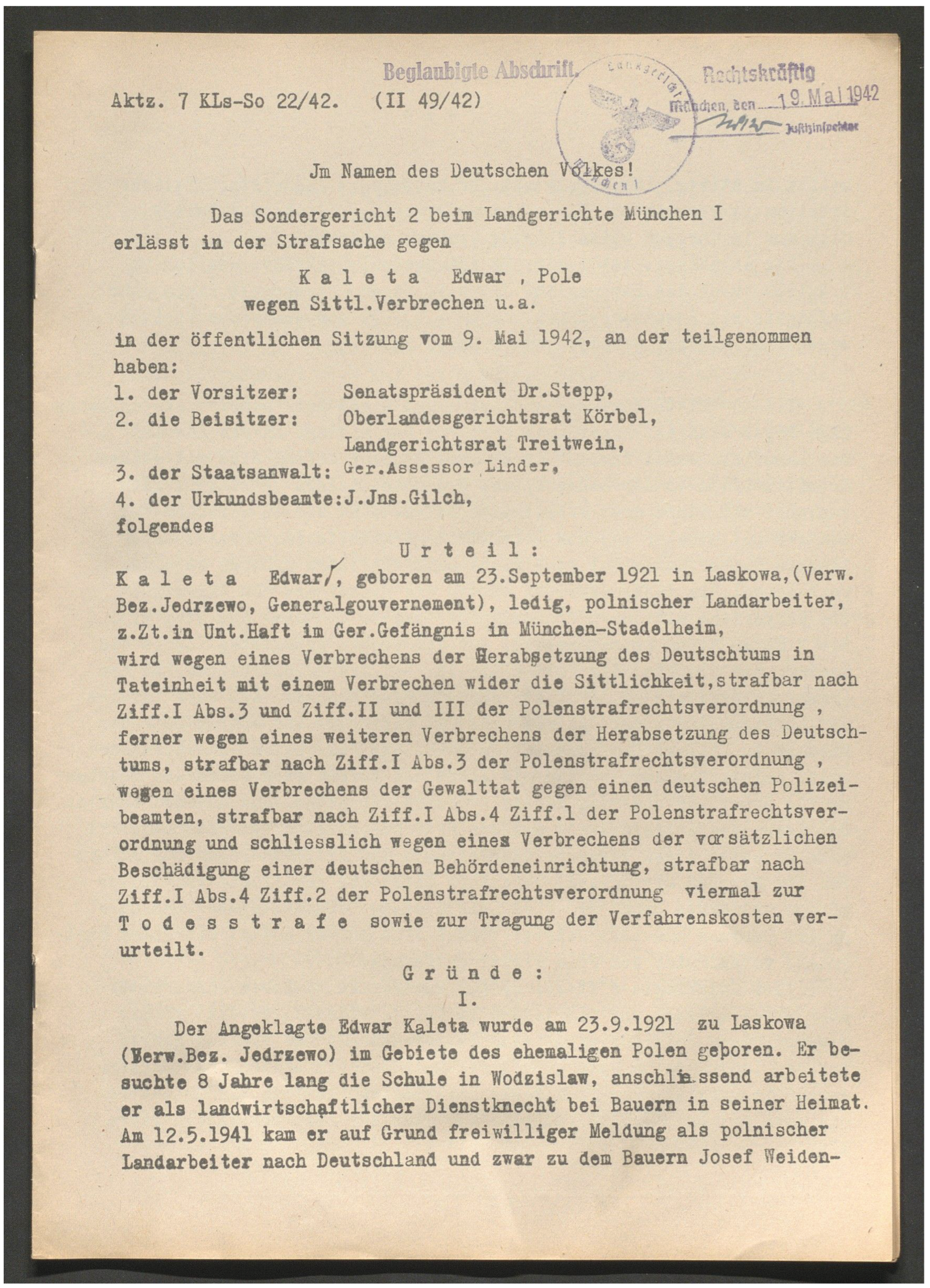
The Munich Special Court’s Quadruple death sentence against underaged Edward Kaleta, a Polish farmhand who had been taken to Etting in the Ingolstadt district of Upper Bavaria for forced labor; State Archives of Munich, Staatsanwaltschaften 11181.
Figure 7.
The Munich Special Court’s Quadruple death sentence against underaged Edward Kaleta, a Polish farmhand who had been taken to Etting in the Ingolstadt district of Upper Bavaria for forced labor; State Archives of Munich, Staatsanwaltschaften 11181.
6. Giving the Victims Back Their Names: The Ideologically Driven NS Repression and Murder of Eduard Wojcik (1918–1942) and Edward Kaleta (1921–1942); Exemplary Close-Reading-Approaches to Munich Special Court
In terms of the central role played by concepts such as race and biological approaches (“nature”, “blood”, “honor”) in the National Socialist understanding of “law” (see above, Chapter 2), it seems to be logical that the Special Court punished “offenses” that, in the perception of Nazi ideology, ‘damaged’ the racially “pure” Germanic people (“gesunder deutscher Volkskörper”), were punished particularly harshly–especially if the “perpetrators” were, according to these concepts, outside the German “people’s community” (“Volksgemeinschaft”) from the outset, and even more so if the perpetrators had sociocultural backgrounds that were considered biologically inferior in Nazi ideology, such as Poles and Jews.97
Of all the cases heard before the Munich Special Court and recorded in the “Archive Inventory” in the 1970s, three seem to be of special interest for a detailed reading of the original court files. This should supplement and complete the macroscopic investigations carried out in this article. These three cases lead us directly to the biologism described above, to racism and sexuality. They concern contacts between members of peoples who were considered inferior in Nazi ideology and therefore undesirable to the Nazi regime, and the epitome of the transmission of “pure” “German blood,” i.e., women of childbearing age. All three cases also exemplify the complexity of victim and perpetrator roles in National Socialism, as recently emphasized by Götz Aly in his magnum opus published in 2025.98
It is obvious how much a process such as any kind of relationship between foreign “guest workers” in Germany and German women, especially sexual relationships, and especially when the husbands of the women concerned were at war, fighting on the front lines, must have shocked the National Socialists’ view of society, women, and the world. Here, inhuman ideology and practice (namely, the exploitation of millions of foreign workers for the purposes of the German war economy) collided with human nature. This phenomenon, which occurred frequently in historical reality, has also been well researched and presented from a regional historical perspective.99
Among the relevant proceedings before the Munich Special Court, two cases stand out when reading the archive inventory because they illustrate in a very special way the perversion and ideology-driven configuration of regular criminal law described in chapter 3 of this article, which was taken to extremes in these cases. Two young Polish “farm workers” accused of “attempted rape” and “indecent exposure” were not only sentenced to death by the Munich Special Court but received multiple death sentences. Eduard Wojcik, then 24 years old, from Przededworze in Poland, a forced laborer in Wartenberg in the Upper Bavarian Landkreis of Erding, was sentenced to death three times and executed in April 1942.100 And in April 1942, 20-year-old Edward Kaleta from Laskowa, who was still a minor under the law at the time, working as a “farm laborer” in Etting in the former Landkreis of Ingolstadt (incorporated into the city of Ingolstadt in 1972), was “sentenced to death four times”, „viermal zur Todesstrafe verurteilt” (cf. Figure 9).101
These very young Polish forced laborers, who worked as agricultural assistants, had physical contact with German women in a way that cannot be clearly clarified solely based on the information contained in the Nazi court files (see below). The situation appears to be more complex than Wojcik and Kaleta being solely victims of the special court; in Kaleta’s case, for example, he had already been convicted twice by his homeland, before the German Reich invaded the Republic of Poland in September 1939.102 In Wojcik’s case, his behavior toward women would probably be considered unacceptable and punishable by law even by today’s standards, not just after “#MeToo”–his sexual advances were directed at Catholic nuns.–But the punitive fury with which the two young Poles were judged by the Munich Special Court, namely with triple and quadruple death sentences, specifically one death sentence for each of the individual offenses they were accused of–i.e., for each attempt by the Poles to approach a “German maiden” (“deutsches Mädchen”) that was recognized as true by the Special Court–is unparalleled in modern criminal law history; at least, we have not read anything similar in sources and literature from or about the Nazi era. This is such an extraordinary incident that one has to resort to downright archaic analogies, such as the “sevenfold beheaded woman”103 or, in more recent history, the “Beast of Rostov,” Andrei R. Chikatilo (1936–1994), who received three death sentences in 1992 solely because he had committed his crimes between 1978 and 1990 in the territory of three different republics of the Soviet Union that had become sovereign states at the time of his convictions: Russia, Ukraine, and Uzbekistan. Compared to the at least 53 murders committed by Chikalito, the crimes for which the Munich Special Court sentenced Edward Kaleta and Edward Wojcik to multiple death penalties in 1942 were less brutal–without excusing them, they were certainly brutal in terms of Nazi ideology.
The trial against Eduard Wojcik is particularly revealing in this regard. His case shows the full complexity of the reality of war. The unmarried Pole had been an unskilled worker on his parents’ small farm in the Kielce district of the “General Government”. He had only attended elementary school for four years and had no other education. In 1938, before the German Reich invaded and conquered Poland, he had already worked for several months “in Germany on a large estate in Saxony near Meissen as an agricultural worker”104. The verdict of the Munich Special Court for Nazi Crimes states: “At the beginning of April 1940, the defendant voluntarily reported to Germany as a farm worker. He arrived in Moosburg on collective transport and was assigned by the local employment office on April 6, 1940, as a farm worker to the approximately 80-acre agricultural estate in Wartenberg (Erding district) belonging to the Franciscan Order’s mother house in Mallersdorf. Since then, the defendant had been employed in agriculture for a monthly wage of 40 RM [Reichsmark] and free accommodation.”105
How “voluntary” Wojcik’s report really was must certainly be called into question. And the young Pole’s place of employment makes it clear that the Roman Catholic Church, in this case even a convent of a mendicant order, also profited from the exploitation of millions of European “foreign workers” by the Nazi state during the World War II. In this case, it was the “St. Josef’s Anstalt” in the idyllic Upper Bavarian market village (Marktgemeinde) of Wartenberg run by the “Poor Franciscan Sisters of the Holy Family of Mallersdorf,” which was founded in 1885 primarily around the children’s home that still exists today; the convent and children’s home still exist today.106 This highlights the complexity of the role played and suffered by the Roman Catholic Church in the Nazi state, whose systematic persecution by the regime was implemented not least through the Special Courts (cf. the disproportionately high representation of clergy before the special courts in the occupational classification of the defendants in Chapter 4.b), and equally so the fact that it was the Mother Superior of St. Joseph’s Institution who went to the mayor of Wartenberg on 27 February 1942 to report that Wojcik had tried to force 27-year-old servant Anna Fruth to perform sexual acts once and 30-year-old nun Pilingatis Gassner twice a few days earlier (cf. Appendix B). The Mother Superior of the Wartenberg Franciscan monastery, precisely because of the Catholic experience of being persecuted by the Nazi regime, must have been aware of the consequences that reporting the Polish foreign worker to the authorities of the National Socialist regime would have. Especially since the Franciscan nun also told the mayor in her report that another of her sisters, Sighilla Kammerloher, was apparently having some kind of romantic relationship with the Polish foreign worker, which resulted in the local gendarmerie arresting not only Wojcik, but also Sister Sighilla “on suspicion of continued forbidden contact with a Polish farm worker.”107
The triple death sentence against Eduard Wojcik on April 21, 1942 was handed down by “Presiding Judge Braun, Senate President of the Munich I Regional Court.”108 According to Blumberg-Ebel109, and Materna110, he can be identified as Adolf Braun, born in 1878, a “long-serving Bavarian judicial officer”, who had taken over the chairmanship of the Munich Special Court in 1933 and continued to hold this chairmanship even after his promotion to Senate President, which was actually due to his exceeding the regular age limit under civil service law.111 The ideologically driven furor leading to a triple death sentence for the alleged sexual assault by a 24-year-old uneducated farmhand was not handed down by a fanatical, ambitious career prosecutor, but by a 64-aged highly established top legal professional, who had been socialized during the time of the Kingdom of Bavaria and held in 1942 one of the highest judicial positions in the regular Bavarian justice system.112 This high hierarchical position of a perpetrator applies even more to the judge who, in the same spring of 1942, was responsible for the quadruple death sentence against the underage Polish foreign worker Edward Kaleta (cf. Figure 7) at the Munich Special Court, “Senate President Dr. Stepp”. He can be identified with Walther Stepp (1898–1972), who was 20 years younger than Adolf Braun. Stepp was the son of a Protestant pastor from the then Bavarian Palatinate, and a graduate of a “Humanistisches Gymnasium”,113 front-line soldier in World War I114. Unlike Adolf Braun, Stepp was “one of the ‘career lawyers’ between 1933 and 1945 who had already been National Socialists before 1933. He pursued a dual career as a judicial officer, member of the SS, and ‘Reinhard Heydrich’s man in Munich’.”115 In the same year that he handed down the quadruple death sentence for attempted sexual assault against “German girls” by an underage Polish “foreign labourer” in four cases, Stepp was appointed president of the Munich Higher Regional Court on the recommendation of the Reich Minister of Justice Otto Georg Thierack with “the corresponding approval of Martin Bormann,” the head of the NSDAP party office.116 „His exam grades did not qualify him for this position. The decisive factors for his advancement were his membership in the NSDAP, SA, and SS. With Stepp, a staunch National Socialist was appointed president of the Higher Regional Court.” Walther Stepp’s martial inauguration, attended by the leaders of Germany’s National Socialist judiciary and leading National Socialists in Bavaria, took place on February 12, 1943, in Munich’s Palace of Justice,117 which was also the headquarters of the Munich Special Court, exactly ten days before the People’s Court (“Volksgerichtshof”), presided over by Roland Freisler, was to sentence Hans and Sophie Scholl and Christoph Probst to death in this same building.
One need only quote the reasoning behind the quadruple death sentence handed down to Edward Kaleta to illustrate the racist blindness that led to it. Here, in a manner that aptly captures the very essence of the Nazi Special Courts, legal precision is coupled with ideological disregard for humanity:
"However, by committing each of these three offenses (§ 73 StGB), a crime under Section 3 I (3) last sentence of the Polish Criminal Law Regulation, according to which, among other things, Poles shall be punished with death[,] or in less serious cases with imprisonment, if their conduct disparages or damages the reputation or welfare of the German Reich or the German people. However, if, as in this case [p. 9 = p. 22 of the file], a Pole commits such a serious crime of attempted rape of a German girl in Germany, there can be no doubt that such an offense, which at the same time constitutes a breach of the special duty of obedience of Poles in Germany, is not only directed against the personal sexual honor of the girl directly affected by the act, but that this act also constitutes an attack on German legal peace and involves a disparagement and damage to the reputation and, at the same time, the welfare of the German Reich and the German people as a whole. The court is also convinced that the defendant was aware of these circumstances.”118
This case serves as a prime example of just how far Nazi ideology–shaped by racism and a biologically narrow view of humanity and the world–could go. Was Christianity–alongside and together with communism and Judaism–fundamentally and in accordance with a long-term plan to translate Nazi ideology into historical reality the main ideological opponent of National Socialism, as Roland Freisler, presiding judge of the People’s Court, noted in the trial of the resistance fighter Helmuth James Graf von Moltke (1907–1945), the most brilliant mind of the German resistance against Hitler119, prior to his sentencing to death: “Herr Graf, Christianity and we National Socialists have one thing in common, and only this one thing: we demand the whole person.”120 Moltke described Freisler’s statement in his farewell letter to his wife as the “the decisive statement of the hearing”121. During the Third Reich, it was particularly true, that “in the image of the enemy that the Catholic Church presented to the regime, monasteries occupied a central place.”122 However, if a Polish forced labourer touched a nun of German descent – who, according to Roman Catholic self-perception, was a ‘bride of Christ’ by virtue of her vows – she was no longer regarded by the Nazi regime as a member of one of the last potentially resistant organizations remaining in the country, but was now seen primarily as a ‘German girl’. This highlights the sheer absurdity of Nazi ideology, particularly as the whole incident took place at the time of the so-called ‘storming of the monastery’ “Klostersturm” by the Nazi government.
7. Conclusion
(i) In research on the Third Reich, it remains controversial to this day whether it is even possible to speak of a single National Socialist ideology; only recently, in his magnum opus published at the end of August 2025, the great historian Götz Aly “Wie konnte das geschehen? Deutschland 1933 bis 1945” (How Could This Happen? Germany 1933 to 1945), published at the end of August 2025: “It is misleading to still speak of ‘Nazi ideology’. There was no such thing. In fact, it was a series of changing political programs modified to suit the situation.”123 The institution of the Nazi Special Courts–illustrated here by the example of the Munich Special Court–paints a nuanced and, above all, more complex picture of Aly’s resolute denial of the historical existence of a ‘Nazi ideology’. On the one hand, these Special Courts highlight the deep contempt held by committed Nazis for the judiciary and the historically developed formal rule of law and its institutions. On the other hand, the Special Courts demonstrate, over more than 12 years of the ‘Third Reich’s’ rule, an extremely skilful exploitation and abuse of precisely this constitutional state and the separation of powers by lawyers who had become ideologically unhinged. The ‘state of emergency’ became the norm. Nazi Special Jurisdiction exemplifies in an exemplary manner in terms of institutional history, but first of all more fundamentally in terms of intellectual and ideological history, how approaches from the very highest intellectual elite in Germany influenced the changes to the established state institutions introduced in the course of the ‘seizure of power’ and how, on the other hand, the Nazi regime simultaneously made skilful use of these very institutions for its own establishment. Even though the Special Courts always maintained the formal legal framework–unlike in the case of the extermination of the Jews–the substance of the proceedings was by no means consistent with the actions of a liberal, democratic and enlightened constitutional state; rather, it was pure Nazi ideology that underpinned the outward form
Special courts did not hear cases involving minor offenses in accordance with Nazi ideology; rather, all “offenses” that were deemed “particularly serious” under the Nazis’ racial worldview were, as a rule, brought before special courts. As Hüttenberger noted in his study on the sentencing practices of the Munich Special Court up to 1939, relatively lenient sentences were handed down for criticism of the regime–provided the defendants were German “Volksgenossen”.124 How far-reaching this “leniency” towards homegrown compatriots was towards persecuted people showed Himmler’s notorious comment when it came to the question of how to select the forced sex workers in camp brothels, one of the most perverse, yet, in terms of ideology, thoroughly revealing inventions of the Nazi regime and the concentration camp system. Even on German women sent to a Concentration Camp he demanded from his SS, “we should therefore never have to reproach ourselves for having spoiled a person who can still be saved for the German people, even if we examine them very strictly”, even if this ideological claim was “not met” in practice.125 In contrast, the Special Court showed draconian severity towards ‘public order’ offences, such as sexual intercourse between ‘racially inferior’ persons and German women, or ‘interaction with prisoners of war’. In the case of ‘honour-related’ offences, however, German women were not spared either; indeed, they were punished even more severely than German men.
(ii) “Although all the files of the former Munich Special Court are available as evidence, the use of this extensive body of evidence goes beyond the scope of the claim”126 This is how the Munich K 187 Denazification Chamber described the situation on 15 February 1949, following the end of the Second World War, in the context of the proceedings against Adolf Braun, the former president of the Munich Special Court, who, among other things, had signed off on the triple death sentence against Eduard Wojcik on 21 April 1942, the collection of sources comprising the approximately 10,000 case files of the Munich Special Court, on which the present study is based.127
Drawing on the pre-digital cataloguing of these court records in the form of the ‘Archive Inventory’ from the 1970s, and with the aid of computational historical methods, we are now able to analyse the full scope and depth of the Munich Special Court’s activities. And this data-driven, computational and historical resumption can achieve even more, primarily from the perspective of the history of ideas and ideology. For the totalitarian nature of the Nazi regime, however (pseudo-)‘elitist’ the ideology behind it may have been, can only be fully understood if due recognition is given to how it permeated society as a whole, right down to the everyday lives of all people and into the lowest social strata, even in the smallest hamlets in the countryside. Expanded with such basic but relevant information the quantitative analysis of the Special Court cases could reach an even higher level: an essential new and indispensable contribution to the basic understanding of the Nazi dictatorship and how it utilised the judiciary for the purpose of establishing its own regime and enforcing its own ideology throughout society. Thus, making structures visible that would otherwise remain invisible – through computer-aided methods of big-data-driven research128.
Author Contributions
Conceptualization, Markus Gerstmeier and Malte Rehbein; methodology, Markus Gerstmeier, Malte Rehbein and Sebastian Gassner; software, Sebastian Gassner; validation, Sebastian Gassner, Markus Gerstmeier and Marlene Ernst; formal analysis, Markus Gerstmeier, Sebastian Gassner and Marlene Ernst; investigation, Markus Gerstmeier and Sebastian Gassner; resources, Markus Gerstmeier and Malte Rehbein; data curation, Sebastian Gassner, Markus Gerstmeier, Marlene Ernst and Malte Rehbein; writing—original draft preparation, Markus Gerstmeier, Sebastian Gassner, and Marlene Ernst; writing—review and editing, Markus Gerstmeier, Sebastian Gassner, and Marlene Ernst; visualization, Sebastian Gassner, Marlene Ernst and Markus Gerstmeier; supervision, Malte Rehbein; project administration, Malte Rehbein; funding acquisition, Malte Rehbein. All authors have read and agreed to the published version of the manuscript.
Funding
This research received no external funding.
Data Availability Statement
The data on which the study is based has been published in print (cf. Resistance and Persecution in Bavaria 1933-1945).
Acknowledgments
The authors would like to thank the Bavarian State Archives for their constructive cooperation, and in this case, Dr Christoph Bachmann (Bavarian Main State Archive, Munich) in particular.
Conflicts of Interest
The authors declare no conflicts of interest.
Appendix A
HISCO Statistics
Table A1.
Absolute and relative occupation counts by HISCO1 and HISCO2 categories, obtained by classifying occupation strings using the OccCANINE transformer model. Categories 0 through 4, see Table A2 for categories 5 through 9. Each HISCO1 category is further divided into HISCO2 categories.
Table A1.
Absolute and relative occupation counts by HISCO1 and HISCO2 categories, obtained by classifying occupation strings using the OccCANINE transformer model. Categories 0 through 4, see Table A2 for categories 5 through 9. Each HISCO1 category is further divided into HISCO2 categories.
| cat | label | abs | rel |
|---|---|---|---|
| 0_ | PROFESSIONAL, TECHNICAL AND RELATED WORKERS | 178 | 2.61% |
| 1 | Physical Scientists And Related Technicians | 7 | 0.10% |
| 2 | Architects, Engineers And Related Technicians | 60 | 0.88% |
| 3 | Architects, Engineers And Related Technicians | 38 | 0.56% |
| 4 | Aircraft And Ships’ Officers | 3 | 0.04% |
| 5 | Life Scientists And Related Technicians | 4 | 0.06% |
| 6 | Medical, Dental, Veterinary And Related Workers | 35 | 0.51% |
| 7 | Medical, Dental, Veterinary And Related Workers | 26 | 0.38% |
| 8 | Statisticians, Mathematicians, Systems Analysts And Related Technicians | 1 | 0.01% |
| 9 | Economists | 4 | 0.06% |
| 1_ | PROFESSIONAL, TECHNICAL AND RELATED WORKERS | 300 | 4.40% |
| 11 | Accountants | 7 | 0.10% |
| 12 | Jurists | 23 | 0.34% |
| 13 | Teachers | 42 | 0.62% |
| 14 | Workers In Religion | 146 | 2.14% |
| 15 | Authors, Journalists And Related Writers | 3 | 0.04% |
| 16 | Sculptors, Painters, Photographers And Related Creative Artists | 31 | 0.45% |
| 17 | Composers And Performing Artists | 38 | 0.56% |
| 18 | Athletes, Sportsmen And Related Workers | 1 | 0.01% |
| 19 | Professional, Technical And Related Workers Not Elsewhere Classified | 9 | 0.13% |
| 2_ | ADMINISTRATIVE AND MANAGERIAL WORKERS | 254 | 3.73% |
| 20 | Legislative Officials And Government Administrators | 16 | 0.23% |
| 21 | Managers | 157 | 2.30% |
| 22 | Supervisors, Foremen And Inspectors | 81 | 1.19% |
| 3_ | CLERICAL AND RELATED WORKERS | 519 | 7.61% |
| 30 | Clerical And Related Workers, Specialisation Unknown | 3 | 0.04% |
| 31 | Government Executive Officials | 23 | 0.34% |
| 32 | Stenographers, Typists And Card- And Tape-Punching Machine Operators | 20 | 0.29% |
| 33 | Bookkeepers, Cashiers And Related Workers | 106 | 1.55% |
| 34 | Computing Machine Operators | 0 | 0.00% |
| 36 | Transport Conductors | 22 | 0.32% |
| 37 | Mail Distribution Clerks | 159 | 2.33% |
| 38 | Telephone And Telegraph Operators | 0 | 0.00% |
| 39 | Clerical And Related Workers Not Elsewhere Classified | 186 | 2.73% |
| 4_ | SALES WORKERS | 495 | 7.26% |
| 41 | Working Proprietors (Wholesale And Retail Trade) | 344 | 5.05% |
| 42 | Buyers | 0 | 0.00% |
| 43 | Technical Salesmen, Commercial Travellers And Manufacturers Agents | 119 | 1.75% |
| 44 | Insurance, Real Estate, Securities And Business Services Salesmen And Auctioneers | 11 | 0.16% |
| 45 | Salesmen, Shop Assistants And Related Workers | 21 | 0.31% |
| 49 | Sales Workers Not Elsewhere Classified | 0 | 0.00% |
Table A2.
Absolute and relative occupation counts by HISCO1 and HISCO2 categories, obtained by classifying occupation strings using the OccCANINE transformer model. Categories 5 through 9, see Table A1 for categories 0 through 4. Each HISCO1 category is further divided into HISCO2 categories.
Table A2.
Absolute and relative occupation counts by HISCO1 and HISCO2 categories, obtained by classifying occupation strings using the OccCANINE transformer model. Categories 5 through 9, see Table A1 for categories 0 through 4. Each HISCO1 category is further divided into HISCO2 categories.
| cat | label | abs | rel |
|---|---|---|---|
| 5_ | SERVICE WORKERS | 725 | 10.63% |
| 51 | Working Proprietors (Catering, Lodging And Leisure Services) | 108 | 1.58% |
| 53 | Cooks, Waiters, Bartenders And Related Workers | 122 | 1.79% |
| 54 | Maids And Related Housekeeping Service Workers Not Elsewhere Classified | 328 | 4.81% |
| 55 | Building Caretakers, Charworkers, Cleaners And Related Workers | 18 | 0.26% |
| 56 | Launderers, Dry-Cleaners And Pressers | 11 | 0.16% |
| 57 | Hairdressers, Barbers, Beauticians And Related Workers | 45 | 0.66% |
| 58 | Protective Service Workers | 80 | 1.17% |
| 59 | Service Workers Not Elsewhere Classified | 13 | 0.19% |
| 6_ | AGRICULTURAL, ANIMAL HUSBANDRY AND FORESTRY WORKERS, FISHERMEN AND HUNTERS | 972 | 14.26% |
| 61 | Farmers | 788 | 11.56% |
| 62 | Agricultural And Animal Husbandry Workers | 154 | 2.26% |
| 63 | Forestry Workers | 26 | 0.38% |
| 64 | Fishermen, Hunters And Related Workers | 4 | 0.06% |
| 7_ | PRODUCTION AND RELATED WORKERS, TRANSPORT EQUIPMENT OPERATORS AND LABOURERS | 519 | 7.61% |
| 71 | Miners, Quarrymen, Well-Drillers And Related Workers | 15 | 0.22% |
| 72 | Metal Processors | 19 | 0.28% |
| 73 | Wood Preparation Workers And Paper Makers | 21 | 0.31% |
| 74 | Chemical Processors And Related Workers | 2 | 0.03% |
| 75 | Spinners, Weavers, Knitters, Dyers And Related Workers | 18 | 0.26% |
| 76 | Tanners, Fellmongers And Pelt Dressers | 5 | 0.07% |
| 77 | Food And Beverage Processors | 310 | 4.55% |
| 78 | Tobacco Preparers And Tobacco Product Makers | 2 | 0.03% |
| 79 | Tailors, Dressmakers, Sewers, Upholsterers And Related Workers | 127 | 1.86% |
| 8_ | PRODUCTION AND RELATED WORKERS, TRANSPORT EQUIPMENT OPERATORS AND LABOURERS | 811 | 11.89% |
| 80 | Shoemakers And Leather Goods Makers | 87 | 1.28% |
| 81 | Cabinetmakers And Related Woodworkers | 136 | 1.99% |
| 82 | Stone Cutters And Carvers | 2 | 0.03% |
| 83 | Blacksmiths, Toolmakers And Machine-Tool Operators | 108 | 1.58% |
| 84 | Machinery Fitters, Machine Assemblers And Precision-Instrument Makers | 186 | 2.73% |
| 85 | Electrical Fitters And Related Electrical And Electronics Workers | 54 | 0.79% |
| 86 | Broadcasting And Sound-Equipment Operators And Cinema Projectionists | 0 | 0.00% |
| 87 | Plumbers, Welders, Sheet-Metal, And Structural Metal Preparers And Erectors | 208 | 3.05% |
| 88 | Jewellers And Precious Metal Workers | 6 | 0.09% |
| 89 | Glass Formers, Potters And Related Workers | 24 | 0.35% |
| 9_ | PRODUCTION AND RELATED WORKERS, TRANSPORT EQUIPMENT OPERATORS AND LABOURERS | 1560 | 22.88% |
| 90 | Rubber And Plastics Product Makers | 2 | 0.03% |
| 91 | Paper And Paperboard Products Makers | 0 | 0.00% |
| 92 | Printers And Related Workers | 33 | 0.48% |
| 93 | Painters | 77 | 1.13% |
| 94 | Production And Related Workers Not Elsewhere Classified | 28 | 0.41% |
| 95 | Bricklayers, Carpenters And Other Construction Workers | 216 | 3.17% |
| 96 | Stationary Engine And Related Equipment Operators | 28 | 0.41% |
| 97 | Material Handling And Related Equipment Operators, Dockers And Freight Handlers | 65 | 0.95% |
| 98 | Transport Equipment Operators | 181 | 2.65% |
| 99 | Workers Not Elsewhere Classified | 930 | 13.64% |
Appendix B Excerpts from an original record of a trial before the Munich Special Court
StA München, Staatsanwaltschaften 10867
[Bl. 1 des Akts, verso] Gend[armerie]=Posten Wartenberg, Kreis Erding, Reg.=Bezirk Oberbayern, An das Amtsgericht Erding, Wartenberg, den 27. Februar 1942, Betrifft: Vorläufige Festnahme des led. polnischen Landarbeiters W o j c i k Vorname Eduard, zuletzt beschäftigt u. wohnhaft im landw. Gut der St. Josefs Anstalt Wartenberg, LK. Erding, wegen fortgesetzten Notzutversuchs u. a. und K a m m e r l o h e r Vorname Theresia – Schwester Sighilla vom Orden Franziskanerinnen, z. Zt. in Wartenberg, wegen dringenden Verdachts des fortgesetzten verbotenen Umgangs mit einem polnischen Landarbeiter. Tatort: Wartenberg, AG. Erding
[...]
M o h r Barbara, geb. 6.1.67, Oberin Hermas (Ordensname) von der Erziehungsanstalt St. Josefs Anstalt in Wartenberg [...] am 27.2.42 zur Sache gehört gab an: [...] Am 17.2.42 war die Anna F r u t h bei mir gewesen und hatte Beschwerde geführt, daß die im Gutshof beschäftigte und wohnhafte Schwester Sighilda den polnischen Landarbeiter W o j c i k ganz auffallend gut behandle. W o j c i k habe sie vor ca. 3 Wochen im Heustadel notzüchtigen wollen. Nur durch ernstliche Gegenwehr habe sie sich vom Wojcik frei machen können. Der Pole Wojcik erhalte [Bl. 1 verso] von der Schwester Sighilda mehr zu essen als sie und sie habe selbst die Beobachtung gemacht, daß die Schwester Sighilda gedulde, daß er längere Zeit bei ihr in der Küche verweile, während sie draußen arbeiten müßten. Sie habe ferner vor kurzer Zeit gesehen, daß Wojcik die Schwester Sighilda in der Speisestube zärtlich umhalst habe. Weiter habe sie die Schwester Sighilda gesehen, wie sie im Bett bei Wojcik gelegen sei.
[...]
Am 19.2.42 habe ihr die in der Erziehungsanstalt beschäftigte sogen. Gartenschwester Pilingatis gemeldet, daß sie am 16.2. und 18.2.42 während der Arbeit von dem Polen W o j c i k zu vergewaltigen versucht worden sei. Da dem Treiben des Wojcik länger nicht mehr zuzusehen sei, habe sie die Sache dem Bürgermeister [Ferdinand] Reiter von Wartenberg gemeldet.“
Sentence, page 8: „Der Angeklagte hat sich somit dreier sachlich zusammentreffender Verbrechen des Versuches eines Verbrechens der Notzucht nach §§ 177, 43, 44, 74 StGB. schuldig gemacht. Diese Verbrechen sind hierbei jeweils nach Ziffer II und III der auf den Angeklagten anwendbaren Polenstrafrechts-VO v. 4.12.1941 strafbar.
2.) Der Angeklagte hat sich aber zugleich durch jede dieser 3 Straftaten (§ 73 StGB.) eines Verbrechens nach 3 I Abs. 3 letzter Satzteil der Polenstrafrechts-VO schuldig gemacht, wonach u.a. Polen mit dem Tode[,] in minder schweren Fällen mit Freiheitsstrafe bestraft werden, wenn sie durch ihr Verhalten das Ansehen oder Wohl des Deutschen Reiches oder des deutschen Volkes herabsetzen oder schädigen. Wenn aber, wie hier, [S. 9 = S. 22 des Akts] ein Pole in Deutschland ein so schweres Verbrechen der versuchten Notzucht an einem deutschen Mädchen begeht, so kann es nicht zweifelhaft sein, dass sich eine solche Straftat, die zugleich eine Verfehlung gegen die besondere Gehorsamspflicht der Polen in Deutschland darstellt, nicht bloss gegen die persönliche Geschlechtsehre des von der Handlung unmittelbar betroffenen Mädchens richtet, sondern dass diese Tat zugleich ein Angriff gegen den deutschen Rechtsfrieden ist und eine Herabsetzung und Schädigung des Ansehens und zugleich des Wohles des Deutschen Reiches und des deutschen Volkes in ihrer Gesamtheit in sich schliesst. Der Angeklagte war sich auch nach Überzeugung des Gerichts dieser Tatumstände bewusst.“
References
- Aly, Götz. Wie konnte das geschehen? Deutschland 1933 bis 1945; S. Fischer: Frankfurt am Main, 2025. [Google Scholar]
- Ambos, Kai. Nationalsozialistisches Strafrecht: Kontinuität und Radikalisierung. In Grundlagen des Strafrechts 6; Nomos: Baden-Baden, 2019. [Google Scholar]
- Anschütz, Gerhard. Die Verfassung des Deutschen Reichs vom 11. August 1919: Ein Kommentar für Wissenschaft und Praxis, 3rd ed.; Stilke: Berlin, 1930. [Google Scholar]
- Bauer, Franz J. "Volksgerichte. 2006. Available online: https://www.historisches-lexikon-bayerns.de/Lexikon/Volksgerichte,_1918-1924 (accessed on 5 February 2025).
- Bauer, Franz J.; Schmitt, Eduard. Die bayerischen Volksgerichte: 1918-1924. Das Problem ihrer Vereinbarkeit mit der Weimarer Reichsverfassung. Z. Für Bayer. Landesgesch. 1985, 48, 449–478. [Google Scholar]
- Blumberg-Ebel, Anna. Sondergerichtsbarkeit und »politischer Katholizismus« im Dritten Reich; Mainz, 1990. [Google Scholar]
- Bracher, Karl Dietrich. "Stufen der Machtergreifung." In Die nationalsozialistische Machtergreifung: Studien zur Errichtung des totalitären Herrschaftssystems in Deutschland 1933/34; Bracher, Karl Dietrich, Sauer, Wolfgang, Schulz, Gerhard, Eds.; Westdeutscher Verlag: Cologne, 1960; pp. 31–368. [Google Scholar]
- Breuel, Thomas M. "The hOCR Microformat for OCR Workflow and Results. In Proceedings of the Ninth International Conference on Document Analysis and Recognition (ICDAR 2007); IEEE: Paraná, 2007; Volume 2, pp. 1063–1067. [Google Scholar]
- Broszat, Martin. "Dokumentation: Zur Perversion der Strafjustiz im Dritten Reich. Vierteljahrsh. Für Zeitgesch. 1958, 6(no. 4), 390–443. [Google Scholar]
- Bundeskriminalamt. "Anzahl der Straftatverdächtigen bei Mord in Deutschland nach Geschlecht von 2014 bis 2024." Polizeiliche Kriminalstatistik (PKS) 2024 - Zeitreihen - Tatverdächtige männlich / Tatverdächtige weiblich. 2025. Available online: https://de.statista.com/statistik/daten/studie/1391070/umfrage/tatverdaechtige-bei-mord-in-deutschland/ (accessed on 27 February 2026).
- Chapoutot, Johann. Le meurtre de Weimar; Presses Universitaires de France: Paris, 2015. [Google Scholar]
- Chapoutot, Johann. La loi du sang: Penser et agir en nazi Das Gesetz des Blutes: Von der NS-Weltanschauung zum Vernichtungskrieg, German version; Gallimard: Paris; Philipp von Zabern: Mainz, 2014. [Google Scholar]
- Dahl, Christian Møller; Jansen, Torben; Vedel, Christian. "Breaking the HISCO Barrier: Automatic Occupational Standardization with OccCANINE." Submitted on February 21, 2024. arXiv. 2024. Available online: https://arxiv.org/abs/2402.13604 (accessed on Day Month Year).
- Montesquieu, Charles de Secondat; Baron de. De l’esprit des loix, ou du rapport que les loix doivent avoir avec la Constitution de chaque Gouvernement, les Mœurs, le Climat, la Religion, le Commerce, &c., Tome I; PUBLISHER>: Geneva, 1748. [Google Scholar]
- Deutschland in Daten: Zeitreihen zur Historischen Statistik; Rahlf, Thomas, Ed.; Bundeszentrale für politische Bildung: Bonn, 2022. [Google Scholar]
- Dörrenbächer, Simon. NS-Strafjustiz an der Saar: Nationalsozialistisches Strafrecht in der Rechtsprechung des Sondergerichts Saarbrücken 1939 bis 1945; Metropol: Berlin, 2023; pp. 28–33. [Google Scholar]
- Donig, Simon; Rehbein, Malte. Für eine ’gemeinsame digitale Zukunft’: Eine kritische Verortung der Digital History. Gesch. Wiss. Und Unterr. 2022, 73(no. 9/10), 527–545. [Google Scholar]
- Dreizehnte Verordnung zum Reichsbürgergesetzbuch. Vom 1. Juli 1943." 1943. Reichsgesetzblatt Jahrgang 1943, Teil I, 372.
- Dritte Verordnung zur Sicherung von Wirtschaft und Finanzen und zur Bekämpfung politischer Ausschreitungen. Vom 6. Oktober 1931." 1931. Reichsgesetzblatt Jahrgang 1931, Teil I, 537.
- Grundgesetz-Kommentar. In Lieferung; Dürig, Günter, Herzog, Roman, Scholz, Rupert, Jachmann-Michel, Monika, Eds.; C.H. Beck: Munich, 2023; p. 84. [Google Scholar]
- Eichmüller, Andreas. "Oberstes Parteigericht der NSDAP." In nsdoku.lexikon. edited by NS-Dokumentationszentrum München. 2024. Available online: https://www.nsdoku.de/lexikon/artikel/oberstes-parteigericht-der-nsdap-626 (accessed on 11 April 2025).
- Ernst, Marlene; Gassner, Sebastian; Gerstmeier, Markus; Rehbein, Malte. "Categorising Legal Records – Deductive, Pragmatic, and Computational Strategies. DHQ Digit. Humanit. Q. 2023, 17(no. 3). Available online: http://www.digitalhumanities.org/dhq/vol/17/3/000708/000708.html (accessed on 9 February 2026). [CrossRef]
- Fraenkel, Ernst. The Dual State: A Contribution to the Theory of Dictatorship; Shils, E. A., Translator; Oxford University Press: New York, N.Y., 1941. [Google Scholar]
- Garbe, Detlef. Zwischen Widerstand und Martyrium: Die Zeugen Jehovas im "Dritten Reich", 4th ed.; C.H. Beck: Munich, 1999. [Google Scholar]
- General Directorate of the Archives of the Bavarian. Resistance and Persecution in Bavaria 1933-1945: Resources, Archive Inventories. In Munich Special Court; PUBLISHER>: Munich/Regensburg, 77 1975; Vol. 3. [Google Scholar]
- Geerling, Wayne; Magee, Gary. Quantifying Resistance: Political Crime and the People’s Court in Nazi Germany; Springer: Singapore, 2017. [Google Scholar]
- Gerstmeier, Markus; Ernst, Marlene. Forthcoming. "Ideologically Based Organization of Regular Penal Justice During the ’Third Reich’: A Computational Historical Macroscope on the Munich Sondergericht. In Handbook Ideologies in National Socialism; von Reitzenstein, Julien, O’Byrne, Darren, Eds.; :; vol. 2, p. art. 59.
- Gerstmeier, Markus; Donig, Simon; Gassner, Sebastian; Rehbein, Malte. "Die Archivinventare zum Sondergericht München (1933–1945) digital: Quellenwert – Verdatung – Erkenntnisperspektiven. In Archivalische Zeitschrift; Böhlau: Vienna/Cologne, 2022; Volume 99, pp. 215–251. [Google Scholar]
- Glunz, Josef. Die Stellung der Sondergerichte in der Strafrechtspflege. PhD diss., Rheinische Friedrich-Wilhelms-Universität Bonn, Essen, 1940. [Google Scholar]
- Graf von Moltke, Helmuth James. Im Land der Gottlosen: Tagebuch und Briefe aus der Haft., 2nd ed.; Brakelmann, Günter, Ed.; C.H. Beck: Munich, 2009. [Google Scholar]
- Gritschneder, Otto. Der Hitler-Prozeß und sein Richter Georg Neithardt: Skandalurteil von 1924 ebnet Hitler den Weg; C.H. Beck: Munich, 2001; pp. 77–79. [Google Scholar]
- Der Hitler-Prozeß 1924; Gritschneder, Otto, Gruchmann, Lothar, Weber, Reinhard, Eds.; Oldenbourg: Munich, 1997-1999; 4 vols. [Google Scholar]
- Gruchmann, Lothar. Justiz im Dritten Reich 1933-1940: Anpassung und Unterwerfung in der Ära Gürtner, 3rd ed.; Oldenbourg: Munich, 2001. [Google Scholar]
- Gruchmann, Lothar. "Gürtner, Franz.". In Neue Deutsche Biographie, edited by Historische Kommission bei der Bayerischen Akademie der Wissenschaften; Duncker & Humblot: Berlin, 1966; Volume 7, pp. 288–289. [Google Scholar]
- Haaf, Tobias. "Sondergerichte (1933-1945)." Historisches Lexikon Bayerns. February 23, 2023. 2023. Available online: https://www.historisches-lexikon-bayerns.de/Lexikon/Sondergerichte_(1933-1945) (accessed on 5 February 2025).
- Haaf, Tobias. Von volksverhetzenden Pfaffen und falschen Propheten: Klerus und Kirchenvolk im Bistum Würzburg in der Auseinandersetzung mit dem Nationalsozialismus; Echter: Würzburg, 2005. [Google Scholar]
- Haase, Lena. Strafverfolgungspraxis im Schein-Rechtsstaat des »Dritten Reiches«: Zur Zusammenarbeit von Justiz- und Polizeibehörden unter nationalsozialistischer Herrschaft; Böhlau: Cologne, 2023. [Google Scholar]
- Haffner, Sebastian. Geschichte eines Deutschen: Die Erinnerungen 1914–1933. Als Engländer maskiert. Ein Gespräch mit Jutta Krug über das Exil; Deutsche Verlags-Anstalt: Munich, 2006. [Google Scholar]
- Halbmayr, Brigitte. "Sexualisierte Gewalt gegen Frauen während der NS-Verfolgung." In Nationalsozialismus und Geschlecht: Zur Politisierung und Ästhetisierung von Körper, »Rasse« und Sexualität im »Dritten Reich« und nach 1945; Fretsch, Elke, Herkommer, Christina, Eds.; transcript: Bielefeld, 2009; pp. 141–155. [Google Scholar]
- Hartmann, Angela. "Stepp, Walther." In nsdoku.lexikon. edited by Munich Documentation Center for the History of National Socialism. 2025. Available online: https://www.nsdoku.de/lexikon/artikel/stepp-walther-805 (accessed on 21 February 2026).
- Heusler, Andreas. "Ausbeutung und Disziplinierung: Zur Rolle des Münchner Sondergerichts und der Stapoleitstelle München im Kontext der nationalsozialistischen Fremdarbeiterpolitik." forum historiae iuris. January 15, 1998. 1998. Available online: https://forhistiur.net1998-01-heusler (accessed on 7 February 2025).
- Hitler, Mein Kampf: Eine kritische Edition. 2 vols; Elaborated from the first edition of "Mein Kampf" (1925/27); Hartmann, Christian, Vordermayer, Thomas, Plöckinger, Othmar, Töppel, Roman, Eds.; Institut für Zeitgeschichte: Munich/Berlin, 2016. [Google Scholar]
- Höhn, Reinhard. Rechtsgemeinschaft und Volksgemeinschaft; Hanseatische Verlagsanstalt: Hamburg, 1935. [Google Scholar]
- Hüttenberger, Peter. "Heimtückefälle vor dem Sondergericht München 1933-1939." In Bayern in der NS-Zeit. In Herrschaft und Gesellschaft im Konflikt, part C, edited by Martin Broszat, Elke Fröhlich, and Anton Grossmann, [PAGE RANGE]; Oldenbourg: Munich/Vienna, 1981; vol. 4. [Google Scholar]
- Ingrao, Christian. Croire et détruire: Les intellectuels dans la machine de guerre SS. In Hitlers Elite: Die Wegbereiter des nationalsozialistischen Massenmords; Perrin. German edition: Paris; Propyläen: Berlin, 2010. [Google Scholar]
- Irmen, Helmut. "Das Sondergericht Aachen 1941-1945 PAGE RANGE. In Juristische Zeitgeschichte; De Gruyter: Berlin/Boston, 2018; no. 21, p. 2. [Google Scholar]
- Jenß, Johannes. Die «Volksgemeinschaft» als Rechtsbegriff: Die Staatsrechtslehre Reinhard Höhns (1904-2000) im Nationalsozialismus; Klostermann: Frankfurt am Main, 2018. [Google Scholar]
- Johe, Werner. Die gleichgeschaltete Justiz: Organisation des Rechtswesens und Politisierung der Rechtsprechung 1933-1945 am Beispiel des Oberlandesgerichtsbezirks Hamburg; Europäische Verlagsanstalt: Frankfurt am Main, 1967; pp. 172–175. [Google Scholar]
- Kalmbach, Peter Lutz. "Das System der NS-Sondergerichtsbarkeiten. Krit. Justiz 2017, 50(no. 2), 226–235. [Google Scholar] [CrossRef]
- Kay, Anthony. "Tesseract: An Open-Source Optical Character Recognition Engine. Linux J. 2007, no. 159 (July), 2. Available online: https://dl.acm.org/doi/10.5555/1288165.1288167 (accessed on [Day Month Year]).
- Keil, Norbert. "Priester und Ordensleute vor dem Sondergericht München." In Das Erzbistum München und Freising in der Zeit der nationalsozialistischen Herrschaft; Schwaiger, Georg, Ed.; Schnell & Steiner: Munich/Zurich, 1984; Volume 1, pp. 489–580. [Google Scholar]
- Kerscher, William. "Sonderrecht und Sondergerichte im jungen Freistaat Bayern: Die Volksgerichte im Landgerichtsbezirk Eichstätt und das Strafrecht des Ausnahmezustandes im Krisenjahr 1923. Rechtskultur 2023, 11, 57–132. [Google Scholar] [CrossRef] [PubMed]
- Heigl; Kinderheim St. Josef; Wartenberg; edited by Sr. Edwolda. Hundert Jahre Kinderheim St. Josef Wartenberg, Obb. 1885-1985; Feldenkirchen, 1985. [Google Scholar]
- Kluke, Paul. "Der Fall Potempa.". In Vierteljahrshefte für Zeitgeschichte; Oldenbourg: Munich, 1957; Volume 5, pp. 279–297. [Google Scholar]
- Kohl, Christiane. "The Maiden and the Jew: The Story of a Fatal Friendship in Nazi Germany. In Mazal Holocaust Collection; University Press of New England: Hanover, N.H., 2004. [Google Scholar]
- Lahusen, Benjamin. Der Dienstbetrieb ist nicht gestört: Die Deutschen und ihre Justiz 1943-1948; C.H. Beck: Munich; Bundeszentrale für politische Bildung: Bonn, 2022/2023. [Google Scholar]
- Large, David Clay. Where Ghosts Walked: Munich’s Road to the Third Reich. In Hitlers München: Aufstieg und Fall der Hauptstadt der Bewegung; German edition; Norton: New York; C.H. Beck: Munich, 1997. [Google Scholar]
- Löffler, Bernhard. Das Land der Bayern: Geschichte und Geschichten von 1800 bis heute; C.H. Beck: Munich, 2024. [Google Scholar]
- Longerich, Peter; Staas, Christian. "Alles überzeugte Nazis? Nein, schreibt der Historiker Peter Longerich in seinem neuen Buch »Unwillige Volksgenossen«: Das NS-Regime habe nie die Mehrheit der Deutschen hinter sich gehabt. Sein Kollege Frank Bajohr widerspricht." Interview by Christian Staas and Frank Werner. In Die Zeit; Zeitverlag: Hamburg, 10 April 2025; Volume N° 15, p. 39. [Google Scholar]
- Ludyga, Hannes. Das Oberlandesgericht München zwischen 1933 und 1945; De Gruyter: Berlin, 2012. [Google Scholar]
- Manthe, Barbara. Richter in der nationalsozialistischen Kriegsgesellschaft; Böhlau: Cologne, 2011. [Google Scholar]
- Mertens, Annette. "Klostersturm (1940-1942)." Historisches Lexikon Bayerns. December 22, 2022. 2022. Available online: https://www.historisches-lexikon-bayerns.de/Lexikon/Klostersturm_(1940-1942) (accessed on 19 March 2026).
- Mehring, Reinhard. Carl Schmitt: Aufstieg und Fall, 2nd ed.; C.H. Beck: Munich, 2009. [Google Scholar]
- Müller, Ingo. Furchtbare Juristen: Die unbewältigte Vergangenheit unserer Justiz; Droemer Knaur: Munich, 1998. [Google Scholar]
- Muggenhalter, Thomas. Verbrechen Liebe: von polnischen Männern und deutschen Frauen. Hinrichtungen und Verfolgung in Niederbayern und der Oberpfalz während der NS-Zeit; Lichtung: Viechtach, 2010. [Google Scholar]
- Nehlsen, Hermann. "Der Zweite Weltkrieg in seiner Wirkung auf das Strafrecht während der NS-Zeit: Der Krieg als Argument. In Der Zweite Weltkrieg und die Gesellschaft in Deutschland: 50 Jahre danach; Schubert, Venanz, Grimm, Gerhard, Nehlsen, Hermann, Eds.; EOS: St. Ottilien, 1992; pp. 311–362. [Google Scholar]
- Niess, Wolfgang. Der Hitlerputsch 1923: Geschichte eines Hochverrats; C.H. Beck: Munich, 2023. [Google Scholar]
- [N.N.] 1945. "Kelsen amerikanischer Staatsbürger." Oberösterreichische Nachrichten. August 1, 1945, 2; ANNO. Historische österreichische Zeitungen und Zeitschriften. Available online: https://anno.onb.ac.at/cgi-content/anno?apm=0&aid=oon&datum=19450801&seite=2 (accessed on 14 April 2024).
- Oleschowski, Thomas; Busch, Jürgen; Ehs, Tamara; Gassner, Miriam; Wedrac, Stefan. Hans Kelsen: Biographie eines Rechtswissenschaftlers; Mohr Siebeck: Tübingen, 2020. [Google Scholar]
- Pauer-Studer, Herlinde. Im Namen von »Führer« und »Volk«: Das Recht im Nationalsozialismus, Revised German version of her 2020 Justifying Injustice: Legal Theory in Nazi Germany. Cambridge: Cambridge University Press.; Mohr Siebeck: Tübingen, 2025. [Google Scholar]
- Peukert, Detlef. Volksgenossen und Gemeinschaftsfremde: Anpassung, Ausmerze und Aufbegehren unter dem Nationalsozialismus; Bund: Cologne, 1982. [Google Scholar]
- Picker, Henry. Hitlers Tischgespräche im Führerhauptquartier 1941-42; Ritter, Gerhard, Ed.; Athenäum: Bonn, 1951. [Google Scholar]
- Rehbein, Malte. "Was sind Digital Humanities?". In Akademie Aktuell: Zeitschrift der Bayerischen Akademie der Wissenschaften; Bayerische Akademie der Wissenschaften: Munich, 2016; Volume no. 1, pp. 14–17. [Google Scholar]
- Sandkühler, Hans Jörg. Nach dem Unrecht: Plädoyer für einen neuen Rechtspositivismus; Karl Alber: Freiburg im Breisgau/Munich, 2015; pp. 52–55. [Google Scholar]
- Scheltjens, Walter. "Upcycling historical data collections: A paradigm for digital history?". J. Doc. accessed on. 2023, 79(no. 6), 1325–1345. (accessed on 10 April 2025). [Google Scholar] [CrossRef]
- Schmitt, Carl. Politische Theologie: Vier Kapitel zur Lehre von der Souveränität, 11th ed.; Duncker & Humblot: Berlin, 2021. [Google Scholar]
- Schoenemakers, Christine. "Gestalter und Hüter der Gemeinschaftsgrenzen: NS-Justiz und ›Volksgemeinschaft‹. In »Volksgemeinschaft« als soziale Praxis: Neue Forschungen zur NS-Gesellschaft vor Ort; von Reeken, Dietmar, Ed.; Schöningh: Paderborn, 2013; pp. 209–223. [Google Scholar]
- Siemens, Daniel. Sturmabteilung: Die Geschichte der SA; Siber, Karl Heinz, Translator; Siedler: Munich, 2019. [Google Scholar]
- Siemens, Daniel. Stormtroopers: A New History of Hitler’s Brownshirts; Yale University Press: New Haven/London, 2017. [Google Scholar]
- Bayerisches Statistisches. Statistisches Jahrbuch für Bayern, 21. Jahrgang; Bayerisches Statistisches Landesamt: Munich, 1938. [Google Scholar]
- Strafgesetzbuch für das Deutsche Reich vom 15. Mai 1871. 20th edition Strafgesetzbuch für das Deutsche Reich: Mit Erläuterungen und einem Anhang, enthaltend strafrechtliche Nebengesetze und Notverordnungen; C.H. Beck: Munich/Berlin, 1935.
- Strenge, Irene. Machtübernahme 1933 – alles auf legalem Weg? Duncker & Humblot: Berlin, 2002. [Google Scholar]
- Verhandlungen des Reichstags. 4. Wahlperiode 1939. In Anlagen zu den Stenographischen Berichten, 1.–8. Sitzung; Reichsdruckerei: Berlin, 1942; Vol. 460.
- Verordnung über die Strafrechtspflege gegen Polen und Juden in den eingegliederten Ostgebieten vom 4. Dezember 1941. Reichsgesetzblatt I 1941, no. 140, 759–761.
- Ulrich, Volker. "Ich konnte nicht umhin zu lächeln". Die Zeit 2026, N° 14, 36. [Google Scholar]
- van der Walt, Stéfan; Schönberger, Johannes L.; Nunez-Iglesias, Juan; Boulogne, François; Warner, Joshua D.; Yager, Neil; Gouillart, Emmanuelle; Yu, Tony. and the scikit-image contributors scikit-image: Image processing in Python. PeerJ accessed on. 2014, 2, e453. (accessed on [Day Month Year]). [Google Scholar] [CrossRef] [PubMed]
- van Leeuwen, Marco H.D.; Maas, Ineke; Miles, Andrew. HISCO: Historical International Standard Classification of Occupations; Leuven University Press: Leuven, 2002. [Google Scholar]
- von Otting, Paul. Die siebenfach Enthauptete: Eine Geschichte der Todesstrafe in der römischen Antike. In Studies and Texts in Antiquity and Christianity 140; Mohr Siebeck: Tübingen, 2025. [Google Scholar]
- Vurgun, Oskar. Die Staatsanwaltschaft beim Sondergericht Aachen; Duncker & Humblot: Berlin, 2017. [Google Scholar]
- Winkler, Heinrich August. Der lange Weg nach Westen. In Deutsche Geschichte vom Ende des Alten Reiches bis zum Untergang der Weimarer Republik, 4th ed.; C.H. Beck: Munich, 2002; Vol. 1. [Google Scholar]
- Weitlauff, Manfred. "Die Schließung und Wiedereröffnung der Theologischen Fakultät der Universität München und des Herzoglichen Georgianums in den Jahren 1939 und 1945/46. Münchener Theol. Z. 2014, 65, 358–403. Available online: https://mthz.ub.uni-muenchen.de/MThZ/article/view/2014H4S358-403/5165 (accessed on 14 March 2026).
- Zehnpfennig, Barbara. Adolf Hitler: Mein Kampf. In Studienkommentar; Oldenbourg: Munich, 2018. [Google Scholar]
| 1 | Cf., e.g., Hitler’s so called “Oath of Legality” (“Legalitätseid”) he took in September 1930 during a trial against members of the Reichswehr close to the NSDAP before the Reich Supreme Court (“Reichsgericht”) in Leipzig; on this Irene Strenge, Machtübernahme 1933 – alles auf legalem Weg? (Berlin, 2002), 27-31. |
| 2 | Cf. Christine Schoenemakers, ‘Gestalter und Hüter der Gemeinschaftsgrenzen. NS-Justiz und ›Volksgemein-schaft‹’ in »Volksgemeinschaft« als soziale Praxis. Neue Forschungen zur NS-Gesellschaft vor Ort, ed. Dietmar von Reeken (Paderborn et al., 2013), 209-223. |
| 3 | Cited after Frank Bajohr in his recent debate with Peter Longerich in a conversation conducted by Christian Staas and Frank Werner, “Alles überzeugte Nazis? Nein, schreibt der Historiker Peter Longerich in seinem neuen Buch »Unwillige Volksgenossen«: Das NS-Regime habe nie die Mehrheit der Deutschen hinter sich gehabt. Sein Kollege Frank Bajohr widerspricht” in Die Zeit No 15, 10 April 2025, 39. |
| 4 | Wayne Geerling / Gary Magee, Quantifying Resistance. Political Crime and the People’s Court in Nazi Germany (Singapore, 2017). |
| 5 | Recent overview of the state of research cf. Simon Dörrenbacher, NS-Strafjustiz an der Saar. Nationalsozialistisches Strafrecht in der Rechtsprechung des Sondergerichts Saarbrücken 1939 bis 1945 (Berlin, 2023), 28-33; Tobias Haaf, “Sondergerichte (1933-1945)”, in Historisches Lexikon Bayerns, February 23, 2023, https://www.historisches-lexikon-bayerns.de/Lexikon/Sondergerichte_(1933-1945) (viewed February 5, 2025). |
| 6 | Detlef Garbe, Zwischen Widerstand und Martyrium. Die Zeugen Jehovas im “Dritten Reich” (Munich, 41999). |
| 7 | Tobias Haaf, Von volksverhetzenden Pfaffen und falschen Propheten. Klerus und Kirchenvolk im Bistum Würzburg in der Auseinandersetzung mit dem Nationalsozialismus (Würzburg, 2005), passim; Anna Blumberg-Ebel, Sondergerichtsbarkeit und »politischer Katholizismus« im Dritten Reich (Mainz 1990), esp. 16-52, 90-194; Norbert Keil, “Priester und Ordensleute vor dem Sondergericht München”, in Das Erzbistum München und Freising in der Zeit der nationalsozialistischen Herrschaft, ed. Georg Schwaiger, Vol. 1, (Munich / Zurich, 1984), 489–580. |
| 8 | Pauline Studer-Pauer completely ignores the Nazi Special Courts in her overview work “Justifying Injustice. Legal Theory in Nazi Germany” (Cambridge, 2020); she does not mention them even once, let alone discuss their peculiarity within the system of the Nazi tyranny (see here, chapter 3). Studer-Pauer has not remedied this omission in the recently published “revised German-language edition” either, “Im Namen von »Führer« und »Volk«. Das Recht im Nationalsozialismus” (Tübingen, 2025). |
| 9 | Initial approaches to a number-based evaluation can be found at Andreas Heusler, “Ausbeutung und Disziplinierung. Zur Rolle des Münchner Sondergerichts und der Stapoleitstelle München im Kontext der nationalsozialistischen Fremdarbeiterpolitik” in forum historiae iuris, January 15, 1998, https://forhistiur.net1998-01-heusler (viewed February 7, 2025), and Christiane Oehler, Die Rechtsprechung des Sondergerichts Mannheim 1933-1945, Berlin 1997, 122-278. Oehler’s data analysis can even be seen as ‘digital’ as she worked with the help of SPSSx (cf. op. cit., 129). However, an attribution as a macroscopic data analysis is questionable in the case of the Mannheim Special Court, as only 632 people were sentenced before this Court. |
| 10 | Cf. Resistance and Persecution in Bavaria 1933-1945. Resources, Archive Inventories Vol. 3: Munich Special Court, ed. General Directorate of the archives of the Bavarian State, on behalf of the Bavarian State Ministry of Education and Cultural Affairs (Munich / Regensburg, 1975-77), Vol 3, Part I, X. |
| 11 | Op. cit. |
| 12 | Simon Donig and Malte Rehbein, “Für eine ‘gemeinsame digitale Zukunft’. Eine kritische Verortung der Digital History” in Geschichte in Wissenschaft und Unterricht 9/10, 2022, 527-545; Walter Scheltjens, “Upcycling historical data collections. A paradigm for digital history?” in Journal of Documentation, Vol. 79 (6), March 28, 2023, 1325-1345, https://doi.org/10.1108/jd-12-2022-0271 (viewed April 10, 2025). |
| 13 | When historians began examining the Nazi dictatorship in the 1950s, research at institutions such as the Institute of Contemporary History (Munich), founded in 1949, was still very much influenced by 19th-century ideas about the history of rulers. One of the first major publication projects of the Institute of Contemporary History is symptomatic of this approach: Dr. Henry Picker, Hitlers Tischgespräche im Führerhauptquartier 1941-42. Im Auftrage des Deutschen Instituts für Geschichte der nationalsozialistischen Zeit geordnet, eingeleitet und veröffentlicht von Gerhard Ritter, Professor der Geschichte a. d. Universität Freiburg (Bonn, 1951). |
| 14 | Markus Gerstmeier, Simon Donig, Sebastian Gassner, and Malte Rehbein, “Die Archivinventare zum Sondergericht München (1933–1945) digital. Quellenwert – Verdatung – Erkenntnisperspektiven” in Archivalische Zeitschrift 99 (Wien / Köln, 2022), 215-251, here 215-218. |
| 15 | Lothar Gruchmann, Justiz im Dritten Reich 1933-1940. Anpassung und Unterwerfung in der Ära Gürtner (Munich, 32001), 946-947; Blumberg-Ebel, Sondergerichtsbarkeit und »politischer Katholizismus«, 19-26. |
| 16 | Reich President Hindenburg had already authorised the government to do this on October 6, 1931, on the basis of this very article of the Weimar constitution, i.e. using the so called “emergency decree”, cf. “Dritte Verordnung zur Sicherung von Wirtschaft und Finanzen und zur Bekämpfung politischer Ausschreitungen” in Reichgesetz-blatt, Jahrgang 1943, Teil I, 537. |
| 17 | Daniel Siemens, Stormtroopers: A New History of Hitler’s Brownshirts (New Haven / London, 2017), 49; German version: Sturmabteilung. Die Geschichte der SA. Aus dem Englischen von Karl Heinz Siber (Munich, 2019), 95. |
| 18 | Siemens, Stormtroopers, xiv-xxii; Sturmabteilung, 9-17, esp. 12-13. About this also ; Johann Chapoutot, Le meurtre de Weimar (Paris, 2015), passim; Heinrich August Winkler, Der lange Weg nach Westen. Erster Band: Deutsche Geschichte vom Ende des Alten Reiches bis zum Untergang der Weimarer Republik (Munich, 42002), 516-519; Paul Kluke, “Der Fall Potempa” in Vierteljahrshefte für Zeitgeschichte 5 (1957), 279-297; Markus Gerstmeier and Marlene Ernst, “Ideologically Based Organization of Regular Penal Justice During the "Third Reich": A Computational Historical Macroscope on the Munich Sondergericht” in Handbook Ideologies in National Socialism, Vol. II: Ideologies and Institutions, ed. by Julien Reitzenstein and Darren O’Byrne, Article 59 (upcoming, cf. Preview, 1). |
| 19 | Siemens, Stormtroopers, xviii. |
| 20 | On the following matters cf. also Gerstmeier / Ernst, “Ideologically Based Organization”, 2-4; Franz J. Bauer, “Volksgerichte, 1918-1924” in Historisches Lexikon Bayerns, May 11, 2006, https://www.historisches-lexikon-bayerns.de/Lexikon/Volksgerichte,_1918-1924 (viewed 5 February 2025); William Kerscher, “Sonderrecht und Sondergerichte im jungen Freistaat Bayern. Die Volksgerichte im Landgerichtsbezirk Eichstätt und das Strafrecht des Ausnahmezustandes im Krisenjahr 1923” in Rechtskultur 11 (2023), 57-132. |
| 21 | According to Bauer, “Volksgerichte”. |
| 22 | Primary sources on this are edited in Otto Gritschneder, Lothar Gruchmann, and Reinhard Weber (eds.), Der Hitler-Prozeß 1924, 4 vols. (Munich, 1997-99). As a current historiographic reassessment cf. Wolfgang Niess, Der Hitlerputsch 1923. Geschichte eines Hochverrats (Munich, 2023). |
| 23 | Franz J. Bauer / Eduard Schmitt, “Die bayerischen Volksgerichte: 1918-1924. Das Problem ihrer Vereinbarkeit mit der Weimarer Reichsverfassung” in Zeitschrift für bayerische Landesgeschichte 48 (1985), 449-478. |
| 24 | David Clay Large, Where Ghosts Walked. Munich’s Road to the Third Reich (New York, N.Y., 1997); German version: Hitlers München. Aufstieg und Fall der Hauptstadt der Bewegung (Munich, 1998), 245. |
| 25 | The following five paragraphs of this essay are an expanded version of Gerstmeier / Ernst, “Ideologically Based Organization”, 3-4. |
| 26 | Hannes Ludyga‚ Das Oberlandesgericht München zwischen 1933 und 1945 (Berlin, 2012), 90-99; Otto Gritschneder, Der Hitler-Prozeß und sein Richter Georg Neithardt. Skandalurteil von 1924 ebnet Hitler den Weg (Munich, 2001), 77-79. |
| 27 | Gritschneder, Der Hitler-Prozeß, 5. |
| 28 | Lothar Gruchmann, “Gürtner, Franz” in Neue Deutsche Biographie, ed. Historische Kommission bei der Bayerischen Akademie der Wissenschaften, Vol. 7 (Berlin, 1966), 288-289, here 288. |
| 29 | Hitler, Mein Kampf. Eine kritische Edition, 2 vols., eds. Christian Hartmann, Thomas Vordermayer, Othmar Plöckinger, Roman Töppel, in co-operation with Edith Raim, Pascal Tees, Angelika Reizle, and Martina Seewald-Mooser on behalf of the Institute for Contemporary History Munich-Berlin (Munich / Berlin, 32016), elaborated on the basis of the first edition of “Mein Kampf” 1925/27 (cf. op. cit., Vol. I, 67-69). |
| 30 | Hans Jörg Sandkühler, Nach dem Unrecht. Plädoyer für einen neuen Rechtspositivismus (Freiburg im Breisgau / Munich, 2015), 52-55. |
| 31 | Hitler, Mein Kampf, [193]: “Im übrigen ist in dieser Frage meine Stellungnahme die, daß man nicht kleine Diebe hängen soll, um große laufen zu lassen; sondern daß einst ein deutscher Nationalgerichtshof etliche Zehntausend der organisierenden und damit verantwortlichen Verbrecher des Novemberverrats und alles dessen, was dazugehört, abzuurteilen und hinzurichten hat. Ein solches Exempel wird dann auch dem kleinen Waffenverräter einmal für immer die notwendige Lehre sein.” |
| 32 | Johann Chapoutot, La loi du sang. Penser et agir en nazi (Paris, 2014); German version: Das Gesetz des Blutes. Von der NS-Weltanschauung zum Vernichtungskrieg (Mainz, 2016). |
| 33 | Chapoutot, Das Gesetz des Blutes, 72-75, 76-80. |
| 34 | “Die größte Freude meines Lebens war, als erster Professor von Hitler entlassen worden zu sein.”, in: [N.N.,] Kelsen amerikanischer Staatsbürger, in: Oberösterreichische Nachrichten, Mittwoch, 1. August 1945, S. 2, online in: ANNO. Historische österreichische Zeitungen und Zeitschriften, https://anno.onb.ac.at/cgi-content/anno?apm=0&aid=oon&datum=19450801&seite=2 (viewed 14 April 2024). Kelsen had taken up a Full Professorship of Public Law, especially Constitutional Theory and Legal Philosophy, at the University of Cologne in Winter Semester 1930/31 and would be put on compulsory leave on 13 April 1933, cf. Thomas Oleschowski (with the co-operation of Jürgen Busch, Tamara Ehs, Miriam Gassner, and Stefan Wedrac), Hans Kelsen. Biographie eines Rechtswissenschaftlers (Tübingen, 2020), 481–493, 545–550, 752–753. |
| 35 | Chapoutot, Das Gesetz des Blutes, 84-108. |
| 36 | To this aspect of Höhn’s life cf. also Christian Ingrao, Croire et détruire. Les intellectuels dans la machine de guerre SS (Paris, 2010), German version: Hitlers Elite. Die Wegbereiter des nationalsozialistischen Massenmords (Berlin, 2012), passim. |
| 37 | Reinhard Höhn, Rechtsgemeinschaft und Volksgemeinschaft (Hamburg, 1935); cf. Johannes Jenß, Die «Volksgemeinschaft» als Rechtsbegriff. Die Staatsrechtslehre Reinhard Höhns (1904-2000) im Nationalsozialismus (Frankfurt am Main, 2018), 211-350. |
| 38 | Reinhard Mehring, Carl Schmitt. Aufstieg und Fall (Munich, 22009), 374. |
| 39 | Lena Haase, Strafverfolgungspraxis im Schein-Rechtsstaat des „Dritten Reiches“. Zur Zusammenarbeit von Justiz- und Polizeibehörden unter nationalsozialistischer Herrschaft (Cologne et al., 2023), 123-132. |
| 40 | “8. Sitzung. Sonntag den 26. April 1942” in Verhandlungen des Reichstags, 4. Wahlperiode 1939, Vol. 460: Stenographische Berichte 1939.–1942. Anlagen zu den Stenographischen Berichten, 1.–8. Sitzung (Berlin, 1942), 109-120, here 120; online: https://www.reichstagsprotokolle.de/Blatt2_n4_bsb00000613_00000.html (viewed 6 February 2025). |
| 41 | [Charles de Secondat, Baron de Montesquieu,] De l’esprit des loix, ou du rapport que les loix doivent avoir avec la Constitution de chaque Gouvernement, les Mœurs, le Climat, la Religion, le Commerce, &c., Tome I, Geneve [1748]. |
| 42 | Werner Johe, Die gleichgeschaltete Justiz. Organisation des Rechtswesens und Politisierung der Rechtsprechung 1933-1945 am Beispiel des Oberlandesgerichtsbezirks Hamburg (Frankfurt am Main, 1967), 172-175. |
| 43 | Cf. Gerstmeier / Ernst, “Ideologically Based Organization”, 2. |
| 44 | Höhn, Rechtsgemeinschaft und Volksgemeinschaft, 23-27, disparages this in comparison to an ideal community of the German people assumed for the “Germanic” Middle Ages following the Austrian historian Otto Brunner (1898-1982). |
| 45 | Barbara Zehnpfennig, Adolf Hitler: Mein Kampf. Studienkommentar (Munich, 2018), 230. |
| 46 | Detlef Peukert, Volksgenossen und Gemeinschaftsfremde. Anpassung, Ausmerze und Aufbegehren unter dem Nationalsozialismus (Köln, 1982). |
| 47 | On that and its contexts cf. Gerstmeier / Ernst, “Ideologically Based Organization”, 5-6. |
| 48 | Strafgesetzbuch für das Deutsche Reich vom 15. Mai 1871; 20th edition: Strafgesetzbuch für das Deutsche Reich. Mit Erläuterungen und einem Anhang, enthaltend strafrechtliche Nebengesetze und Notverordnungen. Begründet von Julius von Staudinger. Neubearbeitet von Hermann Schmitt (Munich / Berlin, 1935). |
| 49 | Karl Dietrich Bracher, “Stufen der Machtergreifung” in Die nationalsozialistische Machtergreifung. Studien zur Errichtung des totalitären Herrschaftssystems in Deutschland 1933/34, eds. Karl Dietrich Bracher, Wolfgang Sauer and Gerhard Schulz (Cologne, 1960), 31-368, here 82. |
| 50 | Carl Schmitt, Politische Theologie. Vier Kapitel zur Lehre von der Souveränität (Berlin, 112021), 13-14. |
| 51 | Schmitt, Politische Theologie, 18-21. |
| 52 | For a contemporary summary of the academic NS legal literature cf. Josef Glunz, Die Stellung der Sondergerichte in der Strafrechtspflege. Abhandlung zur Erlangung des Grades eines Doktors der Rechte der Rechts- und Staatswissenschaftlichen Fakultät der Rheinischen Friedrich-Wilhelms-Universität zu Bonn (Essen, 1940), 9-14. |
| 53 | Peter Lutz Kalmbach, “Das System der NS-Sondergerichtsbarkeiten” in Kritische Justiz, Vol. 50, No. 2 (2017), 226-235. |
| 54 | There were even “Erbgesundheitsobergerichte”, such as at the Munich OLG, cf. Ludyga, Das Oberlandesgericht München, 212–245. |
| 55 | The so called “Oberstes Parteigericht der NSDAP”, which had its seat in Munich, at Karolinenplatz 4 and thus only a good 700 metres as the crow flies from the Palace of Justice, where the Munich Special Court had its headquarters. Cf. Andreas Eichmüller, “Oberstes Parteigericht der NSDAP. May 15, 2024 in nsdoku.lexikon, ed. NS-Dokumentationszentrum München, https://www.nsdoku.de/lexikon/artikel/oberstes-parteigericht-der-nsdap-626 (viewed April 11, 2025). |
| 56 | Ernst Fraenkel, The Dual State. A Contribution to the Theory of Dictatorship. Transl. from the German by E. A. Shils, in collaboration with Edith Lowenstein and Klaus Knorr (New York, N.Y., et al. 1941). |
| 57 | “Dreizehnte Verordnung zum Reichsbürgergesetzbuch. Vom 1. Juli 1943” in Reichsgesetzblatt, Jahrgang 1943, Teil I, 372: “§ 1 (1): Strafbare Handlungen von Juden werden durch die Polizei geahndet.”–“Criminal acts committed by Jews are dealt with by the police.” and “(2) Die Polenstrafrechtsverordnung vom 4. Dezember 1941 […] gilt nicht mehr für Juden”–“(2) The Polish Criminal Code Ordinance of December 4, 1941 [...] no longer applies to Jews.” Cf. also Ludyga, Das Oberlandesgericht München, 210 ff.; Even worse than in the ordinance on the “Rechtspflege” against Poles and Jews’ of 4 December 1941, the 13th ordinance to the Reich Citizenship Act of 1 July 1943 was intended to ‘deprive the Jews of the last remnants of the protection of a judicial criminal law’ - from now on, ‘criminal acts by Jews [...] were to be punished by the police’, cf. Hermann Nehlsen, “Der Zweite Weltkrieg in seiner Wirkung auf das Strafrecht während der NS-Zeit. Der Krieg als Argument” in Der Zweite Weltkrieg und die Gesellschaft in Deutschland. 50 Jahre danach, eds. Venanz Schubert, Gerhard Grimm, and Hermann Nehlsen, St. Ottilien 1992, 311-362, here 322. |
| 58 | 10 years in Prison was apparently the maximum sentence in this category–this only happened twice; cf. Resistance and Persecution Vol. 3, Part 3, 628; Part 4, 1190. |
| 59 | Cf. proceeding (8659) 12947, Vol. 3 Part 6, 1801. |
| 60 | Cf. proceeding (8594) 12883, Vol. 3 Part 7, 1783. |
| 61 | Cf. proceeding (8821) 13881, Vol. 3 Part 6, 1840. |
| 62 | Cf., e.g., proceeding (8734) 13021, Vol. 3 Part 6, 1819 (The defendant has “escaped”) or ibid., 1820: “Main hearing could not be held due to unknown whereabouts of the accused.” |
| 63 | Cf. proceeding (1981) 8766, Vol. 3 Part 2, 394: The defendant “fled to Austria before the trial”. |
| 64 | Haase, Strafverfolgungspraxis. |
| 65 | Glunz, Die Stellung der Sondergerichte, 9-14. |
| 66 | Gerhard Anschütz, Die Verfassung des Deutschen Reichs vom 11. August 1919. Ein Kommentar für Wissenschaft und Praxis. Dritte Bearbeitung (Berlin, 131930), 425-433. |
| 67 | Marlene Ernst, Sebastian Gassner, Markus Gerstmeier, and Malte Rehbein, “Categorising Legal Records – Deductive, Pragmatic, and Computational Strategies” in Digital Humanities Quarterly 17/3 (2023), http://www.digitalhumanities.org/dhq/vol/17/3/000708/000708.html, (viewed February 9, 2026), p37. |
| 68 | For a synopsis cf. Barbara Manthe, Richter in der nationalsozialistischen Kriegsgesellschaft (Cologne, 2011), 36. |
| 69 | Martin Broszat, “Dokumentation: Zur Perversion der Strafjustiz im Dritten Reich” in Vierteljahrshefte für Zeitgeschichte 6 (1958), fasc. 4, 390-443, here 394. |
| 70 | Ernst et al., “Categorising Legal Records”, p14. |
| 71 | Kai Ambos, Nationalsozialistisches Strafrecht. Kontinuität und Radikalisierung. Grundlagen des Strafrechts 6 (Baden-Baden, 2019), 101-102. |
| 72 | Particularly the case of Leo Katzenberger (1873–1942), who was also portrayed in three post-war films, became well known. The Jewish businessman was sentenced to death by the Nuremberg Special Court for an alleged relationship with an ‘aryan’ acquaintance 37 years his junior, married photograph Irene Seiler; cf. Christiane Kohl, “The Maiden and the Jew. The Story of a Fatal Friendship in Nazi Germany” in Mazal Holocaust Collection (Hanover, N.H., 2004). |
| 73 | Benjamin Lahusen, Der Dienstbetrieb ist nicht gestört. Die Deutschen und ihre Justiz 1943–1948 (Munich, 2022, and Bonn, 2023). |
| 74 | See e.g. Oskar Vurgun, Die Staatsanwaltschaft beim Sondergericht Aachen (Berlin, 2017); Helmut Irmen, Das Sondergericht Aachen 1941-1945, in: Juristische Zeitgeschichte 2/21 (Berlin / Boston, 2018), for the Munich Special Court cf. Ludyga, Das Oberlandesgericht München, 163-210. |
| 75 | For details on the upcycling process cf. Gerstmeier et al., “Das Archivinventar”, 233-239; Ernst et al., “Categorising Legal Records”, p1-12. |
| 76 | Technological advancements allow for more efficient scanning while also producing higher quality results. The chair of Computational Humanities now owns a Treventus ScanRobot, which produces perfectly flat images without unbinding the books. |
| 77 | Stéfan van der Walt, Johannes L. Schönberger, Juan Nunez-Iglesias, François Boulogne, Joshua D. Warner, Neil Yager, Emmanuelle Gouillart, Tony Yu, and the scikit-image contributors, “scikit-image: Image processing in Python” in PeerJ 2:e453 (2014), https://doi.org/10.7717/peerj.453. |
| 78 | Anthony Kay, “Tesseract: an open-source optical character recognition engine” in Linux J. Volume 2007, Issue 159 (01 July 2007), 2, https://dl.acm.org/doi/10.5555/1288165.1288167. |
| 79 | Thomas M. Breuel, “The hOCR Microformat for OCR Workflow and Results” in Ninth International Conference on Document Analysis and Recognition (ICDAR 2007), Sept. 23 2007 to Sept. 26 2007, Parana, Proceedings, Volume 2, 1063–1067. |
| 80 | Cited after Malte Rehbein, “Was sind Digital Humanities?” in Akademie Aktuell. Zeitschrift der Bayerischen Akademie der Wissenschaften 1 (2016), 14-17. |
| 81 | The Munich Special Court handed down a total of 254 death sentences in 1939-45. The detailed case numbers are: 1939: 15 death sentences, 1940/41: 43 death sentences, 1942/43: 119 death sentences, 1944/45: 77 death sentences. |
| 82 | Christian Møller Dahl, Torben Jansen, and Christian Vedel, “Breaking the HISCO Barrier: Automatic Occupational Standardization with OccCANINE.”, submitted on 21 Feb 2024, arXiv:2402.13604, https://arxiv.org/abs/2402.13604. |
| 83 | van Leeuwen, Marco H.D., Ineke Maas, and Andrew Miles, HISCO: Historical International Standard Classification of Occupations, Leuven 2002. |
| 84 | Deutschland in Daten. Zeitreihen zur Historischen Statistik, ed. by Thomas Rahlf (Bonn, 2022), 66–68. |
| 85 | Deutschland in Daten, 69. |
| 86 | Blumberg-Ebel, Sondergerichtsbarkeit und »politischer Katholizismus«; Haaf, Von volksverhetzenden Pfaffen; Keil, “Priester und Ordensleute vor dem Sondergericht München”. |
| 87 | Cf. Deutschland in Daten, 74 f. |
| 88 | Manfred Weitlauff, “ Die Schließung und Wiedereröffnung der Theologischen Fakultät der Universität München und des Herzoglichen Georgianums in den Jahren 1939 und 1945/46” in Münchener Theologische Zeitschrift 65 (2014) 358 – 403, online: https://mthz.ub.uni-muenchen.de/MThZ/article/view/2014H4S358-403/5165 (viewed 2026-03-14) |
| 89 | Cf. Deutschland in Daten, 74 f. |
| 90 | Cf. Bernhard Löffler, Das Land der Bayern Geschichte und Geschichten von 1800 bis heute (Munich, 2024), 223-250. |
| 91 | cf. Hüttenberger, “Heimtückefälle” |
| 92 | Data source: https://de.statista.com/statistik/daten/studie/1391070/umfrage/tatverdaechtige-bei-mord-in-deutschland/, accessed 26 March 2026 |
| 93 | In the German original text: „Ist in besonderen Ausnahmefällen die Todesstrafe nicht angemessen, so ist die Strafe lebenslanges Zuchthaus“ |
| 94 | Gerstmeier et al., “Die Archivinventare”. |
| 95 | Other possible ways of categorization of the court cases are discussed in the paper Ernst et al., “Categorizing Legal Records”. |
| 96 | See also Gerstmeier / Ernst, “Ideologically Based Organization”. |
| 97 | A separate Special Criminal Law Ordinance was enacted for these two groups of victims: “‘Verordnung über die Strafrechtspflege gegen Polen und Juden in den eingegliederten Ostgebieten’ vom 4. Dezember 1941” in Reichsgesetzblatt I 1941, Nr. 140, 759–761. |
| 98 | Götz Aly, Wie konnte das geschehen? Deutschland 1933 bis 1945 (Frankfurt am Main, 2025). |
| 99 | E. g. Thomas Muggenhalter, Verbrechen Liebe: von polnischen Männern und deutschen Frauen. Hinrichtungen und Verfolgung in Niederbayern und der Oberpfalz während der NS-Zeit (Viechtach, 2010). |
| 100 | Resistance and Persecution, Vol. 3 Part 5, proceeding (6678) 10867. |
| 101 | Resistance and Persecution, Vol. 3 Part 5, proceeding (6993) 11181. |
| 102 | Cf. page 2 of the judgement against Kaleta, Landgericht München I, Aktz. 7 KLs-So 22/42, Jm Namen des Deutschen Volkes!, in: Staatsarchiv München, Staatsanwaltschaften 11181: „nämlich am 1.4.1939 durch das Burggericht Jedrzewo wegen Betrugs mit einem Jahr Gefängnis mit Bewährungsfrist und am 2.5.1939 von demselben Gericht wegen fahrlässiger Hehlerei mit 1 Monat Haft.“ |
| 103 | Paul von Otting, Die siebenfach Enthauptete. Eine Geschichte der Todesstrafe in der römischen Antike (= Studies and Texts in Antiquity and Christianity 140) (Tübingen, 2025). |
| 104 | StA München, Staatsanwaltschaften 10867, Aktz. 3 KLs-So 28/42. (I 90/42), Bl. 18, page 1 of the judgement. |
| 105 | Page 2 of the judgement. |
| 106 | Kinderheim St. Josef, Wartenberg / Sr. Edwolda Heigl (ed.), Hundert Jahre Kinderheim St. Josef Wartenberg, Obb. 1885 – 1985 (Feldenkirchen, 1985). |
| 107 | StA München, Staatsanwaltschaften 10867, Bl. 1. |
| 108 | Cf. Brauns signature on page 10 of this judgement. |
| 109 | Blumberg-Ebel, Sondergerichtsbarkeit und »politischer Katholizismus«, 59. |
| 110 | Materna, Selbstexkulpation, 105, 130-131, 160, 162, 165, 300, 302-303, 305. |
| 111 | Materna, Selbstexkulpation, 131. |
| 112 | After World War II, Adolf Braun was classified as a “follower” by the denazification tribunal, cf. Materna., Selbstexkulpation, 527. |
| 113 | Ludyga, Das Oberlandesgericht München, 112-129. |
| 114 | Angela Hartmann, “Stepp, Walther (published October 6, 2025)” in: nsdoku.lexikon, ed. by the Munich Documentation Center for the History of National Socialism, https://www.nsdoku.de/lexikon/artikel/stepp-walther-805 (viewed February 21, 2026). |
| 115 | Ludyga, Das Oberlandesgericht München, 114. |
| 116 | Ibid., 115-116. |
| 117 | Ibid., 117-120. |
| 118 | See the original record as shown here in the Figure 9. |
| 119 | Volker Ulrich, “»Ich konnte nicht umhin zu lächeln«. Helmuth James von Moltke war Hitler-Gegner von Anfang an – und blieb aufrecht bis zum Ende. Als Kopf des Kreisauer Kreises spielte er eine Schlüsselrolle im Widerstand gegen den Nationalsozialismus. Woher nahm er seinen Mut?” in Die Zeit N° 14, 26 March 2026, 36. |
| 120 | “Herr Graf, eines haben das Christentum und wir Nationalsozialisten gemeinsam, und nur dies eine: wir verlangen den ganzen Menschen.” |
| 121 | “Letter of Helmuth James Graf von Moltke to his wife Freya (1911–2010), Berlin-Tegel, January 10th and 11th, 1945” in Helmuth James Graf von Moltke, Im Land der Gottlosen. Tagebuch und Briefe aus der Haft, herausgegeben und eingeleitet von Günter Brakelmann. Mit einem Geleitwort von Freya von Moltke (Munich, 22009), 328–343, here 340. |
| 122 | Annette Mertens, “Klostersturm (1940–1942)”, December 22, 2022, in Historisches Lexikon Bayerns, https://www.historisches-lexikon-bayerns.de/Lexikon/Klostersturm_(1940-1942) (viewed March 19, 2026). |
| 123 | Aly, Wie konnte das geschehen, 18. |
| 124 | Peter Hüttenberger, “Heimtückefälle vor dem Sondergericht München 1933–1939”, in Bayern in der NS-Zeit IV. Herrschaft und Gesellschaft im Konflikt. Teil C, eds. Martin Broszat, Elke Fröhlich, and Anton Grossmann (München / Wien 1981), 435–526. |
| 125 | Brigitte Halbmayr, “Sexualisierte Gewalt gegen Frauen während der NS-Verfolgung” in Nationalsozialismus und Geschlecht. Zur Politisierung und Ästhetisierung von Körper, »Rasse« und Sexualität im »Dritten Reich« und nach 1945, eds. Elke Fretsch / Christina Herkommer (Bielefeld, 2009), 141-155, here 148: “Es sollten nur Reichsdeutsche in Bordelle selektiert werden, also keine Angehörigen »minderer Rassen«, und unter Ersteren wiederum nur als »asozial« stigmatisierte Frauen, Frauen die, so Himmler, »nach Vorleben und Haltung für ein späteres geordnetes Leben nicht mehr zu gewinnen sind. [...] Wir sollten uns also bei strengster Prüfung niemals den Vorwurf machen müssen, einen für das deutsche Volk noch zu rettenden Menschen verdorben zu haben.«” |
| 126 | Original quote in German: “Obwohl sämtliche Akten des ehemaligen Sondergerichts München als Beweis zur Verfügung stehen, übersteigt die Heranziehung dieses umfangreichen Beweismaterials die Aufgabe der Klage.” |
| 127 | Klageschrift des Generalklägers beim Kassationshof”, 15. Februar 1949, cited after Materna, Selbstexkulpation, 271. |
| 128 | Special thanks go to our colleague Tobias Perschl (University of Passau) for his valuable advice on the data analyses. |
Figure 1.
This photograph illustrates the Nazi regime’s cynical treatment of the regular legal system: a scene from the Nazi “community camp” for trainee lawyers in the East Elbian town of Jüterbog in August 1933, according to its best-known ‘inmate’ Sebastian Haffner (1907–1999) “the entire Third Reich in a nutshell” (“[…] in einer Nußschale das ganze Dritte Reich”, Sebastian Haffner, Geschichte eines Deutschen. Die Erinnerungen 1914–1933. Als Engländer maskiert. Ein Gespräch mit Jutta Krug über das Exil (Munich, 2006), 259). The Prussian Minister of Justice Hanns Kerrl (NSDAP member since 1923) and “camp director” senior prosecutor Christian Spieler stand in the middle under the gallows. © Bildarchiv Preußischer Kulturbesitz, Berlin.
Figure 1.
This photograph illustrates the Nazi regime’s cynical treatment of the regular legal system: a scene from the Nazi “community camp” for trainee lawyers in the East Elbian town of Jüterbog in August 1933, according to its best-known ‘inmate’ Sebastian Haffner (1907–1999) “the entire Third Reich in a nutshell” (“[…] in einer Nußschale das ganze Dritte Reich”, Sebastian Haffner, Geschichte eines Deutschen. Die Erinnerungen 1914–1933. Als Engländer maskiert. Ein Gespräch mit Jutta Krug über das Exil (Munich, 2006), 259). The Prussian Minister of Justice Hanns Kerrl (NSDAP member since 1923) and “camp director” senior prosecutor Christian Spieler stand in the middle under the gallows. © Bildarchiv Preußischer Kulturbesitz, Berlin.
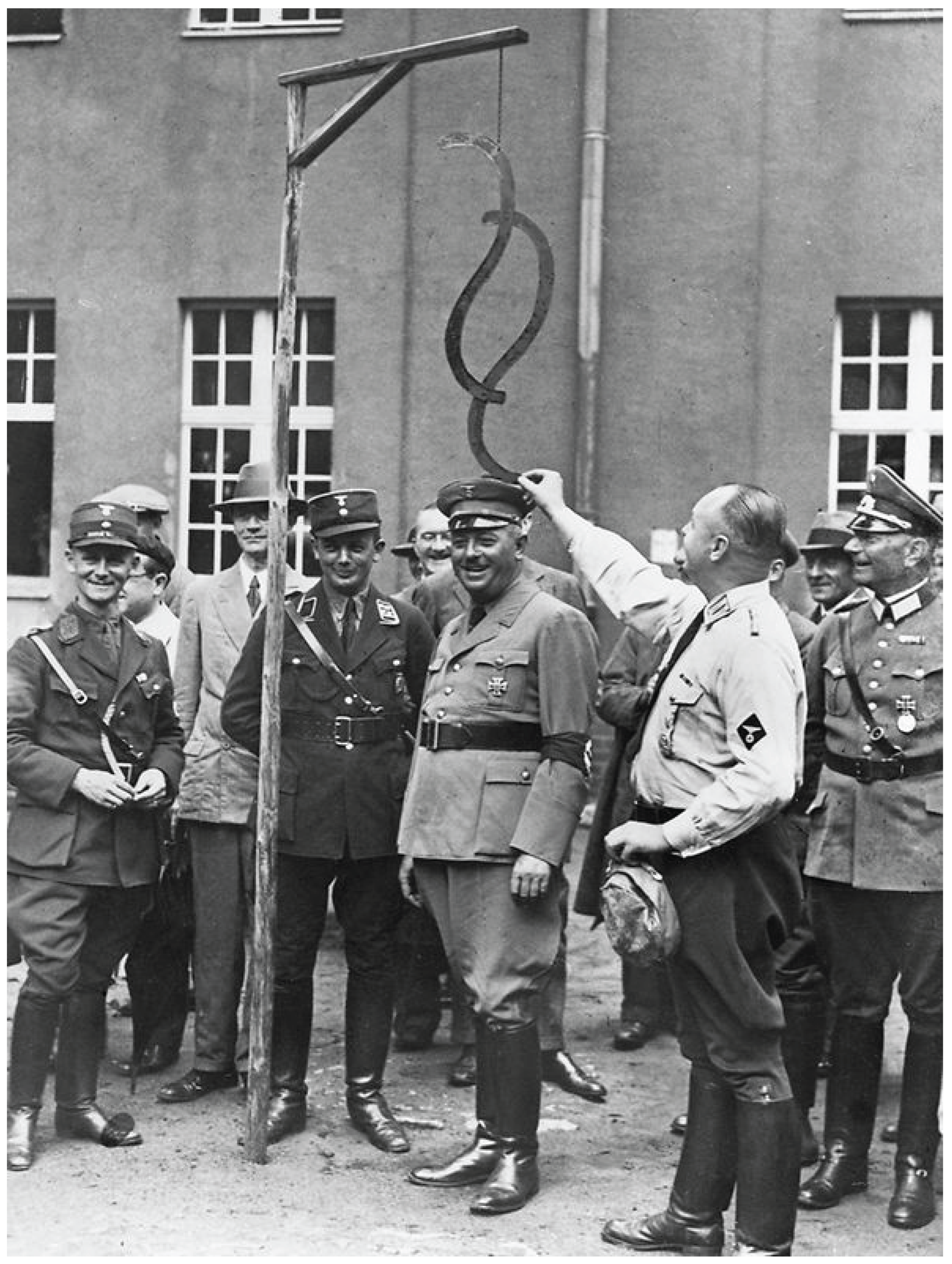
Figure 2.
Cut-out of Resistance and Persecution in Bavaria 1933-1945, 1798, proceeding (8649) 12938.
Figure 2.
Cut-out of Resistance and Persecution in Bavaria 1933-1945, 1798, proceeding (8649) 12938.
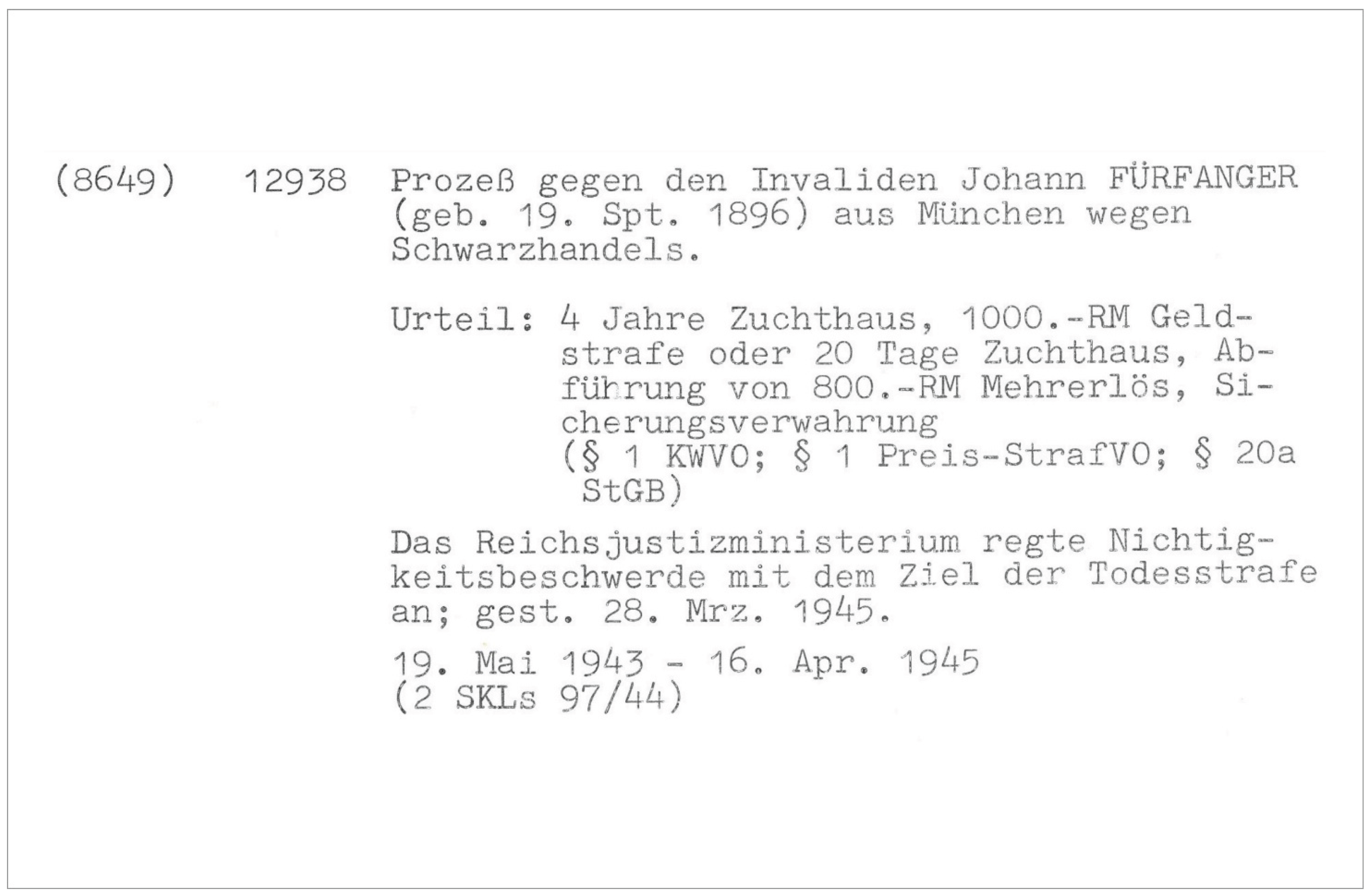
Figure 3.
“Publishing of the judgement” as a NS-specific Secondary penalty (“Nebenstrafe”) –State Archive of Munich, Staatsanwaltschaften 11181
Figure 3.
“Publishing of the judgement” as a NS-specific Secondary penalty (“Nebenstrafe”) –State Archive of Munich, Staatsanwaltschaften 11181
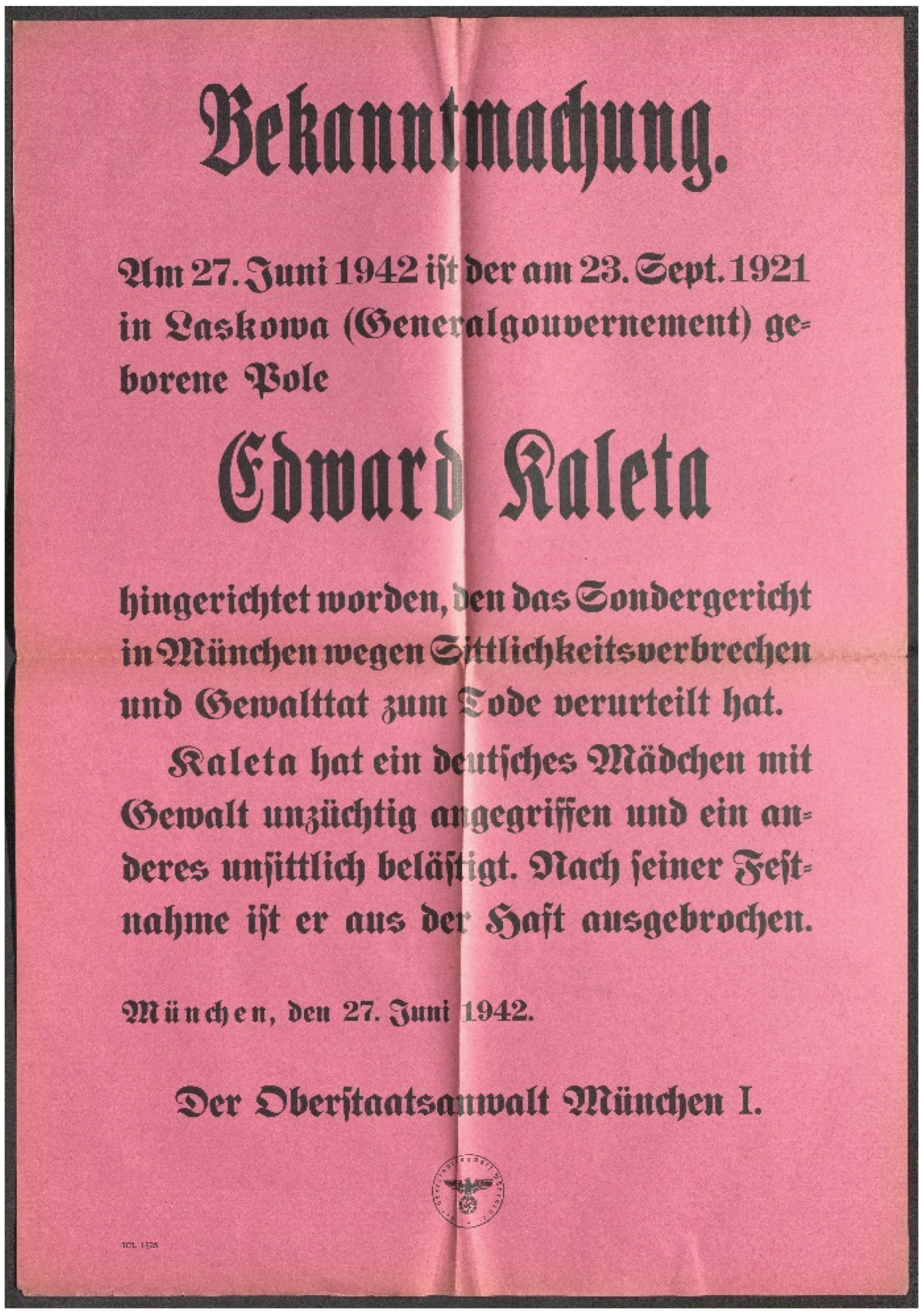
Figure 4.
Structured information in JSON format, extracted from the scanned image shown in Figure 2 above.
Figure 4.
Structured information in JSON format, extracted from the scanned image shown in Figure 2 above.
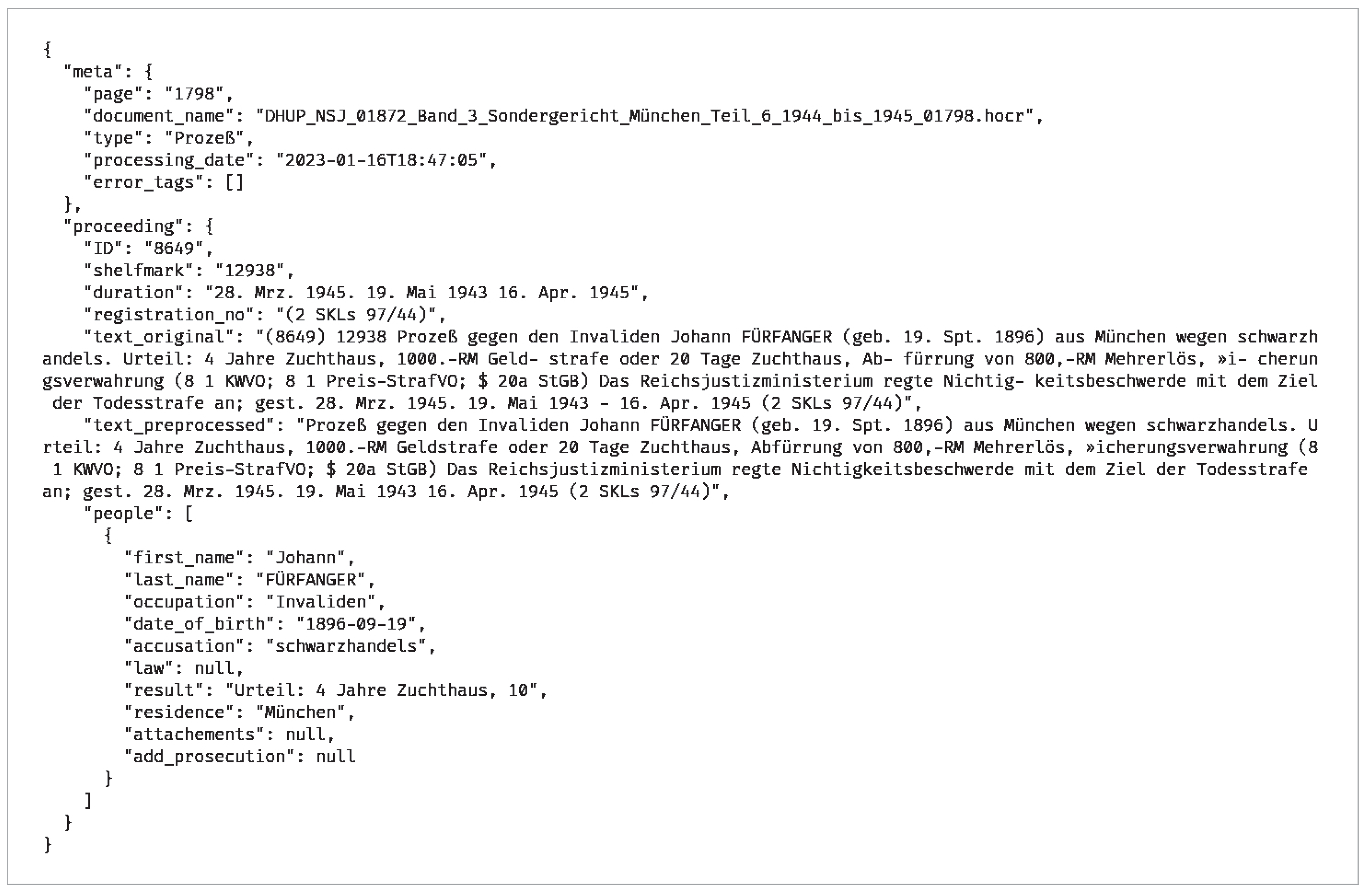
Table 2.
Outcomes of proceedings brought before the Munich Special Court, broken down by the socio-cultural backgrounds of the defendants, categories 0 through 5. Abbreviations: (pr)ison, (ps) penal servitude, (lc) labor camp, (susp) suspended, (RB) “Reichsbanner”, (JW) Jehova’s Witness, (BB) “Bauernbund”, (SH) “Stahlhelm”, (PA) “Protektoratsangehörige”. The last three columns contain average sentence lenghts, in months. Countries of origin are specified as ISO 3166 alpha-2 codes.
Table 2.
Outcomes of proceedings brought before the Munich Special Court, broken down by the socio-cultural backgrounds of the defendants, categories 0 through 5. Abbreviations: (pr)ison, (ps) penal servitude, (lc) labor camp, (susp) suspended, (RB) “Reichsbanner”, (JW) Jehova’s Witness, (BB) “Bauernbund”, (SH) “Stahlhelm”, (PA) “Protektoratsangehörige”. The last three columns contain average sentence lenghts, in months. Countries of origin are specified as ISO 3166 alpha-2 codes.
| total | pr | ps | lc | fine | susp | death | avg pr | avg pen | avg lc | ||
|---|---|---|---|---|---|---|---|---|---|---|---|
| 0 - uncategoriginsed | |||||||||||
| gender | male | 687 | 266 | 28 | 17 | 8 | 351 | 17 | 13.18 | 38.52 | 37.29 |
| gender | female | 80 | 22 | 11 | 2 | 0 | 44 | 1 | 12.18 | 48.00 | 33.00 |
| origin | FR | 8 | 6 | 0 | 0 | 0 | 2 | 0 | 14.34 | - | - |
| origin | IT | 5 | 1 | 0 | 0 | 0 | 2 | 2 | 18.00 | - | - |
| origin | PL | 20 | 4 | 0 | 13 | 0 | 1 | 2 | 25.25 | 41.08 | - |
| origin | CZ | 6 | 1 | 1 | 0 | 0 | 4 | 0 | 12.00 | 18.00 | - |
| member | BVP | 5 | 2 | 0 | 0 | 0 | 3 | 0 | 5.00 | - | - |
| member | KP | 16 | 13 | 0 | 0 | 0 | 2 | 1 | 6.42 | - | - |
| member | NSDAP | 19 | 10 | 0 | 1 | 1 | 7 | 0 | 14.70 | 22.00 | |
| member | RB | 6 | 3 | 0 | 0 | 0 | 3 | 0 | 4.34 | - | - |
| member | SA | 30 | 9 | 0 | 0 | 1 | 19 | 1 | 10.12 | - | - |
| member | SPD | 7 | 4 | 0 | 0 | 0 | 3 | 0 | 3.50 | - | - |
| member | SS | 8 | 4 | 0 | 0 | 0 | 4 | 0 | 14.75 | - | - |
| religion | JW | 8 | 5 | 0 | 0 | 1 | 2 | 0 | 8.75 | - | - |
| religion | jewish | 6 | 1 | 0 | 0 | 0 | 5 | 0 | 7.00 | - | - |
| religion | catholic | 15 | 1 | 0 | 0 | 0 | 14 | 0 | 9.00 | - | - |
| 1 - bodily harm and morality | |||||||||||
| gender | male | 155 | 31 | 41 | 19 | 0 | 12 | 52 | 27.61 | 65.46 | 53.68 |
| gender | female | 12 | 3 | 4 | 0 | 0 | 1 | 4 | 33.34 | 76.50 | - |
| origin | PL | 45 | 2 | 7 | 16 | 0 | 0 | 20 | 63.00 | 49.71 | 57.00 |
| member | RB | 5 | 2 | 2 | 0 | 0 | 0 | 1 | 8.50 | 51.00 | - |
| 2 - fraud | |||||||||||
| gender | male | 189 | 81 | 77 | 1 | 0 | 18 | 12 | 23.84 | 45.45 | 48.00 |
| gender | female | 27 | 6 | 20 | 0 | 0 | 0 | 1 | 6.34 | 40.50 | - |
| member | NSDAP | 12 | 9 | 2 | 0 | 0 | 1 | 0 | 80.34 | 25.50 | - |
| member | SA | 7 | 5 | 2 | 0 | 0 | 0 | 0 | 15.40 | 52.00 | - |
| 3 - theft and bribery | |||||||||||
| gender | male | 427 | 91 | 276 | 9 | 4 | 24 | 23 | 14.94 | 45.43 | 54.89 |
| gender | female | 78 | 21 | 54 | 1 | 1 | 1 | 0 | 18.71 | 34.98 | 24.00 |
| origin | FR | 33 | 1 | 32 | 0 | 0 | 0 | 0 | 8.00 | 36.10 | - |
| origin | IT | 11 | 2 | 8 | 0 | 0 | 0 | 1 | 12.00 | 25.86 | - |
| origin | NL | 10 | 0 | 9 | 0 | 0 | 0 | 1 | 26.50 | - | - |
| origin | PL | 18 | 1 | 9 | 5 | 0 | 1 | 2 | 24.00 | 17.75 | 48.40 |
| origin | PA | 18 | 2 | 15 | 0 | 0 | 0 | 1 | 14.00 | 35.21 | - |
| member | RB | 18 | 1 | 14 | 0 | 0 | 1 | 2 | 8.00 | 34.64 | - |
| 4 - war-related economic crimes | |||||||||||
| gender | male | 222 | 120 | 51 | 1 | 8 | 40 | 2 | 25.57 | 31.67 | 6.00 |
| gender | female | 36 | 17 | 17 | 0 | 2 | 0 | 0 | 18.20 | 40.59 | - |
| member | NSDAP | 5 | 5 | 0 | 0 | 0 | 0 | 0 | 44.40 | - | - |
| 5 - prisoners of war-related | |||||||||||
| gender | male | 192 | 67 | 116 | 2 | 1 | 6 | 0 | 13.04 | 20.18 | 19.50 |
| gender | female | 198 | 78 | 115 | 3 | 1 | 1 | 0 | 13.62 | 22.13 | 18.00 |
Table 3.
Outcomes of proceedings brought before the Munich Special Court, broken down by the socio-cultural backgrounds of the defendants, categories 6 through 9. Abbreviations: (pr)ison, (ps) penal servitude, (lc) labor camp, (susp) suspended, (RB) “Reichsbanner”, (JW) Jehova’s Witness, (BB) “Bauernbund”, (SH) “Stahlhelm”, (PA) “Protektoratsangehörige”. The last three columns contain average sentence lenghts, in months. Countries of origin are specified as ISO 3166 alpha-2 codes.
Table 3.
Outcomes of proceedings brought before the Munich Special Court, broken down by the socio-cultural backgrounds of the defendants, categories 6 through 9. Abbreviations: (pr)ison, (ps) penal servitude, (lc) labor camp, (susp) suspended, (RB) “Reichsbanner”, (JW) Jehova’s Witness, (BB) “Bauernbund”, (SH) “Stahlhelm”, (PA) “Protektoratsangehörige”. The last three columns contain average sentence lenghts, in months. Countries of origin are specified as ISO 3166 alpha-2 codes.
| total | pr | ps | lc | fine | susp | death | avg pr | avg pen | avg lc | ||
|---|---|---|---|---|---|---|---|---|---|---|---|
| 6 - regime criticism incl. religious and political persecution | |||||||||||
| gender | male | 120 | 56 | 3 | 0 | 0 | 61 | 0 | 8.82 | 70.67 | - |
| gender | female | 26 | 10 | 3 | 0 | 1 | 12 | 0 | 7.00 | 44.00 | - |
| member | KP | 26 | 8 | 1 | 0 | 0 | 17 | 0 | 5.25 | 168.00 | - |
| member | SPD | 6 | 4 | 0 | 0 | 0 | 2 | 0 | 12.25 | - | - |
| religion | JW | 31 | 28 | 0 | 0 | 0 | 3 | 0 | 9.18 | - | - |
| religion | catholic | 15 | 3 | 0 | 0 | 0 | 12 | 0 | 6.67 | - | - |
| 7 - conspiracy and protest | |||||||||||
| gender | male | 302 | 74 | 35 | 1 | 6 | 186 | 0 | 11.37 | 26.44 | 30.00 |
| gender | female | 34 | 9 | 7 | 0 | 2 | 16 | 0 | 19.89 | 28.00 | - |
| member | KP | 29 | 17 | 6 | 0 | 1 | 5 | 0 | 6.53 | 23.83 | - |
| member | NSDAP | 5 | 2 | 1 | 0 | 0 | 2 | 0 | 3.50 | 19.00 | - |
| member | SA | 22 | 3 | 0 | 0 | 3 | 16 | 0 | 3.00 | - | - |
| member | SPD | 6 | 3 | 2 | 0 | 1 | 0 | 0 | 15.00 | 50.50 | - |
| member | SS | 7 | 1 | 0 | 0 | 0 | 6 | 0 | 12.00 | - | - |
| religion | catholic | 8 | 1 | 0 | 0 | 0 | 7 | 0 | 7.00 | - | - |
| 8 - negative remarks and hearsay | |||||||||||
| gender | male | 1371 | 496 | 8 | 4 | 20 | 840 | 3 | 8.50 | 30.00 | 30.00 |
| gender | female | 162 | 55 | 4 | 0 | 1 | 102 | 0 | 8.54 | 33.00 | - |
| origin | PL | 7 | 1 | 0 | 4 | 0 | 1 | 1 | 2.00 | 30.00 | - |
| origin | PA | 5 | 4 | 0 | 0 | 0 | 1 | 0 | 52.34 | - | - |
| origin | CZ | 18 | 5 | 0 | 0 | 0 | 13 | 0 | 7.60 | - | - |
| origin | AT | 9 | 3 | 0 | 0 | 0 | 6 | 0 | 9.34 | - | - |
| member | BVP | 18 | 11 | 0 | 0 | 2 | 5 | 0 | 4.73 | - | - |
| member | BB | 8 | 5 | 1 | 0 | 0 | 2 | 0 | 8.00 | - | - |
| member | KP | 62 | 36 | 0 | 0 | 0 | 26 | 0 | 13.50 | - | - |
| member | NSDAP | 28 | 18 | 0 | 0 | 3 | 7 | 0 | 8.97 | - | - |
| member | RB | 15 | 7 | 0 | 0 | 0 | 8 | 0 | 14.57 | - | - |
| member | SA | 36 | 11 | 0 | 0 | 0 | 25 | 0 | 6.36 | - | - |
| member | SPD | 28 | 16 | 0 | 0 | 1 | 11 | 0 | 5.56 | - | - |
| member | SS | 9 | 3 | 0 | 0 | 0 | 6 | 0 | 5.34 | - | - |
| member | SH | 8 | 5 | 0 | 0 | 1 | 2 | 0 | 5.40 | - | - |
| religion | protestant | 7 | 0 | 0 | 0 | 0 | 7 | 0 | - | - | - |
| religion | jewish | 10 | 3 | 0 | 0 | 0 | 7 | 0 | 11.67 | - | - |
| religion | catholic | 83 | 11 | 0 | 0 | 0 | 72 | 0 | 4.90 | - | - |
| 9 - person-related remarks | |||||||||||
| gender | male | 865 | 306 | 2 | 0 | 8 | 548 | 1 | 11.47 | 17.00 | - |
| gender | female | 145 | 43 | 2 | 0 | 3 | 97 | 0 | 29.76 | 35.00 | - |
| origin | CZ | 8 | 4 | 0 | 0 | 0 | 4 | 0 | 8.75 | - | - |
| origin | AT | 7 | 4 | 0 | 0 | 0 | 3 | 0 | 5.75 | - | - |
| member | BVP | 12 | 9 | 0 | 0 | 2 | 1 | 0 | 8.44 | - | - |
| member | BB | 5 | 4 | 0 | 0 | 0 | 1 | 0 | 32.00 | - | - |
| member | KP | 25 | 16 | 0 | 0 | 0 | 9 | 0 | 7.31 | - | - |
| member | NSDAP | 12 | 7 | 0 | 0 | 0 | 5 | 0 | 13.57 | - | - |
| member | RB | 13 | 7 | 0 | 0 | 0 | 6 | 0 | 14.43 | - | - |
| member | SA | 22 | 7 | 0 | 0 | 1 | 14 | 0 | 16.14 | - | - |
| member | SPD | 20 | 15 | 0 | 0 | 0 | 5 | 0 | 12.13 | - | - |
| member | SH | 5 | 3 | 0 | 0 | 0 | 1 | 1 | 22.17 | - | - |
| religion | jewish | 5 | 2 | 0 | 0 | 0 | 3 | 0 | 2.00 | - | - |
| religion | catholic | 16 | 4 | 0 | 0 | 0 | 12 | 0 | 8.75 | - | - |
Disclaimer/Publisher’s Note: The statements, opinions and data contained in all publications are solely those of the individual author(s) and contributor(s) and not of MDPI and/or the editor(s). MDPI and/or the editor(s) disclaim responsibility for any injury to people or property resulting from any ideas, methods, instructions or products referred to in the content. |
© 2026 by the authors. Licensee MDPI, Basel, Switzerland. This article is an open access article distributed under the terms and conditions of the Creative Commons Attribution (CC BY) license (http://creativecommons.org/licenses/by/4.0/).
Copyright: This open access article is published under a Creative Commons CC BY 4.0 license, which permit the free download, distribution, and reuse, provided that the author and preprint are cited in any reuse.