

Submitted:
13 May 2026
Posted:
15 May 2026
You are already at the latest version
Abstract
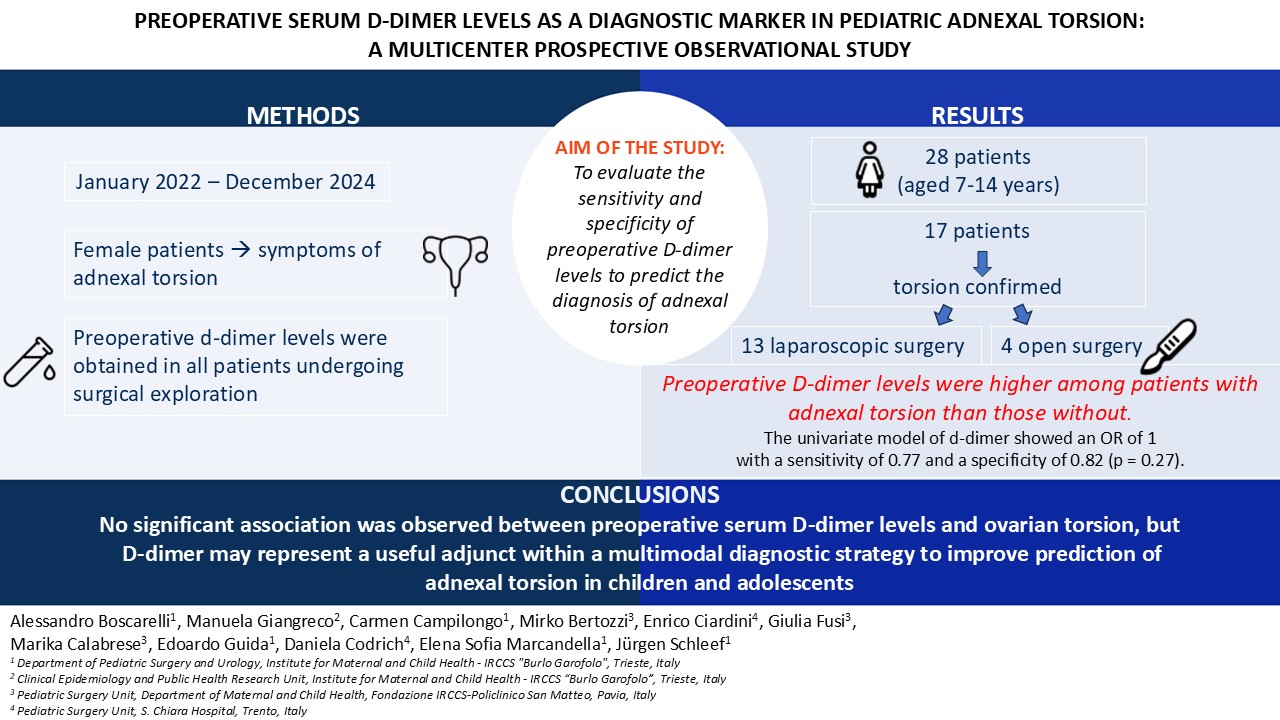
Background: Adnexal torsion is an uncommon cause of abdominal pain, and its clinical presentation in children is nonspecific. In some studies, serum D-dimer showed promise as a biochemical marker. The aim of this multicenter prospective observational study was to evaluate the sensitivity and specificity of preoperative serum D-dimer levels for diagnosing adnexal torsion in children and adolescents. Methods: Female patients aged <18 years presenting to the emergency departments of participating centers with symptoms suggestive of adnexal torsion between January 2022 and December 2024 were invited to participate in the study. Preoperative serum D-dimer levels were measured in all patients undergoing surgical exploration. Patients’ characteristics were examined using descriptive and inferential statistics, and the accuracy of preoperative serum D-dimer levels for diagnosing adnexal torsion was assessed using univariate logistic regression and a receiver operating characteristic curve. Results: Twenty-eight patients aged 4–17 years were enrolled. Adnexal torsion was found in 17 patients, on the left side in 4 (23.53%) and on the right side in 13 (76.47%). Almost all patients were treated laparoscopically, and no postoperative complications occurred. Preoperative serum D-dimer levels were higher among patients with adnexal torsion than among those without. The univariate model of serum D-dimer levels had an odds ratio of 1, a sensitivity of 0.77, and a specificity of 0.82 (p = 0.27). Conclusions: No direct association was observed between preoperative serum D-dimer levels and adnexal torsion. Nonetheless, the sensitivity and specificity suggest the possible utility of including serum D-dimer levels in multi-marker diagnostic models to complement rather than replace existing tools.
Keywords:
adnexal torsion
; adolescents
; children
; d‐dimer levels
; diagnosis
Copyright: This open access article is published under a Creative Commons CC BY 4.0 license, which permit the free download, distribution, and reuse, provided that the author and preprint are cited in any reuse.


