

Submitted:
21 April 2026
Posted:
22 April 2026
You are already at the latest version
Abstract
Background: The clinical presentation of adnexal torsion in children is nonspecific. In some studies, serum D-dimer showed promise as a biochemical marker. Thus, this multi-center prospective observational study aimed to evaluate the sensitivity and specificity of preoperative serum D-dimer levels for diagnosing adnexal torsion in children and adolescents. Methods: This study prospectively enrolled female patients aged < 18 years presenting to the emergency departments of participating centers with symptoms suggestive of adnexal torsion between January 2022 and December 2024. Preoperative serum D-dimer levels were measured for all patients undergoing surgical exploration. Patients’ characteristics were examined using descriptive and inferential statistics, and the accuracy of preoperative serum D-dimer levels for diagnosing adnexal torsion was assessed using univariate logistic regression and a receiver operating characteristic curve. Results: This study enrolled 28 patients aged 4–17 years. Adnexal torsion was found in 17 patients, on the left side in 4 (23.53%) and on the right side in 13 (76.47%). Almost all patients were treated laparoscopically, and no postoperative complications occurred. Pre-operative serum D-dimer levels were higher among patients with adnexal torsion than among those without. The univariate model of serum D-dimer levels had an odds ratio of 1, a sensitivity of 0.77, and a specificity of 0.82 (p = 0.27). Conclusions: No direct association was observed between preoperative serum D-dimer levels and adnexal torsion. Nonetheless, the sensitivity and specificity suggest the possible utility of including serum D-dimer levels in multi-marker diagnostic models to complement rather than replace existing tools.
Keywords:
adnexal torsion
; adolescents
; children
; d-dimer levels
; diagnosis
1. Introduction
Adnexal torsion refers to the twisting of the ovary and/or fallopian tube on its vascular pedicle, leading to reduced blood flow and tissue ischemia. If not treated promptly, it may lead to hemorrhagic infarction and necrosis of adnexal structures, which may impair future fertility. It is the fifth most common gynecologic emergency, with approximately 30% of cases occurring in females aged under 20 years. Its incidence is estimated at 5 per 100,000 females aged 1–20 years, with those aged over 10 years at increased risk due to a higher frequency of both physiological and pathological masses [1,2].
The clinical presentation of adnexal torsion is often nonspecific, mimicking other acute diseases such as hemorrhagic ovarian cysts, ruptured ovarian cysts, and appendicitis. The most common symptom is acute, intermittent, non-radiating lower abdominal pain, associated with nausea and vomiting in 60%–70% of cases. Notably, common laboratory markers, including leukocytosis, pyuria, C-reactive protein (CRP), and erythrocyte sedimentation rate, are not reliable for diagnosing adnexal torsion. Abdominal ultrasonography (US) is the primary diagnostic imaging modality, which demonstrates high sensitivity (92%) and specificity (96%) in detecting adnexal torsion. Magnetic resonance imaging (MRI) and/or computed tomography (CT) may be used when US is inconclusive. Unfortunately, clinical and radiological findings can be deceptive and inconsistent, making the diagnosis of adnexal torsion challenging. Currently, no clinical or imaging criteria are sufficiently definitive to confirm the preoperative diagnosis of adnexal torsion. Diagnostic scoring systems have been described that combine various clinical features, laboratory findings, and/or radiological parameters to predict adnexal torsion, demonstrating promising results. However, none can definitively rule out an adnexal torsion. Therefore, patients with a high clinical suspicion of adnexal torsion must still undergo emergent surgical exploration [1,2].
Research on predictive markers for adnexal torsion in adults has reported promising results, including the inflammatory marker interleukin 6 (IL6). A few studies have also investigated the role of other biochemical markers, such as D-dimer, which has been proposed as a potential indicator of ischemia in various tissues. Preliminary data suggest that elevated serum D-dimer levels may correlate with adnexal torsion, although further studies are needed to establish its diagnostic utility in children and adolescents [3,4,5].
Therefore, this multicenter prospective observational study aimed to evaluate the specificity and sensitivity of preoperative serum D-dimer levels for diagnosing adnexal torsion in children and adolescents, thereby reducing unnecessary surgical procedures and preserving ovarian function in affected patients.
2. Materials and Methods
This multicenter prospective observational study was approved by the institutional review board of our hospital (approval number: CEUR-2021-Os-219). Informed consent was obtained from all study participants. This study enrolled female patients aged under 18 years who presented to the emergency department of three tertiary Italian hospitals with clinical and radiological findings suggestive of adnexal torsion between January 2022 and December 2024. It excluded those aged over 18 years, with a history of prior surgery for adnexal pathologies, or exhibiting clinical symptoms and imaging findings suggestive of alternative surgical conditions, such as appendicitis or gastroenteritis.
This study’s primary aim was to prospectively evaluate the diagnostic accuracy of serum D-dimer levels in the preoperative assessment of adnexal torsion. Its secondary aims were to investigate the possible consequent reduction in unnecessary surgical procedures in these patients and any related complications.
Patients’ demographic and clinical characteristics were collected using a Word-based data sheet and stored in an Excel spreadsheet (Microsoft, Seattle, WA, USA), including age; clinical history; preoperative test results, symptoms, and imaging features; laparoscopic findings (e.g., the aspect of each tube and the ovaries); the presence of cyst or malformations; surgical outcomes; and complications. The serum D-dimer concentration was measured at admission, and the clinical cut-off was set at 500 ng/mL.
All statistical analyses were conducted using SAS (version 9.4; SAS Institute Inc., Cary, NC, USA). The patients’ demographic and clinical characteristics were analyzed descriptively, with categorical variables reported as the number (percentage) of patients, and quantitative variables reported as the median (interquartile range [IQR]). Associations between categorical variables were evaluated using a chi-square or Fisher’s exact test, as appropriate. Continuous variables were compared between dichotomic variable categories using the non-parametric Wilcoxon–Mann–Whitney test. The accuracy of serum D-dimer levels in preoperatively diagnosing adnexal torsion was evaluated using a receiver operating characteristic (ROC) curve, which was used to calculate sensitivity, specificity, and positive and negative predictive values. The optimal threshold of serum D-dimer levels capable of discriminating the presence of adnexal torsion was evaluated using the Youden Index. The number of surgical procedures that could have been avoided if serum D-dimer levels had been used to predict adnexal torsion was evaluated by calculating and verifying the number of patients with serum D-dimer levels below the optimal threshold determined by the Youden Index.
3. Results
This multicenter analysis included 28 patients, and their clinical characteristics are summarized in Table 1. Their ages ranged from 4 to 17 years, with a median of 13 (12–14) years. All patients reported abdominal pain, as well as other symptoms, including vomiting (n = 13, 46.42%), nausea (n = 4, 14.28%), fever (n = 4, 14.28%), and abdominal mass (n = 3, 10.71%). At presentation, 18 patients (64.28%) reported active menstruation. Preoperatively, all patients underwent abdominal US, and only 5 (17.86%) underwent additional imaging for more accurate diagnosis: 3 (10.71%) underwent a CT scan and 2 (7.14%) underwent an MRI. The suspected side was more often the right (n = 17, 60.71%).
All patients underwent surgical exploration: 24 (85.71%) underwent laparoscopic surgery, 2 (7.14%) initially underwent laparoscopic surgery that was subsequently converted to open surgery, and 2 (7.14%) underwent open surgery. Intraoperatively, adnexal torsion was confirmed in 17 patients (60.71%), involving the left side in 4 (23.53%) and the right side in 13 (76.47%). All patients underwent different surgical procedures according to their findings: derotation, treatment of cysts if present, and ovariectomy and/or salpingectomy if deemed necessary. Notably, 2 (7.14%) patients presented with a hemorrhagic corpus luteum cyst requiring no procedures. Remarkably, none of these patients experienced postoperative complications.
Preoperative parameters did not differ significantly between patients with and without adnexal torsion (Table 2). Specifically, they had similar white blood cell counts (median: 8.8 [7.6–10.9] vs. 9.1 [6.0–10.6] × 103/μL, p = 0.78), neutrophil percentages (median: 68.2% [58.3%–78.3%] vs. 64.7% [55.6–79.1], p = 0.84), and CRP levels (median: 0.5 [0.1–1.8] vs. 0.3 [0.1–8.2] mg/L, p = 1.00). However, preoperative serum D-dimer levels were nonsignificantly higher in patients with than without adnexal torsion (median: 520 [499–877] vs. 327 [234.5–395.0] ng/mL, p = 0.09). Notably, no association between preoperative serum D-dimer levels and adnexal torsion was observed, with an odds ratio of 1 (p = 0.27). The area under the ROC curve (AUC) was 0.70 (95% confidence interval [CI]: 0.47–1.00), with a sensitivity of 0.77 and a specificity of 0.82. The optimal threshold of serum D-dimer levels was determined to be 499 ng/mL (Table 3 and Figure 1).
4. Discussion
Adnexal torsion may involve the ovary, the fallopian tube, or both, and is defined as the partial or complete rotation of the adnexa on its vascular pedicle [6]. Venous and lymphatic flow are compromised first, resulting in widespread edema and ovarian enlargement. Subsequent collapse of the thick arterial walls due to increased intravascular pressure may gradually lead to thrombosis, ischemia, and ultimately necrosis. Delayed diagnosis and treatment may result in serious sequelae, including peritonitis and thrombophlebitis. Long-term consequences such as subfertility, infertility, and premature menopause may also occur [7,8,9,10,11].
Given its clinical and radiological variability, diagnosing adnexal torsion remains challenging, and no consolidated, easily applicable, noninvasive diagnostic tools currently exist. Clinically, lower abdominal pain (~60%–70%), abdominal tenderness (~80%–90%), and fever (~10%, typically a late finding associated with necrotic tissue) are commonly reported. A palpable mass is reported in 20%–36% of pediatric patients with adnexal torsion, and torsion of ovarian masses is thought to be related to the increased size and weight of the affected ovary. Pain is usually acute and short-term, and vomiting frequently accompanies the onset of symptoms, likely triggered by a vagal reflex secondary to pain [6,12,13,14].
To date, studies have consistently reported the limited diagnostic value of routine laboratory tests, including white blood cell count, pyuria, CRP level, and erythrocyte sedimentation rate, in diagnosing adnexal torsion [1]. In contrast, serum D-dimer and IL6 levels have shown promising diagnostic potential [3,4,5]. Although radiologic findings suggestive of possible adnexal torsion may be misleading and inconsistent, imaging studies are often relied upon in clinical practice to evaluate abdominal pain in female adolescents. US is an appropriate first-line imaging modality, as it is rapid and widely used in emergency settings [15]. However, its diagnostic accuracy remains limited, with reported confirmation rates of adnexal torsion ranging from 26% to 79% [7].
Several findings may be related to adnexal torsion, including the abnormal position of the adnexa; ovarian enlargement relative to the other normal ovary; the presence of a cyst, mass, or both measuring ≥3 cm on the same side of the adnexa; edema of the involved ovary, appearing as heterogeneous ovarian parenchyma with echogenic stroma; follicular edema or a “ring” sign (1–2 mm hyperechoic rims surrounding all antral follicles measuring 3–7 mm in the affected ovary); displacement of the follicles within the affected ovary; abnormal arterial or venous blood flow in the adnexa, including absent venous and arterial flow; a twisted vascular pedicle (“whirlpool” sign), or the presence of concentric, low-level echogenic tubular structures resembling a “cochlea”; abnormalities of the ipsilateral fallopian tube, which may demonstrate a tubular vortex, fluid distension, or edema; and free fluid in the pelvis. These features demonstrate variable sensitivity, specificity, and positive predictive value, particularly in younger patients. Importantly, the absence of typical sonographic findings does not rule out adnexal torsion. For instance, Doppler flow may be an unreliable indicator of torsion due to intermittent or incomplete compression of the pedicle, transient spontaneous detorsion, or performing a US scan at an early stage of the torsion process. Since a single US sign has limited predictive value for definitive diagnosis, efforts have been made to develop US scoring systems by identifying which signs are the most predictive for an accurate diagnosis of adnexal torsion [7]. MRI and/or CT may be used when US is inconclusive, although they are less commonly employed in the pediatric population. MRI findings may include decreased contrast enhancement in the ovary, asymmetric ovarian enlargement, uterine deviation toward the affected side, and multiple small peripherally located follicles; however, MRI may require sedation and is not routinely available in emergency settings. CT findings indicative of adnexal torsion include uterine tube thickening (74%), eccentric or concentric wall thickening (54%), and eccentric septal thickening (50%) [1,2,6]. Nevertheless, because CT involves radiation, its use should be limited to selected pediatric cases.
Currently, clinical practice in cases of suspected adnexal torsion still mandates urgent surgical exploration. In this study, all enrolled patients underwent surgery, and adnexal torsion was confirmed intraoperatively in 17 patients (60.71%). Although surgery is most often performed with a minimally invasive approach, which is associated with a low overall risk compared with open surgery, it remains an invasive procedure requiring exposure to general anesthesia and carrying potential surgical and perioperative risk, as well as postoperative pain and recovery that may result in missed school and work for both patients and their families [5,16].
Consequently, recent studies have aimed to identify diagnostic tools that can rapidly and reliably rule out adnexal torsion. Therefore, this study aimed to evaluate the potential of serum D-dimer as a diagnostic biomarker for adnexal torsion. Although the inflammatory marker IL6 has shown promise in predicting adnexal torsion in adults,3 serum D-dimer could be an easy-to-use diagnostic marker that can be easily incorporated into routine blood testing without additional institutional costs. This study confirmed a recent pilot study showing higher serum D-dimer levels in patients with adnexal torsion than in those without adnexal torsion, although the difference was not statistically significant [5]. In particular, the AUC, sensitivity, and specificity suggest that, with a larger sample size, serum D-dimer could emerge as a valuable diagnostic marker for adnexal torsion in children and adolescents, particularly as a component of a composite scoring system.
Indeed, several composite scores have been described in the literature that combine various clinical features, laboratory findings, and/or radiological parameters to predict adnexal torsion and appropriately triage pediatric patients for surgery. For example, Schwartz et al. developed a composite score incorporating vomiting, adnexal volume, and adnexal volume ratio that demonstrated encouraging results, simplifying a previous model that also included pain duration [17,18]. They then retrospectively re-evaluated this composite score in a larger cohort and further simplified it to only two variables, enhancing its practicality as an emergency department triage tool [19]. Despite their promise, these scoring systems were highly accurate primarily in patients with low or high suspicion, while still missing 10%–15% of adnexal torsion cases, particularly among postmenarchal patients.
Regarding laboratory parameters, a composite score combining vomiting, short duration of abdominal pain, and elevated CRP level has demonstrated predictive value for diagnosing adnexal torsion [13]. However, this study was limited by its retrospective design, small sample size, and inclusion of only surgically-proven cases of adnexal torsion. To our knowledge, no previous studies have investigated the role of serum D-dimer in a diagnostic score for adnexal torsion. Based on our findings, serum D-dimer appears to be a suitable candidate laboratory marker for inclusion in a simple, noninvasive, and easily applicable composite scoring system or multi-marker diagnostic model for risk stratification in suspected adnexal torsion.
Our study had some limitations that should be acknowledged. Firstly, despite its multicenter design, the sample size was relatively small, limiting statistical power. Secondly, factors such as time from symptom onset, hormonal fluctuations, nutritional and dietary factors, or concurrent infections were not evaluated as possible confounders.
5. Conclusions
Adnexal torsion is a surgical emergency, and accurate, timely diagnosis is essential to prevent serious sequelae, particularly in pediatric patients. Appropriate selection of patients for surgical intervention, while avoiding unnecessary procedures, is advisable. Identifying relevant clinical, laboratory, and imaging features that are easily assessable in an emergency setting and that enable surgeons to confidently diagnose adnexal torsion is therefore of great importance. Our study highlights the potential diagnostic utility of preoperative serum D-dimer levels for diagnosing adnexal torsion, supporting its possible role in the early identification of this condition. While serum D-dimer alone cannot yet replace existing tools in current clinical practice, it warrants further investigation to assess its utility in multi-marker diagnostic models.
Author Contributions
Conceptualization: A.B., and J.S.; methodology: A.B., and M.G.; investigation: A.B., M.B., E.C., E.G., and D.C.; data curation: A.B., C.C., G.F., M.C., and E.S.M.; formal analysis: A.B., M.G., C.C., and E.S.M.; validation: A.B., M.G., and J.S.; writing—original draft preparation: M.G., C.C., M.B., E.C., G.F., M.C., and E.S.M.; writing—review and editing: A.B., E.G., D.C., and J.S.; supervision: J.S.; this work has not been published previously and is not under consideration for publication elsewhere. All the authors approved the final version of the manuscript and attest that they meet the ICMJE criteria for authorship.
Funding
This work was supported by the Italian Ministry of Health, through the contribution given to the Institute for Maternal and Child Health IRCCS Burlo Garofolo, Trieste – Italy.
Institutional Review Board Statement
All procedures performed in studies involving human participants were in accordance with the ethical standards of the institutional research committee (approval number: CEUR-2021-Os-219) and with the 1964 Helsinki declaration and its later amendments or comparable ethical standards.
Informed Consent Statement
Informed consent was obtained from all subjects involved in the study.:
Data Availability Statement
The data that support the findings of this study are available on request from the corresponding author.
Conflicts of Interest
The authors declare no conflicts of interest.
Abbreviations
The following abbreviations are used in this manuscript:
| CRP | C-Reactive Protein |
| US | Ultrasonography |
| MRI | Magnetic Resonance Imaging |
| CT | Computed Tomography |
| IL6 | Interleukin 6 |
| AUC | Area Under the Curve |
References
- Adnexal Torsion in Adolescents: ACOG Committee Opinion No, 783. Obstet Gynecol 2019, 134(2), e56–e63. [CrossRef] [PubMed]
- Rougier, E.; Mar, W.; Della Valle, V.; Morel, B.; Irtan, S.; Audureau, E.; Coulomb-L'Hermine, A.; Ducou Le Pointe, H.; Blondiaux, E. Added value of MRI for the diagnosis of adnexal torsion in children and adolescents after inconclusive ultrasound examination. Diagn Interv Imaging Epub. 2020, 101(11), 747–756. [Google Scholar] [CrossRef] [PubMed]
- Reed, J.L.; Strait, R.T.; Kachelmeyer, A.M.; Byczkowski, T.L.; Ho, M.L.; Huppert, J.S. Biomarkers to distinguish surgical etiologies in females with lower quadrant abdominal pain. Acad Emerg Med. 2011, 18(7), 686–91. [Google Scholar] [CrossRef] [PubMed]
- Kart, C.; Aran, T.; Guven, S.; Karahan, S.C.; Yulug, E. Acute increase in plasma D-dimer level in ovarian torsion: an experimental study. Hum Reprod. 2011, 26(3), 564–8. [Google Scholar] [CrossRef] [PubMed]
- Boscarelli, A.; Giangreco, M.; Valvo, E.; Codrich, D.; Masiello, V.; Iaquinto, M.; Scarpa, M.G.; Olenik, D.; Maita, S.; Campilongo, C.; Guida, E.; Schleef, J. The role of preoperative D-dimer levels in diagnosing adnexal torsion in children and adolescents: a prospective monocentric pilot analysis. Front Med (Lausanne) 2025, 12, 1706633. [Google Scholar] [CrossRef] [PubMed] [PubMed Central]
- Kives, S.; Gascon, S.; Dubuc, É; Van Eyk, N. No. 341-Diagnosis and Management of Adnexal Torsion in Children, Adolescents, and Adults. J Obstet Gynaecol Can. 2017, 39(2), 82–90. [Google Scholar] [CrossRef] [PubMed]
- Chen, Y.; Liu, M.; Zhang, M.; Yang, M.; Weng, Z.; Wu, Q.; He, S. Ultrasonographic scoring system for the diagnosis of adnexal torsion. J Clin Ultrasound 2022, 50(4), 525–531. [Google Scholar] [CrossRef] [PubMed]
- Nichols, D.H.; Julian, P.J. Torsion of the adnexa. Clin Obstet Gynecol 1985, 28(2), 375–80. [Google Scholar] [CrossRef] [PubMed]
- Ghandehari, H.; Kahn, D.; Tomlinson, G.; et al. Ovarian torsion: time limiting factors for ovarian salvage. Emerg Med Open Access 2015, 5, 5. [Google Scholar]
- Yuk, J.S.; Kim, L.Y.; Shin, J.Y.; Choi, D.Y.; Kim, T.Y.; Lee, J.H. A national population-based study of the incidence of adnexal torsion in the Republic of Korea. Int J Gynaecol Obstet 2015, 129(2), 169–70. [Google Scholar] [CrossRef] [PubMed]
- Moribata, Y.; Kido, A.; Yamaoka, T.; Mikami, Y.; Himoto, Y.; Kataoka, M.; Fujimoto, K.; Konishi, I.; Togashi, K. MR imaging findings of ovarian torsion correlate with pathological hemorrhagic infarction. J Obstet Gynaecol Res. 2015, 41(9), 1433–9. [Google Scholar] [CrossRef] [PubMed]
- Adeyemi-Fowode, O.; Lin, E.G.; Syed, F.; Sangi-Haghpeykar, H.; Zhu, H.; Dietrich, J.E. Adnexal Torsion in Children and Adolescents: A Retrospective Review of 245 Cases at a Single Institution. J Pediatr Adolesc Gynecol. 2019, 32(1), 64–69. [Google Scholar] [CrossRef] [PubMed]
- Bolli, P.; Schädelin, S.; Holland-Cunz, S.; Zimmermann, P. Ovarian torsion in children: Development of a predictive score. Medicine (Baltimore) 2017, 96(43), e8299. [Google Scholar] [CrossRef] [PubMed] [PubMed Central]
- Rousseau, V.; Massicot, R.; Darwish, A.A.; Sauvat, F.; Emond, S.; Thibaud, E.; Nihoul-Fékété, C. Emergency management and conservative surgery of ovarian torsion in children: a report of 40 cases. J Pediatr Adolesc Gynecol. 2008, 21(4), 201–6. [Google Scholar] [CrossRef] [PubMed]
- Ssi-Yan-Kai, G.; Rivain, A.L.; Trichot, C.; Morcelet, M.C.; Prevot, S.; Deffieux, X.; De Laveaucoupet, J. What every radiologist should know about adnexal torsion. Emerg Radiol 2018, 25(1), 51–59. [Google Scholar] [CrossRef] [PubMed]
- Minneci, P.C.; Mahida, J.B.; Lodwick, D.L.; Sulkowski, J.P.; Nacion, K.M.; Cooper, J.N.; Ambeba, E.J.; Moss, R.L.; Deans, K.J. Effectiveness of Patient Choice in Nonoperative vs Surgical Management of Pediatric Uncomplicated Acute Appendicitis. JAMA Surg 2016, 151(5), 408–15. [Google Scholar] [CrossRef] [PubMed]
- Schwartz, B.I.; Huppert, J.S.; Chen, C.; Huang, B.; Reed, J.L. Creation of a Composite Score to Predict Adnexal Torsion in Children and Adolescents. J Pediatr Adolesc Gynecol. 2018, 31(2), 132–137. [Google Scholar] [CrossRef] [PubMed]
- King, A.; Keswani, S.; Biesiada, J.; Breech, L.; Crombleholme, T.; Huppert, J. The utility of a composite index for the evaluation of ovarian torsion. Eur J Pediatr Surg. 2014, 24(2), 136–140. [Google Scholar] [CrossRef] [PubMed]
- Marcinkowski, K.; Saul, D.; Gould, S.; Berman, L.; Schwartz, B.I. Application of a Composite Score to Predict Adnexal Torsion in Premenarchal and Menarchal Children and Adolescents. J Pediatr Surg. 2024, 59(3), 509–514. [Google Scholar] [CrossRef] [PubMed]
Figure 1.
Receiver operating characteristic (ROC) curve constructed to evaluate the accuracy of D-dimer levels in the preoperative diagnosis of adnexal torsion.
Figure 1.
Receiver operating characteristic (ROC) curve constructed to evaluate the accuracy of D-dimer levels in the preoperative diagnosis of adnexal torsion.
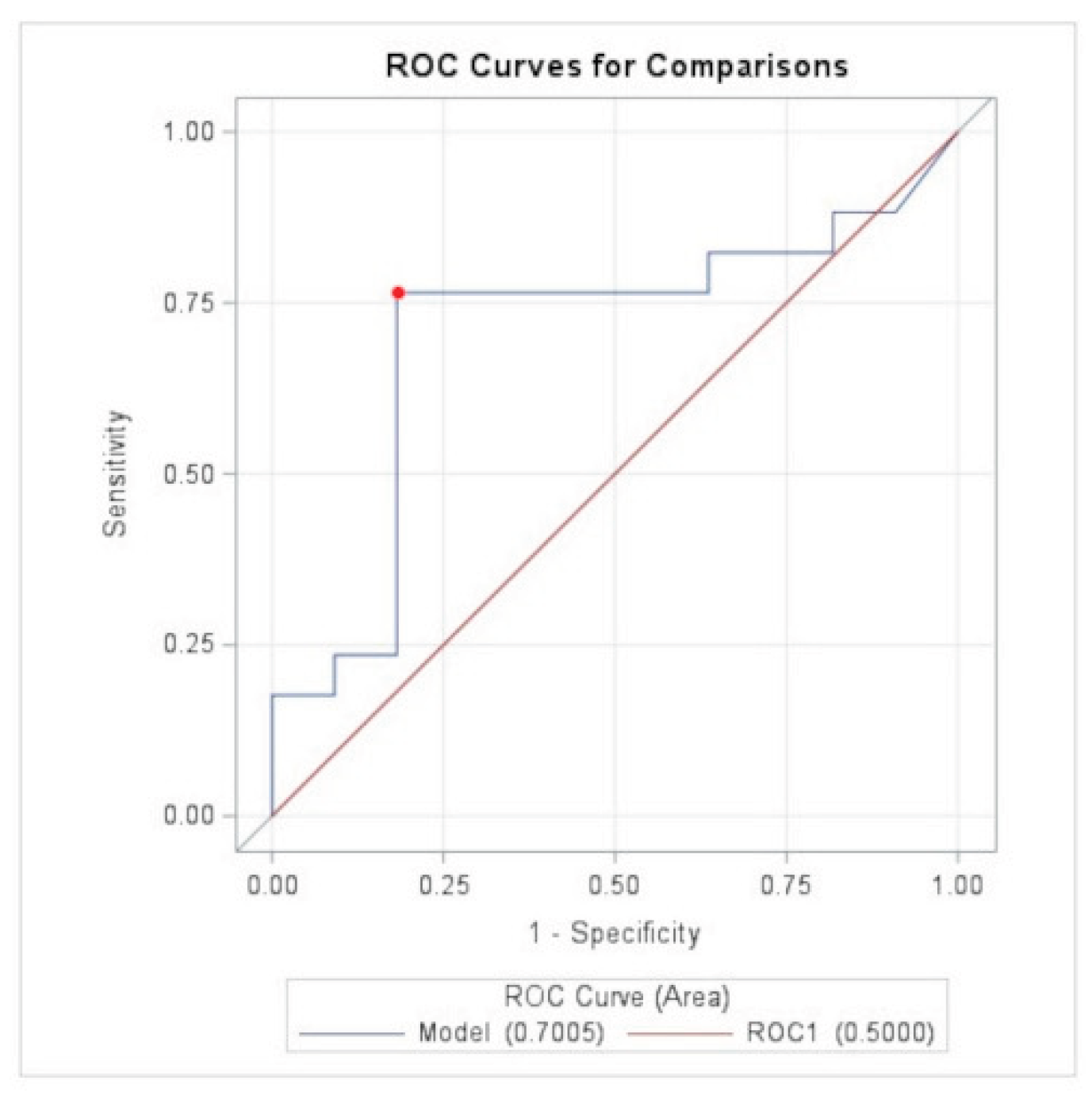

Table 1.
Clinical Characteristics of patients enrolled in our study.
| n | % | |
|---|---|---|
| Menstruation | ||
| N | 10 | 35.72 |
| Y | 18 | 64.28 |
| Symptoms | ||
| Abdominal Pain |
28 |
100.00 |
| Vomiting | 13 | 46.42 |
| Nausea | 4 | 14.28 |
| Fever | 4 | 14.28 |
| Abdominal mass | 3 | 10.71 |
| Ultrasonography | ||
| N | 0 | 0.00 |
| Y | 28 | 100.00 |
| Computed Tomography | ||
| N | 23 | 82.14 |
| Y | 5 | 17.86 |
| Magnetic Resonance Imaging | ||
| N | 26 | 92.86 |
| Y | 2 | 7.14 |
| Suspected Side | ||
| Left | 11 | 39.29 |
| Right | 17 | 60.71 |
| Surgical Approach | ||
| Laparoscopic | 24 | 85.71 |
| Laparoscopic converted | 2 | 7.14 |
| Open | 2 | 7.14 |
| Torsion confirmed | ||
| N | 11 | 39.29 |
| Y | 17 | 60.71 |
| Side of torsion verified | ||
| Left | 4 | 23.53 |
| Right | 13 | 76.47 |
| Post-operative complications | ||
| N | 28 | 100.00 |
| Y | 0 | 0.00 |
* Abbreviations: n=number; N=no; Y=yes.
Table 2.
Statistical analysis of demographic and preoperative blood values and their correlation with adnexal torsion.
Table 2.
Statistical analysis of demographic and preoperative blood values and their correlation with adnexal torsion.
| Value | Torsion | Min | 25° percentile | Median | 75° percentile | Max | Wilcoxon Mann Whitney P-value |
|---|---|---|---|---|---|---|---|
| Age | N | 10 | 12 | 13 | 15 | 17 | 0.48 |
| Y | 4 | 12 | 13 | 14 | 16 | ||
| Weight | N | 43 | 53 | 55 | 65 | 70 | 0.31 |
| Y | 12 | 40 | 54 | 62 | 77 | ||
| WBC | N | 5.8 | 6 | 9.1 | 10.6 | 13.4 | 0.78 |
| Y | 6.1 | 7.6 | 8.8 | 10.9 | 15.9 | ||
| Neu | N | 46.4 | 55.6 | 64.7 | 79.1 | 84.1 | 0.84 |
| Y | 34.4 | 58.3 | 68.2 | 78.3 | 92.1 | ||
| CRP | N | 0.1 | 0.1 | 0.3 | 8.2 | 140.3 | 1.00 |
| Y | 0.1 | 0.1 | 0.5 | 1.8 | 98.7 | ||
| D-dimer | N | 189 | 234 | 327 | 395 | 1788 | 0.09 |
| Y | 189 | 499 | 520 | 877 | 9450 |
* Abbreviations: N=no; Y=yes; WBC=White Blood Cells; Neu=Neutrophils; CRP=C-Reactive Protein.
Table 3.
Statistical analysis to assess the accuracy of D-dimer levels in the preoperative diagnosis of adnexal torsion.
Table 3.
Statistical analysis to assess the accuracy of D-dimer levels in the preoperative diagnosis of adnexal torsion.
| D-dimer | Univariate model - Torsion | |||
|---|---|---|---|---|
| Odds Ratio | p-value | Sensitivity | Specificity | |
| 1.00 | 0.27 | 0,77 | 0,82 | |
Disclaimer/Publisher’s Note: The statements, opinions and data contained in all publications are solely those of the individual author(s) and contributor(s) and not of MDPI and/or the editor(s). MDPI and/or the editor(s) disclaim responsibility for any injury to people or property resulting from any ideas, methods, instructions or products referred to in the content. |
© 2026 by the authors. Licensee MDPI, Basel, Switzerland. This article is an open access article distributed under the terms and conditions of the Creative Commons Attribution (CC BY) license.
Copyright: This open access article is published under a Creative Commons CC BY 4.0 license, which permit the free download, distribution, and reuse, provided that the author and preprint are cited in any reuse.


