
Submitted:
17 April 2026
Posted:
21 April 2026
You are already at the latest version
Abstract
Background/Objective: To evaluate the long-term effects of eosinophilic esophagitis (EoE) on children’s nutritional status and growth. Methods: We performed a retrospective cohort study assessing longitudinal growth patterns (height and BMI z-scores) in pediatric patients (<18 years) newly diagnosed with EoE and followed for at least one year. Nutritional status was classified using BMI-based criteria from the American Dietetic Association and the World Health Organization. Results: Among 50 patients, 20% presented with impaired nutritional status at diagnosis, including 12% with moderate malnutrition (BMI z-score < –2) and 8% with obesity (BMI z-score > 2). After a mean follow-up of 24.5 months, the prevalence of moderate malnutrition decreased to 6%, whereas obesity increased to 12%. Height z-scores remained largely stable over time. Conclusion: EoE affects children across the full BMI spectrum. Long-term follow-up highlights the importance of monitoring nutritional status in all pediatric patients with EoE, given the risks of both malnutrition and obesity.
Keywords:
cohort study
; growth
; height
; malnutrition
; obesity
Introduction
Eosinophilic esophagitis (EoE) is a chronic immune-mediated esophageal disease characterized histologically by an eosinophil-predominant inflammation of the esophagus and clinically by symptoms related to esophageal dysfunction [1]. EoE was first described as a distinct disease in the early 1990s. Since then, the incidence and prevalence have increased so rapidly that EoE is currently considered the most frequent eosinophilic gastrointestinal disorder and the second most common cause of chronic esophagitis, after gastroesophageal reflux disease [2]. The clinical presentation of EoE varies with age and primarily includes symptoms such as food refusal, dysphagia, vomiting or regurgitation, upper abdominal or chest pain, food impaction, and failure to thrive. In published series of children with EOE, failure to thrive or malnutrition occurs in 10-30% of patients at the time of diagnosis [3,4,5,6,7,8]. Several factors can negatively impact the nutritional status of children with EoE, including recurrent vomiting, nausea, problems with swallowing, gagging and dysphagia. All of these factors may compromise feeding behaviour leading to the development of feeding disorders which may further impair nutritional status.
During the course of therapy patients may also experience altered nutritional status which could be the result of the persisted maladaptive learned feeding behaviours [9]. Lack of response to therapy or low treatment compliance may lead to sustained esophageal inflammation which may also contribute to altered nutritional status [10]. Moreover, need for prolonged elimination diet therapy can further decrease adequate food oral intake. Nearly all studies assessing the nutritional status of children with EoE report data only at the time of diagnosis, and there is still paucity of data in the long term [5,7]. Therefore, the aim of our study was to assess the long-term impact of treatment on nutritional status and linear growth parameters in a cohort of children diagnosed with EoE.
Methods
This was a retrospective follow-up study performed in Pediatric Teaching Clinical Hospital at Medical University of Warsaw, Poland. Patients meeting the following criteria were included in the study: 1) a confirmed diagnosis of EoE 2) age < 18 years, and 3) a follow-up period of at least one year after diagnosis of EoE. Children were excluded from the study if there were lack of information regarding weight or height at the time of diagnosis or during subsequent check-ups. The diagnosis of EoE was based on the International Consensus Diagnostic Criteria for Eosinophilic Esophagitis. These criteria include: reported symptoms of esophageal dysfunction, histopathological examination of esophageal tissue with at least 15 eosinophils per high-power field, equivalent 60 to eosinophils per mm2, and a comprehensive differential diagnosis to rule out other, non-EoE disorders, that could cause esophageal eosinophilia [11]. Data were collected from the electronic medical records of EoE cases at the Pediatric Teaching Clinical Hospital at Medical University of Warsaw. All patients’ weight and height were reviewed. At the study centre, weight and height measurements were taken to the nearest 0.1 kg and 0.1 cm, respectively, using stadiometers, and professional medical scales. Body mass index (BMI) was calculated from height and weight measurements, expressed in kg/m2. Age-standardized z-scores for height and BMI were determined using external reference data through the World Health Organization (WHO) Anthropo and Anthropo plus software [12,13]. Descriptive statistics were used to summarize the data and examine its distribution. All patients were assessed the following outcome measures at the time of EoE diagnosis and the last available check-up:
- -
- moderate malnutrition, defined as BMI z-score < -2;
- -
- obesity, defined as BMI z-score > +2;
- -
- short stature, defined as a height z-score < -2;
- -
- tall stature, defined as a height z-score > +2.
The definitions of outcome measures were based on various authoritative sources: moderate malnutrition was defined to the Academy of Nutrition and Dietetics/American Society for Parenteral and Enteral Nutrition (ADA/ASPEN) recommendations; obesity was defined following WHO guidelines; and the criteria for short and tall stature were derived from the European Society for Paediatric Endocrinology Classification of Paediatric Endocrine Diagnoses [14,15,16].
Additional baseline patient information included sex, age at diagnosis, concomitant disease and assessments utilizing medical records and Index of Severity for Eosinophilic Esophagitis (I-SEE). Longitudinal data were also collected on: clinical remission (resolution of symptoms) as determined by the attending physician, I-SEE scores, and the most recent data on biopsy-confirmed histological remission, defined as fewer than 15 eosinophils per high power field across two levels of the esophagus. All the data were recorded with predefined standardized data extraction protocol.
The study was approved by the Ethics Committee of the Medical University of Warsaw, Poland. Descriptive statistics were employed to study population and outcomes, with data presented as number of participants (n) and frequencies of subgroup (%), or means ± 95% confidence interval (95%CI) as appropriate.
Results
Initially, a cohort of 58 patients diagnosed with EoE between July 2017 and July 2019 was identified. However, 8 patients were subsequently excluded from the study for the following reasons: 1 patient had a questionable diagnosis due to inconclusive histopathological result, 2 patients were lost to follow, 1 patient voluntarily discontinued treatment, and 4 patients lacked essential anthropometric data either at diagnosis or at their last visit. Consequently, 50 subjects fulfilled the entry criteria. The characteristics of these subjects are detailed in the Table 1.
The average duration of treatment for the final cohort was 24.5 months, with a range of 12.5 to 35 months. At the time of EoE diagnosis, the average BMI z-score was 0.002 (95% CI: -0.72 to 0.73). Among the patients, 8% had a BMI z-score less than -2, an additional 4% had a z-score less than -3, resulting in a total of 12% classified as malnourished. Additionally, 8% of the children were classified as obese (Figure 1).
At the end of the follow-up period, the average BMI z-score in our study group had slightly increased to 0.025 (95% CI: -0.63 to 0.81). Six percent of patients were classified as having moderate malnutrition (none of them had BMI <-3 z-score), and the prevalence of obesity increased to 12% (Figure 1). Of note, only two patients (4%) had been on topical steroids for more than three months.
The average height z-score at diagnosis was 0.12 (95%CI: -0.65 to 0.89). At the end of follow-up period, the average height z-score had increased to 0.24 (95%CI: -0.35 to 1,03). At diagnosis, 4% of the patients were classified as having short stature, while 10% were considered to have tall stature. These proportions remained stable through to the end of the follow-up period (Figure 2). At the time of diagnosis, all but one patients (98%) initially started therapy with proton pump inhibitors. During their treatment, 78% of patients were prescribed some form of elimination diet, including 30% who followed an elemental diet. Additionally, 56% of the study group received topical steroid therapy, with some of these patients concomitantly undergoing elimination diet treatment. At the final visit, 86% of patients were evaluated as remaining in clinical remission, and 56% had achieved histological remission. Nevertheless, at the end of the follow up period, 32% of patients were still classified as having severe active EoE, and 8% as having moderately active EoE, based on the I-SEE (Table 2).
Discussion
Summary of the Results
This study aimed to assess the long-term nutritional status and height among pediatric patients diagnosed with EoE. The findings indicated that at the time of diagnosis, a minority (20%) of EoE patients exhibited compromised nutritional status according to BMI criteria, 12% were moderately malnourished, and notably, 8% were classified as obese. After an average treatment duration of 24 months, the proportion of children experiencing moderate malnutrition decreased by half to 6%. However, during this saw an increase in obesity rates from 8% to 12%. At the end of the follow-up, the distribution of nutritional statuses within our cohort closely mirrored that of the general population of Polish children, as determined by epidemiological studies [17]. Additionally, our analysis found no significant changes in mean height z-score throughout the study period. However, there was a marginal reduction in the prevalence of short stature (<-2 z-score), alongside a stable rate of children with tall stature (height >2 standard deviations above the mean).
The findings of this study have several practical implications for the clinical management of EoE in pediatric patients. Firstly, the study underscores the importance of considering EoE as a differential diagnosis in children regardless of their initial nutritional status, thereby acknowledging the incidence of EoE in obese children. This finding emphasizes the need for a broad diagnostic consideration that transcends traditional associations of EoE with malnutrition.
Secondly, the study highlights the necessity for clinicians to monitor not only undernourished children but also those presenting with normal or excessive nutritional statuses during the long-term management of EoE. This approach necessitates the incorporation of comprehensive dietary and activity education tailored to all patient profiles to reduce the risk factors associated with undernutrition and obesity.
Lastly, our findings suggest that pediatric patients with EoE generally maintain normal linear growth across different treatment modalities. However, the study also brings to light the challenges associated with accurately assessing disease severity. The discrepancies between clinical judgment and standardized scoring systems, such as the I-SEE, may lead to a misestimation of disease severity, potentially influencing therapeutic strategies and outcomes. This observation calls for a careful approach to evaluating EoE severity, ensuring that treatment plans are optimally tailored to the individual patient’s condition.
Overall, these insights contribute to a more comprehensive understanding of EoE’s impact on pediatric patients and underline the need for a multifaceted approach to diagnosis, monitoring, and treatment.
Comparison with Other Studies
Previous studies investigating nutritional status in EoE pediatric patients have documented varying rates of growth failure/malnutrition, reported incidences ranging from 10% to 30% [3,4,5,6,7,8]. Differences among these studies may be attributed to multiple factors, including potential selection bias resulting from the predominance of small-scale, single-centre studies conducted in specialized tertiary pediatric facilities, as well as variations in the definition of failure to thrive/malnutrition. In contrast, our study implemented a more conservative approach to defining malnutrition, adhering to the guidelines set forth by the ADA/ASPEN. This approach exclusively categorized children exhibiting moderate and severe malnutrition (indicated by a BMI z-score of less than -2) as malnourished. Consequently, the prevalence of malnutrition identified within our cohort was lower compared to many previous studies.
Surprisingly, there is a notable scarcity of comprehensive data on the proportion of obese children (with a BMI z-score >2) at the time of EoE diagnosis. A recent study from Poland highlighted that 8% of children with EoE were classified as obese, using a BMI > 90th percentile based on regional growth reference data, which is corresponding to the result of our study [8]. However, only a few long-term follow-up studies have assessed nutritional status with BMI z-scores, and these studies primarily focused on reporting they only reported mean changes in z-scores rather than specifying the percentages of underweight and obese children [5,7]. Furthermore, the mean duration of surveillance in these studies was notably shorter than ours, with a limitation to just 12 months. This gap underscores the need for more detailed and extended research on the nutritional outcomes of pediatric EoE patients, particularly regarding obesity, to better understand and address the full spectrum of nutritional impacts associated with the disease.
Strengths and Limitations
The strength of this study is in its relatively long-term observation period of patients diagnosed with EoE, setting it apart from previous studies Furthermore, we also implemented a meticulously designed, a priori defined, and standardized data extraction protocol, coupled with stringent data management practices. In evaluating of nutritional status, we adopted definitions that are well-established and universally recognized, as endorsed by the ADA/ASPEN and the WHO. Our analytical approach focused on height and BMI z-scores, effectively eliminating the influence of age and sex on the results. Additionally, the study population underwent careful analysis to confirm that the diagnosis of EoE in our patients adhered to recommendations.
While our study boasts significant strengths, we also recognize a few inherent limitations that warrant mention. The retrospective design required reliance on medical records for data abstraction, which could potentially introduce errors or omissions in the data. Another potential limitation is lack of standardization in anthropometric measurement methods, which could impact the comparability and accuracy of our findings. However, it’s important to note that the anthropometric assessments were carried out at a university hospital by personnel specifically trained in pediatric anthropometry. This measure ensures a higher degree of quality and consistency in the measurements obtained, somewhat mitigating the concerns regarding standardization. Despite these limitations, the study’s findings contribute valuable insights into the long-term nutritional and growth outcomes of pediatric patients diagnosed with EoE.
Moreover, the scope of our study, being confined to a single hospital, inherently limited the number of children we could include, thus constraining its external generalizability. The relatively modest sample size further restricted our ability to perform subgroup analyses based on treatment modalities. Additionally, such detailed analyses were not feasible due to the the considerable number of patients who altered their treatment approaches throughout the study duration. Notably, except for one patient, all initiated treatment with proton pump inhibitors. Subsequently, around 80% transitioned to alternative treatments, such as swallowed steroids or food elimination diets, illustrating the dynamic nature of treatment strategies in the management of EoE.
Conclusions
EoE can impact children regardless of their nutritional status, ranging from malnutrition to obesity. It is essential for clinicians to closely monitor the growth of all patients with EoE throughout the follow-up period. This approach acknowledges the reality that both undernutrition and obesity can pose significant challenges for individuals affected by EoE. Effective management requires a comprehensive understanding of each patient’s unique nutritional needs, emphasizing the importance of personalized care to address the diverse effects of EoE on growth and nutritional health.
Author Contributions
Conceptualization, Borys Marta, Horvath Andrea, Dziechciarz Piotr; Methodology, Borys Marta, Horvath Andrea, Dziechciarz Piotr; Formal Analysis, Borys Marta, Horvath Andrea, Dziechciarz Piotr; Borys Marta, Horvath Andrea, Dziechciarz Piotr Investigation, Borys Marta, Horvath Andrea, Dziechciarz Piotr; Data Curation, Borys Marta, Horvath Andrea, Dziechciarz Piotr; Writing – Borys Marta, Horvath Andrea, Dziechciarz Piotr Original Draft Preparation, Borys Marta, Horvath Andrea, Dziechciarz Piotr.; Writing – Review & Editing, Borys Marta, Horvath Andrea, Dziechciarz Piotr X.X.
Funding
This research received no external funding.
Institutional Review Board Statement
The study was conducted in accordance with the Declaration of Helsinki, and approved by the Institutional Review Board (or Ethics Committee) of Medical University of WARSAW (protocol 1701/2023).
Informed Consent Statement
Informed consent was obtained from all subjects involved in the study.
Data Availability Statement
Data are available from researchers upon request.
Conflicts of Interest
The authors declare no conflict of interest.
References
- Dellon, E.S.; Liacouras, C.A.; Molina-Infante, J.; Furuta, G.T.; Spergel, J.M.; Zevit, N.; Spechler, S.J.; Attwood, S.E.; Straumann, A.; Aceves, S.S.; et al. Updated International Consensus Diagnostic Criteria for Eosinophilic Esophagitis: Proceedings of the AGREE Conference. Gastroenterology 2018, 155, 1022–1033.e10. [CrossRef]
- Dellon, E.S.; Hirano, I. Epidemiology and Natural History of Eosinophilic Esophagitis. Gastroenterology 2018, 154, 319–332.e3. [CrossRef]
- Hoofien A, Dias JA, Malamisura M et al. Pediatric Eosinophilic Esophagitis: Results of the European Retrospective Pediatric Eosinophilic Esophagitis Registry (RetroPEER). J. Pediatr. Gastroenterol. Nutr. 2019,68,552–558.
- Paquet, B.; Bégin, P.; Paradis, L.; Drouin, E.; Roches, A.D. High rate of failure to thrive in a pediatric cohort with eosinophilic esophagitis. Ann. Allergy, Asthma Immunol. 2016, 116, 73–74.e1. [CrossRef]
- Jensen, E.T.; Huang, K.Z.; Chen, H.X.; Landes, L.E.; McConnell, K.A.; Almond, M.A.; Safta, A.M.; Johnston, D.T.; Durban, R.; Jobe, L.; et al. Longitudinal Growth Outcomes Following First-line Treatment for Pediatric Patients With Eosinophilic Esophagitis. J. Pediatr. Gastroenterol. Nutr. 2019, 68, 50–55. [CrossRef]
- Mehta, P.; Furuta, G.T.; Brennan, T.; Henry, M.L.; Maune, N.C.; Sundaram, S.S.; Menard-Katcher, C.; Atkins, D.; Takurukura, F.; Giffen, S.; et al. Nutritional State and Feeding Behaviors of Children With Eosinophilic Esophagitis and Gastroesophageal Reflux Disease. J. Pediatr. Gastroenterol. Nutr. 2018, 66, 603–608. [CrossRef]
- Kovačić, M.; Unić, J.; Mišak, Z.; Jadrešin, O.; Konjik, V.; Kolaček, S.; Hojsak, I. One-year outcomes in children with eosinophilic esophagitis. Esophagus 2018, 16, 162–167. [CrossRef]
- Zdanowicz, K.; Kucharska, M.; Sobaniec-Lotowska, M.E.; Lebensztejn, D.M.; Daniluk, U. Eosinophilic Esophagitis in Children in North-Eastern Poland. J. Clin. Med. 2020, 9, 3869. [CrossRef]
- Mukkada, V.A.; Haas, A.; Maune, N.C.; Capocelli, K.E.; Henry, M.; Gilman, N.; Petersburg, S.; Moore, W.; Lovell, M.A.; Fleischer, D.M.; et al. Feeding Dysfunction in Children With Eosinophilic Gastrointestinal Diseases. Pediatrics 2010, 126, e672–e677. [CrossRef]
- Votto, M.; De Filippo, M.; Olivero, F.; Raffaele, A.; Cereda, E.; De Amici, M.; Testa, G.; Marseglia, G.L.; Licari, A. Malnutrition in Eosinophilic Gastrointestinal Disorders. Nutrients 2020, 13, 128. [CrossRef]
- Hirano, I.; Chan, E.S.; Rank, M.A.; Sharaf, R.N.; Stollman, N.H.; Stukus, D.R.; Wang, K.; Greenhawt, M.; Falck-Ytter, Y.T.; Chachu, K.A.; et al. AGA Institute and the Joint Task Force on Allergy-Immunology Practice Parameters Clinical Guidelines for the Management of Eosinophilic Esophagitis. Gastroenterology 2020, 158, 1776–1786. [CrossRef]
- https://www.who.int/tools/child-growth-standards/software.
- https://www.who.int/tools/growth-reference-data-for-5to19-years/application-tools.
- WHO Expert Committee Physical status: the use and interpretation of anthropometry Report of a WHO Expert Committee Technical Report Series No. 854 World Health Organization, Geneva 1995.
- Becker, P.J.; Nieman Carney, L.; Corkins, M.R.; Monczka, J.; Smith, E.; Smith, S.E.; Spear, B.A.; White, J.V. Consensus Statement of the Academy of Nutrition and Dietetics/American Society for Parenteral and Enteral Nutrition: Indicators Recommended for the Identification and Documentation of Pediatric Malnutrition (Undernutrition). J. Acad. Nutr. Diet. 2014, 114, 1988–2000. [CrossRef]
- Quigley CA, Ranke MB. International classification of pediatric endocrine diagnoses. 2016. www.icped.org.
- Inchley J, Currie D, Budisavljevic S et al., editors. Spotlight on adolescent health and well-being. Findings from the 2017/2018 Health Behaviour in School-aged Children (HBSC) survey in Europe and Canada. International report. Volume 2. Key data. Copenhagen: WHO Regional Office for Europe; 2020. Licence: CC BY-NC-SA 3.0 IGO.
Figure 1.
Distribution to BMI groups at diagnosis of eosinophilic esophagitis and follow-up.
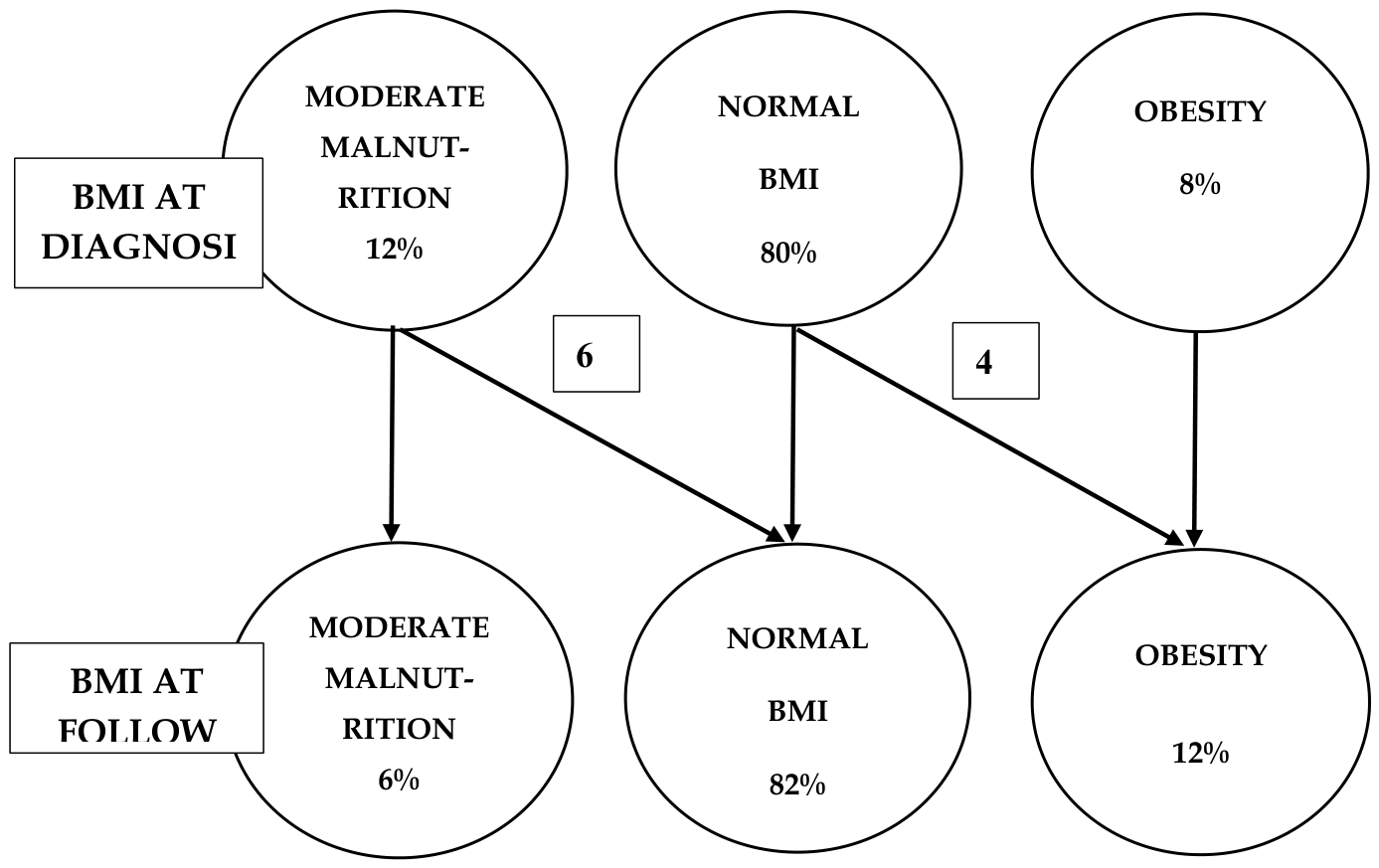

Table 1.
Characteristics of study participants.
| Characteristic | Value |
Gender
|
42(84) 8 (16%) |
Age at diagnosis
|
12.4 years 1-16 years |
Concomitant diseases:
|
6 4 1 2 7 1 |
Table 2.
Index of Severity for Eosinophilic Esophagitis assessed with the available data at diagnosis and the last visit.
Table 2.
Index of Severity for Eosinophilic Esophagitis assessed with the available data at diagnosis and the last visit.
| Severity level | At diagnosis n (%) | At the last visit n (%) |
| inactive | 0 (0%) | 2 (4%) |
| mild active | 32 (64%) | 28 (56%) |
| moderate active | 8 (16%) | 4 (8%) |
| Severe | 10 (20%) | 16 (32%) |
Disclaimer/Publisher’s Note: The statements, opinions and data contained in all publications are solely those of the individual author(s) and contributor(s) and not of MDPI and/or the editor(s). MDPI and/or the editor(s) disclaim responsibility for any injury to people or property resulting from any ideas, methods, instructions or products referred to in the content. |
© 2026 by the authors. Licensee MDPI, Basel, Switzerland. This article is an open access article distributed under the terms and conditions of the Creative Commons Attribution (CC BY) license.
Copyright: This open access article is published under a Creative Commons CC BY 4.0 license, which permit the free download, distribution, and reuse, provided that the author and preprint are cited in any reuse.


