

Submitted:
08 April 2026
Posted:
20 April 2026
You are already at the latest version
Abstract
Background/Objectives: Disease-related malnutrition is highly prevalent in oncology and is associated with poor clinical outcomes. Early detection through nutritional screening is essential; however, the optimal screening tool for ambulatory cancer patients remains uncertain. This study aimed to evaluate the agreement and diagnostic performance of the Malnutrition Screening Tool (MST) and NUTRISCORE compared with the Global Leadership Initiative on Malnutrition (GLIM) criteria in a large nationwide cohort of ambulatory cancer patients. Methods: In this multicenter, observational, cross-sectional nationwide study, adult patients attending oncology day hospitals for intravenous antineoplastic treatment between April and November 2021 were included. Nutritional risk was assessed using MST (cut-off ≥ 2) and NUTRISCORE (cut-off ≥ 5). Malnutrition was diagnosed according to GLIM criteria. Agreement between tools was assessed with Cohen’s kappa, and diagnostic performance was evaluated by sensitivity, specificity, accuracy, positive predictive value, and negative predictive value. Analyses were stratified by tumor nutritional risk and cancer stage. Results: Among 4440 patients from 86 hospitals, 50.7% met the GLIM criteria for malnutrition; 72.5% had moderate and 27.5% severe malnutrition. MST identified 37.5% of patients as being at nutritional risk, compared with 17.3% identified by NUTRISCORE. Agreement between MST and NUTRISCORE was moderate overall (κ = 0.48; 95% CI, 0.45–0.51), but varied markedly according to tumor nutritional risk, ranging from high agreement in high-risk tumors (κ = 0.82) to low agreement in low-risk tumors (κ = 0.28). Relative to GLIM, MST was more sensitive than NUTRISCORE (0.51 vs. 0.27), whereas NUTRISCORE was more specific (0.92 vs. 0.76) and had a higher positive predictive value (0.77 vs. 0.68). Negative predictive value was low for both tools. Conclusions: GLIM-defined malnutrition was highly prevalent in this large cohort of ambulatory patients with cancer. MST provided greater case detection, whereas NUTRISCORE showed a more conservative profile with higher specificity but substantially lower sensitivity. These findings suggest that the choice of screening tool should consider clinical context and tumor-related nutritional risk, and that neither instrument alone reliably excludes malnutrition in outpatient oncology settings.
Keywords:
malnutrition
; cancer
; nutrition screening tools
; ambulatory oncology
; clinical nutrition
; malnutrition diagnosis
1. Introduction
Disease-related malnutrition in patients with cancer represents a major clinical challenge, with a reported prevalence ranging between 30% and 70% depending on tumor location and stage [1]. Malnutrition in this population is consistently associated with increased morbidity and mortality, impaired quality of life, reduced functional capacity, higher rates of treatment-related toxicity, poorer tolerance to chemotherapy and radiotherapy, increased postoperative complications, and overall worse oncologic outcomes [2].
In oncology, malnutrition is a dynamic and progressive condition. It frequently develops early in the disease course and may worsen as the tumor burden increases and systemic inflammation intensifies. If not identified and treated in a timely manner, disease-related malnutrition may progress to cancer cachexia, a multifactorial syndrome characterized by ongoing loss of skeletal muscle mass that is only partially reversible with conventional nutritional support [3].
Given the high incidence of malnutrition in oncology, its progressive nature, and its profound clinical consequences, cancer patients should be systematically screened for nutritional risk throughout the entire cancer process, in order to implement nutritional strategies in a timely manner to prevent further deterioration and avoid progression to irreversible stages.
Several tools are currently used for nutritional screening in oncology populations. The ESPEN clinical guidelines recommend the Malnutrition Screening Tool (MST) and the Malnutrition Universal Screening Tool (MUST) for patients with cancer [4], whereas NUTRISCORE was specifically developed for use in ambulatory oncology settings [5]. Although multiple studies have compared instruments such as NRS-2002, MUST, MST, and NUTRISCORE in this population, there is still no clear consensus regarding their relative diagnostic performance [6,7,8,9,10]. Moreover, there is insufficient evidence to support the superiority of one tool over another, as results vary depending on the reference standard used (e.g., GLIM criteria or PG-SGA), the clinical setting (outpatient, inpatient, or surgical), and the oncologic population studied [11,12].
Previous studies assessing the diagnostic performance of MST and NUTRISCORE have used PG-SGA [13,14] or GLIM criteria [15,16,17] as reference standards, reporting heterogeneous results influenced by care setting and tumor type. Importantly, studies comparing MST and NUTRISCORE against GLIM have largely been conducted in hospitalized patients or in specific tumor sites, such as lung, head and neck, or gastrointestinal cancers. The variability observed in ambulatory oncology populations highlights the need for further research in this context. To our knowledge, no study has comprehensively evaluated the performance of MST and NUTRISCORE against the GLIM diagnostic criteria in a broad cohort of ambulatory cancer patients encompassing multiple tumor locations. Thus, the main objective of this study was to analyse the correlation of the risk of malnutrition according to MST and NUTRISCORE tests with the diagnosis of malnutrition according to GLIM criteria.
2. Materials and Methods
2.1. Study Design and Participants
This was a multicentre, observational, cross-sectional, nation-wide study in standard clinical practice. Patients were recruited and evaluated upon admission to oncohaematology day hospital to receive intravenous antineoplastic treatment. Recruitment took place between Abril and November 2021.
To ensure random selection, a systematic sampling method was used: patients with even-numbered medical records were recruited on even-numbered days, while those with odd-numbered medical records were recruited on odd-numbered days. All patients were followed for a period of six months from the time of recruitment.
We considered the following exclusion criteria: age under 18 years, refusal to participate, or the presence of cognitive impairment. All patients included in the study signed an informed consent form prior to participation.
The OncoNutridos study was promoted by the Spanish Foundation of Hospital Pharmacy and was carried out with the collaboration of the clinical nutrition group and the group for the development of oncological pharmacy of the Spanish Society of Hospital Pharmacy. The study was approved by the Clinical Research Ethics Committee of the Basque Country (CEIm-E), as well as by the ethics committees of all participating hospitals (reference code: OncoNutridos).
2.2. Demographic, Clinical and Anthropometric Measurements
Demographic characteristics, clinical variables, and anthropometric data were collected at the time of patient’s admission to the chemotherapy suite. All patients were interviewed by trained healthcare professionals including pharmacists, nurses, and dieticians.
Anthropometric data included weight (kg), height (m), both obtained from the patient’s medical record, and calf circumference (CC). The most recent weight, used for calculating anticancer drug dosages, was recorded. Usual weight was obtained through patient’s interview, which allowed to assess and quantify the weight loss over time (3-6 months or >6 months). Body mass index (BMI) was calculated as weight in kilograms divided by height in meters squared (kg/m2).
Tumour location, TNM stage (I-II, III-IV) and type of cancer treatment (chemotherapy, radiotherapy, or oncologic surgery), were obtained from the patient’s medical records. Tumour locations were classified into three categories based in NUTRISCORE classification [5,18]: High-, medium- and low-nutritional risk tumours.
2.3. Assessment of Malnutrition Risk and Nutritional Status
Two different screening test were used to identify the risk of malnutrition: Malnutrition Screening Tool (MST) [19], being the cut-off point ≥2; and NUTRISCORE, which includes the MST and adds tumor location and treatment, setting the cut-off point at score ≥5.
Diagnosis of malnutrition was performed using the GLIM criteria as a reference [20,21,22]. This criteria require at least one phenotypic criterion (weight loss, low body mass index, and/or reduced muscle mass) and one etiological criterion (decreased intake, a chronic gastrointestinal condition or systemic inflammation). Severity of malnutrition was graded according to cut-off points suggested for each phenotypic criterion.
Reduced muscle mass was assessed via calf circumference (CC), measured at the widest point using a non-extendable tape measure, with the patient seated and feet flat on the floor. The raw CC was adjusted for the patient’s BMI as follows: If BMI <18 kg/m2 by adding 4 cm, if BMI 25–29,9 kg/m2 by subtracting 3 cm, and if BMI 30–39,9 kg/m2 or >40 kg/m2 by subtracting 7 cm and 12 cm, respectively. Cut-off values for reduced muscle mass were 33 cm in men and 32 cm in women [21].
We also estimated Appendicular Skeletal Mass (ASM) using the validated equation [23]: ASM (kg) = -10 + (CC x 0.768) − (age x 0.029) + (sex x 7.523) (sex: men=1; women=2; all assumed with), and calculated the Appendicular Skeletal Mass Index (ASMI) as ASM/height2.
Regarding the etiological criteria, all patients met the criterion of moderate inflammation because they were cancer patients receiving intravenous antineoplastic treatment at the time of recruitment. A decreased intake was considered when the patient presented a reduction of at least 50% of the baseline amount for at least one week, or any reduction for at least two weeks.
All patients at risk of DRM received general dietary recommendations provided within the study protocol, aimed at increasing caloric and protein intake. These recommendations were delivered to patients by the study investigators, which could include nutrition support pharmacists, nutritionists, dietitians, or physicians, depending on the resources available at each participating hospital. No standardized follow-up regarding adherence to these recommendations or their impact on nutritional status was performed.
2.4. Statistical Analysis
Descriptive statistics are presented as mean ± standard deviation (SD) for continuous variables and as absolute (n) and relative (%) frequencies for categorical variables. Malnutrition assessed by the GLIM criteria was considered as the reference and compared to the other nutritional screening tools. Agreement between these tests and GLIM criteria was analyzed by the kappa (k) statistic. Diagnostic capabilities of the screening tests were evaluated by different metrics: sensibility, specificity, accuracy, predictive positive value (PPV), and negative predictive value (NPV), using standard formulae. All analyses were conducted in R version 4.4.2 (R Core Team 2025).
3. Results
3.1. Patient Characteristics, Risk of Malnutrition and Malnutrition Prevalence
A total of 4,548 patients were included among 86 hospitals between April and November 2021. Of these, 108 patients were excluded due to missing data, resulting in a final sample of 4,440 patients (57% women). Low-risk nutritional tumours were the most prevalent (63,6%), being breast and colorectal the main tumour locations (23.9% and 18.5%, respectively). Most patients (72%) were at an advanced tumour stage (stage III-IV). Regarding treatment, most of the participants were receiving chemotherapy alone (63%) and 25% were oncology surgery patients (Table 1).
Overall, 51.9% of patients had experienced weight loss, with a median loss of 7.1 kg [0.2–74.0]. The prevalence of weight loss increased according to the nutritional risk associated with tumor location, affecting 48.2% of patients with low-risk tumors, 51.6% of those with medium-risk tumors, and 68.6% of those with high-risk tumors. Median weight loss was 8.6 kg [0.5–74.0], 7.1 kg [0.5–73.5], and 8.6 kg [1.0–40.0], respectively.
The mean score for MST was 1.25 ± 1.40 (SD) [range: 0-5]; for NUTRISCORE, the mean value was 2.79 ± 1.78 (SD) [range: 0-9]. Globally, using MST as screening tool, 37.48% of patients were classified at risk of malnutrition, whereas NUTRISCORE detected 17.34% of patients as at nutritional risk. The detection of risk of malnutrition fell down in both test according with the nutritional risk associated with tumor location (Table 2).
The weight loss matched the GLIM diagnostic criteria in 24,4% of patients. Reduced muscle mass was present at 29,98% of patients, and low BMI was detected in 11,8% of patients. Reduced intake or absorption was detected in 27,5% of patients. All patients fulfilled the inflammation criterion, as they were undergoing active chemotherapy for cancer. According to the GLIM diagnostic criteria, 2253 patients (50.74%) presented malnutrition, of whom 72.52% was moderate (1634) and severe in 27.48% (619). Malnutrition prevalence changed depending on tumour location (Table 2), ranging from 37.7% in breast cancer to 75.0% in patients with gastric tumors.
3.2. Agreement Between MST and NUTRISCORE.
The overall agreement between MST and NUTRISCORE was moderate, with an observed agreement of 78.0% and a kappa coefficient of 0.48, indicating a moderate level of concordance between the two risk classification tools (Table 3).
To assess whether agreement between both screening tools varied according to tumor location, concordance was analysed in relation to the nutritional risk associated with each tumor type. Overall, agreement between MST and NUTRISCORE progressively decreased as the nutritional risk of the tumor declined (Table 4). Agreement was very high in high-risk tumors (κ = 0.81), indicating that both tools classified patients in a highly consistent manner. In medium-risk tumors, agreement was moderate (κ = 0.58), with the highest levels observed in lung and biliary tract cancers (κ = 0.62 and 0.64, respectively). In contrast, agreement between MST and NUTRISCORE was clearly limited in low nutritional risk tumors, with κ values generally <0.35 across all locations. The highest agreement in this group was observed in central nervous system (CNS) and prostate tumors; however, these estimates were associated with substantial uncertainty due to the small number of cases.
3.3. Diagnostic Capabilities of the Screening Tests
When GLIM criteria were used as the diagnostic reference, clear differences emerged in the performance of MST and NUTRISCORE (Table 5). MST (≥2) identified approximately half of the patients classified as malnourished (sensitivity 0.51), whereas NUTRISCORE (≥5) detected only one quarter of cases (sensitivity 0.27), highlighting the limited ability of both instruments to achieve complete detection of malnutrition. However, NUTRISCORE demonstrated a greater capacity to correctly classify patients as “not at risk” (specificity 0.92 vs 0.76). Both tools showed low negative predictive values, indicating that a substantial proportion of patients categorized as “not at risk” could still be malnourished; thus, a negative screening result cannot reliably exclude malnutrition.
When the cohort was stratified according to the nutritional risk associated with tumor location, meaningful discrepancies arose in diagnosis accuracy of MST and NUTRISCORE against the GLIM criteria (Table 6). In tumors classified as high nutritional risk, both tools identified a similar proportion of patients as being at risk (54.6% with MST and 51.5% with NUTRISCORE), with comparable sensitivities and positive predictive values. However, this pattern did not persist in tumors of medium and low nutritional risk. In these groups, MST identified substantially more patients at risk and demonstrated consistently higher sensitivity, whereas NUTRISCORE showed markedly lower sensitivity. Conversely, NUTRISCORE exhibited systematically higher specificity, particularly in medium- and low-risk tumors (0.89 and 0.97, respectively), resulting in higher positive predictive values in these groups. Negative predictive values were modest for both tools across all categories. Overall, MST provided greater case detection across risk strata, while NUTRISCORE maintained a more conservative profile characterized by higher specificity, especially in tumors with lower baseline nutritional risk.
Metrics related to the diagnostic performance of MST and NUTRISCORE by specific tumor location are shown in Table 7. Broadly, both screening tools showed the highest sensitivity (≈60%) in head and neck, oesophagus, gastric and pancreas tumors, all of them classified as high-risk nutritional tumors. In the rest of cancer locations analysed, MST had consistently higher sensitivities than NUTRISCORE. MST showed also a good performance (≈50%) in lung and biliary tract tumors (among medium-risk nutritional locations), and in colorectal and leukemia cancers in low-risk nutritional locations. In tumors classified as medium- and low-nutritional risk, NUTRISCORE showed low sensitivities (<0.44 and <0.25, respectively), indicating a limited ability to identify malnutrition according to the GLIM diagnostic criteria. In contrast, NUTRISCORE specificity was consistently high, exceeding 0.80 across all tumor types and reaching values close to 1.00 in some tumors. Overall, accuracy was moderate across most tumor types, with comparable values between both methods and slight advantages observed for MST in several tumor locations.
We also split the cohort to determine if the agreement and performance of both screening tools were influenced by cancer stage. The agreement between MST and NUTRISCORE was moderate in both cancer stages. The kappa index in stages I-II was 0.40 (IC95%: 0.33–0.47), while in stages III-IV it was slightly higher (κ = 0.50; IC95%: 0.46-0.53). When analysing performance, MST demonstrated higher sensitivities than NUTRISCORE in both stages I–II (0.43 vs 0.18) and stages III–IV (0.53 vs 0.29). In contrast, NUTRISCORE showed higher specificities in both groups (0.96 and 0.90, respectively), as well as higher positive predictive values. The negative predictive value was greater with MST in both stages, while overall accuracy was similar between tools in stages I–II (≈ 0.65) and slightly higher for MST in stages III–IV (0.63 vs 0.57).
4. Discussion
The present multicenter study provides a comparison of two widely used nutritional screening tools in ambulatory oncology patients and evaluates their diagnostic performance against malnutrition defined according to the GLIM criteria. Several relevant findings emerge from this analysis.
First, our results confirm the high prevalence of disease-related malnutrition in ambulatory oncology populations. In this cohort, more than half of the patients (50.7%) were classified as malnourished according to GLIM criteria. This finding is consistent with previous studies reporting a substantial burden of malnutrition among oncology patients and reinforces the clinical importance of systematic nutritional assessment in cancer care [24,25]. Notably, this prevalence was observed despite the predominance of tumor types traditionally considered to have lower nutritional risk, such as breast and colorectal cancer. These findings support the concept that malnutrition is not limited to tumors classically associated with severe nutritional impairment but may affect a wide spectrum of oncology patients [1].
Second, differences were observed in the diagnostic performance of the screening tools. Overall, MST identified a substantially higher proportion of patients at nutritional risk than NUTRISCORE (37.5% vs. 17.3%). Gascón-Ruiz et al. (2021) reported higher detection rates (52% MST vs. 38% NUTRISCORE) when evaluating screening performance across tumor sites such as head and neck, digestive, and colorectal cancers. The higher prevalence observed in their cohort likely reflects a study population enriched with tumors associated with higher nutritional risk. Another contributing factor to these differences is the sample size, as the number of patients recruited by Gascón-Ruiz differs significantly from our own cohort. In addition, involuntary weight loss was reported in 60.6% of patients in their study compared with 51.9% in our cohort. Despite differences in absolute prevalence, both studies show a consistent pattern in which MST identifies a greater proportion of patients at nutritional risk than NUTRISCORE, suggesting higher sensitivity of MST in heterogeneous oncology populations.
Third, the moderate agreement observed between both screening tools (κ = 0.48) indicates that they identify partially different patient subsets. Concordance varied considerably according to tumor location and associated nutritional risk. In tumors traditionally associated with severe nutritional impairment—such as upper gastrointestinal or pancreatic cancers—agreement was very high. In contrast, concordance progressively decreased in tumors with lower baseline nutritional risk. This pattern likely reflects the design of NUTRISCORE, which incorporates tumor location and oncologic treatment into its scoring system. Accordingly, the clinical utility of NUTRISCORE appears strongly dependent on the tumor’s nutritional impact. In high-risk tumors, the tool demonstrated excellent agreement (κ = 0.81), higher than the κ = 0.63 reported by Gascón-Ruiz. However, agreement decreased substantially in our overall sample (κ = 0.48) due to the relatively low prevalence of these tumors (14.6%).
This finding suggests that NUTRISCORE may underestimate nutritional risk in tumors with low nutritional impact. Because these tumor locations do not contribute points to the scale, patients must experience greater weight loss to reach the diagnostic threshold of ≥ 5 points.
Consequently, our results suggest that both tools may be interchangeable in tumors with high nutritional risk and are consistent with previously published by other authors (Gascon et al). In medium-risk tumors, agreement was lower (κ = 0.57) and varied according to tumor location. Higher concordance was observed in lung and biliary tract cancers, whereas lower agreement in ovarian cancer indicates greater discrepancies between the instruments. In tumors with low nutritional risk, the tools cannot be considered interchangeable. These findings indicate that the interchangeability of screening instruments is highly dependent on the clinical context.
In advanced stages (III-IV) MST demonstrated higher global accuracy compared to NUTRISCORE (0.63 vs 0.57), suggesting that MST remains more robust identifying nutritional risk as the disease progresses. In contrast, NUTRISCORE may lose some of its screening effectiveness in these more complex stages. Despite this differences in individual performance, the degree of agreement between both tools remained moderate and even increased slightly in advanced stages, as reflected by the Kappa index (0.50 vs 0.40).
Fourth, regarding diagnostic performance compared with GLIM criteria, MST showed approximately double the sensitivity of NUTRISCORE (50.7% vs. 26.5%), indicating greater ability to detect malnourished patients. However, MST still failed to identify approximately 49% of cases. In contrast, NUTRISCORE demonstrated higher specificity (92% vs. 76%), suggesting greater reliability for ruling out malnutrition when patients are classified as having “no risk”.
Both screening methods showed good positive predictive value (PPV), although NUTRISCORE presented a higher PPV (77%), indicating that a positive result is relatively reliable. Conversely, both tools showed low negative predictive values (NPV), particularly NUTRISCORE (55%), indicating that a negative screening result does not reliably exclude malnutrition.
These findings highlight important limitations in the screening capacity of both tools when compared with GLIM criteria. Although MST is twice as sensitive as NUTRISCORE, it still misses nearly half of malnourished patients. This limitation is even more pronounced for NUTRISCORE, which fails to identify approximately three out of four malnourished patients despite its high specificity and strong confirmatory value for positive results. Together, these results support the need to complement nutritional screening with structured diagnostic assessment, particularly in oncology populations at higher risk of malnutrition.
The lower sensitivity observed in our study compared with the findings of Gascón-Ruiz et al. may be explained by differences in study populations. In the Gascón-Ruiz cohort, more than 50% of patients had high-risk tumors (head and neck or upper gastrointestinal), whereas these represented only 14.6% of our sample. Because NUTRISCORE assigns points based on tumor location, patients in their study were more likely to reach the ≥ 5 score threshold. In our cohort, dominated by tumors with lower nutritional impact, the tool relied mainly on severe weight loss to generate a positive result, which likely explains the lower sensitivity observed (26.5%). Differences in treatment intensity may also influence the results, as NUTRISCORE assigns points to aggressive treatments (e.g., concomitant radiochemotherapy), but this point couldn’t be evaluated with respect to cohort comparison.
According to this, our results suggest that in populations where tumors with lower nutritional impact predominate, NUTRISCORE loses the additional scoring contribution derived from tumor location and treatment intensity. Consequently, the tool shows a high rate of false negatives and reduced sensitivity, even when the prevalence of malnutrition remains high.
Based on these discrepancies, our findings suggest that a re-evaluation of the NUTRISCORE scoring criteria may be warranted to improve its sensitivity in contemporary oncological settings. First, our data indicate the need for a re-assignment of the nutritional risk attributed to certain malignancies currently classified as low or moderate risk. In our cohort, these tumors exhibited a high prevalence of malnutrition according to GLIM criteria, but failed to trigger the NUTRISCORE threshold because of their low baseline score. Second the current model might benefit from incorporating age > 70 years as a specific risk factor. This is supported by findings from OncoNutridos study [1], where the prevalence of malnutrition reached 62,86% in patients over 70 years, regardless of tumor location, compared to 50,7% in younger patients.
5. Conclusions
In the OncoNutridos study, the prevalence of malnutrition according to the Global Leadership Initiative on Malnutrition (GLIM) criteria was high (50.7%), affecting one out of every two oncology patients undergoing active treatment, with a predominance of moderate forms (72.5%). This confirms that malnutrition remains a clinical issue of great magnitude in oncology.
Nutritional screening showed relevant differences between tools. MST (≥2) identified a higher number of patients at risk and presented higher overall sensitivity, while NUTRISCORE (≥5) was more specific but had low sensitivity. Consequently, NUTRISCORE adopts a more conservative profile, while MST offers greater detection capacity.
The degree of agreement between MST and NUTRISCORE was moderate, and increased slightly in advanced stages (III–IV). However, MST proved to be a more robust screening tool across all stages, particularly due to its higher sensitivity in advanced disease compared to NUTRISCORE.
Overall, MST appears more suitable as an initial detection tool due to its higher sensitivity, while NUTRISCORE could be useful in contexts where specificity is prioritized. However, the high prevalence of malnutrition supports the need for systematic nutritional assessment in oncology.
Neither tool showed a high negative predictive value, indicating that a negative screening result does not rule out malnutrition according to GLIM.
Strengths and Limitations
This study has several strengths that should be considered when interpreting the results. First, it includes a large multicenter cohort of ambulatory oncology patients recruited from 86 hospitals, providing a broad and heterogeneous representation of real-world clinical practice. The large sample size allowed the inclusion of a wide range of tumor locations and nutritional risk profiles, enabling subgroup analyses according to tumor nutritional risk and stage. This aspect is particularly relevant because the performance of nutritional screening tools may vary depending on tumor characteristics and disease severity.
Second, the study evaluates the performance of two widely used nutritional screening tools against the GLIM criteria, which currently represent an internationally accepted framework for the diagnosis of malnutrition. By comparing screening tools with standardized diagnostic criteria, our study provides clinically meaningful information regarding their ability to identify patients who may require further nutritional assessment.
Third, the multicenter design and inclusion of patients undergoing different oncologic treatments enhance the external validity of the findings. This design reflects the heterogeneity typically observed in ambulatory oncology populations and therefore increases the applicability of the results to routine clinical practice.
However, several limitations should also be acknowledged.
First, although GLIM criteria were used as the diagnostic reference for malnutrition, it should be noted that GLIM itself requires the use of a screening tool as the first step in the diagnostic process. Consequently, the choice of screening instrument may influence the identification of patients entering the diagnostic pathway, which could partially affect comparisons between screening methods.
Second, some tumor subgroups included a relatively small number of patients, which may have limited the precision of diagnostic performance estimates in specific cancer locations. This limitation was particularly relevant in tumors with low incidence within the cohort.
Finally, the study was conducted in ambulatory oncology settings, and therefore the findings may not be directly generalizable to hospitalized cancer patients or to populations with different clinical characteristics.
Despite these limitations, the large sample size and multicenter design provide robust evidence regarding the comparative performance of MST and NUTRISCORE as nutritional screening tools in ambulatory oncology populations.
Author Contributions
Conceptualization, C.R., O.O., and S.V.; methodology, C.R., O.O., and S.V.; validation, C.R., O.O., S.V., and M.S.; formal analysis, C.R., O.O., S.V., and M.S.; investigation, L.L., E.P., R.R., L.P., P.T., S.H., A.C., R.G., F.Q., I.C., and M.E.G.; resources, C.R., O.O., and S.V.; data curation, C.R., O.O., S.V. and M.S.; writing—original draft preparation, C.R., O.O., S.V. and M.S.; writing—review and editing, C.R., O.O., S.V. and M.S.; supervision, C.R., O.O., and S.V.; project administration, C.R., O.O., and S.V.; funding acquisition, C.R., O.O., and S.V. All authors have read and agreed to the published version of the manuscript.
Funding
This research was funded in recruiting and publishing by Fresenius Kabi®.
Institutional Review Board Statement
The study was conducted in accordance with the Declaration of Helsinki, and approved by the Institutional Review Board (or Ethics Committee) of Basque Country (CEIm-E), as well as by the ethics committees of all participating hospitals (reference code: OncoNutridos).
Informed Consent Statement
Informed consent was obtained from all subjects involved in the study.
Acknowledgments
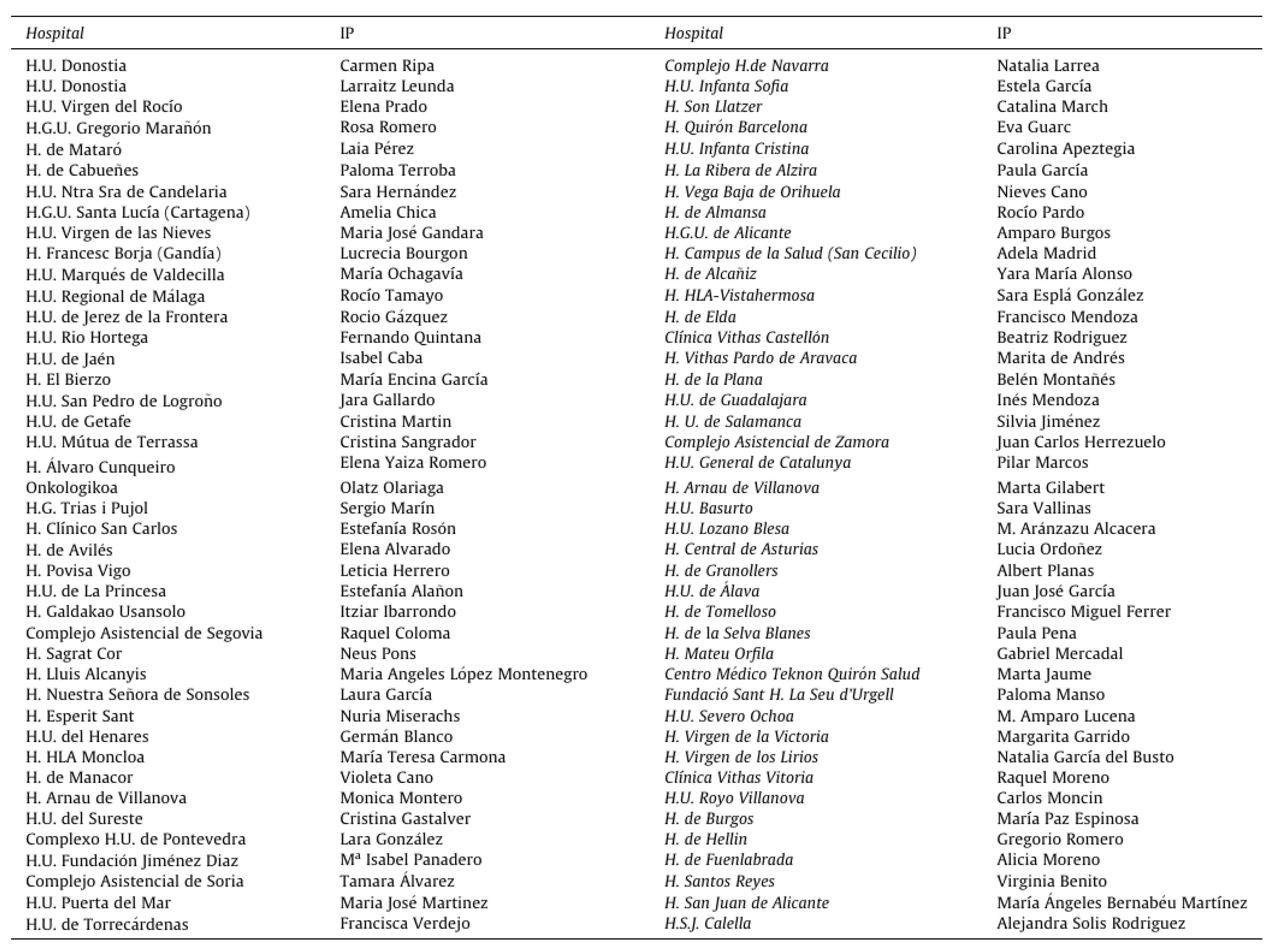
The OncoNutridos study has been possible by the work of the investigators in the 86 hospitals enrolled that are mentioned in Appendix A.
Conflicts of Interest
The authors declare no conflicts of interest. The funders had no role in the design of the study; in the collection, analyses, or interpretation of data; in the writing of the manuscript; or in the decision to publish the results.
Abbreviations
The following abbreviations are used in this manuscript:
| MDPI | Multidisciplinary Digital Publishing Institute |
| DOAJ | Directory of open access journals |
| TLA | Three letter acronym |
| LD | Linear dichroism |
Appendix A
Hospitals enrolled and IP
References
- Ripa, C.; Olariaga, O.; Vallinas, S.; Sirvent, M.; Prado, E.; Romero, R.; et al. OncoNutridos study: Prevalence of disease-related malnutrition according to GLIM criteria in cancer patients in oncohaematology day hospitals. Clin Nutr ESPEN 2025, 70, 666–675. [Google Scholar] [CrossRef]
- Arends, J. Malnutrition in cancer patients: Causes, consequences and treatment options. Eur J Surg Oncol. 2024, 50(5), 107074. [Google Scholar] [CrossRef]
- Faiad, J.; Andrade, M.F.; de Castro, G.; de Resende, J.; Coêlho, M.; Aquino, G.; Seelaender, M. Muscle loss in cancer cachexia: what is the basis for nutritional support? Front Pharmacol. 2025, 16, 1519278. [Google Scholar] [CrossRef] [PubMed]
- Arends, J.; Bachmann, P.; Baracos, V.; Barthelemy, N.; Bertz, H.; Bozzetti, F.; et al. ESPEN guidelines on nutrition in cancer patients. Clin Nutr. 2017, 36(1), 11–48. [Google Scholar] [CrossRef] [PubMed]
- Arribas, L.; Hurtós, L.; Sendrós, M.J.; Peiró, I.; Salleras, N.; Fort, E.; Sánchez-Migallón, J.M. NUTRISCORE: A new nutritional screening tool for oncological outpatients. Nutrition 2017, 33, 297–303. [Google Scholar] [CrossRef] [PubMed]
- Chen, X.; Liu, X.; Ji, W.; Zhao, Y.; He, Y.; Liu, Y.; et al. The PG-SGA outperforms the NRS 2002 for nutritional risk screening in cancer patients: a retrospective study from China. Front Nutr. 2023, 10, 1272420. [Google Scholar] [CrossRef]
- Tan, S.; Jiang, J.; Qiu, L.; Liang, Y.; Meng, J.; Tan, N.; Xiang, B. Prevalence of Malnutrition in Patients with Hepatocellular Carcinoma: A Comparative Study of GLIM Criteria, NRS2002, and PG-SGA, and Identification of Independent Risk Factors. Nutr Cancer 2024, 76(4), 335–344. [Google Scholar] [CrossRef]
- Cortés-Aguilar, R.; Malih, N.; Abbate, M.; Fresneda, S.; Yañez, A.; Bennasar-Veny, M. Validity of nutrition screening tools for risk of malnutrition among hospitalized adult patients: A systematic review and meta-analysis. Clin Nutr. 2024, 43(5), 1094–1116. [Google Scholar] [CrossRef]
- Zhang, Z.; Wan, Z.; Zhu, Y.; Zhang, L.; Zhang, L.; Wan, H. Prevalence of malnutrition comparing NRS2002, MUST, and PG-SGA with the GLIM criteria in adults with cancer: A multi-center study. Nutrition 2021, 83, 111072. [Google Scholar] [CrossRef]
- Trujillo, E.B.; Kadakia, K.C.; Thomson, C.; et al. Malnutrition risk screening in adult oncology outpatients: an ASPEN systematic review and clinical recommendations. J Parenter Enteral Nutr. 2024, 48, 874–894. [Google Scholar] [CrossRef]
- Molfino, A.; Imbimbo, G.; Laviano, A. Current Screening Methods for the Risk or Presence of Malnutrition in Cancer Patients. Cancer Manag Res. 2022, 14, 561–567. [Google Scholar] [CrossRef]
- Gil-Andrés, D.; Cabañas-Alite, L. A Narrative Review Comparing Nutritional Screening Tools in Outpatient Management of Cancer Patients. Nutrients 2024, 16(5), 752. [Google Scholar] [CrossRef]
- Susetyowati, S.; Sarasati, R.; Rizqi, F.; Sanubari, N.; Nuraini, A. Determining the Valid Tools to Screen Malnutrition in Cancer Patients: A Comparison to Patient Generated-Subjective Global Assessment (PG-SGA). Journal Gizi Indonesia (The Indonesian Journal of Nutrition) 2025, 11, 49–56. [Google Scholar] [CrossRef]
- Kang, J.; Li, H.; Shi, X.; Ma, E.; Chen, W. Validation of the efficacy of the NUTRISCORE for the nutritional screening of cancer patients in China. BMC Cancer 2022, 22(1), 43. [Google Scholar] [CrossRef] [PubMed]
- Gascón-Ruiz, M.; Casas-Deza, D.; Torres-Ramón, I.; Zapata-García, M.; Alonso, N.; Sesma, A.; et al. Comparation of different malnutrition screening tools according to GLIM criteria in cancer outpatiens. Eur J Clin Nutr. 2021, 76(5), 698–702. [Google Scholar] [CrossRef] [PubMed]
- Accuracy of screening tools in predicting malnutrition in cancer outpatients according to the glim criteria. In Clinical Nutrition ESPEN; Tobberup, R., Thoresen, L., LUCANO, Eds.; 2020; Volume 40, pp. 565–566. [Google Scholar]
- Merchán-Chaverra, R.A.; Acero-Alfonso, D.A.; Cuellar-Fernandez, Y.M.; Medina-Parra, J.; Lloreda, P.S. Malnutrition screening tool and nutritional screening tool for classification of nutritional risk in patients with cancer upon hospital admission: Comparison of diagnostic performance using Global Leadership Initiative on malnutrition criteria as reference. Clin Nutr ESPEN 2024, 61, 46–51. [Google Scholar] [CrossRef] [PubMed]
- Wie, G.A.; Cho, Y.A.; Kim, S.Y.; Kim, S.M.; Bae, J.M.; Joung, H. Prevalence and risk factors of malnutrition among cancer patients according to tumor location and stage in the National Cancer Center in Korea. Nutrition 2010, 26, 263–8. [Google Scholar] [CrossRef]
- Ferguson, M.; Capra, S.; Bauer, J.; Banks, M. Development of a valid and reliable malnutrition screening tool for adult acute hospital patients. Nutrition 1999, 15(6), 458–64. [Google Scholar] [CrossRef]
- Cederholm, T.; Jensen, G.L.; Correia, M.I.T.D.; Gonzalez, M.C.; Fukushima, R.; Higashiguchi, T.; et al.; GLIM Core Leadership Committee; GLIM Working Group GLIM criteria for the diagnosis of malnutrition - A consensus report from the global clinical nutrition community. Clin Nutr. 2019, 38(1), 1–9. [Google Scholar] [CrossRef]
- Barazzoni, R.; Jensen, G.L.; Correia, M.I.T.D.; Gonzalez, M.C.; Higashiguchi, T.; Shi, H.P.; et al. Guidance for assessment of the muscle mass phenotypic criterion for the Global Leadership Initiative on Malnutrition (GLIM) diagnosis of malnutrition. Clin Nutr. 2022, 41(6), 1425–1433. [Google Scholar] [CrossRef]
- Cederholm, T.; Jensen, G.L.; Ballesteros-Pomar, M.D.; Blaauw, R.; Correia, M.I.T.D.; Cuerda, C.; et al. Guidance for assessment of the inflammation etiologic criterion for the GLIM diagnosis of malnutrition: A modified Delphi approach. Clin Nutr. 2024, 43(5), 1025–1032. [Google Scholar] [CrossRef] [PubMed]
- Santos, L.P.; Gonzalez, M.C.; Orlandi, S.P.; Bielemann, R.M.; Barbosa-Silva, T.G.; Heymsfield, S.B. COCONUT Study Group. New Prediction Equations to Estimate Appendicular Skeletal Muscle Mass Using Calf Circumference: Results From NHANES 1999-2006. JPEN J Parenter Enteral Nutr. 2019, 43(8), 998–1007. [Google Scholar] [CrossRef] [PubMed]
- Muscaritoli, M.; Lucia, S.; Farcomeni, A.; Lorusso, V.; Saracino, V.; Barone, C. PreMiO Study Group. Prevalence of malnutrition in patients at first medical oncology visit: the PreMiO study. Oncotarget 2017, 8(45), 79884–79896. [Google Scholar] [CrossRef]
- de Melo Silva, F.R.; de Oliveira Lima Sales, J.T.; de Morais Borba, G.; Silveira, A.C.R.; de Mello, M.J.G.; Fayh, A.P.T.; Souza, A.S.R. Malnutrition in older adults with cancer undergoing outpatient care: associated factors. Support Care Cancer 2026, 34(4), 282. [Google Scholar] [CrossRef] [PubMed]

Table 1.
Demographic and tumor-related clinical variables.
| Variables | n (%) | Variables | n (%) |
| Sex | Tumor location | ||
| Male | 1909 (43.0) | High-risk nutritional tumors (n=649) | |
| Female | 2531 (57.0) | Head and neck | 104 (2.3) |
| Esophagus | 67 (1.5) | ||
| Age (years) | 61.1 [53.0; 74.0] | Stomach | 164 (3.7) |
| Small intestine | 34 (0.8) | ||
| Cancer stage | Digestive lymphomas | 47 (1.1) | |
| I-II | 1228 (27.7) | Pancreas | 233 (5.2) |
| III-IV | 3212 (72.3) | Medium-risk nutritional tumors (n=967) | |
| Lung | 554 (12.5) | ||
| BMI (Kg/m2) | Ovarian | 201 (4.5) | |
| Mean (SD) | 25.9 (4.9) | Endometrium | 67 (1.5) |
| Median | 25.3 | Biliary tract | 54 (1.2) |
| Liver | 48 (1.1) | ||
| BMI by groups (Kg/m2) | Kidney | 43 (1.0) | |
| < 18.5 | 162 (3.7) | Low-risk nutritional tumors (n=2824) | |
| 18.5-19.9 | 227 (5.1) | Breast | 1061 (23.9) |
| 20.0-24.9 | 1676 (37.7) | Colorectal | 823 (18.5) |
| 24.9-29.9 | 1563 (35.2) | Leukemias | 91 (2.0) |
| ≥ 30 | 812 (18.3) | Other lymphomas | 285 (6.4) |
| Prostate | 70 (1.6) | ||
| ASMI (Kg/m2) by sex | Bladder | 99 (2.2) | |
| Male (Mean; SD) | 7.28 (0.84) | CNS | 20 (0.5) |
| Female (Mean; SD) | 5.25 (0.98) | Other tumors | 375 (8.4) |
Data are shown as median [IQR] for continuous variables and number of cases (%) for categorical variables.
Table 2.
Risk of malnutrition and malnutrition prevalence by tumor location.
| Tumor location | Risk of malnutrition | Malnutrition | |
| MST | NUTRISCORE | ||
| n (%) | n (%) | n (%) | |
| High-risk nutritional tumours | 355 (54.7) | 335 (51.6) | 438 (67.49) |
| Head and neck | 48 (46.2) | 54 (51.9) | 64 (61.5) |
| Oesophagus | 43 (64.2) | 40 (59.7) | 44 (65.7) |
| Stomach | 100 (61.0) | 92 (56.1) | 123 (75.0) |
| Small intestine | 13 (38.2) | 8 (23.5) | 18 (52.9) |
| Digestive lymphomas | 15 (31.9) | 14 (29.8) | 23 (48.9) |
| Pancreas | 136 (58.4) | 127 (54.5) | 166 (71.2) |
| Medium-risk nutritional tumours | 378 (39.1) | 210 (21.7) | 505 (52.22) |
| Lung | 228 (41.2) | 140 (25.3) | 294 (53.1) |
| Ovary | 74 (36.8) | 24 (11.9) | 104 (51.7) |
| Endometrium | 22 (32.8) | 13 (19.4) | 30 (44.8) |
| Biliary tract | 25 (46.3) | 15 (27.8) | 27 (50.0) |
| Liver | 14 (29.2) | 12 (25.0) | 25 (52.1) |
| Kidney | 15 (34.9) | 6 (14.0) | 25 (58.1) |
| Low-risk nutritional tumours | 931 (33.0) | 225 (8.0) | 1,310 (46.39) |
| Breast | 280 (26.4) | 39 (3.7) | 400 (37.7) |
| Colorectal | 337 (31.8) | 103 (12.5) | 458 (55.7) |
| Leukemias | 34 (37.4) | 8 (8.8) | 45 (49.5) |
| Other lymphoma | 89 (31.2) | 23 (8.1) | 135 (47.4) |
| Prostate | 20 (28.6) | 7 (10.0) | 35 (50.0) |
| Bladder | 31 (31.3) | 8 (8.1) | 54 (54.5) |
| CNS | 5 (25.0) | 2 (10.0) | 4 (20.0) |
| Other tumours | 135 (36.0) | 35 (13.2) | 179 (47.7) |
MST: Malnutrition screening tool.
Table 3.
Agreement between MST and NUTRISCORE.
| VARIABLE | VALUE |
| OBSERVED AGREEMENT (PO) | 0.780 |
| EXPECTED AGREEMENT (PE) | 0.660 |
| COHEN’S KAPPA (κ) | 0.481 |
| STANDARD ERROR | 0.0148 |
| 95% CI FOR κ | 0.452–0.510 |
| INTERPRETATION | Moderate agreement |
Table 4.
Agreement between MST and NUTRISCORE regarding tumor location.
| Tumor location | Kappa (κ) | 95% CI | Standard error |
| High nutritional risk | 0.82 | 0.77-0.86 | 0.02 |
| Head and neck | 0.73 | 0.60-0.86 | 0.07 |
| Oesophagus | 0.84 | 0.70-0.97 | 0.07 |
| Stomach | 0.87 | 0.80-0.95 | 0.04 |
| Small intestine | 0.66 | 0.39-0.94 | 0.14 |
| Digestive lymphomas | 0.85 | 0.69-1.01 | 0.08 |
| Pancreas | 0.80 | 0.72-0.88 | 0.04 |
| Medium nutritional risk | 0.58 | 0.52-0.63 | 0.03 |
| Lung | 0.64 | 0.58-0.71 | 0.03 |
| Ovary | 0.38 | 0.23-0.53 | 0.08 |
| Endometrium | 0.51 | 0.27-0.75 | 0.12 |
| Biliary tract | 0.62 | 0.40-0.83 | 0.11 |
| Liver | 0.58 | 0.31-0.84 | 0.14 |
| Kidney | 0.46 | 0.15-0.77 | 0.16 |
| Low nutritional risk | 0.28 | 0.24-0.33 | 0.02 |
| Breast | 0.18 | 0.09-0.27 | 0.05 |
| Colorectal | 0.32 | 0.25-0.40 | 0.04 |
| Leukemias | 0.27 | 0.04-0.51 | 0.12 |
| Other lymphoma | 0.30 | 0.16-0.45 | 0.07 |
| Prostate | 0.35 | 0.06-0.64 | 0.15 |
| Bladder | 0.32 | 0.08-0.57 | 0.12 |
| CNS | 0.50 | -0.03-1.02 | 0.27 |
| Other tumours | 0.29 | 0.17-0.40 | 0.07 |
MST: Malnutrition screening tool.
Table 5.
Diagnostic performance of MST and NUTRISCORE comparing with GLIM.
| Score | n (%) positive | Accuracy | Sensitivity | Specificity | PPV | NPV | |
| MST | ≥ 2 | 1664 (37.5) | 0.63 | 0.51 | 0.76 | 0.68 | 0.60 |
| NUTRISCORE | ≥ 5 | 770 (17.3) | 0.58 | 0.27 | 0.92 | 0.77 | 0.55 |
MST: Malnutrition screening tool; PPV: Positive predictive value; NPV: Negative predictive value.
Table 6.
Diagnostic performance MST and NUTRISCORE by tumor nutritional risk.
| Group |
n (%) positive |
Sensitivity | Specificity | PPV | NPV | Accuracy | |
| High risk | MST | 355 (54.6) | 0.61 | 0.59 | 0.76 | 0.43 | 0.61 |
| NUTRISCORE | 335 (51.5) | 0.58 | 0.61 | 0.75 | 0.41 | 0.59 | |
| Medium risk | MST | 378 (39.1) | 0.52 | 0.75 | 0.69 | 0.59 | 0.63 |
| NUTRISCORE | 210 (21.7) | 0.32 | 0.89 | 0.76 | 0.54 | 0.59 | |
| Low risk | MST | 931 (33.0) | 0.47 | 0.79 | 0.66 | 0.63 | 0.64 |
| NUTRISCORE | 225 (7.9%) | 0.14 | 0.97 | 0.82 | 0.57 | 0.59 |
MST: Malnutrition screening tool; PPV: Positive predictive value; NPV: Negative predictive value.
Table 7.
MST and NUTRISCORE diagnostic capabilities based on tumor location.
| Tumor location | Tool | Sensitivity | Specificity | PPV | NPV | Accuracy |
| High nutritional risk | ||||||
| Head and neck | MST | 0.61 | 0.78 | 0.81 | 0.55 | 0.67 |
| NUTRISCORE | 0.66 | 0.70 | 0.78 | 0.56 | 0.67 | |
| Oesophagus | MST | 0.66 | 0.66 | 0.67 | 0.35 | 0.56 |
| NUTRISCORE | 0.61 | 0.41 | 0.68 | 0.35 | 0.55 | |
| Stomach | MST | 0.64 | 0.49 | 0.79 | 0.31 | 0.60 |
| NUTRISCORE | 0.59 | 0.51 | 0.78 | 0.29 | 0.57 | |
| Small intestine | MST | 0.39 | 0.63 | 0.54 | 0.48 | 0.50 |
| NUTRISCORE | 0.22 | 0.75 | 0.50 | 0.46 | 0.47 | |
| Digestive lymphomas | MST | 0.43 | 0.79 | 0.67 | 0.59 | 0.62 |
| NUTRISCORE | 0.39 | 0.79 | 0.64 | 0.58 | 0.60 | |
| Pancreas | MST | 0.63 | 0.55 | 0.77 | 0.38 | 0.61 |
| NUTRISCORE | 0.59 | 0.58 | 0.77 | 0.37 | 0.59 | |
| Medium nutritional risk | ||||||
| Lung | MST | 0.55 | 0.75 | 0.71 | 0.60 | 0.64 |
| NUTRISCORE | 0.36 | 0.87 | 0.75 | 0.54 | 0.60 | |
| Ovary | MST | 0.49 | 0.77 | 0.69 | 0.59 | 0.63 |
| NUTRISCORE | 0.19 | 0.96 | 0.83 | 0.53 | 0.57 | |
| Endometrium | MST | 0.40 | 0.73 | 0.55 | 0.60 | 0.58 |
| NUTRISCORE | 0.27 | 0.86 | 0.62 | 0.59 | 0.60 | |
| Biliary tract | MST | 0.59 | 0.67 | 0.64 | 0.62 | 0.63 |
| NUTRISCORE | 0.37 | 0.81 | 0.67 | 0.56 | 0.59 | |
| Liver | MST | 0.44 | 0.86 | 0.79 | 0.58 | 0.64 |
| NUTRISCORE | 0.44 | 0.95 | 0.92 | 0.60 | 0.68 | |
| Kidney | MST | 0.40 | 0.71 | 0.67 | 0.44 | 0.52 |
| NUTRISCORE | 0.20 | 0.94 | 0.83 | 0.44 | 0.50 | |
| Low nutritional risk | ||||||
| Breast | MST | 0.41 | 0.82 | 0.58 | 0.70 | 0.67 |
| NUTRISCORE | 0.07 | 0.98 | 0.72 | 0.63 | 0.63 | |
| Colorectal | MST | 0.54 | 0.75 | 0.74 | 0.57 | 0.64 |
| NUTRISCORE | 0.19 | 0.96 | 0.85 | 0.48 | 0.53 | |
| Leukemias | MST | 0.51 | 0.74 | 0.68 | 0.59 | 0.63 |
| NUTRISCORE | 0.18 | 1.00 | 1.00 | 0.54 | 0.56 | |
| Other lymphoma | MST | 0.44 | 0.80 | 0.67 | 0.61 | 0.63 |
| NUTRISCORE | 0.14 | 0.97 | 0.83 | 0.55 | 0.60 | |
| Prostate | MST | 0.34 | 0.77 | 0.60 | 0.54 | 0.56 |
| NUTRISCORE | 0.20 | 1.00 | 1.00 | 0.56 | 0.61 | |
| Bladder | MST | 0.39 | 0.78 | 0.68 | 0.52 | 0.57 |
| NUTRISCORE | 0.13 | 0.98 | 0.88 | 0.48 | 0.60 | |
| CNS | MST | 0.50 | 0.80 | 0.40 | 0.86 | 0.74 |
| NUTRISCORE | 0.25 | 0.93 | 0.50 | 0.82 | 0.83 | |
| Other tumours | MST | 0.45 | 0.75 | 0.60 | 0.62 | 0.61 |
| NUTRISCORE | 0.16 | 0.97 | 0.80 | 0.58 | 0.62 | |
MST: Malnutrition screening tool; PPV: Positive predictive value; NPV: Negative predictive value.
Disclaimer/Publisher’s Note: The statements, opinions and data contained in all publications are solely those of the individual author(s) and contributor(s) and not of MDPI and/or the editor(s). MDPI and/or the editor(s) disclaim responsibility for any injury to people or property resulting from any ideas, methods, instructions or products referred to in the content. |
© 2026 by the authors. Licensee MDPI, Basel, Switzerland. This article is an open access article distributed under the terms and conditions of the Creative Commons Attribution (CC BY) license (http://creativecommons.org/licenses/by/4.0/).
Copyright: This open access article is published under a Creative Commons CC BY 4.0 license, which permit the free download, distribution, and reuse, provided that the author and preprint are cited in any reuse.


