
Submitted:
16 April 2026
Posted:
18 April 2026
You are already at the latest version
Abstract
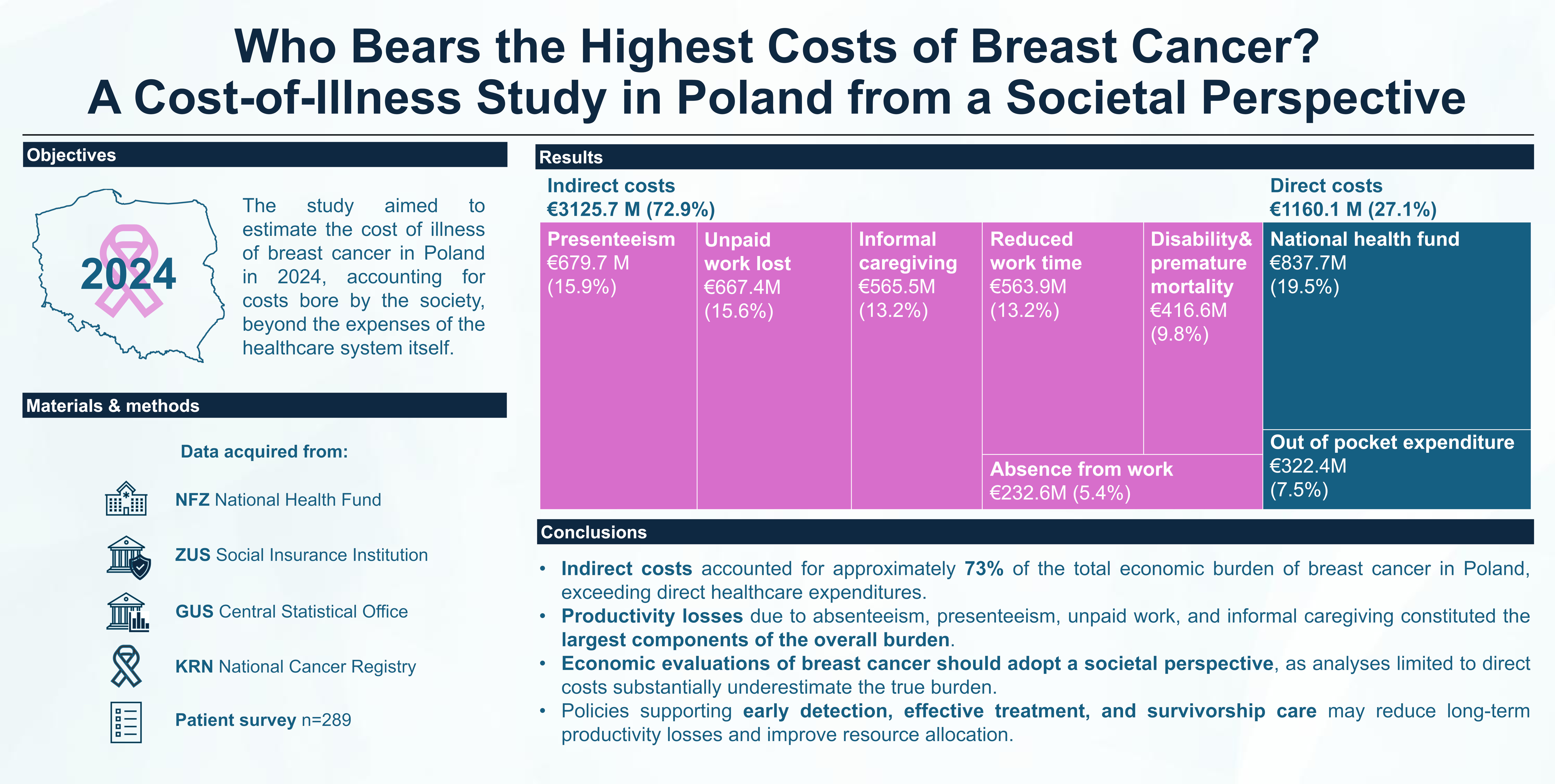
Background/Objectives: Breast cancer represents a major public health and economic challenge, generating substantial costs for healthcare systems, patients, and the broader economy. In Poland, comprehensive assessments capturing the full societal burden remain limited. This study aimed to estimate the cost of illness of breast cancer in Poland in 2024 from a societal perspective, including direct and indirect costs, and to assess their distribution across cost bearers. Methods: A cost-of-illness analysis was conducted using a societal perspective. Data were derived from administrative sources, including the National Health Fund (NFZ), Social Insurance Institution (ZUS), Central Statistical Office (GUS), and National Cancer Registry (NCR), supplemented with a patient survey (n = 289). Direct medical, direct non-medical, and indirect costs were estimated. Productivity losses were valued using a human capital approach with a GDP-based productivity metric adjusted by a correction factor. Results: Total costs of breast cancer in Poland in 2024 were dominated by indirect costs, which accounted for approximately 73% of the total burden. Direct costs represented 27% and included €837.7 million in public healthcare expenditures and €322.4 million in patient-borne costs. Among indirect costs, absenteeism, presenteeism, unpaid work, and informal caregiving contributed substantially, with productivity losses exceeding several hundred million euros in each category. The largest single indirect component was absenteeism, followed by presenteeism and unpaid work. Conclusions: Breast cancer imposes a substantial societal burden in Poland, driven predominantly by indirect costs. These findings highlight the importance of adopting a societal perspective in economic evaluations and support the inclusion of productivity losses in health policy decision-making.
Keywords:
breast cancer
; cost-of-illness
; economic burden
; societal perspective
; indirect costs
; productivity loss
; absenteeism
; presenteeism
; Poland
; healthcare costs
Copyright: This open access article is published under a Creative Commons CC BY 4.0 license, which permit the free download, distribution, and reuse, provided that the author and preprint are cited in any reuse.


