

Submitted:
16 April 2026
Posted:
17 April 2026
You are already at the latest version
Abstract
The sound speed profile (SSP) is a core environmental parameter for underwater acoustic detection, navigation, communication, and other applications. However, its accurate acquisition is constrained by the sparsity of observational data and the ill-posed nature of inversion problems. This paper systematically reviews the research progress of SSP inversion under sparse observation constraints: it combs the technical evolution from physical model-driven methods (Matched Field Processing, MFP; Compressed Sensing, CS) to data-driven approaches (Dictionary Learning, DL; Machine Learning, ML), and classifies and compares the principles, applicable scenarios, advantages, and disadvantages of mainstream methods. It integrates typical measured cases from existing studies (including mesoscale eddy monitoring, underwater navigation and positioning, etc.) and quantitatively analyzes the inversion accuracy and practical value of different technical routes. The research shows that fusing physical constraints with multi-source sparse data (remote sensing, in-situ discrete measurements) is the core direction to balance inversion accuracy, efficiency, and cost. This paper provides a comprehensive reference for technical selection in fields such as marine national defense and resource exploration.
Keywords:
sound speed profile (SSP)
; sparse observation
; inversion method
; marine acoustics
; machine learning
1. Introduction
The sound speed profile (SSP) characterizes the vertical distribution of seawater sound speed with depth. As a core marine physical parameter, it plays a decisive role in underwater acoustic wave propagation—specifically, it regulates propagation paths, sound field focusing, and sound ray bending. For practical applications, SSP accuracy directly dictates the performance of sonar systems, underwater target positioning, navigation, and acoustic communication networks. In fact, it has become an irreplaceable environmental foundation for almost all underwater acoustic tasks, from military target detection to civilian marine resource exploration[1,2,3,4].
However, obtaining accurate and real-time SSP faces enormous challenges. Traditional direct measurement methods (such as deploying sound speed profilers or indirect calculation via Conductivity-Temperature-Depth (CTD)/Expendable CTD (XCTD) instruments) offer high precision but are time-consuming, labor-intensive and costly, with extremely limited spatial and temporal coverage, making it difficult to meet the urgent demand for large-scale, fast and real-time environmental information acquisition in modern marine applications[5]. At the same time, traditional inversion methods based on sound field measurements, such as the early Ocean Acoustic Tomography (OAT), usually require the deployment of complex and expensive vertical line arrays or horizontal arrays to obtain dense sound field data, which is difficult to deploy and has strict requirements on data sources[6,7]. More fundamentally, in the actual marine environment, the amount of both in-situ measured sound speed data and received sound field signals is often limited and sparse[8], leading to the inversion problem becoming a typical ill-posed problem in mathematics and posing fundamental difficulties for accurate solution[5].
This research stems directly from a practical contradiction: traditional methods fail to meet the demand for real-time, accurate SSP in modern marine applications. Against this backdrop, emerging data sources and theoretical breakthroughs have opened up new avenues[9,10,11,12]. Satellite remote sensing, for instance, now delivers large-scale, high-resolution surface parameters—including sea surface temperature anomaly (SSTA) and sea surface height anomaly (SLA)—laying the groundwork for "surface-to-subsurface" SSP inference. Yet a key limitation remains: remote sensing cannot penetrate the water column, making it hard to capture vertical stratification details—a critical gap that current research aims to address[13,14]. Compressed sensing theory has matured into a robust mathematical tool—one that enables signal recovery from far fewer observations than traditional methods demand. Its core insight, leveraging signal sparsity to tackle ill-posed inverse problems, directly targets the "sparse observation" bottleneck in SSP inversion[15]. Meanwhile, artificial intelligence (AI), particularly deep learning, has demonstrated remarkable potential in modeling complex nonlinear relationships between sea surface parameters and underwater SSP. This capability has paved the way for multi-source data fusion, offering new technical solutions to boost inversion accuracy and computational efficiency in practical scenarios[16].
Therefore, researching methods to achieve high-precision and high-efficiency inversion of SSP under sparse observation conditions (such as a small number of acoustic sensors and mainly relying on sea surface remote sensing data) has great theoretical and practical significance.

Table 1.
The significance of SSP researches.
| Dimension of Significance | Specific Embodiment | Impact and Value |
|---|---|---|
| Practical Value | Improving inversion efficiency and feasibility | It seeks to address the limitations of traditional direct measurement and complex array deployment, offering technical pathways for rapid, low-cost, large-scale SSP estimation. This is crucial for application scenarios with high timeliness requirements such as real-time tracking of underwater targets, dynamic navigation and emergency marine monitoring. |
| Guaranteeing the accuracy of key underwater applications | Accurate SSP is the foundation of underwater positioning, navigation and timing, reliable acoustic communication and target detection. Obtaining more accurate SSP through sparse observations can significantly improve the accuracy of sound field calculation, thereby directly enhancing the performance and reliability of various marine systems that rely on acoustic information. | |
| Theoretical Value | Promoting cross-border innovation of methodologies | Strongly promoting the in-depth cross-integration of marine acoustics, signal processing, satellite remote sensing and artificial intelligence. For example, combining compressed sensing with acoustic inversion, optimizing the traditional empirical orthogonal function representation using dictionary learning, or constructing complex surface-underwater mappings using neural networks provides innovative methodologies for solving the classic problem of marine environmental parameter inversion. |
| Deepening the understanding of marine acoustic coupling processes | Exploring how to recover the complete vertical profile from limited surface or acoustic information is itself an in-depth exploration of the physical mechanism by which marine dynamic processes (such as mesoscale eddies and fronts) modulate the spatial structure of SSP and thus affect sound propagation, which plays a promoting role in the basic research of physical oceanography and underwater acoustics. |
To sum up, this research focuses on SSP inversion under sparse observation conditions. Its core driving force lies in integrating advanced theories—like compressed sensing and machine learning—with new data sources (e.g., multi-source remote sensing) to overcome traditional method limitations. The ultimate goal is to realize efficient, accurate, and practical SSP acquisition.
2. Technical Development History and Classic Literature Context
SSP inversion technology has evolved to tackle two core bottlenecks: traditional methods are time-consuming, labor-intensive, and spatially limited, while sparse observations often lead to ill-posed inverse problems. From its early days of idealized, data-heavy physical inversion, the field has gradually shifted toward practical, data-driven intelligent estimation. This evolution follows a clear, overlapping iterative path: first laying theoretical and mathematical foundations, then advancing traditional physical inversion methods, followed by a methodological shift toward sparsity, and finally embracing data-driven intelligence. (Figure 1.)
2.1. Foundation of Basic Theories and Parameterization (1970s–1980s)
The 1970s–1980s laid the physical and mathematical groundwork for SSP inversion, with dimensionality reduction emerging as a key innovative idea.
2.1.1. Proposal of Ocean Acoustic Tomography
A landmark contribution came from Munk and Wunsch[17], who systematically introduced Ocean Acoustic Tomography (OAT). Their work built a theoretical framework for inverting marine physical parameters—including SSP—using acoustic propagation time and related signals. Critically, this study shifted acoustic inversion from passive measurement to active solution of the "inverse problem", a breakthrough that remains the physical core of nearly all modern inversion methods[18,19].
2.1.2. Parameterization and Dimensionality Reduction of SSP
To tackle the high-dimensional nature of SSP, LeBlanc and Middleton[20] proposed Empirical Orthogonal Function (EOF) decomposition as a basis for SSP parameterization. The approach works by first conducting statistical analysis on historical SSP databases to extract dominant variation modes. These modes then allow the infinite-dimensional continuous SSP to be represented using just a few EOF coefficients—effectively reducing the parameter dimension of the inversion problem[11,21,22]. This breakthrough provided the earliest practical toolbox for addressing data sparsity, a challenge that still persists in modern marine observations.
2.2. Deepening of Traditional Physical Inversion Methods (1990s–Early 2000s)
Building on the OAT theoretical framework, researchers in the 1990s–early 2000s developed a suite of traditional physical inversion methods. These approaches relied primarily on sound field information, eliminating the need for sea surface observations—a key advantage at the time.
2.2.1. Rise and Evolution of Matched Field Processing (MFP)
One pivotal development was Matched Field Processing (MFP), proposed by Tolstoy[23]. The core motivation behind MFP was to avoid the complex explicit inverse mapping between the sound field and SSP, offering a more practical alternative to direct inversion[24,25]. It generates candidate SSPs, then computes the theoretical sound field for each candidate using acoustic propagation models, and finally selects the candidate that best matches the measured sound field as the inversion result. To enhance its performance, subsequent studies introduced key optimizations: Taroudakis and Markaki[26] integrated the Genetic Algorithm (GA) to boost global search capability, while Skarsoulis[27] combined EOF with MFP to constrain the solution space—effectively reducing non-uniqueness issues.
2.2.2. Early Germination of Data-Driven Ideas
Parallel to the development of physical inversion methods, a small group of researchers began exploring alternatives to the pure physical framework—marking the early germination of the data-driven paradigm. Stephan[28] laid the groundwork for this shift by establishing the first inversion framework for acoustic velocity fields using Artificial Neural Networks (ANN). Building on this idea, Jain et al[29]. made a pivotal breakthrough: they integrated ANN with satellite remote sensing sea surface parameters, demonstrating for the first time that SSP inversion was feasible without relying on sound field observations. This work opened new avenues for "surface-to-subsurface" SSP mapping, a direction that remains central to modern research.
2.3. Methodological Transition Towards "Sparsity" (2010s)
By the 2010s, two key developments reshaped the field: the maturity of compressed sensing theory and the explosion of big data. This shift redirected research focus to a critical question: how to leverage "sparsity"—either signal sparsity or observation sparsity—to solve ill-posed inversion problems, ultimately achieving reliable SSP estimation with minimal data input.
2.3.1. Introduction of Compressed Sensing and Sparse Representation
This period marked a key theoretical turning point for addressing sparse observation challenges. Bianco and Gerstoft[30,31]delivered a landmark contribution by systematically integrating Compressed Sensing (CS) and Dictionary Learning into SSP inversion. Their approach had two core innovations: first, using the K-SVD algorithm to learn an overcomplete dictionary, which enabled sparser and more flexible SSP representation compared to traditional EOF; second, combining this dictionary with algorithms like Orthogonal Matching Pursuit (OMP). Together, these innovations made high-precision SSP reconstruction possible using only a small number of acoustic observations. The work of Choo also advanced along this path[32]. The review by Bianco[33] further consolidated the position of machine learning (especially dictionary learning) in acoustic inversion.
2.3.2. Continuous Improvement of EOF Method
Even as compressed sensing and dictionary learning gained traction, the traditional EOF method continued to evolve to meet emerging demands. Liu et al. proposed the single Empirical Orthogonal Function regression (sEOF-r) method[11,34], simplifying EOF application while maintaining inversion accuracy. Meanwhile, Zhang et al. developed a layered EOF model—specifically designed to capture the time-varying characteristics of SSP[35]. This improvement addressed a key limitation of traditional EOF, which struggled to account for dynamic marine environment changes.
2.4. The Intelligent Era of Deep Integration of Data-Driven and Physical Constraints (2020s to Present)
Since the 2020s, SSP inversion research has entered an "intelligent" era, with deep learning at its core. A defining feature of this phase is the deep integration of multi-source data and physical priors—all aimed at a critical goal: achieving accurate, fast, and large-scale SSP acquisition with little to no real-time underwater observations. This shift addresses the long-standing challenge of balancing inversion precision with deployment feasibility.
2.4.1. Diversified Application of Deep Learning Architectures
Neural networks are no longer just simple mapping tools, but have evolved into dedicated architectures for solving inversion/imputation problems.
i) Spatiotemporal prediction. Long-term spatiotemporal prediction of SSP and three-dimensional acoustic velocity fields has become a key focus, driving the development of specialized models. Examples include Hierarchical LSTM (H-LSTM)[24], Semi-Transformer Network (STNet)[36], and ST-UNet—a hybrid model fusing U-Net with Swin Transformer[37]. These architectures excel at capturing spatiotemporal dependencies, drastically reducing the need for real-time underwater measurements and enabling large-scale SSP forecasting.
ii) Reconstruction in specific scenarios. Complex marine regions like mesoscale eddies pose unique challenges for SSP inversion, as their dynamic structures disrupt traditional methods. To address this, models like the Physically Constrained Attention Residual Network (PC-ARN) have been developed[38]. PC-ARN integrates remote sensing data and introduces an eddy normalization model as physical constraints—two innovations that work together to significantly enhance reconstruction accuracy in these complex environments.
iii) Adaptation to new hardware paradigms. The rise of distributed networked underwater sensor systems has brought new requirements: these systems feature irregularly and sparsely deployed nodes that generate multi-modal data—such as time difference of arrival (TDOA) and angle of arrival (AOA). Graph Attention Network (GAT) is well-suited to this scenario[39]; its ability to model non-Euclidean data enables effective processing of sparse multi-modal inputs, supporting reliable SSP inversion in distributed sensor networks.
2.4.2. Exploration of Minimizing Sensor Requirements
Cutting-edge research is committed to reducing the demand for in-situ data to the limit.
Modal Extraction-based SSP Inversion (ME-SSPI) – a prior-free method: This approach represents a major leap in passive inversion[22]. It requires only a single-frequency signal received by a single vertical line array, enabling simultaneous inversion of SSP and sound source velocity. Critically, it eliminates the need for historical SSP data or geoacoustic prior information of the target sea area—making it ideal for unknown marine environments where prior knowledge is scarce.
AI inversion using a minimal number of depth points (3–5 key points): Drawing on EOF analysis, researchers have identified a small set of key depth points that capture the core characteristics of SSP. By measuring sound speed at these points and inputting the data into a trained neural network (e.g., BP network), the complete SSP can be accurately reconstructed. This method drastically reduces in-situ measurement complexity, making it particularly suitable for mobile platforms like AUVs that can only perform discrete depth sampling.
2.5. Summary
Looking back at the technical evolution of SSP inversion, a clear logic emerges: the field has shifted from relying on complete sound field data to solve physical inverse problems, to leveraging signal or structural sparsity to overcome data scarcity, and ultimately to "replacing measurements with intelligence and calculations"—driven by prior knowledge bases and advanced intelligent algorithms. This historical context not only clarifies the origin and development of current technical routes but also offers a framework for identifying future research directions in sparse observation-based SSP inversion.
3. Current Research Status: Classification and Comparison of Core Inversion Methods
As reviewed in Chapter 2, the evolution of SSP inversion technology has experienced four stages: theoretical foundation, traditional physical inversion, sparse-oriented methodological transformation, and data-driven intelligence. Based on this historical context, Chapter 3 systematically classifies and compares the current mainstream inversion methods for sparse observations, analyzing their core principles, applicable conditions, advantages and disadvantages.
With the evolution of the technical development context, the sound speed profile (SSP) inversion methods for sparse observations have gradually differentiated and formed a system, which can be mainly summarized into two paradigms: "physical model-driven" and "data-driven". The former constructs an inversion framework based on the physical laws of acoustic propagation, while the latter relies on historical data to mine statistical laws and mapping relationships. This section will sort out four types of mainstream representative methods and conduct a systematic comparison of them.
3.1. Physical Model-Driven Methods
Physical model-driven methods are rooted in the fundamental laws of acoustic propagation. Their core idea is straightforward: leverage known sound propagation models to convert the SSP inversion problem into a model-based optimization or direct solution task—avoiding the need to directly invert complex nonlinear relationships between sound fields and SSP.
3.1.1. Matched Field Processing (MFP)
MFP circumvents the need to establish an explicit inverse mapping between sound fields and SSP—one of its key advantages. The method follows a classic "forward simulation-matching search" workflow[40]: first, it extracts principal components from historical SSP datasets via EOF decomposition, then generates a set of candidate SSPs using search algorithms (e.g., grid traversal[41] or heuristic methods like PSO[42,43]). For each candidate, it computes the theoretical sound field using a sound propagation model, then selects the candidate with the highest matching degree to the measured sound field as the final inversion result.
Applicable conditions: MFP relies heavily on measured sound field data—such as sound pressure or propagation time—as the matching benchmark. It also requires historical SSP datasets of the target sea area to extract prior features (e.g., EOF). As such, it is best suited for sea areas with deployed fixed or mobile observation systems, where in-situ acoustic data is readily available[44].
Advantages: Its core strength lies in intuitive logic—it bypasses the complexity of directly solving nonlinear inverse problems. Additionally, the framework is mature and stable, delivering high inversion accuracy when sufficient observational data is available.
Disadvantages: The main drawback is extremely high computational complexity: early grid search methods suffered from poor timeliness, and while heuristic algorithms (e.g., PSO, GA) have accelerated the process, the computational burden remains significant. MFP is also fully dependent on sound field observations, making it inapplicable to unobserved areas or predictive scenarios. Furthermore, it is sensitive to environmental parameter mismatches (e.g., seabed properties, sound source location) and often faces the issue of non-unique solutions.
3.1.2. Compressed Sensing (CS) Method
Compressed Sensing (CS) leverages the inherent sparsity of SSP for inversion. Its workflow can be broken down into three key steps[45,46]: first, it represents SSP using a set of sparse bases (e.g., EOF or learned dictionaries), where SSP is approximated as the product of a basis function matrix and a sparse coefficient vector. Second, it linearizes the nonlinear relationship between sound field observations and SSP via first-order Taylor expansion, establishing an approximate linear connection between observations and sparse coefficients. Third, to address the ill-posed problem (fewer observations than unknowns), it introduces sparsity constraints (e.g., L1 norm) to construct an optimization problem, then uses algorithms like Orthogonal Matching Pursuit (OMP) to solve for the sparsest coefficients—enabling reconstruction of the complete SSP.
Applicable conditions: CS tends to rely heavily on the sparsity of the sound speed profile in a specific transform domain—such as EOF basis, wavelet basis, or dictionary basis—as a core premise. It also typically requires historical SSP data or environmental prior information of the target sea area to construct an effective sparse basis. As such, it is generally well-suited for sea areas with stable hydrological conditions (e.g., shallow seas, stable deep-sea layers) where the SSP exhibits strong sparsity, and is particularly applicable to scenarios with scarce in-situ observation data (e.g., mobile surveys, towed XBTs) where traditional methods may be difficult to apply[47,48].
Advantages: Its core strength lies in its ability to break through the Nyquist sampling limit—it can generally reconstruct the SSP stably with ~ 20% to 50% of the sparse observation data, which can significantly reduce the cost of observation equipment and ship time. Additionally, it introduces L1 regularization as a physical prior, which can effectively alleviate the ill-posed and non-unique solution problems of traditional inverse methods, and may exhibit better noise robustness under moderate signal-to-noise ratio conditions[49].
Disadvantages: A major drawback is its relatively strong dependence on sparsity: it may fail or produce relatively large errors in sea areas with severe hydrological disturbances (e.g., strong internal waves, fronts, eddies) where the SSP lacks sufficient sparsity. It also tends to have high computational complexity: although greedy algorithms (e.g., OMP) have improved efficiency, convex optimization or iterative learning may still lead to a heavy computational burden, which can make it challenging to deploy on low-power embedded platforms or apply to real-time 3D large-scale reconstruction. Furthermore, it is often sensitive to the accuracy of the measurement matrix and acoustic forward model; mismatches in environmental parameters or violations of the RIP condition may lead to reconstruction artifacts or failure, and its performance may degrade sharply under strong noise[50].
3.2. Data-Driven Methods
Data-driven methods differ fundamentally from physical model-driven approaches: they do not rely on explicit acoustic propagation models. Instead, they learn statistical patterns from large volumes of historical data to establish a mapping between easily obtainable observations (e.g., sea surface remote sensing data, a few depth points) and SSP. This shift eliminates the need for complex physical modeling, making the methods more flexible in data-scarce or dynamically changing environments.
3.2.1. Dictionary Learning (DL) Method
Dictionary Learning (DL) builds directly on the compressed sensing (CS) framework, addressing a key limitation of traditional CS: the reliance on fixed sparse bases (e.g., EOF). DL’s core innovation lies in unsupervised learning of an overcomplete, non-orthogonal dictionary from historical SSP data—typically via algorithms like K-SVD. This learned dictionary outperforms fixed bases by enabling more accurate SSP representation with fewer sparse coefficients. During inversion, the DL-derived dictionary replaces the fixed basis in the CS framework; the inversion process then follows CS’s standard workflow (linearization + sparsity constraints) to solve for coefficients and reconstruct the complete SSP[51].
Applicable conditions: DL’s performance hinges on sufficient, representative historical SSP data—ideally with a large spatiotemporal span—to train a robust dictionary. It excels in scenarios with sparse sound field observations, as well as areas requiring high inversion accuracy (e.g., regions with internal waves or eddies, where SSP structures are complex). Notably, DL can be extended to sparse representation and inversion of three-dimensional acoustic velocity fields, a key advantage for large-scale marine applications[52,53].
Advantages: DL outperforms EOF in both sparse representation and inversion accuracy. Its greatest strength is the ability to capture local details and complex SSP features—attributed to the abundant, flexible information in dictionary atoms, which adapt better to non-uniform marine environments than fixed EOF bases.
Disadvantages: The main drawback is high computational complexity—K-SVD iterations during training and OMP-based coefficient solving during inversion are significantly more time-consuming than traditional methods. Additionally, DL is highly sensitive to training data quality—insufficient or unrepresentative data can lead to overfitting or poor generalization. Like CS, it also suffers from potential accuracy loss due to linearization approximation, limiting its performance in large SSP perturbation scenarios[54,55].
3.2.2. Machine Learning (ML) Method
Machine Learning (ML) methods adopt a purely data-driven paradigm, focusing on learning the complex nonlinear mapping Y = F(X)—where X represents sparse inputs and Y denotes the complete SSP or its key coefficients. These inputs are typically easy to obtain: examples include sound speed measurements at a few depth points, sea surface remote sensing parameters (SST, SLA), or geographic position information. To build the mapping, ML models are trained on large datasets of historical "input-output" sample pairs. Common architectures are tailored to specific tasks: feedforward neural networks (e.g., BP), optimized variants (e.g., GA-BP), attention-augmented LSTM (for spatiotemporal data), CNN/ResNet (for spatial feature extraction), random forests (for robust regression), and hybrid models that integrate physical knowledge to enhance interpretability[56,57].
Applicable conditions: ML methods require large volumes of high-quality historical SSP data and corresponding auxiliary data (e.g., remote sensing, position information) for model training—data quality directly dictates inversion performance. During application, only sparse, easily obtainable real-time inputs are needed (e.g., sound speed at a few fixed depths, satellite data), eliminating the need for dense in-situ measurements. This makes ML ideal for fast, low-cost, large-scale SSP estimation, especially in scenarios with strong nonlinear relationships that traditional linear methods struggle to handle. For data-scarce regions, few-shot technologies (e.g., transfer learning, generative adversarial networks) can mitigate limitations by leveraging knowledge from data-rich areas.
Advantages: ML’s greatest strengths lie in its powerful nonlinear fitting capability—enabling it to mine complex, hidden relationships between inputs and SSP—and its exceptional real-time performance (only one forward calculation during inversion). It also excels at fusing multi-source heterogeneous data (e.g., remote sensing + discrete measurements) and offers flexible model structures that can be customized to specific application requirements.
Disadvantages: ML is highly data-dependent—insufficient or low-quality training data often leads to overfitting and poor generalization. Most models are "black boxes" with limited physical interpretability, making it hard to validate results in complex environments. Regional dependence is another key challenge: models trained in one sea area may perform poorly in others due to differences in marine dynamics. Additionally, ML accuracy can degrade in extreme dynamic environments (e.g., strong eddies, solitary internal waves), and current methods face an overall accuracy bottleneck (approximately 1–2 m/s)[58,59,60].
3.3. Comprehensive Comparison of Methods
To provide a clear reference for practical method selection, we summarize the core characteristics, performance, and application scopes of the four mainstream inversion methods in Table 2. This comparison highlights key trade-offs—such as between computational efficiency, data requirements, and inversion accuracy—that are critical for matching methods to specific marine scenarios.
Table 2.
Comprehensive Comparison of Current Methods
| Comparison Dimension | Matched Field Processing (MFP) | Compressed Sensing (CS) | Dictionary Learning (DL) | Machine Learning (ML) |
|---|---|---|---|---|
| Core Principle | Physical model forward simulation + sound field matching search | Signal sparsity + linearized inverse problem solving | Data-driven overcomplete sparse representation + linearized solving | Data-driven end-to-end nonlinear mapping learning |
| Data Dependence (Prior) | Historical SSP data (for EOF) | Historical SSP data (for constructing sparse bases) | A large amount of historical SSP data (for training dictionaries) | A large amount of historical SSP and multi-source auxiliary data (for training models) |
| Data Dependence (Observation) | Must have measured sound field data | Must have measured sound field data | Must have measured sound field data (or other observations) | Only easily obtainable data such as sea surface remote sensing and a very small number of fixed-depth points are needed |
| Computational Characteristics | Complex for both offline/online calculation, time-consuming search, poor real-time performance | Offline dictionary preparation, good real-time performance for online inversion | Complex for both offline/online calculation, time-consuming training and solving | Complex and time-consuming offline training, extremely fast online inversion |
| Accuracy Characteristics | High accuracy and stability when observations are sufficient | High accuracy under small perturbations, accuracy loss due to linearization | Sparse representation accuracy is usually better than CS/EOF, accuracy loss due to linearization | Able to learn complex relationships, great potential but restricted by data quality, with existing bottlenecks |
| Application Flexibility | Dependent on in-situ deployment, cannot predict, limited spatiotemporal coverage | Dependent on in-situ deployment and small perturbation conditions, cannot predict | Dependent on in-situ observations and small perturbation conditions, cannot predict, but with stronger representation capability | Wide application scenarios, enabling large-scale and fast inversion with prediction potential, but requiring corresponding training |
| Main Advantages | Clear physical framework, stable, guaranteed accuracy | Using sparsity to obtain good accuracy with a small number of observations, improved real-time performance | Better sparse representation, leading inversion accuracy among data-driven basis methods | Powerful nonlinear capability, highest inversion real-time performance, flexible data utilization, broad application prospects |
| Core Challenges | Heavy computational burden, absolute dependence on acoustic observations, sensitive to environmental mismatches | Linearization assumption limits accuracy and application scope, dependent on accurate environmental priors | Low computational efficiency, extremely high requirements for training data, possible overfitting | "Black box" with poor interpretability, strong data dependence and regional restrictions, generalization and extreme environment adaptation are challenges |
In summary, SSP inversion research under sparse observations has evolved into a dual-driven paradigm—combining physical model rigor with data-driven flexibility—with sparsity and intelligence as core enablers. MFP and CS lay a solid foundation for physical inversion: MFP excels in scenarios with sufficient data and stable environments, while CS breaks through sampling limits via sparsity. DL and ML, by contrast, unlock more powerful representation and generalization capabilities from data, addressing the limitations of traditional physical methods. In practical applications, method selection must balance key factors: inversion accuracy requirements, available computing resources, data accessibility (e.g., sparse observations vs. historical datasets), real-time needs, and the complexity of the target marine environment (e.g., mesoscale eddies, internal waves).
4. Typical Application Scenarios and Case Verification
As detailed in Chapter 3, different inversion methods have distinct applicable conditions and performance characteristics. This chapter matches these methods with typical marine application scenarios, and verifies their effectiveness through measured cases, to clarify the practical value of each technical route.
Based on the analysis of the technical background, development context and current status in the first three chapters, the sound speed profile inversion technology controlled by sparse observations has evolved from theoretical method research to practical engineering applications serving specific needs. Its core value lies in using limited and easily obtainable observation data to "see through" the complex underwater sound speed structure through advanced algorithms, providing key environmental information support for different marine activities. Based on existing research and measured verification, this chapter will sort out the typical application scenarios and specific cases of this technology in several key fields.
4.1. Ocean Acoustic Tomography and Underwater Target Detection
Ocean acoustic tomography and underwater target detection are critical for national defense and marine security. The core demand here is clear: rapidly acquiring high-precision acoustic velocity fields to optimize sonar system performance—ultimately enhancing the accuracy and reliability of underwater target detection and positioning. This scenario requires methods that balance speed and precision, as real-time decision-making and target tracking leave no room for delayed inversion results.
4.1.1. Inversion with Minimal Acoustic Observations
Case (Bianco & Gerstoft): In shallow sea environments, the team demonstrated that Compressed Sensing (CS) can achieve high-precision inversion of range-independent SSP using only a small number of acoustic signal observations[47]. This work provided direct experimental evidence for the feasibility of sparse acoustic observations, proving that CS can reliably reconstruct SSP with far fewer measurements than traditional methods.
Application logic: Both methods address critical pain points in practical operations. In scenarios where large array deployment is impractical—such as shallow coastal waters, remote marine areas, or concealed defense missions—they can still obtain high-quality sound speed information. This data directly supports real-time sound field prediction and sonar system calibration, ensuring that target detection and positioning remain reliable even under sparse observation constraints.
4.1.2. Tomographic Inversion Based on Propagation Time
Case (Choo et al.): The team linearized the relationship between acoustic propagation time and sound speed perturbations via Taylor expansion, establishing a direct model between propagation time observations and SSP sparse representation coefficients. Leveraging compressed sensing, they demonstrated that SSP inversion is feasible using only sparse propagation time data—no additional acoustic measurements required. This method is particularly well-suited for sea areas with gentle horizontal sound speed variations (e.g., open oceans), where the linearization approximation holds and sparse observations are sufficient to capture SSP characteristics[32].
Case (Brown et al.): Taking a passive approach, the researchers extracted equivalent propagation time from the cross-correlation function of marine environmental noise, then performed tomographic inversion based on ray theory[61]. This work successfully reconstructed the sound speed distribution in the Florida Strait—using only natural environmental sound sources, no active sound emission. The innovation lies in turning ambient noise into a "passive sensor", making it ideal for long-term, low-cost monitoring in remote or ecologically sensitive areas.
4.1.3. Sequential Inversion for Tracking Dynamic Environments
Case (Su et al.): Internal waves and other dynamic marine processes cause rapid, time-varying SSP changes—posing a major challenge for traditional static inversion methods. To address this, Su et al. proposed a sequential inversion approach that combines the unscented Kalman filter with particle filter[62]. By processing sparse time-series observations, the method can dynamically track the temporal evolution of SSP, adapting to rapid environmental changes. This significantly enhances inversion robustness in dynamic scenarios, ensuring that sound speed information remains accurate for real-time target tracking or navigation.
4.2. High-Precision Underwater Navigation and Positioning
This scenario has extremely high requirements for the local accuracy and real-time performance of SSP, with the core demand of correcting sound ray bending errors to achieve centimeter-level positioning.
4.2.1. General Technical Chain of EOF Fused with Machine Learning
This technical chain has become the most widely used practical solution for high-precision underwater navigation. Its workflow is highly structured and reproducible: first, sparse observations—combining satellite remote sensing data (SST, SLA) with a small number of Argo/CTD profiles—provide the input data; second, EOF dimensionality reduction extracts key SSP modes, simplifying the complex profile into manageable coefficients; third, machine learning models (e.g., BPNN, LSTM) learn the nonlinear relationship between input data and EOF coefficients; fourth, the full-field SSP is reconstructed using the learned coefficients and EOF modes; finally, the reconstructed SSP is fed into sound ray tracing algorithms to correct sound ray bending errors, ultimately achieving centimeter-level positioning accuracy.
Case (Yuan Hanxiao, ST-LSTM-SA model): Yuan et al. proposed the ST-LSTM-SA model, which integrates spatial-temporal attention mechanisms to predict acoustic velocity fields[63]. They validated the model by simulating underwater acoustic wave propagation paths and propagation loss—results showed that the predicted acoustic velocity field closely matches real measurements, confirming its feasibility in supporting high-precision underwater acoustic positioning. Notably, the model’s attention mechanism enhances sensitivity to key spatial-temporal features, making it robust to sparse observation gaps.
Case (Zhang Linhu, layered EOF method): Zhang et al. developed a layered EOF model tailored to handle sparse observation data. Unlike traditional EOF, the layered approach separately models SSP characteristics in different depth layers, enabling simultaneous inversion of both the sound speed profile and its horizontal gradient[35]. This dual output directly improves the accuracy of underwater acoustic positioning (e.g., GNSS-A), as horizontal gradient information helps correct lateral sound ray bending errors often overlooked by single-layer EOF methods.
4.2.2. Real-Time Acoustic Velocity Field Construction for Navigation
Case (U-Net reconstruction): U-Net, originally designed for image segmentation, has been repurposed for acoustic velocity field reconstruction—its encoder-decoder structure excels at capturing spatial details from sparse inputs[8]. In underwater acoustic positioning simulations, U-Net-based reconstruction achieves high consistency with real acoustic velocity fields (RMSE < 0.8 m/s in shallow waters). This makes it particularly valuable for scenarios requiring rapid acoustic velocity field construction—such as AUV real-time navigation—where computational efficiency and spatial detail retention are critical.
4.3. Underwater Acoustic Communication and Marine Environmental Monitoring
This scenario emphasizes the acquisition of large-scale and trending acoustic velocity field information to guarantee communication links and evaluate environmental effects.
4.3.1. Communication Channel Guarantee and Optimization
Underwater acoustic communication faces unique challenges: sound speed variations cause channel fading, multipath effects, and time-varying propagation delays—all of which degrade link reliability. SSP directly dictates acoustic channel formation and characteristics, making it a core parameter for communication optimization. By inverting or predicting the acoustic velocity field via sparse observations, researchers can evaluate link quality in advance, then optimize critical communication parameters: transmission power (reducing energy consumption while ensuring coverage), modulation mode (adapting to channel conditions), and node deployment (avoiding blind zones caused by sound ray bending). While this application logic is indirect, it is foundational to improving communication reliability and throughput. Studies have confirmed that reliable sound speed information can reduce underwater acoustic communication bit error rates (BER) by 30–50% in dynamic environments, highlighting its irreplaceable role in communication system performance[64].
4.3.2. Fine Reconstruction of Sound Field Inside Mesoscale Eddies
Case (Li Hongchen, PIRF-DEN model)[65]: Targeting mesoscale eddies—complex marine phenomena with dynamic, non-uniform SSP—Li et al. proposed the PIRF-DEN model. Its core innovation lies in integrating a unified physical structure model of mesoscale eddies with machine learning: by combining satellite sea surface height anomaly (SLA) data and only one Argo profile (sparse constraint, closest to the eddy center), the model first reconstructs the eddy’s three-dimensional density field, then maps it to the full-eddy acoustic velocity field via trained neural networks.
Measured verification: Validated on three northwest Pacific eddies (1 cyclonic, 2 anticyclonic), the model used just one profile per eddy (selected from over 10 observation stations). Results showed a mean absolute error (MAE) of 1.06–2.60 m/s for reconstructed sound speed—outperforming traditional methods by 15–20% in eddy core regions. This breakthrough realizes "single-point sparse observation-controlled full-eddy sound field inversion", providing a low-cost solution for monitoring acoustic environments in eddy-prone areas.
4.3.3. Acoustic Velocity Field Modeling in Internal Wave Active Areas
Case (shallow water internal wave environment in the northern South China Sea): Internal waves are prevalent in the northern South China Sea, causing severe spatiotemporal sound speed fluctuations—especially near thermoclines, where sound speed gradients change drastically. To address this, researchers identified 3–5 key depth points (e.g., 38 m, 53 m, 72 m) that capture core profile characteristics (e.g., thermocline position and intensity). Using a BP neural network trained on local historical data, they demonstrated high-precision full-depth SSP inversion, with test set RMSE mostly below 0.6 m/s[66]. This method is ideally suited for mobile platforms like AUVs, which can only perform discrete depth sampling—its minimal data requirements align with the payload and operational constraints of such platforms in internal wave-active shallow waters.
4.4. Empirical Applications in Specific Sea Areas
This technology has been verified in specific applications in many key sea areas around the world, reflecting its regional adaptability.
4.4.1. Application in the Arabian Sea
Case (Li et al.): The Arabian Sea (14–19°N, 65–70°E) is characterized by strong seasonal variations and sparse in-situ observation coverage—making it a challenging area for SSP estimation. Li et al. applied a compressed sensing method based on a Learned Dictionary (LD), trained on multi-year September ARGO sparse observation data (capturing the post-monsoon sound speed characteristics). Verification results showed that the LD-based method outperforms traditional EOF in SSP estimation when observation data is limited: it reduces RMSE by ~18% compared to EOF, particularly in the upper 500 m water column where seasonal variations are most pronounced. This advantage stems from the LD’s ability to learn region-specific sparse patterns, adapting better to the Arabian Sea’s unique environmental dynamics than generic EOF bases[67].
4.4.2. Application in the South China Sea
The South China Sea—with its complex topography, frequent internal waves, and strategic importance for marine activities—has become a key testbed and application hub for sparse observation-based SSP inversion. Multiple technical paths have been validated here, each addressing specific regional challenges:
i) EOF + intelligent algorithm: Hu et al. optimized neural networks using Argo data and genetic algorithms for SSP inversion in the South China Sea, achieving an RMSE of ~0.8 m/s. This method balances accuracy and computational efficiency, making it suitable for routine SSP monitoring in the region.
ii) Step-by-step refined construction: Researchers first build a large-scale background SSP field using long-time-series Argo data (via EOF), then superimpose small-scale perturbations modeled with short-term high-resolution data. This approach delivers a prediction accuracy of 1.038 m/s in the 600 m water depth area, effectively capturing both large-scale trends and small-scale dynamic variations (e.g., internal waves) in the South China Sea.
iii) Direct support for positioning: A series of studies leverage SSP inversion results to correct sound ray bending errors, significantly improving the accuracy of underwater acoustic positioning (e.g., GNSS-A) in the South China Sea—critical for marine resource exploration and navigation safety in this busy waterway.
Table 3.
Comparison of Typical Application Scenarios of Sound Speed Profile Inversion Controlled by Sparse Observations.
Table 3.
Comparison of Typical Application Scenarios of Sound Speed Profile Inversion Controlled by Sparse Observations.
| Application Scenario | Core Demand | Typical Types of Sparse Observation Data | Representative Inversion/Reconstruction Methods | Technical Characteristics and Measured Cases |
|---|---|---|---|---|
| Acoustic Tomography and Target Detection | Real-time and accurate sound field prediction | A small number of array element acoustic signals, propagation time, environmental noise | Compressed Sensing (CS), Matched Field Processing (MFP), Particle Filter Sequential Inversion | Bianco & Gerstoft (2017) CS inversion of shallow sea SSP; Su et al. (2019) Particle filter tracking of dynamic SSP |
| Underwater Navigation and Positioning | Local high precision and low latency | Satellite remote sensing (SST/SLA) + a very small number of in-situ profiles | EOF + machine learning such as BPNN/LSTM, deep learning such as U-Net | Yuan Hanxiao ST-LSTM-SA model supporting positioning simulation; Zhang Linhu layered EOF improving GNSS-A accuracy |
| Mesoscale Eddy Monitoring | Three-dimensional sound field structure inside eddies | Single/few Argo profiles inside eddies + satellite SLA | Physical model (PIRF-DEN) + Random Forest (RF), etc. | Li Hongchen PIRF-DEN model, single profile reconstructing the whole eddy, MAE 1.06-2.60 m/s |
| Underwater Acoustic Communication Guarantee | Channel evaluation and optimization | Sea surface remote sensing data, historical climatological data | End-to-end machine learning models, spatiotemporal prediction models | Providing environmental prior information for communication link budget and node deployment |
| Shallow Sea/Internal Wave Area | Rapid spatiotemporal change tracking | Sound speed values at a few key depths, discrete sampling by mobile platforms | BP neural network, spatiotemporal sequence model | Northern South China Sea, inverting the full profile with 3-5 depth values, RMSE <0.6 m/s |
These regional applications highlight a key insight: sparse observation-based SSP inversion methods must be tailored to local environmental characteristics (e.g., seasonal variations in the Arabian Sea, internal wave activity in the South China Sea). This adaptability—enabled by data-driven learning and physical constraint integration—makes the technology viable across diverse marine environments worldwide.
5. Comprehensive Comparison of Full Technical Routes for SSP Acquisition
Building on the detailed comparison of core sparse observation inversion methods in Chapter 3, this chapter expands the scope to a comprehensive horizontal comparison of all conventional SSP acquisition technical routes—encompassing direct measurement, acoustic inversion, remote sensing inversion, and hybrid assimilation methods. The goal is to provide a holistic decision-making reference for practical application selection, helping researchers and engineers match technical routes to specific requirements (e.g., accuracy, cost, real-time performance, data availability).
Table 4 synthesizes the comprehensive performance characteristics of direct measurement, traditional physical inversion, and emerging data-driven methods—capturing key dimensions such as core principles, advantages, limitations, and applicable scenarios. This synthesis helps clarify not only the technical differences between routes but also their practical trade-offs: for example, whether to prioritize accuracy over cost, or large-scale coverage over deep-water detail. Such insights are critical for tailoring technical route selection to real-world application needs.
The comprehensive comparison in Table 4 reveals clear trade-offs across technical routes: direct measurement methods offer unrivaled accuracy but are limited by cost and coverage; acoustic inversion methods (e.g., MFP, CS) balance accuracy and data efficiency but rely on in-situ acoustic observations; remote sensing inversion methods enable large-scale, low-cost estimation but struggle with deep-water accuracy; hybrid methods mitigate individual limitations but increase system complexity. In practice, selection should prioritize core requirements: for high-precision benchmarking, direct measurement (CTD/SVP) is optimal; for real-time sparse observation scenarios, ML-based methods or CS are preferred; for large-scale operational forecasting, remote sensing inversion or hybrid assimilation methods are more suitable.
6. Summary, Challenges and Future Trends
The evolution of SSP acquisition technical routes reveals two core trends, driven by the growing demand for large-scale, real-time, and low-cost marine environmental information: first, a shift from dense, expensive in-situ observations to sparse, multi-source data integration (e.g., remote sensing + discrete measurements); second, a transition from complex physical iterative solving to efficient data-driven inference. Looking ahead, technical breakthroughs will focus on addressing three key challenges: improving the generalization ability of data-driven models under limited samples (e.g., via transfer learning or few-shot learning), enhancing the physical interpretability and consistency of deep learning models (e.g., integrating physical constraints into network architectures), and designing more robust fusion inversion frameworks adaptable to complex distributed observation networks (e.g., heterogeneous sensor nodes with irregular deployment).
6.1. Trade-off Between Accuracy and Efficiency
Traditional direct measurement methods (CTD/SVP) and physical model inversion (OAT/MFP) deliver unrivaled accuracy—often serving as benchmark standards—but at the cost of poor spatiotemporal coverage and real-time performance. This makes them impractical for time-sensitive applications like AUV real-time navigation or large-scale marine monitoring. Compressed Sensing (CS) strikes a middle ground: it maintains high accuracy with sparse observations while offering better real-time performance than MFP. In contrast, end-to-end machine learning mapping drastically improves online inversion efficiency (one forward pass) but faces trade-offs: reduced physical interpretability (black-box issue) and an inherent reliance on high-quality, region-specific training data—limiting generalization in data-scarce or dynamically changing environments.
6.2. Evolution of Data Dependence
◆ The evolution of observation input requirements reflects a clear "data reduction" logic, driven by advances in theory and algorithms: early methods relied on dense underwater acoustic arrays (e.g., vertical line arrays for OAT/MFP), which were costly and difficult to deploy; subsequent methods (e.g., CS) reduced inputs to a small amount of acoustic data, lowering deployment barriers; modern data-driven methods (e.g., ML) have further expanded inputs to include sea surface remote sensing data and historical databases—eliminating the need for real-time in-situ acoustic measurements in many cases. This progression has drastically reduced the difficulty, cost, and resource intensity of real-time SSP acquisition, enabling large-scale, low-cost applications that were previously impractical.
6.3. Differentiation of Applicable Scenarios
◆ Method selection must be tailored to specific application scenarios and core requirements:
For tactical environments requiring ultra-high real-time performance (e.g., AUV underwater navigation, dynamic target tracking), EOF-ML or fixed depth + AI schemes are optimal—their fast online inversion (single forward calculation) and minimal data requirements align with the low-latency needs of mobile platforms.
In unknown sea areas with scarce data and only sporadic acoustic observations (e.g., deep-sea exploration, first-time surveys), CS or ME-SSPI offer feasible startup solutions: CS leverages sparsity to work with limited data, while ME-SSPI requires no prior environmental knowledge.
For long-term, fixed-point high-precision scientific observations (e.g., marine climate research, baseline monitoring), traditional OAT/MFP or high-quality direct measurements (CTD/SVP) remain irreplaceable—their accuracy and physical interpretability are critical for scientific data reliability.
For operational marine forecasting (e.g., national marine environmental prediction systems), multi-source data assimilation and physics-informed machine learning models are the future mainstream: they integrate sparse observations, remote sensing data, and physical constraints to balance large-scale coverage, real-time performance, and inversion accuracy.
Author Contributions
For research articles with several authors, a short paragraph specifying their individual contributions must be provided. Writing—original draft preparation, Haopeng Fan; writing—review and editing, Haopeng Fan; formal analysis, Haopeng Fan; investigation, Haopeng Fan; data curation, Haopeng Fan; Conceptualization, Haopeng Fan; methodology, Haopeng Fan. Resources, Shuling Xie; data curation, Shuling Xie; investigation, Shuling Xie; formal analysis, Shuling Xie; writing—review and editing, Shuling Xie. Project administration, Shuqiang Xue; funding acquisition, Shuqiang Xue; Conceptualization, Shuqiang Xue. All authors have read and agreed to the published version of the manuscript.
Funding
This research was funded by Open Fund of State Key Laboratory of Spatial Datum, grant number SKLSD2025-KF-15 and Natural Science Foundation of China, grant number 42574011. The APC was funded by Open Fund of State Key Laboratory of Spatial Datum.
Informed Consent Statement
Not applicable.
Acknowledgments
We would like to thank all individuals who provided assistance during the manuscript writing, editing, and publication processes. During the preparation of this manuscript, the authors used Nano Banana 2 for the purposes of plotting Figure 1, and the Minimax2.5 agent for manuscript polishing. We appreciate the teams that provided these edge AI tools. The rest of the content in this publication is the original work of the authors, who take full responsibility for its accuracy and integrity.
Conflicts of Interest
The authors declare no conflicts of interest.
Abbreviations
The following abbreviations are used in this manuscript:
| ANN | Artificial Neural Network |
| AUV | Autonomous Underwater Vehicle |
| BP | Back Propagation |
| CNN | Convolutional Neural Network |
| CS | Compressed Sensing |
| CTD | Conductivity-Temperature-Depth |
| DL | Dictionary Learning |
| DOAJ | Directory of open access journals |
| EOF | Empirical Orthogonal Function |
| EnKF | Ensemble Kalman Filter |
| GA | Genetic Algorithm |
| GAT | Graph Attention Network |
| GNSS-A | Global Navigation Satellite System-Acoustic |
| H-LSTM | Hierarchical Long Short-Term Memory |
| LSTM | Long Short-Term Memory |
| MAE | Mean Absolute Error |
| MFP | Matched Field Processing |
| ML | Machine Learning |
| OAT | Ocean Acoustic Tomography |
| OMP | Orthogonal Matching Pursuit |
| PIRF-DEN | Physical Inertial-Related Feature Deep Network |
| PSO | Particle Swarm Optimization |
| RF | Random Forest |
| RMSE | Root Mean Square Error |
| SLA | Sea Level Anomaly |
| SSP | Sound Speed Profile |
| SST | Sea Surface Temperature |
| SSTA | Sea Surface Temperature Anomaly |
| STNet | Semi-Transformer Network |
| TLA | Three letter acronym |
| U-Net | U-shaped Network |
| XCTD | Expendable Conductivity-Temperature-Depth |
| XBT | Expendable Bathythermograph |
References
- Soares, C.; Siderius, M.; Jesus, S.M. Source Localization in a Time-Varying Ocean Waveguide. J. Acoust. Soc. Am. 2002, 112, 1879–1889. [CrossRef]
- Jones, B.A.; Colosi, J.A.; Stanton, T.K. Echo Statistics of Individual and Aggregations of Scatterers in the Water Column of a Random, Oceanic Waveguide. J. Acoust. Soc. Am. 2014, 136, 90–108. [CrossRef]
- Storto, A.; Falchetti, S.; Oddo, P.; Jiang, Y.; Tesei, A. Assessing the Impact of Different Ocean Analysis Schemes on Oceanic and Underwater Acoustic Predictions. J. Geophys. Res. Oceans 2020, 125, e2019JC015636. [CrossRef]
- Liu, H.; Zhao, S.; Wang, Z.; Zhou, J.; Du, K.; Shan, R. An In-Situ Sound Speed Profile Correction Scheme for the Tight-Coupling Integration of SINS/USBL in Deep-Sea ARV Navigation. Satell. Navig. 2025, 6, 31. [CrossRef]
- Madiligama, M.; Zou, Z.; Zhang, L. Leveraging Satellite Observations and Machine Learning for Underwater Sound Speed Estimation. Commun. Eng. 2025, 4, 126. [CrossRef]
- Dushaw, B.D.; Gaillard, F.; Terre, T. Acoustic Tomography in the Canary Basin: Meddies and Tides. J. Geophys. Res. Oceans 2017, 122, 8983–9003. [CrossRef]
- Baolong, C.; Jingyi, L.; Wuhong, G.; Lianglong, D. Enhancing Ocean Environment Prediction in Yellow Sea through Targeted Observation Using Ocean Acoustic Tomography. Front. Mar. Sci. 2023, 10, 1259864. [CrossRef]
- He, K.; Wang, S.; Ji, S.; Qiao, Y.; Yao, C. A Novel Reconstruction Method of Ocean Sound Speed Field Based on U-Net Network with Application in Underwater Acoustic Positioning. Ocean Eng. 2025, 337, 121859. [CrossRef]
- Van Vossen, R.; Eidem, E.J.; Ivansson, S.; Chalindar, B.; Dybedal, J.; Colin, M.E.G.D.; Benders, F.P.A.; Andersson, B.L.; Juhel, B.; Cristol, X.; et al. Improved Active Sonar Tactical Support by Through-the-Sensor Estimation of Acoustic Seabed Properties. IEEE J. Ocean. Eng. 2014, 39, 755–768. [CrossRef]
- Zhang, K.; Li, Y.; Zhao, J.; Rizos, C. Underwater Navigation Based on Real-Time Simultaneous Sound Speed Profile Correction. Mar. Geod. 2016, 39, 98–111. [CrossRef]
- Feng, X.; Tian, T.; Zhou, M.; Sun, H.; Li, D.; Tian, F.; Lin, R. Sound Speed Inversion Based on Multi-Source Ocean Remote Sensing Observations and Machine Learning. Remote Sens. 2024, 16, 814. [CrossRef]
- Wu, P.; Huang, W.; Lu, J.; Xiu, Z.; Xu, Z. An Attention Assisted LSTM Model for Underwater Sound Speed Profile Prediction. In Proceedings of the Proceedings of the 2024 4th International Conference on Signal Processing and Communication Technology; ACM: Shenzhen Sichuan China, December 27 2024; pp. 133–140.
- Stramska, M.; Stramski, D. Effects of a Nonuniform Vertical Profile of Chlorophyll Concentration on Remote-Sensing Reflectance of the Ocean. Appl. Opt. 2005, 44, 1735. [CrossRef]
- (:Unkn) Unknown OceanScope: A Proposed Partnership between the Maritime Industries and the Ocean Observing Community to Monitor the Global Ocean Water Column. Report of SCOR/IAPSO Working Group 133.; Ortner, P., Rossby, H.T., Eds.; UNESCO/IOC, 2012.
- Bernstein, B.; Liu, S.; Papadaniil, C.; Fernandez-Granda, C. Sparse Recovery Beyond Compressed Sensing: Separable Nonlinear Inverse Problems. IEEE Trans. Inf. Theory 2020, 66, 5904–5926. [CrossRef]
- Chen, Z.-T.; Liu, H.-Y.; Xu, C.-Y.; Wu, X.-C.; Liang, B.-Y.; Cao, J.; Chen, D. Deep Learning Projects Future Warming-Induced Vegetation Growth Changes under SSP Scenarios. Adv. Clim. Change Res. 2022, 13, 251–257. [CrossRef]
- Munk, W.; Wunsch, C. Ocean Acoustic Tomography: A Scheme for Large Scale Monitoring. Deep Sea Res. Part Oceanogr. Res. Pap. 1979, 26, 123–161. [CrossRef]
- Lu, J.; Zhang, H.; Wu, P.; Li, S.; Huang, W. Predictive Modeling of Future Full-Ocean Depth SSPs Utilizing Hierarchical Long Short-Term Memory Neural Networks. J. Mar. Sci. Eng. 2024, 12, 943. [CrossRef]
- Zhou, J.; Chen, Z.; Zhu, Y.; Zheng, X. Deep Learning-Enhanced Ocean Acoustic Tomography: A Latent Feature Fusion Framework for Hydrographic Inversion with Source Characteristic Embedding. Information 2025, 16, 665. [CrossRef]
- LeBlanc, L.R.; Middleton, F.H. An Underwater Acoustic Sound Velocity Data Model.
- Ji, X.; Cheng, L.; Zhao, H. Physics-Guided Reduced-Order Representation of Three-Dimensional Sound Speed Fields with Ocean Mesoscale Eddies. Remote Sens. 2022, 14, 5860. [CrossRef]
- Zeng, Q.; Li, X.; Gao, W. Passive Inversion of Sound Speed Profile Based on Normal Mode Extraction of Monochromatic Signals. Intell. Mar. Technol. Syst. 2025, 3, 33. [CrossRef]
- Tolstoy, A.; Diachok, O.; Frazer, L.N. Acoustic Tomography via Matched Field Processing. J. Acoust. Soc. Am. 1991, 89, 1119–1127. [CrossRef]
- Lu, J.; Zhang, H.; Li, S.; Wu, P.; Huang, W. Enhancing Few-Shot Prediction of Ocean Sound Speed Profiles through Hierarchical Long Short-Term Memory Transfer Learning. J. Mar. Sci. Eng. 2024. [CrossRef]
- Wu, P.; Zhang, H.; Shi, Y.; Lu, J.; Li, S.; Huang, W.; Tang, N.; Wang, S. Real-Time Estimation of Underwater Sound Speed Profiles with a Data Fusion Convolutional Neural Network Model. Appl. Ocean Res. 2024, 150, 104088. [CrossRef]
- Taroudakis, M.I.; Markaki, M.G. Matched Field Ocean Acoustic Tomography Using Genetic Algorithms. In Acoustical Imaging; Tortoli, P., Masotti, L., Eds.; Acoustical Imaging; Springer US: Boston, MA, 1996; Vol. 22, pp. 601–606 ISBN 978-1-4613-4687-6.
- Skarsoulis, E.K.; Athanassoulis, G.A.; Send, U. Ocean Acoustic Tomography Based on Peak Arrivals. J. Acoust. Soc. Am. 1996, 100, 797–813. [CrossRef]
- Stephan, Y.; Thiria, S.; Badran, F. Inverting Tomographic Data with Neural Nets. In Proceedings of the “Challenges of Our Changing Global Environment”. Conference Proceedings. OCEANS ’95 MTS/IEEE; IEEE: San Diego, CA, USA, 1995; Vol. 3, pp. 1501–1504.
- Jain, S.; Ali, M.M. Estimation of Sound Speed Profiles Using Artificial Neural Networks. IEEE Geosci. Remote Sens. Lett. 2006, 3, 467–470. [CrossRef]
- Bianco, M.; Gerstoft, P. Compressive Acoustic Sound Speed Profile Estimation. J. Acoust. Soc. Am. 2016, 139, EL90–EL94. [CrossRef]
- Bianco, M.J.; Gerstoft, P. Dictionary Learning of Acoustic Sound Speed Profiles. J. Acoust. Soc. Am. 2016, 140, 3054–3054. [CrossRef]
- Choo, Y.; Seong, W. Compressive Sound Speed Profile Inversion Using Beamforming Results. Remote Sens. 2018, 10, 704. [CrossRef]
- Bianco, M.J.; Gerstoft, P.; Traer, J.; Ozanich, E.; Roch, M.A.; Gannot, S.; Deledalle, C.-A. Machine Learning in Acoustics: Theory and Applications. 2019. [CrossRef]
- Liu, Y.; Chen, Y.; Meng, Z.; Chen, W. Performance of Single Empirical Orthogonal Function Regression Method in Global Sound Speed Profile Inversion and Sound Field Prediction. Appl. Ocean Res. 2023. [CrossRef]
- Zhang, L.; Liu, Y.; Liu, Y.; Chen, G.; Li, M. Modeling of Time-Varying Characteristics of Deep-Sea Sound Velocity Profile Based on Layered-EOF. Coast. Eng. 2022, 41, 209–222. [CrossRef]
- Huang, W.; Lu, J.; Lu, J.; Wu, Y.; Zhang, H.; Xu, T. STNet: Prediction of Underwater Sound Speed Profiles with an Advanced Semi-Transformer Neural Network. J. Mar. Sci. Eng. 2025, 13, 1370. [CrossRef]
- He, X.; Zhou, Y.; Zhao, J.; Zhang, D.; Yao, R.; Xue, Y. Swin Transformer Embedding UNet for Remote Sensing Image Semantic Segmentation. IEEE Trans. Geosci. Remote Sens. 2022, 60, 1–15. [CrossRef]
- Liu, Y.; Wang, J.; Chen, W.; Chen, Y.; Zhu, J.; Zhang, W.; Meng, Z. Reconstruction of the Underwater Sound Speed Field of Mesoscale Eddies in Typical Sea Areas Based on the Physically-Constrained Deep Learning Model. Appl. Ocean Res. 2026, 168, 104988. [CrossRef]
- Wu, L.; Song, C.; Tu, Q.; Wu, Z.; Shi, J.; Yuan, F. Sound Speed Profile Inversion Based on Distributed Networked Underwater Sensors System and Graph Attention Networks. J. Acoust. Soc. Am. 2025. [CrossRef]
- Huang, W.; Li, D.; Jiang, P. Underwater Sound Speed Inversion by Joint Artificial Neural Network and Ray Theory. In Proceedings of the Proceedings of the Thirteenth ACM International Conference on Underwater Networks & Systems; ACM: Shenzhen China, December 3 2018; pp. 1–8.
- Zhang, W.; Jin, S.; Bian, G.; Peng, C.; Xia, H. A Method for Full-Depth Sound Speed Profile Reconstruction Based on Average Sound Speed Extrapolation. J. Mar. Sci. Eng. 2024, 12, 930. [CrossRef]
- Dong, Y.; Sun, C.; Zhang, K. Underwater Localization with Sound Velocity Profile. In Proceedings of the Proceedings of the Thirteenth ACM International Conference on Underwater Networks & Systems; ACM: Shenzhen China, December 3 2018; pp. 1–2.
- Xing, Y.; Wang, J.; Hou, B.; He, Z.; Zhou, X. Underwater Long Baseline Positioning Based on B-Spline Surface for Fitting Effective Sound Speed Table. J. Mar. Sci. Eng. 2024, 12, 1429. [CrossRef]
- Zhao, J.; Ma, S.; Lan, Q. Inversion of Seawater Sound Speed Profile Based on Hamiltonian Monte Carlo Algorithm. J. Mar. Sci. Eng. 2025, 13, 1670. [CrossRef]
- Bianco, M.J.; Niu, H.; Gerstoft, P. Compressive Acoustic Sound Speed Profile Estimation Using Wavelets. J. Acoust. Soc. Am. 2016, 139, 2167–2167. [CrossRef]
- Gerstoft, P.; Mecklenbräuker, C.F.; Seong, W.; Bianco, M. Introduction to Compressive Sensing in Acoustics. J. Acoust. Soc. Am. 2018, 143, 3731–3736. [CrossRef]
- Bianco, M.; Gerstoft, P. Compressive Ocean Acoustic Sound Speed Profile Estimation in Shallow Water. J. Acoust. Soc. Am. 2015, 138, 1934–1934. [CrossRef]
- Wu, H.; Wang, M.; Zhao, J. Underwater 3D Sound Speed Field Reconstruction Based on Block Term Tensor Decomposition. Front. Phys. 2026, 14, 1808380. [CrossRef]
- Wang, M.; Wei, S.; Shi, J.; Wu, Y.; Qu, Q.; Zhou, Y.; Zeng, X.; Tian, B. CSR-Net: A Novel Complex-Valued Network for Fast and Precise 3-D Microwave Sparse Reconstruction. IEEE J. Sel. Top. Appl. Earth Obs. Remote Sens. 2020, 13, 4476–4492. [CrossRef]
- Jiang, J.; Chen, C. Analysis in Theory and Technology Application of Compressive Sensing. In Proceedings of the 2014 Sixth International Conference on Intelligent Human-Machine Systems and Cybernetics; IEEE: Hangzhou, China, August 2014; pp. 184–187.
- Bianco, M.; Gerstoft, P. Travel Time Tomography with Adaptive Dictionaries 2017.
- Yaghoobi, M.; Blumensath, T.; Davies, M.E. Dictionary Learning for Sparse Approximations With the Majorization Method. IEEE Trans. Signal Process. 2009, 57, 2178–2191. [CrossRef]
- Tosic, I.; Frossard, P. Dictionary Learning. IEEE Signal Process. Mag. 2011, 28, 27–38. [CrossRef]
- Madhuri, G.; Negi, A. Discriminative Dictionary Learning Based on Statistical Methods 2021.
- He, J.; Cheng, Z.; Guo, B. Anomaly Detection in Satellite Telemetry Data Using a Sparse Feature-Based Method. Sensors 2022, 22, 6358. [CrossRef]
- Ehlers, S.; Klein, M.; Heinlein, A.; Wedler, M.; Desmars, N.; Hoffmann, N.; Stender, M. Machine Learning for Phase-Resolved Reconstruction of Nonlinear Ocean Wave Surface Elevations from Sparse Remote Sensing Data. Ocean Eng. 2023, 288, 116059. [CrossRef]
- Zhang, H.; Liu, Y.; Zhang, C.; Li, N. Machine Learning Methods for Weather Forecasting: A Survey. Atmosphere 2025, 16, 82. [CrossRef]
- Niu, H.; Li, X.; Zhang, Y.; Xu, J. Advances and Applications of Machine Learning in Underwater Acoustics. Intell. Mar. Technol. Syst. 2023, 1, 8. [CrossRef]
- Zhao, Q.; Peng, S.; Wang, J.; Li, S.; Hou, Z.; Zhong, G. Applications of Deep Learning in Physical Oceanography: A Comprehensive Review. Front. Mar. Sci. 2024, 11, 1396322. [CrossRef]
- Nallakaruppan, M.K.; Gangadevi, E.; Shri, M.L.; Balusamy, B.; Bhattacharya, S.; Selvarajan, S. Reliable Water Quality Prediction and Parametric Analysis Using Explainable AI Models. Sci. Rep. 2024, 14, 7520. [CrossRef]
- Brown, M.G.; Godin, O.A.; Williams, N.J.; Zabotin, N.A.; Zabotina, L.; Banker, G.J. Acoustic Green’s Function Extraction from Ambient Noise in a Coastal Ocean Environment. Geophys. Res. Lett. 2014, 41, 5555–5562. [CrossRef]
- Su, L.; Ren, Q.; Pang, L.; Guo, S.; Ma, L. Sequential Inversion of Highly Nonlinear Time-Evolving Sound Speed Profiles. Acta Acust. 2019, 44, 452–462. [CrossRef]
- Yuan, H.; Liu, Y.; Tang, Q.; Li, J.; Chen, G.; Cai, W. ST-LSTM-SA: A New Ocean Sound Velocity Field Prediction Model Based on Deep Learning. Adv. Atmospheric Sci. 2024. [CrossRef]
- Li, B. Research on Ocean Spatio-Temporal Sound Velocity PredictionBased on Argo Data, Jilin University, 2020.
- Li, H.; Liu, Y.; Li, M.; Wang, P.; Zhu, Y.; Mao, K.; Chen, X. A Deep Learning-Based Reconstruction Model for 3d Sound Speed Field Combining Underwater Vertical Information 2024.
- Zhang, Z.; Qu, K.; Li, Z. A Statistical Optimization Method for Sound Speed Profiles Inversion in the South China Sea Based on Acoustic Stability Pre-Clustering. Appl. Sci. 2025, 15, 8451. [CrossRef]
- Li, Q.; Khan, S.; Yang, F.; Xu, Y.; Zhang, K. Compressive Acoustic Sound Speed Profile Estimation in the Arabian Sea. Mar. Geod. 2020, 43, 603–620. [CrossRef]
Figure 1.
Technical evolution of SSP inversion under sparse observation conditions.
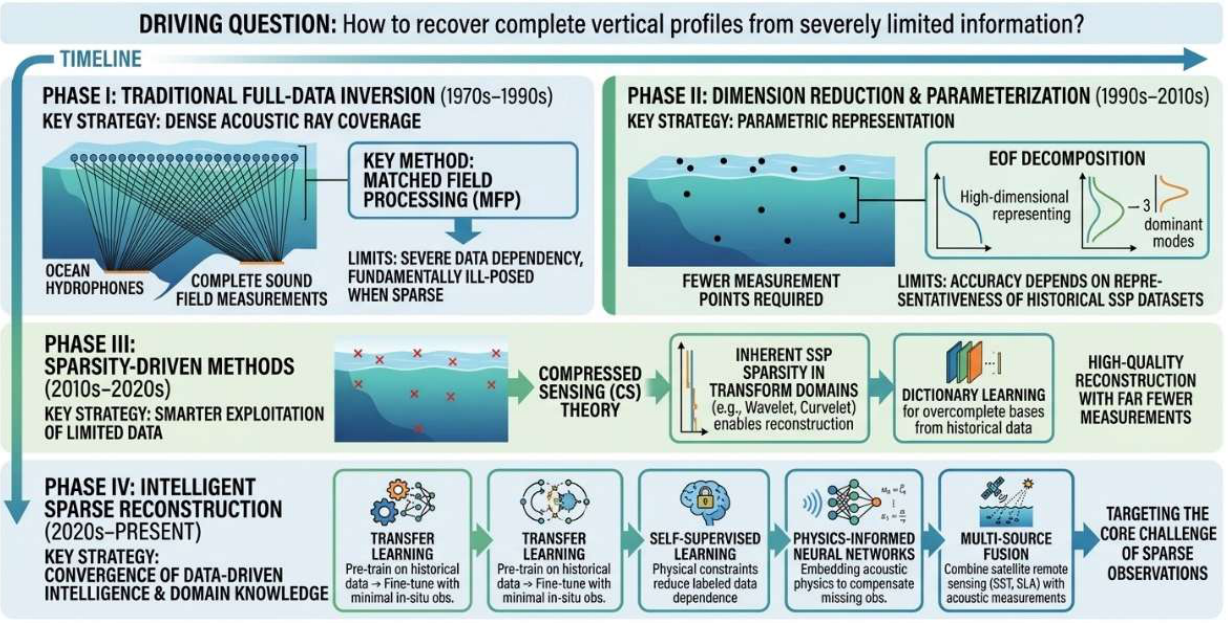
Table 4.
Comprehensive Performance Comparison Table of Conventional Technical Routes.
| Method Category | Representative Methods | Core Principle/Key Characteristics | Main Advantages | Main Disadvantages/Limitations | Key Applicable Scenarios |
|---|---|---|---|---|---|
| Direct Measurement Method | CTD/SVP | Obtain in-situ CTD or direct sound speed data, and calculate or directly obtain SSP through empirical formulas. | 1. High precision, often used as the "true value" benchmark. 2. Full sea depth observation capability (CTD/SVP). |
1. Extremely low efficiency and poor real-time performance: for example, measuring a 2000 m profile takes at least 80 minutes (CTD/SVP). 2. High cost and resource-intensive. 3. Sparse spatial coverage, only point measurements. 4. Systematic errors introduced by indirect calculation (CTD). |
Needing high-precision benchmark verification; fixed-point long-term observation stations. |
| XCTD | Expendable probe for measuring CTD. | 1. High operation efficiency: a 2000 m profile takes about 20 minutes, and the ship can sail at low speed. 2. Flexible deployment. |
1. Limited depth: usually no more than 2000 meters. 2. The probe is a consumable with usage costs. 3. Still a point measurement with limited coverage. |
Rapid profile surveys; auxiliary remote sensing or model verification. | |
| Inversion Based on Acoustic Data | Traditional OAT/MFP | Establish a physical model of sound propagation, and invert SSP by matching observed and theoretical sound fields (such as propagation time, sound pressure). | 1. Clear physical mechanism. 2. High accuracy under ideal conditions (experimental RMSE can reach ~0.02 m/s). |
1. High computational cost and limited real-time performance: it is a computationally intensive time-consuming iterative process. 2. Sensitive to environmental mismatches. 3. Heavily dependent on specific array deployment (such as vertical line arrays), with poor scalability. |
Long-term monitoring of fixed arrays; basic theoretical research. |
| Compressed Sensing (CS) | Using the sparsity of SSP under specific bases (such as EOF, learned dictionaries) to solve sparse coefficients through linearizing the observation equation. | 1. Theoretically complete, good at solving ill-posed problems with few required observation data. 2. High computational efficiency, better real-time inversion performance than MFP. 3. Low storage requirements (sparse representation). |
1. Existence of accuracy loss: the first-order Taylor expansion linear approximation is only applicable to small changes in sound speed. 2. Dependent on the construction of effective sparse bases/dictionaries. 3. Sensitive to noise. |
Scenarios with extremely sparse observation data; online fast inversion requirements. | |
| Modal Extraction-based SSP Inversion (ME-SSPI) | A single vertical line array receives single-frequency signals to simultaneously extract modal parameters and invert SSP and source parameters. | 1. No need for SSP prior knowledge. 2. Low computational cost. |
Dependent on specific observation configurations (single vertical line array + monochromatic signal). | Preliminary detection in unknown environments. | |
| Inversion Based on Sea Surface Remote Sensing | EOF-machine learning hybrid | Using historical SSP to construct EOF basis for dimensionality reduction, and using neural networks to learn the nonlinear mapping between sea surface remote sensing parameters (SSTA, SLA) and EOF coefficients. | 1. No need for real-time underwater observations, extremely low cost. 2. Extremely fast online inversion speed (single forward propagation). 3. Realizing large-scale and near real-time monitoring. |
1. Weak deep information reconstruction capability, with errors increasing with depth. 2. Highly dependent on a large amount of high-quality historical training data, performance degradation in sea areas with scarce data. 3. Poor model interpretability ("black box"). |
Operational forecasting of large-scale and near real-time acoustic velocity fields; sea areas with abundant remote sensing data. |
| Hybrid/Assimilation Method | Fixed depth points + AI Multi-source data assimilation |
Fusing extremely sparse direct observations (such as sound speed values at 3-4 key depths, Argo profiles) with remote sensing data or historical statistical models, and performing reconstruction or update through neural networks or data assimilation algorithms (such as EnKF). | 1. Complementation of multi-source data, improving accuracy and reliability. 2. Dynamic update capability (assimilation methods). 3. Minimizing the reliance on direct observations. |
1. Complex system and difficult parameter tuning. 2. Still large computational load for assimilation methods. 3. Still limited by the quality and representativeness of fused data. |
Remote sensing inversion with sporadic in-situ data verification; SSP initialization and update of marine numerical forecasting systems. |
Disclaimer/Publisher’s Note: The statements, opinions and data contained in all publications are solely those of the individual author(s) and contributor(s) and not of MDPI and/or the editor(s). MDPI and/or the editor(s) disclaim responsibility for any injury to people or property resulting from any ideas, methods, instructions or products referred to in the content. |
© 2026 by the authors. Licensee MDPI, Basel, Switzerland. This article is an open access article distributed under the terms and conditions of the Creative Commons Attribution (CC BY) license (http://creativecommons.org/licenses/by/4.0/).
Copyright: This open access article is published under a Creative Commons CC BY 4.0 license, which permit the free download, distribution, and reuse, provided that the author and preprint are cited in any reuse.


