
Submitted:
16 April 2026
Posted:
17 April 2026
You are already at the latest version
Abstract
This study examines the dynamic relationship between deposits, credit and sales across Ecuador’s provinces over the period 2019-2025 using a Panel VAR model estimated by two-step GMM. Sales declared to the Internal Revenue Service are employed as a high-frequency administrative indicator of provincial economic activity. The results are consistent with a predominantly supply-leading structure, in which deposits and credit exhibit predictive capacity over provincial sales, with no robust evidence in the reverse direction. The speed of transmission differs between the two financial channels. De-posits affect sales with a one-period lag, whereas credit does so with two, suggesting that liquidity is channelled toward commercial activity more immediately than credit financing. During the pandemic period, an increase in deposits, a contraction in credit, and a decline in sales are observed. The study provides subnational evidence for a dol-larized Latin American economy and covers a recent period marked by an extraordinary shock. The findings indicate that the relevance of financial intermediation for territorial economic activity depends not only on the direction of the linkage but also on the dif-ferentiated speed of its components.
Keywords:
financial intermediation
; provincial economic activity
; panel VAR
; credit
; deposits
; dollarization
1. Introduction
The relationship between financial intermediation and economic activity remains an open question in applied financial economics. The direction of causality between the two dimensions has not converged toward a single result, and the accumulated evidence shows that findings depend on the institutional context, the variables selected, and the econometric strategy adopted (Rousseau & Wachtel, 2000; Shan et al., 2001). Three areas, however, remain insufficiently explored. Latin America, and in particular the region’s dollarized economies, has received limited attention in studies employing multivariate dynamic designs. The subnational dimension continues to be marginal, even though territorial differences in financial deepening and productive structure can be as pronounced as those observed across countries. And most of the available evidence ends before 2020, leaving unexamined the effect of the pandemic on the interaction between liquidity, credit, and economic activity.
Ecuador offers a pertinent case for addressing these three limitations jointly. In a dollarized economy, lacking its own monetary policy instruments, banking intermediation acquires greater macroeconomic visibility in the channelling of resources and in the propagation of adverse shocks. This feature became more acute after 2020, when liquidity, financing and commercial activity experienced simultaneous disruptions in the absence of conventional monetary adjustment mechanisms.
This study analyses the dynamic relationship between deposits, credit, and sales across Ecuador’s 24 provinces over the period 2019-2025 using a Panel VAR model. It examines whether financial intermediation statistically precedes the evolution of provincial sales, whether deposits and credit transmit at the same speed toward commercial activity, and how the pandemic shock fits into this dynamic. The central hypothesis posits a predominantly supply-leading structure, whereby financial intermediation precedes economic activity rather than the reverse. As a complementary proposition, transmission is expected to be heterogeneous within the financial block: deposits should be reflected more immediately in sales, whereas credit would operate with an additional lag arising from the processes of evaluation, disbursement, and maturation of the financed resources.
The article provides subnational evidence for a dollarized Latin American economy, shifts the analysis to the provincial scale at monthly frequency, and covers a recent period marked by an extraordinary shock. Beyond the direction of the linkage between financial intermediation and economic activity, the study makes it possible to distinguish the speed at which different financial channels operate across the territory. Section 2 presents the literature review. Section 3 describes the data and the empirical strategy. Section 4 reports the results and their discussion. Section 5 sets out the conclusions and policy implications.
2. Literature Review
2.1. Financial Intermediation and Economic Activity: Hypotheses and Empirical Patterns
The relationship between financial intermediation and economic activity has been examined through three hypotheses. The supply-leading hypothesis posits that financial development precedes the expansion of economic activity by mobilising savings, allocating resources, and reducing information frictions. The demand-following hypothesis holds that growth in real activity increases the demand for financial services and thereby deepens the system. A third position recognizes a bidirectional relationship between the two dimensions. Shan et al. (2001) showed that none of these hypotheses can be assumed as universal, since the direction of the linkage depends on the institutional context, the variables selected, and the specification adopted.
A substantial body of empirical evidence has been consistent with the supply-leading hypothesis. Rousseau & Wachtel (1998) documented, for industrialised economies, a positive association between financial depth and economic performance. Rousseau & Wachtel (2000), using a Panel VAR for 47 countries, found that the activity of financial intermediaries and stock market liquidity precede per capita output growth. Sahoo (2014) identified in India an effect of private credit on real GDP, Shah et al. (2023) reported similar results for Nepal, and Awad et al. (2025) concluded that banking intermediation favours economic activity in Palestine, although they noted limitations in the efficient channelling of deposits toward productive uses.
Other studies support the demand-following hypothesis. Mushtaq (2016) found for Pakistan that economic growth precedes bank credit, with no solid evidence in the reverse direction. Awad & Al Karaki (2019) reached a similar conclusion for Palestine and attributed this pattern to more conservative banking behaviour toward higher-risk productive sectors. The literature has also documented bidirectional relationships. Durafe & Jha (2018) reported mutual feedback between credit and growth in India, a result consistent with Chakraborty (2008) who had documented bidirectionality between bank credit and industrial production despite finding that, at the aggregate level, growth precedes financial development. Zhou & Tewari Dev (2020) identified a positive bidirectional relationship between shadow banking, credit and growth in a panel of developed and emerging economies. The direction and intensity of the linkage depend, in sum, on the level of financial development, the productive structure, and the way in which both dimensions are operationalised.
2.2. Methodological Strategies and Conditioning Factors
The differences observed in the literature are not solely attributable to the economic context but also to the empirical strategy employed. The transition from time-series VAR models to panel designs broadened the scope of the analysis by incorporating structural differences across units. Hsueh et al. (2013), through a bootstrap panel Granger causality test for Asian economies, showed that causal patterns differ across countries, confirming that the methodology conditions the identification of the linkage. The Toda-Yamamoto procedure, which allows causality testing when the order of integration is uncertain, has yielded mixed results: Wolde-Rufael (2009) found mutual feedback between credit and growth for Kenya, while Sulaiman et al. (2015) for Nigeria, detected no causality in either direction, a result they attributed to the limited capacity of the banking system to intermediate resources toward the productive sector.
Panel VAR models estimated by GMM have advanced the treatment of endogeneity inherent in dynamic panels. Obed et al. (2024) identified, for Middle Eastern economies, a shift in the causal pattern before and after the Arab Spring. Tinoco-Zermeño (2023) found bidirectional causality between financial development and GDP in a panel of developing economies. Cheng & Hou (2020) showed that the effects on growth differ according to the type of financial service and the time horizon. Alodayni (2016) demonstrated that oil shocks affect output through non-performing loans and credit restriction in GCC countries, and Avdjiev & Zeng (2014) found that the effect of credit varies according to the prevailing economic growth regime.
Two factors recurrently appear as conditioning elements of the linkage. Institutional quality moderates the effect of financial intermediation, though not in a simple linear fashion. Nabi & Suliman (2009) showed that the causal channel running from banking development to economic growth intensifies as the institutional environment improves, while Abuzayed & Al-Fayoumi (2016) found that, in contexts characterised by weak institutions, banking concentration can substitute for the absent legal framework and sustain a positive effect on growth. Pradhan et al. (2023) confirmed, for a broad panel of lower-income countries, that both institutional quality and financial development independently drive long-run growth, with the institutional effect dominating. Taken together, these studies suggest that the direction and magnitude of the finance-growth nexus are shaped by the quality of the regulatory and governance environment rather than by financial depth alone. Crises also alter the relationship. Li & Zhang (2022) showed that, following the 2008 crisis, the linkage between banking and growth in US states shifted from a unidirectional pattern to mutual feedback, and Jeke et al. (2025) documented that crises can weaken or reverse the effect of credit in emerging markets. This evidence is pertinent to the analysis of the pandemic period, where the shock to real activity and the response of the financial system may have modified the transmission channels in an analogous manner.
2.3. Research Gaps
The review allows the identification of the gaps that motivate the present study. Geographically, the evidence is concentrated in Asia, the Middle East, Africa and broad international panels. Tinoco-Zermeño (2023) incorporated Latin American countries within a larger sample, but without disaggregating regional dynamics or distinguishing specific monetary contexts. Jungo et al. (2022) examined this relationship for Latin America and Sub-Saharan Africa using a PVAR framework; however, their analysis assumes economies with autonomous monetary systems, in which conventional transmission channels operate without structural constraints. For fully dollarised economies, where bank credit constitutes the primary transmission mechanism toward real activity and interest rate policy is effectively absent, no literature is identified that examines this relationship with equivalent methodological tools.
Regarding the analytical scale, the dominant literature relies on national data or cross-country comparisons. Li & Zhang (2022) examined US states, and Jula & Jula (2013) applied panel data models to Romanian subnational units; however, the use of Panel VAR frameworks at the subnational level in developing economies remains infrequent. In temporal terms, a significant share of studies closes before 2020. Giyasova et al. (2026) and Al-rahamneh et al. (2026) provide more recent coverage—extending to 2024 and 2021, respectively—yet both operate at the national level in Middle Eastern and Central Asian contexts, without a subnational focus on Latin America. Table 1 synthesises the reviewed studies, highlighting the geographical concentration of the evidence, the predominance of national scales, and the limited presence of post-2020 samples.
3. Data, Variables, and Empirical Strategy
3.1. Data and Variables
The analysis is based on a balanced panel of Ecuador’s 24 provinces at monthly frequency for the period 2019-2025. Monthly sales declared by province were obtained from the Internal Revenue Service (SRI), while deposit and credit data came from the Superintendency of Bank. Declared sales are employed as a high-frequency indicator of provincial economic activity. This choice is consistent with the practice of the Central Bank of Ecuador, which uses the SRI’s VAT Form (F104) as an input for the construction of the Monthly Index of Short-Term Economic Activity (IMAEc) and as a component of its coincident business cycle indicator. The estimated correlations between sales and other aggregate indicators support this decision: an association of 0.87 with the IMAEc, 0.79 with adequate employment, 0.63 with tax revenue, and 0.61 with energy consumption is observed, with the maximum association concentrated at the contemporaneous lag in all cases.
The endogenous variables of the model are deposits, credit, and sales. Deposits correspond to the stock of public savings held in supervised financial institutions, assigned according to the province of the receiving branch. Credit captures total lending by the financial system, including private banks, public banks, and finance companies, classified by credit type, portfolio status, and geographical origin. Sales represent the monthly value declared by taxpayers in each province. The three series were deflated using a 2018 base year, seasonally adjusted through the X-11 procedure applied independently by province, and transformed into natural logarithms. This sequence ensures that the estimated dynamics reflect real variations, free from seasonal patterns and nominal effects.
The vector of endogenous variables is defined as , where i = 1, …, 24 identifies the provinces and the monthly periods. An exogenous variable, is included, taking the value 1 between March 2020 and December 2021 and 0 otherwise, in order to control for the shock associated with the pandemic period. Table 2 details the operational definition, source, and transformation applied to each variable in the model.
Figure 1 presents the monthly variation of the three series by province. The asymmetry in volatility is marked: sales exhibit a standard deviation of 14.5%, compared with 2.6% for credit and 5.1% for deposits. Ninety-seven percent of monthly credit variations fall within the ±5% range, confirming its character as a slow-adjusting variable relative to commercial activity. Provincial heterogeneity is considerable: Guayas and Pichincha display sales volatility of 4.7% and 6.8%, whereas smaller provinces such as Zamora Chinchipe, Galápagos, and Pastaza reach 48.2%, 20.9%, and 15.1%. This disparity justifies the panel estimation, which exploits temporal and cross-sectional variation jointly.
Overall, this section should provide a clear, transparent, and replicable description of how the study was conducted. The reader must be able to reproduce the work or, at a minimum, fully understand the methodological choices and their justifications. It should be written following the chronological order of the research process.
3.2. Panel VAR Specification and Estimation
The relationship between deposits, credit, and sales was modelled through a Panel VAR, an approach that extends the VAR framework to the panel context and allows all variables in the system to be treated as endogenous, capturing their dynamic interdependencies both over time and across provinces (Abrigo & Love, 2016; Love & Zicchino, 2006). The general specification of the model is:
where denotes the vector of first differences of the endogenous variables, and are the coefficient matrices associated with the two lags of the system, is the coefficient vector of the exogenous variable, and is the idiosyncratic error term. Estimation in first differences eliminates time-invariant provincial fixed effects and, since the variables were previously expressed in logarithms, the captured dynamics are interpreted in terms of relative changes.
Estimation was carried out by two-step Generalised Method of Moments (GMM), following the logic of dynamic panel models developed by Arellano & Bond (1991) and adopted in the Panel VAR literature (Abrigo & Love, 2016). The first-difference transformation introduces a mechanical correlation between the lagged regressors and the transformed error, which invalidates ordinary least squares estimation and requires the use of internal instruments constructed from lagged levels. The instrument matrix was collapsed and restricted to lags 2 and 3 in order to contain instrument proliferation. The resulting number of instruments is 33, a figure that slightly exceeds the number of groups (24); therefore, the validity of the instrumental scheme is formally assessed through the Hansen test, whose null hypothesis states that the moment conditions are jointly valid.
The two-lag specification was adopted as the main model after comparing models with p = 1, …, 5 using the MMSC criteria of Andrews & Lu (2001). The criteria did not converge on a single optimal order —the MMSC-BIC and MMSC-HQIC favour one lag, while the MMSC-AIC selects two—but the two-lag specification captures the more gradual transmission of credit toward sales, a central aspect of the study’s second hypothesis. The one-lag version was retained as a robustness exercise.
Preliminary tests included the verification of stationarity in first differences through the Levin et al. (2002) test, complemented by the CIPS test of Pesaran (2007) to control for possible cross-sectional dependence among provinces, and the assessment of predictability through the panel Granger causality test of Dumitrescu & Hurlin (2012). Regarding the adequacy of the GMM scheme, the diagnostics were complemented with auxiliary Arellano & Bond (1991)-type equations to verify the absence of second-order serial autocorrelation in the residuals.
3.3. Dynamic Analysis and Robustness
The system dynamics were examined through generalised impulse response functions (GIRFs), which measure the response path of each variable to a one-standard-deviation shock in another variable of the system over an eight-month horizon. Unlike orthogonalised impulse response functions, which depend on the ordering of the variables and may yield different results according to the assumed causal hierarchy, GIRFs are invariant to the ordering (Love & Zicchino, 2006). Confidence intervals were constructed at the 90% level by means of non-parametric bootstrap resampling with 500 replications, resampling entire provinces with replacement and preserving the internal temporal structure of each unit.
The interpretation of the dynamic responses was complemented with the forecast error variance decomposition (FEVD), applied following Cadena-Silva et al. (2025), which quantifies the proportion of each variable’s variability, at different horizons, that is attributable to its own shocks and the proportion explained by shocks in the remaining variables of the system. This decomposition was computed up to an 18-month horizon. Both tools require the system to be stable, a condition verified when all eigenvalues of the companion matrix have modulus less than 1, ensuring that the effects of shocks are transitory.
Robustness was assessed through an alternative specification with p=1 and 24 instruments, equating the number of instruments to the number of provincial groups. This version imposes a more parsimonious structure and strictly satisfies the condition on the number of instruments. The comparison between the two specifications makes it possible to examine whether the linkage between financial intermediation and sales holds under a more restricted temporal structure and whether the identification of the credit channel depends on the dynamic breadth of the model.
4. Results
4.1. Preliminary Evidence and Model Adequacy
The unit root tests of Levin et al. (2002), reported in Table 3, decisively reject the null hypothesis of non-stationarity for all three variables in first differences. The CIPS test of Pesaran (2007) confirms this result under a setting of possible cross-sectional dependence among provinces. Both tests support the estimation of the system on stationary transformed variables.
The results of the Dumitrescu & Hurlin (2012) panel Granger causality test, presented in Table 4, reveal a directional pattern consistent with the central hypothesis of the study. Deposits and credit exhibit significant predictive capacity over the evolution of provincial sales, whereas sales show no statistical predictive capacity over the financial variables. The only additional significant linkage runs from credit to deposits, suggesting an internal interaction within the territorial financial system. This result is compatible with the supply-leading hypothesis documented by Rousseau & Wachtel (2000) and approximates the evidence of Sahoo (2014), Shah et al. (2023), and Awad et al. (2025), who document temporal precedence from credit to output. The absence of causality running from sales to the financial variables marks a departure from studies where demand-following or mutual feedback patterns prevail, such as Mushtaq (2016), Shan et al. (2001), and Zhou & Tewari Dev (2020).
Table 5 presents the comparison of specifications using the MMSC criteria of Andrews & Lu (2001).The criteria do not converge on a single optimal order: the MMSC-BIC and MMSC-HQIC favour one lag, while the MMSC-AIC selects two. The two-lag specification is adopted as the main model because it captures the more gradual transmission of credit toward sales, a central aspect of the study’s second hypothesis. The one-lag version is employed as a robustness check.
The econometric diagnostics of the main model are summarised in Table 6. The Hansen statistic does not reject the null hypothesis of joint instrument validity (p=0.288), and the stability condition is satisfied, with the maximum eigenvalue modulus below unity. The auxiliary Arellano & Bond (1991)-type tests confirm the expected significance of AR (1) and do not reject the absence of second-order autocorrelation at the 5% level, although the AR (2) p-values lie close to the conventional threshold (0.091 for deposits, 0.099 for credit, and 0.075 for sales), which counsels caution in the interpretation.
4.2. Estimated Coefficients and Transmission Across Financial Channels
Table 7 reports the coefficients of the main model with two lags. The relationship between financial intermediation and provincial sales is dynamic and heterogeneous across financial channels. In the deposits equation, autoregressive persistence is high (0.654 at the first lag), one-period lagged credit exerts a significant positive effect, and lagged sales display a positive coefficient of smaller magnitude. This latter result, absent in the bivariate Granger test reported in Table 4, reflects a conditional feedback that emerges when the simultaneous dynamics of all variables in the system are controlled for.
In the credit equation, own inertia dominates. The first-lag coefficient reaches 0.841 and no robust effects from deposits or sales are observed. Provincial credit dynamics depend, to a large extent, on their own trajectory— a feature compatible with lending processes subject to prior portfolio decisions, risk assessment, and bank supply conditions. This evidence approximates the findings of Mushtaq (2016) and Awad et al. (2025), who show that credit does not always respond immediately to variations in economic activity.
The central result of the study is concentrated in the sales equation. One-period lagged deposits exert a positive and statistically significant effect, while credit operates through its second lag, as the first lag is not significant. The temporal difference between the two channels supports the study’s second hypothesis and suggests that deposits function as a faster-transmitting liquidity component, whereas credit requires an additional period to translate into observable commercial activity. This pattern is compatible with the evidence of Rousseau & Wachtel (2000), Sahoo (2014) and Shah et al. (2023), although it adds a nuance that Cheng & Hou (2020) had already anticipated: the effects of the financial system depend on the composition of the service analysed and the time horizon considered.
The coefficients of the pandemic exogenous variable display signs consistent with expectations: positive in the deposits equation, negative in credit, and contractionary in sales. The increase in deposits is consistent with a greater preference for liquidity and precautionary saving, the decline in credit reflects a more cautious supply in a high-uncertainty environment, and the contraction in sales indicates that the most intense adjustment fell on commercial activity. This evidence is coherent with the literature documenting disruptions in transmission channels during crisis periods (Jeke et al., 2025; Li & Zhang, 2022; Obed et al., 2024).
4.3. Dynamic Responses to Financial Shocks
Figure 2 presents the generalised impulse response functions of the main model. The response of sales to a credit shock is positive over the initial horizons and dissipates gradually, confirming that credit constitutes a relevant dynamic channel for the trajectory of sales, albeit with decreasing intensity. The response to a deposit shock displays a more gradual profile and turns positive after the first periods, suggesting a liquidity mechanism that ultimately sustains commercial activity. The responses of the financial system to shocks originating in sales are weaker and exhibit lower statistical precision. The system does not display a symmetric feedback structure but rather a dynamic in which the financial block retains greater precedence over the commercial variable.
Figure 3 presents the forecast error variance decomposition at selected horizons. For deposits, the share explained by own shocks declines from 100% in the first period to 51.7% at horizon 10, while the contribution of credit rises to 39.3%. Credit exhibits the greatest autonomy within the system: at horizon 10, 89.6% of its variance remains explained by own innovations. Sales maintain a predominance of own shocks (75.2% at horizon 10), although credit accounts for 22.1% of their future variability. Read jointly with the estimated coefficients and the dynamic trajectories in Figure 2, these results confirm that credit constitutes the main transmission mechanism within the system, both through its persistence and through its ability to explain a growing fraction of the variability of the remaining variables.
4.4. Robustness
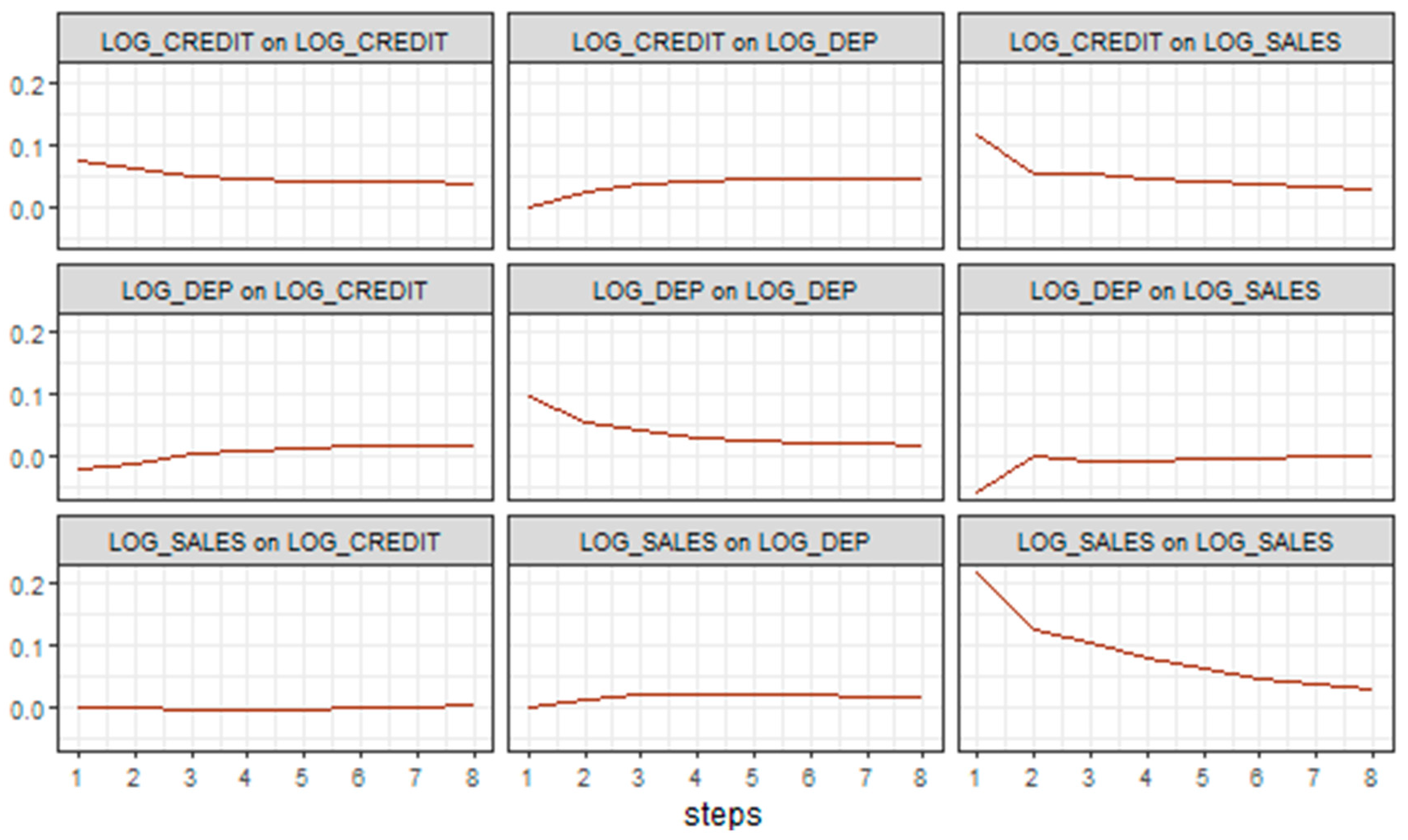
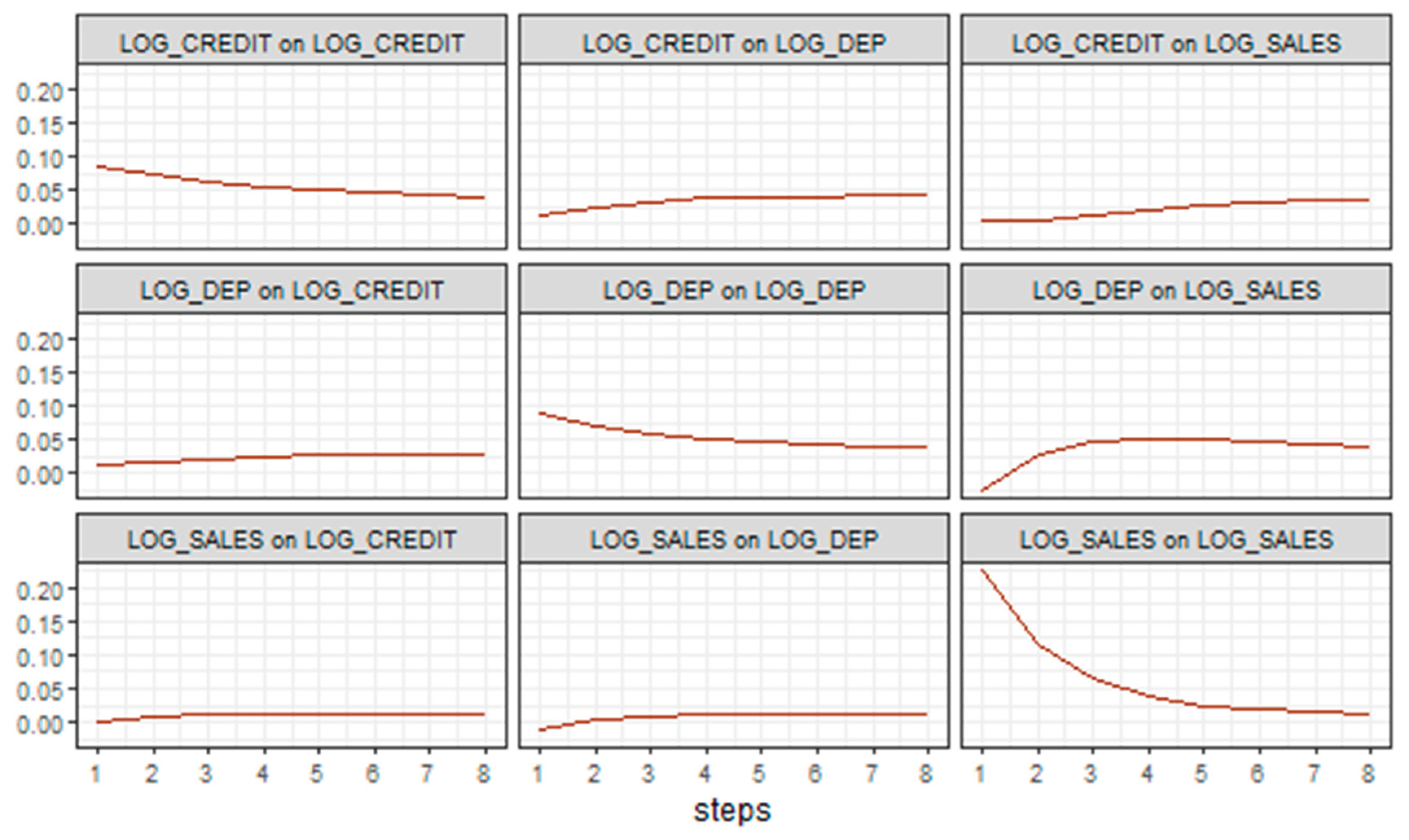
Table 8 reports the coefficients of the alternative specification with a single lag and 24 instruments. Credit continues to exert a positive and significant effect on deposits, and deposits retain a positive effect on sales. The overall direction of the system does not change. The Hansen statistics remain in a range compatible with instrument validity (p=0.126), and the system preserves the stability condition (maximum eigenvalue of 0.937). The main difference appears in the sales equation: the effect of credit ceases to be significant when the system is restricted to a single lag. This result does not invalidate the central conclusion but confirms that the transmission of credit toward sales is not instantaneous and requires a broader time horizon to become visible, as suggested by the dynamic trajectories in Figure 2. The deposit channel, by contrast, remains significant under both specifications, reinforcing its role as a more immediate transmission component. As a complementary check, the orthogonalised impulse response functions for the main and robustness specifications, reported in Appendix A and Appendix B respectively, yield qualitatively consistent trajectories.
5. Conclusions and Policy Implications
This study examined the dynamic relationship between financial intermediation and provincial economic activity in Ecuador using a Panel VAR model estimated with monthly data for 24 provinces over the period 2019-2025. The evidence obtained is consistent with a predominantly supply-leading structure in which deposits and credit statistically precede the evolution of provincial sales. However, the most relevant finding of the article does not lie in the direction of the linkage—already documented for other contexts— but rather in the temporal heterogeneity within the financial block itself. Deposits are associated with sales over an immediate horizon, whereas credit operates with an additional lag, a difference that reflects the distinct nature of the two channels: available liquidity is channelled rapidly toward the commercial circuit, while credit financing passes through processes of evaluation, disbursement, and maturation before materialising in observable economic activity. In a dollarized economy, where the absence of conventional monetary instruments constrains the avenues for macroeconomic adjustment, this distinction acquires direct practical relevance.
The behaviour of the system during the pandemic period reinforces this reading. The simultaneous increase in deposits, the contraction in credit, and the decline in sales reveal that adjustments to severe shocks are transmitted with differentiated intensity depending on the financial channel considered. This asymmetry suggests that crisis response strategies should envisage channel-differentiated interventions. Preserving the continuity of credit during adverse episodes is particularly relevant: if its effect on sales operates with a lag, a prolonged contraction in lending can intensify recessionary phases and delay territorial recovery. At the same time, improving the transformation of deposits into credit at the provincial scale constitutes a complementary policy objective, since territorial financial depth depends not only on the volume of funds captured but also on the institutional capacity to channel them toward activities with an impact on employment and local commercial circulation.
The results should be interpreted within the limits of the empirical design. Provincial variables reflect the administrative location of operations and not necessarily the final destination of financial flows. The Panel VAR specification imposes an average structure that does not capture the full heterogeneity across provinces. And the approach allows the identification of temporal precedence and joint dynamics but does not constitute a structural causal identification strategy in the strict sense. These limitations delimit the inferential scope and, at the same time, open avenues for future research: disaggregating credit by segment to identify which component most intensely drives the transmission toward sales, exploring provincial heterogeneities according to productive structure and banking density, incorporating alternative measures of territorial economic activity, and moving toward more demanding identification designs.
Author Contributions
Conceptualization, Á.M.-L.; methodology, F.C.-C.; software, F.C.-C.; validation, Á.M.-L., R.G.-R., P.A.-M. and J.C.-S.; formal analysis, F.C.-C.; investigation, Á.M.-L., R.G.-R., P.A.-M. and J.C.-S.; resources, F.C.-C.; data curation, F.C.-C.; writing—original draft preparation, F.C.-C.; writing—review and editing, Á.M.-L., P.A.-M. and J.C.-S.; visualization, Á.M.-L. and R.G.-R.; supervision, Á.M.-L.; project administration, Á.M.-L. and R.G.-R.; funding acquisition, Á.M.-L and P.A.-M. All authors have read and agreed to the published version of the manuscript.
Funding
This research received no external funding.
Institutional Review Board Statement
Not applicable.
Informed Consent Statement
Not applicable.
Data Availability Statement
The deposits and credit data can be consulted on the Superintendency of Banks website through the following link: https://www.superbancos.gob.ec/estadisticas/(accessed on 15 January 2026). The monthly declared sales data reported by the Internal Revenue Service (SRI), see: https://www.sri.gob.ec/estadisticas-sri (accessed on 15 January 2026). The COVID-19 dummy variable was constructed by the authors based on the officially declared pandemic period.
Conflicts of Interest
The authors declare no conflicts of interest.
Appendix A
Figure A1.
Orthogonalised impulse response functions of the main Panel VAR model (p=2). Note. Each panel shows the estimated dynamic response of one variable to a one-standard-deviation orthogonalised shock in another variable of the system over an eight-month horizon. Responses are obtained from the main Panel VAR model estimated by two-step GMM.
Figure A1.
Orthogonalised impulse response functions of the main Panel VAR model (p=2). Note. Each panel shows the estimated dynamic response of one variable to a one-standard-deviation orthogonalised shock in another variable of the system over an eight-month horizon. Responses are obtained from the main Panel VAR model estimated by two-step GMM.
Appendix B
Figure A2.
Orthogonalised impulse response functions of the robustness Panel VAR model (p=1). Note. Each panel shows the estimated dynamic response of one variable to a one-standard-deviation orthogonalised shock in another variable of the system over an eight-month horizon. Responses are obtained from the robustness Panel VAR model estimated by two-step GMM with 24 instruments.
Figure A2.
Orthogonalised impulse response functions of the robustness Panel VAR model (p=1). Note. Each panel shows the estimated dynamic response of one variable to a one-standard-deviation orthogonalised shock in another variable of the system over an eight-month horizon. Responses are obtained from the robustness Panel VAR model estimated by two-step GMM with 24 instruments.
References
- Abrigo, M. R. M.; Love, I. Estimation of panel vector autoregression in Stata. Stata Journal 2016, 16(3), 778–804. [Google Scholar] [CrossRef]
- Abuzayed, B.; Al-Fayoumi, N. Bank concentration, institutional quality, and economic growth: Empirical evidence from MENA countries. Review of International Business and Strategy 2016, 26(2), 219–231. [Google Scholar] [CrossRef]
- Alodayni, S. Oil Prices, Credit Risks in Banking Systems, and Macro-Financial Linkages across GCC Oil Exporters. International Journal of Financial Studies 2016, Vol. 4(Page 23, 4(4)), 23. [Google Scholar] [CrossRef]
- Al-rahamneh, A. A.; Al-assaf, G. I.; Al-assaf, M. E.; Al-zedaneen, H. M. An Empirical Analysis of the Effect of Financial Sector Development on Economic Growth in Emerging Economies. Montenegrin Journal of Economics 2026, 22(1), 15–26. [Google Scholar] [CrossRef]
- Andrews, D. W. K.; Lu, B. Consistent model and moment selection procedures for GMM estimation with application to dynamic panel data models. Journal of Econometrics 2001, 101(1), 123–164. [Google Scholar] [CrossRef]
- Arellano, M.; Bond, S. Some Tests of Specification for Panel Data: Monte Carlo Evidence and an Application to Employment Equations. The Review of Economic Studies 1991, 58(2), 277. [Google Scholar] [CrossRef]
- Avdjiev, S.; Zeng, Z. Credit growth, monetary policy and economic activity in a three-regime TVAR model. Applied Economics 2014, 46(24), 2936–2951. [Google Scholar] [CrossRef]
- Awad, I. M.; Al Karaki, M. S. The impact of bank lending on Palestine economic growth: An econometric analysis of time series data. Financial Innovation 2019, 5(1), 14. [Google Scholar] [CrossRef]
- Awad, I. M.; Hamad, R. A.; Abdallah, B. Stimulating economic growth in Palestine through conventional and FinTech banking: A time-series and stylized simulation approach. International Review of Economics & Finance 2025, 104, 104756. [Google Scholar] [CrossRef]
- Cadena-Silva, J. P.; Sanz Lara, J. Á; Rodríguez Fernández, J. M. Stock market volatility and oil shocks: A study of G7 economies. International Review of Financial Analysis 2025, 103, 104218. [Google Scholar] [CrossRef]
- Chakraborty, I. Does financial development cause economic growth? The case of India. South Asia Economic Journal 2008, 9(1), 109–139. [Google Scholar] [CrossRef]
- Cheng, S. Y.; Hou, H. Do non-intermediation services tell us more in the finance–growth nexus?: Causality evidence from eight OECD countries. Applied Economics 2020, 52(7), 756–768. [Google Scholar] [CrossRef]
- Dumitrescu, E. I.; Hurlin, C. Testing for Granger non-causality in heterogeneous panels. Economic Modelling 2012, 29(4), 1450–1460. [Google Scholar] [CrossRef]
- Durafe, A.; Jha, A. Bank capital buffer, bank credit and economic growth: Evidence from India. Afro-Asian Journal of Finance and Accounting 2018, 8(3), 257–270. [Google Scholar] [CrossRef]
- Giyasova, Z.; Salahov, R.; Jabbarova, A.; Oktem, M. K.; Safarova, F. The impact of economic growth, inflation, and exports on domestic credit to the private sector in Turkey. Investment Management and Financial Innovations 2026, 23(1), 253–263. [Google Scholar] [CrossRef]
- Hsueh, S. J.; Hu, Y. H.; Tu, C. H. Economic growth and financial development in Asian countries: A bootstrap panel Granger causality analysis. Economic Modelling 2013, 32(1), 294–301. [Google Scholar] [CrossRef]
- Jeke, L.; Erasmus, C. R. J.; Abel, S.; Matsvai, S.; Mukarati, J. Bank credit’s role in influencing economic growth in the emerging market. Risk Governance and Control: Financial Markets & Institutions 2025, 15(3, special issue), 300. [Google Scholar] [CrossRef]
- Jula, D.; Jula, N. Economic Growth and Structural Changes in Regional Employment. Romanian Journal of Economic Forecasting. 2013. [Google Scholar]
- Jungo, J.; Madaleno, M.; Botelho, A. The Relationship between Financial Inclusion and Monetary Policy: A Comparative Study of Countries’ in Sub-Saharan Africa and Latin America and the Caribbean. Journal of African Business 2022, 23(3), 794–815. [Google Scholar] [CrossRef]
- Levin, A.; Lin, C. F.; Chu, C. S. J. Unit root tests in panel data: Asymptotic and finite-sample properties. Journal of Econometrics 2002, 108(1), 1–24. [Google Scholar] [CrossRef]
- Li, F.; Zhang, S. Does financial crisis change the relationship between bank development and economic growth? Evidence from US states. PLoS ONE 2022, 17(4), e0267394. [Google Scholar] [CrossRef]
- Love, I.; Zicchino, L. Financial development and dynamic investment behavior: Evidence from panel VAR. The Quarterly Review of Economics and Finance 2006, 46(2), 190–210. [Google Scholar] [CrossRef]
- Mushtaq, S. Causality between bank’s major activities and economic growth: Evidences from Pakistan. Financial Innovation 2016, 2:1(2(1)), 7. [Google Scholar] [CrossRef]
- Nabi, M. S.; Suliman, M. O. Institutions, banking development, and economic growth. Developing Economies 2009, 47(4), 436–457. [Google Scholar] [CrossRef]
- Obed, M. K.; Hussein, H. S.; Fadhel, A. M.; Faraj, B. A. A.; Battal, A. H.; Abd, M. K. Enhance the Link Between Financial Development and Economic Growth: Insights from a GMM-VAR Approach. International Journal of Economics and Finance Studies 2024, 12, 389–410. [Google Scholar]
- Pesaran, M. H. A simple panel unit root test in the presence of cross-section dependence. Journal of Applied Econometrics 2007, 22(2), 265–312. [Google Scholar] [CrossRef]
- Pradhan, R. P.; Nair, M. S.; Arvin, M. B.; Hall, J. H. Institutional quality, financial development and sustainable economic growth among lower income countries. Natural Resources Forum 2023, 47(3), 435–483. [Google Scholar] [CrossRef]
- Rousseau, P. L.; Wachtel, P. Financial Intermediation and Economic Performance: Historical Evidence from Five Industrialized Countries. Journal of Money, Credit and Banking 1998, 30(4), 657. [Google Scholar] [CrossRef]
- Rousseau, P. L.; Wachtel, P. Equity markets and growth: Cross-country evidence on timing and outcomes, 1980–1995. Journal of Banking & Finance 2000, 24(12), 1933–1957. [Google Scholar] [CrossRef]
- Sahoo, S. Financial Intermediation and Growth: Bank-Based versus Market-Based Systems. Margin: The Journal of Applied Economic Research 2014, 8(2), 93–114. [Google Scholar] [CrossRef]
- Shah, B. N.; Bhuyan, M. I.; Kim, S. S.; Salam, R. Financial Intermediation and Economic Growth: Evidence from Nepal. Journal of Global Business and Trade 2023, 19(3), 151–168. [Google Scholar] [CrossRef]
- Shan, J. Z.; Morris, A. G.; Sun, F. Financial development and economic growth: An egg-and-chicken problem? Review of International Economics 2001, 9(3), 443–454. [Google Scholar] [CrossRef]
- Sulaiman; Adedamola, L.; Aluko; Adewale, O. Financial intermediation and economic growth: A test for causality in Nigeria. Banks and Bank Systems 2015, 10(4), 69–74. Available online: https://doaj.org/article/552429b1184844b4b6a7feca102d6209.
- Tinoco-Zermeño, M. Energy consumption, financial development, CO2 emissions, and economic growth in 23 developing economies. Revista Mexicana de Economía y Finanzas Nueva Época REMEF 2023, 18(1), e775–e775. [Google Scholar] [CrossRef]
- Wolde-Rufael, Y. Re-examining the financial development and economic growth nexus in Kenya. Economic Modelling 2009, 26(6), 1140–1146. [Google Scholar] [CrossRef]
- Zhou, S.; Tewari Dev, D. The Impact of Shadow Banking on Economic Growth: Evidence from Cross Country Data (2006–2018). Journal of International Commerce, Economics and Policy 2020, 11(3). [Google Scholar] [CrossRef]
Figure 1.
Monthly variation of sales, credit, and deposits by province (%). Note. Own elaboration based on SRI, BCE and INEC.
Figure 1.
Monthly variation of sales, credit, and deposits by province (%). Note. Own elaboration based on SRI, BCE and INEC.
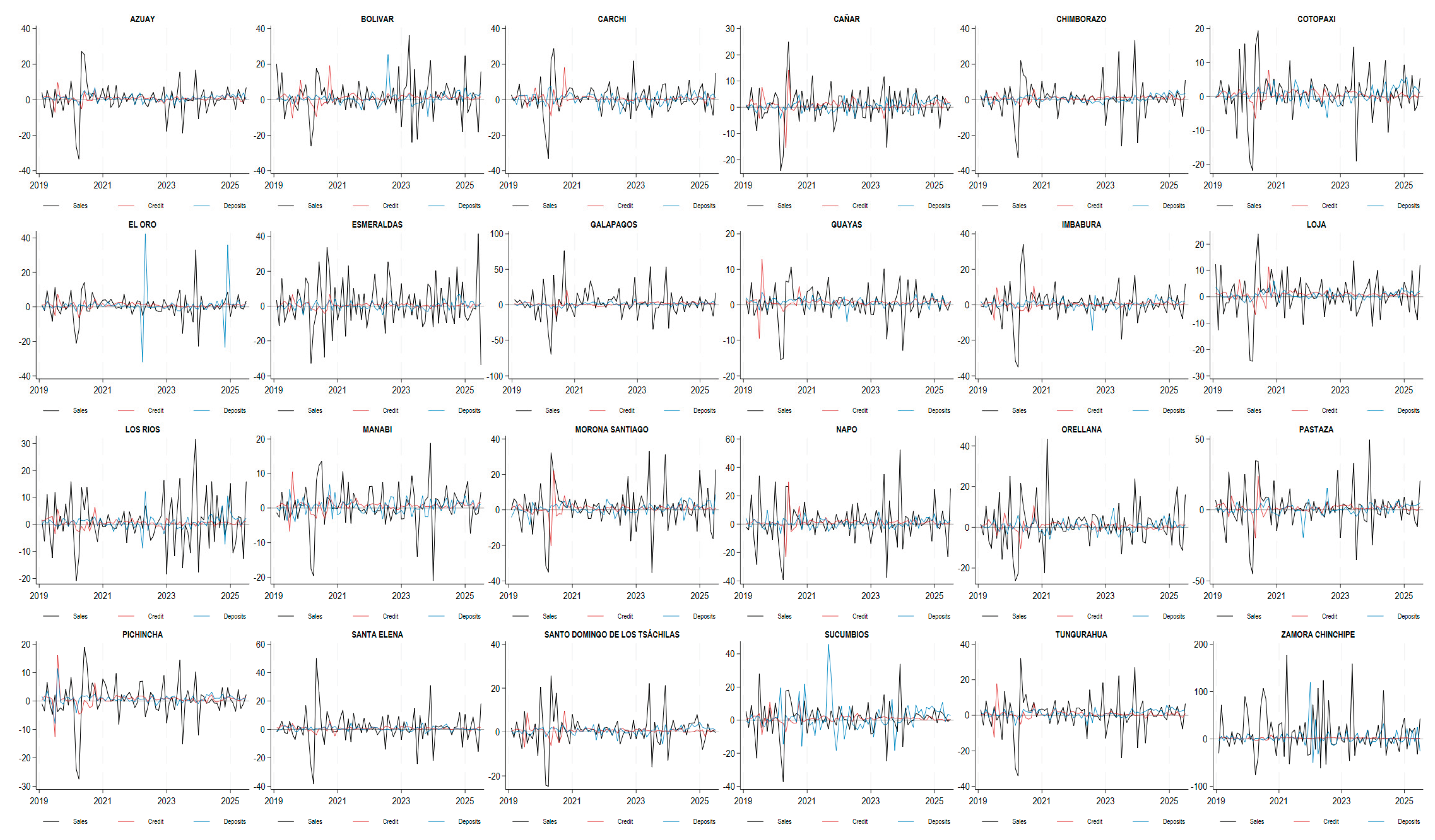
Figure 2.
Generalised impulse response functions of the main Panel VAR model (p=2). Note. Each panel shows the estimated dynamic response of one variable to a shock in another variable of the system over an eight-month horizon. The central line represents the estimated response and the shaded area corresponds to the bootstrap confidence bands. Responses are obtained from the main Panel VAR model estimated by two-step GMM.
Figure 2.
Generalised impulse response functions of the main Panel VAR model (p=2). Note. Each panel shows the estimated dynamic response of one variable to a shock in another variable of the system over an eight-month horizon. The central line represents the estimated response and the shaded area corresponds to the bootstrap confidence bands. Responses are obtained from the main Panel VAR model estimated by two-step GMM.
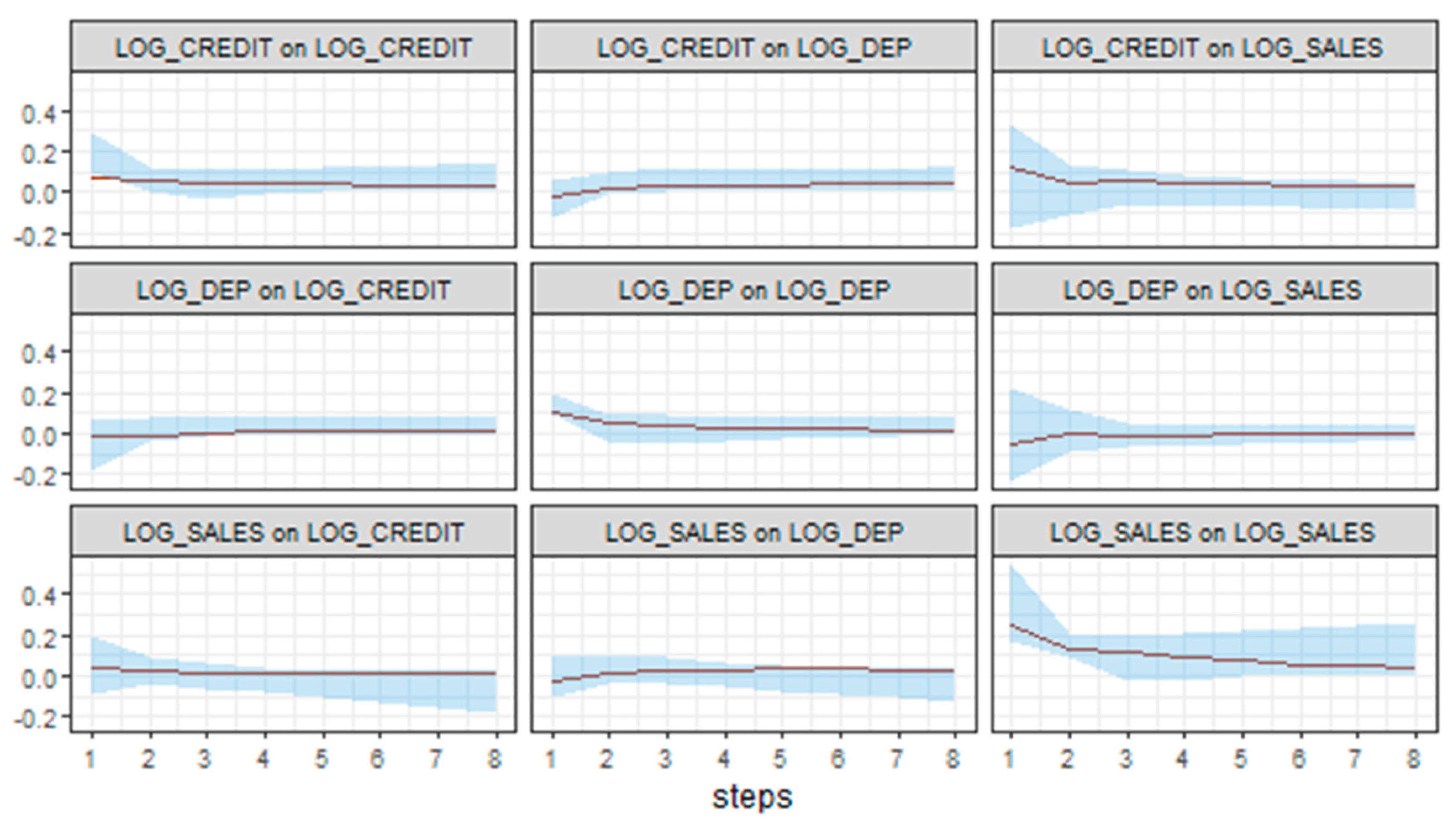
Figure 3.
Forecast error variance decomposition (FEVD) of the main Panel VAR model.
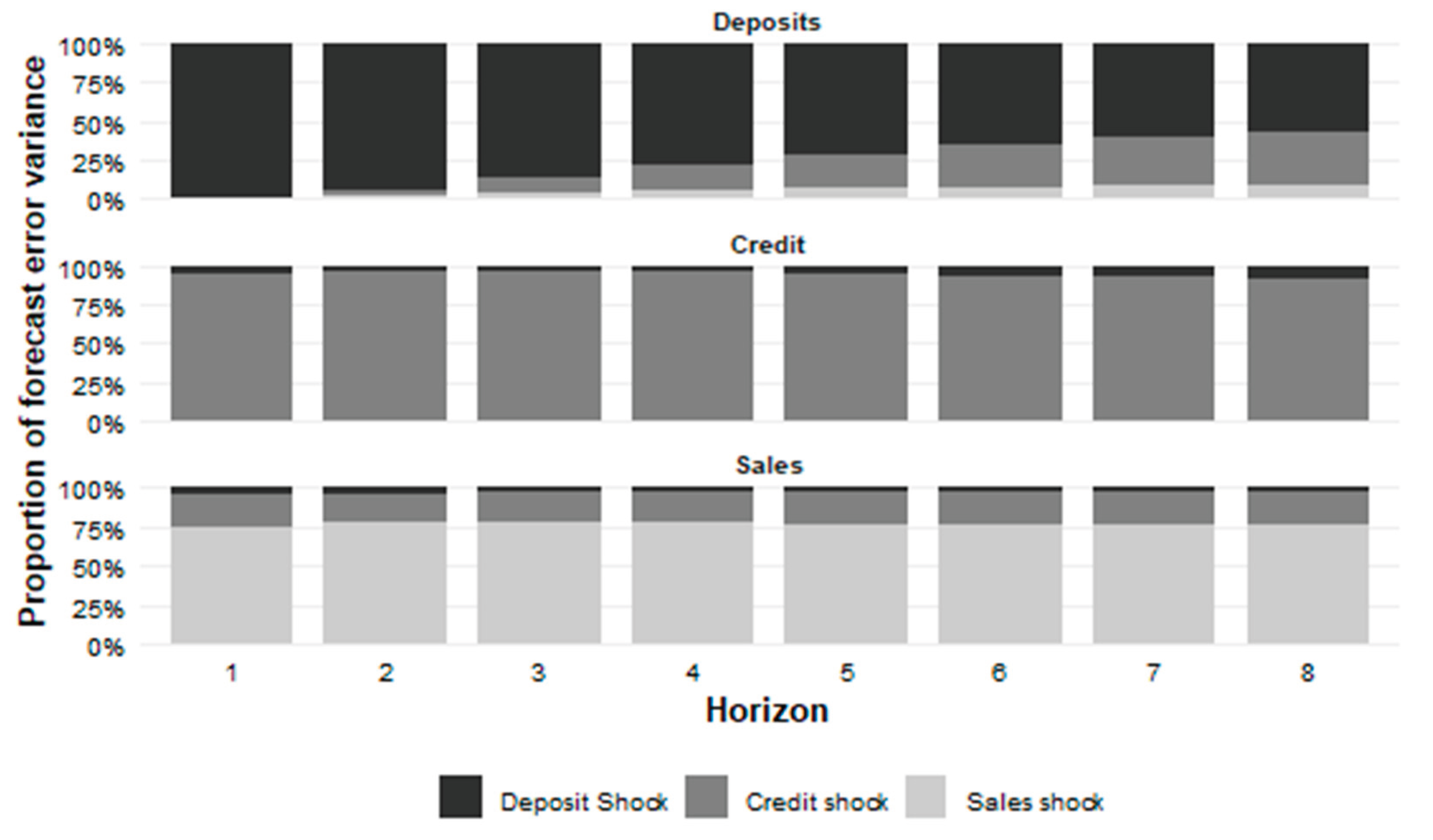

Table 1.
Summary of studies on financial intermediation and economic activity.
| Authors | Country/Region | Method | Key variables | Main finding |
| Rousseau & Wachtel (2000) | 47 countries | Panel VAR | Financial intermediation, stock market, GDP p.c. | Financial intermediation leads per capita output growth |
| Shan et al. (2001) | 9 OECD/Asia | Multivariate VAR, Granger | Financial development, GDP, trade, investment | Bidirectional or absent causality depending on context |
| Chakraborty (2008) | India | Granger, cointegration | Bank credit, market cap., GDP | Growth causes intermediation; bidirectional credit-industry |
| Wolde-Rufael (2009) | Kenya | Toda-Yamamoto VAR | M2, M3, bank credit, GDP | Bidirectional in 3 of 4 financial indicators |
| Hsueh et al. (2013) | Asia (panel) | Bootstrap panel Granger | Financial development, GDP | Heterogeneous patterns across countries |
| Sahoo (2014) | India | ARDL, Granger | Private credit, market cap., GDP | Bank credit causes growth; market has no effect |
| Sulaiman et al. (2015) | Nigeria | Toda-Yamamoto | Financial intermediation, GDP | No causal relationship in either direction |
| Alodayni (2016) | GCC countries | System GMM, Panel VAR | Oil, NPLs, credit, GDP | NPLs restrict credit and depress output |
| Mushtaq (2016) | Pakistan | Johansen, Granger | Deposits, bank credit, GDP | Growth drives credit; not the reverse |
| Durafe & Jha (2018) | India | Granger, correlation | Bank capital, credit, GDP | Bidirectional credit-growth; procyclical behaviour |
| Cheng & Hou (2020) | 8 OECD countries | Cointegration, Granger | Intermediation, non-intermediation, GDP | Heterogeneous effects by type of financial service |
| Zhou & Tewari Dev (2020) | 28 economies | Panel GLS, Granger | Shadow banking, credit, GDP | Positive bidirectional shadow banking-growth relationship |
| Tinoco-Zermeño (2023) | 23 developing | Panel VAR-GMM | Credit, liquidity, energy, CO2, GDP | Bidirectional financial development-GDP |
| Shah et al. (2023) | Nepal | VECM, Granger | Private credit, bank assets, M2, GDP p.c. | Intermediation leads long-run growth |
| Obed et al. (2024) | 12 Middle East | GMM Panel VAR, IRF | FII, FMI, M3, GDP p.c. | Structural break: causal pattern shifts after political crisis |
| Awad et al. (2025) | Palestine | ARDL, simulation | Loans, deposits, GDP | Credit positive in the long run; deposits not channelled |
| Al-rahamneh et al. (2026) | Jordan | VECM, Granger | Private credit, deposits, M2, GDP | Bidirectional deposits; credit causes growth |
| Giyasova et al. (2026) | Turkey | VAR, Toda-Yamamoto | Exports, GDP, inflation, credit | Real activity and inflation cause domestic credit |
Note. The table summarises the geographical context, method, key variables, and main findings of the reviewed studies. The evidence is concentrated at national and international scales, with scarce presence of dollarised economies, subnational analyses, and post-2020 periods.
Table 2.
Variable definitions and data sources.
| Variable | Definition | Source | Transformation |
| depi,t | Stock of public deposits in financial institutions, province i, month t | Superintendency of Banks | Deflation, seasonal adjustment, natural logarithm |
| credi,t | Total credit granted by the financial system, province i, month t | Superintendency of Banks | Deflation, seasonal adjustment, natural logarithm |
| salesi,t | Monthly declared sales, province i, month t | Internal Revenue Service | Deflation, seasonal adjustment, natural logarithm |
| covidt | Dummy variable: 1 if March 2020 ≤ t ≤ December 2021; 0 otherwise | Authors’ construction | Exogenous variable |
Note. Monetary variables are expressed in real dollars. , and correspond to the transformed series used in the model estimation. The econometric specification is estimated on the first differences of their logarithms, so the captured dynamics should be interpreted in terms of relative changes rather than levels.
Table 3.
Unit root tests.
| Variable | Z-statistic | p-value | CIPS statistic | CIPS lags | CIPS p-value | Conclusion |
| Credit | —32.238 | < 0.00 | —6.8707 | 2 | ≤ 0.01 | Stationary |
| Deposits | —34.611 | < 0.01 | —.9083 | 2 | ≤ 0.01 | Stationary |
| Sales | —48.571 | < 0.00 | —7.6203 | 2 | ≤ 0.01 | Stationary |
Note. Variables are expressed in log differences.
Table 4.
Dumitrescu & Hurlin panel Granger causality test results.
| Causal relationship | Z-statistic | p-value | Decision |
| Credit → Deposits | 2.575 | 0.010 | Null hypothesis rejected |
| Sales → Deposits | —0.367 | 0.714 | Null hypothesis not rejected |
| Deposits → Credit | 1.021 | 0.307 | Null hypothesis not rejected |
| Sales → Credit | 1.333 | 0.183 | Null hypothesis not rejected |
| Deposits → Sales | 7.082 | 0.000 | Null hypothesis rejected |
| Credit → Sales | 8.665 | 0.000 | Null hypothesis rejected |
Note. The null hypothesis of the Dumitrescu & Hurlin test posits homogeneous Granger non-causality across all panel units. A p-value below 0.05 allows the null to be rejected, suggesting predictive capacity of the explanatory variable over the dependent variable in at least a subset of provinces. Values reported as 0.000 correspond to p-values below 0.001.
Table 5.
Lag order selection using Andrews & Lu MMSC criteria.
| Lags | MMSC-BIC | MMSC-AIC | MMSC-HQIC |
| 1 | —192.795 | —38.183 | —100.831 |
| 2 | —176.896 | —39.176 | —95.020 |
| 3 | —140.990 | —20.088 | —69.149 |
Note. The Andrews and Lu MMSC criteria allow comparison of GMM-estimated specifications. Lower values indicate better relative model performance under each criterion. The MMSC-BIC and MMSC-HQIC favour a one-lag specification, while the MMSC-AIC selects two lags. The main analysis adopts p=2 on theoretical and empirical grounds and uses p=1 as a robustness check.
Table 6.
Econometric diagnostics of the main Panel VAR model (p=2).
| Indicator | Result |
| Estimation method | Two-step GMM |
| Transformation | First differences |
| Number of groups | 24 |
| Number of observations | 1,824 |
| Number of instruments | 33 |
| Collapsed instruments | Yes |
| Restricted instrumental lags | Yes |
| Exogenous variable | COVID |
| Hansen statistic (p-value) | 0.288 |
| Maximum eigenvalue modulus | 0.981 |
| Stability condition | Satisfied |
| Auxiliary AR(1)—deposits equation (p-value) | 0.0147 |
| Auxiliary AR(2)—deposits equation (p-value) | 0.0915 |
| Auxiliary AR(1)—credit equation (p-value) | 0.0037 |
| Auxiliary AR(2)—credit equation (p-value) | 0.0991 |
| Auxiliary AR(1)—sales equation (p-value) | 0.0264 |
| Auxiliary AR(2)—sales equation (p-value) | 0.0752 |
Note. The main model was estimated by two-step Panel VAR-GMM with first-difference transformation and collapsed instruments. The null hypothesis of the Hansen test posits the joint validity of the moment conditions. System stability is verified when all eigenvalues of the companion matrix lie within the unit circle. The AR(1) and AR(2) tests were obtained from auxiliary Arellano-Bond-type equations in differences, employed as a complementary check of the instrumental scheme. In this context, AR(1) significance is expected due to the first-difference transformation, while the non-significance of AR(2) at the 5% level constitutes favourable evidence for the absence of second-order serial autocorrelation.
Table 7.
Main Panel VAR model estimates (p=2).
| VARIABLE | LOG_DEP | LOG_CREDIT | LOG_SALES |
| lag1 Deposits | 0.6537 *** | 0.0273 | 0.3111 ** |
| lag1 Credit | 0.2277 *** | 0.8405 *** | —0.2038 |
| lag1 Sales | 0.0665 *** | —0.0052 | 0.5799 *** |
| lag2 Deposits | 0.0739 | 0.1166 | —0.1914 |
| lag2 Credit | —0.0008 | —0.0048 | 0.2063 *** |
| lag2 Sales | 0.013 | —0.0122 | 0.1214 ** |
| COVID | 0.0446 *** | —0.0259 * | —0.1061 *** |
| Constant | 0.1829 * | 0.3370 *** | 0.0245 |
Note. Estimated coefficients of the main two-lag Panel VAR model, estimated by two-step GMM with first-difference transformation. *** , ** , * . The COVID variable corresponds to the exogenous control associated with the pandemic period.
Table 8.
Robustness Panel VAR model estimates (p=1).
| VARIABLE | LOG_DEP | LOG_CREDIT | LOG_SALES |
| lag1 Deposits | 0.7029 *** | 0.0714 * | 0.4139 *** |
| lag1 Credit | 0.2447 ** | 0.8158 *** | —0.0038 |
| lag1 Sales | 0.0460 *** | 0.0255 | 0.4868 *** |
| COVID | 0.0473 *** | —0.0292 *** | —0.1357 *** |
| Constant | 0.461 | 1.2675 *** | —2.5523 *** |
Note. Estimated coefficients of the one-lag robustness Panel VAR model, estimated by two-step GMM with first-difference transformation. *** , ** , * . The COVID variable corresponds to the exogenous control associated with the pandemic period.
Disclaimer/Publisher’s Note: The statements, opinions and data contained in all publications are solely those of the individual author(s) and contributor(s) and not of MDPI and/or the editor(s). MDPI and/or the editor(s) disclaim responsibility for any injury to people or property resulting from any ideas, methods, instructions or products referred to in the content. |
© 2026 by the authors. Licensee MDPI, Basel, Switzerland. This article is an open access article distributed under the terms and conditions of the Creative Commons Attribution (CC BY) license (http://creativecommons.org/licenses/by/4.0/).
Copyright: This open access article is published under a Creative Commons CC BY 4.0 license, which permit the free download, distribution, and reuse, provided that the author and preprint are cited in any reuse.


