

Submitted:
15 April 2026
Posted:
17 April 2026
You are already at the latest version
Abstract
Background: In this study, we radiologically assessed potential increases in microvascularity, the extracellular matrix, collagen deposition, and tissue viscoelasticity following carboxytherapy for periorbital hyperpigmentation (POH). We also analyzed the correlation between radiological changes and clinical outcomes and explored implications for future outpatient selection, as well as the potential to predict treatment success based on radiological–clinical correlations. Materials and Methods: The present study included 78 patients (76 women and 2 men) aged over 18 years with Fitzpatrick skin types I-V and moderate-to-severe infraorbital dark circles who applied for treatment at the Dermatology Department in the Cosmetology Unit of Medical Faculty Hospital. Each patient was given manual, pressure-controlled injections of sterile CO2 into the upper and lower eyelids for 7 weeks, with one round of treatment per week. We conducted dermatoclinical and radiological evaluations, including measurements of epidermis–dermis thickness and SWE elastography, musculus orbicularis oculi pars pretarsalis thickness, and cSMI vascular index percentage, as well as SOOF tissue SWE elastography (measured in Kpa). These analyses were performed on both lower eyelids before treatment and at 1 month and 6 months after treatment. Results: After treatment, VAS scores improved significantly. Grayscale ultrasonography showed significant increases in epidermis–dermis and orbicularis oculi thickness at 1 and 6 months (p<0.05). SMI presented a significant increase in vascular index at both follow-ups (p<0.05). SOOF SWE values increased significantly at 1 and 6 months, whereas epidermis–dermis SWE did not. Procedural pain was common, and 25 participants withdrew during the 7-week period due to discomfort. Conclusions: Radiological findings indicated collagen accumulation, increased microvascularity, myocyte proliferation, and enhanced viscoelasticity resulting from carboxytherapy treatment. The continuity of radiological and clinical improvements from the first to sixth months following treatment suggests the enduring benefits of this therapy.
Keywords:
periorbital hyperpigmentation
; infraorbital dark circles
; carboxytherapy
; ultrasonography
; superb microvascular imaging
; shear‐wave elastography
Introduction
Periorbital hyperpigmentation (POH) is a common condition that accounts for a significant number of patients presenting with skin discoloration [1]. Patients present with semicircular, black-pigmented patches in the periorbital region. In some cases, these patches extend to the upper eyelids, eyebrows, and malar regions [2]. Reported rates of occurrence vary widely in the literature. Studies have reported that up to 78% of the general population may exhibit periorbital hyperpigmentation, with higher prevalence rates observed in Asian and African populations [3]. The mean age of onset is 32, with women aged 16-45 comprising most cases [4].
POH is histologically characterized by dermal melanin incontinence, increased amounts of melanosomes and vesicular melanin, perivascular lymphocyte infiltration, and scattered dermal melanophages [3].
POH has a multifactorial etiology. Contributing factors include UV exposure, inflammation, vascular changes, and lifestyle factors such as tobacco and alcohol use, sleep deprivation, and restricted fluid intake [5,6,7,8,9].
Anatomical factors may also contribute to the development of POH. These factors include a tear trough, a thinner lower eyelid with superficial vasculature, a lack of adipose tissue over the orbicularis oculi pars palpebralis, and skin thinning due to subcutaneous fat loss around the orbit [9,10].
Treatment of POH involves identifying and eliminating etiopathogenetic factors and, when appropriate, aesthetic modalities. Synthetic and naturally derived depigmenting active topical formulations are the primary therapeutic strategy [1]. In addition, hyaluronic acid injection is used for under-eye hollowness accompanying pigmentation [11].
Current and new treatments include laser therapy, autologous fat transplantation, platelet-rich plasma (PRP), and carboxytherapy, all of which are used alone or in combination with topical agents [12,13,14,15].
Recent randomized and comparative studies have reported clinical improvement with carboxytherapy, including comparisons with lasers, microneedling-based approaches, and platelet-rich plasma. However, outcome heterogeneity persists across studies, as reflected in differing efficacy estimates, assessment tools, and follow-up durations. A recent meta-analysis published in 2025 further emphasized this variability, highlighting limitations related to study design, treatment protocols, outcome measures, and patient characteristics, as well as the scarcity of objective imaging-based endpoints. Objective imaging correlates such as microvascularization, tissue stiffness, and layer thickness have been less frequently evaluated in POH carboxytherapy studies.
The mechanism of carboxytherapy treatment involves the formation of an O2–CO2 imbalance under the skin following intradermal or subcutaneous CO2 injection. This imbalance results in fibroblast proliferation, collagen deposition, and the release of vascular endothelial growth factor (VEGF). VEGF stimulates vasculogenesis and increases skin elasticity [8], leading to collagen deposition, lipolysis stimulation, and deposit destruction. For this reason, carboxytherapy is widely used in current aesthetic–clinical practice for skin lifting, rejuvenation, striae alba, and lipolysis regulation [9].
Carboxytherapy outcomes align with the variability of other treatment options; some studies report improvement, while others show inconsistent results [16,17,18]. Radiological imaging may help identify anatomical response modifiers and objectively measure outcomes.
This study aimed to assess radiological support for possible physiopathologic changes, examine the correlation between radiological and clinical changes, and determine the compatibility of radiological changes with clinical findings. The results were used to explore imaging correlates that may inform patient selection in future studies and treatment success based on radiologic–clinical correlation by evaluating thickness, elasticity, and microvascularization in the epidermis, dermis, orbicularis oculi, and suborbicularis oculi fat pad (SOOF) using superb microvascular imaging (SMI), shear-wave elastography (SWE), and conventional gray-scale ultrasonography.
Materials and Methods
This study was conducted in accordance with the Declaration of Helsinki. The hospital’s Ethical Committee approved this study.
We included 78 patients (76 females and 2 males) who presented to our dermatology department with moderate-to-severe infraorbital dark circles and were classified as having Fitzpatrick skin types I-V. The sample size was determined based on the available literature. Our exclusion criteria for this study were previous treatment of any kind for POH, chronic systemic disease, a past medical history of keloid scars, receiving immunosuppressants or PgF2a treatment, pregnancy, or lactation. Informed written consent was secured from all patients. In total, 53 patients completed the study, and 25 voluntarily withdrew during the 7-week treatment period due to discomfort. Baseline demographic and clinical characteristics of patients who completed the study and those who withdrew were comparable (data not shown).
CO2 injections were administered subepidermally into the orbital skin in both periorbital regions using a Skymedic DIOXAGE® device. In the injection protocol, a 32-gauge needle was used with a targeted injection depth of 6 mm. Manual mode was selected, and sterile, warmed CO2 gas was injected at 50 mL/min under controlled pressure and flow. Although the injected volume varied according to each patient’s periorbital morphology, the mean volume was 50-70 mL per eye. The subepidermal injection of sterile carbon dioxide was terminated before the CO2 spread to the perizygomatic area. The procedure was conducted in two rounds, targeting two distinct points on the upper and lower lateral eyelids. When transitioning from the first to second pass, a mean waiting time of 10 minutes was allowed for the injected sterile CO2 gas to fully diffuse and the eyelid to return to its original form. The procedure was performed once per week for seven weeks. Patients were asked to use regular sun protection during the application period to avoid possible UVA-mediated melanosis.
Dermatological and radiological evaluations were performed for both eyes before treatment and at 1 and 6 months after treatment. We recorded Fitzpatrick skin types and POH pigmentation levels according to La Padula et al.; POH types, as described by Huang et al.; and smoking status, sleep, and hydration habits [19,20]. To clinically analyze hyperpigmentation, the primary outcome was the visual analog scale (VAS). Before the first session and 1 month after the last session, photographs were taken before and after carboxytherapy with a 12-megapixel camera under similar lighting conditions. The pre-procedure, one-month, and six-month post-carboxytherapy photographs were evaluated together, placed on a separate scoring sheet, and scored by 2 dermatologists. Patients were also asked to rate the photos using the VAS. Patients and doctors were asked to rate their overall satisfaction with the procedure on a scale of 1-5 (none/low/moderate/good/very good). Evaluations were performed in a blinded manner with a randomized image order.
For the radiological evaluation, an 18-MHz linear transducer (Canon Medical Systems Corporation, Aplio i800 Platinum, Tokyo, Japan) was used for conventional ultrasonographic gray-scale, SMI, and SWE examinations to evaluate the tissue before and at 1 and 6 months after treatment. Ultrasonographic gray-scale, SMI, and SWE examinations were performed with the patients supine and their eyelids completely closed but not squeezed. A gel pad was applied to the eye socket, and a probe was placed perpendicular to the globe midline plane. In gray-scale ultrasound, we recorded the thickness of the orbicularis oculi pars pretarsalis from the midline, 1 cm lateral to the lens in the inferior tarsal area and approximately 3 cm from the orbicularis retaining ligament, and the mean epidermis–dermis thickness. In SMI imaging, the free-hand region of interest (ROI) was used to delineate the borders of the musculus orbicularis oculi pars pretarsalis (MOOPP). The static cSMI mode imaging parameters were low speed and high frame rate (PRF: 0.9–1.2 kHz, 42-49 frames/sec [fps]). The vascular index (VI) of the manually drawn free-hand ROI was expressed as a percentage and evaluated semiquantitatively according to Adler’s model [21].
The 2D-SWE mode was used for the elastographic evaluation of the orbicularis oculi pars pretarsalis and SOOF. Single-shot mode (6 MHz frequency, 0.2 frames/sec [fps]) was used to obtain quantifiable results. We measured the shear-wave stiffness of 2 ROIs of 2 mm in diameter in the epidermis–dermis, orbicularis oculi, and SOOF tissues in kPa (Figure 1).
Data were presented as mean ± standard deviation for continuous variables or as frequencies (%) for categorical variables in the descriptive statistics of the results obtained pre-treatment and at 1 and 6 months post-treatment. The Kolmogorov–Smirnov test was used to assess the distribution of data. For paired comparisons of pre- and post-treatment measurements, the Wilcoxon signed-rank test was used. For comparisons across three time points (baseline, 1 month, and 6 months), the Friedman test was applied. Between-group comparisons were performed using the Mann–Whitney U test. Categorical variables were compared using the chi-square test. A probability value (P value) less than .05 was considered statistically significant, and SPSS 28.0 was used to analyze the data.
Results
A total of 53 patients (49 female and 4 male) were included in this study. Overall, 50.9% of patients (n=27) had Fitzpatrick skin type III, 34% (n=18) had Fitzpatrick skin type II, and 15.1% (n=8) had Fitzpatrick skin type IV. The degree of periorbital pigmentation was grade II in 77.4% (n=46), grade I in 11.3% (n=6), and grade III in 11.3% (n=6) of patients. Pigmentation was a vascular type in 52.8% of patients, a mixed type in 37.7%, a structural type in 5.7%, and a pigmented type in 1.9%. Active smokers accounted for 35.8% of participants. The mean daily fluid intake was 1.8 L/day, and 75.5% of patients slept less than 7 hours per day.
During the procedure, pain occurred in 92.5% of patients (n=49), hematoma in 18.9% (n=10), and swelling and edema in an area distant from the treated region in 15.1% (n=8).
The patients’ pre-procedure VAS scores were 7.7±1.3, whereas their post-procedure VAS scores were 4.6±1.4. Physicians’ pre-procedure VAS scores were 7.7±1.1, and their post-procedure VAS scores were 5.1±1.3. Following the procedure, patient satisfaction with their treatment response was rated as good by 54.7%, moderate by 26.4%, and very good by 13.2%. Physicians’ satisfaction with the treatment response was rated as good by 50.9%, very good by 41.5%, and moderate by 5.7%. Patient- and physician-reported VAS scores decreased significantly after the procedure compared with the baseline (p<0.05).
No significant differences were observed between female and male patient groups in pre- or post-procedure patient- or physician-reported VAS scores (p > 0.05). In both smoking and non-smoking groups, pre- to post-procedure decreases in patient and physician VAS scores were significant (p<0.05). However, the magnitude of the VAS score reduction did not differ significantly between groups (p>0.05). In the group with daily water consumption >2 L, the post-procedure patient VAS score was significantly higher (p<0.05), whereas the physician VAS score was lower. Sleep duration (≥7 hours vs. <7 hours) did not have a significant effect on pre- or post-procedure patient or physician VAS scores in either group (p>0.05). Baseline patient VAS scores were similar across pigmentation-grade groups (p>0.05). However, in all groups, significant reductions in both patient and physician VAS scores were observed after the procedure (p<0.05). This reduction was more pronounced from both patient and physician perspectives among those with pigmentation grade II than among those with grade I (p<0.05). However, there were no significant differences between pigmentation grade III and the other groups (p>0.05). Baseline physician VAS scores were highest for the pigmentation grade III group (p<0.05). After the procedure, this group also received higher physician VAS scores than did the other groups (p<0.05) (Table 1).
In the Fitzpatrick skin type IV group, baseline patient and physician VAS scores were significantly higher than those in the Fitzpatrick skin type II and III groups (p<0.05). In all skin types, post-procedure patient and physician VAS scores decreased significantly compared with those at baseline (p<0.05). The magnitude of pre- and post-procedure reductions in patient and physician VAS scores did not differ significantly between groups (p>0.05) (Table 2).
According to patient satisfaction rates, in both groups (none/low/moderate satisfaction and good/very good satisfaction), both patient and physician VAS scores decreased significantly after the procedure (p<0.05). In the higher-satisfaction group, the post-procedure physician VAS score was lower, and the decrease in scores was greater (p<0.05). However, the reduction in patient VAS scores did not differ significantly between groups (p>0.05).
In patients with and without structural-type pigmentation, baseline patient VAS scores were similar (p>0.05) and decreased significantly after the procedure in both groups (p<0.05). However, the magnitude of reduction did not differ significantly between groups (p>0.05). For physician VAS scores, a significant post-procedure reduction was observed in the non-structural group (p<0.05), whereas no significant change was observed in the structural-type group (p>0.05). Post-procedure physician VAS scores were higher in the structural-type group than in the non-structural group (p<0.05). VAS scores for vascular, post inflammatory-pigmented, and mixed-type pigmentation decreased significantly from pretreatment levels, but there were no significant differences among these types of pigmentation.
The thicknesses observed on the grayscale ultrasounds of the epidermis–dermis and MOOPP both statistically significantly increased at 1 month and 6 months after treatment (p<0.05) (Table 3).
While the SWE values of the SOOF tissue statistically significantly increased at 1 month and 6 months after treatment, epidermis–dermis SWE values did not (Table 3). The lack of significant change in epidermis–dermis SWE values despite histological and thickness alterations may reflect technical limitations of shear-wave elastography in very low stiffness tissues. At low kPa ranges, SWE precision and reproducibility decrease, potentially masking subtle biomechanical changes.
The vascular index value calculated with SMI for MOOPP was also statistically significantly increased at 1 month and 6 months after treatment (p<0.05) (Table 3). All these values were also evaluated with patients separated according to POH subtype, gender, smoking status, sleep habits, and water consumption (Table 1). Additionally, patients were separated according to their satisfaction levels (no satisfaction, minor satisfaction, and moderate satisfaction were combined into one group, and good satisfaction and very good satisfaction were combined into a second group). Radiological values were compared between these groups (Figure 2).
Discussion
Periorbital hyperpigmentation is a cosmetic complaint that does not threaten an individual’s general health but adversely affects quality of life from a psychosocial perspective. Periorbital hyperpigmentation, characterized by brown-gray pigmented macules around both eyes, is influenced by personal habits, the anatomical structure of the region (muscle, fat, and bone tissue), and environmental factors. Topical agents, chemical peels, device-based therapies, and injection techniques can be used in management [22].
In a previous study, seven sessions of carboxytherapy were applied for POH in a cohort of 90 patients, and the outcomes were analyzed 2 months after treatment. Both physicians and patients recorded preoperative and postoperative VAS scores, and a significant reduction in VAS scores was observed by both assessors after the procedure. A 50-60% reduction in periorbital pigmentation was also noted [24]. Another study examining 20 patients found that a four-week periorbital carboxytherapy protocol resulted in a statistically significant reduction in pigmentation in the periorbital area, with a complete response in 20% of patients. Additionally, the procedure was deemed effective and safe [25].
In another study evaluating the efficacy of platelet-rich plasma (PRP) and carboxytherapy in POH, a significant improvement in pigmentation was observed in both groups; however, treatment responses varied by technique and skin type [26]. In a study of 45 patients comparing the efficacy of carboxytherapy, vitamin C mesotherapy, and chemical peeling for POH, no significant differences in efficacy were observed between groups. Nevertheless, the authors argued that although the mesotherapy group experienced a higher rate of burning sensation as an adverse effect, the treatment’s efficacy was superior to that of carboxytherapy [27]. A previous study by Assaf et al. compared carboxytherapy with micro needling plus topical glutathione in POH. The authors noted that carboxytherapy was significantly superior in VAS scoring, patient satisfaction, and dark circle index [28]. A recent meta-analysis published in 2025 evaluated the available comparative evidence and concluded that both carboxytherapy and platelet-rich plasma are associated with clinically meaningful improvements in periorbital hyperpigmentation. However, no consistent superiority of either modality could be established due to substantial methodological and clinical heterogeneity across studies. Sources of heterogeneity included differences in treatment protocols, injection depth, and volume; number of sessions; outcome assessment tools; follow-up duration; and variability in patient- and lesion-related characteristics, particularly the distribution of vascular, pigmentary, structural, and mixed periorbital hyperpigmentation subtypes. Collectively, these findings indicate that existing comparative data are insufficient to define definitive treatment hierarchies and emphasize the need for standardized protocols and objective outcome measures capable of delineating treatment-specific effects at the tissue level. In our study, both patient and physician VAS scores decreased significantly after the procedure compared with baseline. Subgroup analyses indicated that this reduction occurred independent of sex, smoking, sleep duration, Fitzpatrick skin type, vascular-type pigmentation, or structural-type pigmentation.
We compared patients according to the subtypes described by Huang et al. Decreases in patient VAS scores were similar in patients both with and without mixed-type lesions. The thickness of the MOOPP, however, was significantly higher in patients with vascular POH. In patients with mixed-type POH, the thickness of the MOOPP after carboxytherapy was significantly lower. These results suggest that the overall effects may be similar, but the proliferative effect of carboxytherapy is most prominent in patients with vascular POH and least effective in those with mixed-type POH.
The existing literature indicates that after CO2 application, perfusion, oxygenation, growth, and tissue regeneration increase due to a local myogenic mechanism resulting from the rightward shift in the Hb-O2 dissociation curve. Following local vasodilation in the arteriole and metarteriole, as well as in the precapillary sphincter, stimulation of VEGF-A and FGF-1 gene transcription in the tissue leads to increased vasculogenesis [29]. The SMI examination of the MOOPP indicated a statistically significant increase from the baseline VI at 1 and 6 months post-treatment. Notably, the 6-month post-treatment VI was significantly higher than the 1-month post-treatment VI. This result suggests that the vasculogenic effect of carboxytherapy continues over the long term.
In the literature, increased local vascularization is associated with higher tissue temperature and extracellular matrix remodeling. These factors contribute to tissue regeneration through fibroblast proliferation and fibroblast-mediated collagen synthesis and accumulation, driven by the angiogenic effect and growth factor release in the tissue [29]. Nassar et al. reported that subepidermal CO2 injection increased matrix metalloproteinase-1 (MMP-1) expression, favoring collagen turnover, while overall collagen density increased [27]. This increase in collagen would also increase the thickness of the lower eyelid dermis [30]. In line with the literature, our grayscale ultrasound examinations showed a statistically significant increase in the thickness of the lower eyelid epidermis and dermis at 1 and 6 months post-treatment. Once again, we observed that the thickness measurements at 6 months post-treatment were significantly higher than those at 1 month (Table 3). This result suggests that the effects of collagen synthesis and extracellular matrix accumulation induced by carboxytherapy also persist over the long term.
Brochado et al. demonstrated that carboxytherapy stimulates cell proliferation through angiogenic and growth factors, potentially accompanied by nitric-oxide-mediated vasodilator and antispasmodic effects [27]. To explore the hypothesis that this phenomenon could also promote myocyte proliferation, we measured the thickness of the MOOPP using gray-scale ultrasound. A statistically significant increase in the thickness of the MOOPP was observed, suggesting that the effect of carboxytherapy-induced cellular proliferation also continues over the long term.
The literature indicates that carboxytherapy promotes fibroblast proliferation, increases elastin synthesis, and enhances tissue regeneration through well-organized collagen fibers [32]. Biopsy results post-carboxytherapy have shown a significant increase in elastic fiber quantity [27]. Additionally, transcutaneous CO2 injection penetrates subepidermal white adipocytes, producing a lipolytic effect that stimulates adipolysis, as confirmed by histological analysis [30]. Epidermis–dermis and SOOF tissue SWE measurements were performed to evaluate this effect. Epidermis–dermis SWE measurements revealed no significant change, whereas SOOF SWE measurements indicated a significant increase at 1month (Table 3). Since carbon dioxide injection targets a depth of approximately 6 mm, primary gas diffusion is thought to occur at approximately this depth. We hypothesize that this diffusion occurs due to the lack of an effect on the irregular, tight connective tissue in the dermis, which limits the impact of deeper carbon dioxide injection on the dermis’s viscoelasticity.
Even though MOOPP thickness increased less while VI increased more in men, we cannot hypothesize the reason for this phenomenon due to our small male patient sample size (Table 3).
In the literature, chronic smoking is associated with muscle dysfunction and volume loss, which is further associated with muscle apoptosis [33]. Before carboxytherapy, the thickness of MOOPP was statistically significantly lower in smokers. However, no statistically significant differences were observed between smokers and non-smokers in any posttreatment measurements (Table 3). This result indicates that smoking leads to a decrease in muscular volume. Nonetheless, a significant increase in volume was achieved after carboxytherapy.
The literature reports that increasing the water level in the tissue increases the thickness of collagen fibers, decreases the level of collagenase released by fibroblasts, and increases the tissue’s viscoelasticity by reducing the density and amount of collagen [34]. However, the effect of daily water consumption on carboxytherapy responses has not been previously analyzed in the literature. In our study, decreases in both patient and physician VAS scores were significantly greater in patients with daily water consumption <2 L than in those with ≥2 L. In the group that consumed less than 2 liters of water daily, lower eyelid SOOF elastography showed a low but statistically significant increase. In comparison, there was no significant difference in the group that consumed ≥2 L (Table 1). This finding suggests that hydration status may influence the response to carboxytherapy and indicates that further studies are needed to support these data.
The lower eyelid epidermis–dermis elastography values before carboxytherapy in the group with a sleep duration of 7-9 hours were significantly lower than those in the group with a sleep duration of less than 7 hours. However, there was no statistically significant change after carboxytherapy (Table 1). This result suggests that insufficient sleep contributes to tissue elasticity, while carboxytherapy has no statistically significant effect on epidermis–dermis elasticity.
The MOOPP VI in the group with a sleep duration of 7-9 hours was significantly higher than that in the group with a sleep duration of less than 7 hours. This result suggests that the vasodilator and long-term neoangiogenic effects of carbon dioxide were more pronounced in patients with adequate sleep duration.
It has been reported in the literature that insufficient and late sleep onset decreases hydration and thus the elasticity of the skin and subcutaneous soft tissue [35]. In the group with a sleep duration of less than 7 hours, the SOOF elastography value on the first and sixth month after carboxytherapy showed a statistically significant increase compared to that in the pre-carboxytherapy group, while no statistically significant difference was found in the group with a sleep duration of 7-9 hours (Table 1). This outcome suggests that the primary effect of carboxytherapy on white adipose tissue is likely related to lipolysis and elastin fiber synthesis, rather than tissue hydration.
In a study including 90 patients, the most common adverse events observed during seven sessions of carboxytherapy for periorbital pigmentation were ecchymosis, edema, and pain (25%); however, no adverse event leading to treatment discontinuation was observed (24). In an Iran-based cohort of 20 patients, erythema and edema were frequently observed during the procedure and regressed within 1 week with warm compresses and massage. Ocular twitching occurred in two patients, but no abnormality was detected on ophthalmologic consultation (25). In our study, pressure and pain sensations occurred in 92.5% of patients during the procedure, while swelling and edema in an area distant from the treated region developed in 15.1%. Marked edema was observed the morning after the procedure and regressed within 24-48 hours. During this period, if regression was observed, gentle periorbital massage and dispersion of subcutaneous gas were recommended. Mild-to-moderate hematoma persisting for 5-7 days after the procedure was observed in 18.9% of patients. While prior studies often report transient adverse effects without discontinuation, our real-world attrition during the 7-week protocol highlights tolerability as an important practical limitation and suggests that protocol parameters and patient counseling may influence adherence.
A headache lasting <24 hours was recorded in 12% of patients. However, no patient discontinued treatment due to adverse effects. In light of these data, the observed adverse effects appear tolerable and reversible, consistent with the literature, supporting the view that this procedure can be performed safely
In patients experiencing pain during the trial, the MOOPP SMI vascular index and SOOF elastography values increased significantly. In contrast, these values did not show significant changes in patients who did not experience pain (Table 3). Notably, the size of the potential space to be filled with gas may differ between patients, and some mechanical effects of this treatment may be evident. Therefore, we suggest that the amount of sterile gas injected into the subepidermal area during carbon dioxide injection continue until the fascia is stretched, and the patient feels pain. The significant thickening of the MOOPP suggests that it also stimulates myocyte proliferation. However, the literature needs additional studies on this subject to further explain its physiopathogenesis.
The limitations of this study include its single-center design, the small number of male participants, and the fact that carboxytherapy caused procedural pain in a large proportion of the patient population. Multicenter studies with larger populations and a more balanced sex distribution may provide a more statistically meaningful contribution to the literature.
Conclusions
This study provides a radiological view of the tissue changes expected following subepidermal sterile CO2 application, a current treatment for POH.
According to the study results, a statistically significant decrease in pigmentation was observed across all patient groups. The reduction in VAS scores was significantly greater in patients with daily water consumption <2 L and those with grade II pigmentation. Sex, smoking status, sleep duration, and the presence of vascular pigmentation did not create significant differences in procedural outcomes.
Radiological imaging may serve as an objective adjunct to clinical assessment in patient selection and a follow-up to carboxytherapy for POH.
The neoangiogenic and extracellular matrix–collagen accumulation effects of carboxytherapy persisted 6 months after treatment, suggesting that this therapy’s potential effects on tissue persist over a long term. However, further studies are needed to evaluate the durability of treatment outcomes and identify possible long-term adverse effects.
Funding
This research received no external funding.
Conflicts of Interest
The authors declare that they have no conflicts of interest related to this study.
References
- Mi, R.; Chung, K. Infraobital dark circles: definition, causes, and treatment options. Dermatol Surg. 2009, 35(8), 1163–1171. [Google Scholar] [CrossRef]
- Desai, S.R.; Alexis, A.; Sarkar, R.; Ranjan, R.; Sonthalia, S. Periorbital hyperpigmentation: a comprehensive review. J Clin Aesthet Dermatol. 2016, 9(1), 49–55. [Google Scholar]
- Sawant, O.; Khan, T. Management of periorbital hyperpigmentation: An overview of nature-based agents and alternative approaches. Dermatol Ther 2020, 33(4), e13717. [Google Scholar] [CrossRef] [PubMed]
- Masson, F. Periorbital hyperpigmentation: What lies beneath? Indian Dermatol Online J 2018, 9(4), 229–230. [Google Scholar]
- Sardana, K.; Rajpal, M.; Garg, V.; et al. Periorbital hyperpigmentation mimicking fixed drug eruption: a rare presentation of erythema dyschromicum perstans in a paediatric patient. J Eur Acad Dermatol Venereol 2006, 20, 1381–3. [Google Scholar] [CrossRef]
- Goodman, R.M.; Belcher, R.W. Periorbital hyperpigmentation. An overlooked genetic disorder of pigmentation. Arch Dermatol 1969, 100, 169–74. [Google Scholar] [CrossRef]
- Kurban, R.S.; Bhawan, J. Histologic changes in skin associated with aging. J Dermatol Surg Oncol 1990, 16, 908–14. [Google Scholar] [CrossRef]
- Hori, Y.; Takayama, O. Circumscribed dermal melanoses. Classification and histologic features. Dermatol Clin 1988, 6, 315–26. [Google Scholar] [CrossRef]
- Goldberg, R.A.; McCann, J.D.; Fiaschetti, D.; et al. What causes eyelid bags? Analysis of 114 consecutive patients. Plast Reconstr Surg 2005, 115, 1395–402; discussion 403–4. [Google Scholar] [CrossRef]
- Kane, M.A. Treatment of tear trough deformity and lower lid bowing with injectable hyaluronic acid. Aesthetic Plast Surg 2005, 29, 363–7. [Google Scholar] [CrossRef]
- Goldberg, R.A.; Fiaschetti, D. Filling the periorbital hollows with hyaluronic acid gel: initial experience with 244 injections. Oph-thal Plast Reconstr Surg 2006, 22, 335–41; discussion 41–3. [Google Scholar] [CrossRef]
- Budania, A.; Mandal, S.; Pathania, Y.S.; Lahoria, U.; Khan, M.A.; Puri, I.; Mishra, R. Comparing novel versus conventional technique of platelet-rich plasma therapy in periorbital hyperpigmentation: A randomized prospective split-face study. J Cosmet Dermatol. 2021, 20(10), 3245–3252. [Google Scholar] [CrossRef] [PubMed]
- Alster, T.S.; Bellew, S.G. Improvement of dermatochalasis and periorbital rhytides with a high-energy pulsed CO2 laser: a retrospective study. Dermatol Surg. 2004, 30 4 Pt 1, 483–487;discussion 7. [Google Scholar] [CrossRef] [PubMed]
- Montolío-Marzo, S.; Montolío-Marzo, E.; Martínez-Gil, C.; Rodríguez- Iranzo, G.; Arias-García, E.; Pérez-López, M. Treatment of periorbital hyperpigmentation using light devices. In Archivos de la Sociedad Española de Oftalmología (English Edition); 2023. [Google Scholar]
- Vanaman Wilson, M.J.; Jones, I.T.; Bolton, J.; Larsen, L.; Wu, D.C.; Goldman, M.P. Prospective studies of the efficacy and safety of the picosecond 755, 1,064, and 532 nm lasers for the treatment of infraorbital dark circles. Lasers Surg Med. 2018, 50(1), 45–5. [Google Scholar] [CrossRef] [PubMed]
- El-Tahlawi, S.M.; Fawzy, M.M.; El Maadawi, Z.; Yasen, S.M.; Aboraia, N.M. Platelet-rich plasma versus carboxytherapy in the treatment of periorbital dark circles: A split-face study. J Cosmet Dermatol. 2022, 21(10), 4332–4338. [Google Scholar] [CrossRef]
- Seirafianpour, F.; Atefi, N.; Amin, N.G.; et al. Effectiveness, safety, and patient satisfaction of carboxytherapy as an adjunctive treatment for periorbital hyperpigmentation. Skin Res Technol. 2024, 30(3), e13651. [Google Scholar] [CrossRef]
- Nofal, E.; Elkot, R.; Nofal, A.; Eldesoky, F.; Shehata, S.; Sami, M. Evaluation of carboxytherapy and platelet-rich plasma in treatment of periorbital hyperpigmentation: A comparative clinical trial. J Cosmet Dermatol. 2018, 17(6), 1000–1007. [Google Scholar] [CrossRef]
- Sacks, D.; Baxter, B.; et al.; From the American Association of Neurological Surgeons (AANS); American Society of Neuroradiology (ASNR); Cardiovascular and Interventional Radiology Society of Europe (CIRSE); Canadian Interventional Radiology Association (CIRA); Congress of Neurological Surgeons (CNS); European Society of Minimally Invasive Neurological Therapy (ESMINT); European Society of Neuroradiology (ESNR); European Stroke Organization (ESO); Society for Cardiovascular Angiography and Interventions (SCAI); Society of Interventional Radiology (SIR); Society of NeuroInterventional Surgery (SNIS); and World Stroke Organization (WSO) Multisociety Consensus Quality Improvement Revised Consensus Statement for Endovascular Therapy of Acute Ischemic Stroke. Int J Stroke 2018, 13(6), 612–632. [Google Scholar] [CrossRef]
- Huang, Y.L.; Chang, S.L.; Ma, L.; et al. Clinical analysis and classification of dark eye circle. Int J Dermatol. 2014, 53(2), 164–170. [Google Scholar] [CrossRef]
- Adler, D.D.; Carson, P.L.; Rubin, J.M.; Quinn-Reid, D. Doppler ultrasound color flow imaging in the study of breast cancer: preliminary findings. Ultrasound Med Biol. 1990, 16(6), 553–559. [Google Scholar] [CrossRef]
- Zenker, S. Carboxytherapy carbon dioxide injections in aesthetic medicine. Prime-Journal 2012, 2, 1–12. [Google Scholar]
- Montolío-Marzo, S.; Montolío-Marzo, E.; Martínez-Gil, C.; Rodríguez- Iranzo, G.; Arias-García, E.; Pérez-López, M. Treatment of periorbital hyperpigmentation using light devices. In Archivos de la Sociedad Española de Oftalmología (English Edition); 2023. [Google Scholar]
- Paolo, F.; Nefer, F.; Paola, P.; Nicolò, S. Periorbital area rejuvenation using carbon dioxide therapy. J Cosmet Dermatol. 2012, 11(3), 223–8. [Google Scholar] [CrossRef] [PubMed]
- Seirafianpour, F.; Atefi, N.; Amin, N.G.; Namazi, M.R.; Behrangi, E.; Shafiei, A.; Ghassemi, M.; Mozafarpoor, S.; Goodarzi, A. Effectiveness, safety, and patient satisfaction of carboxytherapy as an adjunctive treatment for periorbital hyperpigmentation. Skin Res Technol. 2024, 30(3), e13651. [Google Scholar] [CrossRef] [PubMed] [PubMed Central]
- Asilian, A.; Amiri, A.; Mokhtari, F.; Faghihi, G.; Iraji, F.; Mozafarpoor, S. Platelet-rich plasma versus carboxytherapy for the treatment of periocular hyperpigmentation; which approach is superior? Dermatol Ther. 2021, 34(4), e14980. [Google Scholar] [CrossRef] [PubMed]
- Ahmed, N.A.; Mohammed, S.S.; Fatani, M.I. Treatment of periorbital dark circles: Comparative study of carboxy therapy vs chemical peeling vs mesotherapy. J Cosmet Dermatol. 2019, 18(1), 169–175. [Google Scholar] [CrossRef]
- Assaf, H.A.; Ahmed, D.; Abdelhamed, A. Efficacy and safety of carboxytherapy versus combined microneedling with topical glutathione in the treatment of patients with periorbital hyperpigmentation:an evaluator-blind, split-face, controlled pilot clinical trial. Indian J Dermatol. 2022, 67(5), 504–511. [Google Scholar] [CrossRef]
- Wollina, U. Improvement of tear trough by monophasic hyaluronic acid and calcium hydroxylapatite. J Clin Aesthet Dermatol. 2014, 7(10), 38. [Google Scholar]
- Alster, T.S.; Bellew, S.G. Improvement of dermatochalasis and periorbital rhytides with a high-energy pulsed CO2 laser: a retrospective study. Dermatol Surg. 2004, 30 4 Pt 1, 483–487;discussion 7. [Google Scholar] [CrossRef]
- Michelle, L.; Pouldar Foulad, D.; Ekelem, C.; Saedi, N.; Mesinkovska, N.A. Treatments of periorbital hyperpigmentation: a systematic review. DermatolSurg 2021, 47, 70–74. [Google Scholar] [CrossRef]
- Pianez, L.R.G.; Custódio, F.S.; Guidi, R.M.; de Freitas, J.N.; Sant’Ana, E.M.C. Effectiveness of carboxytherapy in the treatment of cellulite in healthy women: a pilot study. ClinCosmetInvestigDermatol 2016, 9, 183–190. [Google Scholar]
- Moftah, N.; ElK hayyat, M.A.M.; Ragai, M.; Alaa, H. Carboxytherapy versus skin microneedling in treatment of atrophic postacne scars. Dermatol Surg. 2018, 44, 1332–1341. [Google Scholar] [CrossRef]
- Hodeib, A.A.; Hassan, G.F.R.; Ragab, M.N.M.; Hasby, E.A. Clinical and immunohistochemical comparative study of the efficacy of carboxytherapy vs platelet-richplasma in treatment of stretch marks. JCosmetDermatol 2018, 17, 1008–1015. [Google Scholar]
- El-Domyati, M.; Hosam El-Din, W.; Medhat, W.; Ibrahim, M.R.; Khaled, Y. Carboxytherapy for striae distensae: a promising modality. J Cosmet Dermatol. 2021, 20, 546–553. [Google Scholar] [CrossRef]
Figure 1.
Sonoanatomy of the lower eyelid when the cornea, lens, and optic canal are aligned in the same plane. Epidermis–dermis (double-headed yellow arrow), orbicularis oculi muscle, pretarsal part (red outlined area), suborbital fat pad (yellow outlined area), tarsus (green outlined area), orbicularis retaining ligament (white arrowhead) B. The vascular index of the orbicularis oculi muscle, pretarsal portion, delineated using a free-hand region of interest (ROI), with a velocity scale limit of 3 cm/s (white arrow), and the SMI ratio (white arrow) C. Shear wave stiffness, expressed in kPa, was evaluated in the epidermis–dermis, orbicularis oculi muscle, and suborbicularis oculi fat (SOOF) using two ROIs for each tissue, each with a 2-mm diameter, covering a total assessed area of 1 cm².
Figure 1.
Sonoanatomy of the lower eyelid when the cornea, lens, and optic canal are aligned in the same plane. Epidermis–dermis (double-headed yellow arrow), orbicularis oculi muscle, pretarsal part (red outlined area), suborbital fat pad (yellow outlined area), tarsus (green outlined area), orbicularis retaining ligament (white arrowhead) B. The vascular index of the orbicularis oculi muscle, pretarsal portion, delineated using a free-hand region of interest (ROI), with a velocity scale limit of 3 cm/s (white arrow), and the SMI ratio (white arrow) C. Shear wave stiffness, expressed in kPa, was evaluated in the epidermis–dermis, orbicularis oculi muscle, and suborbicularis oculi fat (SOOF) using two ROIs for each tissue, each with a 2-mm diameter, covering a total assessed area of 1 cm².
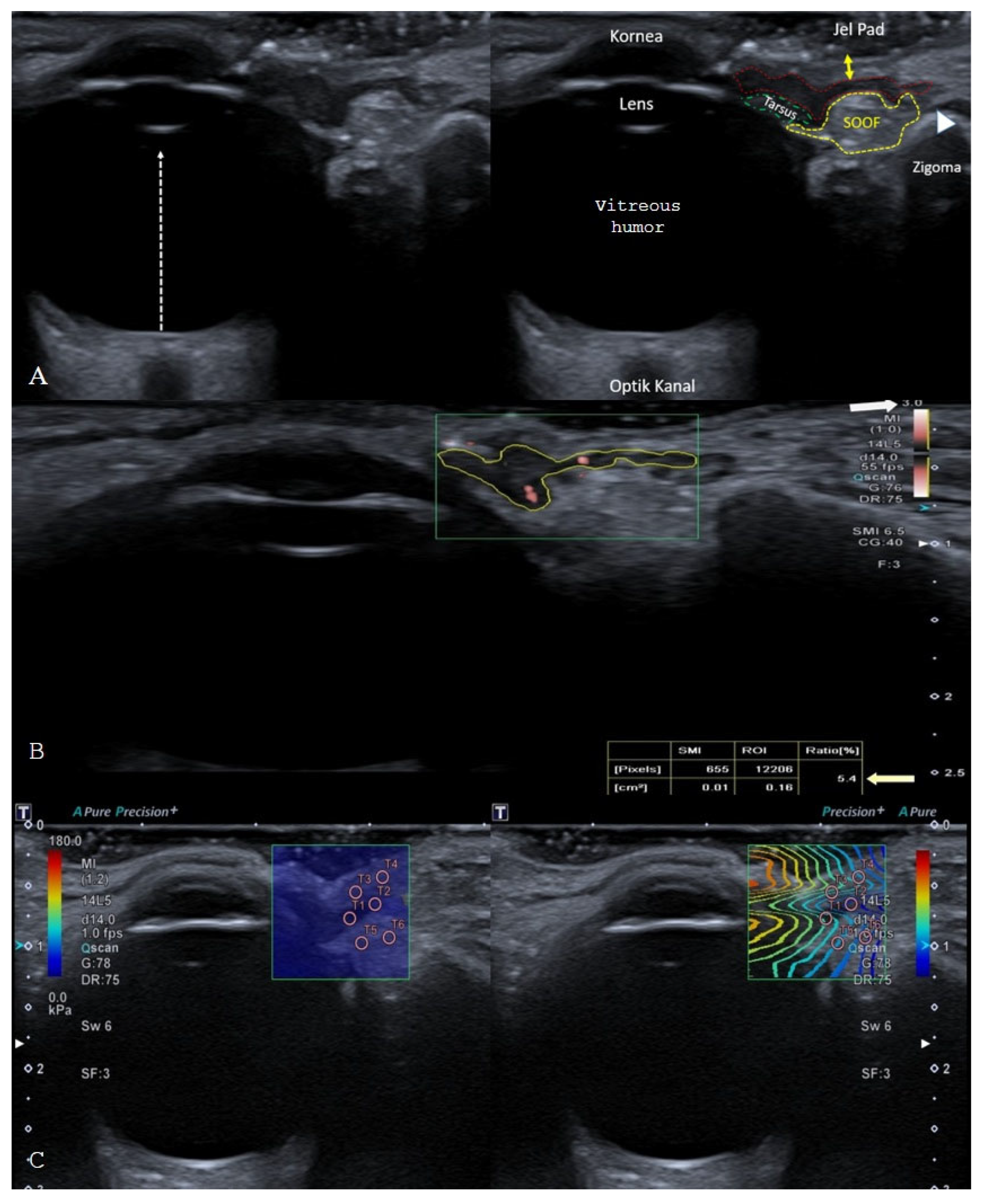
Figure 2.
A. At a measurement point 1 cm lateral to lower eyelid tarsal level, taken medial to the zygomatic eminence, an increase in epidermis-dermi thickness is demonstrated (double-headed yellow arrow) B. At the same measurement point (1 cm lateral to oower eyelid tarsal level, medial to thr zygomatic eminence), an increase in the thickness of the orbicularis oculi muscle (area within the red dotted outline) is demonstrated (level indicated by the white arrow) C. At the same measurement point (1 cm lateral to the lower eyelid tarsal level, medial to the zygomatic eminence), an increase in the SMI vascular index percentag of the orbicularis oculi muscle is demonstrated before carboxytherapy, at the 1-month follow-up after carboxytherapy, and at the 6-month follow-up after carboxytherapy.
Figure 2.
A. At a measurement point 1 cm lateral to lower eyelid tarsal level, taken medial to the zygomatic eminence, an increase in epidermis-dermi thickness is demonstrated (double-headed yellow arrow) B. At the same measurement point (1 cm lateral to oower eyelid tarsal level, medial to thr zygomatic eminence), an increase in the thickness of the orbicularis oculi muscle (area within the red dotted outline) is demonstrated (level indicated by the white arrow) C. At the same measurement point (1 cm lateral to the lower eyelid tarsal level, medial to the zygomatic eminence), an increase in the SMI vascular index percentag of the orbicularis oculi muscle is demonstrated before carboxytherapy, at the 1-month follow-up after carboxytherapy, and at the 6-month follow-up after carboxytherapy.
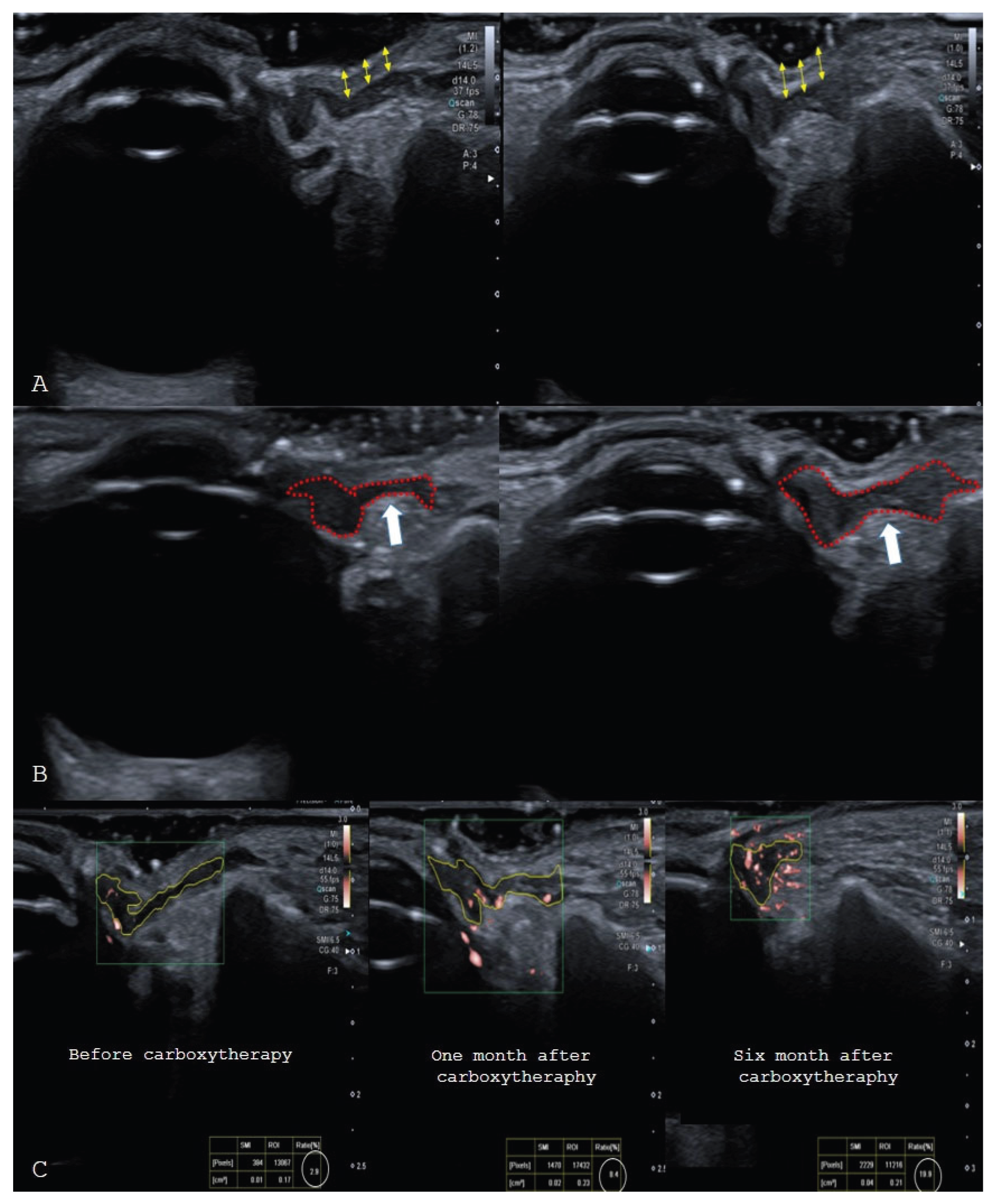

Table 1.
Patient-reported and physician-assessed Visual Analog Scale (VAS) scores before treatment and at 1 month after treatment according to age, sex, smoking status, daily water intake, and sleep duration. Values are presented as mean ± standard deviation. Statistical comparisons were performed between subgroups; a p value <0.05 was considered statistically significant.
Table 1.
Patient-reported and physician-assessed Visual Analog Scale (VAS) scores before treatment and at 1 month after treatment according to age, sex, smoking status, daily water intake, and sleep duration. Values are presented as mean ± standard deviation. Statistical comparisons were performed between subgroups; a p value <0.05 was considered statistically significant.
| Age 18-49 | Age 50-65 |
p value | Woman | Man | p value | Smo-ker | Non smo-ker |
p value | Daily water intake < 2 lt | Daily water intake > 2 lt | p value | Sleep time <7 hr | Sleep time >7 hr | p value | |
| Patient VAS score | |||||||||||||||
| Before treatment | 7.8 +- 1.2 | 7.5 +- 1.5 | 0.395 | 7.7 +- 1.3 | 7.3 +- 0.9 | 0.340 | 7.5 +- 1.3 | 7.8 +- 1.3 | 0.312 | 7.7 +- 1.3 | 7.6 +- 1.5 | 0.993 | 7.6 +-1.3 | 8.1+-1.3 | 0.126 |
| One month after treatment | 4.7 +- 1.5 | 4.6 +- 1 | 0.760 | 4.6 +- 1.5 | 4.8 +- 0.5 | 0.527 | 4.5 +- 1.1 | 4.7 +- 1.6 | 0.535 | 4.5 +- 1.4 | 5.3 +- 1.3 | 0.03 | 4.5 +-1.2 | 5.1 +- 1.9 | 0.289 |
| Doctor VAS score | |||||||||||||||
| Before treatment | 7.6 +- 1 | 7.8 +- 1.2 | 0.744 | 7.7 +- 1.1 | 7.8 +- 0.9 | 0.801 | 7.6 +- 0.9 | 7.7 +- 1.2 | 0.839 | 7.8 +- 1 | 7.3 +- 1.2 | 0.03 | 7.6 +-1 | 7.8+- 1.3 | 0.429 |
| One month after treatment | 5.1 +- 1.3 | 5.1 +- 1.1 | 0.500 | 5.1 +- 1.3 | 5.3 +- 0.9 | 0.407 | 4.9 +- 1.2 | 5.1 +- 1.3 | 0.625 | 5 +- 1.2 | 5.3 +- 1.4 | 0.888 | 4.9 +-1 | 5.6 +- 1.8 | 0.230 |
Table 2.
Patient-reported and physician-assessed Visual Analog Scale (VAS) scores before treatment and at 1 month after treatment according to pigmentation degree and Fitzpatrick skin type. Values are presented as mean ± standard deviation. A p value <0.05 was considered statistically significant.
Table 2.
Patient-reported and physician-assessed Visual Analog Scale (VAS) scores before treatment and at 1 month after treatment according to pigmentation degree and Fitzpatrick skin type. Values are presented as mean ± standard deviation. A p value <0.05 was considered statistically significant.
| Pigmen-tation degree I | Pigmen-tation degree II | Pigmen-tation degree III | p value | Skin type II | Skin type III | Skin type IV | p value | |
| Patient VAS score | ||||||||
| Before treatment | 7.8 +- 1.1 | 7.6 +- 1.2 | 8.6 +- 1.6 | 0.092 | 7.4 +- 1.3 | 7.7 +- 1.2 | 8.5 +- 1.2 | 0.048 |
| One month after treatment | 5.5 +- 1 | 4.3 +- 1.1 | 6 +- 2.4 | 0.001 | 4.2 +- 1.4 | 4.8 +- 1.5 | 5.2 +- 0.9 | 0.011 |
| Doctor VAS score | ||||||||
| Before treatment | 7 +- 0.6 | 7.6 +- 0.9 | 9.2 +- 1.4 | <0.001 | 7.3 +- 0.9 | 7.7 +- 1.1 | 8.3 +- 1.2 | 0.024 |
| One month after treatment | 5.2 +- 1.1 | 4.8 +- 0.9 | 7 +- 1.8 | <0.001 | 4.7 +- 0.9 | 5.3 +- 1.4 | 5.3 +- 1.5 | 0.146 |
Table 3.
Ultrasonographic and elastographic measurements of the lower eyelid, orbicularis oculi muscle, and suborbicularis oculi fat (SOOF) at baseline, 1 month, and 6 months after treatment. Values are presented as mean ± standard deviation. P values represent pairwise comparisons between time points; a p value <0.05 was considered statistically significant.
Table 3.
Ultrasonographic and elastographic measurements of the lower eyelid, orbicularis oculi muscle, and suborbicularis oculi fat (SOOF) at baseline, 1 month, and 6 months after treatment. Values are presented as mean ± standard deviation. P values represent pairwise comparisons between time points; a p value <0.05 was considered statistically significant.
| Region/ Structure | Parameter (unit) | Baseline | 1st month | 6th month | p value (Base-line vs 1st month) | p value (Base-line vs 6th month) | p value (1st month vs 6th month) |
| Lower eyelid | Epidermis-dermis thickness (mm) | 1.1 ± 0.2 | 1.7 ± 0.3 | 2.0 ± 0.5 | <0.001 | <0.001 | <0.001 |
| Epidermis-dermis elastography (kPa) | 4.3 ± 1.1 | 4.3 ± 1.3 | 4.4 ± 2.0 | 0.740 | 0.880 | 0.937 | |
| Orbicularis oculi muscle | Pars pretarsalis thickness (mm) | 0.9 ± 0.3 | 1.5 ± 0.4 | 1.9 ± 0.5 | <0.001 | <0.001 | <0.001 |
| Pars pretarsalis SMI ratio (%) | 3.3 ± 1.7 | 7.2 ± 3.2 | 9.2 ± 4.6 | <0.001 | <0.001 | <0.001 | |
| SOOF | SOOF elastography (kPa) | 5.0 ± 1.9 | 6.2 ± 2.8 | 6.9 ± 4.0 | <0.001 | <0.001 | <0.001 |
Disclaimer/Publisher’s Note: The statements, opinions and data contained in all publications are solely those of the individual author(s) and contributor(s) and not of MDPI and/or the editor(s). MDPI and/or the editor(s) disclaim responsibility for any injury to people or property resulting from any ideas, methods, instructions or products referred to in the content. |
© 2026 by the authors. Licensee MDPI, Basel, Switzerland. This article is an open access article distributed under the terms and conditions of the Creative Commons Attribution (CC BY) license (http://creativecommons.org/licenses/by/4.0/).
Copyright: This open access article is published under a Creative Commons CC BY 4.0 license, which permit the free download, distribution, and reuse, provided that the author and preprint are cited in any reuse.


