
Submitted:
15 April 2026
Posted:
17 April 2026
You are already at the latest version
Abstract
Wearable smart inhalers represent a transformative approach to chronic respiratory management in advanced lung cancer, integrating sensor‑based monitoring, real‑time connectivity, and patient‑centric feedback loops. These devices track inhalation technique, dosing frequency, and timing, then transmit encrypted data to cloud‑based platforms for analysis by clinicians and AI‑driven algorithms. For advanced‑stage lung cancer patients, this enables continuous surveillance of bronchospasm, dyspnoea, and medication adherence outside the intensive care setting, thereby reducing uncontrolled exacerbations and unplanned hospitalizations. Smart inhalers also support tele‑follow‑ups and personalized adjustment of bronchodilator or palliative regimens based on individual patterns of use and symptom burden. When embedded within an end‑to‑end care pathway from intensive care discharge to home care these wearables facilitate seamless transitions, improve self‑management, and empower multidisciplinary teams with objective, longitudinal respiratory data. This article explores design principles, clinical integration, and emerging digital‑health frameworks that position wearable smart inhalers as a cornerstone of modern, technology‑driven chronic respiratory support in advanced lung cancer.
Keywords:
wearable smart inhalers
; chronic respiratory management
; digital health platforms
; remote monitoring
; AI-assisted adherence
; home-based care
1. Introduction
Chronic respiratory symptoms in advanced lung cancer significantly impair quality of life and increase the risk of acute exacerbations, emergency visits, and hospital readmissions. Many patients experience persistent dyspnoea, wheezing, cough, and fatigue due to tumour-related airway obstruction, treatment-induced lung injury, and overlapping obstructive lung diseases. Managing these symptoms across the continuum from intensive care to home care poses substantial clinical and logistical challenges [1]. Recent advances in digital health, particularly wearable smart inhalers, offer a promising pathway to continuous, objective monitoring of inhaler technique, adherence, and symptom patterns outside the hospital setting. This paper discusses how such technologies can bridge gaps in care transitions, support individualized respiratory management, and enhance patient-centred outcomes in advanced lung cancer [2].
1.1. Burden of Chronic Respiratory Symptoms in Advanced Lung Cancer
In advanced lung cancer, chronic respiratory symptoms arise from both the primary tumour and the effects of systemic therapies, including chemotherapy, immunotherapy, and radiotherapy. Patients frequently report moderate to severe dyspnoea, which is often refractory to standard bronchodilators and correlates poorly with spirometry measures. Persistent cough, wheezing, and chest tightness further contribute to functional decline, sleep disturbance, and emotional distress [3]. These symptoms are compounded by comorbidities such as chronic obstructive pulmonary disease (COPD) or interstitial lung disease, which are common in this population.
The subjective nature of symptom reporting and episodic clinical assessment in routine practice limit the ability to detect subtle changes or early deterioration. Consequently, acute exacerbations are often recognized at an advanced stage, when hospitalization becomes inevitable. Effective chronic respiratory management in advanced lung cancer therefore requires not only pharmacological optimization but also continuous, objective surveillance that can capture day-to-day variability and accelerate timely intervention [4].
1.2. Challenges in Transitioning from Intensive Care to Home Care
Transitioning patients with advanced lung cancer from intensive care to home care involves discontinuity of monitoring, fragmentation of information, and reduced access to specialized respiratory support. During intensive care, patients benefit from continuous physiological monitoring, frequent clinical assessments, and immediate access to invasive and non-invasive ventilatory support [5]. Once discharged, many patients rely on intermittent clinic visits and self-managed inhaler therapy, often without structured follow-up or real-time feedback. This transition period is particularly vulnerable, as residual respiratory compromise, fatigue, and weakened cough reflex may predispose individuals to recurrent infections or decompensation.
Caregivers and outpatient clinicians may lack timely, objective data on inhaler use, adherence, or symptom evolution, leading to delayed recognition of impending exacerbations [6]. Moreover, advanced-stage patients often face mobility limitations, transportation barriers, and psychosocial stressors, which further complicate adherence to complex treatment regimens. Developing a seamless, technology-enabled care pathway that extends intensive-care-grade monitoring into the home environment is therefore critical to sustaining respiratory stability, reducing unplanned admissions, and preserving functional independence [7].
1.3. Rationale for Wearable Smart Inhalers in Chronic Respiratory Management
Wearable smart inhalers provide a natural technological bridge between intensive-care-level respiratory surveillance and long-term home-based management in advanced lung cancer. These devices integrate miniaturized sensors, wireless connectivity, and embedded analytics to capture inhalation flow profiles, actuation timing, and adherence patterns, then transmit encrypted data to cloud-based platforms accessible to clinicians and caregivers [8]. By continuously monitoring how and when patients use their inhalers, smart inhalers can detect suboptimal technique, missed doses, or erratic usage that may otherwise go unnoticed during routine clinic consultations. This objective feedback can guide personalized dose adjustments, technique retraining, and targeted education, thereby enhance therapeutic effectiveness and reduce symptom burden. For patients transitioning from intensive care to home care, wearable smart inhalers can function as a remote monitoring node, enabling early detection of worsening respiratory patterns and facilitating timely tele-consultations or home-care interventions [9].
2. Pathophysiology and Clinical Need
In advanced lung cancer, respiratory dysfunction results from a combination of tumour-mediated airway obstruction, treatment-related lung injury, and intrinsic lung-tissue remodelling [10]. Chronic bronchospasm, persistent dyspnoea, and intractable cough are among the most disabling symptoms, often coexisting with systemic fatigue, cachexia, and psychological distress. These manifestations not only reduce physical performance but also compromise nutrition, sleep, and social engagement, thereby worsening overall prognosis and quality of life [11]. Conventional inhaler-based therapies, although widely used, frequently fail to address the full complexity of these symptoms, especially in the context of multimodal oncological treatment and comorbid obstructive lung diseases. Understanding the underlying pathophysiology and unmet clinical needs is therefore essential to justify the integration of more advanced, technology-enabled solutions such as wearable smart inhalers into chronic respiratory management [12].
2.1. Chronic Bronchospasm, Dyspnoea, and Cough in Advanced Lung Cancer
Chronic bronchospasm in advanced lung cancer arises from tumour-induced airway narrowing, peri-bronchial inflammation, and mediators released by both malignant cells and the host immune response. Endobronchial lesions or perihilar masses can cause partial or intermittent obstruction, leading to dynamic airflow limitation and episodic wheezing, particularly during exertion or nocturnal periods [13]. Dyspnoea is often multifactorial, reflecting a combination of mechanical obstruction, reduced lung compliance, impaired gas exchange, and increased work of breathing.
In many patients, dyspnoea is disproportionate to spirometry decline, indicating a significant neuromechanical and affective component driven by anxiety and fear of breathlessness. Persistent cough may result from airway irritation, post-tussive bronchospasm, or the presence of mucus congestion in partially obstructed bronchi [14]. These symptoms are typically refractory to standard bronchodilators and may fluctuate unpredictably, making them difficult to manage in routine outpatient settings. Moreover, systemic therapies such as radiotherapy and certain systemic agents can further exacerbate airway hyperreactivity, leading to a vicious cycle of bronchospasm, dyspnoea, and cough that degrades functional status and increases the risk of acute decompensation [15].
2.2. Impact of Comorbid Obstructive Lung Diseases
A substantial proportion of patients with advanced lung cancer have pre-existing obstructive lung diseases, including chronic obstructive pulmonary disease (COPD) and asthma, which profoundly influence respiratory symptomatology and treatment response [16]. Smoking history, chronic inflammation, and structural remodelling characteristic of COPD coexist with tumour-related airway distortion, resulting in accelerated airflow limitation and heightened airway hyperresponsiveness [17]. Asthma-like features such as variable bronchoconstriction and reversibility may further complicate symptom attribution, as clinicians must distinguish between tumour-driven obstruction and exacerbations of underlying obstructive disease.
Comorbid conditions also increase the risk of treatment-related respiratory toxicity, including radiation-induced lung injury or immune-related pneumonitis, which can mimic or amplify obstructive symptoms [18]. The presence of obstructive lung diseases often necessitates higher-dose inhaled bronchodilators and corticosteroids, further burdening patients with complex regimens and increasing the likelihood of technique errors and non-adherence. From a clinical standpoint, overlapping pathophysiological mechanisms reduce the margin for error in inhaler use and make objective monitoring of inhaler performance crucial to prevent exacerbations and optimize long-term respiratory control [19].
2.3. Limitations of Conventional Inhaler-Based Therapy
Conventional inhaler-based therapy in advanced lung cancer relies primarily on handheld metered-dose inhalers (MDIs) or dry-powder inhalers (DPIs), which require coordinated inspiration, proper inhalation flow, and correct timing of actuation [20]. Many patients, particularly those with advanced disease, experience significant difficulty mastering these techniques due to fatigue, weakness, cognitive impairment, or fear of breathlessness [21]. Inconsistent inhaler use, suboptimal inspiratory effort, and missed doses are common, yet these factors are rarely captured in routine clinical practice, where assessment is typically based on subjective recall or intermittent spirometry. As a result, healthcare providers may overestimate adherence and incorrectly attribute persistent symptoms to disease progression rather than poor inhaler technique [22].
Dose-titration decisions are often made without objective data on real-world usage patterns, leading to either under- or over-treatment. Moreover, conventional inhalers lack integrated feedback mechanisms or connectivity, making them ill-suited for continuous monitoring across the intensive-care-to-home-care continuum. The absence of real-time data also hinders early detection of exacerbation precursors and limits opportunities for personalized, adaptive respiratory management. These limitations underscore the need for a more sophisticated, technology-enhanced inhaler platform that can provide objective, longitudinal insights into inhaler performance and symptom evolution in advanced lung cancer [23].
3. Evolution of Inhaler Technology
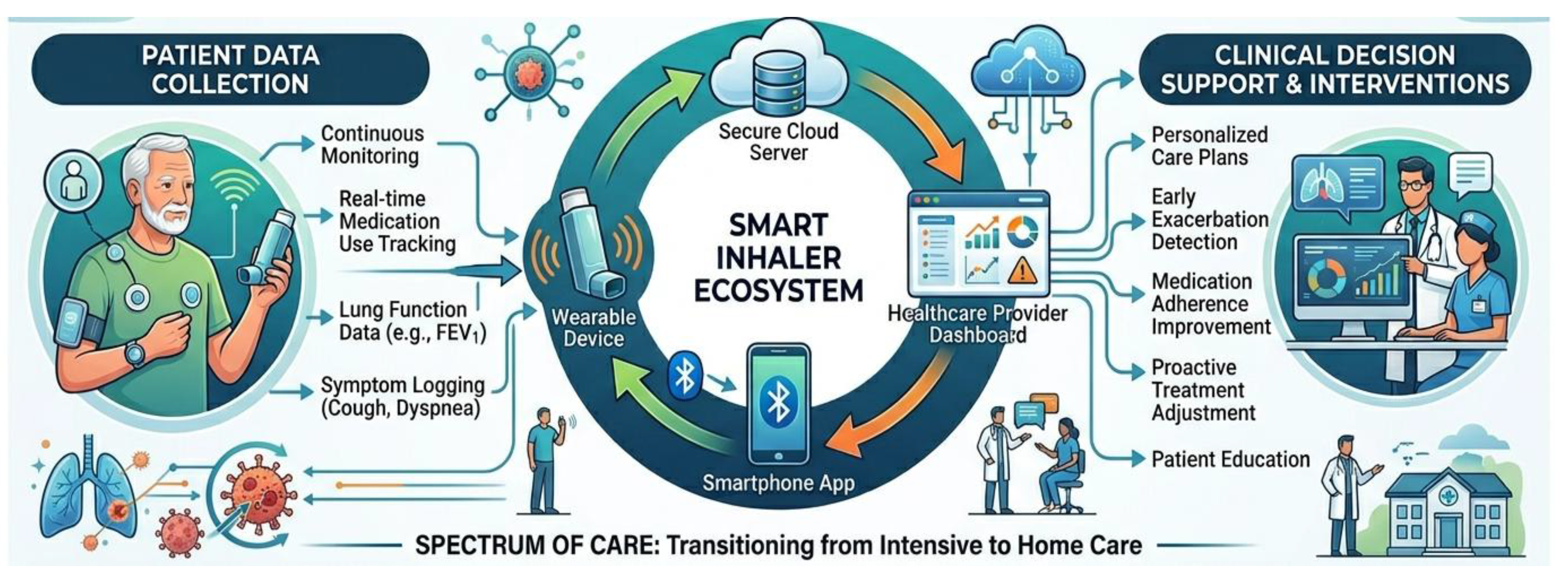
Inhaler technology has evolved from simple mechanical devices delivering fixed drug doses to intelligent, connected platforms that support data-driven, patient-centred respiratory care. This shift is particularly relevant for advanced lung cancer, where chronic respiratory symptoms and complex treatment regimens demand more precise, real-time monitoring than conventional inhalers can provide [24]. Smart connected inhalers integrate sensors, wireless communication, and analytics to capture inhaler use, technique, and related physiological or contextual data, enabling clinicians to move beyond episodic assessments toward continuous, objective management. In the context of chronic respiratory care across intensive care and home settings, this evolution supports earlier intervention, improved adherence, and personalized therapeutic strategies for patients with advanced lung cancer [25].
Figure 1.
Acute And Chronic Respiratory Management in Advanced Lung Cancer Patients.
3.1. From Metered-Dose Inhalers to Smart Connected Devices
Metered-dose inhalers (MDIs) and dry-powder inhalers (DPIs) have long been the cornerstones of inhaled therapy for obstructive lung diseases, but they rely on manual technique and lack built-in feedback mechanisms [26]. In many patients with advanced lung cancer, factors such as fatigue, neuromuscular weakness, and anxiety further compromise the ability to achieve consistent, effective inhalation. Smart connected inhalers address these limitations by embedding miniature electronics directly on or within standard inhaler platforms, allowing automatic detection of actuation, inhalation timing, and flow profiles [27]. These devices typically communicate via Bluetooth or low-energy wireless protocols with a smartphone or central hub, transforming each inhaler use into a timestamped, structured data point that can be stored, analysed, and shared with clinicians.
A key quantitative expression of inhaler performance is the inhalation quality index , which can be formulated as
where is peak inspiratory flow, is inspiratory duration, is the fraction of missed doses, and are empirically tuned weights reflecting clinical priorities [28]. This index exemplifies how smart inhalers translate mechanical actions into a quantifiable metric for tracking inhaler technique and adherence over time, thereby supporting data-driven optimization of chronic respiratory management in advanced lung cancer.
3.2. Role of Sensors, Connectivity, and Data Analytics
Smart inhalers leverage a suite of miniaturized sensors typically flow sensors, accelerometers, and temperature or humidity sensors to capture inhalation dynamics, device orientation, and environmental conditions during each actuation. Flow sensors characterize the shape and magnitude of the inspiratory waveform, enabling classification of acceptable versus suboptimal inhalation patterns [29]. Accelerometers help detect whether the device is properly primed and aligned, while contextual data such as time-of-day and ambient temperature can inform adherence models and trigger-based alerts. Once collected, these raw sensor readings are transmitted over Bluetooth or cellular-enabled gateways to cloud-based platforms, where they are stored in secure, interoperable databases compatible with electronic health-record systems [30].
From a data-science perspective, the observed inhaler-usage sequence can be modelled as a temporal series , where each includes features such as dose timing, inhalation flow, and symptom annotation. A simple predictive model for adherence risk can be expressed as
where is a feature vector extracted from the time-series inhaler data, is a learned weight vector, is a bias term, and is the sigmoid activation function [31]. This logistic-style formulation illustrates how smart-inhaler platforms can transform raw sensor data into clinically actionable risk scores, supporting early intervention and personalized respiratory-care pathways in advanced lung cancer.
3.3. Current Evidence from Asthma and COPD Cohorts
Clinical experience with smart inhalers largely derives from large asthma and COPD cohorts, where digital monitoring has demonstrated improvements in adherence, symptom control, and exacerbation rates [32]. Meta-analyses of electronic monitoring devices show that connected inhalers significantly increase the proportion of days with correct inhaler use and reduce gaps in dosing, particularly for maintenance therapies. In randomized trials, patients using smart inhalers with feedback apps and clinician dashboards tend to experience fewer moderate-to-severe exacerbations and report better asthma-related quality-of-life scores compared with standard care groups [33]. These findings suggest that continuous, objective inhaler monitoring can identify barriers to adherence such as poor technique, nighttime dosing errors, or fear of side effects and enable targeted education and regimen adjustments.
To express the relative benefit of smart-inhaler interventions, studies often compute the relative risk reduction (RRR) of exacerbations between intervention and control groups as
4. Wearable Smart Inhalers, Design and Functionality
Wearable smart inhalers merge miniaturized hardware, wireless connectivity, and human-centred software into a unified platform for chronic respiratory management in advanced lung cancer [36]. These devices extend beyond simple drug delivery by embedding tensorized modules that capture inhalation dynamics, transmitting encrypted data to cloud platforms, and presenting actionable feedback to patients and clinicians [37]. The design must balance clinical precision, power efficiency, and ease of use, particularly for frail, elderly, or treatment-fatigued individuals. By integrating sensor-based technique analysis, secure connectivity, and intuitive interfaces, wearable smart inhalers enable continuous, objective monitoring of inhaler performance along the intensive-care-to-home care pathway [38].

Table 1.
Comparison Of Inhaler Types and Features.
| Feature / Device Type | Conventional MDI/DPI | Smart Inhaler (Basic) | Wearable Smart Inhaler (Advanced) |
|---|---|---|---|
| Dose delivery mechanism | Manual actuation | Manual actuation | Manual or sensor-guided actuation |
| Technique feedback | None | Simple LED/audio cue | Flow-based technique scoring |
| Connectivity | None | Bluetooth to smartphone | BLE + IoT/cloud integration |
| Adherence tracking | Subjective recall only | Daily usage logs | Time-stamped adherence index |
| Environmental/physio sensing | No | Limited (timestamp, location) | Integrated with wearables (SpO2, RR) |
| AI-based decision support | No | Basic alerts | Personalized regimen suggestions |
| Suitable setting | Outpatient, home | Home, ambulatory care | ICU → home, chronic management |
4.1. Sensor Modules for Inhalation Technique and Timing
Sensor modules in wearable smart inhalers typically include flow sensors, accelerometers, and pressure or temperature sensors to quantify inhalation effort, device orientation, and actuation timing [39]. Flow sensors characterize the inspiratory waveform, measuring peak inspiratory flow , inhalation duration , and hold time to assess whether the patient achieves the minimum flow required for effective drug deposition [40]. Accelerometers detect whether the inhaler is shaken, primed, and held upright, while capacitive or resistive sensors can confirm proper mouthpiece sealing and detect exhalation before inhalation [41]. These measurements are time-stamped and aggregated into a per-dose inhalation profile that reflects real-world technique over days or weeks.
A compact technique-quality metric can be expressed as
4.2. Wireless Data Transmission and Cloud-Based Platforms
Once inhalation data are captured, they are transmitted via low-energy wireless protocols (e.g., Bluetooth Low Energy or BLE) to a smartphone, tablet, or dedicated gateway, which then forwards encrypted packets to cloud-based platforms. These platforms store longitudinal data in structured databases, often using RESTful APIs or FHIR-compatible interfaces to interoperate with electronic health-record (EHR) systems [43]. Cloud-hosted analytics engines preprocess raw sensor readings, extract features such as adherence rate, dosing frequency, and technique trends, and generate summary dashboards for clinicians. Role-based access control, end-to-end encryption, and audit logging ensure that sensitive respiratory data remain compliant with medical-device and privacy regulations [44].
From a system-engineering perspective, the observed data stream can be modelled as a sequence of inhaler events , where each [45]. The adherence ratio over a window is then
which underpins adherence-based alerts and care-path recommendations [46]. This ratio, updated incrementally, supports real-time monitoring of chronic respiratory management in advanced lung cancer patients transitioning from intensive care to home care.
4.3. Real-Time Feedback and User-Interface Design for Patients
Effective user-interface design is critical for ensuring that wearable smart inhalers are usable by patients with advanced lung cancer, who may experience fatigue, cognitive load, and visual or manual limitations. Real-time feedback is typically delivered via smartphone apps or embedded LED/audible cues on the device itself, indicating whether an inhalation passively met target flow, duration, or timing thresholds [47]. Visual feedback may include color-coded icons (green for optimal, yellow for acceptable, red for poor), simple progress bars, or short textual prompts such as “inhale slower” or “hold breath longer.” Auditory or haptic cues can further assist patients with visual impairment or low-literacy backgrounds [48].
From a usability perspective, the perceived effectiveness of the interface can be characterized by a user-experience score , combining measures of task completion, perceived ease of use, and symptom-report reduction. A simplified composite index might be defined as
5. Application in Advanced Lung Cancer
Wearable smart inhalers can be strategically deployed within advanced lung cancer care to monitor chronic respiratory symptoms, optimize inhaler use, and support symptom-guided dose adjustments across the intensive-care-to-home continuum [50]. Their application is most impactful when targeted to patients with significant obstructive or bronchospastic components, persistent dyspnoea, or a history of inhaler-related exacerbations. By integrating objective data on adherence, technique, and symptom trajectories into existing oncological and palliative workflows, these devices enable more responsive, individualized respiratory management while preserving patient autonomy and reducing treatment burden [51].
5.1. Selection Criteria and Patient Suitability
Selection of patients for wearable smart inhalers in advanced lung cancer should balance respiratory phenotype, functional status, and digital-literacy factors. Ideal candidates typically exhibit recurrent or moderate-to-severe dyspnoea, wheezing, or cough attributable to bronchospasm or obstructive lung physiology, often with comorbid COPD or asthma [52]. Patients who have experienced frequent inhaler-related exacerbations, emergency visits, or hospitalizations due to uncontrolled respiratory symptoms are strong candidates for continuous monitoring. Conversely, individuals with profound cognitive impairment, severe upper-limb dysfunction, or inability to engage with a smartphone interface may derive limited benefit unless caregiver-mediated support is available [53].
Clinically, a simple eligibility score can be defined as
5.2. Monitoring Adherence, Technique, and Symptom Patterns
Wearable smart inhalers enable granular, longitudinal monitoring of inhaler adherence, inhalation technique, and associated symptom patterns in advanced lung cancer. Each actuation is recorded as a time-stamped event, allowing the system to compute adherence rates, dose-timing regularity, and gaps in use [55]. Inhalation-flow and technique data are processed to flag suboptimal inhalations such as insufficient inspiratory flow, short inhalation duration, or missed breath-holding so that clinicians can retrain patients or adjust device type. Symptom data, ideally captured via linked patient-reported outcomes (PROs) or wearable biosensors, can be correlated with inhaler-use events to identify patterns such as nocturnal wheezing or exercise-induced breathlessness.
Mathematically, the adherence pattern over time can be represented as a binary sequence , where if a dose is taken as scheduled and otherwise. A smoothed adherence index can then be expressed as
where is a rolling window (e.g., 7 days). This index supports dynamic risk stratification, sustained low values can trigger alerts for early intervention, while improving adherence trends may justify dose-reduction or regimen simplification [56]. By aligning these metrics with symptom trajectories, wearable smart inhalers provide a data-driven framework for chronic respiratory management in advanced lung cancer.
5.3. Integration with Existing Oncology and Palliative Care Regimens
For smart inhalers to be clinically meaningful, they must be integrated into existing oncology and palliative care regimens rather than treated as standalone tools. In multidisciplinary tumour boards or palliative care conferences, inhaler-use data can complement performance-status assessments, imaging findings, and treatment-related toxicity profiles to inform decisions about bronchodilator escalation, opioid-based breathlessness control, or referral to pulmonary rehabilitation [57]. Real-time dashboards can be configured to feed alerts directly into electronic health-record workflows, enabling respiratory therapists, oncologists, and palliative specialists to jointly review adherence lapses, technique errors, or emerging symptom clusters [58].
From a systems perspective, integration can be formalized as a care-path function that combines inhaler-monitoring data , oncology status indicators , and palliative-symptom scores
6. Transition from Intensive Care to Home Care
The transition from intensive care to home care in advanced lung cancer is a high-risk phase during which respiratory stability can rapidly deteriorate without continuous monitoring and structured follow-up. Wearable smart inhalers can bridge this gap by extending objective inhaler-use and symptom data from the ICU into the home environment, enabling seamless handover, remote surveillance, and coordinated multidisciplinary support [60]. By embedding smart-inhaler insights into discharge planning and post-ICU care pathways, healthcare teams can detect early warning signs, optimize inhaler regimens, and prevent unplanned readmissions, thereby supporting safe and sustainable respiratory management at home.
6.1. Handover Protocols Incorporating Smart Inhaler Data
Handover protocols from intensive care to home care should explicitly integrate smart inhaler data to ensure continuity of respiratory monitoring. At discharge, the ICU team can generate a structured inhaler-use summary that includes adherence rate, technique-quality index, and recent symptom trends over the preceding days. This summary, along with a clear list of inhaler-related goals (e.g., target adherence threshold, acceptable technique range), can be transmitted via secure messaging or EHR interfaces to the home-care team and primary oncologist [61]. Standardized handover checklists may include fields such as “baseline adherence over last 72 hours,” “frequent time-of-day patterns,” and “recent technique alerts.”
Formally, a handover readiness index can be expressed as
6.2. Remote Monitoring During Post-ICU Recovery
During post-ICU recovery at home, wearable smart inhalers enable remote monitoring of inhaler adherence, technique, and symptom progression without requiring frequent clinic visits. Encrypted inhaler-use data are transmitted periodically to cloud platforms, where they are aggregated into time-series dashboards accessible to clinicians, nurses, and respiratory therapists. Automated rule-based or AI-driven algorithms can flag concerning patterns, such as prolonged adherence lapses, sudden deterioration in technique, or clusters of nocturnal inhalers use that may indicate worsening breathlessness [63]. These alerts can trigger scheduled tele-consultations, same-day home visits, or pre-emptive medication adjustments, thereby reducing the window between symptom onset and clinical intervention.
Mathematically, a risk-of-exacerbation score can be defined over a rolling window as
6.3. Roles of Home-Care Nurses, Respiratory Therapists, and Caregivers
Home-care nurses, respiratory therapists, and family caregivers play complementary roles in interpreting and acting on smart-inhaler data within the post-ICU pathway. Home-care nurses typically perform routine visits, review inhaler-use dashboards, and correlate objective adherence and technique metrics with physical findings such as oxygen saturation, respiratory rate, and work-of-breathing [65]. Respiratory therapists can conduct technique-coaching sessions, reassess inhaler choice, and recommend device switches (e.g., from MDI to DPI or nebulizer) based on flow-profile data and patient strength. Family caregivers are often responsible for reminding patients about scheduled doses, assisting with device handling, and reporting subjective changes in symptom burden to the care team.
Functionally, the collaborative care loop can be described by a shared responsibility function
where , , and represent the nurse’s, respiratory therapist’s, and caregiver’s inputs at time , and are role-specific coefficients reflecting their relative contribution to inhaler-related decision-making [66]. When integrated with smart-inhaler data, this distributed model ensures that the transition from intensive care to home care remains coordinated, patient-centred, and responsive to evolving respiratory needs in advanced lung cancer.
7. Data-Driven Decision Support
Data-driven decision support in advanced lung cancer leverages inhaler-generated and clinical data to enable predictive analytics, personalized therapy, and secure, compliant care pathways. By applying AI and machine-learning models to longitudinal inhaler-use, symptom, and physiological data, clinicians can move from reactive symptom management to proactive, individualized respiratory support [67]. At the same time, robust privacy, security, and regulatory frameworks are essential to ensure that sensitive respiratory and oncological data are handled in accordance with medical-device standards and patient-trust requirements.
7.1. AI and Machine-Learning Models for Early Exacerbation Prediction
AI and machine-learning models can analyse time-series inhaler-use data, symptom diaries, and ancillary physiological signals (e.g., pulse oximetry, activity) to predict early exacerbations in advanced lung cancer [68]. Features such as declining adherence, suboptimal technique, increased nocturnal inhaler use, or abrupt changes in symptom-report patterns can be encoded into a feature vector at each time step [69]. Supervised classifiers such as gradient-boosted trees or recurrent neural networks can then estimate the probability of an impending exacerbation within a defined horizon (e.g., 24–72 hours).
A simplified probabilistic model can be expressed as
7.2. Personalized Adjustment of Bronchodilator and Inhaler Regimens
Data-driven decision support also enables personalized adjustment of bronchodilator and inhaler regimens based on individual response patterns. By analysing inhaler-use data, symptom trajectories, and clinical markers, algorithms can propose dose-titration strategies that balance efficacy with side-effect risk. For instance, a patient showing frequent short-acting bronchodilator use at night may benefit from intensified long-acting bronchodilator coverage, whereas another with stable adherence but persistent dyspnoea may require adjunctive non-pharmacological interventions [71].
Formally, a regimen-suitability index can be defined as
7.3. Privacy, Security, and Regulatory Considerations
Privacy, security, and regulatory compliance are central to the deployment of smart-inhaler–based decision support in oncology practice. Inhaler-generated data are typically classified as personal health information and must be encrypted both in transit (e.g., TLS/HTTPS) and at rest, with strict access controls limiting visibility to authorized clinicians, caregivers, and investigators [73]. Anonymization or pseudonymization techniques should be applied whenever data are used for research or model training. From a regulatory standpoint, smart inhalers and associated analytics platforms must comply with relevant medical-device directives (e.g., CE marking, FDA Class II/III requirements), data-protection regulations (e.g., GDPR, HIPAA), and local health-authority guidelines.
A basic security-compliance index can conceptually aggregate key safeguards:
8. Clinical Outcomes and Patient-Reported Benefits
The integration of wearable smart inhalers into chronic respiratory management in advanced lung cancer has the potential to improve objective clinical outcomes while simultaneously enhancing patient-reported experiences. By providing continuous, objective data on inhaler use and symptom patterns, these devices support early intervention, regimen optimization, and shared decision-making [75]. Evidence from related obstructive-lung-disease cohorts suggests that smart-inhaler platforms can reduce exacerbations and hospitalizations, improve symptom control, and positively influence quality of life, even in frail, advanced-stage populations. However, their real-world impact depends on usability, patient acceptance, and mitigation of digital-literacy or physical-access barriers.
8.1. Reduction in Exacerbations and Hospital Readmissions
Wearable smart inhalers can contribute to a measurable reduction in respiratory exacerbations and unplanned hospital readmissions in advanced lung cancer by enabling earlier detection of deteriorating patterns [76]. Continuous monitoring of adherence, technique, and nocturnal inhaler use allows clinicians and home-care teams to identify subtle shifts such as increasing short-acting bronchodilator use or declining technique quality before overt decompensation occurs. Timely interventions, including dose adjustments, caregiver education, or pre-emptive home visits, can interrupt the progression from mild symptom escalation to full-blown exacerbation [77].
Quantitatively, the impact can be accessed via the exacerbation-rate ratio before and after smart-inhaler implementation
8.2. Improvement in Symptom Control and Quality of Life
Beyond objective clinical metrics, wearable smart inhalers can improve symptom control and overall quality of life by making inhaler use more intentional and responsive to individual needs. Real-time feedback on inhalation technique and adherence helps patients correct errors, gain confidence in self-management, and reduce anxiety related to uncontrolled breathlessness [79]. Personalized dose-adjustment suggestions, triggered by inhaler-use and symptom data, can lead to more stable bronchodilation and fewer episodes of severe dyspnoea, wheezing, or nocturnal cough.
A composite quality-of-life index can conceptually combine symptom-severity reduction , functional-status improvement , and psychological-well-being gain
8.3. Usability, Acceptance, and Barriers Among Advanced-Stage Patients
Despite their potential, wearable smart inhalers face several usability and acceptance barriers in advanced-stage lung cancer [81]. Factors such as visual or manual impairment, cognitive fatigue, limited digital literacy, and fear of technology can reduce comfort with smartphone-based apps, Bluetooth pairing, and data-sharing workflows. Some patients may perceive continuous monitoring as intrusive or anxiety-provoking, especially when alerts are poorly contextualized or overly frequent [82]. Additionally, cost, insurance coverage, and device-maintenance responsibilities may limit sustained engagement, particularly in low-resource or home-care–only settings.
From a human-factors perspective, overall usability can be captured by a composite score that combines task-success rate , perceived ease of use , and perceived usefulness
9. Implementation Challenges and Future Directions
The successful implementation of wearable smart inhalers in advanced lung cancer care requires addressing economic, organizational, and technical barriers alongside workforce readiness and evolving device capabilities [84]. While these platforms offer strong promise for continuous respiratory monitoring and personalized therapy, their widespread adoption depends on sustainable financing, seamless integration into existing health-system workflows, and robust training for clinicians and caregivers [85]. Looking ahead, next-generation smart inhalers and hybrid respiratory platforms are likely to incorporate richer sensing, multimodal feedback, and deeper integration with broader digital-health ecosystems.
9.1. Cost, Reimbursement, and Health-System Integration
Cost, reimbursement variability, and health-system integration represent major hurdles to the routine deployment of wearable smart inhalers in advanced lung cancer. The devices themselves, along with associated connectivity infrastructure, cloud platforms, and software maintenance, can entail significant upfront and recurring expenses [86]. Reimbursement policies for digital-health tools remain fragmented, with many payers lacking clear coverage codes or outcome-based payment models for inhaler-monitoring services. Furthermore, integrating smart-inhaler data into existing electronic health-record systems, oncology information systems, and tele-health platforms requires interoperability standards, API-level connectivity, and change-management effort at the institutional level [87].
A simplified cost-effectiveness index can conceptually capture the balance between financial outlay and clinical benefit
9.2. Training Clinicians and Caregivers in Digital-Device Use
Effective use of wearable smart inhalers depends heavily on training clinicians, home-care nurses, respiratory therapists, and family caregivers in digital-device workflows. Clinicians must learn to interpret inhaler-use dashboards, distinguish between technical artifacts and true clinical deterioration, and translate data-driven insights into actionable treatment adjustments [89]. Caregivers often require hands-on training in device setup, Bluetooth pairing, app navigation, and basic troubleshooting, particularly when supporting older or physically impaired patients. Without standardized education modules, simulation-based workshops, and role-specific protocols, the risk of misinterpretation, alert fatigue, or underutilization rises [90].
A training-readiness metric can be expressed as
9.3. Next-Generation Smart Inhalers and Hybrid Respiratory Platforms
Next-generation smart inhalers are expected to evolve into hybrid respiratory platforms that combine inhaler monitoring with additional physiological and environmental sensing. Future devices may integrate pulse oximetry, respiratory-rate detection, voice-based symptom capture, or even positional sensors to provide a more holistic picture of respiratory status. These platforms could operate in a multimodal fashion, linking inhaler-use data with wearable biosensors, home-based spirometry, or tele-rehabilitation systems to support end-to-end respiratory management [92]. From an engineering perspective, a unified platform scores can conceptually represent the degree of system integration
Conclusions
Wearable smart inhalers offer a clinically meaningful pathway to bridge the gap between intensive care and home-based chronic respiratory management in advanced lung cancer, enabling continuous, objective monitoring of inhaler adherence, technique, and symptom patterns while supporting early intervention and personalized bronchodilator adjustments. Evidence from related obstructive-lung-disease cohorts indicates that connected inhaler platforms can reduce exacerbations, hospital readmissions, and symptom burden when embedded within structured care pathways, and these benefits are likely transferable to selected advanced lung cancer patients with significant bronchospastic components and frequent inhaler-related exacerbations. Successful implementation will depend on addressing cost and reimbursement barriers, integrating smart-inhaler data into existing oncology and palliative-care workflows, standardizing training for clinicians and caregivers, and advancing next-generation hybrid respiratory platforms that combine richer sensing, multimodal feedback, and deeper interoperability with digital-health ecosystems.
References
- Thangamani, M.; Anandakumar, D.; Indirajith, K.; Vijayaragavan, S.; Gandhimathi, M. (2026, March). Enhanced multimodal BERT-based deep learning method to predict prostate cancer from clinical data. In Sixth International Conference on Optical and Wireless Technologies (OWT 2025) (Vol. 14168, pp. 831-837). SPIE.
- Thamilarasi, V. Auditory Library Guide: A Digital Solution for Visually Impaired Readers. ITEGAM-JETIA 2026, 12(58), 108–117. [Google Scholar] [CrossRef]
- Suganya, V.; Vijayakumar, L.; Annur, E. A.; Praveen, R. V. S.; Bharathi, A.; Amsa, M. (2025, September). A Hybrid LSTM-Fuzzy Inference Model for Uncertainty-Aware Stock Market Forecasting. In 2025 International Conference on Electronics and Computing, Communication Networking Automation Technologies (ICEC2NT) (pp. 1-6). IEEE.
- Chellam, S.; Kalyani, S. Power flow tracing based transmission congestion pricing in deregulated power markets. International Journal of Electrical Power & Energy Systems 2016, 83, 570–584. [Google Scholar] [CrossRef]
- Govarthan, V.; Thangamani, M.; Anandakumar, D.; Tamizharasu, S.; Rajasekhara Babu, L.; Gandhimathi, K. (2026, March). Federated learning-enabled inverse design of photonic crystals with blockchain-secured collaboration for next-generation AI hardware. In Sixth International Conference on Optical and Wireless Technologies (OWT 2025) (Vol. 14168, pp. 552-557). SPIE.
- Shrivastava, A.; Praveen, R.; Alfilh, R. H.; Singh, N.; Yadav, K.; Rajalakshmi, B. (2025, September). AI-Driven Fault Resilience: Integrating Deep Graph Neural Networks in Spatio-Temporal Smart Grid Monitoring. In 2025 International Conference on Computing and Communications (COMPUTINGCON) (pp. 1-7). IEEE.
- Indoria, D.; Devi, K. Analyzing the effect of COVID-19 in the financial behavior of consumers and investors. International journal of health sciences 2022, 6(S5), 5976–5988. [Google Scholar] [CrossRef]
- Thamilarasi, V.; Sivakumar, J.; Roselin, R.; Jeysankar, N.; Wanjale, K. H.; Susila, S. J. G. (2026). Exploring AI Tools and Framework for Supply Chain Management. In Industry 6.0 and Digital Transformation in Supply Chain, Assets, and Services (pp. 65-98). IGI Global Scientific Publishing.
- Praveen, R. V. S.; Alsalami, Z.; Varshney, N.; Rajalakshmi, B.; Prasad, K. S.; Boob, N. S. (2025, September). AI-Integrated Demand Response with Dynamic Pricing in Prosumer-Driven Renewable Microgrids. In 2025 International Conference on Computing and Communications (COMPUTINGCON) (pp. 1-6). IEEE.
- Arunmohan, A. M.; Lakshmi, M. Analysis of modern construction projects using montecarlo simulation technique. International Journal of Engineering & Technology 2018, 7(2.19), 41–44. [Google Scholar] [CrossRef]
- Indoria, D. Ethical Challenges in Accounting Practice in the Era of Performance-Based Reporting. Minnesota Journal of Business Law and Entrepreneurship 2026, (1), 32–45. [Google Scholar]
- Sundaramoorthy, P.; Praveen, R. V. S.; Puli, B.; Tiwari, A.; Kanimozhi, S.; Keerthana, N. V. (2025, October). Decentralized Anomaly Detection in IoT Networks Using Federated Learning Models. In 2025 International Conference on Cognitive, Green and Ubiquitous Computing (IC-CGU) (pp. 1-6). IEEE.
- Thankappan, M.; Narayanan, N.; Sanaj, M. S.; Manoj, A.; Menon, A. P.; Krishna, M. G. (2024, April). Machine Learning and Deep Learning Architectures for Intrusion Detection System (IDS): A Survey. In 2024 1st International Conference on Trends in Engineering Systems and Technologies (ICTEST) (pp. 01-06). IEEE.
- Ravi, V.; Srivastava, V. K.; Singh, M. P.; Burila, R. K.; Chippagiri, S.; Pasam, V. R.; Prova, N. N. I. (2025, February). AI-powered fraud detection in real-time financial transactions. In International Conference on Web 6.0 and Industry 6.0 (pp. 431-447). Singapore: Springer Nature Singapore.
- Murugadoss, R.; Praveen, R. V. S.; Kunjumohamad, S. C.; PS, B. Osegnet-F-Unext: O-Segnet-Fusion-Unext for pulmonary lobe segmentation of Covid-19 using Computed Tomography image. European Spine Journal 2025, 1–17. [Google Scholar] [CrossRef]
- Jajini, M.; Kamaraj, N.; Santhiya, M.; Chellam, S. (2023). Blockchain-enabled electric vehicle charging. In Blockchain-Based Systems for the Modern Energy Grid (pp. 189-201). Academic Press.
- Dasari, D. R.; Bindu, G. H. Feature Selection Model-based Intrusion Detection System for Cyberattacks on the Internet of Vehicles Using Cat and Mouse Optimizer. J. Wirel. Mob. Networks Ubiquitous Comput. Dependable Appl. 2024, 15(2), 251–269. [Google Scholar] [CrossRef]
- Lavanya, K.; Thangamani, M.; Ganthimathi, M.; Priyanka, S.; Peter, V. J.; Sapthika, J. A Multi-Class Deep Neural Network Framework Driven Automated Classification Of Diabetic Retinopathy Using Retinal Fundus Images. Genetics and Molecular Research 2026, 25(1). [Google Scholar]
- Joshi, S. C.; Kumar, A. (2016, January). Design of multimodal biometrics system based on feature level fusion. In 2016 10th International Conference on Intelligent Systems and Control (ISCO) (pp. 1-6). IEEE.
- Praveen, R.; Simhadati, P.; Kavitha, K.; Majeeth, N. D. A.; Sethumadhavan, R.; Chauhan, A. (2024, December). Emotion Detection and Psychological Prediction Using Capsule Networks and Recurrent Neural Networks. In 2024 4th International Conference on Mobile Networks and Wireless Communications (ICMNWC) (pp. 1-6). IEEE.
- Thamilarasi, V.; Sivaraman, G.; Krishnan, R. H.; Kavitha, S. K.; Pushpa, P. EnhancinEnhancing Personalized Brand Recommendations through Machine Learning-Driven Analysis of User Behavior and Brand Interaction. In Intelligent Business Analytics (pp. 156-173). Auerbach Publications.
- Lakhekar, G. V.; Waghmare, L. M.; Roy, R. G. Disturbance observer-based fuzzy adapted S-surface controller for spatial trajectory tracking of autonomous underwater vehicle. IEEE Transactions on Intelligent Vehicles 2019, 4(4), 622–636. [Google Scholar] [CrossRef]
- Punitha, A.; Ramani, P. Dynamically stabilized recurrent neural network optimized with intensified sand cat swarm optimization for intrusion detection in wireless sensor network. Computers & Security 2025, 148, 104094. [Google Scholar]
- Kalaiselvi, M.; Dasa, S. K.; Malik, N.; Praveen, R. V. S. (2025, July). Intrusion Detection and Security Challenges in 6G Networks Using Stochastic Graph Neural Networks. In 2025 International Conference on Information, Implementation, and Innovation in Technology (I2ITCON) (pp. 1-6). IEEE.
- Kumar, G. H.; Elicherla, S. L. R.; Kumar, G. S.; Rai, B. K.; Saini, D. K. J. B.; Kumar, G. Proof-of-Metrology (PoM): A Blockchain Consensus for Tamper-Proof Calibration in Adversarial Cyber-Physical Systems. IEEE Access 2025, 13, 195937–195952. [Google Scholar] [CrossRef]
- Devarajanayaka, K. M.; Banu, S. S.; Desai, D. J.; TV, V.; Palav, M. R.; Dash, S. K. Machine learning-based pricing optimization for dynamic pricing in online retail. Journal of Informatics Education and Research 2024, 4(3). [Google Scholar]
- Chellam, S.; Kalyani, S. Optimization technique based power flow tracing in deregulated power system. Advances in Natural and Applied Sciences 2014, 8(20), 60–67. [Google Scholar]
- Shrivastava, A.; Habelalmateen, M. I.; Kaur, A.; Praveen, R. V. S.; Badhoutiya, A.; Kumar, A. (2025, August). Green Diagnosis: Deep Learning-Based Guava Leaf Disease Classification. In 2025 IEEE Madhya Pradesh Section Conference (MPCON) (pp. 267-273). IEEE.
- Sawant, V.; Zambare, P. DC fast charging stations for electric vehicles: A review. Energy Conversion and Economics 2024, 5(1), 54–71. [Google Scholar] [CrossRef]
- Arunmohan, A. M.; Bharathi, S.; Kokila, L.; Ponrooban, E.; Naveen, L.; Prasanth, R. An experimental investigation on utilisation of red soil as replacement of fine aggregate in concrete. Psychology and Education Journal 2021, 58. [Google Scholar]
- Poikaryil, O. B.; Babu, T. B.; Sagar, G.; Krishna, V.; Mitra, S. (2024). Transformative Fusion: Leveraging Blockchain and AI for Educational Data Analytics in Modern Education Systems. In Blockchain and AI in Shaping the Modern Education System (pp. 182-208). CRC Press.
- Shrivastava, A.; Praveen, R. V. S.; MuhsnHasan, M.; Bansal, S.; Dwivedi, S. P.; Krishna, O. (2025, September). Industry 4.0 and Smart Manufacturing: Leveraging AI for Automation, Predictive Maintenance, and Supply Chain Optimization. In 2025 International Conference on Computing and Communications (COMPUTINGCON) (pp. 1-6). IEEE.
- Chellam, S.; Kuruseelan, S.; & Jasmine Gnanamalar, A. Wind Energy Conversion System using Cascading H-Bridge Multilevel Inverter in High Ripple Scenario. International Journal of Electrical and Electronics Research 2024, 12(1), 178–186. [Google Scholar] [CrossRef]
- Prova, N. N. I.; Ravi, V.; Singh, M. P.; Srivastava, V. K.; Chippagiri, S.; Singh, A. P. Multilingual sentiment analysis in e-commerce customer reviews using GPT and deep learning-based weighted-ensemble model. International Journal of Cognitive Computing in Engineering 2025. [Google Scholar] [CrossRef]
- Radhika, A.; Karuppiah, N.; Soundradevi, G.; Mounica, P. (2024, July). Monitoring and Coordinated Control of Hybrid Power System with Energy Storage Device Using Arduino. In 2024 2nd International Conference on Sustainable Computing and Smart Systems (ICSCSS) (pp. 10-17). IEEE.
- Padmaja, A. R. L.; Mani, M. S. R. M.; Thangam, A.; Praveen, R. V. S.; Tikhe, K.; Sharma, M. S. (2025, September). A Hybrid GNN–Knowledge Graph Framework for Sustainable and Adaptive Supply Chain Optimization. In 2025 IEEE 4th International Conference for Advancement in Technology (ICONAT) (pp. 1-6). IEEE.
- Dasari, D. R.; Bindu, G. H. An Intelligent Intrusion Detection System in IoV Using Machine Learning and Deep Learning Models. International Journal of Communication Systems 2025, 38(10), e70131. [Google Scholar] [CrossRef]
- Indoria, D.; Devi, K. Exploring The Impact of Creative Accounting on Financial Reporting and Corporate Responsibility: A Comprehensive Analysis in Earnings Manipulation in Corporate Accounts. Journal of Marketing & Social Research 2025, 2, 668–677. [Google Scholar]
- Thamilarasi, V.; Krishnan, R. H.; Vijayalakshmi, V. (2025, July). Artificial Intelligence Driven Kyphosis. In Proceedings of Fourth International Conference on Computing and Communication Networks: ICCCN 2024, Volume 4 (Vol. 4, p. 177). Springer Nature.
- Eswari, S.; Nadgaundi, S. K.; Praveen, R. V. S.; Trakroo, K. (2025, November). Hybrid Genetic Algorithm–Fuzzy Logic Framework for Optimized Seed Quality Assessment and Yield Enhancement. In 2025 5th International Conference on Ubiquitous Computing and Intelligent Information Systems (ICUIS) (pp. 1074-1079). IEEE.
- Devi, K.; Indoria, D. Significance of employee training and development programs for skill enhancement, career growth, and employee retention. Asian Journal of Management and Commerce 2023, 4(2), 212–221. [Google Scholar] [CrossRef]
- Gurram, N. T. (2025, December). AI-Based Intrusion Detection Systems Using Deep Learning and Network Traffic Analysis. In 2025 OITS International Conference on Information Technology (OCIT) (pp. 492-497). IEEE.
- Kshirsagar, K. P. Key Frame Selection for One-Two Hand Gesture Recognition with HMM. International Journal of Advanced Computer Research 2015, 5(19), 192. [Google Scholar]
- Rajyaguru, M. H.; Shrivastava, A.; Praveen, R. V. S.; Vemuri, H. K.; Sista, S.; Al-Fatlawy, R. R. Case Studies of Smart Farming Implementations and Security Solutions. Sustainable Agriculture Production Using Blockchain Technology 2027, 239–251. [Google Scholar]
- Surendiran, R.; Chellam, S.; Jothin, R.; Ahilan, A.; Vallisree; Jasmine Gnana Malar, S.; Sathiamoorthy, A.J. (2023, April). Modified Elephant Herd Optimization-Based Advanced Encryption Standard. In International Conference on Frontiers of Intelligent Computing: Theory and Applications (pp. 519-528).
- Joshi, S.; Kumar, A. (2013, January). Feature extraction using DWT with application to offline signature identification. In Proceedings of the Fourth International Conference on Signal and Image Processing 2012 (ICSIP 2012) Volume 2 (pp. 285-294). India: Springer India.
- Sanaj, M. S.; Prathap, P. J. An infrastructure for embedded systems using task scheduling. Microprocessors and Microsystems 2020, 77, 103190. [Google Scholar] [CrossRef]
- Vignesh, V.; Karthik Babu, N. B.; Arun Mohan, A. M.; Sathees Kumar, S.; Nagaprasad, N.; Ayrilmis, N.; Krishnaraj, R. Development of hybrid fiber-reinforced vinyl ester composites for civil and automotive applications. Scientific Reports 2025, 15(1), 37174. [Google Scholar] [CrossRef] [PubMed]
- Sholapurapu, P. K.; Riadhusin, R.; Praveen, R. V. S.; Boob, N. S.; Singh, N.; Gudainiyan, J. Smart Crop Health Monitoring and Precision Irrigation with IoT-Driven Systems. Sustainable Agriculture Production Using Blockchain Technology 2027, 115–126. [Google Scholar]
- Akat, G. B. Structural Analysis of Ni1-xZnxFe2O4 Ferrite System. MATERIAL SCIENCE 2023, 22(05). [Google Scholar]
- Ramasubramanian, M.; Rathish babu, T. K. S.; Anantha Krishna, V.; Syed, K. (2021, July). Design of intelligent control and monitoring system for agriculture based on renewable energy and IoT. In Journal of Physics: Conference Series (Vol. 1964, No. 4, p. 042031). IOP Publishing.
- Punitha, A.; Manickam, J. M. L. Privacy preservation and authentication on secure geographical routing in VANET. Journal of ExpErimEntal & thEorEtical artificial intElligEncE 2017, 29(3), 617–628. [Google Scholar]
- Shrivastava, A.; Hundekari, S.; Praveen, R. V. S.; Alabdeli, H.; Labde, V. V.; Bansal, S. Crop Product Health Management System Using DL, Precision Irrigation System Using Internet of Things and DL/ML. Sustainable Agriculture Production Using Blockchain Technology 2027, 27–38. [Google Scholar]
- Srivastava, V. K.; Ravi, V.; Singh, M. P.; Prova, N. N. I. (2025, November). Federated Learning Optimization for Privacy-Preserving AI in Cloud Environments. In 2nd International Conference on Sustainable Business Practices and Innovative Models (ICSBPIM-2025) (pp. 825-840). Atlantis Press.
- Shivaraj, R. K.; Ramesh, S. N.; Shaheeda Banu, S. Effect of TM and loop length on drape coefficient of single jersey knitted fabrics. Int J Adv Res Eng Technol 2015, 6(1), 1–6. [Google Scholar]
- Bharath, B.; Shashidhar, V.; Santhosh Kumar, G. (2025, October). Trustworthy AI-Powered Multimodal Biofeedback for Stress Management: An Explainable, Privacy-Preserving, and Fairness-Aware Framework. In 2025 7th International Conference on Innovative Data Communication Technologies and Application (ICIDCA) (pp. 1250-1255). IEEE.
- Chunawala, H.; Ihsan, M.; Praveen, R. V. S.; Boob, N. S.; Thethi, H. P.; Badhoutiya, A. Agriculture Supply Chain Management System Using Blockchain. Sustainable Agriculture Production Using Blockchain Technology 2027, 15–26. [Google Scholar]
- Dasari, D. R.; Gottumukkala, H. An efficient intrusion detection system in iov using improved random forest model. International Journal of Transport Development and Integration 2024, 8(4). [Google Scholar] [CrossRef]
- Lakhekar, G. V.; Waghmare, L. M.; Jadhav, P. G.; Roy, R. G. Robust diving motion control of an autonomous underwater vehicle using adaptive neuro-fuzzy sliding mode technique. IEEE Access 2020, 8, 109891–109904. [Google Scholar] [CrossRef]
- Indoria, D.; Devi, K. (2021). An Analysis On The Consumers Perception Towards Upi.
- Wadate, M. P. R.; Deshmukh, P. S.; Kadam, V. V.; Kadam, C. T.; Navgire, M. A study of electric bike-future needs. International Journal for Research in Applied Science & Engineering Technology 2019, 2(5), 1331–1334. [Google Scholar]
- Victor, S.; Kumar, K. R.; Praveen, R. V. S.; Aida, R.; Kaur, H.; Bhadauria, G. S. (2025, August). GAN and RNN Based Hybrid Model for Consumer Behavior Analysis in E-Commerce. In 2025 2nd International Conference on Intelligent Algorithms for Computational Intelligence Systems (IACIS) (pp. 1-6). IEEE.
- Anand, J.; Thamilarasi, V.; Rayal, A.; Gupta, H. K.; Jyothi, K.; Vishwakarma, P. (2025, February). Fuzzy Logic-Based Deep Learning for Human-Machine Interaction and Gesture Recognition in Uncertain and Noisy Environments. In 2025 First International Conference on Advances in Computer Science, Electrical, Electronics, and Communication Technologies (CE2CT) (pp. 435-440). IEEE.
- Aravindhan, K.; Soundradevi, G. Power flow control of hybrid micro-grids using modified UIPC. Materials Today: Proceedings 2020, 33, 3810–3818. [Google Scholar] [CrossRef]
- NAZIR, M. W.; RABBANI, A. A.; ABDULLAEVA, I.; WARSI, A. Z.; NURULLAYEVA, N.; SULTANA, F.; FAROOQ, B. The role of green supply chains in enhancing corporate social responsibility and consumer engagement. TPM–Testing, Psychometrics, Methodology in Applied Psychology 2025, 32 (S1 (2025): Posted, 1557–1566. [Google Scholar]
- Praveen, R. V. S.; Peri, S. S. S. R. G.; Vemuri, H.; Sista, S.; Vemuri, S. S.; Aida, R. (2025, September). Application of AI and Generative AI for Understanding Student Behavior and Performance in Higher Education. In 2025 International Conference on Intelligent Communication Networks and Computational Techniques (ICICNCT) (pp. 1-6). IEEE.
- Akat, G. B.; Magare, B. K. Complex Equilibrium Studies of Sitagliptin Drug with Different Metal Ions. Asian Journal of Organic & Medicinal Chemistry 2022. [Google Scholar]
- Devi, K.; Indoria, D. Impact of Russia-Ukraine War on the Financial Sector of India. Drishtikon: A Management Journal 2024, 15(1). [Google Scholar]
- Zambare, P.; Liu, Y. (2023, October). An optimized graph neural network-based approach for intrusion detection in smart vehicles. In IFIP International Internet of Things Conference (pp. 3-17). Cham: Springer Nature Switzerland.
- Kumar, S.; Praveen, R. V. S.; Aida, R.; Varshney, N.; Alsalami, Z.; Boob, N. S. (2025, September). Enhancing AI Decision-Making with Explainable Large Language Models (LLMs) in Critical Applications. In 2025 IEEE International Conference on Advances in Computing Research On Science Engineering and Technology (ACROSET) (pp. 1-6). IEEE.
- Mohan, A. A.; Vignesh, V.; Nagaprasad, N.; Krishnaraj, R. Mechanical and thermal behaviour of waste spent coffee ground filler reinforced vinyl-ester composites for civil construction applications. Scientific Reports 2025. [Google Scholar] [CrossRef]
- Akat, G. B.; Magare, B. K. Mixed Ligand Complex Formation of Copper (II) with Some Amino Acids and Metoprolol. Asian Journal of Organic & Medicinal Chemistry 2022. [Google Scholar]
- Pavan Kumar, U.; Santhosh Kumar, G.; Hemanth Kumar, G.; Aryalekshmi, B. N.; Saxena, S. (2025, June). Fault Detection in Power Line Communication Systems for Smart Grids by Using One Class Support Vector Machine-Based Autoencoder. In International Conference on 6G Communications Networking and Signal Processing (pp. 333-344). Singapore: Springer Nature Singapore.
- Praveen, R. V. S.; Aida, R.; Trakroo, K.; Rambhatla, A. K.; Srivastava, K.; Perada, A. (2025, October). Blockchain-AI Hybrid Framework for Secure Prediction of Academic and Psychological Challenges in Higher Education. In 2025 10th International Conference on Communication and Electronics Systems (ICCES) (pp. 1618-1623). IEEE.
- Palaniappan, K.; Krishna, V. A.; Ramasubramanian, M.; Babu, T. R. (2023, January). A blockchain based virtual machine detection system app market. In AIP Conference Proceedings (Vol. 2523, No. 1, p. 020013). AIP Publishing LLC. AIP Conference Proceedings. [CrossRef]
- Joshi, S. (2021, November). Discrete Wavelet Transform Based Approach for Touchless Fingerprint Recognition. In Proceedings of International Conference on Data Science and Applications: ICDSA 2021, Volume 1 (pp. 397-412). Singapore: Springer Singapore.
- Suganthi, D. B.; Vidhyalakshmi, M. K.; Punitha, A.; Raghupathi, S.; Subhapradha, M. A Review on Transdisciplinary Approach and Challenges on Wearable Technology. Recent Progress in Science and Technology 2023, Vol. 7(7), 161–173. [Google Scholar]
- Praveen, R. V. S.; Aida, R.; Rambhatla, A. K.; Trakroo, K.; Maran, M.; Sharma, S. (2025, October). Hybrid Fuzzy Logic-Genetic Algorithm Framework for Optimized Supply Chain Management in Smart Manufacturing. In 2025 10th International Conference on Communication and Electronics Systems (ICCES) (pp. 1487-1492). IEEE.
- Kumar, G. H.; Saini, D. K. J.; Kalpana, V.; Kumar, Y. D. (2025, December). Secure Edge AI: A Federated Learning Approach to Cache Side-Channel Attack Detection in Vehicular Networks. In 2025 IEEE 17th International Conference on Computational Intelligence and Communication Networks (CICN) (pp. 1046-1052). IEEE.
- Scientific, L. L. AN EFFICIENT AND EXTREME LEARNING MACHINE FOR AUTOMATED DIAGNOSIS OF BRAIN TUMOR. Journal of Theoretical and Applied Information Technology 2025, 103(17). [Google Scholar]
- Shrivastava, A.; Praveen, R. V. S.; Aida, R.; Vemuri, K.; Vemuri, S. S.; Husain, S. O. (2025, September). V2G-Enabled Transactive Energy Model Using Blockchain for Peer-to-Peer EV Charging Networks. In 2025 International Conference on Computing and Communications (COMPUTINGCON) (pp. 1-7). IEEE.
- Singh, M. P.; Ravi, V.; Srivastava, V. K.; Prova, N. (2025, August). AI-Driven Autonomous API Orchestration for Multi-Cloud Integration. In 2025 International Conference on Sustainability, Innovation & Technology (ICSIT) (pp. 1-6). IEEE.
- Sanaj, M. S.; Prathap, P. J. (2020, July). An enhanced Round robin (ERR) algorithm for effective and efficient task scheduling in cloud environment. In 2020 Advanced Computing and Communication Technologies for High Performance Applications (ACCTHPA) (pp. 107-110). IEEE.
- Praveen, R. V. S.; Sista, S.; Aida, R.; Vemuri, S. S.; Yusuf, N.; Sankar, B. (2025, September). Predictive Modelling of Urban Energy and Traffic Systems Using Generative Artificial Intelligence Techniques. In 2025 IEEE 4th International Conference for Advancement in Technology (ICONAT) (pp. 1-6). IEEE.
- Kshirsagar, K. P.; Doye, D. (2010, October). Object Based Key Frame Selection for Hand Gesture Recognition. In 2010 International Conference on Advances in Recent Technologies in Communication and Computing (pp. 181-185). IEEE.
- Lakhekar, G. V.; Roy, R. G. (2014, March). Heading control of an underwater vehicle using dynamic fuzzy sliding mode controller. In 2014 International Conference on Circuits, Power and Computing Technologies [ICCPCT-2014] (pp. 1448-1454). IEEE.
- Praveen, R. V. S.; Sista, S.; Aida, R.; Vemuri, S. S.; Chagi, S.; Sankar, B. (2025, September). Intelligent Integration of Generative AI in Medical Diagnostics and Data Analysis for Next-Generation Healthcare Systems. In 2025 IEEE 4th International Conference for Advancement in Technology (ICONAT) (pp. 1-6). IEEE.
- Kumar, R. S. P.; Banu, S. S. An exploration of strategies in marketing of organic fruits and vegetables. South Eastern European Journal of Public Health 2025. [Google Scholar] [CrossRef]
- Praveen, R. V. S.; Vemuri, H.; Peri, S. S. S. R. G.; Aida, R.; Vemuri, S. S.; Yusuf, N. (2025, September). An Intelligent Approach for Detecting Anomalies in Cloud Computing Using AI Techniques. In 2025 IEEE 4th International Conference for Advancement in Technology (ICONAT) (pp. 1-6). IEEE.
- Saxena, S.; Pavan Kumar, U.; Santhosh Kumar, G.; Hemanth Kumar, G.; Aryalekshmi, B. N. (2025, June). Signal Processing Approaches for Secure Channel Estimation and Data Transmission in 5G/6G. In International Conference on 6G Communications Networking and Signal Processing (pp. 193-203). Singapore: Springer Nature Singapore.
- Bindu, G. H.; Dasari, D. R. Federated Learning Framework for Intrusion Detection System in Internet of Vehicles with Memory-Augmented Deep Autoencoder. 2024. [Google Scholar] [CrossRef]
- Praveen, R. V. S.; Sista, S.; Aida, R.; Vemuri, S. S.; Yusuf, N.; Sankar, B. (2025, October). A Hybrid CNN-LSTM Framework for Real-Time Human Intrusion Detection in Wireless Sensor Networks. In 2025 IEEE 6th Global Conference for Advancement in Technology (GCAT) (pp. 1-6). IEEE.
- Devi, K.; Indoria, D. Recent Trends of Financial Growth and Policy Interventions in the Higher Educational System. Advances in Consumer Research 2025, 2(2). [Google Scholar]
Disclaimer/Publisher’s Note: The statements, opinions and data contained in all publications are solely those of the individual author(s) and contributor(s) and not of MDPI and/or the editor(s). MDPI and/or the editor(s) disclaim responsibility for any injury to people or property resulting from any ideas, methods, instructions or products referred to in the content. |
© 2026 by the authors. Licensee MDPI, Basel, Switzerland. This article is an open access article distributed under the terms and conditions of the Creative Commons Attribution (CC BY) license (http://creativecommons.org/licenses/by/4.0/).
Copyright: This open access article is published under a Creative Commons CC BY 4.0 license, which permit the free download, distribution, and reuse, provided that the author and preprint are cited in any reuse.


