
Submitted:
14 April 2026
Posted:
16 April 2026
You are already at the latest version
Abstract
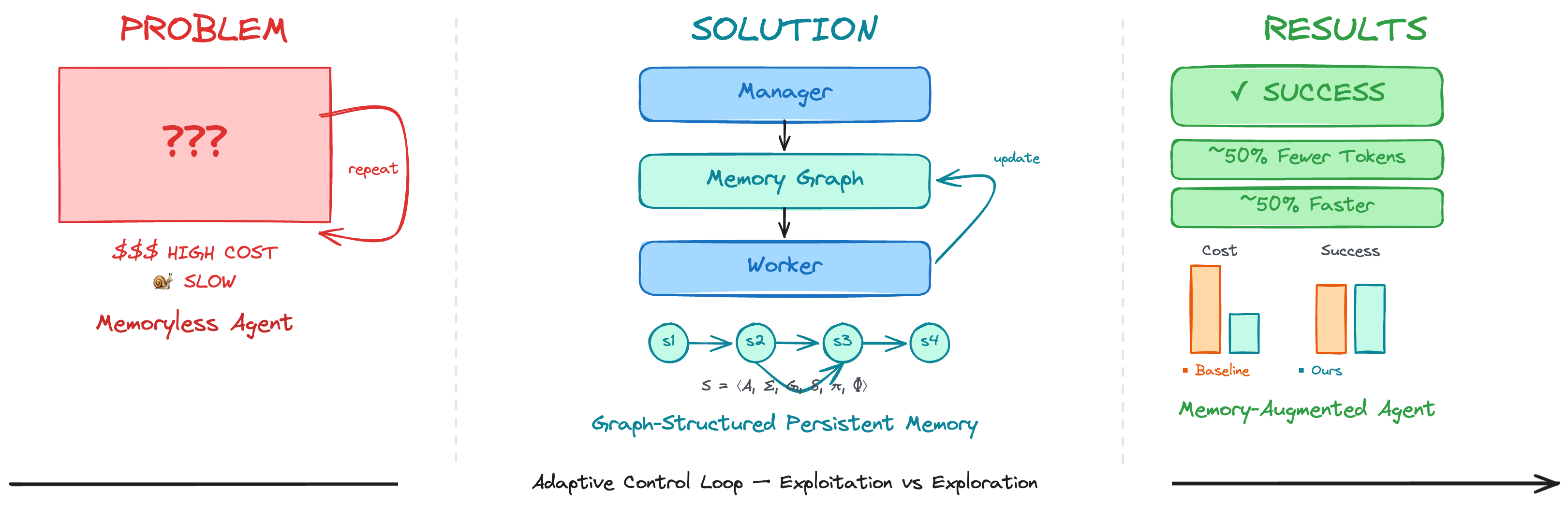
Large language model (LLM)-driven computer use agents (CUAs) automate graphical user interface (GUI) tasks but often re-solve previously encountered subtasks, increasing token use, latency, and instability. We address this limitation with a directed graph-based persistent memory in which nodes represent observable GUI states and edges encode executable action sequences. We formalize the memory-augmented agent as S=〈A,Σ,G,δ,π,Φ〉, define stability conditions by analogy with functional stability theory, and derive token-cost efficiency bounds. In control-theoretic terms, the Manager–Worker architecture becomes a closed-loop system where memory provides experience-based feedback, and selecting between memory retrieval and fresh LLM planning is treated as adaptive control. Experiments on OSWorld show that the proposed agent cuts both LLM token consumption and execution time by about 50% versus a memoryless baseline while preserving comparable success rates (≈36.9% on 15-step and ≈46.9% on 50-step tasks). Structured graph memory therefore improves robustness under perturbation and supports convergent efficiency gains over time.
Keywords:
functional stability
; adaptive control
; decision-making theory
; machine learning
; graph memory
; LLM agents
; GUI automation
; hierarchical control systems
; knowledge reuse
; directed graphs
Copyright: This open access article is published under a Creative Commons CC BY 4.0 license, which permit the free download, distribution, and reuse, provided that the author and preprint are cited in any reuse.


