
Submitted:
14 April 2026
Posted:
15 April 2026
You are already at the latest version
Abstract
Digital platforms increasingly mediate economic coordination, labor allocation, and decision-making. As artificial intelligence becomes embedded within these platform ecosystems, automation no longer targets only manual labor. Instead, algorithmic systems are displacing routine tasks across both low-wage entry-level work and middle-management functions. This paper argues that the emerging phase of platform-mediated automation risks hollowing out labor structures from both directions, from below through the erosion of repetitive, junior roles, and from above through the automation of supervisory coordination functions. Drawing on institutional economics, platform governance literature, and recent research on AI-enhanced learning and workforce development, the paper examines how this dual displacement creates structural vulnerability. Entry-level roles have historically functioned as apprenticeships in which workers acquire tacit knowledge and critical judgment. At the same time, experienced workers are aging out of the workforce. If platforms curtail formative occupational layers, organizations may face a shortage of workers capable of exercising contextual reasoning required to manage complex systems. The paper situates these developments within broader debates about technological unemployment, platform labor, and the political economy of capitalism. It argues that the challenge is not merely job quantity, but institutional continuity, how societies reproduce practical competence when platforms optimize for efficiency rather than formation. This study proposes a framework for evaluating platform ecosystems by their long-term effects on human capital formation and institutional resilience.
Keywords:
platform ecosystems
; algorithmic management
; artificial intelligence and labor
; workforce formation
; technological unemployment
; institutional resilience
University of Missouri-Kansas City, 5000 Holmes St, Kansas City, MO 64110, USA * Correspondence: wiggerl@umkc.edu; Tel.: (816) 235-2317
1. Introduction
Digital platforms have reshaped the organization of work by mediating economic coordination across distributed networks of firms and individuals. Rather than internalizing production, platform firms such as Uber and DoorDash have relied on decentralized arrangements in which independent contractors supply both labor and capital, while the platform orchestrates matching, pricing, and evaluation. In this sense, platforms function as coordination layers within broader economic systems, consistent with a supply chain perspective in which production and distribution occur across interconnected organizational networks rather than within a single firm [1].
This model, however, may prove transitional. The technological advances that enabled platform growth, data analytics, algorithmic management, and real-time coordination, may well also support the organizational replacement of labor-mediated service provision with capital-intensive autonomous systems. The emergence of driverless mobility and automated delivery introduces a structural inflection point, allowing platforms to internalize production through owned or controlled capital assets rather than coordinating human labor.
This shift raises questions that extend beyond technological substitution. Institutional economists have long emphasized that technological change reshapes not only tasks, but also the distribution of rights, responsibilities, and control across economic actors [2,3,4]. Platform-mediated automation therefore represents a reconfiguration of firm boundaries and labor relations, with implications for economic power, income distribution, and workforce organization.
The consequences may be particularly acute for labor formation. Automation has historically displaced routine tasks, but it has also generated new roles and pathways for skill development. Yet recent advances in artificial intelligence and algorithmic systems suggest a different trajectory. Automation increasingly targets both low-wage, entry-level roles and higher-level coordination functions, compressing the occupational structure from both directions. When entry-level roles disappear, a critical question emerges: how will future workers acquire the experience and judgment necessary to manage increasingly complex systems [5]?
This paper argues that the current phase of platform-mediated automation risks undermining not only employment levels, but the institutional mechanisms through which labor capabilities are reproduced. Platforms may optimize for efficiency by eliminating redundancy, variability, and training costs, yet in doing so they risk eroding the very processes that sustain long-term organizational competence. The problem, therefore, is not merely one of technological unemployment, but of institutional continuity.
To address this issue, the paper examines how the transition from labor-mediated platforms to capital-intensive autonomous systems reshapes the structure of work and the organization of economic activity. Drawing on institutional economics, platform governance literature, and recent research on labor and technology, it develops a framework for evaluating platform ecosystems not only in terms of productivity gains, but also in relation to labor erosion, workforce formation, and institutional resilience.
2. Platforms as Labor Externalization Systems
Digital platforms can be understood as organizational forms that restructure how production is coordinated across networks of actors. Rather than internalizing labor and capital within the firm, platform models externalize both, relying on independent contractors to supply key inputs while the platform governs coordination through algorithmic systems. In this sense, platforms operate less as traditional firms and more as orchestrators of distributed production networks.
From a supply chain economics perspective, this arrangement reflects a broader shift in how organizations pursue their objectives across internal and external relationships. Production, distribution, and service delivery occur through networks of organizations and individuals, with firms selecting among alternative configurations of labor, capital, and coordination mechanisms to achieve desired outcomes [1]. Platform firms extend this logic by minimizing direct ownership of productive assets while maximizing control over information flows, pricing, and performance evaluation [6].
Ride-sharing and delivery platforms illustrate this model clearly. Drivers provide vehicles, labor time, fuel, and maintenance, effectively bearing the capital and operational risks associated with service provision. The platform, in turn, manages demand aggregation, route optimization, pricing algorithms, and reputation systems. This division of responsibilities allows platforms to scale rapidly without the fixed costs associated with traditional asset ownership, while also shifting variability and risk onto workers.
Such arrangements are best understood through transaction cost and institutional lenses. Platforms reduce certain coordination costs, such as search, matching, and information asymmetry, while introducing new forms of control through algorithmic management. Workers are formally independent, yet their activities are tightly governed by platform rules, performance metrics, and dynamic pricing structures. This hybrid form blurs the boundary between market and hierarchy, combining decentralized labor supply with centralized coordination.
The externalization of labor in platform systems also has implications for workforce formation. By design, these systems treat labor as modular and interchangeable, emphasizing task completion rather than skill accumulation. Workers enter and exit the system with minimal barriers, and performance is evaluated primarily through short-term metrics rather than long-term development. While this flexibility has expanded access to income opportunities, it also limits the extent to which platform work functions as a site of learning, apprenticeship, or career progression.
Historically, organizations have relied on structured roles, particularly entry-level positions, to facilitate the development of tacit knowledge and practical judgment. These roles serve as pipelines through which workers gain experience, build competencies, and progress into positions requiring greater responsibility. Platform-mediated labor weakens this pipeline by fragmenting work into discrete tasks and reducing opportunities for sustained engagement with complex processes.
At the same time, platform systems have proven highly effective in optimizing operational efficiency. Algorithmic coordination enables real-time adjustment of supply and demand, reduces idle capacity, and enhances resource utilization. From the perspective of firm performance, the externalization of labor represents a rational response to competitive pressures, allowing organizations to achieve flexibility, scalability, and cost efficiency.
This tension, between efficiency and capability formation, lies at the heart of the platform model. By minimizing commitments to labor, platforms reduce costs and increase responsiveness. Yet in doing so, they also diminish the institutional structures through which workers acquire the skills and experience necessary for long-term economic participation. This dynamic becomes particularly consequential as technological advances enable the further reduction, and eventual elimination, of human labor within these systems.
3. Automation and the Reversal of Platform Logic
The defining feature of platform business models has been the externalization of labor and capital. By relying on independent contractors, firms such as Uber and DoorDash have minimized fixed costs while achieving rapid scalability. However, emerging advances in autonomous vehicles, robotics, and artificial intelligence introduce a structural shift that challenges this logic. These technologies enable platforms not merely to coordinate labor more efficiently, but to reduce or eliminate the need for human labor altogether.
This development represents a reversal of the organizational strategy that underpinned platform growth. Rather than functioning as intermediaries that match supply and demand across distributed actors, platforms can increasingly internalize production through the deployment of capital-intensive systems. Autonomous vehicles, delivery robots, and AI-driven coordination tools allow firms to substitute owned or tightly controlled capital for previously externalized labor inputs. In this sense, platform firms begin to resemble more traditional vertically integrated organizations, albeit with digitally enhanced coordination capabilities.
The economic incentives driving this shift are significant. Autonomous systems reduce variability in service provision, lower long-term labor costs, and eliminate many of the regulatory and classification challenges associated with managing large contractor workforces. While the initial capital investment required for autonomous fleets is substantial, these costs are offset by scalability and declining marginal operating expenses. Once deployed, autonomous systems can operate continuously, without the constraints associated with human labor, including scheduling limitations, turnover, and variability in performance.
Importantly, full technological substitution is not required for these dynamics to take effect. Partial deployment of autonomous systems, particularly in high-density urban areas, predictable routes, or high-value service segments, may disproportionately affect human workers. Platforms can allocate the most profitable or efficient tasks to automated systems while leaving residual, lower-margin work to human labor. This selective substitution risks eroding earnings and destabilizing income streams for workers who rely on multi-platform strategies, combining ride-sharing, delivery, and other forms of contingent work.
From an institutional perspective, this transition reflects broader patterns associated with technological change. Automation has historically been accompanied by increasing capital intensity, the reorganization of production processes, and shifts in the distribution of economic power [5]. As in earlier industrial transformations, the introduction of new technologies alters not only how work is performed, but also who controls the means of production and how value is captured. In platform contexts, this implies a shift away from decentralized labor provision toward centralized control of productive assets and data.
This shift also intensifies existing trends toward the de-skilling and fragmentation of labor. Task-based automation reduces the scope of activities performed by human workers, concentrating remaining roles in either highly specialized technical functions or low-value residual tasks. As artificial intelligence systems extend into cognitive and coordination domains, even roles previously insulated from automation, such as routing, supervision, and customer interaction, become susceptible to algorithmic replacement. The result is a compression of the occupational structure, in which both entry-level and mid-level roles are diminished.
At the same time, the pace of technological change has accelerated dramatically. Institutional adjustments that once unfolded over decades now occur within years, compressing the time available for workers, firms, and policymakers to adapt [5]. This acceleration heightens the risks associated with labor displacement, as traditional mechanisms for retraining, skill development, and workforce transition struggle to keep pace with evolving technological capabilities.
For platform firms, the implications are double-edged. On one hand, automation offers a pathway to increased efficiency, scalability, and control. On the other, it undermines the very labor structures that supported platform expansion in the first place. As platforms internalize production through capital deployment, they transition from coordination mechanisms to producers, fundamentally altering their role within economic systems.
This transformation sets the stage for a deeper examination of labor market consequences. If platforms increasingly substitute capital for labor, the effects will not be confined to employment levels alone. Rather, they will reshape the structure of work, the distribution of income, and the processes through which workers acquire skills and experience. Platforms that once depended on distributed labor now face the opportunity and incentive to replace it. The following section explores these dynamics through the lens of dual labor erosion, examining how automation affects both the lower and upper bounds of the occupational hierarchy.
4. Dual Labor Erosion: Compression from Below and Above
The transition toward capital-intensive platform systems does not produce a uniform pattern of labor displacement. Rather, it generates a dual process of erosion that compresses the occupational structure from both ends. Automation displaces routine, entry-level roles at the lower bound while simultaneously encroaching on supervisory, coordination, and middle-management functions at the upper bound. The result is not simply job loss, but a restructuring of the labor hierarchy that undermines both access and progression within the workforce.
4.1. Erosion from Below: Entry-Level Displacement
At the lower bound, platform-mediated work has served as a point of entry into income generation for a wide range of workers. Ride-sharing and delivery roles, in particular, have offered relatively low barriers to participation, allowing individuals to supply labor and capital in exchange for flexible earnings opportunities. These roles have functioned not only as sources of income, but also as informal sites of skill acquisition, where workers develop familiarity with operational systems, customer interaction, and time-sensitive decision-making.
Automation threatens to eliminate many of these entry-level roles. Autonomous vehicles and delivery systems directly target the routine, repetitive tasks that define much of platform-based work. Unlike earlier waves of automation, which primarily displaced industrial labor, contemporary systems extend into service domains that had previously been insulated by the need for human presence and judgment. As these technologies are deployed, the availability of low-barrier entry points into the labor market may decline significantly.
The consequences extend beyond immediate income loss. Entry-level roles have historically provided pathways through which workers accumulate experience and develop competencies that support upward mobility. When these roles are removed, workers face increased difficulty acquiring the tacit knowledge and practical judgment necessary for more complex positions. As previously noted, automation tends to displace tasks rather than entire occupations, but when the tasks that remain are concentrated at higher levels of complexity, access to those roles becomes more restricted, particularly in the context of an aging workforce and declining succession pathways within organizations [5,7,8].
This dynamic is particularly consequential in an environment characterized by demographic contraction and labor shortages. Declining birth rates and an aging workforce reduce the inflow of younger workers into the labor market, increasing the importance of accessible entry points for workforce development. The simultaneous removal of these entry points through automation exacerbates existing constraints, creating a paradox in which economies face both labor shortages and reduced opportunities for labor participation.
4.2. Erosion from Above: Algorithmic Coordination and the Displacement of Oversight
At the upper bound, advances in artificial intelligence extend automation into domains traditionally associated with supervision, coordination, and decision-making. Platform firms have long relied on algorithmic systems to manage pricing, routing, and performance evaluation. As these systems become more sophisticated, they increasingly substitute for human oversight functions that were once embedded within organizational hierarchies.
Algorithmic management systems now perform tasks that include dispatching, monitoring worker performance, resolving customer issues, and optimizing resource allocation in real time. These functions, which historically required layers of supervisory and middle-management roles, can be executed through integrated software systems operating at scale [9]. As a result, the demand for human intermediaries within these coordination processes is reduced.
This development reflects a broader extension of automation into cognitive and organizational domains. While early automation focused on physical tasks, contemporary systems leverage machine learning and data analytics to replicate aspects of human judgment, particularly in environments characterized by structured data and repeatable decision rules. Although such systems lack the contextual awareness and ethical reasoning of human agents, they are often sufficient for routine coordination tasks, especially when combined with feedback loops and continuous data collection.
The displacement of supervisory roles has implications for organizational structure and career progression. Middle-management positions have traditionally served as bridges between operational execution and strategic decision-making, providing workers with opportunities to develop leadership skills and organizational knowledge. As these roles are compressed or eliminated, the pathways through which individuals transition from task execution to strategic responsibility become less accessible.
4.3. Compression and the Collapse of the Pipeline
Taken together, these dynamics produce a compression of the labor structure that challenges conventional models of workforce development. Entry-level roles are reduced or eliminated at the lower bound, while supervisory and coordination roles are automated at the upper bound. The remaining positions tend to be either highly specialized technical roles or residual tasks that are not yet economically viable to automate.
This pattern raises a fundamental institutional concern: the erosion of workforce formation itself. Platform-mediated automation risks undermining these processes by removing the intermediate stages through which workers develop practical expertise. When organizations optimize for efficiency by eliminating redundancy, variability, and training costs, they may also eliminate the conditions necessary for capability formation. As noted in prior work, the disappearance of entry-level roles raises a critical question: how will future workers gain the experience required to manage increasingly complex systems [5]?
This challenge is compounded by the speed of technological change. Institutional adjustments that historically unfolded over extended periods now occur within compressed timeframes, limiting the capacity of educational systems, firms, and policymakers to respond effectively. The result is a growing mismatch between the skills required by advanced technological systems and the opportunities available for workers to acquire those skills.
The implications extend beyond individual workers to organizational and societal resilience. Firms may find themselves with increasingly sophisticated technological systems but insufficient human capability to manage exceptions, interpret ambiguous situations, and exercise judgment in complex environments. At a societal level, the erosion of workforce formation mechanisms risks contributing to inequality, reduced economic mobility, and weakened institutional stability.
In this context, the problem of automation cannot be reduced to questions of job quantity alone. It must be understood as a challenge of institutional continuity: the capacity of economic systems to reproduce the human capabilities on which they ultimately depend. Platforms may optimize away not only labor, but the processes that make labor capable. The following section examines the broader implications of this dynamic, considering how labor markets, firms, and policy frameworks may adapt, or fail to adapt, to the pressures of platform-mediated automation.
5. Institutional Consequences: The Collapse of the Pipeline
The dual erosion of labor described above points to a broader institutional consequence: the potential collapse of the mechanisms through which economic systems reproduce human capability, consistent with prior work showing that crises often reveal structural vulnerabilities embedded in institutional arrangements [4]. While discussions of automation often focus on employment levels or wage effects, the more fundamental issue may lie in how workers acquire the experience, judgment, and tacit knowledge required to sustain complex organizational systems over time.
Modern economies depend on structured pathways of workforce formation; but that division of labor, while increasing productivity, may degrade workers’ intellectual capacities absent countervailing institutions [10]. Entry-level roles, intermediate positions, and supervisory functions collectively form a developmental sequence through which individuals progress from task execution to decision-making authority. These roles are not merely components of production; they are institutional arrangements that enable learning-by-doing, mentorship, and the gradual accumulation of practical competence. As such, they serve a dual purpose: contributing to immediate output while simultaneously preparing the next generation of workers.
From an institutional perspective, these pathways are embedded within broader systems of rights, responsibilities, and expectations that govern economic activity [2,3]. Organizations design roles not only to complete tasks, but to structure participation, distribute authority, and cultivate capability. The continuity of these arrangements is essential for maintaining the alignment between technological systems and human operators.
Platform-mediated automation disrupts this alignment by selectively eliminating the roles that support workforce development. As entry-level and intermediate positions are reduced, the opportunities for workers to engage with increasingly complex systems in a meaningful way are diminished. Workers may be left with either highly routinized residual tasks or highly specialized technical roles, with fewer pathways connecting the two.
This dynamic can be understood as a form of institutional misalignment. Technological systems continue to advance in complexity, requiring greater levels of contextual reasoning, judgment, and adaptability. At the same time, the processes through which workers develop these capabilities are weakened. The result is a growing gap between the demands of advanced production systems and the capacity of the workforce to meet those demands.
This concern is not without historical precedent. Earlier waves of industrialization similarly disrupted traditional forms of skill acquisition, replacing artisanal knowledge with mechanized processes. However, these transitions were often accompanied by the emergence of new institutional structures—such as formal training programs, managerial hierarchies, and professionalized occupations—that provided alternative pathways for capability development. The current phase of platform-mediated automation differs in that it may remove existing pathways without generating sufficiently robust replacements.
Prior work has emphasized that technological change interacts with institutional structures in ways that shape long-term economic outcomes, rather than merely producing short-term disruptions. In the context of supply chains and labor systems, production processes are inseparable from the networks of organizations and workers that sustain them [1]. When these networks are optimized solely for efficiency, they may become fragile, lacking the redundancy and developmental capacity necessary to adapt to shocks. Similarly, recent analyses of labor and technology highlight how automation can de-skill labor and concentrate control, raising concerns about inequality and the erosion of worker autonomy [5].
The implications of these dynamics extend beyond individual firms. At the level of the broader economy, the weakening of workforce formation mechanisms may contribute to reduced social mobility, persistent skill shortages, and increasing polarization between high-skill and low-skill roles. As entry points into the labor market become more limited, workers may face greater barriers to participation, while firms encounter difficulties in sourcing individuals capable of managing complex systems.
This tension is further intensified by demographic trends. Aging populations and declining birth rates reduce the inflow of new workers, increasing reliance on the effective development of existing labor resources, as documented in prior work on workforce succession and demographic transition [7]. When combined with the erosion of entry-level roles, these trends create conditions in which the reproduction of human capital becomes increasingly uncertain. As prior research has shown, workforce development challenges are already emerging as critical constraints within supply chain systems, where labor shortages and skill mismatches disrupt production and distribution processes [11].
The resulting scenario is one in which economic systems risk becoming both technologically advanced and institutionally fragile. Organizations may possess sophisticated automated capabilities, yet lack the human expertise required to interpret, manage, and adapt these systems in dynamic environments. In such cases, efficiency gains achieved through automation may be offset by reduced resilience and increased vulnerability to disruption.
In this context, the challenge of automation must be reframed. Rather than asking solely how many jobs will be lost or created, the more pressing question is how economic systems will sustain the processes through which workers become capable participants in those systems. This is fundamentally a question of institutional continuity: the ability of societies to reproduce the human capacities that underpin production, coordination, and governance. In optimizing for efficiency, platforms risk optimizing away the conditions that make labor capable.
Understanding this challenge requires moving beyond narrow measures of productivity or employment and toward a broader evaluation of how technological change interacts with institutional structures. The following section considers these broader implications, examining how labor markets, firms, and policy frameworks may respond to the pressures introduced by platform-mediated automation and the erosion of workforce formation pathways.
6. Broader Implications: Labor Markets, Firms, and Institutional Stability
The erosion of workforce formation pathways within platform-mediated systems has implications that extend beyond individual firms or industries. As automation and capital intensification reshape the structure of work, the effects propagate across labor markets, organizational capabilities, and broader institutional arrangements. Understanding these implications requires situating platform transformation within a wider political economy of technological change.
6.1. Labor Market Polarization and Participation
As entry-level roles are reduced and mid-level coordination functions are automated, the remaining opportunities tend to cluster at the extremes; highly specialized technical roles on one end and low-value, residual tasks on the other [12,13,14]. This bifurcation limits the availability of transitional roles that facilitate movement between skill levels, thereby constraining upward mobility.
The implications for labor market participation are significant. Platform work has expanded access to income generation for individuals who may otherwise face barriers to traditional employment, including those seeking flexible schedules or supplemental income. As these opportunities diminish, workers may encounter reduced access to earnings without corresponding expansion of alternative pathways. This dynamic risks increasing both underemployment and labor force detachment, particularly among workers who rely on multi-platform income strategies.
At the same time, the erosion of entry points may contribute to persistent skill shortages in higher-level roles. As the processes through which workers acquire experience are weakened, the supply of individuals capable of performing complex, context-dependent tasks may decline. This paradox—simultaneous labor shortages and reduced participation—reflects a structural misalignment between the evolving demands of production systems and the institutional mechanisms that support workforce development.
6.2. Organizational Capability and Over-Automation Risk
For firms, the transition toward autonomous systems introduces a tension between efficiency and capability. Automation offers clear advantages in terms of cost reduction, consistency, and scalability. However, the removal of human labor from key processes may also reduce the organization’s capacity to respond to variability, uncertainty, and unforeseen disruptions.
Human workers provide forms of judgment, improvisation, and contextual understanding that are difficult to codify within algorithmic systems. While artificial intelligence can replicate certain aspects of decision-making, it remains limited in its ability to navigate novel situations, interpret ambiguous information, and exercise ethical discretion. Organizations that rely heavily on automated systems may therefore become vulnerable to edge cases and systemic shocks that fall outside predefined parameters.
This creates the risk of over-automation, in which firms pursue efficiency gains at the expense of resilience. By eliminating roles that contribute to experiential learning and institutional knowledge, organizations may inadvertently weaken their ability to adapt over time. As prior work has shown, production systems optimized for efficiency can become fragile when deprived of redundancy and developmental capacity [1]. In the context of platform-mediated automation, this fragility may manifest as a shortage of workers capable of managing, maintaining, and improving complex systems.
6.3. Concentration of Power and Control
The internalization of production through capital-intensive systems also has implications for the distribution of economic power. Platform firms that once relied on decentralized networks of workers may increasingly consolidate control over both assets and data. Autonomous systems require substantial upfront investment and access to large-scale datasets, creating barriers to entry and reinforcing the position of dominant firms.
As control over production becomes more centralized, workers may lose not only income opportunities but also bargaining power. The flexibility associated with platform work has often been framed as a benefit, yet it also reflects a shift in risk from firms to workers. The transition to autonomous systems reverses this dynamic in part, but without necessarily restoring worker influence. Instead, it may concentrate decision-making authority within a smaller set of firms and technological systems.
This concentration has broader institutional implications. The allocation of rights and responsibilities within economic systems, who controls production, who bears risk, and who captures value, is reshaped by technological change. In platform contexts, this concentration is reinforced by control over data, routing logic, pricing systems, and the capital-intensive assets that increasingly determine service delivery.
6.4. Institutional Stability and Social Provisioning
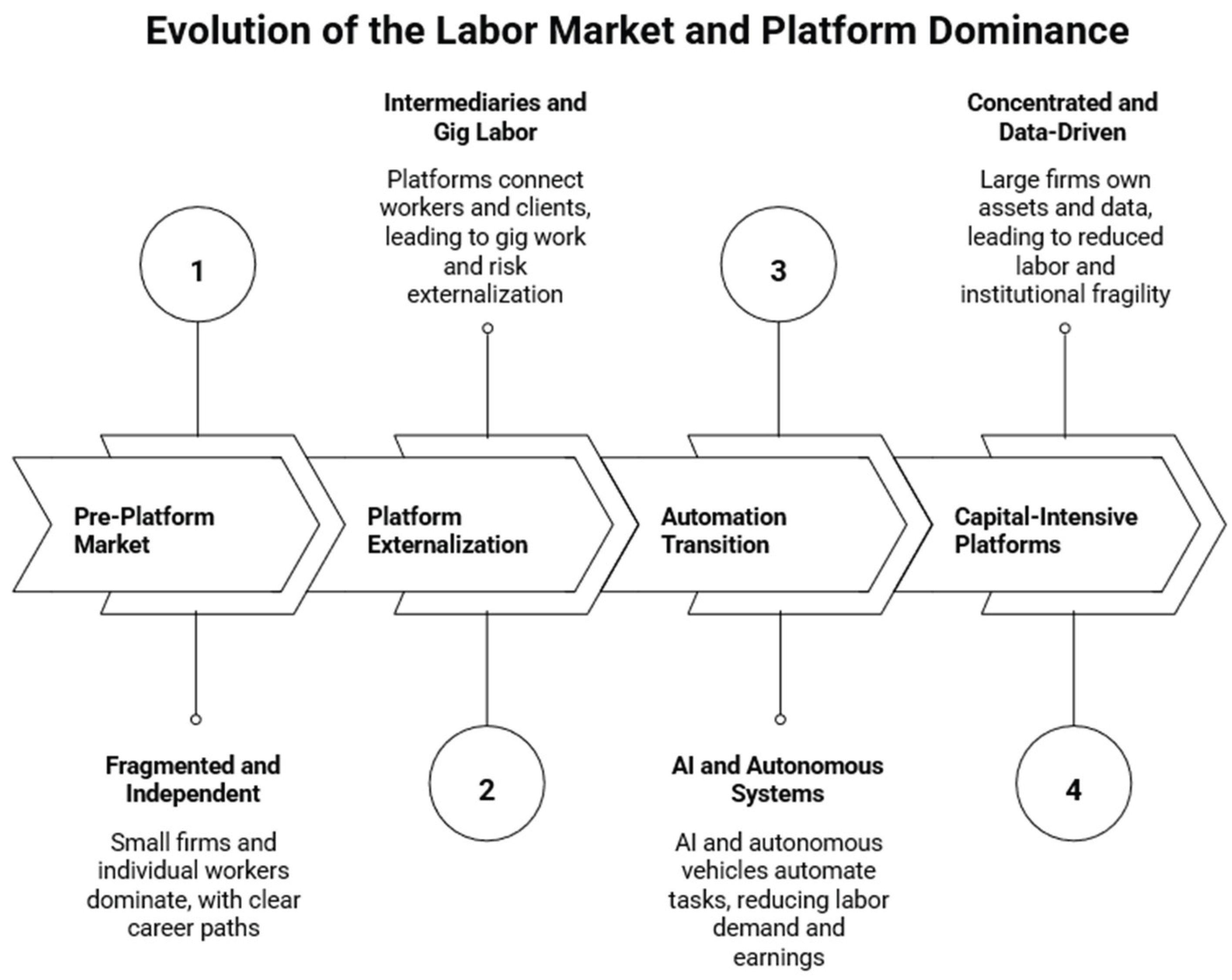
At the societal level and as illustrated in Figure 1, the erosion of workforce formation mechanisms raises concerns about institutional stability. Economic systems rely on a continuous process of social provisioning, through which individuals gain access to income, develop capabilities, and participate in productive activity. When these processes are disrupted, the effects extend beyond labor markets to include social mobility, community stability, and the legitimacy of economic institutions.
Historically, periods of technological transformation have required complementary institutional innovations to sustain social cohesion. Educational systems, labor market policies, and organizational practices have evolved to support transitions in the nature of work. The current phase of platform-mediated automation presents a similar challenge, but with the added complication of accelerated technological change and fragmented organizational structures.
If the processes through which workers develop capabilities are weakened without adequate replacement, the result may be a decline in both economic participation and institutional resilience. Societies may find themselves with advanced technological systems but insufficient human capacity to manage and sustain them. This imbalance risks undermining not only economic performance but also the broader social contract that underpins market economies.
6.5. Reframing the Problem
Taken together, these implications suggest the need to reframe the analysis of automation within platform systems. The central issue is not solely the number of jobs lost or created, but the transformation of the institutional arrangements that support labor participation and capability development. Evaluating platform ecosystems therefore requires attention not only to productivity and efficiency, but also to the long-term effects on workforce formation and institutional continuity. Systems optimized for efficiency may ultimately prove brittle when they fail to reproduce the human capabilities on which they depend.
The following section builds on this perspective by proposing a framework for assessing platform-mediated automation. This framework aims to provide a structured approach for analyzing the trade-offs between efficiency, labor erosion, and institutional resilience, offering a basis for both scholarly inquiry and practical decision-making.
7. A Framework for Evaluating Platform Systems Under Automation
The preceding analysis suggests that existing approaches to evaluating platform firms are incomplete. Much of the literature assesses platform performance in terms of efficiency, scalability, and market expansion. While these metrics are important, they do not capture the broader institutional effects associated with platform-mediated automation. In particular, they overlook the ways in which organizational design choices influence labor formation, capability development, and long-term system resilience.
To address this gap, this section proposes a framework for evaluating platform systems under conditions of increasing automation and capital intensification. The framework is designed to complement existing performance metrics by incorporating dimensions related to labor, organizational capability, and institutional continuity. It provides a structured approach for analyzing the trade-offs inherent in platform transformation.
7.1. Platform Institutional Resilience Framework (PIRF)
The PIRF framework consists of four interrelated dimensions:
(1) Productivity and Efficiency Gains
The first dimension captures the conventional metrics of platform performance, including cost reduction, resource utilization, service reliability, and scalability. Autonomous systems offer clear advantages along these lines, enabling continuous operation, reduced variability, and improved coordination across distributed networks.
However, as prior research has emphasized, systems optimized for efficiency may become vulnerable when exposed to shocks or variability [1]. Evaluating productivity gains therefore requires consideration not only of immediate performance improvements, but also of potential trade-offs in flexibility and resilience.
(2) Labor Displacement and Income Effects
The second dimension assesses the extent to which automation displaces human labor and alters income distribution. This includes both direct effects, such as the elimination of specific roles, and indirect effects, such as reduced earnings opportunities within multi-platform income strategies.
Importantly, this dimension should account for the uneven nature of displacement. As discussed earlier, partial automation may disproportionately affect high-value tasks, leaving workers with residual, lower-margin opportunities. Evaluating labor displacement therefore requires attention to how income streams are reconfigured, not simply whether jobs are eliminated.
(3) Workforce Formation and Capability Development
The third dimension focuses on the processes through which workers acquire skills, experience, and practical judgment. This includes the availability of entry-level roles, opportunities for progression, and mechanisms for learning-by-doing. This dimension is central to the framework’s contribution. While productivity and labor displacement are frequently measured, the effects of automation on workforce formation are often overlooked. Yet, as prior work has emphasized, the disappearance of entry-level roles raises critical questions about how future workers will develop the capabilities required to operate and manage complex systems [5].
Evaluating platform systems along this dimension requires examining whether organizational structures support or undermine the development of human capital over time.
(4) Institutional Resilience and Adaptability
The fourth dimension captures the capacity of platform systems to adapt to changing conditions, including technological shifts, market volatility, and external shocks. This includes both organizational resilience—such as the ability to manage exceptions and respond to unforeseen events—and broader institutional stability.
From a supply chain perspective, resilience depends on the presence of redundancy, flexibility, and distributed capability across networks of actors [1]. Platform systems that eliminate human roles in pursuit of efficiency may reduce these qualities, increasing vulnerability to disruption.
This dimension also encompasses the distribution of control and decision-making authority. Systems that concentrate power within a narrow set of actors may achieve short-term efficiency gains but face longer-term challenges related to governance, legitimacy, and coordination.
7.2. Trade-Offs and System-Level Implications
These four dimensions are not independent; they interact in ways that create trade-offs. Gains in productivity may come at the expense of labor participation or workforce formation. Reductions in labor costs may weaken organizational capability over time. Centralization of control may enhance coordination while reducing adaptability.
Understanding platform transformation therefore requires moving beyond single-metric evaluation toward a more holistic perspective. As supply chain economics suggests, production systems should be analyzed as networks of interdependent processes and actors, in which changes in one dimension propagate across others [1].
This perspective highlights the importance of balance. Platform systems that prioritize efficiency without regard for labor formation may generate short-term gains but undermine long-term sustainability. Conversely, systems that maintain workforce development at the expense of efficiency may struggle to compete. The challenge lies in designing organizational arrangements that align technological capabilities with human development.
7.3. Applications of the Framework
The proposed framework can be applied across multiple levels of analysis. At the firm level, managers can use it to evaluate automation strategies, assessing not only cost savings but also the implications for workforce capability and organizational resilience. Decisions regarding the deployment of autonomous systems can be informed by considering how changes in one dimension affect outcomes in others.
At the industry level, the framework can be used to compare different platform models, identifying variations in how firms balance efficiency, labor utilization, and capability development. This may help explain differences in long-term performance and adaptability across firms operating in similar markets.
At the policy level, the framework provides a basis for evaluating the broader societal effects of platform-mediated automation. Policymakers can use it to assess whether technological adoption supports or undermines workforce participation, skill development, and institutional stability, informing the design of interventions aimed at sustaining these outcomes.
7.4. Toward a Broader Evaluation of Platform Systems
The framework proposed here is not intended as a definitive model, but as a starting point for integrating institutional considerations into the analysis of platform economies. By incorporating dimensions related to labor formation and resilience, it expands the scope of evaluation beyond traditional performance metrics. Platform systems should be evaluated not only by what they produce, but by whether they sustain the human capacities required to operate them.
Ultimately, the transformation of platform systems under conditions of automation raises fundamental questions about the purpose of economic organization. If platforms evolve from coordination mechanisms into capital-intensive producers, the criteria by which they are evaluated must also evolve. Efficiency and scalability remain important, but they must be considered alongside the capacity of these systems to sustain human capability and institutional continuity.
8. Conclusion
Platform firms have reshaped economic organization by externalizing labor and coordinating production across distributed networks of workers and assets. This model has delivered significant gains in flexibility, scalability, and efficiency, expanding access to income opportunities while redefining the boundaries of the firm. Yet the same technological capabilities that enabled this transformation now introduce a new phase in platform evolution, one characterized by the increasing substitution of capital for labor.
As autonomous systems become commercially viable, platforms face strong incentives to internalize production through the deployment of capital-intensive technologies. This shift represents not merely a continuation of automation trends, but a reversal of the logic that defined platform growth. In moving from labor-mediated coordination to capital-driven production, platforms transition from orchestrators of work to producers within the systems they once mediated.
The implications of this transition extend beyond employment levels. The analysis presented in this paper has emphasized the dual erosion of labor, in which automation compresses the occupational structure from both below and above, reducing entry-level roles while displacing coordination and supervisory functions. More fundamentally, it has highlighted the risk that platform-mediated automation undermines the institutional mechanisms through which workers acquire experience, develop judgment, and progress within the labor market.
This concern reframes the problem of automation. The central challenge is not simply the quantity of jobs created or displaced, but the continuity of the processes that enable workforce formation. Economic systems rely on structured pathways through which individuals become capable participants in production, coordination, and governance. When these pathways are weakened or eliminated, the long-term sustainability of both firms and labor markets is called into question.
The framework proposed in this paper offers a means of evaluating platform systems along dimensions that extend beyond traditional performance metrics. By incorporating considerations of labor displacement, workforce formation, and institutional resilience, it provides a more comprehensive basis for assessing the trade-offs associated with automation and capital intensification. This perspective aligns with a broader institutional approach, in which technological change is understood as reshaping not only productive capacity, but also the distribution of rights, responsibilities, and capabilities across economic actors.
Looking forward, the evolution of platform systems will depend on how organizations, policymakers, and society respond to these challenges. Technological capabilities alone do not determine outcomes; institutional design and governance shape how those capabilities are deployed and who benefits from them. The opportunity remains to align automation with human development, ensuring that efficiency gains do not come at the expense of workforce capability and social stability.
If platforms are to serve as durable components of modern economic systems, they must be evaluated not only by what they produce, but by whether they sustain the human capacities required to operate them. The future of platform economies will therefore be determined not solely by advances in artificial intelligence or autonomous systems, but by the institutional choices that govern their integration into the fabric of work and society.
Funding
This research was funded in part by THE HENRY W. BLOCH SCHOOL OF MANAGEMENT AT THE UNIVERSITY OF MISSOURI-KANSAS CITY, through the 2025-2026 Bloch Social Impact Research Fellowship and The APC was graciously funded by MDPI.
Acknowledgments
During the preparation of this manuscript/study, the author used GPT-5.3 architecture (OpenAI) for the purposes of investigation and writing—review and editing and napkin.ai for generation of Figure 1. The author has reviewed and edited the output and takes full responsibility for the content of this publication.
Conflicts of Interest
The author declares no conflicts of interest. The funders had no role in the design of the study; in the collection, analyses, or interpretation of data; in the writing of the manuscript; or in the decision to publish the results.
References
- Wigger, L. Supply Chain Economics: A Fresh Lens for Holistic Analysis. Journal of Economic Issues 2024, vol. 58(no. 2), 440–446. [Google Scholar] [CrossRef]
- J. R. Commons, Institutional Economics: Its Place in Political Economy, Madison, WI, USA: University of Wisconsin Press, 1934.
- Veblen, T. The Place of Science in Modern Civilisation and Other Essays; Huebsch: New York, NY, USA, 1919. [Google Scholar]
- Wigger, L. Crisis Revealing Structure: An Institutional Analysis of Labor, Technology, and Supply Chains Beyond the Pandemic. Journal of Economic Issues forthcoming. [Google Scholar]
- Wigger, L. Following the Light of the Sun: Humanity in the New (Work) World of AI. Journal of Economic Issues 2025, vol. 59(no. 3), 932–939. [Google Scholar] [CrossRef]
- Srnicek, N. Platform Capitalism; Polity Press: Cambridge, UK, 2017. [Google Scholar]
- Wigger, L. Silver Surfers: Employee-Ownership Conversions for Retiring Entrepreneurs. Journal of Economic Issues forthcoming. [Google Scholar]
- Acemoglu, D.; Restrepo, P. “Artificial Intelligence, Automation, and Work,” in The Economics of Artificial Intelligence: An Agenda, Chicago, IL, USA; University of Chicago Press, 2018; pp. 197–236. [Google Scholar]
- Kellogg, K.; Valentine, M.; Christin, A. Algorithms at Work: The New Contested Terrain of Control. Academy of Management Annals 2020, vol. 14(no. 1), 366–410. [Google Scholar] [CrossRef]
- Smith, An Inquiry into the Nature and Causes of the Wealth of Nations; Strahan and Cadell: London, UK, 1776.
- Wigger, L. Oregon Trail: Labor and Housing as Essential Links in the Critical Materials Supply Chain. Journal of Economic Issues 2025, vol. 59(no. 2), 534–541. [Google Scholar] [CrossRef]
- Brynjolfsson, E.; McAfee, A. The Second Machine Age: Work, Progress, and Prosperity in a Time of Brilliant Technologies; W.W. Norton & Company: New York, NY, USA, 2014. [Google Scholar]
- World Economic Forum. The Future of Jobs Report 2023; World Economic Forum: Geneva, Switzerland, 2023. [Google Scholar]
- McKinsey Global Institute, Generative AI and the Future of Work in America; McKinsey & Company: New York, NY, USA, 2023.
Disclaimer/Publisher’s Note: The statemensts, opinions and data contained in all publications are solely those of the individual author(s) and contributor(s) and not of MDPI and/or the editor(s). MDPI and/or the editor(s) disclaim responsibility for any injury to people or property resulting from any ideas, methods, instructions or products referred to in the content. |
Figure 1.
The figure illustrates the transition from competitive, labor-intensive market structures to platform-mediated coordination and ultimately capital-intensive automation. As platforms scale, labor is first externalized through gig work and later displaced through autonomous systems. This process compresses occupational structures, weakens workforce formation pathways, and increases concentration of control, raising concerns about long-term institutional resilience.
Figure 1.
The figure illustrates the transition from competitive, labor-intensive market structures to platform-mediated coordination and ultimately capital-intensive automation. As platforms scale, labor is first externalized through gig work and later displaced through autonomous systems. This process compresses occupational structures, weakens workforce formation pathways, and increases concentration of control, raising concerns about long-term institutional resilience.
Disclaimer/Publisher’s Note: The statements, opinions and data contained in all publications are solely those of the individual author(s) and contributor(s) and not of MDPI and/or the editor(s). MDPI and/or the editor(s) disclaim responsibility for any injury to people or property resulting from any ideas, methods, instructions or products referred to in the content. |
© 2026 by the authors. Licensee MDPI, Basel, Switzerland. This article is an open access article distributed under the terms and conditions of the Creative Commons Attribution (CC BY) license (http://creativecommons.org/licenses/by/4.0/).
Copyright: This open access article is published under a Creative Commons CC BY 4.0 license, which permit the free download, distribution, and reuse, provided that the author and preprint are cited in any reuse.


