

Submitted:
09 April 2026
Posted:
16 April 2026
You are already at the latest version
Abstract
Background Tuberculosis-related stigma remains a substantial psychosocial burden among patients with multidrug-resistant tuberculosis, particularly in resource-constrained settings where prolonged treatment, social vulnerability, and barriers to care may further compromise well-being and engagement with health services. Stigma may adversely affect patients’ treatment experience, healthcare-seeking behavior, and continuity of care. This study aimed to assess perceived stigma and examine its association with tuberculosis-related knowledge, attitudes, and practices among patients with multidrug-resistant tuberculosis in Vietnam. Methods We conducted a cross-sectional study among 528 patients with multidrug-resistant tuberculosis in Vietnam. Perceived stigma was assessed using the Van Rie tuberculosis stigma scale. Knowledge, attitude, and practice scores were derived from structured questionnaire items. Spearman correlation analysis was used to assess bivariate associations between stigma and the knowledge, attitude, and practice domains. Multivariable linear regression was performed to identify factors independently associated with stigma. Results The mean age of participants was 42.61 years (standard deviation, 13.62), and 68.8% were male. The mean stigma score was 23.68 (standard deviation, 4.30), with a median of 24.0 and an interquartile range of 21.0-27.0, indicating a considerable burden of perceived stigma. In bivariate analysis, stigma was inversely correlated with knowledge score (rho = -0.095, p = 0.030), attitude score (rho = -0.270, p < 0.001), and total knowledge-attitude-practice score (rho = -0.192, p < 0.001), while the correlation with practice score was not statistically significant (rho = 0.081, p = 0.064). In multivariable analysis, a higher attitude score remained independently associated with lower stigma (beta = -0.229, 95% confidence interval: -0.306 to -0.153, p < 0.001), whereas knowledge and practice scores were not independently associated with stigma. Being on treatment was also associated with lower stigma (beta = -1.966, 95% confidence interval: -2.716 to -1.216, p < 0.001). Conclusions Patients with multidrug-resistant tuberculosis in Vietnam experienced a considerable burden of perceived stigma. More favorable tuberculosis-related attitudes were independently associated with lower stigma, underscoring the importance of integrating stigma reduction, psychosocial support, and patient-centered educational interventions into multidrug-resistant tuberculosis care. Such approaches may help improve treatment experience and strengthen sustained engagement in care, particularly in settings facing persistent social and health-system challenges.
Keywords:
multidrug-resistant tuberculosis
; MDR-TB
; tuberculosis stigma
; Van Rie tuberculosis stigma scale
; perceived stigma
; knowledge attitudes and practices
; KAP
; post-cure stigma paradox
; Vietnam
; psychosocial support
; patient-centered care
; cross-sectional study
1. Introduction
Multidrug-resistant tuberculosis (MDR-TB) remains a major public health challenge and continues to threaten progress in tuberculosis control, particularly in low- and middle-income countries.[1] Compared with drug-susceptible tuberculosis, MDR-TB is characterized by prolonged treatment, greater toxicities, higher costs, and poorer treatment outcomes, all of which can impose profound social and psychological burdens on affected individuals.[2] In addition to these biomedical and programmatic challenges, patients with MDR-TB frequently experience tuberculosis-related stigma driven by fear of infection, misconceptions regarding transmission and prognosis, and negative societal attitudes toward those living with the disease. Such stigma may compromise not only emotional well-being but also patients’ social relationships and engagement with health services.[3,4]
Tuberculosis-related stigma has been consistently linked to adverse consequences across the continuum of care, including delayed healthcare seeking, non-disclosure, poor adherence, social exclusion, and reduced quality of life [1,2,3,4]. These consequences may be particularly important among patients with MDR-TB, for whom treatment is longer, more demanding, and often more visible to others. Moreover, the perception that drug-resistant tuberculosis is more severe or more threatening may intensify stigma and increase the risk of self-blame, discrimination, and withdrawal from care.[5,6]Addressing stigma is therefore essential not only for improving psychosocial well-being but also for supporting effective, patient-centered MDR-TB management.
Knowledge, attitudes, and practices related to tuberculosis may represent important and potentially modifiable determinants of stigma. Accurate knowledge about the causes, transmission, treatment, and curability of tuberculosis may help reduce fear and counter misinformation. Positive attitudes toward tuberculosis and its treatment may lessen shame and anticipated discrimination, while appropriate practices may support treatment adherence and constructive social interaction.[3,7,8] However, limited knowledge and unfavorable attitudes may reinforce stigmatizing beliefs and hinder care engagement. Despite the relevance of these relationships, evidence on the association between tuberculosis-related knowledge, attitudes, and practices and perceived stigma among patients with MDR-TB remains scarce, especially in Vietnam.[6]
Vietnam is among the countries with a high burden of MDR-TB, underscoring the need for comprehensive approaches that address both the clinical and psychosocial dimensions of care.[6,9] To strengthen national MDR-TB services, greater attention should be paid to how patients experience stigma and to the factors that may mitigate or exacerbate it. Such evidence could inform the design of integrated counseling, communication, and stigma-reduction interventions within routine tuberculosis programs.
This study aimed to assess perceived tuberculosis-related stigma among patients with MDR-TB in Vietnam and to examine its association with tuberculosis-related knowledge, attitudes, and practices. We hypothesized that more favorable attitudes and higher overall knowledge-attitude-practice scores would be associated with lower perceived stigma.
2. Methods
2.1. Study Design and Setting
We conducted a cross-sectional study among patients with multidrug-resistant tuberculosis (MDR-TB) in six provinces of Vietnam, including Hanoi and Ho Chi Minh City, between June 2023 and June 2025. The study aimed to assess perceived tuberculosis-related stigma and examine its association with tuberculosis-related knowledge, attitudes, and practices.
2.2. Study Participants
Participants were patients with MDR-TB who were either receiving treatment or had completed treatment at the time of data collection. Patients were eligible if they were aged 15 years or older, had a confirmed diagnosis of MDR-TB based on national tuberculosis program or clinical records, and were able to communicate and provide informed consent. Patients who were too ill to participate, had severe cognitive or communication impairment, or declined participation were excluded. Participants were recruited by convenience sampling from National Tuberculosis Program clinics in the six study provinces.
3. Data Collection and Study Measures
Data were collected through interviews using a structured questionnaire administered by trained healthcare workers in a private setting. Each interview lasted approximately 40 minutes. The questionnaire included sociodemographic and treatment-related characteristics, including age, sex, occupation, residence, treatment status, time of treatment initiation, and number of previous tuberculosis treatment episodes.
Knowledge, attitudes, and practices related to MDR-TB treatment were assessed using structured items developed for this study. The knowledge domain covered general understanding of MDR-TB, treatment adherence, treatment interruption, and recognition and management of common adverse events. The attitude domain assessed beliefs and perceptions related to treatment adherence and adverse event management. The practice domain evaluated self-reported behaviors related to medication adherence, symptom monitoring, communication with healthcare workers, and responses to treatment-related complications.
Perceived tuberculosis-related stigma was measured using the Van Rie tuberculosis stigma scale, with higher total scores indicating greater perceived stigma.[6]
3.1. Variable Definition
The primary outcome was the total stigma score, analyzed as a continuous variable. Knowledge scores were calculated by summing correct responses, coded as 1 for correct and 0 for incorrect. Attitude and practice scores were generated by summing item scores, with higher values indicating more favorable attitudes and more appropriate practices. A total knowledge-attitude-practice score was calculated as the sum of the three domain scores. Other covariates included age, sex, treatment status, occupation, and number of previous tuberculosis treatment episodes.
3.2. Statistical Analysis
Data were analyzed using R software. Continuous variables were summarized using mean and standard deviation or median and interquartile range, as appropriate, and categorical variables were presented as frequencies and percentages. Associations between stigma score and knowledge, attitude, practice, and total knowledge-attitude-practice scores were assessed using Spearman’s rank correlation coefficient. Multivariable linear regression was used to identify factors independently associated with stigma score. The final model included knowledge, attitude, and practice scores together with age, sex, and treatment status. Regression coefficients, 95% confidence intervals, and p values were reported. A two-sided p value of less than 0.05 was considered statistically significant.
4. Ethical Considerations
The study was conducted in accordance with the ethical principles of the Declaration of Helsinki. Ethical approval was obtained from Vietnam National Lung Hospital Ethical Commitee and the Hanoi Medical University Ethical Committee. Written informed consent was obtained from all participants prior to enrollment. Participants were informed that participation was voluntary, that they could decline to answer any question or withdraw from the study at any time without consequence, and that all information would be kept confidential and reported only in aggregate form.
5. Results
A total of 528 patients with multidrug-resistant tuberculosis were included in the analysis. The mean age was 42.61 ± 13.62 years. Most participants were male (364/528, 68.94%), while 164/528 (31.06%) were female. Regarding occupation, 256/528 (48.48%) were classified as informal/manual workers, 117/528 (22.16%) as not currently employed, 80/528 (15.15%) as working in business/service, and 75/528 (14.20%) were categorized as other/missing. Most participants were recruited from Ho Chi Minh (278/528, 52.65%), followed by An Giang (109/528, 20.64%) and Can Tho (52/528, 9.85%).(Table 1)
Perceived tuberculosis-related stigma was common in the study population. The mean Van Rie stigma score was 23.68 with a standard deviation of 4.30. The median stigma score was 24.0, and the interquartile range was 21.0 to 27.0, indicating a moderate burden of stigma across the sample.(Figure 1)
In 0. p = 0.030). A stronger inverse correlation was observed for attitude score (rho = -0.270, p < 0.001), suggesting that participants with more favorable tuberculosis-related attitudes tended to report lower stigma. Total KAP score was also inversely correlated with stigma (rho = -0.192, p < 0.001) (Table 2). In contrast, the association between practice score and stigma was not statistically significant (rho = 0.081, p = 0.064)(Figure 2).
To further examine factors independently associated with stigma, we performed multivariable linear regression using stigma score as the dependent variable and KAP domains together with selected demographic and treatment-related variables as predictors. In the adjusted model, attitude score remained significantly associated with stigma. Specifically, each one-point increase in attitude score was associated with a 0.229-point decrease in stigma score (beta = -0.229, 95% CI -0.306 to -0.153, p < 0.001). By contrast, knowledge score was no longer significantly associated with stigma after adjustment (beta = 0.089, 95% CI -0.059 to 0.237, p = 0.237), and practice score also remained non-significant (beta = -0.058, 95% CI -0.187 to 0.071, p = 0.374).
Among the covariates included in the regression model, treatment status was significantly associated with stigma. Participants who were currently on treatment had lower stigma scores than the reference group (beta = -1.966, 95% CI -2.716 to -1.216, p < 0.001). Neither age (beta = 0.021, 95% CI -0.006 to 0.047, p = 0.124) nor sex (beta = -0.139, 95% CI -0.900 to 0.622, p = 0.720) showed a significant independent association with stigma (Table 3).
Overall, these findings indicate that perceived stigma was substantial among patients with multidrug-resistant tuberculosis, and that tuberculosis-related attitude was the KAP domain most consistently associated with stigma. The attenuation of the knowledge association after adjustment suggests that attitude may be more closely linked to stigma than factual knowledge alone.
6. Discussion
This study demonstrated that Vietnamese MDR-TB patients has experienced a considerable burden of perceived tuberculosis-related stigma. Among the KAP domains examined, tuberculosis-related attitude was the only factor that remained independently associated with stigma after multivariable adjustment. In addition, patients who were currently receiving treatment reported lower stigma than those who had completed treatment. These findings suggest that stigma among patients with MDR-TB is shaped less by knowledge deficits alone, and more by how patients perceive, emotionally interpret, and internally relate to the disease and its treatment.
The mean Van Rie stigma score of 23.68 (SD 4.30) observed in this study reflects a moderate but meaningful level of perceived stigma in the study population. This is broadly consistent with previous studies conducted in low- and middle-income settings where tuberculosis-related stigma remains prevalent and is closely associated with fear of transmission, social exclusion, and anticipated discrimination.[10,11] For patients with MDR-TB specifically, the stigma burden may be further compounded by the prolonged treatment course, high pill burden, frequent adverse events, and the social perception that drug-resistant tuberculosis represents a more severe and dangerous form of disease.[4,7,12] Our findings therefore support the view that MDR-TB imposes not only a substantial clinical burden but also a significant psychosocial one that warrants targeted programmatic attention.
A principal finding of this study was the independent inverse association between tuberculosis-related attitude scores and perceived stigma (beta = − 0.229, 95% CI − 0.306 to − 0.153, p < 0.001). Patients with more positive attitudes toward MDR-TB and its treatment consistently reported lower levels of stigma, and this association persisted after adjusting for knowledge scores, practice scores, age, sex, and treatment status. This result is in line with earlier findings indicating that stigma is closely linked to illness perceptions, emotional appraisal, and internalised negative beliefs rather than to factual understanding of the disease alone.[7,13] When patients view MDR-TB as shameful, personally discrediting, or socially threatening, stigma may persist regardless of the level of biomedical knowledge they possess. The attitude domain, which captures beliefs, perceptions, and affective responses toward disease and treatment, may therefore represent a more proximal determinant of stigma than knowledge in this population.[14,15]
The association between knowledge score and stigma was statistically significant in the bivariate analysis (rho = − 0.095, p = 0.030); however, it was attenuated to non-significance in the multivariate model (beta = 0.089, 95% CI − 0.059 to 0.237, p = 0.237). This finding is consistent with a growing body of evidence suggesting that knowledge alone has limited power to reduce stigma once broader psychosocial and attitudinal factors are considered.[16] Patients may correctly understand the causes, transmission, and treatability of MDR-TB; nevertheless, they may internalise negative social meanings attached to the disease. This observation underscores the importance of going beyond biomedical education in stigma-reduction efforts and addressing the emotional, perceptual, and social dimensions of illness experience.[4,12]. The association between treatment status and stigma warrants particular attention. Patients currently on treatment had significantly lower stigma scores than those who had completed treatment (beta = -1.966, 95% CI -2.716 to -1.216, p < 0.001). This finding is somewhat counterintuitive and may reflect the protective role of structured clinical contact during the treatment period. Regular engagement with healthcare workers, peer support from other patients, and sustained counseling during treatment may buffer against stigma by normalizing the illness experience and reinforcing coping. Among patients who have completed treatment, the withdrawal of these supports may allow residual social labeling and negative self-perceptions to persist, even after biomedical cure has been achieved. This observation highlights the importance of extending psychosocial support beyond the active treatment phase to patients who have completed the MDR-TB regimen.[16,17,18]
While Redwood et al. [6] established that MDR-TB patients in Vietnam face a disproportionately high burden of stigma due to perceived infectiousness and prolonged isolation, our finding suggests that the active treatment phase provides a "clinical buffer." During this period, the patient is under the structured care of healthcare workers, which—according to the Normalization Process Theory—helps normalize the illness experience.
On the other hand, Our results align with the observations in 2022 regarding the cultural importance of "family reputation" in Vietnam. [15] Previous studies suggest that during treatment, the patient’s status is validated by the medical system. However, once treatment is completed and this "medical safety net" is withdrawn, patients may become more acutely aware of residual social labeling and the "spoiled identity" of a former TB patient as they attempt to reintegrate into the community. Our finding is complementary to evidence from other high-burden settings, which indicates that while "anticipated stigma" is high at diagnosis, the sustained counseling and peer support available during the treatment journey can effectively lower perceived stigma levels compared to the post-cure phase where such supports are typically absent.
The findings of this study carry several practical implications for MDR-TB programs in Vietnam and comparable settings. Stigma-reduction interventions should not rely on educational approaches alone. Strategies that target attitude change, such as motivational counseling, illness reframing, peer-led support groups, and communication approaches that normalize the treatment experience, are likely to be more effective in reducing perceived stigma. Routine integration of stigma screening into MDR-TB care, including for patients who have completed treatment, may also help identify those requiring additional psychosocial support.[4,13,19]
This study has several limitations that should be acknowledged. The cross-sectional design precludes causal inference, and the direction of the associations observed between attitude and stigma cannot be determined from these data alone. The use of self-reported questionnaire responses introduces the possibility of recall bias and social desirability bias. The study population was recruited from MDR-TB treatment settings in Vietnam, which may limit generalizability to other contexts or to patients who are not engaged in formal treatment programs. Furthermore, certain potentially relevant variables, including household socioeconomic status, level of social support, comorbid mental health conditions, and community-level stigma norms, were not measured and may confound the observed associations.
Despite these limitations, this study contributes important evidence on the psychosocial dimensions of MDR-TB care in Vietnam. The relatively large sample size of 528 patients strengthens the precision of the estimates, and the use of a validated stigma scale enabled a standardized assessment of perceived tuberculosis-related stigma. The findings add to the limited literature on KAP and stigma in MDR-TB populations and provide a basis for the development and evaluation of attitude-focused stigma-reduction strategies within national tuberculosis programs.
6. Conclusions
This study demonstrated that patients with multidrug-resistant tuberculosis in Vietnam experienced a substantial burden of perceived tuberculosis-related stigma. Among the domains of knowledge, attitudes, and practices examined, tuberculosis-related attitude was the only factor independently associated with stigma in the multivariable analysis, with more positive attitudes consistently predicting lower stigma scores. Patients who were currently receiving treatment also reported lower stigma than those who had completed treatment, suggesting that sustained engagement with care may provide some protection against perceived stigma.
The findings suggest that stigma within this population is predominantly influenced by patients' perceptions and emotional responses to their illness, rather than solely by factual knowledge or self-reported practices. Therefore, initiatives aimed at reducing tuberculosis-related stigma among patients with MDR-TB should extend beyond mere information dissemination and focus on interventions that address illness perceptions, challenge negative beliefs, and promote more positive attitudes toward the disease and its treatment. Counseling approaches, peer support programs, and patient-centered communication strategies that normalize the MDR-TB treatment experience may be particularly beneficial in this context. Psychosocial support should not be confined to the active treatment phase. Given that patients who had completed treatment reported higher stigma scores, ongoing follow-up and support post-treatment completion constitute a crucial and underutilized aspect of comprehensive MDR-TB care.
Routine assessment of stigma and attitudes should be integrated into national MDR-TB programs to identify vulnerable patients early and guide the delivery of targeted psychosocial interventions. Future longitudinal studies are warranted to clarify the causal pathways linking attitudes, treatment engagement, and stigma, and to evaluate the effectiveness of attitude-focused interventions in reducing stigma and improving outcomes among patients with MDR-TB.
Funding
The authors received fund from Global Funds for this work.
Institutional Review Board Statement
The study was conducted in accordance with the ethical principles of the Declaration of Helsinki. Ethical approval was obtained from the Vietnam National Lung Hospital Ethical Committee and the Hanoi Medical University Ethical Committee, number: 633/2023/NCKH.
Informed Consent Statement
Written informed consent was obtained from all participants prior to enrollment. Participants were informed that participation was voluntary and that they could withdraw at any time.
Clinical trial number
Not applicable (This is a cross-sectional study, not a clinical trial).
Consent for publication
Not applicable.
Conflicts of Interest
The authors declare that they have no competing interests.
References
- Global tuberculosis report 2023. Available online: https://www.who.int/publications/i/item/9789240083851 (accessed on 18 Jun 2024).
- Vishwakarma, D.; Gaidhane, A.; Sahu, S.; Rathod, A.S.; Vishwakarma, D.; Gaidhane, A.; et al. Multi-Drug Resistance Tuberculosis (MDR-TB) Challenges in India: A Review. Cureus 2023, 15. [Google Scholar] [CrossRef] [PubMed]
- Chen, X.; Xu, J.; Chen, Y.; Wu, R.; Ji, H.; Pan, Y.; et al. The relationship among social support, experienced stigma, psychological distress, and quality of life among tuberculosis patients in China. Sci Rep. 2021, 11, 24236. [Google Scholar] [CrossRef] [PubMed]
- Craig, G.M.; Daftary, A.; Engel, N.; O’Driscoll, S.; Ioannaki, A. Tuberculosis stigma as a social determinant of health: a systematic mapping review of research in low incidence countries. International Journal of Infectious Diseases 2017, 56, 90–100. [Google Scholar] [CrossRef] [PubMed]
- Liboon Aranas, L.; Alam, K.; Gyawali, P.; Alam, R.M. Drug-Resistant Tuberculosis Stigma Among HealthCare Workers Toward the Development of a Stigma-Reduction Strategy: A Scoping Review. INQUIRY 2023, 60, 00469580231180754. [Google Scholar] [CrossRef] [PubMed]
- Redwood, L.; Mitchell, E.M.H.; Nguyen, T.A.; Viney, K.; Duong, L.; Phạm, H.T.; et al. Adaptation and validation of the Van Rie tuberculosis stigma scale in Vietnam. International Journal of Infectious Diseases 2022, 114, 97–104. [Google Scholar] [CrossRef] [PubMed]
- Naidu, T.; Pillay, S.R.; Ramlall, S.; Mthembu, S.S.; Padayatchi, N.; Burns, J.K.; et al. Major Depression and Stigma among Individuals with Multidrug-Resistant Tuberculosis in South Africa. 2020. [Google Scholar] [CrossRef] [PubMed]
- Knowledge, Attitude and Practice(KAP) of tuberculosis patients enrolled on treatment in Juba City, South Sudan2010. A pilot study. Available online: http://www.southsudanmedicaljournal.com/archive/may-2014/knowledge-attitude-and-practicekap-of-tuberculosis-patients-enrolled-on-treatment-in-juba-city-south-sudan2010.-a-pilot-study.html (accessed on 12 Jul 2022).
- Hoa, N.B.; Nhung, N.V.; Khanh, P.H.; Hai, N.V.; Quyen, B.T.T. Adverse events in the treatment of MDR-TB patients within and outside the NTP in Pham Ngoc Thach hospital, Ho Chi Minh City, Vietnam. BMC Research Notes 2015, 8, 809. [Google Scholar] [CrossRef] [PubMed]
- Van Rie, A.; Sengupta, S.; Pungrassami, P.; Balthip, Q.; Choonuan, S.; Kasetjaroen, Y.; et al. Measuring stigma associated with tuberculosis and HIV/AIDS in southern Thailand: exploratory and confirmatory factor analyses of two new scales. Trop Med Int Health 2008, 13, 21–30. [Google Scholar] [CrossRef] [PubMed]
- Yan, S.; Zhang, S.; Tong, Y.; Yin, X.; Lu, Z.; Gong, Y. Nonadherence to Antituberculosis Medications: The Impact of Stigma and Depressive Symptoms. Am J Trop Med Hyg. 2018, 98, 262–5. [Google Scholar] [CrossRef] [PubMed]
- Redwood, L.; Mitchell, E.M.H.; Viney, K.; Snow, K.; Nguyen, T.A.; Dung La, T.; et al. Depression, stigma and quality of life in people with drug-susceptible TB and drug-resistant TB in Vietnam. Int J Tuberc Lung Dis. 2021, 25, 461–7. [Google Scholar] [CrossRef] [PubMed]
- Pradhan, A.; Koirala, P.; Bhandari, S.S.; Dutta, S.; García-Grau, P.; Sampath, H.; et al. Internalized and Perceived Stigma and Depression in Pulmonary Tuberculosis: Do They Explain the Relationship Between Drug Sensitivity Status and Adherence? Front Psychiatry 2022, 13. [Google Scholar] [CrossRef] [PubMed]
- Isara, A.R.; Akpodiete, A. Concerns about the knowledge and attitude of multidrug-resistant tuberculosis among health care workers and patients in Delta State, Nigeria. Niger J Clin Pract. 2015, 18, 664–9. [Google Scholar] [CrossRef] [PubMed]
- Redwood, L.; Fox, G.J.; Nguyen, T.A.; Bernarys, S.; Mason, P.; Vu, V.A.; et al. Good citizens, perfect patients, and family reputation: Stigma and prolonged isolation in people with drug-resistant tuberculosis in Vietnam. PLOS Global Public Health 2022, 2, e0000681. [Google Scholar] [CrossRef] [PubMed]
- Morris, M.D.; Quezada, L.; Bhat, P.; Moser, K.; Smith, J.; Perez, H.; et al. Social, economic, and psychological impacts of MDR-TB treatment in Tijuana, Mexico: a patient’s perspective. Int J Tuberc Lung Dis. 2013, 17, 954–60. [Google Scholar] [CrossRef] [PubMed]
- Agarwal, N.; Sarthi, P. The necessity of psychological interventions to improve compliance with Tuberculosis treatment and reduce psychological distress. J Family Med Prim Care 2020, 9, 4174–80. [Google Scholar] [CrossRef] [PubMed]
- Alemu, A.; Bitew, Z.W.; Worku, T. Poor treatment outcome and its predictors among drug-resistant tuberculosis patients in Ethiopia: A systematic review and meta-analysis. International Journal of Infectious Diseases 2020, 98, 420–39. [Google Scholar] [CrossRef] [PubMed]
- Courtwright, A.; Turner, A.N. Tuberculosis and stigmatization: pathways and interventions. Public Health Rep. 2010, 125 Suppl 4, 34–42. [Google Scholar] [CrossRef] [PubMed]
Figure 1.
Stigma scores across attitude score groups.
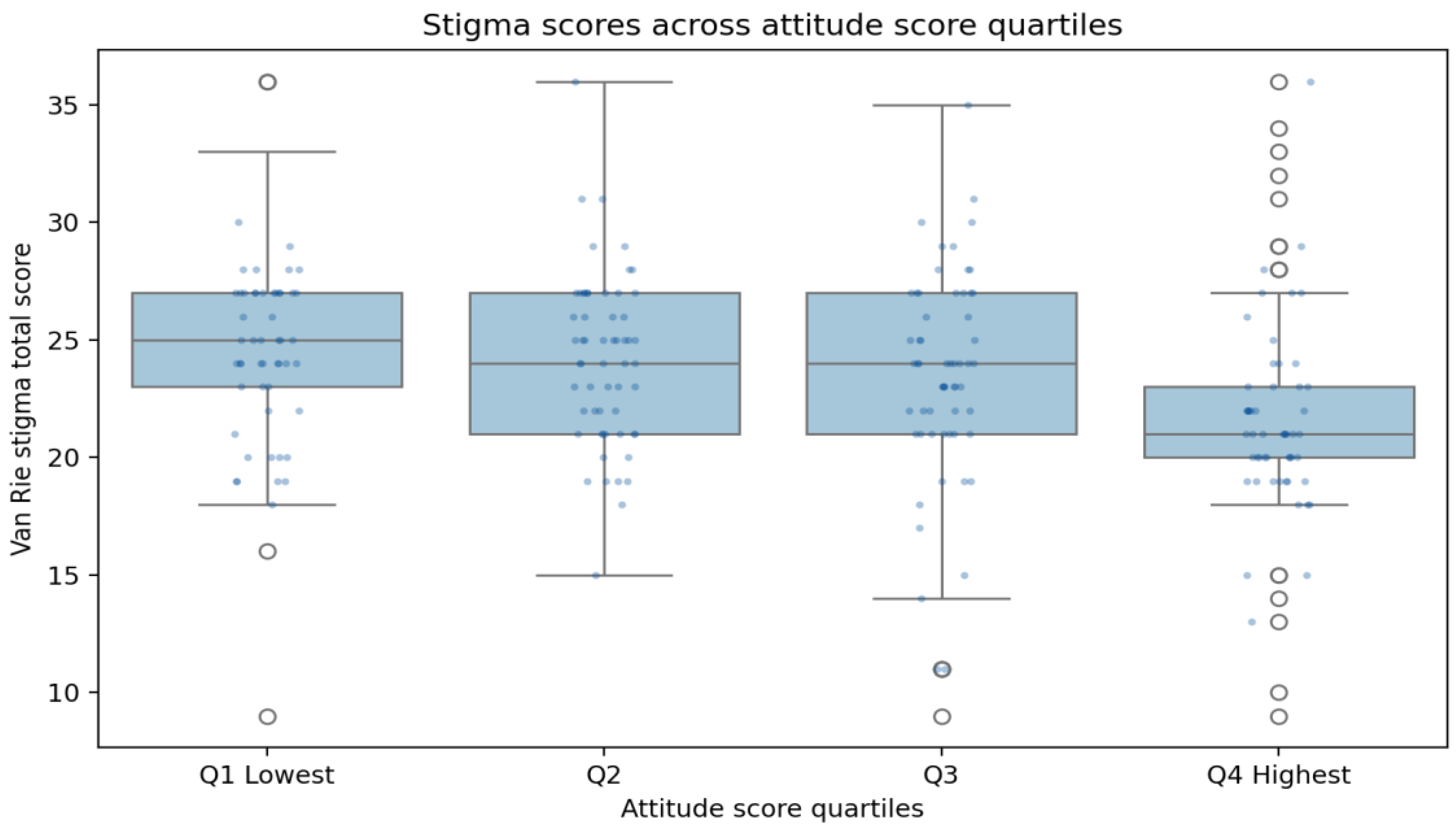
Figure 2.
The distribution of KAP scores across VanRie stigma classification groups.
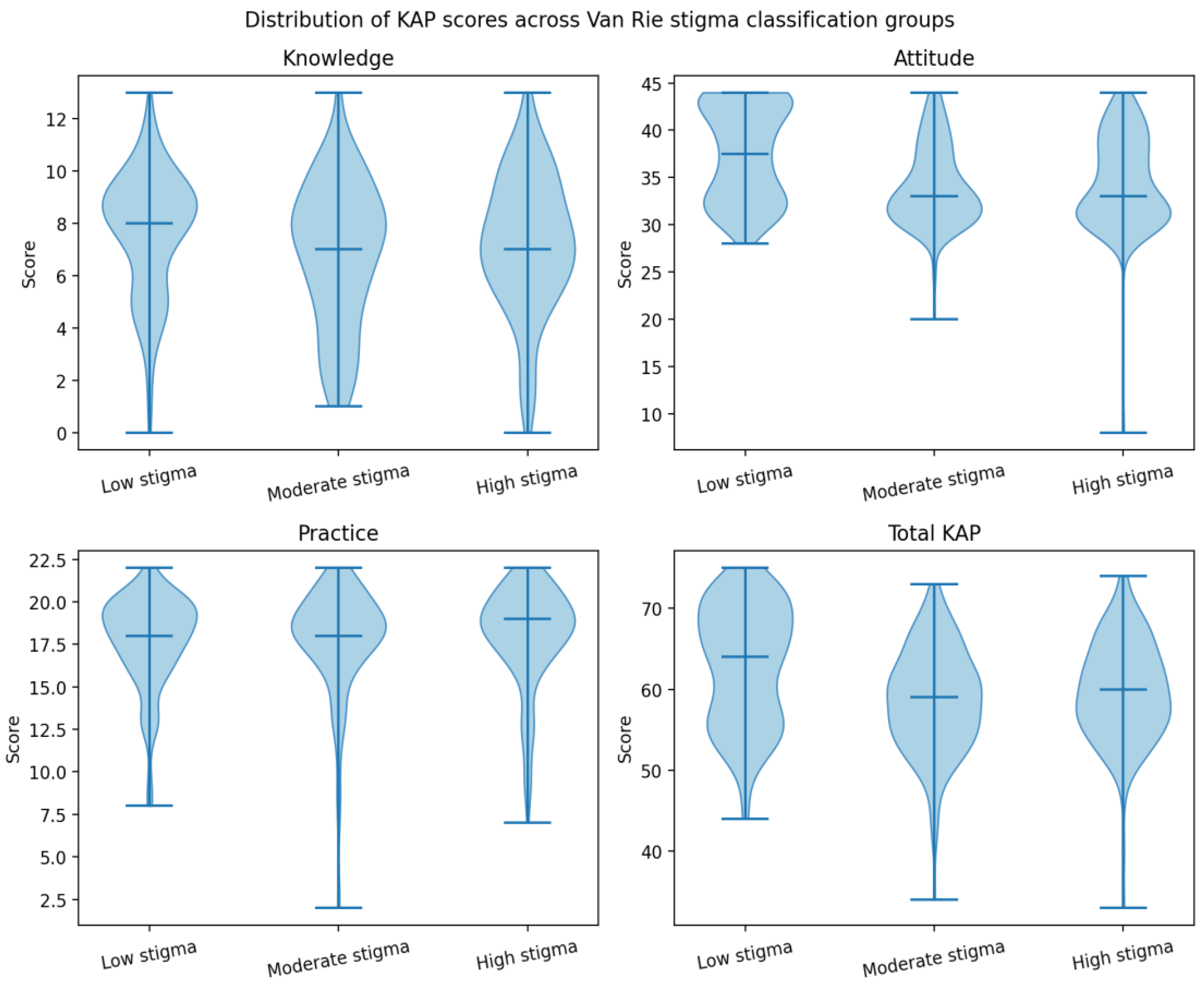

Table 1.
Sociodemographic and treatment-related characteristics of patients with multidrug-resistant tuberculosis in Vietnam (n = 528). Values are presented as mean ± SD or n (%). Percentages were calculated using the total sample size unless otherwise indicated.
Table 1.
Sociodemographic and treatment-related characteristics of patients with multidrug-resistant tuberculosis in Vietnam (n = 528). Values are presented as mean ± SD or n (%). Percentages were calculated using the total sample size unless otherwise indicated.
| Variable | Total (n = 528) |
|---|---|
| Age, years | 42.61 ± 13.62 |
| Sex | |
| Male | 364 (68.94) |
| Female | 164 (31.06) |
| Occupation | |
| Informal/manual work | 256 (48.48) |
| Not currently employed | 117 (22.16) |
| Business/service | 80 (15.15) |
| Other | 75 (14.20) |
| Study site | |
| Ho Chi Minh | 278 (52.65) |
| An Giang | 109 (20.64) |
| Can Tho | 52 (9.85) |
| Ha Noi | 39 (7.39) |
| Thanh Hoa | 24 (4.55) |
| Tien Giang | 20 (3.79) |
| Da Nang | 6 (1.14) |
Table 2.
Bivariate Analysis of KAP Factors and Stigma Score (N=528).
| Variable | Spearman's ρ0. | P-value |
|---|---|---|
| Knowledge total | -0.095 | 0.030 |
| Attitude total | -0.270 | < 0.001 |
| Practice total | 0.081 | 0.065 |
| Total KAP | -0.192 | < 0.001 |
Table 3.
Multiple Linear Regression Factors Associated with Stigma Score.
| Variable | Unstandardized β | 95% Confidence Interval (CI) | P-value |
|---|---|---|---|
| (Constant) | 32.319 | [28.571, 36.068] | < 0.001 |
| Knowledge total | 0.089 | [-0.059, 0.237] | 0.237 |
| Attitude total | -0.229 | [-0.306, -0.153] | < 0.001 |
| Practice total | -0.058 | [-0.187, 0.071] | 0.374 |
| Age | 0.021 | [-0.006, 0.047] | 0.124 |
| Female | -0.139 | [-0.900, 0.622] | 0.720 |
| On treatment | -1.966 | [-2.716, -1.216] | < 0.001 |
Note: Statistical significance is typically considered at $p < 0.05$. Values shown as "0.000" in data have been formatted as "< 0.001".
Disclaimer/Publisher’s Note: The statements, opinions and data contained in all publications are solely those of the individual author(s) and contributor(s) and not of MDPI and/or the editor(s). MDPI and/or the editor(s) disclaim responsibility for any injury to people or property resulting from any ideas, methods, instructions or products referred to in the content. |
© 2026 by the authors. Licensee MDPI, Basel, Switzerland. This article is an open access article distributed under the terms and conditions of the Creative Commons Attribution (CC BY) license (http://creativecommons.org/licenses/by/4.0/).
Copyright: This open access article is published under a Creative Commons CC BY 4.0 license, which permit the free download, distribution, and reuse, provided that the author and preprint are cited in any reuse.


