
Submitted:
14 April 2026
Posted:
15 April 2026
You are already at the latest version
Abstract
(1) Background: Femoroacetabular impingement syndrome (FAIS) is a common cause of hip pain and functional limitation in young and physically active individuals. Although hip arthroscopy is an established treatment when conservative management fails, objective data on early postoperative changes in active hip range of motion (ROM) remain limited. This study aimed to evaluate changes in active hip ROM three months after arthroscopic treatment for FAIS using inertial measurement units (IMUs) and to investigate their relationship with patient-reported outcomes. (2) Methods: A prospective cohort of patients undergoing hip arthroscopy for FAIS was assessed preoperatively and at a three-month follow-up. Active hip ROM—including flexion, internal rotation, external rotation, and total rotation—was measured using IMU sensors, while subjective outcomes were evaluated using the Hip disability and Osteoarthritis Outcome Score (HOOS). (3) Results: Significant improvements were observed across all HOOS subscales at follow-up. Active hip ROM increased significantly in internal rotation, external rotation, and total rotation of the operated hip, whereas changes in hip flexion were minimal and no meaningful changes were observed in the non-operated hip. (4) Conclusions: Hip arthroscopy for FAIS leads to early improvements in both patient-reported outcomes and active hip mobility, particularly in rotational movements, although the relationship between ROM and subjective outcomes appears weak.
Keywords:
femoroacetabular impingement syndrome
; hip arthroscopy
; range of motion
; inertial measurement units
; IMU sensors
; hip biomechanics
; HOOS
1. Introduction
Femoroacetabular impingement syndrome (FAIS) is a leading cause of hip pain and functional limitation in young, active individuals. According to current clinical standards, FAIS is defined as a clinical triad of symptoms—including pain, stiffness, and restricted range of motion (ROM)—associated with structural conflict arising from morphological variations of the proximal femur (CAM) and/or acetabulum (Pincer) [1]. This condition frequently leads to progressive damage at the chondrolabral junction and is recognized as a primary risk factor for the premature development of hip osteoarthritis [2].
In most clinical scenarios, conservative management—comprising activity modification, targeted physical therapy, and intra-articular injections—is the first-line approach. However, if symptoms persist, arthroscopic intervention is the recommended treatment [2]. This procedure typically involves the correction of the impingement morphology (osteoplasty) and the repair or reconstruction of the acetabular labrum and cartilage. A critical, yet often overlooked, aspect of the surgical approach is the capsulotomy, which is necessary for joint distraction and visualization. While the capsule is typically sutured at the end of the procedure, the integrity and healing of the capsulolabral complex significantly influence joint stability and early postoperative biomechanics [3].
The efficacy of hip arthroscopy is traditionally evaluated through a combination of subjective patient-reported outcome measures (PROMs) and objective clinical assessments. PROMs, such as those validated by Kemp et al., provide essential data on the patient’s perception of pain and quality of life [4]. Objectively, successful arthroscopic treatment has been shown to improve strength, functional performance, and range of motion [5,6,7]. A recent meta-analysis highlighted significant improvements in internal rotation and flexion following surgery for FAIS [8].
Despite these findings, a significant gap remains in the literature. Most studies focus exclusively on passive ROM or measurements within the primary “impingement zones” (e.g., flexion and internal rotation). However, emerging evidence suggests that FAIS patients also exhibit movement restrictions in non-impingement directions, indicating a more global dysfunction of the hip joint complex [9,10]. Additionally, there is a paucity of studies directly comparing objective functional outcomes with patient-reported measures following hip arthroscopy [11,12].
Furthermore, traditional goniometric measurements often lack the precision and dynamic capability required to capture subtle changes in active movement during the early recovery phase. Inertial Measurement Units (IMUs) offer a solution to these limitations. Unlike traditional motion analysis or manual goniometry, IMUs provide a portable, high-precision, and objective means of assessing dynamic, active range of motion in a clinical setting. In our previous study, we demonstrated that IMUs are a feasible and reliable tool for evaluating hip kinematics, revealing significant limitations in active flexion and total rotation in symptomatic FAIS patients compared to healthy controls [13].
The present study builds directly upon those findings by examining the same cohort three months after arthroscopic treatment. This early postoperative milestone is critical, as it coincides with the completion of initial tissue healing and the transition to functional loading. The aim of this work was to quantify changes in active ROM using IMU technology and to explore the correlations between these objective biomechanical parameters and subjective functional outcomes as measured by the Polish version of Hip disability and Osteoarthritis Outcome Score (HOOS) questionnaire.
2. Materials and Methods
2.1. Participants
The present study represents a 3-month follow-up analysis of a previously recruited prospective cohort of patients undergoing hip arthroscopy for symptomatic femoroacetabular impingement syndrome.
Initially, 53 patients were enrolled between July 2022 and August 2024. Eligibility for surgery was determined by a single experienced orthopedic surgeon (25 years of practice) based on medical history, clinical examination, and relevant imaging findings. Intraoperative assessment confirmed morphological features consistent with FAIS and identified any concomitant lesions in all cases.
Inclusion criteria were age 18–60 years and referral for hip arthroscopy due to FAIS symptoms refractory to at least 12 weeks of conservative management. Exclusion criteria comprised other musculoskeletal or systemic conditions that could potentially affect the study outcomes.
At the 3-month follow-up, 42 patients completed the full assessment and were included in the final analysis. Eleven patients were excluded from the follow-up analysis: two underwent reoperation before the 3-month evaluation due to adhesions and calcifications, and nine were lost to follow-up (inability to contact or long travel distance)(Figure 1).
The study was approved by the Bioethical Committee of the University of Medical Sciences in Poznań (no. 13/21) and all participants provided written informed consent.
2.2. Surgical Procedure
All hip arthroscopies were performed in a single specialized orthopedic clinic with a focus on sports-related injuries. All procedures were carried out by a single surgeon with over 25 years of overall surgical experience and more than 15 years of specific experience in hip arthroscopy. Patients were positioned supine on the operating table, and the affected hip was placed under traction. While the number and location of portals were tailored to each patient’s specific anatomy and pathology, the standard anterolateral and midanterior portals were utilized in most cases. Intraoperative data collected included the type of intra-articular pathology and the procedures performed. Fluoroscopy was used to guide portal placement and to confirm adequate cam and/or pincer resection. A limited capsulotomy was performed in all cases, followed by routine capsular repair.
2.3. Postoperative Rehabilitation
Postoperative rehabilitation was conducted according to the four-phase protocol described in a previous work [14]. The program was based on functional rather than time-dependent criteria and was individualized according to each patient’s goals, physical capacity, and rate of recovery. During the initial phase (0–2 weeks), the primary objectives were to protect the operated structures, reduce pain and swelling, and prevent adhesions and muscle inhibition. Range of motion was initially restricted to 0° of extension, 30° of abduction, 20° of external rotation, and 90° of flexion. Patients ambulated with two crutches using a foot-flat weight-bearing technique according to the surgeon’s recommendations. In the subsequent phase (approximately 2–6 weeks), rehabilitation focused on gait re-education, gradual restoration of hip mobility, and the introduction of light strengthening exercises. Between 4 and 12 weeks postoperatively, the program emphasized restoring full range of motion, muscle strength, and endurance comparable to the contralateral limb. After 12 weeks, patients progressed to functional and sport-specific training aimed at regaining full performance and safe return to unrestricted activity. All participants were educated about the rehabilitation protocol and its functional progression criteria, even if therapy was conducted outside the clinic, to ensure consistency with the standardized rehabilitation framework.
2.4. Procedure
Participants were assessed at two time points: preoperatively and at the 3-month postoperative follow-up. Demographic data, patient-reported outcomes (HOOS), and active range of motion measured using IMU sensors (RSQ Motion, RSQ Technologies, Poznań, Poland) were collected. Radiological data and intraoperative findings were obtained from the patient database.
Active ROM assessment followed the previously validated protocol, including standing flexion and prone internal/external rotation tests with sensor placement and stabilization as described in [13]. Patient-reported outcomes were evaluated using the HOOS, which assesses symptoms, pain, activities of daily living, sports, and quality of life on a 0–100 scale, with higher scores indicating better outcomes [15].
2.5. Statistical Analysis
Quantitative variables were described using means and standard deviations (SD), while qualitative variables were presented as frequencies (n) and percentages (%). The normality of data distribution was assessed using the Shapiro–Wilk test. To compare changes between the two time points (Preoperation and at 3 months), the Wilcoxon signed-rank test for dependent samples was employed.
To quantify the magnitude of differences for non-parametric data, effect sizes were calculated using Cohen’s r coefficient (r = Z/√N), with values of approximately 0.10–0.29 interpreted as small, 0.30–0.49 as moderate, and ≥ 0.50 as large effects. For parametric comparisons, including active range of motion analysis, Cohen’s d was utilized, with values of approximately 0.20–0.49 considered small, 0.50–0.79 moderate, and ≥0.80 large effects.
Clinical changes in patient outcomes were evaluated using the Minimal Important Change (MIC) for individual HOOS subscales, based on established psychometric thresholds for hip arthroscopy by Kemp et al. [4]. The following thresholds were applied to identify clinical responders: 9 points for Symptoms, Pain, and Quality of Life (QOL); 6 points for ADL; and 10 points for Sport. The proportion of participants achieving the MIC was calculated as the percentage of individuals whose change met or exceeded these thresholds.
Changes in active range of motion between the operated and non-operated limb across the two time points were analyzed using a two-way repeated-measures analysis of variance (2×2 ANOVA). In cases of significant interactions, Tukey’s HSD post hoc test was performed. The relationship between selected parameters was examined using the non-parametric Spearman’s rank correlation coefficient. All statistical analyses were performed using Statistica software (StatSoft, Tulsa, OK, USA). The level of statistical significance was set at p ≤ 0.05.
3. Results
3.1. General Characteristics of Participants
The study included 42 patients who underwent hip arthroscopy for FAIS. The baseline demographic and clinical characteristics of the participants are presented in Table 1.
3.2. Hip Disability and Osteoarthritis Outcome Score (HOOS)
Significant improvements were observed in the HOOS Total score and all HOOS subscales at the 3-month follow-up compared with baseline (Table 2). The HOOS Total score increased by a mean of 25.7 points (p < 0.001; large effect size).
Based on the MIC thresholds, the following clinical improvements were observed: 31 (74%) participants reached the MIC for HOOS Symptoms (mean increase 22.1 points; p < 0.001), and 34 (81%) patients achieved the MIC for HOOS Pain (mean increase 26.5 points; p < 0.001). Regarding HOOS ADL, a mean increase of 25.7 points was recorded (p<0.001), with 34 (81%) participants reaching the MIC. The HOOS Sport subscale showed the largest mean increase of 33.5 points (p<0.001; large effect size), with 35 (83%) participants achieving the MIC. Finally, HOOS QOL improved by an average of 25.6 points (p < 0.001), and 28 (67%) participants met the MIC.
3.3. Active Range of Motion
As shown in Table 3, significant time × side interactions were observed for hip external rotation, internal rotation, and total rotation, indicating side-specific improvements in the operated hip over the 3-month follow-up. No significant interaction effect was found for hip flexion.
The rotational parameters of the operated hip demonstrated robust clinical improvements characterized by substantial effect sizes. External rotation increased with a moderate-to-large effect size (Cohen’s d ≈ 0.7), while internal rotation demonstrated a large effect size (d ≈ 1.2), reflecting substantial restoration of transverse-plane mobility. Total hip rotation showed the most pronounced change, accompanied by a very large effect size (d ≈ 1.5).
In contrast, changes in hip flexion were associated with a negligible effect size and thus were not considered clinically meaningful. No meaningful changes were observed in the non-operated hip for any ROM parameter.
Side-to-side differences in hip range of motion at baseline and at the 3-month follow-up are illustrated in Figure 2. Before surgery, the operated hip demonstrated lower rotational range of motion compared with the contralateral side. At the 3-month follow-up, a clear improvement was observed in the operated hip, particularly for external rotation, internal rotation, and total rotation, while the non-operated hip remained largely unchanged. Despite this improvement, measurable differences between the operated and non-operated hips persisted at the 3-month follow-up. In contrast, only minimal changes were observed in hip flexion over time.
3.4. Associations Between Hip Range of Motion and HOOS Scores
Spearman rank correlation analysis demonstrated weak and inconsistent associations between hip active range of motion and HOOS subscales at both time points, with correlation coefficients ranging from r = − 0.34 to r = 0.31, and no consistent pattern observed. Notably, the highest observed correlation (external rotation vs. HOOS Total at 3 months, r = 0.31, p = 0.044) did not remain significant after correction for multiple comparisons.
In contrast, moderate correlations were identified at 3 months between the alpha angle measured in the anteroposterior projection and selected HOOS subscales, specifically Activities of Daily Living (ADL) (r = 0.41), Sport/Recreation (r = 0.38), Symptoms (r = 0.33), and Quality of Life (r = 0.32). No comparable associations were observed at baseline. After adjustment for multiple comparisons, only the association with the ADL subscale remained statistically significant.
4. Discussion
FAIS is a complex clinical entity characterized by chronic pain and restricted hip mobility due to structural impingement. For persistent symptoms, arthroscopic intervention is the preferred treatment, aimed at repairing intra-articular lesions and restoring physiological kinematics through morphological correction. This study aimed to determine if the intervention improves active ROM in non-impingement directions and to assess the correlation between these objective biomechanical changes and PROM.
Our study demonstrated clinically and statistically significant improvements across all HOOS subscales, accompanied by a substantial increase in active hip ROM — specifically internal rotation, external rotation, and total rotation—at the three-month follow-up. Interestingly, only weak correlations were observed between these objective mobility measures and patient-reported outcomes. This finding suggests that perceived functional recovery in daily life may not be determined solely by the magnitude of restored joint mobility, highlighting the multifactorial nature of postoperative recovery.
PROMs are the primary benchmarks for evaluating the short- and long-term efficacy of hip arthroscopy. The existing literature reflects a variety of outcome measures utilized across different follow-up periods[16,17]. Both Ramisetty et al. and Kemp et al. recommend a range of validated tools for assessing outcomes after hip arthroscopy, including the HOOS, which was the primary measure adopted in this study[4,18]. HOOS was selected due to its formal validation and cultural adaptation into the Polish language[15]. Our findings at the 3-month follow-up align with results reported by other authors, further supporting the early clinical benefits of arthroscopic intervention in this patient population[19,20]. Flores et al. also utilized the HOOS questionnaire and demonstrated that the most significant improvement occurred within the first 3 months postoperatively. In terms of mean scores, our patients achieved higher improvements across all HOOS subscales compared to the data reported in the aforementioned study at the 3-month follow-up; this was particularly evident in the Pain (+26.5 vs. +19.8 points) and Sport (+33.5 vs. +21.2 points) domains. These differences could be attributed to variations in baseline characteristics, surgical techniques, or rehabilitation protocols, which may further limit direct comparability between cohorts.
The results regarding active ROM are consistent with a recent meta-analysis demonstrating postoperative improvements, particularly in rotational movements [8]. However, direct comparisons with existing literature are challenging, as our study is among the first to specifically assess active range of motion. Moreover, methodological heterogeneity across studies—including differences in testing positions, follow-up duration, and measurement tools—further limits comparability. The study by Freke et al. remains the most comparable to our research, as both investigated post-hip arthroscopy patients using prone positions and inclinometry—a method similar to IMU-based measurements[9]. Notably, similar to our study, the follow-up assessment of range of motion was conducted at 3 months postoperatively. While both studies observed ROM improvements, our findings demonstrated a substantially greater increase in internal rotation (mean 6.7° vs. 1.4° in Freke et al.), reaching both statistical and clinical significance. This discrepancy may be attributed to the higher prevalence of cartilage damage in the cohort studied by Freke et al., a factor previously associated with restricted internal rotation in extension [21]. Choi et al. also demonstrated a significant improvement in internal rotation (mean 10.1° vs. 6.7° in our study)[22]. The primary difference lay in the measurement methodology; the authors used a goniometer and assessed internal rotation at 90° of hip flexion. Therefore, the observed improvement may be more closely related to the surgical correction of the bony impingement.
Despite a significant improvement in active ROM, deficits on the operated side relative to the contralateral limb persisted at the 3-month post-arthroscopy follow-up. However, these findings were comparable to those reported by other authors. For instance, in a study by Burlen et al., where rotation was assessed in the prone position 2.5 months after surgery, the side-to-side deficit relative to the contralateral side was 13% for internal rotation and 11.6% for external rotation (compared to 9.9% and 5.3%, respectively, in the present study)[23]. Notably, Tijsen et al. demonstrated that more than two years after hip arthroscopy, deficits of 10.7% for internal rotation (vs. 9.9% in our study), 7% for external rotation (vs. 5.3% in our study), and 3.3% for flexion persist, which corresponds with our finding of a 2.8% flexion deficit at only 3 months[24]. These findings suggest that residual interlimb asymmetries may persist despite early postoperative improvements and should be considered when evaluating recovery trajectories following hip arthroscopy.
Interestingly, in our study we demonstrated that improvements in active ROM occurred in movement directions that were not previously restricted by structural abnormalities such as CAM or pincer morphology. The most plausible explanation is a reduction in pain; however, the contribution of structural and mechanical changes at the level of the joint capsule, repaired labrum, and musculotendinous tissues cannot be excluded, particularly as these structures were subjected to stretching during postoperative rehabilitation[25,26].This relationship may be bidirectional: while some motion gains may be driven by symptom resolution, persistent deficits relative to the contralateral side may reflect adhesions or ongoing healing processes within the aforementioned structures[26].
The results of the present study demonstrated predominantly weak associations between subjective outcomes and objective clinical measures. Only a limited number of studies in the literature have investigated these relationships in patients treated with hip arthroscopy, although most report findings similar to ours [11,12]. In a study by Kemp et al., conducted in patients 12–24 months after hip arthroscopy, the authors examined the associations between PROMs and hip range of motion. Similar to our findings, rotational range of motion did not show meaningful correlations with patient-reported outcomes. However, in contrast to our results, a greater hip flexion range of motion demonstrated moderate correlations with the HOOS-QOL and International Hip Outcome Tool-33 scores. One possible explanation for this discrepancy may be the methodological differences between the studies, including the passive assessment of ROM and the substantially longer follow-up period compared with the present study. A similar pattern, although observed in a cohort of patients with FAIS, has been reported in previous studies [27,28]. Gomes et al. demonstrated that an active hip flexion ROM exceeding 107° — rather than rotational range of motion — was associated with a lower risk of severe symptoms. In another study, the authors reported a comparable relationship and, similarly to our findings, found no association with rotational range of motion assessed in the prone position. Direct comparison of our results regarding hip flexion is challenging due to the unique assessment protocol used in the present study. The standing active hip flexion test requires not only sufficient joint range of motion but also adequate strength of the hip flexor muscles and appropriate pelvic mobility, which may still be impaired three months after surgery [9,29].
Several limitations of this study should be acknowledged. First, the follow-up period was limited to three months, representing an early stage of postoperative recovery after hip arthroscopy. Although several studies have shown that the most substantial clinical improvement occurs within the first three months after surgery, further functional gains may continue for up to two years postoperatively[20]. Therefore, the relationships between objective measures and patient-reported outcomes observed in the present study may evolve over a longer follow-up period. Second, the relatively small sample size may have limited the statistical power of the correlation analyses, particularly when examining subtle associations between objective and subjective measures. Third, the study did not include a control group, which restricts the ability to determine the extent to which the observed improvements were attributable solely to the surgical intervention rather than postoperative rehabilitation or natural recovery processes. Finally, the range of motion was assessed using active measurements. This approach may limit direct comparison with much of the existing literature, which predominantly relies on passive range of motion. However, active testing may better reflect functional capacity in daily activities. It requires not only joint mobility, but also adequate muscle activation and neuromuscular control.
5. Conclusions
Hip arthroscopy for FAIS resulted in significant improvements in patient-reported outcomes and active hip range of motion at three months postoperatively. The greatest gains were observed in rotational movements, including positions not directly constrained by osseous impingement, suggesting that postoperative improvements may extend beyond the mechanical correction of the bone morphology. Despite these improvements, measurable side-to-side differences between the operated and contralateral hips persisted at the three-month follow-up. Furthermore, only weak associations were observed between objective mobility measures and patient-reported outcomes, indicating that patient-perceived recovery is likely influenced by multiple factors beyond joint mobility alone. These findings highlight the value of assessing active hip motion using objective measurement tools when evaluating early functional recovery after hip arthroscopy.
Author Contributions
Conceptualization, Ł.S, G.K and T.P; methodology, Ł.S, G.K and T.P.; validation, Ł.S, and T.P.; formal analysis, Ł.S.; investigation, Ł.S.; resources, Ł.S,T.P.; data curation, L.S.; writing—original draft preparation, Ł.S.; writing—review and editing, Ł.S, G.K and T.P.; visualization, Ł.S.; supervision, G.K and T.P,; project administration, T.P,.; funding acquisition, T.P. All authors have read and agreed to the published version of the manuscript.
Funding
This research received no external funding.
Institutional Review Board Statement
The study was approved by the bioethical Comitee of the University of Medical Sciences in Poznań, Poland(nr of resolution 13/21) and met the criteria of the Declaration of Helsinki.
Informed Consent Statement
Informed consent was obtained from all subjects involved in the study.
Acknowledgments
Mr Łukasz Stołowski is a participant of STER Internationalisation of Doctoral Schools Programme from NAWA Polish National Agency for Academic Exchange No. PPI/STE/2020/1/00014/DEC/02. During the preparation of this manuscript, the authors used Grammarly, ChatGPT, and Google Gemini for language editing and grammar support. The authors reviewed and edited the outputs and take full responsibility for the final content of the manuscript.
Conflicts of Interest
The authors declare no conflict of interest.
References
- Griffin, D.R.; Dickenson, E.J.; O’Donnell, J.; Agricola, R.; Awan, T.; Beck, M.; Clohisy, J.C.; Dijkstra, H.P.; Falvey, E.; Gimpel, M.; et al. The Warwick Agreement on femoroacetabular impingement syndrome (FAI syndrome): An international consensus statement. Br. J. Sports Med. 2016, 50, 1169–1176. [CrossRef]
- Harris, J.D.; Erickson, B.J.; Bush-Joseph, C.A.; Nho, S.J. Treatment of femoroacetabular impingement: A systematic review. Curr. Rev. Musculoskelet. Med. 2013, 6, 207–218. [CrossRef]
- Dasari, S.P.; Kasson, L.B.; Condon, J.J.; Mameri, E.S.; Kerzner, B.; Khan, Z.A.; Jackson, G.R.; Gursoy, S.; Sivasundaram, L.; Hevesi, M.; et al. Systematic review and meta-analysis of studies comparing complete capsular closure against unrepaired hip capsules during hip arthroscopy. Orthop. J. Sports Med. 2023, 11, 23259671231197435. [CrossRef]
- Kemp, J.L.; Collins, N.J.; Roos, E.M.; Crossley, K.M. Psychometric properties of patient-reported outcome measures for hip arthroscopic surgery. Am. J. Sports Med. 2013, 41, 2065–2073. [CrossRef]
- Burnel, J.; Chamu, T.; Bonin, N.; Van Cant, J.; Pairot De Fontenay, B. Strength, mobility, and functional outcomes 2.5 months after hip arthroscopy for femoroacetabular impingement syndrome: A cross-sectional study. Phys. Ther. Sport 2025, 71, 43–52. [CrossRef]
- Garcia-Lopez, E.; Halvorson, R.T.; Foley, A.J.; Zhang, A.L.; Wong, S.E. Restoration of hip kinematics after arthroscopy for femoroacetabular impingement syndrome: A 1-year evaluation of gait and stair performance. Orthop. J. Sports Med. 2025, 13, 23259671251339777. [CrossRef]
- Casartelli, N.C.; Maffiuletti, N.A.; Item-Glatthorn, J.F.; Impellizzeri, F.M.; Leunig, M. Hip muscle strength recovery after hip arthroscopy in a series of patients with symptomatic femoroacetabular impingement. Hip Int.2014, 24, 387–393. [CrossRef]
- Filan, D.; Mullins, K.; Carton, P. Hip range of motion is increased after hip arthroscopy for femoroacetabular impingement: A systematic review. Arthrosc. Sports Med. Rehabil. 2022, 4, e797–e822. [CrossRef]
- Freke, M.D.; Crossley, K.; Sims, K.; Russell, T.; Weinrauch, P.; Gamboa, G.; Semciw, A. Acute and subacute changes in hip strength and range of movement after arthroscopy to address chondrolabral pathology. Am. J. Sports Med. 2019, 47, 1939–1948. [CrossRef]
- Pålsson, A.; Kostogiannis, I.; Ageberg, E. Combining results from hip impingement and range of motion tests can increase diagnostic accuracy in patients with FAI syndrome. Knee Surg. Sports Traumatol. Arthrosc. 2020, 28, 3382–3392. [CrossRef]
- Kannan, A.S.; Hartwell, M.J.; Grace, T.; Hammond, E.; Soriano, K.K.J.; Souza, R.B.; Zhang, A.L. Correlating biomechanical gait analysis with patient-reported outcomes after hip arthroscopy for femoroacetabular impingement syndrome. Orthop. J. Sports Med. 2022, 10, 23259671221121352. [CrossRef]
- Kemp, J.L.; Makdissi, M.; Schache, A.G.; Finch, C.F.; Pritchard, M.G.; Crossley, K.M. Is quality of life following hip arthroscopy in patients with chondrolabral pathology associated with impairments in hip strength or range of motion? Knee Surg. Sports Traumatol. Arthrosc. 2016, 24, 3955–3961. [CrossRef]
- Stołowski, Ł.; Kerkhoffs, G.; Piontek, T. Hip active range of motion in patients with femoroacetabular impingement syndrome. Sensors 2025, 25, 1219. [CrossRef]
- Stołowski, Ł.; Bąkowski, P.; Kiedrowski, B.; Kaszyński, J.; Kerkhoffs, G.; Piontek, T. Rehabilitation protocol after hip arthroscopy. Issue Rehabil. Orthop. Neurophysiol. Sport Promot. 2021, 36, 49–65. [CrossRef]
- Gojło, M.K.; Paradowski, P.T. Polish adaptation and validation of the hip disability and osteoarthritis outcome score (HOOS) in osteoarthritis patients undergoing total hip replacement. Health Qual. Life Outcomes 2020, 18, 135. [CrossRef]
- Polascik, B.A.; Peck, J.; Cepeda, N.; Lyman, S.; Ling, D. Reporting clinical significance in hip arthroscopy: Where are we now? HSS J. 2020, 16, 527–533. [CrossRef]
- Minkara, A.A.; Westermann, R.W.; Rosneck, J.; Lynch, T.S. Systematic review and meta-analysis of outcomes after hip arthroscopy in femoroacetabular impingement. Am. J. Sports Med. 2019, 47, 488–500. [CrossRef]
- Ramisetty, N.; Kwon, Y.; Mohtadi, N. Patient-reported outcome measures for hip preservation surgery—A systematic review of the literature. J. Hip Preserv. Surg. 2015, 2, 15–27. [CrossRef]
- Thorborg, K.; Kraemer, O.; Madsen, A.D.; Hölmich, P. Patient-reported outcomes within the first year after hip arthroscopy and rehabilitation for femoroacetabular impingement and/or labral injury: The difference between getting better and getting back to normal. Am. J. Sports Med. 2018, 46*, 2607–2614. [CrossRef]
- Flores, S.E.; Sheridan, J.R.; Borak, K.R.; Zhang, A.L. When do patients improve after hip arthroscopy for femoroacetabular impingement? A prospective cohort analysis. Am. J. Sports Med. 2018, 46, 3111–3118. [CrossRef]
- Birrell, F.; Croft, P.; Cooper, C.; Hosie, G.; Macfarlane, G.; Silman, A. Predicting radiographic hip osteoarthritis from range of movement. Rheumatology 2001, 40, 506–512. [CrossRef]
- Choi, S.M.; Park, M.S.; Ju, B.C.; Yoon, S.J. Alterations in range of motion and clinical outcomes after femoroplasty in Asians. J. Am. Acad. Orthop. Surg. 2018, 26, e181–e190. [CrossRef]
- Burnel, J.; Chamu, T.; Bonin, N.; Van Cant, J.; Pairot De Fontenay, B. Strength, mobility, and functional outcomes 2.5 months after hip arthroscopy for femoroacetabular impingement syndrome: A cross-sectional study. Phys. Ther. Sport 2025, 71, 43–52. [CrossRef]
- Tijssen, M.; van Cingel, R.; de Visser, E.; Nijhuis-van der Sanden, M. A clinical observational study on patient-reported outcomes, hip functional performance and return to sports activities in hip arthroscopy patients. Phys. Ther. Sport 2016, 20, 45–55. [CrossRef]
- Naili, J.E.; Stålman, A.; Valentin, A.; Skorpil, M.; Weidenhielm, L. Hip joint range of motion is restricted by pain rather than mechanical impingement in individuals with femoroacetabular impingement syndrome. Arch. Orthop. Trauma. Surg. 2022, 142, 1985–1994. [CrossRef]
- Nguyen, K.H.; Shaw, C.; Link, T.M.; Majumdar, S.; Souza, R.B.; Vail, T.P.; Zhang, A.L. Changes in hip capsule morphology after arthroscopic treatment for femoroacetabular impingement syndrome with periportal capsulotomy are correlated with improvements in patient-reported outcomes. Arthroscopy 2022, 38, 394–403. [CrossRef]
- Gomes, D.A.; Heerey, J.; Scholes, M.; Mosler, A.; Jones, D.; Coburn, S.; Johnston, R.; Agricola, R.; et al. More is not always better—Association between hip range of motion and symptom severity in patients with femoroacetabular impingement syndrome: A cross-sectional study. Braz. J. Phys. Ther. 2025, 29, 101189. [CrossRef]
- Freke, M.; Kemp, J.; Crossley, K.; Sims, K.; Russell, T.; Semciw, A. Strength and range of movement deficits are associated with symptom severity in people scheduled for hip arthroscopy. Eur. J. Pain 2019, 23, 1083–1090. [CrossRef]
- Stambaugh, J.; Morrissey, P.; Hurvitz, A.; Bernstein, E.; Barlow, B. Hip-spine relationship in femoroacetabular impingement: Does hip arthroscopy affect pelvic mobility? Clin. Orthop. Relat. Res. 2025, 483, 846–852. [CrossRef]
Figure 1.
Flow diagram of patient inclusion and 3-month follow-up.
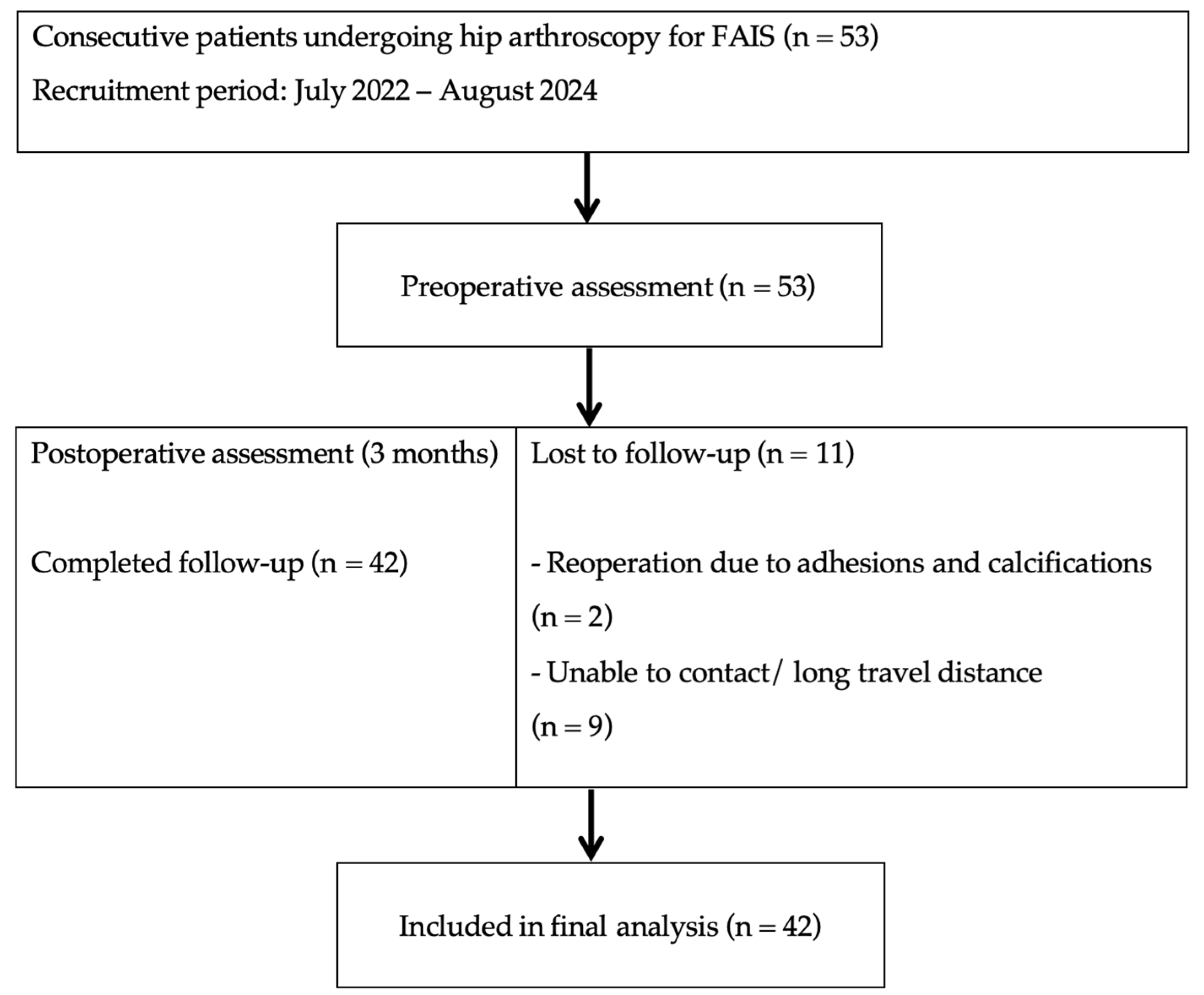
Figure 2.
Changes in hip range of motion between baseline and the 3-month follow-up in the operated and non-operated hips. (A) External rotation, (B) flexion, (C) internal rotation, and (D) total rotation.
Figure 2.
Changes in hip range of motion between baseline and the 3-month follow-up in the operated and non-operated hips. (A) External rotation, (B) flexion, (C) internal rotation, and (D) total rotation.
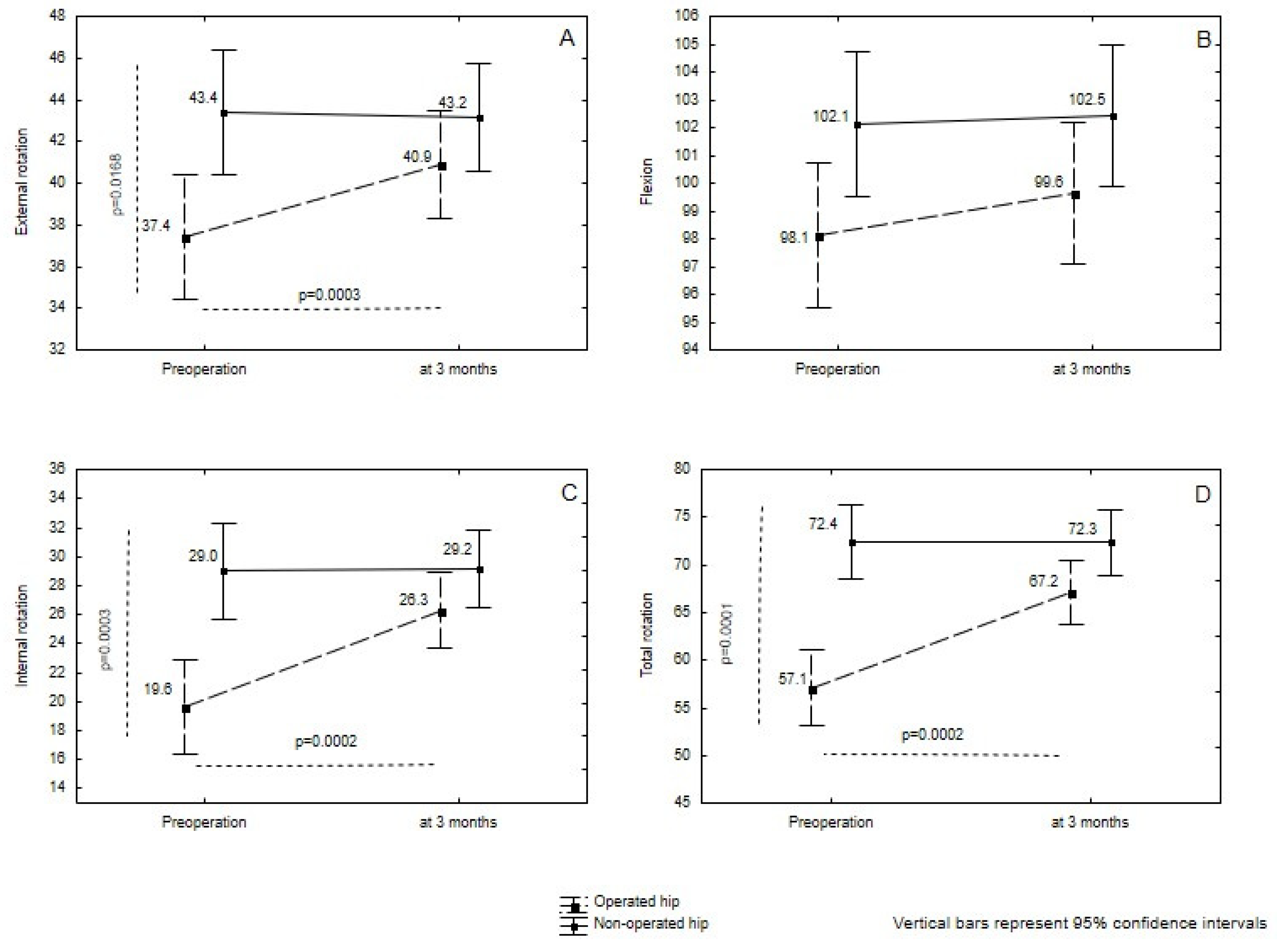

Table 1.
General characteristics of participants.
| Variable | Study group (n=42) |
| Sex/men (%, n) | 64.3 (27) |
| mean± SD | |
| Age (years) | 36.0 ± 9.2 |
| Weight (kg) | 74.1 ± 13.5 |
| Height (cm) | 176.0 ± 8.0 |
| BMI (kg/m2) | 23.7 ± 3.2 |
| LCEA (°) | 35.4 ± 5.0 |
| AA AP (°) | 67.4 ± 13.3 |
| AA Dunn (°) | 61.1 ± 10.9 |
| Concomitant procedure(%, n) | |
| Labrum repair | 54.8 (23) |
| Labrum reconstruction | 7.1 (3) |
| Labrum resection | 21.4 (9) |
| Microfracture | 23.8 (10) |
Abbreviations: BMI=Body mass index; LCEA= Lateral Center Edge Angle; AA AP= Alpha Angle Anterior Posterior View; AA Dunn= Alpha angle Dunn view.
Table 2.
Changes in HOOS scores between baseline and 3-month follow-up.
| Variable | Preoperation | at 3 months | p - value | Cohen’s r |
| mean ± SD | ||||
| HOOS Total | 57.3 ± 15.3 | 83.0 ± 11.3 | <0.0001 | 0.85 |
| HOOS Symptoms | 55.2 ± 19.1 | 77.3 ± 15.9 | <0.0001 | 0.68 |
| HOOS Pain | 59.4 ± 16.4 | 85.9 ± 11.0 | <0.0001 | 0.86 |
| HOOS ADL | 65.3 ± 17.8 | 91.0 ± 9.2 | <0.0001 | 0.83 |
| HOOS Sport | 43.6 ± 21.6 | 77.1 ± 16.9 | <0.0001 | 0.80 |
| HOOS QOL | 31.7 ± 14.1 | 57.3 ± 21.9 | <0.0001 | 0.76 |
Abbreviations: HOOS, Hip disability and Osteoarthritis Outcome Score; ADL, activities of daily living; QOL, quality of life; SD, standard deviation; r, effect size expressed as Cohen’s r.
Table 3.
Changes in hip range of motion (ROM) between baseline and 3-month follow-up for operated and non-operated hips.
Table 3.
Changes in hip range of motion (ROM) between baseline and 3-month follow-up for operated and non-operated hips.
|
ROM(°) |
Hip | Preoperation |
at 3 months |
F | p - value (interaction) |
| mean ± SD | |||||
| Flexion |
Operated | 98.1 ± 8.7 | 99.6 ± 8.6 | 1.90 | 0.1720 |
| Non-operated | 102.1 ± 8.3 | 102.5 ± 8.0 | |||
| External rotation | Operated | 37.4 ± 10.2 | 40.9 ± 8.3 | 11.55 | 0.0010 |
| Non-operated | 43.4 ± 9.1 | 43.2 ± 8.6 | |||
| Internal rotation |
Operated | 19.6 ± 11.9 | 26.3 ± 8.7 | 36.10 | <0.0001 |
| Non-operated | 29.0 ± 9.3 | 29.2 ± 8.5 | |||
| Total rotation | Operated | 57.1 ± 14.5 | 67.2 ± 11.6 | 60.09 | <0.0001 |
| Non-operated | 72.4 ± 11.1 | 72.3 ± 10.3 | |||
Note. Values are presented as mean ± SD. ROM, range of motion; SD, standard deviation; F, F-statistic (analysis of variance); p, probability value. F and p - values represent the interaction effect (time × side) from a two-way repeated-measures ANOVA (2 × 2 design).
Disclaimer/Publisher’s Note: The statements, opinions and data contained in all publications are solely those of the individual author(s) and contributor(s) and not of MDPI and/or the editor(s). MDPI and/or the editor(s) disclaim responsibility for any injury to people or property resulting from any ideas, methods, instructions or products referred to in the content. |
© 2026 by the authors. Licensee MDPI, Basel, Switzerland. This article is an open access article distributed under the terms and conditions of the Creative Commons Attribution (CC BY) license (http://creativecommons.org/licenses/by/4.0/).
Copyright: This open access article is published under a Creative Commons CC BY 4.0 license, which permit the free download, distribution, and reuse, provided that the author and preprint are cited in any reuse.


