

Submitted:
06 June 2026
Posted:
08 June 2026
You are already at the latest version
Abstract
This study presents a comprehensive qualitative synthesis and critical analysis of how foundational mass communication theories have been transformed across the digital media age, spanning the period from 2000 to 2025. Drawing on a systematic integrative review of 23 scholarly manuscripts that collectively engage more than 600 peer-reviewed sources, the investigation examines how ten canonical theories—Agenda Setting, Cultivation, Framing, the Two-Step Flow of Communication, the Spiral of Silence, Uses and Gratifications, Media Dependency, Gatekeeping, Diffusion of Innovation, and Technological Determinism—have evolved, converged, and been reconceptualized in response to the affordances and constraints of digital platforms, algorithmic mediation, and networked communication environments. Employing reflexive thematic analysis grounded in a critical-realist epistemology, the study identifies five overarching meta-themes: (a) the emergence of algorithmic agency as a structural force reshaping every theoretical paradigm; (b) the dialectical tension between expanded user agency and platform-imposed constraint; (c) the increasing platform specificity of communication effects; (d) the convergence and theoretical integration of formerly discrete paradigms; and (e) persistent global inequities in digital communication power structures. The findings indicate that although the core premises of classical theories retain explanatory value, their operative mechanisms, boundary conditions, and societal implications have undergone fundamental transformation. To capture this transformation, the study advances an integrative framework—the Algorithmic Communication Ecology Model (ACEM) that synthesizes insights across all ten theories to account for the recursive, multidirectional, and structurally mediated character of contemporary communication. Significant research gaps are identified, including the scarcity of longitudinal and cross-cultural scholarship, the limited investigation of emergent technologies such as generative artificial intelligence and immersive virtual environments, and the need for methodological innovation that couples computational scales with interpretive depth. The manuscript contributes to communication scholarship by offering a unified analytical lens for understanding how digital transformation has simultaneously preserved, disrupted, and reconstituted the theoretical foundations of the field.
Keywords:
mass communication theory
; digital media
; algorithmic mediation
; qualitative synthesis
; theoretical convergence
; agenda setting
; cultivation
; framing
; uses and gratifications
; media dependency
; gatekeeping
; spiral of silence
; two-step flow
; diffusion of innovation
; technological determinism
; and platform communication
1. Introduction
The landscape of mass communication has been remade since the turn of the twenty-first century. The proliferation of digital platforms, the ubiquity of mobile connectivity, the rise of algorithmic content curation, and the dissolution of the once-firm boundary between media producers and consumers have collectively unsettled the institutional architecture on which the discipline’s classical theories were built (Castells, 2010; Jenkins, 2006). Frameworks formulated during the era of broadcast television and print journalism—when a small number of institutional gatekeepers governed the flow of information to comparatively passive mass audiences—now confront an ecosystem defined by decentralization, interactivity, personalization, and an unprecedented velocity of information diffusion (Chadwick, 2017).
The scholarly imperative to reassess these foundational frameworks is far from merely academic; it bears directly on how scholars understand democratic discourse, the formation of public opinion, cultural production, and the distribution of communicative power. As Couldry and Hepp (2017) argue, the process of “deep mediatization” has rendered media technologies inseparable from the fabric of social life, demanding theoretical apparatus capable of accounting for the recursive, multilayered, and algorithmically mediated nature of contemporary communication. The pressing question, then, is not whether classical theories remain relevant, but how their core insights must be reconceptualized, extended, and integrated to explain communication phenomena in the digital age.
This study responds to that imperative by undertaking a comprehensive qualitative synthesis of the evolution, adaptation, and reconceptualization of ten foundational mass communication theories across the period 2000–2025. The theories examined—Agenda Setting, Cultivation, Framing, the Two-Step Flow of Communication, the Spiral of Silence, Uses and Gratifications, Media Dependency, Gatekeeping, Diffusion of Innovation, and Technological Determinism—together constitute the intellectual architecture of the communication discipline. Each has generated an extensive empirical literature, shaped media policy and practice, and informed scholarly understanding of how mediated messages influence individuals, communities, and societies.
What distinguishes the present investigation from prior reviews is its integrative scope and synthesizing ambition. Rather than treating each theory in isolation, the study identifies the cross-cutting themes, convergent trajectories, and emergent theoretical possibilities that surface only when these paradigms are analyzed collectively within the context of digital transformation. The analysis draws on 23 scholarly manuscripts comprising more than 600 peer-reviewed sources—among the most comprehensive syntheses of communication-theory adaptation assembled to date.
1.1. Research Questions
Four interrelated research questions structure the inquiry. First, how have the core premises, mechanisms, and boundary conditions of foundational mass communication theories evolved in response to the affordances and constraints of digital media environments between 2000 and 2025? Second, what cross-cutting themes and convergent trajectories emerge when these paradigms are examined collectively rather than in isolation? Third, what significant research gaps persist in the scholarly literature on the adaptation of communication theory to digital contexts? Fourth, what integrative theoretical framework can account for the recursive, multidirectional, and structurally mediated character of contemporary communication across the full spectrum of foundational theories?
1.2. Significance of the Study
The significance of this investigation lies in its capacity to provide a unified analytical lens through which the otherwise fragmented landscape of communication-theory adaptation can be comprehended. As the discipline has grown increasingly specialized—with scholars often working within discrete theoretical traditions in relative isolation from one another—the need for integrative scholarship that identifies common patterns, shared challenges, and complementary insights has become acute (Craig, 1999; Vorderer & Klimmt, 2021). The study meets that need by demonstrating that the digital transformation of communication is not a series of isolated theoretical adjustments but a systemic reconstitution of the discipline’s foundational assumptions about media power, audience agency, information flow, and communicative effects.
The study further contributes to ongoing debates about the role of algorithms as communicative agents, the implications of platform capitalism for democratic discourse, and the adequacy of Western-centric theoretical frameworks for explaining communication dynamics in diverse global contexts. By proposing the Algorithmic Communication Ecology Model as an integrative framework, it offers a conceptual architecture capable of guiding future empirical research, informing media policy, and advancing pedagogical approaches to communication theory in an era of accelerating technological change.
2. Literature Review
This review synthesizes scholarship on the adaptation and reconceptualization of ten foundational communication theories within digital media environments. It is organized thematically, grouping theories by their primary analytical focus: media effects and perception theories, information flow and influence theories, audience-centered theories, and structural and systemic theories. Within each cluster, the review traces theoretical evolution, weighs the empirical evidence, and identifies persistent gaps.
2.1. Media Effects and Perception Theories
This section examines three foundational traditions that theorize how mediated communication shapes audience perception, cognition, and worldview: Agenda Setting, Cultivation, and Framing. Although developed in the mass-media era to account for the influence of centralized broadcast and print institutions, each tradition has been reopened by digital transition. Algorithmic curation, platformed participation, and audience fragmentation have not displaced the core insight that media exposure conditions how publics see the world; rather, they have redistributed the agents and mechanisms through which that conditioning occurs. The sub-sections that follow trace how each theory has been empirically tested, conceptually extended, and methodologically retooled across the 2000–2025 period and identify the persistent gaps—cross-cultural scope, longitudinal evidence, and algorithmic opacity—that continue to constrain the field.
2.1.1. Agenda Setting Theory
Agenda Setting Theory, originating in the seminal Chapel Hill study by McCombs and Shaw (1972), holds that the mass media exert significant influence over public perception by determining which issues receive prominent coverage and thereby shaping their salience in public consciousness. The theory has matured through three distinct levels: first-level agenda setting, concerning the transfer of issue salience; second-level agenda setting, addressing attribute salience and its intersection with framing; and third-level, or Network Agenda Setting, which examines how the media construct interconnected networks of issues and attributes that jointly shape public understanding (Guo & McCombs, 2012; Vu et al., 2014).
The digital environment has introduced fundamental challenges to classical agenda-setting mechanisms even as it validates the theory’s central claim that mediated information shapes public attention. Meraz (2009) and Vargo et al. (2014) demonstrate that, although legacy outlets such as the New York Times and the BBC retain considerable agenda-setting influence online, new actors—political figures, social media influencers, activist networks, and algorithmic recommendation systems—now participate in agenda construction. The Network Agenda Setting model (Guo & McCombs, 2012) captures this complexity by theorizing how networks of issues and attributes are co-constructed across multiple platforms and actors rather than transferred linearly from media to audience.
Algorithmic curation has proven especially consequential. Search engines and social media platforms operate as structural agenda setters, governing visibility through ranking algorithms, engagement metrics, and personalization systems (Bucher, 2018; Pariser, 2011). Unlike human editors, whose decisions can be interrogated and contested, algorithmic agenda setting proceeds with considerable opacity, raising pointed normative questions about democratic accountability. The phenomenon of reverse agenda setting—in which public conversation on social platforms compels mainstream outlets to cover particular issues—further illustrates the multidirectional character of contemporary agenda dynamics (McCombs, 2014). Persistent gaps include the scarcity of cross-cultural and longitudinal studies and an incomplete understanding of how algorithmic and traditional agenda-setting mechanisms interact.
2.1.2. Cultivation Theory
Cultivation Theory, developed by George Gerbner and colleagues through the Cultural Indicators program from the 1960s onward, contends that long-term, cumulative exposure to media content gradually shapes viewers’ perceptions of social reality, cultivating worldviews aligned with the patterns prevalent in media narratives rather than with objective statistical realities (Gerbner & Gross, 1976; Gerbner et al., 2002). Its two central mechanisms—mainstreaming, whereby heavy viewers across diverse groups converge toward homogeneous perspectives, and resonance, whereby media messages amplify experiences congruent with viewers’ lived realities—were formulated within the centralized, repetitive storytelling environment of broadcast television.
The fragmentation of the media landscape across cable, internet, and social platforms has prompted sustained debate about the theory’s continued viability. Meta-analytic evidence from Shanahan and Morgan (1999), and a broader synthesis of social-media effect sizes by Appel et al. (2020), document small but statistically reliable associations between digital media exposure and a range of perceptual and well-being outcomes, affirming the theory’s continued relevance while underscoring the need for reconceptualization. Platform-specific cultivation effects are now well attested: Instagram exposure cultivates body dissatisfaction through upward social comparison with peers and influencers (Fardouly et al., 2015; Pedalino & Camerini, 2022), while algorithmic news feeds cultivate polarized political worldviews (Bail et al., 2018).
The most consequential development has been the reconceptualization of cultivation mechanisms for algorithmic environments. The notion of niche-streaming—which replaces the singular mainstreaming effect of broadcast television with the algorithmic sorting of audiences into insular communities of like-minded users—captures how personalization converts cultivation’s homogenizing function into a fragmenting one. The complementary concept of algorithmic resonance describes how recommendation systems amplify mediated messages by targeting content to those whose preferences and viewing histories render them most susceptible to reinforcement (Pariser, 2011; Sunstein, 2017). Together, these reformulations suggest that algorithms have assumed the role of institutional storyteller once occupied by broadcast networks, selecting, ranking, and personalizing content according to engagement metrics rather than journalistic or narrative convention.
2.1.3. Framing Theory
Framing Theory, conceptualized by Goffman (1974) and adapted to communication research by Entman (1993), examines how the presentation of information—through selection, emphasis, and contextual placement—shapes audience interpretation and evaluation. Entman’s influential formulation identifies four framing functions: defining problems, diagnosing causes, rendering moral judgments, and recommending remedies. The theory bridges production and reception, illuminating how communicators construct the interpretive scaffolding that guides audience understanding.
Digital environments have fundamentally altered framing dynamics by democratizing the construction and dissemination of frames. Cacciatore et al. (2016) and Scheufele and Iyengar (2017) show that framing has shifted from an elite-controlled process—in which professional journalists and editors fixed interpretive frameworks—to a networked, participatory process in which ordinary users construct, modify, and circulate alternative frames through sharing, commenting, and content creation. Algorithmic framing adds a structural dimension absent from classical models: platform algorithms determine which frames gain visibility on the basis of engagement, introducing subtle but consequential biases into information exposure (Gillespie, 2018). Hashtag activism, viral memes, and user-generated visual content have emerged as potent framing devices that operate according to a logic distinct from that of traditional news frames. The cross-cultural reach of this participatory framing is visible beyond Western contexts; corpus-based discourse analysis of the Saudi press, for instance, demonstrates how national reform agendas such as Vision 2030 are framed and reproduced through deliberate lexical and thematic selection (Afzal & Omar, 2021; Almaghlouth, 2022).
Methodological innovation has been particularly consequential for framing research. Computational approaches—natural language processing, sentiment analysis, and network analysis—allow researchers to examine framing across massive datasets, surfacing patterns invisible to manual content analysis (Burscher et al., 2014). Scholars caution, however, that computational methods alone cannot capture the interpretive nuance of frame construction and reception, necessitating mixed method designs that pair computational scale with qualitative depth (Boyd & Crawford, 2012). Persistent gaps include the scarcity of longitudinal studies of the behavioral effects of digital framing, limited investigation of novel affordances such as ephemeral and immersive content, and a pronounced Western-centric bias that constrains cross-cultural generalizability.
2.2. Information Flow and Influence Theories
This section turns from the perceptual effects of media content to the structural dynamics of how information moves through social systems and how influence is exerted along the way. Four traditions are examined: Two-Step Flow, Gatekeeping, Diffusion of Innovation, and Spiral of Silence. Each was developed to explain a distinct intermediating mechanism—opinion leaders relaying messages, editors filtering them, adopters propagating them, and perceived opinion climates suppressing them—yet all share the premise that information flow is socially mediated rather than direct. The digital environment has not invalidated this premise but has multiplied and reconfigured the intermediaries themselves: influencers and micro-celebrities supplement traditional opinion leaders, algorithms join human editors as gatekeepers, network effects and platform design reshape adoption pathways, and platform-specific opinion climates fragment what was once theorized as a singular public. The sub-sections that follow examine how each theory has been empirically extended and conceptually reworked to account for these shifts, and where its explanatory reach remains contested.
2.2.1. Two-Step Flow Theory
The Two-Step Flow Theory, originating with Lazarsfeld, Berelson, and Gaudet (1944) and elaborated by Katz and Lazarsfeld (1955), holds that media influences not directly to the public but is mediated by opinion leaders who interpret, contextualize, and relay messages to their interpersonal networks. The model decisively challenged the prevailing hypodermic-needle conception of direct effects by introducing social mediation as a critical intervening variable.
Digital media have profoundly restructured opinion leadership and influenced diffusion. The rise of social media influencers, micro-celebrities, and networked individuals as new categories of opinion leader marks a significant departure from the institutional authority that characterized classical opinion leadership (Aral & Walker, 2012; Marwick & Boyd, 2011). Syntheses spanning 2005 to 2025 indicate that traditional opinion leaders—journalists, academics, politicians—persist online but now share influence with digital-native actors whose authority derives from perceived authenticity, niche expertise, and parasocial connection rather than institutional position (Bakshy et al., 2012). The model’s assumption of a clear leader–follower dichotomy has been especially strained, as platforms enable fluid, context-dependent relations in which individuals act as leaders and followers simultaneously across different domains.
Network analysis reveals that information diffusion online frequently follows multistep, nonlinear pathways that diverge sharply from the original model (Watts & Dodds, 2007). Algorithmic curation complicates the picture further by functioning as an intermediary that determines which opinion leaders attain visibility, inserting a new layer of mediation between content creation and audience reception. The influence of micro-influencers—individuals with small but highly engaged following has proven particularly significant for niche communities yet remains underexamined. Critical gaps persist concerning how algorithmic selection shapes opinion-leader prominence, how coordinated inauthentic behavior and bot networks distort influence pathways, and how opinion-leadership dynamics vary across cultural contexts.
2.2.2. Gatekeeping Theory
Gatekeeping Theory, originating in Lewin’s (1947) metaphor of information flowing through channels governed by decision-making gates and operationalized for journalism by White (1950), has undergone perhaps the most dramatic transformation of any classical communication theory in the digital age. Its trajectory runs from individual editorial judgment, through organizational and institutional models, to the contemporary hybrid systems in which algorithms, users, and platforms collectively determine information flow (Shoemaker & Vos, 2009; Singer, 2014).
Barzilai-Nahon’s (2008) Network Gatekeeping Theory marked a pivotal advance by reconceptualizing gatekeeping as a networked phenomenon involving multiple actors, fluid power relations, and dynamic processes rather than a linear, hierarchical function. In digital environments three forms of gatekeeping operate simultaneously: algorithmic gatekeeping, in which platform algorithms filter and prioritize content according to engagement metrics and user data; secondary gatekeeping, in which users share, amplify, or suppress content within their networks (Singer, 2014); and what Bruns (2018) terms gatewatching, whereby users observe and curate information flows rather than controlling access to them.
The convergence of gatekeeping and agenda-setting functions within algorithmic systems is a development of considerable theoretical weight. Algorithms simultaneously perform filtering functions (determining what passes through information gates) and salience functions (determining what becomes prominent in public attention), dissolving the institutional separation between these processes that defined traditional media (Bucher, 2018; Napoli, 2015). This convergence has generated urgent normative questions about accountability and transparency: algorithmic gatekeeping has been linked to echo-chamber formation, ideological polarization, and the amplification of misinformation, while citizen gatekeeping has simultaneously democratized access and facilitated the spread of unverified content. Scholarship from Global South contexts shows how algorithmic systems can replicate and amplify existing power asymmetries, constraining the diversity of perspectives that reach public attention.
2.2.3. Diffusion of Innovation Theory
Diffusion of Innovation Theory, formalized by Rogers (2003) over five decades of empirical research, explains how new ideas, practices, and technologies spread through social systems via communication channels over time. Its analytical framework—innovation attributes (relative advantage, compatibility, complexity, trialability, and observability), adopter categories (innovators, early adopters, early majority, late majority, and laggards), and diffusion channels (mass media and interpersonal communication)—has been applied across fields from agriculture and public health to information technology and organizational management.
Digital media have simultaneously validated and challenged these concepts. The pace of adoption has accelerated markedly because of network effects, whereby an innovation’s value rises with the number of users, generating positive feedback loops absent from classical models (Katz & Shapiro, 1985). The collapse of the boundary between mass and interpersonal channels complicates the theory’s channel distinction, since platforms function simultaneously as mass-distribution systems and interpersonal-influence networks. Opinion leaders, the principal interpersonal channel in classical diffusion, have evolved into digital influencers whose reach is shaped by platform algorithms and network structures rather than by interpersonal ties alone (Van Dijk, 2020).
The adopter categories have proven less analytically useful in digital contexts, where adoption is increasingly shaped by structural factors—infrastructure availability, platform design, algorithmic visibility, and economic access—that cut across individual characteristics. The digital divide constitutes a structural barrier that the typology of individual innovativeness cannot adequately explain (Van Dijk, 2020). National digital-transformation programs illustrate the structural turn vividly: in Saudi Arabia, where internet penetration approaches universality and social media reach is among the highest worldwide, adoption is driven less by individual innovativeness than by state-led infrastructure investment, digital-government provision, and targeted digital-inclusion policy under Vision 2030 (DataReportal, 2025). Further, phenomena such as technostress (Tarafdar et al., 2019) and technology resistance suggest that non-adoption frequently reflects rational responses to structural constraint rather than individual conservatism. Gaps include an incomplete understanding of how algorithmic curation shapes diffusion pathways, limited cross-cultural validation of adapted models, and inadequate investigation of the relationship between technostress and adoption.
2.2.4. Spiral of Silence Theory
The Spiral of Silence Theory, developed by Noelle-Neumann (1974), holds that individuals continuously monitor their social environment for dominant opinion trends and suppress their own views when they perceive themselves to be in the minority, fearing social isolation. This self-censorship produces a spiraling process in which minority views grow increasingly invisible while majority views gain apparent dominance, distorting the public’s perception of opinion distribution and potentially suppressing legitimate dissent.
Digital environments have produced qualitatively distinct spiral-of-silence phenomena that both validate and complicate the theory’s premises. Research spanning 2005 to 2025 shows that multiple, simultaneous opinion climates coexist across platforms, with users perceiving different opinion distributions on X (formerly Twitter), Facebook, TikTok, and Reddit (Hampton et al., 2014). Perceived anonymity—a variable absent from the theory’s original face-to-face orientation—reshapes suppression dynamics in complex ways: some evidence indicates that anonymity reduces the fear of isolation and facilitates minority expression, while other findings show that online harassment, doxxing, and coordinated attacks constitute potent new silencing mechanisms that exceed the social disapproval the theory originally envisaged.
Algorithmic curation introduces a structural dimension by selectively amplifying or suppressing viewpoints through automated ranking. Echo chambers and filter bubbles expose users to algorithmically curated opinion climates that may diverge markedly from actual distributions, potentially triggering spiral effects based on distorted perception (Bail et al., 2018). Cross-cultural analysis reveals differential effects across Western, Asian, Middle Eastern, and African contexts, reflecting the influence of cultural values regarding conformity, individualism, and political expression. The exceptionally high social-media saturation of Gulf societies makes them a valuable—and underused—setting for such inquiry: with social-media reach near the top of global rankings, Saudi Arabia and its neighbors offer a natural laboratory for examining how opinion climates form and shift across platforms in a non-Western context (DataReportal, 2025). Persistent gaps include the scarcity of longitudinal studies on the societal implications of digital silencing, limited research on emerging technologies, and an incomplete understanding of how individuals navigate multiple, potentially contradictory opinion climates simultaneously.
2.3. Audience-Centered Theories
This section reverses the analytical vantage point of the preceding sections. Where §2.1 examined what media does to audience perception and §2.2 traced how information flows through intermediating structures, the traditions surveyed here begin with the audience itself—its needs, motivations, and structural reliance on media resources. Two frameworks are examined: Uses and Gratifications, which models audiences as active selectors pursuing identifiable needs, and Media Dependency, which situates that selection within the broader system of goals individuals and societies pursue through media. Both originated as correctives to media-centric effects models and have proven unusually portable across technological transitions, yet both have been stretched by the digital environment in characteristic ways. Algorithmic curation, platform affordances, and engagement-maximizing design have complicated the assumption of straightforwardly active audiences, generating new categories of gratification, new forms of dependency, and a recursive interplay between user agency and platform architecture that neither theory alone fully captures. The sub-sections that follow examine these extensions and the integrative frameworks that have emerged at their intersection.
2.3.1. Uses and Gratifications Theory
Uses and Gratifications Theory (UGT), systematized by Katz, Blumler, and Gurevitch (1974), effected a paradigmatic shift from media-centric effects models to audience-centered approaches, positing that individuals actively select media to satisfy pre-existing needs—information, entertainment, identity construction, social interaction, and emotional regulation. Its core assumptions—that audiences are active and goal-directed, that media use is motivated by identifiable needs, and that media compete with alternative sources of gratification—have proven remarkably durable across technological transitions (Ruggiero, 2000).
Digital platforms have exponentially expanded the scope and complexity of gratification. Research employing interpretive phenomenological analysis has identified emergent, digital-specific gratification categories, including curated self-expression, algorithmically mediated connection, and the convergence of information-seeking with escapism (Sundar & Limperos, 2013). Qualitative inquiry reveals paradoxical tensions: users seek authentic connection through engineered systems, pursue individual expression within standardized templates, and attempt autonomous choice within algorithmically curated environments. The phenomenon of “fighting the feed”—in which users develop strategies to circumvent algorithmic curation in pursuit of desired gratifications—epitomizes the dialectic between user agency and platform architecture.
Equally important is the recognition that negative gratifications accompany positive ones: social-comparison anxiety on Instagram, information overload from news aggregation, time displacement through infinite scrolling, and validation dependency tied to social-media metrics together demonstrate that gratification in digital environments is inherently ambivalent (Tandoc et al., 2015). Integrating UGT with Media Ecology Theory has been proposed to capture how platform environments shape the field of possible gratifications, with UGT explaining the internal “pull” of needs and motivations and Media Ecology explaining the environmental “push” of structural biases and affordances. Gaps include the scarcity of longitudinal studies of gratification evolution, limited cross-cultural investigation, and insufficient theoretical integration with complementary frameworks.
2.3.2. Media Dependency Theory
Media Dependency Theory (MDT), formulated by Ball-Rokeach and DeFleur (1976), conceptualizes audience–media relations as structural dependencies shaped by the degree to which individuals and social systems rely on media resources to achieve goals. The theory identifies three dependency goals—understanding (comprehending one’s social environment), orientation (guiding behavior and interaction), and play (relaxation and emotional release)—and holds that dependency intensity varies with the centrality of media information to goal attainment and with the degree of instability in the social environment.
Digital media have fundamentally altered dependency dynamics, multiplying the platforms, affordances, and information resources available for goal attainment while generating new forms of structural dependency on digital infrastructure. Research across three generations of the theory—the foundational Uses and Dependency Model (Ball-Rokeach & DeFleur, 1976), internet-use adaptations, and the New Media Uses and Dependency Effect Model (Cho, 2009)—shows that, although the core logic of goal-directed reliance remains valid, the intensity, distribution, and mechanisms of dependency have been profoundly reshaped. Platform-level analysis reveals differentiated dependencies, with social networking sites establishing stronger, more intensive dependencies than traditional media (Kim & Jung, 2017).
The integration of MDT with UGT constitutes a significant theoretical advance. The proposed Need–Gratification–Dependency (NGD) cycle conceptualizes the relationship between user agency and platform architecture as a dynamic, self-reinforcing process: users initially engage a platform in search of gratifications (the UGT phase), but design features—algorithmic personalization, variable reward schedules, and infinite scrolling—systematically foster dependency (the MDT phase), which in turn reshapes user needs and perpetuates the loop (Alter, 2017; Thaler & Sunstein, 2008). The concept of “guided activeness” captures the paradox of genuine agency exercised within powerful choice architectures engineered to maximize engagement. At the macro level, dependency theory has been extended to digital colonialism, demonstrating how multinational technology corporations headquartered in “digital core” nations extract data and exploit digital labor from the Global South, producing structural dependencies analogous to historical colonialism (Couldry & Mejias, 2019; Kwet, 2019).
2.4. Structural and Systemic Theories
The traditions surveyed in the preceding sections theorize media at the level of content, flow, or audience disposition. This section steps back to a more fundamental question: how does the material and technological architecture of communication systems condition what is communicable at all? The sub-section that follows examines Technological Determinism, the longstanding—and persistently contested—proposition that technological form is itself a primary driver of social, cognitive, and institutional change. Once largely displaced by social-constructionist, actor-network, and political-economy critiques, the framework has been reopened by the digital transition, as platform architectures, algorithmic systems, and data infrastructures exert structural influence over information flows, public attention, and democratic processes in ways that earlier media did not. Contemporary work no longer defends the “hard” claim that technology operates autonomously but takes seriously a “soft” or architectural variant in which design choices create path dependencies that shape probable outcomes even where users retain agency. The sub-section traces this reformulation and identifies the unresolved tension—between technological architecture and human practice—that it places at the center of contemporary communication theory.
2.4.1. Technological Determinism
Technological determinism, the proposition that technological development is the primary driver of social, cultural, and institutional change—has long faced sustained critique from social-constructionist, actor-network, and political-economy perspectives (Williams, 1974; Winner, 1986). The concept has nonetheless attracted renewed attention in the digital age, as platform architectures, algorithmic systems, and data-driven technologies exert increasingly consequential influence over social structures, cognitive patterns, and democratic processes.
Contemporary scholarship distinguishes “hard” determinism—the discredited proposition that technology operates as an autonomous, unstoppable force—from “soft” or “architectural” determinism, which recognizes the interplay of design and agency while acknowledging that platform architectures create powerful path dependencies that shape probable outcomes. The concept of affordance bridges deterministic and constructionist perspectives by identifying how technological features simultaneously enable and constrain particular forms of communication and interaction, recognizing the constraining as well as enabling materiality of artifacts (Bucher & Helmond, 2018; Hutchby, 2001). Studies of new media from 2020 onward indicate that digital platforms establish structural conditions that meaningfully narrow the range of probable human behavior even as users exercise agency within those conditions.
The debate between deterministic and constructionist positions carries salience for communication theory because it implies the location of communicative power. If algorithmic systems deterministically shape information flows, public attention, and opinion expression, then democratic accountability requires transparency and governance mechanisms aimed at technological architecture. If, alternatively, users retain meaningful capacity to appropriate, resist, and reconfigure those systems, then media literacy and digital-citizenship interventions may prove more consequential. The consensus reflected in the reviewed literature is that neither extreme adequately captures the complexity of human–technology interaction, necessitating frameworks that account for the recursive co-constitution of technological affordances and human practice. Gaps include the scarcity of empirical analysis linking specific design decisions to particular social outcomes, limited global perspectives on deterministic narratives, and the insufficient integration of digital-humanities methodologies.

Table 1.
Theoretical Evolution: Classical Premises Versus Digital-Age Reconceptualization.
| Theory | Classical Premise | Digital-Age Reconceptualization | Key Scholars |
|---|---|---|---|
| Agenda Setting | Media determine issue salience through coverage decisions | Multidirectional, networked agenda construction involving algorithms, users, and legacy media | McCombs & Shaw (1972); Guo & McCombs (2012); Vargo et al. (2014) |
| Cultivation | Heavy television exposure cultivates homogeneous worldviews (mainstreaming) | Algorithmic curation produces niche-streaming and fragmented cultivation across platforms | Gerbner & Gross (1976); Appel et al. (2020) |
| Framing | Elite media construct interpretive frameworks for audiences | Networked, participatory frame co-construction by users, algorithms, and influencers | Entman (1993); Cacciatore et al. (2016) |
| Two-Step Flow | Opinion leaders mediate mass-media influence to followers | Multistep, nonlinear influence via digital influencers, micro-celebrities, and algorithms | Katz & Lazarsfeld (1955); Watts & Dodds (2007) |
| Gatekeeping | Editors control information access through selection decisions | Hybrid algorithmic–human–user gatekeeping with convergent filtering and salience functions | White (1950); Barzilai-Nahon (2008); Bruns (2018) |
| Spiral of Silence | Fear of isolation suppresses minority opinion in public | Multiple simultaneous opinion climates; algorithmic amplification of perceived majorities | Noelle-Neumann (1974); Hampton et al. (2014) |
| Uses & Gratifications | Active audiences select media to satisfy pre-existing needs | Platform-specific, algorithmically shaped gratifications with paradoxical negative dimensions | Katz et al. (1974); Sundar & Limperos (2013) |
| Media Dependency | Goal-directed reliance on media information resources | Platform-differentiated dependencies; NGD cycle from gratification to structural dependency | Ball-Rokeach & DeFleur (1976); Cho (2009) |
| Diffusion of Innovation | Innovations spread through channels to adopter categories over time | Accelerated, network-effect-driven diffusion; structural barriers replace adopter typologies | Rogers (2003); Van Dijk (2020) |
| Technological Determinism | Technology drives social change autonomously | Architectural determinism: platform design creates path dependencies within agency constraints | Williams (1974); Hutchby (2001); Bucher & Helmond (2018) |
Note. Synthesized from 23 source manuscripts comprising more than 600 peer-reviewed sources (2000–2025). Each reconceptualization reflects the dominant scholarly consensus represented in the reviewed literature.
3. Methodology
This section sets out the methodological architecture of the study. Because the inquiry advances a synthetic and interpretive argument about how foundational communication theories have been transformed under digital conditions, the methodology is necessarily qualitative, integrative, and reflexive rather than statistical or single design. The sub-sections that follow specify, in turn, the research design and epistemological orientation that anchors the analysis (§3.1); the scholarly corpus from which the synthesis is constructed and the procedure by which it was assembled (§3.2); the three-phase reflexive thematic-analysis protocol through which the corpus was coded and themes derived (§3.3); and the trustworthiness strategies—credibility, transferability, dependability, and confirmability—through which interpretive rigor was maintained (§3.4). Taken together, these elements are designed to render the analytical pathway from primary sources to overarching themes transparent, auditable, and open to critical assessment.
3.1. Research Design
This study employs a qualitative integrative-synthesis design grounded in a critical-realist epistemology, which holds that communication phenomena possess both material manifestations and discursive dimensions requiring interpretive analysis (Bhaskar, 2008; Maxwell, 2012). Integrative synthesis is especially suited to the present inquiry because it enables the systematic analysis and reconceptualization of findings across multiple bodies of literature employing diverse methodologies, rather than being restricted to studies sharing an identical design as in conventional systematic reviews (Whittemore & Knafl, 2005). The critical-realist orientation acknowledges that, while the theoretical transformations documented here reflect real structural changes in communication environments, they are simultaneously mediated by the scholarly interpretive frameworks through which those changes are understood and articulated.
3.2. Data Sources and Corpus Construction
The primary corpus comprises 23 scholarly manuscripts examining the evolution of foundational mass communication theories in digital media environments. These manuscripts were produced within a sustained program of research conducted between 2024 and 2026, each applying systematic or integrative review methods to synthesize between 30 and 183 peer-reviewed sources. Collectively, the corpus draws on more than 600 unique peer-reviewed sources published between 2000 and 2025, spanning communication studies, media psychology, information science, sociology, political science, and interdisciplinary digital studies.
The manuscripts address the ten foundational theories enumerated above, with several additional examining theoretical integration and the convergence of multiple frameworks. The original literature searches underpinning these manuscripts queried major academic databases—including Scopus, Web of Science, Google Scholar, PsycINFO, Communication and Mass Media Complete, JSTOR, and ProQuest—with backward and forward citation tracking employed to ensure comprehensive coverage. Figure 1 summarizes the distribution of reviewed sources across theoretical domains, illustrating the weighting of the corpus toward audience-centered and dependency-oriented traditions.
3.3. Analytical Procedure
The analytical procedure followed a three-phase reflexive thematic-analysis protocol adapted from Braun and Clarke (2021). In the first phase, the researcher engaged in systematic familiarization with the full corpus through repeated close reading, annotating theoretical arguments, empirical findings, identified gaps, and methodological observations across all 23 manuscripts; this phase produced a detailed analytical log of initial impressions, conceptual connections, and emergent patterns. In the second phase, initial codes were generated through line-by-line analysis of theoretical claims, empirical evidence, and gap identifications. Codes were organized into categories reflecting both specific theoretical domains (theory-level codes) and cross-cutting analytical dimensions (meta-level codes); the process was iterative, with codes refined and reorganized as analysis progressed. A total of 247 initial codes were generated and subsequently consolidated into 34 categories. In the third phase, categories were synthesized into overarching themes through abstraction and integration, using constant-comparison analysis to identify convergent patterns, divergent trajectories, and emergent possibilities. Five meta-themes were identified that transcend individual theoretical traditions and capture the structural logic of communication-theory transformation. Theme development was guided by the principle of theoretical sufficiency, whereby analysis continued until the themes adequately accounted for the patterns observed across the corpus without significant residual categories. Table 2 summarizes the analytical progression.
3.4. Trustworthiness and Reflexivity
Trustworthiness was established through multiple, complementary strategies. Credibility was enhanced through prolonged engagement with the corpus, persistent observation of patterns across analytical cycles, and triangulation across the diverse methodological traditions represented in the source manuscripts (Lincoln & Guba, 1985). Transferability is supported by the thick description of analytical procedures and contextual factors provided throughout this section. Dependability was maintained through a comprehensive audit trail documenting analytical decisions, code revisions, and theme development. Confirmability was addressed through reflexive journaling in which the researcher examined how their theoretical commitments, disciplinary training, and cultural positioning shaped interpretation. Table 3 details the composition of the corpus by theoretical domain.
4. Findings
Reflexive thematic analysis of the 23-manuscript corpus yielded five overarching meta-themes that capture the structural logic of communication-theory transformation in the digital age. These themes are not discrete categories but interlocking dimensions of a single systemic transformation, each illuminating a different facet of how digital environments have reconstituted the foundational assumptions, operative mechanisms, and societal implications of classical theory. Figure 2 presents the five themes in overview.
4.1. Theme 1: Algorithmic Agency as a Structural Force
The most pervasive and consequential finding across the corpus is the emergence of algorithmic systems as autonomous agents in communication processes, operating across every theoretical domain examined. Algorithms are not neutral conduits facilitating pre-existing dynamics; they constitute a structural force that actively shapes what information becomes visible (gatekeeping), what issues achieve salience (agenda setting), what interpretive frameworks gain prominence (framing), whose influence reaches audiences (two-step flow), what opinion climates appear dominant (spiral of silence), what gratifications are discoverable (uses and gratifications), what dependencies form and intensify (media dependency), how innovations diffuse (diffusion of innovation), and what perceptions of social reality are cultivated (cultivation).
The analysis reveals that algorithms discharge four distinct communicative functions across these domains, illustrated in Figure 3. First, they perform a filtering function analogous to traditional gatekeeping, determining what content passes through information channels. Second, they perform a salience function analogous to agenda setting, governing the prominence and visibility of content that has passed the filter. Third, they perform a framing function by contextualizing content through juxtaposition, sequencing, and recommendation patterns that constitute implicit interpretive frameworks. Fourth, they perform a dependency-generating function by engineering engagement architectures that systematically convert use into reliance. The simultaneous performance of these functions by unified systems dissolves the institutional boundaries that traditionally separated these processes, producing what the corpus collectively characterizes as an integrated algorithmic communication ecology.
The opacity of algorithmic decision-making emerges as a critical normative concern across every domain. Unlike human communicators, whose decisions can be interrogated, contested, and held to account through professional norms and regulatory oversight, algorithmic systems operate through proprietary processes that resist public scrutiny. This opacity bears on democratic discourse (agenda setting and framing), opinion expression (spiral of silence), the distribution of power (gatekeeping), and cultural perception (cultivation) in ways that the existing theoretical apparatus is only beginning to address. The finding extends rather than supersedes classical insight: the agenda-setting recognition that attention is selectively allocated, the gatekeeping recognition that access is governed by identifiable gates, and the cultivation recognition that cumulative exposure shapes perception all remain valid—but their locus has migrated from accountable human institutions to opaque computational systems.
4.2. Theme 2: The Agency–Structure Dialectic in Digital Communication
A fundamental tension pervades the corpus between the expanded user agency afforded by digital environments and the structural constraints imposed by platform architectures, algorithmic systems, and corporate governance. This dialectic manifests differently across traditions yet reflects a common underlying dynamic: digital media simultaneously empower users with unprecedented communicative capability and embed that capability within carefully engineered choice architectures that shape probable outcomes.
On the side of agency, UGT scholarship documents how users actively select platforms and content to satisfy diverse needs, devise creative strategies to circumvent algorithmic curation, and exercise meaningful choice in their media diets; the concept of “fighting the feed” names this active resistance to algorithmic determination. Gatekeeping research shows how citizen gatekeeping has democratized dissemination, enabling marginalized voices to bypass institutional filters and reach audiences directly. Framing research documents how users construct, modify, and circulate alternative interpretive frameworks through activism, meme culture, and hashtag campaigns.
On the side of structure, MDT scholarship reveals how design features—algorithmic personalization, variable reward schedules, infinite scrolling, and push notifications—systematically transform voluntary use into structural dependency, constraining the very agency that initially motivated engagement. The Need–Gratification–Dependency cycle, depicted in Figure 4, theorizes this as a self-reinforcing loop in which gratification-seeking generates dependencies that reshape needs, effectively capturing users within engagement architectures optimized for platform metrics. The concept of “guided activeness” crystallizes the paradox: users exercise genuine agency, but within powerful choice architectures that delimit the range of probable outcomes in ways that serve platform interests.
The dialectic directly on communicative inequality. Diffusion of Innovation research shows how structural barriers—infrastructure availability, economic access, and algorithmic visibility—shape adoption in ways irreducible to individual characteristics. Technological-determinism scholarship highlights how platform architectures create path dependencies that constrain social possibility regardless of intention. MDT’s extension to digital colonialism reveals how global structural inequalities are reproduced through dependency on platforms controlled by corporations concentrated in a small number of “digital core” nations. Agency and structure, in short, are not competing explanations but co-constitutive forces whose interaction the discipline must theorize directly.
4.3. Theme 3: Platform Specificity and the Fragmentation of Communication Effects
The corpus consistently demonstrates that communication effects in digital environments are platform-specific rather than universal fundamental departure from classical theories formulated within the relatively homogeneous environment of broadcast media. Each platform’s distinctive constellation of affordances (technical features, interface design, algorithmic logic, user norms, and commercial imperatives) constitutes a distinct communicative ecology that determines which effects manifest and through what mechanisms.
Cultivation research illustrates the point vividly: Instagram cultivates body-image concern and materialistic values through visual comparison; X cultivates perceptions of political polarization through trending-algorithm design; TikTok cultivates abbreviated attention patterns through short-form affordances; and news-aggregation platforms cultivate either broadened or narrowed worldviews depending on the intensity of algorithmic personalization. Spiral-of-silence research shows that users perceive different opinion climates across platforms, with the relative anonymity of Reddit facilitating minority expression even as identity-linked platforms such as Facebook suppress it. UGT research documents platform-specific gratification patterns, with users strategically selecting different platforms for different needs.
This specificity carries profound methodological implications. Research designs that treat “digital media” or “social media” as undifferentiated constructs risk aggregating fundamentally different communicative environments, yielding findings that may characterize no specific platform accurately. The reviewed literature increasingly advocates platform-specific theoretical specifications that identify how particular affordances produce particular effects, while simultaneously recognizing that users navigate across multiple platforms and that cross-platform dynamics—content migration, audience overlap, and competitive algorithmic adaptation—create interdependencies that single-platform analyses cannot capture.
4.4. Theme 4: Theoretical Convergence and Integration
Perhaps the most theoretically significant finding of this synthesis is the pronounced convergence of formerly discrete traditions within the digital environment. Theories developed to explain distinct phenomena—agenda setting and gatekeeping, uses and gratifications and media dependency, framing and cultivation—increasingly address overlapping processes, shared mechanisms, and common analytical concerns, to the point that the boundaries between them are becoming analytically untenable.
The convergence of gatekeeping and agenda setting illustrates the pattern most clearly. In traditional media, gatekeeping (determining what content passes institutional filters) and agenda setting (determining what issues achieve public salience) were institutionally and analytically distinct. In algorithmic environments these functions are performed simultaneously by unified systems: the same algorithm that filters content also determines its visibility and prominence, collapsing the conceptual distinction between access and salience. Likewise, the integration of UGT and MDT through the NGD framework shows that user agency and structural dependency represent sequential phases of a single process rather than competing perspectives.
The trend extends across all domains. Framing and cultivation increasingly address how algorithmic selection produces both interpretive frameworks (framing) and cumulative perceptual effects (cultivation) through the same recommendation mechanisms. Two-Step Flow and Diffusion of Innovation converge in analyzing how influence and adoption propagate through algorithmically mediated networks. Spiral of Silence and agenda setting intersect in examining how algorithmically curated opinion climates shape both issue salience and the willingness to express opinion. These convergences suggest that the disciplinary habit of analyzing communication through discrete lenses may require fundamental reconsideration, favoring instead integrated frameworks capable of capturing the recursive, multifunctional nature of algorithmic communication systems. Table 4 consolidates the five meta-themes, their cross-theoretical reach, and their principal manifestations.
4.5. Theme 5: Global Inequities and the Reproduction of Communicative Power
The corpus reveals persistent—and in some respects intensifying—global inequities in the distribution of communicative power within digital environments. These inequities operate at multiple levels: the concentration of platform ownership and algorithmic control in a small number of technology corporations headquartered principally in the United States and China; the extraction of data and digital labor from the Global South for processing and monetization in the “digital core”; the encoding of Western cultural assumptions in algorithmic systems deployed globally; and the dominance of English-language, Western academic perspectives in the theoretical frameworks applied to diverse cultural contexts.
MDT’s extension to digital colonialism provides the most comprehensive lens on these dynamics. A synthesis of 183 sources demonstrates that digital technologies, rather than democratizing opportunity as frequently promised, have created new mechanisms of exploitation and structural dependency analogous to historical colonialism (Couldry & Mejias, 2019; Kwet, 2019). Peripheral nations supply raw data and digital labor while importing proprietary software and platforms, reproducing the unequal exchange identified by classical dependency theorists. Counter-movements seeking digital and data sovereignty have emerged across the Global South—indigenous data-governance initiatives, policy innovation, and alternative-platform development—yet they confront formidable obstacles, including technological lock-in, infrastructure dependency, and capital concentration.
Crucially, the reviewed literature also reveals the limits of treating non-Western settings solely as sites of deficit or dependency. Several high-saturation digital societies are now actively shaping their own communicative environments through state-led transformation, generating empirical conditions that Western-derived theory has yet to assimilate. Saudi Arabia is an instructive case. With internet penetration near universal and social-media reach among the highest in the world, the Kingdom’s media ecology is intensively algorithmic and platform-mediated (Datar portal, 2025). Under the Vision 2030 agenda, large-scale investment in digital infrastructure, e-government, and digital-inclusion policy has accompanied a substantive expansion of the public communicative sphere, while a growing body of corpus-based and discourse-analytic scholarship documents how national reform narratives are framed and contested across domestic and international media (Afzal & Omar, 2021; Almaghlouth, 2022). Such cases indicate that the relationship between the “digital core” and the rest is more differentiated than a strict dependency reading allows, and they underscore the analytic value of theory-building grounded in non-Western evidence. Table 5 maps the cross-cutting research gaps that the synthesis identifies across all theoretical domains.
5. Discussion
This section steps back from the theory-by-theory and theme-by-theme findings to consider what the synthesis means in the aggregate. Three interpretive moves organize the discussion. First, the five meta-themes—algorithmic agency, the agency–structure dialectic, platform specificity, theoretical convergence, and global communicative inequality—are read together as evidence that the digital transition has not merely refined classical theories but reconstituted the conceptual architecture of the field (§5.1). Second, the convergence documented across that architecture motivates a positive proposal: the Algorithmic Communication Ecology Model (ACEM), an integrative framework that situates algorithmic architecture, communicative agency, platform environment, and recursively interacting dimensions of digital communication (§5.2). Third, the implications of this reconstitution are drawn out for empirical research and cross-cultural scholarship (§5.3) and for policy, platform governance, media literacy, and professional practice (§5.4). Together, the sub-section argues that the changes documented in the synthesis are not adjustments to a stable disciplinary core but a shift in what the discipline must theorize, how it must do so, and to whose benefit.
5.1. Theoretical Implications
The findings carry substantial implications for communication theory, methodology, and practice. The five meta-themes—algorithmic agency, the agency–structure dialectic, platform specificity, theoretical convergence, and global communicative inequality—together indicate that the digital transformation of communication represents not a series of incremental theoretical adjustments but a fundamental reconstitution of the discipline’s conceptual architecture.
The emergence of algorithmic agency as a structural force operating across all domains challenges the discipline’s long-standing analytical division among media production, message content, and audience reception. Classical theories were formulated within a model in which human agents—editors, journalists, producers—made identifiable decisions about content that audiences then received and interpreted. Algorithmic systems collapse these distinctions by simultaneously producing (generating and curating), distributing (filtering and ranking), and personalizing (adapting to individual characteristics) content through unified computational processes. Theories designed to illuminate one segment of the communication process must therefore be reconceptualized to account for the integrated, recursive nature of algorithmic mediation.
The pronounced convergence documented in this synthesis suggests that the disciplinary convention of studying communication through discrete lenses may have reached its analytical limit in digital environments. When a single algorithmic system performs gatekeeping, agenda-setting, framing, cultivation, and dependency-generating functions at once, analyzing these processes through separate frameworks produces an artificial fragmentation that obscures the integrated logic of digital communication. Convergence does not render individual theories obsolete; rather, it necessitates meta-theoretical frameworks capable of incorporating their complementary insights within a unified analytical architecture.
5.2. The Algorithmic Communication Ecology Model
In response to the convergent trajectories documented here, this study proposes the Algorithmic Communication Ecology Model (ACEM) as an integrative framework for understanding communication in digital environments. As depicted in Figure 5, the ACEM conceptualizes digital communication as an ecology of recursive interactions among four analytical dimensions: algorithmic architecture, encompassing the filtering, salience, framing, and engagement mechanisms built into platform systems; communicative agency, encompassing the diverse, context-dependent ways in which individuals and groups use, resist, and appropriate digital technologies; platform environment, encompassing the distinctive affordances, norms, and commercial imperatives that shape communication within and across platforms; and structural power, encompassing the global, institutional, and economic forces that determine who controls communication infrastructure, who benefits from data extraction, and whose perspectives are encoded in algorithmic systems.
The framework holds that communication phenomena in digital environments emerge from the recursive interaction of these four dimensions rather than from any single mechanism. Agenda-setting effects, for example, arise from the interaction of algorithmic salience mechanisms (architecture), user sharing and attention patterns (agency), platform-specific trending algorithms (environment), and the concentration of platform ownership in particular corporate and national contexts (power). The model’s recursive structure recognizes that these dimensions are not independent but mutually constitutive: algorithmic architecture shapes user agency, which in turn generates the data that modifies algorithmic behavior; platform environments are constructed by corporate decisions reflecting structural power relations, which collective communicative action can in turn challenge and modify.
The ACEM is offered not as a replacement for individual theories but as a meta-theoretical architecture within which their specific insights can be integrated and contextualized. Each theory illuminates particular dimensions and interactions within the ecology: Agenda Setting clarifies the salience dimension of algorithmic architecture; Cultivation clarifies the long-term perceptual consequences of sustained exposure within particular platform environments; Uses and Gratifications clarifies the motivational dimensions of communicative agency; Media Dependency clarifies the structural mechanisms linking agency to architecture; and Gatekeeping clarifies the power-laden filtering processes that govern information access. By situating these theories within a common ecological framework, the ACEM enables scholars to examine how their insights interact and compound in specific contexts. Table 6 maps each dimension to its contributing theories, key mechanisms, and priority research questions.
5.3. Methodological and Cross-Cultural Implications
The findings carry significant methodological implications. The platform specificity of effects requires designs that differentiate among distinct platform environments rather than treating digital or social media as undifferentiated. The temporal dynamics of digital communication—the rapid evolution of algorithms, the emergence and decline of platforms, and shifting user norms—demand longitudinal designs capable of tracking change over extended periods. The recursive interaction of algorithmic and human processes calls for mixed-method approaches that combine the scale and pattern-detection of computational methods with the interpretive depth and contextual sensitivity of qualitative inquiry.
The global inequities documented across the corpus underscore the urgent need for research conducted in, and relevant to, diverse cultural, linguistic, and political contexts. The dominance of English-language, Western-centric scholarship in the reviewed literature is not merely a bibliometric limitation but a substantive analytical blind spot that distorts understanding of communication operating within fundamentally different institutional, cultural, and technological environments. Addressing it requires both more research in non-Western contexts and the development of frameworks informed by diverse epistemological traditions, including indigenous knowledge systems, postcolonial theory, and Southern epistemologies. High-saturation digital societies in the Gulf—where near-universal connectivity coexists with distinctive cultural and regulatory configurations—are particularly valuable test sites for assessing the boundary conditions of Western-derived theory (Afzal & Omar, 2021; DataReportal, 2025). Table 7 illustrates how non-Western evidence, including the Saudi case, maps onto specific theoretical domains and the gaps it helps to address.
5.4. Practical Implications
The findings bear on media policy, platform governance, media-literacy education, and professional practice. The identification of algorithmic agency as a structural force operating across all communication processes strengthens the case for regulatory frameworks requiring algorithmic transparency, accountability, and auditability—as exemplified by initiatives such as the European Union’s Digital Services Act and emerging frameworks for artificial-intelligence governance. The documentation of the NGD cycle informs the design of digital-wellness interventions and platform features that support user autonomy rather than systematically fostering dependency. The analysis of global communicative inequality provides an evidence base for policy promoting digital sovereignty, data governance, and equitable access to communication infrastructure.
For media-literacy education, the findings suggest that effective programs must move beyond individual-level skills training to address the structural dimensions of digital communication. Understanding how algorithms shape information environments, how platform architectures engineer engagement, and how global power relations structure access provides a firmer foundation for critical digital citizenship than approaches focused narrowly on content evaluation. For professional communicators, the findings illuminate how the landscape has shifted from controlled message dissemination to a complex ecology of networked, algorithmically mediated, and participatory processes that demand fundamentally different strategic approaches.
6. Conclusion
This study has undertaken a comprehensive qualitative synthesis of the transformation of ten foundational mass communication theories in the digital media age, analyzing 23 scholarly manuscripts encompassing more than 600 peer-reviewed sources published between 2000 and 2025. The investigation demonstrates that, although the core premises of classical theories retain explanatory value, their operative mechanisms, boundary conditions, and societal implications have undergone fundamental transformation in response to the affordances and constraints of digital platforms, algorithmic mediation, and networked communication environments.
Five meta-themes capture the structural logic of this transformation. The emergence of algorithmic agency as a structural force is the most consequential development, as unified systems now perform filtering, salience, framing, and dependency-generating functions once distributed across separate institutional actors and analytical frameworks. The dialectic between expanded user agency and platform-imposed constraint reveals the central paradox of digital communication: users possess unprecedented capability that is nonetheless exercised within powerful choice architectures designed to serve platform interests. The platform specificity of effects demands analytical approaches that differentiate among distinct communicative ecologies rather than treating digital media as a monolithic category. The convergence of formerly discrete traditions suggests that the disciplinary convention of separate theoretical lenses has reached its analytical limit. And the persistence of global inequities demonstrates that digital transformation has reproduced—and in some cases intensified—existing asymmetries in who controls communication infrastructure, who benefits from data flows, and whose perspectives are encoded in the systems that increasingly mediate human experience.
The Algorithmic Communication Ecology Model offers a meta-theoretical architecture within which the complementary insights of individual theories can be integrated and contextualized. By conceptualizing digital communication as an ecology of recursive interactions among algorithmic architecture, communicative agency, platform environment, and structural power, the ACEM accounts for the integrated, multidirectional, and structurally mediated nature of contemporary communication while preserving the analytical specificity that individual theories provide.
Significant research gaps should guide future inquiry. Longitudinal research tracking the evolution of communication processes over extended periods is urgently needed to move beyond prevailing snapshot designs. Cross-cultural scholarship conducted in, and relevant to, diverse global contexts is essential to redress the Western-centric bias that currently limits the generalizability and inclusiveness of communication theory; high-saturation non-Western societies offer especially fertile ground. Investigation of emergent technologies—generative artificial intelligence, immersive virtual and augmented reality, blockchain-based systems, and metaverse platforms—is necessary to keep theoretical frameworks adequate to a rapidly evolving landscape. Methodological innovation that couples computational and interpretive approaches is required to capture both the scale and the meaning of digital communication. And the development of integrated frameworks capable of bridging the convergent insights of multiple traditions represents perhaps the most important intellectual challenge facing the discipline.
The digital transformation of mass communication is not a complete event but an ongoing process whose trajectory remains uncertain. As artificial-intelligence systems grow more sophisticated, platform architectures evolve in response to regulatory pressure and competitive dynamics, and as global struggles over digital governance intensify, the theories that have guided communication scholarship for more than half a century will continue to be tested, adapted, and reconceptualized. This study has sought to provide a comprehensive map of the transformations that have occurred to date, an integrated framework for understanding their interconnected logic, and a research agenda for the work that lies ahead. The enduring challenge is to develop theoretical frameworks that are at once faithful to the complexity of contemporary communication environments and useful for understanding, critiquing, and improving the communicative conditions of human flourishing in an algorithmically mediated world.
7. Recommendations for Future Research
Building on the gaps identified above, this section outlines a research agenda intended to guide both theoretical and practical progress within the field.
A foundational priority is longitudinal research that systematically examines change in communication practices over extended periods. As digital technologies and algorithms continue to evolve, tracking shifts in user behavior and attitudes becomes increasingly essential. Researchers might, for example, follow cohorts who engage with artificial-intelligence-driven platforms at varying intensities, documenting how their perceptions and interactions transform over time. Such designs are particularly valuable for revealing the dynamics of opinion leadership and media dependency as platforms mature—insights unattainable through cross-sectional or short-term methods.
Expanding research to international and intercultural perspectives is equally crucial. Comparative analysis of communication patterns across diverse cultural and regional contexts, with particular attention to the Global South and to high-saturation societies such as those of the Gulf, can illuminate the multifaceted effects of technology and media worldwide. Investigations of digital colonialism and data sovereignty will clarify how infrastructure and access shape communicative behavior and how local norms influence the articulation and suppression of opinion. This global orientation enriches scholarly discourse while addressing pressing societal challenges.
A further priority is the scrutiny of algorithmic transparency. As platforms increasingly rely on complex recommendation systems to curate content, robust frameworks and tools are needed to assess their influence. Researchers are encouraged to develop auditing mechanisms that evaluate algorithmic effects on news framing and to assess how regulatory interventions reshape information dissemination—an imperative given the growing role of platforms in agenda setting and the formation of opinion climates.
The proliferation of generative artificial intelligence and synthetic media introduces new complexities for audience engagement and perception. Experimental studies can investigate how individuals respond to AI-generated opinion leaders and can compare the effects of human-produced and machine-produced content. Examining how the spiral of silence manifests in AI-mediated environments, and identifying novel patterns of gratification and dependency, will deepen understanding of these transformative developments.
Methodological innovation remains a cornerstone of impactful research. Promising strategies include integrating behavioral data harvested from platforms with traditional survey responses, employing computational methods to analyze framing across multimedia formats, and designing interdisciplinary protocols that merge communication theory with human–computer interaction. The formulation of ethical guidelines for AI-related research is paramount, ensuring that inquiry remains both responsible and pioneering.
Attention to the distinctive characteristics of individual platforms offers further opportunity for nuanced analysis. Comparative studies of environments such as TikTok, Instagram, and YouTube can clarify how platform-specific features shape attitudes and behavior, while investigation of immersive technologies, including virtual and augmented reality, and assessment of interventions aimed at mitigating spiral-of-silence effects or navigating competing opinion climates, will enhance the granularity of findings.
Finally, research emphasizing practical interventions and policy analysis is essential for addressing real-world challenges. Evaluating approaches such as prebunking and inoculation against misinformation, scrutinizing the effects of regulatory policy on platform gatekeeping, and developing media-literacy programs tailored to algorithmic and AI-related issues will ensure that scholarly contributions yield tangible societal benefit. A holistic understanding of communication in the digital era ultimately requires the integration of diverse theoretical frameworks and empirical approaches: scholars should test integrated models across platforms and cultural contexts, devise metrics for assessing theoretical convergence, and explore the neurobiological correlates of media dependency through neuroimaging. Interdisciplinary collaboration will be instrumental in cultivating a comprehensive and nuanced perspective on the evolving landscape of communication studies.
Funding
This work was supported and funded by the Deanship of Scientific Research at Imam Mohammad ibn Saud Islamic University (IMSIU) (grant number: IMSIU-DDRSP2602).
Conflicts of Interest
The author declares no conflicts of interest.
Transparency
The author confirms that the manuscript is an honest, accurate, and transparent account of the study, that no vital features have been omitted, and that any deviations from the planned study have been explained. This study followed accepted ethical standards in research and publication.
References
- Afzal, N.; Omar, A. The Saudi Vision 2030: Reproduction of women’s empowerment in the Saudi press: A corpus-based critical discourse analysis. Regist. J. 2021, 14(1), 121–138. [Google Scholar] [CrossRef]
- Almaghlouth, S. Environmental sustainability in the online media discourses of Saudi Arabia: A corpus-based study of keyness, intertextuality, and interdiscursivity. PLoS ONE 2022, 17(11), e0277253. [Google Scholar] [CrossRef] [PubMed]
- Alter, A. Irresistible: The rise of addictive technology and the business of keeping us hooked.; Penguin Press, 2017. [Google Scholar]
- Appel, M.; Marker, C.; Gnambs, T. Are social media ruining our lives? A review of meta-analytic evidence. Rev. General. Psychol. 2020, 24(1), 60–74. [Google Scholar] [CrossRef]
- Aral, S.; Walker, D. Identifying influential and susceptible members of social networks. Science 2012, 337(6092), 337–341. [Google Scholar] [CrossRef]
- Bail, C. A.; Argyle, L. P.; Brown, T. W.; Bumpus, J. P.; Chen, H.; Hunzaker, M. B. F.; Lee, J.; Mann, M.; Merhout, F.; Volfovsky, A. Exposure to opposing views on social media can increase political polarization. Proc. Natl. Acad. Sci. 2018, 115(37), 9216–9221. [Google Scholar] [CrossRef]
- Bakshy, E.; Rosenn, I.; Marlow, C.; Adamic, L. The role of social networks in information diffusion. In Proceedings of the 21st International Conference on World Wide Web; ACM, 2012; pp. 519–528. [Google Scholar] [CrossRef]
- Ball-Rokeach, S. J.; DeFleur, M. L. A dependency model of mass-media effects. Commun. Res. 1976, 3(1), 3–21. [Google Scholar] [CrossRef]
- Barzilai-Nahon, K. Toward a theory of network gatekeeping: A framework for exploring information control. J. Am. Soc. Inf. Sci. Technol. 2008, 59(9), 1493–1512. [Google Scholar] [CrossRef]
- Bhaskar, R. A realist theory of science.; Original work published 1975; Routledge, 2008. [Google Scholar]
- Boyd, D.; Crawford, K. Critical questions for big data: Provocations for a cultural, technological, and scholarly phenomenon. Inf. Commun. Soc. 2012, 15(5), 662–679. [Google Scholar] [CrossRef]
- Braun, V.; Clarke, V. Thematic analysis: A practical guide.; SAGE Publications, 2021. [Google Scholar]
- Bruns, A. Gatewatching and news curation: Journalism, social media, and the public sphere.; Peter Lang, 2018. [Google Scholar]
- Bucher, T. If...then: Algorithmic power and politics.; Oxford University Press, 2018. [Google Scholar]
- Bucher, T.; Helmond, A. The affordances of social media platforms. In The SAGE handbook of social media; Burgess, J., Marwick, A., Poell, T., Eds.; SAGE Publications, 2018; pp. 233–253. [Google Scholar]
- Burscher, B.; Odijk, D.; Vliegenthart, R.; de Rijke, M.; de Vreese, C. H. Teaching the computer to code frames in news: Comparing two supervised machine learning approaches to frame analysis. Commun. Methods Meas. 2014, 8(3), 190–206. [Google Scholar] [CrossRef]
- Cacciatore, M. A.; Scheufele, D. A.; Iyengar, S. The end of framing as we know it... and the future of media effects. Mass Commun. Soc. 2016, 19(1), 7–23. [Google Scholar] [CrossRef]
- Castells, M. The rise of the network society, 2nd ed.; Wiley-Blackwell, 2010. [Google Scholar]
- Chadwick, A. The hybrid media system: Politics and power, 2nd ed.; Oxford University Press, 2017. [Google Scholar]
- Cho, J. Uses and dependency of new media as a function of traditional and new media use. In Conference Papers—International Communication Association; 2009; pp. 1–27. [Google Scholar]
- Couldry, N.; Hepp, A. The mediated construction of reality.; Polity Press, 2017. [Google Scholar]
- Couldry, N.; Mejias, U. A. The costs of connection: How data is colonizing human life and appropriating it for capitalism.; Stanford University Press, 2019. [Google Scholar]
- Craig, R. T. Communication theory as a field. Commun. Theory 1999, 9(2), 119–161. [Google Scholar] [CrossRef]
- DataReportal. Digital 2025: Saudi Arabia. 2025. Available online: https://datareportal.com/reports/digital-2025-saudi-arabia.
- Entman, R. M. Framing: Toward clarification of a fractured paradigm. J. Commun. 1993, 43(4), 51–58. [Google Scholar] [CrossRef]
- Fardouly, J.; Diedrichs, P. C.; Vartanian, L. R.; Halliwell, E. Social comparisons on social media: The impact of Facebook on young women’s body image concerns and mood. Body Image 2015, 13, 38–45. [Google Scholar] [CrossRef] [PubMed]
- Gerbner, G.; Gross, L. Living with television: The violence profile. J. Commun. 1976, 26(2), 172–199. [Google Scholar] [CrossRef]
- Gerbner, G.; Gross, L.; Morgan, M.; Signorielli, N.; Shanahan, J. Growing up with television: Cultivation processes. In Media effects: Advances in theory and research, 2nd ed.; Bryant, J., Zillmann, D., Eds.; Lawrence Erlbaum Associates, 2002; pp. 43–67. [Google Scholar]
- Gillespie, T. Custodians of the internet: Platforms, content moderation, and the hidden decisions that shape social media.; Yale University Press, 2018. [Google Scholar]
- Goffman, E. Frame analysis: An essay on the organization of experience.; Harvard University Press, 1974. [Google Scholar]
- Guo, L.; McCombs, M. An expanded perspective on agenda-setting effects: Exploring the third level of agenda setting. Rev. De Comun. 2012, 11, 51–68. [Google Scholar]
- Hampton, K. N.; Rainie, L.; Lu, W.; Dwyer, M.; Shin, I.; Purcell, K. Social media and the “spiral of silence.”. Pew Research Center, 2014; Available online: https://www.pewresearch.org/internet/2014/08/26/social-media-and-the-spiral-of-silence/.
- Hutchby, I. Technologies, texts and affordances. Sociology 2001, 35(2), 441–456. [Google Scholar] [CrossRef]
- Jenkins, H. Convergence culture: Where old and new media collide.; New York University Press, 2006. [Google Scholar]
- Katz, E.; Blumler, J. G.; Gurevitch, M. Uses and gratifications research. Public Opin. Q. 1974, 37(4), 509–523. [Google Scholar] [CrossRef]
- Katz, E.; Lazarsfeld, P. F. Personal influence: The part played by people in the flow of mass communications.; Free Press, 1955. [Google Scholar]
- Katz, M. L.; Shapiro, C. Network externalities, competition, and compatibility. Am. Econ. Rev. 1985, 75(3), 424–440. [Google Scholar]
- Kim, Y.; Jung, J.-Y. SNS dependency and interpersonal storytelling: An extension of media system dependency theory. New Media Soc. 2017, 19(9), 1458–1475. [Google Scholar] [CrossRef]
- Kwet, M. Digital colonialism: US empire and the new imperialism in the Global South. Race Cl. 2019, 60(4), 3–26. [Google Scholar] [CrossRef]
- Lazarsfeld, P. F.; Berelson, B.; Gaudet, H. The people’s choice: How the voter makes up his mind in a presidential campaign. Duell, Sloan and Pearce, 1944. [Google Scholar]
- Lewin, K. Frontiers in group dynamics: II. Channels of group life; social planning and action research. Hum. Relat. 1947, 1(2), 143–153. [Google Scholar] [CrossRef]
- Lincoln, Y. S.; Guba, E. G. Naturalistic inquiry.; SAGE Publications, 1985. [Google Scholar]
- Marwick, A. E.; Boyd, D. I tweet honestly, I tweet passionately: Twitter users, context collapse, and the imagined audience. New Media Soc. 2011, 13(1), 114–133. [Google Scholar] [CrossRef]
- Maxwell, J. A. A realist approach for qualitative research.; SAGE Publications, 2012. [Google Scholar]
- McCombs, M. Setting the agenda: Mass media and public opinion, 2nd ed.; Polity Press, 2014. [Google Scholar]
- McCombs, M. E.; Shaw, D. L. The agenda-setting function of mass media. Public Opin. Q. 1972, 36(2), 176–187. [Google Scholar] [CrossRef]
- Meraz, S. Is there an elite hold? Traditional media to social media agenda setting influence in blog networks. J. Comput.-Mediat. Commun. 2009, 14(3), 682–707. [Google Scholar] [CrossRef]
- Napoli, P. M. Social media and the public interest: Governance of news platforms in the realm of individual and algorithmic gatekeepers. Telecommun. Policy 2015, 39(9), 751–760. [Google Scholar] [CrossRef]
- Noelle-Neumann, E. The spiral of silence: A theory of public opinion. J. Commun. 1974, 24(2), 43–51. [Google Scholar] [CrossRef]
- Pariser, E. The filter bubble: What the internet is hiding from you.; Penguin Press, 2011. [Google Scholar]
- Pedalino, F.; Camerini, A.-L. Instagram use and body dissatisfaction: The mediating role of upward social comparison with peers and influencers among young females. Int. J. Environ. Res. Public Health 2022, 19(3), 1543. [Google Scholar] [CrossRef]
- Rogers, E. M. Diffusion of innovations, 5th ed.; Free Press, 2003. [Google Scholar]
- Ruggiero, T. E. Uses and gratifications theory in the 21st century. Mass Commun. Soc. 2000, 3(1), 3–37. [Google Scholar] [CrossRef] [PubMed]
- Scheufele, D. A.; Iyengar, S. The state of framing research: A call for new directions. In The Oxford handbook of political communication; Kenski, K., Hall Jamieson, K., Eds.; Oxford University Press, 2017; pp. 619–632. [Google Scholar]
- Shanahan, J.; Morgan, M. Television and its viewers: Cultivation theory and research.; Cambridge University Press, 1999. [Google Scholar]
- Shoemaker, P. J.; Vos, T. P. Gatekeeping theory.; Routledge, 2009. [Google Scholar]
- Singer, J. B. User-generated visibility: Secondary gatekeeping in a shared media space. New Media Soc. 2014, 16(1), 55–73. [Google Scholar] [CrossRef]
- Sundar, S. S.; Limperos, A. M. Uses and grats 2.0: New gratifications for new media. J. Broadcast. Electron. Media 2013, 57(4), 504–525. [Google Scholar] [CrossRef]
- Sunstein, C. R. #Republic: Divided democracy in the age of social media.; Princeton University Press, 2017. [Google Scholar]
- Tandoc, E. C.; Ferrucci, P.; Duffy, M. Facebook use, envy, and depression among college students: Is Facebooking depressing? Comput. Hum. Behav. 2015, 43, 139–146. [Google Scholar] [CrossRef]
- Tarafdar, M.; Cooper, C. L.; Stich, J.-F. The technostress trifecta—techno eustress, techno distress and design: Theoretical directions and an agenda for research. Inf. Syst. J. 2019, 29(1), 6–42. [Google Scholar] [CrossRef]
- Thaler, R. H.; Sunstein, C. R. Nudge: Improving decisions about health, wealth, and happiness.; Yale University Press, 2008. [Google Scholar]
- Van Dijk, J. A. G. M. The digital divide.; Polity Press, 2020. [Google Scholar]
- Vargo, C. J.; Guo, L.; McCombs, M.; Shaw, D. L. Network issue agendas on Twitter during the 2012 U.S. presidential election. J. Commun. 2014, 64(2), 296–316. [Google Scholar] [CrossRef]
- Vorderer, P.; Klimmt, C. The Oxford handbook of entertainment theory.; Oxford University Press, 2021. [Google Scholar]
- Vu, H. T.; Guo, L.; McCombs, M. E. Exploring “the world outside and the pictures in our heads”: A network agenda-setting study. Journal. Mass Commun. Q. 2014, 91(1), 76–94. [Google Scholar] [CrossRef]
- Watts, D. J.; Dodds, P. S. Influentials, networks, and public opinion formation. J. Consum. Res. 2007, 34(4), 441–458. [Google Scholar] [CrossRef] [PubMed]
- White, D. M. The “gate keeper”: A case study in the selection of news. Journal. Q. 1950, 27(4), 383–390. [Google Scholar] [CrossRef]
- Whittemore, R.; Knafl, K. The integrative review: Updated methodology. J. Adv. Nurs. 2005, 52(5), 546–553. [Google Scholar] [CrossRef]
- Williams, R. Television: Technology and cultural form.; Fontana, 1974. [Google Scholar]
- Winner, L. The whale and the reactor: A search for limits in an age of high technology.; University of Chicago Press, 1986. [Google Scholar]
Author Biography
Dr. Safran Safar Almakaty is a Professor of Communication and Media at Imam Mohammad ibn Saud Islamic University (IMSIU) in Riyadh, Saudi Arabia. He holds a Master of Arts from Michigan State University and a PhD from the University of Kentucky. His research examines media evolution in the Middle East, with particular attention to how new technologies, global trends, and socio-political reform reshape public discourse and information exchange. He has published widely in peer-reviewed venues and contributes to international scholarly forums on media and communication.
Figure 1.
Distribution of Reviewed Sources Across Theoretical Domains. Note. Approximate counts of peer-reviewed sources synthesized per theoretical domain; bar shading indicates the number of source manuscripts addressing each domain. Source counts are approximate because several manuscripts share overlapping references. Adapted from the 23-manuscript corpus (2000–2025).
Figure 1.
Distribution of Reviewed Sources Across Theoretical Domains. Note. Approximate counts of peer-reviewed sources synthesized per theoretical domain; bar shading indicates the number of source manuscripts addressing each domain. Source counts are approximate because several manuscripts share overlapping references. Adapted from the 23-manuscript corpus (2000–2025).
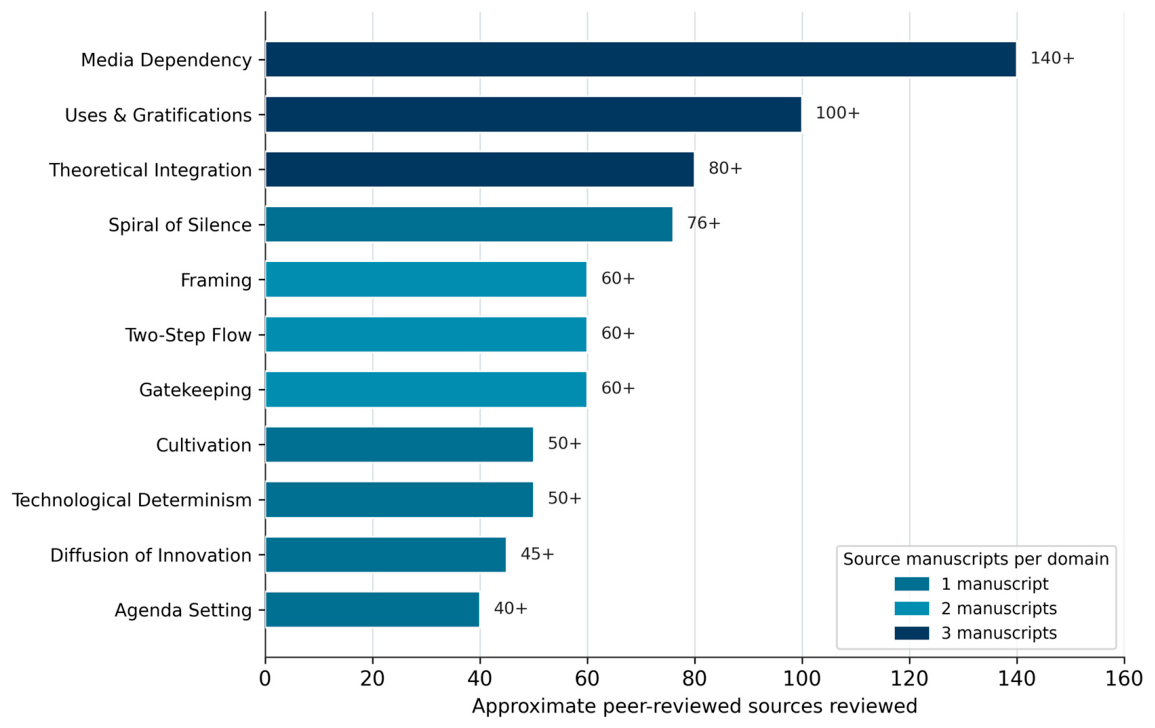
Figure 2.
The Five Meta-Themes of Communication-Theory Transformation. Note. The five cross-cutting meta-themes are identified through reflexive thematic analysis of the corpus. The themes are interdependent rather than mutually exclusive. Original figure synthesizing the study’s findings.
Figure 2.
The Five Meta-Themes of Communication-Theory Transformation. Note. The five cross-cutting meta-themes are identified through reflexive thematic analysis of the corpus. The themes are interdependent rather than mutually exclusive. Original figure synthesizing the study’s findings.
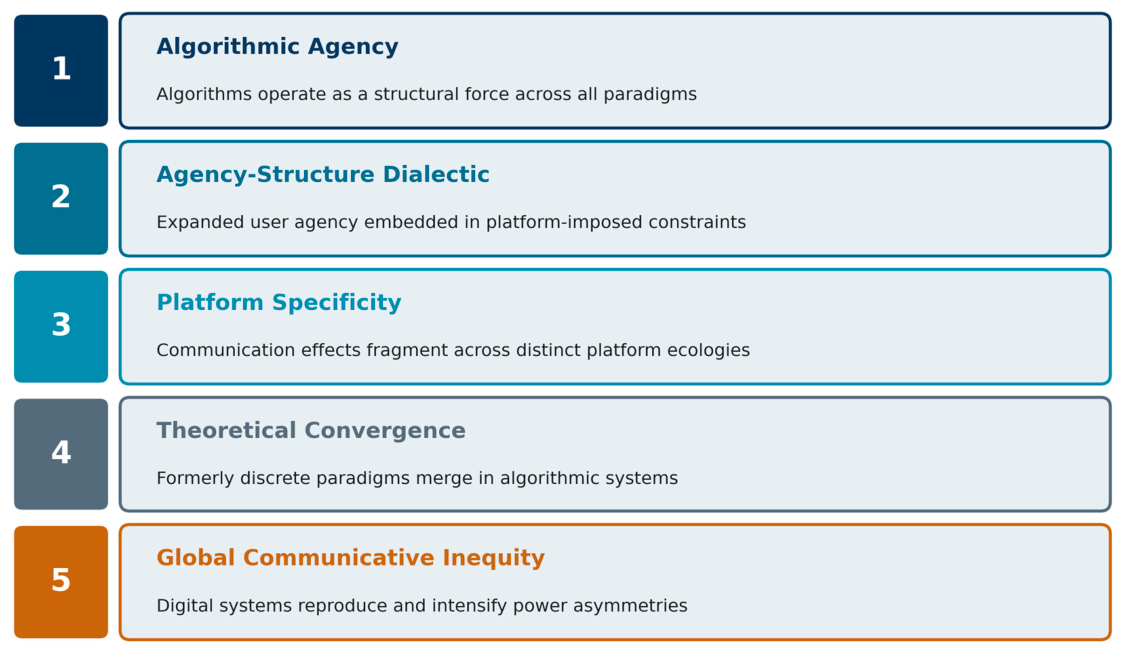
Figure 3.
The Four Communicative Functions of Unified Algorithmic Systems. Note. A single algorithmic system simultaneously performs functions historically distributed across separate institutional actors and theoretical traditions, collapsing the boundaries among them. Original figure synthesizing the study’s findings.
Figure 3.
The Four Communicative Functions of Unified Algorithmic Systems. Note. A single algorithmic system simultaneously performs functions historically distributed across separate institutional actors and theoretical traditions, collapsing the boundaries among them. Original figure synthesizing the study’s findings.
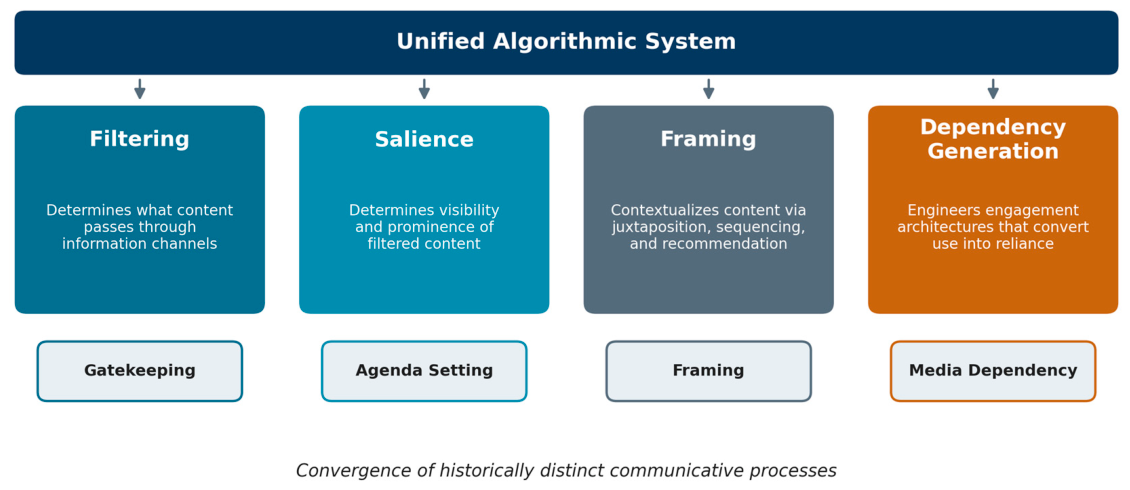
Figure 4.
The Need–Gratification–Dependency (NGD) Cycle. Note. The NGD cycle integrates Uses and Gratifications Theory and Media Dependency Theory, theorizing gratification-seeking and structural dependency as sequential phases of a single self-reinforcing process. Original figure based on the synthesized literature (Alter, 2017; Ball-Rokeach & DeFleur, 1976; Katz et al., 1974).
Figure 4.
The Need–Gratification–Dependency (NGD) Cycle. Note. The NGD cycle integrates Uses and Gratifications Theory and Media Dependency Theory, theorizing gratification-seeking and structural dependency as sequential phases of a single self-reinforcing process. Original figure based on the synthesized literature (Alter, 2017; Ball-Rokeach & DeFleur, 1976; Katz et al., 1974).
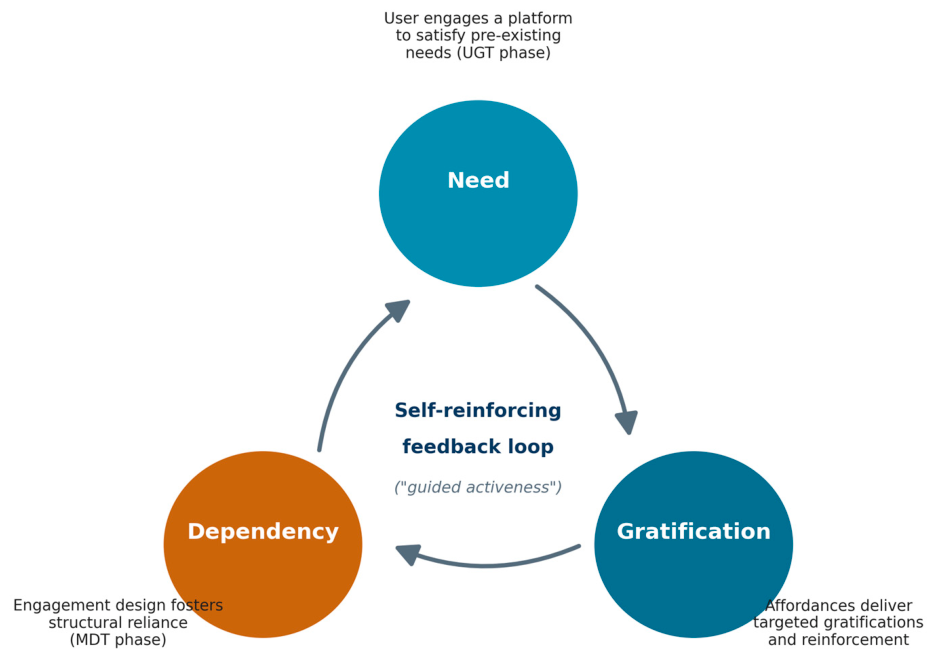
Figure 5.
The Algorithmic Communication Ecology Model (ACEM). Note. The ACEM positions digital communication phenomena at the intersection of four recursively interacting dimensions. The dimensions are mutually constitutive rather than independent variables. Original conceptual framework developed in this study.
Figure 5.
The Algorithmic Communication Ecology Model (ACEM). Note. The ACEM positions digital communication phenomena at the intersection of four recursively interacting dimensions. The dimensions are mutually constitutive rather than independent variables. Original conceptual framework developed in this study.
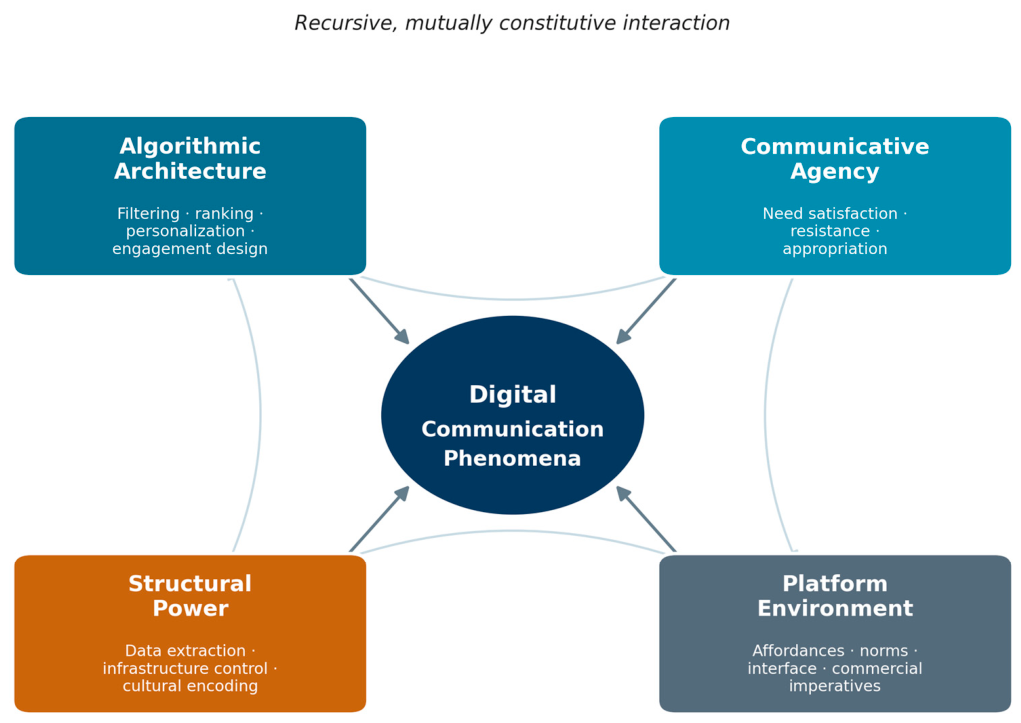
Table 2.
Three-Phase Reflexive Thematic Analysis: Analytical Progression.
| Phase | Analytical Activity | Output | Methodological Safeguard |
|---|---|---|---|
| 1. Familiarization | Repeated close reading and annotation of all 23 manuscripts | Detailed analytical log of impressions and patterns | Prolonged engagement; persistent observation across cycles |
| 2. Coding | Line-by-line generation of theory-level and meta-level codes | 247 initial codes consolidated into 34 categories | Iterative refinement; audit trail of code revisions |
| 3. Theme development | Constant-comparison synthesis of categories | Five cross-cutting meta-themes | Theoretical sufficiency; reflexive journaling |
Note. Protocol adapted from Braun and Clarke (2021). Each phase incorporated reflexive checks consistent with the trustworthiness criteria detailed in Section 3.4.
Table 3.
Corpus Composition and Source Distribution by Theoretical Domain.
| Theoretical Domain | Manuscripts | Approx. Sources Reviewed | Temporal Scope |
|---|---|---|---|
| Agenda Setting Theory | 1 | 40 | 2004–2024 |
| Cultivation Theory | 1 | 50+ | 2005–2025 |
| Framing Theory | 2 | 60+ | 2005–2025 |
| Two-Step Flow Theory | 2 | 60 | 2005–2025 |
| Spiral of Silence Theory | 1 | 76+ | 2005–2025 |
| Uses and Gratifications Theory | 3 | 100+ | 2000–2025 |
| Media Dependency Theory | 3 | 140+ | 2005–2025 |
| Gatekeeping Theory | 2 | 60 | 2000–2025 |
| Diffusion of Innovation | 1 | 45+ | 2000–2025 |
| Technological Determinism | 1 | 50+ | 2020–2025 |
| Theoretical Integration / Overview | 3 | 80+ | 2000–2025 |
| Supporting Documents | 3 | — | — |
Note. Source counts are approximate because several manuscripts share overlapping references across theoretical domains. Supporting documents include methodological guidelines and author-profile materials.
Table 4.
The Five Meta-Themes: Description, Cross-Theoretical Reach, and Principal Manifestations.
| Meta-Theme | Description | Principal Manifestation | Cross-Theoretical Reach |
|---|---|---|---|
| 1. Algorithmic agency | Algorithms operate as autonomous structural agents in communication | Unified systems perform filtering, salience, framing, and dependency functions | All ten theories |
| 2. Agency–structure dialectic | Expanded user agency embedded within platform-imposed constraint | “Fighting the feed” versus the NGD cycle and “guided activeness” | Uses & Gratifications, Media Dependency, Gatekeeping, Diffusion |
| 3. Platform specificity | Effects fragment across distinct platform ecologies | Divergent cultivation and opinion-climate effects across platforms | Cultivation, Spiral of Silence, Framing, Uses & Gratifications |
| 4. Theoretical convergence | Formerly discrete paradigms merge within algorithmic systems | Gatekeeping–agenda-setting and UGT–MDT convergence | All ten theories |
| 5. Global inequity | Digital systems reproduce and intensify power asymmetries | Digital colonialism; Western-centric data and theory | Gatekeeping, Media Dependency, Diffusion, Technological Determinism |
Note. Themes are interdependent rather than mutually exclusive. “Cross-theoretical reach” indicates the traditions in which each theme was most prominently identified across the corpus.
Table 5.
Cross-Cutting Research Gaps Identified Across Theoretical Domains.
| Research Gap | Affected Theories | Nature of the Gap |
|---|---|---|
| Longitudinal research | All ten theories | Insufficient tracking of how digital-transformation processes evolve over extended periods; snapshot designs predominate |
| Cross-cultural scholarship | All ten theories | Western-centric bias limiting global generalizability; limited research from the Global South, Asian, Middle Eastern, and African contexts |
| Algorithmic transparency | Agenda Setting, Gatekeeping, Framing, Spiral of Silence, Cultivation | Opacity of algorithmic decision-making impedes understanding of filtering and salience mechanisms |
| Emerging technologies | All ten theories | Limited research on generative AI, immersive VR/AR, blockchain, and metaverse implications |
| Methodological integration | All ten theories | Need for mixed methods combining computational scale with interpretive depth |
| Platform-specific dynamics | Uses & Gratifications, Cultivation, Spiral of Silence, Framing | Insufficient differentiation of effects across platform affordances; “social media” treated as monolithic |
| Intervention effectiveness | Cultivation, Spiral of Silence, Media Dependency | Limited research on media-literacy, digital-citizenship, and design interventions that mitigate harm |
| Theoretical integration | All ten theories | Insufficient development of integrated frameworks for convergent processes in algorithmic environments |
| Power and inequality | Gatekeeping, Media Dependency, Diffusion, Technological Determinism | Underexamined reproduction and amplification of global communicative power asymmetries |
| Neurobiological mechanisms | Cultivation, Media Dependency, Uses & Gratifications | Limited integration of neuroscience on attention, reward, and habit formation with communication theory |
Note. Gaps identified through synthesis of 23 source manuscripts. “All ten theories” indicates that the gap was identified in literature addressing every theoretical domain examined.
Table 6.
The Algorithmic Communication Ecology Model: Dimensions, Theoretical Contributions, and Research Priorities.
Table 6.
The Algorithmic Communication Ecology Model: Dimensions, Theoretical Contributions, and Research Priorities.
| ACEM Dimension | Contributing Theories | Key Mechanisms | Priority Research Question |
|---|---|---|---|
| Algorithmic architecture | Agenda Setting, Gatekeeping, Framing, Cultivation | Filtering, ranking, personalization, recommendation, engagement optimization | How do specific algorithmic design decisions produce measurable communication effects? |
| Communicative agency | Uses & Gratifications, Two-Step Flow, Diffusion of Innovation | Need satisfaction, opinion leadership, innovation adoption, resistance, appropriation | How do users navigate, resist, and appropriate algorithmic environments across cultures? |
| Platform environment | Cultivation, Spiral of Silence, Framing, Uses & Gratifications | Affordances, norms, commercial imperatives, interface design, content modalities | How do platform-specific affordances shape distinct patterns of effect? |
| Structural power | Media Dependency, Technological Determinism, Gatekeeping | Data extraction, infrastructure control, cultural encoding, regulatory governance | How do global power asymmetries shape digital communication infrastructure and effects? |
Note. The ACEM integrates insights from all ten theories within a unified ecological framework. Contributing theories indicate primary analytical alignment; all theories inform multiple dimensions.
Table 7.
Non-Western Evidence and Its Theoretical Relevance: The Gulf and Saudi Context.
| Theoretical Domain | Illustrative Non-Western Evidence | Theoretical Contribution / Gap Addressed |
|---|---|---|
| Diffusion of Innovation | Near-universal internet penetration and top-ranked social-media reach driven by Vision 2030 infrastructure investment (Datar portal, 2025) | Demonstrates structural, state-led adoption that adopter-category typologies cannot explain |
| Framing | Corpus-based discourse analysis of how Saudi reform agendas are framed in domestic and international media (Afzal & Omar, 2021) | Extends participatory and elite framing beyond Western press systems |
| Agenda Setting / Framing | Analysis of Saudi online sustainability and reform discourse across news and social platforms (Almaghlouth, 2022) | Provides non-Western evidence on networked, cross-platform agenda construction |
| Spiral of Silence | High-saturation, multi-platform opinion environments in Gulf societies (DataReportal, 2025) | Offers a natural laboratory for opinion-climate formation outside Western, low-anonymity contexts |
| Media Dependency | Coexistence of strong platform dependency with sovereign digital-infrastructure development | Complicates a strict digital-colonialism reading of core–periphery relations |
Note. The table is illustrative rather than exhaustive; it demonstrates how evidence from a high-saturation non-Western society can inform and refine Western-derived theory. Compiled from the cited sources.
Disclaimer/Publisher’s Note: The statements, opinions and data contained in all publications are solely those of the individual author(s) and contributor(s) and not of MDPI and/or the editor(s). MDPI and/or the editor(s) disclaim responsibility for any injury to people or property resulting from any ideas, methods, instructions or products referred to in the content. |
© 2026 by the authors. Licensee MDPI, Basel, Switzerland. This article is an open access article distributed under the terms and conditions of the Creative Commons Attribution (CC BY) license (http://creativecommons.org/licenses/by/4.0/).
Copyright: This open access article is published under a Creative Commons CC BY 4.0 license, which permit the free download, distribution, and reuse, provided that the author and preprint are cited in any reuse.