
Submitted:
14 April 2026
Posted:
15 April 2026
You are already at the latest version
Abstract
Friedreich ataxia (FRDA) is a rare, autosomal recessive, progressive neurodegenerative disorder characterized by multisystem involvement, including gait and limb ataxia, cardiomyopathy, skeletal deformities, and metabolic dysfunction. Most patients harbor biallelic GAA trinucleotide repeat expansions in intron 1 of FXN, whereas others are compound heterozygotes with a GAA expansion on one allele and a pathogenic FXN variant on the other. FXN encodes frataxin, a nuclear-encoded mitochondrial protein essential for iron-sulfur (Fe-S) cluster biogenesis and mitochondrial energy production. Frataxin deficiency disrupts mitochondrial metabolism, promotes iron dysregulation and oxidative stress, and leads to progressive cellular injury, particularly in high-energy tissues such as the nervous system and myocardium. Despite substantial advances in understanding FRDA pathogenesis, no curative therapy is currently available. In 2023, omaveloxolone (Skyclarys) became the first approved treatment for FRDA, marking a significant therapeutic milestone. Concurrently, disease-directed strategies have expanded rapidly, including small-molecule modulators, adeno-associated virus (AAV)-mediated gene replacement, and transcriptional or epigenetic approaches aimed at restoring endogenous FXN expression. In addition, antisense oligonucleotide-based therapies and emerging CRISPR-mediated gene editing platforms are advancing through preclinical and early clinical development. This review provides a comprehensive overview of the evolving therapeutic landscape in FRDA, highlighting mechanistic rationales, preclinical progress, clinical trial outcomes, and the key translational challenges that must be addressed to achieve durable disease modification.
Keywords:
Friedreich ataxia
; frataxin deficiency
; translational therapeutics
1. Introduction
Friedreich’s ataxia (FRDA) is a rare, autosomal recessive disorder characterized by progressive neurodegeneration and multisystem involvement, affecting approximately 1 in 50,000 individuals worldwide [1,2]. First described by Nikolaus Friedreich in the late 19th century, the disease was initially defined by spinal cord degeneration, ataxia, and sensory deficits [3]. More than a century later, advances in genetic mapping established FRDA as one of the first autosomal recessive disorders to be localized using linkage analysis, with key restriction fragment length polymorphism (RFLP) markers identified on chromosome 9 (9q13-q21.1) [1,4]. These discoveries enabled positional cloning efforts that ultimately led to the identification of the FXN gene [5].
Subsequent molecular studies revealed that FRDA is most commonly caused by a homozygous GAA trinucleotide repeat expansion within intron 1 of FXN, resulting in transcriptional repression and reduced gene expression [6]. Approximately 96% of individuals with FRDA are homozygous for this expansion, while the remaining ~4% are compound heterozygotes, carrying a GAA expansion on one allele and a distinct pathogenic variant on the other [6,7]. These mutations lead to deficiency of frataxin, a mitochondrial protein essential for iron-sulfur cluster biosynthesis and cellular iron homeostasis. Impaired frataxin function results in mitochondrial dysfunction, which underlies the progressive neurodegeneration and systemic manifestations of the disease [8].
Clinically, FRDA typically presents between 10 and 15 years of age, with progressive ataxia as the hallmark feature, manifesting as impaired balance and coordination [9,10]. In addition to neurological impairment, patients frequently develop non-neurological complications, including hypertrophic cardiomyopathy, musculoskeletal abnormalities, and metabolic dysfunction. Disease progression is associated with substantial functional decline, with most individuals requiring wheelchair assistance within approximately 15 years of symptom onset [11]. Life expectancy is significantly reduced, with an average survival of approximately 36 years after onset, most commonly due to cardiac complications [12].
Despite the considerable disease burden, current management remains largely supportive, and no curative therapies are available [8]. However, growing insights into the genetic and molecular basis of FRDA have catalyzed the development of targeted therapeutic strategies. An increasing number of these approaches are now advancing through preclinical and clinical evaluation [3,8,13]. In this review, we provide a comprehensive overview of the neurodegenerative and multisystem features of FRDA and critically examine the evolving therapeutic landscape. We highlight key mechanistic insights, summarize recent advances, and discuss the major translational challenges that must be addressed to achieve durable disease modification.
2. Genetics of FRDA
FRDA is caused by mutations in the frataxin (FXN) gene located on chromosome 9 [6]. The underlying genetic defects can be broadly categorized into two types: expansion of a GAA trinucleotide repeat within intron 1 of FXN and non-expansion pathogenic variants. Approximately 96% of affected individuals are homozygous for the GAA repeat expansion, whereas the remaining ~4% are compound heterozygotes, carrying a GAA expansion on one allele and a distinct inactivating mutation on the other [6,7].
The FRDA GAA repeat is located within an Alu-Sx sequence, a type of repetitive DNA unique to humans and absent in laboratory animals [14]. In unaffected individuals, the GAA repeat length typically ranges from 7 to 30 units, whereas pathogenic alleles contain expanded repeats ranging from approximately 60 to over 1,700 units [15,16] (Figure 1). The size of the repeat expansion correlates inversely with age of onset and directly with disease severity. Expansions below ~100 repeats are rarely pathogenic, particularly when interrupted by non-GAA sequences [17]. Notably, the expanded repeat is genetically unstable, exhibiting both germline and somatic variability. Germline instability occurs during transmission through both maternal and paternal lineages, with paternal transmission often associated with repeat contraction [18]. Somatic instability results in tissue-specific variation in repeat length, with greater instability observed in the heart and pancreas compared to the central nervous system, and progressive expansion occurring with age [19,20].
Expanded GAA repeats promote transcriptional silencing of FXN and reduced frataxin expression through a combination of structural and epigenetic mechanisms [3] (Figure 1). At the DNA level, the expanded GAA repeat adopts non-B DNA conformations that interfere with transcription [16] (Figure 1). These include the formation of triplex (triple-helix) DNA structures, where the polypurine GAA strand interacts with the DNA duplex via Hoogsteen base pairing, creating a physical barrier to RNA polymerase progression. Another proposed structure, termed “sticky DNA,” involves intermolecular triplex formation between separate DNA molecules, although its physiological relevance in vivo remains uncertain [21]. In addition to DNA structural abnormalities, the GAA repeat region promotes the formation of R-loops, consisting of RNA/DNA hybrids and a displaced single DNA strand (Figure 1). These R-loops are associated with transcriptional stalling and serve as nucleation sites for chromatin remodeling, thereby reinforcing gene silencing [22].
These structural disruptions initiate a cascade of epigenetic changes that establish a repressive chromatin environment. The expanded GAA repeat induces heterochromatin formation, a process first demonstrated to resemble position-effect variegation. This is characterized by: (1) Increased histone H3 methylation (repressive marks such as H3K9me and H3K27me), (2) Decreased histone acetylation, which reduces chromatin accessibility, and (3) Recruitment of chromatin-silencing complexes [23,24,25,26]. Importantly, these repressive histone modifications spread from the expanded repeat toward the FXN promoter, impairing both transcriptional initiation and elongation. Concurrently, DNA methylation accumulates upstream of the GAA repeat, forming a disease-specific differentially methylated region (FRDA-DMR). This methylation further stabilizes the silenced chromatin state and correlates strongly with disease severity. Beyond repeat expansions, more than 60 non-expansion mutations have been identified, including point mutations and deletions that disrupt FXN function, often by impairing precursor mRNA splicing [27].
Importantly, disease severity is closely linked to residual frataxin levels. Patients typically exhibit <10% of normal FXN transcript, whereas heterozygous carriers with ~50% expression remain asymptomatic. Even modest increases in frataxin levels (to ~10-30% of normal) are associated with milder disease and delayed progression [28,29]. These observations underscore the therapeutic potential of strategies aimed at restoring FXN expression, including approaches that reverse gene silencing through epigenetic modulation, disruption of R-loop structures, or alleviation of RNA polymerase II stalling.
3. Frataxin Biology and Consequences of Its Deficiency
The FXN gene encodes frataxin, a highly conserved mitochondrial protein expressed across a wide range of species, including plants, invertebrates, yeast, and mammals [1]. In humans, frataxin is enriched in tissues most affected in FRDA, such as the dorsal root ganglia, spinal cord, cerebellum, heart, pancreas, liver, and skeletal muscle [30]. Frataxin is primarily translated from the most abundant FXN transcript (exons 1-5a) as a 210-amino acid precursor, which undergoes sequential cleavage by the mitochondrial processing peptidase to yield the mature 130-amino acid functional protein [31]. In addition to this canonical mitochondrial form, alternative frataxin isoforms have been described and may exhibit tissue-specific expression; however, their precise functional roles, particularly in the context of FRDA, remain incompletely defined. Structurally, frataxin is a compact globular protein composed of α-helices and β-sheets, characterized by a conserved ridge of negatively charged residues and a hydrophobic surface region [32].
Frataxin plays a central role in mitochondrial function and intracellular iron homeostasis [33]. It acts as an allosteric activator of the iron-sulfur (Fe-S) cluster assembly machinery, thereby contributing to the biosynthesis, maintenance, and repair of Fe-S clusters [34]. These clusters serve as essential cofactors for numerous cellular processes, including mitochondrial electron transport chain activity (complexes I-III), regulation of iron metabolism, heme biosynthesis, redox reactions, amino acid and purine metabolism, and DNA repair [33,35,36,37,38,39,40,41]. Consequently, frataxin deficiency disrupts both mitochondrial and extramitochondrial Fe-S cluster biogenesis, as cytosolic Fe-S assembly depends on mitochondrial Fe-S export, ultimately leading to impaired activity of key metabolic enzymes [3] (Figure 1).
Cellular consequences of Frataxin deficiency: Frataxin deficiency leads to widespread dysfunction of Fe-S cluster-dependent enzymes across cellular compartments, with pronounced effects on mitochondrial proteins such as aconitase and respiratory chain complexes [42]. This results in impaired oxidative phosphorylation, reduced mitochondrial membrane potential, cellular energy deficits, and increased production of reactive oxygen species (ROS). In response to Fe-S cluster depletion, cells activate iron uptake pathways via iron-responsive protein 1 (IRP1), enhancing iron import while limiting storage [43]. However, defective Fe-S cluster synthesis impairs proper iron utilization, leading to mitochondrial iron accumulation. Excess iron, together with elevated ROS, promotes the Fenton reaction, generating highly reactive hydroxyl radicals that drive oxidative damage. This process is further exacerbated by depletion of antioxidant defenses, including glutathione, culminating in oxidative stress, cellular injury, and degeneration. These pathological mechanisms are particularly prominent in high-energy-demand tissues, contributing to the selective vulnerability observed in FRDA [44].
Downstream pathways and metabolic dysregulation: Frataxin deficiency also induces widespread downstream molecular and metabolic alterations that link impaired Fe-S cluster biogenesis to cellular pathology. These include reduced antioxidant capacity and impaired mitochondrial biogenesis, largely driven by downregulation of key regulatory factors such as PGC-1α and Nrf2 [45,46]. In addition, transcriptomic and metabolomic studies have identified disruptions in multiple metabolic pathways, including sphingolipid metabolism, ketogenesis, and one-carbon metabolism, along with potential dysregulation of mTOR signaling, regulator of cell growth and metabolism. Emerging evidence also supports activation of neuroinflammatory pathways, as indicated by biomarker analyses and neuroimaging studies [3]. Despite these advances, the mechanisms underlying cell type-specific vulnerability to frataxin deficiency remain incompletely understood.
Frataxin is also found to be essential for viability, as complete loss of FXN function results in early embryonic lethality in animal models. Consistent with this, individuals with FRDA retain residual frataxin expression, typically ranging from approximately 5% to 35% of normal levels across tissues. This partial deficiency is sufficient to sustain viability but drives progressive oxidative damage and neurodegeneration, underscoring the critical importance of frataxin in maintaining cellular and mitochondrial homeostasis [20,47,48,49].
4. Multisystem Involvement of the Disease
FRDA is a multisystem disease-causing progressive symptom throughout the body (Figure 2). Neurological symptoms include unsteady gait, limb coordination disorders, dysarthria, hearing loss, nystagmus, visual impairment, absent reflexes, impaired vibration and position sense, and mild olfactory dysfunction. Non-neurological symptoms include musculoskeletal abnormalities such as weakness in the hands and legs, scoliosis, and high arched feet, as well as type 1 diabetes and hypertrophic cardiomyopathy [50]. Additionally, coordination disorder is often accompanied by neuropathic pain [51].
4.1. Neurological and Psychiatric Symptoms
Neurological involvement is a universal and defining feature of FRDA, affecting multiple interconnected systems. The most prominent clinical manifestation is progressive ataxia, involving both axial and appendicular coordination. This arises from combined dysfunction of the cerebellum, posterior columns, dorsal root ganglia, and peripheral nerves, leading to impaired proprioception and loss of position sense [52]. Degeneration of large-fiber sensory pathways contributes to early loss of deep tendon reflexes and sensory ataxia, while cerebellar involvement results in impaired coordination, dysmetria, and gait instability. Over time, involvement of the corticospinal tracts leads to progressive weakness and spasticity, particularly in the lower limbs, with spasticity being more common in advanced disease and in late-onset forms [11,53,54,55,56,57,58].
Dysarthria is a frequent and early feature, characterized by slow and slurred speech that progressively worsens and significantly impacts communication and quality of life [52]. Dysphagia is also highly prevalent, occurring in up to 69-98% of patients, and contributes to an increased risk of aspiration pneumonia, which is a major cause of mortality [51,59]. Sensory peripheral neuropathy is almost universal, predominantly affecting the lower limbs and often leading to neuropathic pain. Electrophysiological studies typically demonstrate reduced or absent sensory nerve action potentials, with relatively preserved motor conduction [51].
Additional neurological features include autonomic dysfunction, particularly urinary disturbances such as urgency and frequency, reflecting involvement of autonomic fibers [60,61]. Other less common but clinically relevant manifestations include optic neuropathy, auditory pathway involvement leading to hearing impairment, and small-fiber neuropathy [62,63].
Psychiatric and cognitive manifestations also contribute to disease burden. Affective disorders, including depression and anxiety, are common, with major depression reported in approximately 14-36% of patients and milder mood disturbances affecting up to 50-92%. These symptoms may reflect both disease-related neurobiological changes and the psychological impact of living with a chronic, progressive condition. While global cognitive function is generally preserved, subtle deficits have been reported in specific domains, including executive function, attention, visuospatial processing, and social cognition. Interpretation of cognitive testing can be challenging, as performance may be confounded by motor impairment, dysarthria, and slowed response times [51,64,65].
Overall, neurological and psychiatric manifestations in FRDA reflect the widespread and progressive involvement of sensory, cerebellar, motor, and autonomic systems, alongside significant psychosocial impact, underscoring the need for comprehensive multidisciplinary management.
4.2. Musculoskeletal Symptoms
Skeletal muscle involvement in FRDA is increasingly recognized as an active component of disease pathology rather than solely a secondary consequence of neurodegeneration. While denervation due to sensory neuropathy and spinocerebellar tract degeneration contributes to muscle weakness, growing evidence highlights a significant role for intrinsic skeletal muscle defects [66]. Frataxin deficiency impairs mitochondrial iron-sulfur cluster biogenesis, leading to reduced activity of key respiratory chain enzymes, compromised oxidative phosphorylation, and decreased ATP production. At the structural level, skeletal muscle in FRDA exhibits features of mitochondrial myopathy, including reduced mitochondrial content and function, altered fiber-type composition with a shift away from oxidative (type I) fibers, and accumulation of lipid droplets. These changes are consistent with impaired fatty acid oxidation and energy utilization [67,68]. Transcriptomic and proteomic studies further reveal widespread dysregulation of pathways involved in mitochondrial biogenesis, oxidative metabolism, and cellular stress responses, reinforcing the concept of a primary metabolic defect in muscle tissue [69]. Progressive muscle weakness typically begins distally and progressively contributes to worsening gait instability and loss of mobility, exacerbating ataxia-related disability. In addition, musculoskeletal abnormalities are common and further compound functional impairment [51,70]. Scoliosis, affecting approximately 60–90% of patients, often develops early, sometimes preceding neurological symptoms, and is typically characterized by a left-sided thoracic curvature that may progress rapidly during adolescence, particularly in individuals with longer GAA repeat expansions, frequently necessitating surgical intervention [71,72]. Foot deformities are also common, with pes cavus (high-arched foot) being the most prevalent, further impairing gait and balance [51]. Together, these musculoskeletal abnormalities significantly contribute to functional decline, reduced mobility, and overall disease burden in FRDA.
4.3. Cardiac Symptoms
Cardiac involvement is a major feature of FRDA, affecting approximately 40-85% of patients and representing the leading cause of premature mortality, accounting for nearly 60% of deaths [73,74,75]. The severity of cardiac disease is strongly associated with earlier disease onset and longer GAA repeat expansions, although it does not always correlate with the degree of neurological impairment. The hallmark cardiac phenotype in FRDA is hypertrophic cardiomyopathy, typically characterized by concentric left ventricular hypertrophy, increased ventricular wall thickness, and reduced ventricular cavity size [76,77,78]. In the early stages, electrocardiographic abnormalities, particularly repolarization changes such as T-wave inversion, are often among the earliest detectable features [79]. Despite these changes, systolic function is usually preserved initially, and patients may remain asymptomatic. However, diastolic dysfunction is common due to reduced ventricular compliance and may become clinically evident under physiological stress, such as fluid overload or dehydration [80].
With disease progression, the cardiomyopathy may evolve into a dilated phenotype, characterized by thinning of the ventricular walls, increased chamber size, reduced ejection fraction, and eventual development of overt heart failure [73,75,81,82,83]. This transition reflects underlying pathological processes, including progressive myocardial fibrosis, myocyte loss, and impaired mitochondrial energy metabolism resulting from frataxin deficiency [47,84]. Clinically, cardiac symptoms are often subtle and may overlap with neuromuscular limitations inherent to FRDA. Patients may experience fatigue, dyspnea, and exercise intolerance, which can be difficult to distinguish from neurological causes [80]. Episodes of chest pain resembling angina are also reported but are typically not associated with coronary artery disease; instead, they may reflect altered myocardial oxygen demand or microvascular dysfunction within the hypertrophied myocardium [85]. Cardiac arrhythmias are another important manifestation and may occur at any stage of the disease. Atrial arrhythmias are relatively common and can arise even in the absence of severe structural abnormalities, whereas ventricular arrhythmias are more frequently observed in advanced stages associated with myocardial fibrosis. These rhythm disturbances can contribute significantly to morbidity and may require specialized management, including pharmacological therapy or device-based interventions such as implantable cardioverter-defibrillators in selected patients [86,87,88].
4.4. Metabolic Symptoms
Metabolic dysfunction is a recognized component of FRDA, reflecting the systemic consequences of frataxin deficiency and mitochondrial impairment. One of the most clinically relevant features is glucose dysregulation, with approximately 30% of patients exhibiting impaired glucose tolerance and 7-9% developing overt diabetes mellitus (DM) [51,89,90]. In individuals with early-onset FRDA, diabetes often resembles an insulin-deficient phenotype similar to autoimmune type 1 diabetes, frequently presenting with ketoacidosis, low insulin and C-peptide levels, and an early requirement for insulin therapy [91]. This is primarily driven by pancreatic β-cell dysfunction, resulting from mitochondrial impairment and increased susceptibility to metabolic and endoplasmic reticulum stress-induced β-cell death [92]. In contrast, later-onset disease involves a combination of β-cell dysfunction and peripheral insulin resistance. Notably, diabetes in FRDA tends to occur at younger ages and at lower levels of adiposity compared to typical type 2 diabetes [89,93,94,95].
Growth and body composition are also altered in FRDA. Pediatric patients commonly exhibit reduced growth velocity, short stature, delayed pubertal development, and low body mass index (BMI), due to impaired mitochondrial energy metabolism [96,97,98]. In contrast, adults with FRDA are often overweight or exhibit increased visceral adiposity despite relatively modest BMI values. This paradox may be explained by frataxin deficiency in adipose tissue, which promotes adipocyte hypertrophy, inflammation, fibrosis, and metabolic dysregulation [96,99,100]. Additionally, interactions between adipose tissue and the gut microbiome may further influence metabolic homeostasis, although these mechanisms remain incompletely understood [8].
Emerging evidence also suggests a role for chronic low-grade inflammation in FRDA-associated metabolic dysfunction. Altered immune responses, including increased pro-inflammatory signaling and microglial activation, have been observed and may contribute to both metabolic disturbances and neurodegeneration [101,102]. However, the complex interplay between inflammation, immune activation, metabolism, and the gut microbiome in FRDA remains poorly defined.
Furthermore, individuals with FRDA are at increased risk of impaired bone health, likely due to reduced mobility, chronic disease burden, and altered metabolism. Reduced bone mineral density has been reported in a subset of patients, potentially increasing susceptibility to fractures [80,103].
Overall, metabolic manifestations in FRDA are multifactorial, involving disruptions in glucose metabolism, growth, adipose biology, and inflammatory pathways. These abnormalities contribute significantly to disease burden and represent important considerations for clinical management and therapeutic development.
5. Cellular & Animal Models of FRDA
Relevant experimental models are essential for elucidating disease mechanisms and advancing therapeutic development in FRDA. Although frataxin is highly conserved across species, supporting the use of diverse model organisms, only humans and non-human primates harbor the pathogenic GAA trinucleotide repeat expansion within the native FXN genomic context [104]. This fundamental difference makes it challenging for the non-human systems to fully recapitulate the genetic and epigenetic features of the disease. Over time, numerous cellular and animal models have been developed, each contributing valuable insights into specific aspects of FRDA pathophysiology. However, mammalian systems, particularly mouse models and human-derived cells, remain the most physiologically relevant. An ideal FRDA model would exhibit significantly reduced frataxin levels, preferably through GAA repeat-mediated transcriptional silencing and reproduce key clinical features, including progressive sensory ataxia, cardiomyopathy, and associated biochemical abnormalities. Below, we summarize the principal mammalian cellular and animal models used in FRDA research.
5.1. Cellular Models
Cellular models play a critical role in studying frataxin deficiency and evaluating therapeutic strategies. Patient-derived cells, including fibroblasts, lymphoblasts, and peripheral blood cells, are widely used due to their accessibility and retention of the full FXN locus with expanded GAA repeats and reduced frataxin expression [105,106]. These models represent the most physiologically relevant in vitro systems currently available. Although these cells do not fully recapitulate the disease phenotype under basal conditions, they exhibit increased sensitivity to oxidative stress, supporting their use in biomarker studies and therapeutic screening [107,108].
A major advancement in FRDA modeling has been the development of induced pluripotent stem cells (iPSCs). Patient-derived fibroblasts can be reprogrammed into iPSCs, which retain the GAA repeat expansion and epigenetic silencing of FXN. These iPSCs can then be differentiated into disease-relevant cell types, including neurons and cardiomyocytes, enabling investigation of tissue-specific pathology [109,110]. For example, FRDA iPSC-derived neurons display delayed maturation, impaired electrophysiological properties, and reduced mitochondrial membrane potential, while cardiomyocytes exhibit mitochondrial degeneration, structural abnormalities, and compromised contractile function [110]. Emerging evidence also implicates non-neuronal cells in disease progression; notably, iPSC-derived microglia demonstrate intrinsic activation, suggesting a contribution of neuroinflammatory mechanisms to FRDA pathogenesis [111].
Advances in three-dimensional (3D) culture systems and organoid technologies are further enhancing the ability to model complex cellular interactions and disease progression in vitro [112,113]. In parallel, engineered cellular models using RNA interference (siRNA/shRNA), CRISPR/Cas9, or ribozyme-based approaches have been developed to reduce frataxin expression in established cell lines. While these systems successfully reproduce key biochemical defects such as mitochondrial dysfunction, iron accumulation, and oxidative stress, their physiological relevance is limited by the use of non-disease cell types and their proliferative nature [104].
Humanized cellular models provide an additional platform by introducing disease relevant FXN mutations into murine or other non-human cells. In these systems, endogenous frataxin is deleted and replaced with human frataxin, either wild-type or carrying pathogenic missense mutations such as G130V or I154F. These models recapitulate several aspects of FRDA pathology, including impaired mitochondrial function and dysregulated iron homeostasis, although phenotypic instability over time remains a limitation [1,114,115].
5.2. Mouse Models
A wide range of mouse models has been developed to investigate FRDA pathophysiology. Early studies demonstrated that complete loss of frataxin is incompatible with life, resulting in embryonic lethality and underscoring its essential role in cellular viability, particularly in iron-sulfur (Fe-S) cluster biogenesis. To overcome this limitation, conditional knockout (cKO) models were generated using Cre-loxP technology to enable tissue-specific and temporally controlled deletion of Fxn [104].
The cKO-MCK model, in which Fxn is deleted in cardiac and skeletal muscle, recapitulates key features of FRDA cardiomyopathy, including cardiac hypertrophy by approximately 5 weeks of age and mortality by 10 weeks, accompanied by severe mitochondrial abnormalities [116]. Neuronal models, such as the NSE-Cre mouse, were developed to study frataxin deficiency in the nervous system; however, due to promoter leakiness, Fxn deletion also occurs in the heart and liver, leading to combined neurological and cardiac phenotypes [116]. These mice exhibit progressive ataxia, loss of proprioception, iron accumulation, fibrosis, and early mortality (around postnatal day 25), limiting their utility for modeling the progressive nature of human FRDA. Additionally, non-physiological features, such as cortical spongiform degeneration, reduce their translational relevance [117].
To address these limitations, inducible conditional models have been developed. In particular, the PRP-Cre model, in which Cre recombinase is driven by the prion protein promoter, allows temporal control of Fxn deletion and more closely mimics disease progression. These mice develop progressive cerebellar and sensory ataxia, degeneration of dorsal root ganglion neurons, and subsequent involvement of spinal and cerebellar pathways. Early pathological features include autophagy, vacuolization, and lipofuscin accumulation, highlighting the role of impaired cellular quality control mechanisms in disease progression [118]. Additional tissue-specific models have provided insight into non-neurological manifestations. Pancreatic β-cell-specific deletion leads to impaired glucose tolerance and diabetes, while liver-specific models highlight the role of frataxin in iron homeostasis and cellular metabolism [119,120]. More recently, transgenic mouse models carrying disease-relevant FXN point mutations observed in compound heterozygous patients-such as FxnG127V/G127V and FxnI151F/I151F, have been developed, offering improved genetic fidelity and clinical relevance [3].
GAA repeat expansion-based mouse models more closely mimic the genetics of FRDA and are useful for studying FXN epigenetics, repeat instability, and epigenetic therapies. One such model, the KIKI mice exhibit approximately 66-83% residual frataxin levels, whereas KIKO mice, which combine a GAA repeat expansion (~230 repeats) with exon 4 deletion, show reduced levels of approximately 25-36% [104,121]. However, these models display relatively mild phenotypes with limited neurodegeneration or cardiomyopathy, suggesting the existence of a critical threshold of frataxin deficiency required for overt disease manifestation [104].
Humanized transgenic mouse models, including YG8R and YG22R, incorporate the human FXN gene with GAA repeat expansions [122]. The YG8 line contains two repeats of approximately 90 and 190 units, while the YG22 line carries a single repeat of approximately 190 units. These lines are crossed onto a frataxin-null background to generate “rescue” models that express only human frataxin at reduced levels. These mice exhibit mild, slowly progressive phenotypes, including subtle motor coordination deficits, sensory neuron abnormalities, mitochondrial dysfunction, and modest oxidative stress [24,123,124]. Although these models preserve the genetic basis of FRDA more accurately, their relatively mild phenotype may reflect species-specific differences or insufficient repeat expansion length.
To better model repeat instability and epigenetic silencing, newer models such as YG8-800 have been developed, harboring more than 800 GAA repeats within the human FXN gene. These mice demonstrate somatic and intergenerational repeat instability, epigenetic repression of FXN, progressive locomotor impairment, and cardiac hypertrophy [125]. However, disease onset is relatively late, and phenotypic severity can vary between studies.
Collectively, no single model fully recapitulates all aspects of FRDA. Cellular models provide mechanistic and therapeutic insights at the molecular level, while animal models enable investigation of systemic disease features and progression. The continued development and integration of these complementary systems remain essential for advancing our understanding of FRDA and for the successful translation of therapeutic strategies.
6. Bio Marks & Outcome Measures
The identification of reliable biomarkers and outcome measures is critical for tracking disease progression and evaluating therapeutic efficacy in FRDA.
Molecular and biochemical biomarkers: Frataxin itself represents a central disease biomarker; however, its clinical application is complicated by the presence of distinct isoforms. Two major forms have been described: the mitochondrial isoform (frataxin-M) and an extracellular isoform (frataxin-E) detectable in red blood cells [79,126]. Quantification of frataxin remains technically challenging, but studies have demonstrated that frataxin levels correlate with disease severity. Specifically, frataxin concentration shows a positive correlation with age at disease onset and an inverse correlation with disease burden, with frataxin-E exhibiting a stronger clinical correlation than frataxin-M. These findings support the potential of frataxin, particularly frataxin-E, as a biomarker for disease stratification and progression monitoring [79,126]. While frataxin levels are consistently reduced in individuals with FRDA, accurate quantification remains technically challenging and is typically limited to cellular sources such as peripheral blood mononuclear cells, buccal swabs, or tissue biopsies [3].
Additionally, early investigations into biochemical biomarkers focused on iron metabolism and oxidative stress; however, these markers have shown limited reliability in clinical settings [3]. More recently, attention has shifted toward biofluid-based markers identified through metabolomic and proteomic approaches. Among these, neurofilament light chain (NfL) has emerged as a promising indicator of neuronal damage, with elevated plasma levels observed particularly in younger patients, although these levels tend to plateau in early adulthood [127]. Additional candidates include alterations in sphingolipid metabolism and markers of neuroinflammation detected in cerebrospinal fluid, though these findings require validation in larger cohorts [111,127].
Neurophysiological biomarkers: Neurophysiological assessments provide sensitive indicators of neural dysfunction in FRDA. A characteristic finding for FRDA is the marked reduction or absence of sensory nerve action potentials, while motor and sensory nerve conduction velocities are relatively preserved. Consistent with sensory fiber degeneration, somatosensory evoked potentials are frequently delayed or absent, often evident even in early stages [3]. Advanced techniques such as magnetoencephalography (MEG) have revealed impaired somatosensory processing in nearly all patients, with minimal progression over time [128]. Similarly, reduced cortico-kinematic coherence, reflecting impaired proprioceptive input, is evident early and remains relatively stable, supporting the concept of a developmental sensory deficit. In contrast, other neurophysiological measures indicate ongoing neurodegeneration. Brainstem auditory and visual evoked potentials show progressive deterioration, reflecting involvement of these pathways over time. Additionally, slowing of central motor conduction has been observed with disease progression, consistent with degeneration of corticospinal tracts [129].
Neuroimaging biomarkers: Neuroimaging provides structural and metabolic insights into disease progression. Magnetic resonance imaging (MRI) typically shows cervical spinal cord thinning, a key hallmark, along with mild cerebellar atrophy in later stages [130,131,132]. Quantitative volumetric analyses further reveal progressive spinal cord atrophy and microstructural changes in the cerebellum, dentatothalamic pathways, and corticospinal tracts, as well as iron accumulation in the dentate nuclei. Metabolic imaging approaches, such as magnetic resonance spectroscopy (MRS), further reveal reduced neuronal integrity and impaired energy metabolism in the brain, spinal cord, and skeletal muscle [133].
Clinical and functional outcome measures: A range of standardized clinical scales are used to quantify neurological impairment in FRDA. The Scale for the Assessment and Rating of Ataxia (SARA) is widely used due to its simplicity and feasibility in clinical settings, enabling rapid assessment with a limited number of items. The Modified Friedreich’s Ataxia Rating Scale (mFARS), in contrast, provides a more detailed and comprehensive evaluation and may offer greater sensitivity in early disease stages [134]. Both scales demonstrate comparable psychometric properties. The Inventory of Non-Ataxia Signs (INAS) complements these tools by capturing non-ataxic manifestations, reflecting the multisystem nature of the disease [135]. Functional assessments provide additional insight into real-world disease impact. Activities of Daily Living (ADL), typically assessed through structured interviews, reflect an individual’s ability to perform routine tasks and maintain independence. Data from the European Friedreich’s Ataxia Consortium for Translational Studies (EFACTS) indicate that ADL measures may be more sensitive to longitudinal changes than SARA, particularly in younger-onset individuals [136]. Performance-based measures such as the Spinocerebellar Ataxia Functional Index (SCAFI) further quantify functional impairment. SCAFI includes three timed components: an 8-meter walk test, the 9-hole peg test (9HPT), and a 10-second syllable repetition task (“pata” rate) [137]. While overall sensitivity to change is modest, individual components provide stage-specific utility. The 8-meter walk test is most informative in ambulatory patients but becomes unsuitable following loss of ambulation [136]. In contrast, the 9HPT remains applicable in non-ambulatory individuals and is highly sensitive to changes in upper limb function. Given disease progression and potential ceiling effects in gait-based assessments, upper limb and speech measures may provide more sensitive indicators in later stages [8].
Despite substantial progress, current biomarkers and outcome measures remain insufficient to fully capture the complexity of FRDA. An ideal biomarker should reflect the multisystem nature of the disease, detect subtle changes over time, and correlate with clinically meaningful outcomes. Ongoing efforts integrating molecular, neurophysiological, imaging, and functional measures are expected to improve disease monitoring and accelerate therapeutic development.
7. Therapeutic Development
Clinical management for FRDA has traditionally been largely symptomatic, relying on multidisciplinary care, including physiotherapy, occupational therapy, and speech therapy, to maintain function and delay disease progression. However, recent advances have shifted the focus toward disease-modifying therapies. These include the first approved treatment, as well as emerging small-molecule, gene therapy, antisense oligonucleotide, and CRISPR/Cas-based approaches aimed at restoring frataxin levels and addressing the underlying genetic cause of the disease (Table 1).
7.1. Approved Therapy
Omaveloxolone (Skyclarys™): Omaveloxolone is the first approved therapy for Friedreich’s ataxia (FRDA), initially authorized by the U.S. Food and Drug Administration (FDA) in 2023 for patients aged 18 years and older and subsequently approved by the European Commission in 2024 [138]. Omaveloxolone acts through activation of nuclear factor erythroid 2-related factor 2 (Nrf2), a transcription factor that is suppressed in FRDA and plays a central role in maintaining redox homeostasis, reducing reactive oxygen species production, and supporting mitochondrial function [13]. Clinical efficacy was demonstrated in the MOXIe trial, in which omaveloxolone improved neurological function as measured by the modified Friedreich’s Ataxia Rating Scale (mFARS) [139]. Longer-term analyses further suggested that treatment slowed disease progression by approximately 55% over a 3-year period compared with matched natural history cohorts [140]. Omaveloxolone has generally been well tolerated, although elevated aminotransferases are a common adverse effect, typically emerging soon after treatment initiation and resolving within 12 weeks; importantly, these side effects appear to reflect Nrf2 activation rather than hepatocellular injury. Increased cholesterol levels have also been frequently reported, while other mild adverse events include upper respiratory tract infection and headache [141]. As the first disease-modifying therapy for FRDA, omaveloxolone represents a major milestone in the field, although it does not completely prevent disease progression. Future studies are planned to further evaluate its long-term safety and efficacy, particularly in pediatric patients.
7.2. Therapies Targeting Oxidative Stress and Mitochondrial Dysfunction
Vatiquinone (PTC-743): Vatiquinone is an orally administered small-molecule compound, developed to target mitochondrial dysfunction and oxidative stress in FRDA. Its mechanism of action involves inhibition of 15-lipoxygenase, a key regulator of inflammation, oxidative stress, and ferroptosis, thereby improving mitochondrial and cellular function [142]. Clinical evaluation of vatiquinone has been conducted in the Phase 3 MOVE-FA trial, a randomized, double-blind, placebo-controlled study involving 146 children and young adults with FRDA (aged 7-21 years) over 72 weeks, followed by a 24-week open-label extension phase. Although the trial did not meet its primary endpoint of change in the mFARS, improvements were observed in several secondary outcomes, including fatigue and upright stability [13]. Notably, data from the long-term extension phase suggested a potential effect corresponding to approximately a 50% delay in disease progression. Vatiquinone was generally well tolerated, and ongoing open-label extension studies continue to assess its long-term safety and efficacy [143]. Based on these findings, further discussions with regulatory agencies are underway to explore potential approval pathways.
Resveratrol: Resveratrol is a naturally derived polyphenol, primarily found in the skin of red grapes, nuts, and berries, known for its broad biological activities, including antioxidant, anticarcinogenic, antidiabetic and neuroprotective properties [144,145]. In FRDA, it has been explored as a potential therapeutic agent due to its ability to reduce oxidative stress and support mitochondrial function. An initial 12-week open-label study in 24 adults with FRDA evaluated oral resveratrol at doses of 1 g and 5 g daily. While the higher dose was associated with improvements in neurological symptoms, it also resulted in notable gastrointestinal side effects, limiting its tolerability [145]. To further assess its efficacy, a Phase 2 randomized, double-blind, placebo-controlled crossover trial using a micronized formulation of resveratrol was conducted in Australia. In this study, participants aged 16 years and older received 2 g/day of resveratrol for 24 weeks, with the primary endpoint being change in the modified mFARS, along with several clinical and biochemical secondary outcomes. Although the trial has been completed, the results have not yet been reported [13].
Elamipretide (ELAM; SS-31; Bendavia; MTP-131): Elamipretide is a mitochondria-targeting peptide developed to improve cellular bioenergetics in FRDA. It modulates the mitochondrial function by binding to cardiolipin in mitochondrial inner membrane. Preclinical studies have shown that elamipretide enhances mitochondrial respiration and ATP production while reducing the generation of pathogenic reactive oxygen species, thereby addressing key aspects of mitochondrial dysfunction in FRDA [146,147]. Elamipretide has previously been evaluated in clinical trials for primary mitochondrial myopathy and is currently being investigated in FRDA. An ongoing investigator-initiated Phase 1/2 clinical trial (ELViS-FA) is assessing its effects on high-contrast visual acuity in 18 individuals with FRDA over 52 weeks, comparing high-dose (40-60 mg) versus low-dose (20-30 mg) treatment [13]. Additional studies are also exploring its potential benefits in patients with vision impairment or progressive cardiac involvement. Results from these trials are anticipated to clarify its therapeutic potential in FRDA.
MIB-626: MIB-626 is a microcrystalline formulation of β-nicotinamide mononucleotide (NMN), a key intermediate in the NAD⁺ biosynthesis pathway. By increasing intracellular NAD⁺ levels, MIB-626 is thought to enhance mitochondrial oxidative phosphorylation and ATP generation, while also supporting NAD⁺-dependent enzymes involved in DNA repair, cellular stress responses, and metabolic regulation [148]. Through these mechanisms, it aims to counteract the mitochondrial dysfunction and energy deficits characteristic of FRDA. In a Phase 2 open-label study in adults with FRDA, short-term treatment (1000 mg/day for 14 days) was well tolerated and associated with increased NAD⁺ levels and improvements in bioenergetic measures [13,148]. Further placebo-controlled trials are planned to evaluate its long-term safety and clinical efficacy.
7.3. Therapies to Increase Frataxin Expression and to Modulate Frataxin-Controlled Metabolic Pathways
Nomlabofusp (CTI-1601): Nomlabofusp is a novel frataxin replacement therapy designed to directly address the underlying deficiency of frataxin in FRDA. It is a recombinant fusion protein that combines a cell-penetrating peptide with full-length human frataxin, enabling efficient intracellular delivery and targeting of frataxin to the mitochondria. Administered subcutaneously, nomlabofusp facilitates increased mitochondrial frataxin levels, thereby aiming to restore impaired cellular and mitochondrial function [149]. Early clinical evaluation of nomlabofusp in Phase 1 single and multiple ascending dose randomized, placebo-controlled trials in ambulant adults with FRDA demonstrated a dose-dependent increase in frataxin levels across peripheral tissues, including buccal cells, skin, and muscle. Higher doses (50-100 mg) produced significant elevations, with frataxin levels reaching approximately one-third of those observed in unaffected individuals [149]. Nomlabofusp was generally well tolerated, with no serious adverse events reported; common side effects included injection site reactions, nausea, dizziness, headache, and erythema [150]. However, limitations include small sample sizes, restriction to ambulant participants, and uncertainty regarding the translation of increased frataxin levels into sustained clinical benefit. Additionally, the requirement for frequent dosing may present challenges for long-term use.
Dimethyl fumarate (DMF): Dimethyl fumarate is an anti-inflammatory and neuroprotective drug currently approved for multiple sclerosis and being repurposed for FRDA. It is proposed to exert dual therapeutic effects by increasing FXN gene expression, thereby elevating frataxin protein levels, and activating the Nrf2 pathway, which enhances antioxidant defenses and reduces oxidative stress [123,151]. Preclinical studies and observations in treated patients have demonstrated significant increases in frataxin levels, supporting its potential in FRDA. A Phase 2 randomized, placebo-controlled clinical trial is currently underway to evaluate its safety, tolerability, and effects on frataxin expression and clinical outcomes [152].
Leriglitazone (MIN-102): Leriglitazone is a selective agonist of PPARγ that targets metabolic and mitochondrial dysfunction in FRDA. Activation of PPARγ enhances lipid metabolism, antioxidant defenses, and cellular energy homeostasis, while upregulating PGC-1α, a key driver of mitochondrial biogenesis that is reduced in FRDA. Through these mechanisms, leriglitazone is proposed to improve mitochondrial function and promote neuronal survival [153]. Although a Phase 2 clinical trial did not meet its primary endpoint, modest improvements in mitochondrial-related biomarkers and iron accumulation were observed, and the drug was generally well tolerated [13,154].
DT-216: DT-216 is a novel small-molecule therapy developed using the GeneTAC™ (gene-targeted chimera) platform, designed to restore frataxin expression in FRDA. Its mechanism involves a bifunctional structure in which one component binds specifically to the GAA repeat expansion within the FXN gene that impairs transcription, while the linked ligand facilitates transcriptional elongation through this region. This approach effectively bypasses the transcriptional block caused by the repeat expansion, leading to increased endogenous frataxin production [155]. Early Phase 1 studies demonstrated that DT-216 was generally well tolerated and produced a dose-dependent increase in frataxin mRNA levels in skeletal muscle, although injection site reactions, including thrombophlebitis, were noted [156]. To address these limitations and improve pharmacokinetics, an optimized version, DT-216P2, is currently in development for further clinical evaluation [13].
Etravirine (ETR): Etravirine is a non-nucleoside reverse transcriptase inhibitor originally approved for HIV-1 treatment that has been repurposed as a potential therapy for FRDA [157]. Its proposed mechanism in FRDA involves increasing endogenous frataxin levels, as demonstrated in patient-derived lymphoblasts and fibroblasts, although the precise molecular pathway remains incompletely defined. This ability to enhance frataxin expression, combined with its established safety profile, makes it an attractive candidate for repositioning [157,158]. In a pilot Phase 2 study, oral etravirine was generally well tolerated and showed a transient improvement in neurological function (SARA score) during treatment; however, effects were not sustained after discontinuation, and no significant changes were observed in other clinical parameters [159]. Given the small sample size, short duration, and limited mechanistic clarity, further studies are required to determine its therapeutic potential in FRDA.
Artesunate: Artesunate is an antimalarial agent being explored as a potential therapy for FRDA, with a mechanism targeting iron dysregulation [160]. In frataxin-deficient cells, impaired iron-sulfur cluster biogenesis disrupts enzymes involved in lipid metabolism, leading to defective palmitoylation of transferrin receptor 1 (TfR1). This results in increased TfR1 accumulation at the plasma membrane, enhanced transferrin-mediated iron uptake, and subsequent intracellular iron overload [161,162]. Artesunate has been shown to restore TfR1 palmitoylation, thereby promoting proper receptor trafficking and reducing its surface expression. This normalization of TfR1 dynamics limits excessive iron uptake and alleviates cellular iron accumulation, as demonstrated in FRDA patient-derived fibroblasts and peripheral blood mononuclear cells [161,163]. These findings support artesunate as a promising strategy to correct iron homeostasis defects in FRDA, and it is currently under investigation in early-phase clinical trials.
RGFP109 (RG2833): RGFP109 is a histone deacetylase (HDAC) inhibitor developed to counteract epigenetic silencing of the FXN gene in FRDA [164,165]. The GAA repeat expansion induces heterochromatin formation and transcriptional repression, and HDAC inhibition promotes histone acetylation, thereby restoring a more transcriptionally active chromatin state and increasing frataxin expression [164,166,167]. In a Phase 1 clinical trial, treatment with RGFP109 led to increased FXN mRNA levels and enhanced histone acetylation in peripheral blood mononuclear cells. Although these findings demonstrate target engagement and epigenetic modulation, clinical efficacy has yet to be established [168].
7.4. Therapies Modulating Lipid Metabolism
RT001: RT001 is a deuterated form of linoleic acid developed to reduce lipid peroxidation associated with mitochondrial dysfunction in FRDA. By stabilizing polyunsaturated fatty acids within cellular membranes, RT001 is proposed to limit oxidative damage and improve mitochondrial integrity. In early clinical studies, RT001 showed improvement in peak workload during cardiopulmonary exercise testing; however, a subsequent Phase 2 trial failed to meet its primary endpoint and did not demonstrate significant clinical benefit in secondary analyses [169,170].
7.5. Gene Therapies
LX2006: LX2006 (AAVrh.10hFXN) is an adeno-associated virus–based gene replacement therapy developed to treat FRDA-associated cardiomyopathy by restoring cardiac frataxin expression. It uses an AAVrh.10 vector to deliver a functional human FXN cDNA to cardiac cells through a single intravenous infusion. Once delivered, the transgene enables production of frataxin in the heart, aiming to correct the underlying frataxin deficiency that drives impaired mitochondrial function, defective iron-sulfur cluster biogenesis, and progressive cardiac dysfunction in FRDA. By increasing frataxin levels in cardiomyocytes, LX2006 is intended to improve cardiac energy metabolism and reduce disease-related structural and functional abnormalities [8,13]. Preclinical studies demonstrated that AAVrh.10hFXN delivery could prevent disease onset and reverse established cardiac pathology in FRDA mouse models. Building on this, a Phase 1/2 open-label, dose-escalation clinical trial is currently underway to evaluate the safety and efficacy of LX2006 in adults with FRDA-associated cardiomyopathy. Participants receive a single intravenous dose across low, mid, and high dose cohorts, with primary endpoints focused on safety, including treatment-emergent adverse events. Secondary endpoints assess cardiac structure and function, including left ventricular mass index, ejection fraction, fibrosis by cardiac MRI, cardiopulmonary exercise capacity, and arrhythmia burden. Early interim data indicate that LX2006 is generally well tolerated, with no unexpected safety concerns. Importantly, cardiac biopsies have demonstrated dose-dependent increases in frataxin expression, with approximately fivefold higher levels observed in higher-dose cohorts compared to lower doses, providing strong evidence of target engagement. Long-term follow-up is ongoing to evaluate durability of expression and sustained clinical benefit [8,13,171].
ASP2016: ASP2016 is an adeno-associated virus–based gene replacement therapy designed to restore frataxin expression in FRDA, particularly targeting cardiac disease. It utilizes an Adeno-associated virus serotype 8 (AAV8) to deliver a full-length functional FXN gene to cardiomyocytes via intravenous administration [172]. This approach enables sustained production of frataxin in the heart, aiming to correct mitochondrial dysfunction, improve iron-sulfur cluster biogenesis, and restore normal cellular metabolism [172]. Preclinical studies demonstrated that a single systemic administration improved cardiac function and survival in FRDA mouse models. ASP2016 has received Fast Track designation from the FDA, and a Phase 1 clinical trial is expected to evaluate its safety and early efficacy in individuals with FRDA-associated cardiomyopathy [13].
7.6. Antisense Oligonucleotide (ASO)-Based Therapeutic Strategies
Antisense oligonucleotide (ASO)-based approaches have emerged as a promising strategy to restore frataxin expression in FRDA, particularly given that the disease is primarily caused by transcriptional repression of an otherwise functional FXN gene. Current ASO-based strategies can be broadly categorized into four main approaches: (i) repeat-targeted transcriptional reactivation, (ii) mRNA stabilization, (iii) DNA-targeting anti-gene oligonucleotides, and (iv) splice-switching therapies for rare mutations [173,174,175,176,177].
The most extensively studied approach involves targeting the expanded GAA repeat within the first intron of the FXN gene. Multiple studies have demonstrated that ASOs, duplex RNAs, and single-stranded siRNA-like molecules directed against the GAA repeat can relieve transcriptional repression and increase frataxin expression. These oligonucleotides are thought to disrupt abnormal nucleic acid structures (e.g., R-loops or triplex DNA) and transcriptional barriers formed at the repeat expansion, thereby promoting transcriptional elongation [174,178]. Optimization studies further showed that chemically modified ASOs, including gapmers, can enhance potency and efficacy in activating FXN expression in patient-derived cells, including neuronal models [179,180]. A complementary strategy focuses on post-transcriptional regulation of FXN by targeting untranslated regions (UTRs) of the mRNA. ASOs designed against the 5′ and 3′ UTRs have been shown to increase frataxin levels by stabilizing FXN transcripts, thereby enhancing mRNA availability for translation. This approach is particularly attractive as it does not rely on directly modifying the repeat expansion but instead augments the output from residual transcription [175].
More recently, anti-gene oligonucleotides (AGOs) have been developed to target the expanded GAA·TTC repeat at the genomic DNA level. These oligonucleotides bind directly to the repeat region within chromosomal DNA and promote transcription through the expanded locus, resulting in increased frataxin mRNA and protein expression. This strategy represents a novel mechanism that acts upstream of RNA, aiming to bypass repeat-induced transcriptional silencing [176]. In addition to repeat expansion-targeted therapies, ASOs are also being explored for mutation-specific applications, such as correcting aberrant splicing in rare FXN variants (e.g., c.165+5G>C). In these cases, splice-switching ASOs targeting intronic regulatory elements have been shown to restore proper splicing and increase frataxin expression in patient-derived cells, highlighting the potential for precision medicine approaches in FRDA [177].
Despite strong efficacy in cellular models, translation to in vivo systems remains challenging due to limitations in delivery, tissue targeting, and pharmacokinetics. Furthermore, potential sequence-independent effects of certain ASO chemistries highlight the need for careful mechanistic validation. Overall, ASO-based therapies represent a versatile and evolving strategy for FRDA, with continued optimization required for clinical translation.
7.7. CRISPR/Cas-Based Therapeutic Strategies
CRISPR/Cas-based therapeutic strategies for FRDA currently focus on three main approaches: excision of the expanded GAA repeat, ex vivo correction of patient-derived hematopoietic stem/progenitor cells, and base editing of the repeat tract to introduce stabilizing interruptions [181,182,183,184]. Repeat excision studies have shown that removal of the pathogenic intronic expansion can restore endogenous FXN expression and ameliorate molecular and cellular defects, including mitochondrial and neuronal abnormalities in patient-derived models [183]. Ex vivo editing of FRDA CD34+ HSPCs further supports the feasibility of an autologous cell therapy strategy [181]. More recently, base editing has emerged as a distinct approach that does not remove the repeat but instead installs interruptions within the expanded tract, reducing somatic repeat expansion in patient cells and FRDA mouse models [184]. Together, these studies indicate that CRISPR/Cas technologies are being developed in FRDA both to directly reactivate FXN and to stabilize the pathogenic repeat itself.
8. Current Challenges
A major challenge in FRDA is the incomplete understanding of disease heterogeneity [185], as variability in age of onset, progression, and organ involvement cannot be fully explained by GAA repeat length alone [29]. This heterogeneity complicates patient stratification and interpretation of therapeutic outcomes [13]. The multisystem nature of the disease further adds complexity, requiring therapies that effectively target neurological, cardiac, and metabolic dysfunction simultaneously. Another critical limitation is the lack of sensitive and reliable biomarkers. Existing clinical outcome measures often lack the sensitivity to detect early or subtle disease changes and may not adequately reflect multisystem progression [186]. Moreover, current surrogate biomarkers, such as frataxin levels in peripheral tissues, may not accurately represent levels in key organs like the heart or central nervous system.
Translational barriers also remain significant. Although many therapies have shown promise in preclinical models, their clinical efficacy has been limited due to challenges in delivery, tissue targeting, long-term safety, and durability of response [186]. Achieving sustained and therapeutically meaningful increases in frataxin across affected tissues remains a major hurdle. In addition, clinical trial design in FRDA is inherently difficult due to slow disease progression, small patient populations, and variability in disease presentation. Early trials were further limited by inadequate duration, heterogeneous cohorts, and insensitive endpoints. Even now, traditional clinical scales show limited sensitivity, particularly in advanced disease stages. Finally, gaps persist in understanding the interplay between mitochondrial dysfunction, metabolism, inflammation, and inter-organ communication, which are critical for identifying effective therapeutic targets.
9. Conclusions and Future Directions
Friedreich’s ataxia (FRDA) is a complex multisystem disorder caused by frataxin deficiency, leading to mitochondrial dysfunction and progressive neurodegenerative, cardiac, and metabolic impairment. Substantial progress has been made in elucidating the function of frataxin and defining the natural history of the disease, culminating in the approval of Omaveloxolone as the first FRDA-specific therapy. Despite this important milestone, FRDA remains incurable, and current treatments provide only partial benefit.
Significant challenges continue to limit therapeutic advancement. These include the difficulty in translating promising preclinical findings into clinical efficacy, substantial disease heterogeneity, the limited sensitivity of existing clinical outcome measures, and the lack of robust, tissue-relevant biomarkers. The multisystem nature of FRDA and its slow progression further complicate clinical trial design and the assessment of therapeutic response. In addition, important practical barriers remain, including limited access to approved therapies, delays in diagnosis, and restricted availability of genetic testing and counseling for at-risk individuals.
Future efforts should focus on refining how FRDA is studied and measured, alongside continued therapeutic development. Large-scale, global natural history initiatives will be critical for harmonizing data collection, improving patient stratification, and enabling more efficient and informative clinical trials. There is also a pressing need to develop more sensitive and clinically meaningful outcome measures, including digital and imaging-based approaches. Importantly, future studies must include underrepresented populations, particularly pediatric patients, to ensure broad applicability of emerging therapies.
From a therapeutic perspective, priority should be given to strategies that directly address the underlying defect, including gene replacement, gene editing, and RNA-based approaches, as well as interventions targeting mitochondrial dysfunction.
In conclusion, while FRDA research has entered a promising new phase, further progress will depend on improved biomarkers, optimized trial design, and therapies that target the root cause of the disease. Continued global collaboration and multidisciplinary integration provide strong optimism for the development of more effective and transformative treatments for individuals living with FRDA.
Author Contributions
US.H., Y.O. and T.Y. prepared the manuscript. All authors have read and agreed to the published version of the manuscript.
Funding
No specific grant support was received for this study.
Institutional Review Board Statement
Not applicable.
Informed Consent Statement
Not applicable.
Data Availability Statement
Not applicable.
Acknowledgments
We thank the University of Alberta Faculty of Medicine and Dentistry, the Canadian Institutes of Health Research, the Friends of Garrett Cumming Research Funds, HM Toupin Neurological Science Research Funds, Muscular Dystrophy Canada, and the Women and Children’s Health Research Institute for their support.
Conflicts of Interest
T.Y. is a co-founder and shareholder of OligomicsTx Inc., which aims to commercialize antisense technology. The remaining author declares that the research was conducted in the absence of any commercial or financial relationships that could be construed as a potential conflict of interest.
References
- Campuzano, V.; Montermini, L.; Molto, M.D.; Pianese, L.; Cossee, M.; Cavalcanti, F.; Monros, E.; Rodius, F.; Duclos, F.; Monticelli, A.; et al. Friedreich's ataxia: autosomal recessive disease caused by an intronic GAA triplet repeat expansion. Science 1996, 271, 1423-1427. [CrossRef]
- Pandolfo, M. Friedreich ataxia: Detection of GAA repeat expansions and frataxin point mutations. Methods Mol Med 2006, 126, 197-216. [CrossRef]
- Pandolfo, M. Friedreich Ataxia: An (Almost) 30-Year History After Gene Discovery. Neurol Genet 2025, 11, e200236. [CrossRef]
- Koeppen, A.H. Friedreich's ataxia: pathology, pathogenesis, and molecular genetics. J Neurol Sci 2011, 303, 1-12. [CrossRef]
- Montermini, L.; Rodius, F.; Pianese, L.; Moltò, M.D.; Cossée, M.; Campuzano, V.; Cavalcanti, F.; Monticelli, A.; Palau, F.; Gyapay, G.; et al. The Friedreich ataxia critical region spans a 150-kb interval on chromosome 9q13. Am J Hum Genet 1995, 57, 1061-1067.
- Galea, C.A.; Huq, A.; Lockhart, P.J.; Tai, G.; Corben, L.A.; Yiu, E.M.; Gurrin, L.C.; Lynch, D.R.; Gelbard, S.; Durr, A.; et al. Compound heterozygous FXN mutations and clinical outcome in friedreich ataxia. Ann Neurol 2016, 79, 485-495. [CrossRef]
- Shen, M.M.; Rummey, C.; Lynch, D.R. Phenotypic variation of FXN compound heterozygotes in a Friedreich ataxia cohort. Ann Clin Transl Neurol 2024, 11, 1110-1121. [CrossRef]
- Reetz, K.; Lischewski, S.A.; Dogan, I.; Didszun, C.; Pishnamaz, M.; Konrad, K.; Marx-Schutt, K.; Farmer, J.; Lynch, D.R.; Corben, L.A.; et al. Friedreich's ataxia-a rare multisystem disease. Lancet Neurol 2025, 24, 614-624. [CrossRef]
- Reetz, K.; Dogan, I.; Costa, A.S.; Dafotakis, M.; Fedosov, K.; Giunti, P.; Parkinson, M.H.; Sweeney, M.G.; Mariotti, C.; Panzeri, M.; et al. Biological and clinical characteristics of the European Friedreich's Ataxia Consortium for Translational Studies (EFACTS) cohort: a cross-sectional analysis of baseline data. Lancet Neurol 2015, 14, 174-182. [CrossRef]
- Reetz, K.; Dogan, I.; Hilgers, R.D.; Giunti, P.; Mariotti, C.; Durr, A.; Boesch, S.; Klopstock, T.; de Rivera, F.J.R.; Schols, L.; et al. Progression characteristics of the European Friedreich's Ataxia Consortium for Translational Studies (EFACTS): a 2 year cohort study. Lancet Neurol 2016, 15, 1346-1354. [CrossRef]
- Rummey, C.; Farmer, J.M.; Lynch, D.R. Predictors of loss of ambulation in Friedreich's ataxia. EClinicalMedicine 2020, 18, 100213. [CrossRef]
- Schulz, J.B.; Boesch, S.; Burk, K.; Durr, A.; Giunti, P.; Mariotti, C.; Pousset, F.; Schols, L.; Vankan, P.; Pandolfo, M. Diagnosis and treatment of Friedreich ataxia: a European perspective. Nat Rev Neurol 2009, 5, 222-234. [CrossRef]
- Scott, V.; Delatycki, M.B.; Tai, G.; Corben, L.A. New and Emerging Drug and Gene Therapies for Friedreich Ataxia. CNS Drugs 2024, 38, 791-805. [CrossRef]
- Montermini, L.; Andermann, E.; Labuda, M.; Richter, A.; Pandolfo, M.; Cavalcanti, F.; Pianese, L.; Iodice, L.; Farina, G.; Monticelli, A.; et al. The Friedreich ataxia GAA triplet repeat: premutation and normal alleles. Hum Mol Genet 1997, 6, 1261-1266. [CrossRef]
- Burnett, R.; Melander, C.; Puckett, J.W.; Son, L.S.; Wells, R.D.; Dervan, P.B.; Gottesfeld, J.M. DNA sequence-specific polyamides alleviate transcription inhibition associated with long GAA.TTC repeats in Friedreich's ataxia. Proc Natl Acad Sci U S A 2006, 103, 11497-11502. [CrossRef]
- Ohshima, K.; Montermini, L.; Wells, R.D.; Pandolfo, M. Inhibitory effects of expanded GAA.TTC triplet repeats from intron I of the Friedreich ataxia gene on transcription and replication in vivo. J Biol Chem 1998, 273, 14588-14595. [CrossRef]
- McDaniel, D.O.; Keats, B.; Vedanarayanan, V.V.; Subramony, S.H. Sequence variation in GAA repeat expansions may cause differential phenotype display in Friedreich's ataxia. Mov Disord 2001, 16, 1153-1158. [CrossRef]
- Monros, E.; Molto, M.D.; Martinez, F.; Canizares, J.; Blanca, J.; Vilchez, J.J.; Prieto, F.; de Frutos, R.; Palau, F. Phenotype correlation and intergenerational dynamics of the Friedreich ataxia GAA trinucleotide repeat. Am J Hum Genet 1997, 61, 101-110. [CrossRef]
- De Biase, I.; Rasmussen, A.; Endres, D.; Al-Mahdawi, S.; Monticelli, A.; Cocozza, S.; Pook, M.; Bidichandani, S.I. Progressive GAA expansions in dorsal root ganglia of Friedreich's ataxia patients. Ann Neurol 2007, 61, 55-60. [CrossRef]
- Long, A.; Napierala, J.S.; Polak, U.; Hauser, L.; Koeppen, A.H.; Lynch, D.R.; Napierala, M. Somatic instability of the expanded GAA repeats in Friedreich's ataxia. PLoS One 2017, 12, e0189990. [CrossRef]
- Sakamoto, N.; Chastain, P.D.; Parniewski, P.; Ohshima, K.; Pandolfo, M.; Griffith, J.D.; Wells, R.D. Sticky DNA: self-association properties of long GAA.TTC repeats in R.R.Y triplex structures from Friedreich's ataxia. Mol Cell 1999, 3, 465-475. [CrossRef]
- Groh, M.; Lufino, M.M.; Wade-Martins, R.; Gromak, N. R-loops associated with triplet repeat expansions promote gene silencing in Friedreich ataxia and fragile X syndrome. PLoS Genet 2014, 10, e1004318. [CrossRef]
- Soragni, E.; Miao, W.; Iudicello, M.; Jacoby, D.; De Mercanti, S.; Clerico, M.; Longo, F.; Piga, A.; Ku, S.; Campau, E.; et al. Epigenetic therapy for Friedreich ataxia. Ann Neurol 2014, 76, 489-508. [CrossRef]
- Al-Mahdawi, S.; Pinto, R.M.; Ismail, O.; Varshney, D.; Lymperi, S.; Sandi, C.; Trabzuni, D.; Pook, M. The Friedreich ataxia GAA repeat expansion mutation induces comparable epigenetic changes in human and transgenic mouse brain and heart tissues. Hum Mol Genet 2008, 17, 735-746. [CrossRef]
- Wang, Y.; Juranek, S.; Li, H.; Sheng, G.; Tuschl, T.; Patel, D.J. Structure of an argonaute silencing complex with a seed-containing guide DNA and target RNA duplex. Nature 2008, 456, 921-926. [CrossRef]
- Greene, E.; Mahishi, L.; Entezam, A.; Kumari, D.; Usdin, K. Repeat-induced epigenetic changes in intron 1 of the frataxin gene and its consequences in Friedreich ataxia. Nucleic Acids Res 2007, 35, 3383-3390. [CrossRef]
- Rodden, L.N.; Chutake, Y.K.; Gilliam, K.; Lam, C.; Soragni, E.; Hauser, L.; Gilliam, M.; Wiley, G.; Anderson, M.P.; Gottesfeld, J.M.; et al. Methylated and unmethylated epialleles support variegated epigenetic silencing in Friedreich ataxia. Hum Mol Genet 2021, 29, 3818-3829. [CrossRef]
- Chutake, Y.K.; Lam, C.; Costello, W.N.; Anderson, M.; Bidichandani, S.I. Epigenetic promoter silencing in Friedreich ataxia is dependent on repeat length. Ann Neurol 2014, 76, 522-528. [CrossRef]
- Delatycki, M.B.; Bidichandani, S.I. Friedreich ataxia- pathogenesis and implications for therapies. Neurobiol Dis 2019, 132, 104606. [CrossRef]
- Ercanbrack, W.S.; Ramirez, M.; Dungan, A.; Gaul, E.; Ercanbrack, S.J.; Wingert, R.A. Frataxin deficiency and the pathology of Friedreich's Ataxia across tissues. Tissue Barriers 2025, 13, 2462357. [CrossRef]
- Schmucker, S.; Argentini, M.; Carelle-Calmels, N.; Martelli, A.; Puccio, H. The in vivo mitochondrial two-step maturation of human frataxin. Hum Mol Genet 2008, 17, 3521-3531. [CrossRef]
- Castro, I.H.; Pignataro, M.F.; Sewell, K.E.; Espeche, L.D.; Herrera, M.G.; Noguera, M.E.; Dain, L.; Nadra, A.D.; Aran, M.; Smal, C.; et al. Frataxin Structure and Function. Subcell Biochem 2019, 93, 393-438. [CrossRef]
- Campuzano, V.; Montermini, L.; Lutz, Y.; Cova, L.; Hindelang, C.; Jiralerspong, S.; Trottier, Y.; Kish, S.J.; Faucheux, B.; Trouillas, P.; et al. Frataxin is reduced in Friedreich ataxia patients and is associated with mitochondrial membranes. Hum Mol Genet 1997, 6, 1771-1780. [CrossRef]
- Tsai, C.L.; Barondeau, D.P. Human frataxin is an allosteric switch that activates the Fe-S cluster biosynthetic complex. Biochemistry 2010, 49, 9132-9139. [CrossRef]
- Martelli, A.; Wattenhofer-Donze, M.; Schmucker, S.; Bouvet, S.; Reutenauer, L.; Puccio, H. Frataxin is essential for extramitochondrial Fe-S cluster proteins in mammalian tissues. Hum Mol Genet 2007, 16, 2651-2658. [CrossRef]
- Adamec, J.; Rusnak, F.; Owen, W.G.; Naylor, S.; Benson, L.M.; Gacy, A.M.; Isaya, G. Iron-dependent self-assembly of recombinant yeast frataxin: implications for Friedreich ataxia. Am J Hum Genet 2000, 67, 549-562. [CrossRef]
- Llorens, J.V.; Soriano, S.; Calap-Quintana, P.; Gonzalez-Cabo, P.; Molto, M.D. The Role of Iron in Friedreich's Ataxia: Insights From Studies in Human Tissues and Cellular and Animal Models. Front Neurosci 2019, 13, 75. [CrossRef]
- Yoon, T.; Cowan, J.A. Frataxin-mediated iron delivery to ferrochelatase in the final step of heme biosynthesis. J Biol Chem 2004, 279, 25943-25946. [CrossRef]
- Jasoliya, M.J.; McMackin, M.Z.; Henderson, C.K.; Perlman, S.L.; Cortopassi, G.A. Frataxin deficiency impairs mitochondrial biogenesis in cells, mice and humans. Hum Mol Genet 2017, 26, 2627-2633. [CrossRef]
- Das, D.; Patra, S.; Bridwell-Rabb, J.; Barondeau, D.P. Mechanism of frataxin "bypass" in human iron-sulfur cluster biosynthesis with implications for Friedreich's ataxia. J Biol Chem 2019, 294, 9276-9284. [CrossRef]
- Pandey, A.; Gordon, D.M.; Pain, J.; Stemmler, T.L.; Dancis, A.; Pain, D. Frataxin directly stimulates mitochondrial cysteine desulfurase by exposing substrate-binding sites, and a mutant Fe-S cluster scaffold protein with frataxin-bypassing ability acts similarly. J Biol Chem 2013, 288, 36773-36786. [CrossRef]
- Rotig, A.; de Lonlay, P.; Chretien, D.; Foury, F.; Koenig, M.; Sidi, D.; Munnich, A.; Rustin, P. Aconitase and mitochondrial iron-sulphur protein deficiency in Friedreich ataxia. Nat Genet 1997, 17, 215-217. [CrossRef]
- Martelli, A.; Schmucker, S.; Reutenauer, L.; Mathieu, J.R.R.; Peyssonnaux, C.; Karim, Z.; Puy, H.; Galy, B.; Hentze, M.W.; Puccio, H. Iron regulatory protein 1 sustains mitochondrial iron loading and function in frataxin deficiency. Cell Metab 2015, 21, 311-323. [CrossRef]
- Babcock, M.; de Silva, D.; Oaks, R.; Davis-Kaplan, S.; Jiralerspong, S.; Montermini, L.; Pandolfo, M.; Kaplan, J. Regulation of mitochondrial iron accumulation by Yfh1p, a putative homolog of frataxin. Science 1997, 276, 1709-1712. [CrossRef]
- Marmolino, D.; Manto, M.; Acquaviva, F.; Vergara, P.; Ravella, A.; Monticelli, A.; Pandolfo, M. PGC-1alpha down-regulation affects the antioxidant response in Friedreich's ataxia. PLoS One 2010, 5, e10025. [CrossRef]
- Chantrel-Groussard, K.; Geromel, V.; Puccio, H.; Koenig, M.; Munnich, A.; Rotig, A.; Rustin, P. Disabled early recruitment of antioxidant defenses in Friedreich's ataxia. Hum Mol Genet 2001, 10, 2061-2067. [CrossRef]
- Koeppen, A.H.; Ramirez, R.L.; Becker, A.B.; Bjork, S.T.; Levi, S.; Santambrogio, P.; Parsons, P.J.; Kruger, P.C.; Yang, K.X.; Feustel, P.J.; et al. The pathogenesis of cardiomyopathy in Friedreich ataxia. PLoS One 2015, 10, e0116396. [CrossRef]
- Pianese, L.; Turano, M.; Lo Casale, M.S.; De Biase, I.; Giacchetti, M.; Monticelli, A.; Criscuolo, C.; Filla, A.; Cocozza, S. Real time PCR quantification of frataxin mRNA in the peripheral blood leucocytes of Friedreich ataxia patients and carriers. J Neurol Neurosurg Psychiatry 2004, 75, 1061-1063. [CrossRef]
- Li, Y.; Lu, Y.; Polak, U.; Lin, K.; Shen, J.; Farmer, J.; Seyer, L.; Bhalla, A.D.; Rozwadowska, N.; Lynch, D.R.; et al. Expanded GAA repeats impede transcription elongation through the FXN gene and induce transcriptional silencing that is restricted to the FXN locus. Hum Mol Genet 2015, 24, 6932-6943. [CrossRef]
- Burk, K. Friedreich Ataxia: current status and future prospects. Cerebellum Ataxias 2017, 4, 4. [CrossRef]
- Reetz, K.; Dogan, I.; Hohenfeld, C.; Didszun, C.; Giunti, P.; Mariotti, C.; Durr, A.; Boesch, S.; Klopstock, T.; Rodriguez de Rivera Garrido, F.J.; et al. Nonataxia symptoms in Friedreich Ataxia: Report from the Registry of the European Friedreich's Ataxia Consortium for Translational Studies (EFACTS). Neurology 2018, 91, e917-e930. [CrossRef]
- Corben, L.A.; Blomfield, E.; Tai, G.; Bilal, H.; Harding, I.H.; Georgiou-Karistianis, N.; Delatycki, M.B.; Vogel, A.P. The Role of Verbal Fluency in the Cerebellar Cognitive Affective Syndrome Scale in Friedreich Ataxia. Cerebellum 2024, 23, 1975-1980. [CrossRef]
- Patel, M.; Isaacs, C.J.; Seyer, L.; Brigatti, K.; Gelbard, S.; Strawser, C.; Foerster, D.; Shinnick, J.; Schadt, K.; Yiu, E.M.; et al. Progression of Friedreich ataxia: quantitative characterization over 5 years. Ann Clin Transl Neurol 2016, 3, 684-694. [CrossRef]
- Harding, I.H.; Lynch, D.R.; Koeppen, A.H.; Pandolfo, M. Central Nervous System Therapeutic Targets in Friedreich Ataxia. Hum Gene Ther 2020, 31, 1226-1236. [CrossRef]
- Koeppen, A.H.; Becker, A.B.; Qian, J.; Gelman, B.B.; Mazurkiewicz, J.E. Friedreich Ataxia: Developmental Failure of the Dorsal Root Entry Zone. J Neuropathol Exp Neurol 2017, 76, 969-977. [CrossRef]
- Koeppen, A.H.; Becker, A.B.; Qian, J.; Feustel, P.J. Friedreich Ataxia: Hypoplasia of Spinal Cord and Dorsal Root Ganglia. J Neuropathol Exp Neurol 2017, 76, 101-108. [CrossRef]
- Koeppen, A.H.; Mazurkiewicz, J.E. Friedreich ataxia: neuropathology revised. J Neuropathol Exp Neurol 2013, 72, 78-90. [CrossRef]
- Koeppen, A.H.; Davis, A.N.; Morral, J.A. The cerebellar component of Friedreich's ataxia. Acta Neuropathol 2011, 122, 323-330. [CrossRef]
- Keage, M.J.; Delatycki, M.B.; Gupta, I.; Corben, L.A.; Vogel, A.P. Dysphagia in Friedreich Ataxia. Dysphagia 2017, 32, 626-635. [CrossRef]
- Lad, M.; Parkinson, M.H.; Rai, M.; Pandolfo, M.; Bogdanova-Mihaylova, P.; Walsh, R.A.; Murphy, S.; Emmanuel, A.; Panicker, J.; Giunti, P. Urinary, bowel and sexual symptoms in a cohort of patients with Friedreich's ataxia. Orphanet J Rare Dis 2017, 12, 158. [CrossRef]
- Durr, A.; Cossee, M.; Agid, Y.; Campuzano, V.; Mignard, C.; Penet, C.; Mandel, J.L.; Brice, A.; Koenig, M. Clinical and genetic abnormalities in patients with Friedreich's ataxia. N Engl J Med 1996, 335, 1169-1175. [CrossRef]
- Rance, G.; Fava, R.; Baldock, H.; Chong, A.; Barker, E.; Corben, L.; Delatycki, M.B. Speech perception ability in individuals with Friedreich ataxia. Brain 2008, 131, 2002-2012. [CrossRef]
- Seyer, L.A.; Galetta, K.; Wilson, J.; Sakai, R.; Perlman, S.; Mathews, K.; Wilmot, G.R.; Gomez, C.M.; Ravina, B.; Zesiewicz, T.; et al. Analysis of the visual system in Friedreich ataxia. J Neurol 2013, 260, 2362-2369. [CrossRef]
- Perez-Flores, J.; Hernandez-Torres, A.; Monton, F.; Nieto, A. Health-related quality of life and depressive symptoms in Friedreich ataxia. Qual Life Res 2020, 29, 413-420. [CrossRef]
- Nieto, A.; Hernandez-Torres, A.; Perez-Flores, J.; Monton, F. Depressive symptoms in Friedreich ataxia. Int J Clin Health Psychol 2018, 18, 18-26. [CrossRef]
- Indelicato, E.; Wanschitz, J.; Loscher, W.; Boesch, S. Skeletal Muscle Involvement in Friedreich Ataxia. Int J Mol Sci 2024, 25. [CrossRef]
- Nachbauer, W.; Boesch, S.; Reindl, M.; Eigentler, A.; Hufler, K.; Poewe, W.; Loscher, W.; Wanschitz, J. Skeletal muscle involvement in friedreich ataxia and potential effects of recombinant human erythropoietin administration on muscle regeneration and neovascularization. J Neuropathol Exp Neurol 2012, 71, 708-715. [CrossRef]
- Gallagher, C.L.; Waclawik, A.J.; Beinlich, B.R.; Harding, C.O.; Pauli, R.M.; Poirer, J.; Pandolfo, M.; Salamat, M.S. Friedreich's ataxia associated with mitochondrial myopathy: clinicopathologic report. J Child Neurol 2002, 17, 453-456. [CrossRef]
- Indelicato, E.; Kirchmair, A.; Amprosi, M.; Steixner, S.; Nachbauer, W.; Eigentler, A.; Wahl, N.; Apostolova, G.; Krogsdam, A.; Schneider, R.; et al. Skeletal muscle transcriptomics dissects the pathogenesis of Friedreich's ataxia. Hum Mol Genet 2023, 32, 2241-2250. [CrossRef]
- Indelicato, E.; Nachbauer, W.; Eigentler, A.; Amprosi, M.; Matteucci Gothe, R.; Giunti, P.; Mariotti, C.; Arpa, J.; Durr, A.; Klopstock, T.; et al. Onset features and time to diagnosis in Friedreich's Ataxia. Orphanet J Rare Dis 2020, 15, 198. [CrossRef]
- Rummey, C.; Flynn, J.M.; Corben, L.A.; Delatycki, M.B.; Wilmot, G.; Subramony, S.H.; Bushara, K.; Duquette, A.; Gomez, C.M.; Hoyle, J.C.; et al. Scoliosis in Friedreich's ataxia: longitudinal characterization in a large heterogeneous cohort. Ann Clin Transl Neurol 2021, 8, 1239-1250. [CrossRef]
- Milbrandt, T.A.; Kunes, J.R.; Karol, L.A. Friedreich's ataxia and scoliosis: the experience at two institutions. J Pediatr Orthop 2008, 28, 234-238. [CrossRef]
- Pousset, F.; Legrand, L.; Monin, M.L.; Ewenczyk, C.; Charles, P.; Komajda, M.; Brice, A.; Pandolfo, M.; Isnard, R.; Tezenas du Montcel, S.; et al. A 22-Year Follow-up Study of Long-term Cardiac Outcome and Predictors of Survival in Friedreich Ataxia. JAMA Neurol 2015, 72, 1334-1341. [CrossRef]
- Norrish, G.; Rance, T.; Montanes, E.; Field, E.; Brown, E.; Bhole, V.; Stuart, G.; Uzun, O.; McLeod, K.A.; Ilina, M.; et al. Friedreich's ataxia-associated childhood hypertrophic cardiomyopathy: a national cohort study. Arch Dis Child 2022, 107, 450-455. [CrossRef]
- Tsou, A.Y.; Paulsen, E.K.; Lagedrost, S.J.; Perlman, S.L.; Mathews, K.D.; Wilmot, G.R.; Ravina, B.; Koeppen, A.H.; Lynch, D.R. Mortality in Friedreich ataxia. J Neurol Sci 2011, 307, 46-49. [CrossRef]
- Weidemann, F.; Stork, S.; Liu, D.; Hu, K.; Herrmann, S.; Ertl, G.; Niemann, M. Cardiomyopathy of Friedreich ataxia. J Neurochem 2013, 126 Suppl 1, 88-93. [CrossRef]
- Peverill, R.E.; Romanelli, G.; Donelan, L.; Hassam, R.; Corben, L.A.; Delatycki, M.B. Left ventricular structural and functional changes in Friedreich ataxia - Relationship with body size, sex, age and genetic severity. PLoS One 2019, 14, e0225147. [CrossRef]
- Legrand, L.; Heuze, C.; Diallo, A.; Monin, M.L.; Ewenczyk, C.; Vicaut, E.; Montalescot, G.; Isnard, R.; Durr, A.; Pousset, F. Prognostic value of longitudinal strain and ejection fraction in Friedreich's ataxia. Int J Cardiol 2021, 330, 259-265. [CrossRef]
- Rojsajjakul, T.; Wu, L.; Grady, C.B.; Hwang, W.T.; Mesaros, C.; Lynch, D.R.; Blair, I.A. Liquid Chromatography-Mass Spectrometry Analysis of Frataxin Proteoforms in Whole Blood as Biomarkers of the Genetic Disease Friedreich's Ataxia. Anal Chem 2023, 95, 4251-4260. [CrossRef]
- Lynch, D.R.; Schadt, K.; Kichula, E.; McCormack, S.; Lin, K.Y. Friedreich Ataxia: Multidisciplinary Clinical Care. J Multidiscip Healthc 2021, 14, 1645-1658. [CrossRef]
- Yoda, M.; El-Banayosy, A.; Arusoglu, L.; Tendrich, G.; Minami, K.; Korfer, R. Permanent use of a ventricle assist device for dilated cardiomyopathy in Friedreich's ataxia. J Heart Lung Transplant 2006, 25, 251-252. [CrossRef]
- Sedlak, T.L.; Chandavimol, M.; Straatman, L. Cardiac transplantation: a temporary solution for Friedreich's ataxia-induced dilated cardiomyopathy. J Heart Lung Transplant 2004, 23, 1304-1306. [CrossRef]
- Legrand, L.; Weinsaft, J.W.; Pousset, F.; Ewenczyk, C.; Charles, P.; Hatem, S.; Heinzmann, A.; Biet, M.; Durr, A.; Redheuil, A. Characterizing cardiac phenotype in Friedreich's ataxia: The CARFA study. Arch Cardiovasc Dis 2022, 115, 17-28. [CrossRef]
- Isnard, R.; Kalotka, H.; Durr, A.; Cossee, M.; Schmitt, M.; Pousset, F.; Thomas, D.; Brice, A.; Koenig, M.; Komajda, M. Correlation between left ventricular hypertrophy and GAA trinucleotide repeat length in Friedreich's ataxia. Circulation 1997, 95, 2247-2249. [CrossRef]
- Friedman, L.S.; Schadt, K.A.; Regner, S.R.; Mark, G.E.; Lin, K.Y.; Sciascia, T.; St John Sutton, M.; Willi, S.; Lynch, D.R. Elevation of serum cardiac troponin I in a cross-sectional cohort of asymptomatic subjects with Friedreich ataxia. Int J Cardiol 2013, 167, 1622-1624. [CrossRef]
- Ivak, P.; Zumrova, A.; Netuka, I. Friedreich's ataxia and advanced heart failure: An ethical conundrum in decision-making. J Heart Lung Transplant 2016, 35, 1144-1145. [CrossRef]
- Coskun, K.O.; Popov, A.F.; Schmitto, J.D.; Coskun, S.T.; Brandes, I.; Zenker, D.; Melnychenko, I.; Schoendube, F.A.; Ruschewski, W. Feasibility of implantable cardioverter defibrillator treatment in five patients with familial Friedreich's ataxia--a case series. Artif Organs 2010, 34, 1061-1065. [CrossRef]
- Feingold, B.; Mahle, W.T.; Auerbach, S.; Clemens, P.; Domenighetti, A.A.; Jefferies, J.L.; Judge, D.P.; Lal, A.K.; Markham, L.W.; Parks, W.J.; et al. Management of Cardiac Involvement Associated With Neuromuscular Diseases: A Scientific Statement From the American Heart Association. Circulation 2017, 136, e200-e231. [CrossRef]
- Cnop, M.; Igoillo-Esteve, M.; Rai, M.; Begu, A.; Serroukh, Y.; Depondt, C.; Musuaya, A.E.; Marhfour, I.; Ladriere, L.; Moles Lopez, X.; et al. Central role and mechanisms of beta-cell dysfunction and death in friedreich ataxia-associated diabetes. Ann Neurol 2012, 72, 971-982. [CrossRef]
- Tamaroff, J.; DeDio, A.; Wade, K.; Wells, M.; Park, C.; Leavens, K.; Rummey, C.; Kelly, A.; Lynch, D.R.; McCormack, S.E. Friedreich's Ataxia related Diabetes: Epidemiology and management practices. Diabetes Res Clin Pract 2022, 186, 109828. [CrossRef]
- Chakraborty, P.P.; Ray, S.; Bhattacharjee, R.; Ghosh, S.; Mukhopadhyay, P.; Mukhopadhyay, S.; Chowdhury, S. First Presentation of Diabetes as Diabetic Ketoacidosis in a Case of Friedreich's Ataxia. Clin Diabetes 2015, 33, 84-86. [CrossRef]
- Pappa, A.; Hausler, M.G.; Veigel, A.; Tzamouranis, K.; Pfeifer, M.W.; Schmidt, A.; Bokamp, M.; Haberland, H.; Wagner, S.; Bruckel, J.; et al. Diabetes mellitus in Friedreich Ataxia: A case series of 19 patients from the German-Austrian diabetes mellitus registry. Diabetes Res Clin Pract 2018, 141, 229-236. [CrossRef]
- Lynch, D.R.; Willi, S.M.; Wilson, R.B.; Cotticelli, M.G.; Brigatti, K.W.; Deutsch, E.C.; Kucheruk, O.; Shrader, W.; Rioux, P.; Miller, G.; et al. A0001 in Friedreich ataxia: biochemical characterization and effects in a clinical trial. Mov Disord 2012, 27, 1026-1033. [CrossRef]
- Igoillo-Esteve, M.; Gurgul-Convey, E.; Hu, A.; Romagueira Bichara Dos Santos, L.; Abdulkarim, B.; Chintawar, S.; Marselli, L.; Marchetti, P.; Jonas, J.C.; Eizirik, D.L.; et al. Unveiling a common mechanism of apoptosis in beta-cells and neurons in Friedreich's ataxia. Hum Mol Genet 2015, 24, 2274-2286. [CrossRef]
- McCormick, A.; Farmer, J.; Perlman, S.; Delatycki, M.; Wilmot, G.; Matthews, K.; Yoon, G.; Hoyle, C.; Subramony, S.H.; Zesiewicz, T.; et al. Impact of diabetes in the Friedreich ataxia clinical outcome measures study. Ann Clin Transl Neurol 2017, 4, 622-631. [CrossRef]
- Patel, M.; McCormick, A.; Tamaroff, J.; Dunn, J.; Mitchell, J.A.; Lin, K.Y.; Farmer, J.; Rummey, C.; Perlman, S.L.; Delatycki, M.B.; et al. Body Mass Index and Height in the Friedreich Ataxia Clinical Outcome Measures Study. Neurol Genet 2021, 7, e638. [CrossRef]
- Wolny, S.; McFarland, R.; Chinnery, P.; Cheetham, T. Abnormal growth in mitochondrial disease. Acta Paediatr 2009, 98, 553-554. [CrossRef]
- Wortmann, S.B.; Zweers-van Essen, H.; Rodenburg, R.J.; van den Heuvel, L.P.; de Vries, M.C.; Rasmussen-Conrad, E.; Smeitink, J.A.; Morava, E. Mitochondrial energy production correlates with the age-related BMI. Pediatr Res 2009, 65, 103-108. [CrossRef]
- Pomplun, D.; Voigt, A.; Schulz, T.J.; Thierbach, R.; Pfeiffer, A.F.; Ristow, M. Reduced expression of mitochondrial frataxin in mice exacerbates diet-induced obesity. Proc Natl Acad Sci U S A 2007, 104, 6377-6381. [CrossRef]
- Shinnick, J.E.; Schadt, K.; Strawser, C.; Wilcox, N.; Perlman, S.L.; Wilmot, G.R.; Gomez, C.M.; Mathews, K.D.; Yoon, G.; Zesiewicz, T.; et al. Comorbid Medical Conditions in Friedreich Ataxia: Association With Inflammatory Bowel Disease and Growth Hormone Deficiency. J Child Neurol 2016, 31, 1161-1165. [CrossRef]
- Nachun, D.; Gao, F.; Isaacs, C.; Strawser, C.; Yang, Z.; Dokuru, D.; Van Berlo, V.; Sears, R.; Farmer, J.; Perlman, S.; et al. Peripheral blood gene expression reveals an inflammatory transcriptomic signature in Friedreich's ataxia patients. Hum Mol Genet 2018, 27, 2965-2977. [CrossRef]
- Sciarretta, F.; Zaccaria, F.; Ninni, A.; Ceci, V.; Turchi, R.; Apolloni, S.; Milani, M.; Della Valle, I.; Tiberi, M.; Chiurchiu, V.; et al. Frataxin deficiency shifts metabolism to promote reactive microglia via glucose catabolism. Life Sci Alliance 2024, 7. [CrossRef]
- Weber, D.R. Bone Health in Childhood Chronic Disease. Endocrinol Metab Clin North Am 2020, 49, 637-650. [CrossRef]
- Perdomini, M.; Hick, A.; Puccio, H.; Pook, M.A. Animal and cellular models of Friedreich ataxia. J Neurochem 2013, 126 Suppl 1, 65-79. [CrossRef]
- Calmels, N.; Schmucker, S.; Wattenhofer-Donze, M.; Martelli, A.; Vaucamps, N.; Reutenauer, L.; Messaddeq, N.; Bouton, C.; Koenig, M.; Puccio, H. The first cellular models based on frataxin missense mutations that reproduce spontaneously the defects associated with Friedreich ataxia. PLoS One 2009, 4, e6379. [CrossRef]
- Jauslin, M.L.; Wirth, T.; Meier, T.; Schoumacher, F. A cellular model for Friedreich Ataxia reveals small-molecule glutathione peroxidase mimetics as novel treatment strategy. Hum Mol Genet 2002, 11, 3055-3063. [CrossRef]
- Wong, A.; Yang, J.; Cavadini, P.; Gellera, C.; Lonnerdal, B.; Taroni, F.; Cortopassi, G. The Friedreich's ataxia mutation confers cellular sensitivity to oxidant stress which is rescued by chelators of iron and calcium and inhibitors of apoptosis. Hum Mol Genet 1999, 8, 425-430. [CrossRef]
- Jauslin, M.L.; Meier, T.; Smith, R.A.; Murphy, M.P. Mitochondria-targeted antioxidants protect Friedreich Ataxia fibroblasts from endogenous oxidative stress more effectively than untargeted antioxidants. FASEB J 2003, 17, 1972-1974. [CrossRef]
- Liu, J.; Verma, P.J.; Evans-Galea, M.V.; Delatycki, M.B.; Michalska, A.; Leung, J.; Crombie, D.; Sarsero, J.P.; Williamson, R.; Dottori, M.; et al. Generation of induced pluripotent stem cell lines from Friedreich ataxia patients. Stem Cell Rev Rep 2011, 7, 703-713. [CrossRef]
- Hick, A.; Wattenhofer-Donze, M.; Chintawar, S.; Tropel, P.; Simard, J.P.; Vaucamps, N.; Gall, D.; Lambot, L.; Andre, C.; Reutenauer, L.; et al. Neurons and cardiomyocytes derived from induced pluripotent stem cells as a model for mitochondrial defects in Friedreich's ataxia. Dis Model Mech 2013, 6, 608-621. [CrossRef]
- Khan, W.; Corben, L.A.; Bilal, H.; Vivash, L.; Delatycki, M.B.; Egan, G.F.; Harding, I.H. Neuroinflammation in the Cerebellum and Brainstem in Friedreich Ataxia: An [18F]-FEMPA PET Study. Mov Disord 2022, 37, 218-224. [CrossRef]
- Dionisi, C.; Chazalon, M.; Rai, M.; Keime, C.; Imbault, V.; Communi, D.; Puccio, H.; Schiffmann, S.N.; Pandolfo, M. Proprioceptors-enriched neuronal cultures from induced pluripotent stem cells from Friedreich ataxia patients show altered transcriptomic and proteomic profiles, abnormal neurite extension, and impaired electrophysiological properties. Brain Commun 2023, 5, fcad007. [CrossRef]
- Mazzara, P.G.; Muggeo, S.; Luoni, M.; Massimino, L.; Zaghi, M.; Valverde, P.T.; Brusco, S.; Marzi, M.J.; Palma, C.; Colasante, G.; et al. Frataxin gene editing rescues Friedreich's ataxia pathology in dorsal root ganglia organoid-derived sensory neurons. Nat Commun 2020, 11, 4178. [CrossRef]
- Correia, A.R.; Pastore, C.; Adinolfi, S.; Pastore, A.; Gomes, C.M. Dynamics, stability and iron-binding activity of frataxin clinical mutants. FEBS J 2008, 275, 3680-3690. [CrossRef]
- Delatycki, M.B.; Knight, M.; Koenig, M.; Cossee, M.; Williamson, R.; Forrest, S.M. G130V, a common FRDA point mutation, appears to have arisen from a common founder. Hum Genet 1999, 105, 343-346. [CrossRef]
- Puccio, H.; Simon, D.; Cossee, M.; Criqui-Filipe, P.; Tiziano, F.; Melki, J.; Hindelang, C.; Matyas, R.; Rustin, P.; Koenig, M. Mouse models for Friedreich ataxia exhibit cardiomyopathy, sensory nerve defect and Fe-S enzyme deficiency followed by intramitochondrial iron deposits. Nat Genet 2001, 27, 181-186. [CrossRef]
- Payne, R.M.; Pride, P.M.; Babbey, C.M. Cardiomyopathy of Friedreich's ataxia: use of mouse models to understand human disease and guide therapeutic development. Pediatr Cardiol 2011, 32, 366-378. [CrossRef]
- Simon, D.; Seznec, H.; Gansmuller, A.; Carelle, N.; Weber, P.; Metzger, D.; Rustin, P.; Koenig, M.; Puccio, H. Friedreich ataxia mouse models with progressive cerebellar and sensory ataxia reveal autophagic neurodegeneration in dorsal root ganglia. J Neurosci 2004, 24, 1987-1995. [CrossRef]
- Ristow, M.; Mulder, H.; Pomplun, D.; Schulz, T.J.; Muller-Schmehl, K.; Krause, A.; Fex, M.; Puccio, H.; Muller, J.; Isken, F.; et al. Frataxin deficiency in pancreatic islets causes diabetes due to loss of beta cell mass. J Clin Invest 2003, 112, 527-534. [CrossRef]
- Thierbach, R.; Schulz, T.J.; Isken, F.; Voigt, A.; Mietzner, B.; Drewes, G.; von Kleist-Retzow, J.C.; Wiesner, R.J.; Magnuson, M.A.; Puccio, H.; et al. Targeted disruption of hepatic frataxin expression causes impaired mitochondrial function, decreased life span and tumor growth in mice. Hum Mol Genet 2005, 14, 3857-3864. [CrossRef]
- Miranda, C.J.; Santos, M.M.; Ohshima, K.; Smith, J.; Li, L.; Bunting, M.; Cossee, M.; Koenig, M.; Sequeiros, J.; Kaplan, J.; et al. Frataxin knockin mouse. FEBS Lett 2002, 512, 291-297. [CrossRef]
- Al-Mahdawi, S.; Pinto, R.M.; Varshney, D.; Lawrence, L.; Lowrie, M.B.; Hughes, S.; Webster, Z.; Blake, J.; Cooper, J.M.; King, R.; et al. GAA repeat expansion mutation mouse models of Friedreich ataxia exhibit oxidative stress leading to progressive neuronal and cardiac pathology. Genomics 2006, 88, 580-590. [CrossRef]
- Sahdeo, S.; Scott, B.D.; McMackin, M.Z.; Jasoliya, M.; Brown, B.; Wulff, H.; Perlman, S.L.; Pook, M.A.; Cortopassi, G.A. Dyclonine rescues frataxin deficiency in animal models and buccal cells of patients with Friedreich's ataxia. Hum Mol Genet 2014, 23, 6848-6862. [CrossRef]
- Chutake, Y.K.; Costello, W.N.; Lam, C.C.; Parikh, A.C.; Hughes, T.T.; Michalopulos, M.G.; Pook, M.A.; Bidichandani, S.I. FXN Promoter Silencing in the Humanized Mouse Model of Friedreich Ataxia. PLoS One 2015, 10, e0138437. [CrossRef]
- Pook, M.A.; Al-Mahdawi, S.; Carroll, C.J.; Cossee, M.; Puccio, H.; Lawrence, L.; Clark, P.; Lowrie, M.B.; Bradley, J.L.; Cooper, J.M.; et al. Rescue of the Friedreich's ataxia knockout mouse by human YAC transgenesis. Neurogenetics 2001, 3, 185-193. [CrossRef]
- Guo, L.; Wang, Q.; Weng, L.; Hauser, L.A.; Strawser, C.J.; Mesaros, C.; Lynch, D.R.; Blair, I.A. Characterization of a new N-terminally acetylated extra-mitochondrial isoform of frataxin in human erythrocytes. Sci Rep 2018, 8, 17043. [CrossRef]
- Clay, A.; Obrochta, K.M.; Soon, R.K., Jr.; Russell, C.B.; Lynch, D.R. Neurofilament light chain as a potential biomarker of disease status in Friedreich ataxia. J Neurol 2020, 267, 2594-2598. [CrossRef]
- Marty, B.; Naeije, G.; Bourguignon, M.; Wens, V.; Jousmaki, V.; Lynch, D.R.; Gaetz, W.; Goldman, S.; Hari, R.; Pandolfo, M.; et al. Evidence for genetically determined degeneration of proprioceptive tracts in Friedreich ataxia. Neurology 2019, 93, e116-e124. [CrossRef]
- Santoro, L.; Perretti, A.; Lanzillo, B.; Coppola, G.; De Joanna, G.; Manganelli, F.; Cocozza, S.; De Michele, G.; Filla, A.; Caruso, G. Influence of GAA expansion size and disease duration on central nervous system impairment in Friedreich's ataxia: contribution to the understanding of the pathophysiology of the disease. Clin Neurophysiol 2000, 111, 1023-1030. [CrossRef]
- Dogan, I.; Romanzetti, S.; Didszun, C.; Mirzazade, S.; Timmann, D.; Saft, C.; Schols, L.; Synofzik, M.; Giordano, I.A.; Klockgether, T.; et al. Structural characteristics of the central nervous system in Friedreich ataxia: an in vivo spinal cord and brain MRI study. J Neurol Neurosurg Psychiatry 2019, 90, 615-617. [CrossRef]
- Dogan, I.; Tinnemann, E.; Romanzetti, S.; Mirzazade, S.; Costa, A.S.; Werner, C.J.; Heim, S.; Fedosov, K.; Schulz, S.; Timmann, D.; et al. Cognition in Friedreich's ataxia: a behavioral and multimodal imaging study. Ann Clin Transl Neurol 2016, 3, 572-587. [CrossRef]
- Oz, G.; Harding, I.H.; Krahe, J.; Reetz, K. MR imaging and spectroscopy in degenerative ataxias: toward multimodal, multisite, multistage monitoring of neurodegeneration. Curr Opin Neurol 2020, 33, 451-461. [CrossRef]
- Di Letto, P.; De Leonibus, C.; Palmieri, F.P.; Zanobio, M.; Scarpato, M.; Cetrangolo, V.; Rahman, S.I.; Selicorni, A.; Mariani, M.; D'Arrigo, S.; et al. Reanalysis of Undiagnosed Neurodevelopmental Disorder Cases: From RNU4-2 Variants to Clinical Phenotypes. Neurol Genet 2025, 11, e200312. [CrossRef]
- Rummey, C.; Harding, I.H.; Delatycki, M.B.; Tai, G.; Rezende, T.; Corben, L.A. Harmonizing results of ataxia rating scales: mFARS, SARA, and ICARS. Ann Clin Transl Neurol 2022, 9, 2041-2046. [CrossRef]
- Jacobi, H.; Rakowicz, M.; Rola, R.; Fancellu, R.; Mariotti, C.; Charles, P.; Durr, A.; Kuper, M.; Timmann, D.; Linnemann, C.; et al. Inventory of Non-Ataxia Signs (INAS): validation of a new clinical assessment instrument. Cerebellum 2013, 12, 418-428. [CrossRef]
- Reetz, K.; Dogan, I.; Hilgers, R.D.; Giunti, P.; Parkinson, M.H.; Mariotti, C.; Nanetti, L.; Durr, A.; Ewenczyk, C.; Boesch, S.; et al. Progression characteristics of the European Friedreich's Ataxia Consortium for Translational Studies (EFACTS): a 4-year cohort study. Lancet Neurol 2021, 20, 362-372. [CrossRef]
- Schmitz-Hubsch, T.; Giunti, P.; Stephenson, D.A.; Globas, C.; Baliko, L.; Sacca, F.; Mariotti, C.; Rakowicz, M.; Szymanski, S.; Infante, J.; et al. SCA Functional Index: a useful compound performance measure for spinocerebellar ataxia. Neurology 2008, 71, 486-492. [CrossRef]
- Lee, A. Omaveloxolone: First Approval. Drugs 2023, 83, 725-729. [CrossRef]
- Lynch, D.R.; Chin, M.P.; Delatycki, M.B.; Subramony, S.H.; Corti, M.; Hoyle, J.C.; Boesch, S.; Nachbauer, W.; Mariotti, C.; Mathews, K.D.; et al. Safety and Efficacy of Omaveloxolone in Friedreich Ataxia (MOXIe Study). Ann Neurol 2021, 89, 212-225. [CrossRef]
- Lynch, D.R.; Goldsberry, A.; Rummey, C.; Farmer, J.; Boesch, S.; Delatycki, M.B.; Giunti, P.; Hoyle, J.C.; Mariotti, C.; Mathews, K.D.; et al. Propensity matched comparison of omaveloxolone treatment to Friedreich ataxia natural history data. Ann Clin Transl Neurol 2024, 11, 4-16. [CrossRef]
- Gunther, K.; Profeta, V.; Keita, M.; Park, C.; Wells, M.; Sharma, S.; Schadt, K.; Lynch, D.R. Safety Monitoring of Omaveloxolone in Friedreich Ataxia: Results from One Year of Clinical Treatment. Neurol Ther 2025, 14, 1105-1114. [CrossRef]
- Shrader, W.D.; Amagata, A.; Barnes, A.; Enns, G.M.; Hinman, A.; Jankowski, O.; Kheifets, V.; Komatsuzaki, R.; Lee, E.; Mollard, P.; et al. alpha-Tocotrienol quinone modulates oxidative stress response and the biochemistry of aging. Bioorg Med Chem Lett 2011, 21, 3693-3698. [CrossRef]
- SOURCE PTC Therapeutics, I. PTC Therapeutics Announces Positive Results from Long-Term Treatment Studies and Updates on Regulatory Progress for Vatiquinone Friedreich Ataxia Program. Available online: https://ir.ptcbio.com/news-releases/news-release-details/ptc-therapeutics-announces-positive-results-long-term-treatment (accessed on.
- Venturelli, S.; Berger, A.; Bocker, A.; Busch, C.; Weiland, T.; Noor, S.; Leischner, C.; Schleicher, S.; Mayer, M.; Weiss, T.S.; et al. Resveratrol as a pan-HDAC inhibitor alters the acetylation status of histone [corrected] proteins in human-derived hepatoblastoma cells. PLoS One 2013, 8, e73097. [CrossRef]
- Yiu, E.M.; Tai, G.; Peverill, R.E.; Lee, K.J.; Croft, K.D.; Mori, T.A.; Scheiber-Mojdehkar, B.; Sturm, B.; Praschberger, M.; Vogel, A.P.; et al. An open-label trial in Friedreich ataxia suggests clinical benefit with high-dose resveratrol, without effect on frataxin levels. J Neurol 2015, 262, 1344-1353. [CrossRef]
- Edzeamey, F.J.; Ramchunder, Z.; Pourzand, C.; Anjomani Virmouni, S. Emerging antioxidant therapies in Friedreich's ataxia. Front Pharmacol 2024, 15, 1359618. [CrossRef]
- Pharaoh, G.; Kamat, V.; Kannan, S.; Stuppard, R.S.; Whitson, J.; Martin-Perez, M.; Qian, W.J.; MacCoss, M.J.; Villen, J.; Rabinovitch, P.; et al. The mitochondrially targeted peptide elamipretide (SS-31) improves ADP sensitivity in aged mitochondria by increasing uptake through the adenine nucleotide translocator (ANT). Geroscience 2023, 45, 3529-3548. [CrossRef]
- Pencina, K.M.; Lavu, S.; Dos Santos, M.; Beleva, Y.M.; Cheng, M.; Livingston, D.; Bhasin, S. MIB-626, an Oral Formulation of a Microcrystalline Unique Polymorph of beta-Nicotinamide Mononucleotide, Increases Circulating Nicotinamide Adenine Dinucleotide and its Metabolome in Middle-Aged and Older Adults. J Gerontol A Biol Sci Med Sci 2023, 78, 90-96. [CrossRef]
- Clayton, R.; Galas, T.; Scherer, N.; Farmer, J.; Ruiz, N.; Hamdani, M.; Schecter, D.; Bettoun, D. Safety, pharmacokinetics, and pharmacodynamics of nomlabofusp (CTI-1601) in Friedreich's ataxia. Ann Clin Transl Neurol 2024, 11, 540-553. [CrossRef]
- Larimar Therapeutics, I. Larimar Therapeutics Reports Positive Top-line Data from Phase 2 Dose Exploration Study from 25 mg and 50 mg Cohorts of Nomlabofusp in Patients with Friedreich’s Ataxia. Available online: https://investors.larimartx.com/news-releases/news-release-details/larimar-therapeutics-reports-positive-top-line-data-phase-2-dose (accessed on 04-11).
- Jasoliya, M.; Sacca, F.; Sahdeo, S.; Chedin, F.; Pane, C.; Brescia Morra, V.; Filla, A.; Pook, M.; Cortopassi, G. Dimethyl fumarate dosing in humans increases frataxin expression: A potential therapy for Friedreich's Ataxia. PLoS One 2019, 14, e0217776. [CrossRef]
- Pane, C.; Marra, A.M.; Aliberti, L.; Campanile, M.; Coscetta, F.; Crisci, G.; D'Assante, R.; Marsili, A.; Puorro, G.; Salzano, A.; et al. Rationale and protocol of a double-blind, randomized, placebo-controlled trial to test the efficacy, safety, and tolerability of dimethyl fumarate in Friedreich Ataxia (DMF-FA-201). Front Neurosci 2023, 17, 1260977. [CrossRef]
- Rodriguez-Pascau, L.; Britti, E.; Calap-Quintana, P.; Dong, Y.N.; Vergara, C.; Delaspre, F.; Medina-Carbonero, M.; Tamarit, J.; Pallardo, F.V.; Gonzalez-Cabo, P.; et al. PPAR gamma agonist leriglitazone improves frataxin-loss impairments in cellular and animal models of Friedreich Ataxia. Neurobiol Dis 2021, 148, 105162. [CrossRef]
- Pandolfo, M.; Reetz, K.; Darling, A.; Rodriguez de Rivera, F.J.; Henry, P.G.; Joers, J.; Lenglet, C.; Adanyeguh, I.; Deelchand, D.; Mochel, F.; et al. Efficacy and Safety of Leriglitazone in Patients With Friedreich Ataxia: A Phase 2 Double-Blind, Randomized Controlled Trial (FRAMES). Neurol Genet 2022, 8, e200034. [CrossRef]
- Khorkova, O.; Stahl, J.; Joji, A.; Volmar, C.H.; Wahlestedt, C. Amplifying gene expression with RNA-targeted therapeutics. Nat Rev Drug Discov 2023, 22, 539-561. [CrossRef]
- Design Therapeutics, I. Design Therapeutics Outlines Progress Across GeneTAC™ Platform and Announces Fourth Quarter and Full Year 2023 Financial Results. Available online: https://designtx.gcs-web.com/news-releases/news-release-details/design-therapeutics-outlines-progress-across-genetactm-platform/ (accessed on 04-11).
- Rufini, A.; Malisan, F.; Condo, I.; Testi, R. Drug Repositioning in Friedreich Ataxia. Front Neurosci 2022, 16, 814445. [CrossRef]
- Alfedi, G.; Luffarelli, R.; Condo, I.; Pedini, G.; Mannucci, L.; Massaro, D.S.; Benini, M.; Toschi, N.; Alaimo, G.; Panarello, L.; et al. Drug repositioning screening identifies etravirine as a potential therapeutic for friedreich's ataxia. Mov Disord 2019, 34, 323-334. [CrossRef]
- Paparella, G.; Straga, C.; Pesenti, N.; Dal Molin, V.; Martorel, G.A.; Merotto, V.; Genova, C.; Piazza, A.; Piccoli, G.; Panzeri, E.; et al. A Pilot Phase 2 Randomized Trial to Evaluate the Safety and Potential Efficacy of Etravirine in Friedreich Ataxia Patients. Children (Basel) 2024, 11. [CrossRef]
- Yang, X.; Zheng, Y.; Liu, L.; Huang, J.; Wang, F.; Zhang, J. Progress on the study of the anticancer effects of artesunate. Oncol Lett 2021, 22, 750. [CrossRef]
- Drecourt, A.; Babdor, J.; Dussiot, M.; Petit, F.; Goudin, N.; Garfa-Traore, M.; Habarou, F.; Bole-Feysot, C.; Nitschke, P.; Ottolenghi, C.; et al. Impaired Transferrin Receptor Palmitoylation and Recycling in Neurodegeneration with Brain Iron Accumulation. Am J Hum Genet 2018, 102, 266-277. [CrossRef]
- Petit, F.; Drecourt, A.; Dussiot, M.; Zangarelli, C.; Hermine, O.; Munnich, A.; Rotig, A. Defective palmitoylation of transferrin receptor triggers iron overload in Friedreich ataxia fibroblasts. Blood 2021, 137, 2090-2102. [CrossRef]
- Ba, Q.; Zhou, N.; Duan, J.; Chen, T.; Hao, M.; Yang, X.; Li, J.; Yin, J.; Chu, R.; Wang, H. Dihydroartemisinin exerts its anticancer activity through depleting cellular iron via transferrin receptor-1. PLoS One 2012, 7, e42703. [CrossRef]
- Herman, D.; Jenssen, K.; Burnett, R.; Soragni, E.; Perlman, S.L.; Gottesfeld, J.M. Histone deacetylase inhibitors reverse gene silencing in Friedreich's ataxia. Nat Chem Biol 2006, 2, 551-558. [CrossRef]
- Rai, M.; Soragni, E.; Jenssen, K.; Burnett, R.; Herman, D.; Coppola, G.; Geschwind, D.H.; Gottesfeld, J.M.; Pandolfo, M. HDAC inhibitors correct frataxin deficiency in a Friedreich ataxia mouse model. PLoS One 2008, 3, e1958. [CrossRef]
- Punga, T.; Buhler, M. Long intronic GAA repeats causing Friedreich ataxia impede transcription elongation. EMBO Mol Med 2010, 2, 120-129. [CrossRef]
- Codazzi, F.; Hu, A.; Rai, M.; Donatello, S.; Salerno Scarzella, F.; Mangiameli, E.; Pelizzoni, I.; Grohovaz, F.; Pandolfo, M. Friedreich ataxia-induced pluripotent stem cell-derived neurons show a cellular phenotype that is corrected by a benzamide HDAC inhibitor. Hum Mol Genet 2016, 25, 4847-4855. [CrossRef]
- Libri, V.; Yandim, C.; Athanasopoulos, S.; Loyse, N.; Natisvili, T.; Law, P.P.; Chan, P.K.; Mohammad, T.; Mauri, M.; Tam, K.T.; et al. Epigenetic and neurological effects and safety of high-dose nicotinamide in patients with Friedreich's ataxia: an exploratory, open-label, dose-escalation study. Lancet 2014, 384, 504-513. [CrossRef]
- Zesiewicz, T.; Heerinckx, F.; De Jager, R.; Omidvar, O.; Kilpatrick, M.; Shaw, J.; Shchepinov, M.S. Randomized, clinical trial of RT001: Early signals of efficacy in Friedreich's ataxia. Mov Disord 2018, 33, 1000-1005. [CrossRef]
- Lynch, D.R.; Mathews, K.D.; Perlman, S.; Zesiewicz, T.; Subramony, S.; Omidvar, O.; Vogel, A.P.; Krtolica, A.; Litterman, N.; van der Ploeg, L.; et al. Double blind trial of a deuterated form of linoleic acid (RT001) in Friedreich ataxia. J Neurol 2023, 270, 1615-1623. [CrossRef]
- Lexeo Therapeutics, I. Lexeo Therapeutics Provides Update on Cardiac Portfolio and Reports Third Quarter 2024 Financial Results. Available online: https://ir.lexeotx.com/news-releases/news-release-details/lexeo-therapeutics-provides-update-cardiac-portfolio-and-reports (accessed on 04-11).
- Chang, J.C.; Ryan, M.R.; Stark, M.C.; Liu, S.; Purushothaman, P.; Bolan, F.; Johnson, C.A.; Champe, M.; Meng, H.; Lawlor, M.W.; et al. AAV8 gene therapy reverses cardiac pathology and prevents early mortality in a mouse model of Friedreich's ataxia. Mol Ther Methods Clin Dev 2024, 32, 101193. [CrossRef]
- Li, L.; Matsui, M.; Corey, D.R. Activating frataxin expression by repeat-targeted nucleic acids. Nat Commun 2016, 7, 10606. [CrossRef]
- Li, L.; Shen, X.; Liu, Z.; Norrbom, M.; Prakash, T.P.; O'Reilly, D.; Sharma, V.K.; Damha, M.J.; Watts, J.K.; Rigo, F.; et al. Activation of Frataxin Protein Expression by Antisense Oligonucleotides Targeting the Mutant Expanded Repeat. Nucleic Acid Ther 2018, 28, 23-33. [CrossRef]
- Li, Y.; Li, J.; Wang, J.; Lynch, D.R.; Shen, X.; Corey, D.R.; Parekh, D.; Bhat, B.; Woo, C.; Cherry, J.J.; et al. Targeting 3' and 5' untranslated regions with antisense oligonucleotides to stabilize frataxin mRNA and increase protein expression. Nucleic Acids Res 2021, 49, 11560-11574. [CrossRef]
- Mozafari, N.; Milagres, S.; Umek, T.; Rocha, C.S.J.; Vargiu, C.M.; Freyberger, F.; Saher, O.; Napierala, M.; Napierala, J.S.; Blomberg, P.; et al. Anti-gene oligonucleotides targeting Friedreich's ataxia expanded GAA⋅TTC repeats increase Frataxin expression. Mol Ther Nucleic Acids 2025, 36, 102541. [CrossRef]
- Yameogo, P.; Aguilar, S.; Prakash, T.P.; Rigo, F.; Lynch, D.R.; Napierala, J.S.; Napierala, M. Antisense oligonucleotide therapy for patients with Friedreich's ataxia carrying the c.165+5G>C splicing mutation. Mol Ther Nucleic Acids 2025, 36, 102617. [CrossRef]
- Li, Y.; Li, J.; Wang, J.; Zhang, S.; Giles, K.; Prakash, T.P.; Rigo, F.; Napierala, J.S.; Napierala, M. Premature transcription termination at the expanded GAA repeats and aberrant alternative polyadenylation contributes to the Frataxin transcriptional deficit in Friedreich's ataxia. Hum Mol Genet 2022, 31, 3539-3557. [CrossRef]
- Shen, X.; Beasley, S.; Putman, J.N.; Li, Y.; Prakash, T.P.; Rigo, F.; Napierala, M.; Corey, D.R. Efficient electroporation of neuronal cells using synthetic oligonucleotides: identifying duplex RNA and antisense oligonucleotide activators of human frataxin expression. RNA 2019, 25, 1118-1129. [CrossRef]
- Shen, X.; Wong, J.; Prakash, T.P.; Rigo, F.; Li, Y.; Napierala, M.; Corey, D.R. Progress towards drug discovery for Friedreich's Ataxia: Identifying synthetic oligonucleotides that more potently activate expression of human frataxin protein. Bioorg Med Chem 2020, 28, 115472. [CrossRef]
- Rocca, C.J.; Rainaldi, J.N.; Sharma, J.; Shi, Y.; Haquang, J.H.; Luebeck, J.; Mali, P.; Cherqui, S. CRISPR-Cas9 Gene Editing of Hematopoietic Stem Cells from Patients with Friedreich's Ataxia. Mol Ther Methods Clin Dev 2020, 17, 1026-1036. [CrossRef]
- Mishra, P.; Sivakumar, A.; Johnson, A.; Pernaci, C.; Warden, A.S.; El-Hachem, L.R.; Hansen, E.; Badell-Grau, R.A.; Khare, V.; Ramirez, G.; et al. Gene editing improves endoplasmic reticulum-mitochondrial contacts and unfolded protein response in Friedreich's ataxia iPSC-derived neurons. Front Pharmacol 2024, 15, 1323491. [CrossRef]
- Li, Y.; Polak, U.; Bhalla, A.D.; Rozwadowska, N.; Butler, J.S.; Lynch, D.R.; Dent, S.Y.R.; Napierala, M. Excision of Expanded GAA Repeats Alleviates the Molecular Phenotype of Friedreich's Ataxia. Mol Ther 2015, 23, 1055-1065. [CrossRef]
- Matuszek, Z.; Arbab, M.; Kesavan, M.; Hsu, A.; Roy, J.C.L.; Zhao, J.; Yu, T.; Weisburd, B.; Newby, G.A.; Doherty, N.J.; et al. Base editing of trinucleotide repeats that cause Huntington's disease and Friedreich's ataxia reduces somatic repeat expansions in patient cells and in mice. Nat Genet 2025, 57, 1437-1451. [CrossRef]
- Rummey, C.; Corben, L.A.; Delatycki, M.; Wilmot, G.; Subramony, S.H.; Corti, M.; Bushara, K.; Duquette, A.; Gomez, C.; Hoyle, J.C.; et al. Natural History of Friedreich Ataxia: Heterogeneity of Neurologic Progression and Consequences for Clinical Trial Design. Neurology 2022, 99, e1499-e1510. [CrossRef]
- Corben, L.A.; Collins, V.; Milne, S.; Farmer, J.; Musheno, A.; Lynch, D.; Subramony, S.; Pandolfo, M.; Schulz, J.B.; Lin, K.; et al. Clinical management guidelines for Friedreich ataxia: best practice in rare diseases. Orphanet J Rare Dis 2022, 17, 415. [CrossRef]
Figure 2.
Genetic and epigenetic mechanisms underlying frataxin deficiency in FRDA. (A) In healthy individuals, the FXN gene contains a normal GAA repeat length (~7–30) within intron 1, allowing open chromatin structure and efficient transcription, resulting in normal FXN mRNA and frataxin protein levels. (B) In FRDA, expanded GAA repeats (~66–1500) promote the formation of abnormal DNA structures, including triplex DNA and R-loops, leading to heterochromatin formation and transcriptional stalling. This epigenetic silencing reduces FXN mRNA transcription and frataxin protein levels. Frataxin deficiency impairs mitochondrial iron-sulfur cluster biogenesis, increases oxidative stress, and disrupts mitochondrial function, contributing to disease pathogenesis.
Figure 2.
Genetic and epigenetic mechanisms underlying frataxin deficiency in FRDA. (A) In healthy individuals, the FXN gene contains a normal GAA repeat length (~7–30) within intron 1, allowing open chromatin structure and efficient transcription, resulting in normal FXN mRNA and frataxin protein levels. (B) In FRDA, expanded GAA repeats (~66–1500) promote the formation of abnormal DNA structures, including triplex DNA and R-loops, leading to heterochromatin formation and transcriptional stalling. This epigenetic silencing reduces FXN mRNA transcription and frataxin protein levels. Frataxin deficiency impairs mitochondrial iron-sulfur cluster biogenesis, increases oxidative stress, and disrupts mitochondrial function, contributing to disease pathogenesis.
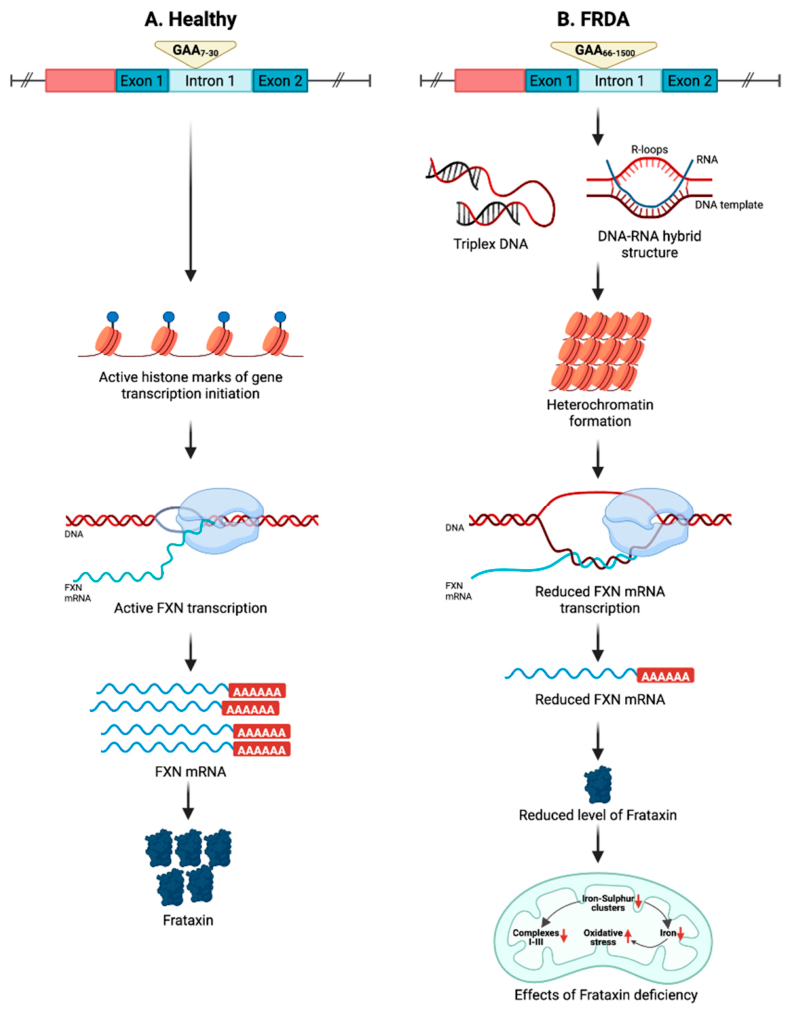
Figure 2.
Multisystem manifestations of Friedreich ataxia (FRDA). Schematic overview of the major clinical features of FRDA, highlighting its multisystem involvement.
Figure 2.
Multisystem manifestations of Friedreich ataxia (FRDA). Schematic overview of the major clinical features of FRDA, highlighting its multisystem involvement.
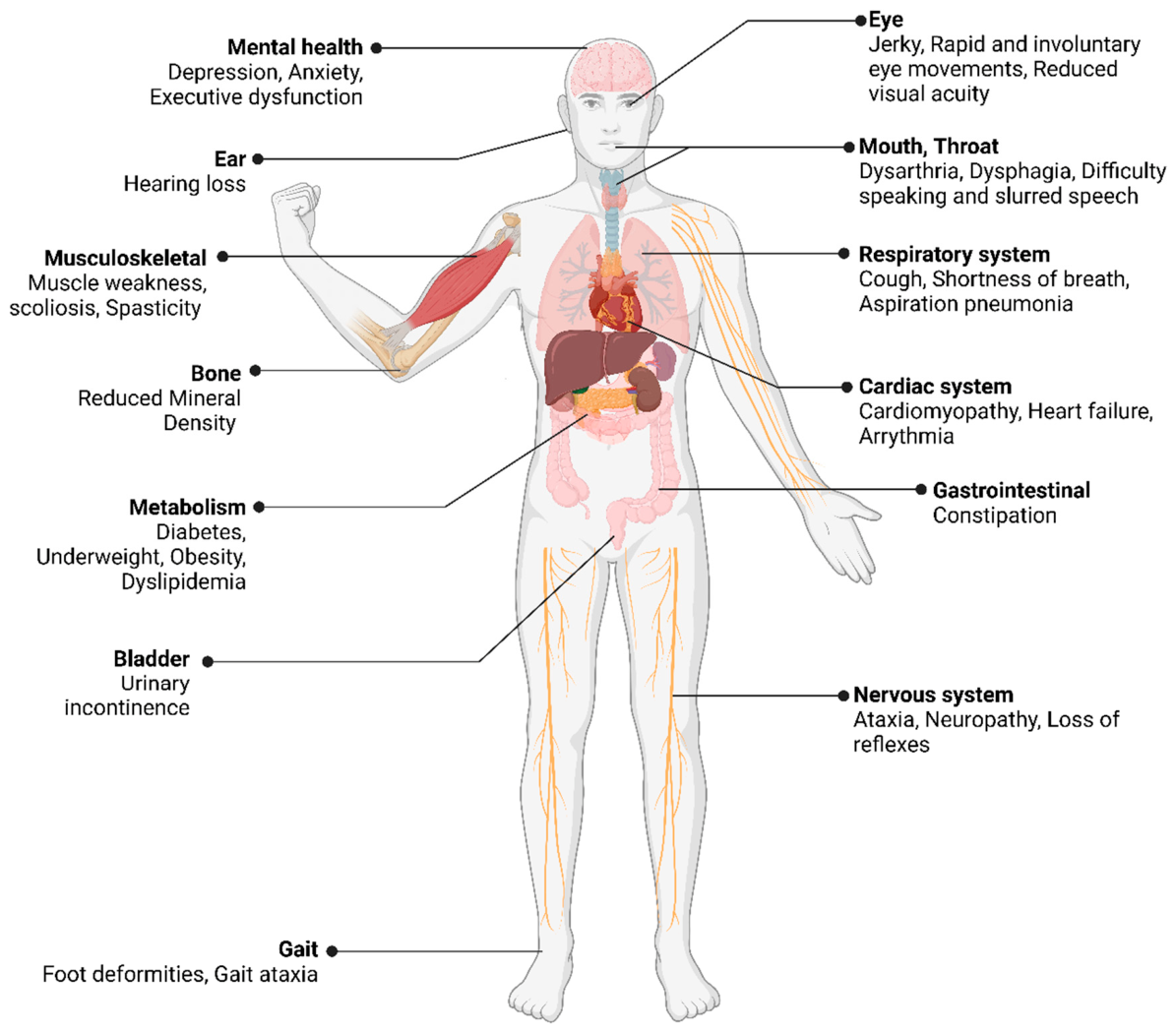

| Category | Therapy | Mechanism of action | Clinical status/ Pre-clinical status/ Key findings |
| Approved Therapy | Omaveloxolone (Skyclarys™) | Activates Nrf2 → improves redox balance, reduces oxidative stress, supports mitochondrial function | FDA (2023), EU (2024); improves mFARS; slows progression (~55% over 3 years); mild side effects (↑ liver enzymes, cholesterol) |
| Oxidative Stress & Mitochondrial Dysfunction | Vatiquinone (PTC-743) | Inhibits 15-lipoxygenase → reduces oxidative stress & ferroptosis | Phase 3 (MOVE-FA); no primary endpoint met; improved fatigue & stability; ~50% progression delay (extension) |
| Resveratrol | Antioxidant; improves mitochondrial function | Phase 2 completed; mixed results; high dose limited by GI side effects | |
| Elamipretide (SS-31) | Binds cardiolipin → improves mitochondrial respiration & ATP | Ongoing Phase 1/2 (ELViS-FA); targeting vision & cardiac function | |
| MIB-626 (NMN) | Increases NAD⁺ → enhances mitochondrial metabolism | Phase 2 (open-label); improved bioenergetics; further trials planned | |
| Frataxin Restoration / Metabolic Modulation | Nomlabofusp (CTI-1601) | Frataxin replacement protein → mitochondrial delivery | Phase 2; ↑ frataxin (~⅓ normal); well tolerated; frequent dosing needed |
| Dimethyl fumarate (DMF) | ↑ FXN expression + activates Nrf2 | Ongoing Phase 2 trial | |
| Leriglitazone (MIN-102) | PPARγ agonist → improves mitochondrial function & metabolism | Phase 2; modest biomarker improvements; well tolerated | |
| DT-216 | GeneTAC™ → bypasses GAA transcription block | Phase 1; ↑ FXN mRNA; optimized version in development | |
| Etravirine | Repurposed HIV drug → increases frataxin (unclear mechanism) | Phase 2 pilot; transient neurological improvement | |
| Artesunate | Restores TfR1 trafficking → reduces iron overload | Early clinical investigation | |
| RGFP109 (HDAC inhibitor) | Reverses FXN gene silencing via histone acetylation | Phase 1; ↑ FXN mRNA; no proven clinical benefit yet | |
| Lipid Metabolism | RT001 | Stabilizes lipids → reduces peroxidation | Phase 2; no significant clinical benefit |
| Gene Therapy | LX2006 (AAVrh.10hFXN) | AAV-based FXN delivery to heart | Phase 1/2; ↑ cardiac frataxin (~5×); well tolerated |
| ASP2016 (AAV8-FXN) | Gene replacement targeting cardiomyocytes | Preclinical success; Phase 1 planned | |
| ASO-Based Therapies | Multiple ASO strategies | Target GAA repeat, stabilize mRNA, anti-gene DNA targeting, splice correction | Strong preclinical data; challenges: delivery, PK, off-target effects |
| CRISPR/Cas Approaches | Gene editing strategies | Repeat excision, base editing, ex vivo HSPC correction | Preclinical stage; restores FXN expression; promising but early |
Disclaimer/Publisher’s Note: The statements, opinions and data contained in all publications are solely those of the individual author(s) and contributor(s) and not of MDPI and/or the editor(s). MDPI and/or the editor(s) disclaim responsibility for any injury to people or property resulting from any ideas, methods, instructions or products referred to in the content. |
© 2026 by the authors. Licensee MDPI, Basel, Switzerland. This article is an open access article distributed under the terms and conditions of the Creative Commons Attribution (CC BY) license.
Copyright: This open access article is published under a Creative Commons CC BY 4.0 license, which permit the free download, distribution, and reuse, provided that the author and preprint are cited in any reuse.


