

Submitted:
14 April 2026
Posted:
15 April 2026
You are already at the latest version
Abstract
Agrotourism constitutes a key strategy to stimulate territorial development by enhancing endogenous resources in rural areas. However, conceptual and methodological gaps persist regarding the definition of farms with agrotourism potential (FPAT) and their articulation, which limits their effective development. The objective of this research was to conceptualize FPAT, their articulation among themselves and with the locality, and to operationalize this latter concept through georeferencing and the value chain approach, with the purpose of designing agrotourism routes and providing inputs for agrarian policies aimed at territorial development in Cuba. A mixed methodology was employed, integrating theoretical analysis, documentary review, and statistical tools, complemented with georeferencing techniques and value chain analysis. The results show that this approach enables the articulation of farms into agrotourism routes and proposes actions that strengthen local governance and community resilience.
Keywords:
territorial development
; farms with agrotourism potential (FPAT)
; articulation among farms with agrotourism potential
; georeferencing
; value chains
; agrarian economic policies
1. Introduction
Territorial development and agrotourism are closely linked through their capacity to diversify and enhance endogenous resources, generating benefits for local actors and the community as a whole. This collaboration functions as a catalyst for economic revitalization in rural areas. Achieving this requires the strengthening of governance systems that facilitate more harmonized, participatory, and sustainable management.
In this regard, the United Nations approved the 2030 Agenda for Sustainable Development in 2015. It established 17 goals and 169 targets that highlight, among other aspects, the close relationship between the agricultural sector and tourism. Specifically, Goals 2, 8, 12, 15, and 17 promote the need for intersectoral collaboration as a means to combat rural poverty, foster social inclusion, and advance territorial development with a transformative vision toward economic, social, and environmental sustainability (ECLAC, 2018, 2022, 2024; UNWTO, 2018; FAO, 2019; IICA, 2019; Balanta et al., 2022).
At the World Congresses on Agrotourism held in Bolzano, Italy in 2018, and in Mérida, the capital of the western region of Spain, on May 24–25, 2023, discussions highlighted the importance of this relationship. Their role in diversifying agricultural production and consolidating practices that foster territorial sustainability was emphasized. Concepts were clarified and challenges identified to strengthen the sector through networking and dynamic linkages among the involved sectors, supported by scientifically based methodologies and the incorporation of governmental, academic, private, and third-sector institutions (Anzardo et al., 2022; Noa & Gascón, 2023; Pérez Anzardo et al., 2023; Ragno & Pashikhina, 2018; Wendy, 2022).
In Cuba, the management of agrotourism does not resemble that of other nations that have advanced in this field. This form of alternative tourism is relatively recent in the country. Although it is primarily oriented toward agriculture and possesses significant agrotourism potential, it has not been efficiently utilized. Since 2004, the concept-movement of agrotourism and Slow Food began to be implemented, promoted by independent farms separately, with the aim of strengthening agriculture and diversifying income sources based on their own potential.
The Cuban government has launched strategies to promote agrotourism, such as the National Plan for Economic and Social Development 2030 (PNDES), which aligns with and responds to the strategies adopted by the United Nations. Its objective is to foster socioeconomic development adapted to the particularities of each territory, ensuring the well-being and prosperity of the population with equity and social justice. It also seeks to improve the connection between agriculture and tourism, which will increase export revenues, create new job opportunities, promote national and local culture, and strengthen linkages with domestic markets and national production (PCC, 2017).
For its part, the 2019 Constitution of the Republic grants autonomy to municipalities in Article 168 (Constitution of the Republic of Cuba, 2019, pp. 13–14), enabling them to address socioeconomic and structural issues within the territorial demarcation of each community through proper local governance. Likewise, the Guidelines of Economic and Social Policy of the Party and the Revolution for the period 2021–2026 define directives to strengthen territorial economic development. In this regard, Guidelines 37, 260, 262, 263, and 264 establish provisions that link the tourism and agricultural sectors as key drivers to achieve this objective, generating income for the benefit of both sectors and the community as a whole (PCC, 2021).
In this context, Decree 33/2021 on Strategic Management of Territorial Development, together with Decree 128/25 on Agroecology approved by the Council of Ministers, are considered the only regulatory references advocating for the proper use of endogenous potential. Both encourage the management of tourism from a local perspective and through productive linkages, based on resources with potential for development within the municipality. However, they do not establish guidelines for the use of farms as a distinctive element of agrotourism nor for their articulation into routes, which limits their full contribution to territorial development.
It is worth noting that, in the review of national and international literature on the subject (Alcalá & López, 2017; Blanco & Riveros, 2011; Cevallos, 2021; Cruz et al., 2013; Noboa, 2019; Rodríguez et al., 2016; Rodríguez et al., 2024; Saldaña, 2016), no conceptualization of farms with agrotourism potential (FPAT) nor of their articulation among themselves and with the locality was identified. This theoretical gap constitutes the main justification for the research. Therefore, its purpose is to introduce both concepts and to operationalize the latter through georeferencing and the value chain approach, with the aim of designing agrotourism routes and providing inputs for agrarian economic policies oriented toward territorial development in Cuba.
This study offers a dual contribution to the field of agrotourism and territorial development. First, it conceptualizes FPAT and their articulation—categories absent from the academic literature reviewed and necessary to understand the territorial dynamics of agrotourism. Second, it proposes the methodological operationalization of articulation through georeferencing and the value chain approach as the main tools for the creation of agrotourism routes. Furthermore, it provides inputs both for academic research and for the formulation of agrarian economic policies aimed at strengthening local governance and territorial development.
2. Literature Review
The literature on agrotourism acknowledges its role in productive diversification, and although proposals have been developed regarding rural tourism and agrotourism farms, conceptual and methodological gaps persist concerning the definition of farms with agrotourism potential (FPAT) and their articulation to form agrotourism routes that contribute to territorial development. This research therefore introduces a new specific analytical category (FPAT) and their articulation. These units constitute the differentiating and central element for the design of agrotourism routes. However, this differs from what has been expressed by other authors who have focused their research on rural tourism or isolated farms without considering them as such (Alcalá & López, 2017; Blanco & Riveros, 2011; Cevallos, 2021; Noboa, 2019; Rodríguez et al., 2016; Rodríguez et al., 2024; Saldaña, 2016).
Similarly, several authors have employed terms such as productive articulation, associativity, cooperation, interconnection, and integration as synonyms (Alburquerque, 2014; González, 2009; López, 2019; Rojas, 2018; Gómez et al., 2020; Feijoo, 2018; Trujillo, 2022; Martínez, 2020, 2021), without a methodological framework that systematically links them to tools of territorial and socioeconomic analysis. This limitation reduces the capacity to translate these concepts into territorial practice. The deployment of both concepts in an integrated manner serves as an input for the generation of agrarian policies aimed at contributing to territorial development.
To achieve the optimal point of operationalization, two key instruments are highlighted: georeferencing and the value chain approach. The former is understood as the process of assigning geographic coordinates to objects or phenomena in order to integrate them into a spatial reference system, which allows for the localization of FPAT, the identification of strategic nodes (Cruz, 2010; Escamilla & López, 2017). In this context, it is used to spatially locate FPAT, their resources, infrastructures, and connections; to identify gaps that may generate conflicts; to detect strategic nodes; and to transform qualitative relationships into quantifiable inputs, based on connectivity, accessibility, and proximity among them and with the largest population settlements or nodal centers.
For this purpose, several tools are employed to collect, analyze, and represent geographic, biophysical, and socioeconomic information of the territory and/or geographic entity (farm) in both graphic and textual form. Among the tools used, participatory mapping stands out, considered a diagnostic technique that enables the representation of farms and their attributes as part of a process of observation, discussion, and reflection by the economic actors involved. Its use provides initial information for planning the management of FPAT and for evaluating changes resulting from proposed actions and environmental conditions (Cruz, 2010, cited in Espinoza, 2019).
In the field of Geographic Information Systems (GIS), map algebra is used for the processing of geographic data through the integration of cartographic layers, enabling the design and analysis of spatial data by applying a set of operators that transform a series of inputs into outputs, resulting in the identification of areas with specific features of interest (Moreno, 2008, cited in Alcalá & López, 2017).
This method serves as the foundation for the articulation among FPAT, based on the set of geoprocesses developed in each of them. Its essence lies in the construction of initial raster layers employed for these analyses. These layers are composed of digital photographs of the areas, satellite images, or scanned maps, organized into pixel grids as digital image elements or cell matrices, generally square in shape and of regular size (Alcalá & López, 2017).
Thus, through geospatial analysis that allows the identification and connection of the tourist areas of interest in each FPAT, their resources are identified with the aim of designing the most suitable route for the development of the agrotourism product and the elements that, in the short, medium, and long term, could be integrated to promote this tourism modality and, with it, territorial development. Field surveys are used to capture the coordinates of FPAT with a global positioning system (GPS), supported by digitization and georeferencing processes through a Geographic Information System (GIS).
Additionally, orthophotos or satellite imagery and reference cartography from OpenStreetMap are employed as a base. Coordinates are digitized as vector layers in the GIS, and basic metadata are recorded (date, device, and approximate accuracy). Subsequently, the layers are exported in interoperable formats (GeoPackage / GeoJSON / KML) for analysis and dissemination.
Once the agrotourism elements are located on each farm map, territorial concentration is established through a point density analysis supported by GIS (Barbini, 2003; Correa et al., 2017; Lazo, 2002; Madruga, 2015; Nova, 2012; Ragno & Pashikhina, 2018). For this purpose, an analysis is required that shows the factors according to their concentration and relationship, through a new layer based on the overlay method (Moreno, 2008), which allows the combination of cartography created for each element by summing all density layers and accessibility maps according to the aggregation of FPAT maps within the same space.
In density analysis, higher values indicate concentration while lower values reflect dispersion. Accessibility analysis, in turn, involves the reclassification of the values obtained to assign greater weight to shorter travel distances than to longer ones. The information generated represents a new source of data that enables the connection among FPAT and the establishment of the most suitable route, highlighting points of interest, activities to be carried out, available services, and access routes.
It should be noted that georeferencing not only allows for the visualization of proximity or distance among farms, but also identifies how this spatial relationship can maximize results and minimize costs, thereby transforming spatial dispersion into an added value for the agrotourism product. Along these lines, farms as the distinctive element of agrotourism contribute, through their specificity, natural and/or built resources, agricultural practices, and cultural traditions to a collective offer (Pérez Anzardo et al., 2023; Rodríguez Alonso, 2019; Vélez Betancourt, 2020).
The value chain approach, for its part, constitutes an analytical framework that spans from the acquisition of inputs to the final sale, aimed at improving competitiveness and equity among actors. It allows for the examination of the environment, roles, and interactions, as well as support services, thereby guiding the formulation of strategies directed toward generating sustainable socioeconomic value and long-term impact. Moreover, it describes the set of interrelated activities that create value in a product or service, from raw materials to distribution and final sale (Alcalá & López, 2017; Cifuentes et al., 2011; Muñoz, 2010, cited in Franco et al., 2020; Madruga, 2015).
This method reflects an economic sequence involving primary production, transformation, transportation, commercialization, distribution, and consumption. Madruga (2015) organizes these elements into three categories: essential links, which include activities related to the physical generation of the product and its delivery to consumers; support activities, associated with the supply of inputs, provision of services, and personnel training; and strategic activities, which influence competitiveness and are linked to organizational structure and technology.
As Cifuentes et al. (2011) affirm, knowledge of the market and information sharing facilitate the organization of the value chain and foster collaboration among actors, ensuring quality, access, and sustainability. Therefore, the chain is considered stronger when fair and efficient relationships exist, production aligns with demand, innovation and cost optimization are achieved, and access to information, resources, negotiation capacity, and rewards are distributed according to effort and risk assumed. Its robustness depends both on operational efficiency and on equity in relationships and shared access to resources.
The above is supported by the initial conceptualization of the value chain proposed by Michael Porter in 1985, who defined that every company generates value through primary activities related to inbound logistics, operations, outbound logistics, marketing and sales, and service; and support activities associated with infrastructure, human resources, technology, and procurement. Although the complete model encompasses multiple links, in the agro-productive and tourism fields, primary production, transformation, and commercialization have been highlighted as essential (Alcalá & López, 2017; Cifuentes et al., 2011; Muñoz, 2010, cited in Franco et al., 2020; Madruga, 2015), due to their relevance in sectoral dynamics.
Thus, we concur with Muñoz (2010, cited in Franco Romero et al., 2020), who defines that value chains in the tourism sector:
“Thus, we concur with Muñoz (2010, cited in Franco Romero et al., 2020), who defines that value chains in the tourism sector “allow the offering of packages that ensure a minimum cost for a given level of tourist satisfaction. They also involve adequately combining transportation, accommodation, and activities at the destination, in addition to optimizing the overall service delivery process, where the elimination of unnecessary processes reduces costs and improves service provision” (p. 5).
In the agrotourism context, the links of the value chain are adjusted to local practices and territorial integration. Primary production is connected with industrial or artisanal transformation processes, depending on resource availability, technical capacity, sanitary regulations, and market preferences. Commercialization, in turn, materializes in the tourist experience that integrates sustainability, culture, and the local economy. Consequently, it is necessary for participating actors to recognize that they are part of a broader system, with interrelations and dependencies that must be managed to maximize the utility of all components and contribute to territorial development.
Along these lines, farms as the distinctive element of agrotourism contribute, through their specificity, natural and/or built resources, agricultural practices, and cultural traditions to a collective offer. Therefore, a key component of economic analysis is the study of primary production costs. Their calculation makes it possible to determine crop profitability, plan, control, and make decisions to optimize processes and increase profits. Through complementarity and cooperation among farms, a value chain is formed that can generate authentic, competitive experiences consistent with territorial development (Castillo-Martínez et al., 2025; Pérez Anzardo et al., 2023; Rodríguez Alonso, 2019; Vélez Betancourt, 2020).
It is also essential to analyze critical points related to those processes, support activities, or stages where the greatest risks and impacts are concentrated, in order to achieve maximum competitiveness based on existing demand and competition. Internal vertical and horizontal relationships must also be considered, including producers, institutions, and public and private entities that provide financing, training, inputs, and research services.
It is worth emphasizing that one of the main aspects to be considered is costs, which are conceived as resources invested (economic, human, logistical, symbolic) to ensure that the different processes are coordinated and generate added value. The dynamics are systemic and relational, depending on the interactions among actors and the degree of territorial integration achieved, which goes beyond the traditional view of costs as mere operating expenses (Medina-Rojas, 2025). They are not limited to optimizing supply or improving the visitor’s experience, but rather emerge from cooperative relationships among producers, operational coordination, and the construction of territorial complementarities.
Secondary service providers are also important, as they are present in most chains and their support is often less costly; in some cases, their participation contributes to the proper functioning of the chain. Likewise, social effects must be considered, such as job creation for vulnerable groups in the locality, women’s participation, the level of socio-organizational strengthening of communities, and environmental impacts. These elements demonstrate the contribution of agrotourism to territorial development.
Value chain mapping is a tool that allows for a detailed understanding of all activities carried out during the process, while critical point analysis helps mitigate risks and plan strategies to be followed. Altogether, this enables the establishment of sustainability strategies and the creation of a basis for monitoring improvements in income, benefit distribution across the different links, and the conservation of natural resources. To achieve this, it is necessary to provide relevant information to the different actors so that they can make informed decisions, define improvement actions, and design and implement strengthening and support projects.
This approach enables productive and socioeconomic articulation between farms with agrotourism potential (FPAT) and the locality through resource optimization and diversification of the offer, generating added value with both individual and collective benefits. The analysis shows that this depends on the coordination among different processes and appropriate governmental management; since not all farms have inputs, infrastructure, or technical capacities to implement agrotourism, it is necessary to articulate them in order to consolidate more attractive and complementary routes (Alcalá & López, 2017; Cifuentes et al., 2011; Muñoz, 2010, cited in Franco et al., 2020; Madruga, 2015).
In this line of thought, international experiences highlight the need to link the design of agrotourism routes with agrarian economic policies, given that the articulation between agriculture and tourism cannot be consolidated without an institutional framework that guarantees incentives, regulation, and equitable distribution of benefits (ECLAC, 2024; FAO, 2019; PCC, 2017, 2021). Such policies include financing actions for farms, training programs and product certification, creation of territorial brands, and strengthening of local governance, which allow the transformation of endogenous potential into sustainable development strategies.
3. Materials and Methods
The research adopts a mixed approach that combines qualitative and quantitative methods with a descriptive scope. The general method employed was the dialectical–materialist, aimed at developing cognitive and creative capacities that allow for a deeper understanding of the essence of phenomena. Within this framework, theoretical methods were applied, notably the historical–logical, analytical–synthetic, and inductive–deductive. Empirical methods were related to psychosocial instruments for information gathering, such as interviews, as well as statistical methods processed through specialized software, including VOSviewer, which enabled the identification of trends, regularities, and relationships with the phenomenon under study.
Complementarily, two key methodological tools were incorporated to operationalize the concept of articulation between FPAT and the locality: georeferencing and the value chain approach. The former made it possible to spatially locate farms, identify strategic nodes, and transform qualitative relationships into quantifiable inputs; while the latter allowed for the analysis of productive and tourism activities as interrelated links, optimizing processes and evaluating the distribution of benefits. Together, these methods and tools facilitated the construction of an analytical framework that supported the formulation of conclusions and the proposal of public policies oriented toward sustainable territorial development.
4. Results and Discussion
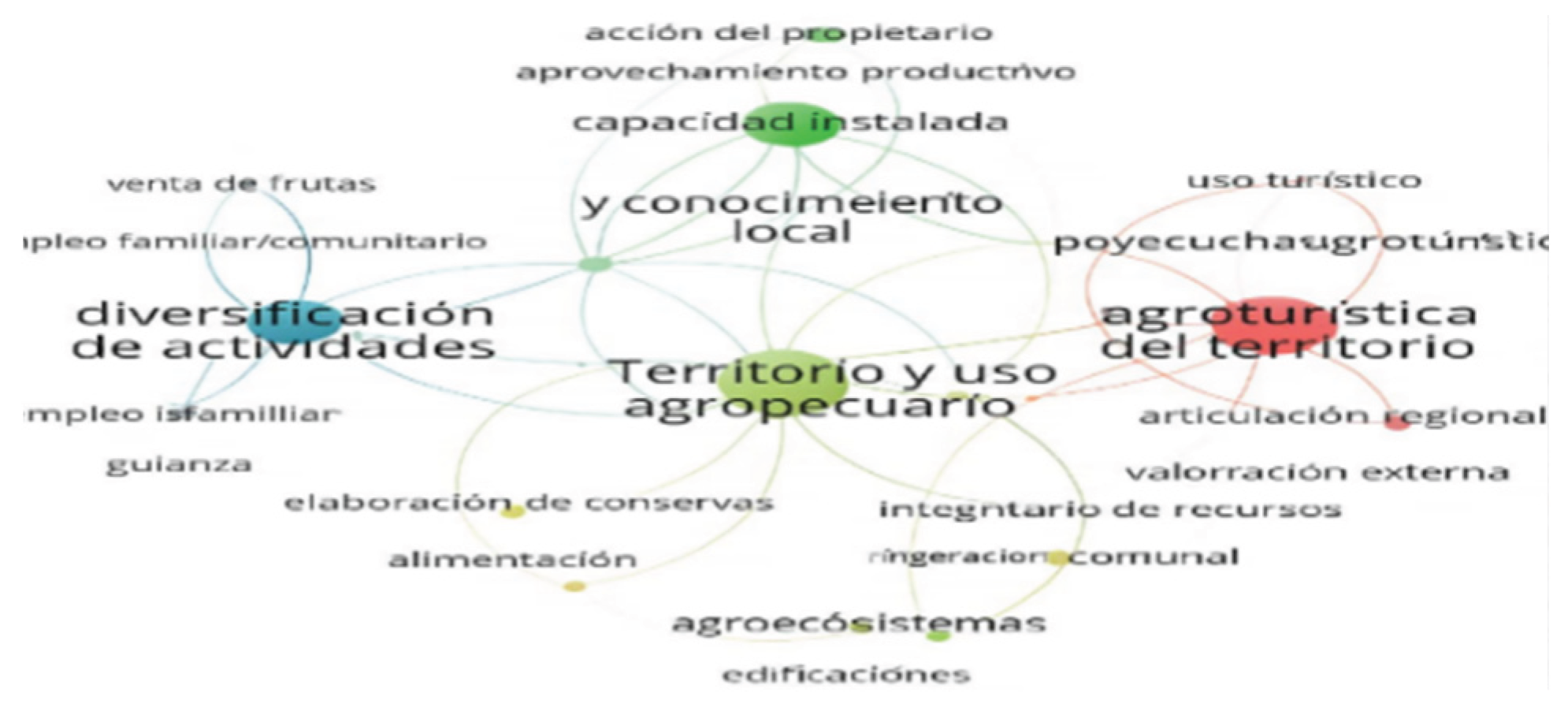
Based on an analysis of seven concepts of farms associated with agrotourism (Balanta et al., 2022; Blanco & Riveros, 2011; Cevallos, 2021; Lazo et al., 2017; Muñoz & Zambrano, 2021; Noboa, 2019; Saldaña, 2016), the use of each variable in defining the construct was identified. In order to establish the conceptual line of the scientific field related to FPAT, a total of 356 keywords were processed in the VOSviewer software, developed by Van Eck and Waltman (2010), through the co-occurrence of terms using the full counting method, and those with a frequency of appearance greater than or equal to 5 were selected. This procedure enabled the creation of a network of term relationships, composed of 13 nodes grouped into four relevant clusters, as shown in Figure 1.
The clusters identified in the context of agrotourism and rural revitalization are fundamentally interrelated to promote sustainable development. The first cluster, focused on territory and agricultural use, establishes the foundation upon which other activities are built. It emphasizes the importance of properly managing territory and agricultural practices, which enables the development of agrotourism activity, represented by the second cluster. This cluster expresses the connection of visitors with rural life, where the characteristics of the territory and local production are leveraged. The third cluster, encompassing installed capacity and knowledge, is crucial for the success of these activities, as adequate infrastructure and deep local knowledge optimize both resource management and the tourism offer.
Finally, the cluster of activity diversification is linked to the previous ones by allowing the expansion of offerings beyond traditional agricultural practices, incorporating recreational and cultural experiences that attract different types of tourists. This diversification must be aligned with territorial characteristics and sustainable practices, ensuring a positive impact on the local economy and environmental conservation. Together, these clusters form an integrated system that strengthens the agrotourism potential of farms, enabling the effective articulation of strategies for territorial transformation and rural revitalization.
Surrounding these clusters are transformative variables that expand the impact of farms beyond their productive scale and generate synergies that directly influence territorial development in municipalities with agricultural presence. Among these variables are technological innovation, which improves efficiency and the quality of services offered; training and capacity building for farmers and local entrepreneurs, essential to maximize agrotourism potential through sustainable practices and proper tourism management. In addition, collaboration routes among producers, tourism enterprises, and local organizations foster the exchange of resources and knowledge, thereby enhancing the development of farm-based agrotourism activities.
These transformative variables, when interacting with FPAT, not only contribute to job creation and the strengthening of the circular economy, but also improve the tourism positioning of the territory and raise the quality of life of the rural communities involved. In this sense, farms act not only as productive units but also as strategic platforms for sustainable endogenous development, where independent variables (such as innovation and training) influence dependent variables, which are the tangible results in territorial development.
Consequently, agrotourism potential is conceived as the latent capacity of a farm to develop and sustain competitive, sustainable, and territorially integrated agrotourism activities. It results from the combination of tangible attributes (natural resources, infrastructure, accessibility, productive diversity) and intangible ones (social capital, reputation, local knowledge, cultural identity, management capacities). This potential is a necessary but not sufficient condition: it requires processes of articulation within the value chain and insertion into agrotourism routes in order to materialize into economic, social, cultural, environmental, and politico-territorial benefits. From a systems perspective, potential is neither static nor exclusively inherent to the farm; rather, it depends on market configurations, public policies, information technologies, and cooperation networks.
An operational framework can decompose this potential into subdimensions:
- ✓ Resource potential: landscape diversity, environmental quality, biocultural richness, water availability, and attractive climate.
- ✓ Productive potential: variety of crops and production systems, level of technification, agroecological practices, and production seasonality.
- ✓ Service potential: lodging and food infrastructure, signage, road and digital accessibility, and visitor service capacities.
- ✓ Sociocultural potential: local knowledge, identity, narratives, and community social capital.
- ✓ Institutional-relational potential: participation in associations, cooperatives, or tourism networks; access to support programs; and level of internal family/community organization.
- ✓ Market potential: proximity to source markets, connectivity, visibility on digital platforms, and complementarity with other territorial attractions.
As a result of the analysis of scientific production and the co-occurrence of terms, a new concept of FPAT was defined, understood as: a limited territorial extension that allows for the diversification of its primary activity through the use of its natural and/or built resources, the possibility of articulation among them, as well as the infrastructure of the locality. This determines its short-, medium-, and long-term projection, which, for its valorization as a tourism use, requires public action to contribute to territorial development.
The prevailing reality in many regions with agricultural vocation and latent tourism attractions is that of farms with agrotourism potential operating as isolated productive units, which severely limits their competitiveness, resilience, and capacity to generate a transformative impact on the territory. This fragmentation leads to negative externalities such as duplication of efforts, inability to scale offerings, lack of coordination with markets, and a marginal contribution to local socioeconomic development (Rivera & Hernández, 2020). In this scenario, articulation emerges not as an option but as a strategic necessity. Without articulation, agrotourism potential remains underutilized, and subsistence models are replicated that fail to capture greater added value or foster endogenous and sustainable territorial development.
Hence, it is necessary to conceive articulation among these farms as a deliberate process of coordination and cooperation among actors (producers, local governments, MSMEs, cooperatives, community, and institutions) that enables the organization of the productive base, the construction of linkages, and the transformation of the territory’s comparative advantages into sustainable competitive advantages.
Thus, in order to structure a concept of its own, the traits attributed in the literature to productive articulation, associativity, cooperation, interconnection, and integration were identified (Alburquerque, 2014, 2015; López, 2019; González, 2009; Rojas, 2018; Gómez et al., 2020; Feijoo, 2018; Trujillo, 2022; Martínez, 2020, 2021), since these terms are often used as synonyms but present nuances that condition the focus and outcomes of development strategies. Based on these traits, the conceptual foundations for an operational definition are established, adapted to the Cuban context and oriented toward measuring its contribution to territorial development.
From this perspective, articulation among FPAT requires strategic triangulation among local public actors, private enterprises, and community organizations; for it is not only about receiving tourists but about weaving a network that captures and distributes the value generated in the territory, so that success depends less on the individual farm and more on the strength of the articulated network. Consequently, articulation among FPAT is much more than a commercial strategy: it is a comprehensive territorial development policy.
Therefore, the author of this research considers that articulation among FPAT should be understood as a comprehensive strategy aimed at contributing to territorial development through associativity and cooperation among farms and local actors, using the value chain approach to design coherent agrotourism routes and packages that highlight cultural traditions and local products. In this way, it maximizes the economic impact of each farm, strengthens the cultural identity of the territory, improves the quality of services offered, and creates a diversified offer that responds to market demands. Thus, articulation becomes a driver of sustainable development that benefits both producers and the community as a whole.
The construct of articulation of farms with agrotourism potential is conceptualized as a multidimensional and dynamic process that transcends mere operational coordination. It involves the deliberate construction of a territorialized socio-productive system, where farms interact to:
- ✓ Integrate resources and complementarities: share infrastructure, landscapes, traditional knowledge, biodiversity, and products to create a diversified and coherent agrotourism offer.
- ✓ Generate network economies and collective learning: strengthen capacities through knowledge exchange, joint innovation, and the creation of a common territorial identity and brand.
- ✓ Collaboratively govern the territory: establish collective decision-making mechanisms that enable the sustainable management of common goods (landscape, water, culture) and ensure a more equitable distribution of the benefits generated.
This articulation is therefore the catalytic mechanism that transforms a set of isolated farms into an integrated agrotourism product, where the visitor’s experience is enriched and the economic impact is multiplied and redistributed across the territory. In this way, articulation becomes a mechanism of sustainable development that transcends the productive sphere and strengthens the community as a whole.
The proposed definition seeks to construct a theoretical–methodological concept that facilitates its operationalization and clarifies the relevant empirical elements related to the FPAT concept presented earlier. It allows for the evaluation of the benefits of articulation for farms and their contribution to territorial development, by explaining how they relate to each other and to other actors within the territorial system.
To operationalize the articulation among farms with agrotourism potential, it is necessary to consider two analytical categories: the degree of articulation and the level of interaction among actors of FPAT, both of which are crucial for the success of agrotourism routes with a value chain approach. These categories enable a deeper understanding of the dynamics of articulation among farms and other territorial actors, while also contributing to sustainable development and the strengthening of local communities involved in agrotourism. This framework is supported by georeferencing and the value chain approach, which make it possible to understand how FPAT are integrated into cooperation networks and how the intensity of their linkages contributes to territorial development.
The practical validation of the procedure in the municipalities of Rafael Freyre, Antilla, and Gibara in the province of Holguín demonstrated the relevance of the proposed methodological tools. In Rafael Freyre, agro-livestock routes were structured with an emphasis on biodiversity and accessibility; in Antilla, routes were designed that articulated coastal farms with agricultural and fishing activities supported by GIS systems; while in Gibara, routes focused on the synergy between productive and heritage dimensions, integrating urban agriculture and cultural traditions. These results show how the combination of georeferencing and value chains transformed local experiences into coherent and competitive agrotourism products, providing concrete inputs for territorial development.
Georeferencing, in particular, proved its capacity to establish spatial connectivity among farms, identify strategic nodes, and optimize visitor mobility. This tool converted qualitative relationships into quantifiable inputs and revealed how spatial dispersion can become an added value for the agrotourism product. Consequently, it was consolidated as a key instrument for operationalizing FPAT articulation and strengthening territorial planning, by integrating resources, infrastructures, and accessibility into a more efficient and sustainable system.
The value chain approach facilitated cooperation among agricultural, cultural, and community actors, which increased the competitiveness of agrotourism products and their impact on territorial development. However, the experience in the three municipalities confirms that this articulation cannot be sustained solely through local practice, but requires a solid institutional framework. Hence the importance of establishing agrarian policies that institutionalize the articulation of FPAT, ensuring that agrotourism routes are not only designed but consolidated as instruments of local governance, community resilience, and sustainable territorial development.
The analysis shows that this depends on the coordination among different processes and appropriate governmental management; since not all farms have inputs, infrastructure, or technical capacities to implement agrotourism, it is necessary to articulate them in order to consolidate more attractive and complementary routes (Alcalá & López, 2017; Cifuentes et al., 2011; Muñoz, 2010, cited in Franco et al., 2020; Madruga, 2015). Likewise, the critical point analysis revealed unequal availability of infrastructure, limited technical training in some farms, and the need to strengthen inter-institutional coordination—factors that condition the sustainability of the routes.
In this regard, although methodological tools (georeferencing and value chains) facilitate the creation of agrotourism routes, it is public policies that ensure these routes effectively contribute to sustainable territorial development. Therefore, it is proposed that municipal governments and governmental actors generate agrarian policies aimed at institutionalizing FPAT articulation, so that agrotourism routes are consolidated as instruments of local governance, community resilience, and sustainable territorial development.
Among these policies, the following stand out:
- ✓ Financing for infrastructure and services: allocate economic resources to improve roads, lodging, signage, and technologies, ensuring that farms and agrotourism routes are competitive and accessible.
- ✓ Quality certifications: establish accreditation mechanisms that guarantee production and service standards, facilitating access to premium markets and increasing the profitability of local products.
- ✓ Joint commercialization: create formal organizations that group FPAT to sell in a coordinated manner, based on market studies and demand trends, thereby avoiding fragmentation and strengthening the collective offer.
- ✓ Specialized working groups: integrate state and non-state enterprises together with complementary services (gastronomy, transportation, culture) to diversify the offer and generate stronger productive linkages.
- ✓ Territorial branding: develop a common identity that encompasses the products and services of FPAT, differentiating the offer in national and international markets and positioning the territory as a unique destination.
- ✓ Strategic promotion and communication: implement marketing campaigns that position agrotourism routes as quality destinations in national and international markets, increasing their visibility and attractiveness.
- ✓ Knowledge management and continuous training: promote training programs for farmers, entrepreneurs, and technicians linked to the value chain, ensuring innovation, sustainability, and professionalization of the sector.
Taken together, these agrarian policies make it possible to move from isolated local experiences to an institutionalized model of territorial development, where FPAT articulated in agrotourism routes become engines of economic, social, and cultural transformation.
5. Conclusion
FPAT constitute a differentiating element within agrotourism as a specialized segment of rural tourism, by directly linking agricultural production with the tourist experience. Hence, articulation among them and with the locality emerges as a necessary condition for agrotourism to transcend the individual scale and become a territorial development strategy. However, the results confirm what has been noted in the literature: limitations related to infrastructure, technical capacity, and institutional coordination persist, which must be addressed to ensure sustainability.
Similarly, it is observed that, in Cuban territorial practice, georeferencing and thematic maps have been underutilized and not systematically integrated into municipal planning, which restricts local governments from properly using endogenous resources and defining agrarian policies oriented toward territorial development. Likewise, the use of the value chain approach has been limited, as operational models that articulate farms, institutions, and communities are lacking, and scarce strategic planning together with weak intersectoral articulation hinder the analysis and guarantee of an equitable distribution of benefits among actors.
This coincides with the gaps identified in the literature review, where concepts such as associativity or cooperation are mentioned but without methodological tools that link them to territorial management. The practical validation in Holguín demonstrates that the combination of georeferencing and value chains can overcome these limitations, provided it is accompanied by agrarian policies that institutionalize articulation and ensure an equitable distribution of benefits.
The research introduces two novel concepts: FPAT and their articulation. The latter can be operationalized through methodological tools such as georeferencing and the value chain approach. This contribution expands the theoretical framework of agrotourism by offering replicable analytical categories that allow for understanding the transition from isolated farms to integrated territorial systems. Moreover, articulation is conceptualized as a multidimensional process that transcends operational coordination and becomes a territorial development policy. In this way, the research provides a theoretical–methodological framework that can be adapted to other rural contexts, thereby enriching the international literature on alternative tourism and local development.
The validation in municipalities of Holguín confirms that the proposal is applicable and generates economic, social, and cultural benefits. Georeferencing enabled the optimization of spatial connectivity and visitor mobility, while the value chain approach strengthened cooperation among agricultural, cultural, and community actors. However, its consolidation depends on agrarian policies that support the articulation between agriculture and tourism, requiring priority actions such as securing financing, developing a territorial brand, and certifying products, among others. These measures are not isolated actions but policies aimed at institutionalizing FPAT articulation and transforming agrotourism routes into instruments of local governance and community resilience.
The main limitation lies in the absence of socioeconomic indicators and specific indices that allow for a comprehensive measurement of the benefits of agrotourism articulation. In this line of thought, future research should advance in estimating the economic, social, cultural, environmental, and politico-territorial impact of articulated FPAT, as well as in designing methodologies to calculate the feasibility and sustainability of the routes.
It is also recommended to incorporate local development projects (LDP) as spaces for validation and transfer of the procedure, to promote its adaptation to other Latin American countries with similar agro-productive and cultural conditions, and to develop research on the design of agrotourism products with a value chain approach. These lines of work will make it possible to move toward a model of smart agrotourism, capable of integrating technological innovation, sustainability, and international cooperation, thereby consolidating the relevance of the proposal in different rural contexts.
References
- Alcalá, M.; López, J. Tipología de fincas rurales y su papel en el desarrollo territorial . In Universidad Nacional de Colombia; 2017; Available online: https://repositorio.unal.edu.co.
- Alburquerque, F. El enfoque del desarrollo económico territorial; Conferencia: Igorre, Bizkaia, España, 2014. [Google Scholar]
- Alburquerque, F.; Dini, M.; Pérez, R. El enfoque del desarrollo económico territorial . In Enfoque, estrategias e información para el desarrollo territorial: Los aprendizajes desde ConectaDEL; Costamagna, P., Pérez Rozzi, S., Eds.; 2015; pp. 15–38. Available online: https://publications.iadb.org/es/enfoque-estrategias-e-informacion-para-el-desarrollo-territorial-los-aprendizajes-desde-conectadel.
- Balanta Martínez, V. J.; López de Parra, L.; García Capdevilla, D. A. Análisis de los factores socioeconómicos de la agricultura familiar campesina de subsistencia en el agroturismo . Revista FACE 2022, 22(1). Available online: https://revistaface.unilibre.edu.co/index.php/fac/article/view/682. [CrossRef]
- Barbini, B. Viabilidad del turismo productivo agropecuario en el interior bonaerense . Aportes y Transferencia 2003, 7(1), 97–108. Available online: https://www.redalyc.org/pdf/276/27600707.pdf.
- Blanco, M.; Riveros, H. El agroturismo como diversificación de la actividad agropecuaria y agroindustrial . Estudios Agrarios 2011, 49, 117–128. [Google Scholar]
- Castillo-Martínez, D. C.; Mera-Guzmán, P. E.; Palomino-Siza, L. B.; Chicaiza-Lema, N. F. Cadena de valor y eficiencia de costos en el agroturismo de la provincia Tungurahua: Value chain and cost efficiency in agrotourism in the province of Tungurahua. Multidisciplinary Latin American Journal (MLAJ) 2025, 4(1), 142–154. [Google Scholar] [CrossRef]
- CEPAL. La Agenda 2030 y los Objetivos de Desarrollo Sostenible: Una oportunidad para América Latina y el Caribe . 2018. Available online: https://bibliotecadigital.ccb.org.co/items/aa326bc6-c65e-4b8e-9eb2-7ac96ee22944/full.
- CEPAL. Turismo rural y desarrollo sostenible en América Latina . In Naciones Unidas.; 2022; Available online: https://repositorio.cepal.org/handle/11362/48221.
- CEPAL. Panorama del desarrollo territorial de América Latina y el Caribe, 2024: Nuevas capacidades para la transformación territorial . 2024. Available online: https://repositorio.cepal.org/server/api/core/bitstreams/53af3201-1171-419e-9dd7-aa9eb20caace/content.
- Cevallos Tulcanaza, V. G. Fincas con potencial agroturístico y el aporte al turismo rural en la parroquia de Maldonado . Tesis de grado inédita, 2021. [Google Scholar]
- Cifuentes Álvarez, W.; Pérez, M. J.; Gil-Casares Mesonero-Romanos, M. Metodología de análisis de cadenas productivas bajo el enfoque de cadenas de valor; Fundación CODESPA, 2011; Available online: http://www.codespa.org.
- Constitución de la República de Cuba. Constitución de la República.; Editorial Universitaria, 2019. [Google Scholar]
- Consejo de Ministros. Decreto 33/2021: Para la Gestión Estratégica del Desarrollo Territorial. Gaceta Oficial de la República de Cuba. 2021. Available online: http://www.gacetaoficial.gob.cu/es/decreto-332021.
- Correa Escribano, M.; Hernández Companioni, J. C.; Loredo Carballo, N. La cadena productiva del ecoturismo como contribución al desarrollo local . Retos de la Dirección 2017, 11(1), 147–171. Available online: http://scielo.sld.cu/scielo.php?script=sci_arttext&pid=S2306-915520170001000.
- Cruz, J. Mapeo participativo de fincas: Una guía para implementarlo. CATIE. 2010. Available online: https://repositorio.catie.ac.cr/handle/11554/6695.
- Cruz, L.; Arencibia, L. R.; Alamino, R. Propuesta de un procedimiento para la selección de espacios rurales con fines de agroturismo . Revista Cubana de Investigaciones Turísticas. Retos Turísticos 2013, 12(1), 1–13. Available online: https://retosturisticos.umcc.cu/index.php/retosturisticos/issue/view/30.
- Escamilla, B. A.; López, Á. L. Zonas con potencial agroturístico en la región citrícola de Nuevo León, México: Un análisis a partir del álgebra de mapas . Cuadernos de Turismo 2017, 39, 17–40. [Google Scholar] [CrossRef]
- Espinoza, M. El agroturismo, una visión desde el desarrollo sostenible . Centro Agrícola 2019, 46(1), 62–66. Available online: http://scielo.sld.cu/scielo.php?script=sci_arttext&pid=S0253-57852019000100062.
- FAO. Marco de la FAO sobre pobreza extrema rural: Hacia el logro de la meta 1.1 de los Objetivos de Desarrollo Sostenible . 2019. Available online: https://www.fao.org/documents/card/es/c/ca4819es.
- Feijoo, D. C. La asociatividad en las pequeñas empresas: Incidencia económica en los miembros de la asociación agraria bananera fincas de El Oro . Tesis de licenciatura; Universidad Técnica de Machala, 2018. Available online: https://repositorioslatinoamericanos.uchile.cl/handle/2250/4647634.
- Gómez Prieto, J. L.; Ramírez Pérez, J. F.; Zaldívar Puig, M. Sistemas productivos locales y turismo: Alternativa para el desarrollo socioeconómico en Cuba . Cooperativismo y Desarrollo 2020, 8(1), 115–130. Available online: http://coodes.upr.edu.cu/index.php/coodes/article/view/273.
- IICA. Informe anual de 2019 del IICA.; Instituto Interamericano de Cooperación para la Agricultura, 2019; Available online: https://hdl.handle.net/11324/15258.
- Lazo, C. Modelo de dirección del desarrollo local con enfoque estratégico . Tesis doctoral inédita;Experiencia en Pinar del Río, Universidad “Hermanos Saíz Montes de Oca”, 2002. [Google Scholar]
- López, M. Agroturismo y sostenibilidad en fincas rurales . Revista de Desarrollo Local 2019, 8(2), 33–49. Available online: https://revistadeldesarrollolocal.org/index.php/rd/article/view/198.
- Madruga Torres, A. G. Aglomeraciones productivas como base para los sistemas productivos locales . Tesis doctoral inédita, Universidad de Camagüey, 2015. [Google Scholar]
- Medina-Rojas, I. D. Perspectivas sobre la cadena de valor en la agricultura: una revisión semisistemática de la literatura . Entramado doi.org in Bing. 2025, 21(1), e11796. [Google Scholar] [CrossRef]
- Muñoz, A. Logística y turismo. Ediciones Díaz de Santos; 2010; Available online: https://books.google.com.co/books?id=HXG1zMNHiw0C.
- Noboa Abdo, L. A. Diseño de un sistema de certificación de calidad para fincas agroturísticas . Tesis inédita, 2019. [Google Scholar]
- Noa Guerra, D.; Gascón González, D. Producto agroturístico finca La Prometida, una oportunidad de desarrollo local para el municipio Bolivia . Retos de la Dirección 2023, 17(3). Available online: http://scielo.sld.cu/scielo.php?script=sci_arttext&pid=S2306-91552023000300009.
- Organización Mundial del Turismo (OMT). La contribución del turismo a los objetivos de desarrollo sostenible en Iberoamérica . doi.org in Bing. 2018. [CrossRef]
- Pérez Anzardo, L. E.; Infante Estrabao, F.; Hechavarría Laffita, U. Análisis del sector agropecuario como soporte del agroturismo para potenciar el desarrollo local . Revista de Investigación Latinoamericana en Competitividad Organizacional 2023, 5(18), 18–32. [Google Scholar] [CrossRef]
- Ragno, R.; Pashikhina, A. 1er Congreso Mundial de Agroturismo WCA 2018. Alba Sud 2018, 25(11). [Google Scholar]
- Rodríguez Alonso, G. El agroturismo, una visión desde el desarrollo sostenible . Centro Agrícola 2019, 46(1), 62–65. Available online: http://scielo.sld.cu/scielo.php?script=sci_arttextypid=S0253-57852019000100062.
- Vélez Betancourt, A. F. Estrategia de competitividad de la cadena de valor del cacao, con enfoque de conservación del bosque seco tropical en Montes de María . Tesis de pregrado;Universidad del Valle, Facultad de Ciencias Sociales y Económicas, Programa de Economía, 2020. [Google Scholar]
- Wendy, R. C. Agroturismo como alternativa económica en el municipio de Guachetá, Cundinamarca . Tesis inédita, 2022. [Google Scholar]
Figure 1.
Figure 1. Co-occurrence network of terms with VOSviewer / Red de co-ocurrencia de términos con VOSviewer. An analysis of seven concepts associated with agrotourism processed with the VOSviewer software to create a co-occurrence network of the most significant clusters and variables, as well as their interrelationships. / Análisis realizado a siete conceptos de fincas asociadas al agroturismo procesados mediante el software VOSviewer para crear una red de co-ocurrencia de los clústeres y variables más significativas, así como las relaciones entre ellas.
Figure 1.
Figure 1. Co-occurrence network of terms with VOSviewer / Red de co-ocurrencia de términos con VOSviewer. An analysis of seven concepts associated with agrotourism processed with the VOSviewer software to create a co-occurrence network of the most significant clusters and variables, as well as their interrelationships. / Análisis realizado a siete conceptos de fincas asociadas al agroturismo procesados mediante el software VOSviewer para crear una red de co-ocurrencia de los clústeres y variables más significativas, así como las relaciones entre ellas.
Disclaimer/Publisher’s Note: The statements, opinions and data contained in all publications are solely those of the individual author(s) and contributor(s) and not of MDPI and/or the editor(s). MDPI and/or the editor(s) disclaim responsibility for any injury to people or property resulting from any ideas, methods, instructions or products referred to in the content. |
© 2026 by the authors. Licensee MDPI, Basel, Switzerland. This article is an open access article distributed under the terms and conditions of the Creative Commons Attribution (CC BY) license.
Copyright: This open access article is published under a Creative Commons CC BY 4.0 license, which permit the free download, distribution, and reuse, provided that the author and preprint are cited in any reuse.


