

Submitted:
13 April 2026
Posted:
15 April 2026
You are already at the latest version
Abstract
ADAM17 (a disintegrin and metalloproteinase 17) is increasingly recognized as a central regulator of multiple myeloma (MM) biology beyond its canonical role in TNF-α shedding. Rather than acting as a classical oncogenic driver, ADAM17 functions as a master regulator of ectodomain shedding, controlling the balance between membrane-bound and soluble mediators that shape signaling across the bone marrow microenvironment. Through coordinated processing of cytokines, cytokine receptors, growth factor ligands, and adhesion molecules, ADAM17 amplifies inflammatory signaling, endothelial activation, immune dysfunction, and tumor dissemination.In MM, ADAM17 contributes to key pathogenic processes by modulating the spatial and temporal dynamics of extracellular communication. Shedding of CX3CL1 and adhesion molecules such as JAM-A promotes angiogenesis and vascular niche remodeling, while IL-6R cleavage enables trans-signaling that sustains stromal activation, chronic inflammation, and malignant plasma cell survival. In parallel, ADAM17-dependent processing of immune receptors, including CD62L, alters lymphocyte trafficking and immune surveillance, contributing to an immunologically permissive niche. Proteolytic remodeling of adhesion systems may also facilitate niche escape and extramedullary dissemination.These coordinated shedding events define a dynamic myeloma “sheddome,” in which ADAM17 acts as a systems-level node integrating tumor, stromal, endothelial, and immune signals. This framework helps explain the context-dependent and pleiotropic effects of ADAM17 throughout disease evolution. Clinically, circulating ADAM17 shows promise as a dynamic biomarker reflecting tumor burden, microenvironmental activation, and immune dysfunction. However, therapeutic targeting remains challenging because of substrate redundancy, systemic functions, and the risk of disrupting physiological immune regulation. Future strategies will require selective and context-aware modulation of ADAM17-driven shedding networks to effectively reprogram the myeloma microenvironment.
Keywords:
ADAM17
; multiple myeloma
; tumor microenvironment
Introduction
ADAM17 was initially identified as the protease responsible for the release of soluble TNF-α, but this original definition no longer captures the full biological breadth of the enzyme.1,2 Beyond TNF-α processing, ADAM17 regulates ectodomain shedding across multiple substrate classes, including cytokines, cytokine receptors, growth factor ligands, and adhesion molecules, thereby controlling how signals are generated, spatially distributed, and perceived within tissues.2 As proposed by Scheller and colleagues, ADAM17 functions as a molecular switch of inflammation and tissue regeneration because shedding can simultaneously terminate membrane-confined signaling while generating soluble mediators with paracrine activity.3 This systems-level perspective is particularly relevant in cancer, where the biological output of ADAM17 depends less on individual substrates than on the composite extracellular signaling state generated by coordinated shedding events.3
This framework is especially pertinent in multiple myeloma (MM), a disease in which malignant plasma cells are tightly dependent on the bone marrow microenvironment.4 Myeloma progression is sustained not only by tumor-intrinsic programs, but also by reciprocal interactions with endothelial cells, stromal cells, osteolineage populations, inflammatory myeloid cells, and dysfunctional lymphoid effectors.5 In this context, the pathogenic relevance of ADAM proteases is increasingly linked to extracellular matrix remodeling, cytokine release, and microenvironmental support rather than to classical mutation-driven oncogenic mechanisms.6,7
Within this landscape, ADAM17 is best understood as a regulator of the soluble signaling interface connecting tumor cells to their niche. A paradigmatic MM-specific example is the CX3CL1/fractalkine axis: bone marrow CX3CL1 levels are increased in active MM, correlate with microvessel density, and promote angiogenesis, while its release from endothelial cells depends on ADAM10/17-mediated cleavage in response to tumor-associated inflammatory cues.8,9 Similarly, ADAM17-mediated shedding of IL-6R enables IL-6 trans-signaling, expanding inflammatory and trophic signaling beyond IL-6R–expressing cells and reinforcing stromal and endothelial activation.10,11
The immune and adhesive dimensions further strengthen this model. As the main sheddase for CD62L/L-selectin, ADAM17 regulates immune-cell trafficking and activation thresholds, and elevated ADAM17 in MM has been associated with reduced CD62L expression on marrow T-cell subsets and altered immune infiltration patterns.12,13 In parallel, ADAM17 substrates include adhesion molecules such as JAM-A/F11R, whose cleavage may shift them from membrane-bound regulators of cell contact to soluble effectors with distinct signaling functions. This is particularly relevant in MM, where JAM-A has already been implicated in endothelial activation, angiogenesis, and disease progression.8,9,14-17
Overall, current evidence supports a model in which ADAM17 does not act as a classical oncogenic driver, but as a network orchestrator of the myeloma microenvironment. By regulating the balance between membrane-bound and soluble mediators, ADAM17 reshapes the spatial range, intensity, and cellular ownership of signaling across tumor, stromal, endothelial, and immune compartments, thereby contributing to disease progression.
Microenvironmental Dependency and Proteolytic Control
The transition from MGUS to overt multiple myeloma (MM) is increasingly recognized as a multicellular evolutionary process driven by progressive reprogramming of the bone marrow ecosystem rather than by plasma cell–intrinsic changes alone.18 Endothelial and mesenchymal stromal cells are key players in this evolution, acquiring pro-tumorigenic features including enhanced angiogenesis, inflammatory cytokine production, and permissive extracellular matrix remodeling.19-21 These changes actively contribute to clonal expansion, immune escape, and dissemination.22,23
This shift toward a tumor-supportive niche highlights the importance of regulatory mechanisms beyond transcriptional control. Among these, proteolytic remodeling of the cell surface and extracellular space has emerged as a critical determinant of disease progression.24-26 Several ADAM metalloproteinases, including ADAM8, ADAM9, and ADAM15, have been implicated in MM through effects on proliferation, extracellular matrix interaction, and clinical outcome.6 However, their effects are generally linked to localized signaling events such as adhesion turnover or receptor activation.27,28
ADAM17 occupies a distinct position within this network as a master regulator of ectodomain shedding rather than a direct intracellular signaling effector.29,30 By controlling the release of cytokines, cytokine receptors, growth factor ligands, and adhesion molecules, ADAM17 regulates the balance between membrane-bound and soluble signaling states.31 This is mechanistically important because shedding expands the spatial reach of local signals, allowing endothelial activation or stromal inflammation to propagate across the niche.32 This role becomes particularly relevant during disease progression, when endothelial and stromal compartments adopt inflammatory and pro-angiogenic phenotypes increasingly sustained by soluble mediators.33,34 In this setting, ADAM17-dependent shedding links niche reprogramming to functional output by amplifying inflammatory loops and weakening adhesion-dependent retention.3,35 This framework helps explain why ADAM17, despite limited evidence as a classical oncogenic driver, remains consistently associated with MM progression).17 Rather than initiating transformation, ADAM17 acts as a context-dependent amplifier of stromal, endothelial, and immune signals, placing it at the intersection of angiogenesis, chronic inflammation, and loss of niche dependency.3,36
Angiogenesis: A Prototypical ADAM17-Driven Circuit
Angiogenesis is one of the clearest processes linking ADAM17 to multiple myeloma (MM), as bone marrow vascular remodeling is tightly coupled to inflammation and endothelial activation during disease progression. A paradigmatic example is the CX3CL1/fractalkine axis, which illustrates how tumor-derived inflammatory cues are translated into pro-angiogenic endothelial outputs through proteolytic shedding.8
CX3CL1 exists as both a membrane-bound adhesion molecule and a soluble chemokine generated through ADAM10/17-mediated cleavage. In MM, bone marrow CX3CL1 levels are increased and correlate with microvessel density, supporting its functional relevance in disease-associated angiogenesis.8,9 Importantly, malignant plasma cells are not the main source of CX3CL1; rather, they induce its endothelial expression and release through inflammatory mediators such as TNF-α.37-39 This positions ADAM17 as a key amplifier of endothelial inflammatory signaling rather than a direct initiator of angiogenesis.13
This model is reinforced by the role of JAM-A in MM.16 Endothelial JAM-A is upregulated in active disease, correlates with poor outcome, and contributes to angiogenesis, microenvironmental remodeling, and tumor growth.40,41 As a dynamic regulator of endothelial permeability and migration, JAM-A can also undergo ADAM17-mediated cleavage, generating soluble fragments with biological activity.14,42,43
Together, these findings support a model in which ADAM17 coordinates endothelial surface remodeling by coupling chemokine release with adhesion reprogramming.44,45 The result is a qualitatively altered vascular niche characterized by enhanced permeability, aberrant signaling, and sustained tumor–endothelial cross-talk, thereby contributing to a pro-angiogenic sheddome that supports MM progression.46-52
Inflammatory Amplification and IL-6 Trans-Signaling
The IL-6 axis is a central signaling dependency in multiple myeloma (MM), sustaining not only malignant plasma cell survival but also the inflammatory architecture of the bone marrow niche.53 Because IL-6 is produced mainly by stromal and accessory cells, its biological impact depends largely on receptor availability and signaling range).54
In this context, ADAM17 occupies a pivotal regulatory position through its role in IL-6 receptor (IL-6R) shedding. As one of the principal sheddases of membrane-bound IL-6R, ADAM17 generates soluble IL-6R (sIL-6R), thereby enabling IL-6 trans-signaling.55 This mechanism fundamentally expands the spatial reach of IL-6: instead of remaining restricted to IL-6R–expressing cells, IL-6/sIL-6R complexes can activate gp130-positive stromal, endothelial, and immune cells throughout the niche.56,57
In MM, this converts IL-6 signaling from a localized trophic cue into a distributed microenvironmental circuit that reinforces tumor survival, stromal activation, endothelial remodeling, and chronic inflammation.58,59 Importantly, IL-6R shedding is dynamic: inflammatory stimuli and cellular stress enhance ADAM17 activity, increasing sIL-6R release and creating a feed-forward loop in which inflammation amplifies its own signaling network.55,60
From a systems perspective, ADAM17 determines not simply the intensity but the range and persistence of IL-6 signaling within the marrow.61-63 This helps explain why IL-6 remains central to MM despite limited tumor-intrinsic alterations in the pathway: disease dependency may be sustained, at least in part, by proteolytic mechanisms that expand and stabilize inflammatory signaling.64-67 Beyond direct effects on myeloma cells, ADAM17-mediated IL-6 trans-signaling also shapes immune responses and endothelial activation, reinforcing its broader role as an orchestrator of the MM microenvironment.68
Immune Dysfunction: A Context-Dependent Role
Immune dysfunction is a hallmark of MM, characterized by progressive impairment of both innate and adaptive immunity, including NK-cell exhaustion, T-cell dysfunction, and defective immune surveillance.13,65,66 In this context, ADAM17 intersects with immune regulation primarily through ectodomain shedding of key surface receptors.
A paradigmatic substrate is CD62L/L-selectin, which is essential for lymphocyte homing and immune surveillance. ADAM17-mediated cleavage reduces CD62L surface expression and alters trafficking patterns, thereby reshaping T-cell localization and activation dynamics.69,70 Clinically, elevated circulating ADAM17 has been associated with reduced CD62L expression on marrow T cells and altered immune infiltration patterns, supporting a role for ADAM17 in remodeling the immune landscape rather than directly suppressing effector cells.69,71,72
However, the role of ADAM17 in MM immunity is not unidirectional. Beyond excessive shedding, physiological ADAM17 activity is also required for receptor turnover and dynamic regulation of immune activation, including NK-cell ligand processing and co-stimulatory pathways.66,73 In this sense, both excessive and insufficient shedding may be detrimental: hyperactivation of ADAM17 can promote immune evasion through receptor loss, whereas inadequate shedding may impair receptor turnover, favoring chronic stimulation and functional exhaustion.74,75
Taken together, these observations support a model in which ADAM17 acts as a regulator of immune receptor homeostasis rather than as a simple suppressor of anti-tumor immunity. In MM, perturbations in this balance may contribute to the establishment of an immunologically permissive niche, with important therapeutic implications for strategies aimed at modulating ADAM17 activity.74-76
ADAM17 in Adhesion Remodeling, Dissemination, and Biomarker Potential
Extramedullary dissemination marks a critical transition in MM, reflecting not only greater aggressiveness and treatment resistance but also a profound reprogramming of tumor–microenvironment interactions.62,77 This process depends on disruption of adhesion systems that normally anchor myeloma cells within the bone marrow niche and provide survival and drug-resistance signals.78-81
In this context, JAM-A is a particularly relevant substrate. Beyond its structural role at intercellular junctions, JAM-A functions as a signaling scaffold regulating polarity, migration, and tumor–microenvironment interactions, and can undergo proteolytic cleavage into soluble fragments with pro-migratory activity.16,82-86 Disruption of JAM-A–integrin–tetraspanin signaling complexes enhances cytoskeletal dynamics and motility, providing a plausible mechanism for niche escape and dissemination.87-89 This is consistent with proteomic data showing that extramedullary MM is associated with circulating signatures enriched for adhesion-related proteins and soluble mediators, supporting a shift from adhesion-dependent retention to circulation-compatible programs.67 Together, these findings suggest that ADAM17-dependent adhesion remodeling may facilitate dissemination by weakening niche retention while promoting invasive signaling.90
This same systems-level role makes ADAM17 an attractive dynamic biomarker. Recent longitudinal data show that circulating ADAM17 levels increase across disease stages and correlate with clinical burden and organ involvement, including renal dysfunction.91,92 Unlike conventional static biomarkers, ADAM17 may capture the integrated state of tumor burden, microenvironmental activation, and immune dysfunction.17,43,93 Given its central role in regulating cytokine, receptor, and adhesion shedding, circulating ADAM17 may provide a real-time readout of extracellular signaling dynamics, with potential value for disease monitoring and early detection of progression, although current evidence remains limited by small cohorts and assay variability.94-98
A Unifying Model: The Myeloma “Sheddome”
Current evidence supports a shift from a pathway-centric view of ADAM17 toward a systems-level model in which its pathogenic relevance lies in coordinating extracellular signaling across the myeloma microenvironment.99 Ectodomain shedding is not merely degradative: by simultaneously reducing membrane-bound receptor availability and generating soluble ligands or receptor fragments, ADAM17 reshapes the spatial range and duration of signaling within the bone marrow niche.100
In multiple myeloma, this is reflected in the coordinated release of mediators that regulate angiogenesis, inflammation, immune function, and adhesion. CX3CL1 shedding amplifies vascular remodeling, IL-6R cleavage expands inflammatory trans-signaling, and CD62L processing alters immune-cell trafficking and activation.101 In parallel, proteolytic processing of adhesion molecules such as JAM-A couples niche detachment with migratory and invasive signaling, consistent with the context-dependent role of tight junction proteins in cancer progression.93,102
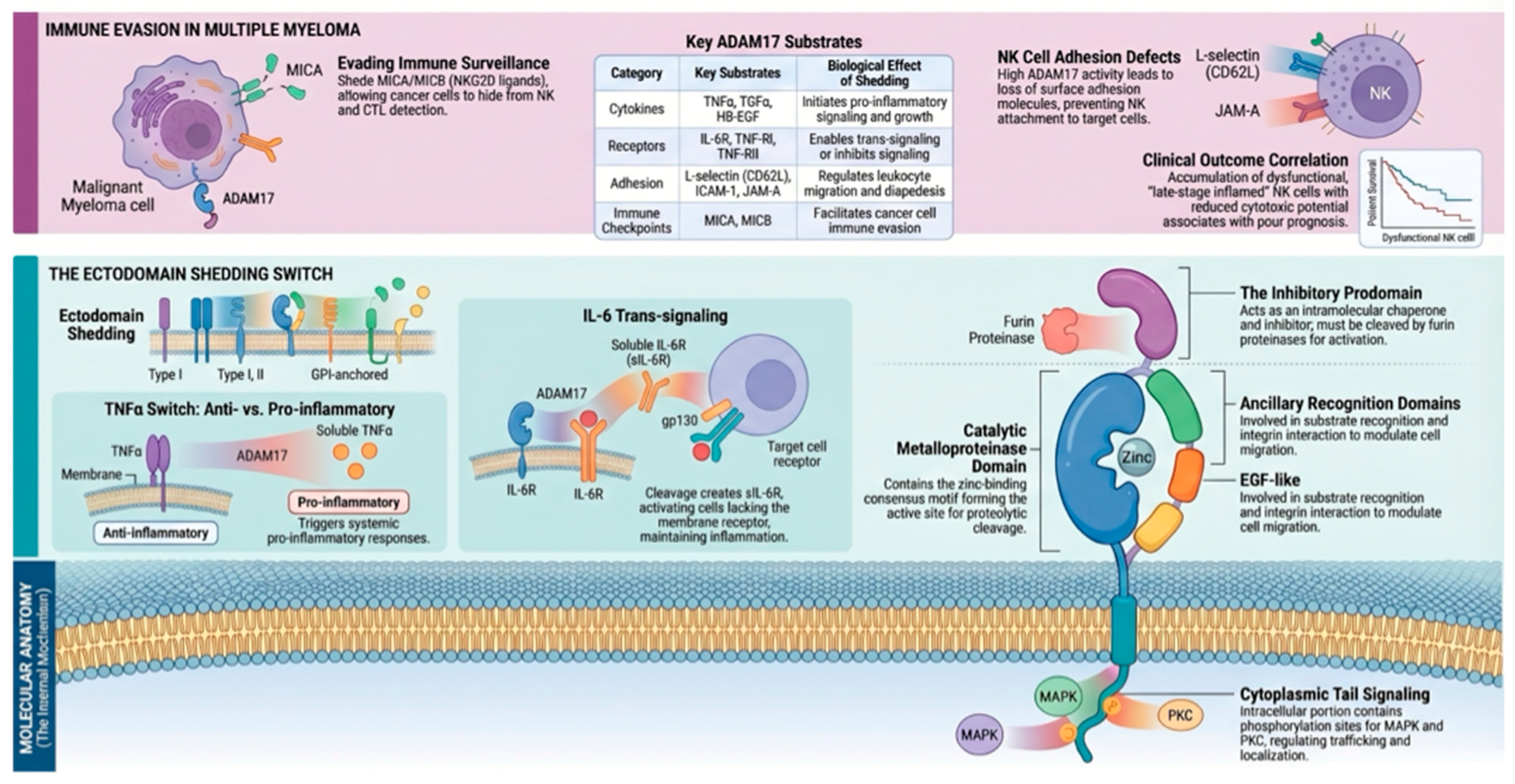
These processes define a dynamic myeloma “sheddome”: a continuously evolving extracellular signaling state determined by the balance between membrane-bound and soluble cytokines, receptors, and adhesion molecules.10,94 In this framework, ADAM17 acts as a central regulatory node that converts localized microenvironmental cues into distributed signaling circuits spanning tumor, stromal, endothelial, and immune compartments, thereby sustaining progression, immune escape, and dissemination (Figure 1).103-105
This perspective has important therapeutic implications: the relevance of ADAM17 lies less in individual substrates than in its role as an architect of the extracellular signaling network that sustains disease, suggesting that effective targeting will require modulation of the broader sheddome rather than single pathways.106,107
Therapeutic Implications and Challenges
Despite its biological relevance, therapeutic targeting of ADAM17 remains challenging because of its broad substrate repertoire, systemic functions, and context-dependent effects across the myeloma niche.3,31,104 While ADAM17 promotes tumor-supportive programs in plasma cells, stromal cells, and endothelial compartments, it also contributes to immune receptor turnover and physiological immune regulation, making systemic inhibition potentially detrimental.
This challenge is compounded by substrate overlap within the ADAM family, particularly with ADAM10, which shares multiple cytokine, adhesion, and immune substrates and may compensate for ADAM17 inhibition. This redundancy likely contributes to the limited success of early broad-spectrum metalloproteinase inhibitors and highlights that shedding is regulated by a coordinated proteolytic network rather than a single enzyme.29,108
Future strategies will therefore require more selective and systems-oriented approaches. Rather than global blockade, targeting specific pathogenic shedding events, such as IL-6 trans-signaling or endothelial activation, or modulating ADAM17 activity in stromal and vascular niches while sparing immune compartments may offer a better therapeutic window.109 ADAM17-directed therapies will likely be most effective in combination settings. By reshaping the extracellular signaling milieu, ADAM17 modulation could enhance both immunotherapeutic and anti-angiogenic strategies, supporting a broader effort to reprogram the microenvironmental circuitry that sustains myeloma progression.103,110
Concluding Perspective
ADAM17 occupies a distinctive position in multiple myeloma biology that is not adequately captured by conventional oncogenic models. Its pathogenic relevance lies less in tumor-intrinsic genetic alterations than in its ability to regulate the conversion of membrane-bound signals into diffusible mediators, thereby reshaping communication across the tumor microenvironment.10,104
In MM, ADAM17 acts at the interface of malignant plasma cells, stromal cells, endothelial compartments, and immune populations by controlling the shedding of cytokines, receptors, adhesion molecules, and growth factor ligands. Through this function, it regulates not only signal availability but also spatial range, cellular reach, and persistence, thereby influencing angiogenesis, inflammation, immune dysfunction, and dissemination.6-8,13 This systems-level role helps explain the context-dependent and often paradoxical effects of ADAM17 in MM.31
The key challenge moving forward is not simply to validate ADAM17 as a biomarker or therapeutic target, but to define how its proteolytic activity shapes disease evolution over time, from MGUS progression to drug resistance and extramedullary spread. In this light, ADAM17 should be viewed less as an isolated molecule than as a conceptual framework for understanding MM as a dynamically regulated multicellular ecosystem. Dissecting and ultimately modulating this proteolytic layer may be essential to develop more effective microenvironment-directed therapies.
Author Contributions
A.G.S. conceived the project; F.S., A.A. and A.G.S. acquired data; G.d.M., G.D., I.C. and V.D., did the article search. F.S. and A.G.S. wrote the first manuscript draft, which has been revised and approved by all the authors.
Acknowledgement and Funding
This study was funded by the Italian network of excellence for advanced diagnosis INNOVA, “Ministero della Salute” (code PNC-E3-2022-23683266 PNC-HLS-DA, to VD and AGS), and by European Union–Next Generation EU–NRRP M6C2–Investment 2.1 “Enhancement and strengthening of biomedical research in the NHS” (Italian Ministry of Health grant n. PNRR-POC-2022-12375862) to AGS. Moreover, this study was funded by “Fondo per il Programma Nazionale di Ricerca e Progetti di Rilevante Interesse Nazionale - PRIN” (code 2022ZKKWLW to AGS), and from the “Società Italiana di Medicina Interna-SIMI” 2023 Research Award (Camel to AGS).
Data Availability Statement
Not applicable.
Conflict of Interest
Authors declare no conflict of interest.
References
- Black, R.A.; Rauch, C.T.; Kozlosky, C.J.; Peschon, J.J.; Slack, J.L.; Wolfson, M.F.; Castner, B.J.; Stocking, K.L.; Reddy, P.; Srinivasan, S.; Nelson, N.; Boiani, N.; Schooley, K.A.; Gerhart, M.; Davis, R.; Fitzner, J.N.; Johnson, R.S.; Paxton, R.J.; March, C.J.; Cerretti, D.P. A metalloproteinase disintegrin that releases tumour-necrosis factor-alpha from cells. Nature 1997, 385(6618), 729–33. [Google Scholar] [CrossRef] [PubMed]
- Gooz, M. ADAM-17: the enzyme that does it all. Crit Rev Biochem Mol Biol. 2010, 45(2), 146–69. [Google Scholar] [CrossRef]
- Scheller, J.; Chalaris, A.; Garbers, C.; Rose-John, S. ADAM17: a molecular switch to control inflammation and tissue regeneration. Trends Immunol 2011, 32(8), 380–7. [Google Scholar] [CrossRef]
- Solimando, A.G.; Malerba, E.; Leone, P.; Prete, M.; Terragna, C.; Cavo, M.; Racanelli, V. Drug resistance in multiple myeloma: Soldiers and weapons in the bone marrow niche. Front Oncol. 2022, 12, 973836. [Google Scholar] [CrossRef]
- Gullà, A.; Dhodapkar, M.V.; Einsele, H.; Raab, M.S.; Solimando, A.G.; Botta, C.; Turi, M.; Sester, L.S.; Portuguese, A.J.; Steinbrunn, T.; Anderson, K.C. Rethinking Multiple Myeloma Treatment: The Biological and Clinical Insights Guiding Immune-Based Combinations. Blood Cancer Discov. 2026, 7(2), 176–194. [Google Scholar] [CrossRef]
- Evers, M.; Stühmer, T.; Schreder, M.; Steinbrunn, T.; Rudelius, M.; Jundt, F.; Ebert, R.; Hartmann, T.N.; Bargou, R.C.; Rosenwald, A.; Leich, E. Association of ADAM family members with proliferation signaling and disease progression in multiple myeloma. Blood Cancer J 2024, 14(1), 156. [Google Scholar] [CrossRef]
- Evers, M.; Schreder, M.; Stühmer, T.; Jundt, F.; Ebert, R.; Hartmann, T.N.; Altenbuchinger, M.; Rudelius, M.; Kuric, M.; Rindt, W.D.; Steinbrunn, T.; Langer, C.; Heredia-Guerrero, S.C.; Einsele, H.; Bargou, R.C.; Rosenwald, A.; Leich, E. Prognostic value of extracellular matrix gene mutations and expression in multiple myeloma. Blood Cancer J 2023, 13(1), 43. [Google Scholar] [CrossRef]
- Marchica, V.; Toscani, D.; Corcione, A.; Bolzoni, M.; Storti, P.; Vescovini, R.; Ferretti, E.; Dalla Palma, B.; Vicario, E.; Accardi, F.; Mancini, C.; Martella, E.; Ribatti, D.; Vacca, A.; Pistoia, V.; Giuliani, N. Bone Marrow CX3CL1/Fractalkine is a New Player of the Pro-Angiogenic Microenvironment in Multiple Myeloma Patients. Cancers (Basel) 2019, 11(3), 321. [Google Scholar] [CrossRef] [PubMed]
- Solimando, A.G.; Da Vià, M.C.; Leone, P.; Borrelli, P.; Croci, G.A.; Tabares, P.; Brandl, A.; Di Lernia, G.; Bianchi, F.P.; Tafuri, S.; Steinbrunn, T.; Balduini, A.; Melaccio, A.; De Summa, S.; Argentiero, A.; Rauert-Wunderlich, H.; Frassanito, M.A.; Ditonno, P.; Henke, E.; Klapper, W.; Ria, R.; Terragna, C.; Rasche, L.; Rosenwald, A.; Kortüm, M.K.; Cavo, M.; Ribatti, D.; Racanelli, V.; Einsele, H.; Vacca, A.; Beilhack, A. Halting the vicious cycle within the multiple myeloma ecosystem: blocking JAM-A on bone marrow endothelial cells restores angiogenic homeostasis and suppresses tumor progression. Haematologica 2021, 106(7), 1943–1956. [Google Scholar] [CrossRef] [PubMed]
- Schumacher, N.; Rose-John, S. ADAM17 Activity and IL-6 Trans-Signaling in Inflammation and Cancer. Cancers (Basel) 2019, 11(11), 1736. [Google Scholar] [CrossRef]
- Schumacher, N.; Rose-John, S. ADAM17 orchestrates Interleukin-6, TNFα and EGF-R signaling in inflammation and cancer. Biochim Biophys Acta Mol Cell Res. 2022, 1869(1), 119141. [Google Scholar] [CrossRef]
- Wang, Y.; Herrera, A.H.; Li, Y.; Belani, K.K.; Walcheck, B. Regulation of mature ADAM17 by redox agents for L-selectin shedding. J Immunol. 2009, 182(4), 2449–57. [Google Scholar] [CrossRef]
- Qu, J.; Li, Y.; Li, C.; Wu, D.; Cao, Y.; Xiao, S.; Bao, X.; Li, Q.; Chen, Z.; Chen, L. Longitudinal profiling of serum ADAM17 across clinical stages in multiple myeloma: a dynamic biomarker and its association with T cell alterations. Front Mol Biosci. 2026, 13, 1768193. [Google Scholar] [CrossRef]
- Lauko, A.; Mu, Z.; Gutmann, D.H.; Naik, U.P.; Lathia, J.D. Junctional Adhesion Molecules in Cancer: A Paradigm for the Diverse Functions of Cell-Cell Interactions in Tumor Progression. Cancer Res. 2020, 80(22), 4878–4885. [Google Scholar] [CrossRef]
- Koenen, R.R.; Pruessmeyer, J.; Soehnlein, O.; Fraemohs, L.; Zernecke, A.; Schwarz, N.; Reiss, K.; Sarabi, A.; Lindbom, L.; Hackeng, T.M.; Weber, C.; Ludwig, A. Regulated release and functional modulation of junctional adhesion molecule A by disintegrin metalloproteinases. Blood 2009, 113(19), 4799–809. [Google Scholar] [CrossRef]
- Solimando, A.G.; Brandl, A.; Mattenheimer, K.; Graf, C.; Ritz, M.; Ruckdeschel, A.; Stühmer, T.; Mokhtari, Z.; Rudelius, M.; Dotterweich, J.; Bittrich, M.; Desantis, V.; Ebert, R.; Trerotoli, P.; Frassanito, M.A.; Rosenwald, A.; Vacca, A.; Einsele, H.; Jakob, F.; Beilhack, A. JAM-A as a prognostic factor and new therapeutic target in multiple myeloma. Leukemia 2018, 32(3), 736–743. [Google Scholar] [CrossRef]
- Kummer, D.; Steinbacher, T.; Thölmann, S.; Schwietzer, M.F.; Hartmann, C.; Horenkamp, S.; Demuth, S.; Peddibhotla, S.S.D.; Brinkmann, F.; Kemper, B.; Schnekenburger, J.; Brandt, M.; Betz, T.; Liashkovich, I.; Kouzel, I.U.; Shahin, V.; Corvaia, N.; Rottner, K.; Tarbashevich, K.; Raz, E.; Greune, L.; Schmidt, M.A.; Gerke, V.; Ebnet, K. A JAM-A-tetraspanin-αvβ5 integrin complex regulates contact inhibition of locomotion. J Cell Biol. 2022, 221(4), e202105147. [Google Scholar] [CrossRef] [PubMed]
- Moser-Katz, T.; Joseph, N.S.; Dhodapkar, M.V.; Lee, K.P.; Boise, L.H. Game of Bones: How Myeloma Manipulates Its Microenvironment. Front Oncol 2021, 10, 625199. [Google Scholar] [CrossRef] [PubMed]
- Martello, M.; Solli, V.; Mazzocchetti, G.; Solimando, A.G.; Bezzi, D.; Taurisano, B.; Kanapari, A.; Poletti, A.; Borsi, E.; Armuzzi, S.; Vigliotta, I.; Pistis, I.; Desantis, V.; Marzocchi, G.; Rizzello, I.; Pantani, L.; Mancuso, K.; Tacchetti, P.; Testoni, N.; Nanni, C.; Zamagni, E.; Cavo, M.; Terragna, C. High level of circulating cell-free tumor DNA at diagnosis correlates with disease spreading and defines multiple myeloma patients with poor prognosis. Blood Cancer J 2024, 14(1), 208. [Google Scholar] [CrossRef]
- Solimando, A.G.; Di Palma, F.; Desantis, V.; Vacca, A.; Svelto, M.; Pisani, F. Tunneling nanotubes between bone marrow stromal cells support transmitophagy and resistance to apoptosis in myeloma. Blood Cancer J 2025, 15(1), 3. [Google Scholar] [CrossRef] [PubMed]
- Pilcher, W.C.; Yao, L.; Gonzalez-Kozlova, E.; Pita-Juarez, Y.; Karagkouni, D.; Acharya, C.R.; Michaud, M.E.; Hamilton, M.; Nanda, S.; Song, Y.; Sato, K.; Wang, J.T.; Satpathy, S.; Ma, Y.; Schulman, J.; D'Souza, D.; Jayasinghe, R.G.; Ohlstrom, D.; Ferguson, K.E.; Cheloni, G.; Bakhtiari, M.; Pabustan, N.; Nie, K.; Foltz, J.A.; Saldarriaga, I.; Alaaeldin, R.; Lepisto, E.; Chen, R.; Fiala, M.A.; Thomas, B.E.; Cook, A.; Santos, J.V.D.; I-Ling, C.; Figueiredo, I.; Fortier, J.; Slade, M.; Oh, S.T.; Rettig, M.P.; Anderson, E.; Li, Y.; Dasari, S.; Strausbauch, M.A.; Simon, V.A.; Radkevich, E.; Rahman, A.H.; Chen, Z.; Lagana, A.; DiPersio, J.F.; Rosenblatt, J.; Kim-Schulze, S.; Lonial, S.; Kumar, S.; Bhasin, S.S.; Kourelis, T.; Dhodapkar, M.V.; Vij, R.; Avigan, D.; Cho, H.J.; Mulligan, G.; Ding, L.; Gnjatic, S.; Vlachos, I.S.; Bhasin, M.; Immune Atlas Consortium. A single-cell atlas characterizes dysregulation of the bone marrow immune microenvironment associated with outcomes in multiple myeloma. Nat Cancer 2026, 7(1), 224–246. [Google Scholar] [CrossRef] [PubMed]
- Merz, M.; Hu, Q.; Merz, A.M.A.; Wang, J.; Hutson, N.; Rondeau, C.; Celotto, K.; Belal, A.; Alberico, R.; Block, A.W.; Mohammadpour, H.; Wallace, P.K.; Tario, J.; Luce, J.; Glenn, S.T.; Singh, P.; Samur, M.; Munshi, N.; Liu, S.; McCarthy, P.L.; Wei, L.; Hillengass, J. Spatiotemporal assessment of immunogenomic heterogeneity in multiple myeloma. Blood Adv. 2023, 7(5), 718–733. [Google Scholar] [CrossRef]
- Lutz, R.; Poos, A.M.; Solé-Boldo, L.; John, L.; Wagner, J.; Prokoph, N.; Baertsch, M.A.; Vonficht, D.; Palit, S.; Brobeil, A.; Mechtersheimer, G.; Hildenbrand, N.; Hemmer, S.; Steiger, S.; Horn, S.; Pepke, W.; Spranz, D.M.; Rehnitz, C.; Sant, P.; Mallm, J.P.; Friedrich, M.J.; Reichert, P.; Huhn, S.; Trumpp, A.; Rippe, K.; Haghverdi, L.; Fröhling, S.; Müller-Tidow, C.; Hübschmann, D.; Goldschmidt, H.; Willimsky, G.; Sauer, S.; Raab, M.S.; Haas, S.; Weinhold, N. Bone marrow breakout lesions act as key sites for tumor-immune cell diversification in multiple myeloma. Sci Immunol 2025, 10(104), eadp6667. [Google Scholar] [CrossRef]
- Brandl, A.; Solimando, A.G.; Mokhtari, Z.; Tabares, P.; Medler, J.; Manz, H.; Da Vià, M.C.; Croci, G.A.; Kurzwart, M.; Thusek, S.; Schneider, T.; Ebert, R.; Jakob, F.; Einsele, H.; Beilhack, A. Junctional adhesion molecule C expression specifies a CD138low/neg multiple myeloma cell population in mice and humans. Blood Adv. 2022, 6(7), 2195–2206. [Google Scholar] [CrossRef]
- Vogel, L.K.; Saebø, M.; Skjelbred, C.F.; Abell, K.; Pedersen, E.D.; Vogel, U.; Kure, E.H. The ratio of Matriptase/HAI-1 mRNA is higher in colorectal cancer adenomas and carcinomas than corresponding tissue from control individuals. BMC Cancer 2006, 6, 176. [Google Scholar] [CrossRef] [PubMed]
- Armistead, J.; Hatzold, J.; van Roye, A.; Fahle, E.; Hammerschmidt, M. Entosis and apical cell extrusion constitute a tumor-suppressive mechanism downstream of Matriptase. J Cell Biol. 2020, 219(2), e201905190. [Google Scholar] [CrossRef] [PubMed]
- Zhong, S.; Khalil, R.A. A Disintegrin and Metalloproteinase (ADAM) and ADAM with thrombospondin motifs (ADAMTS) family in vascular biology and disease. Biochem Pharmacol 2019, 164, 188–204. [Google Scholar] [CrossRef] [PubMed]
- Ma, B.; Yu, R. Pan-cancer analysis of ADAMs: A promising biomarker for prognosis and response to chemotherapy and immunotherapy. Front Genet. 2023, 14, 1105900. [Google Scholar] [CrossRef]
- Le Gall, S.M.; Maretzky, T.; Issuree, P.D.; Niu, X.D.; Reiss, K.; Saftig, P.; Khokha, R.; Lundell, D.; Blobel, C.P. ADAM17 is regulated by a rapid and reversible mechanism that controls access to its catalytic site. J Cell Sci. 2010, 123 Pt 22, 3913–22. [Google Scholar] [CrossRef]
- Zhang, W.; Xiang, Y.; Lu, C.; Wang, F.; Ren, H.; Wu, H.; Yan, M. The extracellular matrix in inflammation and cancer. Mol Biomed. 2026, 7(1), 21. [Google Scholar] [CrossRef]
- Liu, L.; Tian, E.; Quan, S.; Su, C.; Zhou, J.; Hu, S.; Bian, N.; Du, S.; Li, J. ADAM17 as a promising therapeutic target: from structural basis to inhibitor discovery in human diseases. Front Pharmacol 2025, 16, 1640090. [Google Scholar] [CrossRef] [PubMed]
- Wang, K.; Xuan, Z.; Liu, X.; Zheng, M.; Yang, C.; Wang, H. Immunomodulatory role of metalloproteinase ADAM17 in tumor development. Front Immunol 2022, 13, 1059376. [Google Scholar] [CrossRef] [PubMed]
- de Jong, M.M.E.; Kellermayer, Z.; Papazian, N.; Tahri, S.; Hofste Op Bruinink, D.; Hoogenboezem, R.; Sanders, M.A.; van de Woestijne, P.C.; Bos, P.K.; Khandanpour, C.; Vermeulen, J.; Moreau, P.; van Duin, M.; Broijl, A.; Sonneveld, P.; Cupedo, T. The multiple myeloma microenvironment is defined by an inflammatory stromal cell landscape. Nat Immunol 2021, 22(6), 769–780. [Google Scholar] [CrossRef]
- Du, J.; Lin, Z.; Fu, X.H.; Gu, X.R.; Lu, G.; Hou, J. Research progress of the chemokine/chemokine receptor axes in the oncobiology of multiple myeloma (MM). Cell Commun Signal 2024, 22(1), 177. [Google Scholar] [CrossRef] [PubMed]
- Düsterhöft, S.; Lokau, J.; Garbers, C. The metalloprotease ADAM17 in inflammation and cancer. Pathol Res Pract. 2019, 215(6), 152410. [Google Scholar] [CrossRef]
- Sisto, M.; Ribatti, D.; Lisi, S. ADAM 17 and Epithelial-to-Mesenchymal Transition: The Evolving Story and Its Link to Fibrosis and Cancer. J Clin Med. 2021, 10(15), 3373. [Google Scholar] [CrossRef]
- Miao, L.; Zhou, R.; Zhang, L.; Feng, L.; Wang, Y.; Song, P.; Lv, D.; Shen, T.M. Unraveling the dual roles of tumor-infiltrating antibodies in solid tumors: friend or foe in the tumor microenvironment? Front Immunol 2025, 16, 1671839. [Google Scholar] [CrossRef]
- Fokkema, C.; Bertamini, L.; de Jong, M.M.E.; Tahri, S.; Hofste Op Bruinink, D.; Kellermayer, Z.; Papazian, N.; den Hollander, C.; Vermeulen, M.P.W.; Stoetman, E.C.G.; van Beek, G.; Hoogenboezem, R.; van der Velden, V.H.J.; Hulin, C.; Perrot, A.; Moreau, P.; Rowe, M.; Vieyra, D.; Carson, R.; van Duin, M.; Sanders, M.A.; Broijl, A.; Sonneveld, P.; Cupedo, T. Circulating tumor cells in myeloma are a compound biomarker for bone marrow high-risk genomic alterations and tumor load. Blood 2026, 147(9), 932–945. [Google Scholar] [CrossRef]
- Da Vià, M.C.; Lazzaroni, F.; Matera, A.; Marella, A.; Maeda, A.; De Magistris, C.; Pettine, L.; Solimando, A.G.; Desantis, V.; Peretti, G.M.; Mangiavini, L.; Giorgino, R.; Fabris, S.; Pioggia, S.; Marchetti, A.; Barbieri, M.; Lonati, S.; Cattaneo, A.; Tornese, M.; Scopetti, M.; Calvi, E.; Latifinavid, N.; Castellano, G.; Torricelli, F.; Neri, A.; Fokkema, C.; Cupedo, T.; Lionetti, M.; Passamonti, F.; Bolli, N. Aberrant single-cell phenotype and clinical implications of genotypically defined polyclonal plasma cells in myeloma. Blood 2025, 145(26), 3124–3138. [Google Scholar] [CrossRef]
- Desantis, V.; Frassanito, M.A.; Tamma, R.; Saltarella, I.; Di Marzo, L.; Lamanuzzi, A.; Solimando, A.G.; Ruggieri, S.; Annese, T.; Nico, B.; Vacca, A.; Ribatti, D. Rhu-Epo down-regulates pro-tumorigenic activity of cancer-associated fibroblasts in multiple myeloma. Ann Hematol. 2018, 97(7), 1251–1258. [Google Scholar] [CrossRef] [PubMed]
- Rao, L.; Giannico, D.; Leone, P.; Solimando, A.G.; Maiorano, E.; Caporusso, C.; Duda, L.; Tamma, R.; Mallamaci, R.; Susca, N.; Buonavoglia, A.; Da Vià, M.C.; Ribatti, D.; De Re, V.; Vacca, A.; Racanelli, V. HB-EGF-EGFR Signaling in Bone Marrow Endothelial Cells Mediates Angiogenesis Associated with Multiple Myeloma. Cancers (Basel) 2020, 12(1), 173. [Google Scholar] [CrossRef]
- Koenen, R.R.; Pruessmeyer, J.; Soehnlein, O.; Fraemohs, L.; Zernecke, A.; Schwarz, N.; Reiss, K.; Sarabi, A.; Lindbom, L.; Hackeng, T.M.; Weber, C.; Ludwig, A. Regulated release and functional modulation of junctional adhesion molecule A by disintegrin metalloproteinases. Blood 2009, 113(19), 4799–809. [Google Scholar] [CrossRef]
- Kummer, D.; Ebnet, K. Junctional Adhesion Molecules (JAMs): The JAM-Integrin Connection. Cells 2018, 7(4), 25. [Google Scholar] [CrossRef]
- Ferguson, I.D.; Patiño-Escobar, B.; Tuomivaara, S.T.; Lin, Y.T.; Nix, M.A.; Leung, K.K.; Kasap, C.; Ramos, E.; Nieves Vasquez, W.; Talbot, A.; Hale, M.; Naik, A.; Kishishita, A.; Choudhry, P.; Lopez-Girona, A.; Miao, W.; Wong, S.W.; Wolf, J.L.; Martin, T.G., 3rd; Shah, N.; Vandenberg, S.; Prakash, S.; Besse, L.; Driessen, C.; Posey, A.D., Jr.; Mullins, R.D.; Eyquem, J.; Wells, J.A.; Wiita, A.P. The surfaceome of multiple myeloma cells suggests potential immunotherapeutic strategies and protein markers of drug resistance. Nat Commun. 2022, 13(1), 4121. [Google Scholar] [CrossRef] [PubMed]
- Tu, C.; Van der Vreken, A.; Meeus, F.; van den Broecke, L.; Brons, J.; De Veirman, K.; Vanderkerken, K.; De Bruyne, E.; Breckpot, K.; Menu, E. Hypoxia promotes BCMA loss and a suppressive secretome thereby hindering CAR T cell therapy in multiple myeloma. Exp Hematol Oncol 2026, 15(1), 1. [Google Scholar] [CrossRef]
- Wada, A.; Ito, A.; Iitsuka, H.; Tsuneyama, K.; Miyazono, T.; Murakami, J.; Shibahara, N.; Sakurai, H.; Saiki, I.; Nakayama, T.; Yoshie, O.; Koizumi, K.; Sugiyama, T. Role of chemokine CX3CL1 in progression of multiple myeloma via CX3CR1 in bone microenvironments. Oncol Rep. 2015, 33(6), 2935–9. [Google Scholar] [CrossRef]
- Göoz, P.; Göoz, M.; Baldys, A.; Hoffman, S. ADAM-17 regulates endothelial cell morphology, proliferation, and in vitro angiogenesis. Biochem Biophys Res Commun 2009, 380(1), 33–8. [Google Scholar] [CrossRef]
- Xia, S.; Menden, H.L.; Mabry, S.M.; Sampath, V. HDAC6 and ERK/ADAM17 Regulate VEGF-Induced NOTCH Signaling in Lung Endothelial Cells. Cells 2023, 12(18), 2231. [Google Scholar] [CrossRef] [PubMed]
- Garbicz, F.; Kaszkowiak, M.; Dudkiewicz-Garbicz, J.; Dorfman, D.M.; Ostrowska, J.; Barankiewicz, J.; Salomon-Perzyński, A.; Lech-Marańda, E.; Nguyen, T.; Juszczyński, P.; Carrasco, R.D.; Misiewicz-Krzeminska, I. Characterization and Experimental Use of Multiple Myeloma Bone Marrow Endothelial Cells and Progenitors. Int J Mol Sci. 2024, 25(22), 12047. [Google Scholar] [CrossRef] [PubMed]
- Ling, W.; Zangari, M.; Van Rhee, F.; Barlogie, B.; Yaccoby, S. Altered mesenchymal and endothelial subsets in interstitial bone marrow and focal lesions in myeloma patients and SCID-hu mice. Haematologica 2025, 110(11), 2740–2751. [Google Scholar] [CrossRef] [PubMed]
- Waldschmidt, J.M.; Simon, A.; Wider, D.; Müller, S.J.; Follo, M.; Ihorst, G.; Decker, S.; Lorenz, J.; Chatterjee, M.; Azab, A.K.; Duyster, J.; Wäsch, R.; Engelhardt, M. CXCL12 and CXCR7 are relevant targets to reverse cell adhesion-mediated drug resistance in multiple myeloma. Br J Haematol 2017, 179(1), 36–49. [Google Scholar] [CrossRef] [PubMed]
- Kawahara, R.; Lima, R.N.; Domingues, R.R.; Pauletti, B.A.; Meirelles, G.V.; Assis, M.; Figueira, A.C.; Paes Leme, A.F. Deciphering the role of the ADAM17-dependent secretome in cell signaling. J Proteome Res. 2014, 13(4), 2080–93. [Google Scholar] [CrossRef]
- Kuroki, W.; Kitadate, A.; Takahashi, Y.; Iwama, S.; Yamada, M.; Kobayashi, T.; Ikeda, S.; Narita, K.; Matsue, K.; Takahashi, N. Multiple myeloma with 1q gain/amplification exhibits reduced CD38 expression via interleukin-6 receptor overexpression. Br J Haematol. 2025, 206(6), 1615–1626. [Google Scholar] [CrossRef]
- Wu, S.; Cao, Z.; Lu, R.; Zhang, Z.; Sethi, G.; You, Y. Interleukin-6 (IL-6)-associated tumor microenvironment remodelling and cancer immunotherapy. Cytokine Growth Factor Rev. 2025, 85, 93–102. [Google Scholar] [CrossRef] [PubMed]
- Chalaris, A.; Gewiese, J.; Paliga, K.; Fleig, L.; Schneede, A.; Krieger, K.; Rose-John, S.; Scheller, J. ADAM17-mediated shedding of the IL6R induces cleavage of the membrane stub by gamma-secretase. Biochim Biophys Acta 2010, 1803(2), 234–45. [Google Scholar] [CrossRef] [PubMed]
- Rose-John, S. IL-6 trans-signaling via the soluble IL-6 receptor: importance for the pro-inflammatory activities of IL-6. Int J Biol Sci. 2012, 8(9), 1237–47. [Google Scholar] [CrossRef]
- Müllberg, J.; Schooltink, H.; Stoyan, T.; Günther, M.; Graeve, L.; Buse, G.; Mackiewicz, A.; Heinrich, P.C.; Rose-John, S. The soluble interleukin-6 receptor is generated by shedding. Eur J Immunol 1993, 23(2), 473–80. [Google Scholar] [CrossRef]
- Gu, J.; Huang, X.; Zhang, Y.; Bao, C.; Zhou, Z.; Jin, J. Cytokine profiles in patients with newly diagnosed multiple myeloma: Survival is associated with IL-6 and IL-17A levels. Cytokine 2021, 138, 155358. [Google Scholar] [CrossRef]
- Fisher, D.T.; Appenheimer, M.M.; Evans, S.S. The two faces of IL-6 in the tumor microenvironment. Semin Immunol. 2014, 26(1), 38–47. [Google Scholar] [CrossRef]
- Schumacher, N.; Meyer, D.; Mauermann, A.; von der Heyde, J.; Wolf, J.; Schwarz, J.; Knittler, K.; Murphy, G.; Michalek, M.; Garbers, C.; Bartsch, J.W.; Guo, S.; Schacher, B.; Eickholz, P.; Chalaris, A.; Rose-John, S.; Rabe, B. Shedding of Endogenous Interleukin-6 Receptor (IL-6R) Is Governed by A Disintegrin and Metalloproteinase (ADAM) Proteases while a Full-length IL-6R Isoform Localizes to Circulating Microvesicles. J Biol Chem. 2015, 290(43), 26059–71. [Google Scholar] [CrossRef]
- Robinson, M.H.; Villa, N.Y.; Jaye, D.L.; Nooka, A.K.; Duffy, A.; McCachren, S.S.; Manalo, J.; Switchenko, J.M.; Barnes, S.; Potdar, S.; Azeem, M.I.; Horvat, A.A.; Parihar, V.C.; Gong, J.; Liang, Y.; Smith, G.H.; Gupta, V.A.; Boise, L.H.; Kaufman, J.L.; Hofmeister, C.C.; Joseph, N.S.; Lonial, S.; Dhodapkar, K.M.; Dhodapkar, M.V. Regulation of antigen-specific T cell infiltration and spatial architecture in multiple myeloma and premalignancy. J Clin Invest. 2023, 133(15), e167629. [Google Scholar] [CrossRef] [PubMed]
- Desantis, V.; Andriano, A.; Düking, T.; Hartwig, O.; Ingravallo, G.; Biondo, M.; Botta, C.; Ria, R.; Vacca, A.; Solimando, A.G. Spatial imaging unlocks the potential of charting multiple myeloma and extramedullary disease. J Hematol Oncol. 2025, 18(1), 47. [Google Scholar] [CrossRef] [PubMed]
- Yip, R.K.H.; Er, J.; Qin, L.; Nguyen, Q.H.; Motyer, A.; Rimes, J.S.; Light, A.; Mishi, R.D.; Ling, L.; Anttila, C.J.A.; Tsui, E.; Amann-Zalcenstein, D.; Dowling, M.R.; Rogers, K.L.; Bowden, R.; Chen, Y.; Harrison, S.J.; Hawkins, E.D. Profiling the spatial architecture of multiple myeloma in human bone marrow trephine biopsy specimens with spatial transcriptomics. Blood 2025, 146(15), 1837–1849. [Google Scholar] [CrossRef] [PubMed]
- Saad, M.I.; Jenkins, B.J. The protease ADAM17 at the crossroads of disease: revisiting its significance in inflammation, cancer, and beyond. FEBS J 2024, 291(1), 10–24. [Google Scholar] [CrossRef] [PubMed]
- D'Souza, C.; Keam, S.P.; Yeang, H.X.A.; Neeson, M.; Richardson, K.; Hsu, A.K.; Canfield, R.; Bezman, N.; Robbins, M.; Quach, H.; Ritchie, D.S.; Harrison, S.J.; Trapani, J.A.; Prince, H.M.; Beavis, P.A.; Darcy, P.K.; Neeson, P.J. Myeloma natural killer cells are exhausted and have impaired regulation of activation. Haematologica 2021, 106(9), 2522–2526. [Google Scholar] [CrossRef]
- Bilotta, M.T.; Solimando, A.G.; Desantis, V.; Di Marzo, L.; Sabatini, A.; Forcelloni, S.; Andriano, A.; Morizio, A.; Argentiero, A.; Ria, R.; Quatrini, L.; Moretta, L.; Vacca, P.; Tumino, N. Progressive NK-cell dysfunction and ILC imbalance favor immune evasion in multiple myeloma. Blood Adv. 2025, 9(24), 6246–6251. [Google Scholar] [CrossRef]
- Saltarella, I.; Link, A.; Lamanuzzi, A.; Reichen, C.; Robinson, J.; Altamura, C.; Melaccio, A.; Solimando, A.G.; Ria, R.; Mariggiò, M.A.; Vacca, A.; Frassanito, M.A.; Desaphy, J.F. Improvement of daratumumab- or elotuzumab-mediated NK cell activity by the bi-specific 4-1BB agonist, DARPin α-FAPx4-1BB: A preclinical study in multiple myeloma. Biomed Pharmacother 2024, 176, 116877. [Google Scholar] [CrossRef]
- Pabst, A.; Brock, N.; Hardt, S.; Grannemann, C.C.F.; Kubiza, H.; Thiebes, A.L.; Ludwig, A.; Babendreyer, A. Mechanoresponsive ion channels Piezo1 and TRPV4 stimulate ADAM10 and ADAM17 with differential impact on endothelial migration and proliferation. Cell Commun Signal 2026, 24(1), 52. [Google Scholar] [CrossRef]
- Yang, S.; Liu, F.; Wang, Q.J.; Rosenberg, S.A.; Morgan, R.A. The shedding of CD62L (L-selectin) regulates the acquisition of lytic activity in human tumor reactive T lymphocytes. PLoS One 2011, 6(7), e22560. [Google Scholar] [CrossRef]
- Link, M.A.; Lücke, K.; Schmid, J.; Schumacher, V.; Eden, T.; Rose-John, S.; Mittrücker, H.W. The role of ADAM17 in the T-cell response against bacterial pathogens. PLoS One 2017, 12(9), e0184320. [Google Scholar] [CrossRef]
- Mahnke, K.; Useliene, J.; Ring, S.; Kage, P.; Jendrossek, V.; Robson, S.C.; Bylaite-Bucinskiene, M.; Steinbrink, K.; Enk, A.H. Down-Regulation of CD62L Shedding in T Cells by CD39+ Regulatory T Cells Leads to Defective Sensitization in Contact Hypersensitivity Reactions. J Invest Dermatol. 2017, 137(1), 106–114. [Google Scholar] [CrossRef]
- Li, Y.; Brazzell, J.; Herrera, A.; Walcheck, B. ADAM17 deficiency by mature neutrophils has differential effects on L-selectin shedding. Blood 2006, 108(7), 2275–9. [Google Scholar] [CrossRef] [PubMed]
- Mishra, H.K.; Dixon, K.J.; Pore, N.; Felices, M.; Miller, J.S.; Walcheck, B. Activation of ADAM17 by IL-15 Limits Human NK Cell Proliferation. Front Immunol 2021, 12, 711621. [Google Scholar] [CrossRef]
- Romee, R.; Foley, B.; Lenvik, T.; Wang, Y.; Zhang, B.; Ankarlo, D.; Luo, X.; Cooley, S.; Verneris, M.; Walcheck, B.; Miller, J. NK cell CD16 surface expression and function is regulated by a disintegrin and metalloprotease-17 (ADAM17). Blood 2013, 121(18), 3599–608. [Google Scholar] [CrossRef]
- Srpan, K.; Ambrose, A.; Karampatzakis, A.; Saeed, M.; Cartwright, A.N.R.; Guldevall, K.; De Matos, G.D.S.C.; Önfelt, B.; Davis, D.M. Shedding of CD16 disassembles the NK cell immune synapse and boosts serial engagement of target cells. J Cell Biol. 2018, 217(9), 3267–3283. [Google Scholar] [CrossRef]
- Pomeroy, E.J.; Hunzeker, J.T.; Kluesner, M.G.; Lahr, W.S.; Smeester, B.A.; Crosby, M.R.; Lonetree, C.L.; Yamamoto, K.; Bendzick, L.; Miller, J.S.; Geller, M.A.; Walcheck, B.; Felices, M.; Webber, B.R.; Starr, T.K.; Moriarity, B.S. A Genetically Engineered Primary Human Natural Killer Cell Platform for Cancer Immunotherapy. Mol Ther. 2020, 28(1), 52–63. [Google Scholar] [CrossRef] [PubMed]
- John, M.; Helal, M.; Duell, J.; Mattavelli, G.; Stanojkovska, E.; Afrin, N.; Leipold, A.M.; Steinhardt, M.J.; Zhou, X.; Žihala, D.; Anilkumar Sithara, A.; Mersi, J.; Waldschmidt, J.M.; Riedhammer, C.; Kadel, S.K.; Truger, M.; Werner, R.A.; Haferlach, C.; Einsele, H.; Kretzschmar, K.; Jelínek, T.; Rosenwald, A.; Kortüm, K.M.; Riedel, A.; Rasche, L. Spatial transcriptomics reveals profound subclonal heterogeneity and T-cell dysfunction in extramedullary myeloma. Blood 2024, 144(20), 2121–2135. [Google Scholar] [CrossRef]
- Zanwar, S.; Novak, J.; Gonsalves, W.; Howe, M.; Braggio, E.; Rajkumar, S.V.; Binder, M.; Jevremovic, D.; Dasari, S.; Kumar, S. Extramedullary myeloma is genomically complex and characterized by near-universal MAPK pathway alterations. Blood Adv. 2025, 9(15), 3979–3987. [Google Scholar] [CrossRef]
- García-Ortiz, A.; Rodríguez-García, Y.; Encinas, J.; Maroto-Martín, E.; Castellano, E.; Teixidó, J.; Martínez-López, J. The Role of Tumor Microenvironment in Multiple Myeloma Development and Progression. Cancers (Basel) 2021, 13(2), 217. [Google Scholar] [CrossRef]
- Glavey, S.V.; Naba, A.; Manier, S.; Clauser, K.; Tahri, S.; Park, J.; Reagan, M.R.; Moschetta, M.; Mishima, Y.; Gambella, M.; Rocci, A.; Sacco, A.; O'Dwyer, M.E.; Asara, J.M.; Palumbo, A.; Roccaro, A.M.; Hynes, R.O.; Ghobrial, I.M. Proteomic characterization of human multiple myeloma bone marrow extracellular matrix. Leukemia 2017, 31(11), 2426–2434. [Google Scholar] [CrossRef]
- Gooding, S.; Olechnowicz, S.W.Z.; Morris, E.V.; Armitage, A.E.; Arezes, J.; Frost, J.; Repapi, E.; Edwards, J.R.; Ashley, N.; Waugh, C.; Gray, N.; Martinez-Hackert, E.; Lim, P.J.; Pasricha, S.R.; Knowles, H.; Mead, A.J.; Ramasamy, K.; Drakesmith, H.; Edwards, C.M. Transcriptomic profiling of the myeloma bone-lining niche reveals BMP signalling inhibition to improve bone disease. Nat Commun. 2019, 10(1), 4533. [Google Scholar] [CrossRef] [PubMed]
- Sborov, D.W.; Nuovo, G.J.; Stiff, A.; Mace, T.; Lesinski, G.B.; Benson, D.M., Jr.; Efebera, Y.A.; Rosko, A.E.; Pichiorri, F.; Grever, M.R.; Hofmeister, C.C. A phase I trial of single-agent reolysin in patients with relapsed multiple myeloma. Clin Cancer Res. 2014, 20(23), 5946–55. [Google Scholar] [CrossRef]
- Kelly, K.R.; Espitia, C.M.; Zhao, W.; Wendlandt, E.; Tricot, G.; Zhan, F.; Carew, J.S.; Nawrocki, S.T. Junctional adhesion molecule-A is overexpressed in advanced multiple myeloma and determines response to oncolytic reovirus. Oncotarget 2015, 6(38), 41275–89. [Google Scholar] [CrossRef]
- Stiff, A.; Caserta, E.; Sborov, D.W.; Nuovo, G.J.; Mo, X.; Schlotter, S.Y.; Canella, A.; Smith, E.; Badway, J.; Old, M.; Jaime-Ramirez, A.C.; Yan, P.; Benson, D.M.; Byrd, J.C.; Baiocchi, R.; Kaur, B.; Hofmeister, C.C.; Pichiorri, F. Histone Deacetylase Inhibitors Enhance the Therapeutic Potential of Reovirus in Multiple Myeloma. Mol Cancer Ther 2016, 15(5), 830–41. [Google Scholar] [CrossRef]
- Liu, K.; Yang, H.; Xiong, R.; Shen, Y.; Song, G.; Yang, J.; Wang, Z. Generation and characterization of mAb 61H9 against junctional adhesion molecule-a with potent antitumor activity. PeerJ 2024, 12, e17088. [Google Scholar] [CrossRef]
- Leech, A.O.; Vellanki, S.H.; Rutherford, E.J.; Keogh, A.; Jahns, H.; Hudson, L.; O'Donovan, N.; Sabri, S.; Abdulkarim, B.; Sheehan, K.M.; Kay, E.W.; Young, L.S.; Hill, A.D.K.; Smith, Y.E.; Hopkins, A.M. Cleavage of the extracellular domain of junctional adhesion molecule-A is associated with resistance to anti-HER2 therapies in breast cancer settings. Breast Cancer Res. 2018, 20(1), 140. [Google Scholar] [CrossRef]
- Thölmann, S.; Seebach, J.; Otani, T.; Florin, L.; Schnittler, H.; Gerke, V.; Furuse, M.; Ebnet, K. JAM-A interacts with α3β1 integrin and tetraspanins CD151 and CD9 to regulate collective cell migration of polarized epithelial cells. Cell Mol Life Sci. 2022, 79(2), 88. [Google Scholar] [CrossRef]
- Tian, Y.; Tian, Y.; Zhang, W.; Wei, F.; Yang, J.; Luo, X.; Zhou, T.; Hou, B.; Qian, S.; Deng, X.; Qiu, Y.; Yao, K. Junctional adhesion molecule-A, an epithelial-mesenchymal transition inducer, correlates with metastasis and poor prognosis in human nasopharyngeal cancer. Carcinogenesis 2015, 36(1), 41–8. [Google Scholar] [CrossRef] [PubMed]
- Xu, P.P.; Sun, Y.F.; Fang, Y.; Song, Q.; Yan, Z.X.; Chen, Y.; Jiang, X.F.; Fei, X.C.; Zhao, Y.; Leboeuf, C.; Li, B.; Wang, C.F.; Janin, A.; Wang, L.; Zhao, W.L. JAM-A overexpression is related to disease progression in diffuse large B-cell lymphoma and downregulated by lenalidomide. Sci Rep. 2017, 7(1), 7433. [Google Scholar] [CrossRef]
- Zunke, F.; Rose-John, S. The shedding protease ADAM17: Physiology and pathophysiology. Biochim Biophys Acta Mol Cell Res. 2017, 1864 11 Pt B, 2059–2070. [Google Scholar] [CrossRef] [PubMed]
- Schmidt, S.; Schumacher, N.; Schwarz, J.; Tangermann, S.; Kenner, L.; Schlederer, M.; Sibilia, M.; Linder, M.; Altendorf-Hofmann, A.; Knösel, T.; Gruber, E.S.; Oberhuber, G.; Bolik, J.; Rehman, A.; Sinha, A.; Lokau, J.; Arnold, P.; Cabron, A.S.; Zunke, F.; Becker-Pauly, C.; Preaudet, A.; Nguyen, P.; Huynh, J.; Afshar-Sterle, S.; Chand, A.L.; Westermann, J.; Dempsey, P.J.; Garbers, C.; Schmidt-Arras, D.; Rosenstiel, P.; Putoczki, T.; Ernst, M.; Rose-John, S. ADAM17 is required for EGF-R-induced intestinal tumors via IL-6 trans-signaling. J Exp Med. 2018, 215(4), 1205–1225. [Google Scholar] [CrossRef]
- Qu, J.; Li, Y.; Li, C.; Wu, D.; Cao, Y.; Xiao, S.; Bao, X.; Li, Q.; Chen, Z.; Chen, L. Longitudinal profiling of serum ADAM17 across clinical stages in multiple myeloma: a dynamic biomarker and its association with T cell alterations. Front Mol Biosci. 2026, 13, 1768193. [Google Scholar] [CrossRef] [PubMed]
- Mohammed, R.N.; Wehenkel, S.C.; Galkina, E.V.; Yates, E.K.; Preece, G.; Newman, A.; Watson, H.A.; Ohme, J.; Bridgeman, J.S.; Durairaj, R.R.P.; Moon, O.R.; Ladell, K.; Miners, K.L.; Dolton, G.; Troeberg, L.; Kashiwagi, M.; Murphy, G.; Nagase, H.; Price, D.A.; Matthews, R.J.; Knäuper, V.; Ager, A. ADAM17-dependent proteolysis of L-selectin promotes early clonal expansion of cytotoxic T cells. Sci Rep. 2019, 9(1), 5487. [Google Scholar] [CrossRef]
- de Queiroz, T.M.; Lakkappa, N.; Lazartigues, E. ADAM17-Mediated Shedding of Inflammatory Cytokines in Hypertension. Front Pharmacol 2020, 11, 1154. [Google Scholar] [CrossRef]
- Le Gall, S.M.; Bobé, P.; Reiss, K.; Horiuchi, K.; Niu, X.D.; Lundell, D.; Gibb, D.R.; Conrad, D.; Saftig, P.; Blobel, C.P. ADAMs 10 and 17 represent differentially regulated components of a general shedding machinery for membrane proteins such as transforming growth factor alpha, L-selectin, and tumor necrosis factor alpha. Mol Biol Cell 2009, 20(6), 1785–94. [Google Scholar] [CrossRef]
- Zhou, Y.; Heitmann, J.S.; Kropp, K.N.; Hinterleitner, M.; Koch, A.; Hartkopf, A.D.; Salih, H.R.; Hinterleitner, C.; Maurer, S. Regulation of Platelet-Derived ADAM17: A Biomarker Approach for Breast Cancer? Diagnostics (Basel) 2021, 11(7), 1188. [Google Scholar] [CrossRef] [PubMed]
- Zhang, Y.; Chen, X.; Roozbahani, G.M.; Guan, X. Rapid and sensitive detection of the activity of ADAM17 using a graphene oxide-based fluorescence sensor. Analyst 2019, 144(5), 1825–1830. [Google Scholar] [CrossRef] [PubMed]
- Khattab, H.; Solujic, J.; Saad, M.I. ADAM proteases in cytokine biology: Modulators of immune signaling, inflammation and cancer. Biochim Biophys Acta Mol Cell Res. 2026, 1873(4), 120137. [Google Scholar] [CrossRef]
- Garbers, C.; Jänner, N.; Chalaris, A.; Moss, M.L.; Floss, D.M.; Meyer, D.; Koch-Nolte, F.; Rose-John, S.; Scheller, J. Species specificity of ADAM10 and ADAM17 proteins in interleukin-6 (IL-6) trans-signaling and novel role of ADAM10 in inducible IL-6 receptor shedding. J Biol Chem. 2011, 286(17), 14804–11. [Google Scholar] [CrossRef] [PubMed]
- Hayashida, K.; Bartlett, A.H.; Chen, Y.; Park, P.W. Molecular and cellular mechanisms of ectodomain shedding. Anat Rec (Hoboken) 2010, 293(6), 925–37. [Google Scholar] [CrossRef] [PubMed]
- Tang, J.; Zarbock, A.; Gomez, I.; Wilson, C.L.; Lefort, C.T.; Stadtmann, A.; Bell, B.; Huang, L.C.; Ley, K.; Raines, E.W. Adam17-dependent shedding limits early neutrophil influx but does not alter early monocyte recruitment to inflammatory sites. Blood 2011, 118(3), 786–94. [Google Scholar] [CrossRef] [PubMed]
- Haining, E.J.; Yang, J.; Bailey, R.L.; Khan, K.; Collier, R.; Tsai, S.; Watson, S.P.; Frampton, J.; Garcia, P.; Tomlinson, M.G. The TspanC8 subgroup of tetraspanins interacts with A disintegrin and metalloprotease 10 (ADAM10) and regulates its maturation and cell surface expression. J Biol Chem. 2012, 287(47), 39753–65. [Google Scholar] [CrossRef]
- Gnosa, S.P.; Puig Blasco, L.; Piotrowski, K.B.; Freiberg, M.L.; Savickas, S.; Madsen, D.H.; Auf dem Keller, U.; Kronqvist, P.; Kveiborg, M. ADAM17-mediated EGFR ligand shedding directs macrophage-promoted cancer cell invasion. JCI Insight 2022, 7(18), e155296. [Google Scholar] [CrossRef]
- Sun, C.; Hu, A.; Wang, S.; Tian, B.; Jiang, L.; Liang, Y.; Wang, H.; Dong, J. ADAM17-regulated CX3CL1 expression produced by bone marrow endothelial cells promotes spinal metastasis from hepatocellular carcinoma. Int J Oncol 2020, 57(1), 249–263. [Google Scholar] [CrossRef]
- Lajoie, L.; Congy-Jolivet, N.; Bolzec, A.; Gouilleux-Gruart, V.; Sicard, E.; Sung, H.C.; Peiretti, F.; Moreau, T.; Vié, H.; Clémenceau, B.; Thibault, G. ADAM17-mediated shedding of FcγRIIIA on human NK cells: identification of the cleavage site and relationship with activation. J Immunol. 2014, 192(2), 741–51. [Google Scholar] [CrossRef]
- Scharfenberg, F.; Helbig, A.; Sammel, M.; Benzel, J.; Schlomann, U.; Peters, F.; Wichert, R.; Bettendorff, M.; Schmidt-Arras, D.; Rose-John, S.; Moali, C.; Lichtenthaler, S.F.; Pietrzik, C.U.; Bartsch, J.W.; Tholey, A.; Becker-Pauly, C. Degradome of soluble ADAM10 and ADAM17 metalloproteases. Cell Mol Life Sci. 2020, 77(2), 331–350. [Google Scholar] [CrossRef] [PubMed]
- Moss, M.L.; Minond, D. Recent Advances in ADAM17 Research: A Promising Target for Cancer and Inflammation. Mediators Inflamm. 2017, 2017, 9673537. [Google Scholar] [CrossRef] [PubMed]
- Zatovicova, M.; Kajanova, I.; Takacova, M.; Jelenska, L.; Sedlakova, O.; Labudova, M.; Pastorekova, S. ADAM10 mediates shedding of carbonic anhydrase IX ectodomain non-redundantly to ADAM17. Oncol Rep. 2023, 49(2), 27. [Google Scholar] [CrossRef] [PubMed]
- Zegeye, M.M.; Andersson, B.; Sirsjö, A.; Ljungberg, L.U. IL-6 trans-Signaling Impairs Sprouting Angiogenesis by Inhibiting Migration, Proliferation and Tube Formation of Human Endothelial Cells. Cells 2020, 9(6), 1414. [Google Scholar] [CrossRef] [PubMed]
- Calligaris, M.; Cuffaro, D.; Bonelli, S.; Spanò, D.P.; Rossello, A.; Nuti, E.; Scilabra, S.D. Strategies to Target ADAM17 in Disease: From its Discovery to the iRhom Revolution. Molecules 2021, 26(4), 944. [Google Scholar] [CrossRef] [PubMed]
Figure 1.
ADAM17: The molecular switch governing immune evasion in multiple myeloma. ADAM17 is a membrane-bound metalloproteinase that regulates ectodomain shedding, controlling the balance between membrane-bound and soluble mediators in the myeloma microenvironment. Shedding of immune ligands such as MICA/MICB promotes immune evasion by impairing NK and cytotoxic T-cell recognition, while cleavage of adhesion molecules including CD62L and JAM-A disrupts immune cell trafficking and tumor–endothelial interactions. ADAM17 also acts as a key regulator of inflammatory signaling, generating soluble TNFα and IL-6R to enable systemic inflammation and IL-6 trans-signaling, thereby expanding pro-survival and pro-angiogenic pathways. At the endothelial level, coordinated shedding of CX3CL1 and adhesion molecules drives angiogenesis and vascular remodeling. Structurally regulated through its catalytic and regulatory domains, ADAM17 integrates extracellular proteolysis with intracellular signaling. Collectively, these processes define a dynamic “sheddome” that sustains tumor progression, immune dysfunction, and niche reprogramming in multiple myeloma.
Figure 1.
ADAM17: The molecular switch governing immune evasion in multiple myeloma. ADAM17 is a membrane-bound metalloproteinase that regulates ectodomain shedding, controlling the balance between membrane-bound and soluble mediators in the myeloma microenvironment. Shedding of immune ligands such as MICA/MICB promotes immune evasion by impairing NK and cytotoxic T-cell recognition, while cleavage of adhesion molecules including CD62L and JAM-A disrupts immune cell trafficking and tumor–endothelial interactions. ADAM17 also acts as a key regulator of inflammatory signaling, generating soluble TNFα and IL-6R to enable systemic inflammation and IL-6 trans-signaling, thereby expanding pro-survival and pro-angiogenic pathways. At the endothelial level, coordinated shedding of CX3CL1 and adhesion molecules drives angiogenesis and vascular remodeling. Structurally regulated through its catalytic and regulatory domains, ADAM17 integrates extracellular proteolysis with intracellular signaling. Collectively, these processes define a dynamic “sheddome” that sustains tumor progression, immune dysfunction, and niche reprogramming in multiple myeloma.
Disclaimer/Publisher’s Note: The statements, opinions and data contained in all publications are solely those of the individual author(s) and contributor(s) and not of MDPI and/or the editor(s). MDPI and/or the editor(s) disclaim responsibility for any injury to people or property resulting from any ideas, methods, instructions or products referred to in the content. |
© 2026 by the authors. Licensee MDPI, Basel, Switzerland. This article is an open access article distributed under the terms and conditions of the Creative Commons Attribution (CC BY) license (http://creativecommons.org/licenses/by/4.0/).
Copyright: This open access article is published under a Creative Commons CC BY 4.0 license, which permit the free download, distribution, and reuse, provided that the author and preprint are cited in any reuse.


