
Submitted:
14 April 2026
Posted:
15 April 2026
You are already at the latest version
Abstract
This study develops a mobile-supported system that local governments can use in their irregular waste collection services within the scope of smart cities. Irregular waste refers to waste that individuals or organizations produce non-periodically, which arises unexpectedly or in an unusual manner. This waste can accumulate within the city and cause environmental pollution if it is not notified to the municipality or local government for collection. Unlike small-volume household waste collected at routine times, irregular waste is generally large-volume waste such as construction rubble, vegetable oil, mineral oil, and garden waste. Municipalities have different collection vehicles with varying capacities to suit different waste types and quantities. To increase efficiency in the waste collection process, waste locations should be sequenced and vehicles appropriate to the waste type should be allocated in planning. In the irregular waste collection system developed in this study, waste locations are marked on the map applications running on mobile devices, and notifications are sent to the municipality. This provides a faster, more traceable, and effortless service compared to traditional telephone or petition-based notification methods. The Google Maps API was used for processing and visualizing the notification locations on the map. Notification data is recorded in a database by municipality, and daily or 4-hour planning is done using this data. In this study, genetic algorithm and differential evolution algorithm were used for vehicle routing and vehicle type optimization. To compare the efficiency of both methods, 4 different scenarios were designed with different numbers of waste locations and different types and quantities of waste, and the successes of the methods were compared. Route optimization is calculated not statically, however, using real-time traffic data with Google Distance Matrix API integration, generating the shortest and most economical travel route between waste locations. In this way, efficiency is increased for densely populated city centers while providing citizens with an innovative irregular waste collection infrastructure using more up-to-date technologies.
Keywords:
smart cities
; irregular waste
; genetic algorithm
; differential evolution
; route optimization
1. Introduction
Today, environmental pollution is a serious problem harming human health and ecosystems. Waste management is of paramount importance, especially in urban areas. Collecting irregular waste as soon as it is generated, effectively managing recycling processes, and disposing of environmentally harmful waste are essential for a sustainable future. The rapid pace of urbanization, the rapid population growth, and the increasing pressure on the environment from both human and other pollutants are all contributing to this growing trend [1]. To ensure the sustainability of a modern and proper urban life and the efficient use of resources, one of the most important services is the implementation of a technologically advanced waste management system.
The regular and periodic collection of waste within a specific plan contributes to the protection of public health, a more environmentally friendly and sustainable life, pollution prevention, and the circular economy [2]. It is known that when waste collection services are disrupted and not carried out regularly in communal living areas, diseases increase, disasters such as fires occur, aesthetic problems arise due to odors, and natural resources such as water and soil are significantly polluted [3]. In this context, the necessity of regular waste collection is examined in many dimensions and justified under the headings of health, environment, and resource efficiency.
Waste collection processes are traditionally carried out through door-to-door methods, collection via containers, and transfer to waste disposal stations. Route planning and vehicle optimization for waste collection vehicles are key factors affecting the operating costs of waste collectors [4,5]. Today, with technological advancements, the digitalization of these managed operations through sensors, geographic information systems, the Internet of Things, and mobile applications has come to the forefront, leading to numerous studies aimed at increasing the efficiency and reducing the cost of waste collection activities.
The use of mobile applications in waste management processes brings benefits to both local governments and citizens. Citizens, the most important participants in waste management, can increase their level of participation in management by reporting container fill levels and other negative situations via mobile applications [6,7]. Furthermore, thanks to applications integrated with sensors and Internet of Things (IoT) applications, collection frequency can be dynamically adjusted, and fuel consumption can be reduced in line with low-carbon policies [8,9]. Thus, mobile applications not only increase operational efficiency but also enhance community participation, raise awareness, and strengthen waste management processes.
The primary motivation for this study is as follows: Studies in the literature focus on regular waste generated as a result of normal daily activities, and there is no research on irregular waste. Furthermore, those studies do not include an integrated system that incorporates waste notification, the use of a database to record notifications, route optimization based on location and waste type, vehicle type optimization, and the creation of task schedules for each vehicle based on the optimization results. The literature generally includes studies that plan vehicle routes for fixed household waste locations in a region and use the same route for a long time as long as the locations do not change.
This study makes three main contributions to the literature. First, it focus on collection of irregular waste which refers to waste that individuals or organizations produce non-periodically, which arises unexpectedly or in an unusual manner. Second, with the developed application running on mobile devices waste locations are notified to the municipality and these notifications are recorded in a database, and daily or 4-hour planning is done using this data. Third, as far as we can see in the literature, there is not any benchmark problem for collecting irregular waste. Therefore an irregular waste collection scenario was developed to build a benchmark, includes different locations, varying quantities and types of waste, and vehicles with different capacities and suitability for each waste type. Finally, for the benchmark problem, route and vehicle optimization was made using genetic algorithm (GA) and differential evolution (DE) algorithms, and the shortest route between waste locations and the most efficient wheicle types were found. The remainder of the paper is structured as follows. Section 2 presents the literature review, Section 3 presents the benchmark developed for collecting irregular waste, Section 4 outlines the methodology used in the study, Section 5 discusses the results and empirical findings, and the Section 6 concludes.
2. Literature Review
In their study, Paolo et al. (2003) developed a new method based on the idea that solid waste collection is one of the largest expense items for local governments and that even small improvements in this area can lead to significant gains. In their paper, the researchers used a GA to minimize the shortest path function. The proposed algorithm was able to find better solutions than the traditional algorithm, achieving an improvement of up to 21% in the best-case scenario [10].
In their article, Karadimas et al. (2007) simulated different scenarios using GA to optimize urban solid waste collection routes in Athens, Greece. Their study showed a 9.62% reduction in route cost for waste collection across the city compared to the existing method [11].
In a paper by Fujdiak et al. (2016), an advanced waste collection system based on GA was developed for smart cities. The study shows that they developed a system that detects whether trash cans are empty or full and creates a collection route accordingly [12].
In a study conducted by Melo et al. (2017), it was stated that the problem of garbage collection in metropolitan areas has become a real problem in many cities worldwide. The study emphasized that it is possible to reduce costs by up to 15% by routing garbage collection vehicles to locations that do not exceed their capacity [13].
A comprehensive literature review revealed that no studies have been conducted on daily irregular waste collection as proposed in our study. As far as we can see, all existing studies focus on optimizing the collection of regular waste periodically, establishing a fixed daily routine route. Since the same vehicle is used to collect waste on the same route every day, vehicle optimization is not performed along with route optimization. Those studies do not use any databases for data recording, nor do they include any synchronized applications utilizing real-time route information on a daily basis. Common aspects, like our study, include the aim of achieving savings in terms of distance, time, and cost in all existing literature.
3. Designing a Test Problem
This section includes a design of a test problem, which is one of the contributions of this study. As far as we can see in the literature, there is no benchmarking problem regarding irregular waste collection. Therefore, an irregular waste collection problem has been developed that includes numerous locations, different types and quantities of waste expected to be collected from these locations, and collection vehicles with different capacities suitable for each type of waste.
In the benchmark we developed, there is only one waste collection repository and numerous waste locations. Collection vehicles start from the repository, visit all waste notification locations, and finish the route back at the waste collection repository. The geographical location (latitude-longitude) of a waste, waste type, waste quantity, and optionally an image of the waste are reported to the municipality by waste owners via mobile devices. The waste locations used in the study are given in Table 1. Table 1a contains 10 notifications, Table 1b contains 20 notifications, and Table 1c contains 40 notifications, which also include waste types and quantities in 4 different scenarios (S1, S2, S3 and S4). The irregular waste types used in the study include construction rubble, mineral oil, vegetable oil, packaging waste and garden waste.

Table 1.
a. Waste locations, types and quantities of 10 notifications.
| Locations of 10 Notifications | ||||||
|---|---|---|---|---|---|---|
| Waste Locations | Location’s Latitude | Location’s Longitude | Waste Quantities and (Types) in Scenarios (kg) | |||
| S1 | S2 | S3 | S4 | |||
| Repository | 41.4588092 | 27.3872315 | - | - | - | - |
| 1 | 41.3965470 | 27.3746385 | 100 (Rub.) | 1100 (Rub.) | 1100 (Rub.) | 2600 (Rub.) |
| 2 | 41.3934534 | 27.3569651 | 100 (M.O.) | 100 (M.O.) | 100 (M.O.) | 1100 (G.W.) |
| 3 | 41.3983778 | 27.3427843 | 100 (Rub.) | 1100 (Rub.) | 100 (Pack.) | 100 (Pack.) |
| 4 | 41.4045958 | 27.3767424 | 100 (Rub.) | 900 (Rub.) | 1900 (Rub.) | 1900 (Rub.) |
| 5 | 41.3824355 | 27.3610047 | 100 (Rub.) | 100 (G.W.) | 200 (Pack.) | 200 (Pack.) |
| 6 | 41.3870425 | 27.3932412 | 100 (M.O.) | 100 (M.O.) | 1100 (Rub.) | 1500 (G.W.) |
| 7 | 41.3839122 | 27.3744872 | 100 (V.O.) | 100 (V.O.) | 100 (M.O.) | 100 (Rub.) |
| 8 | 41.3871556 | 27.3444506 | 100 (Rub.) | 900 (Rub.) | 1900 (Rub.) | 1900 (Rub.) |
| 9 | 41.3900190 | 27.3453489 | 100 (Rub.) | 900 (G.W.) | 200 (Pack.) | 900 (Pack.) |
| 10 | 41.4100243 | 27.3578250 | 100 (V.O.) | 100 (V.O.) | 1000 (Rub.) | 2500 (Rub.) |
Table 1.
b. Waste locations, types and quantities of 20 notifications.
| Locations of 20 Notifications | ||||||
|---|---|---|---|---|---|---|
| Waste Locations | Location’s Latitude | Location’s Longitude | Waste Quantities and (Types) in Scenarios (kg) | |||
| S1 | S2 | S3 | S4 | |||
| Repository | 41.4588092 | 27.3872315 | - | - | - | - |
| 1 | 41.3965470 | 27.3746385 | 100 (V.O.) | 1000 (G.W.) | 1000 (Rub.) | 1000 (G.W.) |
| 2 | 41.3934534 | 27.3569651 | 100 (Rub.) | 1100 (Rub.) | 1100 (Rub.) | 1100 (Rub.) |
| 3 | 41.3983778 | 27.3427843 | 300 (Rub.) | 100 (Rub.) | 1100 (Rub.) | 1100 (Rub.) |
| 4 | 41.4045958 | 27.3767424 | 100 (Rub.) | 500 (Rub.) | 1000 (Rub.) | 1000 (Rub.) |
| 5 | 41.3824355 | 27.3610047 | 200 (Rub.) | 200 (Rub.) | 200 (Rub.) | 200 (G.W.) |
| 6 | 41.3870425 | 27.3932412 | 200 (V.O.) | 200 (M.O.) | 200 (M.O.) | 200 (G.W.) |
| 7 | 41.3839122 | 27.3744872 | 200 (M.O.) | 100 (V.O.) | 100 (Rub.) | 100 (Rub.) |
| 8 | 41.3871556 | 27.3444506 | 200 (M.O.) | 500 (Rub.) | 800 (Rub.) | 800 (G.W.) |
| 9 | 41.3900190 | 27.3453489 | 100 (V.O.) | 200 (M.O.) | 200 (M.O.) | 200 (G.W.) |
| 10 | 41.4100243 | 27.3578250 | 100 (V.O.) | 1100 (Rub.) | 1100 (Rub.) | 1100 (Rub.) |
| 11 | 41.4141052 | 27.3548341 | 500 (Rub.) | 100 (V.O.) | 100 (Rub.) | 100 (Rub.) |
| 12 | 41.4199962 | 27.3432308 | 200 (Rub.) | 100 (Rub.) | 100 (Rub.) | 2100 (Rub.) |
| 13 | 41.4081865 | 27.3290329 | 200 (Rub.) | 100 (Rub.) | 100 (Rub.) | 1100 (Rub.) |
| 14 | 41.4061865 | 27.3250330 | 100 (M.O.) | 100 (Rub.) | 100 (Rub.) | 100 (Rub.) |
| 15 | 41.4027809 | 27.3446722 | 200 (M.O.) | 100 (Rub.) | 100 (Rub.) | 1100 (Rub.) |
| 16 | 41.3854258 | 27.3451406 | 100 (V.O.) | 100 (Rub.) | 100 (Rub.) | 100 (Rub.) |
| 17 | 41.3808565 | 27.3624735 | 600 (Rub.) | 100 (M.O.) | 100 (M.O.) | 100 (G.W.) |
| 18 | 41.3951295 | 27.3810322 | 300 (Rub.) | 100 (V.O.) | 100 (Pack.) | 100 (Pack.) |
| 19 | 41.3953395 | 27.3846133 | 300 (Rub.) | 100 (G.W.) | 100 (Pack.) | 100 (Pack.) |
| 20 | 41.4267475 | 27.3724537 | 300 (V.O.) | 1100 (G.W.) | 100 (Pack.) | 100 (Pack.) |
Table 1.
c. Waste locations, types and quantities of 40 notifications.
| Locations of 40 Notifications | ||||||
|---|---|---|---|---|---|---|
| Waste Locations | Location’s Latitude | Location’s Longitude | Waste Quantities and (Types) in Scenarios (kg) | |||
| S1 | S2 | S3 | S4 | |||
| Repository | 41.4588092 | 27.3872315 | - | - | - | - |
| 1 | 41.3965470 | 27.3746385 | 100 (Rub.) | 300 (M.O.) | 100 (M.O.) | 200 (G.W.) |
| 2 | 41.3934534 | 27.3569651 | 100 (Rub.) | 100 (Rub.) | 500 (Rub.) | 500 (Rub.) |
| 3 | 41.3983778 | 27.3427843 | 100 (Rub.) | 100 (Rub.) | 400 (Rub.) | 400 (Rub.) |
| 4 | 41.4045958 | 27.3767424 | 100 (Rub.) | 300 (Rub.) | 300 (Rub.) | 300 (Rub.) |
| 5 | 41.3824355 | 27.3610047 | 100 (Rub.) | 100 (M.O.) | 100 (M.O.) | 200 (G.W.) |
| 6 | 41.3870425 | 27.3932412 | 100 (M.O.) | 100 (M.O.) | 100 (M.O.) | 100 (G.W.) |
| 7 | 41.3839122 | 27.3744872 | 100 (V.O.) | 100 (Rub.) | 100 (Rub.) | 100 (Rub.) |
| 8 | 41.3871556 | 27.3444506 | 100 (Rub.) | 200 (M.O.) | 200 (M.O.) | 200 (G.W.) |
| 9 | 41.390019 | 27.3453489 | 100 (Rub.) | 200 (M.O.) | 200 (M.O.) | 200 (G.W.) |
| 10 | 41.4100243 | 27.3578250 | 100 (Rub.) | 100 (Rub.) | 100 (Rub.) | 100 (Rub.) |
| 11 | 41.4141052 | 27.3548341 | 100 (M.O.) | 100 (Rub.) | 100 (Rub.) | 100 (Rub.) |
| 12 | 41.4199962 | 27.3432308 | 100 (Rub.) | 100 (Rub.) | 1100 (Rub.) | 2100 (Rub.) |
| 13 | 41.4081865 | 27.3290329 | 100 (Rub.) | 100 (Rub.) | 100 (Rub.) | 1100 (Rub.) |
| 14 | 41.4061865 | 27.3250330 | 100 (Rub.) | 100 (Rub.) | 100 (Rub.) | 100 (Rub.) |
| 15 | 41.4027809 | 27.3446722 | 100 (M.O.) | 100 (Rub.) | 100 (Rub.) | 100 (Rub.) |
| 16 | 41.3854258 | 27.3451406 | 100 (Rub.) | 100 (Rub.) | 100 (Rub.) | 100 (Rub.) |
| 17 | 41.3808565 | 27.3624735 | 100 (M.O.) | 100 (Rub.) | 100 (Rub.) | 100 (G.W.) |
| 18 | 41.3951295 | 27.3810322 | 100 (V.O.) | 100 (V.O.) | 100 (Pack.) | 100 (Pack.) |
| 19 | 41.3953395 | 27.3846133 | 100 (V.O.) | 100 (V.O.) | 100 (Pack.) | 100 (Pack.) |
| 20 | 41.4267475 | 27.3724537 | 100 (V.O.) | 100 (V.O.) | 100 (Pack.) | 100 (Pack.) |
| 21 | 41.4630619 | 27.3963241 | 100 (Rub.) | 300 (Rub.) | 300 (Rub.) | 300 (G.W.) |
| 22 | 41.4693557 | 27.3971262 | 100 (Rub.) | 200 (Rub.) | 200 (Rub.) | 500 (Rub.) |
| 23 | 41.4463374 | 27.3832809 | 100 (Rub.) | 100 (Rub.) | 400 (Rub.) | 400 (Rub.) |
| 24 | 41.4117605 | 27.4063042 | 100 (Rub.) | 300 (Rub.) | 300 (Rub.) | 300 (Rub.) |
| 25 | 41.3905818 | 27.3924887 | 100 (Rub.) | 200 (Rub.) | 200 (Rub.) | 200 (G.W.) |
| 26 | 41.3566706 | 27.4291384 | 100 (M.O.) | 200 (Rub.) | 200 (Rub.) | 200 (G.W.) |
| 27 | 41.3523540 | 27.3975527 | 100 (V.O.) | 100 (Rub.) | 100 (Rub.) | 100 (Rub.) |
| 28 | 41.3653997 | 27.3888838 | 100 (V.O.) | 100 (Rub.) | 400 (Rub.) | 400 (G.W.) |
| 29 | 41.3379846 | 27.3916304 | 100 (V.O.) | 100 (V.O.) | 100 (Pack.) | 200 (G.W.) |
| 30 | 41.3473927 | 27.4499952 | 100 (M.O.) | 1100 (G.W.) | 100 (Pack.) | 100 (Rub.) |
| 31 | 41.3637570 | 27.4791347 | 100 (V.O.) | 600 (G.W.) | 100 (Pack.) | 100 (Rub.) |
| 32 | 41.4483645 | 27.3698753 | 100 (Rub.) | 100 (Rub.) | 100 (Rub.) | 2100 (Rub.) |
| 33 | 41.4655074 | 27.3571723 | 100 (Rub.) | 100 (Rub.) | 1100 (Rub.) | 1100 (Rub.) |
| 34 | 41.4816813 | 27.3351568 | 100 (Rub.) | 100 (Rub.) | 100 (Rub.) | 100 (Rub.) |
| 35 | 41.4657647 | 27.3215955 | 100 (Rub.) | 100 (Rub.) | 100 (Rub.) | 100 (Rub.) |
| 36 | 41.4497155 | 27.3512071 | 100 (Rub.) | 400 (Rub.) | 400 (Rub.) | 100 (Rub.) |
| 37 | 41.4882397 | 27.3367875 | 100 (Rub.) | 100 (G.W.) | 100 (Pack.) | 100 (G.W.) |
| 38 | 41.3739503 | 27.4092938 | 100 (Rub.) | 100 (G.W.) | 100 (Pack.) | 100 (Pack.) |
| 39 | 41.3613894 | 27.3799826 | 100 (Rub.) | 100 (G.W.) | 100 (Pack.) | 100 (Pack.) |
| 40 | 41.3564933 | 27.3211027 | 100 (Rub.) | 500 (G.W.) | 100 (Pack.) | 100 (Pack.) |
The types and capacities of the vehicles in the waste collection fleet are given in Table 2. Vehicle-1 and vehicle-2 are designed to collect only construction rubble, vehicle-3 has a tank divided into two separate compartments and collects mineral oil and vegetable oil wastes, vehicle-4 collects garden waste, and finally, vehicle-5 collects packaging waste. To reduce waste collection costs and increase efficiency, the shortest route covering all locations is minimized, while simultaneously optimizing the vehicle according to the type and quantity of waste.
In order to test the success of the methodology we developed and the optimization method we used, which are presented in the following sections, 4 waste collection scenarios were created. Each of these scenarios is tested by applying it to waste collection routes and vehicle optimizations consisting of 10, 20, and 40 locations. The vehicles used in all scenarios are those whose capacities are specified in Table 2. The total waste amounts for the created scenarios are given in Table 3. In addition to determining the shortest route, these scenarios will test:
1- Whether the appropriate vehicle was selected for the type of waste at each location,
2- Whether the total amount of waste of the same type exceeds the vehicle capacity,
3- Whether the vehicle with the lowest capacity that can collect the total amount of waste of the same type was selected.
4. Methodoloji
The proposed study consists of the following steps: First, collecting waste coordinates and waste information from citizens via an application running on mobile devices. Second, calculating the distance matrix between wastes using the Google Distance Matrix API based on the waste coordinates and information recorded in the database. Third, defining a constraint-based waste collection model for a large number of wastes and collection vehicles. The last, performing route minimization and vehicle optimization using GA and DE algorithms under the same parameters and analyzing the results.
4.1. Notification of Waste via a Mobile Application
With an irregular waste mobile application we developed in this study, individuals can report their waste information to the municipality for collection. The application includes an authentication process using the user's email and password. User information is saved to the municipal database after the user confirms a verification code sent to their email address. Thus, a minimum level of user verification security will be provided.
Users locate the waste on the mobile application's map using a pin symbol, as shown in Figure 1. If the waste is nearby, they pinpoint its current location; if not, they pinpoint the location of the waste. After pinpointing the waste location on the map, a new page appears, as shown in Figure 2, where users can select waste types such as rubble, vegetable oil, mineral oil, packaging, and garden waste. A field is also defined here for entering the quantity of waste along with its type. These fields are essential for route minimization and vehicle optimization. Optionally, users can save a photo of the waste to the database, either by taking a picture with their mobile device's camera or selecting from their gallery. They complete the waste notification by clicking the "Submit Notification" button. Users can view their submitted waste notifications on the map, and by clicking on the pinpoints, they can view the waste information and image as shown in Figure 6. The date and type of waste are also displayed. The mobile application allows users to delete a previously submitted notification by double-clicking the pinpoint and confirming.
4.2. Distance Matrix Generation
Each node represents a real geographic location notified by a user via the mobile application, which are GPS coordinates. The repository is indexed as node 0, and all vehicle routes start from and end at the repository.
In order to obtain realistic wehicle routes and distances, the Google Distance Matrix API (driving mode) was used. Thus, distances are obtained according to the real road network instead of Euclidean distances. The resulting distance matrices are stored locally in a .pkl file to avoid unnecessary API requests and ensure experimental consistency. All optimization processes use the same distance matrix in experiments with GA and DE algorithms.
4.3. Constraint Based Irregular Waste Collection Model
In this section, a constraint-based cost function is proposed for a large number of irregular wastes and collection vehicles. The cost function consists of the total distance between waste locations and constraint penalties. The total distance is the distance covered in one full trip, from the waste collection vehicle leaving the repository, completing its route, and returning to the repository. One objective of this study is to minimize the distance of this route. Another objective is vehicle optimization. A penalty is added to the total distance if a constraint is violated. Constraints are used to ensure vehicle-waste type matching. The cost function and constraints in the proposed model are given in Equation (1) below:
where; f is the total cost, D is the total distance between waste locations (km), Ptype is the penalty for vehicle and waste type mismatch, Pcapacity is the penalty for waste quantity exceeding vehicle capacity, and Poperation is the penalty for selecting right wehicle type but wrong capacity. The total distance is the sum of the distances of the routes starting from and ending at the repository for all vehicles.
4.3.1. Penalty of Waste-Vehicle Type Mismatch
If a waste collection vehicle is assigned to a location containing a different type of waste than its own on any route, a fixed penalty of 500 km is added to that route, thus discouraging the infeasible assignments while allowing for new discoveries during the search. This penalty is calculated by equation (2) below.
where; Nm is the number of type mismatch.
4.3.2. Penalty of Exceeding the Vehicle Capacity
For any type of waste, a capacity penalty is applied if the total amount of waste on the route exceeds the vehicle's capacity. For Vehicle-2 only, this rule consists of two independent constraints. The capacity of the Vehicle-2's mineral oil and vegetable oil compartments are checked separately. The penalty is calculated by equation (3) below.
where; Nc is the number of capacity exceedings.
4.3.3. Penalty of Operational Rules
In addition to the capacity constraint mentioned above, a strategic fleet usage rule is applied to prevent any vehicle from being overloaded or underloaded. Let R represents the total amount of waste of rubble, two strategic rules are defined within this scope:
- If R < 3 tons, Vehicle-0 (5 tons truck) should not be used,
- If 3 ≤ R < 5 tons, Vehicle-0 must be used.
This penalty is calculated by equation (4) below.
where; NR is the number of rules unsatisfied. Violation of a condition results in a penalty of 2000 kilometers. The operation of this mechanism prevents the unnecessary use of high-capacity vehicles for small loads, thus ensuring economically rational fleet usage.
4.4. Genetic Algorithm and Differential Evolution Algorithms
The study employs GA and DE algorithms for route minimization and vehicle optimization in the benchmark problem presented in section 3. Below, we provide brief explanations of these algorithms.
4.4.1. Genetic Algorithm
Genetic algorithms (GAs) are heuristic optimization methods inspired by the mechanism of natural selection. First described by John Holland in 1975, these algorithms aim to reach solutions by mimicking biological evolution and using biological principles such as natural selection, crossover, and mutation [14,15]. GAs are frequently preferred for finding the optimum solution in large and complex solution spaces. These algorithms are used particularly in the field of the traveling salesman problem (TSP), vehicle routing, job and machine scheduling, and artificial intelligence. GAs consist of the following basic steps:
Initial Population: An initial population is created from individuals (chromosomes) randomly or according to a specific distribution in the solution space. Each individual represents a possible candidate solution.
Fitness Evaluation: The fitness value of each individual is calculated using a fitness function that measures the individual's success in solving that problem. In the case of TSP, the fitness value is usually the inverse of the total path length.
Selection: Individuals with high fitness values within the population are selected with a high probability to pass on their genes to the next generation. Selection methods include tournament selection, roulette wheel selection, or sequential selection.
Crossover: The goal is to produce offspring with better fitness values than their parents by crossing over the genes of selected parent individuals. This means searching for better solutions than the current ones for the problem.
Mutation: Genetic diversity is ensured by randomly changing some genes in offspring individuals with a certain probability. This means distributing existing solutions that are gathered in one region to other points in the search space [16].
Elitism: In the crossover, it is possible to produce worse offspring, even though the aim is to produce offspring that are better than their parents. In this case, the selected parents are passed on to the next generation instead of the undesirable offspring, ensuring the continuity of solution quality.
Termination Criterion: The algorithm terminates when a certain number of generations is reached or when the solution quality no longer improves.
4.4.2. Differential Evolution
The DE algorithm is an evolutionary optimization method that generates new solutions using difference vectors between individuals in a population and is effectively used in continuous optimization problems [17]. This method provides a directed exploration in the search space by using the differences between individuals in the existing population during the generation of new candidate solutions. In this respect, it differs from classical random mutation approaches and has the capacity for faster convergence and efficient solution generation. DE, by providing the advantage of the differential mutation strategy in global exploration, shows superiority over other heuristic methods by avoiding strong local optima, although the algorithm can sometimes converge slowly [18]. Furthermore, DE works efficiently in large-scale and nonlinear searches withoutneeding gradient information. This presents the algorithm as a strong option [19]. The parameters of the algorithm are population size, the mutation factor, and the number of generations. The DE algorithm creates a randomly initialized population in the feasible solution space. Similar to GA it uses mutation, crossover, and selection parameters.
5. Results and Discussion
This study, unlike those in the literature, focuses not on regular waste generated as a result of normal daily activities, but on developing a methodology for collecting irregular waste. In order to test the success of the methodology we developed and the optimization methods we used, presented in section 4, we applied it to the test problem we developed in section 3. In the benchmark there is only one waste collection repository and numerous waste locations. The 10 notification locations given in Table 1a, the 20 notification locations given in Table 1b, and the 40 notification locations given in Table 1c were used in the optimizations. Collection vehicles start from the repository, visit all waste notification locations, and finish the route back at the waste collection repository.
Waste types and quantities, along with the geographical locations (latitude-longitude) of the wastes, are taken from Table 1. Waste collection vehicles with maximum capacities given in Table 2 were used in the 4 waste collection scenarios given in Table 3. Each of these scenarios was tested by applying it to waste collection routes and vehicle optimizations consisting of 10, 20, and 40 locations. Notification data was recorded in a database, and daily planning was done using this data. GA and DE algorithms were used for vehicle routing and vehicle type optimization. In addition to determining the shortest route, optimization also considered whether the appropriate vehicle was selected for the type of waste at each location, whether the amount of waste on the route exceeded the vehicle's capacity, and whether an unnecessarily large-capacity vehicle was selected for a low amount of waste To achieve this, the waste-vehicle type mismatch, exceeding the vehicle capacity and operational rules constraints and penalty coefficients described in Section 4.3 were used.
The routes obtained as a result of route minimization and vehicle optimization performed with GA for 10 locations are shown separately for each scenario in Figure 3. Figure 3a and Figure 3b, 3c, and 3d show the routes for the 1st, 2nd, 3rd, and 4th scenarios, respectively. Although the routes shown in the figures are plotted as Euclidean distances, the distances between locations are street distances taken from the Google Distance Matrix API, however route minimization is realized by GA. It was observed for 10 locations that the waste-vehicle type mismatch constraint (C1) was satisfied in all scenarios. In scenario 4, it was observed that exceeding the vehicle capacity constraint (C2) was not satisfied, and a 500 km penalty was added to the distance of 85.78 km. The total amount of rubbles in Scenario 4 is due to exceeding the combined capacity of the two vehicles allocated for ruble collection, and this is not a failure of the algorithm. For all scenarios, operational constraints were satisfied because the amount of waste along the route was lower than that of the lowest-capacity vehicles allocated in the same type. This results in a positive outcome in terms of both fuel costs and carbon emissions.
The routes obtained as a result of optimization with DE for 10 locations are shown for the scenarios 1 to 4 in Figure 4, respectively. It was observed for 10 locations that the waste-vehicle type mismatch constraint (C1) was satisfied in all scenarios. In scenario 4, it was observed that exceeding the vehicle capacity constraint (C2) was not satisfied, and a 500 km penalty was added to the distance of 85.78 km. The total amount of rubbles in Scenario 4 is due to exceeding the combined capacity of the two vehicles allocated for ruble collection, and this is not a failure of the algorithm. In all scenarios, operational constraints were also satisfied in the DE.
The routes obtained as a result of optimization with GA for 20 locations are shown for the scenarios 1 to 4 in Figure 5, respectively. It was observed for 20 locations that the waste-vehicle type mismatch constraint (C1) was satisfied in all scenarios. In scenario 4, it was observed that exceeding the vehicle capacity constraint (C2) was not satisfied, and a 500 km penalty was added to the distance of 102.68 km. The total amount of rubbles in Scenario 4 is due to exceeding the combined capacity of the two vehicles allocated for ruble collection, and again this is not a failure of the algorithm. In all scenarios, operational constraints were also satisfied in the GA.
The routes obtained as a result of optimization with DE for 20 locations are shown for the scenarios 1 to 4 in Figure 6, respectively. It was observed for 20 locations that the waste-vehicle type mismatch constraint (C1) was satisfied in all scenarios. In scenario 4, it was observed that exceeding the vehicle capacity constraint (C2) was not satisfied, and a 500 km penalty was added to the distance of 100.71 km. The total amount of rubbles in Scenario 4 is due to exceeding the combined capacity of the two vehicles allocated for rubble collection, and again this is not a failure of the algorithm. In scenario 1, it was observed that operational constraint (C3) was not satisfied, and a 2000 km penalty was added to the distance of 71.51 km. This was due to the allocation of a 5-ton vehicle instead of a 3-ton vehicle, which was more suitable for the amount of waste.
The routes obtained as a result of optimization with GA for 40 locations are shown for the scenarios 1 to 4 in Figure 7, respectively. It was observed for 40 locations that the waste-vehicle type mismatch constraint (C1) was satisfied in all scenarios. In scenario 4, it was observed that exceeding the vehicle capacity constraint (C2) was not satisfied, and a 500 km penalty was added to the distance of 283.22 km. In scenario 1, it was observed that operational constraint (C3) was not satisfied, and a 2000 km penalty was added to the distance of 211.84 km. This was due to the allocation of a 5-ton vehicle instead of a 3-ton vehicle, which was more suitable for the amount of waste.
The routes obtained as a result of optimization with DE for 40 locations are shown for the scenarios 1 to 4 in Figure 8, respectively. It was observed for 40 locations that the waste-vehicle type mismatch constraint (C1) was satisfied in all scenarios. In scenario 4, it was observed that exceeding the vehicle capacity constraint (C2) was not satisfied, and a 500 km penalty was added to the distance of 272.49 km. In scenario 1, it was observed that operational constraint (C3) was not satisfied, and a 2000 km penalty was added to the distance of 217.40 km. This was due to the allocation of the wrong vehicle.
Table 4 shows the route lengths and whether the constraints are violated in each scenario for the 10, 20, and 40-location problems as a result of optimizations performed with GA and DE. According to the results, it was observed that our penalty-based model significantly prevented constraint violations. It was observed that the waste-vehicle type mismatch constraint (C1) was satisfied in all scenarios and for all numbers of locations. In Scenario 4, it was observed that exceeding the vehicle capacity constraint (C2) was not satisfied for all numbers of locations, and a 500 km penalty is added to the distance. This result is not due to algorithm failure but rather because the total amount of rubble given in Scenario 4 (8 < x < 10 tons) exceeds the total capacity (8 tons) of the vehicles allocated for rubble collection. This scenario was intentionally included among scenarios to demonstrate the success of the developed methodology. In scenario 1, it was observed that the operational constraint (C3) was not satisfied for optimizing 20 locations with DE and 40 locations with both GE and DE. This meant that a 5-ton-capacity vehicle was unnecessarily allocated, even though there was less than 3 tons of rubble waste in total along the route.
In all scenarios for 10 locations, both GA and DE found the same routes with minimum distances and allocated the same vehicles. GA has better results than DE in scenario 1 with 40 locations, scenario 2 with 20 locations, and scenario 3 with 20 locations. DE has better results than GA in scenario 1 with 20 locations, scenario 2 with 40 locations, scenario 3 with 40 locations, and scenario 4 with 20 and 40 locations. This shows that GA and DE can generally find routes of equal or similar length and select appropriate vehicle types according to the type and capacity of the waste.
6. Conclusion
Unlike household waste, which is extensively studied in the literature, we focused on the collection of irregular waste that arises unexpectedly or unusually. In this study, a complete system encompassing irregular waste notification, vehicle allocation, and route planning was developed for municipalities to use in irregular waste collection services within the scope of smart cities. While household waste is collected periodically by a single vehicle following a fixed route within a region, irregular waste collection requires route and vehicle planning for different types and quantities of waste. We used a constraint-based cost function for a large number of irregular wastes and collecting vehicles. We minimized the route length between waste locations and optimized vehicle allocation according to the type of waste. Since we could not find a benchmark problem in the literature to test our developed method, we created a test problem with four different scenarios containing 10, 20, and 40 locations, five waste types, and five vehicle types. We used GA and DE algorithms for these scenarios and discussed their success. We observed that both algorithms were able to allocate vehicles 100% appropriately to the waste type and could allocate vehicles with capacity corresponding to the amount of waste.
Author Contributions
Conceptualization, T.D. and M.Y.; Methodology, T.D. and M.Y..; Software, T.D.; Validation, T.D.; Formal Analysis, T.D.; Investigation, T.D.; Resources, T.D.; Data Curation, T.D.; Writing – Original Draft Preparation, T.D.; Writing – Review & Editing, M.Y.; Visualization, T.D.; Supervision, M.Y.
Funding
This research received no external funding.
Conflicts of Interest
The authors declare no conflict of interest.
References
- Kaçtıoğlu, S.; Şengül, Ü. Erzurum Kenti Ambalaj Atıklarının Geri Dönüşümü İçin Tersine Lojistik Ağı Tasarımı ve Bir Karma Tam Sayılı Programlama Modeli. Atatürk Üniversitesi İktisadi ve İdari Bilimler Dergisi 2010, 24, 89–112. Available online: https://izlik.org/JA29US86JD.
- Coffey, Manus.; Coad, Adrian. Collection of municipal solid waste in developing countries; United Nations Human Settlements Programme, 2010. [Google Scholar]
- United Nations Human Settlements Programme (UN-Habitat). A word from the United Nations Secretary-General. n.d. Available online: https://www.unhabitat.org.
- Das, S.; Bhattacharyya, B. K. Optimization of municipal solid waste collection and transportation routes. Waste Management 2015, 43, 9–18. [Google Scholar] [CrossRef] [PubMed]
- Vu, H. L.; Ng, K. T. W.; Bolingbroke, D. Parameter interrelationships in a dual phase GIS-based municipal solid waste collection model. Waste Management 2018, 78, 258–270. [Google Scholar] [CrossRef] [PubMed]
- Cicala, L.; Gargiulo, F.; Parrilli, S.; Amitrano, D.; Pigliasco, G. Progressive Monitoring of Micro-Dumps Using Remote Sensing: An Applicative Framework for Illegal Waste Management. Sustainability 2024, 16, 5695. [Google Scholar] [CrossRef]
- Medina-Medina, A. J.; Salas López, R.; Barboza, E.; Tuesta-Trauco, K. M.; Zabaleta-Santiesteban, J. A.; Guzman, B. K.; Oliva-Cruz, M.; Tariq, A.; Rojas-Briceño, N. B. Participation GIS for the monitoring of areas contaminated by municipal solid waste: A case study in the city of Pedro Ruiz Gallo (Peru). Case Studies in Chemical and Environmental Engineering 2024, 10, 100941. [Google Scholar] [CrossRef]
- Saha, S.; Chaki, R. IoT based smart waste management system in aspect of COVID-19. Journal of Open Innovation: Technology, Market, and Complexity 2023, 9, 100048. [Google Scholar] [CrossRef]
- Alourani, A.; Ashraf, M. U.; Aloraini, M. Smart waste management and classification system using advanced IoT and AI technologies. PeerJ Computer Science 2025, 11, e2777. [Google Scholar] [CrossRef] [PubMed]
- Viotti, P.; Polettini, A.; Pomi, R.; Innocenti, C. Genetic algorithms as a promising tool for optimisation of the MSW collection routes. Waste Management & Research 2003, 21, 292–298. [Google Scholar] [CrossRef]
- Karadimas, N. V.; Papatzelou, K.; Loumos, V. G. Genetic algorithms for municipal solid waste collection and routing optimization. IFIP International Federation for Information Processing 2007, 247, 223–231. [Google Scholar] [CrossRef]
- Fujdiak, R.; Masek, P.; Mlynek, P.; Misurec, J.; Olshannikova, E. Using Genetic Algorithm for Advanced Municipal Waste Collection in Smart City. In 2016 10th International Symposium on Communication Systems, Networks and Digital Signal Processing (CSNDSP); IEEE, 2016. [Google Scholar] [CrossRef]
- Melo, A. B.; Oliveira, A. M.; de Souza, D. S.; da Cunha, M. J. Optimization of Garbage Collection Using Genetic Algorithm. Proceedings- 14th IEEE International Conference on Mobile Ad Hoc and Sensor Systems, MASS; 2017; 2017, pp. 672–677. [Google Scholar] [CrossRef]
- Holland, J.H. Adaptation in Natural and Artificial Systems, 2nd Edition ed; University of Michigan Press: Ann Arbor; MIT Press, 1975. [Google Scholar]
- Yildirim, M. Heuristic Optimization Methods for Generating Test from a Question Bank. In MICAI 2007: Advances in Artificial Intelligence. MICAI 2007. Lecture Notes in Computer Science; Gelbukh, A., Kuri Morales, ÁF., Eds.; Springer: Berlin, Heidelberg, 2007; vol 4827, pp. 1218–1229. [Google Scholar] [CrossRef]
- Tuncer, A.; Yildirim, M.; Erkan, K. A Hybrid Implementation of Genetic Algorithm for Path Planning of Mobile Robots on FPGA. In Computer and Information Sciences III; Gelenbe, E., Lent, R., Eds.; Springer: London, 2013; pp. 459–465. [Google Scholar] [CrossRef]
- Storn, R.; Price, K. Differential Evolution-A Simple and Efficient Heuristic for Global Optimization over Continuous Spaces. Journal of Global Optimization 1997, 11, 341–359. [Google Scholar] [CrossRef]
- Ren, G.; Zhang, K.; Li, Y.; Wang, S.; Ou, X.; Gao, S. Stiffness and damping identification for bearings using differential evolution algorithm. Journal of Mechanical Science and Technology 2026, 40, 883–894. [Google Scholar] [CrossRef]
- Puzhimel, T. J.; Pappas, G. Differential Evolution-Based Optimization of Hybrid PV–Wind Energy Using Reanalysis Data. Applied Sciences (Switzerland) 2026, 16, 2054. [Google Scholar] [CrossRef]
Figure 1.
Irregular waste mobil application screen showing a waste location pinned on a map.
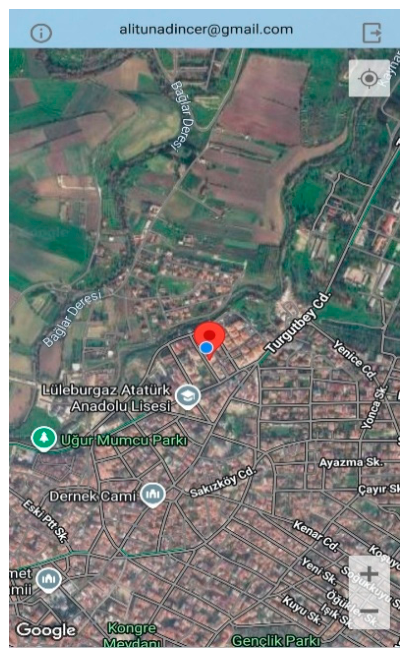
Figure 2.
Mobil application screen showing the waste type and quantity input.
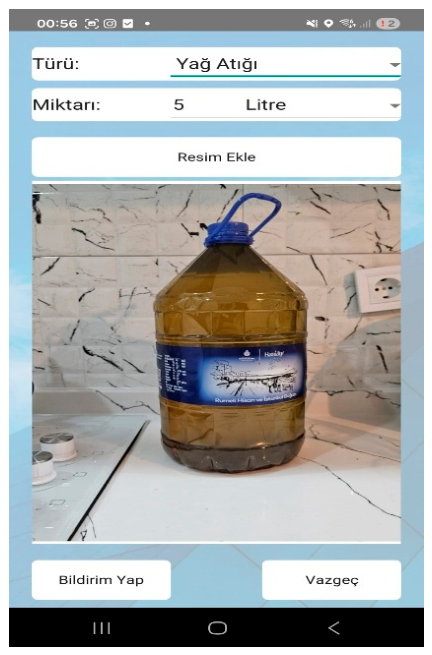
Figure 3.
The routes obtained with GA for 10 locations.
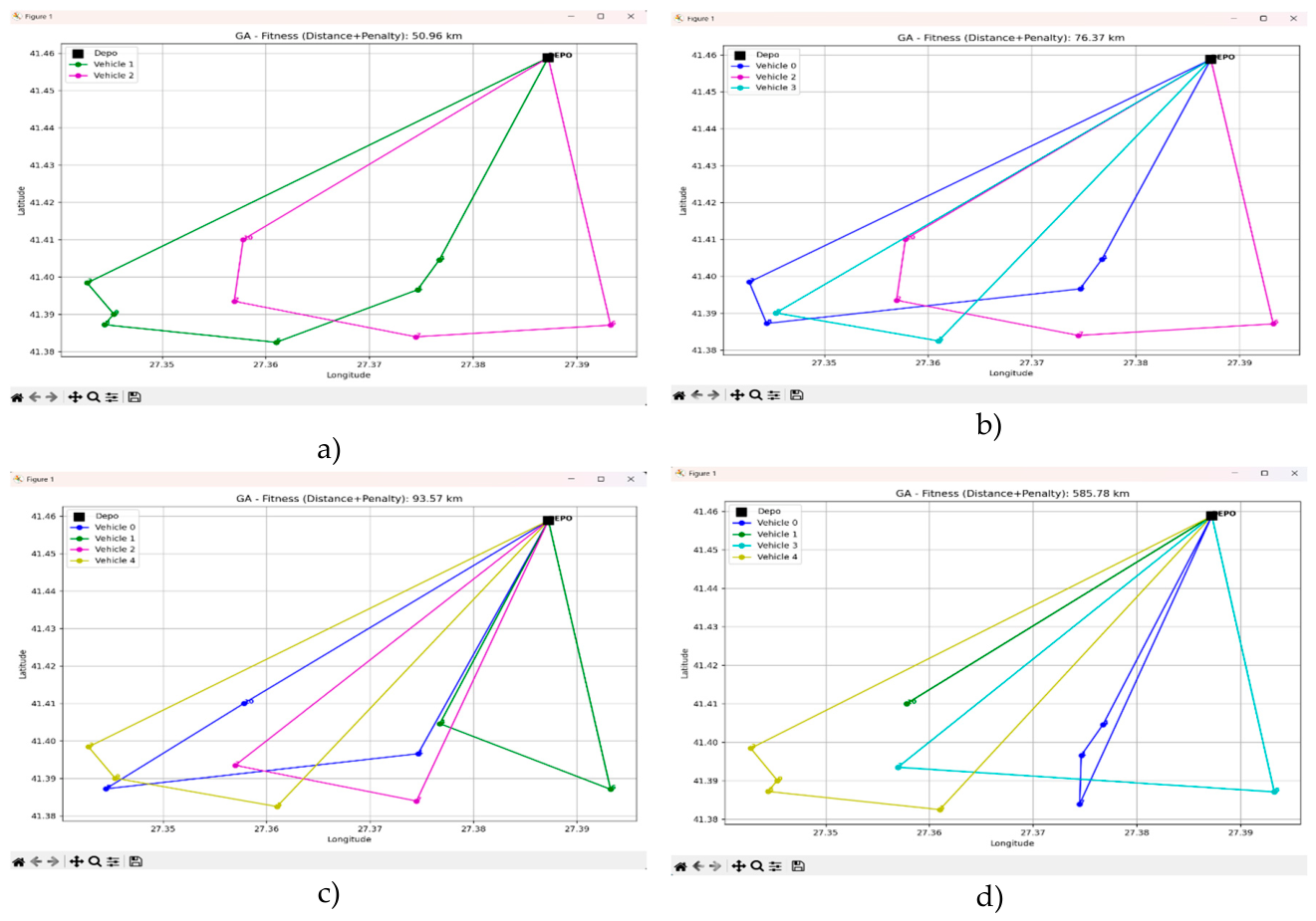
Figure 4.
The routes obtained with DE for 10 locations.
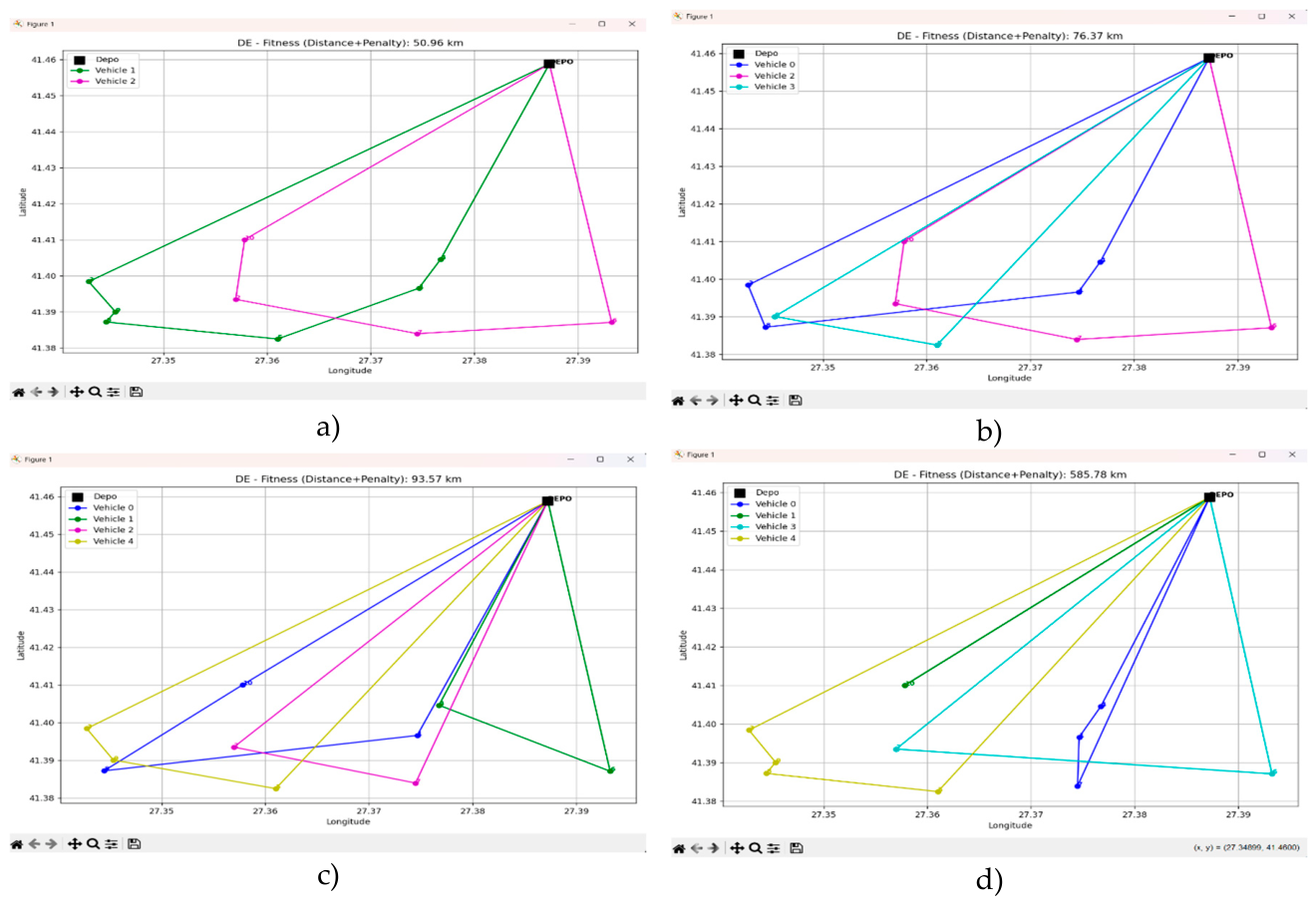
Figure 5.
The routes obtained with GA for 20 locations.
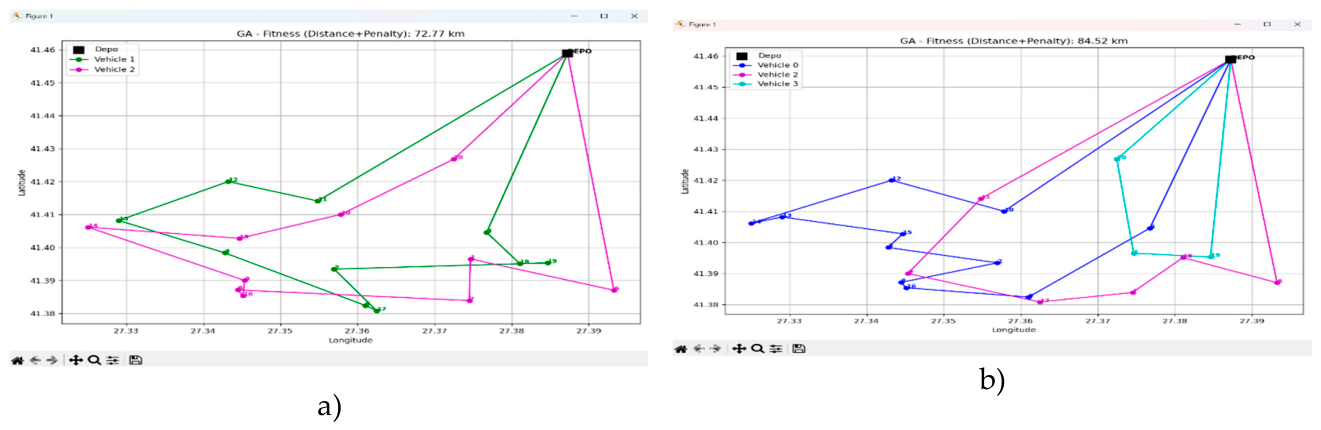
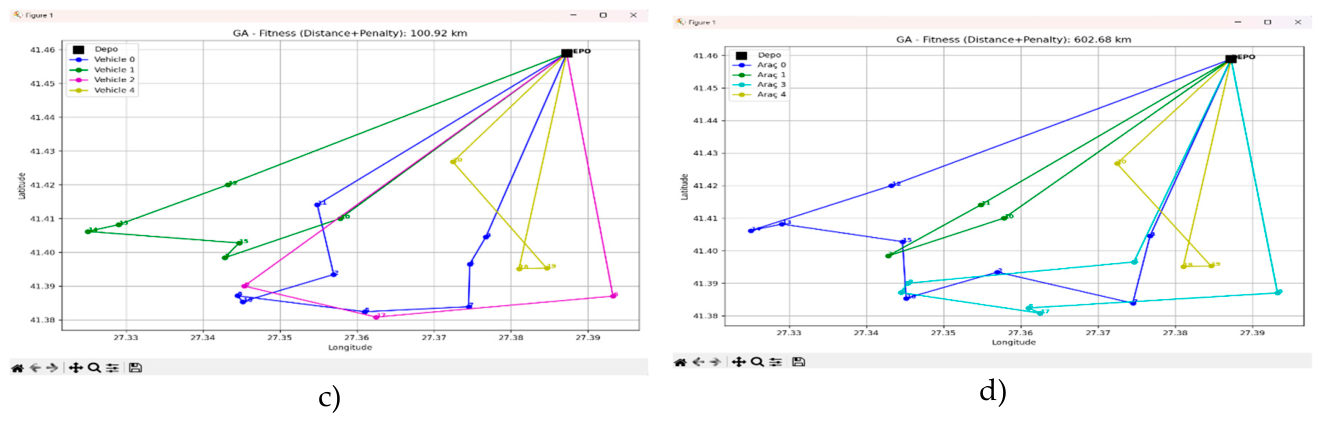
Figure 6.
The routes obtained with DE for 20 locations.
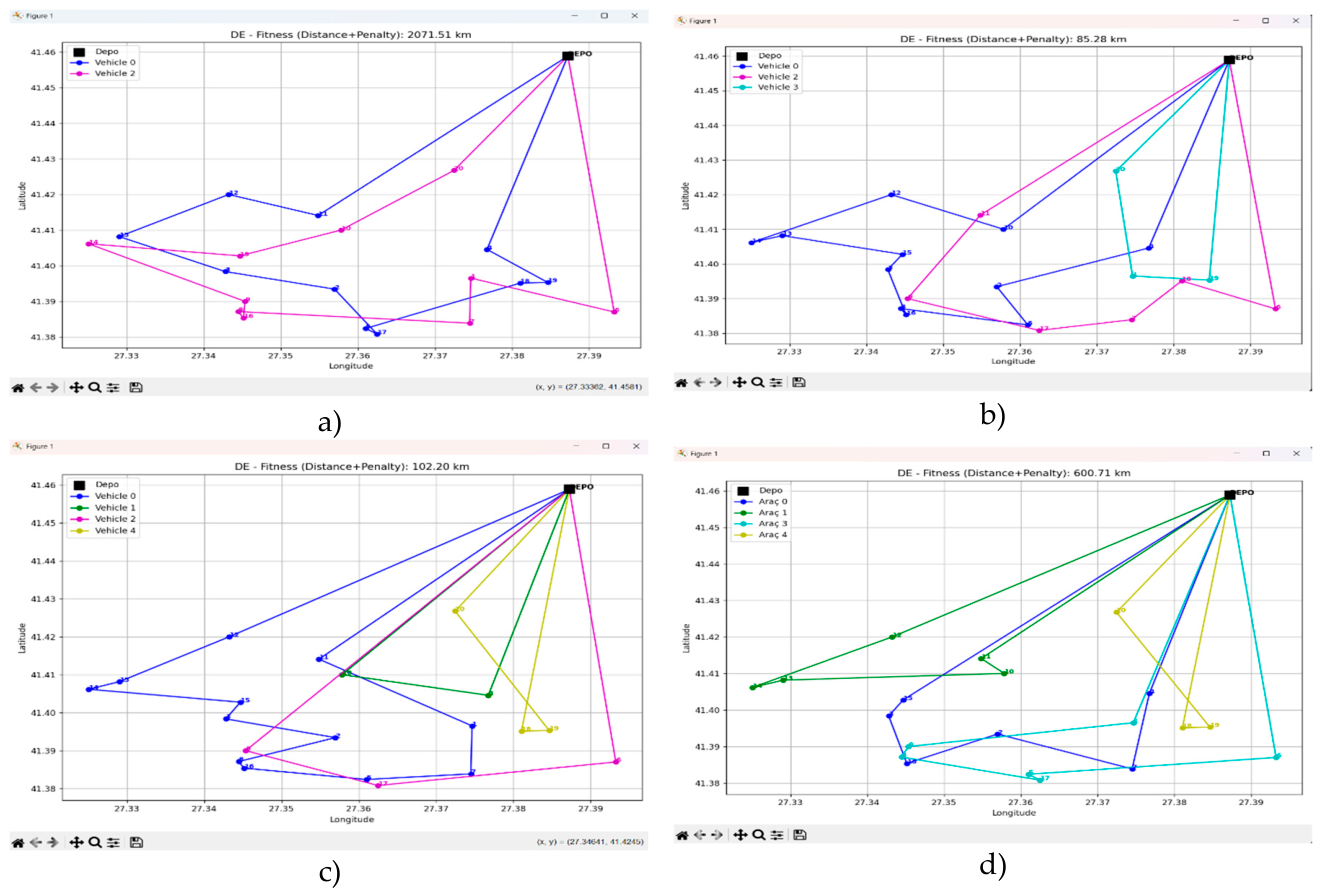
Figure 7.
The routes obtained with GA for 40 locations.
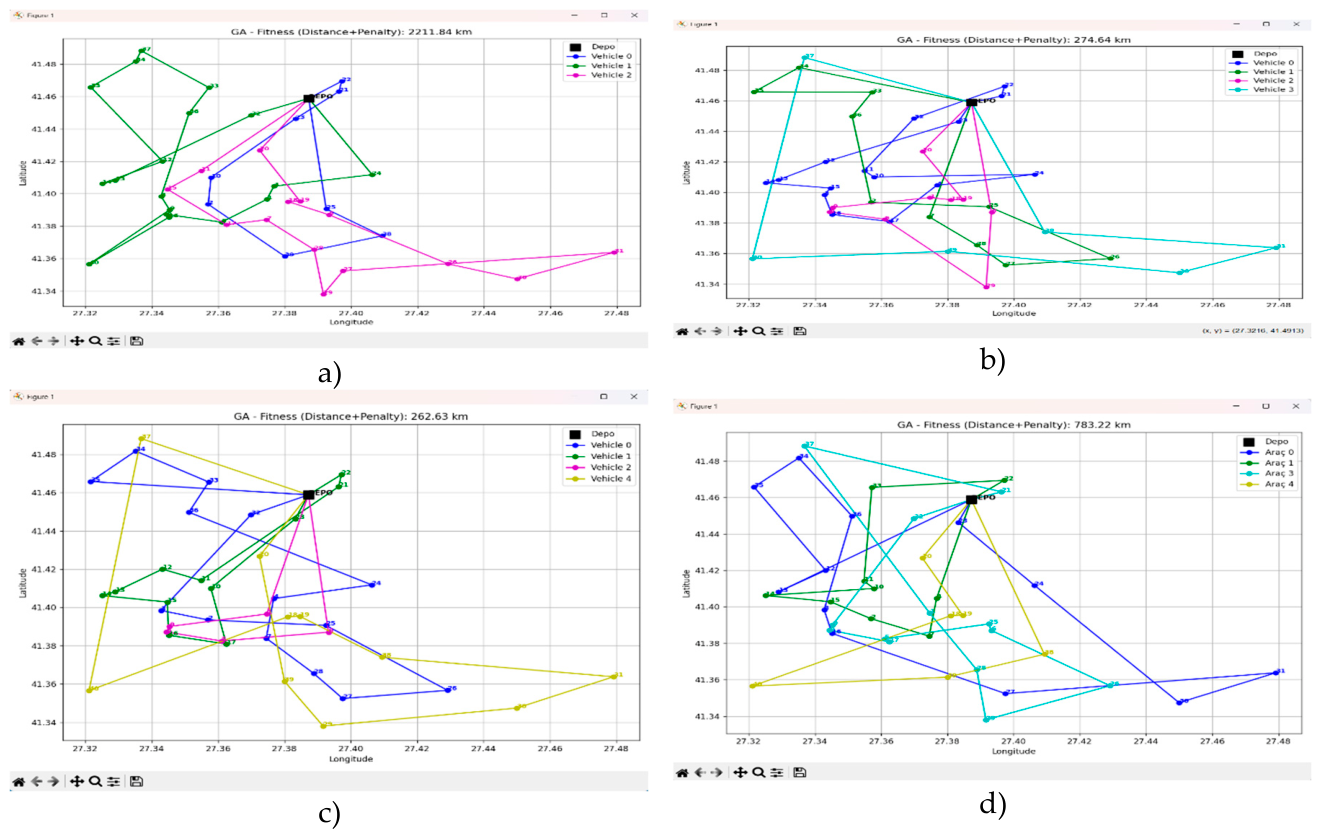
Figure 8.
The routes obtained with DE for 40 locations.
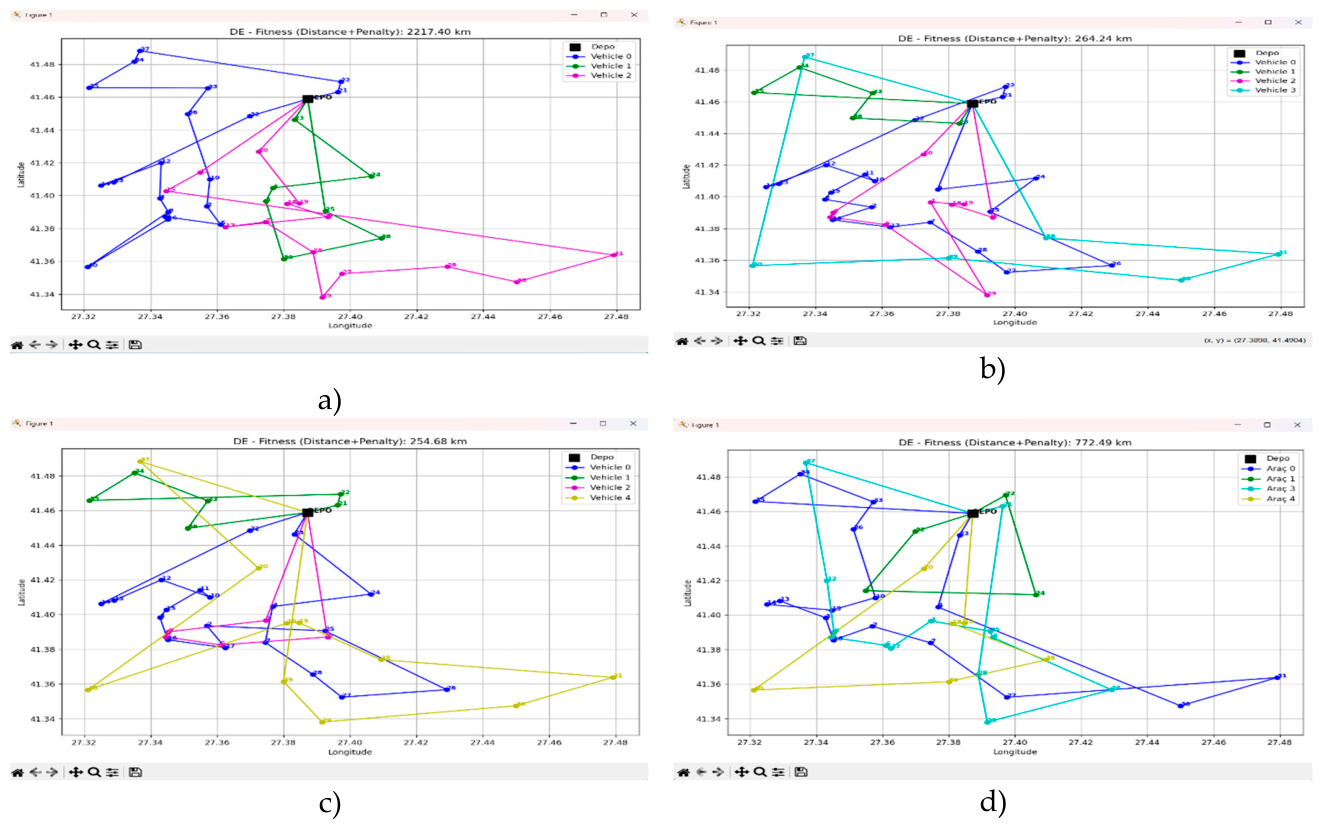
Table 2.
Collection vehicles and capacities for each type of waste.
| Waste Type | Vehicle Types and Capacities | ||||
|---|---|---|---|---|---|
| Vehicle-0 | Vehicle-1 | Vehicle-2 | Vehicle-3 | Vehicle-4 | |
| Rubble | 5 tons | 3 tons | |||
| Mineral Oil | 1000 Liters | ||||
| Vegetable Oil | 1000 Liters | ||||
| Garden Waste | 3 tons | ||||
| Packaging Waste | 2 tons | ||||
Table 3.
Waste quantities for each waste type, according to the scenarios.
| Waste Type | Senerio-1 | Senerio-2 | Senerio-3 | Senerio-4 |
|---|---|---|---|---|
| Rubble | x< 3 tons | x =4 tons | x> 5 tons | 8<x<10 tons |
| Mineral Oil | x < 1000 liters | x< 1000 liters | x< 1000 liters | 0 |
| Vegetable Oil | x < 1000 liters | x< 1000 liters | 0 | 0 |
| Garden Waste | 0 | x< 3 tons | 0 | x< 3 tons |
| Packaging Waste | 0 | 0 | x< 1 ton | x< 2 tons |
Table 4.
Optimization results with GA and DE based on scenarios and number of locations.
| Scenarios | Locations | GA Distance (km) | DE Distance (km) |
GA Constraints | DE Constraints | ||||
|---|---|---|---|---|---|---|---|---|---|
| C1 | C2 | C3 | C1 | C2 | C3 | ||||
| S1 | 10 | 50.96 | 50.96 | 0 | 0 | 0 | 0 | 0 | 0 |
| 20 | 72.77 | 71.51 | 0 | 0 | 0 | 0 | 0 | 2000 | |
| 40 | 211.84 | 217.40 | 0 | 0 | 2000 | 0 | 0 | 2000 | |
| S2 | 10 | 76.37 | 76.37 | 0 | 0 | 0 | 0 | 0 | 0 |
| 20 | 84.52 | 85.28 | 0 | 0 | 0 | 0 | 0 | 0 | |
| 40 | 274.64 | 264.24 | 0 | 0 | 0 | 0 | 0 | 0 | |
| S3 | 10 | 93.57 | 93.57 | 0 | 0 | 0 | 0 | 0 | 0 |
| 20 | 100.92 | 102.20 | 0 | 0 | 0 | 0 | 0 | 0 | |
| 40 | 262.63 | 254.68 | 0 | 0 | 0 | 0 | 0 | 0 | |
| S4 | 10 | 85.78 | 85.78 | 0 | 500 | 0 | 0 | 500 | 0 |
| 20 | 102.68 | 100.71 | 0 | 500 | 0 | 0 | 500 | 0 | |
| 40 | 283.22 | 272.49 | 0 | 500 | 0 | 0 | 500 | 0 | |
Disclaimer/Publisher’s Note: The statements, opinions and data contained in all publications are solely those of the individual author(s) and contributor(s) and not of MDPI and/or the editor(s). MDPI and/or the editor(s) disclaim responsibility for any injury to people or property resulting from any ideas, methods, instructions or products referred to in the content. |
© 2026 by the authors. Licensee MDPI, Basel, Switzerland. This article is an open access article distributed under the terms and conditions of the Creative Commons Attribution (CC BY) license (http://creativecommons.org/licenses/by/4.0/).
Copyright: This open access article is published under a Creative Commons CC BY 4.0 license, which permit the free download, distribution, and reuse, provided that the author and preprint are cited in any reuse.


