
Submitted:
14 April 2026
Posted:
15 April 2026
You are already at the latest version
Abstract
Occlusion is strongly related to oral health and is a key factor for the successful outcome in dental restorations, because prosthetic restorations must not only be harmoniously integrated, but also balanced in terms of occlusion and articulation. The current study aims to establish the reproducibility of tooth contacts in central occlusion using a prototype of a new dental articulator and compare the results with the T-Scan and Medit i500 systems. Materials and Methods: We applied two different types of laboratory methods, digital and conventional, with digital registration being carried out with the T-Scan and Medit i500 systems, and the conventional one—with articulating paper. The R software environment (version 4.2.2, R Core Team, 2022) was employed to carry out the statistical analysis and produce the graphical visualizations. The methods used were: descriptive statistics, stacked paired t-test to test the presence of a statistically significant difference in the mean values of overlap, with the adopted significance level being α=0.05; two-way and three-way analysis of variance (two-way ANOVA); Fisher's post-hoc analysis; graphical analysis for data visualization. Results: The 40μm articulating paper established more common contacts than the digital devices. The three-way ANOVA analysis, used to compare the applied methods, reported good overlap, with statistically significant differences found only in the colors of the occlusal coating at 95% confidence interval, which gives us reason to conclude that there is no difference between the methods used, confirming the reliability of the new device. Conclusion: Despite the remarkable evolution of digital dentistry, still no single flawless occlusal analysis method exists. Both conventional and digital systems have their advantages and disadvantages, and the clinician must use them in a complementary manner for accurate analysis.
Keywords:
approbation
; articulator
; articulating paper
; T-Scan
; intraoral scanner
; occlusion
; articulation
1. Introduction
Dental health is an important prerequisite for ensuring an adequate lifestyle. Many diseases of the stomatognathic apparatus are associated with dental dysfunction and can provoke the occurrence, development, and enduring presence of socially significant diseases, because they lead to disorders in both nutrition and the physiological processes of the body. Occlusion is a key marker of oral health and a vital indicator for the function of the masticatory system [1,2,3,4]. It is also a key factor determining the outcome of any dental restoration process [5], because prosthetic restorations must not only be harmoniously integrated but also balanced in terms of occlusion and articulation.
In order to ensure functional occlusion in prosthetics, conventional or digital analogs of the prosthetic field are used. They must be included in a mechanical articulator or a virtual one to recreate the mandibular movements, which in most cases is a routine procedure, but in a certain proportion of patients, occlusal rehabilitation is difficult due to specific conditions and diseases, in the majority of cases—focused in the orofacial area. The literature indicates stress combined with dental interferences in centric and eccentric occlusion as factors triggering parafunctional activity [6].
Reduced vertical occlusal dimension and severe bruxism resulting from friction during functional and parafunctional activities [7], temporomandibular joint (TMJ) dysfunction, occlusal plane abnormalities including severe supra-eruption, tooth tilt or migration, and some skeletal malocclusions (e.g., pseudo-Class III) make comprehensive oral rehabilitation difficult. Prosthetic treatment of patients with empty nose syndrome also requires high precision in complete reconstructions with crowns, bridges, and complete dentures to optimize the occlusal vertical dimension and restore oral stability. Achieving balanced occlusion-articulation relationships focuses on addressing the specific neuromuscular and psychological challenges of the condition, such as severe dryness due to chronic mouth breathing and overcoming anxiety. Treatment of these conditions often requires a multidisciplinary approach and long-term provisional restorations to ensure the stability of the new occlusal pattern [8,9]. Articulators used in this context are selected based on the need to manage potential TMJ dysfunction, with facebow transfer being mandatory. Optimally accurate reproduction of the occlusal surface in these conditions, requiring complex rehabilitation of the entire dentition, can be done either by means of a fully adjustable mechanical articulator with individual values or by using CAD/CAM-equipped virtual articulators, with the use of digital computer-based articulator systems (e.g., Zebris, Kordass, Gartner) becoming more and more dominant [10,11].
In the described literature on the topic, occlusal analysis methods are divided into two types: conventional and digital. The group of traditional methods consists of using physical indicators such as articulating paper, silk strips, and occlusal sprays. Other standard diagnostic tools are also early contact indicators, transillumination, or occlusal sonography to record jaw sounds [12,13,14]. Among the aforementioned methods, articulating paper is the most commonly used one in clinical practice. The main reasons are the low costs and the ease of use. Many consider it a gold standard in dental practice and, when conducting comparative studies, it is often used as a reference method [15,16]. However, there are also certain disadvantages. One of them is the risk of improper staining when it comes to smoother surfaces, such as metal or polished ceramics, among others [17]. In addition, there is a risk of pseudocontact markings and tearing [18], as well as lack of quantitative data on the parameters that are key in attaining durable functional stability—force distribution and muscle activity [19,20]. For the majority of the conventional methods, the sole focus of analysis is static occlusion. This is problematic as it fails to include important features such as mandibular dynamics, e.g., movements such as latero- and protrusion, and maximum intercuspidation [21].
Digital methods, in contrast to conventional ones, rely on specialized software in order to process data within 2D or 3D systems. This provides the opportunity of recording the total number of contacts, surface distribution, and the intensity of the occlusal forces. Digital indicators have become increasingly popular recently due to their capacity for rapid (semi)quantitative occlusal contact assessment. Prominent examples of this technology are intraoral scanners [3,22], the T-Scan system for occlusal analysis (Tekscan Inc., South Boston, Massachusetts, USA), and the OccluSense hybrid device (Bausch, Cologne, Germany), the latter of which applies digital contact recording using electronic foil and then direct staining.
Compared to traditional methods, when it concerns dental anatomy, the results provided by intraoral scanners are characterized by consistency and repeatability. They are comfortable for the patient because no intermediary material is placed, except for the scanning head. They provide rapid digitalization and immediate feedback. Modern IOS software includes virtual articulator modules that allow studying the movements of the mandible and the occlusal clearance in a 3D environment, which T-Scan cannot provide on its own. While T-Scan is capable of displaying contact points, its primary function is the assessment of bite force distribution and detecting underlying occlusal imbalances. Instead of being visible directly in the oral cavity or on a model, a computer screen displays the contact points. The T-Scan system (v. 8, Tekscan Inc., South Boston, Massachusetts, USA) is used for the visualization of a 2D or 3D virtual dental arch models, which offers objective and measurable data on the occlusal contact locations as well as on the distribution of occlusal pressure [23].
Despite the rapid introduction of digital impressions and the increasing pace of digital production of dental prosthetic structures, the use of analog articulators is not abandoned since physical models remain indispensable when using certain technologies. Although there are many reliable articulators on the dental market, we offer a new mechanical device (arcon type), which has improved characteristics in terms of accuracy, functionality, and economy and is useful for clinical practice because it is easy to use. In order to test it, we conducted a study to establish its reliability by comparing the registered with articulating paper contacts between the tooth rows of the models included in it with the data from intraoral registrations using the T-Scan Novus and Medit i500 systems. We used the contacts registered with articulating paper as reference values.
The current study aims to establish the reproducibility of tooth contacts in central occlusion using a prototype of a new dental articulator and comparing it with the T-Scan and Medit i500 systems.
2. Materials and Methods
This study is focused on testing a new mechanical dental articulator through comparative laboratory measurement of the registered occlusal contacts between the models included in it and the T-Scan and Medit i500 systems, and then comparing the results with the reference values. The new device has received a Certificate of Registration of a Utility Model from the Patent Office of the Republic of Bulgaria and a positive written opinion from the PCT in terms of innovation, technical and industrial applicability. To achieve the goal, a 56-year-old patient with intact dentition and Angle Class I relationships between the dental rows, without the presence of prosthetic restorations and temporomandibular disorders, was subjected to a comparative study using three different methods. Before commencing with data collection, the patient was asked to sign an informed consent form. All the procedures, the aim of the study, and any potential risks involved were explained in detail in order to make sure that the person’s participation was voluntary. The study was conducted in January and February 2025 and is part of the planned studies on the reproducibility of occlusal contacts by the new device.
2.1. Object of the Study
The goal of the study is to determine the degree of occlusal contact point overlap registered between maxillary and mandibular 3D printed models in central occlusion, included in the prototype of the new appliance and the T-Scan and Medit i500 systems.
2.2. Working Hypothesis
We assume that the results of the comparative laboratory measurement of occlusal contacts recorded by the three methods will show a high degree of overlap, which will prove the reliability of the device and contribute to its approval in dental technology laboratories and in dental practice in general.
2.3. Laboratory Methods
2.3.1. Digital
Intraoral high-speed dust-free scanning of the dental arches performed with Medit i500. The clinical procedures followed the recommended protocols of the IOS Medit i500 (Medit Corp., Seoul, Korea) manufacturer. The patient was placed in a comfortable position, with the head placed in a manner ensuring that the headrest was parallel to the floor, in the Frankfort horizontal plane. Before the experiment, the upper and lower dental rows were dried and we started the scan from the molars in the third quadrant to the fourth one, buccally, covering all teeth sequentially. Next were the occlusal and lingual surfaces. Additionally, we scanned locally in more detail and removed the artifacts. Next was the scan of the upper dental row in the same sequence (from the second quadrant occlusally to the first quadrant occlusally, palatally, and buccally). The next step was digital occlusion registration using a bite scan. To minimize operator variability, an experienced dental prosthetist and researcher performed all clinical and scanning procedures. The scanning was performed three times. The generated virtual dental arch models were further processed by software and 3D printed as physical models using a Formlabs Form 3 SLA printer and model resin (Formlabs Model V2). Printing was performed at a layer thickness of 25 µm. Subsequent post-processing involved cleaning the printed models in Form Wash with 99.5% isopropyl alcohol (IPA) for a period of 10 minutes. There was a final curing phase in Form Cure with a 60-minute duration at 60°C.
Digital imaging of the occlusion with T-Scan Novus (Tekscan, Norwood, MA, USA, 2018). The T-Scan system has a sensitive sensor, which can be positioned between the tooth rows, offering data on the contact sequences, their maximum force, the path of movement of the mandible and the times of occlusion and disocclusion. It is also capable of producing video footage of active sequences and the spatial distribution of contacts. All clinical procedures followed the manufacturer’s recommended protocols for T-Scan Novus. The head of the patient was tilted back, at approximately 25–30º to the chest, with the holder positioned parallel to the floor. The selected sensor, appropriately sized according to the size of the dental arches, was positioned between the central incisors, upper and lower, and the patient was instructed to close the mouth, ensuring close contact between the tooth rows. While the Medit i500 system identifies contact points by calculating the distance between the teeth, T-Scan assesses the strength of contacts, irrespective of the area involved. To achieve standardization between the Medit i500 and T-Scan Novus systems, registrations were made sequentially without changing the position of the object.
Clarification: We performed two-dimensional and three-dimensional registration in central occlusion with T-Scan and between the models in the articulator, but we did not use the data because we found that the force of displacement of the movable arm of the device cannot be precisely controlled during the specified studies, and this limitation leads to deviations from the sought-after comparability. Therefore, to determine the degree of overlap, registered by each of the three methods, the two-dimensional images of the contact points recorded intraorally on a patient with the T-Scan and Medit i500 systems were manually superimposed on the images of the articulator-mounted models, with contacts marked by articulating paper, in central occlusion. The indicated methodology has already been reported by other researchers and we followed it [13].
2.3.2. Conventional
Intra- and extraoral registration with articulating paper. We used 40μm two-color articulating paper by Bausch GmbH, and the patient’s dentition was pre-dried. The procedure was performed three times. We mounted the printed models onto the prototype of the new device, following the standardized laboratory protocol for mounting onto an articulator with average values. The extraoral registration of the contact points in central occlusion between the printed models of the dentition of the same patient was done three times to ensure quality results. Before each re-measurement, the models were cleaned with alcohol. To minimize inter-operator variability, one examiner performed all procedures. The marked contact points were documented using a Sony DSC digital camera. The images were captured at an average distance of 35 cm, with the lens perpendicularly to ensure that the entire dental arch was visible. Following the assignment of unique identification numbers to each photograph, the full set of images was reviewed in a single morning and the process included rest periods every 30 minutes to maintain consistency. All photos were in .jpeg format and had a uniform resolution of 920 x 620 pixels, with the total number of pixels of each of them being 570,400. The area of the occlusal contacts registered was measured using the freely available software program Adobe Photoshop CS6. The program allows one to calculate the marked area as a proportion of the total area of the photo, measured in pixels [12]. We made a color scheme to distinguish the different intensity contacts in the total area and to establish their correlation. Each image had a histogram associated with the image of the number of pixels for each color, with red identifying strong contact, green identifying moderate, and blue identifying weak contact. This resulted in numerical values of the registered contacts in central occlusion. We eliminated the lateral and protrusive movements, which ensured that the same occlusal contacts for the opening/closing movement could be reliably repeated. Figure 1 presents the experimental workflow and its structure.
2.3. Statistical Methods and Analysis
The R software environment (version 4.2.2, R Core Team, 2022) was employed to conduct the statistical analysis and produce the graphical visualizations. The following statistical methods were used:
- ❖
- Descriptive statistics—finding averages, standard deviations, standard errors of the means, determining confidence intervals for mathematical expectation;
- ❖
- Stacked paired t-test—determining the presence of any statistically significant differences in the mean values of occlusal contact area overlap. The accepted significance level is ;
- ❖
- Two-way analysis of variance (two-way ANOVA);
- ❖
- Three-way ANOVA—comparing the applied methods;
- ❖
- Fisher’s post-hoc analysis (Fisher's exact test)—determining the statistical significance of the influence between parameters;
- ❖
- Graphical analysis—for visualization of the obtained results.
3. Results
Table 1 provides a summary of the mean values and standard deviations for the occlusal contact areas of both the upper and lower arches, as established by the different methods used.
The highest average occlusal contact area coverage in the maxilla is with the Articulating paper method (4540 pixels), followed by Articulating paper with Medit i500 (4345 pixels), and Medit i500 (3430 pixels). The three higher values are registered intraorally on a patient. The standard deviation is also highest for articulating paper and patient, because we have a significant difference between the reported values by color (according to the intensity of contact), which means that we have a serious variation. With Medit i500 we also have a considerable variation, while in Articulating paper with Medit i500 we have less variation and a large average area of coverage, which indicates higher consistency of the method. With a model, the highest coverage is recorded with Articulating paper and Medit i500 (2903 pixels), followed by Articulating paper with T-Scan. The standard deviation is highest for Articulating paper with T-Scan, followed by Articulating paper with Medit i500.
In the lower jaw, we observe the highest average occlusal contact area of coverage registered intraorally on a patient with the Medit i500 (4875 pixels). This method also has the highest standard deviation of 2281 pixels. The T-Scan method has the lowest coverage, as well as the lowest standard deviation, and this is also observed in the upper jaw. In the model, the highest average coverage (2314 pixels) is observed in the overlap of articulating paper with Medit i500, followed by articulating paper (2272 pixels) with the variation there also being higher. The average values reported for each of the three methods used on the model and the patient are similar.
To test for a statistically significant difference in the mean values of occlusal contact area overlap, we used the paired t-test because the study design included multiple measurements on one patient. The method is good when comparing the parameters of several methods that are used on the same subject or sample, which eliminates individual effects and focuses on the differences in the method. All possible pairs of methods examining the maxilla and the mandible were assessed. The adopted significance level was Table 2 and Table 3 illustrate the results.
The results of the paired t-tests show significant statistical differences in the mean values of the measurements on the patient’s upper jaw, at 95% confidence interval, between T-Scan and Medit i500 and between Articulating paper & T-Scan and Articulating paper & Medit i500. That is, the average area covered by T-Scan and Medit i500 has a statistically significant difference in the three measurements in terms of the intensity of the contacts expressed in colors. The area covered by Medit i500 is on average 2766.33 pixels larger than that covered by T-Scan. In regard to the patient’s upper jaw, there is statistically significant difference, at level of agreement , when comparing Articulating paper & T-Scan and Articulating paper & Medit i500. The average difference is 3573 pixels in favor of Articulating paper & Medit i500.
When examining the average values of the pixels covered by the different methods regarding the model, no statistically significant differences are found at a 95% confidence interval. If we use a 90% confidence interval, there is a statistically significant difference between Articulating paper and Articulating paper and Medit i500, with the second method having a larger average coverage by 1749.67 pixels (Table 2).
The results of the paired t-tests on the patient’s lower jaw show that the only statistically significant difference, at a 95% confidence interval, is between T-Scan and Medit i500, with Medit i500 managing to cover an average of 4182.33 pixels more than T-Scan on the patient’s lower jaw (Table 3). In the model, setting a 95% confidence interval, there are no statistical differences between the three groups of examinations, only at a 90% confidence interval there is a statistically significant difference between Articulating paper and T-Scan and Articulating paper and Medit i500. The former method covers an average of 1528 pixels more than the latter when examining the model’s lower jaw.
The next statistical method we used was the two-way dispersion model (two-way ANOVA). It has more power than paired t-tests because it significantly reduces the risk of accumulating type I error to reject the null hypothesis when it is true. It also includes two factors that can explain the differences in the registered occlusal contact area—regarding the color and the measurement method, which makes the estimate more accurate and reduces stochastic error. First, we tested the relationship between the type of method used and the color of the registered contacts in the patient’s upper jaw (Table 4).
The table shows that at least one measurement method on a patient has a statistically significant difference in the reported pixel coverage. The color is not statistically significant at the selected 95% confidence interval. With a model with a 90% confidence interval, we have a statistically significant difference in at least one of the three pairs of measurement methods, and at 95% confidence, we have a statistically significant difference in at least one of the pairs of colors.
To accurately determine the differences in the mean values between the method groups and their statistical significance, we applied Fisher’s LSD post-hoc test. Since the number of measurements in our study is not large, we chose this method because it is less conservative than Tukey’s and is preferred for detecting small but statistically significant differences between objects. Table 5 presents Fisher’s post-hoc analysis for the upper jaw of a patient and a model, and for the model, the contrasts in regard to the color are also given, since this turns out to be statistically significant.
In the Fisher's post-hoc test on a patient, we see that at 95% confidence interval, there are statistically significant differences in the average pixel coverages for the following pairs of applied methods:
- Articulating paper–Articulating paper & T-Scan—on average, 3768 pixels more for Articulating paper, which is our control group;
- Articulating paper & Medit i500–Articulating paper & T-Scan—on average, 3681 pixels more for Articulating paper and Medit i500;
- Articulating paper–T-Scan—on average, 3573 pixels more coverage of the upper jaw with Articulating paper than with T-Scan.
We also have several significant pair differences at 90% confidence interval:
- Articulating paper & T-Scan–Medit i500—on average, 2658 pixels more coverage with Medit i500 than with Articulating paper & T-Scan;
- Medit i500–T-Scan—on average, 2766 pixels more coverage for Medit i500 than for T-Scan.
In the model, we have one statistically significant difference, at 95% confidence interval, between Articulating paper and Articulating paper with Medit i500, with the second method covering on average 1750 pixels more of the occlusal contact area than that registered with Articulating paper alone. In the contact area registered by colors, according to intensity, we have two statistically significant differences at 95% confidence interval and one at 90% confidence interval. The following pairs are with the ones registered at the higher confidence interval:
- blue–green color—the average difference in the occlusal area is 1596 pixels more for the green color;
- green–red color—here the difference reported is the largest, the occlusal area covered by the green color is, on average, by 2890 pixels larger than the red area.
At 90% confidence interval, we can say that there is a statistically significant difference between the blue and red coverage areas, with the blue area being, on average, by 1294 pixels larger than the red area (Table 5).
To see the expected values of the marginal means, for the different methods applied to the mandibular model and patient’s lower jaw, we used a two-way analysis of variance, at a 95% confidence interval. Table 6 illustrates the results.
The data demonstrate that at least one of the applied measurement methods on a patient has a statistically significant difference, at the selected 95% confidence interval. Here, the color does not come out statistically significant. In the model, no statistically significant difference in the coverage of the occlusal area is established; such is reported only in terms of colors, at a 95% confidence interval. The results from post-hoc test can be seen in Table 7.
When reporting the results regarding the occlusal coverage of the mandible in a patient, at a 95% confidence interval, the following two pairs of methods are statistically significant:
- Articulating paper & T-Scan–Medit i500, with Medit i500 covering an average of 3494 pixels more than Articulating paper with T-Scan;
- Medit i500–T-Scan, with Medit i500 covering an average of 4182 pixels more occlusal area than T-Scan.
At a 90% confidence interval, we find statistically significant differences between:
- Articulating paper–T-Scan—the coverage of the Articulating paper is, on average, 2295 pixels more compared to T-Scan;
- Articulating paper & Medit i500–Medit i500—Medit i500 alone covers an average of 2354 pixels more than Articulating paper combined with Medit i500.
Observing the model, the statistically significant differences in the means, in regard to color, are between the groups: blue–green and green–red, at 95% confidence interval. In the first group the green covers an average of 2141 pixels more than the blue, and in the second group the green covers an average of 2401 pixels more than the red (Table 7).
Finally, a comparison of the applied occlusal registration methods was conducted by means of a three-way ANOVA analysis (Table 8).
To check whether there is a statistically significant difference between the registered occlusal contacts by the new articulator (Prototype) and the other methods, the reported results in the last column Pr(>F) were observed. The focus was on values greater than 0.05 and it was found that for the upper jaw the p-value for Prototype is 0.10798 and for the lower jaw it is 0.34941, from which a conclusion is drawn that no statistically significant difference exists between the measurements made with the new device and the other methods, which proves its reliability. Regarding the influence of the factors (Prototype:Method), the results are again good, with the value reported for the upper jaw being 0.05579, which is still above 0.05, and for the lower jaw it is 0.91576. A conclusion can be drawn that the new device performs consistently, regardless of the chosen registration method, especially for the lower jaw.
In Table 8. the Color factor (contact intensity) is also reported with an asterisk (*), and the p-values are below 0.05 (0.02798 for the upper and 0.01696 for the lower jaw). Here, the reason for the statistically significant differences, at 95% confidence interval, is in the strength of the contacts. It is normal to observe differences there; such were also reported in the two-way variance analyses. From the results in the Mean Sq column, we can assess the precision of the studied prototype for each jaw separately. For the upper jaw the reported value is 6,452,429, and for the lower jaw—1,144,584. Therefore, the precision of the prototype is significantly higher for the lower jaw, because the value is nearly 5.63 times lower than that for the upper one, and in statistics the lower value of Mean Sq indicates less dispersion and higher measurement accuracy.
To visualize the differences between the model and the patient, according to the methods used and the three colors of occlusal coverage, we applied the Bland-Altman method (Figure 4). The graph presents the measured occlusal area in the model and the patient with the three applied methods—Articulating paper, Articulating paper with Medit i500, and Articulating paper with T-Scan, with the left part referring to the maxilla and the right part—to the mandible.
Figure 4 demonstrates that the limits of agreement between the model and the patient are quite wide, with the average difference being 1197 pixels, which signifies that the methods used cover an occlusal contact area in the upper jaw, which is, on average, 1197 pixels larger in the patient than in the model. Despite the differences registered, the observations do not exceed the limits of agreement (the red dashed lines), which proves the reliability of the device. In the lower jaw, an even smaller average difference is observed between the measurements in the patient and the model (504.33 pixels), and they are also within the limit of agreement, at 95% confidence interval. We have only one measurement (with articulating paper, blue color) slightly above the lower limit, but since this is our control, the result does not compromise the reliability of the device.
The distribution of the occlusal contact area as per the different methods used was visualized by a violin plot, with the three horizontal dashed lines (colored green, blue, and red) being the arithmetic means of the coverage area for the corresponding colors, with the specified method. The graph is divided into two parts—relative to the model and relative to the patient, with the data for the upper jaw being presented on the left side and that for the lower jaw—on the right (Figure 5).
The vertical axis represents the measured area in pixels, and the horizontal axis—the applied methods (alone and in combination). In the left part of the graph we see that the most significant difference when comparing the covered area between model and patient is with the articulating paper. In the patient there is much larger coverage by green and blue colors, while for the red it is almost the same as in the model. For Articulating paper with Medit i500 and with T-Scan we have close values of color coverage, especially in Articulating paper with T-Scan, which shows that the upper jaw model has similar coverage with these two methods. In the patient we have the largest occlusal coverage with articulating paper (blue and green colors). In the other two methods we also have very similar coverage for three colors. The right part of the graph, representing the occlusal contact area of the lower jaw is identical, which once again confirms the reliability of the new device.
In conclusion, we can summarize that the results of the comparative laboratory measurement of occlusal contacts registered using articulating paper and the T-Scan and Medit i500 systems have good overlap.
4. Discussion
A systematic review on the topic highlights the advance of digital dental technologies and the establishment of specific criteria to ensure consistent and reliable prosthetic outcomes [24,25,26]. Research indicates that both the T-Scan and 3D intraoral scanning are valid tools for quantifying occlusal contact areas. This confirms the precision of digital techniques, which provide objective measurements as opposed to the subjective interpretation of occlusal contacts associated with the traditionally used articulating paper [25,27,28]. The T-Scan registers a significantly smaller number of contact points than conventional occlusal indicators because it is a quantitative, pressure-sensitive system and only records actual applied forces, eliminating pseudo-contacts that do not meet the minimum pressure threshold [16]. The lower sensitivity of the sensor in certain areas of the dental arch, reported mostly in the front, can also lead to missing very light, peripheral contacts that the articulating paper captures. Compared to T-Scans, intraoral scanners offer a broader range of dental applications and clinical uses, and their performance has demonstrated significant advancement [29,30]. However, they also often report fewer occlusal contacts than articulating paper because they are static digital measurement systems, and articulating paper is a subjective, load-sensitive physical indicator of high points that only exist when the teeth are fully compressed. The digital algorithm tends to record only the most defined contacts, ignoring small approximations between the teeth [23]. From this systematic review, it appears that the main disadvantage of computerized assessment is sensor thickness, which has the potential to distort or interfere with the analysis of the occlusal pattern. This limitation suggests that for routine clinical purposes, reliance on articulating films for the assessment of occlusal contacts still might be considered a superior clinical method. Additional research and more caution are needed before either approach can be considered a standard of reference [31].
In a comparative study, Kui et al. assessed the recording of occlusal contact points using traditional articulating paper alongside three intraoral scanner models, namely: 3Shape® Trios 3, Omnicam Cerec®, and Medit i700®. Analysis of the results revealed no statistically significant differences in terms of accuracy across the four techniques, validating the reliability of both the digital and conventional methods. The authors concluded that articulating paper is still a dependable means of occlusal analysis despite the rise of complex intraoral scanners. The study suggests that professionals can effectively combine or choose either a traditional or digital methodology based on the specific clinical needs and available technologies without losing any diagnostic accuracy [32].
The analysis of the results of our study also confirms the high level of reliability of both the T-Scan and the Medit i500 intraoral scanner when registering occlusal contacts. The 40μm thick articulating paper registered more total contacts than the digital devices, especially in the distal areas. Visual analysis of the Bland-Altman graph and the violin plot demonstrates a high degree of overlap of the contact areas of the new articulator, especially in the lower jaw. The device provides a cleaner and more defined occlusal picture compared to direct intraoral registration with articulating paper, because it is not affected by factors such as saliva, periodontal elasticity, etc., which explains the smaller area registered by it. The differences in the number of contacts and area reported by the three methods do not make them less accurate than each other, because the reason is in the different methodologies. The occlusal contact locations approximately correspond, but the methods used do not provide an accurate assessment of the correspondence. Despite the fact that digital systems are more precise in identifying the strength and timing of contacts, they often register a lower total number of contacts because they only count contacts within a certain range of close distance. The conclusions we can draw are:
- The low Mean Sq for the lower jaw proves that the device is extremely stable and gives predictable results, that is, it has high repeatability.
- The prototype is statistically reliable for registering occlusal contacts in both jaws, and for the lower jaw it shows almost complete compliance with the control methods.
- The ratio between the variation caused by a given factor and the random error (Residuals) proves the precision of the device. The results for the upper jaw of the prototype (F-value = 3.1162) and for the lower jaw (F-value = 0.9637) prove that the device works just as well as the standard methods. For the lower jaw the value is below 1, which means that the difference between the measurements with the new articulator and the control methods is smaller than the random statistical error.
- Evidence of the high statistical power of our study is the reported value of the F-value factor for Color, which is very high (6.3). Therefore, the real physical differences (strong vs. weak contact intensity) are differentiated, but at the same time, the Prototype itself (with an F-value of 0.96) does not change these data, which is objective evidence that the new mechanical articulator provides precise registration of the occlusal area, comparable to the established digital and conventional methods.
- In conclusion, we can summarize that the three-way ANOVA statistical analysis did not establish significant differences between the registrations made with the new mechanical articulator (Prototype) and the established registration methods for both jaws, which confirms the accuracy of the device and allows its testing for clinical and laboratory use as a reliable alternative for the analysis of occlusal contacts.
There were several limitations in this study. The first one is that the study included a single patient, which limits the generalizability of the results. Another limitation is that the clinical and laboratory procedures were performed by the same trained operator, which may interfere with the objective reflection of the possible clinical variability. Still another limitation consists of the fact that the single patient examined was with Angle Class I occlusion, which means that the applicability may not be the same for other occlusal relationships in the population. Fourth, the study compared results only in the position of maximum intercuspation. Fifth, the digital scanning was performed only intraorally, and the data were manually overlaid with 2D images from extraoral registrations, which may influence the reliability of the reported results.
5. Conclusions
This study emphasizes that a balanced occlusion is a vital marker for the health of the masticatory system and has a key role in the longevity of dental restorations. However, it also notes that even with the impressive advances in digital dentistry, a perfect, all-encompassing method for occlusal analysis is yet to be developed. Both conventional and digital systems have their advantages and disadvantages, and the clinician must use them in a complementary manner for an accurate analysis. The comparative laboratory measurement results demonstrated a significant degree of overlap between the applied methods, which supports the reliability of the new articulator, which is useful for clinical practice because it is easy to use and has improved characteristics in terms of accuracy, functionality, and economy. We plan to continue with the studies on its reproducibility by comparing the analog occlusal contacts with their digital counterparts registered in a virtual articulator with integrated data from IOS and CBCT.
Author Contributions
For research articles with several authors, a short paragraph specifying their individual contributions must be provided. The following statements should be used “Conceptualization, S.A.; methodology, S.A.; software, S.A.; validation, S.A.; formal analysis, S.A.; investigation, S.A.; resources, S.A.; data curation, S.A. ; writing—original draft preparation, S.A. ; writing—review and editing, S.A.; visualization, S.A. ; supervision, S.A.; project administration, S.A.; funding acquisition, S.A. All authors have read and agreed to the published version of the manuscript.” Please turn to the CRediT taxonomy for the term explanation. Authorship must be limited to those who have contributed substantially to the work reported.
Funding
This research received no external funding.
Informed Consent Statement
Informed consent was obtained from all subjects involved in the study. Written informed consent has been obtained from the patient to publish this paper.
Data Availability Statement
The dataset is available upon search from the authors. The raw data supporting the conclusions of this article will be referenced by the authors upon search.
Conflicts of Interest
The authors declare no conflicts of interest.
Abbreviations
The following abbreviations are used in this manuscript:
| CAD/CAM | Computer-Aided Design and Computer-Aided Manufacturing |
| SLA | Stereolithography |
| LSD | Least Significant Difference |
| ANOVA | Analysis of Variance |
| IOS | Intraoral Scanner |
| СВСТ | Cone Beam Computed Tomography |
References
- Vlăduțu, D.-E.; Mercuț, R.; Văruț, MC; Stefârță, A.; Mercuț, V.; Radoi, AM; Brătoiu, MR; Popa, AD; Popescu, AM; Dică, Ș.; et al. Assessment of Occlusal Contacts Recorded with the Medit Intraoral Scanner vs. Exocad Software. J. Clin. Med. 2025, 14, 7378. [CrossRef]
- Zhao Z, Wang Q, Li J, Zhou M, Tang K, Chen J, Wang F. Construction of a novel digital method for quantitative analysis of occlusal contact and force. BMC Oral Health. 2023 Apr 1;23(1):190. PMID: 37005643; PMCID: PMC10067253. [CrossRef]
- Kordaß B, Amlang A, Hugger A, Behrendt C, Ruge S. Number and localization of occlusal contact areas on natural posterior teeth without dental findings - evaluations of the regional baseline study (SHIP-1) with the Greifswald Digital Analyzing System (GEDAS). Int J Comput Dent. 2022 Mar 24;25(1):47-56. PMID: 35322652.
- Lee HS, Ko KH, Huh YH, Cho LR, Park CJ. Correlation between occlusal contact area at various levels of interocclusal thicknesses and masticatory performance. J Oral Rehabil. 2022 May;49(5):522-528. Epub 2021 Dec 14. PMID: 34888906. [CrossRef]
- Christensen GJ. Is occlusion becoming more confusing? A plea for simplicity. J Am Dent Assoc. 2004 Jun;135(6):767-8, 770. PMID: 15270161. [CrossRef]
- Thirumurthy VR, Bindhoo YA, Jacob SJ, Kurien A, Limson KS, Vidhiyasagar P. Diagnosis and management of occlusal wear: a case report. J Indian Prosthodont Soc. 2013 Sep;13(3):366-72. Epub 2012 Oct 4. PMID: 24431762; PMCID: PMC3732697. [CrossRef]
- Dawson, PE (2007) Functional Occlusion: From TMJ to Smile Design. CV Mosby, St. Louis, 48-50, 76-96, 108, 264-275, 281, 297, 352-354, 408.
- Kim DH, Basurrah MA, Kim SW, Kim SW. Surgical and Regenerative Treatment Options for Empty Nose Syndrome: A Systematic Review. Clin Exp Otorhinolaryngol. 2024 Aug;17(3):241-252. Epub 2024 Jul 4. PMID: 38961700; PMCID: PMC11375171. [CrossRef]
- Kochar SP, Reche A, Paul P. The Etiology and Management of Dental Implant Failure: A Review. Cureus. 2022 Oct 19;14(10):e30455. PMID: 36415394; PMCID: PMC9674049. [CrossRef]
- Koralakunte PR, Aljanakh M. The role of virtual articulator in prosthetic and restorative dentistry. J Clin Diagn Res. 2014 Jul;8(7):ZE25-8. Epub 2014 Jul 20. PMID: 25177664; PMCID: PMC4149170. [CrossRef]
- Solaberrieta E, Arias A, Barrenetxea L, Etxaniz O, Minguez R, Muniozguren J. A virtual dental prostheses design method using a virtual articulator. Dubrovnik, Croatia. Proceedings of the 11th International Design Conference. 2010:443–52.
- Popa AD, Vlăduțu DE, Turcu AA, Târtea DA, Ionescu M, Păunescu C, Stan RS, Mercuț V. Aspects of Occlusal Recordings Performed with the T-Scan System and with the Medit Intraoral Scanner. Diagnostics (Basel). 2024 Jul 8;14(13):1457. PMID: 39001349; PMCID: PMC11241177. [CrossRef]
- Bostancıoğlu SE, Toğay A, Tamam E. Comparison of two different digital occlusal analysis methods. Clin Oral Investig. 2022 Feb;26(2):2095-2109. Epub 2021 Oct 1. PMID: 34596770. [CrossRef]
- Saraçoğlu A, Ozpinar B. In vivo and in vitro evaluation of occlusal indicator sensitivity. J Prosthet Dent. 2002 Nov;88(5):522-6. PMID: 12474003. [CrossRef]
- Esposito R, Masedu F, Cicciù M, Tepedino M, Denaro M, Ciavarella D. Reliability of recording occlusal contacts by using intraoral scanner and articulating paper - A prospective study. J Dent. 2024 Mar;142:104872. Epub 2024 Feb 6. PMID: 38325145. [CrossRef]
- Reich KM, Tatzber V, Skolka A, Piehslinger E, Lettner S, Kundi M, Sagl B. A comparative study of digital and conventional occlusal indicators: accuracy and reliability of the T-Scan Novus, wax occlusogram, and articulating silk in clinical application. J Dent. 2025 May;156:105695. Epub 2025 Mar 15. PMID: 40096877. [CrossRef]
- M. Behr, J. Fanghänel, T. Attin, K. Behr, R. Bürgers, TI Chao, D. Edelhoff, H. Freyberge, HJ Grabe, JF Güth, S. Hahnel, M. Hautmann, KP Ittner, C. Kirschneck, T. Koppe, S. Krohn, M. März, B. Miehe, P. Proff, R. Rödel, M. Rödiger, J. Rößler, T. Tauböck, J. van de Loo, J. Wilting Craniomandibuläre Dysfunktionen (2020th ed.), Thieme Verlag (2020). [CrossRef]
- Babu, RR and Nayar, SV (2007) Occlusion Indicators: A Review. Journal of Indian Prosthodontic Society,7,170-174. [CrossRef]
- Bogdanov V, Chakalov I. Evaluation of the occlusion with two different methods: A T-scan II occlusal analysis and the teeth synchromyography recording system. J of IMAB. 2025 Jan-Mar;31(1):5956-5961. [Crossref - 10.5272/jimab.2025311.5956 ].
- Dimova M. Registration of centric occlusion in patients with bruxism and bruxomania through articulating paper and the t-scan system - comparative analysis. J of IMAB. 2014 Jan-Jun; 20(1):520-525. [Crossref].
- Da, Gu et al. "Application of Digital Occlusion Analysis System in Stomatological Clinical Medicine." Austin Journal of Dentistry (2022): n. pag.
- Hützen D, Proff P, Gedrange T, Biffar R, Bernhard O, Kocher T, Kordass B. Occlusal contact patterns--population-based data. Ann Anat. 2007;189(4):407-11. PMID: 17696003. [CrossRef]
- Manziuc MM, Savu MM, Almăşan O, Leucuţa DC, Tăut M, Ifrim C, Berindean D, Kui A, Negucioiu M, Buduru S. Insights into Occlusal Analysis: Articulating Paper versus Digital Devices. J Clin Med. 2024 Aug 1;13(15):4506. PMID: 39124772; PMCID: PMC11313013. [CrossRef]
- Dimova-Gabrovska, M., et al. "The Modern Digital Intraoral Scanning Systems: A Review". Acta Medica Bulgarica , vol. 51, no. 2, June 2024, pp. 58-64. [CrossRef]
- Edher F, Hannam AG, Tobias DL, Wyatt CCL. The accuracy of virtual interocclusal registration during intraoral scanning. J Prosthet Dent. 2018 Dec;120(6):904-912. Epub 2018 Jun 28. PMID: 29961618. [CrossRef]
- Paul P, Banerjee TN, Banerjee S, Debnath A. Evaluation of efficacy of digital or virtual bite registration over conventional techniques- A systematic review. J Oral Biol Craniofac Res. 2024 Nov-Dec;14(6):785-792. Epub 2024 Oct 24. PMID: 39512872; PMCID: PMC11541432. [CrossRef]
- Dimova-Gabrovska M. Methodology for composite CAD/CAM crown restoration of lateral deciduous teeth. // Comptes rendus de l'Académie bulgare des Sciences , 74, 2021, No. 5, p. 784-791. ISSN 1310-1331 (Print), ISSN 2367-5535 (Online). [CrossRef]
- Arslan Y, Bankoğlu Güngör M, Karakoca Nemli S, Kökdoğan Boyacı B, Aydın C. Comparison of Maximum Intercuspal Contacts of Articulated Casts and Virtual Casts Requiring Posterior Fixed Partial Dentures. J Prosthodont. 2017 Oct;26(7):594-598. Epub 2016 Feb 5. PMID: 26848940. [CrossRef]
- Nedelcu R, Olsson P, Nyström I, Rydén J, Thor A. Accuracy and precision of 3 intraoral scanners and accuracy of conventional impressions: A novel in vivo analysis method. J Dent. 2018 Feb;69:110-118. Epub 2017 Dec 12. PMID: 29246490. [CrossRef]
- Wesemann C, Muallah J, Mah J, Bumann A. Accuracy and efficiency of full-arch digitization and 3D printing: A comparison between desktop model scanners, an intraoral scanner, a CBCT model scan, and stereolithographic 3D printing. Quintessence Int. 2017;48(1):41-50. PMID: 27834416. [CrossRef]
- Dias RAB, Rodrigues MJP, Messias AL, Guerra FADA, Manfredini D. Comparison between conventional and computerized methods in the assessment of an occlusal scheme. J Oral Rehabil. 2020 Feb;47(2):221-228. Epub 2019 Nov 21. PMID: 31705804. [CrossRef]
- Kui, Andreea Iuliana et al. "Comparative Effectiveness of Intraoral Scanners and Articulating Paper in Occlusal Contact Analysis." Medicine in Evolution (2024): n. pag. https://api.semanticscholar.org/CorpusID:275120598.
Figure 1.
Structure of the experimental workflow . .
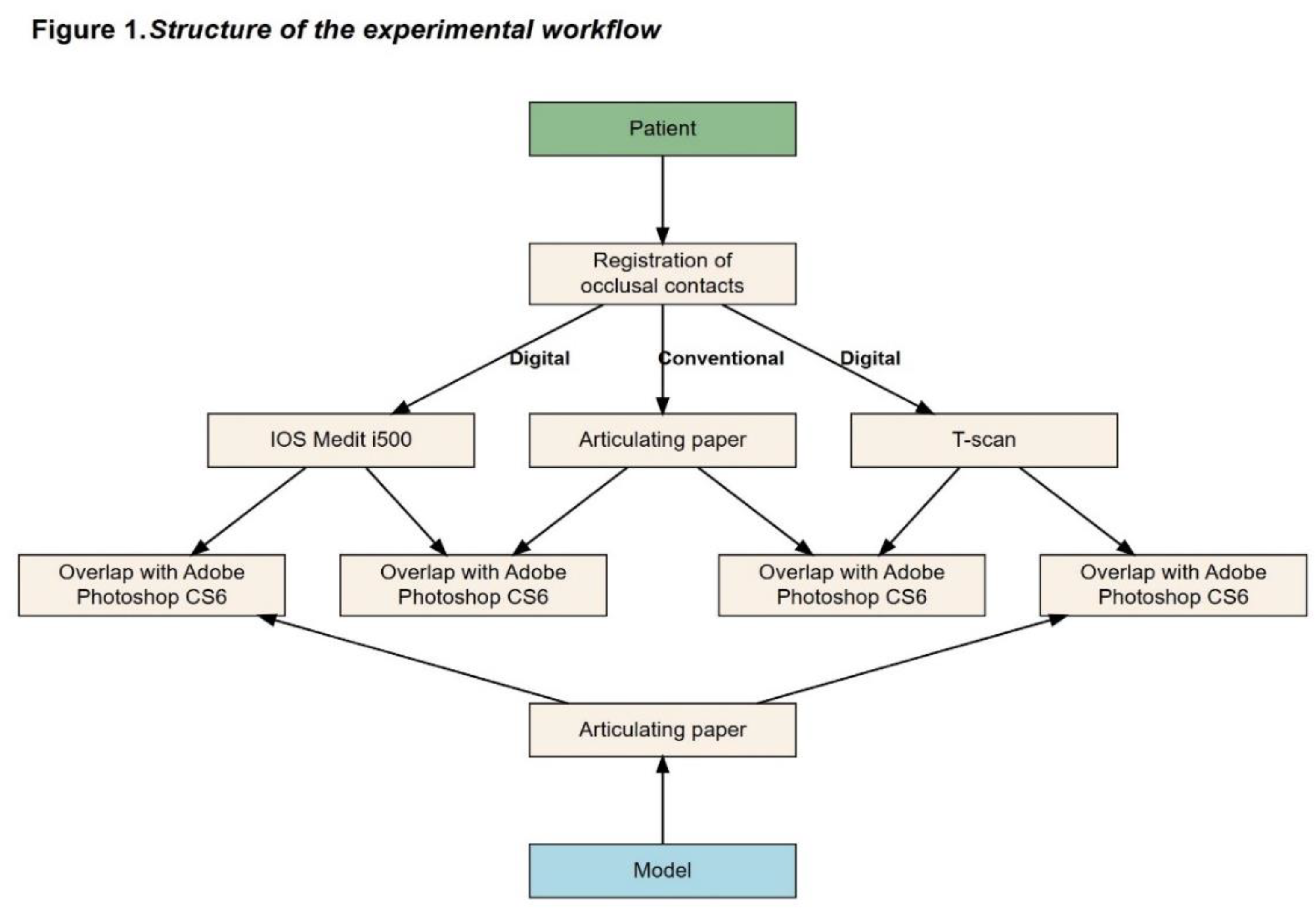
Figure 2.
Intraoral scan of upper and lower dentition with Medit i500 and overlap with the articulating paper images.(a. Medit i500; b. intraoral scan of the upper dentition; f. intraoral scan of the lower dentition; c. intraoral registration of the upper dentition with articulating paper; g. intraoral registration of the lower dentition with articulating paper; d, e. overlap of the IOS scan and the articulating paper images, upper jaw (d. patient; e. model); h, e. overlap of the IOS scan and the articulating paper images, lower jaw (h. patient; i. model)).
Figure 2.
Intraoral scan of upper and lower dentition with Medit i500 and overlap with the articulating paper images.(a. Medit i500; b. intraoral scan of the upper dentition; f. intraoral scan of the lower dentition; c. intraoral registration of the upper dentition with articulating paper; g. intraoral registration of the lower dentition with articulating paper; d, e. overlap of the IOS scan and the articulating paper images, upper jaw (d. patient; e. model); h, e. overlap of the IOS scan and the articulating paper images, lower jaw (h. patient; i. model)).
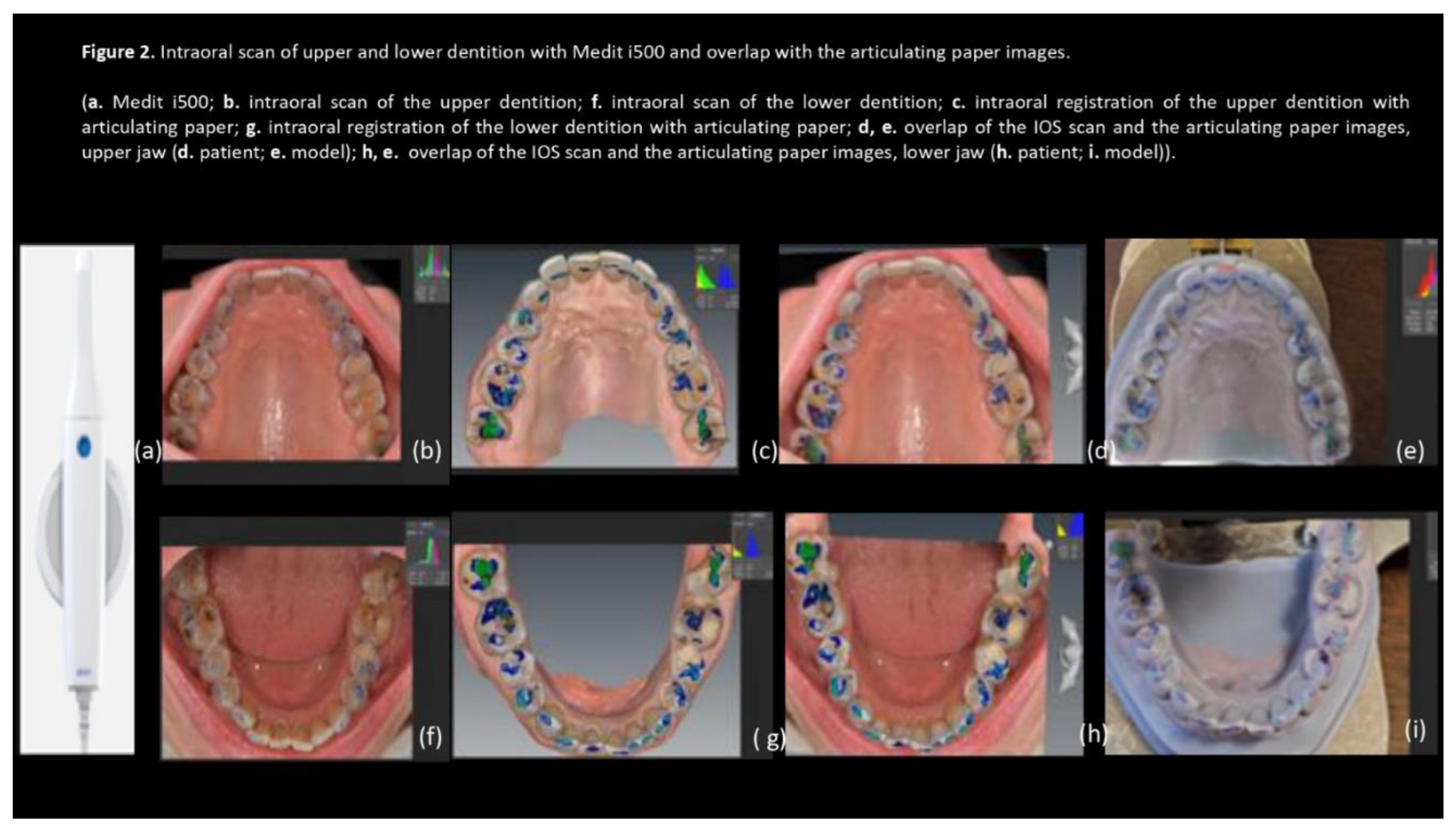
Figure 3.
Intraoral scan of upper and lower dentition with T-Scan and overlap with the articulating paper images. (a. T-Scan; b. intraoral scan of the upper dentition; f. intraoral scan of the lower dentition; c. intraoral registration of the upper dentition with articulating paper; g. intraoral registration of the lower dentition with articulating paper; d, e. overlap of the T-Scan and the articulating paper images, upper jaw (d. patient; e. model); h, i. overlap of the T-Scan and the articulating paper images, lower jaw (h. patient; i. model)).
Figure 3.
Intraoral scan of upper and lower dentition with T-Scan and overlap with the articulating paper images. (a. T-Scan; b. intraoral scan of the upper dentition; f. intraoral scan of the lower dentition; c. intraoral registration of the upper dentition with articulating paper; g. intraoral registration of the lower dentition with articulating paper; d, e. overlap of the T-Scan and the articulating paper images, upper jaw (d. patient; e. model); h, i. overlap of the T-Scan and the articulating paper images, lower jaw (h. patient; i. model)).
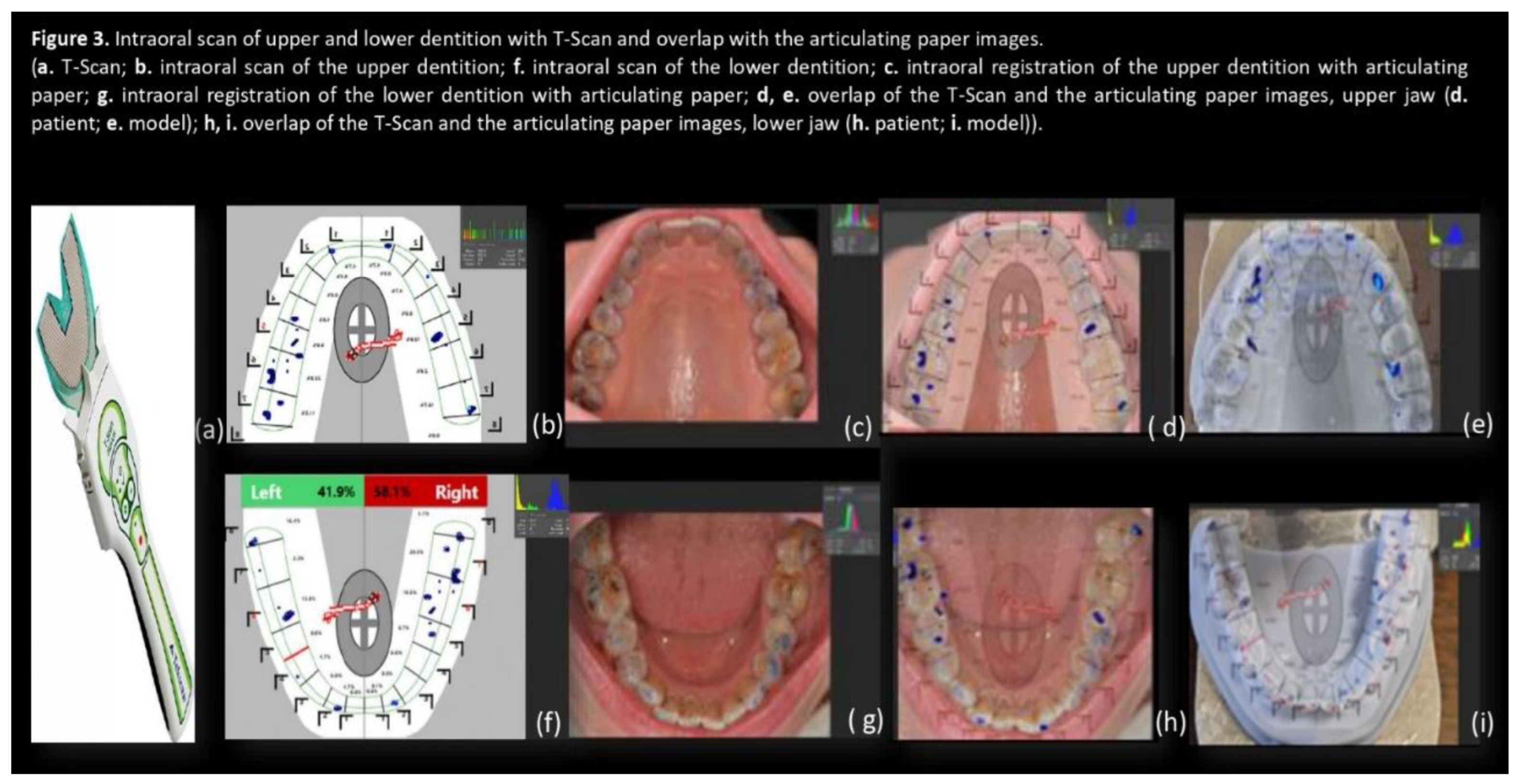
Figure 4.
Bland-Altman method.
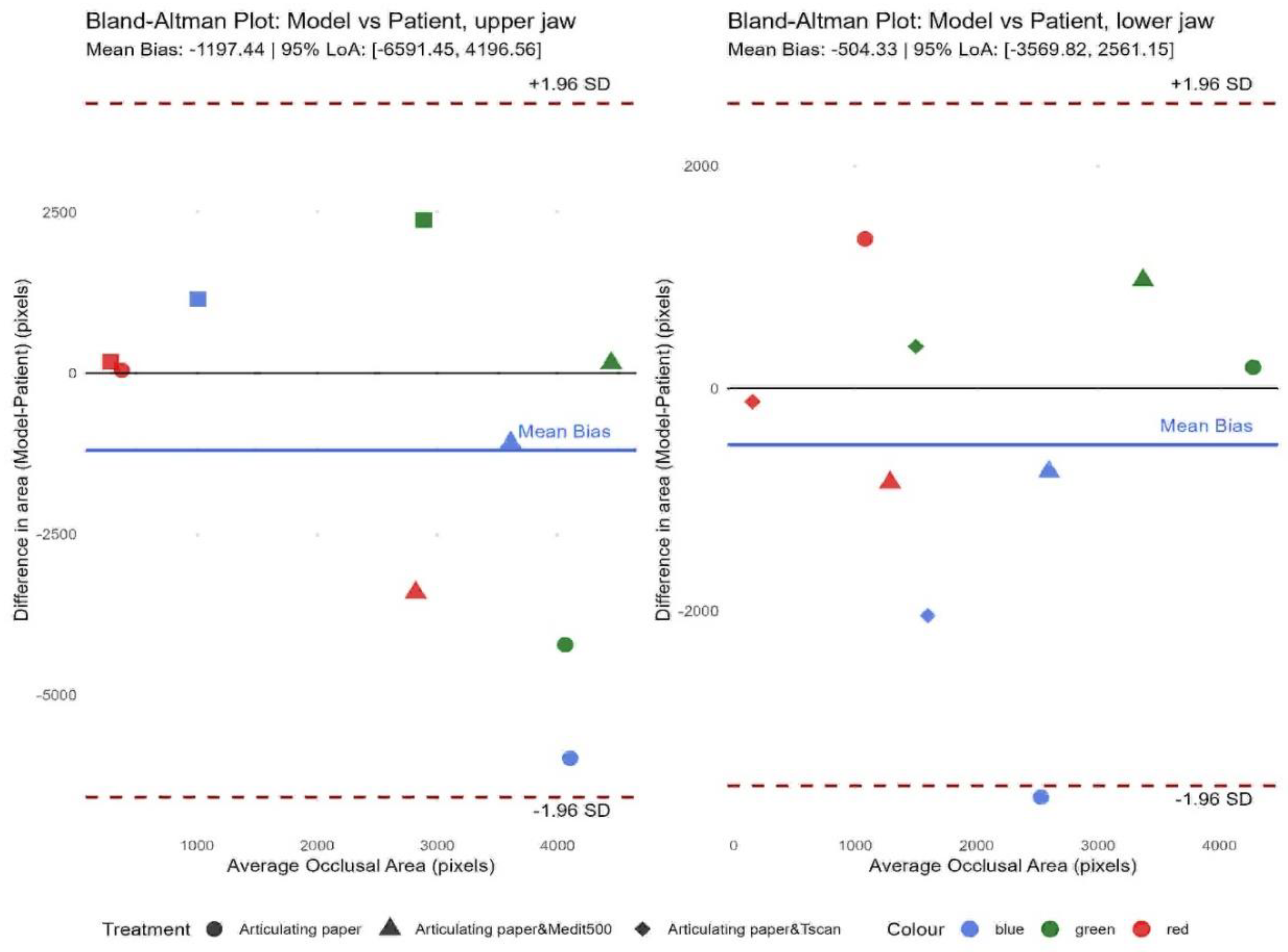
Figure 5.
Distribution of occlusal contact area coverage on the upper and lower jaw of a patient and a model, according to the method used.
Figure 5.
Distribution of occlusal contact area coverage on the upper and lower jaw of a patient and a model, according to the method used.
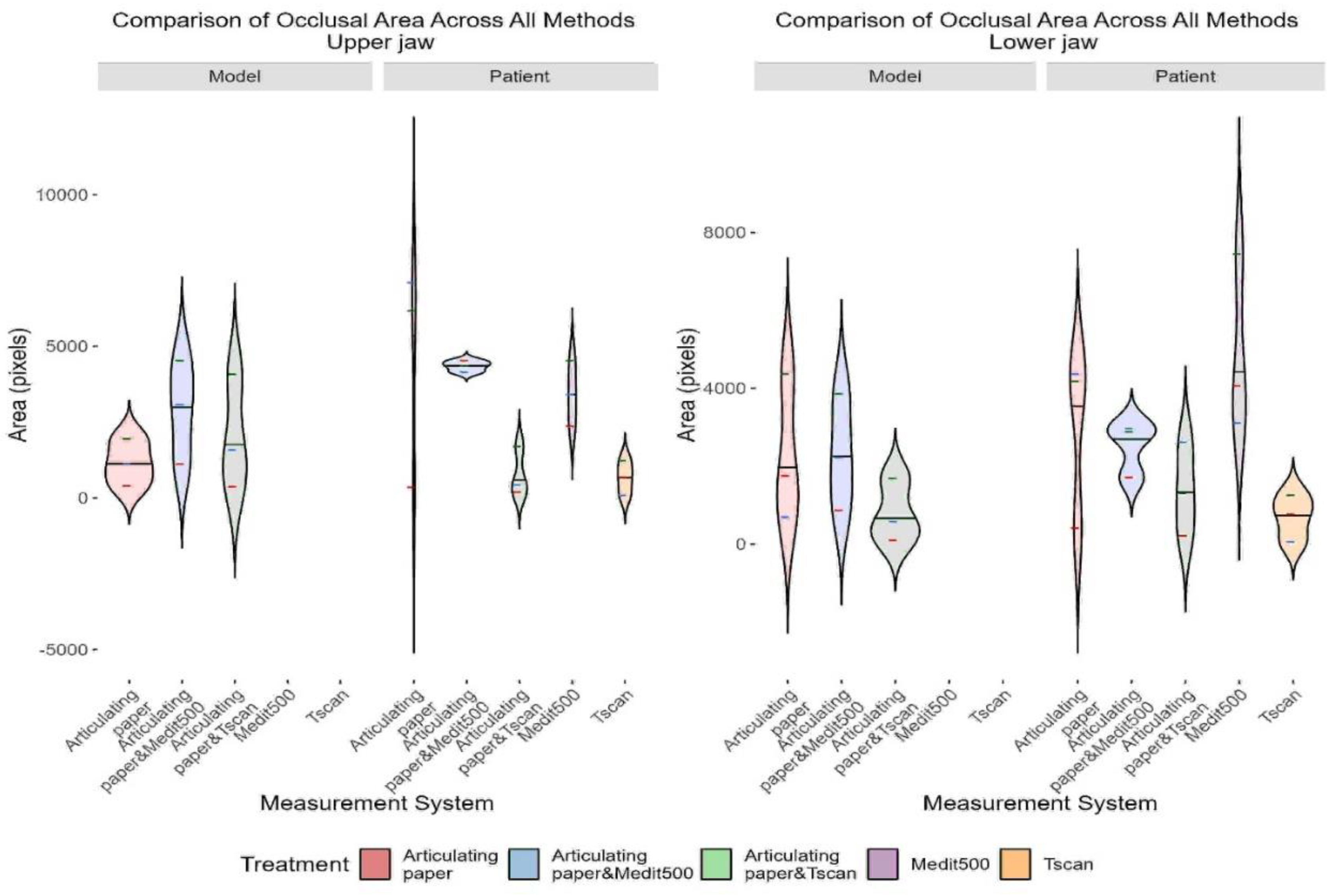

Table 1.
Mean value and standard deviation of the measured occlusal contact area of the maxilla and the mandible with the methods used, in pixels.
Table 1.
Mean value and standard deviation of the measured occlusal contact area of the maxilla and the mandible with the methods used, in pixels.
| Jaw Sample | Prototype | Method | Mean Area (Pixels) | Standard Deviation (Pixels) |
|---|---|---|---|---|
| Upper | Model | Articulating paper | 1153 | 779 |
| Model | Articulating paper & Medit i500 | 2903 | 1711 | |
| Model | Articulating paper & T-Scan | 2010 | 1889 | |
| Patient | Articulating paper | 4540 | 3658 | |
| Patient | Articulating paper & Medit i500 | 4345 | 189 | |
| Patient | Articulating paper & T-Scan | 772 | 807 | |
| Patient | Medit i500 | 3430 | 1080 | |
| Patient | T-Scan | 664 | 574 | |
| Lower | Model | Articulating paper | 2272 | 1893 |
| Model | Articulating paper & Medit i500 | 2314 | 1498 | |
| Model | Articulating paper & -scan | 786 | 816 | |
| Patient | Articulating paper | 2985 | 2233 | |
| Patient | Articulating paper & Medit i500 | 2520 | 703 | |
| Patient | Articulating paper & T-Scan | 1380 | 1203 | |
| Patient | Medit i500 | 4875 | 2281 | |
| Patient | T-Scan | 692 | 602 |
Table 2.
Results of the stacked paired t-tests, conducted at a 95% confidence interval, in order to identify possible statistically significant variances in the mean values of maxillary occlusal contact area overlaps.
Table 2.
Results of the stacked paired t-tests, conducted at a 95% confidence interval, in order to identify possible statistically significant variances in the mean values of maxillary occlusal contact area overlaps.
| Prototype | Estimate | Mean Difference | Statistics | p-value | Degrees of Freedom | Conf. Low | Conf. High |
|---|---|---|---|---|---|---|---|
| Patient |
Articulating paper and T-Scan | 3876 | t = 1.77 | 0.22 | df = 2 | -5531.4 | 13283.4 |
| Articulating paper and Medit i500 | 1109.67 | t = 0.67 | 0.57 | df = 2 | -6067.7 | 8287.05 | |
| T-Scan and Medit i500 | 2766.33 | t = 5.1 | 0.04 | df = 2 | 433.22 | 5099.45 | |
| Articulating paper and Articulating paper & T-Scan | 3767.67 | t = 1.97 | 0.19 | df = 2 | -4461.7 | 11997.1 | |
| Articulating paper and Articulating paper & Medit i500 | 194.67 | t = 0.09 | 0.94 | df = 2 | -9310.2 | 9699.53 | |
| Articulating paper & T-Scan and Articulating paper & Medit i500 | 3573 | t = 7.37 | 0.02 | df = 2 | 1488.02 | 5657.98 | |
| Model | Articulating paper and Articulating paper & T-Scan | -856.67 | t = -1.32 | 0.32 | df = 2 | -3650 | 1936.69 |
| Articulating paper and Articulating paper & Medit i500 | -1749.7 | t = -3.21 | 0.08 | df = 2 | -4096.1 | 596.75 | |
| Articulating paper & T-Scan and Articulating paper & Medit i500 | 893 | t = 2.89 | 0.1 | df = 2 | -436.04 | 2222.04 |
Table 3.
Results of the tests for a statistically significant difference in the mean values of coverage of the occlusal area of the lower jaw, at 95% confidence interval (stacked paired t-test).
Table 3.
Results of the tests for a statistically significant difference in the mean values of coverage of the occlusal area of the lower jaw, at 95% confidence interval (stacked paired t-test).
| Prottype | Estimate | Mean Difeence | Sttitics | p-value | Degrees of Freedom | Conf. Low | Conf. High |
|---|---|---|---|---|---|---|---|
| Patient | Articulating paper and T-Scan | 2292.67 | t = 1.66 | 0.24 | df = 2 | -3664.2 | 8249.57 |
| Articulating paper and Medit i500 | -1889.7 | t = -1.2 | 0.35 | df = 2 | -8671.8 | 4892.5 | |
| T-Scan and Medit i500 | 4182.33 | t = 4.14 | 0.05 | df = 2 | -162.28 | 8526.95 | |
| Articulating paper and Articulating paper & T-Scan | 1604.67 | t = 2.07 | 0.17 | df = 2 | -1733.4 | 4942.72 | |
| Articulating paper and Articulating paper & Medit i500 | 464.67 | t = 0.53 | 0.65 | df = 2 | -3335.9 | 4265.18 | |
| Articulating paper & T-Scan and Articulating paper & Medit i500 | 1140 | t = 2.89 | 0.1 | df = 2 | -560.09 | 2840.09 | |
| Model | Articulating paper and Articulating paper & T-Scan | 1485.67 | t = 1.99 | 0.18 | Df = 2 | -1725.2 | 4696.53 |
| Articulating paper and Articulating paper & Medit i500 | -42.33 | t = -0.06 | 0.96 | Df = 2 | -3273.8 | 3189.17 | |
| Articulating paper & T-Scan and Articulating paper & Medit i500 | 1528 | t = 3.74 | 0.06 | Df = 2 | -227.79 | 3283.79 |
Table 4.
Two-way ANOVA of the upper jaw.
| Prototype | Sum Sq | Mean Sq | NumDf | F-value | Pr(>F) | |
|---|---|---|---|---|---|---|
| Patient | Method | 43423808 | 10855952 | 4 | 4.1796 | 0.04066* |
| Color | 10348839 | 5174419 | 2 | 1.9922 | 0.19857 | |
| Residuals | 20779085 | 2597386 | 8 | |||
| Model | Method | 4592660 | 2296330 | 2 | 5.6401 | 0.06853 |
| Color | 12573551 | 6286775 | 2 | 2.1861 | 0.01315 * | |
| Residuals | 1628588 | 407147 | 4 | 1628588 | 407147 | |
| Signif. Codes: 0 '***' 0.001 '**' 0.01 '*' 0.05 '.' 0.1 ' ' 1 | ||||||
Table 5.
Fisher’s post-hoc analysis of the maxilla for the patient and the model.
| Prototype | Contrast | Estimate | SE | Df | t-ratio | p-value |
|---|---|---|---|---|---|---|
| Patient | Articulating paper–Articulating paper & Medit i500 | 195 | 1316 | 8 | 0.148 | 0.8861 |
| Articulating paper–Articulating paper & T-Scan | 3768 | 1316 | 8 | 2.863 | 0.021 | |
| Articulating paper–Medit i500 | 1110 | 1316 | 8 | 0.843 | 0.4236 | |
| Articulating paper–T-Scan | 3876 | 1316 | 8 | 2.946 | 0.0186 | |
| Articulating paper & Medit i500– Articulating paper & T-Scan | 3573 | 1316 | 8 | 2.715 | 0.0264 | |
| Articulating paper & Medit i500– Medit i500 | 915 | 1316 | 8 | 0.695 | 0.5065 | |
| Articulating paper & Medit i500–T-Scan | 3681 | 1316 | 8 | 2.798 | 0.0233 | |
| Articulating paper & T-Scan–Medit i500 | -2658 | 1316 | 8 | -2.02 | 0.0781 | |
| Articulating paper & T-Scan–T-Scan | 108 | 1316 | 8 | 0.082 | 0.9364 | |
| Medit i500–T-Scan | 2766 | 1316 | 8 | 2.102 | 0.0687 | |
| Model | Articulating paper–Articulating paper & Medit i500 | -1750 | 521 | 4 | -3.358 | 0.0283 |
| Articulating paper–Articulating paper & T-Scan | -857 | 521 | 4 | -1.644 | 0.1755 | |
| Articulating paper & Medit i500– Articulating paper & T-Scan | 893 | 521 | 4 | 1.714 | 0.1617 | |
| Results are averaged over the levels of: Color. Degrees of freedom method: Kenward-Roger | ||||||
| Color contrasts | ||||||
| Model | blue–green | -1596 | 521 | 4 | -3.063 | 0.0376 |
| blue–red | 1294 | 521 | 4 | 2.484 | 0.0679 | |
| green–red | 2890 | 521 | 4 | 5.547 | 0.0052 | |
| Results are averaged over the levels of: Treatment. Degrees of freedom method: Kenward-Roger | ||||||
Table 6.
Two-way ANOVA of the lower jaw.
| Prototype | Sum Sq | Mean Sq | NumDf | F-value | Pr(>F) | |
|---|---|---|---|---|---|---|
| Patient | Method | 31186633 | 7796658 | 4 | 4.1511 | 0.04135 * |
| Color | 9956778 | 4978389 | 2 | 2.6506 | 0.13086 | |
| Residuals | 15025575 | 1878197 | 8 | |||
| Model | Method | 4543782 | 2271891 | 2 | 3.5292 | 0.1308 |
| Color | 10413254 | 5206627 | 2 | 8.088 | 0.0393 * | |
| Residuals | 2574979 | 643745 | 4 | |||
| Signif. Codes: 0 '***' 0.001 '**' 0.01 '*' 0.05 '.' 0.1 ' ' 1 | ||||||
Table 7.
Fisher’s LSD post-hoc test of Method s contrasts in lower jaw of patient.
| Prototype | Contrast | Estimate | SE | Df | t-ratio | p-value |
|---|---|---|---|---|---|---|
| Patient | Articulating paper–Articulating paper & Medit i500 | 465 | 1119 | 8 | 0.415 | 0.6889 |
| Articulating paper–Articulating paper & T-Scan | 1605 | 1119 | 8 | 1.434 | 0.1895 | |
| Articulating paper–Medit i500 | -1890 | 1119 | 8 | -1.689 | 0.1297 | |
| Articulating paper–T-Scan | 2293 | 1119 | 8 | 2.049 | 0.0746 | |
| Articulating paper & Medit i500–Articulating paper & T-Scan | 1140 | 1119 | 8 | 1.019 | 0.3381 | |
| Articulating paper & Medit i500–Medit i500 | -2354 | 1119 | 8 | -2.104 | 0.0685 | |
| Articulating paper & Medit i500– T-Scan | 1828 | 1119 | 8 | 1.634 | 0.141 | |
| Articulating paper & T-Scan–Medit i500 | -3494 | 1119 | 8 | -3.123 | 0.0142 | |
| Articulating paper & T-Scan–T-Scan | 688 | 1119 | 8 | 0.615 | 0.5557 | |
| Medit i500–T-Scan | 4182 | 1119 | 8 | 3.738 | 0.0057 | |
| Results are averaged over the levels of: Color | ||||||
| Degrees-of-freedom method: K enward-Roger | ||||||
| Color contrasts | ||||||
| Model | blue–green | -2141 | 655 | 4 | -3.268 | 0.0309 |
| blue–red | 260 | 655 | 4 | 0.397 | 0.7117 | |
| green–red | 2401 | 655 | 4 | 3.665 | 0.0215 | |
| Results are averaged over the levels of: Method | ||||||
Table 8.
Three-way ANOVA.
| Jaw Sample |
Factors | Df | Sum Sq | Mean Sq | F-value | Pr(>F) |
|---|---|---|---|---|---|---|
| upper | Prototype | 1 | 6452429 | 6452429 | 3.1162 | 0.10798 |
| Method | 2 | 15418551 | 7709276 | 3.7232 | 0.06187 | |
| Color | 2 | 21630908 | 10815454 | 5.2233 | 0.02798 * | |
| Prototype: Method | 2 | 16173645 | 8086823 | 3.9055 | 0.05579 | |
| Residuals | 10 | 20706202 | 2070620 | |||
| lower | Prototype | 1 | 1144584 | 1144584 | 0.9637 | 0.34941 |
| Method | 2 | 8423375 | 4211687 | 3.5461 | 0.06855 | |
| Color | 2 | 14965021 | 7482510 | 6.3 | 0.01696 * | |
| Prototype: Method | 2 | 210877 | 105438 | 0.0888 | 0.91576 | |
| Residuals | 10 | 11877002 | 1187700 |
Disclaimer/Publisher’s Note: The statements, opinions and data contained in all publications are solely those of the individual author(s) and contributor(s) and not of MDPI and/or the editor(s). MDPI and/or the editor(s) disclaim responsibility for any injury to people or property resulting from any ideas, methods, instructions or products referred to in the content. |
© 2026 by the authors. Licensee MDPI, Basel, Switzerland. This article is an open access article distributed under the terms and conditions of the Creative Commons Attribution (CC BY) license (http://creativecommons.org/licenses/by/4.0/).
Copyright: This open access article is published under a Creative Commons CC BY 4.0 license, which permit the free download, distribution, and reuse, provided that the author and preprint are cited in any reuse.


