

Submitted:
14 April 2026
Posted:
15 April 2026
You are already at the latest version
Abstract
GJB2-associated hearing loss is the most common form of non-syndromic hereditary deafness worldwide. However, it exhibits significant heterogeneity in terms of both clinical presentation and biological basis. This review focuses on mechanism-oriented therapeutic strategies for GJB2-associated hearing loss, investigating how different types of GJB2 variants correspond to distinct clinical phenotypes and underlying pathogenic mechanisms, and aims to determine appropriate treatments. Current evidence suggests that GJB2-associated hearing loss is not solely caused by channel dysfunction resulting from gap junction defects, but rather the result of multiple pathological processes, including impaired GJB2 transcriptional regulation, cochlear developmental abnormalities, sensory epithelial degeneration and secondary damage pathways such as inflammation. Consequently, emerging therapeutic approaches can be viewed as interventions targeting specific mechanisms, including gene therapy, restoration of protein transport and pharmacological modulation of damage to the cochlear microenvironment. Overall, this review highlights the importance of targeting therapeutic strategies at specific GJB2 variants, the underlying pathogenic mechanisms and the timing of intervention. This improves our understanding of the mechanisms underlying GJB2-associated hearing loss and the development of precision therapies.
Keywords:
GJB2
; hearing loss
; mechanism
; therapy
1. Introduction
Hearing is the foundation of human communication, social activities and cognitive health [1,2]. Over the past decade, global health data indicate that hearing loss has emerged as one of the leading causes of disability worldwide [3]. According to the most recent analytical estimates from the Global Burden of Disease (GBD) 2021 study, approximately 1.546 billion individuals experience varying degrees of hearing loss, with projections indicating this figure will rise to around 2.45 billion by 2050 [4,5,6].
Mutations in GJB2 account for up to ~50% of inherited recessive non-syndromic hearing loss (NSHL) across multiple populations [7,8]. The etiological spectrum of hearing loss encompasses a wide range of factors, including both hereditary causes and non-genetic exposures such as infections, noise, and ototoxic agents [9,10,11]. In cases of congenital and early-onset hearing impairment, however, genetic factors play an especially pivotal role [12]. More than half of congenital hearing loss cases can be attributed to genetic origins [13,14,15]. Non-syndromic sensorineural hearing loss (NSHL) exhibits substantial genetic heterogeneity, with >120 hearing loss-associated genes (including syndromic and nonsyndromic variants) have been identified to date [16,17,18]. Among deafness-associated genes, GJB2 is one of the most common and clinically important genetic causes of nonsyndromic hearing loss, particularly in autosomal-recessive and congenital/early-onset cases [19]. More recent next-generation sequencing–based cohort studies have similarly confirmed the prominent contribution of GJB2 to early-life hearing loss. In a large Canadian pediatric cohort, GJB2 was the most prevalent causative gene, accounting for 38.4% (28/73) of genetically confirmed cases, while a 2024 study of 106 sporadic hearing-loss cases from the United Arab Emirates identified GJB2 variants in 24 affected individuals [20,21]. In this review, we draw upon recent advances in GJB2-related hearing loss research to explore mechanistic-level therapeutic strategies, thereby providing references for expanding current treatment strategies and informing feasible future therapeutic pathways of GJB2-associated hearing impairment.
2. Structure and Function of the GJB2 Gene
GJB2 encodes connexin 26 (Cx26), which is highly expressed in multiple non-sensory cochlear cell populations, including supporting cells, sulcus and limbal cells, spiral ligament fibrocytes, and basal cells of the stria vascularis, together with other epithelial and connective tissue cells that collectively form an extensive cochlear gap junction network [22,23]. Within this network, Cx26 assembles into intercellular channels that play critical roles in ionic homeostasis [24,25], metabolic coupling, and local signal transduction [26,27]. Pathogenic variants of GJB2 represent naturally occurring experimental models, linking molecular defects to clinical phenotypes through their impact on channel assembly, permeability, trafficking, or regulatory function [28,29,30]. These manifestations range from congenital severe-to-profound hearing loss to late-onset mild hearing impairment [31,32,33]. The spectrum of variants in this gene is heterogeneous, encompassing truncating, missense, and splicing alterations, each corresponding to distinct molecular pathological pathways [34,35,36]. This suggests that the underlying mechanisms involve diverse modes of dysfunction, thereby providing a rationale for the development of mechanism-based therapies rather than mere symptomatic management.
Cx26 does not function in isolation in the cochlea, but rather within a broader connexin network in which its principal partner is Cx30, the protein encoded by GJB6 [37]. The two proteins are widely co-expressed in cochlear supporting-cell gap-junction systems, colocalize within the same junctional plaques, and can co-assemble into heteromeric connexons as well as functionally distinct intercellular channels [38]. This heteromeric organization is functionally important because mixed Cx26/Cx30 channel composition shapes pore properties in ways that influence biochemical coupling more strongly than electrical conductance alone [39,40,41]. In this setting, the local Cx26:Cx30 ratio can help preserve efficient ionic coupling while tuning the permeability of small metabolites and second messengers across cochlear regions [42,43]. In mixed Cx26/Cx30 channels, a higher Cx26 fraction generally favors permeability to anionic tracers and other small anionic solutes, whereas a higher Cx30 fraction tends to reduce such permeability by altering the electrostatic microenvironment and pore constriction profile [44,45,46]. As a result, intercellular signaling pathways, including purinergic and Ca²⁺-related signaling, may exhibit spatially restricted and temporally dynamic propagation during development and under stress conditions [47]. Therefore, the functional consequences of Cx26 deficiency should not be interpreted solely as loss of a single connexin, but rather in the context of altered Cx26–Cx30 channel composition and coupling properties. Therefore, the consequences of Cx26 deficiency should be interpreted not simply as loss of a single connexin, but as disruption of Cx26–Cx30 channel composition and intercellular coupling properties. This framework helps explain phenotypic variability in DFNB1-related hearing loss and is also relevant to the interpretation of Cx26-targeted rescue strategies [48].
3. Genetic Epidemiology and Clinical Spectrum of GJB2-Related Hearing Loss
3.1. Genetic Epidemiology
Pathogenic GJB2 variants are among the most common causes of autosomal-recessive non-syndromic hearing loss (AR-NSHL), yet their allele spectra are strongly ancestry-specific. Over one hundred pathogenic or likely pathogenic coding variants have been reported, with marked population specificity [49]. Accordingly, matching panels to local allele spectra improves diagnostic yield, especially in regions dominated by a limited number of recurrent DFNB1 alleles. In East and Southeast Asia, founder and recurrent variants such as c.235delC and c.109G>A (p.V37I) recur at high frequency, whereas c.35delG predominates in many European populations. Large-scale newborn and carrier screening programmes in China and Japan further indicate that a small number of recurrent GJB2 variants explain a substantial proportion of hereditary deafness, making DFNB1 a practical target for precision screening and prevention. Key population-specific alleles and their screening relevance are summarised in Table 1.
Beyond recurrent coding alleles, the mutational spectrum of the DFNB1 locus also includes non-coding and structural variants that can contribute to unresolved or apparently monoallelic GJB2 cases. Recurrent deletions spanning the GJB6–CRYL1 interval, including del(GJB6-D13S1830) and del(GJB6-D13S1854), together with additional upstream copy-number variants identified through genome sequencing, can reduce GJB2 expression, often together with GJB6, through disruption of cis-regulatory elements rather than simple GJB6 haploinsufficiency. Analyses of overlapping deletion intervals have localized a critical upstream regulatory region largely within CRYL1, providing a mechanistic explanation for cases in which only a single coding GJB2 variant is initially detected. These findings indicate that the genetic architecture of DFNB1 extends beyond exon-level sequence changes and support the inclusion of copy-number and regulatory variant assessment in molecular diagnostic workflows.
3.2. Clinical Spectrum
3.2.1. Genotype–Phenotype Correlation and Clinical Variability in Nonsyndromic GJB2-Related Hearing Loss
Clinically, most pathogenic GJB2 alleles are point mutations or small insertions and deletions, yet the associated hearing phenotype is highly variable [61,62]. Across cohorts, a broad genotype–phenotype correlation has nevertheless been observed: biallelic truncating variants, including frameshift, nonsense, and canonical splice-site mutations, are more often associated with prelingual severe-to-profound sensorineural hearing loss, whereas biallelic non-truncating variants more commonly underlie milder phenotypes ranging from mild to moderate impairment [63,64]. In pediatric series, GJB2-associated hearing loss most often presents during infancy or early childhood, and earlier onset is generally associated with a higher likelihood of profound impairment [65,66]. This trend is also reflected in several recurrent GJB2 alleles commonly encountered in clinical practice. Among truncating genotypes, homozygous c.35delG is typically associated with a particularly severe phenotype, and c.235delC, a major recurrent allele in East Asian populations, is likewise frequently linked to congenital or early-onset severe hearing impairment. By contrast, recurrent non-truncating variants such as p.V37I (c.109G>A), p.M34T, and p.L90P are more often associated with mild-to-moderate hearing loss. Representative genotype classes, corresponding nucleotide changes, and their typical phenotypic associations are summarised in Table 2.
This correlation is robust but not absolute. Even among genotypes classified as severe, phenotypic expression can vary, suggesting modulation by genetic background and cochlear network context [67,68]. Clinical series have described families in which biallelic truncating genotypes present with postlingual or moderate impairment, underscoring the relevance of modifiers such as GJB6 regulatory coupling and other connexin-network determinants [69,70]. Conversely, common missense alleles such as p.V37I often exhibit incomplete penetrance and heterogeneous trajectories, with outcomes ranging from normal hearing to bilateral mild-to-moderate loss of variable configuration and progression [71,72]. Collectively, GJB2 coding variation supports a spectrum model rather than a single stereotyped phenotype, and genotype-informed stratification is most informative when interpreted alongside modifiers and life-course context.

Table 2.
Representative genotype classes, nucleotide changes, and clinical spectrum in nonsyndromic DFNB1-associated hearing loss.
Table 2.
Representative genotype classes, nucleotide changes, and clinical spectrum in nonsyndromic DFNB1-associated hearing loss.
| Genotype class | Nucleotide changes | General phenotypic trend | Sources of variability |
| Truncating coding variants [73,74] | c.35delG, c.235delC, c.167delT, c.71G>A, c.299_300delAT | Often prelingual severe to profound sensorineural hearing loss | Genetic background and cochlear network context can shift severity and age at onset |
| Canonical splice site variants [75,76] | c.-23+1G>A, c.-22-2A>C | Frequently severe, with strong population enrichment in some groups | Expressivity may vary across families and cohorts |
| Non truncating coding variants [53] | c.109G>A, c.101T>C, c.269T>C | Often mild to moderate or context dependent phenotypes | Incomplete penetrance and heterogeneous trajectories are common for recurrent missense alleles |
| Mixed severity biallelic genotypes [67] | c.35delG/c.109G>A; c.35delG/c.101T>C; c.235delC/c.109G>A | Broad spectrum, often intermediate but not predictable | Modifier burden and life course context can move the phenotype in either direction |
| DFNB1 regulatory or structural variants [77,78] |
del(GJB6-D13S1830); del(GJB6-D13S1854); upstream DFNB1 cis-regulatory deletions | Can mimic monoallelic GJB2 results on exon sequencing | Cis regulatory disruption may reduce GJB2 expression and explain unresolved cases |
3.2.2. Syndromic Phenotypes Associated with Specific GJB2 Variants
Although most GJB2-associated hearing loss is nonsyndromic, a smaller subset presents as syndromic disease accompanied by cutaneous abnormalities. These disorders are typically caused by heterozygous dominant missense variants rather than the biallelic truncating alleles that underlie classic DFNB1-associated deafness. Reported syndromic phenotypes include palmoplantar keratoderma with deafness, Vohwinkel syndrome, Bart–Pumphrey syndrome, and keratitis–ichthyosis–deafness (KID) syndrome, all of which illustrate the pleiotropic consequences of specific Cx26 substitutions. Functionally, these variants often act through mechanisms beyond simple loss of channel function, including abnormal hemichannel activity, disrupted gap junction communication, and dominant-negative or trans-dominant interference with wild-type Cx26 or co-expressed connexins. Representative syndromic phenotypes, associated variants, and their translational implications are summarised in Table 3.
At present, the management of syndromic GJB2-associated deafness remains largely supportive, with treatment focused on hearing rehabilitation and dermatologic care rather than mutation-directed intervention. However, accumulating mechanistic studies suggest that these disorders may be particularly informative for future precision therapy. In KID syndrome, where hyperactive hemichannels appear to be a major pathogenic driver, topical pharmacologic inhibition has ameliorated epidermal pathology in mouse models, and AAV-mediated delivery of an anti-hemichannel monoclonal antibody has shown substantial therapeutic benefit in vivo. More recently, AAV-mediated adenine base editing restored cochlear gap-junction architecture in a dominant GJB2 R75W syndromic hearing-loss model, supporting the broader concept that dominant missense GJB2 disorders may become tractable targets for allele-specific editing or other mutation-directed strategies. Accordingly, although direct clinical translation remains preliminary, syndromic GJB2 phenotypes provide an important framework for linking variant-specific mechanism to future therapeutic design.
Figure 1.
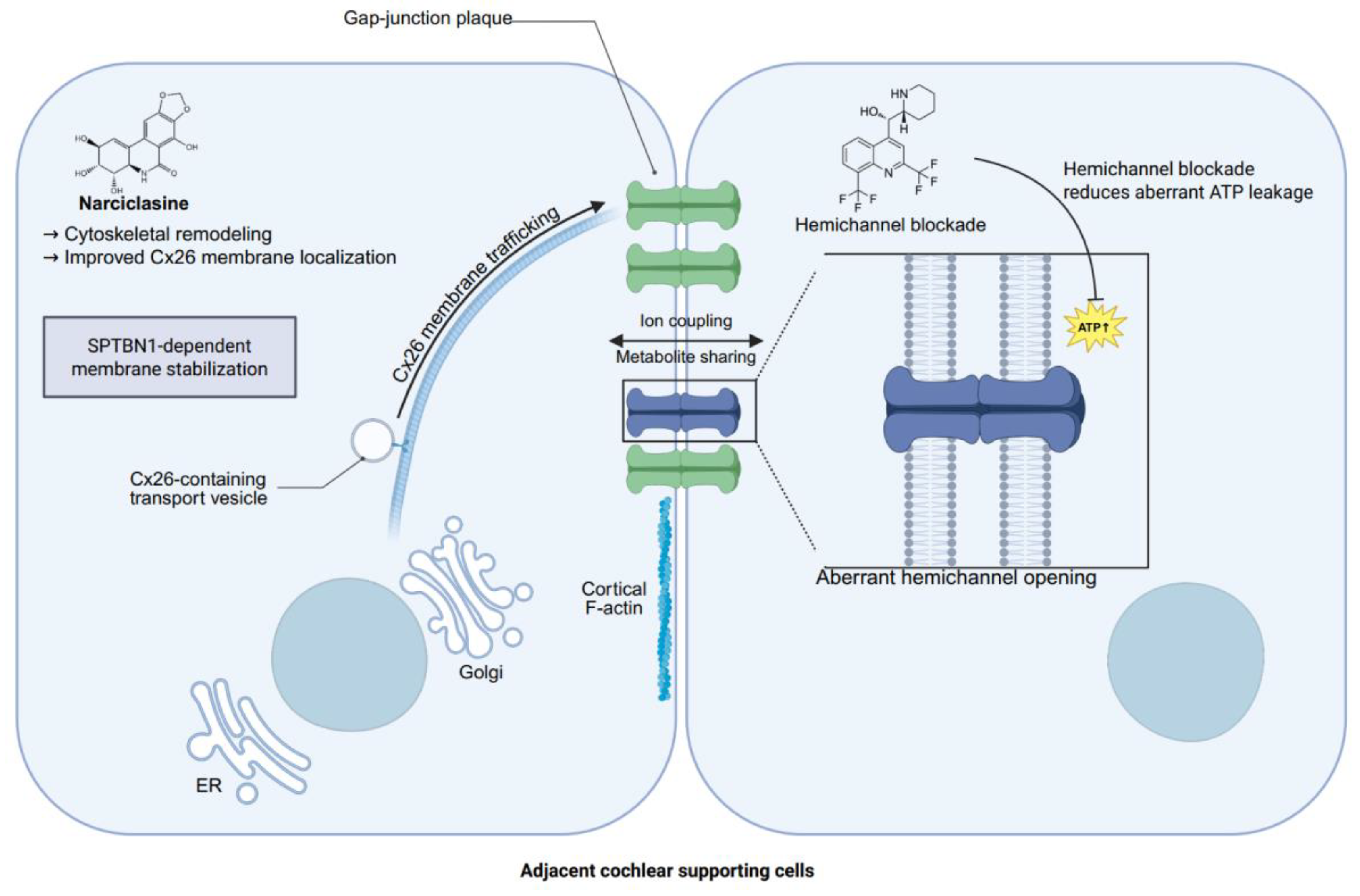
Mechanism-based therapeutic rescue strategies targeting impaired Cx26 trafficking/localization and aberrant hemichannel activity in adjacent cochlear supporting cells.
Figure 1.
Mechanism-based therapeutic rescue strategies targeting impaired Cx26 trafficking/localization and aberrant hemichannel activity in adjacent cochlear supporting cells.
4. Pathogenic Mechanisms and Therapeutic Opportunities in GJB2-Related Hearing Loss
4.1. Therapeutically Relevant Upstream Defects in Cx26 Expression, Trafficking, and Localization
Upstream defects in Cx26 expression, trafficking, and localization represent one of the most therapeutically actionable entry points in GJB2-related hearing loss. At this level, pathogenic variants do not all disrupt cochlear function in the same manner: some primarily reduce Cx26 abundance, whereas others permit protein synthesis but impair its intracellular trafficking, junctional assembly, membrane stability, or channel competence. This mechanistic heterogeneity is important because it means that early pathogenic events may be more amenable to correction than downstream structural degeneration, but also that rescue strategies cannot be applied in a mutation-agnostic fashion. Instead, effective intervention must be matched to the biological level of failure, with expression-restoring approaches being more relevant to protein-deficient alleles and localization- or assembly-directed strategies being more relevant to structurally permissive variants. The following sections therefore begin by outlining the major forms of upstream Cx26 dysfunction and then discuss how these distinct defects shape corresponding therapeutic strategies.
4.1.1. Reduced Cx26 Abundance and Impaired Trafficking, Assembly, and Channel Competence
Pathogenic GJB2 variants can disrupt cochlear function at the most proximal level by reducing the abundance of connexin 26 (Cx26) or compromising its ability to reach, assemble at, and function within the plasma membrane [62,89]. In many cases, the primary defect is quantitative. Truncating variants, including nonsense, frameshift, and canonical splice-site mutations, often result in absent or markedly reduced protein production, thereby severely limiting the formation of functional gap junction channels [90]. Even when translation is not completely abolished, some variants produce unstable proteins that are rapidly degraded or fail to accumulate to levels sufficient for normal intercellular coupling [91,92]. Certain missense variants likewise permit Cx26 synthesis but still reduce its functional availability by impairing protein stability or conformational integrity [93]. A second major class of upstream defects involves abnormal intracellular trafficking and membrane targeting [94]. Newly synthesized Cx26 must undergo proper folding, oligomerization, and delivery to the plasma membrane before it can assemble into gap junction plaques [95]. However, many disease-causing variants are retained within the endoplasmic reticulum, Golgi apparatus, or other intracellular compartments, preventing efficient membrane insertion. In other cases, mutant Cx26 reaches the cell surface but fails to form normal plaque-like structures at sites of cell-cell contact, indicating that membrane localization alone is not sufficient for functional junctional assembly [96]. Even when mutant Cx26 is expressed and delivered to the membrane, channel competence may remain profoundly impaired. Pathogenic variants can disrupt connexon assembly, reduce docking efficiency between adjacent hemichannels, and alter channel permeability, selectivity, or gating behavior [97]. Because Cx26 normally interacts closely with Cx30 in the cochlea, such defects may also perturb heteromeric or heterotypic channel function and thereby amplify network-level dysfunction. In selected dominant or syndromic variants, aberrant hemichannel activity may further introduce a toxic gain-of-function component through inappropriate channel opening and membrane leakiness [98]. Taken together, these findings indicate that GJB2-associated hearing loss may arise not only from reduced Cx26 abundance, but also from impaired trafficking, defective junctional assembly, and loss of physiologically competent channel function, thereby providing a clear mechanistic basis for therapeutic strategies aimed at rescuing these upstream defects.
4.1.2. Therapeutic Rescue of Upstream Cx26 Defects
Therapeutic rescue of upstream Cx26 defects should be guided by the biological level at which a given GJB2 variant fails, because not all pathogenic alleles are amenable to the same corrective strategy. For variants associated with little or no functional protein production, including many truncating and severe splice-site alleles, the most rational upstream objective is not post-translational rescue alone but restoration of Cx26 expression itself. In this setting, gene supplementation has emerged as the clearest proof-of-concept approach. Experimental studies have shown that viral delivery of GJB2 can restore Cx26 expression and re-establish coupling within the supporting-cell gap-junction network, thereby demonstrating that at least part of the upstream molecular deficit is replacement amenable [99,100]. However, these studies have also clarified an equally important point: histologic or molecular correction does not automatically translate into functional hearing recovery. In vivo, broad restoration of connexin 26 expression may reduce sensory epithelial injury and partially reconstruct intercellular networks while yielding limited or inconsistent ABR improvement [101]. This discrepancy suggests that the therapeutic endpoint is not simply re-expression of Cx26, but restoration of appropriately localized, physiologically integrated Cx26 within the native cochlear supporting-cell network. Accordingly, the design problem in GJB2 gene therapy is now less about whether Cx26 can be delivered and more about how to deliver it in the right cells, at the right level, and within the right developmental window. Perinatal delivery has shown clearer benefit than later-stage intervention in several experimental settings, supporting the view that upstream correction becomes less effective once developmental disorganization and secondary degeneration are already established [102]. At the same time, work in more mature cochleae has highlighted a safety ceiling: robust transduction and strong connexin 26 signal can coexist with absent threshold rescue, and in some cases with new injury, particularly when expression extends beyond the physiologic supporting-cell domain [103,104,105]. These findings argue strongly that successful gene-based rescue will require tight control over cell specificity, expression level, and vector tolerability rather than simple maximization of transduction efficiency. Consistent with this principle, newer strategies using regulatory elements to constrain GJB2 expression to appropriate cochlear cell populations appear more promising than earlier approaches driven primarily by strong promoters alone, and they support a broader shift toward integrated optimization of capsid, regulatory design, dose, and local immunologic safety [106,107,108]. Representative studies of gene supplementation for expression-deficient GJB2 variants are summarized in Table 4.
For variants that retain at least partial structural competence, especially selected missense alleles, a second therapeutic route is to improve the amount of Cx26 that successfully reaches and persists at intercellular junctions. In these cases, the central defect may lie less in complete absence of protein than in impaired trafficking, unstable membrane residence, or defective plaque formation. Current evidence supporting this strategy remains limited but is no longer purely conceptual. Recent work has shown that normal Cx26 membrane localization depends on an intracellular transport network involving microtubules, actin microfilaments, and the Golgi apparatus, and has further identified SPTBN1 as a membrane-proximal factor required for maintaining Cx26 at the plasma membrane, thereby nominating junctional stabilization itself as a therapeutically relevant target. In the same study, the small molecule Narciclasine promoted cytoskeletal development, enhanced membrane localization of several cytoplasm-retained Cx26 mutants, improved coupling-related readouts, and was accompanied by partial rescue of hearing loss and hair-cell degeneration in murine Gjb2 models (Figure 1). Earlier cell-based work also showed that trafficking-defective mutants such as G59A and D66H could be partially rescued through co-expression with wild-type Cx26 or Cx30, providing proof of principle that compatible connexin assembly can, in some contexts, restore junctional delivery of retained mutants [113]. Together, these findings suggest that localization-directed rescue is most plausible for a restricted subset of variants that are produced but misprocessed or mislocalized, whereas mutants with severe docking, permeability, gating, or toxic hemichannel defects are less likely to benefit from improved membrane targeting alone.
4.2. Developmental Disruption and Rescue of Cochlear Maturation
Beyond the upstream molecular defects discussed above, GJB2-related hearing loss must also be understood as a disorder of disrupted cochlear maturation. In this context, Cx26 deficiency is important not only because it impairs connexin expression or intercellular coupling, but because it interferes with the developmental programs that shape the organ of Corti and the supporting-cell network during a critical period of postnatal maturation. This developmental perspective has major therapeutic implications. Once abnormal maturation becomes structurally embedded, later molecular correction may be unable to fully restore normal cochlear architecture or function, even when connexin expression is partially recovered. Accordingly, this section focuses on two related questions: first, how Cx26 contributes to normal cochlear maturation, and second, why the timing of intervention is a central determinant of whether developmental rescue remains biologically achievable.
4.2.1. Developmental Roles of Cx26 in Cochlear Maturation
Cx26 plays a fundamental developmental role in cochlear maturation, not merely by maintaining intercellular coupling in the mature ear, but by actively supporting the structural and functional assembly of the immature cochlea [114,115]. During late embryonic and early postnatal development, Cx26 expression emerges in a spatially organized manner within nonsensory epithelial and connective tissue compartments, including the greater epithelial ridge, pillar cells, Deiters’ cells, Claudius cells, and other supporting-cell populations, whereas sensory hair cells themselves do not express Cx26 [116,117]. This distribution suggests that the developmental importance of Cx26 lies primarily in the supporting-cell network that coordinates the local microenvironment required for organ of Corti maturation [118].
Evidence from conditional Gjb2-deficient models indicates that Cx26 is indispensable for the postnatal remodeling events that prepare the cochlea for hearing onset. When Cx26 is absent, the organ of Corti may appear grossly formed at birth, yet its subsequent maturation is profoundly disturbed [119,120]. Key architectural landmarks, particularly the opening of the tunnel of Corti and the formation of Nuel’s space, fail to develop normally, indicating that Cx26 is required not simply for tissue maintenance but for the execution of the maturation program itself [121,122]. These abnormalities are accompanied by arrested differentiation of supporting cells, subsequent degeneration of Claudius cells and outer hair cells, and later secondary loss of spiral ganglion neurons [123,124]. Importantly, the developmental actions of Cx26 are also spatially specific. High-resolution analyses suggest that pillar cells and Deiters’ cells represent especially critical nodes, as their junctional organization appears closely linked to the structural integrity of the sensory epithelium and the long-term survival of outer hair cells [125]. Thus, Cx26 should be viewed as a developmental organizer of the cochlear supporting-cell syncytium, helping shape the architecture, intercellular coordination, and microenvironmental stability needed for normal cochlear maturation [126]. This developmental perspective also provides the mechanistic basis for why early restoration of Cx26 is likely to be more effective than delayed intervention.
More recently, an emerging study has even proposed that Cx26 may localize to the nucleus of supporting cells and directly influence transcription of genes involved in cochlear structural development. This study demonstrates that Cx26 acts as a regulatory factor that directly modulates the TSPANC8/ADAM10 axis, controlling the opening of the cochlear Corti’s canal and the maturation of cochlear structures, thereby influencing the development of hearing [127].
4.2.2. Developmental Timing and Opportunities for Early Rescue
In GJB2-related hearing loss, the therapeutic significance of developmental timing lies not simply in treating earlier, but in intervening while cochlear maturation remains biologically rescuable. Cx26 deficiency can derail the postnatal developmental program of the organ of Corti, leading to disturbed supporting-cell differentiation, failure of tunnel of Corti and Nuel’s space opening, and broader disorganization of the epithelial architecture required for later cochlear amplification [110]. Once these abnormalities become structurally embedded, subsequent molecular correction may no longer be sufficient to reconstruct the original maturation trajectory [109]. From a therapeutic perspective, the relevant question is therefore not only whether Cx26 expression can be restored, but whether restoration occurs during the window in which developmental programs can still be re-engaged [100].
Available evidence strongly supports the existence of such a critical window. In early postnatal explant systems and neonatal in vivo models, GJB2 supplementation has been shown to restore intercellular coupling and re-establish supporting-cell gap-junction networks, indicating that immature cochlear tissue retains substantial developmental plasticity [99]. In several perinatal or very early postnatal paradigms, intervention has also been associated with improved preservation of sensory epithelial structure, attenuation of secondary neural injury, and in some settings measurable recovery of auditory brainstem responses [111]. These findings suggest that early rescue is effective not merely because it precedes extensive degeneration, but because it coincides with a stage at which the supporting-cell syncytium and cochlear architecture have not yet irreversibly diverged from normal development [128].
By contrast, later intervention appears much more constrained. In more mature cochleae, connexin signal may be partially restored without meaningful recovery of hearing, implying that histologic or molecular correction alone does not guarantee functional rescue once developmental defects have already propagated into tissue architecture and cochlear mechanics [129]. Timing is not the only determinant of outcome, however. Therapeutic performance is also shaped by vector tropism, delivery route, expression level, and cellular specificity [100]. In some experimental settings, ectopic or excessive connexin expression has introduced additional injury rather than benefit, underscoring that developmental rescue requires not only early delivery but also biologically appropriate targeting [130]. The goal is not indiscriminate re-expression of Cx26, but restoration of the right protein in the right cells at the right developmental stage.
This developmental framework also explains why prenatal intervention has attracted growing interest in severe congenital disease. The pathogenic defect in GJB2-related deafness is already present during fetal life, and Cx26 expression begins during embryonic cochlear development before expanding across supporting-cell territories during later gestation and early postnatal maturation [131,132,133,134]. Postnatal therapy may therefore arrive after key morphogenetic events have already deviated from their normal course. Prenatal delivery is conceptually attractive because it could align treatment more closely with the earliest rescueable phase of cochlear development [135,136]. At present, however, this remains a highly challenging translational strategy, limited by procedural risk, the need for precise prenatal diagnosis, incomplete control of biodistribution, and uncertainty regarding target-cell competence at different fetal stages [137,138].
Developmental rescue also need not depend exclusively on direct connexin replacement. A complementary approach is to support broader maturation programs during the critical window in which cochlear architecture is being shaped [139]. Pathways linked to organ of Corti remodeling, including thyroid hormone–related signaling, may help promote aspects of epithelial maturation when development is delayed or destabilized. T3 (triiodothyronine) can promote the opening of the tunnel of Corti by upregulating ADAM10, thereby reducing hair cell loss and partially improving hearing loss caused by Cx26 deficiency [127]. At present, however, such strategies should be viewed as exploratory adjuncts rather than substitutes for genotype-directed therapy [139]. Overall, the therapeutic lesson is clear: once GJB2-related disease is understood as a disorder of disrupted maturation, successful intervention must be designed not only to restore Cx26 itself, but to do so within the narrow developmental window in which cochlear structure remains genuinely salvageable.
4.3. Sensory Epithelial Degeneration and Cell-Protective Interventions
Although the initiating lesion in GJB2-related hearing loss resides primarily within the connexin-based supporting-cell network, one of its most clinically and therapeutically consequential downstream outcomes is progressive degeneration of the sensory epithelium. This process extends beyond simple hair-cell disappearance and includes region-specific epithelial destabilization, selective outer hair cell vulnerability, and secondary injury that can ultimately constrain functional rescue. Importantly, once sensory-epithelial damage becomes established, the opportunity for recovery may depend not only on correcting the upstream connexin defect, but also on limiting the cellular programs that execute tissue loss. The following two subsections therefore address this downstream phase from complementary perspectives: first, the spatial and mechanistic patterns by which sensory epithelial degeneration emerges across GJB2-deficient models; and second, the cell-death pathways and protective interventions that may help preserve cochlear structure and prolong the window for functional salvage.
4.3.1. Patterns and Mechanisms of Sensory Epithelial Degeneration
Sensory epithelial degeneration in GJB2-related hearing loss is better viewed as a spatially patterned, model-dependent downstream phenotype than as a uniform initiating lesion. Across Cx26-deficient mouse models, the earliest abnormalities often arise within the nonsensory supporting-cell network, and the subsequent epithelial injury varies substantially with genetic design and developmental timing. In the OtogCre null model, cell death initially involved supporting cells adjacent to the inner hair cell region rather than indiscriminate early hair-cell collapse. Early postnatal knockdown models likewise showed that malformed Deiters’ cell phalangeal processes, reduced pillar-cell microtubules, and failure of normal organ of Corti architecture can precede or accompany later sensory epithelial injury [126]. By contrast, in later or mature inducible loss models, cochlear dysfunction may emerge in the relative absence of rapid structural degeneration, with reduced DPOAEs, altered outer hair cell electromotility, and survival of hair cells for weeks to months after Cx26 reduction [110]. A similar dissociation is evident in the Gjb2 35delG/35delG model, in which mice are already profoundly deaf and lack DPOAEs at P14 while hair cells and adjacent supporting cells remain largely intact, whereas by P35 they show partial outer hair cell loss with relative preservation of supporting cells [121]. Together, these findings argue that overt hair-cell degeneration is common but not invariably the earliest driver of dysfunction [114,140]. When degeneration becomes morphologically evident, it is typically selective rather than diffuse: outer hair cells are often more vulnerable than inner hair cells, and their injury is accompanied by plasma-membrane deformation, loss of the characteristic wavy cortical-lattice surface, and abnormal caveolin-2 accumulation [141]. Local macrophage recruitment further accompanies these lesions and tracks outer hair cell loss and CX3CL1 upregulation, supporting inflammatory remodeling as a secondary amplifier of sensory epithelial damage rather than a proven initiating event [142].
4.3.2. Cell Death Pathways and Protective Interventions
Rather than converging on a single uniform execution program, sensory-epithelial degeneration in GJB2-related hearing loss appears to involve multiple partially overlapping cell-death pathways whose relative importance varies across models, cochlear regions, and disease stages. Early work in conditional Gjb2 knockout mice identified typical apoptotic morphology in outer hair cells, with OHC loss becoming evident between P12 and P21 and clear apoptotic surface changes observed around P18 [143]. These findings support the involvement of apoptosis in at least part of the degenerative process, but they do not justify reducing all epithelial injury in Cx26-deficient cochleae to a single canonical apoptotic mechanism [114]. This more cautious interpretation is reinforced by later mechanistic work showing that the miR-27a/sgk1 axis contributes to cochlear sensory-epithelial apoptosis in Cx26 knockout mice, and that suppression of miR-27a attenuates apoptosis while restoring sgk1 expression [144]. Together, these studies indicate that apoptosis is a genuine component of GJB2-related epithelial injury, yet one that is best viewed as context dependent rather than universally dominant. In a mouse model of progressive hair cell death induced by conditional GJB2 knockout, hair cell death occurs via the parthanatos pathway. This is manifested by the accumulation of PARP-1 and the nuclear translocation of the AIF in hair cells [145].
A more therapeutically useful framework is to place oxidative injury and PARP1-dependent cell death downstream of the initiating connexin defect. Although much of the detailed biochemical evidence for PARP1-mediated injury derives from oxidative-stress models rather than exclusively from mutant hair cells themselves, this line of work has become directly relevant to GJB2 pathology through the demonstration that PARP inhibition can rescue hearing and hair-cell impairment in Cx26-null mice, supporting the involvement of a parthanatos-like pathway as more than a speculative bystander mechanism [146,147,148,149]. In parallel, a recent study reported that verapamil and nimodipine preserved auditory function and reduced outer hair-cell loss in Cx26-cKO mice, nominating calcium overload as another potentially actionable contributor to downstream epithelial death [150]. Taken together, these observations suggest that the most informative therapeutic targets may lie not in nonspecific anti-apoptotic strategies, but in more coherent intervention nodes that interrupt regulated death execution after the primary connexin defect has already destabilized the tissue.
Protective interventions in this setting can therefore be divided into two broad categories. The first includes pathway-directed approaches that more directly interfere with regulated epithelial death, exemplified by PARP inhibition and, more recently, calcium-channel blockade [151]. The second includes adjunct neuro-protective strategies that do not primarily prevent hair-cell death itself but may still preserve downstream neural elements [152]. In this regard, BDNF is best interpreted as a supportive example rather than a central epithelial rescue strategy, because its clearest demonstrated benefit in Gjb2 models has been rescue of spiral ganglion neurons, particularly in the basal turn, rather than direct prevention of sensory-hair-cell degeneration. By contrast, broader anti-inflammatory or stress-modulating interventions such as dexamethasone are conceptually better discussed separately as modulation of downstream injury amplification rather than as direct blockade of a specific death-execution program [153].
4.4. Cochlear Homeostasis Disruption and Intervention and Targeted Intervention
In GJB2-related hearing loss, disruption of cochlear homeostasis represents an important downstream consequence of connexin deficiency and provides a plausible link between supporting-cell network dysfunction and progressive functional decline [154,155]. Once cochlear gap-junction coupling is impaired, the supporting-cell network becomes less capable of coordinating ionic buffering, metabolic exchange, and local intercellular signaling, thereby compromising the conditions required for normal hair-cell function [156]. Within this framework, potassium dysregulation, abnormal calcium handling, and impaired active cochlear amplification can be viewed as related consequences of supporting-cell homeostatic failure rather than as wholly independent abnormalities [157]. This interpretation is therapeutically relevant because it broadens the focus beyond upstream molecular correction alone and supports the idea that preserving the local environment of the organ of Corti may help limit secondary epithelial injury when direct restoration of connexin function remains incomplete.
4.4.1. Homeostatic Breakdown and Ionic Dysregulation in the Cochlear Supporting-Cell Network
At the tissue level, ionic dysregulation in GJB2-related hearing loss is better understood as a failure of a multicellular buffering system than as the isolated loss of a single channel function. In the normal cochlea, Cx26 and Cx30 are the predominant connexins in non-sensory cells, coupling supporting cells of the organ of Corti with epithelial and connective-tissue networks that extend toward the spiral limbus, spiral ligament, and stria vascularis [155]. Through this syncytial organization, the cochlea maintains not only intercellular electrical communication, but also the coordinated redistribution of ions, metabolites, and small signaling molecules required to preserve the highly specialized extracellular environment around hair cells [158]. Once Cx26 expression is reduced or connexin channel function is compromised, this cooperative homeostatic capacity becomes unstable, and the resulting pathology is more plausibly framed as network-level dysregulation of the cochlear microenvironment [159].
One major manifestation of this breakdown is disturbance of potassium handling. The classical concept that cochlear gap junction networks participate in K⁺ recirculation remains an important conceptual framework, because it captures the anatomical continuity between supporting cells, lateral wall fibrocytes, and the strial machinery that sustains endolymphatic composition [160,161,162]. However, the pathogenic consequences of Cx26 deficiency do not need to be interpreted as uniform interruption of every step in a rigid linear recycling pathway [163]. A more defensible view is that impaired intercellular coupling weakens spatial buffering and ionic redistribution within the supporting-cell and lateral-wall networks, thereby reducing the cochlea’s ability to stabilize local extracellular K⁺ loads and maintain a resilient electrochemical milieu under the stress of ongoing sensory transduction [114]. This interpretation also fits the heterogeneity of GJB2-related phenotypes, including conditions in which severe early hair-cell loss or overt collapse of the endocochlear potential is not the dominant initial event [164].
Calcium dysregulation likely represents a second, and therapeutically more tractable, arm of this homeostatic failure. In the cochlear supporting-cell network, connexin hemichannels and assembled gap junction channels cooperate to support ATP-dependent intercellular signaling and the spread of Ca²⁺-mobilizing messengers [165,166,167,168]. Accordingly, connexin dysfunction is not limited to reduced ionic conductance in the narrow electrical sense, but may also impair the propagation of biochemical signals that normally constrain local Ca²⁺ dynamics across the sensory epithelium [169]. This point is mechanistically important because some deafness-associated Cx26 variants can preserve gross electrical coupling while selectively disrupting permeability to signaling molecules such as IP₃, indicating that metabolic and second-messenger uncoupling may be pathogenic even when simple conductance measurements appear less abnormal [170]. In this context, Cx26 deficiency may favor disordered Ca²⁺ handling, abnormal stress signaling, and progressive vulnerability of the sensory epithelium, providing a mechanistic bridge between supporting-cell network failure and downstream cellular injury [171,172].
Taken together, these observations suggest that the core lesion in this subsection is not merely loss of connexin expression, but destabilization of the ionic and signaling microenvironment on which cochlear function depends [173]. This framing is useful for the discussion that follows, because once cochlear pathology is interpreted as microenvironmental failure involving both K⁺ buffering and Ca²⁺ dysregulation, therapeutic strategies no longer need to be limited to upstream gene replacement alone but can also include interventions aimed at preserving the local milieu required for hair-cell function and survival.
4.4.2. Active Amplification Failure and Microenvironment-Targeted Rescue
Outer hair cell dysfunction in GJB2-related hearing loss should be considered in the context of the surrounding supporting-cell network, because active cochlear amplification relies on the mechanical, ionic, and metabolic environment that these neighboring cells help maintain [174]. Experimental findings support a close functional relationship between the cochlear supporting-cell network and outer hair cell amplification [175,176]. Disruption of Cx26 in supporting-cell populations associated with the outer hair cell region has been linked to altered electromotility, reduced distortion product otoacoustic emissions, and preferential impairment of high-frequency hearing [114]. In postnatal inducible models, these functional abnormalities can emerge even when gross cochlear development is initially preserved and overt early hair-cell loss is not yet apparent, suggesting that compromised active amplification may represent an early consequence of supporting-cell network dysfunction [164]. Framed in this way, the key lesion is not simply disappearance of outer hair cells, but deterioration of the local microenvironment that normally allows them to operate as cochlear amplifiers.
These findings warrant a cautious mechanistic interpretation. Although endocochlear potential is reduced in postnatal inducible Cx26-deficient mice, this change does not parallel the progressive pattern of hearing decline [177]. This argues against explaining the phenotype solely by endocochlear potential reduction or by a rigid potassium-recycling defect, and instead supports the view that dysfunction of the supporting-cell network can compromise active cochlear amplification before overt sensory-epithelial degeneration becomes evident.
From a therapeutic perspective, direct pharmacologic correction of potassium-handling abnormalities remains poorly developed. By contrast, calcium-directed protection has begun to show more explicit proof of concept. In a recent Cx26-cKO model, intracellular calcium accumulation was observed in cochlear hair cells, and treatment with verapamil or nimodipine ameliorated hearing loss and reduced outer hair cell loss, particularly in the basal turn [150]. These data do not establish calcium dysregulation as the sole downstream mechanism, but they do suggest that limiting ionic stress may help attenuate sensory-epithelial injury when the upstream connexin defect is not yet fully corrected.
4.5. Secondary Pathogenic Pathways and their Therapeutic Modulation
Beyond the more direct consequences of Cx26 deficiency on cochlear development, sensory-epithelial integrity, and tissue homeostasis, accumulating evidence suggests that GJB2-related hearing loss may also involve broader disturbances in cellular regulation and secondary injury amplification [178]. These processes do not simply represent passive by-products of the initiating connexin defect [179]. Rather, they may influence how cochlear injury evolves over time by reshaping stress responses, redox balance, immune activity, and the molecular programs that govern epithelial vulnerability [180]. This broader framework is therapeutically relevant because it identifies a layer of pathology that is not fully captured by structural rescue or restoration of intercellular coupling alone. Even when the primary defect cannot be completely corrected, modulation of these downstream processes may still help limit collateral damage, stabilize the injured cochlear environment, and improve the conditions under which more definitive restorative interventions can succeed.
4.5.1. Transcriptional Dysregulation and Secondary Injury Amplification
The pathogenic reach of Cx26 deficiency may extend beyond canonical gap-junction failure to broader disturbances in cellular state regulation. In addition to impairing intercellular exchange, loss of Cx26 has been shown to disrupt miRNA-mediated genetic communication between cochlear supporting cells, with reduced miR-96 expression accompanying abnormal postnatal cochlear remodeling in Cx26-deficient but not Cx30-deficient models [118]. Complementing this view, transcriptomic analyses of Gjb2 35delG mutant cochleae have identified region-specific gene-expression changes enriched in pathways related to Ca²⁺ signaling, cell-adhesion molecules, and the synaptic vesicle cycle, arguing that Cx26-related pathology cannot be reduced to a single physiological defect [181].
These regulatory abnormalities are likely to interact with downstream stress pathways that amplify tissue injury over time. Experimental work has shown that partial or complete Cx26 deficiency can be accompanied by oxidative damage, reduced glutathione release, and dysregulation of Nrf2-associated antioxidant programs, supporting the idea that impaired redox resilience is a major component of secondary cochlear vulnerability [180,182]. In parallel, Cx26-null cochleae exhibit a macrophage-dominated local immune response in which CX3CL1, rather than a broad induction of classical inflammatory mediators, appears to play a central role in recruiting immune cells to sites of sensory epithelial degeneration [142]. Other studies further suggest that Cx26 loss is associated with abnormal phasing of apoptosis relative to autophagy, together with defective ATP-dependent Ca²⁺ signaling, indicating that stress-response programs become disordered rather than simply overactivated [183]. Adding another layer of complexity, recent evidence from aging models suggests that endoplasmic reticulum stress may itself accelerate Cx26 degradation through ubiquitination-related mechanisms, raising the possibility of a self-reinforcing loop in which primary connexin deficiency and secondary cellular stress progressively intensify one another [184]. Taken together, these findings support a broader view of GJB2-related hearing loss as a dynamic pathogenic process in which non-canonical regulatory disruption and secondary injury amplification help shape phenotypic progression and therapeutic responsiveness.
4.5.2. Anti-Inflammatory and Stress-Modulating Therapeutic Opportunities
Pharmacologic intervention at this stage is best understood not as a substitute for correcting the primary connexin defect, but as an adjunct strategy aimed at dampening the downstream inflammatory and oxidative milieu that amplifies cochlear injury once Cx26 dysfunction has already destabilized the tissue [185,186,187]. In this context, the strongest GJB2-specific evidence currently supports glucocorticoid-based immunomodulation [153]. In Cx26-deficient settings, dexamethasone has been shown to reduce macrophage recruitment, limit outer hair-cell damage, and improve auditory outcomes, indicating that part of the pathological burden remains pharmacologically modifiable even after the initiating genetic lesion is established. This logic is therapeutically important because it places anti-inflammatory treatment not at the level of developmental rescue or direct blockade of death-execution pathways, but at the level of secondary injury amplification, where excessive immune activation can magnify otherwise localized epithelial damage [188,189].
A parallel rationale applies to redox-directed protection. Cx26 deficiency has been linked to impaired antioxidant resilience, including redox imbalance, reduced glutathione release, and dysregulation of Nrf2-associated defense programs, suggesting that oxidant stress is not merely an incidental accompaniment but a permissive condition for progressive cochlear injury [190]. Although antioxidant therapy has not yet been developed into a mature GJB2-specific pharmacologic platform, broader inner-ear studies provide a useful proof of principle that suppressing ROS-associated injury can preserve hair cells and improve hearing outcomes in selected settings [191,192]. N-acetylcysteine is therefore best viewed here not as an established therapy for GJB2-related deafness, but as a mechanistically relevant example supporting the broader idea that Cx26-deficient cochleae may benefit from strategies that reinforce redox buffering capacity and interrupt oxidative stress propagation [193,194].
Taken together, current evidence favors a combination framework rather than single-pathway pharmacology. Experimental and clinical studies outside the strict GJB2 setting have shown that dexamethasone and N-acetylcysteine can provide greater protection together than either agent alone, consistent with the view that inflammatory and oxidative injury are mutually reinforcing rather than independent processes [195,196,197]. This idea is especially relevant to GJB2-related hearing loss because recent work further suggests that anti-inflammatory medication may also facilitate restorative approaches: dexamethasone enhanced the effect of AAV-mediated Gjb2 replacement in a conditional Cx26-null model, implying that control of macrophage-associated collateral injury may improve the performance of upstream gene-based interventions [111]. Accordingly, the therapeutic value of this class of treatment lies less in reversing the disease on its own than in stabilizing the injured cochlear environment, reducing secondary amplification, and potentially widening the window in which definitive restorative strategies can succeed.
5. Carrier Screening and Reproductive Prevention Strategies for GJB2-Related Hearing Loss
Given the high carrier frequency of pathogenic GJB2 variants, a nontrivial proportion of couples will be double carriers and therefore face an elevated probability of having an affected child [198,199]. Accordingly, multiple screening models have been adopted [200]. Preconception or premarital screening aims to identify carrier couples before pregnancy, typically using targeted panels enriched for recurrent DFNB1 alleles or expanded next generation sequencing panels covering common deafness genes [201]. When both partners carry pathogenic or likely pathogenic DFNB1 variants, counselling can focus on genotype informed recurrence risk and on reproductive options, including natural conception with newborn testing, prenatal diagnosis, or preimplantation genetic testing where available [202]. Cascade testing in families with an affected child remains another efficient pathway, as it clarifies risk for relatives of reproductive age and supports timely counselling [203].
Newborn screening provides a complementary entry point for integrating GJB2 testing into early life care [204]. Adding a small set of recurrent GJB2 variants to physiological hearing screening can increase the yield of early molecular diagnosis and improve triage [205]. Infants who pass physiological screening but have biallelic genotypes associated with delayed onset or progressive loss can be enrolled into structured audiological follow up and risk reduction counselling, while those who fail hearing screening and have definitive DFNB1 genotypes can proceed rapidly to confirmatory testing and early habilitation [206]. Newborn results can also inform parental carrier status and future reproductive planning. Screening programmes must address genotype–phenotype complexity [207]. Truncating alleles are often associated with severe congenital loss in biallelic states, whereas common hypomorphic missense variants such as p.V37I more often underlie milder, variably penetrant phenotypes, and noncoding or structural lesions can modulate DFNB1 expression [208]. Counselling should therefore communicate a spectrum of likely outcomes and residual uncertainty, rather than implying a binary affected versus unaffected prediction (Figure 2) [209].
Finally, assay design and interpretation are critical [210]. Panels limited to common coding variants may miss upstream deletions and other regulatory lesions, leaving apparently monoallelic cases unresolved and underestimating risk. Where founder deletions are prevalent, incorporating dedicated deletion assays and appropriate copy number analysis can materially improve detection. At the same time, cautious interpretation is needed for common noncoding variants with modest effects to avoid unnecessary anxiety [211]. Ethically, programmes should emphasise informed consent, reproductive autonomy, equitable access, and the availability of effective rehabilitation, while anticipating that counselling frameworks may evolve as mechanism based therapies for DFNB1 move closer to clinical application.
6. Conclusions and Future Directions
Research on GJB2-related hearing loss is shifting from a view centered on a single causative gene defect toward a more integrated understanding of a disease driven by multiple layers of pathogenic processes, and its therapeutic strategies are therefore moving beyond simple etiologic correction toward more refined mechanism-based stratified interventions. Although gene therapy, RNA-based regulation, and protective treatments targeting secondary injury have shown considerable promise, their clinical translation remains constrained by several key challenges, including delivery systems, target-cell specificity, therapeutic timing, and long-term efficacy. Future advances in the treatment of GJB2-related hearing loss will depend on integrating molecular diagnosis, mechanistic stratification, and stage-specific intervention strategies, thereby moving the field toward truly precise and clinically translatable therapies.
Author Contributions
Conceptualization, Y.S.; writing-original draft preparation, C.L.; writing—review and editing, X.W. All authors have read and agreed to the published version of the manuscript.
Funding
National Natural Science Foundation of China (No.82430035), the National Key Research and Development Program of China (No.2021YFF0702301, 2024YFC2511101, 2023YFE0203200), the Foundation for Innovative Research Groups of Hubei Province (No.2023AFA038), the Fundamental Research Funds for the Central Universities (No.2024BRA019), the China Postdoctoral Science Foundation (No.2025M782010), and the Open Research Fund of Shanghai Key Laboratory of Gene Editing and Cell Therapy for Rare Diseases (No.gect-2025-Z12).
Institutional Review Board Statement
Not applicable.
Informed Consent Statement
Not applicable.
Data Availability Statement
No new data were created or analyzed in this study. Data sharing is not applicable.
Conflicts of Interest
The authors declare no conflicts of interest.
References
- Livingston, G.; Huntley, J.; Sommerlad, A.; Ames, D.; Ballard, C.; Banerjee, S.; Brayne, C.; Burns, A.; Cohen-Mansfield, J.; Cooper, C.; et al. Dementia prevention, intervention, and care: 2020 report of the Lancet Commission. Lancet (London, England) 2020, 396, 413-446. [CrossRef]
- Podury, A.; Jiam, N.T.; Kim, M.; Donnenfield, J.I.; Dhand, A. Hearing and sociality: the implications of hearing loss on social life. Frontiers in neuroscience 2023, 17, 1245434. [CrossRef]
- Wilson, B.S.; Tucci, D.L. Addressing the global burden of hearing loss. Lancet (London, England) 2021, 397, 945-947. [CrossRef]
- Hearing loss prevalence and years lived with disability, 1990-2019: findings from the Global Burden of Disease Study 2019. Lancet (London, England) 2021, 397, 996-1009. [CrossRef]
- Shen, Y.; Zhou, T.; Zou, W.; Zhang, J.; Yan, S.; Ye, H.; Huang, W. Global, regional, and national burden of hearing loss from 1990 to 2021: findings from the 2021 global burden of disease study. Annals of medicine 2025, 57, 2527367. [CrossRef]
- Yin, L.; Liu, J.; Zhang, J.; Tang, L.; He, S.; Shan, C.; Li, X.; Yang, H.; Zhang, J.; Liu, C.; et al. Economic burden due to hearing loss among individuals in Hebei, China. BMC public health 2025, 25, 1080. [CrossRef]
- Snoeckx, R.L.; Huygen, P.L.; Feldmann, D.; Marlin, S.; Denoyelle, F.; Waligora, J.; Mueller-Malesinska, M.; Pollak, A.; Ploski, R.; Murgia, A.; et al. GJB2 mutations and degree of hearing loss: a multicenter study. American journal of human genetics 2005, 77, 945-957. [CrossRef]
- Kenneson, A.; Van Naarden Braun, K.; Boyle, C. GJB2 (connexin 26) variants and nonsyndromic sensorineural hearing loss: a HuGE review. Genetics in medicine : official journal of the American College of Medical Genetics 2002, 4, 258-274. [CrossRef]
- Prasad, K.; Borre, E.D.; Dillard, L.K.; Ayer, A.; Der, C.; Bainbridge, K.E.; McMahon, C.M.; Tucci, D.L.; Wilson, B.S.; Schmidler, G.D.S.; et al. Priorities for hearing loss prevention and estimates of global cause-specific burdens of hearing loss: a systematic rapid review. The Lancet. Global health 2024, 12, e217-e225. [CrossRef]
- Guo, Z.; Ji, W.; Song, P.; Zhao, J.; Yan, M.; Zou, X.; Bai, F.; Wu, Y.; Guo, Z.; Song, L. Global, regional, and national burden of hearing loss in children and adolescents, 1990-2021: a systematic analysis from the Global Burden of Disease Study 2021. BMC public health 2024, 24, 2521. [CrossRef]
- Choe, G.; Park, S.K.; Kim, B.J. Hearing loss in neonates and infants. Clinical and experimental pediatrics 2023, 66, 369-376. [CrossRef]
- Cradeur, A.; Jackson, A.; Ware, E.; Fourrier, T.L.; Mankekar, G. Congenital Cytomegalovirus (cCMV) Infection as a Leading Cause of Pediatric Hearing Loss: Review. Children (Basel, Switzerland) 2025, 12. [CrossRef]
- Yoshimura, H.; Okubo, T.; Shinagawa, J.; Nishio, S.Y.; Takumi, Y.; Usami, S.I. Epidemiology, aetiology and diagnosis of congenital hearing loss via hearing screening of 153 913 newborns. International journal of epidemiology 2024, 53. [CrossRef]
- Walz, K. Reply to Elgoyhen et al. Comment on “De Rosa et al. Hearing Loss: Genetic Testing, Current Advances and the Situation in Latin America. Genes 2024, 15, 178”. Genes 2024, 15. [CrossRef]
- Egilmez, O.K.; Kalcioglu, M.T. Genetics of Nonsyndromic Congenital Hearing Loss. Scientifica 2016, 2016, 7576064. [CrossRef]
- Svidnicki, M.C.; Silva-Costa, S.M.; Ramos, P.Z.; dos Santos, N.Z.; Martins, F.T.; Castilho, A.M.; Sartorato, E.L. Screening of genetic alterations related to non-syndromic hearing loss using MassARRAY iPLEX® technology. BMC medical genetics 2015, 16, 85. [CrossRef]
- Ouyang, X.M.; Yan, D.; Yuan, H.J.; Pu, D.; Du, L.L.; Han, D.Y.; Liu, X.Z. The genetic bases for non-syndromic hearing loss among Chinese. Journal of human genetics 2009, 54, 131-140. [CrossRef]
- Mahdieh, N.; Bagherian, H.; Shirkavand, A.; Sharafi, M.; Zeinali, S. High level of intrafamilial phenotypic variability of non-syndromic hearing loss in a Lur family due to delE120 mutation in GJB2 gene. International journal of pediatric otorhinolaryngology 2010, 74, 1089-1091. [CrossRef]
- Petrova, N.; Tebieva, I.; Kadyshev, V.; Getoeva, Z.; Balinova, N.; Marakhonov, A.; Vasilyeva, T.; Ginter, E.; Kutsev, S.; Zinchenko, R. Hereditary etiology of non-syndromic sensorineural hearing loss in the Republic of North Ossetia-Alania. PeerJ 2023, 11, e14514. [CrossRef]
- Wener, E.R.; McLennan, J.D.; Papsin, B.C.; Cushing, S.L.; Stavropoulos, D.J.; Mendoza-Londono, R.; Quercia, N.; Gordon, K.A. Variants in Genes Associated with Hearing Loss in Children: Prevalence in a Large Canadian Cohort. The Laryngoscope 2024, 134, 3832-3838. [CrossRef]
- Tlili, A.; Mahfood, M.; Al Mutery, A.; Chouchen, J. Genetic analysis of 106 sporadic cases with hearing loss in the UAE population. Human genomics 2024, 18, 59. [CrossRef]
- Lautermann, J.; ten Cate, W.J.; Altenhoff, P.; Grümmer, R.; Traub, O.; Frank, H.; Jahnke, K.; Winterhager, E. Expression of the gap-junction connexins 26 and 30 in the rat cochlea. Cell and tissue research 1998, 294, 415-420. [CrossRef]
- Liu, Y.P.; Zhao, H.B. Cellular characterization of Connexin26 and Connnexin30 expression in the cochlear lateral wall. Cell and tissue research 2008, 333, 395-403. [CrossRef]
- Kikuchi, T.; Adams, J.C.; Miyabe, Y.; So, E.; Kobayashi, T. Potassium ion recycling pathway via gap junction systems in the mammalian cochlea and its interruption in hereditary nonsyndromic deafness. Medical electron microscopy : official journal of the Clinical Electron Microscopy Society of Japan 2000, 33, 51-56. [CrossRef]
- Zhu, Y.; Zhao, H.B. ATP-mediated potassium recycling in the cochlear supporting cells. Purinergic signalling 2010, 6, 221-229. [CrossRef]
- Jagger, D.J.; Forge, A. Compartmentalized and signal-selective gap junctional coupling in the hearing cochlea. The Journal of neuroscience : the official journal of the Society for Neuroscience 2006, 26, 1260-1268. [CrossRef]
- Cohen-Salmon, M.; Ott, T.; Michel, V.; Hardelin, J.P.; Perfettini, I.; Eybalin, M.; Wu, T.; Marcus, D.C.; Wangemann, P.; Willecke, K.; et al. Targeted ablation of connexin26 in the inner ear epithelial gap junction network causes hearing impairment and cell death. Current biology : CB 2002, 12, 1106-1111. [CrossRef]
- Xu, J.; Nicholson, B.J. The role of connexins in ear and skin physiology - functional insights from disease-associated mutations. Biochimica et biophysica acta 2013, 1828, 167-178. [CrossRef]
- Thönnissen, E.; Rabionet, R.; Arbonès, M.L.; Estivill, X.; Willecke, K.; Ott, T. Human connexin26 (GJB2) deafness mutations affect the function of gap junction channels at different levels of protein expression. Human genetics 2002, 111, 190-197. [CrossRef]
- Mani, R.S.; Ganapathy, A.; Jalvi, R.; Srikumari Srisailapathy, C.R.; Malhotra, V.; Chadha, S.; Agarwal, A.; Ramesh, A.; Rangasayee, R.R.; Anand, A. Functional consequences of novel connexin 26 mutations associated with hereditary hearing loss. European journal of human genetics : EJHG 2009, 17, 502-509. [CrossRef]
- Chen, Y.; Wang, Z.; Jiang, Y.; Lin, Y.; Wang, X.; Wang, Z.; Tang, Z.; Wang, Y.; Wang, J.; Gao, Y.; et al. Biallelic p.V37I variant in GJB2 is associated with increasing incidence of hearing loss with age. Genetics in medicine : official journal of the American College of Medical Genetics 2022, 24, 915-923. [CrossRef]
- Meşe, G.; Valiunas, V.; Brink, P.R.; White, T.W. Connexin26 deafness associated mutations show altered permeability to large cationic molecules. American journal of physiology. Cell physiology 2008, 295, C966-974. [CrossRef]
- Meşe, G.; Londin, E.; Mui, R.; Brink, P.R.; White, T.W. Altered gating properties of functional Cx26 mutants associated with recessive non-syndromic hearing loss. Human genetics 2004, 115, 191-199. [CrossRef]
- Cryns, K.; Orzan, E.; Murgia, A.; Huygen, P.L.; Moreno, F.; del Castillo, I.; Chamberlin, G.P.; Azaiez, H.; Prasad, S.; Cucci, R.A.; et al. A genotype-phenotype correlation for GJB2 (connexin 26) deafness. Journal of medical genetics 2004, 41, 147-154. [CrossRef]
- Shahin, H.; Walsh, T.; Sobe, T.; Lynch, E.; King, M.C.; Avraham, K.B.; Kanaan, M. Genetics of congenital deafness in the Palestinian population: multiple connexin 26 alleles with shared origins in the Middle East. Human genetics 2002, 110, 284-289. [CrossRef]
- Gandía, M.; Del Castillo, F.J.; Rodríguez-Álvarez, F.J.; Garrido, G.; Villamar, M.; Calderón, M.; Moreno-Pelayo, M.A.; Moreno, F.; del Castillo, I. A novel splice-site mutation in the GJB2 gene causing mild postlingual hearing impairment. PLoS One 2013, 8, e73566. [CrossRef]
- Liu, W.; Rask-Andersen, H. GJB2 and GJB6 gene transcripts in the human cochlea: A study using RNAscope, confocal, and super-resolution structured illumination microscopy. Frontiers in molecular neuroscience 2022, 15, 973646. [CrossRef]
- Yum, S.W.; Zhang, J.; Valiunas, V.; Kanaporis, G.; Brink, P.R.; White, T.W.; Scherer, S.S. Human connexin26 and connexin30 form functional heteromeric and heterotypic channels. American journal of physiology. Cell physiology 2007, 293, C1032-1048. [CrossRef]
- Xu, J.; Nicholson, B.J. Divergence between Hemichannel and Gap Junction Permeabilities of Connexin 30 and 26. Life (Basel, Switzerland) 2023, 13. [CrossRef]
- Sanchez, H.A.; Kraujaliene, L.; Verselis, V.K. A pore locus in the E1 domain differentially regulates Cx26 and Cx30 hemichannel function. The Journal of general physiology 2024, 156. [CrossRef]
- Naulin, P.A.; Lozano, B.; Fuentes, C.; Liu, Y.; Schmidt, C.; Contreras, J.E.; Barrera, N.P. Polydisperse molecular architecture of connexin 26/30 heteromeric hemichannels revealed by atomic force microscopy imaging. The Journal of biological chemistry 2020, 295, 16499-16509. [CrossRef]
- Harris, A.L. Connexin specificity of second messenger permeation: real numbers at last. The Journal of general physiology 2008, 131, 287-292. [CrossRef]
- Bedner, P.; Niessen, H.; Odermatt, B.; Kretz, M.; Willecke, K.; Harz, H. Selective permeability of different connexin channels to the second messenger cyclic AMP. The Journal of biological chemistry 2006, 281, 6673-6681. [CrossRef]
- Zhao, H.B. Connexin26 is responsible for anionic molecule permeability in the cochlea for intercellular signalling and metabolic communications. The European journal of neuroscience 2005, 21, 1859-1868. [CrossRef]
- Beltramello, M.; Bicego, M.; Piazza, V.; Ciubotaru, C.D.; Mammano, F.; D’Andrea, P. Permeability and gating properties of human connexins 26 and 30 expressed in HeLa cells. Biochemical and biophysical research communications 2003, 305, 1024-1033. [CrossRef]
- Kraujaliene, L.; Kraujalis, T.; Snipas, M.; Verselis, V.K. An Ala/Glu difference in E1 of Cx26 and Cx30 contributes to their differential anionic permeabilities. The Journal of general physiology 2024, 156. [CrossRef]
- Yi, E.; Lee, J.; Lee, C.J. Developmental Role of Anoctamin-1/TMEM16A in Ca(2+)-Dependent Volume Change in Supporting Cells of the Mouse Cochlea. Experimental neurobiology 2013, 22, 322-329. [CrossRef]
- Ortolano, S.; Di Pasquale, G.; Crispino, G.; Anselmi, F.; Mammano, F.; Chiorini, J.A. Coordinated control of connexin 26 and connexin 30 at the regulatory and functional level in the inner ear. Proceedings of the National Academy of Sciences of the United States of America 2008, 105, 18776-18781. [CrossRef]
- Smith, R.J.H.; Azaiez, H.; Booth, K. GJB2-Related Autosomal Recessive Nonsyndromic Hearing Loss. In GeneReviews(®), Adam, M.P., Bick, S., Mirzaa, G.M., Pagon, R.A., Wallace, S.E., Amemiya, A., Eds.; University of Washington, Seattle.
- Copyright © 1993-2026, University of Washington, Seattle. GeneReviews is a registered trademark of the University of Washington, Seattle. All rights reserved.: Seattle (WA), 1993.
- Dai, P.; Yu, F.; Han, B.; Yuan, Y.; Li, Q.; Wang, G.; Liu, X.; He, J.; Huang, D.; Kang, D.; et al. The prevalence of the 235delC GJB2 mutation in a Chinese deaf population. Genetics in medicine : official journal of the American College of Medical Genetics 2007, 9, 283-289. [CrossRef]
- Dai, P.; Yu, F.; Han, B.; Liu, X.; Wang, G.; Li, Q.; Yuan, Y.; Liu, X.; Huang, D.; Kang, D.; et al. GJB2 mutation spectrum in 2,063 Chinese patients with nonsyndromic hearing impairment. J Transl Med 2009, 7, 26. [CrossRef]
- Dahl, H.H.; Tobin, S.E.; Poulakis, Z.; Rickards, F.W.; Xu, X.; Gillam, L.; Williams, J.; Saunders, K.; Cone-Wesson, B.; Wake, M. The contribution of GJB2 mutations to slight or mild hearing loss in Australian elementary school children. Journal of medical genetics 2006, 43, 850-855. [CrossRef]
- Kim, S.Y.; Park, G.; Han, K.H.; Kim, A.; Koo, J.W.; Chang, S.O.; Oh, S.H.; Park, W.Y.; Choi, B.Y. Prevalence of p.V37I variant of GJB2 in mild or moderate hearing loss in a pediatric population and the interpretation of its pathogenicity. PLoS One 2013, 8, e61592. [CrossRef]
- Van Laer, L.; Coucke, P.; Mueller, R.F.; Caethoven, G.; Flothmann, K.; Prasad, S.D.; Chamberlin, G.P.; Houseman, M.; Taylor, G.R.; Van de Heyning, C.M.; et al. A common founder for the 35delG GJB2 gene mutation in connexin 26 hearing impairment. Journal of medical genetics 2001, 38, 515-518. [CrossRef]
- Barashkov, N.A.; Dzhemileva, L.U.; Fedorova, S.A.; Teryutin, F.M.; Posukh, O.L.; Fedotova, E.E.; Lobov, S.L.; Khusnutdinova, E.K. Autosomal recessive deafness 1A (DFNB1A) in Yakut population isolate in Eastern Siberia: extensive accumulation of the splice site mutation IVS1+1G>A in GJB2 gene as a result of founder effect. Journal of human genetics 2011, 56, 631-639. [CrossRef]
- Morell, R.J.; Kim, H.J.; Hood, L.J.; Goforth, L.; Friderici, K.; Fisher, R.; Van Camp, G.; Berlin, C.I.; Oddoux, C.; Ostrer, H.; et al. Mutations in the connexin 26 gene (GJB2) among Ashkenazi Jews with nonsyndromic recessive deafness. N Engl J Med 1998, 339, 1500-1505. [CrossRef]
- Alvarez, A.; del Castillo, I.; Villamar, M.; Aguirre, L.A.; González-Neira, A.; López-Nevot, A.; Moreno-Pelayo, M.A.; Moreno, F. High prevalence of the W24X mutation in the gene encoding connexin-26 (GJB2) in Spanish Romani (gypsies) with autosomal recessive non-syndromic hearing loss. American journal of medical genetics. Part A 2005, 137a, 255-258. [CrossRef]
- Bouwer, S.; Angelicheva, D.; Chandler, D.; Seeman, P.; Tournev, I.; Kalaydjieva, L. Carrier rates of the ancestral Indian W24X mutation in GJB2 in the general Gypsy population and individual subisolates. Genetic testing 2007, 11, 455-458. [CrossRef]
- Brobby, G.W.; Müller-Myhsok, B.; Horstmann, R.D. Connexin 26 R143W mutation associated with recessive nonsyndromic sensorineural deafness in Africa. N Engl J Med 1998, 338, 548-550. [CrossRef]
- Adadey, S.M.; Quaye, O.; Amedofu, G.K.; Awandare, G.A.; Wonkam, A. Screening for GJB2-R143W-Associated Hearing Impairment: Implications for Health Policy and Practice in Ghana. Public health genomics 2020, 23, 184-189. [CrossRef]
- Bliznetz, E.A.; Lalayants, M.R.; Markova, T.G.; Balanovsky, O.P.; Balanovska, E.V.; Skhalyakho, R.A.; Pocheshkhova, E.A.; Nikitina, N.V.; Voronin, S.V.; Kudryashova, E.K.; et al. Update of the GJB2/DFNB1 mutation spectrum in Russia: a founder Ingush mutation del(GJB2-D13S175) is the most frequent among other large deletions. Journal of human genetics 2017, 62, 789-795. [CrossRef]
- Posukh, O.L.; Maslova, E.A.; Danilchenko, V.Y.; Zytsar, M.V.; Orishchenko, K.E. Functional Consequences of Pathogenic Variants of the GJB2 Gene (Cx26) Localized in Different Cx26 Domains. Biomolecules 2023, 13. [CrossRef]
- Chan, D.K.; Chang, K.W. GJB2-associated hearing loss: systematic review of worldwide prevalence, genotype, and auditory phenotype. The Laryngoscope 2014, 124, E34-53. [CrossRef]
- Marlin, S.; Feldmann, D.; Blons, H.; Loundon, N.; Rouillon, I.; Albert, S.; Chauvin, P.; Garabédian, E.N.; Couderc, R.; Odent, S.; et al. GJB2 and GJB6 mutations: genotypic and phenotypic correlations in a large cohort of hearing-impaired patients. Archives of otolaryngology--head & neck surgery 2005, 131, 481-487. [CrossRef]
- Kecskeméti, N.; Szönyi, M.; Gáborján, A.; Küstel, M.; Milley, G.M.; Süveges, A.; Illés, A.; Kékesi, A.; Tamás, L.; Molnár, M.J.; et al. Analysis of GJB2 mutations and the clinical manifestation in a large Hungarian cohort. European archives of oto-rhino-laryngology : official journal of the European Federation of Oto-Rhino-Laryngological Societies (EUFOS) : affiliated with the German Society for Oto-Rhino-Laryngology - Head and Neck Surgery 2018, 275, 2441-2448. [CrossRef]
- Sobe, T.; Vreugde, S.; Shahin, H.; Berlin, M.; Davis, N.; Kanaan, M.; Yaron, Y.; Orr-Urtreger, A.; Frydman, M.; Shohat, M.; et al. The prevalence and expression of inherited connexin 26 mutations associated with nonsyndromic hearing loss in the Israeli population. Human genetics 2000, 106, 50-57. [CrossRef]
- Kenna, M.A.; Feldman, H.A.; Neault, M.W.; Frangulov, A.; Wu, B.L.; Fligor, B.; Rehm, H.L. Audiologic phenotype and progression in GJB2 (Connexin 26) hearing loss. Archives of otolaryngology--head & neck surgery 2010, 136, 81-87. [CrossRef]
- Belintani Piatto, V.; Vasques Moreira, O.A.; Orate Menezes da Silva, M.A.; Victor Maniglia, J.; Coimbra Pereira, M.; Sartorato, E.L. Correlation between audiometric data and the 35delG mutation in ten patients. Brazilian journal of otorhinolaryngology 2007, 73, 777-783. [CrossRef]
- Norris, V.W.; Arnos, K.S.; Hanks, W.D.; Xia, X.; Nance, W.E.; Pandya, A. Does universal newborn hearing screening identify all children with GJB2 (Connexin 26) deafness? Penetrance of GJB2 deafness. Ear and hearing 2006, 27, 732-741. [CrossRef]
- Minami, S.B.; Mutai, H.; Nakano, A.; Arimoto, Y.; Taiji, H.; Morimoto, N.; Sakata, H.; Adachi, N.; Masuda, S.; Sakamoto, H.; et al. GJB2-associated hearing loss undetected by hearing screening of newborns. Gene 2013, 532, 41-45. [CrossRef]
- Li, L.; Lu, J.; Tao, Z.; Huang, Q.; Chai, Y.; Li, X.; Huang, Z.; Li, Y.; Xiang, M.; Yang, J.; et al. The p.V37I exclusive genotype of GJB2: a genetic risk-indicator of postnatal permanent childhood hearing impairment. PLoS One 2012, 7, e36621. [CrossRef]
- Huang, S.; Huang, B.; Wang, G.; Yuan, Y.; Dai, P. The Relationship between the p.V37I Mutation in GJB2 and Hearing Phenotypes in Chinese Individuals. PLoS One 2015, 10, e0129662. [CrossRef]
- Chan, D.K.; Schrijver, I.; Chang, K.W. Connexin-26-associated deafness: phenotypic variability and progression of hearing loss. Genetics in medicine : official journal of the American College of Medical Genetics 2010, 12, 174-181. [CrossRef]
- Sakata, A.; Kashio, A.; Koyama, M.; Urata, S.; Koyama, H.; Yamasoba, T. Hearing and Hearing Loss Progression in Patients with GJB2 Gene Mutations: A Long-Term Follow-Up. International journal of molecular sciences 2023, 24. [CrossRef]
- Teryutin, F.M.; Pshennikova, V.G.; Solovyev, A.V.; Romanov, G.P.; Fedorova, S.A.; Barashkov, N.A. Genotype-phenotype analysis of hearing function in patients with DFNB1A caused by the c.-23+1G>A splice site variant of the GJB2 gene (Cx26). PLoS One 2024, 19, e0309439. [CrossRef]
- Aboagye, E.T.; Adadey, S.M.; Wonkam-Tingang, E.; Amenga-Etego, L.; Awandare, G.A.; Wonkam, A. Global Distribution of Founder Variants Associated with Non-Syndromic Hearing Impairment. Genes 2023, 14. [CrossRef]
- Rodriguez-Paris, J.; Tamayo, M.L.; Gelvez, N.; Schrijver, I. Allele-specific impairment of GJB2 expression by GJB6 deletion del(GJB6-D13S1854). PLoS One 2011, 6, e21665. [CrossRef]
- Cifuentes, G.A.; Diñeiro, M.; Huete, A.R.; Capín, R.; Santiago, A.; Vargas, A.A.R.; Carrero, D.; Martínez, E.L.; Aguiar, B.; Fischer, A.; et al. A Novel Recurrent 200 kb CRYL1 Deletion Underlies DFNB1A Hearing Loss in Patients from Northwestern Spain. Genes 2025, 16. [CrossRef]
- Iossa, S.; Marciano, E.; Franzé, A. GJB2 Gene Mutations in Syndromic Skin Diseases with Sensorineural Hearing Loss. Current genomics 2011, 12, 475-785. [CrossRef]
- Uyguner, O.; Tukel, T.; Baykal, C.; Eris, H.; Emiroglu, M.; Hafiz, G.; Ghanbari, A.; Baserer, N.; Yuksel-Apak, M.; Wollnik, B. The novel R75Q mutation in the GJB2 gene causes autosomal dominant hearing loss and palmoplantar keratoderma in a Turkish family. Clinical genetics 2002, 62, 306-309. [CrossRef]
- Yuan, Y.; Huang, D.; Yu, F.; Zhu, X.; Kang, D.; Yuan, H.; Han, D.; Dai, P. A de novo GJB2 (connexin 26) mutation, R75W, in a Chinese pedigree with hearing loss and palmoplantar keratoderma. American journal of medical genetics. Part A 2009, 149a, 689-692. [CrossRef]
- Maestrini, E.; Korge, B.P.; Ocaña-Sierra, J.; Calzolari, E.; Cambiaghi, S.; Scudder, P.M.; Hovnanian, A.; Monaco, A.P.; Munro, C.S. A missense mutation in connexin26, D66H, causes mutilating keratoderma with sensorineural deafness (Vohwinkel’s syndrome) in three unrelated families. Hum Mol Genet 1999, 8, 1237-1243. [CrossRef]
- Qiu, Y.; Wang, Z.; Chen, N.; Song, Y.; Wang, Z.; Zhang, L. D66H mutation in GJB2 gene in a Chinese family with classical Vohwinkel syndrome. Indian journal of dermatology, venereology and leprology 2012, 78, 640-642. [CrossRef]
- Richard, G.; Brown, N.; Ishida-Yamamoto, A.; Krol, A. Expanding the phenotypic spectrum of Cx26 disorders: Bart-Pumphrey syndrome is caused by a novel missense mutation in GJB2. The Journal of investigative dermatology 2004, 123, 856-863. [CrossRef]
- Richard, G.; Rouan, F.; Willoughby, C.E.; Brown, N.; Chung, P.; Ryynänen, M.; Jabs, E.W.; Bale, S.J.; DiGiovanna, J.J.; Uitto, J.; et al. Missense mutations in GJB2 encoding connexin-26 cause the ectodermal dysplasia keratitis-ichthyosis-deafness syndrome. American journal of human genetics 2002, 70, 1341-1348. [CrossRef]
- Janecke, A.R.; Hennies, H.C.; Günther, B.; Gansl, G.; Smolle, J.; Messmer, E.M.; Utermann, G.; Rittinger, O. GJB2 mutations in keratitis-ichthyosis-deafness syndrome including its fatal form. American journal of medical genetics. Part A 2005, 133a, 128-131. [CrossRef]
- Arita, K.; Akiyama, M.; Aizawa, T.; Umetsu, Y.; Segawa, I.; Goto, M.; Sawamura, D.; Demura, M.; Kawano, K.; Shimizu, H. A novel N14Y mutation in Connexin26 in keratitis-ichthyosis-deafness syndrome: analyses of altered gap junctional communication and molecular structure of N terminus of mutated Connexin26. The American journal of pathology 2006, 169, 416-423. [CrossRef]
- van Geel, M.; van Steensel, M.A.; Küster, W.; Hennies, H.C.; Happle, R.; Steijlen, P.M.; König, A. HID and KID syndromes are associated with the same connexin 26 mutation. The British journal of dermatology 2002, 146, 938-942. [CrossRef]
- Martínez, A.D.; Acuña, R.; Figueroa, V.; Maripillan, J.; Nicholson, B. Gap-junction channels dysfunction in deafness and hearing loss. Antioxidants & redox signaling 2009, 11, 309-322. [CrossRef]
- Zelante, L.; Gasparini, P.; Estivill, X.; Melchionda, S.; D’Agruma, L.; Govea, N.; Milá, M.; Monica, M.D.; Lutfi, J.; Shohat, M.; et al. Connexin26 mutations associated with the most common form of non-syndromic neurosensory autosomal recessive deafness (DFNB1) in Mediterraneans. Hum Mol Genet 1997, 6, 1605-1609. [CrossRef]
- Martin, P.E.; Coleman, S.L.; Casalotti, S.O.; Forge, A.; Evans, W.H. Properties of connexin26 gap junctional proteins derived from mutations associated with non-syndromal heriditary deafness. Hum Mol Genet 1999, 8, 2369-2376. [CrossRef]
- Ambrosi, C.; Walker, A.E.; Depriest, A.D.; Cone, A.C.; Lu, C.; Badger, J.; Skerrett, I.M.; Sosinsky, G.E. Analysis of trafficking, stability and function of human connexin 26 gap junction channels with deafness-causing mutations in the fourth transmembrane helix. PLoS One 2013, 8, e70916. [CrossRef]
- Beach, R.; Abitbol, J.M.; Allman, B.L.; Esseltine, J.L.; Shao, Q.; Laird, D.W. GJB2 Mutations Linked to Hearing Loss Exhibit Differential Trafficking and Functional Defects as Revealed in Cochlear-Relevant Cells. Frontiers in cell and developmental biology 2020, 8, 215. [CrossRef]
- Skerrett, I.M.; Di, W.L.; Kasperek, E.M.; Kelsell, D.P.; Nicholson, B.J. Aberrant gating, but a normal expression pattern, underlies the recessive phenotype of the deafness mutant Connexin26M34T. FASEB journal : official publication of the Federation of American Societies for Experimental Biology 2004, 18, 860-862. [CrossRef]
- Beltramello, M.; Piazza, V.; Bukauskas, F.F.; Pozzan, T.; Mammano, F. Impaired permeability to Ins(1,4,5)P3 in a mutant connexin underlies recessive hereditary deafness. Nature cell biology 2005, 7, 63-69. [CrossRef]
- Yum, S.W.; Zhang, J.; Scherer, S.S. Dominant connexin26 mutants associated with human hearing loss have trans-dominant effects on connexin30. Neurobiology of disease 2010, 38, 226-236. [CrossRef]
- Lee, J.R.; Derosa, A.M.; White, T.W. Connexin mutations causing skin disease and deafness increase hemichannel activity and cell death when expressed in Xenopus oocytes. The Journal of investigative dermatology 2009, 129, 870-878. [CrossRef]
- Press, E.R.; Shao, Q.; Kelly, J.J.; Chin, K.; Alaga, A.; Laird, D.W. Induction of cell death and gain-of-function properties of connexin26 mutants predict severity of skin disorders and hearing loss. The Journal of biological chemistry 2017, 292, 9721-9732. [CrossRef]
- Crispino, G.; Di Pasquale, G.; Scimemi, P.; Rodriguez, L.; Galindo Ramirez, F.; De Siati, R.D.; Santarelli, R.M.; Arslan, E.; Bortolozzi, M.; Chiorini, J.A.; et al. BAAV mediated GJB2 gene transfer restores gap junction coupling in cochlear organotypic cultures from deaf Cx26Sox10Cre mice. PLoS One 2011, 6, e23279. [CrossRef]
- Yu, Q.; Wang, Y.; Chang, Q.; Wang, J.; Gong, S.; Li, H.; Lin, X. Virally expressed connexin26 restores gap junction function in the cochlea of conditional Gjb2 knockout mice. Gene Ther 2014, 21, 71-80. [CrossRef]
- Vitry, S.; Mendia, C.; Maudoux, A.; El-Amraoui, A. Advancing precision ear medicine: leveraging animal models for disease insights and therapeutic innovations. Mammalian genome : official journal of the International Mammalian Genome Society 2025, 36, 417-443. [CrossRef]
- Suzuki, J.; Hashimoto, K.; Xiao, R.; Vandenberghe, L.H.; Liberman, M.C. Cochlear gene therapy with ancestral AAV in adult mice: complete transduction of inner hair cells without cochlear dysfunction. Scientific reports 2017, 7, 45524. [CrossRef]
- Andres-Mateos, E.; Landegger, L.D.; Unzu, C.; Phillips, J.; Lin, B.M.; Dewyer, N.A.; Sanmiguel, J.; Nicolaou, F.; Valero, M.D.; Bourdeu, K.I.; et al. Choice of vector and surgical approach enables efficient cochlear gene transfer in nonhuman primate. Nature communications 2022, 13, 1359. [CrossRef]
- Ishibashi, Y.; Sung, C.Y.W.; Grati, M.; Chien, W. Immune responses in the mammalian inner ear and their implications for AAV-mediated inner ear gene therapy. Hear Res 2023, 432, 108735. [CrossRef]
- Seist, R.; Copeland, J.S.; Tao, L.; Groves, A.K. Rational design of a Lfng-enhancer AAV construct drives specific and efficient gene expression in inner ear supporting cells. Hear Res 2025, 458, 109203. [CrossRef]
- Ni, X.; Liu, H.; Ji, X.; Chen, Z.; Chen, X.; Luo, Y.; Chen, W.; Yang, S. Cochlear inflammation in AAV-mediated gene therapy: serotype-dependent macrophage activation and promoter-driven immunogenicity. Acta oto-laryngologica 2025, 145, 571-579. [CrossRef]
- Ishibashi, Y.; Zhu, J.; Gernoux, G.; Yu, Y.; Suh, M.J.; Isgrig, K.; Grati, M.; Olszewski, R.; Hoa, M.; Liang, C.; et al. AAV-mediated inner ear gene delivery triggers mild host immune responses in the mammalian inner ear. Mol Ther Methods Clin Dev 2025, 33, 101456. [CrossRef]
- Shi, D.; Han, L.; Li, C.; Geng, G.; Jiang, L.; Chen, X.; Yang, F.; Feng, Y.; Luo, J.; Shu, Y. Transcriptomic Profiling Reveals Divergent Immune Responses to AAV1 and AAV-ie in Mice Inner Ear. International journal of medical sciences 2026, 23, 611-619. [CrossRef]
- Iizuka, T.; Kamiya, K.; Gotoh, S.; Sugitani, Y.; Suzuki, M.; Noda, T.; Minowa, O.; Ikeda, K. Perinatal Gjb2 gene transfer rescues hearing in a mouse model of hereditary deafness. Hum Mol Genet 2015, 24, 3651-3661. [CrossRef]
- Guo, J.; Ma, X.; Skidmore, J.M.; Cimerman, J.; Prieskorn, D.M.; Beyer, L.A.; Swiderski, D.L.; Dolan, D.F.; Martin, D.M.; Raphael, Y. GJB2 gene therapy and conditional deletion reveal developmental stage-dependent effects on inner ear structure and function. Mol Ther Methods Clin Dev 2021, 23, 319-333. [CrossRef]
- Wang, X.; Zhang, L.; Chen, S.; Xie, L.; Qiu, Y.; Kong, C.; Yin, G.; Kong, W.; Sun, Y. Viral-Mediated Connexin 26 Expression Combined with Dexamethasone Rescues Hearing in a Conditional Gjb2 Null Mice Model. Advanced science (Weinheim, Baden-Wurttemberg, Germany) 2025, 12, e2406510. [CrossRef]
- Ivanchenko, M.V.; Booth, K.T.A.; Karavitaki, K.D.; Antonellis, L.M.; Nagy, M.A.; Peters, C.W.; Price, S.; Li, Y.; Lytvyn, A.; Ward, A.; et al. Cell-specific delivery of GJB2 restores auditory function in mouse models of DFNB1 deafness and mediates appropriate expression in NHP cochlea. Nature communications 2025, 16, 11157. [CrossRef]
- Zong, Y.J.; Liu, X.Z.; Shi, X.Y.; Zhao, Z.D.; Sun, Y. Promotion of Cx26 mutants located in TM4 region for membrane translocation successfully rescued hearing loss. Theranostics 2025, 15, 5801-5825. [CrossRef]
- Zhu, Y.; Chen, J.; Liang, C.; Zong, L.; Chen, J.; Jones, R.O.; Zhao, H.B. Connexin26 (GJB2) deficiency reduces active cochlear amplification leading to late-onset hearing loss. Neuroscience 2015, 284, 719-729. [CrossRef]
- Wang, Y.; Jin, Y.; Zhang, Q.; Xiong, Y.; Gu, X.; Zeng, S.; Chen, W. Research progress in delineating the pathological mechanisms of GJB2-related hearing loss. Frontiers in cellular neuroscience 2023, 17, 1208406. [CrossRef]
- Zhao, H.B.; Yu, N. Distinct and gradient distributions of connexin26 and connexin30 in the cochlear sensory epithelium of guinea pigs. The Journal of comparative neurology 2006, 499, 506-518. [CrossRef]
- Mammano, F. Inner Ear Connexin Channels: Roles in Development and Maintenance of Cochlear Function. Cold Spring Harbor perspectives in medicine 2019, 9. [CrossRef]
- Zhu, Y.; Zong, L.; Mei, L.; Zhao, H.B. Connexin26 gap junction mediates miRNA intercellular genetic communication in the cochlea and is required for inner ear development. Scientific reports 2015, 5, 15647. [CrossRef]
- Lin, L.; Wang, Y.F.; Wang, S.Y.; Liu, S.F.; Yu, Z.; Xi, L.; Li, H.W. Ultrastructural pathological changes in the cochlear cells of connexin 26 conditional knockout mice. Mol Med Rep 2013, 8, 1029-1036. [CrossRef]
- Chang, Q.; Tang, W.; Kim, Y.; Lin, X. Timed conditional null of connexin26 in mice reveals temporary requirements of connexin26 in key cochlear developmental events before the onset of hearing. Neurobiology of disease 2015, 73, 418-427. [CrossRef]
- Chen, S.; Xie, L.; Xu, K.; Cao, H.Y.; Wu, X.; Xu, X.X.; Sun, Y.; Kong, W.J. Developmental abnormalities in supporting cell phalangeal processes and cytoskeleton in the Gjb2 knockdown mouse model. Disease models & mechanisms 2018, 11. [CrossRef]
- Xie, L.; Chen, S.; Xu, K.; Cao, H.Y.; Du, A.N.; Bai, X.; Sun, Y.; Kong, W.J. Reduced postnatal expression of cochlear Connexin26 induces hearing loss and affects the developmental status of pillar cells in a dose-dependent manner. Neurochemistry international 2019, 128, 196-205. [CrossRef]
- Yang, W.; Vethanayagam, R.R.; Dong, Y.; Cai, Q.; Hu, B.H. Activation of the antigen presentation function of mononuclear phagocyte populations associated with the basilar membrane of the cochlea after acoustic overstimulation. Neuroscience 2015, 303, 1-15. [CrossRef]
- Hirose, K.; Discolo, C.M.; Keasler, J.R.; Ransohoff, R. Mononuclear phagocytes migrate into the murine cochlea after acoustic trauma. The Journal of comparative neurology 2005, 489, 180-194. [CrossRef]
- Wang, Y.; Chang, Q.; Tang, W.; Sun, Y.; Zhou, B.; Li, H.; Lin, X. Targeted connexin26 ablation arrests postnatal development of the organ of Corti. Biochemical and biophysical research communications 2009, 385, 33-37. [CrossRef]
- Liang, C.; Zhu, Y.; Zong, L.; Lu, G.J.; Zhao, H.B. Cell degeneration is not a primary causer for Connexin26 (GJB2) deficiency associated hearing loss. Neuroscience letters 2012, 528, 36-41. [CrossRef]
- Liu, X.; Xie, L.; Jin, Y.; Chen, S.; Shi, X.; Zong, Y.; Zhao, Z.; Kong, W.J.; Sun, Y. Connexin 26 Functions as a Direct Transcriptional Regulator During the Cochlea Development. Advanced science (Weinheim, Baden-Wurttemberg, Germany) 2026, 13, e14136. [CrossRef]
- Hahn, R.; Avraham, K.B. Gene Therapy for Inherited Hearing Loss: Updates and Remaining Challenges. Audiology research 2023, 13, 952-966. [CrossRef]
- Chen, S.; Sun, Y.; Lin, X.; Kong, W. Down regulated connexin26 at different postnatal stage displayed different types of cellular degeneration and formation of organ of Corti. Biochemical and biophysical research communications 2014, 445, 71-77. [CrossRef]
- Li, Q.; Cui, C.; Liao, R.; Yin, X.; Wang, D.; Cheng, Y.; Huang, B.; Wang, L.; Yan, M.; Zhou, J.; et al. The pathogenesis of common Gjb2 mutations associated with human hereditary deafness in mice. Cellular and molecular life sciences : CMLS 2023, 80, 148. [CrossRef]
- Kammen-Jolly, K.; Ichiki, H.; Scholtz, A.W.; Gsenger, M.; Kreczy, A.; Schrott-Fischer, A. Connexin 26 in human fetal development of the inner ear. Hear Res 2001, 160, 15-21. [CrossRef]
- Qu, Y.; Tang, W.; Zhou, B.; Ahmad, S.; Chang, Q.; Li, X.; Lin, X. Early developmental expression of connexin26 in the cochlea contributes to its dominate functional role in the cochlear gap junctions. Biochemical and biophysical research communications 2012, 417, 245-250. [CrossRef]
- Chen, S.; Xu, K.; Xie, L.; Cao, H.Y.; Wu, X.; Du, A.N.; He, Z.H.; Lin, X.; Sun, Y.; Kong, W.J. The spatial distribution pattern of Connexin26 expression in supporting cells and its role in outer hair cell survival. Cell death & disease 2018, 9, 1180. [CrossRef]
- Hosoya, M.; Fujioka, M.; Murayama, A.Y.; Ogawa, K.; Okano, H.; Ozawa, H. Dynamic Spatiotemporal Expression Changes in Connexins of the Developing Primate’s Cochlea. Genes 2021, 12. [CrossRef]
- Hastings, M.L.; Brigande, J.V. Fetal gene therapy and pharmacotherapy to treat congenital hearing loss and vestibular dysfunction. Hear Res 2020, 394, 107931. [CrossRef]
- Gadenstaetter, A.J.; Krumpoeck, P.E.; Landegger, L.D. Inner Ear Gene Therapy: An Overview from Bench to Bedside. Molecular diagnosis & therapy 2025, 29, 161-181. [CrossRef]
- Omichi, R.; Shibata, S.B.; Morton, C.C.; Smith, R.J.H. Gene therapy for hearing loss. Hum Mol Genet 2019, 28, R65-r79. [CrossRef]
- Das, S.; Manor, U. Gene therapy for hearing loss: challenges and the promise of cellular plasticity and epigenetic modulation. Frontiers in neurology 2024, 15, 1511938. [CrossRef]
- Bai, X.; Xu, K.; Xie, L.; Qiu, Y.; Chen, S.; Sun, Y. The Dual Roles of Triiodothyronine in Regulating the Morphology of Hair Cells and Supporting Cells during Critical Periods of Mouse Cochlear Development. International journal of molecular sciences 2023, 24. [CrossRef]
- Minekawa, A.; Abe, T.; Inoshita, A.; Iizuka, T.; Kakehata, S.; Narui, Y.; Koike, T.; Kamiya, K.; Okamura, H.O.; Shinkawa, H.; et al. Cochlear outer hair cells in a dominant-negative connexin26 mutant mouse preserve non-linear capacitance in spite of impaired distortion product otoacoustic emission. Neuroscience 2009, 164, 1312-1319. [CrossRef]
- Anzai, T.; Fukunaga, I.; Hatakeyama, K.; Fujimoto, A.; Kobayashi, K.; Nishikawa, A.; Aoki, T.; Noda, T.; Minowa, O.; Ikeda, K.; et al. Deformation of the Outer Hair Cells and the Accumulation of Caveolin-2 in Connexin 26 Deficient Mice. PLoS One 2015, 10, e0141258. [CrossRef]
- Xu, K.; Chen, S.; Xie, L.; Qiu, Y.; Bai, X.; Liu, X.Z.; Zhang, H.M.; Wang, X.H.; Jin, Y.; Sun, Y.; et al. Local Macrophage-Related Immune Response Is Involved in Cochlear Epithelial Damage in Distinct Gjb2-Related Hereditary Deafness Models. Frontiers in cell and developmental biology 2020, 8, 597769. [CrossRef]
- Zhang, Y.; Zhang, X.; Li, L.; Sun, Y.; Sun, J. Apoptosis Progression in the Hair Cells in the Organ of Corti of GJB2 Conditional Knockout Mice. Clinical and experimental otorhinolaryngology 2012, 5, 132-138. [CrossRef]
- Wang, Y.; Lin, C.; He, Y.; Li, A.; Ni, W.; Sun, S.; Gu, X.; Li, J.; Li, H. Mir-27a promotes apoptosis of cochlear sensory epithelium in Cx26 knockout mice. Frontiers in bioscience (Landmark edition) 2016, 21, 364-373. [CrossRef]
- Wang, X.; Chen, S.; Qiu, Y.; Xu, K.; Bai, X.; Xie, L.; Kong, W.; Sun, Y. PARP inhibitor rescues hearing and hair cell impairment in Cx26-null mice. 2023, 4, 20230066. [CrossRef]
- Wan, G.; Corfas, G. Transient auditory nerve demyelination as a new mechanism for hidden hearing loss. Nature communications 2017, 8, 14487. [CrossRef]
- Kujawa, S.G.; Liberman, M.C. Adding insult to injury: cochlear nerve degeneration after “temporary” noise-induced hearing loss. The Journal of neuroscience : the official journal of the Society for Neuroscience 2009, 29, 14077-14085. [CrossRef]
- Qiu, Y.; Xie, L.; Wang, X.; Xu, K.; Bai, X.; Chen, S.; Sun, Y. Abnormal Innervation, Demyelination, and Degeneration of Spiral Ganglion Neurons as Well as Disruption of Heminodes are Involved in the Onset of Deafness in Cx26 Null Mice. Neuroscience bulletin 2024, 40, 1093-1103. [CrossRef]
- Zhou, X.X.; Chen, S.; Xie, L.; Ji, Y.Z.; Wu, X.; Wang, W.W.; Yang, Q.; Yu, J.T.; Sun, Y.; Lin, X.; et al. Reduced Connexin26 in the Mature Cochlea Increases Susceptibility to Noise-Induced Hearing Lossin Mice. International journal of molecular sciences 2016, 17, 301. [CrossRef]
- Bai, X.; Liao, B.; Hu, W.H.; Wang, M.Q.; Chen, X.B.; Liu, Y.H.; Sun, Y.; Xu, K. Calcium blockers protect against sensory epithelial damage and hearing loss in Cx26-cKO mice. Biomedicine & pharmacotherapy = Biomedecine & pharmacotherapie 2025, 193, 118829. [CrossRef]
- Zhang, L.; Chen, S.; Sun, Y. Mechanism and Prevention of Spiral Ganglion Neuron Degeneration in the Cochlea. Frontiers in cellular neuroscience 2021, 15, 814891. [CrossRef]
- Takada, Y.; Beyer, L.A.; Swiderski, D.L.; O’Neal, A.L.; Prieskorn, D.M.; Shivatzki, S.; Avraham, K.B.; Raphael, Y. Connexin 26 null mice exhibit spiral ganglion degeneration that can be blocked by BDNF gene therapy. Hear Res 2014, 309, 124-135. [CrossRef]
- Xu, K.; Chen, S.; Xie, L.; Qiu, Y.; Liu, X.Z.; Bai, X.; Jin, Y.; Wang, X.H.; Sun, Y. The protective effects of systemic dexamethasone on sensory epithelial damage and hearing loss in targeted Cx26-null mice. Cell death & disease 2022, 13, 545. [CrossRef]
- Zhao, H.B.; Kikuchi, T.; Ngezahayo, A.; White, T.W. Gap junctions and cochlear homeostasis. The Journal of membrane biology 2006, 209, 177-186. [CrossRef]
- Wu, X.; Zhang, W.; Li, Y.; Lin, X. Structure and Function of Cochlear Gap Junctions and Implications for the Translation of Cochlear Gene Therapies. Frontiers in cellular neuroscience 2019, 13, 529. [CrossRef]
- Zhang, Y.; Tang, W.; Ahmad, S.; Sipp, J.A.; Chen, P.; Lin, X. Gap junction-mediated intercellular biochemical coupling in cochlear supporting cells is required for normal cochlear functions. Proceedings of the National Academy of Sciences of the United States of America 2005, 102, 15201-15206. [CrossRef]
- Zhu, Y.; Liang, C.; Chen, J.; Zong, L.; Chen, G.D.; Zhao, H.B. Active cochlear amplification is dependent on supporting cell gap junctions. Nature communications 2013, 4, 1786. [CrossRef]
- Liu, W.; Boström, M.; Kinnefors, A.; Rask-Andersen, H. Unique expression of connexins in the human cochlea. Hear Res 2009, 250, 55-62. [CrossRef]
- Chang, Q.; Tang, W.; Ahmad, S.; Zhou, B.; Lin, X. Gap junction mediated intercellular metabolite transfer in the cochlea is compromised in connexin30 null mice. PLoS One 2008, 3, e4088. [CrossRef]
- Wang, G.; Simon, D.J.; Wu, Z.; Belsky, D.M.; Heller, E.; O’Rourke, M.K.; Hertz, N.T.; Molina, H.; Zhong, G.; Tessier-Lavigne, M.; et al. Structural plasticity of actin-spectrin membrane skeleton and functional role of actin and spectrin in axon degeneration. eLife 2019, 8. [CrossRef]
- Mohler, P.J.; Davis, J.Q.; Bennett, V. Ankyrin-B coordinates the Na/K ATPase, Na/Ca exchanger, and InsP3 receptor in a cardiac T-tubule/SR microdomain. PLoS biology 2005, 3, e423. [CrossRef]
- Cunha, S.R.; Bhasin, N.; Mohler, P.J. Targeting and stability of Na/Ca exchanger 1 in cardiomyocytes requires direct interaction with the membrane adaptor ankyrin-B. The Journal of biological chemistry 2007, 282, 4875-4883. [CrossRef]
- Chen, P.; Wu, W.; Zhang, J.; Chen, J.; Li, Y.; Sun, L.; Hou, S.; Yang, J. Pathological mechanisms of connexin26-related hearing loss: Potassium recycling, ATP-calcium signaling, or energy supply? Frontiers in molecular neuroscience 2022, 15, 976388. [CrossRef]
- Chen, J.; Chen, J.; Zhu, Y.; Liang, C.; Zhao, H.B. Deafness induced by Connexin 26 (GJB2) deficiency is not determined by endocochlear potential (EP) reduction but is associated with cochlear developmental disorders. Biochemical and biophysical research communications 2014, 448, 28-32. [CrossRef]
- Anselmi, F.; Hernandez, V.H.; Crispino, G.; Seydel, A.; Ortolano, S.; Roper, S.D.; Kessaris, N.; Richardson, W.; Rickheit, G.; Filippov, M.A.; et al. ATP release through connexin hemichannels and gap junction transfer of second messengers propagate Ca2+ signals across the inner ear. Proceedings of the National Academy of Sciences of the United States of America 2008, 105, 18770-18775. [CrossRef]
- Majumder, P.; Crispino, G.; Rodriguez, L.; Ciubotaru, C.D.; Anselmi, F.; Piazza, V.; Bortolozzi, M.; Mammano, F. ATP-mediated cell-cell signaling in the organ of Corti: the role of connexin channels. Purinergic signalling 2010, 6, 167-187. [CrossRef]
- Ceriani, F.; Pozzan, T.; Mammano, F. Critical role of ATP-induced ATP release for Ca2+ signaling in nonsensory cell networks of the developing cochlea. Proceedings of the National Academy of Sciences of the United States of America 2016, 113, E7194-e7201. [CrossRef]
- Mazzarda, F.; D’Elia, A.; Massari, R.; De Ninno, A.; Bertani, F.R.; Businaro, L.; Ziraldo, G.; Zorzi, V.; Nardin, C.; Peres, C.; et al. Organ-on-chip model shows that ATP release through connexin hemichannels drives spontaneous Ca(2+) signaling in non-sensory cells of the greater epithelial ridge in the developing cochlea. Lab on a chip 2020, 20, 3011-3023. [CrossRef]
- Jagger, D.J.; Forge, A. Connexins and gap junctions in the inner ear--it’s not just about K⁺ recycling. Cell and tissue research 2015, 360, 633-644. [CrossRef]
- Schütz, M.; Scimemi, P.; Majumder, P.; De Siati, R.D.; Crispino, G.; Rodriguez, L.; Bortolozzi, M.; Santarelli, R.; Seydel, A.; Sonntag, S.; et al. The human deafness-associated connexin 30 T5M mutation causes mild hearing loss and reduces biochemical coupling among cochlear non-sensory cells in knock-in mice. Hum Mol Genet 2010, 19, 4759-4773. [CrossRef]
- Johnson, S.L.; Ceriani, F.; Houston, O.; Polishchuk, R.; Polishchuk, E.; Crispino, G.; Zorzi, V.; Mammano, F.; Marcotti, W. Connexin-Mediated Signaling in Nonsensory Cells Is Crucial for the Development of Sensory Inner Hair Cells in the Mouse Cochlea. The Journal of neuroscience : the official journal of the Society for Neuroscience 2017, 37, 258-268. [CrossRef]
- Sun, L.; Gao, D.; Chen, J.; Hou, S.; Li, Y.; Huang, Y.; Mammano, F.; Chen, J.; Yang, J. Failure Of Hearing Acquisition in Mice With Reduced Expression of Connexin 26 Correlates With the Abnormal Phasing of Apoptosis Relative to Autophagy and Defective ATP-Dependent Ca(2+) Signaling in Kölliker’s Organ. Frontiers in cellular neuroscience 2022, 16, 816079. [CrossRef]
- Vlajkovic, S.M.; Suzuki-Kerr, H.; Nayagam, B.A. Cochlear Homeostasis in Sensorineural Hearing Loss: Mechanisms, Implications, and Therapeutic Prospects. International journal of molecular sciences 2025, 27. [CrossRef]
- Chen, T.; Rohacek, A.M.; Caporizzo, M.; Nankali, A.; Smits, J.J.; Oostrik, J.; Lanting, C.P.; Kücük, E.; Gilissen, C.; van de Kamp, J.M.; et al. Cochlear supporting cells require GAS2 for cytoskeletal architecture and hearing. Developmental cell 2021, 56, 1526-1540.e1527. [CrossRef]
- Yu, N.; Zhao, H.B. Modulation of outer hair cell electromotility by cochlear supporting cells and gap junctions. PLoS One 2009, 4, e7923. [CrossRef]
- Levic, S.; Lukashkina, V.A.; Simões, P.; Lukashkin, A.N.; Russell, I.J. A Gap-Junction Mutation Reveals That Outer Hair Cell Extracellular Receptor Potentials Drive High-Frequency Cochlear Amplification. The Journal of neuroscience : the official journal of the Society for Neuroscience 2022, 42, 7875-7884. [CrossRef]
- Zhao, H.B. Hypothesis of K(+)-Recycling Defect Is Not a Primary Deafness Mechanism for Cx26 (GJB2) Deficiency. Frontiers in molecular neuroscience 2017, 10, 162. [CrossRef]
- Lin, X.; Li, G.; Zhang, Y.; Zhao, J.; Lu, J.; Gao, Y.; Liu, H.; Li, G.L.; Yang, T.; Song, L.; et al. Hearing consequences in Gjb2 knock-in mice: implications for human p.V37I mutation. Aging 2019, 11, 7416-7441. [CrossRef]
- Xu, K.; Chen, S.; Bai, X.; Xie, L.; Qiu, Y.; Liu, X.Z.; Wang, X.H.; Kong, W.J.; Sun, Y. Degradation of cochlear Connexin26 accelerate the development of age-related hearing loss. Aging cell 2023, 22, e13973. [CrossRef]
- Fetoni, A.R.; Zorzi, V.; Paciello, F.; Ziraldo, G.; Peres, C.; Raspa, M.; Scavizzi, F.; Salvatore, A.M.; Crispino, G.; Tognola, G.; et al. Cx26 partial loss causes accelerated presbycusis by redox imbalance and dysregulation of Nfr2 pathway. Redox biology 2018, 19, 301-317. [CrossRef]
- Sun, L.; Zhang, Y.; Fei, Z.; Wang, X.; Duan, M.; Chen, J.; Yang, J. The cochlear cell atlas of Gjb2-/- mice exhibits alterations accompanied by autophagy-related metabolic imbalances. Free radical biology & medicine 2025, 238, 569-581. [CrossRef]
- Gentile, G.; Paciello, F.; Zorzi, V.; Spampinato, A.G.; Guarnaccia, M.; Crispino, G.; Tettey-Matey, A.; Scavizzi, F.; Raspa, M.; Fetoni, A.R.; et al. miRNA and mRNA Profiling Links Connexin Deficiency to Deafness via Early Oxidative Damage in the Mouse Stria Vascularis. Frontiers in cell and developmental biology 2020, 8, 616878. [CrossRef]
- Mammano, F.; Bortolozzi, M. Ca(2+) signaling, apoptosis and autophagy in the developing cochlea: Milestones to hearing acquisition. Cell calcium 2018, 70, 117-126. [CrossRef]
- Bai, X.; Liao, B.; Hu, W.H.; Wang, M.Q.; Sun, Y.; Chen, X.B.; Xu, K. Cochlear endoplasmic reticulum stress causes connexin 26 degradation is involved in age-related hearing loss. iScience 2025, 28, 113891. [CrossRef]
- Paciello, F.; Pisani, A.; Rolesi, R.; Montuoro, R.; Mohamed-Hizam, V.; Boni, G.; Ripoli, C.; Galli, J.; Sisto, R.; Fetoni, A.R.; et al. Oxidative stress and inflammation cause auditory system damage via glial cell activation and dysregulated expression of gap junction proteins in an experimental model of styrene-induced oto/neurotoxicity. Journal of neuroinflammation 2024, 21, 4. [CrossRef]
- Maniaci, A.; La Via, L.; Lechien, J.R.; Sangiorgio, G.; Iannella, G.; Magliulo, G.; Pace, A.; Mat, Q.; Lavalle, S.; Lentini, M. Hearing Loss and Oxidative Stress: A Comprehensive Review. Antioxidants (Basel, Switzerland) 2024, 13. [CrossRef]
- Liu, Y.C.; Xu, K. Macrophage-related immune responses in inner ear: a potential therapeutic target for sensorineural hearing loss. Frontiers in neuroscience 2023, 17, 1339134. [CrossRef]
- Frye, M.D.; Ryan, A.F.; Kurabi, A. Inflammation associated with noise-induced hearing loss. The Journal of the Acoustical Society of America 2019, 146, 4020. [CrossRef]
- Pan, J.; Wang, K.; Qu, J.; Chen, D.; Chen, A.; You, Y.; Tang, J.; Zhang, H. Activated tissue-resident macrophages contribute to hair cell insults in noise-induced hearing loss in mice. Communications biology 2024, 7, 1078. [CrossRef]
- Paciello, F.; Ripoli, C.; Fetoni, A.R.; Grassi, C. Redox Imbalance as a Common Pathogenic Factor Linking Hearing Loss and Cognitive Decline. Antioxidants (Basel, Switzerland) 2023, 12. [CrossRef]
- Mukherjea, D.; Jajoo, S.; Kaur, T.; Sheehan, K.E.; Ramkumar, V.; Rybak, L.P. Transtympanic administration of short interfering (si)RNA for the NOX3 isoform of NADPH oxidase protects against cisplatin-induced hearing loss in the rat. Antioxidants & redox signaling 2010, 13, 589-598. [CrossRef]
- Coleman, J.K.; Kopke, R.D.; Liu, J.; Ge, X.; Harper, E.A.; Jones, G.E.; Cater, T.L.; Jackson, R.L. Pharmacological rescue of noise induced hearing loss using N-acetylcysteine and acetyl-L-carnitine. Hear Res 2007, 226, 104-113. [CrossRef]
- Fetoni, A.R.; Ralli, M.; Sergi, B.; Parrilla, C.; Troiani, D.; Paludetti, G. Protective effects of N-acetylcysteine on noise-induced hearing loss in guinea pigs. Acta otorhinolaryngologica Italica : organo ufficiale della Societa italiana di otorinolaringologia e chirurgia cervico-facciale 2009, 29, 70-75.
- Ding, D.; Jiang, H.; Chen, G.D.; Longo-Guess, C.; Muthaiah, V.P.; Tian, C.; Sheppard, A.; Salvi, R.; Johnson, K.R. N-acetyl-cysteine prevents age-related hearing loss and the progressive loss of inner hair cells in γ-glutamyl transferase 1 deficient mice. Aging 2016, 8, 730-750. [CrossRef]
- Bai, X.; Chen, S.; Xu, K.; Jin, Y.; Niu, X.; Xie, L.; Qiu, Y.; Liu, X.Z.; Sun, Y. N-Acetylcysteine Combined With Dexamethasone Treatment Improves Sudden Sensorineural Hearing Loss and Attenuates Hair Cell Death Caused by ROS Stress. Frontiers in cell and developmental biology 2021, 9, 659486. [CrossRef]
- Eshraghi, A.A.; Shahal, D.; Davies, C.; Mittal, J.; Shah, V.; Bulut, E.; Garnham, C.; Sinha, P.; Mishra, D.; Marwede, H.; et al. Evaluating the Efficacy of L-N-acetylcysteine and Dexamethasone in Combination to Provide Otoprotection for Electrode Insertion Trauma. J Clin Med 2020, 9. [CrossRef]
- Eshraghi, A.A.; Roell, J.; Shaikh, N.; Telischi, F.F.; Bauer, B.; Guardiola, M.; Bas, E.; Van De Water, T.; Rivera, I.; Mittal, J. A novel combination of drug therapy to protect residual hearing post cochlear implant surgery. Acta oto-laryngologica 2016, 136, 420-424. [CrossRef]
- Zhang, J.; Wang, H.; Yan, C.; Guan, J.; Yin, L.; Lan, L.; Li, J.; Zhao, L.; Wang, Q. The Frequency of Common Deafness-Associated Variants Among 3,555,336 Newborns in China and 141,456 Individuals Across Seven Populations Worldwide. Ear and hearing 2023, 44, 232-241. [CrossRef]
- Liu, Y.; Wang, L.; Yuan, L.; Li, Y.; Chen, Z.; Yang, B.; Wang, D.; Sun, Y. Hereditary deafness carrier screening in 9,993 Chinese individuals. Frontiers in genetics 2023, 14, 1327258. [CrossRef]
- Zhao, S.; Xiang, J.; Fan, C.; Asan; Shang, X.; Zhang, X.; Chen, Y.; Zhu, B.; Cai, W.; Chen, S.; et al. Pilot study of expanded carrier screening for 11 recessive diseases in China: results from 10,476 ethnically diverse couples. European journal of human genetics : EJHG 2019, 27, 254-262. [CrossRef]
- Gregg, A.R.; Aarabi, M.; Klugman, S.; Leach, N.T.; Bashford, M.T.; Goldwaser, T.; Chen, E.; Sparks, T.N.; Reddi, H.V.; Rajkovic, A.; et al. Screening for autosomal recessive and X-linked conditions during pregnancy and preconception: a practice resource of the American College of Medical Genetics and Genomics (ACMG). Genetics in medicine : official journal of the American College of Medical Genetics 2021, 23, 1793-1806. [CrossRef]
- Sagaser, K.G.; Malinowski, J.; Westerfield, L.; Proffitt, J.; Hicks, M.A.; Toler, T.L.; Blakemore, K.J.; Stevens, B.K.; Oakes, L.M. Expanded carrier screening for reproductive risk assessment: An evidence-based practice guideline from the National Society of Genetic Counselors. Journal of genetic counseling 2023, 32, 540-557. [CrossRef]
- Dai, P.; Huang, L.H.; Wang, G.J.; Gao, X.; Qu, C.Y.; Chen, X.W.; Ma, F.R.; Zhang, J.; Xing, W.L.; Xi, S.Y.; et al. Concurrent Hearing and Genetic Screening of 180,469 Neonates with Follow-up in Beijing, China. American journal of human genetics 2019, 105, 803-812. [CrossRef]
- Schimmenti, L.A.; Warman, B.; Schleiss, M.R.; Daly, K.A.; Ross, J.A.; McCann, M.; Jurek, A.M.; Berry, S.A. Evaluation of newborn screening bloodspot-based genetic testing as second tier screen for bedside newborn hearing screening. Genetics in medicine : official journal of the American College of Medical Genetics 2011, 13, 1006-1010. [CrossRef]
- Zhu, Q.W.; Li, M.T.; Zhuang, X.; Chen, K.; Xu, W.Q.; Jiang, Y.H.; Qin, G. Assessment of Hearing Screening Combined With Limited and Expanded Genetic Screening for Newborns in Nantong, China. JAMA network open 2021, 4, e2125544. [CrossRef]
- Hoefsloot, L.H.; Roux, A.F.; Bitner-Glindzicz, M. EMQN Best Practice guidelines for diagnostic testing of mutations causing non-syndromic hearing impairment at the DFNB1 locus. European journal of human genetics : EJHG 2013, 21, 1325-1329. [CrossRef]
- Wilch, E.; Azaiez, H.; Fisher, R.A.; Elfenbein, J.; Murgia, A.; Birkenhäger, R.; Bolz, H.; Da Silva-Costa, S.M.; Del Castillo, I.; Haaf, T.; et al. A novel DFNB1 deletion allele supports the existence of a distant cis-regulatory region that controls GJB2 and GJB6 expression. Clinical genetics 2010, 78, 267-274. [CrossRef]
- Alford, R.L.; Arnos, K.S.; Fox, M.; Lin, J.W.; Palmer, C.G.; Pandya, A.; Rehm, H.L.; Robin, N.H.; Scott, D.A.; Yoshinaga-Itano, C. American College of Medical Genetics and Genomics guideline for the clinical evaluation and etiologic diagnosis of hearing loss. Genetics in medicine : official journal of the American College of Medical Genetics 2014, 16, 347-355. [CrossRef]
- Li, M.M.; Tayoun, A.A.; DiStefano, M.; Pandya, A.; Rehm, H.L.; Robin, N.H.; Schaefer, A.M.; Yoshinaga-Itano, C. Clinical evaluation and etiologic diagnosis of hearing loss: A clinical practice resource of the American College of Medical Genetics and Genomics (ACMG). Genetics in medicine : official journal of the American College of Medical Genetics 2022, 24, 1392-1406. [CrossRef]
- Antoniadi, T.; Pampanos, A.; Petersen, M.B. Prenatal diagnosis of prelingual deafness: carrier testing and prenatal diagnosis of the common GJB2 35delG mutation. Prenatal diagnosis 2001, 21, 10-13. [CrossRef]
- Chen, H.L.; Lin, P.H.; Chiang, Y.T.; Huang, W.J.; Lin, C.F.; Ma, G.C.; Chang, S.P.; Fan, J.Y.; Lin, S.Y.; Wu, C.C.; et al. Preimplantation Genetic Diagnosis in Hereditary Hearing Impairment. Diagnostics (Basel, Switzerland) 2021, 11. [CrossRef]
Figure 2.
Population-based carrier screening and genetic counseling pathways for GJB2-related hearing loss.
Figure 2.
Population-based carrier screening and genetic counseling pathways for GJB2-related hearing loss.
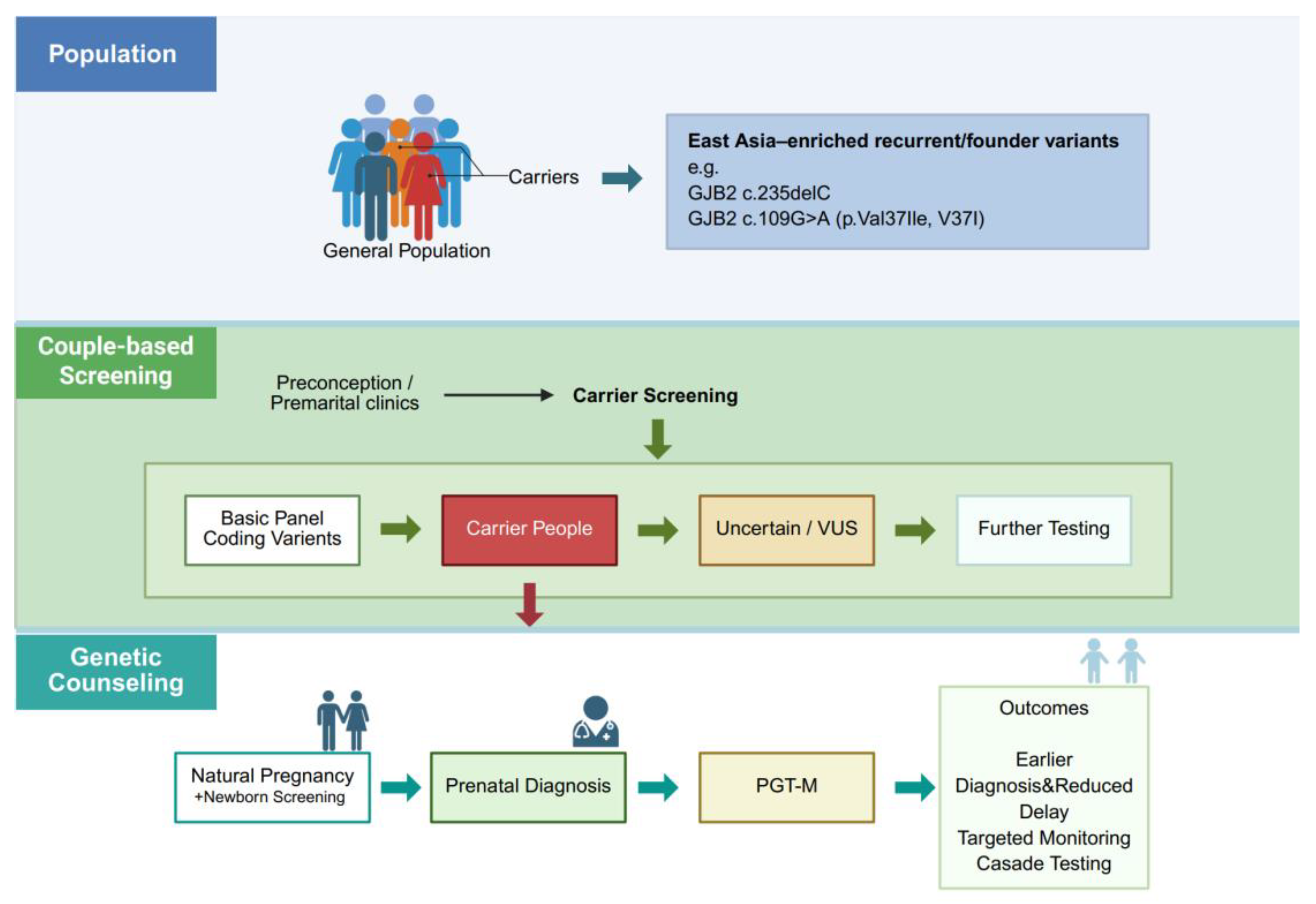
Table 1.
Recurrent/founder DFNB1 alleles by population.
| Population/Region | Major recurrent/founder alleles | Notes |
| East Asia [50,51,52,53] | c.235delC c.109G>A(p.Val37Ile) c.299_300delAT c.-23+1G>A (region-specific) |
A limited, population-matched panel can capture a substantial proportion of DFNB1 cases; p.Val37Ile is often linked to milder/variable or later-onset hearing loss. |
| Europe [54] | c.35delG | High-yield first-tier variant in many cohorts; consider reflex testing for DFNB1 structural variants (e.g., GJB6 deletions) when only one pathogenic GJB2 allele is detected. |
| Yakut / Native Siberian groups [55] | c.-23+1G>A (IVS1+1G>A) | Classic founder architecture in Yakut and related groups; emphasizes ancestry-matched panels. |
| Ashkenazi Jewish / parts of the Middle East [56] | c.167delT | Frequent founder allele; inclusion improves first-tier yield in relevant populations. |
| South Asia & Romani [57,58] | c.71G>A (p.Trp24Ter; “W24X”) | High carrier frequency reported in some Romani and South Asian subpopulations; useful for targeted screening. |
| West Africa (e.g., Ghana) [59,60] | c.427C>T (p.Arg143Trp) | A regionally prevalent recurrent allele, highlighting the need for population-tailored screening panels |
Table 3.
Representative syndromic phenotypes associated with dominant or pleiotropic GJB2 variants and their translational relevance.
Table 3.
Representative syndromic phenotypes associated with dominant or pleiotropic GJB2 variants and their translational relevance.
| Syndrome | cardinal symptom(s) | Hearing phenotype | Representative GJB2 variants | inheritance mechanism | Translational relevance |
|---|---|---|---|---|---|
|
Palmoplantar keratoderma with deafness (PPK + deafness) [79,80,81] |
Diffuse palmoplantar keratoderma, sometimes knuckle involvement | Usually congenital or early-onset SNHL; severity variable | R75W, R75Q, H73R, G59A, S183F | Usually AD; often dominant-negative / trans-dominant effects on Cx26/Cx30 | A useful bridge phenotype linking skin disease and cochlear dysfunction; relevant to dominant-variant editing strategies |
|
Vohwinkel syndrome [82,83] |
Honeycomb PPK, starfish-like keratoses, pseudoainhum/constriction bands | Usually progressive SNHL, often mild to moderate but variable | Y65H, D66H; some reports also include G130V | Usually AD; impaired gap-junction function with variant-specific dominant effects | Highlights the overlap between keratoderma and auditory phenotypes; useful for discussing pleiotropy rather than immediate therapy |
|
Bart–Pumphrey syndrome [84,85] |
PPK, knuckle pads, leukonychia | Sensorineural HL with variable severity | N54K | AD; defective trafficking and dominant / trans-dominant effects have been reported | Mechanistically informative because it sits between milder keratoderma phenotypes and more severe KID-spectrum disease |
|
Keratitis–ichthyosis–deafness (KID) syndrome [86,87] |
Keratitis, ichthyosis/erythrokeratoderma, severe skin barrier disease, infection/cancer risk in some patients | Usually severe congenital SNHL; some variants associated with lethal early disease | D50N, G45E, A88V, G12R, N14K, N14Y, I30N | Usually AD/de novo; gain-of-function hyperactive hemichannels, plus additional dominant effects in some variants | Best current example for mechanism-based therapy: hemichannel blockade (Figure 1), anti-hemichannel mAb delivery, and dominant-variant editing all have preclinical support |
|
Hystrix-like ichthyosis with deafness (HID) / overlap phenotypes [88] |
Severe ichthyotic or spiky hyperkeratotic skin changes | Congenital or early-onset SNHL | Often overlaps with D50N-related spectrum | Overlap disorder within the Cx26 syndromic continuum rather than a wholly separate mechanism | Better treated as a spectrum/extreme phenotype than a standalone major entity in a hearing-focused review |
Table 4.
Representative gene supplementation studies for upstream rescue in GJB2-related hearing loss.
Table 4.
Representative gene supplementation studies for upstream rescue in GJB2-related hearing loss.
| Year | Study | Model | Treatment window | Delivery route | Principal target cells | Key findings |
| 2011 [99] |
Crispino et al. | Cx26 conditional deletion, organ of Corti explant culture | Early postnatal tissue, ex vivo | Ex vivo viral transduction in cochlear explants | Non sensory epithelium and supporting cell network | Restored Cx26 expression and improved intercellular coupling, providing proof of concept that GJB2 supplementation can re-engage epithelial gap-junction function. |
| 2014 [100] |
Yu et al. | Conditional Gjb2 loss in supporting cell lineages | Neonatal, around birth | Cochlear local injection targeting scala media | Supporting cells and adjacent epithelial cells | Re-established the gap-junction network and reduced epithelial injury, but hearing recovery remained limited or inconsistent. |
| 2015 [109] |
Iizuka et al. | Cx26 conditional loss model | Perinatal versus adult comparison | Round window based local delivery | Supporting cell enriched patterns in the cochlea | Perinatal delivery improved ABR thresholds and preserved cochlear architecture, whereas adult-stage treatment showed little benefit, supporting a narrow developmental rescue window. |
| 2021 [110] |
Guo et al. | Inducible Gjb2 deficiency model | More mature stage, postnatal weeks | Round window related local cochlear delivery | Supporting cells with unintended inner hair cell transduction | Restored Cx26 signal in supporting cells but failed to improve hearing; ectopic inner hair cell expression was associated with hair-cell loss, highlighting the need for strict cell specificity. |
| 2025 [111] |
Wang et al. | Conditional Cx26 deficiency model | Neonatal | Local cochlear delivery | Supporting cell targeted expression | Vector delivery triggered marked immune activation and could compromise hearing in wild-type ears; adjunct anti-inflammatory treatment improved tolerability and functional outcome. |
| 2025 [112] |
Ivanchenko et al. | DFNB1 mouse models with non-human primate validation | Early postnatal | Round window local delivery | Expression constrained to physiologic cochlear cell populations | Regulatory-element-constrained expression improved cochlear pathology and hearing in DFNB1 models, while showing appropriate localization and minimal threshold disturbance in non-human primate cochlea. |
Disclaimer/Publisher’s Note: The statements, opinions and data contained in all publications are solely those of the individual author(s) and contributor(s) and not of MDPI and/or the editor(s). MDPI and/or the editor(s) disclaim responsibility for any injury to people or property resulting from any ideas, methods, instructions or products referred to in the content. |
© 2026 by the authors. Licensee MDPI, Basel, Switzerland. This article is an open access article distributed under the terms and conditions of the Creative Commons Attribution (CC BY) license (http://creativecommons.org/licenses/by/4.0/).
Copyright: This open access article is published under a Creative Commons CC BY 4.0 license, which permit the free download, distribution, and reuse, provided that the author and preprint are cited in any reuse.


