

Submitted:
13 April 2026
Posted:
15 April 2026
You are already at the latest version
Abstract
In this paper, we present the notion of S-2-prime hyperideals, which provides a unifying generalization of 2-prime and S-prime hyperideals within multiplicative hyperrings. We explore their key algebraic properties and investigate their connections with other hyperideal classes. We emphasize the unique aspects that differentiate S-2-prime hyperideals, illustrating their role in expanding the theoretical framework of hyperideal structures. We examine how these hyperideals behave under hyperring homomorphisms, extensions, and standard algebraic operations, demonstrating that many known properties of prime, 2-prime, and S-prime hyperideals extend naturally to the S-2-prime setting. We provide illustrative examples to highlight important differences and to offer practical insight into their structure. Overall, we enhance the theoretical understanding of hyperideals in multiplicative hyperrings and establish a framework for future research in this area.
Keywords:
2- prime hyperideals
; S- prime hyperideals
; S-2- prime hyperideals
1. Introduction
Hyperstructures constitute a broader framework than classical algebraic structures. In classical algebra, a binary operation assigns a single element to each pair of elements, whereas in the context of hyperstructures, such an operation produces a set of elements [1]. This theory was first introduced by F. Marty [2]. Algebraic hyperstructures are utilized across multiple fields, such as geometry, artificial intelligence, and cryptography, providing adaptable frameworks to represent complex and uncertain systems. A comprehensive reference on the applications of hyperstructures is the book Applications of Hyperstructures Theory by P. Corsini and V. Leoreanu [3]. Hyperrings were initially proposed by Krasner in 1983, where addition is interpreted as a hyperoperation and multiplication remains standard, thereby broadening the framework of classical ring theory [9]. Earlier, in 1982, Rota introduced the notion of multiplicative hyperrings [10]. In 1994, Vougiouklis studied hyperstructures extensively in his book "Hyperstructures and Their Representations"[18]. In 1997, Procesi and Rota introduced the concept of a prime hyperideal in a multiplicative hyperring [14]. In 2012, Dasgupta, on the other hand, has studied the prime ideals of multiplicative hyperring extensively [11]. Davvaz has covered hyperrings extensively in his book "Hyperring Theory and Applications" [1]. Algebraic hyperstructures have applications in various fields. [15,16,17,20]. In 2014, Ameri and Norouzi studied commutative hyperrings as a generalization of classes of hyperrings [12]. Ameri and Kordi (2017) first defined the concept of coprime hyperideals within the context of multiplicative hyperrings [13]. In 2016, Beddani introduced notion 2-prime ideals [8]. In 2017, Ay, Yesilot and Sonmez defined the prime expansion, which is associated to prime hyperideals [19]. Hamed and Malek (2020) proposed the notion of S-prime ideals, extending the concept of traditional prime ideals [7]. The concept of S-prime hyperideals, extending prime hyperideals, was introduced by Ghiasvand and Farzalipour in 2021 [4]. Subsequently, Anbarloei defined 2-prime hyperideals in 2022 as another generalization of prime ideals [5]. More recently, in 2024, Yavuz introduced S-2 prime ideals, which unify the notions of 2-prime ideals and S-prime ideals [6].
In recent years, researchers have explored various generalizations of hyperideal concepts within multiplicative hyperring theory. Prime, 2-prime, and S-prime hyperideals, in particular, have been studied in detail to better understand the fundamental algebraic properties of multiplicative hyperrings. These concepts not only extend classical ideal theory to hyperstructures but also help to investigate the connections between different hyperideals. Although the study of general prime hyperideals remains an active area of research, a comprehensive structure that combines the features of S-prime and 2-prime hyperideals in multiplicative hyperrings has not been sufficiently addressed in the literature. Motivated by this, we introduce a broader hyperideal, S-2- prime hyperideal, and examine its fundamental properties.
In this study, we generalize the concepts of S-2-prime ideals from commutative ring theory, along with S-prime and 2-prime hyperideals in the context of multiplicative hyperrings. Throughout the paper, we let stand for a multiplicative hyperring and S indicate a multiplicatively closed subset of . The paper is organized into four main sections. The first section includes a literature review. The next section provides preliminary information related to our main topic. In the third section of the study, the definition of an S-2-prime hyperideal is presented, along with an illustrative example. Building on the notions of S-prime hyperideals and 2-prime hyperideals found in earlier works, it is shown by theorem that these hyperideals are also S-2 hyperideals; however, the converses are demonstrated to be false by means of counter examples. Then, we give a new characterization of S-2-prime hyperideal in Teorem 3 Subsequently, we investigate the relationship between S-2-prime hyperideals and matrice space Teorem 4 Also, we examine this ideals properties under homomorphism see Teorem 5, 6 Moreover, In Theorem 7, we examine these ideals in direct product rings, and in Theorem 8, we give their generalization. Moreover, studying S-2-prime hyperideals provides deeper insight into the interplay between S-prime and 2-prime hyperideals. This framework clarifies their algebraic structure and opens up potential applications in areas where hyperstructure theory is relevant, such as geometry, artificial intelligence, and cryptography. In addition, our work not only defines S-2-prime hyperideals but also investigates their fundamental properties, relationships with existing hyperideals, and broader generalizations, highlighting the original contribution of this study. The final section presents the results obtained from this study.
2. Preliminaries
This section provides some preliminary information for the topic. Below are the definitions of hypergroup, multiplicative hyperring, hyperideal, prime hyperideal, good homomorphism, and multiplicatively closed subset.
Definition 1.
[1] Let be a nonempty set, and let denote a hyperoperation. The pair is then called a hypergrouoid.
For any two nonempty subsets E and F of and , we define
Definition 2.
[1] A hypergroupoid is called a semihypergroup if for all of we have , which means that
Definition 3.
[1] A hypergroupoid is called a quasihypergroup if, for every element , the equalities hold.
Definition 4.
[1] A hypergroupoid that at the same time fulfills the conditions of a semihypergroup and a quasihypergroup is designated a hypergroup.
Definition 5.
[1] A triple is called a multiplicative hyperring if
- (1)
- is an abelian group;
- (2)
- is a semihypergroup;
- (3)
- For all , we have and ;
- (4)
- For all , we have .
If we have equalities instead of inclusions in (3), then we say that the multiplicative hyperring is strongly distributive.
In this study, unless otherwise specified, we will take the muptiplicative hyperring as strongly distributive.
Definition 6.
[1] We say that D is a hyperideal of if and for all .
Definition 7.
Notation 1.
[21] Let Λ be a subset of a hyperring , and let denote the collection of all hyperideals of containing Λ. The hyperideal generated by Λ is defined as the set of elements belonging to every and is denoted by . If , this hyperideal is written as .
Proposition 1.
[11] Let be a commutative multiplicative hyperring. Then for any , .
Definition 8.
[1] Let be a multiplicative hyperring, and let D be a hyperideal of . We define addition on cosets in the usual manner, and multiplication as follows:
on the set of all cosets of D. Then forms a multiplicative hyperring, and it retains strong distributivity if possesses it.
Definition 9.
[1] A homomorphism (good homomorphism) between two multiplicative hyperrings and is a map such that for all of , we have and ( respectively).
Definition 10.
[5] Let D be a proper hyperideal of a multiplicative hyperring . We say that D is a 2-prime if for all , implies or .
Definition 11.
[4] A nonempty subset S of , a multiplicative hyperring with identity 1, is called multiplicatively closed when it obeys the following conditions:
- (i)
- ,
- (ii)
- for all .
Definition 12.
[4] Let be a multiplicative hyperring, be a multiplicatively closed subset of and D be a hyperideal of such that . We say that D is S-prime if there exists an such that for all with , we have or .
Notation 2.
[1] Let be a hyperring with identity 1. We consider the relation Ψ given by if and only if , where Θ is a finite sum of finite products of elements from , that is,
We denote by the transitive closure of Ψ. This relation is the smallest equivalence relation on the multiplicative hyperring for which the quotient consists of all finite sums of products of elements from . Accordingly, the definition of on can be restated as follows:
⇔ with and and such that for .
Suppose that is the equivalence class containing . Then, both the sum ⊕ and the product ⊙ in are defined as follows: for all and for all . Then forms a ring, called the fundamental ring of .
Proposition 2.
[4] Let be a multiplicative hyperring with scaler 1. Then is a multiplicatively closed subset of if and only if is a multiplicatively closed subset of the ring .
Notation 3.
[22] Recall that the ideal generated by the powers of elements of a proper ideal D is denoted by . It is clear that , and equality holds when . Moreover, if is a unit in , then we have .
Notation 4.
[13] Let be a multiplicative hyperring and let represent the set of all hypermatrices over . For any and in , precisely when for each .
3. S-2- Prime Hyperideals
In this section, we will define S-2- prime hyperideals and examine their algebraic properties with examples.
Definition 13.
Let be a multiplicative hyperring. be a multiplicatively closed subset of and D be a proper hyperideal of such that . We say that D is S-2 prime if there exists an such that for all with , we have or .
Example 1.
Let is a ring and be a ideal of . We define hyperoperation for .
| ★ | ||||
| D | D | D | D | |
| D | D | |||
| D | D | D | D | |
| D | D |
is a multiplicative hyperring. Now, we consider the multiplicative closed subset of and hyperideal of . Its easy to see that . For and that satisfy the requirement , or . Thus, D is an S-2 prime hyperideal of .
Example 2.
Let . We define for all . Then is a multiplicative hyperring. be a multiplicatively closed subset of and be a hyperideal of . It easy to see that . Put . Then D is an S-2 prime hyperideal of .
Theorem 1.
Let be a multiplicative hyperring, a multiplicatively closed subset, and D a hyperideal of such that . If D is an S-prime hyperideal of , then it is also an S-2-prime hyperideal of .
Proof.
Let D is a S- prime hyperideal of . Then, there exists such that for all with then or . Let . Since and D is a hyperideal of , . According to (2) and (3) in definition 5. Let . Then . Since then . Thus D is an - prime hyperideal of . □
The theorem does not necessarily hold in the reverse. A corresponding example is presented below.
Example 3.
Let be a ring and be an ideal of and be a multiplicative closed subset of . We define hyperoperation on hyperring . For , let . We have there exists an , or . But, when there is not exists an such that .
Theorem 2.
Let be a multiplicative hyperring, and let S be a multiplicatively closed subset of . Let D be a hyperideal of such that D has empty intersection with S. If D is a 2-prime hyperideal in , then D is also an S-2-prime hyperideal of .
Proof.
Let D is a 2- prime hyperideal of . Then there exists for all then or . We take an S multiplicatively closed subset of such that . For , if then or if then . □
The theorem does not necessarily hold in the reverse. A corresponding example is presented below.
Example 4.
Let be a ring and be an ideal of and be a multiplicatively closed subset of . We define hyperoperation on hyperring . For , . For , or is true but neither of nor . Then P is an - prime hyperideal but D is not a 2- prime hyperideal of .
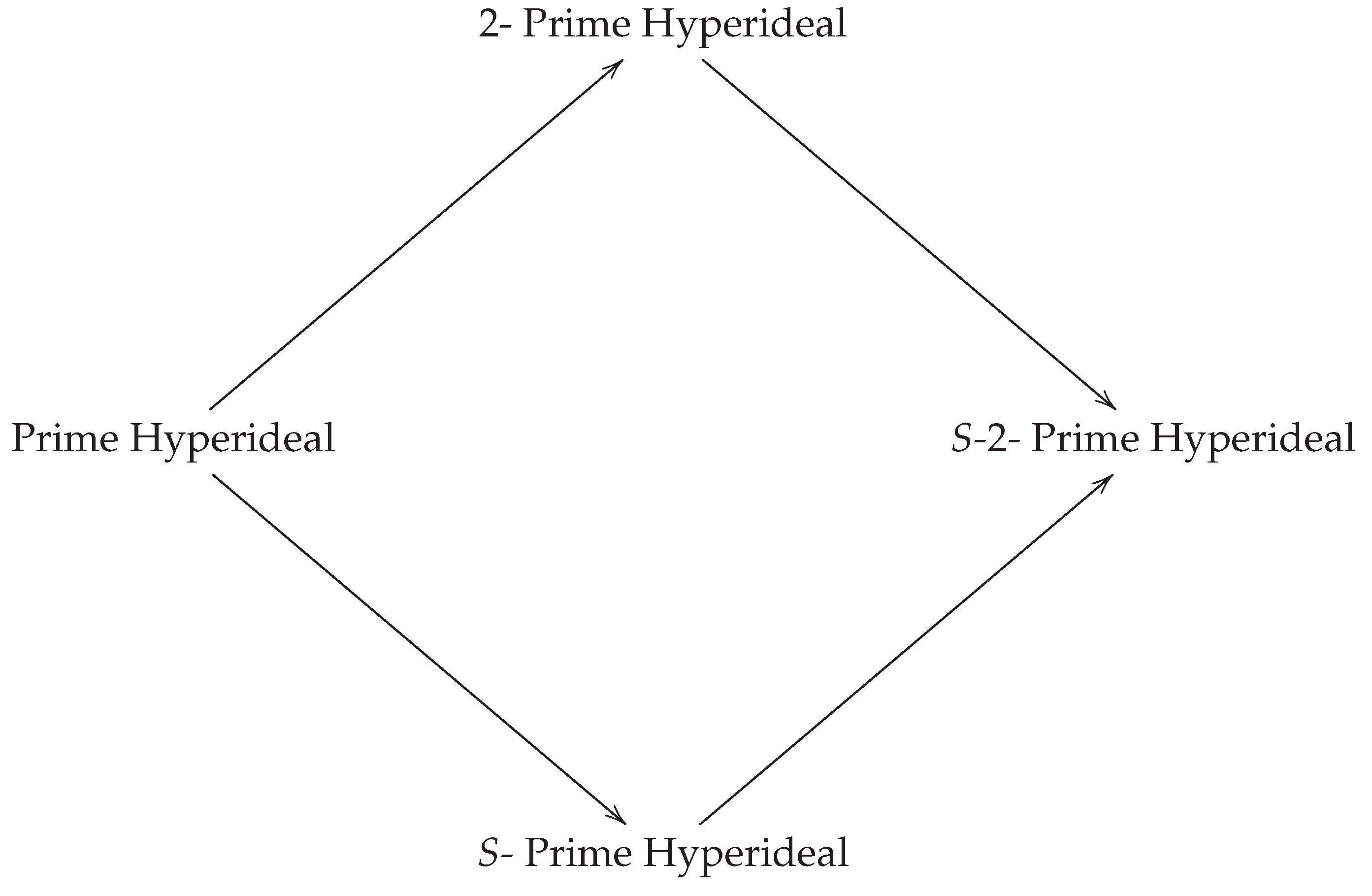
Earlier studies have established that every prime hyperideal simultaneously qualifies as a 2-prime hyperideal [5] and an S-prime hyperideal [4]. In this study, using both of the above theorems, we have shown that both 2-prime hyperideals and S are also S-2- prime hyperideals. As can be seen from the examples above, this diagram is one-sided and its converse is not always true.
Definition 14.
It is noted that the hyperideal formed by taking the powers of elements from a proper hyperideal D is denoted by . It is evident that , with equality occurring when . Moreover, if is invertible in , then .
Theorem 3.
Let be a multiplicative hyperring, a multiplicatively closed subset, and D a hyperideal of such that . Then D is an S-2-prime hyperideal of if and only if for any two hyperideals I and J of with , there exists an element such that or .
Proof. (⇒): Let D is a S-2 prime hyperideal. Then, there exists such that for all with then or . Let for all , there exists hyperideals of with , and . Since there exists hyperideals, of with and . Thus there exists and such that and with that it contradicts with hypothesis.
(⇐): Let where . Thus . By [11], we have and so . Thus there exists an such that or by hypothesis. Therefore, or . Hence D is a S-2 prime hyperideal of and the proof is complete. □
Corollary 1.
Let be a multiplicative hyperring, a multiplicatively closed subset, and D a hyperideal of with . If there exists an element such that for any hyperideals of , whenever , there is some for which , then D is an S-2-prime hyperideal of .
Proof.
Let are hyperideals of . By previous theorem let where . Thus . Then we have and so . So, let where . Thus . Then we have . By hypothesis there exists an such that , ,..., or . Thus , ,..., or . Therefore, D is a S-2 hyperideal of . □
Proposition 3.
Let be a multiplicative hyperring, a multiplicatively closed set, and D a hyperideal of with . Suppose there exists such that for any elements , if , then at least one index satisfies . Under these conditions, D qualifies as an S-2-prime hyperideal of .
Proof.
Let there exists an such that for all of , if , then for some . Take . Then there exists an such that for of , if , then or . Then D is an S-2- prime hyperideal of . □
Proposition 4.
Let be a multiplicative hyperring, a multiplicatively closed subset, and D a hyperideal of disjoint from S. Then
- (i)
- Let O be a hyperideal of with . Whenever D is an S-2-prime hyperideal of , the product also constitutes an S-2-prime hyperideal of .
- (ii)
- Let be an extension of . If K is an S-2-prime hyperideal of , then its intersection with , , also forms an S-2-prime hyperideal of .
Proof.
- (i)
- Let . Let where . Hence there exists an such that or . Thus or . Since , so there is . Thus or . So , is an S-2 prime hyperideal of .
- (ii)
- Let where . Since K is an S-2 prime hyperideal of , there exists such that or . Therefore or . So, is an S-2 prime hyperideal of .
□
Example 5.
Let be a hyperring, and let be a hyperideal of . We define a hyperoperation ★ on by for all .
For , and
Let . Take . Then
but
Here but .
A proof of this example is given below.
Theorem 4.
Let be a multiplicative hyperring with identitiy 1, be a multiplicatively closed subset of and D be a hyperideal of . If is an -2 prime hyperideal of , then D is an S-2 prime hyperideal of .
Proof.
is a multiplicatively closed subset of . Let where . Then
We have
Since is an -2 prime hyperideal, then
so or
.
Since is an prime hyperideal
or
Hence
or
Therefore or . Hence D is an S-2 prime hyperideal of .
□
Let D be a hyperideal of a multiplicative hyperring , and let . Define . Then, for every , the set forms a hyperideal of .
Proposition 5.
Let be a multiplicative hyperring, a multiplicatively closed subset, and D a hyperideal of with . If there exists such that is a 2-prime hyperideal of , then D is an S-2-prime hyperideal of .
Proof.
Let is a 2 prime hyperideal of . Assume that for some . Since D is a hyperideal, then . Thus , so since is a 2-prime, or . Therefore or . Hence D is an S-2 prime hyperideal of .
□
Theorem 5.
Let be a multiplicative hyperring with identity 1, and let be a multiplicatively closed subset. Then D is an S-2-prime hyperideal if and only if is an -2-prime ideal of .
Proof. (⇒): Let D is an S-2 prime hyperideal of . Let where . Thus there exists such that and . Hence and so . Then there exists an such that or since D is an S-2 prime hyperideal of . Therefore or . Thus is an -2 prime ideal of .
(⇐): Assume that is an -2 prime ideal of . Let where . Then . Thus . Thus there exists such that or since is an -2 prime ideal of . Thus, or . Therefore or . Hence, D is an S-2 prime hyperideal of . The proof is complete. □
The following theorem states that if D, a prime hyperideal of , is an -2-prime hyperideal, then its preimage under f is an S-2-prime hyperideal of .
Theorem 6.
Let be a multiplicative hyperring and let S be a multiplicatively closed subset of . Consider a homomorphism of hyperrings such that the image contains no zero element. If D is an -2-prime hyperideal in , then its preimage under f, denoted , forms an S-2-prime hyperideal in .
Proof.
is a multiplicatively closed subset of . Let D be an -2 prime hyperideal of . Hence there exists an such that for all if , then or . Let . Hence we have since . Let where . Thus which implies that or . Therefore or since f is a good homomorphism. Hence or . The proof is complete. □
Proposition 6.
Let be a multiplicative hyperring, with a multiplicatively closed subset, and let D be a hyperideal of such that D and S are disjoint. Suppose O is a proper hyperideal of containing D, and let denote the image of S in , with . Then, O is an S-2-prime hyperideal of if and only if the quotient is an -2-prime hyperideal of .
Proof. (⇒): Let O be an S-2 prime hyperideal. Then there exists an such that for all with , then or . Let where . Hence and, so or . Thus or . Therefore, is an -2 prime hyperideal of .
(⇐): Since , we can easily prove that . Let where . Thus . There exists an such that or . Hence we conclude or . □
We will now examine the properties of S-2- prime hyperideals in the cartesian product of multiplicative hyperrings to better understand their behavior under such constructions. In the subsequent theorem, we extend this definition to the product of n multiplicative hyperrings and explore their properties accordingly.
Theorem 7.
Let and where and are multiplicatively closed subsets of and , respectively. Suppose is a hyperideal of . Then D is an prime hyperideal of if and only if is an -2 prime hyperideal of with or is an -2 prime hyperideal of with .
Proof. (⇒): Let is an S-2 prime hyperideal of . Since , there exists such that or . Thus or . We may assume that . As , we have . Let for some . Since and D is an S-2 prime hyperideal of , or . Hence we get or . Thus is an S-2 prime hyperideal of . In the other case, we can easily show that is an S-2 prime hyperideal of .
(⇐): Conversely, assume that and is an S-2 prime hyperideal of . Therefore there exists an . Let for some and . This refers to and there exists an such that or . Put . Thus we get or . Therefore P is an S-2 prime hyperideal of . Similarly if and is an -2 prime hyperideal of , then we can achieve a similar conclusion.
□
Theorem 8.
Let , and consider the hyperring with , where each is a multiplicatively closed subset of . Assume that is a proper hyperideal of for every . Define . Then D forms an S-2-prime hyperideal of if and only if there exists an index such that is an -2-prime hyperideal of , and for all other indices , the intersection is nonempty.
Proof.
Consider a positive integer . The statement holds for by the previous theorem. Assume that the statement is valid for any integer p with . Let and , and . Since , it follows from the assumption that either is an -2-prime hyperideal of with , or is an -2-prime hyperideal of with . If and is an -2-prime hyperideal of , then the argument is concluded. Then, assume that and forms an -2-prime hyperideal within . From induction hypothesis for , we have that is an -2- prime hyperideal of for some and for each . Hence, the necessary condition is satisfied.
For the reverse direction, assume that is an -2-prime hyperideal of corresponding to some element , and for each , there exists . Define . Then it follows that forms an S-2-prime hyperideal of .
□
4. Conclusions
Since hyperideals play a central role in multiplicative hyperrings, many researchers have explored their generalizations, focusing particularly on prime, 2-prime, and S-prime hyperideals to better understand the fundamental algebraic properties of these structures. These generalizations provide the motivation for our study, in which we introduce a new hyperideal, S-2- prime hyperideal, that encompasses the features of both S-prime and 2-prime hyperideals. We examine the fundamental properties of S-2- prime hyperideal in detail and investigate its relationships with other hyperideal classes, highlighting similarities and distinctions. Our results demonstrate that several properties established for prime, 2-prime, and S-prime hyperideals also hold for S-2- prime hyperideal, while it additionally exhibits new characteristics not addressed by previous notions. Moreover, we consider the behavior of S-2- prime hyperideal under various operations, homomorphisms, and ring extensions, and suggest potential avenues for future research, such as exploring weakly S-2-prime hyperideal generalizations or -expansion methods to further understand its structure. Overall, our work contributes to a more comprehensive understanding of hyperideals in multiplicative hyperrings and opens new directions for subsequent studies.
References
- Davvaz, B.; Leoreanu-Fotea, V. Hyperring Theory and Applications; International Academic Press: USA, 2007; Vol. 347. [Google Scholar]
- Marty, F. Sur une Generalization de la Notion de Groups. 8th Congress Math. Scandinaves, Stockholm, 1934. [Google Scholar]
- Corsini, P.; Leoreanu, V. Applications of Hyperstructure Theory; Springer Science, Business Media, 2013; Vol. 5. [Google Scholar]
- Ghiasvand, P.; Farzalipour, F. On S-prime Hyperideals in Multiplicative Hyperrings. Journal of Algebraic Hyperstructures and Logical Algebras 2021, 2(2), 25–34. [Google Scholar] [CrossRef]
- Anbarloei, M. 2-Prime Hyperideals of Multiplicative Hyperrings. Journal of Mathematics 2022, 2022(1), 5721946. [Google Scholar] [CrossRef]
- Yavuz, S.; Ersoy, B. A.; Tekir, Ü; Yetkin Çelikel, E. On S-2-Prime Ideals of Commutative Rings. Mathematics 2024, 12(11), 1636. [Google Scholar] [CrossRef]
- Hamed, A.; Malek, A. S-prime Ideals of a Commutative Ring. Beiträge zur Algebra und Geometrie/Contributions to Algebra and Geometry 2020, 61(3), 533–542. [Google Scholar] [CrossRef]
- Beddani, C.; Messirdi, W. 2-prime Ideals and Their Applications. Journal of Algebra and its Applications 2016, 15(03), 1650051. [Google Scholar] [CrossRef]
- Krasner, M. A Class of Hyperrings and Hyperfields. International Journal of Mathematics and Mathematical Sciences 1983, 6(2), 307–311. [Google Scholar] [CrossRef]
- Rota, R. Sugli Iperanelli Moltiplicativi. Rend. Di Mat., Series 1982, 7(4), 2. [Google Scholar]
- Dasgupta, U. On Prime and Primary Hyperideals of a Multiplicative Hyperring. Annals of the Alexandru Ioan Cuza University-Mathematics 2012, 58(1), 19–36. [Google Scholar] [CrossRef]
- Ameri, R.; Norouzi, M. On Commutative Hyperrings. International Journal of Algebraic Hyperstructures and its Applications 2014, 1(1), 45–58. [Google Scholar]
- Ameri, R.; Kordi, A.; Hoskova-Mayerova, S. Multiplicative Hyperring of Fractions and Coprime Hyperideals. An. Stiint. Univ. Ovidius Constanta Ser. Mat 2017, 25(1), 5–23. [Google Scholar] [CrossRef]
- Procesi, R.; Rota, R. On Some Classes of Hyperstructures. Discrete Mathematics 1999, 208, 485–497. [Google Scholar] [CrossRef]
- Onar, S. A Note on Neutrosophic Soft Set over Hyperalgebras. Symmetry 2024, 16(10), 1288. [Google Scholar] [CrossRef]
- Davvaz, B. A Brief Survey on Algebraic Hyperstructures: Theory and Applications. Journal of Algebraic Hyperstructures and Logical Algebras 2020, 1(3), 15–29. [Google Scholar] [CrossRef]
- Novák, M.; Křehlík, Š; Ovaliadis, K. Elements of Hyperstructure Theory in UWSN Design and Data Aggregation. Symmetry 2019, 11(6), 734. [Google Scholar] [CrossRef]
- Vougiouklis, T. Hyperstructures and Their Representations; Hadronic Press, 1994. [Google Scholar]
- Ozel Ay, E.; Yesilot, G.; Sonmez, D. δ-Primary Hyperideals on Commutative Hyperrings. International Journal of Mathematics and Mathematical Sciences 2017, 2017(1), 5428160. [Google Scholar] [CrossRef]
- Davvaz, B.; Cristea, I. Fuzzy algebraic hyperstructures. Studies in Fuzziness and soft computing 2015, 321, 38–46. [Google Scholar]
- Davvaz, B.; Salasi, A. A Realization of Hyperrings. Communications in Algebra 2006, 34(12), 4389–4400. [Google Scholar] [CrossRef]
- Anderson, D. D.; Knopp, K. R.; Lewin, R. L. Ideals Generated by Powers of Elements. Bulletin of the Australian Mathematical Society 1994, 49(3), 373–376. [Google Scholar] [CrossRef]
Disclaimer/Publisher’s Note: The statements, opinions and data contained in all publications are solely those of the individual author(s) and contributor(s) and not of MDPI and/or the editor(s). MDPI and/or the editor(s) disclaim responsibility for any injury to people or property resulting from any ideas, methods, instructions or products referred to in the content. |
© 2026 by the authors. Licensee MDPI, Basel, Switzerland. This article is an open access article distributed under the terms and conditions of the Creative Commons Attribution (CC BY) license (http://creativecommons.org/licenses/by/4.0/).
Copyright: This open access article is published under a Creative Commons CC BY 4.0 license, which permit the free download, distribution, and reuse, provided that the author and preprint are cited in any reuse.


