

Submitted:
14 April 2026
Posted:
14 April 2026
You are already at the latest version
Abstract
The Gielis superformula is a powerful parametric tool that generates an infinite variety of natural and organic curves and surfaces through a compact set of parameters. However, classical differential geometry has lacked a unified framework for analyzing their curvature, torsion, and intrinsic geometric properties. This study addresses this gap by developing a novel superelliptic geometric framework that integrates the superformula 6with the differential geometry of curves and surfaces. We define the superelliptic inner and cross products, the star derivative, and the superelliptic Frenet frame to extend Euclidean and Riemannian interpretations of curvature and torsion to a more flexible parametric structure. The framework provides a uniform geometric characterization of all Gielis curves and surfaces, independent of their classical parametric expressions; even singular cases are regularized so that their curvature and torsion reduce exactly to those of a circle. This unifies the entire family under a common, robust foundation while preserving orthonormality and differentiability. This superelliptic approach offers a consistent and computationally 14tractable model that bridges mathematical abstraction with real-world morphology, with 15the superformula serving as a representative example of the framework’s broad generality for diverse geometric structures.
Keywords:
superelliptic geometry
; superformula
; Frenet frame
; differential geometry
1. Introduction
One of the most traditional and basic areas of differential geometry is the theory of curves, which focuses on the local and global characteristics of smooth curves in Euclidean spaces [1,9]. The formal definition of a curve is a smooth mapping
where t is either a differentiable reparameterization of the arc-length or a real parameter that represents it. The derivatives of such a curve, which provide details about its velocity, curvature, and torsion, are used to examine its geometric behavior. The Frenet-Serret frame is an orthonormal moving trihedron made up of the tangent vector , the normal vector , and the binormal vector . The definition of this frame is as follows:
The Frenet-Serret equations control how this frame changes along the curve:
where and represent the curve’s curvature and torsion, respectively. Up to rigid motion, these numbers fully characterize the curve [7].
Simple yet fundamental examples of curves, like circles and circular helices, illustrate the geometric meaning of these invariants. A circle has zero torsion and constant curvature , but a helix has both constant curvature and constant torsion and maintains a constant ratio . These canonical forms serve as reference models for understanding more complex curves in physics, biology, and computer-aided design [5].
Curve theory’s current advancement uses parametric and computational modeling to expand on traditional concepts. Specifically, the introduction of the Superformula, which is a generalization of supercircle and superellipses [3,14], offers a potent parametric generalization that can describe a variety of closed and open curves seen in nature. The names superformula and supershapes originate from the names superellipses and superquadrics. The name superformula was changed by mathematicians to the Gielis Formula [16,18,19], and supershapes to Gielis’ curves and surfaces [15,17]. It has the following definition in polar coordinates:
The superformula introduces the parameters m, a, b, , , and , which govern the symmetry, curvature variation, and geometric complexity of the curve, where a, b, and are assumed to be nonzero. It generalizes Lamé’s superellipse [8] and Piet Hein’s superellipse [6]. This formula can produce smooth transitions between circular, polygonal, star-like, and biomorphic shapes when the right parameters are used [3,13,14,15]. Gielis transformations denote the superformula applied as a transformation on other functions. The name "Universal natural shapes" was introduced by Leopold Verstraelen to denote that the formula can be used to describe/model shapes and forms at any level [15,20]. The way back to Cartesian via Chebyshev polynomials is first used in [34]. This includes a wide range of possibilities, including trigonometric and exponential functions, as well as polynomials. The cosine and sine functions in the superformula can also be other functions, like cosh/sinh or even many other functions. One could set math requirements for this (closed curves, going through the origin,….), see [21]. It has been widely used in computer-aided geometric design, biological modeling, and form optimization [22,23,24,25,26,27,28,29,30,31,32,33].
Recent advances by Özdemir and Parlak [10,11] extend the Superformula by integrating superelliptic and quaternionic algebraic structures, thereby enabling the unified treatment of superelliptic rotational forms and spatial transformations within a single analytical framework. These methods enable the study of curvature-driven morphologies and symmetric deformations in higher dimensions by fusing traditional Frenet-Serret theory with contemporary parametric geometry.
In this study, the differential geometric properties of the curves generated by the superformula are investigated. Using the Frenet-Serret formalism, we aim to determine the curvatures, torsions, and frame evolutions of these parametrically defined curves both analytically and numerically. Furthermore, the theoretical framework is supported by illustrative examples and visualizations. This approach enables a clearer, visually intuitive understanding of the geometric behavior and kinematic evolution of the curves. In this study, the intrinsic geometry of superformula-based curves is elucidated, and the interaction between geometric invariants and parameter management is emphasized. As a result, integrating parametric models such as the superformula with classical curve theory creates new opportunities for the precise differential geometric definition and construction of complex, nature-inspired structures.
Although Gielis curves are capable of modeling a wide variety of natural and synthetic shapes within a large parametric family, they exhibit singularities and sharp corner behavior, particularly for certain specific parameter choices, such as asteroids. This complicates the definition of differential geometric quantities such as curvature, torsion, and differentiability at every point.
In this study, we demonstrate that all Gielis shapes can be reduced to a common geometric class by using a new Frenet-frame structure defined for Gielis curves. This structure provides a transformation that allows each Gielis curve to be reinterpreted within a framework equivalent to a circle with constant curvature and zero torsion. Thus, the Gielis family is given a globally regular structure despite its local singularities, providing a holistic basis for differential-geometric investigations.
2. Basic Concepts and Notions
The most essential part of this paper is the definition and some properties of the Gielis formula. Gabriel Lamé expanded the formulas for circles and ellipses to encompass squares, rectangles, parallelograms, astroids, and all conic sections. Subsequently, he formulated a singular equation expressed as follows: where are positive constants.
As a result, the notion of Lamé curves is incorporated into geometry [36,37]. This study [3] demonstrates the influence of parameter values in the Lamé curve equation on the geometric forms of ellipses and rectangles. An expression for Lamé’s extended equation in polar coordinates is described below:
In the 1990s, superellipses were generalized for any symmetry [3].
For the Lamé equation, when , this formulation is referred to as the superformula. The parameters m, a, and b are real-valued, while , , and are typically taken as positive real constants, although negative values have also been considered in the literature [38]. By varying the parameters in a novel, straightforward, and unifying equation that transcends the limitations of Euclidean and Pythagorean measurements. In the literature, "superformula" and "supershapes" are also referred to as "Superellipse," "Gielis formula," and "Gielis curve".
We introduced the following three-dimensional form, which is symmetric and positive definite bilinear, which was utilized in our research: for any two vectors
where and , . The vectors , will be defined as superelliptic vectors in this context. A superelliptic inner product describes this type of multiplication. The space equipped with the superelliptic inner product is referred to as the superelliptic 3-space, denoted as . The superelliptic inner product can also be written as , where the associated matrix is
The superelliptic inner product’s length is supplied by the superelliptic vector
A pair of superelliptic vectors and are considered superelliptic orthogonal in if and only if If the superelliptic norm of a superelliptic vector equals 1, the vector is termed a superelliptic orthonormal vector. We will refer to the conventional basis of Euclidean 3-space as . Based on this, we can represent the base vectors of as , and they meet the condition
and this form can be used to express any vector .
Given two non-zero superelliptic vectors and , find the cosine function of the angle between them.
Here agrees with the angular parametric equations of a superellipse or a superellipsoid. In , the superelliptic cross product of two vectors is computed as
where (See [11], for details).
Before developing the superelliptic geometric framework, let us define the following function that will be used in establishing this structure.
Definition 1.
Consider a vector function such that the function is a smooth function. Then, we can define the function ϝ as
where is the Gielis’ superformula and , positive real number. This function is referred to as the Gielis radial scaling transformation.
The Gielis radial scaling transformation satisfies the following conditions:
- 1.
- Since each component function , , is of class , the mapping is also a smooth.
- 2.
- Since , the function is one-to-one and its inverse can be expressed as:
- 3.
-
The Gielis transformation can be written in matrix form:where is a time-dependent diagonal matrix:Under this transformation, the inner product changes to:which shows that preserves the inner product, i.e., it preserves both angles and lengths. That is, in , the Gielis radial scaling transformation is an isometry.
Therefore, the Gielis radial scaling transformation defines an isometric diffeomorphism on .
3. Superelliptic Curve
In this section, we examine the properties of superelliptic curves from the perspective of differential geometry.
Definition 2.
Let I be an interval in space and be a curve. In , the superelliptic curve defined via the following Gielis radial scaling transformation ϝ as follows:
where is the Gielis’ super formula and , positive real number.
Example 1.
In , the unit circle can be expressed as , then the corresponding superelliptic circle (superellipse) can be obtained as . Similarly, a right helix can be given as , then the corresponding superelliptic helix can be obtained as . Figure 1 and Figure 2 illustrate the superellipses and superelliptic helices for some values of the Gielis formula .
In order to remain compatible with the metric , the direct use of the classical derivative is no longer sufficient, since it does not incorporate the scaling effects induced by the superelliptic structure. For this reason, we introduce a modified differentiation operator that reflects the intrinsic geometry of the space .
Via the transformation , the classical derivative of a curve is mapped into the superelliptic space, giving rise to a new derivative operator, which we call the star derivative (or *-derivative). This operator simultaneously encodes the directional behavior of the curve and the metric-dependent scaling factor.
Definition 3.
The star derivative operator, denoted by , is defined as the composition of the radial scaling ϝ with the classical differential operator :
Definition 4.
The tangent vector at point t on the curve is denoted by . In this case, under ϝ transformation, the tangent vector of the superelliptic curve is determined as follows:
Thus, the k-th order star derivative of the curve α is given by the pushforward of the k-th order classical derivative under the map ϝ:
The star derivative is a direct transfer of the classical derivative to superelliptic space. This allows quantities such as the velocity and acceleration of the curve to be expressed under the new metric. Since the transformation preserves angles, the vectors obtained with the star derivative also preserve angular relationships. Since derivatives are taken component-wise, all the properties of the classical derivative and the chain rule apply to the star derivative.
The star derivative represents the tangent vector field measured with respect to the Gielis-type metric rather than the standard Euclidean one. It accounts for the local stretching and compression of the ambient space.
Since is a radial transformation, the star derivative preserves the angular orientation of the classical derivative while rescaling its magnitude. It describes the curve’s evolution within a deformed geometry where distances are governed by the superelliptic scaling factor.
This construction ensures that local geometric properties, such as curvature and torsion, are consistently defined within the superelliptic framework. The resulting Frenet-Serret frame in corresponds to a scaled version of the Euclidean frame, maintaining compatibility with the induced inner product of the space.
In Figure 3, The transformation of a fundamental Euclidean unit circle into a superelliptic geometry, and the subsequent modification of its associated tangent vector fields, is depicted. This visual representation elucidates the operational impact of the Gielis radial scaling on the curve’s differential characteristics. Consequently, Figure 3 demonstrates that the star derivative is the natural velocity vector of the curve when the ambient space itself is deformed. This approach provides a more robust framework for analyzing organic morphologies where growth rates and surface tangents are dictated by non-Euclidean radial constraints.
Definition 5.
Let be a superelliptic curve at each point . Then is called a unit-speed superelliptic curve if and only if it satisfies .
Example 2.
Consider that the superelliptic curve in then we compute that it is a superelliptic tangent vector as the form and since . Therefore, the curve is of unit-speed in the superelliptic sense.
Proposition 1.
Let be a unit-speed curve, that is, . Then, at each point , the related superelliptic curve also satisfies , which confirms that the corresponding superelliptic curve is of unit-speed.
Definition 6.
A superelliptic curve is called a regular superelliptic curve if and only if, at each point , it satisfies .
Proposition 2.
Let be a regular curve such that . Then at each point , the related superelliptic curve is also a superelliptic regular curve.
4. An Orthonormal Frame of a Superelliptic Curve in
In this section, we explain how to construct an orthonormal frame at any point on the regular superelliptic curve . For a unit-speed curve , we know that such that . This gives . Thus, we can write . Finally, we compute . Accordingly, we can write the following matrix equations;
Theorem 1.
Assume α is a unit-speed curve with the Frenet frame . Then, for the unit-speed superelliptic curve , we have . Thus, the superelliptic Frenet frame along the superelliptic curve is obtained as .
Proof.
Let be a unit-speed curve with the Frenet frame apparatus . Then, we compute that is a unit superelliptic curve, and we obtain:
and since , we reach
□
Theorem 2.
Let be the orthonormal frame of any regular curve α in such that and are the curvature function and the torsion function, respectively. Then the related superelliptic regular curve with the superelliptic orthonormal frame such that has the following superelliptic frame equation
Proof.
First, since we have , , and , it is clear that under the transformation, it will be , , and . Since , we have and . Then the derivative of the equation is calculated as . If we take for the curve , then we can take the superelliptic unit tangent vector as . Then the vector is obtained by rotating counterclockwise to the vector as follows;
Accordingly, if the derivative of the equation is taken, we reach
If the inner product of this equation with is taken and using the equality , it becomes and thus we obtain , , where curvature satisfies
□
5. An Orthonormal Frame of a Superelliptic Curve in
Consider a unit-speed superelliptic curve with tangent vector . Then we have
If we take the derivative of the last equation, we reach
Therefore, if we normalize the vector and represent it by , we get
Hence, two mutually orthogonal unit vectors are obtained along the related superelliptic curve. By easily obtaining the third vector, which is perpendicular to these two vectors, through the vector cross product, we have three mutually perpendicular unit vectors on the curve . We denote the third vector obtained by the cross product of the two vectors and , as . Accordingly, we have
Consequently, the superelliptic Frenet frame fields are given by . For a unit-speed curve and a related superelliptic curve , we can express the following relationship under the transformation ,
where is an orthonormal frame for a unit-speed superelliptic curve and satisfies
Example 3.
In , is a superelliptic curve, the orthonormal frame satisfies the equations
and
then using the superelliptic vector product with and the superelliptic binormal vector is found as
Similarly,
and
can be calculated.
Figure 4 shows the motion of the Frenet frame vectors along a helical curve and the motion of superelliptic Frenet vector fields along the superelliptic curve associated with this curve. The first figure (Figure 4(a)) shows the motion of the standard Frenet frame along the helical curve, and as can be seen, the frame is an orthonormal frame in its motion along the curve. The second figure (Figure 4(b)) shows the motion of the superelliptic Frenet frame for different values of the Gielis formula. It can be observed that the length of the frame vectors along the superelliptic curve is scaled by the Gielis radial scaling function. However, according to the superelliptic inner product defined in the article, the superelliptic frame is still an orthonormal frame along the superelliptic curve.
Definition ;7.
Let be a unit-speed curve with the Frenet frame apparatus . Then the superelliptic curvature and torsion of superelliptic curve can be calculated as
and
Additionally, since
it is also defined as
Theorem 3.
Let be a unit-speed superelliptic curve with the superelliptic frame apparatus . Then the superelliptic frame derivative formulas are computed by
Proof.
According to the definition of the curvature function, we have , , and . Let us write the vector in terms of the vectors as . If the derivative of the expression is taken, it is clear that which means that it is in the form of . If we take the inner product of this equation with and since and , we get
Conversely
and if we use the equation , we obtain
If similar operations are performed to find w, the result will be . In this case, we compute
Finally, using similar calculations, and using the definition of , we reach . □
Theorem 4.
Let us take the superelliptic curve with the superelliptic frame apparatus such that . Then the superelliptic frame fields derivative formulas are given by
Theorem 5.
Consider the superelliptic curve with curvature and torsion . Then the following equations are satisfied
Proof.
Since and , we compute:
Furthermore, considering the following relations:
it follows that:
By taking the norm of both sides and observing that , we obtain:
On the other hand, given that , the binormal vector is defined as:
The principal normal vector is then derived via the vector product:
If the third-order star derivative is expanded with respect to the superelliptic Frenet basis, we have:
According to the Frenet formulas, we obtain:
Thus, the third-order derivative is computed as:
From this result, the superelliptic torsion is derived as:
□
5.1. Some Geometric Meaning of the Superelliptic Curvatures
Theorem 6.
A superelliptic curve is a superelliptic line; the necessary and sufficient condition is that it is .
Proof. If the superelliptic curve is a superelliptic line, it can be written in the form , where is a constant superelliptic unit vector. Consequently, Consequently, since the vector is constant, we compute and thus we get .
Let the curvature of the unit-speed superelliptic curve be zero, ie., . According to the orthonormal frame equations, we obtain
Therefore, the superelliptic tangent vector is a constant superelliptic unit vector. Since is constant, we reach
and this is the equation of the superelliptic line whose direction is and which passes through the point a. So, is a superelliptic line. □
Next, we introduce the following definition, which will be used to prove Theorem 7.
Definition 8.
Assume that is a superelliptic curve in such that all the points on this superelliptic curve have a constant distance from the constant point . Then, this curve is called a superelliptic circle with the center and the radius , satisfying as follows:
Theorem 7.
A superelliptic curve is a superelliptic circle if and only if is constant and .
Proof. (⇒)Let be a unit-speed superelliptic circle with center and radius . Then, we know that is a superelliptic planar curve and so . Therefore, we must show that is a positive constant. A circle with radius and center point can be written as
and from here we have
If we take the star derivative of both sides of the equation, we get
If we take the star derivative again, we find
According to the last equation, we obtain
Taking the star derivative of the last equation, we compute
Then, since and , we reach
Since and is planar, then we have . Thus, we obtain
Since
it becomes . So, we calculate that is constant.
(⇐) Let be constant and =0. To show that the superelliptic curve is a unit-speed circle, we must show that the distance from the point to a fixed point is equal to a constant number . First, let us see that the center is fixed. In equation
since , is a constant and , we find that Therefore, is a constant. On the other hand, let us show that the distance from every point on the curve to the point is . Indeed,
is found to be . Therefore, is a circle. □
Example 4.
Let us see is a superelliptic circle by finding and . If we take the following star derivatives
then we compute the cross product as
Thus we calculate and and we reach
If we take the third star derivative
we calculate
Definition 9.
In , a superelliptic curve is a helix such that if and only if the superelliptic tangent vector makes a constant angle with a constant vector . Accordingly, a superelliptic helix is defined by
- .
Theorem 8.
Consider the superelliptic curve with curvature and torsion . Then is a superelliptic helix if and only if the ratio is constant.
Proof. (⇒)According to the definition above, if is a helix, there exists a vector that satisfies the conditions and we know that and . Then we get , which gives In this case, since the vector is in the plane formed by and , it is written as
If the star derivative of both sides of the equation is taken and since , we compute
Thus, it is found that the ratio is constant.
(⇐) Now assume that the ratio is constant. We claim that is a constant vector and the superelliptic curve makes a constant angle with the superelliptic tangent vector . Then we have
If is written, then is obtained. Therefore, the vector is constant. □
Theorem 9.
Let α be a helix in and be a related superelliptic curve. Then the superelliptic curve is a superelliptic helix. The converse of this theorem is also true.
Proof. (⇒)According to the definition above, if is a helix, there exists a U vector that satisfies condition and we know that and . If , then we have . On the other hand, since is an isometry, we have
In this case, we obtain . Therefore, is a superelliptic helix. Similarly, we can prove that the converse holds as well. □
Example 5.
Let us construct the superelliptic frame apparatus structure for the unit-speed superelliptic helix . If we take the star derivative, we get
such that Thus, we compute
and
Next, we calculate and for the superelliptic helix . For these, we compute
and Then the superelliptic curvature is calculated as
If we use
and
the superelliptic torsion is obtained as
5.2. The Superelliptic Darboux Vector of the Superelliptic Orthonormal Frame
Definition 10.
The rate at which a point rotates about a center, that is, the rate of change of its angular position, is briefly called angular speed, and during this rotation, there is also a rotation axis. This axis of rotation is called the angular velocity vector. This vector is denoted by . The angular velocity vector of the superelliptic orthonormal frame of a space curve is called the superelliptic Darboux vector. Accordingly, the vector that satisfies the equation
for the orthogonal vector fields of an curve is called the superelliptic Darboux vector of the superelliptic orthonormal frame. This vector is usually denoted by the letter .
Theorem 10.
Let be the superelliptic Darboux vector of the orthonormal frame of any unit-speed superelliptic curve . It is determined by
Proof.
Assume that .
from the equality, and are found. Therefore, it has to be structured as . On the other hand
in the equation, is obtained. Consequently, is acquired. □
6. Superelliptic Surface
As is well known, in this study a conformal elliptic metric defined on the space in the following form is used:
where are positive constant coefficients and is a direction-dependent radial function. This metric can be interpreted as a conformal scaling of the elliptic inner product.
In the previous section, a curve on the elliptic sphere, , was defined with respect to the superelliptic metric in the following form:
This definition expresses the normalization of the curve under the superelliptic metric and its mapping onto the superelliptic sphere. Using the superelliptic metric and the mapping;
by
We can give the following definition.
Definition 11.
Let be a smooth surface. In , the superelliptic surface is defined via the following Gielis radial scaling transformation ϝ as follows:
where is the Gielis’ super formula and , are positive real numbers.
Next, we introduce distinguished surfaces within superelliptic three-dimensional space, characterized by their specific geometric and algebraic properties. These surfaces play a significant role in understanding the structural behavior and symmetry conditions inherent to superelliptic geometries
6.1. Superelliptic Sphere
In space, under the superelliptic metric, the geometric locus consisting of all points whose distance to a fixed point is constant is called a superelliptic sphere. This fixed point is referred to as the center of the superelliptic sphere, and the constant distance is called the superelliptic radius. Since the superelliptic metric defines a direction-dependent and scaled notion of distance, the resulting superelliptic sphere exhibits anisotropic geometric properties when compared to the classical sphere. For appropriate choices of the metric and parameters, this definition reduces to the classical sphere, whereas in the general case, the superelliptic sphere represents a broader class of spherical surfaces characterized by superelliptic structures.
The superelliptic sphere (superellipsoid) is obtained as
The superellipsoids obtained for various values of the Gielis formula with are illustrated in Figure 5.
6.2. Superelliptic Cylindrical Surface
In superelliptic space, the surface generated by straight lines that move along a fixed superelliptic curve and remain parallel to a fixed direction is called a superelliptic cylindrical surface. In this definition, the fixed superelliptic curve is called the directrix, and the fixed direction is referred to as the director of the superelliptic cylinder.
According to this definition, let the superelliptic directrix be
and the director be
Then, the parametric equation of the corresponding superelliptic cylindrical is obtained as
Here, are real constants. Examples of superelliptic cylinders for some values of r are given in Figure 6.
Example 6.
Let us determine the parametric equation of the superelliptic cylinder with the base curve and the direction vector . The parametric equation for is,
and it is given in Figure 7
6.3. Superelliptic Conical Surface
In space, the surface generated by a superelliptic line passing through a fixed point and moving along a superelliptic curve is called a superelliptic conical surface. The curve lying on the superelliptic curve and forming the base of the surface is called the base curve, and the fixed point of the cone is called the vertex. The moving line is referred to as the generatrix of the superelliptic cone.
Let the base curve be
and let the vertex point on the curve be
Then, the equation of the superelliptic conical surface is given by
Example 7.
Let us take the base curve
and the vertex point
Then, we obtain the superelliptic conical surface as
Some superelliptic conical surfaces corresponding to different values of the superformula are presented in Figure 8.
6.4. Superelliptic Surfaces of Revolution
Surfaces obtained by rotating a superelliptic curve about a specified axis are called superelliptic surfaces of revolution. For example, a superellipsoid can be regarded as a surface of revolution obtained by rotating a superellipse. A curve given in the -plane by
when rotated superelliptically (see [11]) about the z-axis, yields a surface of revolution whose parametric representation is
Example 8.
Consider a superelliptic circle of radius a whose center is located at in the -plane.
Under the superelliptic rotation, a point about the angle is mapped to
Substituting the expressions of and yields
For different choices of the parameters in r, the corresponding superelliptic tori are illustrated in Figure 9.
Example 9.
Let us consider the curve in the -plane given by
and rotate this curve superelliptically about the z-axis by an angle v. As a result of this rotation, the parametric representation of the resulting superelliptic surface of revolution is given by
6.5. Superelliptic Ruled Surface
These surfaces are called superelliptic ruled surfaces. In other words, the surfaces obtained by sweeping superelliptic lines that move along a superelliptic curve and whose directions may vary depending on the parameter are superelliptic ruled surfaces.
For any differentiable superelliptic curve, let be the base curve and be the director curve. Then, the ruled surface is given by
Example 10.
The superelliptic helicoid surface given by the parametrization
can be written as
This surface is a ruled surface and is illustrated in Figure 11.
Example 11.
Let the superelliptic Möbius strip be defined by the parametrization
This expression can be written in the affine form
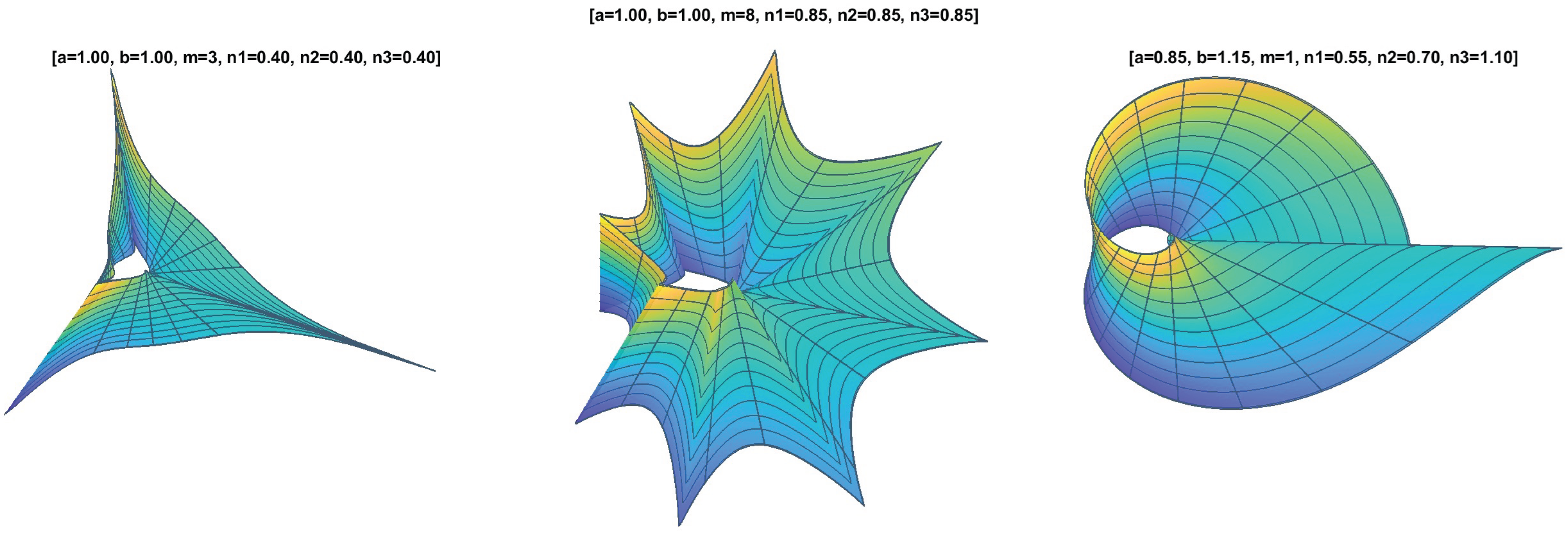
Therefore, X is aruled surface: for each fixed t, the map is linear in v and parametrizes a straight ruling in . The corresponding superelliptic Möbius strip is depicted in Figure 12.
6.6. Superelliptic Gauss and Mean Curvatures
The surface normal is a vector perpendicular to the surface’s tangent plane spanned by the vectors at a given point, in a superelliptic sense. For a parametrized surface , the normal vector is given by
and the unit normal is
For a parametrized surface , the first fundamental form describes the metric properties (lengths and angles) on the surface:
where
The second fundamental form
describes how the surface bends in space, where
Gaussian curvature can be expressed using the fundamental form coefficients as
It indicates whether the superelliptic surface is locally shaped like a superelliptic sphere (), a superelliptic saddle (), or a superelliptic plane (). The mean curvature describes how the surface bends on average and appears in many geometric and physical problems such as minimal surfaces, which is given by
Here, the coefficients represent the intrinsic metric properties of the superelliptic surface , characterizing the first fundamental form. In contrast, the coefficients correspond to the second fundamental form and describe how the surface bends within the ambient space .
A surface is said to be minimal if its mean curvature satisfies at every point. As a canonical example, the superelliptic catenoid constitutes a minimal surface, since its mean curvature vanishes identically across the entire surface.
6.7. Superelliptic Darboux Frame Apparatus in
A natural moving frame constructed on a surface is known as a Darboux frame. Let X be a superelliptic surface in and be a superelliptic curve on the superelliptic surface. We denote the superelliptic normal vector field with and the superelliptic tangent vector with , then since they are perpendicular to each other, the vector is perpendicular to both the vectors and . If we say , we obtain a superelliptic orthonormal basis on the surface consisting of the vectors along the curve . Moreover, for a unit-speed curve and a related superelliptic curve , we can express the following relationship under the transformation ,
where is a Darboux frame for a unit-speed superelliptic curve and satisfies
Additionally, the function that measures how much a superelliptic curve bends toward its surface normal is called the superelliptic normal curvature and can be calculated as follows:
The function that measures the deviation of a superelliptic curve from being a straight line on the surface is called the superelliptic geodesic curvature and can be calculated as follows:
The function showing how the direction of a superelliptic curve on a surface rotates with respect to the curvature direction of the surface is called the superelliptic geodesic torsion and can be calculated as follows:
On the other hand, if is a unit-speed superelliptic curve, then we compute the superelliptic normal curvature, superelliptic geodesic curvature, and superelliptic geodesic torsion, respectively, as follows:
Next, we give the formulas for the star derivatives of the moving frame .
Theorem 11.
Let be a unit-speed superelliptic curve on the superelliptic surface X, and be the Darboux frame apparatus. Then, the superelliptic Darboux frame derivative formulas are computed by
Proof.
We can write . If the superelliptic inner product of this equation with is taken, respectively, it becomes
Thus we can write
Similarly, if we write and if the superelliptic inner product of this equation with is taken, respectively, it becomes
then we compute
Finally, the calculation is done in a similar way for , we obtain
These completes the proof. □
Example 12.
Let us take the superelliptic cyclinder is
In this case, the superelliptic moving frame along the superelliptic cyclinder are computed as follows: For and we compute the superelliptic unit normal vector
superelliptic tangent vector
and superelliptic vector
Then, the superelliptic normal curvature, superelliptic geodesic curvature, and superelliptic geodesic torsion are calculated as follows:
7. Conclusion
In this study, we introduced a novel geometric framework that integrates Gielis’ superformula with the classical differential geometry of curves and surfaces. By defining the superelliptic inner and cross products, as well as the star derivative and the superelliptic Frenet frame, we extended the Euclidean and Riemannian interpretations of curvature and torsion to a more parametric and flexible geometric structure.
The proposed superelliptic geometry provides a new perspective in modeling natural and organic forms, where symmetry, scaling, and deformation can be controlled through a small set of parameters. This structure preserves essential geometric properties such as orthonormality and differentiability while allowing an infinite family of curves and surfaces to be generated from the same analytical foundation.
The framework definition presented in this study demonstrates that Gielis curves can be treated within the same formal and geometric characterization, independent of their classical parametric expressions. The resulting framework reduces even singular Gielis curves to the curvature and torsion properties of a circle, thus providing a "regulatory" layer that eliminates the geometric effects of singularities. This approach unifies all members of the Gielis family, including generalized Möbius-Listing surfaces [35], within a common framework, providing a more robust foundation for both computational geometry and natural shape modeling.
Finally, it is worth emphasizing that the proposed framework is highly general. In particular, when the superformula is considered as an illustrative example, it can be shown that, through the use of the star derivative, a wide variety of geometric structures and families of curves can be represented within the same formalism. This observation indicates that the proposed approach is not restricted to a specific special case; rather, it possesses the flexibility to encompass a broad class of functions and shapes. Hence, the superformula, analyzed via the star derivative, provides a representative example that highlights the generality and potential applicability of the developed framework. The results show that the superelliptic framework offers a consistent and computationally tractable model for analyzing complex geometries, bridging the gap between mathematical abstraction and real-world morphology.
Future work may include the extension of this framework to non-Euclidean manifolds and applications in physics, architecture, and biological modeling. Furthermore, this framework paves the way for the development of new differential-geometric methods that can be applied to Gielis surfaces, growth models, and minimal surfaces in the future.
Conflicts of Interest
The authors declare no conflicts of interest.
References
- Do Carmo, M.P. Differential geometry of curves and surfaces; Prentice-Hall: New Jersey, USA, 1979. [Google Scholar]
- Gielis, J. Wiskundige supervormen bij bamboes. Newsl. Belg. Bamboo Soc. 1996, 13, 20–26. [Google Scholar]
- Gielis, J. A generic geometric transformation that unifies a wide range of natural and abstract shapes. Am. J. Bot. 2003, 90(3), 333–338. [Google Scholar] [CrossRef]
- Gielis, J.; Beirinckx, B.; Bastiaens, E. Superquadrics with rational and irrational symmetry. In Proceedings of the eighth ACM symposium on Solid modeling and applications, Seattle, WA, USA, 16–20 June 2003; pp. 262–265. [Google Scholar]
- Gray, A. Modern differential geometry of curves and surfaces with Mathematica, 2nd ed.; CRC Press: Boca Raton, FL, USA, 1998. [Google Scholar]
- Gardner, M. Piet Hein’s Superellipse, Mathematical Carnival. A New Round-Up of Tantalizers and Puzzles from Scientific American; Vintage Press: New York, NY, USA, 1977. [Google Scholar]
- Kühnel, W. Differential geometry, 3rd ed.; American Mathematical Soc.: Providence, RI, USA, 2015; Vol. 77. [Google Scholar]
- Lamé, G.; Courcier, Mme. Ve. Examen des différentes méthodes employées pour résoudre les problémes de géométrie; Imprimeur-Libraire: Paris, France, 1818. [Google Scholar]
- O’Neill, B. Elementary differential geometry, 2nd ed.; Academic Press: San Diego, CA, USA, 1997. [Google Scholar]
- Özdemir, Z.; Parlak, E. Superquadric Motion and Superquadric Hyperbolic Split Quaternion Algebra Via Gielis Formula. Math. Meth. Appl. Sci. 2025, 48(16), 15035–15048. [Google Scholar] [CrossRef]
- Parlak, E.; Özdemir, Z. Superelliptic quaternions and superelliptic rotations with applications. Phys. Scr. 2025, 100(9), 095212. [Google Scholar] [CrossRef]
- Brandi, P.; Salvadori, A. A magic formula of nature. In Proceedings of the APLIMAT 17th Conference on Applied Mathematics, Bratislava, Slovakia, 6–8 February 2018; pp. 110–126. [Google Scholar]
- Gielis, J. The Geometrical Beauty of Plants; Atlantis/Springer: Berlin/Heidelberg, Germany, 2017. [Google Scholar]
- Gielis, J. De Uitvinding van de Cirkel (Dutch, 2001); Inventing the Circle (English, 2003); Geniaal 557 Publishing: Antwerp, Belgium, 2001. [Google Scholar]
- Gielis, J.; Haesen, S.; Verstraelen, L. Universal natural shapes: from the supereggs of Piet Hein to the cosmic egg of Georges Lemaître. Kragujevac J. Math. 2005, 28, 57–68. [Google Scholar]
- Koiso, M.; Palmer, B. Equilibria for anisotropic surface energies and the Gielis formula. Forma 2008, 23, 1–8. [Google Scholar]
- Verstraelen, L. A concise mini history of geometry. Kragujevac J. Math. 2014, 38, 5–21. [Google Scholar] [CrossRef]
- Natalini, P.; Patrizi, R.; Ricci, P.E. The Dirichlet problem for the Laplace equation in a starlike domain of a Riemann surface. Numer. Algorithms 2008, 49(1-4), 299–313. [Google Scholar] [CrossRef]
- Matsuura, M. Gielis’ superformula and regular polygons. J. Geom. 2015, 106(2), 383–403. [Google Scholar] [CrossRef]
- Gielis, J.; Caratelli, D.; Fougerolle, Y.; Ricci, P.E.; Tavkelidze, I.; Gerats, T. Universal natural shapes: From unifying shape description to simple methods for shape analysis and boundary value problems. PloSOne 2012, 7(9), e29324. [Google Scholar] [CrossRef]
- Gielis, J.; Natalini, P.; Ricci, P.E. A note about generalized forms of the Gielis formula. In Modeling in Mathematics: Proceedings of the Second Tbilisi-Salerno Workshop on Modeling in Mathematics; Atlantis Press: Dordrecht, The Netherlands, 2017; pp. 107–116. [Google Scholar]
- Haesen, S.; Nistor, A.; Verstraelen, L. On growth and form and geometry I. Kragujevac J. Math. 2012, 36, 5–25. [Google Scholar]
- Shi, P.J.; Huang, J.G.; Hui, C.; Grissino-Mayer, H.D.; Tardif, J.C.; Zhai, L.H.; Wang, F.S.; Li, B.L. Capturing spiral radial growth of conifers using the superellipse to model tree-ring geometric shape. Front. Plant Sci. 2015, 6, 856. [Google Scholar] [CrossRef]
- Faisal, T.R.; Hristozov, N.; Western, T.L.; Rey, A.; Pasini, D. The twistto-bend compliance of the Rheum rhabarbarum petiole: integrated computations and experiments. Comput. Methods Biomech. Biomed. Eng. 2016, 19(15), 1–12. [Google Scholar]
- Shi, P.; Ratkowsky, D.A.; Li, Y.; Zhang, L.; Lin, S.; Gielis, J. A general leaf area geometric formula exists for plants—Evidence from the simplified Gielis equation. Forests 2018, 9, 714. [Google Scholar] [CrossRef]
- Huang, W.; Li, Y.; Niklas, K.J.; Gielis, J.; Ding, Y.; Cao, L.; Shi, P. A superellipse with deformation and its application in describing the cross-sectional shapes of a square bamboo. Symmetry 2020, 12, 2073. [Google Scholar] [CrossRef]
- Gielis, J.; Shi, P.; Beirinckx, B.; Caratelli, D.; Ricci, P.E. Lamé-Gielis curves in biology and geometry. In Proceedings of the International Conference Riemannian Geometry and Applications (RIGA 2021), Bucharest, Romania, 15–17 January 2021. [Google Scholar]
- Mescia, L.; Bia, P.; Caratelli, D.; Chiapperino, M.A.; Stukach, O.; Gielis, J. Electromagnetic mathematical modeling of 3D supershaped dielectric lens antennas. Math. Probl. Eng. 2016, 2016, 8130160. [Google Scholar] [CrossRef]
- Geerarts, J.M.; Theis, G.; Smolders, A.B.; Caratelli, D. Constrained deterministic synthesis of conformal supershaped antenna arrays. IEEE Trans. Antennas Propag. 2023, 71, 8726–8738. [Google Scholar] [CrossRef]
- Leung, K.W.; Huang, C.T.; Fang, Z.; Lu, K.; Yang, N. Wideband Circularly Polarized Horn Antenna with Twisted Ridges of Gielis SuperFormula Contour. IEEE Trans. Antennas Propag. 2024, 73, 1197–1202. [Google Scholar] [CrossRef]
- Rodrigo, J.A.; Alieva, T. Polymorphic beams and Nature inspired circuits for optical current. Sci. Rep. 2016, 6, 35341. [Google Scholar] [CrossRef] [PubMed]
- Xue, S.; Guan, J.; Yue, H.; Sun, Y.; Gao, Y.; Qi, X. Multidimensional controllable sunflower beams: turbulence-resistant encoding in free-space optical communication. J. Opt. Soc. Am. A 2026, 43, B14–B22. [Google Scholar] [CrossRef]
- Fougerolle, Y.D.; Gribok, A.; Foufou, S.; Truchetet, F.; Abidi, M.A. Boolean operations with implicit and parametric representation of primitives using R-functions. IEEE Trans. Vis. Comput. Graph. 2005, 11, 529–539. [Google Scholar] [CrossRef] [PubMed]
- Gielis, J.; Caratelli, D.; Moreno de Jong van Coevorden, C.; Ricci, P.E. The common descent of biological shape description and special functions. In Proceedings of the International Conference on Differential and Difference Equations and Applications; Springer International Publishing: Cham, Switzerland, 2017; pp. 119–131. [Google Scholar]
- Tavkhelidze, I.; Caratelli, D.; Gielis, J.; Ricci, P.E.; Rogava, M.; Transirico, M. On a geometric model of bodies with “Complex” configuration and some movements. In Modeling in Mathematics: Proceedings of the Second Tbilisi-Salerno Workshop on Modeling in Mathematics; Atlantis Press: Paris, France, 2017; pp. 129–158. [Google Scholar]
- Barr, A. H. Superquadrics and angle-preserving transformations. IEEE Computer graphics and Applications. 1981, 1(1), 11–23. [Google Scholar] [CrossRef]
- Jaklic, A.; Leonardis, A.; Solina, Franc. Segmentation and Recovery of Superquadrics of Computational Imaging and Vision; Springer, 2000; volume 20. [Google Scholar]
- Wang, L.; Ratkowsky, D. A.; Gielis, J.; Ricci, P. E.; Shi, P. Effects of the numerical values of the parameters in the Gielis equation on its geometries. Symmetry 2022, 14(12), 2475. [Google Scholar] [CrossRef]
Figure 1.
(a)-(j) Superelliptic circle models for some values of r.
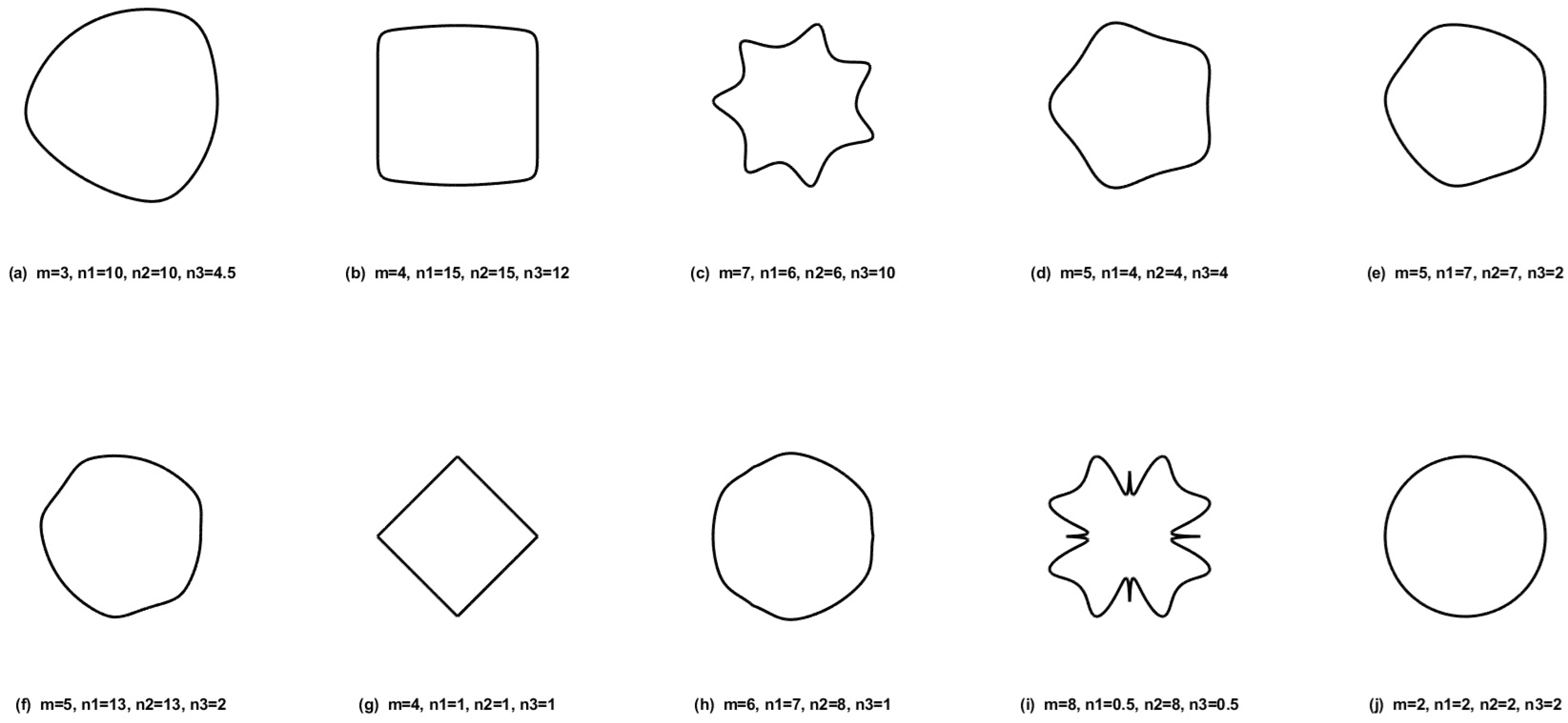
Figure 2.
(a)-(j) Superelliptic helix models for some values of r.
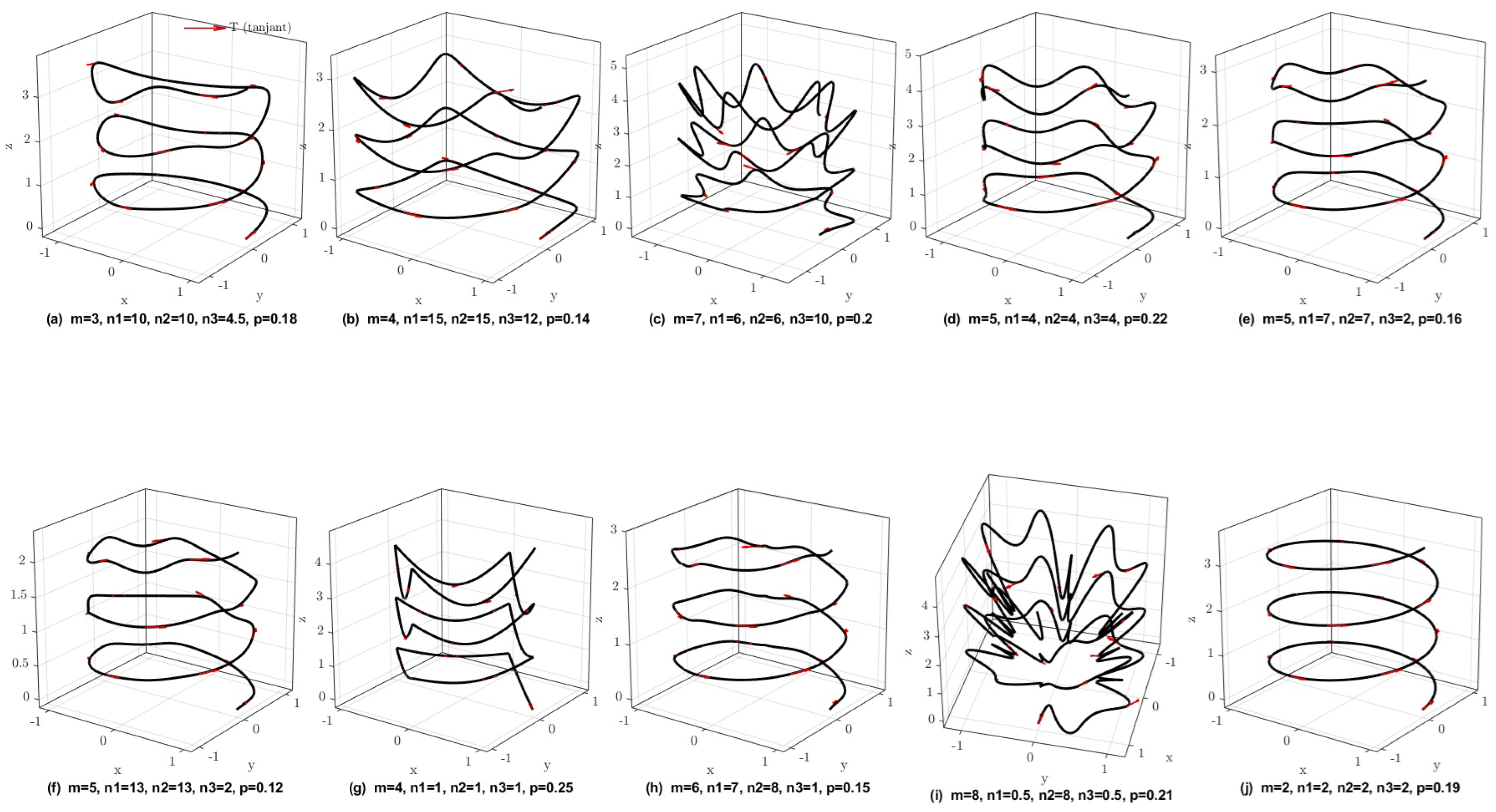
Figure 3.
Superelliptic curve (red) with Star derivative tangent vectors () vs. standard derivative
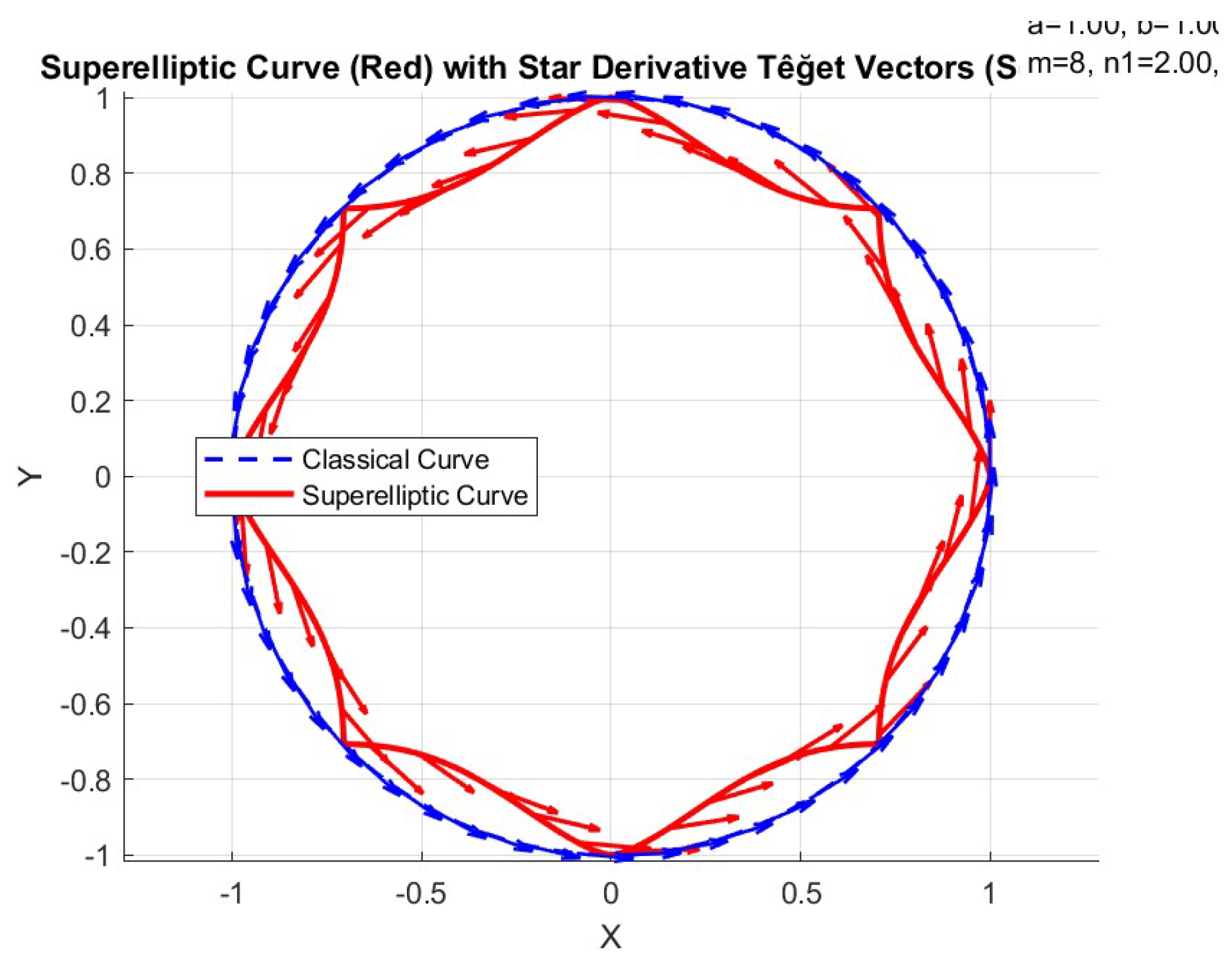
Figure 4.
Moving frames along a helix and a related superelliptic curve , for some values of .
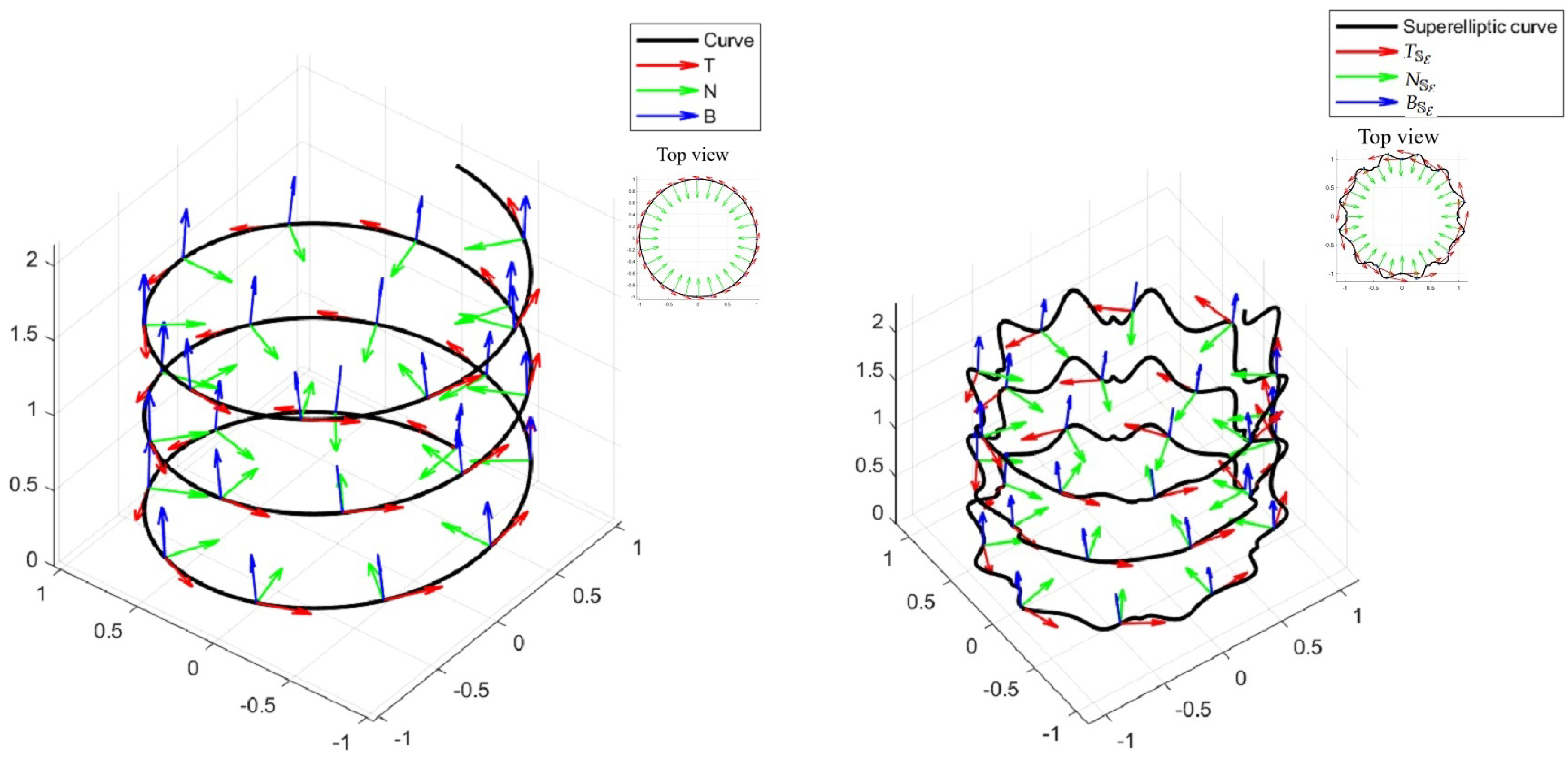
Figure 5.
Superellipsoid models for some values of superformula r.
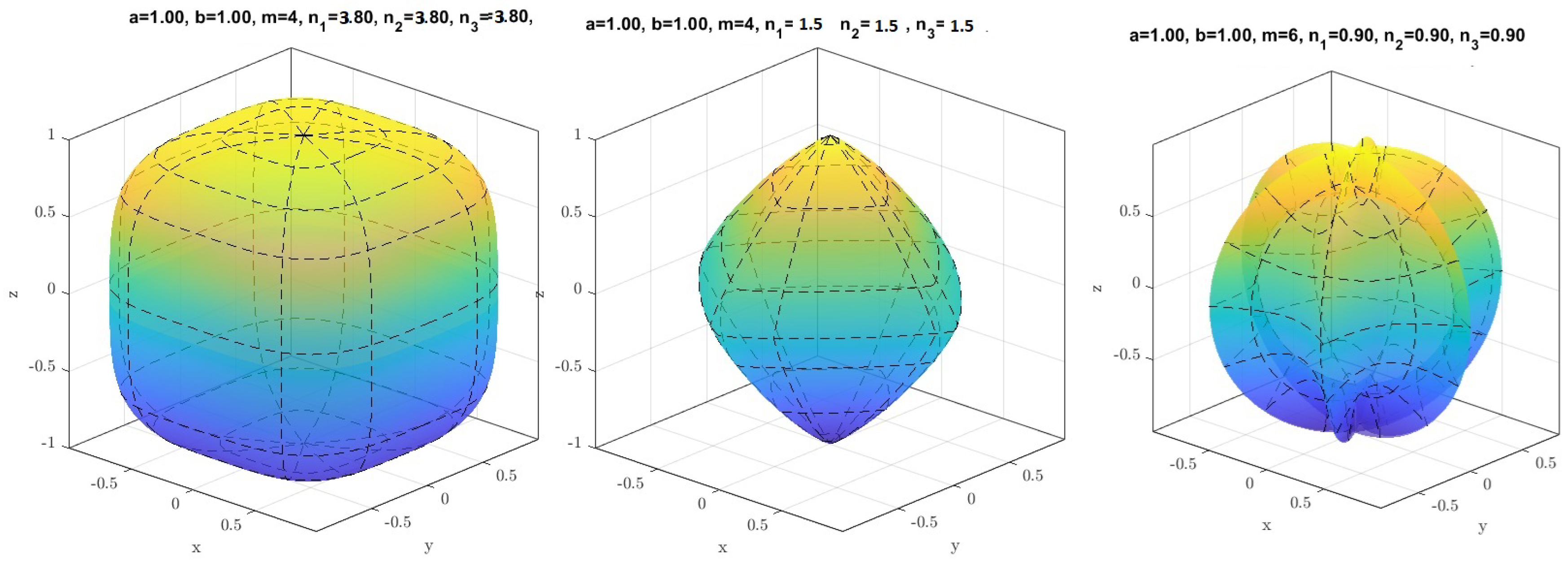
Figure 6.
superelliptic cylinder surface for some values of superformula r.
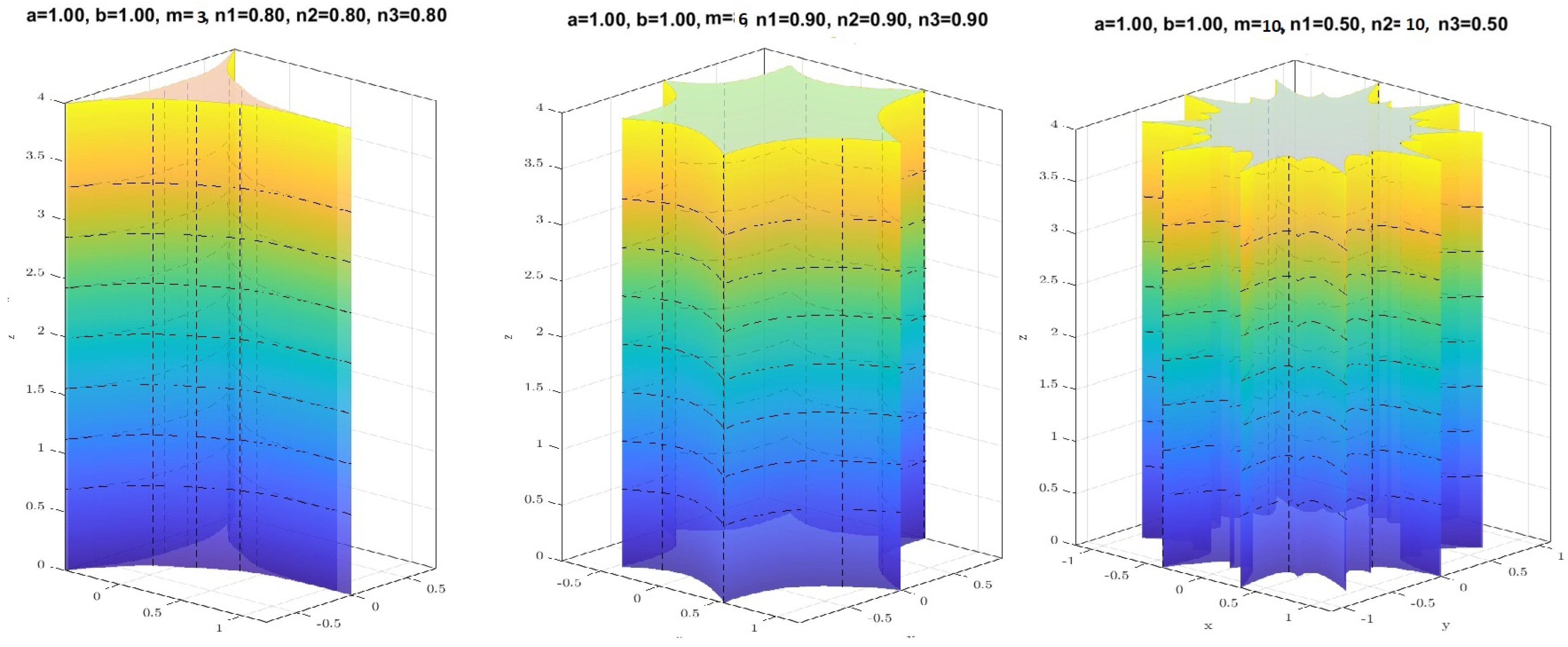
Figure 7.
Twisted superelliptic cylinder surface .
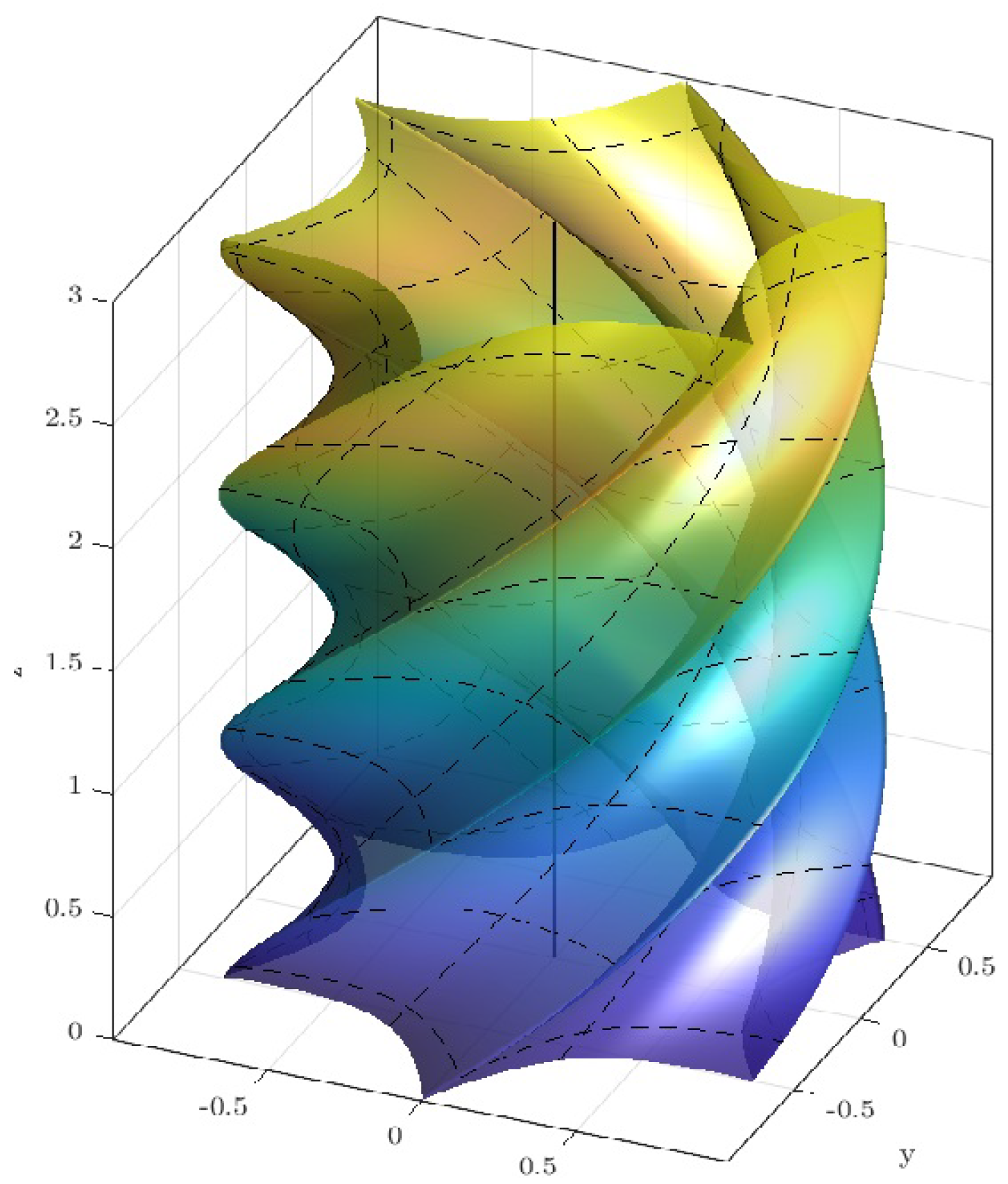
Figure 8.
superelliptic cone surface for some values of superformula r.
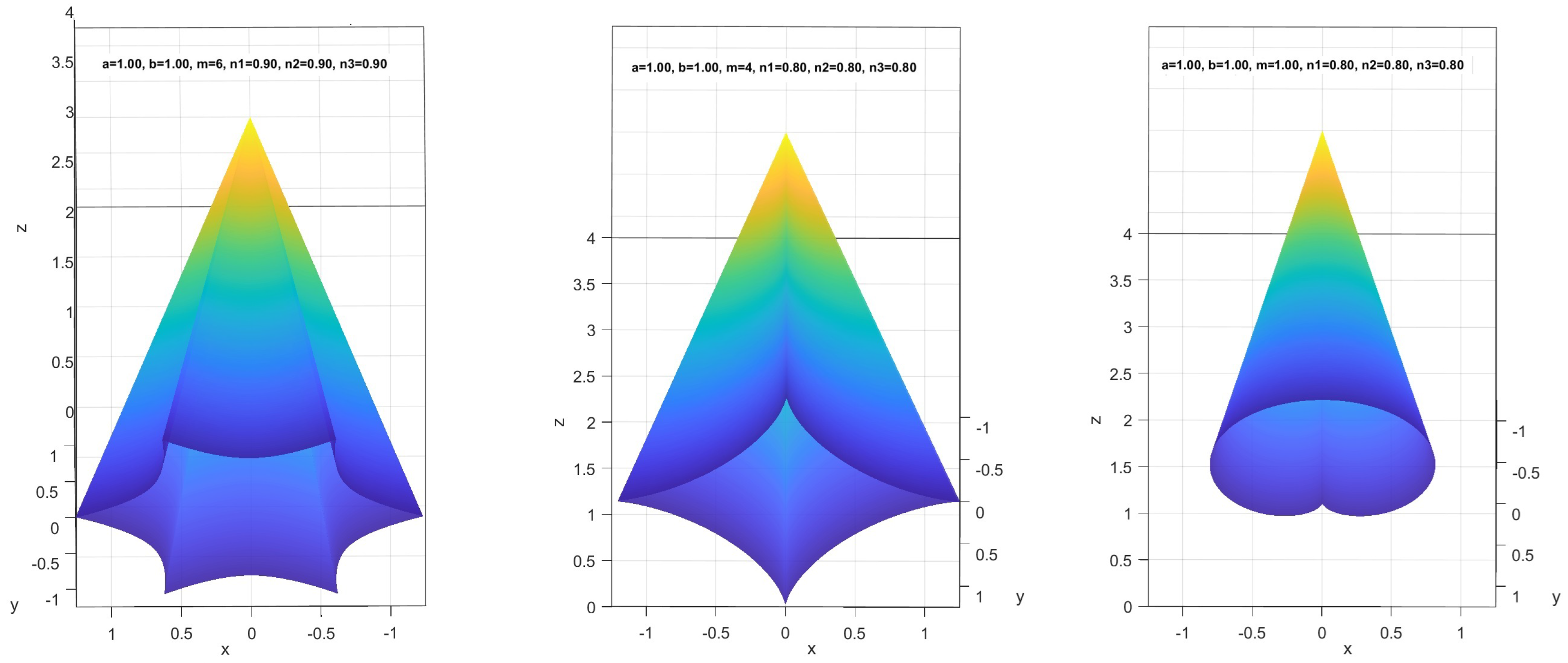
Figure 9.
superelliptic tori surface for some values of superformula r.
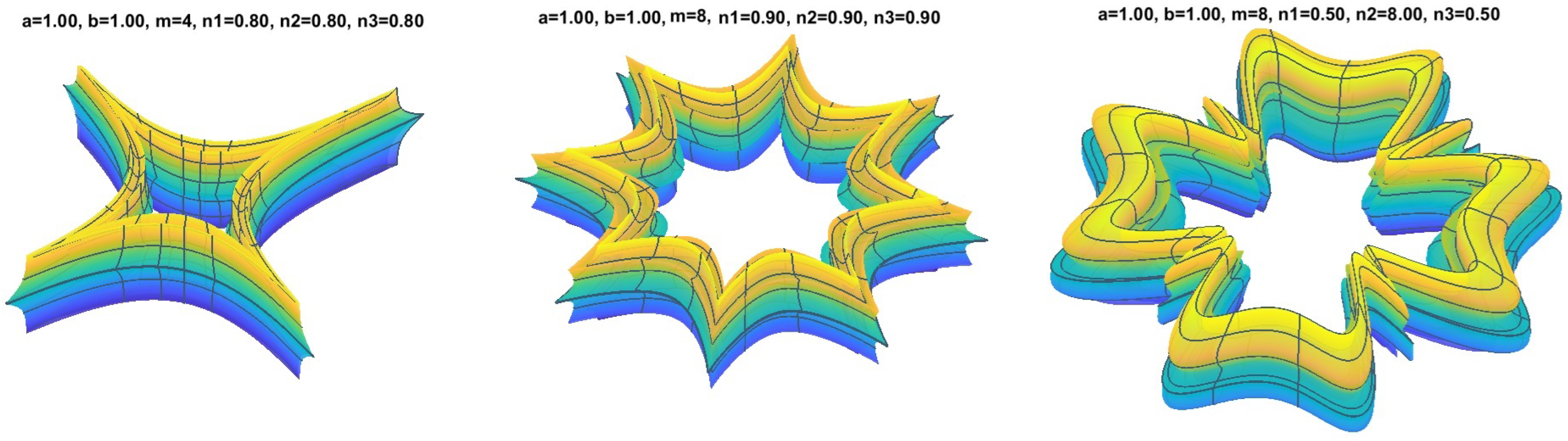
Figure 10.
superelliptic catenoid surface for some values of superformula r.
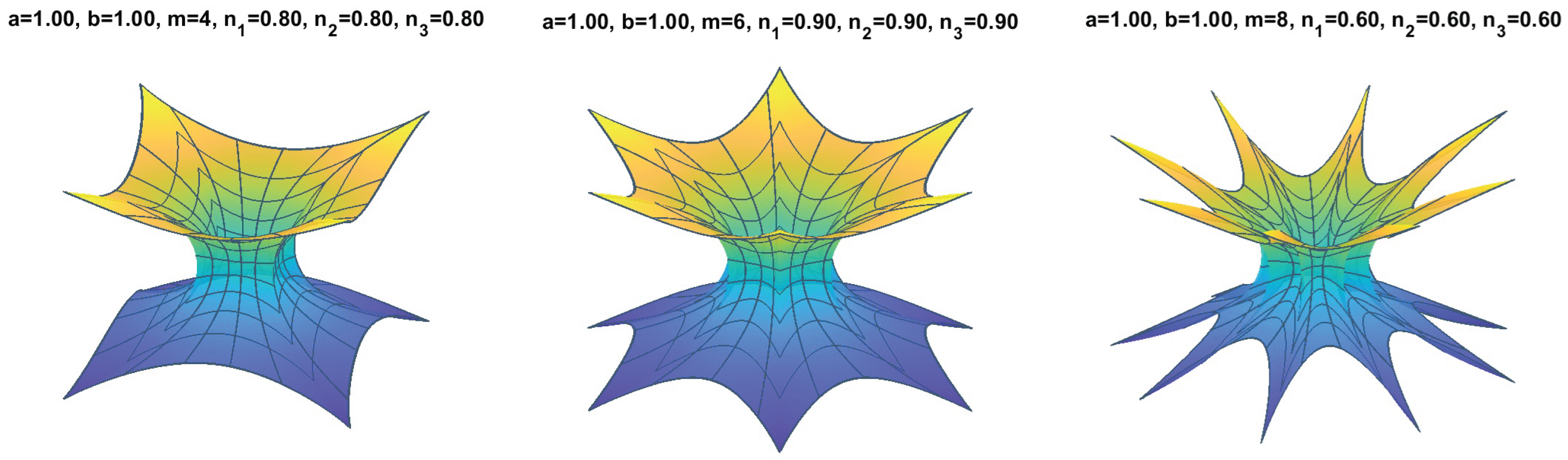
Figure 11.
superelliptic helicoid surfaces for some values of superformula r.
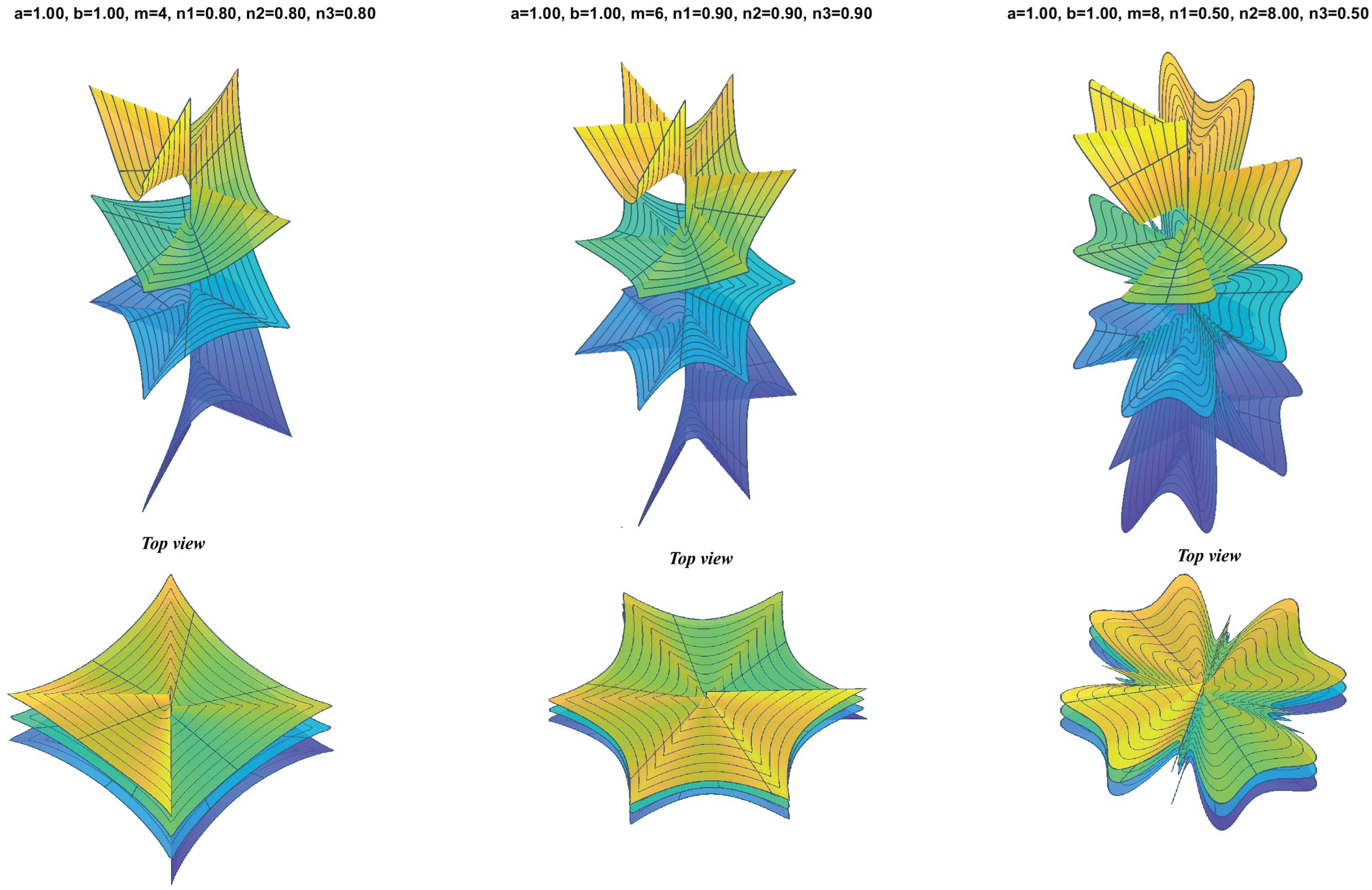
Figure 12.
superelliptic Möbius strip for some values of superformula r.
Disclaimer/Publisher’s Note: The statements, opinions and data contained in all publications are solely those of the individual author(s) and contributor(s) and not of MDPI and/or the editor(s). MDPI and/or the editor(s) disclaim responsibility for any injury to people or property resulting from any ideas, methods, instructions or products referred to in the content. |
© 2026 by the authors. Licensee MDPI, Basel, Switzerland. This article is an open access article distributed under the terms and conditions of the Creative Commons Attribution (CC BY) license (http://creativecommons.org/licenses/by/4.0/).
Copyright: This open access article is published under a Creative Commons CC BY 4.0 license, which permit the free download, distribution, and reuse, provided that the author and preprint are cited in any reuse.


