

Submitted:
13 April 2026
Posted:
14 April 2026
You are already at the latest version
Abstract
Objectives: This study aimed to evaluate the forward translation of the maxillary base in adults undergoing 3D-guided midpalatal piezocorticotomy-assisted Miniscrew-Assisted Rapid Palatal Expansion (MARPE). Furthermore, the research investigated the contributing factors for forward maxillary movement and the subsequent immediate shift of the mandible. Methods: In this retrospective quasi-experimental study, cephalometric records of 80 adult patients (mean age 35.23 ± 8.76 years; 52 females, 28 males) were analyzed. Maxillary translation was assessed via SNA and A-Nperp(FH), while intermaxillary changes were measured using the ANB angle. Vertical and rotational changes were tracked through SN-MP, FH-MP, and various occlusal plane angles (OcP-FH, OcP-SN, OcP-GoMe). Facial height dimensions (TAFH, UAFH, LAFH, PFH) and dento-alveolar positions (U1-MP, U1LENGTH) were also recorded. Results: Following intervention, significant increases were observed in SNA (0.96°; 95% CI [0.48, 1.43]), ANB (1.42°; 95% CI [1.04, 1.80]), and A-Nperp(FH) (0.81 mm; 95% CI [0.24, 1.39]). The SN-GoMe angle increased by 0.98° and Posterior Facial Height (PFH) increased by 1.57 mm, while upper incisor length (U1LENGTH) significantly decreased by 0.71 mm. Conclusions: 3D-Guided midpalatal Piezocoroticotomy Assisted MARPE in adults is associated with the increase in SNA, ANB, SN-GoMe, Posterior Facial Height, A-Nperp(FH), and decrease in the maxillary incisor length. The amount of anterior midpalatal separation is not associated with the SNA increase while the latter is associated with the inclination of the maxillary plane (SN-MP).
Keywords:
MARPE
; adults
; 3D- guided piezocorticotomy
; 3D-GMP MARPE
; downward maxillary rotation
; mandibular rotation
Introduction
Maxillary expansion has demonstrated positive effects for treatment of both Class II [1] and Class III malocclusions [2] in growing individuals. Maxillary expansion was associated with increase in pharyngeal airway volume [3] in growing individuals and improved quality of life in adults diagnosed with Obstructive Sleep Apnea (OSA) [4].
Maxillary forward movement has been one of the desired outcomes when treating both growing and non-growing individuals. Combination of facemask and hybrid-hyrax has become a widely described treatment modality in the late mixed dentition [5,6] in Class III malocclusion patients. For Class II growing individuals, where mandibular advancement has been advocated as one of the treatment options, maxillary skeletal expansion is an adjunct increasing its potential. The amount of mandibular advancement is highly dependent on the vertical position and anterior-posterior inclination of the maxillary incisors, anterior-posterior inclination of mandibular incisors, and the amount of the overjet.
Recent development of custom Miniscrew-Assisted Rapid Palatal Expansion devices has proven predictable maxillary skeletal separation in adult patients. Multiple protocols were introduced to increase the success rate of adult maxillary expansion including slow-turn protocol (MASPE) [7], polycyclic turns [8], 3D- Guided Midpalatal Piezocorticotomy Assisted MARPE (3D-GMP MARPE) [9].
The 3D-GMP MARPE protocol has shown high success rate of midpalatal suture separation in both sexes regardless of age, minimum side effects (skeletal fractures, soft tissue impingement etc), low post-procedural pain level.
This study has aimed at evaluating the effects of maxillary forward translation associated with the 3D-GMP MARPE procedure alone, without the use of facemask or similar devices, evaluated with lateral cephalometric measurements. Authors hypothesized that pre- and post-treatment lateral cephalometric measurements would show evidence of forward maxillary translation following the 3D-GMP MARPE protocol. Gender and Skeletal Classification differences were evaluated between pre- and post-expansion measurements.
Methods
Study design. This quasi-experimental study retrospectively evaluated the records of 80 patients who underwent 3D- GMP MARPE procedure in the clinical setting of the orthodontic practice DrKoval Orthodontics located in Boca Raton, FL, USA. This study was conducted in accordance with the principles of the Declaration of Helsinki. The study protocol was reviewed and approved by Solutions Institutional Review Board (Solutions IRB) (Approval No. 0846). Written informed consent was obtained from all participants.
Participants. 89 participants entered the study. After initial review, the records of 80 participants with the mean age of 35.23 ± 8.76 years were evaluated. Inclusion criteria for the study included adults 19 years old and older with no history of maxillary skeletal expansion, orthognathic surgery, connective tissue diseases, autoimmune conditions, chemotherapy. The study population included 52 females (65%) and 28 (35%) males who underwent 3D-GMP MARPE procedure as a part of the initially recommended treatment. The descriptive characteristics of the study population are included in Table 1.
Data sources/measurements. Lateral cephalometric radiographs were rendered from the CBCT volumes of each patient. The CBCT images were obtained with Planmeca G7 Viso (FOV 022x021 cm, Planmeca, Helsinki, Finland) with Ultra Low Dose protocol (ULD), 100 kV, 6.3 msA, 30 mkmSv, 600 voxel size. The exported lateral cephalometric radiographs processed in Romexis (Planmeca, Helsinki, Finland) were further traced manually in WebCeph (Seongnam-si, South Korea) by the Principal Investigator (SK). The lateral cephalometric radiographs were retraced again in 2 weeks for the increase intra-examiner reliability.
Variables. Fifteen measurements were identified for the purpose of this study. (Table 2). Maxillary forward translation was evaluated using angular (SNA) and linear measurements (A-Nperp(FH)), intermaxillary relationship was measured using angular ANB measurement. Angles SN-MP and FH-MP were used to evaluate the direction and amount of maxillary plane rotation. Occlusal plane rotation and cant was measured with OcP-FH, OcP-SN, and OcP-GoMe angles. Linear measurements of the facial heights were evaluated with TAFH (Total Anterior Facial Height, NaMe), UAFH (Upper Anterior Facial Height (Na-ANS), LAFH (Lower Anterior Facial Height, ANS-Me), and PFH (Posterior Facial Height, S-Go). Dento-alveolar measurements of the maxillary incisors position included angular U1-MP and linear U1LENGTH measurement.
Bias. CBCT images taken with open mouth posture were eliminated from the study. The CBCT volumes taken in a standing position with no head or chin support were evaluated.
Study size. The sample size was determined a priori to estimate the mean SNA angle with a 95% confidence level. Based on the previous literature showing a standard deviation of 3.93°, a sample of 60 subjects was required to achieve a margin of error of 1°. Our study evaluated total of 80 subjects.
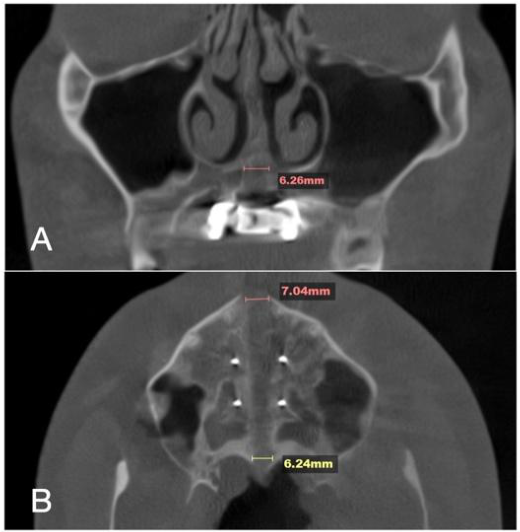
Intervention. The 3D guide for the midpalatal piezocorticotomy (Figure 1) was fabricated based on the initial CBCT volume merged with the intraoral scans taken with iTero intraoral scanner (iTero, Align Technology, San Jose, California, USA). The piezocorticotomy guide was used to precisely place the piezocorticotomy cuts followed by the custom MARPE placement (Figure 3). The activation of the custom MARPE was initiated 7 days after its placement. Further activation was kept at 1 turn a day (0.11 mm) for both males and females after the midpalatal split was confirmed. The activation of the Powerscrew (TigerDental, Hörbranz, Austria.) was 0.11 mm per turn. The complete (from ANS to PNS) midplaatal suture separation was then confirmed with the CBCT. (Figure 4).
Statistical methods. All statistical analyses were conducted in StataNow/SE 19.5 (Stata Corp, College Station, TX, USA). Descriptive statistics were used to summarize studied population. To test the data normality, Shapiro-Wilk test and Quantile-Quantile plots were used for every measured variable. Paired t-tests and two-sample t-test was used to identify differences between groups for all measured variables. To demonstrate statistical significance and P-value of <.05 was used.
Figure 1.
Schematic image of the 3D- printed midpalatal piezocorticotomy guide: 1- incisive foramen, 2 – incision notch for the midpalatal piezocorticotomy, 3 – guide base covering the hard palate, 4 – location of the transverse palatal suture, 5 – 3D printed guide connector, 6 – 3D printed guide occlusal splint covering occlusal surfaces of the maxillary teeth.
Figure 1.
Schematic image of the 3D- printed midpalatal piezocorticotomy guide: 1- incisive foramen, 2 – incision notch for the midpalatal piezocorticotomy, 3 – guide base covering the hard palate, 4 – location of the transverse palatal suture, 5 – 3D printed guide connector, 6 – 3D printed guide occlusal splint covering occlusal surfaces of the maxillary teeth.
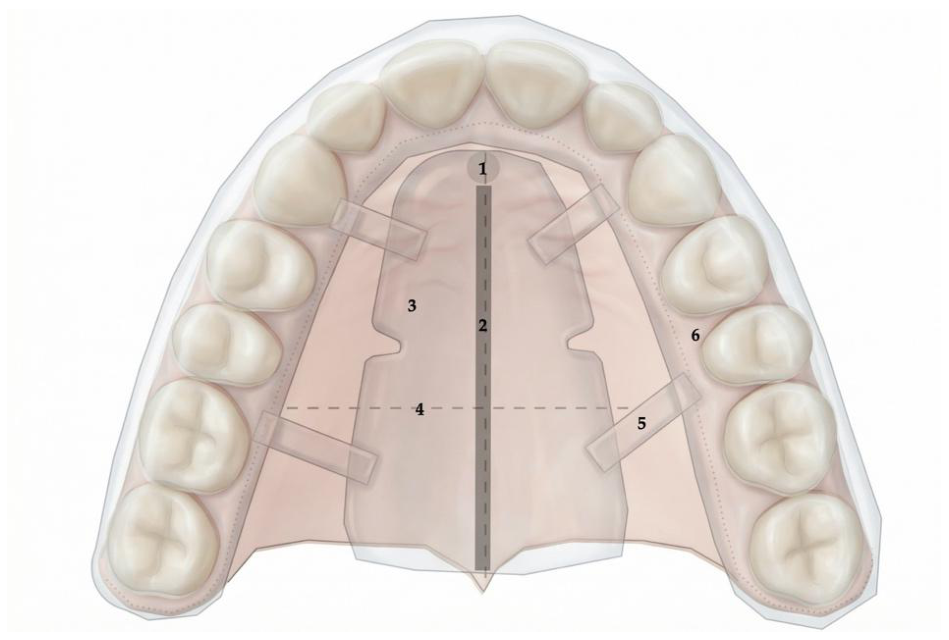

Table 2.
Descriptions of the parameters measured in the study.
| ANTERSEP | Separation of the midpalatal suture at the level of ANS, mm |
| SKCLASS | Skeletal Class |
| SNA | SNA before treatment, degrees |
| ANB | ANB angle degrees |
| A-Nperp(FH) | Distance between point A to the perpendicular to FH constructed through point N , mm |
| SN-MP | SN-ANS-PNS angle before treatment, degrees |
| FH- MP (PPA) | Palatal Plane angle to FH, degrees |
| SN-GoMe | Angle between the SN and GoMe, degrees |
| OcP-SN | Angle between the SN plane and the Occlusal plane, degrees |
| OcP-GoMe | Angle between the GoMe plane and the Occlusal plane, degrees |
| OcP-FH | Angle between the FH plane and the Occlusal plane, degrees |
| TAFH | Total anterior facial height, mm |
| PFH | Posterior Facial Height mm |
| LAFH | Lower anterior facial height, mm |
| UAFH | Upper anterior facial height, mm |
| U1MP | Angle between the axis of the maxillary central incisor and ANS-PNS plane, degrees |
| U1LENGTH | Lenth of the maxillary central incisor to the ANS-PNS plane mm |
Figure 2.
Lateral cephalometric tracing and measurements used for pre- and posttreatment analysis: 1 – SNA, 2- Posterior Facial Height (PFH), 3 – ANB, 4 – A-N perp(FH), 5 – U1LENGTH.
Figure 2.
Lateral cephalometric tracing and measurements used for pre- and posttreatment analysis: 1 – SNA, 2- Posterior Facial Height (PFH), 3 – ANB, 4 – A-N perp(FH), 5 – U1LENGTH.
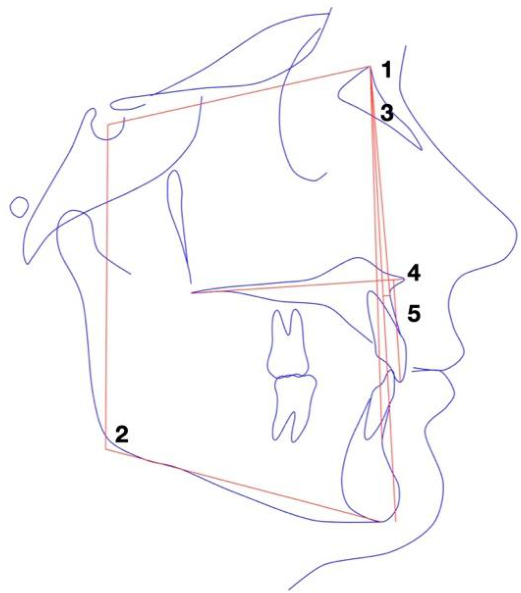
Figure 3.
Design of the custom MARPE used: A- after 3D-Guided Midplaatal Piezocorticotomy and installation (TAD screwheads are covered with composite), B – 6 weeks into expansion, C – completed expansion with tooth-anchored parts of the milled framework removed.
Figure 3.
Design of the custom MARPE used: A- after 3D-Guided Midplaatal Piezocorticotomy and installation (TAD screwheads are covered with composite), B – 6 weeks into expansion, C – completed expansion with tooth-anchored parts of the milled framework removed.
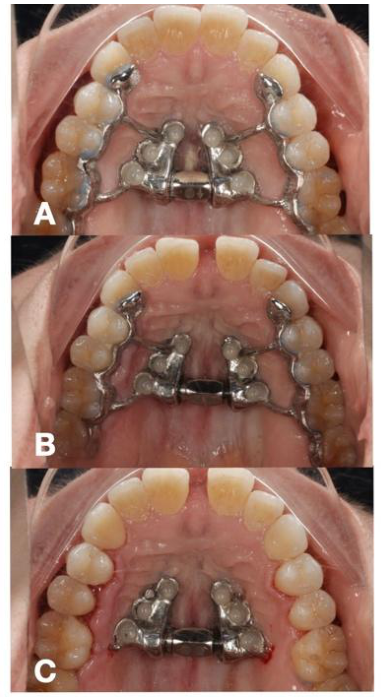
Figure 4.
Resulting midpalatal suture separation: A – coronal view at the level of the maxillary first molars indicating 6.26 mm of separation at the level of the nasal base (ANS-PNS plane), B – axial view of the same patient demonstrating 7.04 mm of the midpalatal separation at the level of the ANS and 6.24 mm of the midpalatal suture separation at the level of the PNS (89% parallelism).
Figure 4.
Resulting midpalatal suture separation: A – coronal view at the level of the maxillary first molars indicating 6.26 mm of separation at the level of the nasal base (ANS-PNS plane), B – axial view of the same patient demonstrating 7.04 mm of the midpalatal separation at the level of the ANS and 6.24 mm of the midpalatal suture separation at the level of the PNS (89% parallelism).
Results
Participants. All 80 participants demonstrated successful separation of the midpalatal suture. The mean anterior separation achieved was 5.55 ±1.34 mm in females, 6.65 ±1.95 mm in males, and 5.94 ±1.65 mm in total sample.
Descriptive data. Among 15 measurements compared between pre- (T0) and post-expansion (T1) stages only 6 showed significantly different change (SNA, ANB, A-Nperp(FH), SN-GoMe, PFH, and U1LENGTH). Parameters measuring the inclination of the maxillary plane relative to the Frankfort horizontal (FH-MP) or base of the skull (SN-MP) did not show significantly different change indicating no significant maxillary plane rotation/inclination with the procedure. Occlusal plane inclination (OcP-FH, OcP-SN, OcP-GoMe) did not significantly change with intervention either.
Outcome data. SNA angle significantly increased by 0.96 degrees with the 95% CI [0.48, 1.43] with intervention, ANB angle significantly increased by 1.42 degrees (95% CI [1.04,1.80]), A-Nperp(FH) significantly increased by 0.81 mm (95% CI [0.24,1.39]), PFH (Posterior Facial Height) significantly decreased by 1.57 mm (95% CI [-2.82, -0.32]), SN-GoMe angle significantly increased by 0.98 degrees (95% CI [ 0.42, 1.54]), upper incisor length (U1LENGTH) significantly decreased by 0.71 mm (95% CI [ -1.36, -0.05]).
Other analyses. Interpercentile group analysis of all 15 variables demonstrated significant difference between percentile groups for A-Nperp(FH). Angle Classification group analysis was performed between Class I and Class II groups showing significant intergroup difference for OcP-FH variable, while Class I group individually demonstrated significant difference in SNA, ANB, SN-GoMe, OcP-SN, OcP-FH variables. Skeletal Class II group showed significant difference in SN-GoMe, A-Nperp(FH), PFH variables. Scatter plots with fitted values of SNA increase and A-Nperp(FH) increase demonstrated a steady pattern in the A-point forward movement with expansion at the average level of 2 mm for males and an increasing point A displacement with expansion for females. Crude and adjusted linear regression analyses showed that SNA change is not associated with the amount of expansion but is rather related to the pre-treatment position of the maxillary plane relative to the base of the skull: for every 1 degree increase in pre-treatment SN-MP angle, the difference of pre- and post-expansion SNA will increase by 0.21 degrees in a mixed group of Class I and Class II subjects with mixed pre-expansion composition of maxillary base inclination.
Table 3.
Pre- and Post- expansion Comparison.
| Measurements | T0 | T1 | P-value | Mean change | 95% CI mean change | ||||||||||
| Mean | SD | Min | Max | [95% conf.interv] | Mean | SD | Min | Max | [95% conf.interv] | ||||||
| SNA, degrees | 80.82 | 3.94 | 69.9 | 88.7 | 79.94 | 81.70 | 81.66 | 4.08 | 72.7 | 90.1 | 80.75 | 82.56 | 0.001* | 0.96 | 0.48, 1.43 |
| ANB, degrees | 3.74 | 2.60 | -3.9 | 10 | 3.16 | 4.32 | 5.16 | 2.67 | -1 | 11.7 | 4.56 | 4.56 | <0.000* | 1.42 | 1.04, 1.80 |
| A-N perp(FH), mm | .03 | 3.97 | -.85 | .91 | -.85 | .91 | .84 | 3.66 | .03 | 1.66 | .03 | 1.66 | 0.006* | 0.81 | 0.24, 1.39 |
| SN-MP, degrees | 8.11 | 3.52 | -.9 | 15.9 | 7.33 | 8.89 | 8.26 | 3.37 | .6 | 15.3 | 7.51 | 9.01 | 0.64 | 0.15 | -0.50, 0.81 |
| FH-MP (PPA), degrees | -1.16 | 3.40 | -9.4 | 9.2 | -1.92 | -.41 | -.98 | 3.38 | -8.5 | 6.9 | -1.73 | -.22 | 0.60 | 0.19 | -0.51, 0.89 |
| SNGoME, degrees | 35.27 | 8.22 | 16.5 | 51.8 | 33.44 | 37.10 | 36.25 | 8.61 | 17.6 | 52.1 | 34.33 | 38.16 | 0.001* | 0.98 | 0.42, 1.54 |
| OcP-SN, degrees | 17.89 | 6.13 | .8 | 41.5 | 16.52 | 19.25 | 18.24 | 5.70 | 3.2 | 31.3 | 16.97 | 19.50 | 0.49 | 0.35 | -0.67, 1.37 |
| OcP -GoMe, degrees | 17.38 | 6.57 | -11.6 | 31.1 | 15.91 | 18.84 | 18.00 | 6.11 | 1.2 | 32.2 | 16.65 | 19.36 | 0.21 | 0.63 | -0.37, 1.63 |
| OcP-FH, degrees | 8.63 | 5.38 | -3.8 | 31.6 | 7.43 | 9.82 | 9.0 | 5.05 | -1.5 | 22.8 | 7.87 | 10.12 | .46 | 0.37 | -0.63, 1.37 |
| TAFH, mm | 117.47 | 9.09 | 77.5 | 140.3 | 115.45 | 119.49 | 116.08 | 11.70 | 79.8 | 135.2 | 113.47 | 118.68 | .13 | -1.39 | -3.22, 0.43 |
| PFH, mm | 76.65 | 8.03 | 52.4 | 99 | 74.86 | 78.44 | 75.08 | 9.78 | 50.7 | 99.1 | 72.90 | 77.26 | .014* | -1.57 | -2.82, - 0.32 |
| LAFH, mm | 68.38 | 6.29 | 41.9 | 83.1 | 66.98 | 69.78 | 67.62 | 7.73 | 43.2 | 81.9 | 65.90 | 69.34 | .23 | -0.76 | -2.04, 0.52 |
| UAFH, mm | 50.90 | 4.17 | 35.9 | 63.9 | 49.97 | 51.83 | 50.63 | 5.09 | 37.1 | 58.9 | 49.49 | 51.76 | .51 | -0.28 | -1.10, 0.55 |
| U1MP, degrees | 108.76 | 7.71 | 91.6 | 124.8 | 107.04 | 110.48 | 107.76 | 8.40 | 82.4 | 127.3 | 105.89 | 109.63 | 0.07 | -1.00 | -2.10, 0.09 |
| U1LENGTH, mm | 29.70 | 2.94 | 20.2 | 35.3 | 29.04 | 30.35 | 28.99 | 3.51 | 17.8 | 35.1 | 28.21 | 29.77 | .03* | -0.71 | -1.36, -0.05 |
* Statistically significant difference.
Table 4.
Amount of Midpalatal Separation in Percentile Groups.
| Percentile Groups | Min | Max | Mean | SD | Count |
| 1 | 3.3 | 4.8 | 4.10 | .55 | 20 |
| 2 | 4.81 | 5.7 | 5.22 | .27 | 21 |
| 3 | 5.71 | 6.81 | 6.26 | .32 | 19 |
| 4 | 6.81 | 10.17 | 5.89 | 1.58 | 20 |
| Total | 80 |
Table 5.
Inter percentile group analysis for different variables.
| Variable | Group 1 | Group 2 | Group 3 | Group 4 | ANOVA | Bartlett`s Test | Kruskal-Wallis test | ||||
| Mean | SD | Mean | SD | Mean | SD | Mean | SD | ||||
| SNA | -1.33 | 2.05 | -1.06 | 2.17 | -.99 | 1.80 | .04 | 3.48 | n/a | .02 | .66 |
| ANB | -1.63 | 1.84 | -1.29 | 1.84 | -1.54 | 1.68 | -1.24 | 1.49 | .86 | .78 | n/a |
| A-N perp(FH) | -1.74 | 2.53 | -.28 | 1.83 | -1.52 | 2.97 | .23 | 2.54 | n/a | .02 | .04* |
| SN-MP | -1.07 | 2.17 | .32 | 2.11 | .88 | 2.69 | -.72 | 4.11 | n/a | .01 | .22 |
| FH-MP (PPA) | -.71 | 3.53 | -.43 | 2.75 | 1.35 | 2.86 | -.86 | 3.12 | .10 | .70 | n/a |
| SNGoME | -1.21 | 1.54 | -.80 | 2.10 | -.93 | 1.83 | -.98 | 4.01 | n/a | <.000 | .73 |
| OcP-SN | .11 | 4.15 | -.38 | 2.16 | -.18 | 7.28 | -.93 | 3.84 | n/a | <.000 | .52 |
| OcP -GoMe | -1.32 | 4.41 | -.45 | 2.68 | -.75 | 6.54 | -.02 | 3.99 | n/a | <.002 | .69 |
| OcP-FH | .48 | 4.25 | -1.11 | 2.78 | .3 | 6.85 | -1.08 | 3.36 | n/a | <.000 | .63 |
| TAFH | .25 | 3.76 | -.82 | 3.85 | 1.87 | 8.92 | 4.41 | 12.54 | n/a | <.000 | .87 |
| PFH | 1.21 | 2.37 | .22 | 3.31 | 1.76 | 6.11 | 3.16 | 8.55 | n/a | <.000 | .68 |
| LAFH | .50 | 3.34 | -.71 | 2.60 | .27 | 6.51 | 3.04 | 8.39 | n/a | <.000 | .41 |
| UAFH | -.48 | 2.53 | -.67 | 2.68 | 1.32 | 3.88 | 1.03 | 5.08 | n/a | <.006 | .43 |
| U1MP | -.35 | 4.42 | 2.04 | 4.66 | 2.89 | 3.81 | -.54 | 5.92 | .06 | .29 | n/a |
| U1LENGTH | .89 | 1.71 | .06 | 1.67 | -.20 | 3.40 | 2.05 | 3.98 | n/a | <.000 | .09 |
*Statistically significant difference.
Discussion
Maxillary forward translation as an effect of expansion technique remains controversial in adults. Skeletal Class III patients have been the focus for the maxillary forward movement - oriented treatment with combination of the facemask therapy and various expansion techniques. Wilmes and colleagues [10] demonstrated significant benefits of bone-anchored maxillary skeletal expansion devices when combined with facemask treatment for the sagittal maxillary movement.
Current study showed significant increase in the anterior position of the maxillary base when measured on the lateral cephalometric radiographs. The measurements used in the study included SNA and A-Nperp(FH), both having point A as a reference for the most anterior point of the maxillary base. The average increase in the SNA was 0.96 degrees, with the A-Nperp(FH) increase being 0.81 mm in the study sample of 80 subjects and 5.94 ±1.65 mm of anterior midpalatal suture separation. Evaluation of the maxillary sagittal changes after Surgically-Assisted Rapid Palatal Expansion (SARPE) was published by Jia-Hong Linin a systematic review and meta-analysis [11] reporting a 0.50° ± 0.08° increase in SNA. Several earlier studies reported clockwise maxillary rotation with SARPE [11,12]. Our study did not confirm maxillary downward rotation with 3D-GMP MARPE showing no statistically significant difference between pre- and post-expansion measurements. Iodice and co-authors [13] did not find any statistically significant changes in the sagittal maxillary base position with SARPE reporting only maxillary incisor inclination change. Our study agrees with this finding reporting dento-alveolar change in the maxillary incisor vertical position (statistically significant decrease in maxillary incisor length) with intervention. Xue and co-authors [14] reported SNA and ANB increase with MARPE treatment in adults (0.54 degrees of increase for SNA angle and 1.54 degrees increase for the ANB angle), while our study showed ANB increase of 1.42 degrees. Thuy and Trang [15] reported no change to the Maxillary Plane Angle and minimal changes to the SNA and ANB angles with MARPE intervention.
McMullen and colleagues evaluated maxillary position changes in growing and non-growing patients treated with MARPE concluding greater downward displacement of ANS in growing patients. [16] Sayar [17] and colleagues evaluated growing and non-growing patients treated with Rapid Palatal Expansion (RPE) devices, and found no difference between groups in skeletal and dental outcomes of RPE.
The SNA increase with facemask- hybrid hyrax combination treatment produced 1.87±1.06 degrees of increase [18], 3.04 mm of forward movement of point A after 10 months of protraction time in growing individuals [19]; Tarraf and colleagues reported 4.26 ± 2.15 degrees of SNA increase with combination of hybrid hyrax and mandibular miniplates treatment in growing subjects [20]. Our data shows that adult maxillary skeletal expansion with 3D-GMP MARPE produces, on average, 0.96± 2.12 degrees of SNA increase.
Factors such as age, sex, suture maturation have been evaluated as contributing to the success of the maxillary skeletal expansion. [21] Chen and Kapetanovic [22] have confirmed that for adult patients the success of midpalatal suture separation is not related to age and gender. Shin [23] and colleagues found a negative correlation between the amount of midpalatal suture separation and subject`s age and sex. These varying outcomes are related to the difference in techniques used, amount of midpalatal separation achieved, and study group characteristics. The 3D-GMP MARPE technique has proven to be successful irrespective of the midpalatal suture maturation stage, patient age or gender. The amounts of anterior separation evaluated in this study averaged at 5.94 ±1.95 mm, which is higher than frequently reported amounts of midpalatal separation [24,25,26]. Additionally, 3D-GMP MARPE did not produce any significant discomfort throughout the expansion stage which is in accordance with the study by Elshehaby [27] who reported lower pain levels when microosteoperforations of the midpalatal suture were combined with MARPE treatment.
Scatter plots (Figure 5 and Figure 6) show visual representation between the amount of anterior separation and the increase in both SNA and A-Nperp(FH). Linear regression analysis did not confirm statistically significant association between two, thus indicating that the amount of anterior midpalatal separation is not directly related to the point A position change with 3D-GMP MARPE. The adjusted linear regression analysis demonstrated that SNA change is dependent on the initial inclination of the maxillary base (SN-MP) rather than the amount of anterior midpalatal separation. (Table 8).
Posterior Facial Height increase reported in the current study was statistically significant for the total sample with intervention indicating immediate mandibular response to the maxillary skeletal expansion. SN-GoMe angle increase was concomitant with the ANB increase indicating posterior mandibular rotation.
The limitations of the current study included analysis of the restricted sample of patients with pre-existing symptoms of Sleep Disordered Breathing and/or Obstructive Sleep Apnea. The predominant tendency to higher ANB angles before treatment and smaller number of patients with Skeletal Class III base relationship did not allow for the comparison of all skeletal classes.
Current data needs to be carefully interpreted as SNA angle and linear A-Nperp(FH) measurements, which both depend on the position of point A, might not be the accurate representations of the maxillary base position. Point A is located in the trajectory of the apex of the maxillary incisor root also being subject to movement with maxillary skeletal expansion, as shown in the current study. Further 3D cephalometric studies are advised to evaluate maxillary forward position changes using different landmarks.
Reported data has limited generalizability due to the nature of the study sample. Further studies are recommended to increase the generalizability of the current findings.
Conclusions
3D-Guided midpalatal Piezocoroticotomy Assisted MARPE in adults is associated with the increase in SNA, ANB, SN-GoMe, Posterior Facial Height, A-Nperp(FH), and decrease in the maxillary incisor length. The amount of anterior midpalatal separation is not associated with the SNA increase while the latter is associated with the inclination of the maxillary plane (SN-MP).
Author Contributions
SK contributed to conceptualization, manuscript text, editing, supervision of the project; DC contributed to preparing Figure 1, Figure 2, Figure 3 and Figure 4, Table 1, Table 2, Table 3, Table 4, Table 5, Table 6, Table 7 and Table 8, editing and reviewing; NS contributed to manuscript writing and editing; AB contributed to data analysis, editing, and writing.
Funding
Not applicable.
Data Availability Statement
The datasets used and/or analyzed during the current study are available from the corresponding author on reasonable request.
Ethics approval and consent to participate
The study protocol was reviewed and approved by Solutions Institutional Review Board (Solutions IRB) (Approval No. 0846). Written informed consent was obtained from all participants.
Consent for publication
Written informed consent for publication of anonymized data was obtained from all participants prior to enrollment.
Conflicts of Interest
One author (SK) declares a pending patent: US and Canada Patent Pending: Piezocorticotomy guide for midpalatal skeletal expansion (Application # 18/919,416).
Abbreviations
| MARPE | Miniscrew-Assisted Rapid Palatal Expansion |
| SARPE | Surgically Assisted Rapid Palatal Expansion |
| RPE | Rapid Palatal Expander |
| 3D-GMP | 3-Dimensional Guided Midpalatal Piezocorticotomy |
References
- Guest, S.S.; McNamara, J.A.; Baccetti, T.; Franchi, L. Improving Class II malocclusion as a side-effect of rapid maxillary expansion: a prospective clinical study. Am J Orthod Dentofacial Orthop 2010, 138, 582–591. [CrossRef]
- Spalj, S.; Zigante, M.; Tudor, V.; Öztürk, T.; Yağcı, A.; Palomo, J.M. Effect of Maxillary Expansion and Protraction in Class III Children on Quality of Life, Dentofacial and Upper Airway Characteristics: A Controlled Clinical Trial. Orthod Craniofac Res 2025. [CrossRef]
- Maraabeh, F.; Shihabi, R.; He, X.; Zhan, J.; Zhang, J.; Hu, L.; Chen, L.-L. Three-dimensional volume changes of the palatal vault and pharyngeal airway following facemask therapy and maxillary expansion: a prospective comparative study. BMC Oral Health 2025, 25, 456. [CrossRef]
- Brunetto, D.P.; Moschik, C.E.; Dominguez-Mompell, R.; Jaria, E.; Sant’Anna, E.F.; Moon, W. Mini-implant assisted rapid palatal expansion (MARPE) effects on adult obstructive sleep apnea (OSA) and quality of life: a multi-center prospective controlled trial. Prog Orthod 2022, 23, 3. [CrossRef]
- Nienkemper, M.; Wilmes, B.; Pauls, A.; Drescher, D. Maxillary protraction using a hybrid hyrax-facemask combination. Prog Orthod 2013, 14, 5. [CrossRef]
- Maino, G.; Turci, Y.; Arreghini, A.; Paoletto, E.; Siciliani, G.; Lombardo, L. Skeletal and dentoalveolar effects of hybrid rapid palatal expansion and facemask treatment in growing skeletal Class III patients. Am J Orthod Dentofacial Orthop 2018, 153, 262–268. [CrossRef]
- Arveda, N.; Migliorati, M.; De Mari, A.; Forin Valvecchi, F.; Schiavetti, I.; Annarumma, F.; Battista, G.; Aghazada, H. Miniscrew-assisted slow palatal expansion with bone borne expander in adult patients: a case control study on consecutively treated patients. Angle Orthod 2025, 95, 513–521. [CrossRef]
- Walter, A.; Winsauer, H.; Crespo, E.; Walter, D.; Winsauer, C.; Schwärzler, A.; Mojal, S.; Arcos, I.; Puigdollers, A. Adult maxillary expansion: CBCT evaluation of skeletal changes and determining an efficiency factor between force-controlled polycyclic slow activation and continuous rapid activation for mini-screw-assisted palatal expansion - MASPE vs. MARPE. Head Face Med 2024, 20, 70. [CrossRef]
- Koval, S.; Kolesnyk, V.; Chepanova, D. Applications of the Novel Midpalatal Piezocorticotomy Guide for MARPE Midfacial Skeletal Expansion. J Clin Med 2025, 14, 4728. [CrossRef]
- Ngan, P.; Wilmes, B.; Drescher, D.; Martin, C.; Weaver, B.; Gunel, E. Comparison of two maxillary protraction protocols: tooth-borne versus bone-anchored protraction facemask treatment. Prog Orthod 2015, 16, 26. [CrossRef]
- Lin, J.-H.; Wang, S.; Abdullah, U.A.; Le, A.D.; Chung, C.-H.; Li, C. Sagittal and Vertical Changes of the Maxilla after Surgically Assisted Rapid Palatal Expansion: A Systematic Review and Meta-Analysis. J Clin Med 2023, 12, 3488. [CrossRef]
- Parhiz, A.; Schepers, S.; Lambrichts, I.; Vrielinck, L.; Sun, Y.; Politis, C. Lateral cephalometry changes after SARPE. Int J Oral Maxillofac Surg 2011, 40, 662–671. [CrossRef]
- Iodice, G.; Bocchino, T.; Casadei, M.; Baldi, D.; Robiony, M. Evaluations of sagittal and vertical changes induced by surgically assisted rapid palatal expansion. J Craniofac Surg 2013, 24, 1210–1214. [CrossRef]
- Xue, H.; Qi, Y.; Ni, X.; Feng, Y.; Lin, J. Efficiency of Cone-Beam Computed Tomography-Based Personalized Microimplant-Assisted Rapid Palatal Expansion in Patients With Maxillary Transverse Deficiency and Thin Palatal Bone. Int Dent J 2026, 76, 109307. [CrossRef]
- Thi Hong Thuy, P.; Thu Trang, P.; Thi Thu Hang, P.; Viet, H. Clinical and cone-beam computed tomography outcomes of miniscrew-assisted rapid palatal expansion in the treatment of maxillary transverse deficiency: A prospective study. Medicine (Baltimore) 2025, 104, e44684. [CrossRef]
- McMullen, C.; Al Turkestani, N.N.; Ruellas, A.C.O.; Massaro, C.; Rego, M.V.N.N.; Yatabe, M.S.; Kim-Berman, H.; McNamara, J.A.; Angelieri, F.; Franchi, L.; et al. Three-Dimensional Evaluation of Skeletal and Dental Effects of Treatment with Maxillary Skeletal Expansion. Am J Orthod Dentofacial Orthop 2022, 161, 666–678. [CrossRef]
- Sayar, G.; Kılınç, D.D. Rapid maxillary expansion outcomes according to midpalatal suture maturation levels. Prog Orthod 2019, 20, 27. [CrossRef]
- Al-Mozany, S.A.; Dalci, O.; Almuzian, M.; Gonzalez, C.; Tarraf, N.E.; Ali Darendeliler, M. A novel method for treatment of Class III malocclusion in growing patients. Prog Orthod 2017, 18, 40. [CrossRef]
- Liu, W.; Zhou, Y.; Wang, X.; Liu, D.; Zhou, S. Effect of maxillary protraction with alternating rapid palatal expansion and constriction vs expansion alone in maxillary retrusive patients: a single-center, randomized controlled trial. Am J Orthod Dentofacial Orthop 2015, 148, 641–651. [CrossRef]
- Tarraf, N.E.; Dalci, O.; Dalci, K.; Altug, A.T.; Darendeliler, M.A. A retrospective comparison of two protocols for correction of skeletal Class III malocclusion in prepubertal children: hybrid hyrax expander with mandibular miniplates and rapid maxillary expansion with face mask. Prog Orthod 2023, 24, 3. [CrossRef]
- Colak, O.; Paredes, N.A.; Elkenawy, I.; Torres, M.; Bui, J.; Jahangiri, S.; Moon, W. Tomographic assessment of palatal suture opening pattern and pterygopalatine suture disarticulation in the axial plane after midfacial skeletal expansion. Prog Orthod 2020, 21, 21. [CrossRef]
- Chen, H.; Kapetanović, A.; Piao, Z.; Xi, T.; Schols, J.G.J.H. Stability of expansion effects following Miniscrew-assisted Rapid Palatal expansion: a prospective longitudinal cohort study. Oral Maxillofac Surg 2025, 29, 23. [CrossRef]
- Shin, H.; Hwang, C.-J.; Lee, K.-J.; Choi, Y.J.; Han, S.-S.; Yu, H.S. Predictors of midpalatal suture expansion by miniscrew-assisted rapid palatal expansion in young adults: A preliminary study. Korean J Orthod 2019, 49, 360–371. [CrossRef]
- Pirelli, P.; Fiaschetti, V.; Fanucci, E.; Giancotti, A.; Condo’, R.; Saccomanno, S.; Mampieri, G. Cone beam CT evaluation of skeletal and nasomaxillary complex volume changes after rapid maxillary expansion in OSA children. Sleep Med 2021, 86, 81–89. [CrossRef]
- Choi, E.-H.A.; Lee, K.-J.; Choi, S.-H.; Jung, H.-D.; Ahn, H.-J.; Deguchi, T.; Cha, J.-Y. Skeletal and dentoalveolar effects of miniscrew-assisted rapid palatal expansion based on the length of the miniscrew: a randomized clinical trial. Angle Orthod 2023, 93, 390–397. [CrossRef]
- Winsauer, H.; Walter, A.; Katsaros, C.; Ploder, O. Success and complication rate of miniscrew assisted non-surgical palatal expansion in adults - a consecutive study using a novel force-controlled polycyclic activation protocol. Head Face Med 2021, 17, 50. [CrossRef]
- Elshehaby, M.; Albelasy, N.F.; Elbialy, M.A.; Hafez, A.M.; Abdelnaby, Y.L. Evaluation of pain intensity and airway changes in non-growing patients treated by MARPE with and without micro-osteoperforation: a randomized clinical trial. BMC Oral Health 2024, 24, 1411. [CrossRef]
Figure 5.
Scatter plot with fitted values with 95% CI of the A-point movement measured as an absolute change of A-Nperp(FH) by gender indicating an increase in forward movement in females with the amount of ANS separation, and a slight decrease of the A-point movement in males as ANS separation increases.
Figure 5.
Scatter plot with fitted values with 95% CI of the A-point movement measured as an absolute change of A-Nperp(FH) by gender indicating an increase in forward movement in females with the amount of ANS separation, and a slight decrease of the A-point movement in males as ANS separation increases.
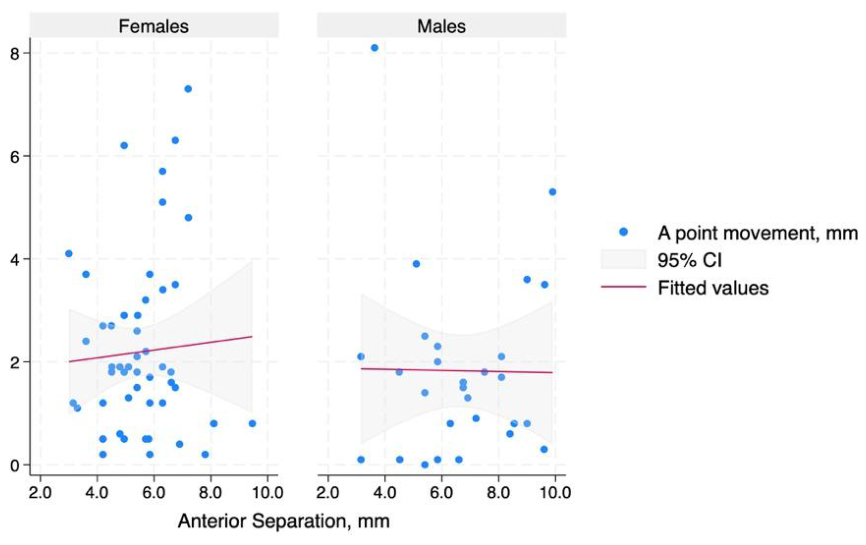
Figure 6.
SNA difference with the amount of anterior midpalatal separation by gender. Downward slope of both fitted lines indicates the decrease in the amount of SNA increase with increasing Anterior separation of the midpalatal suture.
Figure 6.
SNA difference with the amount of anterior midpalatal separation by gender. Downward slope of both fitted lines indicates the decrease in the amount of SNA increase with increasing Anterior separation of the midpalatal suture.
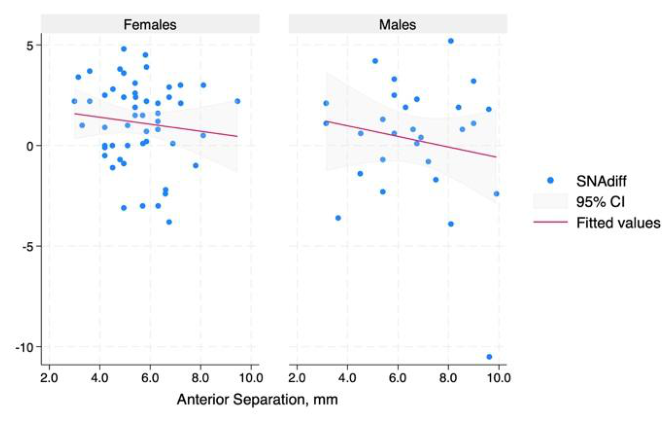
Table 1.
Characteristics of the study participants. Mean values and standard deviations are presented for each continuous variable.
Table 1.
Characteristics of the study participants. Mean values and standard deviations are presented for each continuous variable.
| Gender | |||
| Females | Males | Total | |
| Number | 52 (65%) | 28 (35%) | 80 (100%) |
| Age | 37.94 (7.71) | 30.18 (8.45) | 35.23 (8.76) |
| Anterior Midplaatal Separation, mm | 5.55 (1.34) | 6.65 (1.95) | 5.94 (1.65) |
| ANB before Tx, degrees | 4.07 (2.34) | 3.12 (2.99) | 3.74 (2.61) |
| SNA before Tx, degrees | 80.59 (4.22) | 81.26 (3.38) | 80.82 (3.94) |
| SN- ANSPNS before Tx, degrees | 8.31 (3.35) | 7.73 (3.85) | 8.11 (3.52) |
Table 6.
Skeletal Class I and Class II Subgroups Characteristics before Treatment.
| Skeletal Class | |||
| I | II | Total | |
| N | 38 (50.7%) | 37 (49.3%) | 75 (100.0%) |
| MEANSEP | 5.844 (1.682) | 5.875 (1.462) | 5.859 (1.567) |
| ANB | 2.284 (1.081) | 5.965 (1.428) | 4.100 (2.238) |
| TAFH | 118.400 (10.975) | 116.892 (6.788) | 117.656 (9.122) |
| PPA | -1.153 (3.655) | -0.997 (3.150) | -1.076 (3.393) |
| PFH | 76.992 (8.728) | 75.727 (7.451) | 76.368 (8.093) |
| SNA | 79.876 (3.911) | 81.722 (3.842) | 80.787 (3.961) |
| SNGoMe | 35.253 (8.179) | 36.389 (7.848) | 35.813 (7.984) |
| SN-MP | 8.366 (3.439) | 8.014 (3.735) | 8.192 (3.568) |
| U1-MP | 110.011 (6.069) | 106.273 (8.397) | 108.167 (7.501) |
| OcP-SN | 17.668 (4.638) | 19.051 (6.951) | 18.351 (5.895) |
| OcP-GoMe | 17.576 (5.889) | 17.332 (7.509) | 17.456 (6.692) |
| OcP_FH | 8.161 (4.261) | 10.043 (5.783) | 9.089 (5.123) |
| ANperpFH | -0.726 (3.652) | 0.749 (3.908) | 0.001 (3.827) |
| LAFH | 68.424 (7.594) | 68.630 (4.652) | 68.525 (6.275) |
| UAFH | 51.318 (4.545) | 50.722 (3.957) | 51.024 (4.247) |
| U1-length | 29.521 (3.128) | 30.127 (2.638) | 29.820 (2.893) |
Table 7.
Skeletal Class I and II Subgroup Comparative Analysis.
| Variable | I | II |
Intergroup P value |
||||||||
| T0 | T1 |
P value |
T0 | T1 | P value | ||||||
| Mean | SD | Mean | SD | Mean | SD | Mean | SD | ||||
| SNA | 79.88 | 3.91 | 81.00 | 4.03 | .004* | 81.72 | 3.84 | 81.98 | 4.00 | .16 | .13 |
| ANB | 2.28 | 1.08 | 3.93 | 2.01 | .0052* | 5.96 | 1.43 | 6.95 | 1.99 | .16 | .08 |
| A-N perp(FH) | -.73 | 3.65 | -.084 | 3.39 | .15 | .75 | 3.91 | 1.62 | 3.21 | .027* | .07 |
| SN-MP | 8.37 | 3.44 | 8.33 | 2.87 | .92 | 8.01 | 3.73 | 8.77 | 3.59 | .12 | .22 |
| FH-MP (PPA) | -1.15 | 3.66 | -.70 | 3.48 | .36 | -.10 | 3.15 | -.83 | 3.20 | .74 | .687 |
| SNGoME | 35.25 | 8.18 | 36.03 | 8.28 | .01* | 36.39 | 7.85 | 37.68 | 8.49 | .004* | .69 |
| OcP-SN | 17.67 | 4.64 | 18.53 | 4.98 | .025* | 19.05 | 6.95 | 18.78 | 6.00 | .45 | .29 |
| OcP -GoMe | 17.58 | 5.89 | 17.49 | 5.62 | .50 | 17.33 | 7.51 | 18.89 | 6.55 | .19 | .12 |
| OcP-FH | 8.16 | 4.26 | 9.49 | 4.96 | .016* | 10.04 | 5.78 | 9.19 | 4.95 | .98 | .04* |
| TAFH | 118.4 | 10.97 | 118.23 | 11.44 | .096 | 116.89 | 6.79 | 114.53 | 10.91 | .35 | .23 |
| PFH | 76.99 | 8.73 | 76.64 | 9.29 | .36 | 75.73 | 7.45 | 72.98 | 9.77 | .001* | .052 |
| LAFH | 68.42 | 7.59 | 68.67 | 7.94 | .10 | 68.63 | 4.65 | 66.97 | 6.65 | .32 | .13 |
| UAFH | 51.32 | 4.54 | 51.37 | 4.56 | .319 | 50.72 | 3.96 | 50.25 | 5.48 | .86 | .53 |
| U1MP | 110.01 | 6.07 | 109.62 | 7.79 | .616 | 106.27 | 8.40 | 105.19 | 8.55 | .17 | .53 |
| U1LENGTH | 29.52 | 3.13 | 29.04 | 3.36 | .50 | 30.13 | 2.64 | 29.16 | 3.22 | .18 | .47 |
*Statistically significant difference.
Table 8.
Crude and adjusted analysis for the SNA change with 3D-GMP MARPE procedure in adults.
| SNA difference | |||
| Crude analysis | |||
| Coefficient | P-value | 95% CI | |
| ANT separation, mm | -0.28 | 0.099 | -0.61, 0.05 |
| Adjusted Analysis | |||
| ANT separation, mm | -0.28 | 0.08 | -0.60, 0.04 |
| U1-MP, degrees | 0.001 | 0.99 | -0.07, 0.7 |
| SN-MP, degrees | 0.21 | 0.008* | 0.06, 0.37 |
Disclaimer/Publisher’s Note: The statements, opinions and data contained in all publications are solely those of the individual author(s) and contributor(s) and not of MDPI and/or the editor(s). MDPI and/or the editor(s) disclaim responsibility for any injury to people or property resulting from any ideas, methods, instructions or products referred to in the content. |
© 2026 by the authors. Licensee MDPI, Basel, Switzerland. This article is an open access article distributed under the terms and conditions of the Creative Commons Attribution (CC BY) license.
Copyright: This open access article is published under a Creative Commons CC BY 4.0 license, which permit the free download, distribution, and reuse, provided that the author and preprint are cited in any reuse.


