

Submitted:
13 April 2026
Posted:
14 April 2026
You are already at the latest version
Abstract
Drinking water quality is essential for public health and requires monitoring approaches able to capture both regulatory compliance and short-term variability. This study presents a high-frequency IoT-based comparative physicochemical assessment of two drinking-water sources in Bragança, NE Portugal: treated municipal water derived from surface water and groundwater abstracted from a decentralized supply system. A low-cost IoT monitoring system was used to measure pH, electrical conductivity, temperature, oxidation-reduction potential, and total dissolved solids. Monitoring campaigns were conducted between January and March 2026 at two treated-water points within the public supply system and three groundwater points, complemented by municipal records from 2023 to 2025. The treated municipal supply showed a more stable physicochemical profile and lower variability, whereas groundwater was associated with higher mineralization and stronger temporal fluctuations. Significant differences were found for electrical conductivity, total dissolved solids, oxidation-reduction potential, temperature, and pH. High-frequency monitoring enabled the identification of dynamic patterns and transient fluctuations that would be difficult to detect through discrete sampling alone.
Keywords:
drinking water
; treated surface water
; groundwater
; decentralized supply
; high-frequency IoT monitoring
; physicochemical variability
1. Introduction
Access to safe drinking water remains a central public health concern and a key requirement for sustainable water management. Although groundwater is often perceived as a naturally protected resource, its quality may vary substantially depending on geological substrate, recharge conditions, hydrological dynamics, seasonal influences, and potential contamination sources [1,2,3]. By contrast, the physicochemical profile of treated municipal water reflects both source-water characteristics and treatment processes. Within the European Union, drinking-water quality is regulated under Directive (EU) 2020/2184, which reinforces a risk-based approach to water intended for human consumption [4]. In Portugal, this framework was transposed by Decree-Law No. 69/2023, which defines quality requirements, monitoring obligations, and the responsibilities of entities involved in water supply management [5]. In this context, water supplied through public distribution systems is generally subject to treatment, monitoring, and regulatory control, whereas decentralized groundwater sources may require greater attention where treatment, monitoring, user responsibilities, and institutional oversight are less structured [6]. Comparative assessments of treated municipal water and decentralized groundwater can therefore provide useful information on source-specific differences and temporal variability under contrasting supply conditions.
In recent years, Internet of Things (IoT) technologies have emerged as promising tools for water-quality monitoring [7,8,9,10]. By enabling automated, networked, and relatively low-cost data acquisition, these systems make real-time or high-frequency monitoring increasingly feasible in contexts where conventional monitoring is often based on discrete sampling. IoT-based systems can measure parameters such as pH, electrical conductivity, temperature, total dissolved solids, turbidity, and oxidation-reduction potential, generating continuous datasets that are difficult to obtain through punctual campaigns alone [11,12,13]. Although limitations remain regarding calibration, long-term stability, and interoperability, recent studies have highlighted the potential of these systems for distributed and decentralized monitoring applications [14,15]. Their use is especially valuable in comparative studies involving different water sources because the same IoT-based framework can be applied under distinct supply conditions [9,10]. In this context, the importance of IoT lies not only in remote data transmission, but also in its ability to support high-frequency monitoring and thereby improve the characterization of short-term variability and temporal dynamics. As highlighted by [16,17,18], this type of monitoring can reveal short-lived variability and temporal patterns that may be missed by discrete sampling campaigns, including in groundwater settings, while supporting interpretation and assessment rather than technology-driven claims.
Bragança, in northeastern Portugal, provides an appropriate setting for this comparison because it combines a regulated public water supply based on treated surface-water-derived municipal water with a decentralized groundwater source serving part of the local higher education campus. This context makes it possible to compare treated municipal water and decentralized groundwater under the same monitoring framework and local environmental conditions. The aim of this study was therefore to compare two drinking-water sources in Bragança, Portugal—treated municipal water derived from surface water and groundwater abstracted from a decentralized supply system—using a high-frequency IoT-based monitoring approach. The study also examined temporal variability and the usefulness of continuous monitoring as a complementary tool for water-quality assessment and management. In this region, this appears to be the first application of a high-frequency IoT-based approach to compare treated municipal water and decentralized groundwater under the same local conditions. Available information for groundwater remains scarce and is largely limited to punctual water-quality analyses. Rather than claiming novelty in IoT itself, this study contributes by applying high-frequency comparative monitoring to two contrasting drinking-water supply systems within the same local setting. This approach makes it possible to characterize temporal stability, variability, and source-specific heterogeneity more clearly than punctual sampling alone.
2. Materials and Methods
This section describes the procedures used for the comparative assessment of drinking-water quality from different sources in Bragança, Portugal. It includes the study area, the monitored water sources, the sampling points, the monitoring campaigns, and the methods used to measure physicochemical and microbiological parameters. The data acquisition system, statistical analyses, and criteria adopted to ensure measurement reliability are also presented, providing a framework for the consistent and comparable evaluation of treated surface-water-derived municipal water and groundwater.
2.1. Study Area
Bragança is a medium-sized city located in northeastern Portugal (41°48′10″ N, 6°45′25″ W; 673 m a.s.l.), with 34,582 inhabitants [19]. The region is characterized by a predominantly continental climate with Mediterranean influence, marked by cold winters, dry summers, and annual precipitation ranging from 700 to 1000 mm, most of which occurs during autumn and winter [20]. The treated surface-water-derived municipal water source is Serra Serrada reservoir, located in a predominantly granitic setting in northeastern Portugal [21]. The groundwater source corresponds to a local decentralized abstraction system in the Bragança area, within a regional geological context that includes granitic and metasedimentary units [22].
2.2. Study Design and Water Supply Contexts
This study followed a comparative observational design based on repeated monitoring of two drinking-water source types in Bragança, Portugal. One source corresponded to treated surface-water-derived municipal water from the public supply system, monitored at two treated-water points: the outlet of the water treatment plant (ETA) and the distribution reservoir (MAE). The other source corresponded to groundwater from a decentralized supply system, monitored at three sampling points located on the local higher education campus (ESA, ESE, and ESTIG). The characterization of the sampling points is presented in Table 1.
Monitoring campaigns were conducted between January and March 2026. In addition, municipal records from 2023 to 2025 were consulted as complementary background information [23].
As supplementary information, microbiological analyses were performed only on groundwater samples. According to [5], water intended for human consumption must be free of fecal indicator microorganisms, including Escherichia coli, intestinal enterococci, and Clostridium perfringens, in a 100 mL sample. In the present study, these analyses were considered only as complementary information for the assessment of groundwater quality.
2.3. Monitoring System
Comparative monitoring was performed using a portable multiparameter meter (HI98195, Hanna Instruments) integrated into an IoT based architecture. The same equipment and monitoring logic were applied to both source types. The system was used to measure pH, electrical conductivity (EC), temperature (TEMP), oxidation-reduction potential (ORP), and total dissolved solids (TDS). To minimize stagnation effects and ensure representative hydraulic conditions, the probe was installed in a flow chamber directly connected to the water supply line, allowing continuous water renewal during each monitoring session. In the public supply system, a DULCOMETER diaLog DACb (ProMinent) was also available as part of the operational monitoring infrastructure and was used only as a supplementary reference to check the consistency of the measurements obtained with the equipment described above. The IoT architecture enabled automatic data acquisition, local storage, remote transmission via MQTT and HTTP, and timestamp synchronization via NTP (Network Time Protocol). The data were stored in a MySQL database and subsequently processed in Python using the Pandas, NumPy, and SciPy libraries.
Each of the five sampling points was monitored during three campaigns, with each campaign consisting of approximately 60 consecutive readings taken at 10-second intervals over a 10-minute period. This resulted in approximately 180 measurements per point and about 900 observations in total.
2.4. Data Treatment and Statistical Analysis
Descriptive statistics were used to summarize the monitored parameters, including mean, median, standard deviation, quartiles, and coefficient of variation. Temporal variation was examined across campaigns and sampling points. Data distribution was assessed using the Shapiro–Wilk test. Depending on normality, differences between the two water-source groups were evaluated using Student’s t-test or the Mann–Whitney U test. Correlations among parameters were analyzed using Spearman’s correlation coefficients, as appropriate. Statistical significance was considered at α = 0.05.
3. Results and Discussion
This section presents the comparative results for treated surface-water-derived municipal water and groundwater in Bragança, Portugal, focusing on physicochemical characteristics, microbiological quality, statistical differences, temporal variability, and parameter correlations. The analysis highlights contrast in mineralization, stability, and heterogeneity between the regulated municipal supply and the naturally more variable decentralized groundwater sources.
3.1. Physicochemical Characterization of the Two Water Sources
Treated municipal water from the public supply system and groundwater from the decentralized supply system showed clear physicochemical differences. Treated municipal water displayed a narrow range of variation, with pH values between 7.35 and 7.58, EC between 32 and 57 µS/cm, TDS between 21 and 37 ppm, and ORP between 620 and 667 mV. By contrast, groundwater showed much wider variation, with pH ranging from 5.65 to 8.22, EC from 54 to 470 µS/cm, TDS from 25 to 235 ppm, and ORP from 220.6 to 408.1 mV. Overall, groundwater exhibited markedly higher EC and TDS values, indicating greater mineralization, whereas treated municipal water showed substantially higher ORP values (Table A1 and Table A2, Appendix A). This contrast is also clearly illustrated in Figure 1, where treated municipal water forms a compact cluster characterized by high ORP and near-neutral pH, whereas groundwater occupies a broader domain with lower ORP and wider pH variation, consistent with chlorinated treated water and untreated groundwater.
Microbiological analyses were performed only on groundwater samples collected in March 2026. The results complied with [5], with no fecal indicator microorganisms detected in 100 mL samples. However, these results should be interpreted cautiously, as microbiological monitoring was not carried out continuously throughout the study period.
3.2. Statistical Comparison, Temporal Variability, and Correlation Patterns
The statistical analysis confirmed significant differences between treated municipal water and groundwater for all monitored parameters (p < 0.05), with the strongest contrasts observed for EC, TDS, and ORP. Groundwater also showed greater dispersion, reflected in higher standard deviations and coefficients of variation, whereas treated municipal water was characterized by a narrower range of values and greater temporal consistency. These results indicate lower temporal stability in the decentralized groundwater source and greater predictability in the treated municipal water, which is consistent with the contrast between a controlled treatment and distribution system and a naturally variable subsurface source. In this sense, the distinction between the two supply models was not limited to differences in central tendency but also involved differences in temporal stability. Correlation analysis provided additional insight into the internal structure of the dataset, as evidenced by the Spearman correlation matrices shown in Figure 2.
Strong positive associations between EC and TDS were observed in both supply types, reinforcing the internal consistency of the monitoring results. In groundwater, correlation patterns were generally more heterogeneous, which is consistent with the broader physicochemical variability observed across sampling points. In this respect, the results are consistent with [16,17], who noted that repeated measurements are particularly valuable when the objective is not only to compare average conditions, but also to examine short-term variability and temporal stability. Although each campaign covered a relatively short period, the present design generated repeated short-interval observations that were analytically more informative than single punctual readings and were therefore suitable for the comparative assessment of short-term variability.
From a hydrochemical perspective, the higher EC and TDS values observed in groundwater are consistent with stronger lithological control and longer water–rock interaction, as commonly described for groundwater systems [1,2,24]. The wider pH range observed in groundwater, including values below the lower parametric value of 6.5 established by Portuguese legislation, further highlights the greater heterogeneity of the decentralized source. Variability among ESA, ESE, and ESTIG also suggests local differences in groundwater circulation, abstraction conditions, or source-specific hydrochemical controls. In contrast, treated municipal water showed a weakly mineralized and more homogeneous profile, consistent with its origin and with the operational control associated with the public supply system.
This greater heterogeneity is also evident in Figure 3, where the groundwater sampling points display broader and, in some cases, more irregular distributions of pH, EC, TDS, and ORP.
Temporal median values by campaign reinforced these differences, with treated-water points showing limited inter-campaign variation and groundwater displaying larger shifts between campaigns and among sampling points, as shown in Figure 4. This pattern suggests that treated municipal water remained under relatively stable operational control throughout the monitoring period, whereas groundwater was more responsive to local and short-term influences, including site-specific hydrogeochemical conditions and external environmental variability, as also reported in studies of groundwater wells and drinking-water systems [3]. In this respect, the present results are consistent with previous studies showing that repeated measurements are particularly valuable for identifying dynamic behavior, short-term variability, and temporal instability that may be overlooked by discrete sampling alone, including in groundwater systems [16,17,18].
4. Conclusions
The present research compared treated municipal water and decentralized groundwater in Bragança, Portugal, using a high-frequency IoT-based monitoring approach and revealed clear physicochemical differences between the two supply contexts. Treated municipal water showed greater stability, lower temporal variability, and a more consistent oxidizing profile, whereas groundwater exhibited higher mineralization, greater spatial heterogeneity, and more pronounced short-term fluctuations. These contrasts reflect the difference between a controlled treatment and distribution system and an untreated groundwater source influenced by local hydrochemical conditions. A main contribution of the study was the application of a common monitoring framework to both systems, allowing direct comparison under the same local conditions. The repeated short-interval measurements provided more informative insight into variability, stability, and parameter relationships than single punctual readings alone, supporting this approach as a complementary tool for comparative assessment and routine screening. This study should nevertheless be regarded as an initial assessment, since the monitoring period was limited and broader long-term behavior could not be evaluated. Future research should extend the monitoring period and combine high-frequency measurements with periodic laboratory analyses, including microbiological and more detailed hydrochemical assessment. Overall, the results support the value of comparative monitoring under real-use conditions and contribute to more informed management of decentralized groundwater sources.
Author Contributions
Conceptualization, J.S. and A.M.A.G.; methodology, J.S. and A.M.A.G.; software, J.S. and C.S.; validation, J.S., A.M.A.G. and V.P. ; formal analysis, J.S. and A.M.A.G.; investigation, J.S., A.M.A.G., and V.P.; resources, J.S.; data curation, J.S.; writing—original draft preparation, J.S. A.M.A.G and C.S; writing—review and editing, J.S., A.M.A.G., and C.S.; visualization, J.S., A.M.A.G., and C.S.; supervision, A.M.A.G. and C.S.; project administration, J.S. and A.M.A.G.; funding acquisition, J.S. All authors have read and agreed to the published version of the manuscript.
Funding
This research was funded by CONSTA - Serviço de Análise de Àgua Ltda, João Pessoa - PB, 58033-330, Brasil (https://www.ctagua.com/).
Data Availability Statement
not applicable.
Acknowledgments
J.S. acknowledges the Sandwich PhD Program Abroad (PDSE) of the National Council for Scientific and Technological Development (CNPq, Brazil) for mobility funding A.M.A.-G. is grateful to the Foundation for Science and Technology (FCT, Portugal) for financial support by national funds FCT/MCTES (PIDDAC) to CIMO (UIDB/00690/2020 and UIDP/00690/2020), SusTEC (LA/P/0007/2020). Authors are also grateful to Gracinda Rodrigues (Be Water, S.A.) for the logistical support in the water sampling at the DWTP.
Conflicts of Interest
“The authors declare no conflicts of interest.”.
Appendix A
Appendix A.1

Table A1.
Descriptive statistics by sampling point.
| Point | Parameter | N | Mean ± Std | Median | Range | IQR | CV (%) |
| ETA (WTP Outlet) | pH | 594 | 7.476 ± 0.053 | 7.460 | [7.35, 7.57] | [7.450, 7.520] | 0.7 |
| ETA (WTP Outlet) | EC [µS/cm] | 594 | 41.929 ± 8.034 | 45.000 | [33.00, 57.00] | [35.000, 45.000] | 19.2 |
| ETA (WTP Outlet) | TDS [ppm] | 594 | 31.864 ± 5.248 | 35.000 | [21.00, 37.00] | [28.000, 37.000] | 16.5 |
| ETA (WTP Outlet) | ORP [mV] | 594 | 658.921 ± 7.374 | 665.000 | [645.00, 667.00] | [651.000, 665.000] | 1.1 |
| ETA (WTP Outlet) | Temp [°C] | 594 | 20.250 ± 0.838 | 20.010 | [19.20, 22.10] | [19.500, 21.100] | 4.1 |
| MAE (Reservoir) | pH | 594 | 7.539 ± 0.047 | 7.550 | [7.45, 7.58] | [7.510, 7.580] | 0.6 |
| MAE (Reservoir) | EC [µS/cm] | 594 | 36.328 ± 6.104 | 35.000 | [32.00, 57.00] | [32.000, 35.000] | 16.8 |
| MAE (Reservoir) | TDS [ppm] | 594 | 28.955 ± 6.810 | 25.000 | [21.00, 37.00] | [21.000, 37.000] | 23.5 |
| MAE (Reservoir) | ORP [mV] | 594 | 641.912 ± 17.431 | 633.000 | [620.00, 665.00] | [628.000, 61.000] | 2.7 |
| MAE (Reservoir) | Temp [°C] | 594 | 20.055 ± 1.014 | 20.500 | [18.50, 22.10] | [18.500, 20.500] | 5.1 |
| ESA (Agri. School) | pH | 573 | 7.314 ± 1.083 | 8.140 | [5.65, 8.19] | [5.900, 8.160] | 14.8 |
| ESA (Agri. School) | EC [µS/cm] | 573 | 373.871 ± 149.917 | 461.000 | [54.00, 467.00] | [397.000, 64.000] | 40.1 |
| ESA (Agri. School) | TDS [ppm] | 573 | 187.019 ± 74.984 | 231.000 | [25.00, 233.00] | [199.000, 32.000] | 40.1 |
| ESA (Agri. School) | ORP [mV] | 573 | 255.432 ± 41.868 | 239.900 | [220.60, 355.50] | [235.800, 43.900] | 16.4 |
| ESA (Agri. School) | Temp [°C] | 573 | 17.965 ± 3.436 | 16.420 | [13.61, 23.28] | [16.260, 23.140] | 19.1 |
| ESE (Educ. School) | pH | 219 | 7.755 ± 0.326 | 7.680 | [7.22, 8.15] | [7.560, 8.140] | 4.2 |
| ESE (Educ. School) | EC [µS/cm] | 219 | 466.023 ± 2.361 | 467.000 | [460.00, 470.00] | [463.000, 68.000] | 0.5 |
| ESE (Educ. School) | TDS [ppm] | 219 | 233.050 ± 1.178 | 233.000 | [231.00, 235.00] | [232.000, 34.000] | 0.5 |
| ESE (Educ. School) | ORP [mV] | 219 | 341.239 ± 77.385 | 398.100 | [237.00, 408.10] | [239.900, 00.500] | 22.7 |
| ESE (Educ. School) | Temp [°C] | 219 | 14.252 ± 1.549 | 13.500 | [12.74, 16.27] | [12.875, 16.260] | 10.9 |
| ESTIG (Tech. School) | pH | 319 | 6.635 ± 1.038 | 5.900 | [5.65, 8.22] | [5.900, 7.780] | 15.6 |
| ESTIG (Tech. School) | EC [µS/cm] | 319 | 302.119 ± 169.406 | 397.000 | [54.00, 463.00] | [55.000, 398.000] | 56.1 |
| ESTIG (Tech. School) | TDS [ppm] | 319 | 151.304 ± 84.996 | 199.000 | [27.00, 232.00] | [27.000, 199.000] | 56.2 |
| ESTIG (Tech. School) | ORP [mV] | 319 | 274.010 ± 47.595 | 242.100 | [231.00, 340.10] | [239.700, 39.500] | 17.4 |
| ESTIG (Tech. School) | Temp [°C] | 319 | 20.017 ± 3.188 | 17.370 | [16.25, 23.28] | [17.200, 23.210] | 15.9 |
*N: sample size; Mean: mean; Std: standard deviation; Median: median; IQR: interquartile range; CV: coefficient of variation.
Appendix A.2
Table A2.
Direct comparison of descriptive statistics between treated surface water and decentralized groundwater.
Table A2.
Direct comparison of descriptive statistics between treated surface water and decentralized groundwater.
|
Parameter |
N | N | Mean | Mean | Median | Median | Std | Std | Min | Min | Max | Max | CV | CV |
| Group A | Group B | Group A | Group B | Group A | Group B | Group A | Group B | Group A | Group B | Group A | Group B | Group A | Group B | |
| EC [µS/cm] | 1188.000 | 1111.000 | 39.129 | 371.434 | 35.000 | 461.000 | 7.662 | 151.505 | 32.000 | 54.000 | 57.000 | 470.000 | 19.582 | 40.789 |
| ORP [mV] | 1188.000 | 1111.000 | 650.417 | 277.681 | 652.000 | 241.400 | 15.854 | 61.521 | 620.000 | 220.600 | 667.000 | 408.100 | 2.438 | 22.155 |
| TDS [ppm] | 1188.000 | 1111.000 | 30.409 | 185.838 | 32.000 | 231.000 | 6.249 | 75.833 | 21.000 | 25.000 | 37.000 | 235.000 | 20.549 | 40.806 |
| Temp [°C] | 1188.000 | 1111.000 | 20.152 | 17.822 | 20.500 | 16.420 | 0.935 | 3.658 | 18.500 | 12.740 | 22.100 | 23.280 | 4.639 | 20.522 |
| pH | 1188.000 | 1111.000 | 7.508 | 7.206 | 7.520 | 7.690 | 0.059 | 1.046 | 7.350 | 5.650 | 7.580 | 8.220 | 0.789 | 14.509 |
Note: Group A = treated surface water from the public supply system; Group B = decentralized groundwater.
References
- Olea-Olea, S.; Silva-Aguilera, R.A.; Alcocer, J.; et al. Water–Rock Interaction Processes in Groundwater and Flows in a Maar Lake in Central Mexico. Water 2024, 16, 715. [Google Scholar] [CrossRef]
- de Oliveira, P.C.N.; Athayde, G.B.; Licht, O.A.B.; et al. Understanding Regional Groundwater Flow Using Water-Rock Interaction Processes and Anthropic Signatures in a Fractured Volcanic Aquifer. J. South Am. Earth Sci. 2023, 123, 104207. [Google Scholar] [CrossRef]
- Fira-Mladinescu, C.; Margan, M.-M.; Margan, R.; et al. Meteorological Influence on Drinking Water Quality: Microbial Variability in Groundwater Wells and Piped Distribution Networks from Western Romania. Microorganisms 2026, 14, 148. [Google Scholar] [CrossRef] [PubMed]
- European Parliament and Council of the European Union. Directive (EU) 2020/2184 of the European Parliament and of the Council of 16 December 2020 on the Quality of Water Intended for Human Consumption (Recast). Off. J. Eur. Union 2020, L435, 1–62. Available online: https://eur-lex.europa.eu/eli/dir/2020/2184/oj/eng (accessed on 31 March 2026).
- Estabelece o regime jurídico da qualidade da água destinada ao consumo humano. Diário da República 2023, 1.ª série, n.º 160. Available online: https://diariodarepublica.pt/dr/detalhe/decreto-lei/69-2023-220113533 (accessed on 31 March 2026).
- Priadi, C.R.; Suleeman, E.; Darmajanti, L.; Putri, G.L.; Genter, F.; Foster, T.; Willetts, J. Policy and Regulatory Context for Self-Supplied Drinking Water Services in Two Cities in Indonesia: Priorities for Managing Risks. Environ. Dev. 2024, 49, 100940. [Google Scholar] [CrossRef]
- Essamlali, I.; Nhaila, H.; El Khaili, M. Advances in Machine Learning and IoT for Water Quality Monitoring: A Comprehensive Review. Heliyon 2024, 10, e27920. [Google Scholar] [CrossRef] [PubMed]
- Addow, M.A.; Jimale, A.D. Integrating IoT and Water Quality: A Bibliometric Analysis. SSRG Int. J. Electron. Commun. Eng. 2024, 11, 149–160. [Google Scholar] [CrossRef]
- Forhad, H.M.; Uddin, M.R.; Chakrovorty, R.S.; et al. IoT-Based Real-Time Water Quality Monitoring System in Water Treatment Plants (WTPs). Heliyon 2024, 10, e40746. [Google Scholar] [CrossRef] [PubMed]
- Bandara, R.M.P.N.S.; Jayasignhe, A.B.; Retscher, G. The Integration of IoT Sensors and Location-Based Services for Water Quality Monitoring: A Systematic Literature Review. Sensors 2025, 25, 1918. [Google Scholar] [CrossRef] [PubMed]
- Georgantas, I.; Mitropoulos, S.; Katsoulis, S.; Chronis, I.; Christakis, I. Integrated Low-Cost Water Quality Monitoring System Based on LoRa Network. Electronics 2025, 14, 857. [Google Scholar] [CrossRef]
- Bogdan, R.; Paliuc, C.; Crisan-Vida, M.; Nimara, S.; Barmayoun, D. Low-Cost IoT-Based Water Quality Monitoring System for Rural Areas. Sensors 2023, 23, 3919. [Google Scholar] [CrossRef] [PubMed]
- Wiryasaputra, R.; Huang, C.-Y.; Lin, Y.-J.; Yang, C.-T. IoT Real-Time Potable Water Quality Monitoring and Prediction Model Based on Cloud Computing Architecture. Sensors 2024, 24, 1180. [Google Scholar] [CrossRef] [PubMed]
- Vicente, E.C.; et al. A Structured Review of IoT- and Machine Learning-Based Embedded Systems for Water Quality Monitoring. Appl. Sci. 2025, 15, 11719. [Google Scholar] [CrossRef]
- Silva, J.; Souza, C.P. Dispositivo de Baixo Custo Baseado em Internet das Coisas para Monitoramento Remoto da Qualidade de Água Destinada ao Consumo Humano. OKARA: Geogr. Debate 2025, 19, 107–126. Available online: https://periodicos.ufpb.br/index.php/okara/article/view/74349. [CrossRef]
- Bieroza, M.; Acharya, S.; Benisch, J.; ter Borg, R.N.; Hallberg, L.; Negri, C.; Pruitt, A.; Pucher, M.; Saavedra, F.; Staniszewska, K.; van’t Veen, S.G.M.; Vincent, A.; Winter, C.; Basu, N.B.; Jarvie, H.P.; Kirchner, J.W. Advances in Catchment Science, Hydrochemistry, and Aquatic Ecology Enabled by High-Frequency Water Quality Measurements. Environmental Science & Technology 2023, 57, 4701–4719. [Google Scholar] [CrossRef] [PubMed]
- Rozemeijer, J.; Jordan, P.; Hooijboer, A.; Kronvang, B.; Glendell, M.; Hensley, R.; Rinke, K.; Stutter, M.; Bieroza, M.; Turner, R.; Mellander, P.-E.; Thorburn, P.; Cassidy, R.; Appels, J.; Ouwerkerk, K.; Rode, M. Best Practice in High-Frequency Water Quality Monitoring for Improved Management and Assessment; A Novel Decision Workflow. Environmental Monitoring and Assessment 2025, 197, 353. [Google Scholar] [CrossRef] [PubMed]
- van Zweel, K.N.; Gourdol, L.; Iffly, J.-F.; Léonard, L.; Barnich, F.; Pfister, L.; Zehe, E.; Hissler, C. One Year of High-Frequency Monitoring of Groundwater Physico-Chemical Parameters in the Weierbach Experimental Catchment, Luxembourg. Earth System Science Data 2025, 17, 2217–2229. [Google Scholar] [CrossRef]
- Censos 2021-População Residente em Bragança. Available online: https://censos.ine.pt/xportal/xmain?xpgid=censos21_populacao&xpid=CENSOS21 (accessed on 31 March 2026).
- IPMA-Séries Longas. Available online: https://www.ipma.pt/pt/oclima/series.longas/?loc=Bragan%C3%A7a&type=raw (accessed on 31 March 2026).
- Geraldes, A.M.; Boavida, M.J. Distinct age and landscape influence on two reservoirs under the same climate. Hydrobiologia 2003, 504, 277–288. [Google Scholar] [CrossRef]
- Meireles, C. Mapa Geológico do Sector Nordeste de Bragança, Escala 1:75 000. LNEG: Lisboa, Portugal, 2012; Available online: https://geoportal.lneg.pt/en/opendata/geological_maps/diverse_maps/northeastsectorbragancageologicalmap (accessed on 31 March 2026).
- Câmara Municipal de Bragança. Drinking Water Quality Reports. Bragança, Portugal, 2025. Available online: https://ewater.bewater.com.pt/cmbraganca/kb72y (accessed on 23 March 2026).
- de Carvalho, A.K.N.; de Souza, R.F. Hidroquímica de Águas Superficiais e Subterrâneas em Carnaúba dos Dantas, Rio Grande do Norte. Geol. USP, Sér. Cient. 2022, 22, 55–75. [Google Scholar] [CrossRef]
Figure 1.
Scatter plot of pH versus ORP for treated municipal water and groundwater, showing the compact clustering of treated water at higher ORP and near-neutral pH, and the broader distribution of groundwater with lower ORP and greater pH variability.
Figure 1.
Scatter plot of pH versus ORP for treated municipal water and groundwater, showing the compact clustering of treated water at higher ORP and near-neutral pH, and the broader distribution of groundwater with lower ORP and greater pH variability.
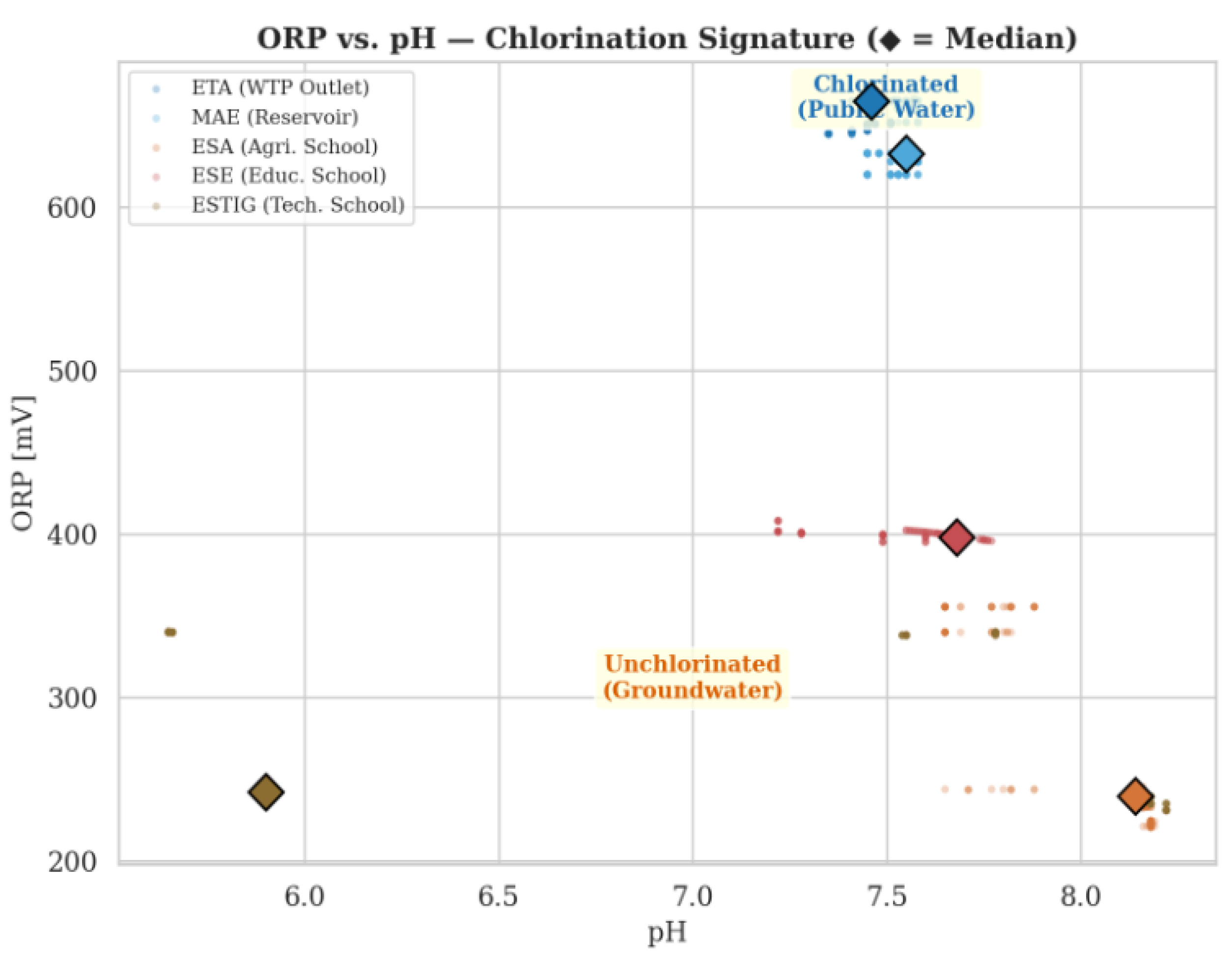
Figure 2.
Spearman correlation matrices for treated municipal water (group A) and groundwater (group B), showing the strength and direction of monotonic relationships among the monitored physicochemical parameters.
Figure 2.
Spearman correlation matrices for treated municipal water (group A) and groundwater (group B), showing the strength and direction of monotonic relationships among the monitored physicochemical parameters.
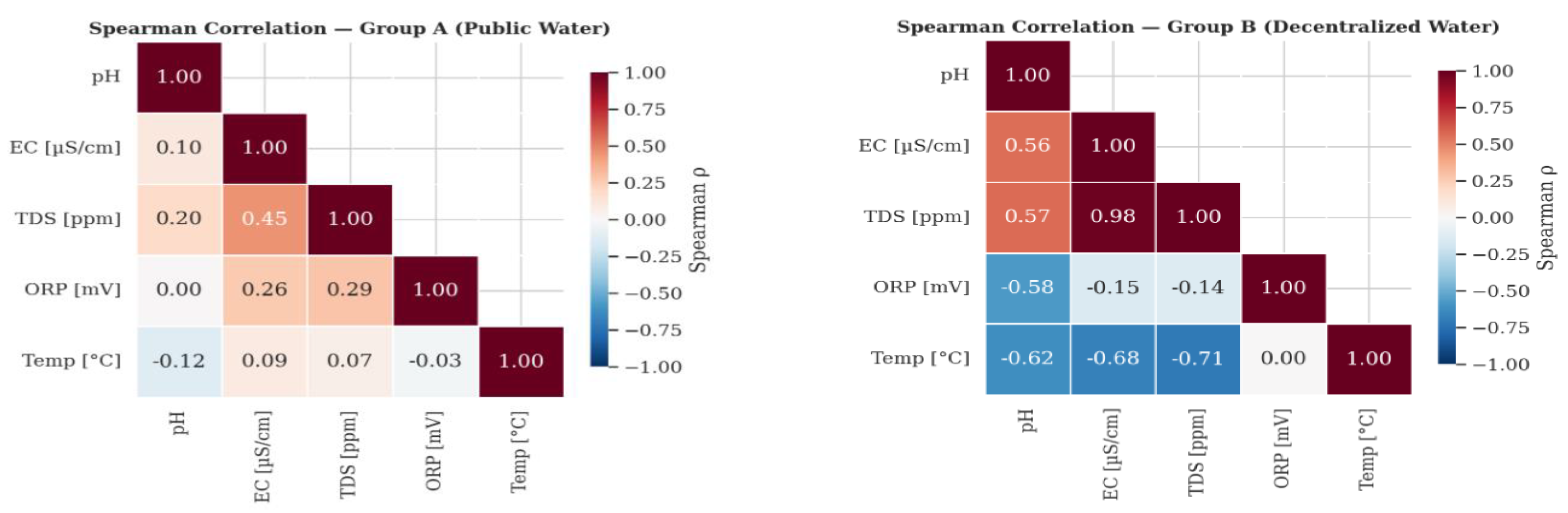
Figure 3.
Violin plots of (1) pH, (2) EC, (3) TDS, and (4) ORP by sampling point, showing the broader distributions and greater heterogeneity of groundwater relative to treated municipal water.
Figure 3.
Violin plots of (1) pH, (2) EC, (3) TDS, and (4) ORP by sampling point, showing the broader distributions and greater heterogeneity of groundwater relative to treated municipal water.
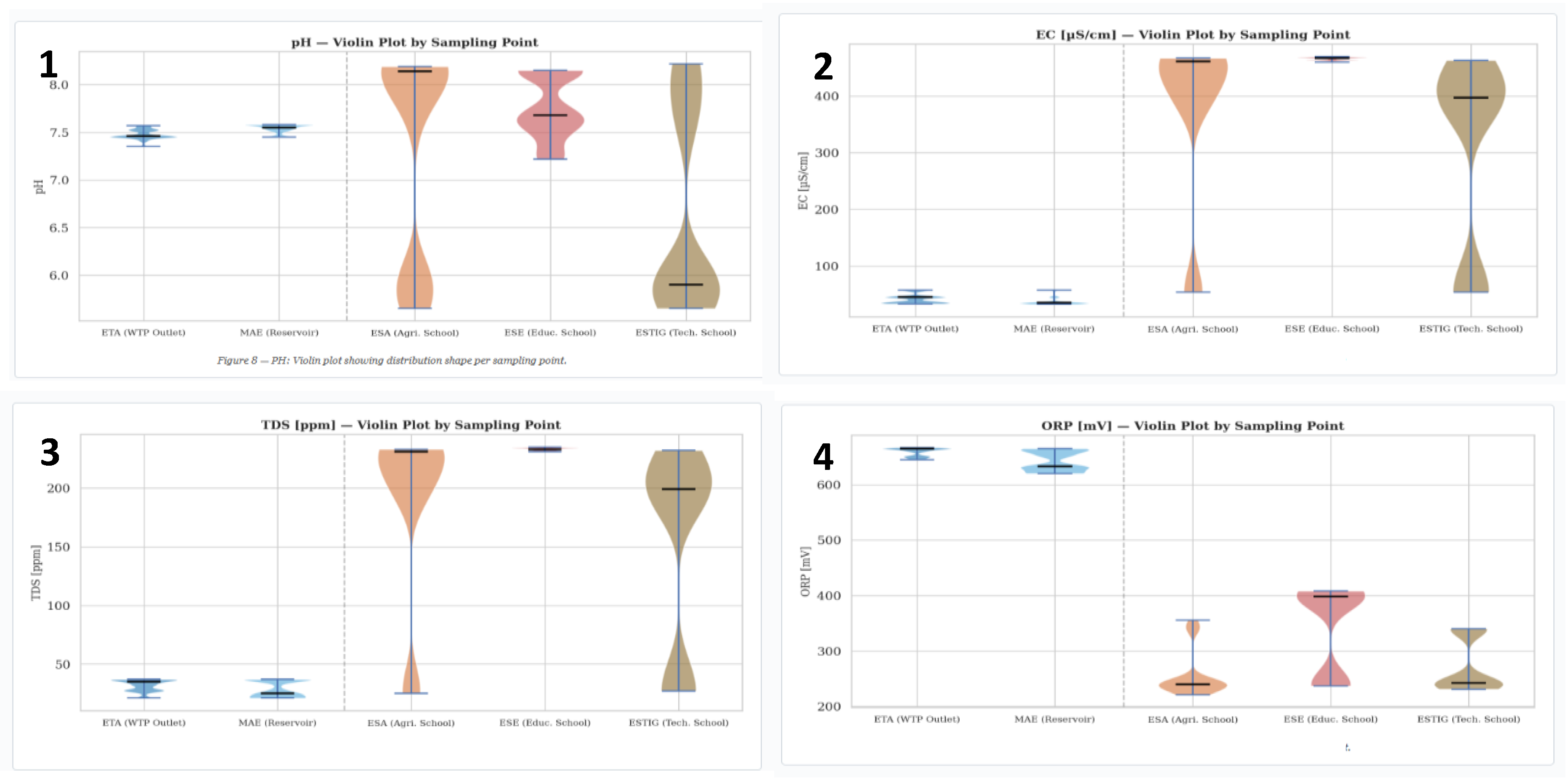
Figure 4.
Median values of pH, EC, ORP and TDS by campaign and sampling point, showing the lower inter-campaign variability of treated water and the greater temporal fluctuation of groundwater.
Figure 4.
Median values of pH, EC, ORP and TDS by campaign and sampling point, showing the lower inter-campaign variability of treated water and the greater temporal fluctuation of groundwater.
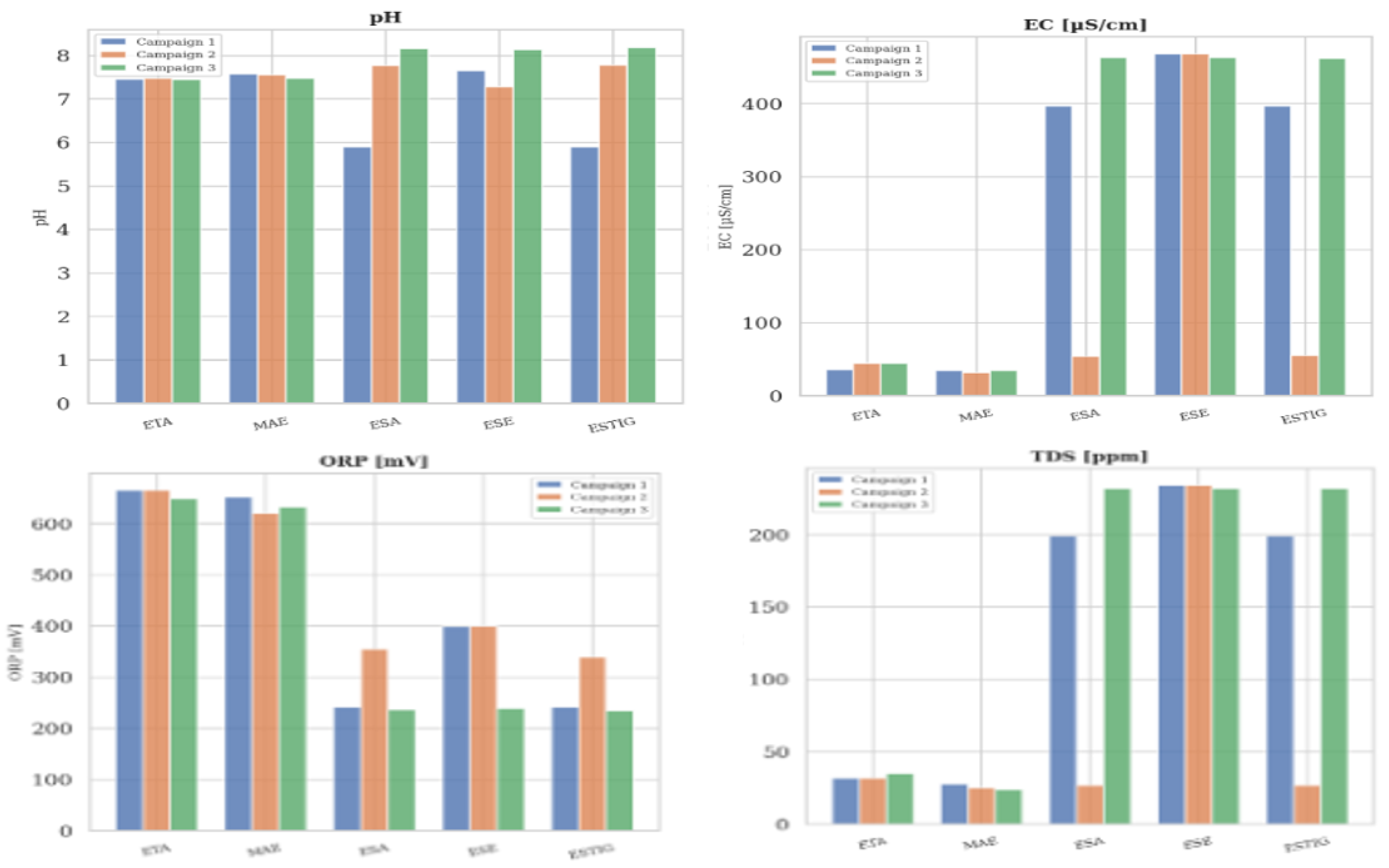
Table 1.
Characterization of the sampling points included in the study.
| Code | Sampling Point | Supply Type | Water Source | Description |
| ETA | Water treatment plant outlet | Public supply | Treated surface water | Outlet of the water treatment plant |
| MAE | Distribution reservoir | Public supply | Treated surface water | Post-treatment distribution reservoir |
| ESA | School of Agriculture | Decentralized supply | Groundwater | Indoor sampling point |
| ESE | School of Education | Decentralized supply | Groundwater | Indoor sampling point |
| ESTIG | School of Technology and Management | Decentralized supply | Groundwater | Indoor sampling point |
Disclaimer/Publisher’s Note: The statements, opinions and data contained in all publications are solely those of the individual author(s) and contributor(s) and not of MDPI and/or the editor(s). MDPI and/or the editor(s) disclaim responsibility for any injury to people or property resulting from any ideas, methods, instructions or products referred to in the content. |
© 2026 by the authors. Licensee MDPI, Basel, Switzerland. This article is an open access article distributed under the terms and conditions of the Creative Commons Attribution (CC BY) license.
Copyright: This open access article is published under a Creative Commons CC BY 4.0 license, which permit the free download, distribution, and reuse, provided that the author and preprint are cited in any reuse.


