

Submitted:
10 April 2026
Posted:
14 April 2026
You are already at the latest version
Abstract
Background/Objectives: Vaccination is a critical public health intervention, yet its global implementation is hindered by high production costs and cold-chain requirements. This review aims to evaluate plant-based systems as sustainable, cost-efficient alternatives for vaccine production. Methods: A comprehensive literature search was conducted across major databases (PubMed, Scopus, Web of Science). The peer-reviewed references were critically assessed, focusing on molecular expression strategies, phytochemical immunomodulators, and plant-mediated oral delivery. Results: Plant and microalgae systems effectively support nuclear, chloroplast, and transient expression of diverse antigens. Furthermore, specific plant-derived compounds were found to act as potent adjuvants and immunostimulants, enhancing the immunogenicity of vaccine formulations. Edible plant tissues also provide a viable platform for oral delivery, reducing the need for extensive purification and refrigerated logistics. Conclusions: Integrating recombinant expression technologies with bioactive plant metabolites offers a flexible and scalable foundation for next-generation vaccines. These biological platforms are uniquely positioned to address global immunization challenges, particularly in low-resource settings.
Keywords:
plant-based vaccines
; recombinant antigens
; microalgae
; phytochemical adjuvants
; oral vaccine delivery
; immunostimulants
; phytocompounds
1. Introduction
Vaccination has long served as one of the most effective public-health interventions, limiting the spread of infectious diseases and, in some regions, contributing to their eradication [1]. Despite their proven value, several practical constraints continue to restrict broader implementation. Key challenges include the identification of appropriate antigenic targets, the development of cost-efficient production systems, and the establishment of accessible delivery formats [2,3]. Oral immunization offers potential solutions to several of these barriers. By eliminating the need for injections, oral formulations reduce dependence on trained medical personnel and diminish the requirement for highly purified material [4,5]. Needle-free administration [4] also improves acceptability, particularly among children, and can enhance vaccine accessibility in low-resource settings by reducing reliance on cold-chain infrastructure. These factors collectively support improved compliance across diverse populations. The success of the oral polio vaccine illustrates the feasibility of large-scale oral immunization [6]. Nevertheless, most contemporary vaccine candidates remain injectable [7], largely due to unresolved technical obstacles associated with oral delivery. Effective oral vaccines must withstand degradation in the gastrointestinal tract, necessitating substantially higher antigen quantities than parenteral formulations. As a result, production demands and raw-material costs increase dramatically, highlighting the difficulty of achieving both low cost and high volume. These constraints become even more pronounced when recombinant DNA technologies are used to generate subunit vaccines [8]. Although subunit antigens offer strong safety profiles, their expression outside the native pathogen can be inefficient. Mammalian cell cultures provide appropriate post-translational modifications but are prohibitively expensive for the large-scale output required for oral delivery [9]. Transgenic animals have been explored as an alternative, particularly through expression in milk, but significant practical and regulatory challenges remain unresolved [10].
Plant-based expression systems have emerged as promising recombinant biofactories for producing therapeutic proteins and vaccine antigens [11]. Plants provide several advantages: the capacity for eukaryotic post-translational modifications, rapid scalability, low production costs, and minimal risk of contamination with human pathogens. When edible plant tissues are used as delivery vehicles, purification steps may be reduced or eliminated, enabling oral administration in a safe and palatable form [12]. Grain crops offer additional benefits through ambient-temperature stability, potentially removing cold-chain requirements. Moreover, plants can accommodate the simultaneous expression of multiple transgenes, enabling multivalent vaccine formulations within a single product [12]. These features collectively position plant-based systems as attractive platforms for developing oral vaccines with improved accessibility and reduced manufacturing constraints. Plant-based expression platforms have demonstrated the capacity to generate a wide range of subunit vaccine antigens. Multiple expression strategies, spanning nuclear, chloroplast, and transient systems, have been employed to produce diverse vaccine candidates. Numerous plant-derived subunit antigens have been purified and shown to induce measurable immune responses following parenteral administration in animal models. In addition to purified formulations, several vaccine candidates have been delivered orally in unprocessed plant tissues used as food or feed, where orally ingested plant material has been shown to stimulate immune responses and, in some instances, provide protective effects [12].
Beyond plant-derived vaccine platforms, progress across the wider biomedical landscape further contextualizes the technological and conceptual advances driving current therapeutic innovation. In fact, biomedicine continues to progress on multiple fronts, among them the creation of supramolecular systems like metallogels designed for therapeutic use [13], as well as ongoing investigations of natural compounds in the context of neurodegenerative disorders [14]. Further advances have been achieved in clarifying the mechanisms of intracellular parasitic and viral diseases and assessing their impact [15,16], along with advances in precision therapies driven by bioactive molecules, multi-omics approaches, and drug-repurposing frameworks [17]. Moreover, recent research has advanced our understanding of protein folding in disease [18], and enabled the design of new anti-infective scaffolds [19,20,21]. These developments are supported by progress in biomacromolecular dynamics [22,23,24,25,26,27,28,29,30,31], computer-assisted biological analysis [32,33], and nature-inspired agents targeting disease-related proteins [34,35], highlighting the broad innovation shaping modern biomedical science. These advances further involve the valorization of agri-food residues for the creation of functional products [36,37,38,39,40,41,42,43,44,45,46], as well as advances in analytical-chemistry techniques [47,48]. Together, these areas delineate the scientific and technological foundations examined in this comprehensive review, which surveys plant-based vaccine production alongside emerging biomedical strategies that could contribute to reshape modern immunoprophylaxis, including the use of plant-derived compounds with intrinsic immunostimulatory or adjuvant properties.
2. Plant-Based Expression Platforms for Recombinant Vaccine Antigen Production
This section highlights the expanding role of plant-derived platforms in next-generation vaccine development, encompassing antigen production, immune-enhancing molecules, and innovative delivery strategies, as detailed in the following subsections.
2.1. Plant-Based Vaccines: Plants as Biofactories and Cellular Platforms for Antigen Production
Plant expression systems demonstrate substantial potential as scalable, cost-efficient biofactories capable of producing recombinant vaccine antigens with appropriate post-translational modifications.
2.1.1. Genetic Transformation and Vector Systems
Antigen production begins with the introduction of a gene of interest into the plant cell, typically with two main mechanisms. In stable (transgenic) systems, the antigen gene is permanently integrated into the plant’s nuclear or plastid genome. In this system, it takes months to years to select viable transgenic lines and grow complete plants from tissue culture. However, once established, it produces a consistent expression of the antigen throughout all the plant tissues. It can be propagated by seeds, and successive generations maintain antigen production [49,50]. Chloroplast transformation offers a high-yield alternative to nuclear integration. Because each plant cell contains hundreds to thousands of chloroplasts, and each chloroplast contains multiple copies of its genome, the gene copy number can reach up to 10,000 per cell [51]. This over-expression can lead to antigen accumulation levels exceeding 70% of the leaf’s total soluble protein [52]. Furthermore, plastid transformation is associated with increased biosafety because chloroplasts are mostly maternally inherited, and the transgene is not present in pollen, thereby decreasing the risk of gene flow for non-target crops [53]. However, unlike nuclear transformation, plastids do not support mammalian-like N-glycosylation and are therefore best suited to non-glycosylated antigens or oral bioencapsulated formats [54]. The second mechanism, transient expression, delivers the antigen gene into plant cells without chromosomal integration and permanent changes in the host genome [55]. In transient expression, plant cells can be programmed to produce the target protein within a matter of days, making it excellent for responding to emerging health threats [56]. Nicotiana benthamiana is widely used for transient expression because it is highly susceptible to Agrobacterium and viral replicons. The agroinfiltration method uses Agrobacterium tumefaciens bacteria as a delivery vehicle to introduce genes into plant cells [57]. The gene of interest is cloned into a binary vector within the bacterium’s Ti plasmid [58]. Syringe infiltration is simple and flexible, and allows for the infiltration of one or multiple constructs on the same leaf. Vacuum infiltration involves submerging whole plants in Agrobacterium solution under vacuum so the intercellular air is replaced by the suspension. However, this method is more technically complex but enables very large-scale batches [59]. Once the infiltration is complete, the bacteria transfer their T-DNA into the plant cell nuclei. The transferred DNA remains episomal rather than integrating into the host chromosome, and transiently expresses over several days before it is gradually diluted as cells divide [60]. In another method using viral vectors, genes encoding viral movement, coat protein synthesis, and other potentially harmful structures are removed, and the transgene encoding the vaccine antigen is inserted. Commonly used plant virus vectors include Tobacco mosaic virus (TMV), Cowpea mosaic virus (CPMV), and Potato virus X (PVX) [61]. This method results in high-level protein accumulation and minimizes biosafety risks associated with infectious agents [62].
2.1.2. Transcriptional and Translational Control
At the transcriptional level, strong plant promoters lead to high mRNA production. Constitutive promoters such as the Cauliflower mosaic virus (CaMV) 35S promoter, a widely used viral promoter, or the ubiquitin promoter are commonly used to achieve this goal [63]. However, these cause mRNA production in all tissues, whereas tissue-specific or inducible promoters are valuable when spatial and temporal control is needed. For example, a fruit-specific promoter was used to restrict expression of an oral vaccine antigen against enterotoxigenic Escherichia coli (ETEC) to tomato fruits, while seed-specific promoters enabled the accumulation of antigens targeting pathogens such as hepatitis B virus (HBV) and cholera toxin in rice grains for oral vaccine prototypes [64,65]. Inducible promoter systems triggered by chemicals, stress, or light enable antigen expression at a desired time [66]. In addition, regulatory genetic elements from plant viruses can increase transcription and mRNA levels [67]. At the translational stage, optimizing codon usage and mRNA stability are important for maximizing antigen yield. Genes derived from humans or pathogens often contain codons that are less preferred by plants, which can lead to ribosomal stalling and translational pauses [68]. To prevent this, the coding sequences of vaccine antigens are typically codon-optimized, and rare codons are replaced with synonymous “preferred” codons that match the plant’s most abundant tRNAs [69]. Furthermore, engineered non-coding regions can improve translation efficiency; for example, the inclusion of potent 5′ UTR leaders from highly expressed genes, such as the Tobacco mosaic virus Ω sequence, and appropriate 3′ UTRs can improve ribosome recruitment and mRNA stability. Additionally, plants can recognize introduced transgenes and produce small interfering RNAs that suppress mRNA accumulation. This effect can be minimized by co-expressing viral silencing suppressor proteins, such as tombusvirus P19 or potyvirus HC-Pro, alongside the antigen gene [70]. For example, influenza vaccine antigens have been produced in Nicotiana benthamiana using transient expression systems that contain silencing suppressors. In one study, co-expression with P19 supported high-level accumulation of H7 hemagglutinin, with peak expression detected at 6 days post-infiltration, and the purified protein maintained hemagglutination and hemagglutination-inhibition activity [71]. More generally, launch-vector systems that include silencing-suppression strategies have been used to rapidly produce high levels of influenza antigens in plants [72].
2.1.3. Glycoengineering and Humanized Glycosylation in Plant Systems
The conserved N-glycan core (Man3GlcNAc2) is shared across eukaryotes. However, plant-specific modifications include the addition of β-1,2-linked xylose and core α-1,3-linked fucose, which are absent in humans, are potentially immunogenic, and may lead to the formation of anti-plant glycan antibodies [73]. Conversely, human glycans are characterized by the addition of α-1,6-linked fucose and terminal extensions such as β-1,4-linked galactose and N-acetylneuraminic acid (sialic acid), which are not naturally synthesized by plants. The primary step in humanizing plant glycosylation is the knockout or downregulation of the endogenous β-1,2-xylosyltransferase and α-1,3-fucosyltransferase genes [74]. Using methods such as CRISPR/Cas9, RNAi, or gene targeting via homologous recombination, this has been successfully done in a number of plant systems, including Nicotiana benthamiana and the moss Physcomitrella patens [75,76]. Furthermore, achieving full humanization requires the terminal addition of sialic acid, which is achieved by expressing mammalian glycosyltransferases (e.g., β-1,4-galactosyltransferase) and installing a multi-gene pathway that enables Neu5Ac biosynthesis, activation to CMP-Neu5Ac, Golgi transport, and transfer to terminal galactose [77,78].
Practical examples of glycoengineered plant systems include HIV-1 gp120/gp140 produced in Nicotiana benthamiana, which carry human-like complex N-glycans with terminal sialylation and keep binding to CD4 and neutralizing antibodies [79]. Furthermore, monoclonal antibodies produced in plants with engineered glycosylation pathways display terminal galactosylation and sialylation while retaining antigen binding and Fc-mediated activity [78]. Likewise, recombinant human erythropoietin produced in glycoengineered plants shows sialylated glycoforms with improved circulatory stability[80].
2.1.4. Subcellular Targeting and Protein Folding
The intracellular destination of a recombinant antigen in plant cells dramatically improves its stability and assembly. Adding an N-terminal signal peptide to the gene directs the antigen to the secretory pathway and guides the nascent protein into the endoplasmic reticulum (ER), where it is cleaved off, and the protein can fold with the assistance of ER chaperones and oxidizing conditions, such as disulfide bond formation [81]. The protein then enters the Golgi apparatus and can be secreted to the apoplast unless an ER-retention signal is used. Targeting recombinant proteins to the ER/Golgi has promoted correct tertiary/quaternary folding and enables post-translational modifications such as N-glycosylation that are often essential for antigen function or immunogenicity [82]. However, if the proteins are secreted to the apoplast, the abundance of endogenous proteases can degrade them. To prevent this, a common tactic is to include a C-terminal ER-retention motif (such as KDEL) on the antigen, which causes it to be retained in the ER [83]. Another option is targeting the vacuole or other storage organelles. There are different kinds of plant vacuoles. In leaves, they are usually lytic and have active degradative enzymes, which are less ideal for sensitive proteins, whereas in seeds, they commonly function as protein storage vacuoles and can keep proteins in a stable, inert environment [84]. Notably, the first FDA-approved plant-derived pharmaceutical, taliglucerase alfa, used for Gaucher disease, was produced in carrot cells by targeting the enzyme to vacuoles, where plant-specific mannosidase activity generated the desired terminal mannose glycan on the enzyme [85]. For vaccine antigens that do not require glycosylation, chloroplasts, thanks to the organelle’s high genome copy number and protein-synthesis capacity, can yield greater amounts and retain immunogenicity [86].
2.1.5. Virus-like Particles (VLPs)
These particles are composed of viral structural proteins that mimic the size and shape of a real virus but lack the genetic material required for replication. Their production approaches can be divided into non-enveloped capsid VLPs (e.g., HPV L1, norovirus VP1) and enveloped VLPs that have a lipid bilayer derived from the host cell membrane. (e.g., influenza HA VLPs; SARS-CoV-2 spike-displaying CoVLP) [87]. Interestingly, plants can produce chimeric particles where a foreign antigen is displayed on the surface of a carrier VLP, such as the Hepatitis B core antigen (HBcAg) on the Cowpea mosaic virus (CPMV) [88]. The assembly process is directed by the spontaneous interactions along with the polymerization of expressed proteins within the ER or cytoplasm, depending on the targeting signals used [87]. The structure of VLPs (typically 20–300 nm in diameter) is ideal for recognition by antigen-presenting cells (APCs), particularly dendritic cells [89]. The repetitive display of epitopes on the VLP surface can also directly cross-link B-cell receptors and result in high antibody titers and long-lasting B-cell memory [90]. Furthermore, VLPs are efficiently processed for presentation to both MHC class I and class II molecules and elicit robust cytotoxic T-lymphocyte responses [91]. In addition to structural benefits, plant-derived VLPs have shown immunogenicity and protective efficacy. For example, SARS-CoV-2 VLP vaccines developed in Nicotiana benthamiana (e.g., Medicago CoVLP) have reached clinical trials and induced neutralizing antibody titers and antigen-specific IgG responses, along with balanced cellular immunity represented by both Th1 (IFN-γ) and Th2 (IL-4) responses. Also, clinical studies have indicated protection against symptomatic infection and severe disease, which supports their safety and efficacy in humans [92,93].
Similarly, plant-derived influenza VLPs expressing hemagglutinin (HA) have been shown to trigger high levels of neutralizing antibodies, as measured by hemagglutination inhibition assays, alongside the activation of both CD4+ and CD8+ T-cell responses. In animal challenge models, these vaccines reduced viral loads, lightened weight loss, and improved survival rates, confirming their protective efficacy. Chimeric VLP platforms, particularly those based on hepatitis B core antigen (HBcAg), can also present heterologous epitopes and stimulate humoral immune responses [94].
2.1.6. Downstream Processing and Purification Strategies
Downstream processing (DSP) is the major economic bottleneck in the plant-made vaccines production and can account for 80% or more of total manufacturing costs [95]. Leaf tissues contain impurities, including phenolics, pigments, proteases, lipids, polysaccharides, and nucleic acids, which make purification difficult and result in reduced yields and increased costs [70]. As a result, upstream pathways must be designed in a DSP-compatible antigen format, including subcellular targeting, secretion, and glycoengineering [96]. In whole-plant extraction, leaves are harvested and subsequently disrupted, either mechanically or enzymatically, before proceeding through the downstream purification steps to clarify the extract. For example, Covifenz production includes enzyme-assisted extraction, low pH treatment, coarse filtration, centrifugation, depth filtration, and microfiltration prior to chromatography [97]. In contrast, plant cell suspension cultures are more consistent at the start of the process [98]. When recombinant proteins are released into the culture medium, they are easier to collect, and downstream processing costs are lower [99]. Due to high solids and impurities that clog filters and resins, clarification in plant systems is challenging [100]. Early steps must minimize oxidative browning from phenolics and prevent protein breakdown [97]. After clarification, purification proceeds through capture (usually ion exchange), polishing (removal of aggregates, host cell proteins, and DNA), and buffer exchange (ultrafiltration/diafiltration) [101]. Affinity tags are helpful during development, but if they need to be removed, they can complicate large-scale production [96]. Additionally, some plants require customized DSP due to plant-specific contaminants, such as nicotine in Nicotiana species [97]. Safety strategies against viruses differ from those against mammal materials. Some plant-based VLPs do not meet the usual standards for virus clearance. Instead, controlling raw materials, monitoring the environment, and conducting extensive testing ensure safety [89]. Overall, plant DSP needs process engineering that accounts for impurities and an integrated upstream-downstream design to achieve maximum safety [102]. An overview of representative plant-based vaccine platforms and their development status is presented in Table 1.
Among the various plant-derived antigens evaluated to date, the cholera toxin B subunit (CTB, Table 1) represents a leading example, with the MucoRice-CTB platform demonstrating clinically validated oral delivery and highlighting the unique advantages of seed-based expression systems.
2.2. Microalgae-Derived Vaccines
Although microalgae share fundamental biological characteristics with plant-based vaccine platforms, they have significant differences. First, cultivation is inherently bioreactor or pond-based, which allows for physical containment, batch-to-batch control, and quick scale modulation without the planting and harvesting logistics that come with whole plants. The study on the Chlamydomonas CTB-D2 vaccine specifically used confined Wave Bioreactor cultivation to grow biomass for oral administration [120]. Second, microalgae support a spectrum of production modes, including photoautotrophic growth (light-driven CO2 fixation with minimal external carbon inputs), mixotrophy (simultaneous use of light and organic carbon sources), and, in some cases, heterotrophic/fermentation-style growth (light-independent cultivation using organic substrates in closed bioreactors). For Chlamydomonas reinhardtii, fermentation-compatible biomass productivities were explored in the context of commercial feasibility for recombinant antigens [121]. Third, microalgal cells can function simultaneously as a manufacturing chassis and an oral delivery matrix. Freeze-dried biomass can protect antigens during storage and partially through gastric transit (bioencapsulation) [120,122]. Fourth, post-translational modifications (PTMs) diverge from both higher plants and mammalian cells. Eukaryotic microalgae can install N-glycans, but the structures are often non-canonical (e.g., methylation and plant-like core xylose/fucose features in Chlamydomonas), and chloroplast-expressed proteins (such as in many proof-of-concept oral vaccines) are typically non-glycosylated [123]. This makes antigen selection and compartment targeting unusually consequential for clinical translation.
2.2.1. Nuclear vs Chloroplast Expression in Microalgae
In Chlamydomonas, chloroplast expression has been repeatedly used for oral vaccine prototypes because it offers stable integration and high accumulation of properly folded, disulfide-rich proteins for antigens that do not require N-glycosylation. For example, fusion antigens such as CTB-VP1, consisting of the cholera toxin B subunit fused to the VP1 capsid protein of foot-and-mouth disease virus [124], and CTB-D2, in which CTB is fused to the D2 domain of the E. coli heat-labile enterotoxin [120], are two well-known examples of chloroplast engineering that enabled stable expression suitable for whole-cell oral delivery. However, chloroplast expression can be incompatible with glycosylated antigens and can introduce antigen processing. In Berndt et al. (2021), a chloroplast-localized RBD fusion was truncated and not recognized as intended, whereas ER-retained or secreted versions accumulated intact and were functional in binding assays with the SARS-CoV-2 cell receptor, angiotensin-converting enzyme 2 (ACE2) [121]. This illustrates compartment choice, chloroplasts for the yield/stability of aglycosylated targets, and secretory routing for glycoproteins and receptor-binding authenticity. In Nannochloropsis, the principal high-yield demonstration for a vaccine antigen, VP2, the major capsid protein of Infectious Bursal Disease Virus (IBDV), was achieved through nuclear expression [125], and efficient nuclear promoter architectures have been shown to bridge the gap between chloroplast and nuclear expression yields in some algae.
2.2.2. Transient/Viral-Vector and Episomal Systems
Microalgal transient expression has advanced via plant-virus-derived replicons adapted to microalgae. The “Algevir” geminiviral vector concept was introduced as an inducible Rep-mediated replication system enabling high-level expression of antigenic proteins in microalgae, including Zaire ebolavirus GP1 and the B subunit of heat-labile E. coli enterotoxin (LT-B), both retaining antigenic activity [126]. Furthermore, limitations, especially associated with Agrobacterium tumefaciens-mediated transformation, particularly the risk of residual bacterial contamination that may compromise oral formulations, have motivated the development of viral-vector approaches to avoid bacterial carryover. Episomal tools are also increasingly relevant, especially for enabling editing without leaving selectable markers or other foreign DNA permanently integrated in the host genome, or for reversible expression. For instance, episomal CRISPR systems have been reported in Nannochloropsis [127], and a more recent base-editing approach uses an episomal vector backbone (centromere + autonomous replication sequence) in N. oceanica to enable subsequent plasmid loss after editing [128].
2.2.3. Promoters, UTRs, and Selectable Markers
Microalgae vaccines often encode the regulatory architecture of transgene expression in UTRs and endogenous regulatory elements, rather than relying on the classic plant promoter framework [129]. Examples include chloroplast expression using photosynthesis-gene UTRs (e.g., rbcL UTR control of CTB-D2 in Chlamydomonas chloroplasts [120]; and chloroplast integration of CTB-VP1 by biolistics [124]). Selectable markers in chloroplast systems frequently rely on antibiotic resistance cassettes such as aadA (spectinomycin/streptomycin) to enable selection of successfully transformed lines under antibiotic pressure [130]. At the nuclear level, promoter and leader selection can dominate yield by orders of magnitude across transformants. In N. oceanica, Rout et al. (2022) explicitly compared endogenous promoters using qPCR/flow cytometry and achieved the highest VP2 yields with the elongation factor promoter with enhancer effects from its N-terminal leader sequence. They also observed transformant-to-transformant production differences spanning orders of magnitude, with multiple vector integrations correlating with peak yields [125]. In Chlorella, an oral vaccine study targeting VP28, an envelope protein of White Spot Syndrome Virus (WSSV), used a codon-optimized cassette integrated via homologous recombination at the nitrate reductase locus and driven by a CaMV 35S promoter with a Chlamydomonas RbcS2 terminator, an example of cross-kingdom regulatory borrowing for practical expression [89].
2.2.4. Glycosylation and PTMs in Microalgae
For secreted/ER-routed antigens, microalgal N-glycosylation can determine antigen folding, receptor binding, and immunogenicity. In C. reinhardtii, studies show endogenous proteins carry predominantly oligomannosides (Man-2 to Man-5), with minor complex N-glycans that can be partially O-methylated and include xylose residues [131]. Subsequent work identifies multiple xylosyltransferases contributing to heterogeneous N-glycan xylosylation, including core β-(1,2)-xylose features and methylation, and genetic studies continue to map enzymes affecting core fucosylation and xylosylation (e.g., identification of candidate core xylosyltransferase XylT1B) [132]. Heterologous expression of GnTI has been used to probe and further explore microalgal N-glycosylation capacity [133]. From a vaccine development point of view, this means that antigens that are meant to mimic mammalian glycoepitopes may need to be targeted to the secretion pathway and have glycoengineering and analytics plans [129]. On the other hand, antigens whose protective epitopes are glycan-independent may be more effectively produced through chloroplast/cytosolic expression and oral bioencapsulation to make them stronger and less complicated [134].
2.2.5. Downstream Processing
As with plant-based vaccines, DSP also constitutes a significant economic bottleneck in microalgal vaccine production [135]. A key challenge specific to microalgae is the presence of a rigid, cellulose-rich cell wall, which necessitates efficient disruption methods to release intracellularly produced vaccine antigens [136,137].
The first step in DSP is harvesting microalgal biomass from dilute cultures. Once harvested, the rigid cell wall of microalgae must be disrupted to release intracellularly produced vaccine antigens. High-pressure homogenization (HPH) is particularly suitable for large-scale operations, forcing cell suspensions through a narrow orifice at high pressure to generate shear forces that rupture the cell wall. Ultrasonication, on the other hand, utilizes acoustic cavitation to fragment the cell membrane [138]. Studies have shown that HPH can have a disruption rate constant approximately seven times higher than that of ultrasonication, making it the preferred choice for high-volume commercial production [139]. In addition to common impurities such as host cell proteins (HCPs) and DNA, microalgal extracts contain high levels of pigments (e.g., chlorophyll and carotenoids) and polysaccharides, which can complicate downstream purification. Therefore, additional clarification and purification steps are often required [140].
The actual purification of the recombinant antigen typically involves a combination of filtration and chromatography. Size-exclusion chromatography (SEC) and anion-exchange chromatography (AEC) are frequently used to remove process-related impurities, such as host cell proteins (HCPs) and DNA [141]. Emerging technologies, such as steric exclusion chromatography (SXC) using low-cost stationary phases, such as cellulose, have demonstrated the ability to capture virus-like particles with recoveries exceeding 95% [142]. Given the increasing interest in microalgae as platforms for recombinant protein and VLP production, similar purification strategies may be applicable to microalgal systems, although their application in this context remains to be investigated [143].
The stability of the final product is highly sensitive to temperature and drying methods. While antigens are stable at -80 °C, significant degradation can occur at room temperature [144]. Spray drying is a common industrial method for producing consistent powders, but the high temperatures involved can degrade sensitive vaccine components [145]. Lyophilization (freeze-drying) remains the gold standard for preserving antigen structural integrity and bioactivity over long-term storage [146].
3. Plant-Derived Compounds as Vaccine Adjuvants
Plant-derived compounds represent a structurally diverse and biologically active reservoir of molecules with significant immunomodulatory potential. Beyond their traditional roles in phytotherapy and natural product research, many of these metabolites are now being investigated as functional components in modern vaccine formulations. Their ability to engage innate immune pathways and modulate adaptive responses provides a mechanistic foundation for their consideration as next-generation adjuvants.
3.1. Introduction and Immunological Rationale
Adjuvants are immunologically active components that increase vaccine efficacy by enhancing, directing, and stabilizing the immune response induced by the antigen [147]. In many recombinant vaccines, the antigen alone is insufficient to activate innate immunity and induce germinal centers, affinity maturation, and durable B and T cell memory; many modern adjuvants act by engaging innate sensors, such as pattern recognition receptors (PRRs), and by shaping local inflammation and antigen trafficking [148].
They optimize antigen transport to draining lymph nodes, increase uptake by APCs, and directly activate innate sensors such as Toll-like receptors (TLRs), C-type lectin receptors (CLRs), and NOD-like receptors (NLRs) [149].
Additionally, they create a controlled local inflammatory microenvironment at the administration site through chemokine/cytokine production, which promotes recruitment and maturation of dendritic cells and monocytes and improves antigen presentation to T lymphocytes [150]. This multi-mechanistic view corresponds with modern conceptual frameworks regarding adjuvant biology and explains why formulation, rather than the adjuvant molecule alone, often determines immune outcomes.
Plant-derived compounds are of particular interest as a reservoir for next-generation adjuvants due to the high phytochemical diversity and the possibility of structural engineering [147]. Some phytochemicals are suited for needle-free vaccines because they can navigate the body’s mucosal barriers using lectins to target M-cells or interact directly with the epithelium, making them effective for intranasal or oral immunization [151].
In general, to understand the efficacy of plant-derived adjuvants, we must look beyond their chemical structures and focus on the specific immune programs they initiate.
This outcome-oriented framework classifies phytochemical adjuvants into five functional categories: PRR agonists that activate innate sensors, membrane-active enhancers that facilitate cytosolic access to antigens, depot-forming scaffolds that enhance antigen retention, mucosal targeting molecules that bypass epithelial barriers, and immunometabolic modulators that regulate inflammation via metabolic signaling [[147]. This classification clarifies how different phytochemical adjuvants shape immune outcomes, indicating whether a vaccine raises antibody levels alone or also provides cellular and barrier protection, both of which are crucial for long-term immunity.
3.2. Major Classes of Phytochemical Adjuvants
The phytochemical adjuvants used in vaccines can be broadly categorized into distinct structural and functional groups based on their immunological mechanisms and structural properties (Figure 1). The following subsections outline the principal classes and summarize their roles in contemporary vaccine design.
3.2.1. Saponins, Membrane-Active Enhancers
Saponins are amphiphilic glycosides composed of a hydrophobic aglycone (typically steroidal or triterpenoid) linked to hydrophilic sugar chains. This amphiphilic nature allows saponins to interact with cell membranes and facilitate the translocation of antigens into the cytosol, a process essential for the cross-presentation of antigens to CD8+ T cells. The most important example is QS-21 (purified from Quillaja saponaria, Figure 1), which forms the core of several modern adjuvant systems [[153]. QS-21, when combined with PRR agonists such as MPL, can generate a rapid innate signature characterized by cytokine production and recruitment of innate effector cells in draining lymph nodes, with an early IFN-γ signal in the lymph nodes serving as a hallmark of the early response. Mechanistically, QS-21 has been linked in multiple models to activation of inflammasome pathways, especially NLRP3, with increased IL-1β/IL-18, although the magnitude of this effect can depend on dose, cell type, and the presence of TLR priming [[154].
A key scientific variation is that QS-21 at higher concentrations can induce cell death, and some of this toxicity can be independent of NLRP3; cholesterol-containing contexts can modulate survival and help separate adjuvant activity from toxicity. To lower these risks, QS-21 is stabilized in lipid-based structures, such as liposomes or cholesterol-bound ISCOM-like assemblies [[155].
QS-21 is the core component of the AS01 adjuvant system, which is utilized in high-efficacy licensed vaccines such as Shingrix (Herpes zoster), Mosquirix (Malaria), and Arexvy (respiratory syncytial virus)[[156] . The AS01 system is a liposomal formulation that combines 50 μg of QS-21 with 50 μg of monophosphoryl lipid A (MPL), a TLR4 agonist, per 0.5 mL dose in the Shingrix vaccine. In Arexvy, the dosage is adjusted to 25 μg of each component [[157]. In addition, the spike ferritin nanoparticle (SpFN) vaccine against COVID-19 represents another QS-21–containing adjuvant system. This vaccine is formulated with Army Liposomal Formulation QS-21 (ALFQ), a liposomal adjuvant comprising QS-21 and a synthetic monophosphoryl lipid A analogue (3D-PHAD®, a TLR4 agonist). In this system, QS-21 improves antigen-specific immune responses, while the MPL analogue promotes innate immune activation via TLR4 signaling, and the liposomal formulation enhances antigen delivery and decreases systemic reactogenicity. Preclinical and early clinical studies have shown that this combination induces strong neutralizing antibody responses [158].
The cooperation between MPL and QS-21 is critical; MPL activates the innate immune system via the TRIF-dependent signaling pathway, while QS-21 triggers lysosomal destabilization and activates the tyrosine kinase SYK, leading to the assembly of the NLRP3 inflammasome and the subsequent release of pro-inflammatory cytokines such as IL-1β and IL-18.[[159] This combined activation induces a strong IFN-γ response in the draining lymph nodes, which is essential for driving a Th1-biased helper T-cell response and high-affinity antibody production [155].
Saponins are often combined into nanoparticle platforms to optimize delivery and minimize toxicity. The Matrix-M™ adjuvant, used in the Nuvaxovid COVID-19 and R21 malaria vaccines, consists of 40 nm nanoparticles formed by combining Quillaja saponins (fractions A and C) with cholesterol and phosphatidylcholine [160]. This configuration separates the saponin, removes its hemolytic activity, and preserves its ability to recruit dendritic cells (DCs) and support a balanced Th1/Th2 immune response [[161]. Likewise, Immunostimulating Complexes (ISCOMs) and ISCOMATRIX are cage-like assemblies that hold antigens with saponins and lipids [162]. Through co-delivery of antigen and adjuvant to an individual APC at the same time, these systems improve antigen processing and presentation through both the MHC I and MHC II pathways [163].
Despite its potency, the QS-21 supply chain is vulnerable because it relies on harvesting wild Quillaja saponaria bark, which raises environmental concerns. QS-21 is also chemically unstable due to its two hydrolytically sensitive ester moieties, which may complicate long-term storage and formulation [164].
Moreover, in comparative terms, aluminum salts (alum) are the most widely used adjuvants because of their long safety record, low cost, and strong ability to amplify antibody responses [165]. However, alum is often biased toward Th2-skewed humoral immunity and is comparatively limited in driving robust Th1 responses, potent Tfh/GC programs, and CD8+ T-cell priming, features that are frequently required for modern recombinant subunit vaccines and for pathogens where neutralizing antibodies alone are insufficient [166]. In contrast, QS-21-type saponins, especially when embedded in adjuvant systems (e.g., liposomes with complementary PRR agonists), are more effective at eliciting a Th1-prone signature and improve Tfh/GC activity and support cross-presentation-linked CD8 priming, even though they often increase reactogenicity and narrow formulation tolerability [167]. Thus, the advantage of QS-21 over alum is not a universal superiority, but rather a different immunological operating point, with stronger cellular/Th1/Tfh biology at the expense of greater formulation complexity and tighter safety/CMC constraints [168].
In addition, there are some eco-friendly alternatives from the seeds of Momordica cochinchinensis, a tropical plant common in Southeast Asia. Researchers have synthesized VSA-2 (C94H147NO42), a semi-synthetic derivative of Momordica saponin II, which contains an amide side chain at the C3 position of its trisaccharide domain. In preclinical models of SARS-CoV-2 subunit vaccines, VSA-2 induced higher neutralizing antibody titers and Th1-prone T-cell responses than QS-21 [[169].
Its chemical stability and scalable production make it a favorable candidate to replace Quillaja-derived saponins in future vaccine generations.
3.2.2. Polysaccharides, Depot-Forming Scaffolds and PRR Agonists
Plant-derived polysaccharides act as self-adjuvanting delivery vehicles, which provide a physical scaffold for the antigen while simultaneously engaging PRRs [170].
Advax™ is a highly characterized adjuvant derived from δ-inulin, a semi-crystalline β-D-(2-1)-polyfructose sourced from Dahlia tubers. Advax is unique among adjuvants because it does not appear to operate through traditional inflammatory danger signaling, such as the activation of the NLRP3 inflammasome; instead, its potency comes from behaving more like an immunological amplifier and delivery scaffold than a stand-alone inflammatory stimulus [171].
Mechanistically, δ-inulin microparticles (∼1–2 μm) are phagocytosed by macrophages and dendritic cells, which increase antigen capture and improve MHC-II presentation and cross-presentation. In clinical trials of Hepatitis B vaccines, people who received 5–10 mg doses of Advax showed higher seroprotection rates and antibody geometric mean titers (GMTs) compared to those who received the antigen alone. Advax has also been used in seasonal influenza vaccination for older people, where it increased plasmablast responses and IgG levels [172]. Recent research has evaluated the efficacy of Advax-CpG combinations for COVID-19 and influenza, suggesting improved immune responses and supporting their potential application in overcoming mucosal immune tolerance [173].
Polysaccharides from Astragalus membranaceus roots (APS) have been used since antiquity in traditional medicine to improve immunity [174] and are currently investigated as modern vaccine adjuvants. Mechanistically, APS primarily binds to TLR4 on macrophages and dendritic cells and forms a signaling cascade involving MyD88, TRAF6, and NF-κB. This activation causes the secretion of Th1-type cytokines such as IL-12 and IFN-γ, which drives the differentiation of CD4+T cells toward a protective phenotype [175,176].
Transcriptomic analyses of APS-adjuvanted vaccines show that APS improved the activation of germinal center (GC) B cells and T follicular helper (Tfh) cells, and provided a long-lasting immune protection [177].
In models of SARS-CoV-2 subunit vaccines, the combination of APS with traditional aluminum salts has shown strong synergy, enhancing IgG isotype switching and increasing antibody titers by 1.7-fold compared to alum alone [174]. While polysaccharides are safe and easy to work with, their clinical translation is limited because they are difficult to standardize and their mechanisms are not always clear across different preparations.
3.2.3. Flavonoids and Phenolics, Immunometabolic Modulators
Flavonoids and phenolics are plant metabolites known for their antioxidant and anti-inflammatory properties. Remarkably, some flavonoids, like apigenin and those derived from Epimedium, activate the immune system by mimicking signals for viral detection [178]. These compounds also engage TLR7/8, in addition to triggering the NF-κB pathway, which is the main switch for inflammation. This mechanism leads to dendritic cell maturation and increases the expression of co-stimulatory molecules like CD80 and CD86 [179].
Experimental data from murine models showed that purified EGCG (epigallocatechin gallate) from green tea offered a more compatible immune response than traditional aluminum adjuvants, which induced a more balanced Th1/Th2 response with reduced reactogenicity [180].
Apigenin has also been shown to modulate the PI3K/Akt/mTOR and MAPK/ERK signaling pathways, which are essential for controlling cancer cell proliferation and regulating the immune microenvironment [181]. Plant phenolics also serve as aromatic haptens, and due to their highly hydroxylated nature, they can interact non-covalently with proteins, and under oxidative conditions, may form covalent adducts. This interaction provides molecular rigidity to the antigen, avoiding premature degradation and enhancing its immunogenicity by presenting a more stable target for B-cell receptors [182].
The main challenge with flavonoids is that their effects are unpredictable. A compound that works as an anti-inflammatory antioxidant in a supplement could act as a pro-inflammatory adjuvant in a vaccine. This means one property does not guarantee the other. To use them in vaccines requires refined formulation strategies to overcome the inherent problem in solubility and systemic pharmacokinetics [183].
3.2.4. Terpenoids, Emulsion-Based Adjuvant Systems
Terpenoids, particularly the triterpene squalene (C30H50, Figure 1), are foundational to the development of oil-in-water (o/w) emulsion adjuvants. Systems such as MF59® and AS03 have been used in hundreds of millions of doses of pandemic and seasonal influenza vaccines, where they facilitate dose-sparing and broaden the immune response across different viral strains [184]. Emulsion adjuvants generally act in the immunocompetent environment of the injection site instead of a single receptor. MF59 triggers the local release of chemokines such as CCL2 and CXCL8, which recruit neutrophils, monocytes, and dendritic cells to the area. These cells capture the antigen and transport it to the draining lymph nodes for presentation to lymphocytes. AS03 also includes alpha-tocopherol (Vitamin E), which acts as an antioxidant and further increases the immune response, resulting in the generation of long-lived plasma cells [185].
Generally, oil-in-water emulsions such as MF59 and AS03 have a similar design logic. They work by altering the local immunocompetent environment at the injection site, which helps recruit innate cells and improve antigen acquisition and trafficking to draining lymph nodes, rather than functioning as single-receptor agonists [186]. However, they may vary in immune phenotype and reactogenicity due to compositional changes that alter the inflammatory and metabolic characteristics of early innate responses. MF59 is considered an APC recruiter with strong antibody enhancement and breadth [187].
As mentioned earlier, AS03 includes α-tocopherol in addition to the emulsion components, which can further modulate innate activation and immunometabolic pathways, often translating into stronger responses in settings such as dose-sparing or immunologically challenging populations [188]. These differences indicate a vital principle relevant to phytochemical adjuvants. Formulation-level systems biology often outweighs single-molecule identity in determining clinical immune outcomes [189].
In the past, squalene was mainly taken from shark liver oil, which threatens marine biodiversity and is inefficient; it takes between 2,500 and 3,000 sharks to produce just one ton of the product [190]. However, industry is transitioning toward more sustainable sources, such as plant-based or bioengineered squalene, to decrease environmental impact. For example, PhytoSquene®, derived from amaranth oil (Amaranthus caudatus), offers a non-animal-derived squalene that meets strict pharmaceutical quality standards [191]. Although PhytoSquene® itself is not yet used in licensed vaccines, plant-derived squalene is already employed in approved adjuvants such as MF59, as discussed above, which is used in licensed influenza vaccines such as Fluad® and Fluad Quadrivalent® [192]. Similarly, AS03 is utilized in pandemic influenza vaccines, including Pandemrix® and Arepanrix® [193].
3.2.5. Alkaloids, Cytosolic Delivery and Modulators
Tomatine (Figure 1) is a glycoalkaloid found in the stems and leaves of tomato (Solanum lycopersicum) plants, and has recently been investigated preclinically as an adjuvant component in nanoparticle and mRNA vaccine contexts. Recent studies on SARS-CoV-2 suggest that combining tomatine with lipid nanoparticle (LNP) formulations may enhance humoral and cellular responses. This approach can make mRNA more stable and facilitate cytosolic release [194].
Alkaloids such as berberine and piperine are recognized for their capacity to modulate key signaling pathways in cancer cells, such as mTOR, MAPK, and NF-κB. Berberine has shown synergistic effects when combined with classical cytostatic agents and may prevent tumor immune escape in colorectal and gastric cancers [195]. Piperine, derived from black pepper, enhances the bioavailability of many therapeutics and adjuvants by inhibiting hepatic metabolism and improving intestinal absorption [196]. In general, alum mostly induces Th2-type responses, which are relatively weak in stimulating cellular immunity. In contrast, these alkaloids offer various benefits, such as the capacity to modulate several intracellular signaling pathways, enhance the bioavailability of co-administered agents, and may induce more balanced immune responses, in addition to the largely Th2-biased effects associated with alum.
However, a major drawback of many alkaloids is their narrow therapeutic window. Because these compounds evolved as plant toxins to deter herbivores, the difference between a beneficial immune-enhancing dose and a toxic dose can be minimal.
3.2.6. Lectins, Mucosal Targeting Ligands
Lectins target mucosal surfaces and help antigens get to inductive sites more easily, and promote local secretory immunoglobulin A (sIgA) responses in addition to tissue-proximal immunity [197]. This localized recruitment is particularly critical for the success of needle-free immunization strategies, such as nasal or oral delivery, where overcoming the mucosal barrier is the fundamental challenge to achieving protective immunity.
ArtinM, a D-mannose-binding lectin derived from jackfruit seeds (Artocarpus integrifolia), can promote Th1-prone responses by interactions with glycosylated receptors and innate signaling modules in APCs. This interaction increases IL-12 production and strengthens the immune system more than other plant lectins [198]. However, its application is currently limited to preclinical studies, and it has not yet been approved for clinical use.
UEA-1 (Ulex europaeus agglutinin-1) can be used for needle-free delivery due to its ability to bind to α-L-fucose residues that are found on M cells. This facilitates transcytosis across mucosal barriers and makes mucosal antibodies stronger [199]. Similarly, UEA-1 remains an experimental tool and is not yet used in routine clinical practice.
Moreover, the clinical application of lectin-based strategies is limited by concerns about mitogenicity, potential allergenicity, and the risk of developing anti-lectin neutralizing antibodies. To reduce side effects, researchers use Lectin-derived functional peptides that keep their targeting power without triggering toxic cell growth, ensuring the treatment hits the right cells while avoiding the off-target immune reactions that cause unwanted inflammation [197].
3.2.7. Plant Viruses as Vaccine Components and Adjuvants
In addition to their established role as expression platforms for recombinant antigens and therapeutic proteins, plant viruses themselves represent an emerging class of vaccine components and adjuvants.
Plant viruses have a unique combination of biosafety, structural uniformity, low reactogenicity, and cost-effective production, which makes them attractive scaffolds for next-generation vaccines [200]. Their utility goes beyond antigen display. Several plant viruses and virus-derived nanoparticles have demonstrated intrinsic adjuvant properties, increasing both the magnitude and durability of immune responses. Among these, structurally modified derivatives of Tobacco mosaic virus have proven promising [201].
Spherical particles generated by thermal remodeling of the Tobacco mosaic virus coat protein exhibit this trend with these spherical particles combining a high adsorption capacity, which permits efficient antigen loading, with strong immunostimulatory activity. Preclinical studies have indicated that these molecular biosystems can potentiate immune responses to a variety of antigens in animal models, supporting their designation as plant-virus–based adjuvants [202]. Importantly, comprehensive toxicological evaluations in mice, rats, and rabbits have demonstrated an absence of adverse local or systemic effects following single or repeated administrations. Parameters, including general health status, hematology, blood chemistry, and reproductive and developmental endpoints, remained within normal ranges [203].
Overall, this evidence supports the view that plant viruses are not only adaptable platforms for antigen presentation but also comprise a distinct category of plant-derived adjuvants. Their structural composition adaptability, immunogenic potential, and proven safety position them as strong candidates for incorporation into recombinant vaccine formulations and cancer immunotherapy strategies [204].
3.3. Safety, Toxicity, and Translational Challenges
Plant-derived adjuvants face distinct safety and translational barriers. First, several classes show membrane activity that can manifest as hemolysis or broader cytotoxicity at higher concentrations, creating a narrow therapeutic window where potency and tolerability must be separated by formulation [147]. Second, immunostimulation can be a double-edged sword. Overly strong innate activation may increase reactogenicity, skew cytokine profiles unfavorably, or amplify inflammatory pathology in susceptible hosts [205]. Third, natural-source materials may vary due to plant genetics, growth conditions, extraction methods, and impurities that are also extracted. Fourth, numerous candidates have chemical instability (e.g., hydrolysis-prone motifs) or physicochemical properties (poor solubility, aggregation), thereby requiring more sophisticated delivery systems. Finally, regulatory pathways require strict characterization of identity, purity, and mechanism of action, as well as validated examination that connects composition to immune outcomes [206].
Table 2 summarizes the major classes of plant-derived adjuvants, their botanical sources, immunological mechanisms, and current clinical or developmental status.
4. Plant-Based Vaccine Delivery Systems: Focus on Oral and Edible Platforms
Plant-based platforms provide an integrated framework for antigen protection, delivery, and immune activation. Their potential lies not only in biological feasibility but also in practical and translational advantages.
4.1. Plant Matrices, Bioencapsulation, and Antigen Stability
Cellulose and lignin are major structural components of the rigid plant cell wall, which largely resists degradation by human digestive enzymes [210]. Consequently, when vaccine antigens are produced inside intact plant cells, the tough plant cell wall protects the antigens as they pass through the acidic, enzyme-rich environment of the stomach. The antigen is essentially shielded until it reaches the intestine. Once in the gut, the resident microbiota can partially destroy plant cell walls (as certain gut microbes produce the necessary cellulolytic enzymes), determining the release of the antigen into the intestinal lumen. There, the antigen can be sampled by the gut-associated lymphoid tissue (GALT), particularly via specialized epithelial M cells in Peyer’s patches, to promote mucosal and, in some cases, systemic immune responses. As this biological encapsulation is inherent to the plant cell wall, researchers have used it to create oral pills or powders by freeze-drying plant tissues. For instance, lyophilized lettuce cells expressing vaccine candidates, such as the protective antigen (PA) from Bacillus anthracis, have been shown to retain antigenicity at room temperature and to induce antigen-specific immune responses in animal models following oral administration [211].
The distinction between dietary proteins and vaccine antigens in orally delivered plant-based systems relies on the mechanisms of mucosal immune recognition. Antigens released in the intestinal lumen are sampled by specialized microfold (M) cells [212] and presented to antigen-presenting cells within the GALT [213]. Then, the immune response depends on how the antigen is presented, including its structure, dose, and the presence of immunostimulatory signals. If these signals are insufficient, oral exposure may give rise to immune tolerance, not protective immunity [214].
Collectively, these features reduce the need for antigen purification and cold-chain storage. Traditional vaccine production in microbial or mammalian cell systems requires purification of the antigen, refrigeration, and sterile delivery, all of which add cost and complexity [215]. In contrast, using edible plant tissues for vaccine production enables a simpler process in which the harvested tissue can be directly formulated into an oral dose, such as a capsule, tablet, or powder [216]. The plant’s storage organelles often naturally compartmentalize the antigen. For example, rice seeds accumulate vaccine antigens in endosperm storage organelles known as protein bodies. The cholera vaccine MucoRice-CTB is a clear example. Transgenic rice grains produced the cholera toxin B subunit, which was deposited in protein bodies that protected it from stomach acid and facilitated its delivery to gut mucosal tissues. Because of this matrix, MucoRice-CTB powder can be stored and transported at room temperature without refrigeration [64].
4.2. Examples and Progress in Plant-Based Vaccine Delivery
Overall, oral plant-based vaccines have made significant progress in preclinical and early clinical studies [217]. Human trials using transgenic plants, including potato-based vaccines targeting Norovirus and enterotoxigenic Escherichia coli, have confirmed the feasibility of inducing mucosal immune responses through oral immunization [218]. Among the most advanced examples, seed-based platforms such as MucoRice-CTB have shown clinical safety, stability, and immunogenicity in early clinical testing [217]. In addition, some plant-derived vaccine formulations, especially certain freeze-dried preparations, have shown improved stability at ambient temperature [219].
Over the past two decades, early human studies demonstrated the feasibility of potato-derived vaccines for Norovirus and diarrheagenic E. coli. In these trials, volunteers ingested doses of transgenic potato tubers expressing the Norwalk virus capsid protein (NVCP) or the E. coli heat-labile enterotoxin B subunit (LT-B) [107,117]. This led to an increase in antigen-specific mucosal IgA antibodies, indicating that the oral immunization triggered mucosal immunity [220]. Although the need to consume raw potatoes and challenges in dose standardization were major drawbacks, these studies showed that an antigen could be delivered orally via a food plant and elicit an immune response. Following that, a variety of plant-based vaccine strategies have been explored, including leafy greens (for instance, lettuce expressing hepatitis B antigen, given in a salad or freeze-dried form) and even fruits like bananas (conceptualized for vaccine delivery, though issues of post-harvest variability and dose standardization have made fruits less practical for standardized vaccine delivery [107,221,222].
Plant-based vaccines have demonstrated promise in veterinary medicine. A notable case is the corn-based oral vaccine for pigs against Transmissible Gastroenteritis Virus (TGEV, a coronavirus). Researchers engineered corn to produce a TGEV antigen in its kernels; feeding this vaccine-enriched corn to sows elevated their anti-TGEV antibody levels and conferred passive protective immunity to piglets via maternal antibodies in milk. The dried corn grain efficiently delivered the antigen and could be administered via regular feed, decreasing the need for injections [220].
Oral vaccine delivery has benefits for enteric infections, as it directly targets the mucosal immune system of the gastrointestinal tract [223]. Since many pathogens, such as Norovirus, enterotoxigenic E. coli, and TGEV, initiate infection at mucosal surfaces, the induction of local IgA responses through oral immunization can provide a first line of defense at the site of pathogen entry. In contrast, parenteral vaccines often induce strong systemic immunity but may be less effective at inducing mucosal immune responses [224]. However, oral vaccines also face challenges, including antigen degradation in the gastrointestinal environment and the risk of inducing oral tolerance rather than protective immunity [225].
Despite these advances, oral plant-based vaccines have limitations. A significant challenge is their weak and variable immunogenicity, which often leads to insufficient immune activation compared to parenteral vaccines [226]. After oral administration, antigens are exposed to harsh gastrointestinal conditions, including acidic pH and digestive enzymes, leading to partial degradation and reduced bioavailability [227]. In addition, oral delivery may induce immune tolerance, particularly in the absence of adequate immunostimulatory signals [228].
To address these limitations, a variety of strategies have been implemented to strengthen the immune-stimulating capacity of plant-derived oral vaccines. For instance, Bioencapsulation in plant cells protects antigens from gastrointestinal degradation and improves delivery to GALT [217]. The use of mucosal adjuvants, including plant-derived compounds and carrier molecules such as CTB or LTB, can enhance immune activation [229]. Another strategy involves targeting antigen delivery to M cells in Peyer’s patches to enhance mucosal sampling [230,231]. In addition, increasing antigen expression levels through optimized constructs, particularly chloroplast-based systems, can help overcome dose limitations [232]. Integrating oral and parenteral immunization in a prime-boost format can also strengthen and sustain immune responses [233].
4.3. Advantages, Challenges, and Limitations
Plant-based vaccines have significant benefits for pharmaceutical applications. They can be administered as oral capsules with food or in beverages to improve patient compliance [215]. Additionally, they decrease the risks related to needles, including infections, pain, and potential administration errors [234]. This approach decreases the need for expensive purification, cold-chain storage, sterile injections, and complex manufacturing systems [215,235]. Freeze-dried plant material is stable at room temperature and can be produced at a large scale, making this approach a low-cost alternative to conventional injectable biopharmaceuticals [236]. Moreover, production relies primarily on plant materials, thereby reducing the risk of contamination by adventitious agents (e.g., adventitious viruses) or prions associated with animal cell-based manufacturing [237].
This strategy also faces several important challenges before widespread use. Achieving sufficiently high and consistent antigen expression is important, as low expression would require impractically large doses; although chloroplast engineering improves yields, each antigen-plant system often needs specific optimization [53,238]. Compared with purified injectable vaccines, maintaining accurate dose uniformity and regulatory compliance is more difficult, requiring additional good manufacturing practice-compliant processes to ensure batch-to-batch consistency and quality control [235]. Also, oral delivery may induce immune tolerance rather than protection [239]. Finally, long-term antigen stability must be validated for each product, and regulatory and public acceptance issues related to genetically modified organisms (GMOs) remain key hurdles [240].
Despite significant progress, several limitations remain. Much of the evidence supporting plant- and microalgae-based vaccine platforms is still preclinical, with limited late-stage clinical validation [93]. Variability in expression levels, challenges in large-scale GMP standardization, glycosylation differences, and potential risks such as oral tolerance may affect translational consistency and immunogenicity [217]. For phytochemical adjuvants, structural heterogeneity and incomplete mechanistic characterization complicate standardization and regulatory approval [241]. Continued clinical evaluation and industrial-scale validation are therefore essential to confirm the practical feasibility of these platforms [93].
5. Regulatory Considerations and Translational Challenges
Despite all the progress in plant-based vaccine development, regulatory approval is still limited because of strict requirements imposed by major agencies, including the U.S. Food and Drug Administration (FDA), the European Medicines Agency (EMA), and Health Canada. To date, one example is the plant-derived COVID-19 VLP vaccine (CoVLP, Covifenz®), which received authorization for human use in Canada, although its commercial development was later discontinued [93]. No plant-based vaccines have yet received full approval from the FDA or the EMA, which reveals the regulatory barriers to broad adoption [242].
Regulatory systems for plant-derived vaccines generally follow the same principles as those for conventional biologics and require strict adherence to Good Manufacturing Practice (GMP), along with detailed characterization of product identity, purity, potency, and safety [243]. However, plant-based systems add complexities. Variability in antigen expression across plant hosts, growth conditions, and production clusters can complicate standardization and reproducibility. Plant-specific post-translational modifications, especially non-human glycosylation patterns, must also be evaluated for their effects on immunogenicity and safety [96,244].
Downstream processing and purification also offer regulatory complications related to the removal of host cell proteins, DNA, plant metabolites (e.g., phenolics and alkaloids), and potential contaminants. For orally delivered plant-based vaccines, additional concerns include dose standardization, stability, and control of antigen release, since whole plant tissues are used as delivery matrices instead of purified formulations [245].
Another important regulatory consideration involves biosafety and environmental containment, especially for genetically modified plants. Regulatory agencies need strict methods to prevent unintended gene flow, cross-contamination with food crops, and environmental release [96]. General approval of genetically modified organisms (GMOs) also affects regulatory pathways and market adoption [246].
Finally, the lack of harmonized international guidelines specific to plant-made pharmaceuticals (PMPs) is a principal limitation. While agencies such as the FDA and EMA have issued general guidance for biologics and recombinant proteins, dedicated regulatory structures designed for plant-based systems are still evolving [247].
6. Conclusions
Vaccination remains one of the most powerful tools in public health, yet its global impact continues to be constrained by challenges in antigen identification, production scalability, cost, and delivery logistics. Traditional manufacturing platforms (particularly mammalian cell cultures and transgenic animals) offer high-quality post-translational processing but are limited by prohibitive costs, complex infrastructure requirements, and difficulties in achieving the large antigen quantities needed for oral immunization. These limitations are especially pronounced for subunit vaccines, which, despite their excellent safety profiles, often require high-yield expression systems and effective adjuvantation strategies to achieve robust immunogenicity. Within this context, plant-based vaccine technologies have emerged as a compelling alternative capable of addressing some of these long-standing barriers. Plants and microalgae function as versatile recombinant biofactories, supporting nuclear, chloroplast, and transient expression systems that can generate diverse antigens. Their inherent scalability, low production costs, and minimal biosafety risks make them particularly attractive for large-volume vaccine manufacturing. Moreover, edible plant tissues and plant-derived matrices offer unique opportunities for oral vaccine delivery, reducing or eliminating purification steps, simplifying distribution, and potentially bypassing cold-chain requirements, factors that collectively enhance accessibility in resource-limited settings. Beyond their role as antigen production platforms, plants also provide a rich source of bioactive metabolites with immunostimulatory and adjuvant properties. Numerous phytocompounds have demonstrated the capacity to enhance antigen presentation, modulate innate and adaptive immune pathways, and potentiate vaccine-induced responses. These molecules expand the functional repertoire of plant-based vaccine systems, enabling the development of formulations that combine antigen expression, immune enhancement, and delivery within a single biological matrix. Microalgae further contribute to this landscape by offering rapid growth rates, high protein yields, and the potential for oral or mucosal delivery formats. Together, plant-derived vaccines, microalgae-based antigen platforms, phytochemical adjuvants, and plant-origin delivery systems represent a rapidly advancing field with the potential to transform vaccine accessibility, scalability, and immunogenicity. By integrating recombinant expression technologies with bioactive plant metabolites and innovative delivery strategies, these approaches provide a flexible and sustainable foundation for next-generation vaccine development. Their combined advantages (low cost, ease of scale-up, biosafety, and compatibility with oral administration) position plant-based systems as promising candidates for addressing global immunization needs, particularly in regions where traditional vaccine production and distribution remain challenging. As research continues to refine expression efficiency, antigen stability, phytochemical characterization, and delivery mechanisms, plant-based technologies are poised to play an increasingly central role in the design of future vaccines.
Despite these advantages, some important drawbacks must be considered. The variability of antigen expression across different plant systems can complicate standardization and reproduction on a wide scale under GMP settings. In addition, plant-specific post-translational modifications, particularly non-human glycosylation patterns, may affect antigen functionality, immunogenicity, or safety. For oral and edible vaccines, further challenges include the risk of inducing immune tolerance rather than protective immunity, as well as difficulties in achieving precise dose control when using whole plant tissues as delivery matrices. Issues such as product consistency, stability, biosafety, and public acceptance of GMOs continue to limit progress, highlighting the need for improved technologies and clearer regulatory frameworks.
Limitations in the underlying science are not the main cause of the small number of plant-based vaccines that have been licensed. The main challenge lies in translating successful experimental results into scalable, regulatory-compliant manufacturing systems. Key bottlenecks include achieving consistent, GMP-compliant production in inherently variable plant-based systems and standardizing doses, especially for oral formulations. In addition, plant-specific post-translational modifications and product heterogeneity introduce uncertainties, complicating regulatory evaluation. Compared with more established platforms, such as mammalian cell-based or mRNA technologies, plant-based systems still lack well-defined and harmonized regulatory pathways. To support the wider use and market development of plant-based vaccines, it will be essential to address broader systemic and translational challenges rather than focusing solely on improving antigen expression.
Author Contributions
Conceptualization, G.N.R., K.N., M.J., and S.N.; investigation, K.N., M.J., and S.N.; writing—original draft preparation, G.N.R., K.N., M.J., and S.N.; writing—review and editing, G.N.R., K.N., M.J., and S.N.; supervision, G.N.R. All authors have read and agreed to the published version of the manuscript.
Funding
This research received no external funding.
Institutional Review Board Statement
Not applicable.
Informed Consent Statement
Not applicable.
Data Availability Statement
No data available.
Conflicts of Interest
The authors declare no conflicts of interest.
Abbreviations
The following abbreviations are used in this manuscript:
| CaMV | Cauliflower Mosaic Virus |
| CRISPR | Clustered Regularly Interspaced Short Palindromic Repeats |
| Cas9 | CRISPR-associated protein 9 |
| RNAi | RNA interference |
| UTR | Untranslated Region |
| ER | Endoplasmic Reticulum |
| KDEL | Lys-Asp-Glu-Leu (ER retention signal) |
| VLP | Virus-Like Particle |
| HPV | Human Papillomavirus |
| HBcAg | Hepatitis B Core Antigen |
| CPMV | Cowpea Mosaic Virus |
| HA | Hemagglutinin |
| SARS-CoV- | Severe Acute Respiratory Syndrome Coronavirus 2 |
| APC | Antigen-Presenting Cell |
| MHC | Major Histocompatibility Complex |
| DSP | Downstream Processing |
| HCP | Host Cell Protein |
| SEC | Size-Exclusion Chromatography |
| AEC | Anion-Exchange Chromatography |
| SXC | Steric Exclusion Chromatography |
| HPH | High-Pressure Homogenization |
| CO2 | Carbon Dioxide |
| PTM | Post-Translational Modification |
| RBD | Receptor-Binding Domain |
| ACE2 | Angiotensin-Converting Enzyme 2 |
| CTB | Cholera Toxin B Subunit |
| LTB | Heat-Labile Enterotoxin B Subunit |
| qPCR | Quantitative Polymerase Chain Reaction |
| VP1 | Viral Protein 1 |
| VP2 | Viral Protein 2 |
| VP28 | Viral Protein 28 |
| GnTI | N-Acetylglucosaminyltransferase I |
| Neu5Ac | N-Acetylneuraminic Acid |
| CMP | Cytidine Monophosphate |
| Ti plasmid | Tumor-Inducing Plasmid |
| PRRs | Pattern Recognition Receptors |
| TLRs | Toll-Like Receptors |
| CLRs | C-Type Lectin Receptors |
| NLRs | NOD-Like Receptors |
| MPL | Monophosphoryl Lipid A |
| Tfh | T Follicular Helper Cells |
| GC | Germinal Center |
| APS | Astragalus Polysaccharides |
| EGCG | Epigallocatechin Gallate |
| LNP | Lipid Nanoparticle |
| sIgA | Secretory Immunoglobulin A |
| UEA-1 | Ulex europaeus Agglutinin-1 |
| GMTs | Geometric Mean Titers |
| GALT | Gut-Associated Lymphoid Tissue |
| NVCP | Norwalk Virus Capsid Protein |
| TGEV | Transmissible Gastroenteritis Virus |
| GMP | Good Manufacturing Practice |
| GMOs | Genetically Modified Organisms |
References
- Mao, H.H.; Chao, S. Advances in vaccines. In Current Applications of Pharmaceutical Biotechnology; 2019; pp. 155–88. [Google Scholar]
- Kis, Z.; Shattock, R.; Shah, N.; Kontoravdi, C. Emerging technologies for low-cost, rapid vaccine manufacture. Biotechnology journal 2019, 14, 1800376. [Google Scholar] [CrossRef] [PubMed]
- Boilesen, D.R.; Nielsen, K.N.; Holst, P.J. Novel antigenic targets of HPV therapeutic vaccines. Vaccines 2021, 9, 1262. [Google Scholar] [CrossRef] [PubMed]
- Giudice, E.L.; Campbell, J.D. Needle-free vaccine delivery. Advanced drug delivery reviews 2006, 58, 68–89. [Google Scholar] [CrossRef] [PubMed]
- Kwong, K.W.-Y.; Xin, Y.; Lai, N.C.-Y.; Sung, J.C.-C.; Wu, K.-C.; Hamied, Y.K.; et al. Oral vaccines: a better future of immunization. Vaccines 2023, 11, 1232. [Google Scholar] [CrossRef]
- Bandyopadhyay, A.S.; Zipursky, S. A novel tool to eradicate an ancient scourge: the novel oral polio vaccine type 2 story. The Lancet Infectious Diseases 2023, 23, e67–e71. [Google Scholar] [CrossRef]
- Boccalini, S.; Del Riccio, M.; Crescioli, G.; Salvati, C.; Sadotti, A.; Cacini, C.; et al. Safety of co-administration of injectable vaccines in individuals under 18 years of age: A systematic literature review. Human Vaccines & Immunotherapeutics 2025, 21, 2592425. [Google Scholar] [CrossRef]
- Carrier, M.J. Protein subunit vaccines and recombinant DNA technology; Routledge: Vaccination Strategies of Tropical Diseases, 2017; pp. 11–29. [Google Scholar]
- Lasky, L.A. From virus to vaccine: recombinant mammalian cell lines as substrates for the production of herpes simplex virus vaccines. Journal of medical virology 1990, 31, 59–61. [Google Scholar] [CrossRef]
- Chen, H.-L.; Huang, J.-Y.; Chu, T.-W.; Tsai, T.-C.; Hung, C.-M.; Lin, C.-C.; et al. Expression of VP1 protein in the milk of transgenic mice: a potential oral vaccine protects against enterovirus 71 infection. Vaccine 2008, 26, 2882–9. [Google Scholar] [CrossRef]
- Fischer, R.; Stoger, E.; Schillberg, S.; Christou, P.; Twyman, R.M. Plant-based production of biopharmaceuticals. Current opinion in plant biology 2004, 7, 152–8. [Google Scholar] [CrossRef]
- Streatfield, S.J.; Howard, J.A. Plant-based vaccines. International Journal for Parasitology 2003, 33, 479–93. [Google Scholar] [CrossRef]
- Scognamiglio, P.L.; Tesauro, D.; Roviello, G.N. Metallogels as Supramolecular Platforms for Biomedical Applications: A Review. Processes 2025, 13, 3671. [Google Scholar] [CrossRef]
- Sargsyan, T.; Simonyan, H.M.; Stepanyan, L.; Tsaturyan, A.; Vicidomini, C.; Pastore, R.; et al. Neuroprotective Properties of Clove (Syzygium aromaticum): State of the Art and Future Pharmaceutical Applications for Alzheimer’s Disease. Biomolecules 2025, 15, 452. [Google Scholar] [CrossRef]
- Sargsyan, T.; Stepanyan, L.; Tsaturyan, A.; Palumbo, R.; Vicidomini, C.; Roviello, G.N. Intracellular Parasitic Infections Caused by Plasmodium falciparum, Leishmania spp., Toxoplasma gondii, Echinococcus multilocularis, Among Key Pathogens: Global Burden, Transmission Dynamics, and Vaccine Advances—A Narrative Review with Contextual Insights from Armenia. Vaccines 2025, 13, 1082. [Google Scholar] [CrossRef]
- Najafi, S.; Jojani, M.; Najafi, K.; Costanzo, V.; Vicidomini, C.; Roviello, G.N. West Nile Virus: Epidemiology, Surveillance, and Prophylaxis with a Comparative Insight from Italy and Iran. Vaccines 2026, 14, 57. [Google Scholar] [CrossRef]
- Costanzo, M.; Roviello, G.N. Precision Therapeutics Through Bioactive Compounds: Metabolic Reprogramming, Omics Integration, and Drug Repurposing Strategies. International Journal of Molecular Sciences 2025, 26, 10047. [Google Scholar] [CrossRef]
- Vicidomini, C.; Roviello, G.N. Therapeutic Convergence in Neurodegeneration: Natural Products, Drug Repurposing, and Biomolecular Targets. Biomolecules 2025, 15, 1333. [Google Scholar] [CrossRef]
- Sargsyan, T.; Stepanyan, L.; Panosyan, H.; Hakobyan, H.; Israyelyan, M.; Tsaturyan, A.; et al. Synthesis and antifungal activity of Fmoc-protected 1, 2, 4-triazolyl-α-amino acids and their dipeptides against Aspergillus species. Biomolecules 2025, 15, 61. [Google Scholar] [CrossRef] [PubMed]
- Ferrara, B.T.; Thompson, E.P.; Roviello, G.N.; Gale, T.F. C-Terminal Analogues of Camostat Retain TMPRSS2 Protease Inhibition: New Synthetic Directions for Antiviral Repurposing of Guanidinium-Based Drugs in Respiratory Infections. International Journal of Molecular Sciences 2025, 26, 6761. [Google Scholar] [CrossRef] [PubMed]
- Stepanyan, L.; Israyelyan, M.; Gori, A.; Tsaturyan, A.; Saribekyan, Z.; Hovsepyan, K.; et al. Natural and Synthetic Peptides as Alternatives to Antibiotics in Intestinal Infections—A Review. Antibiotics 2026, 15, 68. [Google Scholar] [CrossRef]
- Sargsyan, T.; Hakobyan, H.; Simonyan, H.; Soghomonyan, T.; Tsaturyan, A.; Hovhannisyan, A.; et al. Biomacromolecular interactions and antioxidant properties of novel synthetic amino acids targeting DNA and serum albumin. Journal of Molecular Liquids 2025, 128700. [Google Scholar] [CrossRef]
- Stepanyan, L.; Sargsyan, T.; Mittova, V.; Tsetskhladze, Z.R.; Motsonelidze, N.; Gorgoshidze, E.; et al. The Synthesis, characterization, and biological evaluation of a fluorenyl-methoxycarbonyl-containing thioxo-triazole-bearing dipeptide: Antioxidant, antimicrobial, and BSA/DNA binding studies for potential therapeutic applications in ROS scavenging and drug transport. Biomolecules 2025, 15, 933. [Google Scholar]
- Simonyan, H.; Palumbo, R.; Vicidomini, C.; Scognamiglio, P.L.; Petrosyan, S.; Sahakyan, L.; et al. Binding of G-quadruplex DNA and serum albumins by synthetic non-proteinogenic amino acids: Implications for c-Myc-related anticancer activity and drug delivery. Molecular Therapy Nucleic Acids 2025, 36. [Google Scholar] [CrossRef]
- Hayriyan, L.; Grigoryan, A.; Gevorgyan, H.; Tsaturyan, A.; Sargsyan, A.; Langer, P.; et al. A 3-Mannich coupling reaction via chiral propargylglycine Ni (ii) complex: an approach for synthesizing enantiomerically enriched unnatural α-amino acids. RSC advances 2025, 15, 35379–87. [Google Scholar] [CrossRef] [PubMed]
- Tovmasyan, A.S.; Mkrtchyan, A.F.; Tsaturyan, A.H.; Langer, P.; Malkov, A.V.; Saghyan, A.S. Strategy for synthesizing O-protected (S)-α-substituted serine analogs via sequential Ni (ii)-complex-mediated cross-coupling and cycloaddition reactions. New Journal of Chemistry 2025, 49, 11640–5. [Google Scholar] [CrossRef]
- Dadayan, A.S.; Mkrtchyan, A.F.; Poghosyan, A.S.; Dadayan, S.A.; Stepanyan, L.A.; Israyelyan, M.H.; et al. Unnatural Phosphorus-Containing α-Amino Acids and Their N-FMOC Derivatives: Synthesis and In Vitro Investigation of Anticholinesterase Activity. ChemistrySelect 2024, 9, e202303249. [Google Scholar] [CrossRef]
- Tovmasyan, A.S.; Mkrtchyan, A.F.; Khachatryan, H.N.; Hayrapetyan, M.V.; Hakobyan, R.M.; Poghosyan, A.S.; et al. Synthesis, characterization, and study of catalytic activity of chiral Cu (II) and Ni (II) salen complexes in the α-Amino Acid C-α alkylation reaction. Molecules 2023, 28, 1180. [Google Scholar] [CrossRef]
- Mkrtchyan, A.F.; Hayriyan, L.A.; Karapetyan, A.J.; Tovmasyan, A.S.; Tsaturyan, A.H.; Khrustalev, V.N.; et al. Using the Ni-[(benzylprolyl) amino] benzophenone complex in the Glaser reaction for the synthesis of bis α-amino acids. New Journal of Chemistry 2020, 44, 11927–32. [Google Scholar] [CrossRef]
- Mkrtchyan, A.F.; Saghyan, A.S.; Hayriyan, L.A.; Sargsyan, A.S.; Karapetyan, A.J.; Tovmasyan, A.S.; et al. Asymmetric synthesis, biological activity and molecular docking studies of some unsaturated α-amino acids, derivatives of glycine, allylglycine and propargylglycine. Journal of Molecular Structure 2020, 1208, 127850. [Google Scholar] [CrossRef]
- Parpart, S.; Petrosyan, A.; Shah, S.J.A.; Adewale, R.A.; Ehlers, P.; Grigoryan, T.; et al. Synthesis of optically pure (S)-2-amino-5-arylpent-4-ynoic acids by Sonogashira reactions and their potential use as highly selective potent inhibitors of aldose reductase. RSC advances 2015, 5, 107400–12. [Google Scholar] [CrossRef]
- Vicidomini, C.; Fontanella, F.; D’Alessandro, T.; Roviello, G.N.; De Stefano, C.; Stocchi, F.; et al. Resting-state functional MRI metrics to detect freezing of gait in Parkinson’s disease: a machine learning approach. Computers in Biology and Medicine 2025, 192, 110244. [Google Scholar] [CrossRef]
- Fontanella, F.; D’Alessandro, T.; Nardone, E.; De Stefano, C.; Vicidomini, C.; Roviello, G.N. Artificial Intelligence for Natural Products Drug Discovery in Neurodegeneration Therapies: A Review. Biomolecules 2026, 16, 129. [Google Scholar] [CrossRef] [PubMed]
- Roviello, G.N. Nature-Inspired Pathogen and Cancer Protein Covalent Inhibitors: From Plants and Other Natural Sources to Drug Development. Pathogens 2025, 14, 1153. [Google Scholar] [CrossRef]
- Mittova, V.; Tsetskhladze, Z.R.; Motsonelidze, N.; Palumbo, R.; Roviello, G.N. Georgian Grapes and Wines as a Source of Phenolic Compounds: Composition, Antioxidant Activity, and Traditional Winemaking. Molecules 2026, 31, 303. [Google Scholar] [CrossRef]
- Bagiyan, V.; Zakoyan, A.; Verdyan, A.; Ghazanchyan, N.; Kinosyan, M.; Davidyan, T.; et al. Yeast whey-enriched bread: nutritional profile and potential functional relevance. Functional Foods in Health and Disease-Online ISSN: 2160-3855 Print ISSN: 2378-7007. 2025. 15, 854–66. [CrossRef]
- Aghajanyan, A.; Avagyan, G.; Tsaturyan, A.; Hovhannisyan, G.; Yeghiyan, K.; Gasparyan, N.; et al. Valorization of grape pomace through melanin extraction and its biostimulant effects on yield and development of winter barley. Chilean journal of agricultural research 2025, 85, 635–49. [Google Scholar] [CrossRef]
- Hovsepyan, A.; Petrosyan, T.; Saghatelyan, L.; Tsaturyan, A.; Paronyan, M.; Koloyan, H.; et al. Safety evaluation of bacterial melanin as a plant growth stimulant for agricultural and food industry applications. Functional Food Science-Online ISSN: 2767-3146 2025, 5, 450–61. [Google Scholar] [CrossRef]
- Aghajanyan, A.; Minasyan, E.; Soghomonyan, T.; Melyan, G.; Hovhannisyan, G.; Yeghiyan, K.; et al. Isolation, purification, identification of melanin from grape pomace extracts, and its application areas. Bioactive Compounds in Health and Disease-Online ISSN: 2574-0334 2025, 8, 204–16. [Google Scholar] [CrossRef]
- Minasyan, E.; Aghajanyan, A.; Karapetyan, K.; Khachaturyan, N.; Hovhannisyan, G.; Yeghyan, K.; et al. Antimicrobial activity of melanin isolated from wine waste. Indian Journal of Microbiology 2024, 64, 1528–34. [Google Scholar] [CrossRef] [PubMed]
- Aghajanyan, A.E.; Hambardzumyan, A.A.; Minasyan, E.V.; Hovhannisyan, G.J.; Yeghiyan, K.I.; Soghomonyan, T.M.; et al. Efficient isolation and characterization of functional melanin from various plant sources. International Journal of Food Science and Technology 2024, 59, 3545–55. [Google Scholar] [CrossRef]
- Bagiyan, V.; Chitchyan, K.; Goginyan, V.; Tsaturyan, A. Baker’s yeast of the ttkhmor with high α-glucosidase activity for cultivation on whey. Food and Humanity 2024, 2, 100209. [Google Scholar] [CrossRef]
- Poladyan, A.; Trchounian, K.; Paloyan, A.; Minasyan, E.; Aghekyan, H.; Iskandaryan, M.; et al. Valorization of whey-based side streams for microbial biomass, molecular hydrogen, and hydrogenase production. Applied microbiology and biotechnology 2023, 107, 4683–96. [Google Scholar] [CrossRef] [PubMed]
- Stepanyan, L.; Sargsyan, T.; Israyelyan, M.; Karapetyan, K.; Tsaturyan, A. Study of the chemical composition, antibacterial and antioxidant activity of various extracts of the aerial part of Leonurus cardiaca. Farmacia 2023, 71, 1064–71. [Google Scholar] [CrossRef]
- Tsaturyan, A.; Arstamyan, L.; Sargsyan, A.; Saribekyan, J.; Voskanyan, A.; Minasyan, E.; et al. Development of an efficient method for obtaining lactose and lactulose from whey. Pharmacia 2023, 70, 1039–46. [Google Scholar] [CrossRef]
- Aghajanyan, A.E.; Hambardzumyan, A.A.; Minasyan, E.V.; Tsaturyan, A.H.; Paloyan, A.M.; Avetisyan, S.V.; et al. Development of the technology for producing water-soluble melanin from waste of vinary production and the study of its physicochemical properties. European Food Research and Technology 2022, 248, 485–95. [Google Scholar] [CrossRef]
- Tsaturyan, A.; Sahakyan, L.; Hayrapetyan, L.; Minasyan, E.; Chakhoyan, A.; Hayrapetyan, S.; et al. Ion-chromatographic determination of common anions in drinking water in some regions of the Republic of Armenia. Pharmacia 2024, 71, 1–9. [Google Scholar] [CrossRef]
- Kirakosyan, V.G.; Tsaturyan, A.H.; Poghosyan, L.E.; Minasyan, E.V.; Petrosyan, H.R.; Sahakyan, L.Y.; et al. Detection and development of a quantitation method for undeclared compounds in antidiabetic biologically active additives and its validation by high performance liquid chromatography. Pharmacia 2022, 69, 45–50. [Google Scholar] [CrossRef]
- Meyers, B.; Zaltsman, A.; Lacroix, B.; Kozlovsky, S.V.; Krichevsky, A. Nuclear and plastid genetic engineering of plants: comparison of opportunities and challenges. Biotechnology advances 2010, 28, 747–56. [Google Scholar]
- Sala, F.; Rigano, M.M.; Barbante, A.; Basso, B.; Walmsley, A.M.; Castiglione, S. Vaccine antigen production in transgenic plants: strategies, gene constructs and perspectives. Vaccine 2003, 21, 803–8. [Google Scholar] [CrossRef]
- Morley, S.A.; Nielsen, B.L. Chloroplast DNA Copy Number Changes during Plant Development in Organelle DNA Polymerase Mutants. Front Plant Sci. 2016, 7, 57. [Google Scholar] [CrossRef] [PubMed]
- Oey, M.; Lohse, M.; Kreikemeyer, B.; Bock, R. Exhaustion of the chloroplast protein synthesis capacity by massive expression of a highly stable protein antibiotic. The plant journal. 2009, 57, 436–45. [Google Scholar]
- Ruf, S.; Karcher, D.; Bock, R. Determining the transgene containment level provided by chloroplast transformation. Proc Natl Acad Sci U S A 2007, 104, 6998–7002. [Google Scholar] [CrossRef]
- Rigano, M.M.; Scotti, N.; Cardi, T. Unsolved problems in plastid transformation. Bioengineered 2012, 3, 329–33. [Google Scholar] [CrossRef] [PubMed]
- Komarova, T.V.; Baschieri, S.; Donini, M.; Marusic, C.; Benvenuto, E.; Dorokhov, Y.L. Transient expression systems for plant-derived biopharmaceuticals. Expert review of vaccines 2010, 9, 859–76. [Google Scholar] [PubMed]
- Rybicki, E.P. Plant-made vaccines and reagents for the One Health initiative. Hum Vaccin Immunother. 2017, 13, 2912–7. [Google Scholar] [CrossRef]
- Norkunas, K.; Harding, R.; Dale, J.; Dugdale, B. Improving agroinfiltration-based transient gene expression in Nicotiana benthamiana. Plant methods 2018, 14, 71. [Google Scholar] [CrossRef]
- Bevan, M. Binary Agrobacterium vectors for plant transformation. Nucleic Acids Res. 1984, 12, 8711–21. [Google Scholar]
- Kaur, M.; Manchanda, P.; Kalia, A.; Ahmed, F.K.; Nepovimova, E.; Kuca, K.; et al. Agroinfiltration mediated scalable transient gene expression in genome edited crop plants. International journal of molecular sciences 2021, 22, 10882. [Google Scholar] [CrossRef]
- Gelvin, S.B. Agrobacterium-mediated plant transformation: the biology behind the “gene-jockeying” tool. Microbiol Mol Biol Rev. table of contents. 2003, 67, 16–37. [Google Scholar] [CrossRef]
- Hefferon, K.L. Plant virus expression vectors set the stage as production platforms for biopharmaceutical proteins. Virology 2012, 433, 1–6. [Google Scholar] [CrossRef]
- Gleba, Y.; Klimyuk, V.; Marillonnet, S. Viral vectors for the expression of proteins in plants. Curr Opin Biotechnol. 2007, 18, 134–41. [Google Scholar] [CrossRef]
- Feng, Z.; Li, X.; Fan, B.; Zhu, C.; Chen, Z. Maximizing the Production of Recombinant Proteins in Plants: From Transcription to Protein Stability. International Journal of Molecular Sciences 2022, 23, 13516. [Google Scholar] [CrossRef] [PubMed]
- Nochi, T.; Takagi, H.; Yuki, Y.; Yang, L.; Masumura, T.; Mejima, M.; et al. Rice-based mucosal vaccine as a global strategy for cold-chain-and needle-free vaccination. Proceedings of the National Academy of Sciences 2007, 104, 10986–91. [Google Scholar] [CrossRef]
- Sandhu, J.S.; Krasnyanski, S.F.; Domier, L.L.; Korban, S.S.; Osadjan, M.D.; Buetow, D.E. Oral immunization of mice with transgenic tomato fruit expressing respiratory syncytial virus-F protein induces a systemic immune response. Transgenic research 2000, 9, 127–35. [Google Scholar]
- Ali, S.; Kim, W.-C. A fruitful decade using synthetic promoters in the improvement of transgenic plants. Frontiers in plant science 2019, 10, 1433. [Google Scholar] [CrossRef]
- Mushegian, A.R.; Shepherd, R.J. Genetic elements of plant viruses as tools for genetic engineering. Microbiological reviews 1995, 59, 548–78. [Google Scholar]
- Paremskaia, A.I.; Kogan, A.A.; Murashkina, A.; Naumova, D.A.; Satish, A.; Abramov, I.S.; et al. Codon-optimization in gene therapy: promises, prospects and challenges. Front Bioeng Biotechnol. 2024, 12, 1371596. [Google Scholar] [CrossRef]
- Liu, H.; Timko, M.P. Improving Protein Quantity and Quality-The Next Level of Plant Molecular Farming. Int J Mol Sci. 2022, 23. [Google Scholar] [CrossRef]
- Venkataraman, S.; Khan, I.; Habibi, P.; Le, M.; Lippert, R.; Hefferon, K. Recent advances in expression and purification strategies for plant made vaccines. Frontiers in Plant Science 2023, 14, 1273958. [Google Scholar] [CrossRef] [PubMed]
- Kanagarajan, S.; Tolf, C.; Lundgren, A.; Waldenström, J.; Brodelius, P.E. Transient Expression of Hemagglutinin Antigen from Low Pathogenic Avian Influenza A (H7N7) in Nicotiana benthamiana. PLOS ONE 2012, 7, e33010. [Google Scholar] [CrossRef] [PubMed]
- Mett, V.; Musiychuk, K.; Bi, H.; Farrance, C.E.; Horsey, A.; Ugulava, N.; et al. A plant-produced influenza subunit vaccine protects ferrets against virus challenge. Influenza and Other Respiratory Viruses 2008, 2, 33–40. [Google Scholar] [CrossRef]
- Altmann, F. The role of protein glycosylation in allergy. Int Arch Allergy Immunol. 2007, 142, 99–115. [Google Scholar] [CrossRef]
- Mercx, S.; Smargiasso, N.; Chaumont, F.; De Pauw, E.; Boutry, M.; Navarre, C. Inactivation of the β (1, 2)-xylosyltransferase and the α (1, 3)-fucosyltransferase genes in Nicotiana tabacum BY-2 cells by a multiplex CRISPR/Cas9 strategy results in glycoproteins without plant-specific glycans. Frontiers in plant science 2017, 8, 403. [Google Scholar] [CrossRef]
- Jansing, J.; Sack, M.; Augustine, S.M.; Fischer, R.; Bortesi, L. CRISPR/Cas9-mediated knockout of six glycosyltransferase genes in Nicotiana benthamiana for the production of recombinant proteins lacking β-1, 2-xylose and core α-1, 3-fucose. Plant biotechnology journal 2019, 17, 350–61. [Google Scholar] [CrossRef]
- Pantazica, A.M.; van Eerde, A.; Dobrica, M.O.; Caras, I.; Ionescu, I.; Costache, A.; et al. The “humanized” N-glycosylation pathway in CRISPR/Cas9-edited Nicotiana benthamiana significantly enhances the immunogenicity of a S/preS1 Hepatitis B Virus antigen and the virus-neutralizing antibody response in vaccinated mice. Plant biotechnology journal 2023, 21, 1176–90. [Google Scholar] [CrossRef] [PubMed]
- Palacpac, N.Q.; Yoshida, S.; Sakai, H.; Kimura, Y.; Fujiyama, K.; Yoshida, T.; et al. Stable expression of human β1, 4-galactosyltransferase in plant cells modifies N-linked glycosylation patterns. Proceedings of the National Academy of Sciences 1999, 96, 4692–7. [Google Scholar] [CrossRef] [PubMed]
- Kallolimath, S.; Castilho, A.; Strasser, R.; Grünwald-Gruber, C.; Altmann, F.; Strubl, S.; et al. Engineering of complex protein sialylation in plants. Proceedings of the National Academy of Sciences 2016, 113, 9498–503. [Google Scholar] [CrossRef]
- Moore, C.M.; Grandits, M.; Grünwald-Gruber, C.; Altmann, F.; Kotouckova, M.; Teh, A.Y.H.; et al. Characterisation of a highly potent and near pan-neutralising anti-HIV monoclonal antibody expressed in tobacco plants. Retrovirology 2021, 18, 17. [Google Scholar] [CrossRef]
- Castilho, A.; Neumann, L.; Gattinger, P.; Strasser, R.; Vorauer-Uhl, K.; Sterovsky, T.; et al. Generation of Biologically Active Multi-Sialylated Recombinant Human EPOFc in Plants. PLOS ONE 2013, 8, e54836. [Google Scholar] [CrossRef] [PubMed]
- Vitale, A.; Boston, R.S. Endoplasmic reticulum quality control and the unfolded protein response: insights from plants. Traffic 2008, 9, 1581–8. [Google Scholar] [CrossRef]
- Gomord, V.; Fitchette, A.C.; Menu-Bouaouiche, L.; Saint-Jore-Dupas, C.; Plasson, C.; Michaud, D.; et al. Plant-specific glycosylation patterns in the context of therapeutic protein production. Plant Biotechnol J. 2010, 8, 564–87. [Google Scholar] [CrossRef]
- Gomord, V.; Denmat, L.A.; Fitchette-Lainé, A.C.; Satiat-Jeunemaitre, B.; Hawes, C.; Faye, L. The C-terminal HDEL sequence is sufficient for retention of secretory proteins in the endoplasmic reticulum (ER) but promotes vacuolar targeting of proteins that escape the ER. The Plant Journal. 1997, 11, 313–25. [Google Scholar] [CrossRef] [PubMed]
- Rozov, S.M.; Deineko, E.V. Increasing the efficiency of the accumulation of recombinant proteins in plant cells: the role of transport signal peptides. Plants 2022, 11, 2561. [Google Scholar] [CrossRef] [PubMed]
- Shaaltiel, Y.; Bartfeld, D.; Hashmueli, S.; Baum, G.; Brill-Almon, E.; Galili, G.; et al. Production of glucocerebrosidase with terminal mannose glycans for enzyme replacement therapy of Gaucher’s disease using a plant cell system. Plant biotechnology journal. 2007, 5, 579–90. [Google Scholar] [CrossRef]
- Singh, N.D.; Ding, Y.; Daniell, H. Chloroplast-derived vaccine antigens and biopharmaceuticals: protocols for expression, purification, or oral delivery and functional evaluation; Recombinant Proteins From Plants: Methods and Protocols: Springer, 2009; pp. 163–92. [Google Scholar]
- Nooraei, S.; Bahrulolum, H.; Hoseini, Z.S.; Katalani, C.; Hajizade, A.; Easton, A.J.; et al. Virus-like particles: preparation, immunogenicity and their roles as nanovaccines and drug nanocarriers. Journal of nanobiotechnology 2021, 19, 59. [Google Scholar] [CrossRef]
- Marsian, J.; Lomonossoff, G.P. Molecular pharming—VLPs made in plants. Current opinion in biotechnology 2016, 37, 201–6. [Google Scholar] [CrossRef]
- Chen, Q.; Lai, H. Plant-derived virus-like particles as vaccines. Human vaccines & immunotherapeutics 2013, 9, 26–49. [Google Scholar]
- O’Rourke, J.P.; Peabody, D.S.; Chackerian, B. Affinity selection of epitope-based vaccines using a bacteriophage virus-like particle platform. Current opinion in virology 2015, 11, 76–82. [Google Scholar] [CrossRef]
- Ruedl, C.; Schwarz, K.; Jegerlehner, A.; Storni, T.; Manolova, V.; Bachmann, M.F. Virus-like particles as carriers for T-cell epitopes: limited inhibition of T-cell priming by carrier-specific antibodies. J Virol. 2005, 79, 717–24. [Google Scholar] [CrossRef]
- Ward, B.J.; Gobeil, P.; Séguin, A.; Atkins, J.; Boulay, I.; Charbonneau, P.-Y.; et al. Phase 1 randomized trial of a plant-derived virus-like particle vaccine for COVID-19. Nature Medicine 2021, 27, 1071–8. [Google Scholar] [CrossRef]
- Su, H.; van Eerde, A.; Rimstad, E.; Bock, R.; Branza-Nichita, N.; Yakovlev, I.A.; et al. Plant-made vaccines against viral diseases in humans and farm animals. In Frontiers in Plant Science; 2023; pp. 14–2023. [Google Scholar]
- Hodgins, B.; Pillet, S.; Landry, N.; Ward, B.J. A plant-derived VLP influenza vaccine elicits a balanced immune response even in very old mice with co-morbidities. PLOS ONE 2019, 14, e0210009. [Google Scholar] [CrossRef]
- Madeira, L.M.; Szeto, T.H.; Ma, J.K.-C.; Drake, P.M.W. Rhizosecretion improves the production of Cyanovirin-N in Nicotiana tabacum through simplified downstream processing. Biotechnology Journal. 2016, 11, 910–9. [Google Scholar] [CrossRef]
- Zahmanova, G.; Aljabali, A.A.A.; Takova, K.; Minkov, G.; Tambuwala, M.M.; Minkov, I.; et al. Green Biologics: Harnessing the Power of Plants to Produce Pharmaceuticals. International Journal of Molecular Sciences 2023, 24, 17575. [Google Scholar] [CrossRef]
- Buyel, J.F. Product safety aspects of plant molecular farming. In Frontiers in Bioengineering and Biotechnology; 2023; pp. 11–2023. [Google Scholar]
- Verdú-Navarro, F.; Moreno-Cid, J.A.; Weiss, J.; Egea-Cortines, M. The advent of plant cells in bioreactors. In Frontiers in Plant Science; 2023; pp. 14–2023. [Google Scholar]
- Wilson, S.A.; Roberts, S.C. Recent advances towards development and commercialization of plant cell culture processes for the synthesis of biomolecules. Plant Biotechnol J. 2012, 10, 249–68. [Google Scholar] [CrossRef] [PubMed]
- Nandi, S.; Kwong, A.T.; Holtz, B.R.; Erwin, R.L.; Marcel, S.; McDonald, K.A. Techno-economic analysis of a transient plant-based platform for monoclonal antibody production. mAbs 2016, 8, 1456–66. [Google Scholar] [CrossRef]
- Wolf, M.W.; Reichl, U. Downstream processing of cell culture-derived virus particles. Expert Rev Vaccines 2011, 10, 1451–75. [Google Scholar] [CrossRef] [PubMed]
- Schillberg, S.; Raven, N.; Spiegel, H.; Rasche, S.; Buntru, M. Critical Analysis of the Commercial Potential of Plants for the Production of Recombinant Proteins. In Frontiers in Plant Science; 2019; pp. 10–2019. [Google Scholar]
- Hemmati, F.; Hemmati-Dinarvand, M.; Karimzade, M.; Rutkowska, D.; Eskandari, M.H.; Khanizadeh, S.; et al. Plant-derived VLP: a worthy platform to produce vaccine against SARS-CoV-2. Biotechnology Letters 2022, 44, 45–57. [Google Scholar] [CrossRef] [PubMed]
- Pillet, S.; Couillard, J.; Trépanier, S.; Poulin, J.-F.; Yassine-Diab, B.; Guy, B.; et al. Immunogenicity and safety of a quadrivalent plant-derived virus like particle influenza vaccine candidate—Two randomized Phase II clinical trials in 18 to 49 and ≥50 years old adults. PLOS ONE 2019, 14, e0216533. [Google Scholar] [CrossRef]
- Ward, B.J.; Makarkov, A.; Séguin, A.; Pillet, S.; Trépanier, S.; Dhaliwall, J.; et al. Efficacy, immunogenicity, and safety of a plant-derived, quadrivalent, virus-like particle influenza vaccine in adults (18–64 years) and older adults (≥65 years): two multicentre, randomised phase 3 trials. The Lancet 2020, 396, 1491–503. [Google Scholar] [CrossRef]
- Muthamilselvan, T.; Khan, M.R.I.; Hwang, I. Assembly of human papillomavirus 16 L1 protein in Nicotiana benthamiana chloroplasts into highly immunogenic virus-like particles. Journal of Plant Biology 2023, 66, 331–40. [Google Scholar] [CrossRef]
- Tacket, C.O.; Mason, H.S.; Losonsky, G.; Estes, M.K.; Levine, M.M.; Arntzen, C.J. Human Immune Responses to a Novel Norwalk Virus Vaccine Delivered in Transgenic Potatoes. The Journal of Infectious Diseases 2000, 182, 302–5. [Google Scholar] [CrossRef]
- Thanavala, Y.; Mahoney, M.; Pal, S.; Scott, A.; Richter, L.; Natarajan, N.; et al. Immunogenicity in humans of an edible vaccine for hepatitis B. Proc Natl Acad Sci U S A 2005, 102, 3378–82. [Google Scholar] [CrossRef]
- Yuki, Y.; Nojima, M.; Kashima, K.; Sugiura, K.; Maruyama, S.; Kurokawa, S.; et al. Oral MucoRice-CTB vaccine is safe and immunogenic in healthy US adults. Vaccine 2022, 40, 3372–9. [Google Scholar] [CrossRef]
- Pêra, F.F.P.G.; Mutepfa, D.L.R.; Khan, A.M.; Els, J.H.; Mbewana, S.; van Dijk, A.A.A.; et al. Engineering and expression of a human rotavirus candidate vaccine in Nicotiana benthamiana. Virology Journal 2015, 12, 205. [Google Scholar] [CrossRef]
- Kurokawa, N.; Lavoie, P.-O.; D’Aoust, M.-A.; Couture, M.M.J.; Dargis, M.; Trépanier, S.; et al. Development and characterization of a plant-derived rotavirus-like particle vaccine. Vaccine 2021, 39, 4979–87. [Google Scholar] [CrossRef]
- Modelska, A.; Dietzschold, B.; Sleysh, N.; Fu, Z.F.; Steplewski, K.; Hooper, D.C.; et al. Immunization against rabies with plant-derived antigen. Proceedings of the National Academy of Sciences 1998, 95, 2481–5. [Google Scholar] [CrossRef] [PubMed]
- Ashraf, S.; Singh, P.K.; Yadav, D.K.; Shahnawaz, M.; Mishra, S.; Sawant, S.V.; et al. High level expression of surface glycoprotein of rabies virus in tobacco leaves and its immunoprotective activity in mice. Journal of Biotechnology 2005, 119, 1–14. [Google Scholar] [CrossRef]
- Park, Y.; Kang, H.; Min, K.; Kim, N.; Park, M.; Ouh, I.-O.; et al. Rabies virus glycoprotein produced in Nicotiana benthamiana is an immunogenic antigen in mice. Czech Journal of Genetics and Plant Breeding 2021, 57, 26–35. [Google Scholar] [CrossRef]
- Phoolcharoen, W.; Bhoo, S.H.; Lai, H.; Ma, J.; Arntzen, C.J.; Chen, Q.; et al. Expression of an immunogenic Ebola immune complex in Nicotiana benthamiana. Plant Biotechnology Journal 2011, 9, 807–16. [Google Scholar] [CrossRef]
- Pang, E.L.; Peyret, H.; Ramirez, A.; Loh, H.-S.; Lai, K.-S.; Fang, C.-M.; et al. Epitope Presentation of Dengue Viral Envelope Glycoprotein Domain III on Hepatitis B Core Protein Virus-Like Particles Produced in Nicotiana benthamiana. In Frontiers in Plant Science; 2019; pp. 10–2019. [Google Scholar]
- Tacket, C.O.; Mason, H.S.; Losonsky, G.; Clements, J.D.; Levine, M.M.; Arntzen, C.J. Immunogenicity in humans of a recombinant bacterial antigen delivered in a transgenic potato. Nature Medicine 1998, 4, 607–9. [Google Scholar] [CrossRef] [PubMed]
- Margolin, E.; Chapman, R.; Meyers, A.E.; van Diepen, M.T.; Ximba, P.; Hermanus, T.; et al. Production and Immunogenicity of Soluble Plant-Produced HIV-1 Subtype C Envelope gp140 Immunogens. In Frontiers in Plant Science; 2019; pp. 10–2019. [Google Scholar]
- Lamphear, B.J.; Streatfield, S.J.; Jilka, J.M.; Brooks, C.A.; Barker, D.K.; Turner, D.D.; et al. Delivery of subunit vaccines in maize seed. Journal of Controlled Release 2002, 85, 169–80. [Google Scholar] [CrossRef] [PubMed]
- Dreesen, I.A.; Charpin-El Hamri, G.; Fussenegger, M. Heat-stable oral alga-based vaccine protects mice from Staphylococcus aureus infection. Journal of biotechnology 2010, 145, 273–80. [Google Scholar] [CrossRef] [PubMed]
- Berndt, A.J.; Smalley, T.N.; Ren, B.; Simkovsky, R.; Badary, A.; Sproles, A.E.; et al. Recombinant production of a functional SARS-CoV-2 spike receptor binding domain in the green algae Chlamydomonas reinhardtii. PLOS ONE 2021, 16, e0257089. [Google Scholar] [CrossRef]
- Govea-Alonso, D.O.; Malla, A.; Bolaños-Martínez, O.C.; Vimolmangkang, S.; Rosales-Mendoza, S. An Algae-Made RBD from SARS-CoV-2 Is Immunogenic in Mice. Pharmaceuticals 2022, 15, 1298. [Google Scholar] [CrossRef]
- Lucas, P.L.; Mathieu-Rivet, E.; Song, P.C.; Oltmanns, A.; Loutelier-Bourhis, C.; Plasson, C.; et al. Multiple xylosyltransferases heterogeneously xylosylate protein N-linked glycans in Chlamydomonas reinhardtii. The Plant Journal 2020, 102, 230–45. [Google Scholar] [CrossRef]
- Sun, M.; Qian, K.; Su, N.; Chang, H.; Liu, J.; Shen, G. Foot-and-mouth disease virus VP1 protein fused with cholera toxin B subunit expressed in Chlamydomonas reinhardtii chloroplast. Biotechnology letters 2003, 25, 1087–92. [Google Scholar] [CrossRef]
- Rout, S.S.; de Grahl, I.; Yu, X.; Reumann, S. Production of a viral surface protein in Nannochloropsis oceanica for fish vaccination against infectious pancreatic necrosis virus. Applied Microbiology and Biotechnology 2022, 106, 6535–49. [Google Scholar] [CrossRef]
- Bañuelos-Hernández, B.; Monreal-Escalante, E.; González-Ortega, O.; Angulo, C.; Rosales-Mendoza, S. Algevir: an expression system for microalgae based on viral vectors. Frontiers in microbiology 2017, 8, 1100. [Google Scholar] [CrossRef] [PubMed]
- Poliner, E.; Takeuchi, T.; Du, Z.-Y.; Benning, C.; Farré, E.M. Nontransgenic Marker-Free Gene Disruption by an Episomal CRISPR System in the Oleaginous Microalga, Nannochloropsis oceanica CCMP1779. ACS Synthetic Biology 2018, 7, 962–8. [Google Scholar] [CrossRef] [PubMed]
- Moroi, K.; Yamamoto, T.; Kurita, T. Double-strand break-free and transgene-free genome editing in the microalga Nannochloropsis oceanica using removable vectors containing the CRISPR base editing system. Scientific Reports 2025, 15, 42431. [Google Scholar] [CrossRef]
- Specht, E.A.; Mayfield, S.P. Algae-based oral recombinant vaccines. In Frontiers in Microbiology; 2014; pp. 5–2014. [Google Scholar]
- Esland, L.; Larrea-Alvarez, M.; Purton, S. Selectable Markers and Reporter Genes for Engineering the Chloroplast of Chlamydomonas reinhardtii. Biology 2018, 7, 46. [Google Scholar] [CrossRef]
- Mathieu-Rivet, E.; Scholz, M.; Arias, C.; Dardelle, F.; Schulze, S.; Le Mauff, F.; et al. Exploring the N-glycosylation Pathway in Chlamydomonas reinhardtii Unravels Novel Complex Structures*. Molecular & Cellular Proteomics 2013, 12, 3160–83. [Google Scholar] [CrossRef]
- Oltmanns, A.; Hoepfner, L.; Scholz, M.; Zinzius, K.; Schulze, S.; Hippler, M. Novel Insights Into N-Glycan Fucosylation and Core Xylosylation in C. reinhardtii. Front Plant Sci. 2019, 10, 1686. [Google Scholar]
- Vanier, G.; Lucas, P.-L.; Loutelier-Bourhis, C.; Vanier, J.; Plasson, C.; Walet-Balieu, M.-L.; et al. Heterologous expression of the N-acetylglucosaminyltransferase I dictates a reinvestigation of the N-glycosylation pathway in Chlamydomonas reinhardtii. Scientific Reports 2017, 7, 10156. [Google Scholar] [CrossRef]
- Waheed, M.T.; Ismail, H.; Gottschamel, J.; Mirza, B.; Lössl, A.G. Plastids: the green frontiers for vaccine production. Frontiers in Plant Science 2015, 6, 1005. [Google Scholar] [CrossRef]
- Pataro, G.; Eslami, E.; Pignataro, F.; Procentese, A. Downstream Processes in a Microalgae Biorefinery: Cascaded Enzymatic Hydrolysis and Pulsed Electric Field as Green Solution. Processes 2025, 13, 1629. [Google Scholar] [CrossRef]
- Wijffels, R.H.; Barbosa, M.J. An outlook on microalgal biofuels. science 2010, 329, 796–9. [Google Scholar] [CrossRef] [PubMed]
- Choi, S. Powering point-of-care diagnostic devices. Biotechnology advances 2016, 34, 321–30. [Google Scholar] [CrossRef] [PubMed]
- Zhao, F.; Wang, Z.; Huang, H. Physical Cell Disruption Technologies for Intracellular Compound Extraction from Microorganisms. Processes 2024, 12, 2059. [Google Scholar] [CrossRef]
- Halim, R.; Rupasinghe, T.W.; Tull, D.L.; Webley, P.A. Mechanical cell disruption for lipid extraction from microalgal biomass. Bioresour Technol. 2013, 140, 53–63. [Google Scholar] [CrossRef]
- Sun, H.; Wang, Y.; He, Y.; Liu, B.; Mou, H.; Chen, F.; et al. Microalgae-derived pigments for the food industry. Marine Drugs 2023, 21, 82. [Google Scholar] [CrossRef]
- Carvalho, S.B.; Freire, J.M.; Moleirinho, M.G.; Monteiro, F.; Gaspar, D.; Castanho, M.A.R.B.; et al. Bioorthogonal Strategy for Bioprocessing of Specific-Site-Functionalized Enveloped Influenza-Virus-Like Particles. Bioconjugate Chemistry 2016, 27, 2386–99. [Google Scholar] [CrossRef]
- Labisch, J.J.; Wiese, G.P.; Pflanz, K. Steric Exclusion Chromatography for Purification of Biomolecules—A Review. Separations 2023, 10, 183. [Google Scholar] [CrossRef]
- Hillebrandt, N.; Hubbuch, J. Size-selective downstream processing of virus particles and non-enveloped virus-like particles. In Frontiers in Bioengineering and Biotechnology; 2023; pp. 11–2023. [Google Scholar]
- Khan, M.F.H.; Baudin, F.; Sudalaiyadum Perumal, A.; Kamen, A.A. Freeze-Drying of mRNA-LNPs Vaccines: A Review. Vaccines 2025, 13, 853. [Google Scholar] [CrossRef]
- Arpagaus, C.; Collenberg, A.; Rütti, D.; Assadpour, E.; Jafari, S.M. Nano spray drying for encapsulation of pharmaceuticals. International Journal of Pharmaceutics 2018, 546, 194–214. [Google Scholar] [CrossRef]
- Kasper, J.C.; Friess, W. The freezing step in lyophilization: physico-chemical fundamentals, freezing methods and consequences on process performance and quality attributes of biopharmaceuticals. Eur J Pharm Biopharm. 2011, 78, 248–63. [Google Scholar] [CrossRef] [PubMed]
- Zou, M.; Lei, C.; Huang, D.; Liu, L.; Han, Y. Application of plant-derived products as adjuvants for immune activation and vaccine development. Vaccine 2024, 42, 126115. [Google Scholar] [CrossRef]
- Lavelle, E.C.; McEntee, C.P. Vaccine adjuvants: Tailoring innate recognition to send the right message. Immunity 2024, 57, 772–89. [Google Scholar] [CrossRef] [PubMed]
- Zhao, T.; Cai, Y.; Jiang, Y.; He, X.; Wei, Y.; Yu, Y.; et al. Vaccine adjuvants: mechanisms and platforms. Signal transduction and targeted therapy 2023, 8, 283. [Google Scholar] [CrossRef]
- Ben-Akiva, E.; Chapman, A.; Mao, T.; Irvine, D.J. Linking vaccine adjuvant mechanisms of action to function. Science Immunology 2025, 10, eado5937. [Google Scholar] [CrossRef] [PubMed]
- Fu, X. Current landscape and challenges in adjuvant and antigen delivery systems for vaccine. Vaccine: X 2025, 100735. [Google Scholar] [CrossRef]
- Chen, G.; Jiang, N.; Zheng, J.; Hu, H.; Yang, H.; Lin, A.; et al. Structural characterization and anti-inflammatory activity of polysaccharides from Astragalus membranaceus. International Journal of Biological Macromolecules 2023, 241, 124386. [Google Scholar] [CrossRef] [PubMed]
- Morais, V.; Suarez, N.; Silveira, F. Methods of saponin purification from Quillaja sp. for vaccine adjuvant production. Frontiers in Natural Products 2025, 3, 1524624. [Google Scholar] [CrossRef]
- Marty-Roix, R.; Vladimer, G.I.; Pouliot, K.; Weng, D.; Buglione-Corbett, R.; West, K.; et al. Identification of QS-21 as an inflammasome-activating molecular component of saponin adjuvants. Journal of Biological Chemistry 2016, 291, 1123–36. [Google Scholar] [CrossRef]
- Coccia, M.; Collignon, C.; Hervé, C.; Chalon, A.; Welsby, I.; Detienne, S.; et al. Cellular and molecular synergy in AS01-adjuvanted vaccines results in an early IFNγ response promoting vaccine immunogenicity. npj Vaccines 2017, 2, 25. [Google Scholar] [CrossRef] [PubMed]
- Chen, K.; Wang, N.; Zhang, X.; Wang, M.; Liu, Y.; Shi, Y. Potentials of saponins-based adjuvants for nasal vaccines. Frontiers in immunology 2023, 14, 1153042. [Google Scholar] [CrossRef]
- Vn, Mata-Haro; Cekic, C.; Martin, M.; Chilton, P.M.; Casella, C.R.; Mitchell, T.C. The vaccine adjuvant monophosphoryl lipid A as a TRIF-biased agonist of TLR4. Science 2007, 316, 1628–32. [Google Scholar] [CrossRef]
- Joyce, M.G.; King, H.A.; Elakhal-Naouar, I.; Ahmed, A.; Peachman, K.K.; Macedo Cincotta, C.; et al. A SARS-CoV-2 ferritin nanoparticle vaccine elicits protective immune responses in nonhuman primates. Science translational medicine 2021, 14, eabi5735. [Google Scholar] [CrossRef] [PubMed]
- Welsby, I.; Detienne, S.; N’Kuli, F.; Thomas, S.; Wouters, S.; Bechtold, V.; et al. Lysosome-dependent activation of human dendritic cells by the vaccine adjuvant QS-21. Frontiers in immunology 2017, 7, 663. [Google Scholar] [CrossRef]
- Datoo, M.S.; Natama, M.H.; Somé, A.; Traoré, O.; Rouamba, T.; Bellamy, D.; et al. Efficacy of a low-dose candidate malaria vaccine, R21 in adjuvant Matrix-M, with seasonal administration to children in Burkina Faso: a randomised controlled trial. The Lancet 2021, 397, 1809–18. [Google Scholar] [CrossRef]
- Luo, X.; Song, Z.; Zeng, X.; Ye, Y.; Zheng, H.; Cai, D.; et al. A promising self-nanoemulsifying adjuvant with plant-derived saponin D boosts immune response and exerts an anti-tumor effect. Frontiers in Immunology 2023, 14, 1154836. [Google Scholar] [CrossRef]
- Maraskovsky, E.; Schnurr, M.; Wilson, N.S.; Robson, N.C.; Boyle, J.; Drane, D. Development of prophylactic and therapeutic vaccines using the ISCOMATRIX adjuvant. Immunology and cell biology 2009, 87, 371–6. [Google Scholar] [CrossRef]
- Neeland, M.R.; Shi, W.; Collignon, C.; Taubenheim, N.; Meeusen, E.N.; Didierlaurent, A.M.; et al. The lymphatic immune response induced by the adjuvant AS01: a comparison of intramuscular and subcutaneous immunization routes. The Journal of Immunology 2016, 197, 2704–14. [Google Scholar] [CrossRef]
- Cleland, J.L.; Kensil, C.R.; Lim, A.; Jacobsen, N.E.; Basa, L.; Spellman, M.; et al. Isomerization and formulation stability of the vaccine adjuvant QS-21. Journal of pharmaceutical sciences 1996, 85, 22–8. [Google Scholar] [CrossRef] [PubMed]
- Brewer, J.M.; Conacher, M.; Hunter, C.A.; Mohrs, M.; Brombacher, F.; Alexander, J. Aluminium hydroxide adjuvant initiates strong antigen-specific Th2 responses in the absence of IL-4-or IL-13-mediated signaling. The Journal of Immunology 1999, 163, 6448–54. [Google Scholar] [CrossRef] [PubMed]
- HogenEsch, H. Mechanism of immunopotentiation and safety of aluminum adjuvants. Frontiers in immunology 2013, 3, 406. [Google Scholar] [CrossRef]
- Stylianou, V.V.; Bertram, K.M.; Dunn, E.B.; Baharlou, H.; Terre, D.J.; Elhindi, J.; et al. Innate immune cell activation by adjuvant AS01 in human lymph node explants is age independent. The Journal of Clinical Investigation 2024, 134. [Google Scholar] [CrossRef] [PubMed]
- Del Giudice, G.; Rappuoli, R.; Didierlaurent, A.M. Correlates of adjuvanticity: A review on adjuvants in licensed vaccines; Elsevier: Seminars in immunology, 2018; pp. 14–21. [Google Scholar]
- Adam, A.; Lee, C.; Jones, M.C.; Harrington, B.R.; Zou, J.; Peng, B.-H.; et al. VSA-2-, a novel plant-derived adjuvant for SARS-CoV-2 subunit vaccine. Vaccine 2026, 75, 128255. [Google Scholar] [CrossRef]
- Wang, D.; Liu, Y.; Zhao, W. The adjuvant effects on vaccine and the immunomodulatory mechanisms of polysaccharides from traditional Chinese medicine. Frontiers in Molecular Biosciences 2021, 8, 655570. [Google Scholar] [CrossRef]
- Hayashi, M.; Aoshi, T.; Haseda, Y.; Kobiyama, K.; Wijaya, E.; Nakatsu, N.; et al. Advax, a delta inulin microparticle, potentiates in-built adjuvant property of co-administered vaccines. EBioMedicine 2017, 15, 127–36. [Google Scholar] [CrossRef]
- Gordon, D.; Kelley, P.; Heinzel, S.; Cooper, P.; Petrovsky, N. Immunogenicity and safety of Advax™, a novel polysaccharide adjuvant based on delta inulin, when formulated with hepatitis B surface antigen: a randomized controlled Phase 1 study. Vaccine 2014, 32, 6469–77. [Google Scholar] [CrossRef]
- Honda-Okubo, Y.; Vaghasiya, U.; Petrovsky, N. Immunogenicity in mice and non-human primates of an Advax-CpG55. 2-adjuvanted recombinant hemagglutinin seasonal quadrivalent influenza vaccine. Vaccine 2025, 47, 126707. [Google Scholar] [CrossRef]
- Zhao, D.; Chen, X.; Wang, L.; Zhang, J.; Zhao, Z.; Yue, N.; et al. Bidirectional and persistent immunomodulation of Astragalus polysaccharide as an adjuvant of influenza and recombinant SARS-CoV-2 vaccine. International Journal of Biological Macromolecules 2023, 234, 123635. [Google Scholar] [CrossRef] [PubMed]
- Wang, B.; Wu, B.; Ma, Y.; Liu, X.; Tao, L.; Jia, L.; et al. Astragalus polysaccharides: structure-immunomodulation relationships, multi-target pharmacological activities, and cutting-edge applications in immune modulation. Frontiers in Immunology 2025, 16–2025. [Google Scholar] [CrossRef] [PubMed]
- Leroux-Roels, G.; Marchant, A.; Levy, J.; Van Damme, P.; Schwarz, T.F.; Horsmans, Y.; et al. Impact of adjuvants on CD4+ T cell and B cell responses to a protein antigen vaccine: Results from a phase II, randomized, multicenter trial. Clinical Immunology 2016, 169, 16–27. [Google Scholar] [CrossRef] [PubMed]
- Zhang, W.; Chen, J.; Wang, L.; Wu, Y.; Kong, W.; Chen, Y.; et al. Astragalus polysaccharide and aluminum adjuvant synergize to amplify immune responses induced by a recombinant COVID-19 vaccine. Human Vaccines & Immunotherapeutics 2025, 21, 2559504. [Google Scholar] [CrossRef]
- Thilakarathna, S.H.; Rupasinghe, H.V. Flavonoid bioavailability and attempts for bioavailability enhancement. Nutrients 2013, 5, 3367–87. [Google Scholar] [CrossRef]
- Wu, J.; Ou, Y.; Yao, M.; Liu, J.; Ran, H.; Wu, Z.; et al. The immunostimulatory activity of Epimedium flavonoids involves toll-like receptor 7/8. Frontiers in Pharmacology 2025, 16, 1514284. [Google Scholar] [CrossRef]
- Mokra, D.; Adamcakova, J.; Mokry, J. Green tea polyphenol (-)-epigallocatechin-3-gallate (EGCG): a time for a new player in the treatment of respiratory diseases? Antioxidants 2022, 11, 1566. [Google Scholar] [CrossRef]
- Javed, Z.; Sadia, H.; Iqbal, M.J.; Shamas, S.; Malik, K.; Ahmed, R.; et al. Apigenin role as cell-signaling pathways modulator: implications in cancer prevention and treatment. Cancer Cell International 2021, 21, 189. [Google Scholar] [CrossRef]
- Prigent, S.V.; Gruppen, H.; Visser, A.J.; Van Koningsveld, G.A.; De Jong, G.A.; Voragen, A.G. Effects of non-covalent interactions with 5-O-caffeoylquinic acid (chlorogenic acid) on the heat denaturation and solubility of globular proteins. Journal of Agricultural and Food Chemistry 2003, 51, 5088–95. [Google Scholar] [CrossRef]
- Hoskin, D.W.; Coombs, M.R.P. Immune modulation by flavonoids; Frontiers Media SA, 2022; p. 899577. [Google Scholar]
- O’Hagan, D.T.; van der Most, R.; Lodaya, R.N.; Coccia, M.; Lofano, G. “World in motion”–emulsion adjuvants rising to meet the pandemic challenges. npj Vaccines 2021, 6, 158. [Google Scholar] [CrossRef] [PubMed]
- Wilkins, A.L.; Kazmin, D.; Napolitani, G.; Clutterbuck, E.A.; Pulendran, B.; Siegrist, C.-A.; et al. AS03-and MF59-adjuvanted influenza vaccines in children. Frontiers in immunology 2017, 8, 1760. [Google Scholar] [CrossRef] [PubMed]
- O’Hagan, D.T.; Ott, G.S.; De Gregorio, E.; Seubert, A. The mechanism of action of MF59 – An innately attractive adjuvant formulation. Vaccine 2012, 30, 4341–8. [Google Scholar] [CrossRef]
- Ko, E.-J.; Kang, S.-M. Immunology and efficacy of MF59-adjuvanted vaccines. Human Vaccines & Immunotherapeutics 2018, 14, 3041–5. [Google Scholar] [CrossRef]
- Morel, S.; Didierlaurent, A.; Bourguignon, P.; Delhaye, S.; Baras, B.; Jacob, V.; et al. Adjuvant System AS03 containing α-tocopherol modulates innate immune response and leads to improved adaptive immunity. Vaccine 2011, 29, 2461–73. [Google Scholar] [CrossRef]
- Pulendran, B.; S. Arunachalam, P.; O’Hagan, D.T. Emerging concepts in the science of vaccine adjuvants. Nature Reviews Drug Discovery 2021, 20, 454–75. [Google Scholar] [CrossRef]
- Mendes, A.; Azevedo-Silva, J.; Fernandes, J.C. From Sharks to Yeasts: Squalene in the Development of Vaccine Adjuvants. Pharmaceuticals 2022, 15, 265. [Google Scholar] [CrossRef]
- Gohil, N.; Bhattacharjee, G.; Khambhati, K.; Braddick, D.; Singh, V. Engineering Strategies in Microorganisms for the Enhanced Production of Squalene: Advances, Challenges and Opportunities. In Frontiers in Bioengineering and Biotechnology; 2019; pp. 7–2019. [Google Scholar]
- O’Hagan, D.T.; Ott, G.S.; Nest, G.V.; Rappuoli, R.; Giudice, G.D. The history of MF59® adjuvant: a phoenix that arose from the ashes. Expert review of vaccines 2013, 12, 13–30. [Google Scholar] [CrossRef] [PubMed]
- Garçon, N.; Vaughn, D.W.; Didierlaurent, A.M. Development and evaluation of AS03, an Adjuvant System containing α-tocopherol and squalene in an oil-in-water emulsion. Expert review of vaccines 2012, 11, 349–66. [Google Scholar] [CrossRef]
- Xiao, W.; Qin, S.; Li, X.; Jin, X.; Zhu, A.; He, X.; et al. Tomatine as a versatile adjuvant boosts mRNA vaccine responses. Materials Today Bio 2025, 35, 102360. [Google Scholar] [CrossRef]
- Wang, K.; Yin, J.; Chen, J.; Ma, J.; Si, H.; Xia, D. Inhibition of inflammation by berberine: Molecular mechanism and network pharmacology analysis. Phytomedicine 2024, 128, 155258. [Google Scholar] [CrossRef] [PubMed]
- Stojanović-Radić, Z.; Pejčić, M.; Dimitrijević, M.; Aleksić, A.; V. Anil Kumar, N.; Salehi, B.; et al. Piperine-A Major Principle of Black Pepper: A Review of Its Bioactivity and Studies. Applied Sciences 2019, 9, 4270. [Google Scholar] [CrossRef]
- Reyna-Margarita, H.-R.; Irais, C.-M.; Mario-Alberto, R.-G.; Agustina, R.-M.; Luis-Benjamín, S.-G.; David, P.-E. Plant Phenolics and Lectins as Vaccine Adjuvants. Current Pharmaceutical Biotechnology 2019, 20, 1236–43. [Google Scholar] [CrossRef]
- da Silva, T.A.; Mariano, V.S.; Sardinha-Silva, A.; de Souza, M.A.; Mineo, T.W.P.; Roque-Barreira, M.C. IL-17 Induction by ArtinM is Due to Stimulation of IL-23 and IL-1 Release and/or Interaction with CD3 in CD4+ T Cells. PLOS ONE 2016, 11, e0149721. [Google Scholar] [CrossRef]
- Diesner, S.C.; Wang, X.-Y.; Jensen-Jarolim, E.; Untersmayr, E.; Gabor, F. Use of lectin-functionalized Particles for Oral Immunotherapy. Therapeutic Delivery 2012, 3, 277–90. [Google Scholar] [CrossRef] [PubMed]
- Rybicki, E.P. Plant-based vaccines against viruses. Virology journal 2014, 11, 205. [Google Scholar] [CrossRef]
- Lebel M-È; Chartrand, K.; Leclerc, D.; Lamarre, A. Plant viruses as nanoparticle-based vaccines and adjuvants. Vaccines 2015, 3, 620–37. [Google Scholar] [CrossRef]
- Lico, C.; Schoubben, A.; Baschieri, S.; Blasi, P.; Santi, L. Nanoparticles in biomedicine: new insights from plant viruses. Current medicinal chemistry 2013, 20, 3471–87. [Google Scholar] [CrossRef]
- Röder, J.; Dickmeis, C.; Commandeur, U. Small, smaller, nano: New applications for potato virus X in nanotechnology. Frontiers in Plant Science 2019, 10, 158. [Google Scholar] [CrossRef]
- Nikitin, N.; Vasiliev, Y.; Kovalenko, A.; Ryabchevskaya, E.; Kondakova, O.; Evtushenko, E.; et al. Plant viruses as adjuvants for next-generation vaccines and immunotherapy. Vaccines 2023, 11, 1372. [Google Scholar] [CrossRef] [PubMed]
- Pifferi, G.; Restani, P. The safety of pharmaceutical excipients. Il Farmaco 2003, 58, 541–50. [Google Scholar] [CrossRef] [PubMed]
- Zafar, S.; Akhtar, A.; Sayed, E.; Onaiwu, E.; Arshad, M.S.; Ahmad, Z. Vaccine formulation design: challenges and opportunities. RSC Pharmaceutics 2025, 2, 490–516. [Google Scholar] [CrossRef]
- Petrovsky, N.; Cooper, P.D. Advax™, a novel microcrystalline polysaccharide particle engineered from delta inulin, provides robust adjuvant potency together with tolerability and safety. Vaccine 2015, 33, 5920–6. [Google Scholar] [CrossRef]
- Zhou, L.; Liu, Z.; Wang, Z.; Yu, S.; Long, T.; Zhou, X.; et al. Astragalus polysaccharides exerts immunomodulatory effects via TLR4-mediated MyD88-dependent signaling pathway in vitro and in vivo. Scientific reports 2017, 7, 44822. [Google Scholar] [CrossRef]
- Zhong, X.; Wang, G.; Li, F.; Fang, S.; Zhou, S.; Ishiwata, A.; et al. Immunomodulatory effect and biological significance of β-glucans. Pharmaceutics 2023, 15, 1615. [Google Scholar] [CrossRef]
- Holland, C.; Ryden, P.; Edwards, C.H.; Grundy, M.M.-L. Plant cell walls: Impact on nutrient bioaccessibility and digestibility. Foods 2020, 9, 201. [Google Scholar] [CrossRef]
- Kwon, K.-C.; Verma, D.; Singh, N.D.; Herzog, R.; Daniell, H. Oral delivery of human biopharmaceuticals, autoantigens and vaccine antigens bioencapsulated in plant cells. Advanced drug delivery reviews 2013, 65, 782–99. [Google Scholar] [CrossRef] [PubMed]
- Cerovic, V.; Pabst, O.; Mowat, A.M. The renaissance of oral tolerance: merging tradition and new insights. Nature Reviews Immunology 2025, 25, 42–56. [Google Scholar] [CrossRef]
- Mörbe, U.M.; Jørgensen, P.B.; Fenton, T.M.; von Burg, N.; Riis, L.B.; Spencer, J.; et al. Human gut-associated lymphoid tissues (GALT); diversity, structure, and function. Mucosal immunology 2021, 14, 793–802. [Google Scholar] [CrossRef]
- Rezende, R.M.; Weiner, H.L. Oral tolerance: an updated review. Immunology Letters 2022, 245, 29–37. [Google Scholar] [CrossRef] [PubMed]
- Rybicki, E.P. Plant-made vaccines for humans and animals. Plant biotechnology journal 2010, 8, 620–37. [Google Scholar] [CrossRef]
- Shahid, N.; Daniell, H. Plant-based oral vaccines against zoonotic and non-zoonotic diseases. Plant biotechnology journal. 2016, 14, 2079–99. [Google Scholar] [CrossRef]
- Singh, L.; Jain, H.; Jaswal, S.; Patel, R.; Banjare, P. Plant-Based Oral Vaccines: Molecular Biotechnology Approaches Toward Functional Food-Based Immunization. In Molecular Biotechnology; 2026. [Google Scholar]
- Mason, H.S. Plant-based vaccines: Expression and oral immunogenicity. In Vitro Cellular & Developmental Biology - Plant. 2002, 38, 237–40. [Google Scholar]
- Pudhuvai, B.; Koul, B.; Mishra, A.K. Insights into the world of edible vaccines: From lab to reality. Current Research in Biotechnology 2025, 9, 100290. [Google Scholar] [CrossRef]
- Lamphear, B.J.; Jilka, J.M.; Kesl, L.; Welter, M.; Howard, J.A.; Streatfield, S.J. A corn-based delivery system for animal vaccines: an oral transmissible gastroenteritis virus vaccine boosts lactogenic immunity in swine. Vaccine 2004, 22, 2420–4. [Google Scholar] [CrossRef]
- Kapusta, J.; Modelska, A.; Figlerowicz, M.; Pniewski, T.; Letellier, M.; Lisowa, O.; et al. A plant-derived edible vaccine against hepatitis B virus. Faseb j. 1999, 13, 1796–9. [Google Scholar] [CrossRef] [PubMed]
- Kumar, G.B.S.; Ganapathi, T.R.; Revathi, C.J.; Srinivas, L.; Bapat, V.A. Expression of hepatitis B surface antigen in transgenic banana plants. Planta 2005, 222, 484–93. [Google Scholar] [CrossRef] [PubMed]
- Wang, J.; Qin, S.; Li, K.; Yin, X.; Sun, D.; Chang, J. Rotavirus Reverse Genetics Systems and Oral Vaccine Delivery Vectors for Mucosal Vaccination. Microorganisms 2025, 13, 1579. [Google Scholar] [CrossRef] [PubMed]
- Lavelle, E.C.; Ward, R.W. Mucosal vaccines—fortifying the frontiers. Nature Reviews Immunology 2022, 22, 236–50. [Google Scholar] [CrossRef]
- Sinha, D.; Gopalakrishna, P.K.; Paul, S.; Longet, S. A user’s guide to designing efficient and safe mucosal vaccines: Challenges & potentials. Oxford Open Immunology 2025, 6, iqaf007. [Google Scholar] [CrossRef]
- Hou, Y.; Li, J.; Wu, Y. Modulation of oral vaccine efficacy by the gut microbiota. npj Vaccines 2025, 10, 179. [Google Scholar] [CrossRef]
- Sahoo, A.; Mandal, A.K.; Dwivedi, K.; Kumar, V. A cross talk between the immunization and edible vaccine: Current challenges and future prospects. Life Sciences 2020, 261, 118343. [Google Scholar] [CrossRef]
- Mayer, L.; Shao, L. Therapeutic potential of oral tolerance. Nature Reviews Immunology 2004, 4, 407–19. [Google Scholar] [CrossRef]
- Mbongue, J.C.; Vanterpool, E.; Langridge, W.H.R. Exploring the Potential of Plant-Based CTB-INS Oral Vaccines in Treating Type 1 Diabetes. Immuno 2023, 3, 217–27. [Google Scholar] [CrossRef]
- Azizi, A.; Kumar, A.; Diaz-Mitoma, F.; Mestecky, J. Enhancing Oral Vaccine Potency by Targeting Intestinal M Cells. PLOS Pathogens 2010, 6, e1001147. [Google Scholar] [CrossRef]
- Kobayashi, N.; Takahashi, D.; Takano, S.; Kimura, S.; Hase, K. The Roles of Peyer’s Patches and Microfold Cells in the Gut Immune System: Relevance to Autoimmune Diseases. In Frontiers in Immunology; 2019; pp. 10–2019. [Google Scholar]
- Han, J.; Zhang, J.; Hu, L.; Wang, C.; Wang, S.; Miao, G. Chloroplast display of subunit vaccines and their efficacy via oral administration. International Journal of Biological Macromolecules 2024, 258, 129125. [Google Scholar] [CrossRef]
- Rosales-Mendoza, S.; Nieto-Gómez, R. Green Therapeutic Biocapsules: Using Plant Cells to Orally Deliver Biopharmaceuticals. Trends in Biotechnology 2018, 36, 1054–67. [Google Scholar] [CrossRef] [PubMed]
- Streatfield, S.J. Approaches to achieve high-level heterologous protein production in plants. Plant biotechnology journal 2007, 5, 2–15. [Google Scholar] [CrossRef]
- Tusé, D.; Tu, T.; McDonald, K.A. Manufacturing economics of plant-made biologics: case studies in therapeutic and industrial enzymes. BioMed research international 2014, 2014, 256135. [Google Scholar] [CrossRef] [PubMed]
- Kwon, K.-C.; Daniell, H. Low-cost oral delivery of protein drugs bioencapsulated in plant cells. Plant biotechnology journal 2015, 13, 1017. [Google Scholar] [CrossRef] [PubMed]
- Fischer, R.; Schillberg, S.; F Buyel, J.; M Twyman, R. Commercial aspects of pharmaceutical protein production in plants. Current pharmaceutical design 2013, 19, 5471–7. [Google Scholar] [CrossRef]
- Daniell, H.; Singh, N.D.; Mason, H.; Streatfield, S.J. Plant-made vaccine antigens and biopharmaceuticals. Trends in Plant Science 2009, 14, 669–79. [Google Scholar] [CrossRef] [PubMed]
- Mowat, A.M. Anatomical basis of tolerance and immunity to intestinal antigens. Nature Reviews Immunology 2003, 3, 331–41. [Google Scholar] [CrossRef] [PubMed]
- Diao, H.-P.; Guo, Y.-F.; Chen, Y.; Hwang, I.; Song, S.-J. Plant-derived vaccines: Advances in delivery approaches. Plant Communications 2026, 7, 101676. [Google Scholar] [CrossRef]
- Marciani, D.J. Elucidating the Mechanisms of Action of Saponin-Derived Adjuvants. Trends in Pharmacological Sciences 2018, 39, 573–85. [Google Scholar] [CrossRef]
- Eidenberger, L.; Kogelmann, B.; Steinkellner, H. Plant-based biopharmaceutical engineering. Nature Reviews Bioengineering 2023, 1, 426–39. [Google Scholar] [CrossRef]
- Taylor, L.E., II; Dai, Z.; Decker, S.R.; Brunecky, R.; Adney, W.S.; Ding, S.-Y.; et al. Heterologous expression of glycosyl hydrolases in planta: a new departure for biofuels. Trends in Biotechnology 2008, 26, 413–24. [Google Scholar] [CrossRef]
- Kopertekh, L.; Wilhelm, R. Biosafety, Risk Analysis, and Regulatory Framework for Molecular Farming in Europe. In Tools & Techniques of Plant Molecular Farming; Kole, C., Chaurasia, A., Hefferon, K.L., Panigrahi, J., Eds.; Springer Nature Singapore: Singapore, 2023; pp. 359–81. [Google Scholar]
- Buyel, J.F. Plant Molecular Farming – Integration and Exploitation of Side Streams to Achieve Sustainable Biomanufacturing. In Frontiers in Plant Science; 2019; pp. 9–2018. [Google Scholar]
- Sparrow, P.A.C. GM Risk Assessment. Molecular Biotechnology 2010, 44, 267–75. [Google Scholar] [CrossRef] [PubMed]
- Fausther-Bovendo, H.; Kobinger, G. Plant-made vaccines and therapeutics. Science 2021, 373, 740–1. [Google Scholar] [CrossRef]
Figure 1.
Structural representation of key bioactive molecules discussed in this study, including the triterpenoid saponin QS-21 (one of the components of Matrix-MTM), the inulin tetrasaccharide whose higher-order polysaccharide forms constitute the AdvaxTM adjuvant, and a typical monomeric motif of the Astragalus polysaccharide APS-A1, as reported in Ref. [152]. Additional structures shown include squalene, apigenin, epigallocatechin gallate (EGCG), and tomatine.
Figure 1.
Structural representation of key bioactive molecules discussed in this study, including the triterpenoid saponin QS-21 (one of the components of Matrix-MTM), the inulin tetrasaccharide whose higher-order polysaccharide forms constitute the AdvaxTM adjuvant, and a typical monomeric motif of the Astragalus polysaccharide APS-A1, as reported in Ref. [152]. Additional structures shown include squalene, apigenin, epigallocatechin gallate (EGCG), and tomatine.
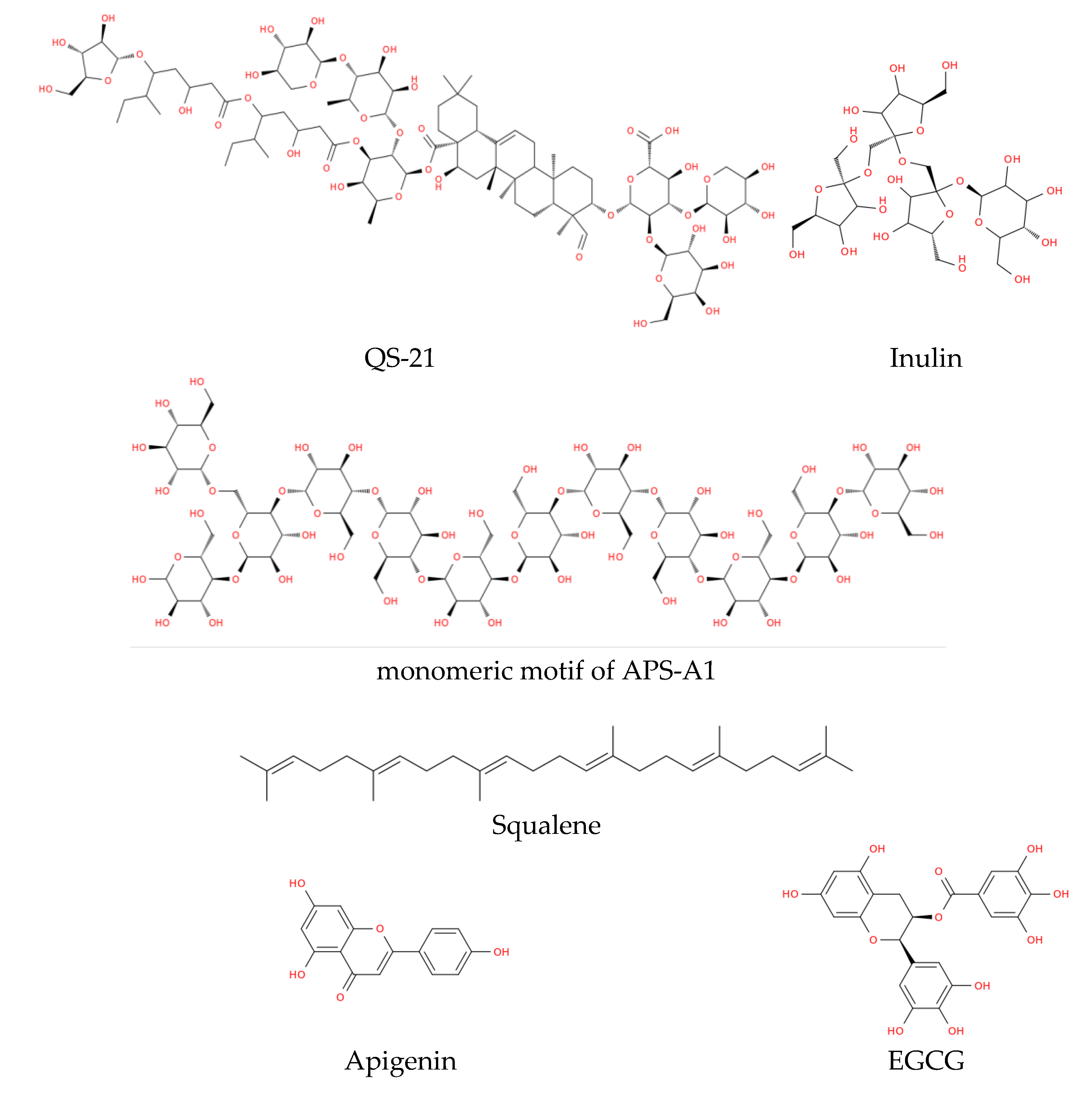
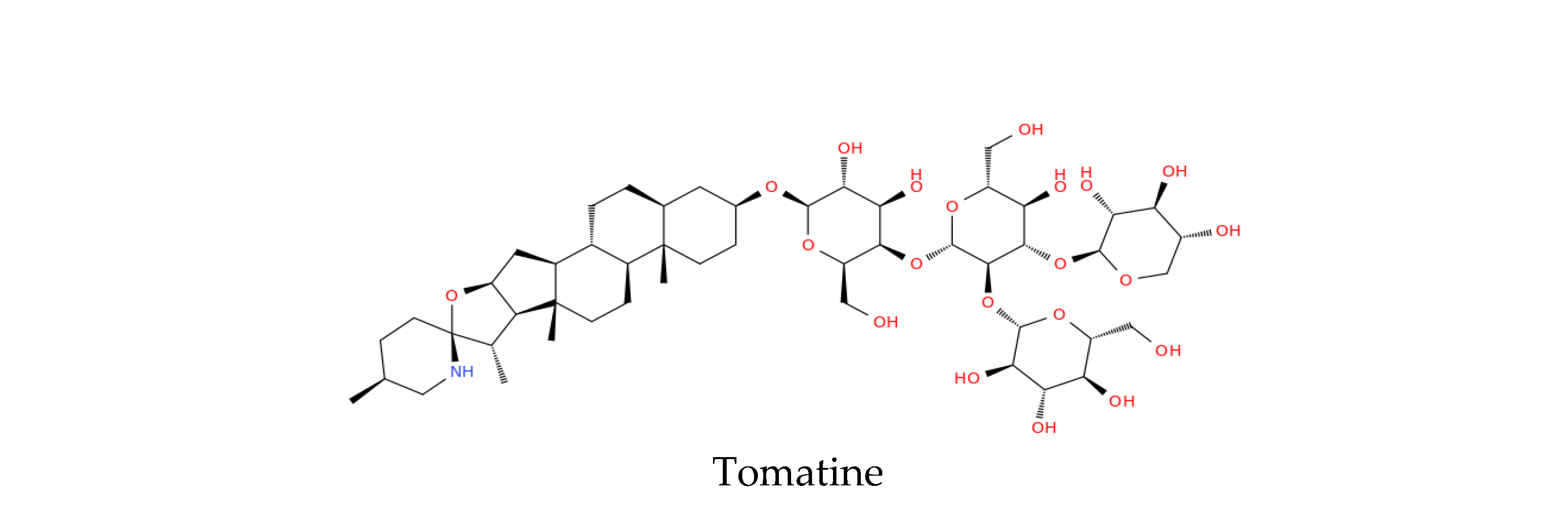

Table 1.
Overview of representative plant-based vaccine candidates, including edible (oral) and non-edible platforms, highlighting pathogen target, antigen type, plant expression host, production strategy, and clinical or regulatory status. It is important to note that only a limited number of candidates have reached advanced clinical stages, while the majority remain in preclinical or early clinical development.
Table 1.
Overview of representative plant-based vaccine candidates, including edible (oral) and non-edible platforms, highlighting pathogen target, antigen type, plant expression host, production strategy, and clinical or regulatory status. It is important to note that only a limited number of candidates have reached advanced clinical stages, while the majority remain in preclinical or early clinical development.
| Pathogen/Vaccine Platform | Antigen/Product Description | Plant Host/Expression Organism | Expression Technology/Method | Platform type | Regulator y Status/Use in Humans | References |
|---|---|---|---|---|---|---|
| SARS-CoV-2 (COVID-19) | Spike (S) protein VLP (CoVLP/Covifenz®) | Nicotiana benthamiana | Transient expression (Agrobacterium-mediated agroinfiltration) | VLP | Authorized for human use in Canada (Covifenz®); authorization was later cancelled by the sponsor (March 31, 2023) | [103] |
| Influenza (Seasonal & Pandemic) | Hemagglutinin (HA)/Quadrivalent Virus-Like Particles (QVLP) | Nicotiana benthamiana | Transient expression (Agrobacterium-mediated) | VLP | Advanced Clinical Trials — Phase III completed (efficacy trials conducted) | [104,105] |
| Human Papillomavirus (HPV) | L1 capsid protein VLPs | Nicotiana benthamiana | Transient expression | VLP | Preclinical / Early clinical | [106] |
| Norovirus | Norwalk virus capsid protein (NVCP) | Potato (Solanum tuberosum) | Stable transformation (nuclear) | Edible/Oral | Early human trials (oral immunogenicity) | [107] |
| Hepatitis B | Hepatitis B surface antigen (HBsAg) expressed in plants | Potato (Solanum tuberosum), Lettuce (Lactuca sativa, edible); Nicotiana tabacum (non-edible research host) | Stable transformation (nuclear) | Edible/Oral | Early clinical studies (Phase I/II oral immunogenicity), but no licensed product | [108] |
| Cholera | Cholera toxin B subunit (CTB) expressed in MucoRice-CTB (rice) | Oryza sativa (rice) MucoRice-CTB | Stable transformation (seed-based) | Edible/Oral | Phase I clinical trial (oral delivery) completed | [109] |
| Rotavirus | VP6/VP7 antigens (plant-expressed) | Nicotiana spp. | Transient/stable expression | Subunit | Preclinical | [110,111] |
| Rabies | Rabies virus glycoprotein (G protein) (plant-produced antigen/chimeric constructs) | Spinach (Spinacia oleracea, chimeric plant virus vaccine), Nicotiana benthamiana, Nicotiana tabacum | Transient expression & stable/transgenic expression approaches | Subunit/Oral | Preclinical/Early human exploratory immunogenicity (Phase I-like oral feeding studies) — no licensed product | [112,113,114] |
| Ebola Virus | Ebola Immune Complex (EIC) based on Ebola glycoprotein GP1 fused to an antibody scaffold | Nicotiana benthamiana | Transient expression (geminiviral replicon vectors) | Immune complex | Preclinical — immunogenic in mice; plant system also used for ZMapp mAbs (therapeutic antibodies), but no licensed plant-derived vaccine | [115] |
| Dengue Virus | Envelope protein (E) / domain III constructs | Nicotiana benthamiana | Transient expression | Subunit | Preclinical | [116] |
| Enterotoxigenic E. coli (ETEC) | Heat-labile enterotoxin B subunit (LTB) | Transgenic maize (Zea mays), Transgenic potato (Solanum tuberosum) | Stable transformation (nuclear) | Edible / Oral | Early human oral immunogenicity studies (Phase I-like / exploratory) — no licensed product | [117] |
| HIV | gp120 / gp140 glycoproteins | Nicotiana benthamiana | Glycoengineered transient expression | Subunit | Preclinical | [118] |
|
Veterinary (TGEV) |
Coronavirus antigen (TGEV) | Transgenic maize | Stable expression (seed-based) | Edible (feed-based) | Veterinary use (preclinical/field studies) | [119] |
Table 2.
Major classes of plant-derived adjuvants, their botanical sources, immunological mechanisms, and current clinical or developmental status. It should be noted that these classes differ in their level of clinical validation, with saponin- and emulsion-based systems being the most advanced, while other phytochemical categories remain largely at the preclinical stage.
Table 2.
Major classes of plant-derived adjuvants, their botanical sources, immunological mechanisms, and current clinical or developmental status. It should be noted that these classes differ in their level of clinical validation, with saponin- and emulsion-based systems being the most advanced, while other phytochemical categories remain largely at the preclinical stage.
| Category | Primary Example | Botanical Source | Target Receptor/Mechanism | Clinical Status/Application | Ref. |
|---|---|---|---|---|---|
| Saponins | QS-21 | Quillaja saponaria | NLRP3 Inflammasome, Syk kinase | Licensed (Shingrix, Mosquirix, Arexvy) | [154] |
| Saponins | ISCOMs / ISCOMATRIX | Quillaja saponaria | Antigen co-delivery, MHC I/II presentation | Clinical / Advanced development | [162,163] |
| Saponins | Matrix-M™ | Quillaja saponaria | DC recruitment, Th1/Th2 balance | Licensed (Nuvaxovid, R21) |
[160] |
| Saponins | Quil-A | Quillaja saponaria | Membrane permeabilization, immune activation | Preclinical / Veterinary use | [153] |
| Saponins | VSA-2 | Quillaja saponaria | Enhanced Th1 response, improved stability | Preclinical (SARS-CoV-2 models) | [169] |
| Polysaccharides | Advax™ (delta inulin) | Dahlia variabilis | Alternative pathway (Non-inflammasome) | Clinical Trials (HBV, Influenza) | [207] |
| Polysaccharides | APS | Astragalus membranaceus | TLR4, MyD88- NF-κB pathway, Dendritic cell maturation | Preclinical (Synergy with Alum) | [208] |
| Polysaccharides | β-glucans | Various plants/fungi | Dectin-1, complement activation | Preclinical / Immunomodulation | [209] |
| Terpenoids | Squalene (MF59) |
Shark-derived, Amaranthus caudatus (Alternative) | Chemokine release (CCL2, CXCL8) | Licensed (MF59, Fluad) |
[184,185,186,187] |
| Terpenoids | Squalene (AS03) |
Plant-derived / mixed sources | Enhanced innate activation (α-tocopherol synergy) | Licensed (Pandemrix, Arepanrix) | [185,188] |
| Flavonoids | EGCG | Camellia sinensis | TLR7/8, PI3K/Akt/mTOR | Preclinical/ Cancer research | [180,181] |
| Flavonoids | Apigenin | Various plants | PI3K/Akt/mTOR, MAPK pathways | Preclinical | [181] |
| Flavonoids | Epimedium flavonoids | Epimedium spp. | TLR7/8 activation | Experimental | [179] |
| Alkaloids | Tomatine | Solanum lycopersicum | Membrane disruption, LNP stabilizer | Preclinical (mRNA platforms) | [194] |
| Alkaloids | Berberine | Berberis spp. | NF-κB, mTOR modulation | Preclinical / adjunct therapy | [195] |
| Alkaloids | Piperine | Piper nigrum | Bioavailability enhancement | Experimental | [196] |
| Lectins | ArtinM | Artocarpus integrifolia | IL-12 induction, Th1 polarization | Preclinical | [198] |
| Lectins | UEA-1 | Ulex europaeus | M-cell targeting, mucosal delivery | Experimental | [199] |
Disclaimer/Publisher’s Note: The statements, opinions and data contained in all publications are solely those of the individual author(s) and contributor(s) and not of MDPI and/or the editor(s). MDPI and/or the editor(s) disclaim responsibility for any injury to people or property resulting from any ideas, methods, instructions or products referred to in the content. |
© 2026 by the authors. Licensee MDPI, Basel, Switzerland. This article is an open access article distributed under the terms and conditions of the Creative Commons Attribution (CC BY) license (http://creativecommons.org/licenses/by/4.0/).
Copyright: This open access article is published under a Creative Commons CC BY 4.0 license, which permit the free download, distribution, and reuse, provided that the author and preprint are cited in any reuse.


