

Submitted:
21 April 2026
Posted:
07 May 2026
You are already at the latest version
Abstract
Achieving carbon neutrality has become a central policy objective for emerging economies, particularly the BRICS countries-BRICS (Brazil, Russia, India, China, and South Africa) which collectively account for a substantial share of global carbon emissions and energy consumption. The transition toward green energy, rapid technological innovation, and the expansion of green finance mechanisms are increasingly viewed as critical drivers of sustainable development and environmental improvement. However, empirical evidence integrating these three dimensions within a unified analytical framework for BRICS remains limited. This study examines the contribution of green energy transition, technological innovation, and green finance to achieving carbon neutrality in BRICS countries using a Pooled mean group auto regressive distributed Lag (PMG ARDL) framework and Dumitrescu–Hurlin panel causality analysis. The results indicate that green energy transition significantly reduces carbon emissions in both the long run (−0.45) and short run (−5.65), emphasizing the importance of shifting toward renewable energy sources. Technological innovation exerts a significant negative effect in the long run (−0.17), reflecting efficiency gains and cleaner production, although its short-run impact remains insignificant. Similarly, green finance improves environmental quality in the long run (−0.10) by supporting low-carbon investments, while short-run effects are statistically insignificant due to adjustment frictions. Economic growth increases emissions in the long run (0.43), confirming the scale effect, whereas trade openness reduces emissions (−0.87), indicating the role of technology diffusion. The error correction term (−0.76) confirms a strong convergence toward long-run equilibrium. The causality analysis reveals unidirectional causality from green energy transition, technological innovation, and green finance to carbon emissions, while bidirectional causality exists between economic growth and emissions, highlighting a feedback mechanism. Policy implications suggest that BRICS economies should strengthen green financial systems, accelerate renewable energy adoption, promote innovation-driven sustainability, and design growth strategies that decouple economic expansion from environmental degradation.
Keywords:
green energy transition
; technological innovation
; green finance
; carbon neutrality
; BRICS
; environmental sustainability
; panel econometrics
1. Introduction
Conceptual Background
The long term survival of human society is seriously threatened by the environmental instability brought on by climate change worldwide. Its consequences such as rising sea levels, changed weather patterns, and a decline in agricultural productivity pose serious risks to both ecological and economic systems. The only realistic way to significantly slow down global warming is to reduce carbon dioxide (CO2) emissions. To achieve this goal it requires significant technological advancements and an increase in the adoption of clean technologies that increase energy efficiency in a sustainable manner (Hermwile et al., 2017; Hsiang & Kopp, 2018; Legg, S. 2021; Raghutla & Chittedi 2023; Raghutla & Chittedi 2023). Furthermore, in this context we should also priortize carbon neutrality which may reduce CO2 emissions and enhance environmental conditions. Accordingly, these initiatives should receive more attention from both developed and developing countries. Policymakers, researchers, and industry leaders are also increasingly emphasizing the energy transition as an essential foundation for an environmentally sustainable future, highlighting the need for immediate action. Therefore, carbon neutrality is not only essential for environment but it is also a significant socioeconomic opportunity (Ahmad et al., 2025).
The BRICS Nation with a population of more than two billion, a third of the global GDP, and a fifth of the global energy consumption, are currently among the fastest-growing economies in the world (Dai et al., 2025; Jana 2022). However they are also the major contributors of carbon polluters and have a significant large ecological footprints (Zahid et al., 2025). The expansion of these large ecological footprints in these countries is positively correlated with increasing carbon emissions, raises concerns about two factors i.e. intensified land use pressure and environmental degradation, (Kayani et al., 2024). Among them, China has set one of the most ambitious climate goals, promising to eliminate the production of carbon before 2030 along with neutrality in carbon emissions by 2060. (Tang et al., 2025). This transition is supported by technological advancements, environmental adaptability and the effective utilization of all renewable resources (Lu et al., 2022). In recent years, due to trade openess and economic integration, the emerging economies have significantly accelerated their growth and higher living standards. While international trade fuels an expansion of manufacturing activities due to increased demand for goods on the global market, often leading to higher consumption of non-renewable energy and consequently greater carbon emission (Liu et al., 2023; Nanda et al., 2023). However, an alternative viewpoint suggests that trade openness can reduce carbon emissions through knowledge spill overs, technological transfer and to promote cleaner production (Aldieri & Vinci, 2020). In order to achieve carbon neutrality, green funding also plays an important role by promoting environmentally sustainable investmentis (Xiao & Xiao, 2025; Hunjra & Goodell, 2024). Through a range of financial instruments, including carbon financing, green bonds, green stocks, green insurance, and green credit, it promotes to the transition towards a low carbon economy (Fan & Shahbaz, 2023; Fu et al., 2023; Zhang, 2024; Yang & Cui, 2025). This was further supported by the main findings of (Xu et al., 2023) which indicated that the issuance of green bonds and the growth of the green economy in the sector might accelerate the pace of green economic development in agriculture. Further, Empirical evidence in BRICS economies, a 1% growth in green-related finance has resulted in a 0.72% shrinkage in ecological footprint (Sahoo et al., 2024; Khan et al., 2025). Governments can further promotes green finance by establishing comprehensive regulatory frameworks that encourages investment in sustainable (Wang et al., 2024). Additionally, the development of Industry 4.0 technologies, such as blockchain, big data, artificial intelligence (AI), and the Internet of Things, is also altering how companies develop and carry out their business goals. (Jia et al., 2025 ; Iansiti & Lakhani, 2020). Together, Emission levels have significantly decreased as a result of the development of the renewable energy, technological innovation and green econmic policies (Liza, et al., 2024).
Achieving carbon neutrality has emerged as a central objective in global environmental policy, particularly in the context of accelerating climate change and rising greenhouse gas emissions (Allan, et al, (2023). The BRICS economies, Brazil, Russia, India, China, and South Africa collectively account for a substantial share of global carbon emissions, making them critical to the success of international climate mitigation efforts (Dong et al., 2019; Khan et al., 2020). In this regard, the roles of green energy transition, technological innovation, and green finance have received growing attention in the empirical literature (Shahbaz et al., 2012; Shahbaz et al., 2020; Zhang et al., 2021). Existing studies have examined the impact of renewable energy consumption and financial development on environmental quality. For instance, Shahbaz et al. (2020) highlight the mitigating effect of renewable energy on carbon emissions, while Zhang et al. (2021) emphasize the importance of green finance in promoting sustainable development. Similarly, Paramati et al. (2017) and Acheampong (2018) report that financial development and technological innovation contribute to environmental sustainability. However, the extant literature largely focuses on these factors in isolation or within limited empirical frameworks (Balsalobre-Lorente et al., 2019; Danish et al., 2019). A critical gap persists in the absence of a comprehensive analysis that simultaneously incorporates green energy transition, technological innovation, and green finance within a unified framework, particularly for BRICS countries. Moreover, many prior studies rely on first-generation econometric techniques that fail to account for cross-sectional dependence and slope heterogeneity, potentially leading to biased and inconsistent estimates (Pesaran, et al., 2004; Pesaran, 2007; Pesaran, 2012). Against this backdrop, the present study makes several novel contributions. First, it integrates green energy transition, technological innovation, and green finance into a single empirical model to assess their combined impact on carbon neutrality. Second, it employs advanced second-generation panel econometric techniques to address issues of cross-sectional dependence and heterogeneity. Third, it provides updated empirical evidence for BRICS economies, thereby offering a more comprehensive and policy-relevant analysis.
Based on the existing literature, the following research questions arise from this study:
RQ1: Does the BRICS countries transition to green energy help them become carbon neutral?
RQ2: What role does increasing technological innovation play in helping the BRICS countries become carbon neutral?
RQ3: How do carbon neutrality and green finance relate to each other in the BRICS countries
The study's structure is divided into multiple sections to deliver a broad analysis of the green energy revolutions in the BRICS nations. The first part serves as an introduction, while the second part examines pertinent research on the relationship between carbon neutrality, green energy transition, technical innovation, and green finance. The data sources and empirical methodologies are then described in the third segment. The outcomes are clarified in the section of discussion and empirical findings. Finally, the last section provides a summary of the conclusions.
2. Literature Review
The effect of technical advancement, green financing, and the shift to green energy on carbon neutrality has received a lot of attention lately. There is not much research on the BRICS nations, despite the fact that numerous studies have examined this connection in diverse geographical areas. The chief purpose of the study is to examine the body of existing literature while emphasizing important discoveries and theoretical viewpoints.
2.1. Green Energy Transition and Carbon Neutrality
The concept of energy transition, which refers to the structural shift from fossil fuel-based energy systems to low-carbon and renewable energy sources such as solar, wind, and hydropower. From a theoretical standpoint, energy transition is essential for decoupling economic growth from carbon emissions. Traditional growth models, particularly those based on fossil fuel dependency, assume a direct and positive relationship between energy consumption and environmental degradation. However, the transition toward renewable energy alters this relationship by enabling cleaner production processes and reducing the carbon intensity of economic activities. According to ecological modernization theory, technological progress and structural changes in the energy sector can lead to environmental improvements without compromising economic performance. Thus, energy transition serves as a primary mechanism for achieving carbon neutrality by directly lowering greenhouse gas emissions. Now day’s fighting with climate modification is the major challenge of the nation. It is very essential to change the procedure of energy system to shrink pollution (Tshikovhi et al., 2023; Singh, 2021; Iqbal et al., 2011; Sims, 2004; Caineng et al. 2021). Renewable energy sources must be used to produce little or no carbon emissions. For instance, Rabbi et al., (2022) focussed on energy transition, energy efficiency, and energy security. The BRICS countries may shift to a clean energy economy and reach carbon neutrality by identifying alternate clean energy supply sources, reducing energy use, and developing renewable energy (Zhang et al., 2025). Shen et al., (2021) employed sophisticated econometric techniques in their study and reached the conclusion that the environmental Kuznets Curve hypothesis is accurate for the BRICS region.
Achieving carbon neutrality is aided by the generation of electricity from renewable resources. CO2 emissions are decreased when electricity is generated from renewable sources (Mostafaeipour et al., 2022; Xianyong & Zixuan, 2022. However, any attempt to speed up the energy transition depends on accurately identifying the motives and their effects on the overall alteration because it is difficult to comprehend how complicated the energy switch strings or cause are (De La Pena, 2022). The years 2021–2030 are a crucial period in human history. There is a serious risk of irreparable harm to the global environment if civilization locks in dirty, high-carbon capital (Raza et al., 2025; Stern & Xie, 2020). Most researcher believe that the most crucial technological instrument and the cornerstone for reaching the carbon neutrality goal is a power sector that is controlled by renewable energy. For instance, stated that according to the majority of organizations and academics, Under the carbon neutral scenario, the proportion of renewable energy in primary energy would increase from around 10% in 2020 to over 70% in 2060 (Zhao et al., 2022). Many businesses are making significant investments in biofuels in an effort to quicken the world's energy transition. The energy needs of the transportation sector in modern civilization are largely met by petroleum-based fuels (Khan et al., 2021). However, the environment is harmed by greenhouse gas emissions produced when fossil fuels are burned in engines. Most researcher agree that biofuels are a viable substitute for environmentally friendly transportation and economic growth (Khan et al., 2021). Although biofuel vehicles can reduce carbon emissions, they use more energy than gasoline-powered vehicles. Therefore, Chang et al., (2017) confirmed through their studies that biofuel vehicles advocate for carbon neutrality yet, better energy efficiency is necessary for complete sustainability. These days, solar, wind, hydropower, nuclear, and hydrogen are the main new energy sources that help the power sector achieve low carbon emissions (Elshkaki & Shen, 2022). The energy source of the future, "green hydrogen," further aids in the reduction of carbon emissions in the industrial and transportation sectors (Hassan et al., 2024). Developed countries are using their financial resources and well-established infrastructure to design effective plans to cut carbon emissions (Ihemeson, 2023). On the other hand, developing nations have to simultaneously manage energy security and address climate issues. Despite these obstacles, a number of developing countries show deliberate commitment by allocating large funding to renewable energy projects (Ahmad et al., 2025; Falcone, 2023). In the meanwhile, the least developed nations face the difficult challenge of coordinating climate policies with pressing development requirements, frequently looking for creative ways to make sustainable progress.
H1:
Green Energy transition significantly contributes to achieving carbon neutrality in BRICS countries
2.2. Technological Innovation and Carbon Neutrality
Technological innovation also plays an indirect role in strengthening the effectiveness of energy transition. For instance, advancements in energy storage technologies, smart grids, and digitalization improve the reliability and efficiency of renewable energy systems. Moreover, innovation reduces the cost of clean technologies over time through learning-by-doing and economies of scale, thereby accelerating their adoption. As a result, economies with higher levels of technological capability are better positioned to achieve rapid decarbonization and progress toward carbon neutrality. The environment is improved by the consumption of clean energy. Technological advancements and the consumption of non-energy resources hinder environmental quality. Economic growth positively influences emissions and the ecological footprint (Raghutla and Chittedi, 2023). As global concern over climate change grows, energy consumption and associated carbon emissions are gaining more attention alongside the BRICS countries' growing economic growth. There are two different roles as stated by Santra, (2017) that environmental policy might play in the economic process. Businesses can either spend in R&D to create new "cleaner" technology or adopt or buy already-existing "cleaner" technology. It is very crucial to promote environmentally friendly technological innovation along with sustainable tourism to achieve sustainable development in BRICS nation. For instance, Ullah et al., 2023 in their study has made use of contemporary methodology methods such as the panel data unit root tests, Westerlund cointegration tests, and CS-ARDL tests, which concluded that carbon dioxide emissions would increase by 1.79%, 0.15%, and 0.10%, respectively, for every 1% increase in economic evolution, technological invention, and natural resources over the lengthy run. On the other hand, carbon dioxide emissions would drop by 0.39% for every 1% rise in tourism. The relationship between economic progress and carbon emissions is U-shaped in Brazil, India, and China, whereas it is inverted in South Africa and Russia, according to the findings of Zhang's, (2021) Environmental Kuznets Curve (EKC) test. Su et al., (2023) findings suggest a unidirectional causal association between GDP growth and technological innovation and CO2 emissions investigates TI's contribution to carbon emission mitigation. The results show that TI affects CO2 in both positive and negative ways. The negative impact implies that TI is an effective approach for lowering CO2 emissions.
In contrast, however all the technology does not impact carbon emission in the same way. For instance, fixed telephone lines, broad band services, high technological export and electric power consumption enhances carbon emission. BRICS nation should use better technology and innovation policies (Su et al., 2021). The ecological footprint of the BRICS economies from 1990 to 2017 was confirmed to increase with economic expansion and technological innovation using panel quantile regression. Causality experiments validated both unidirectional and bidirectional links, highlighting the need for well-coordinated environmental measures (Behera et al., 2024; Awosusi, 2022). Technological progress weakens sustainable economic growth because of excess production and energy use. As industry expands progress of carbon neutrality slows down as stated by Andrew, (2024). Hence Ma et al., 2022 confirmed that policymakers and environmentalists should consider the effects of both positive and negative shocks when formulating their plans. In general, technological innovation helps achieve the objectives of carbon neutrality and emission reduction.
H2:
Higher technological innovation significantly leads to enhance carbon neutrality in BRICS countries
2.3. Green Finance and Carbon Neutrality
The third pillar of this theoretical framework is green finance, which provides the necessary financial resources to support investments in renewable energy and green technologies. Green finance encompasses a wide range of financial instruments, including green bonds, sustainable loans, and climate funds, designed to promote environmentally sustainable projects. From a theoretical perspective, green finance addresses market failures associated with environmental externalities and information asymmetry. Traditional financial systems often underinvest in green projects due to their high initial costs, long payback periods, and perceived risks. Green finance mechanisms help overcome these barriers by channeling capital toward sustainable investments and incentivizing environmentally responsible behavior. Scholars have conducted a great deal of study on the role that green finance plays in achieving energy conservation and advancing the low-carbon economic transition. Green credit incentives are particularly advantageous for China's three main economic zones: the eastern, central, and western regions (Tang et al., (2025). It has been verified that CO2 emissions and GFN, fintech, are causally related in both directions (Jamel & Zhang, 2024). It is recommended by Udeagha and Muchapondwa, (2023) studies that the BRICS nations should increase the capacity of banks and other financial institutions to offer green credit facilities and accelerate the development of green financial products. The BRICS countries use green energy and green financial innovation to lower CO2 emissions from transportation. Green logistics, green innovation, and renewable resources are powerful motivators for implementing neutrality (Du et al., 2023; Tetteh et al., 2025). FinTech and sustainable finance, help the BRICS countries overcome their challenges, especially those pertaining to energy production and environmental degradation. According to Dai et al., (2025), a mix of policy measures and financial innovation can promote the green energy transition plan of the BRICS countries. Global carbon footprint (CF) reduction is one of GNF's most significant effects. By providing funding to projects and programs that promote sustainable development, energy from renewable sources, energy conservation, and other ecologically beneficial endeavors, GNF accelerates the nation's transformation to a low-carbon economy (Amin et. al., 2025). To examine the connection between financial technology, green finance, natural resource rent, and economic growth in achieving environmental friendly goals, “the cross-sectionally augmented autoregressive distributed lag approach was used”(Bel Hadj Miled, 2025 ; Ouni & Ben Abdallah, 2024) The findings demonstrate that fintech may effectively enhance green projects' financial aspects while lowering carbon emissions. Jin et al., (2023) examines empirically how 38 OECD member states' carbon neutrality targets, spanning the years 2013–2021, are impacted by green funding and renewable energy sources. Based on the predicted results, the OECD would achieve more progress toward the carbon neutrality aim if more green bonds were issued. However, environmental deterioration in China is accelerated by urbanization and economic growth. To attain long-term environmental sustainability, policymakers should support clean energy, innovation-based development, and sustainable financing (Feng, 2022). Some researchers spoke about green finance is better than brown and black funds for supporting and investing in zero carbon sustainable projects. Using monthly data from 2011 to 2019, Ji et al., (2021) analyze “6519 actively managed mutual funds in the BRICS after dividing them into black, brown, and green groups based on their investment properties”. The green funds' performance adjusted for risk outperforms that of the brown and black funds, offering strong evidence of the green equity funds' ability to predict volatility. The findings support the idea of investing in zero-carbon projects. In China, green transportation, clean energy, and pollution control are the main areas where green finance capital investments are concentrated. By fostering the growth of green finance, according to Kong., (2022) new energy technologies can be developed, which will help attain carbon neutrality targets. Many other studies uses common correlated effect means group (CCEMG), to scrutinise the effects of financial growth and environmental legislation on carbon emanations in the BRICS countries between 1995 and 2016 (Sarfraz et al., 2021; Zhakanova Isiksal, 2021) Which concluded that environmental rules are also proven to impair the environment by increasing carbon emissions, the empirical data show that financial development leads to carbon emissions (Baloch and Danish, 2022). Similarly environmental degradation and green finance have a negative and strong correlation, indicating that green finance is crucial for halting environmental degradation while simultaneously promoting economic growth. To sum up, research done by Chin, (2022) BRI member states ought to keep pushing green finance by putting in place incentive programs including lowering corporate taxes, creating a green credit guarantee program, and subsidizing interest rates for green loans.
On the other hand, in contrast economic expansion and financial innovation raise carbon emissions from transportation and worsen environmental conditions. (Umar et al., 2020; Du et al., 2024). Hence many researchers strongly advise that policy proposals be made to implement a carbon tax and promote innovation in green finance (Wu et al., 2025; Masoud, 2025)
H3:
Green finance significantly promotes carbon neutrality in BRICS countries
The relationship between environmental sustainability and its economic determinants has been widely explored in the literature (Grossman & Krueger, 1995; Stern, 2017). A growing number of studies indicate that renewable energy consumption significantly reduces carbon emissions and supports cleaner energy transitions (Bekun et al., 2019; Nathaniel and Khan, 2020). Similarly, green finance has been identified as a key mechanism for channeling investments toward environmentally sustainable projects (Wang and Zhi, 2016; Ullah et al., 2022). In addition, technological innovation enhances energy efficiency and contributes to emission reduction by promoting cleaner production processes (Su and Moaniba, 2017; Razzaq et al., 2021). Despite these contributions, the literature exhibits several limitations. Most studies focus on bilateral relationships, such as energy emissions or finance environment linkages, without capturing the combined effects of multiple determinants (Sadorsky, 2010; Acheampong et al., 2020). Moreover, limited attention has been given to distinguishing green finance from conventional financial development, leading to conceptual ambiguity in empirical analyses (Lee and Lee, 2022). Furthermore, many studies overlook cross-country heterogeneity and interdependencies, particularly in the context of BRICS economies (Pesaran, 2006; Baltagi et al., 2012). In light of these gaps, the present study adopts a multidimensional framework that simultaneously incorporates green energy transition, technological innovation, and green finance. This integrated approach provides a more comprehensive understanding of the determinants of carbon neutrality and extends the existing literature by addressing methodological constraints, data limitations, and variable-specific considerations, in addition to the geographical scope, to provide a more comprehensive discussion.
3. Data and Methodology
This study utilizes annual data from the World Bank and the World Development Indicators (WDI 2025) covering the period 1990–2024 for BRICS countries (Brazil, Russia, India, China, and South Africa). The dependent variable is carbon emissions (CO₂) as a proxy for carbon neutrality. The key independent variables include green energy transition (renewable energy consumption), technological innovation (green patents), and green finance. Control variables such as GDP and trade openness are incorporated to avoid omitted variable bias. The study adopts a deductive research approach using secondary data to test hypotheses derived from environmental and endogenous growth theories. To ensure robust and reliable results, advanced panel econometric techniques are applied, including cross-sectional dependence tests, panel unit root and cointegration analysis, PMG-ARDL for long- and short-run dynamics, FMOLS, DOLS, and Dumitrescu–Hurlin panel causality tests. Table 1 presents the variables, measurements, data sources, and expected signs, while Figure 1 illustrates the theoretical framework of the study.
3.1. Model Specifications
The empirical model is developed based on prior environmental and energy–growth literature (e.g., Saidi and Hammami 2017; Dinh et al. 2019; Sahoo and Sethi 2021; Yusuf et al. 2020; Ali et al. 2022; Iqbal et al. 2020), with modifications aligned to the objective of assessing carbon neutrality in BRICS countries (Brazil, Russia, India, China, and South Africa). In this study Equation (1) specifies carbon neutrality conceptually defined as the achievement of net-zero carbon emissions, where total greenhouse gas emissions are balanced by carbon removal or offset mechanisms as the dependent variable. Due to the absence of consistent and comparable cross-country data on net carbon balance, this study employs carbon emissions (CO₂ emissions, measured in metric tons per capita) as a proxy to empirically capture progress toward carbon neutrality. The explanatory variables include Green Energy Transition (GET), proxied by renewable energy consumption (% of total final energy consumption); Technological Innovation (TI), measured by green patent applications (residents); Green Finance (GF), proxied by green credit allocated to the private sector as a percentage of GDP; Economic Growth (GDP), represented by GDP per capita (constant 2015 US$); and Trade Openness (TO), measured as trade (% of GDP). Thus, while carbon neutrality and CO₂ emissions are not conceptually identical, reductions in carbon emissions represent the most direct and measurable pathway toward achieving net-zero targets. Accordingly, CO₂ emissions serve as a suitable empirical proxy for carbon neutrality in the econometric framework. The basic functional form of the model is expressed as follows:
All variables are transformed into natural logarithmic form to reduce heteroscedasticity and facilitate elasticity interpretation. The log-linear specification is presented as follows
Here, i denotes the country and t represents the time period. LNCO₂ is the natural logarithm of carbon emissions, reflecting environmental pressure. LNGET represents renewable energy consumption as a proxy for green energy transition. LNTI captures technological innovation, measured through green patent applications. LNGF denotes green finance indicators (e.g., green credit or climate-related financial flows). LNGDP reflects economic growth, and LNTO indicates trade openness as a percentage of GDP. The term ε represents the stochastic error term. Table 1 provides the definitions and descriptions of the variables used in the study
3.2. Methods of Estimation
This study employs panel data techniques to empirically examine the impact of Green Energy Transition (GET), Technological Innovation (TI), Green Finance (GF), economic growth, and trade openness on carbon emissions (CO₂) in BRICS countries (Brazil, Russia, India, China, and South Africa). The analysis is based on panel estimation using annual time-series data spanning the period 1990–2024. The empirical framework follows a systematic five-step procedure. First, a slope homogeneity test is conducted to assess parameter consistency across countries. Second, cross-sectional dependence is examined to identify interlinkages among panel units. Third, panel unit root tests are applied to determine the stationarity properties of the variables. Fourth, panel cointegration tests are employed to investigate the existence of long-run relationships. Finally, the Pooled Mean Group Autoregressive Distributed Lag (PMG-ARDL) model is used to estimate both short-run and long-run dynamics, complemented by panel causality analysis to explore directional relationships among the variables (Alhashim, et. al., 2024; Alhashim, et al., 2024; Chishty et al., 2025; Shuaib, et. al., 2025).
3.3. Slope Homogeneity Test
Now, the Pesaran and Yamagata (2008) slope homogeneity test is employed in Equation (3) to examine whether slope coefficients are homogeneous across BRICS countries. The test is required because BRICS economies differ significantly in terms of economic structure, energy composition, and policy frameworks, which may lead to variations in the impact of explanatory variables on carbon emissions. Ignoring such heterogeneity can result in biased and misleading estimates. Therefore, testing slope homogeneity helps justify the use of appropriate panel estimation techniques that allow for cross-country differences. Given these structural and institutional variations, slope heterogeneity is expected, as indicated in Equation (4). The test statistics are expressed as follows
3.4. Cross-Sectional Dependence (CSD) Test
The Pesaran (2015) Cross-Sectional Dependence (CD) test is employed to examine the presence of interdependencies among cross-sectional units in panel data. Its primary function is to detect whether residuals across countries are correlated, reflecting common shocks, spillover effects, or unobserved factors influencing multiple economies simultaneously. In the context of BRICS countries, such dependence may arise due to economic integration, trade linkages, and financial interconnectedness. Ignoring cross-sectional dependence can lead to biased and inconsistent estimates; therefore, applying this test is essential to ensure the reliability of empirical findings and to justify the use of second-generation econometric techniques. The mathematical expression of the CD test is presented in Equation (5) below.
3.5. Panel Unit Root Test
Considering the presence of cross-sectional dependence and slope heterogeneity, second-generation panel unit root tests namely the CIPS, CADF, and Levin et al. (2002) tests are employed to examine the stationarity properties of the variables within the framework proposed by Pesaran (2007), as presented in Equation (6). These tests account for cross-sectional dependence through cross-sectional averages, and the resulting evidence on the order of integration ensures the appropriateness of the PMG ARDL model, which requires variables to be integrated of order I(0), I(1), or a combination thereof, but not I(2).
The Cross-sectionally Augmented Dickey-Fuller (CADF) regression equation is presented in Equation (7). This specification extends the conventional ADF framework by incorporating cross-sectional averages of both lagged levels and first differences of the series to account for cross-sectional dependence among panel units. Here, represents the cross-sectional mean of the variable, while denotes the first difference operator. The inclusion of these additional terms improves the reliability of unit root testing in the presence of cross-sectional dependence.
3.6. Panel Cointegration Test
In this study, after examining the presence of cross-sectional dependence, heterogeneity, and unit root properties among countries, a panel cointegration test is employed. Specifically, the Westerlund (2007) cointegration test is applied with a bootstrap procedure to effectively address cross-sectional dependence. The panel-mean statistics from this test are used to determine whether a stable long-run relationship exists among the variables, and the corresponding mathematical expressions are presented in Equations (8), (9), (10), and (11).
Equations (8) and (11) present the group-mean and panel-based test statistics used to examine long-run relationships in the panel framework. Equations (8) and (9) capture cross-sectional heterogeneity by averaging standardized coefficients across units, while Equations (10) and (11) assess individual and panel-level statistical significance. Together, these statistics provide robust evidence on the existence of cointegration by integrating both individual and aggregate panel dynamics.
3.7. Long-Run and Robustness Estimation
Following the confirmation of cointegration, the Pooled Mean Group (PMG–ARDL) model is employed to estimate both the long-run and short-run dynamics among the variables. The specification of the model is presented in Equation (12).
Equation (12) specifies a dynamic panel model in which the current value of the dependent variable is determined by its own lagged values as well as the lagged values of the explanatory variable The inclusion of lag terms captures the dynamic adjustment process and temporal dependencies across time.
Furthermore, the model accommodates cross-sectional heterogeneity through individual-specific intercepts (αᵢ), while the parameters βᵢʲ and γᵢʲ capture the effects of lagged dependent and independent variables, respectively. This framework is widely employed in panel econometrics to simultaneously examine short-run dynamics and long-run equilibrium relationships.
For robustness analysis, the Fully Modified Ordinary Least Squares (FMOLS) and Dynamic Ordinary Least Squares (DOLS) estimators are utilized to validate the consistency of the long-run estimates. Moreover, to investigate the direction of causal relationships among the variables, the Dumitrescu and Hurlin (2012) panel causality test is applied.
Equation (13) defines the hypothesis framework for testing causal relationships among variables. The null hypothesis implies that there is no causal relationship from the explanatory variable to the dependent variable across cross-sectional units. In contrast, the alternative hypothesis indicates the presence of unidirectional causality, meaning that changes in the explanatory variable significantly influence the dependent variable.
Figure 1 presents the comprehensive data analysis framework employed in this study. The empirical strategy follows a structured panel data approach to examine the relationship between carbon emissions and its key determinants over the period 1990–2024.
4. Results and Discussion
4.1. Descriptive Statistics
Table 2 presents the descriptive statistics for the variables used in examining the contribution of green energy transition, technological innovation, and green finance to carbon neutrality in BRICS countries over the period 1990–2024. All variables are transformed into logarithmic form to ensure consistency, reduce heteroskedasticity, and improve normality. The mean value of carbon emissions (LNCO₂) is 1.28, accompanied by a standard deviation of 0.96 and a maximum value of 2.64, reflecting a moderate degree of variation among BRICS economies. This suggests that although the overall emission levels are relatively balanced across countries, there remains a noticeable disparity, with some economies exhibiting higher emissions due to variations in industrial development and energy consumption structures. However, green energy transition (LNGET), proxied by renewable energy consumption, has a mean of 3.02, a standard deviation of 0.74, and a maximum value of 3.97, reflecting a gradual yet uneven adoption of renewable energy technologies among member countries.
Technological innovation (LNTI) reports an average value of 8.52, with a relatively high standard deviation of 2.37 and a maximum of 14.36, indicating a substantial disparity in innovation performance among BRICS nations. This heterogeneity is mainly driven by differences in R&D investment, technological capabilities, and institutional support. For instance, China demonstrates significantly higher patent activity due to its strong innovation ecosystem and policy support, whereas India and other emerging economies exhibit relatively lower levels of green patent development due to resource and infrastructure constraints
Green finance (LNGF) shows a mean value of −0.43, a relatively high standard deviation of 1.47, and a maximum of 2.90, indicating substantial disparities in financial sector development and the mobilization of sustainable finance across BRICS countries..
Economic growth (LNGDP) has an average of 8.07, with a standard deviation of 0.98 and a maximum value of 9.48, reflecting relatively stable but differentiated income levels across BRICS economies. This moderate variation is primarily driven by differences in economic size, industrial structure, and growth trajectories.
Trade openness (LNTO) records a mean of 3.70, a low standard deviation of 0.32, and a maximum of 4.19, suggesting relatively stable trade integration among BRICS countries
4.2. Correlation Analysis
Table 3, reports the correlation coefficients among the variables. Carbon emissions (LNCO₂) are negatively correlated with green energy transition (-0.91), technological innovation (0.02), and green finance (-0.44), suggesting that improvements in renewable energy use, innovation capacity, and sustainable finance are associated with lower emission levels in BRICS countries.
Conversely, economic growth (0.73) and trade openness (0.58) show positive correlations with emissions, indicating that expansion in economic and trade activities may increase environmental pressure. The correlation values remain below 0.95, confirming the absence of severe multicollinearity among the explanatory variables. Weak correlations close to zero (e.g., between trade openness and technological innovation, -0.05) indicate limited direct association between these variables.
4.3. Slope Homogeneity Test
The slope homogeneity test confirms the presence of significant heterogeneity across BRICS countries, indicating that the impact of explanatory variables on carbon emissions varies substantially among member economies. This heterogeneity reflects differences in economic structure, energy mix, institutional quality, and the level of technological and financial development. In particular, the emission reduction effect of green energy transition is not uniform across countries. Economies with a higher share of renewable energy in their energy mix tend to experience stronger emission reductions, while countries with continued reliance on fossil fuels exhibit relatively weaker effects. Similarly, the effectiveness of technological innovation varies depending on the orientation of innovation activities—whether they are directed toward green technologies or conventional industrial expansion. Green finance also demonstrates heterogeneous impacts across BRICS countries due to variations in financial market maturity, regulatory frameworks, and the scale of sustainable investments. In economies where green financial systems are more developed, the allocation of capital toward environmentally friendly projects is more efficient, resulting in stronger environmental outcomes. In contrast, countries with emerging or less developed green finance frameworks experience limited short-term benefits. Trade openness further contributes to heterogeneous outcomes through differing compositions of trade and industrial specialization. Countries exporting cleaner technologies or less energy-intensive goods may benefit from reduced emissions, whereas those specializing in resource- or energy-intensive exports may experience increased environmental pressure. These heterogeneous patterns are consistent with existing literature. Acemoglu et al. (2012) emphasize that the environmental impact of technological change depends on its direction and policy support. Stern (2007) highlights that structural and institutional differences across countries significantly influence the effectiveness of climate mitigation strategies. Additionally, Frankel and Rose (2005) argue that the environmental effects of trade openness vary depending on country-specific economic characteristics.
Table 4 and Table 5, the study examines the stationarity properties of the selected variables after establishing the presence of cross-sectional dependence (CSD) and slope heterogeneity. Accordingly, the CIPS, CADF and Levin et al. (2002 unit root tests are employed, as both tests yield reliable and consistent results in the presence of CSD and heterogeneous slopes.
4.5. Panel Unit Root Test
To determine the order of integration of the variables, second-generation panel unit root tests are applied in Table 6, considering slope heterogeneity and cross-sectional dependence among BRICS countries (Brazil, Russia, India, China, and South Africa). The Cross-Sectionally Augmented IPS (CIPS), Cross-Sectionally Augmented Dickey-Fuller (CADF), and Levin et al. (2002) tests are employed. The null hypothesis assumes that the variables are non-stationary.
Table 6, The results of the CIPS, CADF, and Levin et al. (2002) tests indicate that all unit root tests using a consistent specification based only on the individual intercept become stationary at both level and first differences. This suggests that the variables are integrated of mixed order, implying the possible existence of a long-run cointegration relationship among them.
4.6. Westerlund (2007) Panel Cointegration Test
Following the application of unit root tests, the study proceeds to investigate the presence of long-run cointegration. Accordingly, the Westerlund cointegration test is employed, and the estimated results are reported in Table 7. The findings indicate that all variables are cointegrated in the long run, as evidenced by both the panel and group statistics.
The Gt and Ga statistics test cointegration at the individual country level, while Pt and Pa test cointegration at the panel level under the null hypothesis of no cointegration. The majority of statistics reject the null hypothesis, confirming the presence of a long-run equilibrium relationship among the variables. The confirmation of cointegration implies that green energy transition, technological innovation, and green finance have a stable long-term association with carbon emissions in BRICS countries. Consequently, the PMG-ARDL approach is employed to estimate long-run and short-run dynamics. The selection of PMG-ARDL is justified by its suitability for small sample sizes and its ability to handle mixed integration orders while allowing short-run heterogeneity across countries. The long-run estimation results are presented in Table 8.
4.7. PMG-ARDL Long Run Analysis
PMG-ARDL results for BRICS countries, using D(LCO2) as the dependent variable over the period 1990–2024 (145 observations), with the optimal lag structure selected based on the Akaike Information Criterion (AIC). The ARDL(1,1,1,1,1) model is identified as the preferred specification, incorporating LNGET, LNTI, LNGF, LNGDP, and LNTO with one lag each along with a constant term, ensuring a parsimonious and well-fitted framework.
In the long run, Green Energy Transition (LNGET) has a negative and statistically significant coefficient (-0.45) at the 1% level. This implies that a 1% increase in renewable energy consumption reduces carbon emissions by approximately 0.45%, confirming the crucial role of renewable energy in achieving carbon neutrality. The empirical findings indicate that Green Energy Transition (LNGET) has a negative and statistically significant impact on carbon emissions in the long run, suggesting that an increase in renewable energy consumption contributes to environmental improvement. From a theoretical perspective, this result supports the ecological modernization theory, which argues that technological innovation and cleaner energy systems can reduce environmental degradation while sustaining economic development. It also aligns with the energy transition framework, which emphasizes the gradual shift from fossil-fuel-based energy systems toward renewable and sustainable energy sources to achieve carbon neutrality. Several studies have documented a negative relationship between renewable energy consumption and carbon dioxide emissions. Increasing the share of renewable energy significantly reduces environmental pollution and promotes sustainable development (Huang et al., 2021; Polat & Kızılkan, 2022; Hasnisah et al., 2019). While some empirical studies report a positive relationship between renewable energy consumption and carbon dioxide emissions, particularly in developing economies where fossil fuels still dominate the energy mix and renewable energy adoption remains limited (Sadorsky, 2009; Apergis & Payne, 2010; Zhang & Cheng, 2009; Pata, 2018).
However The long-run coefficient of technological innovation (LNTI) is negative and statistically significant (−0.17), indicating that a 1% increase in technological innovation leads to a 0.17% reduction in carbon emissions in the long run. This finding suggests that technological progress plays a crucial role in improving environmental quality by promoting energy efficiency and facilitating the adoption of cleaner production techniques. The negative relationship explained by the technological innovation enhances the development and diffusion of low-carbon technologies, such as renewable energy systems, energy-efficient industrial processes, and carbon capture mechanisms. Over time, these innovations reduce reliance on fossil fuels and lower overall emissions. However, the impact of technological innovation is typically observed in the long run rather than the short run, as it requires time for research and development, commercialization, and large-scale adoption. These findings are consistent with prior studies that highlight the role of innovation in environmental sustainability. For instance, Aghion et al. (2016) argue that green innovation is essential for achieving sustainable growth and reducing emissions. Similarly, Wang, et. al., (2019) find that technological advancements significantly contribute to carbon emission reduction in emerging economies.
Similarly, The long-run coefficient of green finance (LNGF) is negative and statistically significant (−0.10), indicating that a 1% increase in green finance leads to a 0.10% reduction in carbon emissions in the long run. This result suggests that green financial development plays a vital role in promoting environmental sustainability by channeling investments toward environmentally friendly projects.
The negative relationship can be explained by the fact that green finance facilitates funding for renewable energy projects, energy-efficient technologies, and sustainable infrastructure. Over time, such investments help reduce dependence on fossil fuels and improve environmental performance. However, the impact of green finance is more pronounced in the long run, as financial markets require time to mature, and green investments often have delayed environmental returns.
These findings are supported by previous studies. For instance, Zetzsche, et al. (2022) highlight the importance of green finance in supporting sustainable development and climate mitigation. Likewise, Lee, (2020) emphasizes that green financial policies and instruments significantly contribute to reducing carbon emissions by directing capital toward low-carbon sectors.
Conversely, The long-run coefficient of economic growth (LNGDP) is positive and statistically significant (0.43), indicating that a 1% increase in GDP leads to a 0.43% increase in carbon emissions in the long run. This result suggests that economic expansion in the sampled economies is associated with higher environmental pressure, primarily due to increased energy consumption and industrial activities.
The positive relationship explained by the fact that, in the early and middle stages of development, economic growth is often driven by energy-intensive industries and fossil fuel consumption. As production, urbanization, and infrastructure development expand, the demand for energy rises, leading to higher carbon emissions. This phenomenon is consistent with the early phase of the Environmental Kuznets Curve, which posits that environmental degradation increases with economic growth before eventually declining at higher income levels.
These findings are supported by existing literature. For example, Grossman and Krueger (1995) demonstrate that economic growth initially leads to environmental degradation. Similarly, Muhammad et al. (2021) find that economic growth significantly increases carbon emissions in developing and emerging economies due to reliance on conventional energy sources.
However, the long-run coefficient of trade openness (LNTO) is negative and statistically significant (−0.87), indicating that a 1% increase in trade openness leads to a 0.87% reduction in carbon emissions in the long run. This finding suggests that greater integration into the global economy contributes to environmental improvement over time.
The negative relationship explained through the technology transfer and efficiency effect. Increased trade openness allows countries to access advanced and cleaner technologies from developed economies, which enhances production efficiency and reduces carbon intensity. Moreover, exposure to international markets encourages firms to adopt environmentally friendly standards and practices to remain competitive. Over time, this leads to a transition toward cleaner production processes and lower emissions.
These results are supported by existing literature. For instance, Frankel and Rose (2005) argue that trade openness improve environmental quality through income and technique effects. Similarly, Copeland and Taylor (2004) highlight that international trade promotes cleaner technologies and reduces pollution in the long run.
4.8. PMG-ARDL Short Run Analysis
In the short-run coefficient of green energy transition (LNGET) is negative and statistically significant (−5.65), indicating that an increase in green energy transition leads to a substantial reduction in carbon emissions in the short run. This result suggests that shifting from fossil fuels to renewable energy sources has an immediate and direct impact on reducing environmental pollution.
The negative relationship explained by the fact that green energy transition involves the replacement of carbon-intensive energy sources, such as coal and oil, with cleaner alternatives like solar, wind, and hydro energy. Unlike other variables, renewable energy adoption produces an instantaneous effect on emissions, as it directly reduces the carbon intensity of energy consumption. Therefore, even in the short run, increased reliance on clean energy significantly lowers CO₂ emissions.
These findings are supported by previous literature. For instance, Stern, N. (2008) highlights that transitioning to low-carbon energy systems is essential for immediate and long-term climate mitigation. Similarly, Downie, C. (2020) emphasizes that renewable energy deployment leads to rapid reductions in carbon emissions due to its direct substitution effect over fossil fuels.
However The estimated coefficient of technological innovation (TI) is 2.45, indicating a positive but statistically insignificant relationship with carbon emissions in the short run. This suggests that a 1% increase in technological innovation is associated with an approximate 2.45% change in carbon emissions; however, technological innovation is positively associated with changes in carbon emissions in the short run, its effect is statistically insignificant due to delayed implementation and diffusion processes. In countries such as China and India, a significant share of innovation is initially directed toward enhancing industrial productivity and economic growth rather than environmental sustainability. Moreover, the commercialization and large-scale deployment of green technologies require time, investment, and supportive institutional frameworks. In addition, the “rebound effect” may arise in the short run, where efficiency improvements lower production costs and stimulate higher output and energy consumption, thereby offsetting emission reduction gains. Over time, however, as cleaner technologies mature, energy efficiency improves, and environmental regulations tighten, technological innovation exerts a more pronounced and statistically significant negative effect on carbon emissions. This outcome to the fact that the environmental benefits of technological innovation are not realized immediately, as they require sufficient time for development, diffusion, and effective implementation (Zhang, 2010; Zhao et al., 2016; Li & Yue, 2024). Consequently, the impact of technological innovation becomes more pronounced and statistically significant in the long run.
Moreover The short-run estimates reveal that green finance exerts a negative but statistically insignificant effect on carbon emissions, with a coefficient of −3.49. This implies that a 1% increase in green finance is associated with an approximate 3.49% reduction in carbon emissions; however, the absence of statistical significance suggests that this effect is not robust in the short term. In the context of BRICS economies, this can be explained by cross-country heterogeneity, as these five countries differ significantly in terms of financial market development, institutional quality, and the maturity of green finance frameworks. While some countries have relatively advanced green financial systems, others are still in the early stages, leading to uneven allocation and utilization of green funds. This variation offsets the overall short-run impact and results in statistical insignificance. This finding the underdeveloped nature of green financial markets and the time required for the effective allocation and utilization of green funds in environmentally sustainable projects (Aghion et al., 2016; Li & Yue, 2024). Consequently, the environmental benefits of green finance tend to materialize more prominently in the long run.
Similarly, the short-run estimates indicate that a 1% increase in economic growth leads to a 7.43% rise in carbon emissions; however, this effect remains statistically insignificant. This suggests that although economic expansion tends to increase energy demand and emissions, its immediate environmental impact is not sufficiently strong to yield a statistically robust relationship in the short term. This may be due to structural adjustments, policy interventions, and transitional dynamics in BRICS economies, where the scale effect of growth is partially offset by improvements in energy efficiency and gradual adoption of cleaner technologies (Grossman & Krueger, 1995; Selden & Song, 1994). Consequently, the impact of economic growth on carbon emissions becomes more evident and statistically significant over the long run as these structural effects fully materialize.
In the case of trade openness, the short-run results indicate that a 1% increase leads to a 4.33% rise in carbon emissions; however, this relationship is statistically insignificant. This suggests that while increased trade may initially contribute to higher emissions through the scale effect—by expanding production and energy consumption—the immediate impact is not sufficiently strong to establish statistical significance. In the short run, the environmental effects of trade openness remain ambiguous, as the potential pollution-enhancing effects are often offset by efficiency gains, regulatory adjustments, and gradual technology transfer processes in emerging economies such as the BRICS countries (Grossman & Krueger, 1995; Bhagwati, 1993). Consequently, the impact of trade openness on carbon emissions becomes more pronounced and statistically significant in the long run as structural transformations and environmental policies take full effect.
In contrast, the error correction term (ECT−1 = −0.76**) implies that approximately 76% of the short-run disequilibrium is corrected within a single period, indicating a strong speed of adjustment toward the long-run equilibrium.
4.9. FMOLS and DOLS Robustness Test
Table 9, ensure the robustness of the long-run estimates, the study employs Fully Modified Ordinary Least Squares (FMOLS) and Dynamic Ordinary Least Squares (DOLS) estimators. These techniques effectively control for endogeneity and serial correlation, thereby providing reliable and efficient long-run coefficients. The empirical findings reveal a strong degree of consistency across both estimators. Green Energy Transition (LNGET) exhibits a negative and statistically significant impact on carbon emissions, with coefficients of −0.27 (p = 0.00) under FMOLS and −0.37 (p = 0.04) under DOLS, confirming its effectiveness in reducing environmental degradation. Similarly, Technological Innovation (LNTI) shows a negative relationship, with coefficients of −0.04 (p = 0.03) in FMOLS and −0.09 (p = 0.09) in DOLS, indicating that innovation contributes to emission reduction, albeit with slightly weaker significance in the latter model. Green Finance (LNGF) also demonstrates a consistent negative effect, with estimated coefficients of −0.02 (p = 0.02) in FMOLS and −0.12 (p = 0.08) in DOLS, highlighting its role in promoting environmental sustainability. In contrast, Economic Growth (LNGDP) exerts a positive and statistically significant influence on emissions, with coefficients of 0.64 (p = 0.08) and 0.49 (p = 0.01) in FMOLS and DOLS, respectively, suggesting that higher economic activity is associated with increased carbon emissions. However, Trade Openness (LNTO) presents mixed evidence. While it is positive and significant in the FMOLS model with a coefficient of 0.69 (p = 0.04), it becomes statistically insignificant in the DOLS estimation (0.38, p = 0.14), indicating that its impact may be sensitive to model specification
4.10. Dumitrescu–Hurlin (DH) Panel Causality Test
Table 10, report the Dumitrescu–Hurlin panel causalty results reveal important dynamic interactions among the variables. There is unidirectional causality from Green Energy Transition to carbon emissions, indicating that renewable energy policies actively drive emission reductions in BRICS countries.
Similarly, technological innovation Granger-causes emissions, confirming that innovation-led environmental improvements play a decisive role in advancing carbon neutrality. Green finance also demonstrates unidirectional causality toward emissions, implying that sustainable financial mechanisms directly influence environmental performance. A bi-directional causality between economic growth and emissions is observed, reflecting the growth–environment nexus in BRICS economies. Meanwhile, trade openness shows weak or insignificant causal influence on emissions. Collectively, these findings emphasize that green energy transition, technological innovation, and green finance are not only statistically significant determinants but also dynamic drivers of carbon neutrality in BRICS countries.
5. Conclusions and Policy Implication
This study examines the contribution of green energy transition, technological innovation, and green finance to carbon neutrality in BRICS countries (Brazil, Russia, India, China, and South Africa) over the period 1990–2024. Carbon emissions (CO₂) are used as the dependent variable, while the key independent variables include renewable energy consumption, technological innovation, and green finance. Additionally, economic growth and trade openness are incorporated as control variables. To ensure robust and reliable empirical analysis, several advanced econometric techniques are employed. Cross-sectional dependence (CSD) tests are first conducted to identify interdependencies among countries. The stationarity properties of the variables are examined using second-generation unit root tests, including the Cross-Sectionally Augmented IPS (CIPS), Cross-Sectionally Augmented Dickey–Fuller (CADF), and Levin et al. (2002) tests. Long-run relationships among the variables are investigated using the Westerlund cointegration approach. Furthermore, the Pooled Mean Group Autoregressive Distributed Lag (PMG-ARDL) model is applied to estimate both short-run and long-run dynamics. The Augmented Mean Group (AMG) estimator is utilized to capture heterogeneity in country-specific effects. For robustness, Fully Modified Ordinary Least Squares (FMOLS) and Dynamic Ordinary Least Squares (DOLS) estimators are employed. Finally, the Dumitrescu–Hurlin panel causality test is conducted to examine the direction of causal relationships among the variables. The findings reveal that green energy transition significantly reduces carbon emissions in both the long and short run, highlighting the effectiveness of shifting toward renewable energy for achieving environmental sustainability. Technological innovation also lowers emissions in the long run through improved efficiency and cleaner production, although its short-run impact remains insignificant due to adjustment lags and structural constraints. Similarly, green finance contributes to emission reduction over time by supporting sustainable investments, but its effects are not immediate due to implementation delays. In contrast, economic growth increases emissions in the long run, confirming the scale effect and underscoring the challenge of balancing growth with environmental sustainability, while trade openness helps reduce emissions over time through technology transfer and efficiency gains. Furthermore, causality results indicate that green energy, innovation, and finance drive environmental improvements, whereas a bidirectional relationship exists between economic growth and emissions, along with weak evidence that emissions influence trade openness.
Based on these findings, several important policy implications emerge for BRICS countries. First, governments should prioritize the acceleration of green energy transition by investing in renewable energy infrastructure, such as solar, wind, and hydroelectric power. Policies such as subsidies for clean energy, carbon pricing mechanisms, and the gradual phase-out of fossil fuel subsidies can significantly enhance the adoption of renewable energy technologies. Second, policymakers should promote technological innovation by increasing investments in research and development (R&D), particularly in clean and energy-efficient technologies. Strengthening collaboration between public institutions, private firms, and international organizations can facilitate the transfer and diffusion of advanced technologies. Additionally, providing tax incentives and financial support for green innovation can encourage firms to adopt sustainable practices. Third, the development of green finance mechanisms should be strengthened to mobilize resources for environmentally sustainable projects. Governments and financial institutions should expand green bond markets, promote sustainable banking practices, and establish clear regulatory frameworks to support climate finance. Enhancing transparency and standardization in green financial instruments can also increase investor confidence and participation. Fourth, given the positive relationship between economic growth and carbon emissions, it is essential to adopt a sustainable growth strategy that decouples economic expansion from environmental degradation. This can be achieved by promoting energy efficiency, adopting cleaner production techniques, and encouraging structural transformation toward less carbon-intensive sectors such as services and high-tech industries. Fifth, trade policies should be aligned with environmental objectives to maximize the benefits of globalization. Encouraging the import of environmentally friendly technologies and enforcing environmental standards in trade agreements can help reduce emissions. Additionally, participation in global environmental initiatives and cooperation with other countries can enhance the effectiveness of domestic policies. Finally, policymakers should focus on integrated policy frameworks that simultaneously address energy, environment, finance, and economic growth. Since the causality results indicate that green energy, innovation, and finance are key drivers of environmental improvement, coordinated efforts in these areas can significantly accelerate progress toward carbon neutrality.
Author Contributions
Conceptualization, A.C., N.V., S.Y., N. I. Q., H. N., and S.A., Data curation, H. N., and S.A.; Formal analysis, A.C., N.V., S.Y., N. I. Q., H. N., and S.A.; Methodology A.C., N.V., S.Y., N. I. Q., H. N., and S.A., Writing—original draft A.C., N.V., S.Y., N. I. Q., H. N., and S.A.; Writing—review and editing, A.C., N.V., S.Y., N. I. Q., H. N., and S.A., All authors have read and agreed to the published version of the manuscript.
Funding
Researchers Supporting Project number (PNURSP2026R792), Princess Nourah bint Abdulrahman University, Riyadh, Saudi Arabia.
Institutional Review Board Statement
Not applicable.
Informed Consent Statement
Not applicable.
Data Availability Statement
Data will be available on request.
Acknowledgments
The authors express their gratitude to Princess Nourah bint Abdulrahman University Researchers Supporting Project number (PNURSP2026R792), Princess Nourah bint Abdulrahman University, Riyadh, Saudi Arabia.
Conflicts of Interest
The authors declare no conflict of interest.
References
- Ahmad, H.; Yaqub, M.; Lee, S.H. Global trends in carbon neutrality: a scientometric review on energy transition challenges, practices, policies, and opportunities. Environ. Dev. Sustain. 2025, 1–26. [Google Scholar] [CrossRef]
- Aldieri, L.; Vinci, C.P. Climate change and knowledge spillovers for cleaner production: New insights. J. Clean. Prod. 2020, 271, 122729. [Google Scholar] [CrossRef]
- Amin, N.; Shabbir, M.S.; Pan, Y.; Asif, M. Beyond Growth: The Triple Green Strategy (Green Energy, Green Innovation, and Green Finance) for Sustainable Emissions Reduction in BRICS Countries. Sustainable Development 2025. [Google Scholar]
- Andrew, A.A.; Adebayo, T.S.; Lasisi, T.T.; Muoneke, O.B. Moderating roles of technological innovation and economic complexity in financial development-environmental quality nexus of the BRICS economies. Technol. Soc. 2024, 78, 102581. [Google Scholar] [CrossRef]
- Apergis, N.; Payne, J.E. Renewable energy consumption and economic growth: evidence from a panel of OECD countries. Energy Policy 2010, 38(1), 656–660. [Google Scholar] [CrossRef]
- Awosusi, A.A.; Adebayo, T.S.; Kirikkaleli, D.; Altuntaş, M. Role of technological innovation and globalization in BRICS economies: policy towards environmental sustainability. Int. J. Sustain. Dev. World Ecol. 2022, 29(7), 593–610. [Google Scholar] [CrossRef]
- Baloch, M.A.; Danish, F.N.M. CO2 emissions in BRICS countries: what role can environmental regulation and financial development play? Clim. Change 2022, 172(1), 9. [Google Scholar]
- Behera, B.; Behera, P.; Sethi, N. Decoupling the role of renewable energy, green finance and political stability in achieving the sustainable development goal 13: Empirical insight from emerging economies. Sustain. Dev. 2024, 32(1), 119–137. [Google Scholar] [CrossRef]
- Bel Hadj Miled, K. Nexus between fintech, green finance natural resources, economic growth and environment sustainability: evidence from BRICS countries. Future Bus. J. 2025, 11(1), 47. [Google Scholar]
- Caineng, Z.O. U.; Xiong, B.; Huaqing, X.U.E.; Zheng, D.; Zhixin, G.E.; Ying, W.A.N.G.; Songtao, W.U. The role of new energy in carbon neutral. Pet. Explor. Dev. 2021, 48(2), 480–491. [Google Scholar] [CrossRef]
- Chang, W.R.; Hwang, J.J.; Wu, W. Environmental impact and sustainability study on biofuels for transportation applications. Renew. Sustain. Energy Rev. 2017, 67, 277–288. [Google Scholar] [CrossRef]
- Chin, M.Y.; Ong, S.L.; Ooi, D.B.Y.; Puah, C.H. The impact of green finance on environmental degradation in BRI region. Environ. Dev. Sustain. 2022, 1. [Google Scholar]
- Dai, B.; Zhang, J.; Hussain, N. Policy pathways through FinTech and green finance for low-carbon energy transition in BRICS nations. Energy Strategy Rev. 2025, 57, 101603. [Google Scholar]
- De La Peña, L.; Guo, R.; Cao, X.; Ni, X.; Zhang, W. Accelerating the energy transition to achieve carbon neutrality. Resour. Conserv. Recycl. 2022, 177, 105957. [Google Scholar] [CrossRef]
- Du, J.; Cheng, J.; Ali, K. Modelling the green logistics and financial innovation on carbon neutrality goal, a fresh insight for BRICS-T. Geol. J. 2023, 58(7), 2742–2756. [Google Scholar]
- Du, J.; Rasool, Y.; Ali, K.; Kashif, U.; Ahmed, Z. Can financial innovation and environmental policy curb transport-based CO2 emissions? An advanced panel analysis. Geol. J. 2024, 59(4), 1262–1279. [Google Scholar]
- Elshkaki, A.; Shen, L. Energy transition towards carbon neutrality. Energies 2022, 15(14), 4967. [Google Scholar] [CrossRef]
- Falcone, P.M. Sustainable energy policies in developing countries: a review of challenges and opportunities. Energies 2023, 16(18), 6682. [Google Scholar] [CrossRef]
- Fan, S.; Shahbaz, M. Carbon neutrality and green finance. In Recent Developments in Green Finance, Green Growth and Carbon Neutrality; Elsevier, 2023; pp. 217–238. [Google Scholar]
- Feng, H. The impact of renewable energy on carbon neutrality for the sustainable environment: Role of green finance and technology innovations. Front. Environ. Sci. 2022, 10, 924857. [Google Scholar] [CrossRef]
- Fu, C.; Lu, L.; Pirabi, M. Advancing green finance: a review of sustainable development. Digit. Econ. Sustain. Dev. 2023, 1(1), 20. [Google Scholar] [CrossRef]
- Hassan, Q.; Tabar, V.S.; Sameen, A.Z.; Salman, H.M.; Jaszczur, M. A review of green hydrogen production based on solar energy; techniques and methods. Energy Harvest. Syst. 2024, 11(1), 20220134. [Google Scholar] [CrossRef]
- Huang, Y.; Kuldasheva, Z.; Salahodjaev, R. Renewable energy and CO₂ emissions: Empirical evidence from major energy-consuming countries. Energies 2021, 14(22), 7504. [Google Scholar] [CrossRef]
- The Palgrave handbook of green finance for sustainable development, Palgrave Macmillan, 1st ed.; Hunjra, A.I., Goodell, J.W., Eds.; 2024. [Google Scholar] [CrossRef]
- Hasnisah, A.; Azlina, A.A.; Taib, C.M.I. The impact of renewable energy consumption on carbon dioxide emissions: Empirical evidence from developing countries in Asia. Int. J. Energy Econ. Policy 2019, 9(3), 135–143. [Google Scholar] [CrossRef]
- Iansiti, M.; Lakhani, K.R. Competing in the age of AI: Strategy and leadership when algorithms and networks run the world; Harvard Business Press, 2020. [Google Scholar]
- Ihemeson, O.C. The roles of developed and developing countries in curbing fossil emission for sustainable development: Implications for policies making. Am. J. Soc. Humanit. Res. 2023, 4(11), 116–139. [Google Scholar]
- Iqbal, B.A.; Ghauri, F.N. Climate change: the biggest challenge in 21st century. Mediterr. J. Soc. Sci. 2011, 2(6), 41–41. [Google Scholar]
- Jamel, M.; Zhang, C. Green finance, financial technology, and environmental innovation impact on CO₂ emissions in developed countries. J. Energy Environ. Policy Options 2024, 7(3), 43–51. [Google Scholar]
- Jana, S.K. Sustainable energy development in emerging economies: a study on BRICS Environmental Sustainability, Growth Trajectory and Gender: Contemporary Issues of Developing Economies; Emerald Publishing Limited, 2022; pp. 23–35. [Google Scholar]
- Ji, X.; Zhang, Y.; Mirza, N.; Umar, M.; Rizvi, S.K.A. The impact of carbon neutrality on the investment performance: Evidence from the equity mutual funds in BRICS. J. Environ. Manag. 2021, 297, 113228. [Google Scholar] [CrossRef]
- Jia, F.; Islam, N.; Chen, L. The role of technology-enabled business model innovation in achieving carbon neutrality. Technovation 2025, 147, 103305. [Google Scholar] [CrossRef]
- Jin, C.; Lv, Z.; Li, Z.; Sun, K. Green finance, renewable energy and carbon neutrality in OECD countries. Renew. Energy 2023, 211, 279–284. [Google Scholar] [CrossRef]
- Kayani, U.N.; Nasim, I.; Aysan, A.F.; Bashir, F.; Iqbal, U. Emerging trends of carbon emissions and foreign direct investment: accounting for ecological footprints, renewable energy, globalization, and technological innovations in BRICS. Environ. Sci. Pollut. Res. 2024, 31(29), 41586–41599. [Google Scholar] [CrossRef]
- Khan, N.H.; He, W.; Min, A. Environmental quality and financial flows in emerging economies: Evidence from BRICS countries. J. Environ. Manag. 2025, 387, 125854. [Google Scholar] [CrossRef]
- Khan, N.; Sudhakar, K.; Mamat, R. Role of biofuels in energy transition, green economy and carbon neutrality. Sustainability 2021, 13(22), 12374. [Google Scholar] [CrossRef]
- Kong, F. A better understanding of the role of new energy and green finance to help achieve carbon neutrality goals, with special reference to China. Sci. Prog. 2022, 105(1), 00368504221086361. [Google Scholar] [CrossRef]
- Liu, Y.; Lei, P.; Zhao, Z.; Sun, Y. Influence of green financing, technology innovation, and trade openness on consumptionbased carbon emissions in BRICS countries. Econ. Res.-Ekon. Istraž. 2023, 36(2). [Google Scholar]
- Liza, F.F.; Ahmad, F.; Wei, L.; Ahmed, K.; Rauf, A. Environmental technology development and renewable energy transition role toward carbon-neutrality goals in G20 countries. Clean. Technol. Environ. Policy 2024, 26(10), 3369–3390. [Google Scholar] [CrossRef]
- Lu, Q.; Farooq, M.U.; Ma, X.; Iram, R. Assessing the combining role of public-private investment as a green finance and renewable energy in carbon neutrality target. Renew. Energy 2022, 196, 1357–1365. [Google Scholar] [CrossRef]
- Ma, X.; Arif, A.; Kaur, P.; Jain, V.; Refiana Said, L.; Mughal, N. Revealing the effectiveness of technological innovation shocks on CO2 emissions in BRICS: emerging challenges and implications. Environ. Sci. Pollut. Res. 2022, 29(31), 47373–47381. [Google Scholar] [CrossRef]
- Masoud, N. Driving green innovation: assessing the impact of environmental tax policies and green finance on heavily polluting industries. Soc. Transform. Chin. Soc. 2025, 21(2), 111–139. [Google Scholar] [CrossRef]
- Mostafaeipour, A.; Bidokhti, A.; Fakhrzad, M.B.; Sadegheih, A.; Mehrjerdi, Y.Z. A new model for the use of renewable electricity to reduce carbon dioxide emissions. Energy 2022, 238, 121602. [Google Scholar] [CrossRef]
- Nanda, A.K.; Gupta, S.; Saleth, A.L.M.; Kiran, S. Multi-layer perceptron's neural network with optimization algorithm for greenhouse gas forecasting systems. Environ. Chall. 2023, 11, 100708. [Google Scholar] [CrossRef]
- Ouni, M.; Ben Abdallah, K. Environmental sustainability and green logistics: Evidence from BRICS and Gulf countries by cross-sectionally augmented autoregressive distributed lag (CS-ARDL) approach. Sustain. Dev. 2024, 32(4), 3753–3770. [Google Scholar]
- Pata, U.K. Renewable energy consumption, urbanization, financial development, income and CO2 emissions in Turkey: testing EKC hypothesis with structural breaks. J. Clean. Prod. 2018, 187, 770–779. [Google Scholar] [CrossRef]
- Polat, B.; Kizilkan, Ö. Yenilenebilir enerji tüketimi ve karbon emisyonu ilişkisi: OECD ülkeleri örneği. Euroasia J. Soc. Sci. Humanit. 2022, 9(29), 91–104. [Google Scholar]
- Rabbi, M.F.; Popp, J.; Máté, D.; Kovács, S. Energy security and energy transition to achieve carbon neutrality. Energies 2022, 15(21), 8126. [Google Scholar] [CrossRef]
- Raghutla, C.; Chittedi, K.R. The effect of technological innovation and clean energy consumption on carbon neutrality in top clean energy-consuming countries: A panel estimation. Energy Strategy Rev. 2023, 47, 101091. [Google Scholar] [CrossRef]
- Raza, M.A.; Aman, M.M.; Kumar, L.; Al-Khasawneh, M.A.; Faheem, M.; Ehyaei, M.A. Carbon neutrality and economic stability nexus: An integrated renewable energy transition to decarbonize the energy sector. Energy Rep. 2025, 13, 4586–4608. [Google Scholar] [CrossRef]
- Sadorsky, P. Renewable energy consumption and income in emerging economies. Energy Policy 2009, 37(10), 4021–4028. [Google Scholar] [CrossRef]
- Sahoo, M.; Bhujabal, P.; Gupta, M.; Islam, M.K. Empowering BRICS economies: The crucial role of green finance, information and communication technology and innovation in sustainable development. Sustain. Dev. 2024, 32(6), 7292–7308. [Google Scholar] [CrossRef]
- Santra, S. The effect of technological innovation on production-based energy and CO2 emission productivity: evidence from BRICS countries. Afr. J. Sci. Technol. Innov. Dev. 2017, 9(5), 503–512. [Google Scholar] [CrossRef]
- Sarfraz, M.; Ivascu, L.; Cioca, L.I. Environmental regulations and CO2 mitigation for sustainability: panel data analysis (PMG, CCEMG) for BRICS nations. Sustainability 2021, 14(1), 72. [Google Scholar] [CrossRef]
- Shen, Y.; Li, X.; Hasnaoui, A. BRICS carbon neutrality target: Measuring the impact of electricity production from renewable energy sources and globalization. J. Environ. Manag. 2021, 298, 113460. [Google Scholar] [CrossRef] [PubMed]
- Sims, R.E. Renewable energy: a response to climate change. Sol. Energy 2004, 76(1-3), 9–17. [Google Scholar] [CrossRef]
- Singh, S. Energy crisis and climate change: Global concerns and their solutions. Energy Cris. Chall. Solut. 2021, 1–17. [Google Scholar]
- Stern, N.; Xie, C. China’s 14th Five-Year Plan in the context of COVID-19: Rescue, recovery and sustainable growth for China and the world. London: Grantham Research Institute on Climate Change and the Environment, London School of Economics and Political Science 2020. [Google Scholar]
- Su, C.W.; Liu, F.; Stefea, P.; Umar, M. Does technology innovation help to achieve carbon neutrality? Econ. Anal. Policy 2023, 78, 1–14. [Google Scholar] [CrossRef]
- Su, C.W.; Xie, Y.; Shahab, S.; Faisal, C.M.N.; Hafeez, M.; Qamri, G.M. Towards achieving sustainable development: role of technology innovation, technology adoption and CO2 emission for BRICS. Int. J. Environ. Res. Public Health 2021, 18(1), 277. [Google Scholar] [CrossRef]
- Tang, W.; Huo, M.; Wang, Y.; Adam, N.A.; Bai, B. Transitioning to a low-carbon economy: The impact of green finance policies in BRICS nations. Energy Strategy Rev. 2025, 61, 101851. [Google Scholar] [CrossRef]
- Tetteh, F.K.; Owusu Kwateng, K.; Mensah, J. Enhancing carbon neutral supply chain performance: can green logistics and pressure from supply chain stakeholders make any differences? Sustain. Account. Manag. Policy J. 2025, 16(2), 521–551. [Google Scholar] [CrossRef]
- COVID-19 and climate change in BRICS nations: beyond the Paris agreement and agenda 2030; Tshikovhi, N., Santos, A., Zou, X., Netswera, F., Yarygina, I.Z., Divi, S., Eds.; Taylor & Francis, 2023. [Google Scholar]
- Udeagha, M.C.; Muchapondwa, E. Green finance, fintech, and environmental sustainability: fresh policy insights from the BRICS nations. Int. J. Sustain. Dev. World Ecol. 2023, 30(6), 633–649. [Google Scholar] [CrossRef]
- Ullah, A.; Raza, K.; Mehmood, U. The impact of economic growth, tourism, natural resources, technological innovation on carbon dioxide emission: evidence from BRICS countries. Environ. Sci. Pollut. Res. 2023, 30(32), 78825–78838. [Google Scholar] [CrossRef]
- Umar, M.; Ji, X.; Kirikkaleli, D.; Xu, Q. COP21 Roadmap: Do innovation, financial development, and transportation infrastructure matter for environmental sustainability in China? J. Environ. Manag. 2020, 271, 111026. [Google Scholar] [CrossRef]
- Wang, A.; Shan, S.; Ibrahim, R.L.; Omokanmi, O.J. A new look at environmental sustainability from the lens of green policies, eco-digitalization, affluence, and urbanization: Empirical insights from BRICS economies. Energy Environ. 2024, 35(8), 4195–4222. [Google Scholar] [CrossRef]
- Wu, F.; Dogan, B.; Tiwari, S.; Ghosh, S.; Bashir, M.F.; Balsalobre-Lorente, D. From policy to practice: how eco-innovation, green finance, and environmental taxes drive carbon neutrality and sustainable development. Sustainable Development 2025. [Google Scholar] [CrossRef]
- Xianyong, X.; Zixuan, Z. New Power Systems Dominated by Renewable Energy Towards the Goal of Emission Peak & Carbon Neutrality: Contribution, Key Techniques, and Challenges. Adv. Eng. Sci. Kexue Yu Jishu 2022, 54(1). [Google Scholar]
- Xiao, C.; Xiao, H. Development of the green financial market, carbon emission trading, and corporate environmental responsibility. Financ. Res. Lett. 2025, 109073. [Google Scholar] [CrossRef]
- Xu, J.; She, S.; Gao, P.; Sun, Y. Role of green finance in resource efficiency and green economic growth. Resour. Policy 2023, 81, 103349. [Google Scholar] [CrossRef]
- Yang, B.; Cui, Y. Can the energy consumption rights trading system enhance energy resilience?–A synergistic perspective of green finance and financial technology. Energy 2025, 322, 135605. [Google Scholar] [CrossRef]
- Zahid, K.; Ali, Q.; Iqbal, Z.; Saghir, S.; Khan, M.T.I. Dynamics between economic activities, eco-friendly energy and ecological footprints: a fresh evidence from BRICS countries. Kybernetes 2025, 54(3), 1643–1659. [Google Scholar] [CrossRef]
- Zhang, X.P.; Cheng, X.M. Energy consumption, carbon emissions, and economic growth in China. Ecol. Econ. 2009, 68(10), 2706–2712. [Google Scholar] [CrossRef]
- Zhakanova Isiksal, A. The financial sector expansion effect on renewable electricity production: case of the BRICS countries. Environ. Dev. Sustain. 2021, 23(6), 9029–9051. [Google Scholar] [CrossRef]
- Zhang, D.; Yu, R.; Huang, X.; Zhu, K. A comparative study of energy system transformation toward carbon neutrality in BRICS nations. Energy Clim. Manag. 2025, 1(2), 9400002. [Google Scholar] [CrossRef]
- Zhang, H. Technology innovation, economic growth and carbon emissions in the context of carbon neutrality: evidence from BRICS. Sustainability 2021, 13(20), 11138. [Google Scholar] [CrossRef]
- Zhang, Y. Role of green finance, green bonds, public private partnership, and technology innovation in carbon neutrality and sustainable development. Heliyon 2024, 10(18). [Google Scholar] [CrossRef]
- Zhao, F.; Bai, F.; Liu, X.; Liu, Z. A review on renewable energy transition under China’s carbon neutrality target. Sustainability 2022, 14(22), 15006. [Google Scholar] [CrossRef]
- Aghion, P.; Dechezleprêtre, A.; Hemous, D.; Martin, R.; Van Reenen, J. Carbon taxes, path dependency, and directed technical change: Evidence from the auto industry. J. Political Econ. 2016, 124(1), 1–51. [Google Scholar] [CrossRef]
- Wang, Z.; Sun, Y.; Wang, B. How does the new-type urbanisation affect CO2 emissions in China? An empirical analysis from the perspective of technological progress. Energy Econ. 2019, 80, 917–927. [Google Scholar] [CrossRef]
- Zetzsche, D.A.; Buckley, R.P.; Arner, D.W.; IGFWG, A. Roadmap for Inclusive Green Finance Implementation-Building Blocks to Implement IGF Initiatives and Policies. Univ. Hong. Kong Fac. Law. Res. Pap. 2022, 2022/58, 23–33. [Google Scholar] [CrossRef]
- Lee, J.W. Green Finance and Sustainable Development Goals: The Case of China. J. Asian Financ. Econ. Bus. 2020, 7(7), 577–586. [Google Scholar] [CrossRef]
- Shahbaz, M.; Lean, H.H.; Shabbir, M.S. Environmental Kuznets curve hypothesis in Pakistan: cointegration and Granger causality. Renew. Sustain. Energy Rev. 2012, 16(5), 2947–2953. [Google Scholar] [CrossRef]
- Frankel, J.A.; Rose, A.K. Is trade good or bad for the environment? Sorting out the causality. Rev. Econ. Stat. 2005, 87(1), 85–91. [Google Scholar] [CrossRef]
- Copeland, B.R.; Taylor, M.S. Trade, growth, and the environment. J. Econ. Lit. 2004, 42(1), 7–71. [Google Scholar] [CrossRef]
- Stern, N. The economics of climate change. Am. Econ. Rev. 2008, 98(2), 1–37. [Google Scholar] [CrossRef]
- Downie, C. Strategies for Survival: The International Energy Agency's response to a new world. Energy Policy 2020, 141, 111452. [Google Scholar] [CrossRef]
- Aghion, P.; Dechezleprêtre, A.; Hemous, D.; Martin, R.; Van Reenen, J. Carbon taxes, path dependency, and directed technical change: Evidence from the auto industry. J. Political Econ. 2016, 124(1), 1–51. [Google Scholar]
- Acemoglu, D.; Aghion, P.; Bursztyn, L.; Hemous, D. The environment and directed technical change. Am. Econ. Rev. 2012, 102(1), 131–166. [Google Scholar] [CrossRef] [PubMed]
- Hsiang, S.; Kopp, R.E. An economist’s guide to climate change science. J. Econ. Perspect. 2018, 32(4), 3–32. [Google Scholar] [CrossRef]
- Legg, S. IPCC, 2021: Climate change 2021-the physical science basis. Interaction 2021, 49(4), 44–45. [Google Scholar]
- Hermwille, L.; Obergassel, W.; Ott, H.E.; Beuermann, C. UNFCCC before and after Paris–what's necessary for an effective climate regime? Clim. Policy 2017, 17(2), 150–170. [Google Scholar]
- Dong, P.; Wang, H.; Fang, T.; Wang, Y.; Ye, Q. Assessment of extracellular antibiotic resistance genes (eARGs) in typical environmental samples and the transforming ability of eARG. Environ. Int. 2019, 125, 90–96. [Google Scholar] [CrossRef]
- Khan, M.; Khan, H.; Khan, S.; Nawaz, M. Epidemiological and clinical characteristics of coronavirus disease (COVID-19) cases at a screening clinic during the early outbreak period: a single-centre study. J. Med. Microbiol. 2020, 69(8), 1114–1123. [Google Scholar]
- Shahbaz, M.; Raghutla, C.; Chittedi, K.R.; Jiao, Z.; Vo, X.V. The effect of renewable energy consumption on economic growth: Evidence from the renewable energy country attractive index. Energy 2020, 207, 118162. [Google Scholar] [CrossRef]
- Zhang, C.; Bengio, S.; Hardt, M.; Recht, B.; Vinyals, O. Understanding deep learning (still) requires rethinking generalization. Commun. ACM 2021, 64(3), 107–115. [Google Scholar] [CrossRef]
- Paramati, S.R.; Alam, M.S.; Chen, C.F. The effects of tourism on economic growth and CO2 emissions: a comparison between developed and developing economies. J. Travel Res. 2017, 56(6), 712–724. [Google Scholar] [CrossRef]
- Acheampong, A.O. Economic growth, CO2 emissions and energy consumption: what causes what and where? Energy Econ. 2018, 74, 677–692. [Google Scholar] [CrossRef]
- Balsalobre-Lorente, D.; Gokmenoglu, K.K.; Taspinar, N.; Cantos-Cantos, J.M. An approach to the pollution haven and pollution halo hypotheses in MINT countries. Environ. Sci. Pollut. Res. 2019, 26(22), 23010–23026. [Google Scholar] [CrossRef]
- Danish Zhang, J.; Wang, B.; Latif, Z. Towards cross-regional sustainable development: The nexus between information and communication technology, energy consumption, and CO 2 emissions. Sustain. Dev. 2019, 27(5), 990–1000. [Google Scholar] [CrossRef]
- Pesaran, M.H. On the interpretation of panel unit root tests. Econ. Lett. 2012, 116(3), 545–546. [Google Scholar] [CrossRef]
- Grossman, G.M.; Krueger, A.B. Economic growth and the environment. Q. J. Econ. 1995, 110(2), 353–377. [Google Scholar] [CrossRef]
- Stern, D.I. The environmental Kuznets curve after 25 years. J. Bioeconomics 2017, 19(1), 7–28. [Google Scholar] [CrossRef]
- Bekun, F.V.; Alola, A.A.; Sarkodie, S.A. Toward a sustainable environment: Nexus between CO2 emissions, resource rent, renewable and nonrenewable energy in 16-EU countries. Sci. Total Environ. 2019, 657, 1023–1029. [Google Scholar] [CrossRef]
- Nathaniel, S.; Khan, S.A.R. The nexus between urbanization, renewable energy, trade, and ecological footprint in ASEAN countries. J. Clean. Prod. 2020, 272, 122709. [Google Scholar] [CrossRef]
- Wang, Y.; Zhi, Q. The role of green finance in environmental protection: Two aspects of market mechanism and policies. Energy Procedia 2016, 104, 311–316. [Google Scholar] [CrossRef]
- Ullah, H.; Wang, Z.; Mohsin, M.; Jiang, W.; Abbas, H. Multidimensional perspective of green financial innovation between green intellectual capital on sustainable business: the case of Pakistan. Environ. Sci. Pollut. Res. 2022, 29(4), 5552–5568. [Google Scholar] [CrossRef]
- Su, H.N.; Moaniba, I.M. Does innovation respond to climate change? Empirical evidence from patents and greenhouse gas emissions. Technol. Forecast. Soc. Change 2017, 122, 49–62. [Google Scholar] [CrossRef]
- Razzaq, A.; Ajaz, T.; Li, J.C.; Irfan, M.; Suksatan, W. Investigating the asymmetric linkages between infrastructure development, green innovation, and consumption-based material footprint: Novel empirical estimations from highly resource-consuming economies. Resour. Policy 2021, 74, 102302. [Google Scholar] [CrossRef]
- Sadorsky, P. The impact of financial development on energy consumption in emerging economies. Energy Policy 2010, 38(5), 2528–2535. [Google Scholar] [CrossRef]
- Acheampong, A.O.; Amponsah, M.; Boateng, E. Does financial development mitigate carbon emissions? Evidence from heterogeneous financial economies. Energy Econ. 2020, 88, 104768. [Google Scholar] [CrossRef]
- Lee, C.C.; Lee, C.C. How does green finance affect green total factor productivity? Evidence from China. Energy Econ. 2022, 107, 105863. [Google Scholar] [CrossRef]
- Pesaran, M.H. Estimation and inference in large heterogeneous panels with a multifactor error structure. Econometrica 2006, 74(4), 967–1012. [Google Scholar] [CrossRef]
- Baltagi, B.H.; Feng, Q.; Kao, C. A Lagrange Multiplier test for cross-sectional dependence in a fixed effects panel data model. J. Econom. 2012, 170(1), 164–177. [Google Scholar] [CrossRef]
- Eberhardt, M.; Teal, F. Structural change and cross-country growth empirics. World Bank. Econ. Rev. 2013, 27(2), 229–271. [Google Scholar] [CrossRef]
- Allan, R.P.; Arias, P.A.; Berger, S.; Canadell, J.G.; Cassou, C.; Chen, D.; Zickfeld, K. Intergovernmental panel on climate change (IPCC). Summary for policymakers. In Climate change 2021: The physical science basis. Contribution of working group I to the sixth assessment report of the intergovernmental panel on climate change; Cambridge University Press, 2023; pp. 3–32. [Google Scholar]
- Chishty, S.K.; Rashid, M.; Ansari, S.; Ahmad, F.R.; Mallick, M.F.; Khan, N. The impact of green technological innovation and management improvement on environmental quality in the BRICS economies. Int. J. Energy Econ. Policy 2025, 15(2), 429–440. [Google Scholar] [CrossRef]
- Alhashim, M.; Rehman, M.Z.; Ansari, S.; Ahmed, P. Examining the influence of renewable energy consumption, technological innovation, and export diversification on economic growth: empirical insights from E-7 nations. Sustainability 2024, 16(21), 9159. [Google Scholar] [CrossRef]
- Saidi, S.; Hammami, S. Modeling the causal linkages between transport, economic growth and environmental degradation for 75 countries. Transp. Res. Part D. Transp. Environ. 2017, 53, 415–427. [Google Scholar]
- Dinh, T.T.H.; The Vo, A.; Nguyen, T.C. Foreign direct investment and economic growth in the short run and long run: Empirical evidence from developing countries. J. Risk Financ. Manag. 2019, 12(4), 176. [Google Scholar]
- Sahoo, M.; Sethi, N. The intermittent effects of renewable energy on ecological footprint: evidence from developing countries. Environ. Sci. Pollut. Res. 2021, 28(40), 56401–56417. [Google Scholar] [CrossRef]
- Yusuf, A.M.; Abubakar, A.B.; Mamman, S.O. Relationship between greenhouse gas emission, energy consumption, and economic growth: evidence from some selected oil-producing African countries. Environ. Sci. Pollut. Res. 2020, 27(13), 15815–15823. [Google Scholar] [CrossRef]
- Ali, N.; Phoungthong, K.; Techato, K.; Ali, W.; Abbas, S.; Dhanraj, J.A.; Khan, A. FDI, green innovation and environmental quality nexus: new insights from BRICS economies. Sustainability 2022, 14(4), 2181. [Google Scholar] [CrossRef]
- Iqbal, N.; Khan, A.; Gill, A.S.; Abbas, Q. Nexus between sustainable entrepreneurship and environmental pollution: evidence from developing economy. Environ. Sci. Pollut. Res. 2020, 27(29), 36242–36253. [Google Scholar] [CrossRef]
- Pesaran, M.H.; Yamagata, T. Testing slope homogeneity in large panels. J. Econom. 2008, 142(1), 50–93. [Google Scholar]
- Pesaran, M.H. A simple panel unit root test in the presence of cross-section dependence. J. Appl. Econom. 2007, 22(2), 265–312. [Google Scholar]
- Pesaran, M.H. Testing weak cross-sectional dependence in large panels. Econom. Rev. 2015, 34(6-10), 1089–1117. [Google Scholar]
- Westerlund, J. Testing for error correction in panel data. Oxf. Bull. Econ. Stat. 2007, 69(6), 709–748. [Google Scholar] [CrossRef]
- Levin, A.; Lin, C.F.; Chu, C.S.J. Unit root tests in panel data: asymptotic and finite-sample properties. J. Econom. 2002, 108(1), 1–24. [Google Scholar]
- Dumitrescu, E.I.; Hurlin, C. Testing for Granger non-causality in heterogeneous panels. Econ. Model. 2012, 29(4), 1450–1460. [Google Scholar] [CrossRef]
- Stern, N.; Taylor, C. Climate change: Risk, ethics, and the Stern review. Science 2007, 317(5835), 203–204. [Google Scholar] [CrossRef]
- Muhammad, B.; Khan, M.K.; Khan, M.I.; Khan, S. Impact of foreign direct investment, natural resources, renewable energy consumption, and economic growth on environmental degradation: evidence from BRICS, developing, developed and global countries. Environ. Sci. Pollut. Res. 2021, 28(17), 21789–21798. [Google Scholar] [CrossRef]
- Zhang, J. Technology-supported learning innovation in cultural contexts. Educ. Technol. Res. Dev. 2010, 58(2), 229–243. [Google Scholar]
- Zhao, X.; Sun, B. The influence of Chinese environmental regulation on corporation innovation and competitiveness. J. Clean. Prod. 2016, 112, 1528–1536. [Google Scholar] [CrossRef]
- Li, X.; Yue, S. Blessing or curse? The role of digital technology innovation in carbon emission efficiency. J. Environ. Manag. 2024, 365, 121579. [Google Scholar] [CrossRef] [PubMed]
- Selden, T.M.; Song, D. Environmental quality and development: is there a Kuznets curve for air pollution emissions? J. Environ. Econ. Manag. 1994, 27(2), 147–162. [Google Scholar] [CrossRef]
- Bhagwati, J. The case for free trade. Sci. Am. 1993, 269(5), 42–49. [Google Scholar] [CrossRef]
- Shuaib, M.; Ansari, S.; Gupta, A. Quantifying the Economic Benefits of Improved Environmental Quality in BRICS Economies. In AI-Driven Environmental Pollution Management; Springer Nature Switzerland: Cham, 2025; pp. 223–241. [Google Scholar]
- Pesaran, M.H.; Schuermann, T.; Weiner, S.M. Modeling regional interdependencies using a global error-correcting macroeconometric model. J. Bus. Econ. Stat. 2004, 22(2), 129–162. [Google Scholar] [CrossRef]
Figure 1.
Econometric framework (Alhashim, et al., 2024; Chishty et al., 2025; Shuaib, et. al., 2025).
Figure 1.
Econometric framework (Alhashim, et al., 2024; Chishty et al., 2025; Shuaib, et. al., 2025).
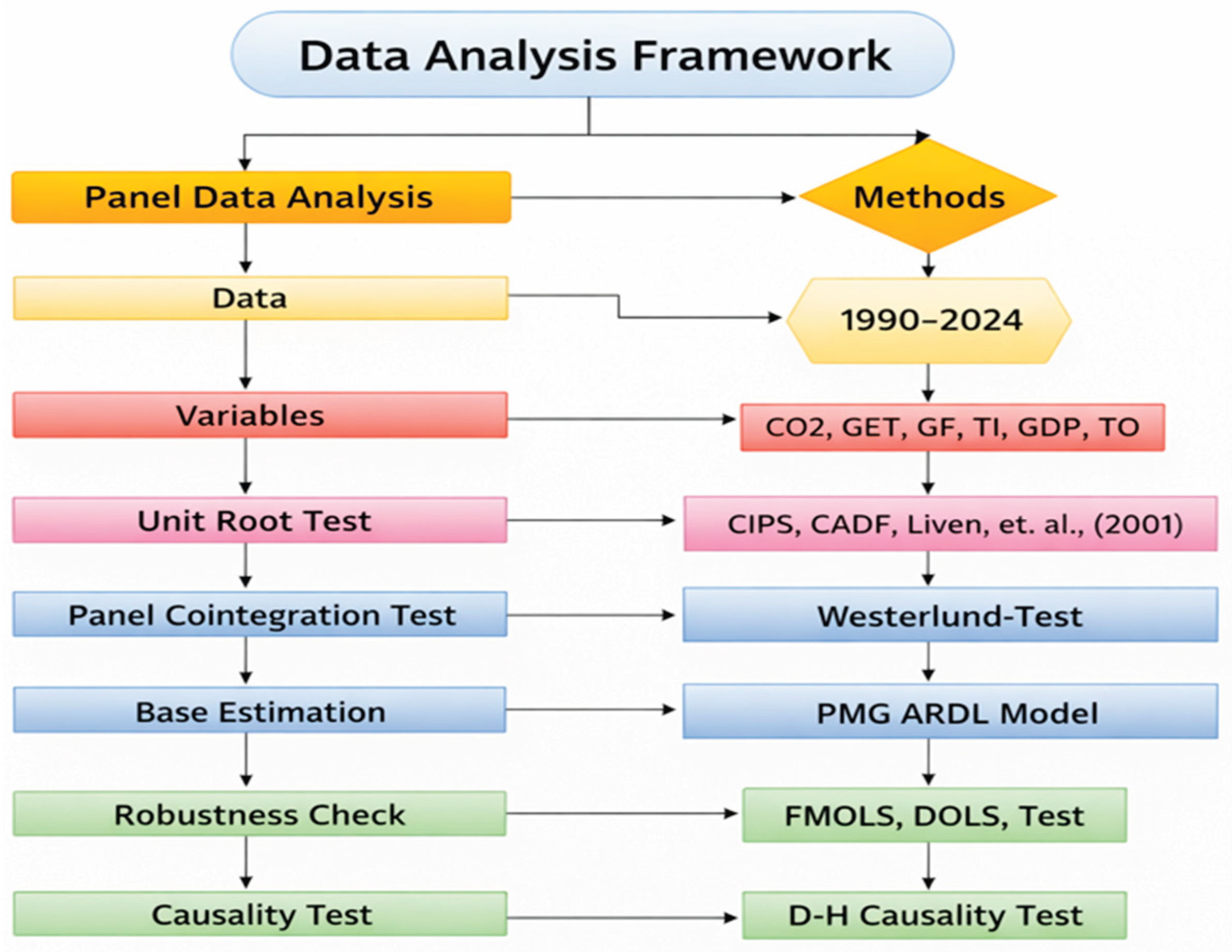

Table 1.
Variable Names and Description.
| Acronym | Variable Title | Measurement | Data Source |
|---|---|---|---|
| CO₂ | Carbon Emissions | CO₂ emissions (metric tons per capita) | World Bank and World Development Indicator |
| GET | Green Energy Transition | Renewable energy consumption (% of total final energy consumption) | World Bank and World Development Indicator |
| TI | Technological Innovation | Green patent applications (residents) | World Bank and World Development Indicator |
| GF | Green Finance | Green credit is allocated to the private sector as a percentage of GDP | World Bank and World Development Indicator |
| GDP | Economic Growth | GDP per capita (constant 2015 US$) | World Bank and World Development Indicator |
| TO | Trade Openness | Trade (% of GDP) | World Bank and World Development Indicator |
Table 2.
Summary Statistics and Correlation Matrix.
| LNCO₂ | LNGET | LNTI | LNGF | LNGDP | LNTO | |
|---|---|---|---|---|---|---|
| Mean | 1.28 | 3.02 | 8.52 | -0.43 | 8.07 | 3.70 |
| Maximum | 2.64 | 3.97 | 14.36 | 2.90 | 9.48 | 4.19 |
| Minimum | -0.36 | 1.18 | 4.93 | -4.34 | 6.28 | 2.74 |
| Std. Dev. | 0.96 | 0.74 | 2.37 | 1.47 | 0.98 | 0.32 |
| Observations | 145 | 145 | 145 | 145 | 145 | 145 |
Table 3.
Correlation Matrix.
| LNCO₂ | LNGET | LNTI | LNGF | LNGDP | LNTO | |
|---|---|---|---|---|---|---|
| LNCO₂ | 1.00 | |||||
| LNGET | -0.91 | 1.00 | ||||
| LNTI | 0.02 | 0.09 | 1.00 | |||
| LNGF | -0.44 | 0.63 | 0.73 | 1.00 | ||
| LNGDP | 0.73 | -0.74 | 0.22 | -0.19 | 1.00 | |
| LNTO | 0.58 | -0.58 | -0.11 | -0.37 | 0.51 | 1.00 |
Table 4.
Slope Heterogeneity Test.
| Test Statistics | Coefficient | p-value |
|---|---|---|
| ∆ test | 2.56** | 0.06 |
| ∆ adj | 3.43*** | 0.00 |
Note: ***, **, and * indicate significance at 1%, 5%, and 10% levels, respectively.
Table 5.
Cross-Sectional Dependence (CSD) Test Results.
| Variables | CD Statistic | p-value | Decision |
|---|---|---|---|
| LNCO₂ | 5.51*** | 0.00 | Cross-sectional dependence |
| LNGET | 10.38*** | 0.00 | Cross-sectional dependence |
| LNTI | 5.59*** | 0.00 | Cross-sectional dependence |
| LNGF | -3.07*** | 0.00 | Cross-sectional dependence |
| LNGDP | 16.86*** | 0.00 | Cross-sectional dependence |
| LNTO | 6.92*** | 0.00 | Cross-sectional dependence |
Note: ***, *, and * represent significance at 1%, 5%, and 10% levels.
Table 6.
Panel Unit Root Test Results. (A) Cross-Sectionally (CIPS). (B) Cross-Sectionally (CADF). (C) Levin et al. (2002).
Table 6.
Panel Unit Root Test Results. (A) Cross-Sectionally (CIPS). (B) Cross-Sectionally (CADF). (C) Levin et al. (2002).
| (A) | |||||
| Variable | Level (Stat.) | Prob. | First Diff. (Stat.) | Prob. | Decision |
| LNCO₂ | -0.11 | 0.45 | -3.83** | 0.00 | I(1) |
| LNGET | -0.43 | 0.33 | -3.33*** | 0.00 | I(1) |
| LNTI | 1.12 | 0.87 | -4.60*** | 0.00 | I(1) |
| LNGF | -16.93*** | 0.00 | -15.19*** | 0.00 | I(0) |
| LNGDP | 1.64 | 0.85 | -3.82*** | 0.00 | I(1) |
| LNTO | -2.49*** | 0.00 | -11.45*** | 0.00 | I(0) |
| (B) | |||||
| Variable | Level (Stat.) | Prob. | First Diff. (Stat.) | Prob. | Decision |
| LNCO₂ | 12.39 | 0.25 | 33.81*** | 0.00 | I(1) |
| LNGET | 8.84 | 0.54 | 34.01*** | 0.00 | I(1) |
| LNTI | 7.40 | 0.68 | 47.83*** | 0.00 | I(1) |
| LNGF | 21.51*** | 0.00 | 20.82*** | 0.00 | I(0) |
| LNGDP | 7.92 | 0.63 | 35.02*** | 0.00 | I(1) |
| LNTO | 27.13*** | 0.00 | 69.30*** | 0.00 | I(0) |
| (C) | |||||
| Variable | Level (Stat.) | Prob. | First Diff. (Stat.) | Prob. | Decision |
| LNCO₂ | -0.85 | 0.19 | -3.82*** | 0.00 | I(1) |
| LNGET | -1.53 | 0.06 | -1.49** | 0.00 | I(1) |
| LNTI | -0.86 | 0.19 | -2.98*** | 0.00 | I(1) |
| LNGF | -34.52*** | 0.00 | -33.21*** | 0.00 | I(0) |
| LNGDP | -1.66*** | 0.00 | -3.91*** | 0.00 | I(1) |
| LNTO | -2.38*** | 0.00 | -14.00*** | 0.00 | I(0) |
Note: ***, *, and * indicate significance at 1%, 5%, and 10%, respectively.
Table 7.
Westerlund Cointegration Test Results.
| Statistics | Value | Z-value | P-value | Outcome |
|---|---|---|---|---|
| Gt | 4.87*** | 3.96*** | 0.00 | Cointegration |
| Ga | -3.28*** | -4.52** | 0.02 | Cointegration |
| Pt | -4.51*** | -5.67*** | 0.00 | Cointegration |
| Pa | -1.19** | -2.63* | 0.06 | Cointegration |
Note: ***, **, and * denote significance at 1%, 5%, and 10%, respectively.
Table 8.
Pooled Mean Group Autoregressive Distributed Lag (PMG-ARDL) Results. Long-Run and Short-Run Estimates.
Table 8.
Pooled Mean Group Autoregressive Distributed Lag (PMG-ARDL) Results. Long-Run and Short-Run Estimates.
| Variables | Long Run Coef. | Std. Error | Short Run Coef. | Std. Error |
|---|---|---|---|---|
| LNGET | -0.45*** | 0.18 | -5.65** | 2.60 |
| (-0.25) | (-2.17) | |||
| LNTI | -0.17** | 0.05 | 2.45 | 2.38 |
| (-3.40) | 1.02 | |||
| LNGF | -0.10*** | 0.12 | -3.49 | 2.78 |
| (-2.33) | (-1.25) | |||
| LNGDP | 0.43*** | 0.18 | 7.43 | 4.73 |
| 2.38 | 1.63 | |||
| LNTO | -0.87** | 0.25 | 4.33 | 3.43 |
| -3.48 | 1.26 | |||
| ECT(-1) | -0.76** | 0.89 | ||
| (-0.85) |
Note: ***, **, and * denote significance at 1%, 5%, and 10%, respectively.
Table 9.
FMOLS and DOLS Robustness Test.
| Variable | FMOLS Coefficient | Prob. | DOLS Coefficient | Prob. |
|---|---|---|---|---|
| LNGET | -0.27*** | 0.00 | -0.37** | 0.04 |
| LNTI | -0.04** | 0.03 | -0.09* | 0.09 |
| LNGF | -0.02** | 0.02 | -0.12* | 0.08 |
| LNGDP | 0.64* | 0.08 | 0.49*** | 0.01 |
| LNTO | 0.69** | 0.04 | 0.38 | 0.14 |
Note: ***, **, and * indicate significance at 1%, 5%, and 10% levels, respectively.
Table 10.
Dumitrescu–Hurlin (DH) Panel Causality Test Results.
| Null Hypothesis | W-Stat | Zbar-Stat. | Prob. | Direction of Causality |
|---|---|---|---|---|
| LNGET ≠ LCO₂ | 2.16** | 1.07 | 0.03 | Uni-directional causality from GET to CO₂ |
| LCO₂ ≠ LNGET | 1.79 | -0.45 | 0.30 | |
| LNTI ≠ LCO₂ | 4.37*** | 3.19 | 0.05 | Uni-directional causality from TI to CO₂ |
| LCO₂ ≠ LNTI | 1.43 | -0.98 | 0.46 | |
| LNGF ≠ LCO₂ | 3.88** | 2.23 | 0.03 | Uni-directional causality from GF to CO₂ |
| LCO₂ ≠ LNGF | 2.15 | -0.14 | 0.89 | |
| LNGDP ≠ LCO₂ | 4.29*** | 2.63 | 0.01 | Bi-directional causality between GDP and CO₂ |
| LCO₂ ≠ LNGDP | 4.19** | 2.15 | 0.04 | |
| LNTO ≠ LCO₂ | 2.75 | 0.09 | 0.95 | Uni-directional causality from CO₂ to TO |
| LCO₂ ≠ LNTO | 3.32* | 1.27 | 0.09 |
Notes: ***, **, * represent rejection of the null hypothesis at 1%, 5%, and 10% levels. The symbol ≠ implies “does not homogeneously cause.
Disclaimer/Publisher’s Note: The statements, opinions and data contained in all publications are solely those of the individual author(s) and contributor(s) and not of MDPI and/or the editor(s). MDPI and/or the editor(s) disclaim responsibility for any injury to people or property resulting from any ideas, methods, instructions or products referred to in the content. |
© 2026 by the authors. Licensee MDPI, Basel, Switzerland. This article is an open access article distributed under the terms and conditions of the Creative Commons Attribution (CC BY) license (http://creativecommons.org/licenses/by/4.0/).
Copyright: This open access article is published under a Creative Commons CC BY 4.0 license, which permit the free download, distribution, and reuse, provided that the author and preprint are cited in any reuse.


