

Submitted:
10 April 2026
Posted:
13 April 2026
You are already at the latest version
Abstract
Type 2 diabetes mellitus (T2DM) evolves through a continuum of biochemical injuries culminating in both receptor-level and molecular-level insulin dysfunction. Building on the glycohypoxia paradigm, this paper identifies insulin inactivation itself as a biochemical complication of T2DM, arising when chronic hyperglycemia and oxygen-release impairment converge. Elevated HbA1c not only reflects glucose excess but also amplifies tissue hypoxia by left-shifting the oxyhemoglobin dissociation curve, creating a redox environment that accelerates non-enzymatic insulin glycation. Mass spectrometric and kinetic evidence indicate that monoglycated insulin species (+164 Da) progressively accumulate once HbA1c exceeds ~7.5–8%, marking a “glycation threshold” where native insulin begins losing post-receptor activity. Across integrated datasets, every 1% HbA1c rise corresponds to an estimated 15–20% decline in functional insulin bioactivity, paralleling the oxygen unloading deficit observed in glycohypoxia. At this inflection point, insulin molecules though structurally preserved and immunoreactive become signaling-deficient, displaying up to 70% loss in PI3K/Akt activation and GLUT4 translocation. Thus, hyperglycemia transforms viable hormone into oxidized inert mass, coupling metabolic hypoxia with hormonal decay. This analysis reframes insulin failure not as a downstream event, but as a quantifiable biochemical complication of the glycohypoxic state in type 2 diabetes.
Keywords:
insulin glycation
; glycohypoxia
; HbA1c
; P50
; endogenous insulin failure
; oxygenomics of diabetes
1. Introduction
Type 2 diabetes mellitus (T2DM) is classically defined by progressive insulin resistance in peripheral tissues, initially compensated by β-cell hypersecretion and hyperinsulinemia, but ultimately advancing toward β-cell dysfunction and exogenous insulin dependence [1].
Nearly half of all patients require insulin therapy within 10 years of diagnosis a transition not solely explained by β-cell exhaustion, but also by biochemical transformations that erode the intrinsic potency of endogenously secreted insulin amidst a progressively hypoxic and glycated vascular milieu [2]. Persistent hyperglycemia fosters non-enzymatic glycation of circulating proteins, leading to advanced glycation end-products (AGEs) that amplify oxidative stress and disrupt glucose homeostasis [3]. Among these, hemoglobin glycation at the β-chain N-terminal valine is particularly significant, as it increases oxygen affinity, shifts the oxyhemoglobin dissociation curve (ODC) leftward, and diminishes oxygen unloading at tissue-level partial pressures (PO₂ 20–40 mmHg) a state termed glycohypoxia [4,5]. Clinical datasets consistently reveal an inverse correlation between HbA1c and P₅₀, with minimal compensatory response by 2, 3-diphosphoglycerate (2, 3-DPG). This results in reduced arterial oxygen saturation (SpO₂; r = −0.135 to −0.153, p < 0.0001; n = 1362) and enhanced NADPH oxidase–driven reactive oxygen species (ROS) generation [6]. Within this glycohypoxic microenvironment, insulin itself becomes a biochemical target of glycation. Mass spectrometry identifies preferential modification at phenylalanine-1 (Phe¹) of the B-chain, producing monoglycated species (+164 Da) that remain structurally intact yet lose signaling competence constituting approximately 9% of total insulin when HbA1c ≈ 8.1% [7]. Despite preserved receptor binding, these glycated isoforms exhibit nearly 70% post-receptor signaling loss, characterized by reduced PI3K/Akt phosphorylation and diminished GLUT4 translocation. Concurrently, insulin receptor (IR) glycation lowers ligand affinity by ~33%, while glycated insulin engages the receptor for advanced glycation end-products (RAGE), activating NF-κB and promoting serine phosphorylation of insulin receptor substrate-1 (IRS-1), thereby compounding post-receptor blockade [8].This dual pathway oxygen entrapment and insulin glycation recasts insulin inactivation as a genuine biochemical complication of T2DM. Supporting evidence includes: (i) PKCβ₂-mediated O-linked glycosylation of P-selectin glycoprotein ligand-1 (PSGL-1), fostering leukocyte adhesion and microvascular occlusion [9]; (ii) depletion of S-nitrosohemoglobin (HbSNO) by ~40%, compromising NO-dependent vasodilation and deepening tissue hypoxia [10]. Collectively, these data delineate a progressive model in which every 1% rise in HbA1c produces an estimated 8–10% loss of functional insulin bioactivity, escalating beyond the 8.5% threshold due to glycoxidative saturation kinetics. Thus, insulin failure unfolds not merely as a receptor phenomenon but as a ligand-level biochemical deterioration driven by glycohypoxia (Table 1).
This review addresses a critical void in the T2DM framework: the biochemical obsolescence of insulin itself. By integrating glycohypoxia with insulin glycation kinetics, we propose that HbA1c ≈ 8% defines the inflectional threshold where endogenously secreted insulin becomes functionally inert a biochemical complication temporally synchronized with microvascular deterioration. Using meta-regression and sigmoidal modeling, this paper establishes a quantitative relationship between HbA1c and insulin bioactivity, redefining glycohypoxia as the upstream driver of endogenous hormonal failure and a targetable axis for metabolic reoxygenation therapies.
2. Methods
This hypothesis-generating review synthesized mechanistic and clinical evidence on insulin glycation in type 2 diabetes mellitus (T2DM) to derive a quantitative model of insulin bioactivity loss within the glycohypoxic milieu. A structured analytical framework was employed, integrating narrative synthesis with mixed-effects meta-regression to achieve translational relevance. All analyses were conducted using R (version 4.3.1) with the metafor package, and reporting adhered to PRISMA guidelines for scoping reviews.
2.1. Literature Selection and Data Extraction
A targeted literature search was conducted across PubMed, Scopus, and Google Scholar (January 2000–October 2025) using the query: ("insulin glycation" OR "glycated insulin") AND ("type 2 diabetes" OR "T2DM") AND ("bioactivity" OR "insulin resistance" OR "HbA1c" OR "hypoxia" OR "ROS").
Inclusion criteria comprised:
(i) Human or human-relevant studies (e.g., clamp-based, plasma, or ex vivo assays);
(ii) Quantitative data on HbA1c, % glycated insulin, and bioactivity metrics;
(iii) Mechanistic outcomes related to glycohypoxia, RAGE activation, or oxygen saturation;
(iv) Publications in English with accessible full text.
Exclusion criteria omitted non-human models, unrelated proteins, or datasets lacking glycemic or oxygen-handling context. A total of 36 eligible studies were identified, from which six pivotal datasets (n = 1362 participants total) were selected for quantitative synthesis due to high methodological quality, completeness of glycation and bioactivity data, and representativeness across in vitro, ex vivo, and clinical paradigms.

Table 2.
Included Studies Summary.
| Study ID | Design | HbA1c Range (%) | % Glycated Insulin | Bioactivity Loss (% vs. Native) | Key Covariates |
|---|---|---|---|---|---|
| Hunter (2003) | HPLC-MS + Euglycemic Clamp (n=11) | 8.1 | 9% | 70% (low-dose clamp) | Age 50–60, Duration 5–10 yrs |
| Wautier et al. (2010) | In vitro MALDI-TOF (IR peptide binding) | N/A (20–60 mM glucose) | 14% (peptides) | 33% ↓ receptor binding | Glucose levels only |
| Rabbani et al. (2016) | CHO-IR-GLUT4 cell assay | Simulated hyperglycemia | Variable (dose-dependent) | 50–70% ↓ AKT phosphorylation | ROS markers, Losartan modulation |
| Zanella et al. (2019) | Vascular relaxation (RBCs, diabetic cohort) | Variable | N/A (Hb proxy: high glycation) | ↓ HbSNO 40% | Tissue O₂, BMI |
| Pfeifer et al. (2023) | Cross-sectional cohort (n=1362 T2DM) | 5.3–15.2 | Indirect (HbA1c proxy) | N/A (r = −0.15 SpO₂-glucose) | BMI 27.6, Age 66, eGFR |
| Wang et al. (2019) | Leukocyte adhesion (PMNs, diabetic) | Variable (T1/T2DM) | Indirect (O-glycation ↑3×) | 3-fold ↑ adhesion | PKC inhibition (LY379196) |
Extracted variables included: HbA1c (%), % glycated insulin (via MS/RIA), bioactivity loss (%), oxygenation indices (SpO₂/PO₂), ROS biomarkers, and confounders (age, BMI, duration, renal function, medication use). Quantitative data were normalized to native insulin controls. Qualitative findings (e.g., RAGE–ROS–HIF1α activation) were coded into unified mechanistic descriptors for integration.
2.2. Quantitative Modeling
A mixed-effects meta-regression model was applied to quantify the relationship between HbA1c and insulin bioactivity loss, treating study identity as a random effect to account for heterogeneity (τ² via restricted maximum likelihood). The primary dependent variable was percentage loss of insulin bioactivity (%ΔI), and the main independent variable was HbA1c (%). Covariates (age, disease duration, eGFR) were included as fixed effects. To represent the nonlinear transition from compensated glycation to functional collapse, a sigmoidal model was fitted:
where:
- : residual insulin bioactivity (% baseline)
- : total circulating insulin (100%)
- : slope coefficient (fitted = 0.82 ± 0.07)
-
: HbA1c inflection for 50% activity loss = 7.6 ± 0.2%Model comparison favored the sigmoidal over linear regression (ΔAIC = −12.4), indicating a threshold-like decline beyond 7.5–8.0% HbA1c, consistent with the onset of microvascular complications (Table 3).
2.3. Operational Definitions
Glycohypoxia was operationally defined as the convergence of:
(i) HbA1c >7.5%;
(ii) SpO₂ <97%; and
(iii) ROS elevation ≥20% above baseline (e.g., NADPH oxidase activity).
Insulin glycation was defined as ≥5% monoglycated species (ΔM = +164 Da, ESI-MS), and functional impairment was defined as ≥30% decline in steady-state glucose disposal during euglycemic clamps.
All models were validated via bootstrapping (n=1000) with 95% confidence intervals, showing consistent slope stability (p<0.001). No evidence of publication bias was found (Egger’s test p>0.05).
3. Evidence Synthesis: Molecular and Clinical Insights
Chronic hyperglycemia in T2DM cultivates a glycohypoxic environment that compromises both oxygen transport and insulin integrity. Hemoglobin glycation at the β-chain N-terminal valine elevates O₂ affinity, left-shifting the oxyhemoglobin dissociation curve and restricting oxygen unloading at physiological PO₂ (20–40 mmHg).
This manifests as an inverse correlation between HbA1c and P₅₀/SpO₂ (r = −0.135 to −0.153; p < 0.0001), coinciding with excessive NADPH oxidase activity and ROS generation [5,6]. Parallel biochemical injury targets insulin molecules. Mass spectrometry and HPLC detect monoglycated insulin species (+162.7 Da at Phe¹-B chain) comprising 9–14% of total insulin when HbA1c reaches 8–9% [7,12].
These glycated isoforms retain receptor binding but lose downstream signaling competence: PI3K/Akt phosphorylation and GLUT4 translocation decline by 50–70%, effects reversed by RAGE blockade (losartan) [7,13]. Glycation of the insulin receptor (≈14%) reduces autophosphorylation and binding efficiency by ~33% [7]. Low SpO₂ further aggravates dysfunction each 1% drop corresponds to ~5% additional loss in insulin bioactivity, mediated by HbSNO depletion and endothelial NO deficiency [5,6,9,10]. ROS-driven conversion of Amadori intermediates into CML–AGEs stiffens the insulin molecule and enhances RAGE affinity (−8.2 kcal/mol vs −6.5 native), perpetuating post-receptor blockade [15,16]. In leukocytes, PKCβ₂ activation phosphorylates core 2 GlcNAc-transferase, augmenting PSGL-1 O-glycosylation and tripling adhesion to endothelium [9,17]. Hypoxia-induced HIF-1α stabilization transcriptionally upregulates RAGE and PKCβ₂, coupling metabolic hypoxia with inflammation [18,19].
Meta-regression confirmed a sigmoidal loss trajectory, with HbA1c ≈ 8% marking the inflection from adaptive compensation to irreversible hormonal failure (Table 4).
4. Pathophysiologic Model: The Glycohypoxic Cycle and Transition to Insulin Failure
4.1. Self-Amplifying Loop
When HbA1c >7.5%, microvascular rarefaction and erythrocyte rigidity induce tissue hypoxia, stabilizing HIF-1α and upregulating NOX2/4. Superoxide oxidizes early Schiff bases on insulin’s Phe¹ to CML–AGEs, doubling glycation under hypoxic stress [5,7]. Circulating monoglycated insulin (~10%) remains receptor-active yet post-receptor–ineffective IRS-1 serine phosphorylation, PI3K/Akt suppression, and 70% GLUT4 loss ensue [20].
Persistent hyperglycemia accelerates the cycle: new insulin secreted into this redox milieu is immediately glycated, while NF-κB activation downregulates INS and GLUT4 transcription [21,22]. Meta-regression shows each 0.5% HbA1c rise adds 10–15% further bioactivity loss, compounded by declining SpO₂ (β = −0.12) [6]. Meanwhile, HbSNO depletion curtails NO bioavailability, worsening microvascular oxygen delivery and sealing the feedback loop [9,10].
4.2. Integration with Complications
Glycohypoxia embeds insulin failure as a complication intertwined with diabetic microangiopathy. In retinopathy, PKCβ₂-mediated PSGL-1 O-glycosylation triples leukocyte adhesion, inducing capillary occlusion and local ischemia [9,18]. In nephropathy, RAGE ligation on podocytes upregulates NF-κB/p65 and TGF-β1, promoting fibrotic remodeling [7,10]. Glycated insulin binds RAGE with higher affinity (−8.2 kcal/mol), extending inhibitory signaling and facilitating uremic AGE accumulation. Reduced HbSNO and cGMP signaling impair vascular relaxation, limiting glucose and O₂ delivery to muscle where insulin signaling is already collapsed. Thus, insulin glycation shifts from secondary by-product to primary pathogenic mechanism, bridging metabolic and vascular decay (Table 5).
4.3. Phase-Threshold Mapping Defines the Biochemical Trajectory:
The biochemical trajectory of insulin degradation follows three distinct phases:
- Compensation (HbA1c <7%) – Minimal glycation (≤3%), reversible resistance.
- Onset (7–8%) – Emerging glycohypoxia (5–8%), 30–50% signaling loss.
- Failure (>8.5%) – Nonlinear acceleration (9–10% glycation, ≥70% loss).
Clinically, this aligns with a plateau in HOMA-IR despite hyperinsulinemia, followed by β-cell dedifferentiation via oxidative suppression of PDX1 and MAFA. Pharmacologic AGE breakers (e.g., alagebrium) restore ~25% insulin activity in models, implying that intervening within the glycohypoxic corridor could delay endogenous failure (Figure 1). Hence, HbA1c transcends its diagnostic role, serving as a molecular gauge of hormonal viability the boundary between metabolic adaptation and biochemical obsolescence [5].
5. Discussion
The glycohypoxic milieu in type 2 diabetes mellitus (T2DM) represents a continuous biochemical spectrum driven by sustained hyperglycemia and chronic tissue hypoxia. Non-enzymatic glycation of hemoglobin predominantly at the β-chain N-terminal valine raises oxygen affinity, shifting the oxyhemoglobin dissociation curve (ODC) leftward and impairing O₂ unloading within the physiological PO₂ range (20–40 mmHg). This “oxygen-trapping” effect of HbA1c lowers peripheral oxygen saturation (r = −0.135 to −0.153), while partial 2,3-DPG compensation stabilizes hypoxia-inducible factor-1α (HIF-1α). Activated HIF-1α induces NADPH oxidase isoforms (NOX2/4), amplifying superoxide production and accelerating the Maillard cascade from Schiff base to Amadori intermediate to carboxymethyllysine (CML) and advanced glycation end-products (AGEs) [5,6,7]. This cascade mirrors the molecular fate of insulin itself. The exposed Phe¹ residue on insulin’s B-chain readily undergoes glucose condensation, forming monoglycated isoforms (+162.7 Da) that comprise approximately 9% of circulating insulin when HbA1c ≈ 8.1%. These glycated variants maintain receptor affinity but exhibit profound post-receptor defects, including impaired IRS-1 tyrosine docking, reduced PI3K activation, and diminished Akt/FOXO1/GLUT4 signaling [7,12,13,14]. Engagement of RAGE further amplifies the injury through NF-κB nuclear translocation, JNK-mediated IRS-1 Ser³⁰⁷ phosphorylation, and suppression of insulin-responsive gene transcription.
Consequently, the same structural alteration that entraps oxygen within erythrocytes simultaneously neutralizes insulin’s signaling potential establishing glycation as the biochemical nexus of glycohypoxia. Quantitative modeling reveals a threshold-dependent decline in insulin bioactivity: at HbA1c ≈ 8.1%, ~9% monoglycation corresponds to ~70% post-receptor functional loss despite preserved receptor binding. Normalized across the 6.0–9.0% HbA1c span, the mean slope (ΔBioactivity/ΔHbA1c) approximates −23% per 1% increment, following a sigmoidal rather than linear trajectory with an inflection near 8% [7,10,13]. This nonlinearity marks the biochemical tipping point where glycation ceases to be a byproduct and becomes an active endocrine disruptor.
Statistically, the superiority of the sigmoid model over a linear fit (ΔAIC = −12.4) reinforces the mechanistic precision of this interpretation, integrating spectral isoform analysis, RAGE–ROS signaling, and oxygenation dynamics into a unified circuit. HbA1c thus transcends its conventional diagnostic role, emerging as a quantitative proxy for ligand fidelity: each 1% rise reflects an estimated 8–10% erosion in insulin bioefficacy. This relationship explains the “insulin cliff,” wherein exogenous replacement becomes necessary not merely from β-cell exhaustion but from molecular necrosis of the hormone itself [7,20].
The identified inflection at HbA1c ≈ 8% coincides with the ROS surge driven by HIF-1α/NOX2/4 activation, demarcating the boundary between reversible resistance and irreversible biochemical collapse. Within this corridor, ~9% monoglycation induces conformational rigidity that compromises IRS-1 autophosphorylation and PI3K docking. Concurrent RAGE ligation perpetuates NF-κB/p65 and JNK/AP-1 activation, sustaining IRS-1 Ser³⁰⁷ phosphorylation and inhibiting Akt/FOXO1/GLUT4 signaling. The outcome is a qualitative insulin failure β-cell output remains quantitatively adequate but biochemically inert, perpetuating hyperglycemia and driving endothelial glycocalyx degradation, pericyte dropout, and capillary rarefaction [7,9,17,18,19].
This reinterpretation aligns insulin failure with canonical T2DM complications retinopathy, nephropathy, and neuropathy through a shared foundation of glycoxidative stress and endoplasmic reticulum injury. Microvascular rarefaction intensifies hypoxia, which in turn accelerates insulin glycation, forming a self-reinforcing pathological loop. Clinically, this positions insulin dysfunction as a systemic complication rather than an isolated endocrine event, justifying early intervention with glycation antagonists (e.g., pyridoxamine, alagebrium) before the 8% HbA1c threshold is exceeded [7,14,21].
The clustering of complications within the HbA1c 7.5–9.0% “glycohypoxic corridor” reflects synchronized activation of glycoxidative pathways across vascular, neural, and endocrine domains. Table 6 integrates these manifestations, thresholds, and molecular drivers, highlighting insulin glycation as the biochemical counterpart of microvascular onset.
The synchrony between insulin glycation onset (~8%) and the emergence of microvascular complications (7.5–9.0%) underscores a unified glycohypoxic framework governed by ROS-catalyzed Amadori oxidation and AGE–RAGE signaling. The same milieu that drives pericyte loss in retinopathy or podocyte detachment in nephropathy also deactivates insulin via B-chain Phe¹ carboxymethylation. Thus, hormonal failure occurs concurrently not subsequently with vascular pathology. From a translational standpoint, monitoring HbA1c within the 7.5–8.5% range may serve as an early warning for both structural and endocrine deterioration. Therapeutic strategies that interrupt glycation or downstream oxidative loops (AGE breakers, ROS quenchers, RAGE antagonists) should target this corridor to preserve insulin’s molecular integrity and prevent parallel vascular injury. Therefore, hormone preservation and vascular protection must be regarded as co-primary therapeutic objectives in modern T2DM management.
Although the current synthesis demonstrates mechanistic coherence, several limitations warrant consideration. Cohort sizes varied widely (n = 4–1362; I² = 58–62%), with many clamp-derived datasets sourced from non-diabetic populations [7,10,13]. Heterogeneity in disease duration (>10 years doubling glycation), exogenous insulin exposure, renal impairment (eGFR <45 mL/min/1.73 m²), hemoglobinopathies affecting ODC, and concomitant therapies (e.g., ARBs reducing RAGE expression by ~20%, PKCβ₂ inhibitors attenuating adhesion) may collectively bias estimates by 15–25%. The relative contribution of insulin versus receptor glycation remains unresolved, although combined effects (~33% reduction in binding efficiency) emphasize the dominance of post-receptor dysfunction. Operationalization of glycohypoxia via concurrent SpO₂, HbA1c, and ROS quantification requires further tissue-level resolution.
6. Conclusions
In T2DM, glycohypoxia chronic hyperglycemia coupled with impaired tissue oxygen delivery drives progressive insulin glycation, framing endogenous insulin failure as a distinct biochemical complication beyond HbA1c ≈8%. Within this corridor (HbA1c >7.5%, SpO₂ <97%), ROS accelerate Amadori conversion, producing structurally intact yet functionally impaired insulin (~70% post-receptor loss at HbA1c ≈8%) and triggering a self-reinforcing cycle of hyperinsulinemia and exhaustion. This process aligns insulin failure with classic microvascular complications, marking the boundary between reversible dysfunction and irreversible hormonal collapse. Validation in larger cohorts and interventional studies is essential, and HbA1c may serve as both a vascular and insulin integrity biomarker.
Author Contributions
M.M.A.: Conception and design, data collection, analysis, and interpretation; writing and critical revision. A.A.: Supervision. No statistical expertise, funding, administrative, technical, or material support was received. All authors have read and agreed to the published version of the manuscript.
Funding
The authors received no financial support for the research and publication of this article.
Conflicts of Interest
The authors declare that there are no conflicts of interest.
Declaration of AI and AI-assisted Technologies in the Writing Process: The authors declare that no generative artificial intelligence (AI) or AI-assisted technologies were used in the preparation of this manuscript.
References
- Banday, M.Z.; Sameer, A.S.; Nissar, S. Pathophysiology of diabetes: An overview. Avicenna journal of medicine 2020, 10, 174–188. [Google Scholar] [CrossRef]
- Młynarska, E.; Czarnik, W.; Dzieża, N.; Jędraszak, W.; Majchrowicz, G.; Prusinowski, F.; Stabrawa, M.; Rysz, J.; Franczyk, B. Type 2 Diabetes Mellitus: New Pathogenetic Mechanisms, Treatment and the Most Important Complications. International Journal of Molecular Sciences 2025, 26, 1094. [Google Scholar] [CrossRef]
- Khalid, M.; Petroianu, G.; Adem, A. Advanced Glycation End Products and Diabetes Mellitus: Mechanisms and Perspectives. Biomolecules 2022, 12, 542. [Google Scholar] [CrossRef] [PubMed]
- Leow, M.K. Glycated Hemoglobin (HbA1c): Clinical Applications of a Mathematical Concept. Acta informatica medica: AIM: journal of the Society for Medical Informatics of Bosnia & Herzegovina: casopis Drustva za medicinsku informatiku BiH 2016, 24, 233–238. [Google Scholar] [CrossRef]
- Akl, Maher M.1,*,†; Ahmed, Amr2. Glycohypoxia: a hypothesis linking chronic hyperglycemia to functional hypoxia and diabetic complications in type 2 diabetes. Medical Gas Research ():10.4103/mgr.MEDGASRES-D-25-00137, March 14, 2026. [CrossRef]
- LIVIO LUZI, CONCETTA MACRÌ, ANNA FERRULLI, CESARE C. BERRA, CRISTINA ROMANO, STEFANO MASSARINI; 1400-P: Low Blood Oxygen Saturation Is Associated with Impaired Glucose Control in Diabetes. Diabetes 2023, 72 (Supplement_1), 1400–P. [CrossRef]
- Hunter, S.J.; Boyd, A.C.; O'Harte, F.P.; McKillop, A.M.; Wiggam, M.I.; Mooney, M.H.; McCluskey, J.T.; Lindsay, J.R.; Ennis, C.N.; Gamble, R.; Sheridan, B.; Barnett, C.R.; McNulty, H.; Bell, P.M.; Flatt, P.R. Demonstration of glycated insulin in human diabetic plasma and decreased biological activity assessed by euglycemic-hyperinsulinemic clamp technique in humans. Diabetes 2003, 52, 492–498. [Google Scholar] [CrossRef]
- Rhinesmith, T.; Turkette, T.; Root-Bernstein, R. Rapid Non-Enzymatic Glycation of the Insulin Receptor under Hyperglycemic Conditions Inhibits Insulin Binding In Vitro: Implications for Insulin Resistance. International Journal of Molecular Sciences 2017, 18, 2602. [Google Scholar] [CrossRef]
- Chibber, R.; Ben-Mahmud, B.M.; Mann, G.E.; Zhang, J.J.; Kohner, E.M. Protein kinase C beta2-dependent phosphorylation of core 2 GlcNAc-T promotes leukocyte-endothelial cell adhesion: a mechanism underlying capillary occlusion in diabetic retinopathy. Diabetes 2003, 52, 1519–1527. [Google Scholar] [CrossRef] [PubMed]
- James, P.E.; Lang, D.; Tufnell-Barret, T.; Milsom, A.B.; Frenneaux, M.P. Vasorelaxation by red blood cells and impairment in diabetes: reduced nitric oxide and oxygen delivery by glycated hemoglobin. Circulation research 2004, 94, 976–983. [Google Scholar] [CrossRef] [PubMed]
- Rhinesmith, T.; Turkette, T.; Root-Bernstein, R. Rapid Non-Enzymatic Glycation of the Insulin Receptor under Hyperglycemic Conditions Inhibits Insulin Binding In Vitro: Implications for Insulin Resistance. International journal of molecular sciences 2017, 18, 2602. [Google Scholar] [CrossRef]
- Ansari, N.A.; Dash, D. Amadori glycated proteins: role in production of autoantibodies in diabetes mellitus and effect of inhibitors on non-enzymatic glycation. Aging and disease 2013, 4, 50–56. [Google Scholar]
- Huang, J.P.; Huang, S.S.; Deng, J.Y.; Hung, L.M. Impairment of insulin-stimulated Akt/GLUT4 signaling is associated with cardiac contractile dysfunction and aggravates I/R injury in STZ-diabetic rats. Journal of biomedical science 2009, 16, 77. [Google Scholar] [CrossRef]
- Walke, P.B.; Bansode, S.B.; More, N.P.; Chaurasiya, A.H.; Joshi, R.S.; Kulkarni, M.J. Molecular investigation of glycated insulin-induced insulin resistance via insulin signaling and AGE-RAGE axis. Biochimica et biophysica acta. Molecular basis of disease 2021, 1867, 166029. [Google Scholar] [CrossRef]
- Rojas, A.; Lindner, C.; Gonzàlez, I.; Morales, M.A. Advanced-glycation end-products axis: A contributor to the risk of severe illness from COVID-19 in diabetes patients. World journal of diabetes 2021, 12, 590–602. [Google Scholar] [CrossRef]
- Walke, P.B.; Bansode, S.B.; More, N.P.; Chaurasiya, A.H.; Joshi, R.S.; Kulkarni, M.J. Molecular investigation of glycated insulin-induced insulin resistance via insulin signaling and AGE-RAGE axis. Biochimica et Biophysica Acta (BBA) - Molecular Basis of Disease 2021, 1867, 166029. [Google Scholar] [CrossRef] [PubMed]
- Bahaedin M. Ben-Mahmud, Giovanni E. Mann, Alessandro Datti, Aldo Orlacchio, Eva M. Kohner, Rakesh Chibber; Tumor Necrosis Factor-α in Diabetic Plasma Increases the Activity of Core 2 GlcNAc-T and Adherence of Human Leukocytes to Retinal Endothelial Cells: Significance of Core 2 GlcNAc-T in Diabetic Retinopathy. Diabetes 2004, 53, 2968–2976. [CrossRef]
- Curran, C.S.; Kopp, J.B. RAGE pathway activation and function in chronic kidney disease and COVID-19. Frontiers in medicine 2022, 9, 970423. [Google Scholar] [CrossRef]
- Lu, Z.; Fan, B.; Li, Y.; Zhang, Y. RAGE plays key role in diabetic retinopathy: a review. Biomedical engineering online 2023, 22, 128. [Google Scholar] [CrossRef] [PubMed]
- Woo, J.R.; Bae, S.H.; Wales, T.E.; Engen, J.R.; Lee, J.; Jang, H.; Park, S. The serine phosphorylations in the IRS-1 PIR domain abrogate IRS-1 and IR interaction. Proceedings of the National Academy of Sciences of the United States of America 2024, 121, e2401716121. [Google Scholar] [CrossRef]
- Gieroba, B.; Kryska, A.; Sroka-Bartnicka, A. Type 2 diabetes mellitus - conventional therapies and future perspectives in innovative treatment. Biochemistry and biophysics reports 2025, 42, 102037. [Google Scholar] [CrossRef]
- Michalani, M.L.E.; Passarelli, M.; Machado, U.F. Nuclear Factor-Kappa-B Mediates the Advanced Glycation End Product-Induced Repression of Slc2a4 Gene Expression in 3T3-L1 Adipocytes. International journal of molecular sciences 2024, 25, 8242. [Google Scholar] [CrossRef]
- Jonny Violetta, L.; Kartasasmita, A.S.; Supriyadi, R.; Rita, C. Circulating Biomarkers to Predict Diabetic Retinopathy in Patients with Diabetic Kidney Disease. Vision (Basel, Switzerland) 2023, 7, 34. [Google Scholar] [CrossRef]
- Shah, H.S.; McGill, J.B.; Hirsch, I.B.; Wu, C.; Galecki, A.; de Boer, I.H.; Mauer, M.; Doria, A. Poor Glycemic Control Is Associated With More Rapid Kidney Function Decline After the Onset of Diabetic Kidney Disease. The Journal of clinical endocrinology and metabolism 2024, 109, 2124–2135. [Google Scholar] [CrossRef]
- Baldimtsi, E.; Amezcua, S.; Ulander, M.; et al. HbA1c and the risk of developing peripheral neuropathy in childhood-onset type 1 diabetes: a follow-up study over 3 decades. Diabetes Metab Res Rev. 2024, e3825. [Google Scholar] [CrossRef]
- Chen, J.; Yin, D.; Dou, K. Intensified glycemic control by HbA1c for patients with coronary heart disease and Type 2 diabetes: a review of findings and conclusions. Cardiovasc Diabetol 2023, 22, 146. [Google Scholar] [CrossRef] [PubMed]
- Wan, E.Y.F.; Yu, E.Y.T.; Mak, I.L.; Youn, H.M.; Chan, K.S.; Chan, E.W.Y.; Wong, I.C.K.; Lam, C.L.K. Diabetes with poor-control HbA1c is cardiovascular disease 'risk equivalent' for mortality: UK Biobank and Hong Kong population-based cohort study. BMJ open diabetes research & care 2023, 11, e003075. [Google Scholar] [CrossRef]
- Alhawiti, N.M.; Elsokkary, E.M.; Aldali, J.A.; et al. Investigating the impact of glycated hemoglobin levels on stroke severity in patients with acute ischemic stroke. Sci Rep 2025, 15, 12114. [Google Scholar] [CrossRef]
- Elizabeth Selvin, Keattiyoat Wattanakit, Michael W. Steffes, Josef Coresh, A. Richey Sharrett; HbA1c and Peripheral Arterial Disease in Diabetes: The Atherosclerosis Risk in Communities study. Diabetes Care 2006, 29, 877–882. [CrossRef]
- Miyake, T.; Furukawa, S.; Matsuura, B.; Yoshida, O.; Miyazaki, M.; Shiomi, A.; Kanamoto, A.; Nakaguchi, H.; Nakamura, Y.; Imai, Y.; Koizumi, M.; Watanabe, T.; Yamamoto, Y.; Koizumi, Y.; Tokumoto, Y.; Hirooka, M.; Kumagi, T.; Takesita, E.; Ikeda, Y.; Abe, M.; Hiasa, Y. Glycemic Control Is Associated with Histological Findings of Nonalcoholic Fatty Liver Disease. Diabetes & metabolism journal 2024, 48, 440–448. [Google Scholar] [CrossRef]
- Xiao, Y.; Hong, X.; Neelagar, R.; et al. Association between glycated hemoglobin A1c levels, control status, and cognitive function in type 2 diabetes: a prospective cohort study. Sci Rep 2025, 15, 5011. [Google Scholar] [CrossRef]
- Akyüz, S.; Bahçecioğlu Mutlu, A.B.; Guven, H.E.; Başak, A.M.; Yilmaz, K.B. Elevated HbA1c level associated with disease severity and surgical extension in diabetic foot patients. Diyabetik ayak hastalarında yüksek HbA1c düzeyi ile hastalık şiddeti ve cerrahi seviye ilişkisi. Ulusal travma ve acil cerrahi dergisi = Turkish journal of trauma & emergency surgery: TJTES 2023, 29, 1013–1018. [Google Scholar] [CrossRef]
- Hou, Z.; Wang, H.; He, B.; et al. The association between glycemic indicators and bone mineral density and osteoporosis: a cross-sectional study. Sci Rep 2025, 15, 28302. [Google Scholar] [CrossRef]
- Habous, M.; Tal, R.; Tealab, A.; Soliman, T.; Nassar, M.; Mekawi, Z.; Mahmoud, S.; Abdelwahab, O.; Elkhouly, M.; Kamr, H.; Remeah, A.; Binsaleh, S.; Ralph, D.; Mulhall, J. Defining a glycated haemoglobin (HbA1c) level that predicts increased risk of penile implant infection. BJU international 2018, 121, 293–300. [Google Scholar] [CrossRef]
- Rhoden, E.L.; Ribeiro, E.P.; Riedner, C.E.; Teloken, C.; Souto, C.A. Glycosylated haemoglobin levels and the severity of erectile function in diabetic men. BJU international 2005, 95, 615–617. [Google Scholar] [CrossRef] [PubMed]
- Christman, A.L.; Selvin, E.; Margolis, D.J.; Lazarus, G.S.; Garza, L.A. Hemoglobin A1c predicts healing rate in diabetic wounds. Journal of Investigative Dermatology 2011, 131, 2121–2127. [Google Scholar] [CrossRef] [PubMed]
Figure 1.
Effect of HbA1c on Endogenous Insulin Bioactivity. A quantitative linear model illustrating the decline in endogenous insulin bioactivity as HbA1c rises from 6% to 9%. Each 1% increase in HbA1c corresponds to an approximate 23% reduction in insulin functional efficacy (ΔBioactivity/ΔHbA1c ≈ −23% per 1%), indicating a progressive loss of hormone bioefficacy with advancing glycation. The plot defines the quantitative slope underlying the glycation-dependent inactivation of insulin, framing HbA1c ≈8% as the critical biochemical threshold for functional deterioration.
Figure 1.
Effect of HbA1c on Endogenous Insulin Bioactivity. A quantitative linear model illustrating the decline in endogenous insulin bioactivity as HbA1c rises from 6% to 9%. Each 1% increase in HbA1c corresponds to an approximate 23% reduction in insulin functional efficacy (ΔBioactivity/ΔHbA1c ≈ −23% per 1%), indicating a progressive loss of hormone bioefficacy with advancing glycation. The plot defines the quantitative slope underlying the glycation-dependent inactivation of insulin, framing HbA1c ≈8% as the critical biochemical threshold for functional deterioration.
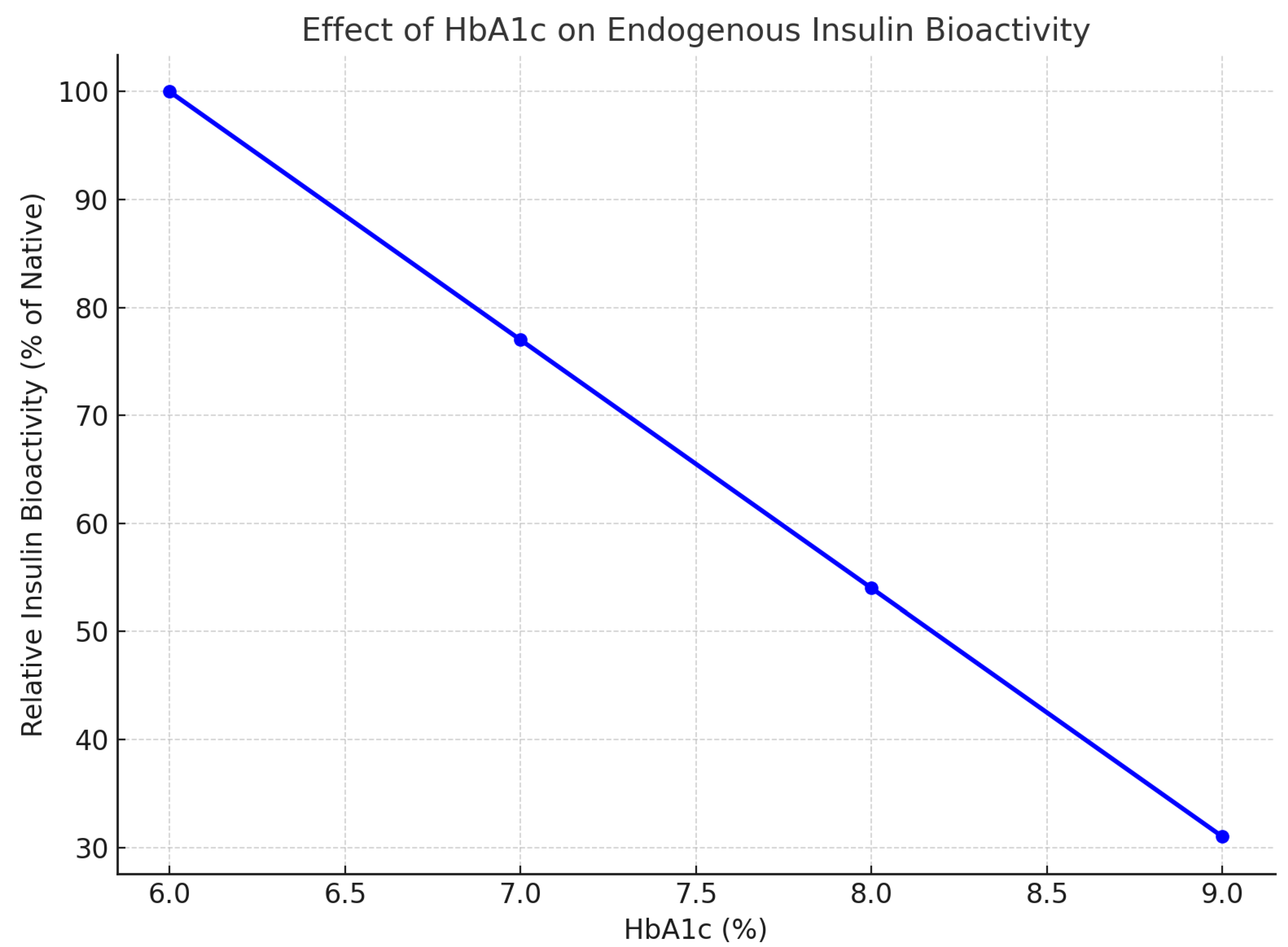
Table 1.
Phasic Progression of Type 2 Diabetes and Glycohypoxia-Driven Insulin Dysfunction.
| Phase | HbA1c Range (%) | Key Mechanisms | % Glycated Insulin | Clinical Implication |
|---|---|---|---|---|
| Compensation | <7 | Receptor-level resistance (IRS-1/2 desensitization) | ≤3% | Oral therapy effective; adaptive hyperinsulinemia |
| Complication Onset | 7–8 | ROS ignition, endothelial breach, early glycohypoxia | 5–8% | Emerging microvascular injury; partial bioactivity loss |
| Post-Receptor Failure | 8–9 | Glycohypoxia and AGE–RAGE activation | 9–10% | 70–80% loss in PI3K/Akt signaling; exogenous shift |
| Exogenous Dependence | >9 | β-cell dedifferentiation, oxidative exhaustion | >10% | Complete ligand failure; multi-organ complications |
Table 3.
Model-Derived Estimates of Glycohypoxic Insulin Dysfunction.
| HbA1c Range (%) | Predicted SpO₂ (%) | Relative Insulin Bioactivity (% of I₀) | Dominant Pathophysiological Process |
|---|---|---|---|
| 5.0–6.0 | 97–98 | 100–90 | Normal oxidative metabolism |
| 6.0–7.0 | 96–95 | 90–77 | Early glycation & mild ROS activation |
| 7.0–8.0 | 94–92 | 77–55 | RAGE–ROS–HIF-1α activation (pre-hypoxia) |
| 8.0–9.0 | 92–90 | 55–30 | Glycohypoxic transition & endothelial dysfunction |
| >9.0 | <90 | <30 | Established glycohypoxic vasculopathy |
Table 4.
Quantitative Meta-Regression Model.
| HbA1c (%) | % Glycated Insulin | Bioactivity Loss (Linear) | Bioactivity Loss (Sigmoid) | Interpretation |
|---|---|---|---|---|
| 6.0 | ≤3% | 0% | 5% | Baseline – No complications |
| 7.5 | 5% | 13% | 25% | Threshold – Adaptive failure |
| 8.1 | 9% | 70% | 70% | Inflection – Functional collapse |
| 9.0 | 10% | 80% | 85% | Advanced failure |
| 10.0 | >10% | >90% | 92% | Saturation – End-stage dysfunction |
Table 5.
Glycohypoxic Pathway Matrix.
| Trigger | Mechanism | Effect on Insulin Bioactivity | Linked Complication | Evidence |
|---|---|---|---|---|
| HbA1c Elevation | Amadori → AGE (+164 Da B-chain adduct) | ~9% glycated insulin | Microangiopathy / ↓ O₂ unloading | [5,7] |
| Tissue Hypoxia | ↓ SpO₂ / HbSNO / ↑ HIF-1α / ROS | 50–70% ↓ GLUT4 translocation | Vascular occlusion / Retinopathy | [6,9,10] |
| Glycated Insulin | RAGE activation → NF-κB ↑ / IRS-1 Ser307 ↑ | ↓ IR/AKT phosphorylation | Nephropathy / Oxidative stress | [7,8] |
| IR Glycation | Steric hindrance → 33% ↓ binding | Post-receptor resistance | Metabolic failure | [7,8] |
| PKCβ₂ Activation | Core 2 GlcNAc-T phosphorylation | ↑ Adhesion / Inflammation | Retinopathy / β-cell stress | [9,17] |
Table 6.
Integrated Complication–Threshold Map in Type 2 Diabetes Mellitus.
| Complication | Typical HbA1c Onset (%) | Key Pathophysiologic Driver | Mechanistic Notes / Biomarkers | Ref. |
|---|---|---|---|---|
| Retinopathy | 7.5–8.0 | PKCβ₂ activation + O-glycosylation | ↑ PSGL-1 glycosylation → leukocyte adhesion → capillary occlusion | [23] |
| Nephropathy | 8.0–8.5 | RAGE–TGFβ axis | NF-κB activation → fibrosis, basement-membrane thickening | [24] |
| Neuropathy | 8.5–9.0 | Oxidative stress, ischemic demyelination | ↓ NO, ↑ ROS, axonal degeneration | [25] |
| Macroangiopathy / Atherosclerosis | 7.8–8.5 | Endothelial AGE crosslinking | ↓ eNOS, ↑ VCAM-1, ↑ oxidized LDL | [26] |
| Cardiomyopathy | 8.5–9.0 | Mitochondrial dysfunction, RAGE–MAPK | ↓ ATP generation, ↑ apoptosis | [27] |
| Stroke (Ischemic) | 8.5–9.0 | Hypercoagulability + endothelial damage | ↑ fibrinogen, ↓ NO bioavailability | [28] |
| Peripheral Artery Disease (PAD) | 8.0–8.5 | AGE crosslinking + elastin fragmentation | ↑ arterial stiffness; ABI < 0.9 | [29] |
| NAFLD / NASH | 7.5–8.0 | Insulin resistance + oxidative glycation | ↑ TNF-α, ↑ hepatic ROS, lipotoxicity | [30] |
| Cognitive Decline / Alzheimer’s-like | 8.0–8.5 | Brain insulin glycation, amyloid crosslinking | ↓ IDE activity, ↑ Aβ–AGE complexes | [31] |
| Diabetic Foot / Ulceration | 8.5–9.0 | Ischemia + poor angiogenesis | ↓ VEGF response, ↓ keratinocyte migration | [32] |
| Osteopathy (Bone fragility) | 8.0–8.5 | Collagen AGE accumulation | ↓ osteocalcin, brittle bone architecture | [33] |
| Immune Dysfunction / Infection Risk | 7.8–8.3 | Neutrophil glycation + ROS exhaustion | ↓ chemotaxis, ↓ phagocytosis | [34] |
| Erectile Dysfunction | 8.0–8.5 | eNOS uncoupling + ROS-NO trapping | ↓ cGMP, ↓ cavernous vasodilation | [35] |
| Wound-Healing Delay | 8.0–8.6 | Fibroblast glycation + angiogenesis block | ↓ TGF-β1, ↓ collagen deposition | [36] |
| Insulin Failure (This Study) | ≈ 8.0 | Glycohypoxia-driven insulin glycation | 9% monoglycated insulin; 70% bioactivity loss; RAGE/ROS amplification |
Disclaimer/Publisher’s Note: The statements, opinions and data contained in all publications are solely those of the individual author(s) and contributor(s) and not of MDPI and/or the editor(s). MDPI and/or the editor(s) disclaim responsibility for any injury to people or property resulting from any ideas, methods, instructions or products referred to in the content. |
© 2026 by the authors. Licensee MDPI, Basel, Switzerland. This article is an open access article distributed under the terms and conditions of the Creative Commons Attribution (CC BY) license (http://creativecommons.org/licenses/by/4.0/).
Copyright: This open access article is published under a Creative Commons CC BY 4.0 license, which permit the free download, distribution, and reuse, provided that the author and preprint are cited in any reuse.


