

Submitted:
10 April 2026
Posted:
13 April 2026
You are already at the latest version
Abstract
Accurate evaluation of stent implantation during percutaneous coronary intervention (PCI) is essential to reduce both early and late adverse events, including stent thrombosis and in-stent restenosis. Although conventional coronary angiography remains the standard imaging modality, its spatial resolution is often insufficient to detect subtle mechanical abnormalities of implanted stents. Enhanced stent visualization (ESV) is an X-ray-based post-processing technique that enhances delineation of stent struts using routine fluoroscopic images, without requiring additional contrast administration or intracoronary instrumentation. We describe a case series of five patients undergoing complex PCI in whom ESV proved crucial for the detection of mechanical complications that were not readily evident on angiography alone. The procedures involved challenging anatomical and clinical settings, including left main coronary artery treatment, bifurcation lesions, multivessel coronary disease, and acute coronary syndromes. In each case, ESV offered incremental diagnostic insight, enabling prompt identification of complications. These findings directly influenced procedural strategy and facilitated appropriate bailout interventions. This case series underscores the potential clinical utility of ESV as an adjunctive imaging tool to standard angiography and intravascular imaging techniques. Given its simplicity, broad accessibility, and negligible effect on procedure duration, ESV represents a feasible option during PCI. In selected complex interventions, its use may enhance mechanical optimization and procedural safety. Further large-scale prospective investigations are needed to corroborate the implementation of ESV in clinical practice.
Keywords:
enhanced stent visualization (ESV)
; percutaneous coronary intervention (PCI)
; stent-related complications
; complex coronary lesions
; intravascular imaging
1. Introduction
Optimal assessment of procedural results after percutaneous coronary intervention (PCI) is essential to reduce acute and long-term complications, including in-stent restenosis and stent thrombosis. Although conventional coronary angiography remains the cornerstone for intraprocedural evaluation, it has well-recognized limitations in accurately visualizing stent architecture, particularly with respect to stent failure, a multifactorial phenomenon mainly driven by mechanical issues (underexpansion, malapposition, fracture, or edge disease).
To overcome these limitations, enhanced stent visualization (ESV), an X-ray-based imaging technology, has been developed, allowing improved delineation of stent struts through post-processing of standard fluoroscopic images. The two major ESV tools are StentBoost and ClearStent. They are widely available, easy to implement in the catheterization laboratory, and does not require additional intravascular instrumentation or contrast administration. By enhancing the radiopacity of metallic stent structures, ESV enables more precise assessment of stent geometry immediately after deployment. Indeed, it can lead to changes in intraprocedural decision-making, such as additional post-dilatation or optimization strategies. Furthermore, a correlation has been reported between ESV findings and intravascular imaging modalities, including intravascular ultrasound (IVUS) and optical coherence tomography (OCT), particularly for the detection of stent underexpansion and malapposition. More specifically, IVUS and OCT provide cross-sectional, high-resolution tomographic imaging: the first is better for the assessment of vessel size and stent underexpansion, especially in calcified or large vessels, the second offers higher spatial resolution and allows a more precise detection of malapposition and edge dissections [1,2,3]. However, ESV correlated with IVUS and OCT for gross stent expansion and positioning, but IVUS and OCT remain the gold standard for the assessment of stent deployment and prediction of clinical outcomes during PCI [1,3,4,5].
ESV is preferred in patients with complex coronary lesions, such as bifurcations, left main (LM) disease, long lesions, severe calcification, or chronic total occlusion, and those presenting with acute coronary syndromes (ACS), including ST-elevation myocardial infarction (STEMI), non-ST-elevation myocardial infarction (NSTEMI) and unstable angina. Indeed, the America College of Cardiology, American Heart Association, and collaborating societies recommend the use of intracoronary imaging, including ESV, for the optimization of stent deployment in ACS and PCI for complex lesions, confirming these patient populations derive the greatest clinical benefit from improved procedural outcomes and reduced adverse events [6]. Moreover, short- and long-term studies have investigated the impact of ESV-guided PCI on clinical outcomes: no significant difference in short-term outcome was proven, but long-term outcomes at 12 months demonstrated a significant reduction in adverse events with lower rates of target lesion restenosis (TLR) and TLR-MACE. Indeed, immediate clinical benefits may not be gained with ESV-guided PCI, but long-term outcomes can be achieved in terms of reduced revascularization need and MACE rates [7,8].
In this context, we present a case series of five patients in whom the use of ESV allowed clear identification of stent fracture, stent loss, stent dislodgement, stent underexpansion, and geographical miss, which were not evident on standard angiography. In these cases, ESV had a direct impact on procedural strategy and optimization, highlighting the clinical value of this technology in selected complex PCI scenarios.
2. Clinical Cases
2.1. First Scenario: Stent Fracture
A 75-year-old man with chronic coronary syndrome was admitted for unstable angina. Previous cardiovascular history was significant for coronary artery bypass grafting (CABG) with arterial graft to the left anterior descending artery (LAD), PCI with two drug-eluting stents (DES) to the right coronary artery (RCA), and PCI with DES implantation to the left main-left circumflex (LM-LCx) bifurcation (Figure 1A) 3 years before.
Coronary angiography at index procedure revealed severe in-stent restenosis of the LM-LCx, moderate disease progression in the RCA, and a patent arterial graft to the LAD. StentBoost imaging demonstrated proximal stent fracture associated with significant stent underexpansion in the LM-LCx segment (Figure 1B).
Clarifying the mechanism of stent restenosis, an in-stent stenting was adopted as therapy. PCI of the LM-LCx was performed with implantation of one DES (3.0 x 16 mm) (Figure 1C). Final IVUS confirmed adequate stent expansion and apposition, complete coverage of the diseased segment, and restoration of TIMI grade 3 flow.
2.2. Second Scenario: Stent Loss
A 56-year-old man was scheduled for LM angioplasty as a staged procedure following STEMI caused by RCA occlusion. The first step involved PCI of the LCx, with implantation of one DES (3.0 x 16 mm). This was followed by PCI of the LM-LAD, with implantation of one DES (3.5 x 32 mm).
Post-deployment angiography revealed acute occlusion of the LCx ostium secondary to plaque shift. Following successful rewiring and predilatation, forceful advancement of the stent was required to achieve LCx stent delivery, owing to unfavorable bifurcation anatomy and severe calcific disease. StentBoost imaging revealed loss of an unexpanded stent within the LM (Figure 2A). The lost stent was sequentially crossed with two balloons (0.75 mm and 1.25 mm) and expanded to achieve anchoring (Figure 2B). Wire, guiding catheter, and stent were then withdrawn en bloc up to the humeral artery. During retrieval, distal embolization of the stent to the ulnar artery occurred, without angiographic evidence of flow limitation or ischemic sequelae.
To complete the procedure, right femoral access was obtained. The LCx was successfully re-crossed, and PCI was performed with DES implantation (3.0 x 8 mm) using the T and Protrusion (TAP) bifurcation technique. Final kissing balloon inflation was performed to optimize bifurcation geometry and stent apposition. IVUS confirmed adequate stent expansion, apposition, and coverage of both the LCx ostium and the LM-LAD segment. Final angiographic result was optimal, with restoration of TIMI grade 3 flow in all treated vessels (Figure 2C).
2.3. Third Scenario: Stent Dislodgement
A 70-year-old man was admitted NSTEMI. Coronary angiography demonstrated severe diffuse disease of the RCA, identified as the culprit vessel. The lesion was treated with primary PCI consisting of drug-coated balloon (DCB) angioplasty and implantation of four DES, achieving satisfactory angiographic results.
Residual coronary artery disease included a borderline stenosis of the distal LM, severe ostial stenosis of the LAD, and severe stenosis of the mid LCx. Given the anatomical complexity, a staged PCI approach was planned.
During the second procedure, PCI of the LCx was performed with implantation of one DES (2.75 x 20 mm) in the mid segment. Subsequently, the ostial-proximal LAD was treated with balloon angioplasty followed by implantation of one DES (3.5 x 16 mm) from the LM into the LAD.
Post-deployment angiographic assessment showed plaque shift involving the proximal LM segment. Consequently, an additional DES (4.5 x 8 mm) was implanted in the LM to ensure adequate lesion coverage and stent apposition.
Final ESV unexpectedly revealed distal stent dislodgement, with partial protrusion and floating of the stent between the LM and the ascending aorta (Figure 3A). A percutaneous stent retrieval maneuver was promptly undertaken using an anchoring balloon technique (5.0 x 8 mm), allowing successful repositioning of the dislodged stent within the LM (Figure 3B).
To secure the entire LM bifurcation and prevent further mechanical instability, an additional DES (4.0 x 12 mm) was implanted to overlap and seal the previously deployed stents. Final angiographic control demonstrated optimal stent expansion, correct apposition, preserved LM bifurcation geometry, and restoration of TIMI 3 flow in all treated vessels (Figure 3C).
2.4. Fourth Scenario: Stent Underexpansion
A 63-year-old man with history of exertional chest pain was admitted for NSTEMI. Coronary angiography showed a critical stenosis of the LM-LAD bifurcation and a critical stenosis of the mid-distal segment of RCA.
PCI of mid and proximal LAD was performed with the implantation of two DES (2.5 x 15 mm and 3.0 x 38 mm), with a good final angiographic result. However, ClearStent technology showed proximal stent underexpansion due to severe calcifications of the vessel (Figure 4A).
The optimization of the expansion was then achieved with the use of bailout Intravascular Lithotripsy (IVL) in-stent, followed by high-atmospheres post-dilations with non-compliant balloons of progressive caliber (Figure 4B). In addition, IVL was used for the lesion preparation at the level of LM-LAD bifurcation, and subsequent further DES implantation (4.0 x 33 mm) overlapping the previous one proximally. The good final angiographic result (Figure 4C) was confirmed by an IVUS run, which demonstrated the achievement of a good Minimum Lumen Area (MLA) despite the persistence of a focal area of underexpansion.
2.5. Fifth Scenario: Missed Overlap
An 85-year-old man was admitted with an inferior STEMI. Successful primary PCI of the RCA with DES implantation was performed.
Staged PCI on left coronary artery was planned during the same hospitalization. After wiring the LAD and the first diagonal branch (D1), two DES (2.5 x 28 mm and 3.0 x 36 mm) were released on the middle and distal segments of LAD. A third DES (3.5 x 24 mm) was added on proximal LAD-D1 bifurcation. Then, after protective wiring of LCx, a fourth DES (4.0 x 28 mm) was added in overlap on the LM-proximal LAD bifurcation.
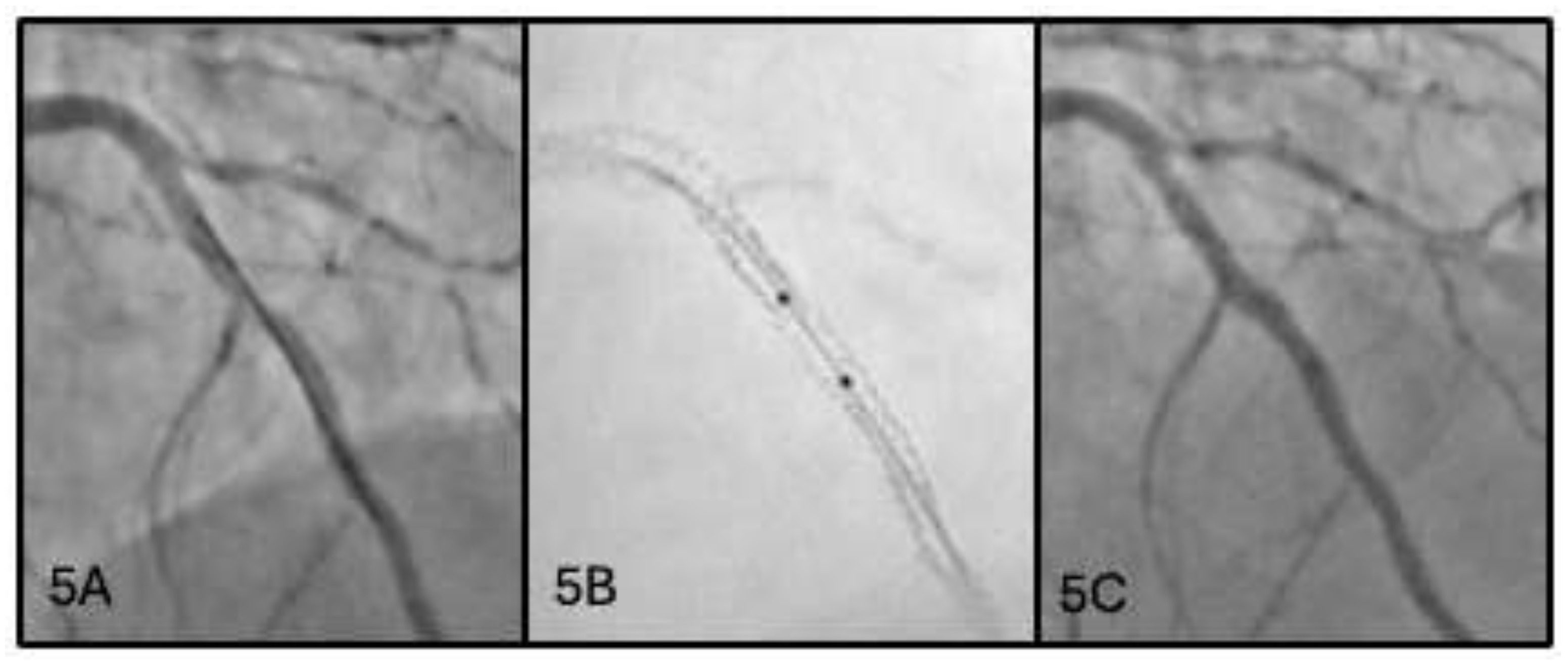
Angioplasty of the entire axis was then optimized with post-dilation using non-compliant balloons, while the double bifurcation stenting was finalized through the Proximal Optimization Technique (POT). However, the final angiography demonstrated a non-clearly optimized portion of the vessel in the mid-distal LAD (Figure 5A), which a ClearStent scan revealed to be a gap between the two stents due to a lack of overlap (Figure 5B).
The procedure was then completed with the implantation of an additional fifth and final DES (3.0 x 12 mm) to cover the gap, achieving an excellent final angiographic result (Figure 5C).
3. Conclusions
In the presented cases, ESV enabled prompt identification of mechanical complications, which were not clearly appreciable on angiography despite careful evaluation. Importantly, the additional information provided by ESV had a direct and immediate impact on procedural decision-making, guiding bailout strategies, further stent implantation, post-dilatation, or stent retrieval techniques.
In the first scenario, StentBoost allowed precise identification of stent fracture and further significant stent underexpansion, which could not be adequately assessed by angiography alone. By improving stent visualization, StentBoost provided essential information to support appropriate decision-making and guide the ideal bail-out strategy. The complementary use of IVUS further confirmed the optimal PCI outcome.
The procedure illustrated in the second scenario was intrinsically high risk due to the recent STEMI, multivessel coronary artery disease, LM involvement, and unfavorable bifurcation anatomy, all factors associated with increased procedural complexity and potential for severe complications. StentBoost enabled immediate recognition of stent loss and facilitated real-time decision-making during a critical phase of the procedure.
The third clinical case confirmed the crucial role of StentBoost in the setting of a complex PCI: it promptly detected the stent dislodgement and guided the rescue maneuvers, significantly improving procedural safety.
In the fourth scenario, the key role of ClearStent was demonstrated by the detection of stent underexpansion, a critical mechanical issue that would likely have remained unrecognized with angiography alone. The optimization of procedural results was later confirmed by IVUS, enhancing again the synergistic work of these two imaging modalities.
In the final case, despite extensive stenting and an apparently acceptable angiographic result, conventional fluoroscopy was unable to clearly identify a geographical miss caused by an unrecognized gap between two stents: ClearStent allowed prompt detection of the complication and confirmed its valuable adjunctive role to angiography.
Overall, the accurate assessment of stent deployment is crucial for procedural success and optimal clinical outcomes in PCI. Coronary angiography, although routinely employed in clinical practice, has intrinsic limitations in the accurate assessment of stent deployment. Mansour et al. reported that PCI guided exclusively by angiography was associated with inadequate stent expansion in 38% of cases, emphasizing the need for more reliable imaging techniques during the procedure. ESV represents a valuable adjunct, as it improves the visibility of stent struts and margins through advanced digital processing of fluoroscopic images, allowing a more precise identification of under-expansion, suboptimal stent apposition and stent fracture [9,10]. Consistently, Blicq et al. demonstrated that ESV was able to detect stent under-expansion in 18% of lesions that were judged satisfactory on angiography, confirming its higher diagnostic sensitivity compared with angiographic assessment alone [11].
In terms of evaluation of correct stent deployment, advanced intravascular imaging modalities such as OCT and IVUS are still considered the gold standards for evaluating stent expansion and integrity. However, their routine use is often constrained by cost, limited availability globally, and procedural complexity. ESV represents an imaging approach positioned between standard coronary angiography and intravascular imaging techniques. It offers improved diagnostic accuracy over angiography in the assessment of stent expansion and procedural complications, while providing results that are largely comparable to intravascular imaging for the evaluation of stent sizing and optimization [12].
In our cases, when integrated with intravascular imaging, ESV findings were consistent with IVUS-confirmed optimization of stent expansion, apposition, and lesion coverage, supporting its role as a complementary rather than competitive modality. On the one hand, ESV provides improved stent visualization over angiography alone, on the other hand IVUS allows a high-resolution imaging and improved clinical outcomes already demonstrated in the literature. Indeed, reliance on ESV alone risks missing clinically significant complications that IVUS can detect, potentially leading to worse clinical outcomes.
The main concern with ESV is radiation exposure and its related risk of complications. However, Fysal et al showed only a 3.7% increase in radiation exposure in ESV-guided PCI [13], while, according to Jin et al, no significant difference in dose-area product, fluoroscopy time or cine frames was reported in ESV compared to non-ESV [14].
Overall, this experience reinforces the concept that ESV represents a promising imaging adjunct that bridges the gap between conventional angiography and intravascular imaging, enabling a more mechanically optimized, individualized, and safer PCI, particularly in cases where stent failure mechanisms are subtle or angiographically occult.
4. Future Perspectives
Based on our observations, ESV may be increasingly considered as a routine or selective intraprocedural screening tool, particularly in complex anatomical settings such as bifurcation lesions, heavily calcified segments, LM interventions, in-stent restenosis, and multi-stent implantations. Additionally, ESV may play a growing role in ultra-low-contrast or zero-contrast PCI, especially in patients with advanced chronic kidney disease, by reducing reliance on contrast angiography while maintaining procedural safety and efficacy (15). Wide availability, ease of use, lack of need for additional contrast administration, and minimal impact on procedural time make ESV an attractive adjunct in daily catheterization laboratory practice, being expected to evolve from a standalone angiographic enhancement tool to a complementary modality that can be fused with intravascular imaging and physiological data [3,5,15,16].
Future prospective studies involving large patient cohorts are warranted to strengthen systematic or targeted use of ESV and corroborate its association with a reduction in short- and long-term adverse events. Moreover, further research may enhance the diagnostic performance, reproducibility, and standardization of ESV techniques.
Abbreviations
The following abbreviations are used in this manuscript:
| PCI | Percutaneous coronary intervention |
| ESV | Enhanced stent visualization |
| IVUS | Intravascular ultrasound |
| OCT | Optical coherence tomography |
| LM | Left main |
| ACS | Acute coronary syndrome |
| STEMI | ST-elevation myocardial infarction |
| NSTEMI | Non-ST-elevation myocardial infarction |
| TLR | Target lesion restenosis |
| CABG | Coronary artery bypass grafting |
| LAD | Left anterior descending artery |
| DES | Drug-eluting stent |
| RCA | Right coronary artery |
| LCx | Left circumflex artery |
| TAP | T and protrusion |
| DCB | Drug-coated balloon |
| IVL | Intravascular lithotripsy |
| MLA | Minimum lumen area |
| D1 | Diagonal branch |
| POT | Proximal optimization technique |
References
- Ali, ZA; Maehara, A; Généreux, P; Shlofmitz, RA; Fabbiocchi, F; Nazif, TM; et al. Optical coherence tomography compared with intravascular ultrasound and with angiography to guide coronary stent implantation (ILUMIEN III: OPTIMIZE PCI): a randomised controlled trial. Lancet 2016, 388, 2618–2628. [Google Scholar] [CrossRef] [PubMed]
- Kang, DY; Ahn, JM; Yun, SC; Hur, SH; Cho, YK; Lee, CH; et al. Guiding Intervention for Complex Coronary Lesions by Optical Coherence Tomography or Intravascular Ultrasound. J Am Coll Cardiol. 2024, 83, 401–413. [Google Scholar] [CrossRef] [PubMed]
- Tufaro, V; Jaffer, FA; Serruys, PW; Onuma, Y; van der Steen, AFW; Stone, GW; et al. Emerging Hybrid Intracoronary Imaging Technologies and Their Applications in Clinical Practice and Research. JACC Cardiovasc Interv. 2024, 17, 1963–1979. [Google Scholar] [CrossRef] [PubMed]
- Truesdell, AG; Alasnag, MA; Kaul, P; Rab, ST; Riley, RF; Young, MN; et al. Intravascular Imaging During Percutaneous Coronary Intervention: JACC State-of-the-Art Review. J Am Coll Cardiol. 2023, 81, 590–605. [Google Scholar] [CrossRef] [PubMed]
- Scalia, L; Squillace, M; Popolo Rubbio, A; Poletti, E; Agnello, F; Sisinni, A; et al. Modern Imaging Techniques for Percutaneous Coronary Intervention Guidance: A Focus on Intravascular Ultrasound and Optical Coherence Tomography. J Clin Med. 2025, 14(24). [Google Scholar] [CrossRef] [PubMed]
- Rao, SV; O’Donoghue, ML; Ruel, M; Rab, T; Tamis-Holland, JE; Alexander, JH; et al. 2025 ACC/AHA/ACEP/NAEMSP/SCAI Guideline for the Management of Patients With Acute Coronary Syndromes: A Report of the American College of Cardiology/American Heart Association Joint Committee on Clinical Practice Guidelines. J Am Coll Cardiol. 2025, 85, 2135–2237. [Google Scholar] [CrossRef] [PubMed]
- Duan, Y; Jing, L; Pan, S; Yan, S; Wang, F; Yu, H; et al. Optical coherence tomography: evaluating the effects of stent boost subtract imaging on stent underexpansion in STEMI patients. BMC Cardiovasc Disord. 2022, 22, 62. [Google Scholar] [CrossRef] [PubMed]
- Oh, DJ; Choi, CU; Kim, S; Im, SI; Na, JO; Lim, HE; et al. Effect of StentBoost imaging guided percutaneous coronary intervention on mid-term angiographic and clinical outcomes. Int J Cardiol. 2013, 168, 1479–1484. [Google Scholar] [CrossRef] [PubMed]
- Mansour, HM; Mohamed, AM; Ibrahim, SG; Ibrahim, AM; Mohamed, RG. Value of stent boost imaging in decision making after coronary stenting. Int J Cardiovasc Imaging 2023, 39, 2557–2566. [Google Scholar] [CrossRef] [PubMed]
- Biscaglia, S; Tebaldi, M; Tumscitz, C; Pavasini, R; Marchesini, J; Gallo, F; et al. Prospective Identification of Stent Fracture by Enhanced Stent Visualization System During Percutaneous Coronary Intervention. Circ J. 2016, 81, 82–89. [Google Scholar] [CrossRef] [PubMed]
- Blicq, E; Georges, JL; Elbeainy, E; Gibault-Genty, G; Benjemaa, K; Jerbi, B; et al. Detection of Stent Underdeployment by StentBoost Imaging. J Interv Cardiol. 2013, 26, 444–453. [Google Scholar] [CrossRef] [PubMed]
- Sant Bakshsingh, V; Bundhoo, SS; Protty, MB. The role of enhanced stent visualization imaging in percutaneous coronary intervention: a systematic review of efficacy and clinical outcomes. Expert Rev Cardiovasc Ther. 2025, 23, 915–921. [Google Scholar] [CrossRef] [PubMed]
- Fysal, Z; Hyde, T; Barnes, E; McCrea, W; Ramcharitar, S. Evaluating stent optimisation technique (StentBoost®) in a dedicated bifurcation stent (the Tryton™). Cardiovasc Revasc Med. 2014, 15, 92–96. [Google Scholar] [CrossRef] [PubMed]
- Jin, Z; Yang, S; Jing, L; Liu, H. Impact of StentBoost subtract imaging on patient radiation exposure during percutaneous coronary intervention. Int J Cardiovasc Imaging 2013, 29, 1207–1213. [Google Scholar] [CrossRef] [PubMed]
- Shabbir, A; Ali, Z; Colletti, G; Dudek, D; Garbo, R; Hellig, F; et al. Ultra-Low-Contrast PCI: A Structured Approach to Reducing Dependence on Contrast Vessel Opacification in PCI. JACC Cardiovasc Interv. 2025, 18, 409–424. [Google Scholar] [CrossRef] [PubMed]
- Alqawasmi M, Blan.
Figure 1.
(A) Optimal stent positioning to LM-LCx bifurcation during primary PCI (first procedure). (B) Stent fracture clearly visualized using StentBoost enhancement at second procedure. (C) Successful bailout treatment with in-stent implantation, achieving an adequate final angiographic result.
Figure 1.
(A) Optimal stent positioning to LM-LCx bifurcation during primary PCI (first procedure). (B) Stent fracture clearly visualized using StentBoost enhancement at second procedure. (C) Successful bailout treatment with in-stent implantation, achieving an adequate final angiographic result.
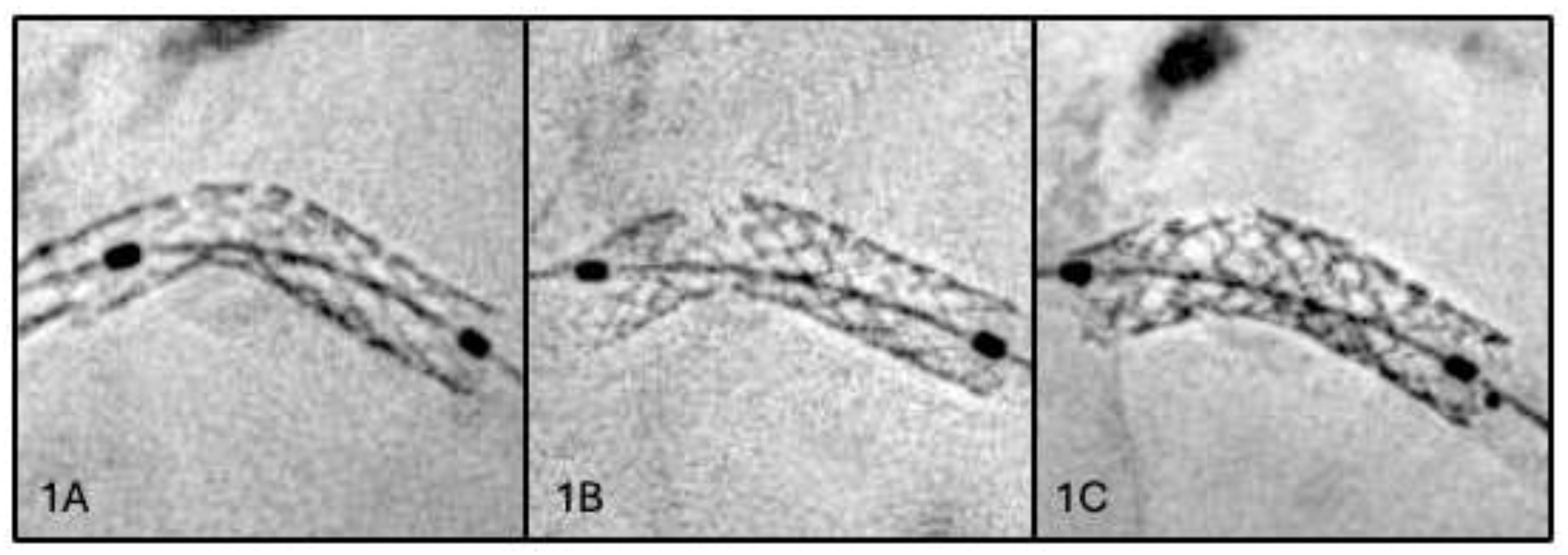
Figure 2.
(A) StentBoost-enhanced visualization of stent loss in the LM. (B) Crossing of the dislodged stent with two balloons followed by balloon inflation to secure adequate anchoring. (C) Final angiographic evaluation with StentBoost confirming maintenance of optimal bifurcation geometry and appropriate stent apposition.
Figure 2.
(A) StentBoost-enhanced visualization of stent loss in the LM. (B) Crossing of the dislodged stent with two balloons followed by balloon inflation to secure adequate anchoring. (C) Final angiographic evaluation with StentBoost confirming maintenance of optimal bifurcation geometry and appropriate stent apposition.
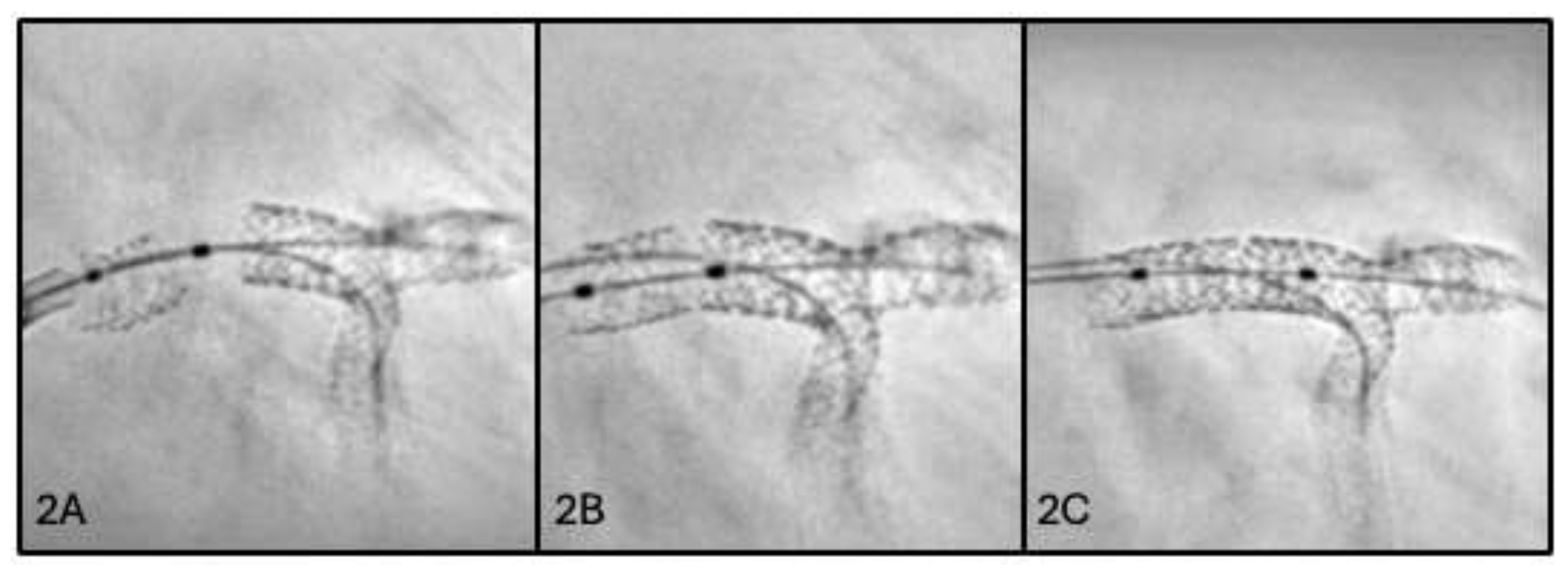
Figure 3.
(A) StentBoost-enhanced image showing distal LM stent. (B) Retrieval of the dislodged stent using the anchoring balloon technique. (C) StentBoost confirmation of optimal stent expansion, proper apposition, and preservation of LM bifurcation geometry.
Figure 3.
(A) StentBoost-enhanced image showing distal LM stent. (B) Retrieval of the dislodged stent using the anchoring balloon technique. (C) StentBoost confirmation of optimal stent expansion, proper apposition, and preservation of LM bifurcation geometry.
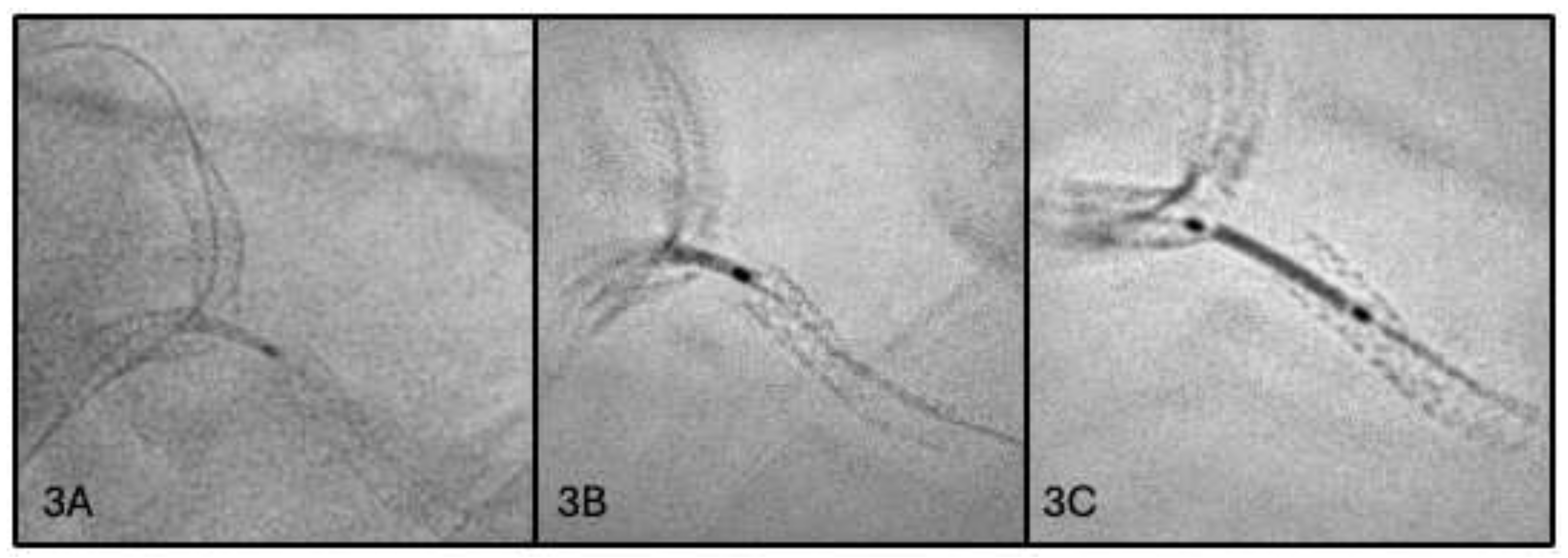
Figure 4.
(A) ClearStent-enhanced visualization revealing proximal stent underexpansion secondary to severe calcification of the LAD. (B) High-atmosphere balloon dilatation. (C) Final angiography confirming an optimal procedural outcome.
Figure 4.
(A) ClearStent-enhanced visualization revealing proximal stent underexpansion secondary to severe calcification of the LAD. (B) High-atmosphere balloon dilatation. (C) Final angiography confirming an optimal procedural outcome.
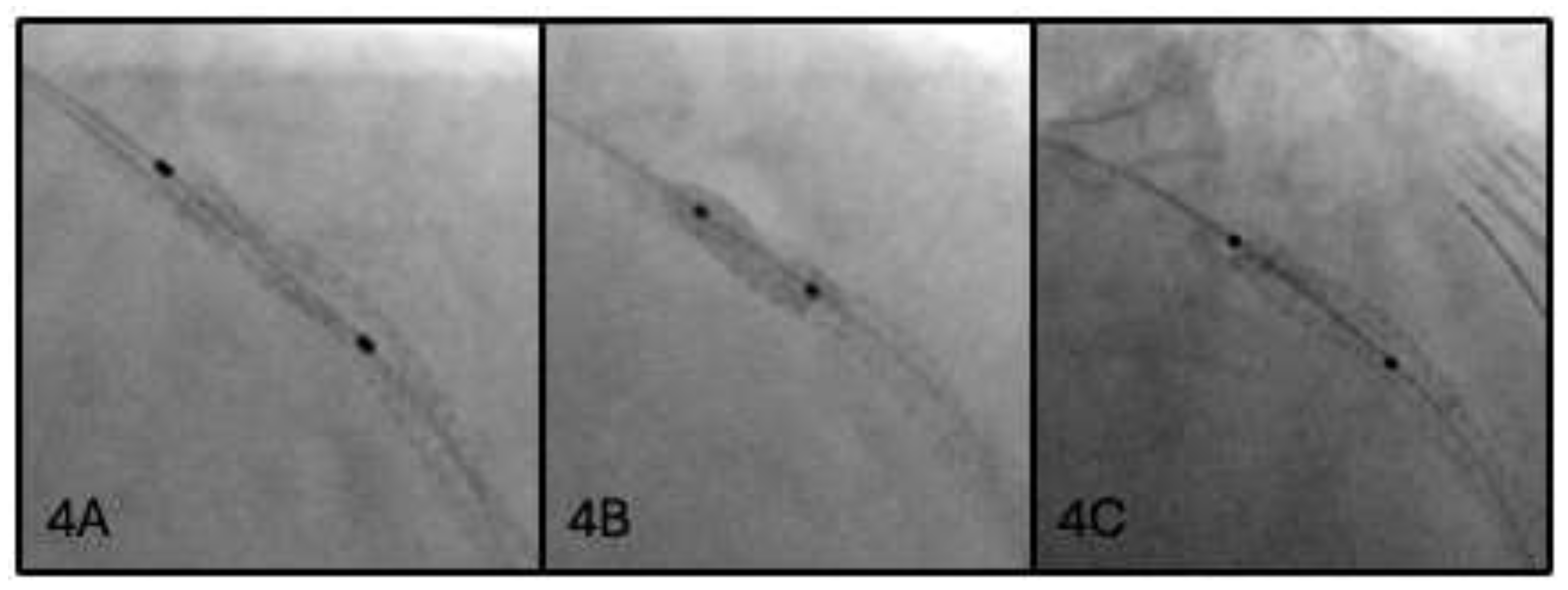
Figure 5.
(A) Angiography showing a suboptimally visualized segment in the mid-distal LAD following stent implantation. (B) ClearStent-enhanced imaging identifying a gap between the two previously implanted stents on the LAD. (C) Final angiography confirming an excellent result after placement of an additional stent to bridge the gap.
Figure 5.
(A) Angiography showing a suboptimally visualized segment in the mid-distal LAD following stent implantation. (B) ClearStent-enhanced imaging identifying a gap between the two previously implanted stents on the LAD. (C) Final angiography confirming an excellent result after placement of an additional stent to bridge the gap.
Disclaimer/Publisher’s Note: The statements, opinions and data contained in all publications are solely those of the individual author(s) and contributor(s) and not of MDPI and/or the editor(s). MDPI and/or the editor(s) disclaim responsibility for any injury to people or property resulting from any ideas, methods, instructions or products referred to in the content. |
© 2026 by the authors. Licensee MDPI, Basel, Switzerland. This article is an open access article distributed under the terms and conditions of the Creative Commons Attribution (CC BY) license (http://creativecommons.org/licenses/by/4.0/).
Copyright: This open access article is published under a Creative Commons CC BY 4.0 license, which permit the free download, distribution, and reuse, provided that the author and preprint are cited in any reuse.


