

Submitted:
10 April 2026
Posted:
14 April 2026
You are already at the latest version
Abstract
Background: Stunting is associated with impaired immune function and increased susceptibility to oral dysbiosis; however, microbiome-targeted interventions in this population remain underexplored. This study aimed to evaluate the effect of adjunctive xylitol therapy following scaling and root planing (SRP) on clinical parameters and salivary microbiota in children with stunted growth. Methods: Eighteen participants were allocated into two groups: SRP alone (n = 9) and SRP with xylitol gum (n = 9). Gingival Index (GI) and Oral Hygiene Index-Simplified (OHI-S) were assessed at baseline and 14 days post-intervention. The salivary microbiota was analyzed using 16S rRNA sequencing, encompassing taxonomic composition, alpha and beta diversity, and correlation network analysis. Results: Both groups showed significant reductions in GI, while OHI-S improved significantly only in the SRP + xylitol group. Microbiota analysis demonstrated an increase in Firmicutes and Proteobacteria and a decrease in Bacteroidota, particularly in the xylitol group. At the genus level, Lautropia increased, whereas periodontopathogenic species, including Prevotella intermedia, Tannerella forsythia, and Treponema denticola, decreased. Alpha diversity (Shannon and Simpson indices) and beta diversity (UniFrac and PCA) showed no significant changes, indicating preservation of overall microbial structure. Correlation analysis revealed synergistic interactions among commensal taxa and antagonistic relationships with pathogenic groups. Conclusions: Adjunctive xylitol therapy improves clinical outcomes and induces targeted microbiome modulation without disrupting overall diversity, supporting ecological rebalancing as a potential mechanism for microbiome-based interventions in stunted children.
Keywords:
stunting
; oral microbiota
; xylitol
; 16S rRNA
; microbiome modulation
1. Introduction
Stunting remains a major global public health challenge, affecting over 149 million children worldwide and disproportionately burdening low- and middle-income countries [1]. Beyond its well-documented impact on physical growth and cognitive development, stunting has increasingly been associated with impaired immune function and alterations in mucosal physiology, including oral health disturbances [2]. Stunted children frequently exhibit reduced salivary flow rate, compromised buffering capacity, and altered salivary composition, which collectively predispose them to oral dysbiosis and inflammatory conditions such as gingivitis [3].
The oral microbiota constitutes a highly complex and dynamic ecological system that plays a critical role in maintaining oral homeostasis [4]. In healthy conditions, a balanced microbial community prevents colonization by pathogenic species and supports host defense mechanisms [5]. However, disruption of this balance leads to dysbiosis, characterized by the proliferation of periodontopathogenic bacteria such as Prevotella intermedia, Tannerella forsythia, and Treponema denticola, which are strongly associated with gingival inflammation and periodontal tissue breakdown [6]. In stunted children, this dysbiotic shift may be exacerbated by systemic nutritional deficiencies and impaired host responses, highlighting the need for targeted therapeutic strategies [7].
Scaling and root planing (SRP) is widely regarded as the gold standard non-surgical periodontal therapy for the management of gingivitis and early periodontal disease [8]. By mechanically removing plaque biofilm and calculus deposits, SRP reduces the microbial load and promotes periodontal healing. However, in high-risk populations such as stunted children, SRP alone may be insufficient to fully restore microbial equilibrium, as underlying host-related factors continue to favor dysbiosis [9]. This limitation underscores the importance of adjunctive therapies that can enhance microbial rebalancing and support long-term oral health.
Xylitol, a naturally occurring sugar alcohol, exhibits antimicrobial and anti-adhesive properties by inhibiting bacterial growth, reducing acid production, and disrupting extracellular polysaccharide formation [10]. It also stimulates salivary flow, enhancing bacterial clearance and maintaining oral ecological balance [11]. Advances in Next Generation Sequencing enable high-resolution analysis of oral microbiota, highlighting that effective periodontal therapy involves targeted suppression of pathogenic taxa and enrichment of beneficial microbes rather than broad changes in microbial diversity [12].
Despite increasing interest in microbiome-based interventions, evidence on the effect of adjunctive xylitol therapy on oral microbiota in stunted children remains limited, particularly using metagenomic approaches [13]. Therefore, this study aimed to evaluate the effect of xylitol gum as an adjunct to scaling and root planning on oral microbiota profiles in stunted children using 16S rRNA sequencing. We hypothesized that xylitol would promote targeted microbial modulation by reducing periodontopathogens and enhancing beneficial taxa without significantly altering overall microbial diversity
2. Materials and Methods
Study Design and Setting
This study was conducted using a pretest–posttest experimental design to evaluate the effect of adjunctive xylitol gum chewing following scaling and root planing (SRP) on the oral microbiota profile of stunted children. The study was carried out from October 2023 to August 2024 in the working area of Lubuk Kilangan Public Health Center, Padang, Indonesia. Scaling and root planing procedures were performed at the Dental Hospital of Universitas Andalas, while microbiome analysis was conducted at the Indonesian Medical Education and Research Institute (IMERI), Universitas Indonesia.
Study Population and Sampling
The study population consisted of stunted children aged 6–12 years attending primary schools within the study area. Participants were selected using a simple random sampling technique and were allocated into two groups: the SRP-only group (control group) and the SRP with adjunctive xylitol gum group (intervention group), each consisting of nine subjects. The minimum sample size was calculated using Lemeshow’s formula, resulting in nine subjects per group, with a total sample size of 18 participants.
Inclusion Criteria, Variables, and Clinical Examination
Participants were included if they were aged 6–12 years, diagnosed as stunted based on height-for-age < −2 standard deviations according to World Health Organization criteria, cooperative during examination, and had provided written informed consent from their parents or guardians. Participants were excluded if a history of systemic disease was present, if special healthcare needs were identified, or if antibiotics had been used within the previous seven days. In this study, the independent variable was defined as adjunctive xylitol gum chewing following scaling and root planing (SRP), while the dependent variable was the oral microbiota profile. Clinical examinations were performed at baseline and 14 days after intervention. Gingival Index (GI) was assessed using a periodontal probe on index teeth with scores ranging from 0 to 3 based on the severity of gingival inflammation. Oral Hygiene Index-Simplified (OHI-S) was evaluated by measuring debris and calculus accumulation on tooth surfaces according to standard diagnostic criteria.
Scaling and Root Planing (SRP)
Scaling and root planing procedures were performed on all participants using an ultrasonic scaler following standard clinical protocols. The procedure included removal of plaque and calculus from all tooth surfaces, followed by polishing using pumice and brush to obtain smooth tooth surfaces. Patients were provided with post-treatment instructions and oral health education. Participants in the intervention group were instructed to chew xylitol-containing gum (Lotte Co., Ltd., Tokyo, Japan), containing 1.33 g of xylitol per piece. Two pieces of gum were chewed three times daily after meals for 5 minutes over a 14-day period. Compliance was monitored throughout the intervention period [14].
Saliva Collection and Handling
Unstimulated saliva samples were collected using the draining method at two time points: before SRP (baseline) and 14 days after intervention. Sample collection was performed between 08:00 and 11:00 AM. Participants were instructed to refrain from eating, drinking, or brushing their teeth for at least one hour prior to collection. Saliva was allowed to accumulate naturally and collected into sterile tubes, which were labeled and stored in a cool box containing dry ice before being transported to the laboratory [15].
DNA Extraction, PCR Amplification, and 16S rRNA Sequencing
Microbiota analysis was performed using Next Generation Sequencing. Genomic DNA was extracted from saliva samples using the ZymoBIOMICS DNA Miniprep Kit (Zymo Research, USA), and DNA quality and concentration were assessed prior to standardization to 1 ng/µL. The V3–V4 regions of the 16S rRNA gene were amplified using universal primers (forward: 5′-TCGTCGGCAGCGTCAGATGTGTATAAGAGACAGCCTACGGGNGGCWG CAG; reverse: 5′-GTCTCGTGCTCGGAGATGTGTATAAGAGACAGGACTACHVGGG TATCTA ATC and Q5® High-Fidelity DNA Polymerase (New England Biolabs, USA). PCR products were verified by 2% agarose gel electrophoresis, purified using the Qiagen Gel Extraction Kit, and quantified using Qubit 4.0 and NanoDrop. Purified amplicons were pooled in equimolar concentrations, prepared using the NEBNext® Ultra™ DNA Library Prep Kit, and sequenced on the Illumina MiSeq platform using paired-end reads [16].
Bioinformatics and Microbiome Analysis
Raw sequencing data in FASTQ format were processed using the QIIME2 pipeline. Paired-end reads were merged and quality-filtered to generate high-quality clean reads. Sequences were clustered into Operational Taxonomic Units (OTUs) at a 97% similarity threshold using the q2-vsearch plugin. Taxonomic classification was performed against the SILVA database (version 138.1). Phylogenetic relationships were constructed using MAFFT alignment, and OTU abundance data were normalized prior to downstream analysis. Microbiome analysis included relative abundance at phylum, genus, and species levels, as well as alpha diversity indices (Shannon and Simpson) and beta diversity (weighted and unweighted UniFrac). Principal Coordinate Analysis (PCoA), Principal Component Analysis (PCA), and hierarchical clustering (UPGMA) were performed using R software (version 4.0.5) for visualization and interpretation [17].
Statistical Analysis
Statistical analysis was performed using SPSS software (version 26). Data normality was assessed using the Shapiro–Wilk test. Paired comparisons between pre- and post-intervention measurements were analyzed using a paired t-test or Wilcoxon test, depending on data distribution. Between-group comparisons were conducted using an independent t-test. Correlation analysis between microbiota and clinical parameters was performed using Spearman’s correlation test. A p-value < 0.05 was considered statistically significant.
Ethical Approval
Ethical approval for this study was obtained from the Research Ethics Committee of the Faculty of Medicine, Universitas Andalas, Indonesia (Approval No. 454/UN.16.2/KEP-FK/2024). All procedures were conducted in accordance with the Declaration of Helsinki for research involving human subjects. Written informed consent was obtained from the parents or legal guardians of all participants prior to their inclusion in the study.
3. Results
Table 1 summarizes the baseline characteristics of the study participants, demonstrating no significant differences between groups in age and height (p > 0.05), confirming the homogeneity and comparability of the study population.
Table 2 shows significant reductions in gingival inflammation in both groups following treatment, with greater improvement observed in the SRP + xylitol group. Significant improvement in oral hygiene (OHI-S) was observed only in the xylitol group, while no significant differences were found between groups after intervention.
Figure 1 illustrates the changes in clinical parameters before and after intervention. Both groups showed a reduction in Gingival Index (GI), with a greater decrease observed in the SRP + xylitol group. For OHI-S, a significant improvement was observed only in the SRP + xylitol group, while the SRP group showed a non-significant reduction.
Table 2 summarizes microbiota changes across taxonomic levels. At the phylum level, significant increases in Firmicutes were observed in both groups, while Proteobacteria increased and Bacteroidota decreased significantly only in the SRP + xylitol group. At the genus level, Lautropia increased significantly in both groups. At the species level, all periodontopathogenic species showed reductions, with statistically significant decreases in the SRP + xylitol group.
Figure 2 illustrates changes in salivary microbiota across taxonomic levels. At the phylum level, Proteobacteria and Firmicutes increased following intervention, particularly in the SRP + xylitol group, while Bacteroidota decreased. At the genus level, Neisseria, Streptococcus, and Lautropia showed increasing trends, with a pronounced rise in Lautropia after xylitol therapy. At the species level, periodontopathogenic bacteria decreased in both groups, with a greater reduction observed in the SRP + xylitol group, especially for Treponema denticola.
Figure 3 demonstrates that microbial diversity remained relatively stable across groups. Despite minor distributional shifts, no significant changes were observed, indicating that the intervention did not alter overall alpha diversity.
Figure 4 shows that microbial communities across all groups were broadly distributed with substantial overlap in both unweighted and weighted UniFrac analyses, indicating that neither SRP alone nor adjunctive xylitol therapy produced significant shifts in overall beta diversity.
Figure 5 shows overlapping clustering of microbial communities across all groups, indicating no distinct separation in PCA space. This suggests that neither SRP nor adjunctive xylitol therapy resulted in significant global changes in microbiota composition.
Table 3 presents Spearman’s rank correlation analysis of salivary microbiota, incorporating 95% confidence intervals, FDR-adjusted p-values, and ecological role interpretation. At the phylum level, Firmicutes and Actinobacteriota—both generally associated with commensal and health-related microbial communities—exhibited a strong positive correlation, indicating a synergistic co-occurrence pattern that may contribute to microbial stability. In contrast, Firmicutes showed a strong negative correlation with Spirochaetota, a phylum commonly linked to periodontopathogenic activity, suggesting an inverse relationship in which beneficial taxa may suppress or compete with pathogenic populations. A similar antagonistic pattern was observed between Spirochaetota and Actinobacteriota, further supporting the presence of competitive ecological interactions within the microbial community. At the genus level, Prevotella and Veillonella demonstrated a moderate positive correlation, reflecting potential co-occurrence within oral biofilm environments. Both genera are considered context-dependent taxa that may function as opportunistic or biofilm-associated organisms, indicating cooperative behavior under specific ecological conditions.
4. Discussion
This study provides a comprehensive evaluation of the effects of adjunctive xylitol therapy following scaling and root planing (SRP) on clinical outcomes and oral microbiome dynamics in stunted children. The integration of clinical findings, microbiota composition, diversity indices, and correlation analysis reveals that xylitol contributes to targeted ecological modulation without disrupting overall microbial structure.
From a clinical perspective, both groups demonstrated significant reductions in gingival inflammation, as reflected by decreased Gingival Index (GI) scores (Table 2; Figure 1A), confirming the effectiveness of SRP as a standard non-surgical periodontal therapy [8]. However, the SRP + xylitol group exhibited greater improvement, indicating an adjunctive benefit of xylitol. This effect is further supported by Oral Hygiene Index-Simplified (OHI-S), which showed a significant reduction only in the xylitol group (Table 2; Figure 1B), suggesting enhanced plaque control and biofilm disruption. These findings are consistent with previous studies demonstrating that xylitol reduces bacterial adhesion and inhibits biofilm formation [18].
At the microbiota composition level, distinct changes were observed across taxonomic levels (Table 2; Figure 2). At the phylum level, increases in Proteobacteria and Firmicutes, along with a decrease in Bacteroidota, were particularly evident in the SRP + xylitol group (Figure 2A). This pattern suggests a shift toward a more health-associated microbial profile, as Firmicutes are often linked to commensal taxa, whereas Bacteroidota includes several periodontopathogenic species [19]. At the genus level, the marked increase in Lautropia (Figure 2B), a genus associated with oral health, further supports this ecological transition. At the species level, reductions in key periodontopathogenic bacteria, including Prevotella intermedia, Tannerella forsythia, and Treponema denticola, were observed, with the most pronounced decrease in the SRP + xylitol group (Figure 2C), indicating effective suppression of disease-associated taxa [20].
Despite these compositional changes, alpha diversity analysis showed no statistically significant differences in Shannon and Simpson indices (Figure 3), indicating that microbial richness and evenness were preserved. Similarly, beta diversity analysis based on unweighted and weighted UniFrac distances demonstrated overlapping clustering patterns (Figure 4), suggesting no significant shifts in overall microbial community structure. These findings were further confirmed by PCA analysis (Figure 5), which showed substantial overlap among groups. Collectively, these results indicate that while specific taxa were modulated, the global microbial structure remained stable. This aligns with recent evidence suggesting that effective periodontal interventions may rely on selective microbial shifts rather than large-scale changes in diversity [21].
The correlation analysis provides further insight into the ecological interactions underlying these changes (Table 3). Strong positive correlations between Firmicutes and Actinobacteriota suggest synergistic relationships among commensal-associated taxa, contributing to microbial stability. In contrast, negative correlations between commensal taxa and Spirochaetota indicate antagonistic interactions, reflecting suppression of periodontopathogenic groups. At the genus level, the positive association between Prevotella and Veillonella suggests co-occurrence within biofilm ecosystems, consistent with known metabolic cooperation among oral bacteria [22].
Importantly, these findings can be mechanistically linked to the biological effects of xylitol. Xylitol interferes with bacterial metabolism by inhibiting glycolytic pathways and reducing acid production, thereby creating an unfavorable environment for pathogenic bacteria [10]. Additionally, xylitol disrupts extracellular polysaccharide (EPS) synthesis and reduces bacterial adhesion, impairing biofilm formation [23]. Increased salivary flow stimulated by xylitol further enhances microbial clearance and contributes to ecological balance [24]. Rather than inducing broad microbial elimination, these mechanisms promote ecological restructuring, where beneficial taxa are maintained or enhanced, while pathogenic taxa are selectively suppressed.
Taken together, the integration of clinical outcomes (Table 2; Figure 1), microbiota composition (Table 2; Figure 2), diversity analyses (Figure 3, Figure 4 and Figure 5), and ecological interactions (Table 3) supports the concept that adjunctive xylitol therapy induces targeted microbiome modulation. This is characterized by improved clinical parameters, suppression of periodontopathogens, reinforcement of beneficial microbial networks, and preservation of overall microbial diversity. Such an approach is particularly relevant in stunted children, who may exhibit altered immune responses and increased susceptibility to dysbiosis [25].
However, several limitations should be acknowledged. The relatively small sample size may limit statistical power, and the short duration of follow-up may not capture long-term microbiome dynamics. In addition, functional analyses were not performed, limiting insights into metabolic pathways. Future studies should incorporate larger cohorts, longitudinal designs, and multi-omics approaches to further elucidate the mechanisms underlying microbiome modulation.
5. Conclusions
Adjunctive xylitol therapy following SRP improves clinical outcomes and induces targeted modulation of the oral microbiota in stunted children. The intervention selectively reduces periodontopathogenic species and enhances beneficial taxa without altering overall microbial diversity, supporting the concept of ecological rebalancing rather than global microbiome disruption. These findings highlight xylitol as a simple, non-invasive adjunctive strategy for microbiome-based oral health management and support the shift toward precision modulation of the microbiome. Further studies with larger cohorts and functional analyses are needed to confirm long-term effects.
Author Contributions
Conceptualization, H.S., M.M., D.S., and N.K.; methodology, H.S., M.M., D.S., and N.K.; software, H.S.; validation, H.S., M.M., D.S., and N.K.; formal analysis, H.S.; investigation, H.S., M.M., D.S., and N.K.; resources, H.S., M.M., D.S., and N.K.; data curation, H.S., M.M., R.I., D.S., and N.K.; writing—original draft preparation, H.S., M.M., and D.S.; writing—review and editing, H.S., M.M., D.S., R.R., and N.K. All authors have read and agreed to the published version of the manuscript.
Funding
This research was funded by the Research and Community Service Institute (LPPM), Universitas Andalas, under contract number 315/UN16.19/PT.01.03/PTM/2024.
Institutional Review Board Statement
Not applicable
Informed Consent Statement
Informed consent was obtained from all subjects involved in the study.
Data Availability Statement
The data supporting this study are not publicly available due to ethical restrictions.
Acknowledgments
The authors gratefully acknowledge the financial support provided by the Institute for Research and Community Service (LPPM), Universitas Andalas, under contract number 315/UN16.19/PT.01.03/PTM/2024, which made this research possible.
Conflicts of Interest
The authors declare no conflicts of interest.
References
- Mulyani, A.T.; Khairinisa, M.A.; Khatib, A.; Chaerunisaa, A.Y. Understanding stunting: Impact, causes, and strategy to accelerate stunting reduction—A narrative Review. Nutrients 2025, 17, 1493. [Google Scholar] [CrossRef]
- Hadi, F.; Kaeun, M.; Mursyid, F.; Melinda, V. Biological Pathways of Oral Health Inequality: A Longitudinal Analysis of Stunting, Enamel Defects, and Salivary Immunity on Caries Trajectories in Indonesian Children. Crown: Journal of Dentistry and Health Research 2024, 2, 161–171. [Google Scholar] [CrossRef]
- Nursal, D.G.A.; Kasuma, N.; Wulandari, R.W.; Ali, H.; Roza, D.; Setiawan, I.; Juwita, D.R.; Ernesto, G.; Effendi, M.D.S.; Wirza, T.R. Stunting and its effects on salivary biomarkers and oral health: a cross-sectional analysis of flow rate, pH, and buffering capacity. The Open Dentistry Journal 2025, 19. [Google Scholar] [CrossRef]
- Sedghi, L.; DiMassa, V.; Harrington, A.; Lynch, S.V.; Kapila, Y.L. The oral microbiome: Role of key organisms and complex networks in oral health and disease. Periodontology 2000 2021, 87, 107–131. [Google Scholar] [CrossRef] [PubMed]
- Caballero-Flores, G.; Pickard, J.M.; Núñez, G. Microbiota-mediated colonization resistance: mechanisms and regulation. Nature Reviews Microbiology 2023, 21, 347–360. [Google Scholar] [CrossRef]
- Scannapieco, F.A.; Dongari-Bagtzoglou, A. Dysbiosis revisited: Understanding the role of the oral microbiome in the pathogenesis of gingivitis and periodontitis: A critical assessment. Journal of periodontology 2021, 92, 1071–1078. [Google Scholar] [CrossRef]
- Morales, F.; Montserrat-De la Paz, S.; Leon, M.J.; Rivero-Pino, F. Effects of malnutrition on the immune system and infection and the role of nutritional strategies regarding improvements in children’s health status: a literature review. Nutrients 2023, 16, 1. [Google Scholar] [CrossRef]
- Vinel, A.; Al Halabi, A.; Roumi, S.; Le Neindre, H.; Millavet, P.; Simon, M.; Cuny, C.; Barthet, J.-S.; Barthet, P.; Laurencin-Dalicieux, S. Non-surgical periodontal treatment: SRP and innovative therapeutic approaches. In Periodontitis: Advances in Experimental Research; Springer, 2022; pp. 303–327. [Google Scholar]
- Farina, R.; Simonelli, A.; Trombelli, L.; Chew, R.J.J.; Tu, Y.K.; Preshaw, P.M. Clinical Efficacy of Interventions Based on Professional Mechanical Plaque Removal in the Treatment of Dental Biofilm-Induced Gingivitis: A Systematic Review and Meta-Analysis. J Clin Periodontol 2026, 53, 572–595. [Google Scholar] [CrossRef]
- Ahuja, V.; Macho, M.; Ewe, D.; Singh, M.; Saha, S.; Saurav, K. Biological and pharmacological potential of xylitol: a molecular insight of unique metabolism. Foods 2020, 9, 1592. [Google Scholar] [CrossRef]
- Boschetto, F.; Zanocco, M.; Kamei, K.; Xu, H.; Marin, E. Xylitol Modification of Electrospun Polymer Scaffolds: Impact on Physicochemical and Antibacterial Properties. Polymers 2025, 17, 3024. [Google Scholar] [CrossRef]
- Kuraji, R.; Shiba, T.; Dong, T.S.; Numabe, Y.; Kapila, Y.L. Periodontal treatment and microbiome-targeted therapy in management of periodontitis-related nonalcoholic fatty liver disease with oral and gut dysbiosis. World J Gastroenterol 2023, 29, 967–996. [Google Scholar] [CrossRef] [PubMed]
- Asakawa, M.; Furuta, M.; Asada, S.; Ando, T.; Yanagisawa, T.; Yoshikawa, E.; Kageyama, S.; Takeshita, T. Effects of 4-week xylitol tablet intake on tongue microbiota composition in children: a single-arm pilot study. Microbiology spectrum 2026, 14, e01360-01325. [Google Scholar] [CrossRef]
- Cobb, C.M.; Sottosanti, J.S. A re-evaluation of scaling and root planing. Journal of Periodontology 2021, 92, 1370–1378. [Google Scholar] [CrossRef]
- Mortazavi, H.; Yousefi-Koma, A.-A.; Yousefi-Koma, H. Extensive comparison of salivary collection, transportation, preparation, and storage methods: a systematic review. BMC Oral Health 2024, 24, 168. [Google Scholar] [CrossRef] [PubMed]
- Claassen-Weitz, S.; Gardner-Lubbe, S.; Mwaikono, K.S.; du Toit, E.; Zar, H.J.; Nicol, M.P. Optimizing 16S rRNA gene profile analysis from low biomass nasopharyngeal and induced sputum specimens. BMC Microbiol 2020, 20, 113. [Google Scholar] [CrossRef]
- Maki, K.A.; Wolff, B.; Varuzza, L.; Green, S.J.; Barb, J.J. Multi-amplicon microbiome data analysis pipelines for mixed orientation sequences using QIIME2: Assessing reference database, variable region and pre-processing bias in classification of mock bacterial community samples. Plos one 2023, 18, e0280293. [Google Scholar] [CrossRef] [PubMed]
- Loimaranta, V.; Mazurel, D.; Deng, D.; Söderling, E. Xylitol and erythritol inhibit real-time biofilm formation of Streptococcus mutans. BMC microbiology 2020, 20, 184. [Google Scholar] [CrossRef]
- He, J.; Liu, Y.; Liu, H.; Liu, H.; Xu, M.; Wei, X.; Chen, M. Combined quantitative and relative microbiome profiling reveals key salivary bacteriome shifts associated with periodontal health and different stages of periodontitis. Journal of Dentistry 2025, 106125. [Google Scholar] [CrossRef]
- Zhang, Y.; Tang, P.; Yang, Q.; Li, C.; Li, L.; Han, M. Efficacy of scaling and root planing with and without adjunct Nd: YAG laser therapy on glucose control and periodontal microecological imbalance in periodontitis patients with type 2 diabetes mellitus: a randomized controlled trial. Clinical Oral Investigations 2024, 28, 143. [Google Scholar] [CrossRef]
- Nath, S.; Pulikkotil, S.J.; Weyrich, L.; Zilm, P.; Kapellas, K.; Jamieson, L. Effect of Periodontal Interventions on Characteristics of the Periodontal Microbial Profile: A Systematic Review and Meta-Analysis. Microorganisms 2022, 10. [Google Scholar] [CrossRef]
- Relvas, M.; Regueira-Iglesias, A.; Balsa-Castro, C.; Salazar, F.; Pacheco, J.; Cabral, C.; Henriques, C.; Tomás, I. Relationship between dental and periodontal health status and the salivary microbiome: bacterial diversity, co-occurrence networks and predictive models. Scientific reports 2021, 11, 929. [Google Scholar] [CrossRef] [PubMed]
- Lin, Y.; Chen, J.; Zhou, X.; Li, Y. Inhibition of Streptococcus mutans biofilm formation by strategies targeting the metabolism of exopolysaccharides. Critical reviews in microbiology 2021, 47, 667–677. [Google Scholar] [CrossRef]
- de Siqueira Fraga, E.G.; Teófilo Campos, F.M.; da Silva Cavalcante, M.P.; Barbosa Martins, L.F.; Rodrigues Neto, E.M.; Mimica, M.J. Xylitol, a Promising Allied for Oral Heath. Journal of Young Pharmacists 2020, 12. [Google Scholar] [CrossRef]
- Gheisary, Z.; Mahmood, R.; Harri Shivanantham, A.; Liu, J.; Lieffers, J.R.L.; Papagerakis, P.; Papagerakis, S. The Clinical, Microbiological, and Immunological Effects of Probiotic Supplementation on Prevention and Treatment of Periodontal Diseases: A Systematic Review and Meta-Analysis. Nutrients 2022, 14. [Google Scholar] [CrossRef] [PubMed]
Figure 1.
Changes in clinical parameters before and after intervention. (A) Gingival Index (GI) showed significant reductions in both the SRP and SRP + xylitol groups. (B) Oral Hygiene Index-Simplified (OHI-S) demonstrated a significant reduction only in the SRP + xylitol group. Data are presented as mean ± standard deviation. *p < 0.05.
Figure 1.
Changes in clinical parameters before and after intervention. (A) Gingival Index (GI) showed significant reductions in both the SRP and SRP + xylitol groups. (B) Oral Hygiene Index-Simplified (OHI-S) demonstrated a significant reduction only in the SRP + xylitol group. Data are presented as mean ± standard deviation. *p < 0.05.
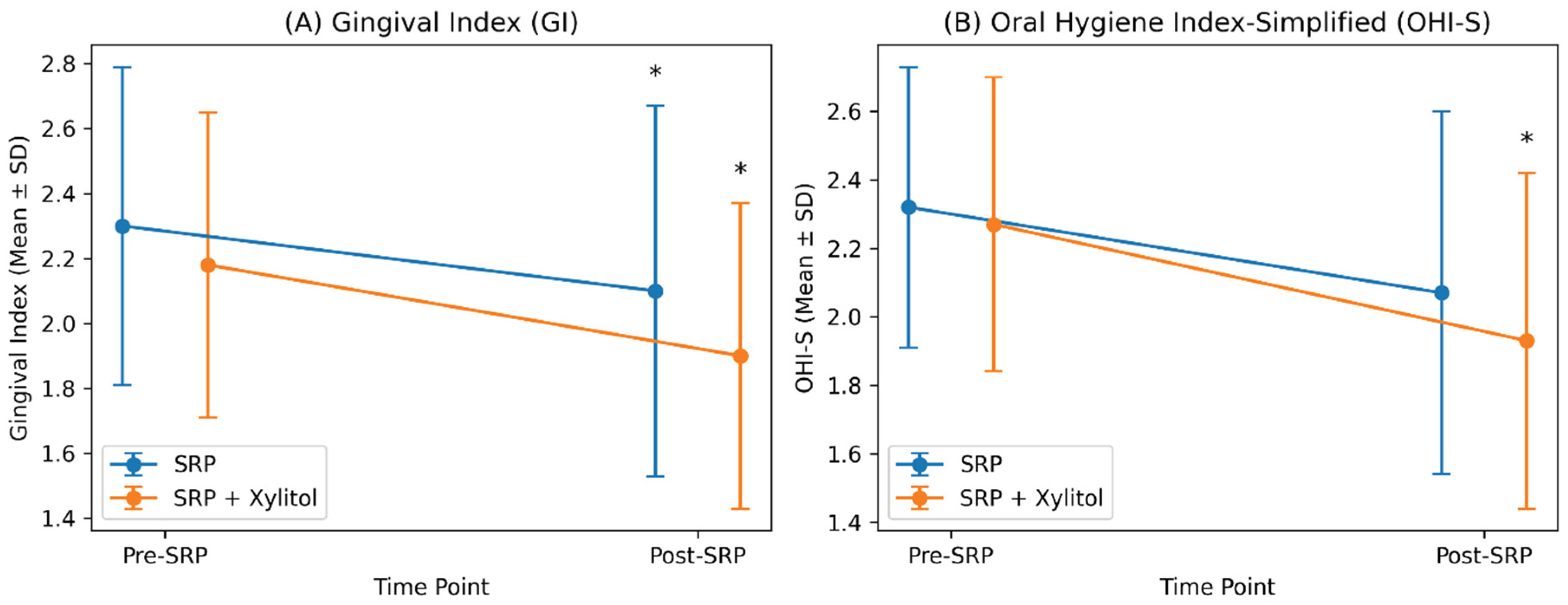
Figure 2.
Changes in salivary microbiota composition across taxonomic levels. (A) At the phylum level, Proteobacteria and Firmicutes increased, particularly in the SRP + xylitol group, while Bacteroidota decreased following intervention. (B) At the genus level, Neisseria, Streptococcus, and Lautropia showed increasing trends, with a marked rise in Lautropia in the SRP + xylitol group. (C) At the species level, key periodontopathogenic bacteria, including Prevotella intermedia, Tannerella forsythia, and Treponema denticola, showed reductions after treatment, with the greatest decrease observed in the SRP + xylitol group.
Figure 2.
Changes in salivary microbiota composition across taxonomic levels. (A) At the phylum level, Proteobacteria and Firmicutes increased, particularly in the SRP + xylitol group, while Bacteroidota decreased following intervention. (B) At the genus level, Neisseria, Streptococcus, and Lautropia showed increasing trends, with a marked rise in Lautropia in the SRP + xylitol group. (C) At the species level, key periodontopathogenic bacteria, including Prevotella intermedia, Tannerella forsythia, and Treponema denticola, showed reductions after treatment, with the greatest decrease observed in the SRP + xylitol group.
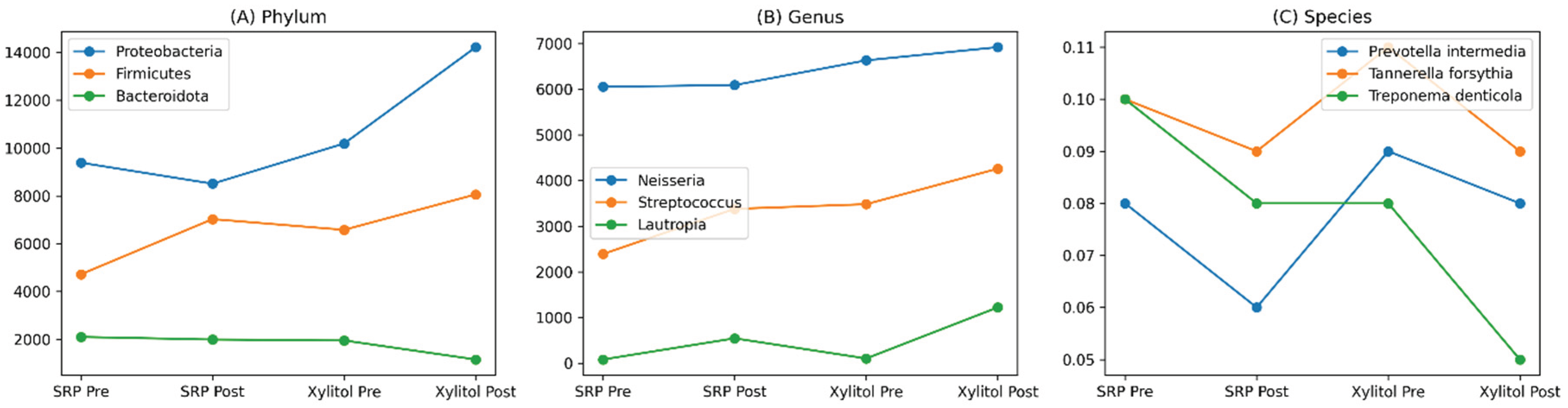
Figure 3.
Alpha diversity based on Shannon (A) and Simpson (B) indices in control and intervention groups before and after scaling and root planing (SRP). Violin plots represent data distribution, overlaid with individual data points. No statistically significant differences were observed between groups (p > 0.05, Wilcoxon signed-rank test), although slight increases were observed in the SRP group and slight decreases in the SRP + xylitol group.
Figure 3.
Alpha diversity based on Shannon (A) and Simpson (B) indices in control and intervention groups before and after scaling and root planing (SRP). Violin plots represent data distribution, overlaid with individual data points. No statistically significant differences were observed between groups (p > 0.05, Wilcoxon signed-rank test), although slight increases were observed in the SRP group and slight decreases in the SRP + xylitol group.
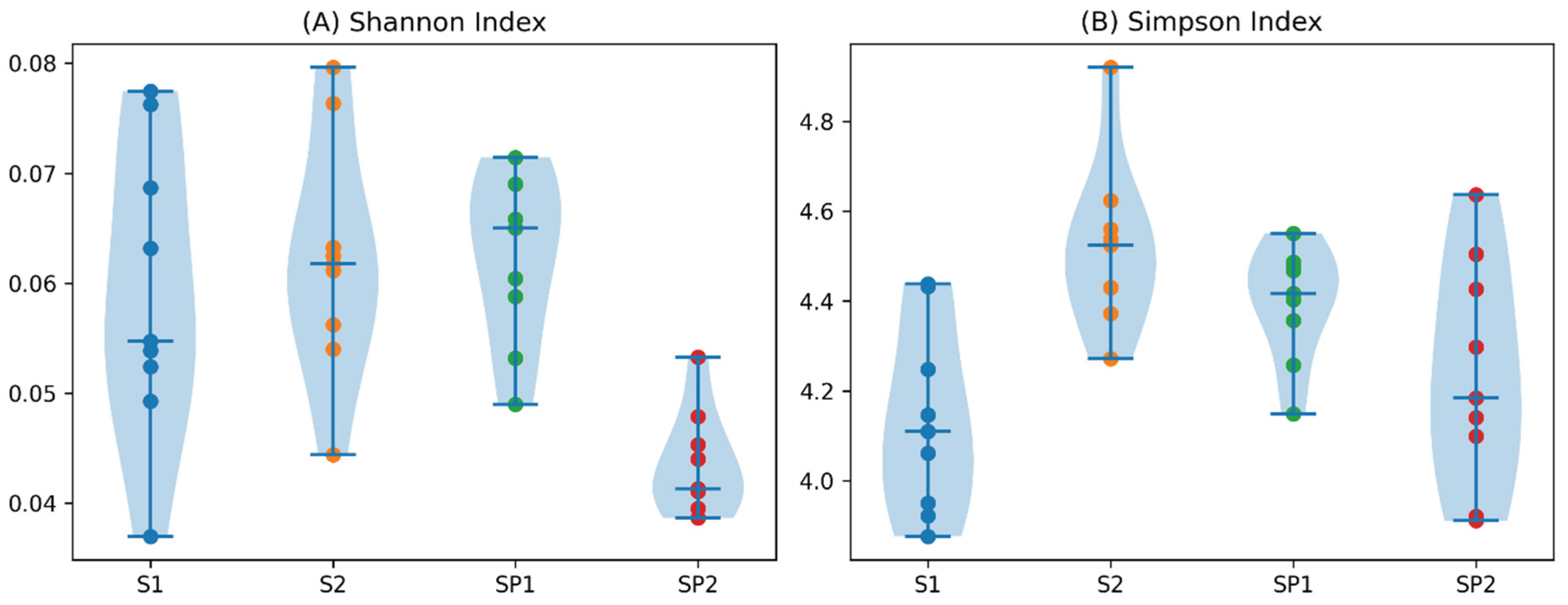
Figure 4.
Beta diversity analysis based on (A) unweighted UniFrac and (B) weighted UniFrac distances visualized using Principal Coordinate Analysis (PCoA). The S1 and S2 groups represent stunted children before and after scaling and root planing (SRP), respectively, while SP1 and SP2 represent stunted children receiving adjunctive xylitol gum therapy before and after SRP. In both analyses, samples exhibited overlapping clustering patterns with no distinct separation between groups, indicating that the intervention did not significantly alter the overall microbial community structure.
Figure 4.
Beta diversity analysis based on (A) unweighted UniFrac and (B) weighted UniFrac distances visualized using Principal Coordinate Analysis (PCoA). The S1 and S2 groups represent stunted children before and after scaling and root planing (SRP), respectively, while SP1 and SP2 represent stunted children receiving adjunctive xylitol gum therapy before and after SRP. In both analyses, samples exhibited overlapping clustering patterns with no distinct separation between groups, indicating that the intervention did not significantly alter the overall microbial community structure.
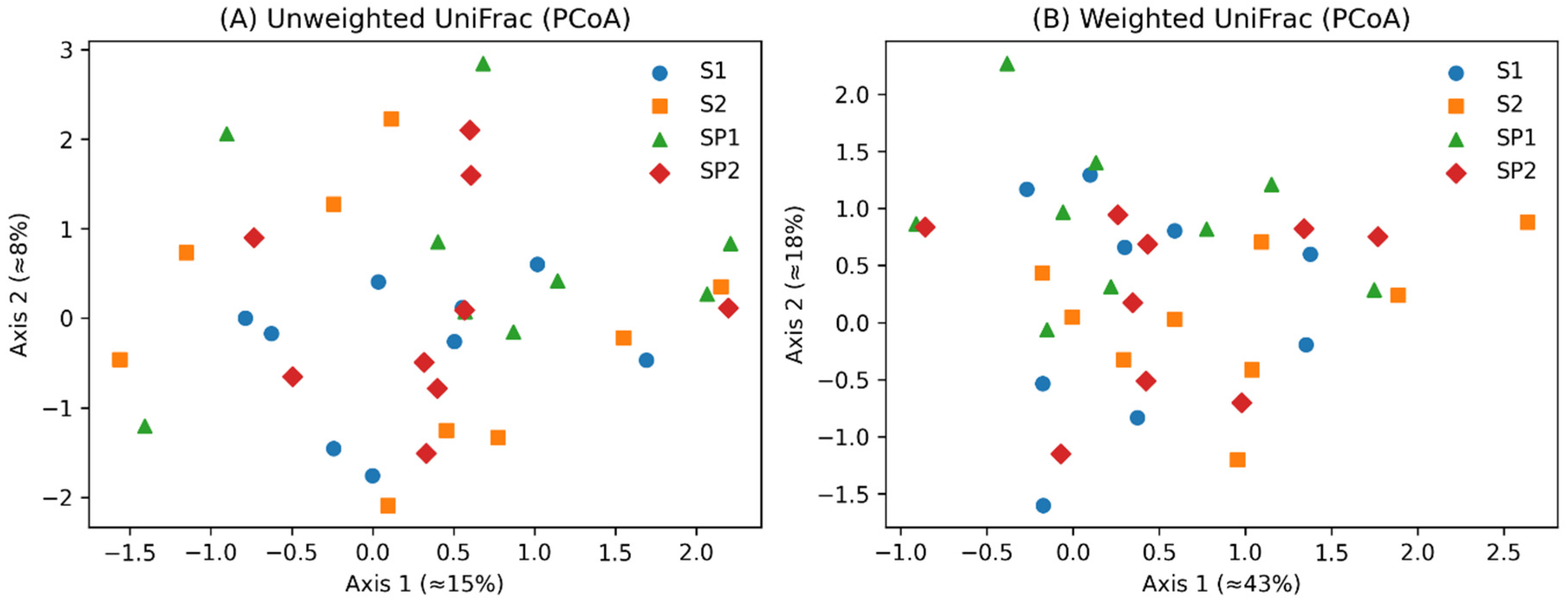
Figure 5.
Principal Component Analysis (PCA) showing the distribution of salivary microbiota in control and intervention groups before and after scaling and root planing (SRP). The S1 and S2 groups represent stunted children before and after SRP, respectively, while SP1 and SP2 represent stunted children receiving adjunctive xylitol gum therapy before and after SRP. The clustering patterns with overlapping confidence ellipses indicate no clear separation between groups, suggesting that the intervention did not significantly alter the overall microbial community structure.
Figure 5.
Principal Component Analysis (PCA) showing the distribution of salivary microbiota in control and intervention groups before and after scaling and root planing (SRP). The S1 and S2 groups represent stunted children before and after SRP, respectively, while SP1 and SP2 represent stunted children receiving adjunctive xylitol gum therapy before and after SRP. The clustering patterns with overlapping confidence ellipses indicate no clear separation between groups, suggesting that the intervention did not significantly alter the overall microbial community structure.
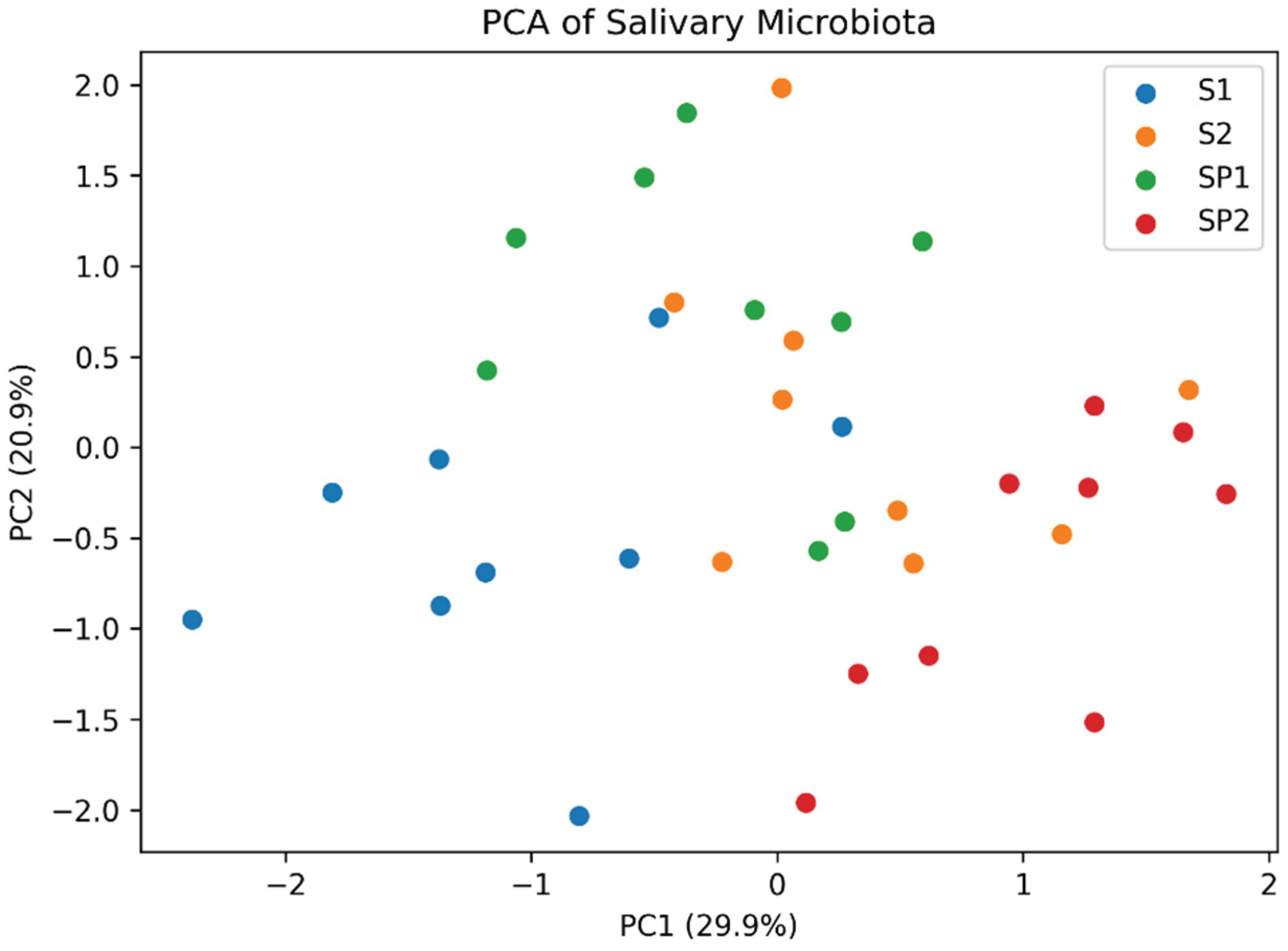

Table 1.
Characteristics of Study Participants.
| Variable | SRP Group (n = 9) | SRP + Xylitol Group (n = 9) | p-value |
|---|---|---|---|
| Age (months), mean | 120.11 | 120.11 | 1.00 |
| Height (cm), mean | 119.65 | 122.07 | 0.89 |
| Sex (Male), n | 4 | 7 | — |
| Sex (Female), n | 5 | 2 | — |
Notes: Data are presented as mean values or counts. p-values were obtained using an independent t-test. No statistically significant differences were observed between groups (p > 0.05).
Table 2.
Changes in Clinical Parameters (GI and OHI-S) Before and After Intervention.
| Parameter | Group | Pre-SRP (Mean ± SD) | Post-SRP (Mean ± SD) | p-value (within group) | p-value (between groups) |
|---|---|---|---|---|---|
| Gingival Index (GI) | SRP | 2.30 ± 0.49 | 2.10 ± 0.57 | 0.005* | 0.22 |
| SRP + Xylitol | 2.18 ± 0.47 | 1.90 ± 0.47 | 0.001* | ||
| OHI-S | SRP | 2.32 ± 0.41 | 2.07 ± 0.53 | 0.065 | 0.20 |
| SRP + Xylitol | 2.27 ± 0.43 | 1.93 ± 0.49 | 0.004* |
Notes: Data are presented as mean ± standard deviation. *p < 0.05 indicates statistical significance. Within-group comparisons were analyzed using a paired t-test. Between-group comparisons were analyzed using an independent t-test.
Table 2.
Changes in Salivary Microbiota at Multiple Taxonomic Levels.
| Taxonomic level | Taxa | SRP (Pre) | SRP (Post) | p-value | SRP + Xylitol (Pre) | SRP + Xylitol (Post) | p-value |
|---|---|---|---|---|---|---|---|
| Phylum | Proteobacteria | 9388 | 8509 | >0.05 | 10190 | 14218 | <0.05* |
| Firmicutes | 4721 | 7028 | <0.05* | 6580 | 8062 | <0.05* | |
| Bacteroidota | 2103 | 1994 | >0.05 | 1955 | 1159 | <0.05* | |
| Spirochaetota | 149 | 119 | >0.05 | 419 | 165 | >0.05 | |
| Actinobacteriota | 16 | 20 | >0.05 | 15 | 32 | >0.05 | |
| Genus | Neisseria | 6054 | 6091 | >0.05 | 6633 | 6922 | >0.05 |
| Streptococcus | 2390 | 3380 | >0.05 | 3482 | 4261 | >0.05 | |
| Veillonella | 2138 | 1954 | >0.05 | 1866 | 1955 | >0.05 | |
| Haemophilus | 1135 | 1258 | >0.05 | 1290 | 1111 | >0.05 | |
| Lautropia | 80 | 544 | <0.05* | 102 | 1222 | <0.05* | |
| Species | Prevotella intermedia | 0.08 | 0.06 | 0.06 | 0.09 | 0.08 | 0.01* |
| Tannerella forsythia | 0.10 | 0.09 | 0.04* | 0.11 | 0.09 | 0.00* | |
| Treponema denticola | 0.10 | 0.08 | 0.04* | 0.08 | 0.05 | 0.00* |
Notes: S1 = SRP pre-intervention; S2 = SRP post-intervention; SP1 = SRP + xylitol pre-intervention; SP2 = SRP + xylitol post-intervention. p < 0.05 indicates statistical significance. † Species data are presented as relative median abundance, in accordance with the original dataset.
Table 3.
Spearman’s Rank Correlation Analysis of Salivary Microbiota.
| Taxonomic Level | Taxa 1 | Taxa 2 | r (Spearman) | 95% CI | p-value | FDR-adjusted p-value |
|---|---|---|---|---|---|---|
| Phylum | Firmicutes | Actinobacteriota | +0.87 | 0.53 to 0.97 | 0.002* | 0.008* |
| Firmicutes | Spirochaetota | −0.77 | −0.94 to −0.28 | 0.016* | 0.021* | |
| Spirochaetota | Actinobacteriota | −0.76 | −0.93 to −0.26 | 0.017* | 0.021* | |
| Genus | Prevotella | Veillonella | +0.67 | 0.05 to 0.92 | 0.050 | 0.050 |
Notes: Spearman’s rank correlation was used. 95% CI were calculated using Fisher’s z transformation. FDR correction was applied using the Benjamini–Hochberg method. *p < 0.05 indicates statistical significance.
Disclaimer/Publisher’s Note: The statements, opinions and data contained in all publications are solely those of the individual author(s) and contributor(s) and not of MDPI and/or the editor(s). MDPI and/or the editor(s) disclaim responsibility for any injury to people or property resulting from any ideas, methods, instructions or products referred to in the content. |
© 2026 by the authors. Licensee MDPI, Basel, Switzerland. This article is an open access article distributed under the terms and conditions of the Creative Commons Attribution (CC BY) license (http://creativecommons.org/licenses/by/4.0/).
Copyright: This open access article is published under a Creative Commons CC BY 4.0 license, which permit the free download, distribution, and reuse, provided that the author and preprint are cited in any reuse.


