

Submitted:
09 April 2026
Posted:
10 April 2026
You are already at the latest version
Abstract
Chemosensory systems exhibit remarkable plasticity that supports adaptive perception, learning, and behavioral responses to changing environmental and physiological conditions. Although synaptic mechanisms have traditionally been regarded as the principal basis of chemosensory plasticity, accumulating evidence indicates that this view is incomplete. This review synthesizes experimental findings showing that adaptive changes in chemosensory circuits arise through coordinated interactions across multiple biological levels. It examines how cortical feedback reshapes circuit dynamics and sensory representations, how astrocytes and microglia regulate the synaptic, metabolic, and inflammatory environments that constrain or enable plasticity, and how neural stem cell–mediated neurogenesis contributes structural remodeling across longer timescales. By integrating these mechanisms, the review proposes a multiscale coupling framework of chemosensory plasticity in which circuit-level modulation, glial regulation, and neurogenic remodeling function as interconnected rather than isolated processes. This perspective provides a more comprehensive account of how olfactory and broader chemosensory systems adapt to experience, internal state, and environmental change, and offers a conceptual basis for understanding how disruption of these coordinated mechanisms may contribute to chemosensory dysfunction in aging, neurodegenerative, metabolic, and post-viral conditions.
Keywords:
chemosensory plasticity
; olfactory bulb
; cortical feedback
; astrocytes
; microglia
; adult neurogenesis
; neural stem cells
; sensory learning
1. Introduction—Chemosensory Plasticity Beyond Synapses
Chemosensory systems, encompassing olfaction and gustation, exhibit a high degree of plasticity that enables organisms to adapt sensory perception and behavior in response to environmental stimuli. This plasticity has traditionally been attributed to synaptic mechanisms, including long-term potentiation, long-term depression, and activity-dependent modulation of synaptic strength within sensory circuits such as the olfactory bulb, piriform cortex, and gustatory cortex [1,2]. These mechanisms have provided a foundational framework for understanding how sensory experiences shape neural representations and behavioral outputs.
Chemosensory systems are uniquely positioned at the interface between the external environment and internal physiological states, continuously integrating chemical signals that influence behavior, metabolism, and survival. This constant exposure to dynamic stimuli places particularly strong demands on adaptive plasticity mechanisms within olfactory and gustatory circuits [3,4].
However, a growing body of experimental evidence indicates that synaptic modifications alone do not fully account for the extent and persistence of chemosensory plasticity. Changes in sensory processing are increasingly recognized to involve coordinated processes across multiple biological levels, including circuit-level reorganization, non-neuronal cellular contributions, and structural remodeling through adult neurogenesis [5,6,7]. For example, top-down cortical feedback has been shown to dynamically modulate early sensory processing and influence odor representations in an experience-dependent manner [6,8]. In parallel, astrocytes and microglia contribute to the regulation of synaptic environments, metabolic support, and activity-dependent remodeling, thereby shaping circuit function beyond purely neuronal mechanisms [7,9]. Additionally, adult neural stem cells located in the subventricular zone generate new interneurons that integrate into olfactory circuits, providing a form of structural plasticity that complements synaptic changes [5,10].
Despite these advances, existing reviews have often examined these mechanisms in isolation, with many studies focusing primarily on synaptic plasticity within sensory circuits, while others emphasize glial regulation or adult neurogenesis as separate contributors to circuit function. Although these perspectives have provided important mechanistic insights, they do not fully account for how these processes interact to shape adaptive sensory responses. As a result, there remains a lack of integrative frameworks that systematically connect synaptic, cellular, and structural mechanisms within the context of chemosensory learning and adaptation. To date, a systematic integration of these processes into a unified framework of chemosensory plasticity remains limited. This gap is particularly relevant in chemosensory systems, where continuous environmental exposure and ongoing circuit remodeling require coordinated regulation across multiple biological scales [5,7].
The present review addresses this gap by synthesizing experimental findings across molecular, cellular, and circuit levels to propose a unified perspective on chemosensory plasticity. Specifically, it advances the concept that adaptive changes in chemosensory systems emerge from the coordinated interaction of three major components: cortical feedback mechanisms that modulate circuit activity, glial cells that regulate the local synaptic and metabolic environment, and neural stem cell–mediated neurogenesis that contributes to structural remodeling. By integrating these elements, the review introduces a multiscale coupling framework of chemosensory plasticity for understanding how plasticity is implemented and maintained across different levels of biological organization.
The aim of this review is threefold. First, to provide a concise synthesis of experimental evidence supporting the roles of cortical feedback, glial regulation, and adult neurogenesis in chemosensory plasticity. Second, to examine how these processes interact rather than operate independently within sensory circuits. Third, to propose a conceptual framework that organizes these interactions into a coherent model of multiscale plasticity. Throughout, emphasis is placed on evidence derived from experimental studies, with careful attention to the strengths and limitations of current findings. This perspective motivates a multiscale view of chemosensory plasticity in which circuit activity, glial regulation, and structural remodeling are functionally coupled across levels of organization.
2. Chemosensory Circuit Architecture as a Plastic Substrate
2.1. Organization of Chemosensory Circuits
Chemosensory processing is mediated by distributed neural circuits that transform chemical stimuli into perceptual and behavioral outputs. In the olfactory system, sensory information originates in olfactory receptor neurons, which project to the olfactory bulb, where inputs are organized into discrete glomerular units based on receptor identity [6,11]. Within the olfactory bulb, principal neurons—mitral and tufted cells—relay processed signals to higher-order regions, most notably the piriform cortex, which serves as a primary olfactory cortical area [6,11]. Unlike other sensory systems, olfactory pathways bypass thalamic relay nuclei and project directly to cortical and limbic structures, enabling rapid integration with memory, emotion, and behavioral circuits [6,12].
A distinguishing feature of chemosensory systems, particularly within the piriform cortex, is the absence of strict topographic organization. Unlike visual or somatosensory systems that rely on spatially ordered maps, olfactory representations are encoded through distributed and associative activity patterns across neuronal populations [8,12]. This organizational principle supports flexible and context-dependent encoding of odor information. Although gustatory pathways involve brainstem and thalamic relays prior to reaching the gustatory cortex, similar principles of distributed representation and adaptive coding apply across chemosensory modalities [2,13].
The major organizational features of chemosensory circuit architecture discussed in this section are summarized in Figure 1.
2.2. Recurrent Connectivity and Feedback Pathways
As illustrated in Figure 1, chemosensory circuits are organized as distributed and highly interconnected systems in which feedforward, recurrent, and top-down pathways jointly shape sensory processing. A defining feature of chemosensory circuits is the presence of extensive recurrent and feedback connectivity. In the olfactory system, the piriform cortex sends dense corticofugal projections back to the olfactory bulb, forming feedback pathways that modulate early sensory processing [6,8]. These projections target both excitatory and inhibitory neuronal populations, enabling dynamic regulation of signal gain, contrast enhancement, and temporal coordination within the bulb [6,8,14].
Local recurrent circuits further contribute to network dynamics. In the olfactory bulb, inhibitory interneurons such as granule and periglomerular cells mediate lateral inhibition and synchronize mitral and tufted cell activity, shaping odor representations [11,14]. In the piriform cortex, recurrent excitatory connections support associative processing, enabling pattern completion and the retrieval of learned odor representations from partial or degraded inputs [12,15]. Together, these recurrent and feedback interactions establish chemosensory circuits as highly interconnected systems in which information flow is continuously shaped by internal network states and prior experience.
2.3. Activity-Dependent Circuit Reconfiguration
Chemosensory circuits exhibit substantial activity-dependent plasticity at multiple levels, including synaptic strength, connectivity patterns, and network organization. Experimental studies have demonstrated that sensory experience, learning, and environmental exposure can modify synaptic efficacy within both the olfactory bulb and piriform cortex, leading to changes in odor tuning, discrimination, and perceptual sensitivity [8,12,16,17]. These modifications include long-term potentiation and depression, as well as shifts in inhibitory–excitatory balance that influence circuit output and stability [6,8,16].
In addition to synaptic changes, activity-dependent processes can alter connectivity patterns and influence the recruitment of neuronal ensembles during sensory processing. Repeated odor exposure or associative learning refines neuronal population responses, enhancing selectivity and improving signal-to-noise ratios in odor representations [8,12,17]. Chemosensory processing is also strongly shaped by temporal dynamics, including oscillatory activity in the beta and gamma frequency ranges and coupling to respiratory rhythms, which organize neuronal firing and influence odor representation and discrimination [18,19,20]. These temporal features provide an additional dimension through which circuit activity is structured and modulated by experience.
2.4. Chemosensory Circuits as Dynamic Processing Systems
The structural organization, recurrent connectivity, and activity-dependent plasticity of chemosensory circuits support the view that these systems function as dynamic processing networks rather than static relays of sensory input. The integration of feedforward signals with recurrent and top-down influences allows continuous updating of sensory representations based on prior experience, internal states, and environmental context [6,8,18]. This dynamic organization enables flexible sensory processing and adaptation across a range of conditions.
Importantly, these circuit-level dynamics are directly linked to behavioral outcomes, including odor discrimination, associative learning, and context-dependent decision making, highlighting the functional relevance of circuit plasticity [12,16,17]. Changes in circuit activity are therefore not only measurable at the neuronal level but are also reflected in modifications of perceptual and behavioral responses. Together, the features summarized in Figure 1 support the view that chemosensory circuits function as dynamic processing networks rather than static relays of sensory input.
This dynamic and reconfigurable architecture provides the substrate upon which additional regulatory mechanisms—including cortical feedback, glial modulation, and activity-dependent neurogenesis—act to shape chemosensory plasticity across multiple levels of organization.
3. Experience-Dependent Plasticity in Chemosensory Systems
3.1. Behavioral and Circuit-Level Adaptation to Sensory Experience
Chemosensory systems exhibit robust forms of experience-dependent plasticity that enable organisms to adapt perception and behavior based on prior exposure to chemical stimuli. Behavioral paradigms in olfaction and gustation have demonstrated that repeated or associative exposure to sensory cues leads to measurable changes in odor detection, discrimination, and preference [12,21]. These processes include both habituation, characterized by reduced responses to repeated non-salient stimuli, and perceptual learning, in which experience enhances discrimination and sensitivity to relevant sensory cues [4,12]. In addition, associative learning mechanisms allow odors or tastes to acquire behavioral significance through linkage with reward or aversion [4,12].
At the circuit level, these behavioral adaptations are supported by modifications in neuronal activity patterns within both early and higher-order processing regions. Electrophysiological and imaging studies have shown that odor learning can alter the responsiveness, selectivity, and temporal dynamics of neurons in the olfactory bulb and piriform cortex [4,12]. For example, repeated exposure to specific odorants can reduce neuronal responses through habituation mechanisms, while associative learning can enhance the discriminability of similar odor representations by refining neuronal tuning and ensemble recruitment [4]. Changes in inhibitory–excitatory balance, synaptic efficacy, and population coding contribute to these experience-dependent modifications [12].
Experience-dependent plasticity also involves changes in temporal coding and oscillatory dynamics, which influence how sensory information is structured and interpreted across repeated exposures [22]. These temporal features, including coordinated activity patterns across neuronal populations, provide an additional dimension through which circuit function is shaped by experience. Importantly, experience-dependent plasticity is context-dependent, with factors such as attention, internal state, and behavioral relevance influencing how sensory information is encoded and modified [23]. Together, these findings indicate that sensory experience reshapes chemosensory processing through coordinated changes in both spatial and temporal aspects of circuit activity.
3.2. Molecular and Cellular Mechanisms Underlying Experience-Dependent Plasticity
Experience-dependent plasticity in chemosensory systems is supported by a range of molecular and cellular mechanisms that translate sensory activity into lasting changes in circuit function. At the molecular level, activity-dependent signaling pathways regulate gene expression, synaptic protein composition, and intracellular signaling cascades that influence neuronal excitability and connectivity [5]. Mechanisms such as calcium-dependent signaling, neuromodulator release, and transcriptional regulation contribute to the stabilization and persistence of experience-driven changes in neural circuits [5,24].
Neuromodulatory systems, including cholinergic, dopaminergic, and noradrenergic pathways, play key roles in gating experience-dependent plasticity by linking sensory processing with attention, reward, and behavioral state [24]. These systems modulate synaptic plasticity, influence neuronal responsiveness, and regulate the salience of sensory inputs, thereby shaping how experience is encoded within chemosensory circuits.
At the cellular level, both neuronal and non-neuronal elements contribute to plasticity. Neurons undergo changes in synaptic strength, dendritic structure, and intrinsic excitability in response to sensory experience [7]. In parallel, glial cells—including astrocytes and microglia—modulate the extracellular environment, regulate neurotransmitter availability, and participate in activity-dependent synaptic remodeling [5,10]. These cellular processes influence how sensory information is encoded, maintained, and updated within dynamic circuit networks.
Experience-dependent plasticity also extends to structural remodeling through adult neurogenesis. Sensory experience has been shown to influence the proliferation, migration, and integration of neural stem cell–derived neurons in the olfactory system, linking environmental exposure to long-term changes in circuit architecture [5,7,10]. The incorporation of newly generated neurons into existing circuits provides an additional mechanism through which plasticity can be sustained over extended timescales.
By integrating behavioral observations with circuit, molecular, and cellular evidence, experience-dependent plasticity can be understood as a multilevel process that shapes chemosensory function. This multilevel organization of experience-dependent plasticity provides a foundation for understanding how higher-order regulatory mechanisms—including cortical feedback, glial activity, and neural stem cell dynamics—interact to shape chemosensory function across multiple biological scales.
4. Cortical Feedback as a Driver of Circuit Reconfiguration
4.1. Anatomical and Functional Organization of Cortical Feedback Pathways
Cortical feedback represents a major component of chemosensory circuit organization, particularly within the olfactory system, where higher-order cortical regions project extensively to early sensory processing structures. The piriform cortex sends dense corticofugal projections to the olfactory bulb, targeting both principal neurons and local interneurons, including granule and periglomerular cells [6,8,25]. These projections establish bidirectional communication between cortical and bulb circuits, enabling continuous interaction between higher-order processing and early sensory encoding.
Functionally, cortical feedback pathways are positioned to influence multiple aspects of sensory processing. By targeting inhibitory interneurons, cortical inputs regulate lateral inhibition, synchronize neuronal activity, and shape the temporal structure of mitral and tufted cell output [26,27,28]. In addition, indirect modulation of excitatory pathways allows cortical signals to influence the strength and specificity of sensory responses. These features indicate that cortical feedback is integrated into the core architecture of chemosensory circuits rather than acting as a peripheral modulatory system.
Importantly, the organization of cortical feedback pathways is itself subject to experience-dependent modification. Changes in synaptic strength, projection efficacy, and network engagement have been observed following learning and repeated sensory exposure, indicating that corticofugal circuits are dynamically tuned based on prior experience and behavioral relevance [6,8,29].
4.2. Mechanisms of Cortical Modulation of Sensory Processing
Cortical feedback influences chemosensory processing through multiple interacting mechanisms that operate across synaptic, cellular, and network levels. One primary mechanism involves the modulation of inhibitory interneurons within the olfactory bulb. Cortical inputs to granule cells regulate lateral inhibition, thereby adjusting the contrast, selectivity, and gain of odor representations [8,29,30]. This modulation of inhibitory tone is critical for shaping the output patterns of mitral and tufted cells.
Cortical feedback also contributes to the temporal coordination of neuronal activity. Corticofugal projections have been shown to influence oscillatory dynamics within the olfactory bulb, including beta and gamma rhythms associated with odor processing and learning [8,31,32]. Through these effects, cortical inputs help organize the timing of neuronal firing, which is essential for encoding complex sensory information.
In addition to local circuit modulation, cortical feedback refines sensory representations through activity-dependent processes. Cortical inputs can selectively enhance responses to behaviorally relevant stimuli while suppressing responses to irrelevant or redundant inputs, thereby improving discrimination and coding efficiency [8,12,30]. These effects are mediated through both synaptic plasticity mechanisms and changes in network dynamics.
Cortical feedback operates in coordination with neuromodulatory systems, including cholinergic, dopaminergic, and noradrenergic inputs, which influence the gain and plasticity of corticofugal signaling and its impact on sensory circuits [19,24,33]. These neuromodulatory influences link cortical activity with behavioral state, attention, and reward, further shaping how sensory information is processed and modified. The influence of cortical feedback is also state-dependent, varying with attention, arousal, and behavioral context, which further modulates its impact on sensory processing [8,32,33].
4.3. Cortical Feedback in Learning and Predictive Processing
Cortical feedback plays a central role in learning-dependent plasticity and the adaptive reconfiguration of chemosensory circuits. During associative learning, changes in cortical activity patterns are transmitted to the olfactory bulb, where they influence sensory encoding in a context-dependent manner [8,12,34]. This process enables the incorporation of prior experience and behavioral relevance into early stages of sensory processing.
One framework for understanding these interactions is predictive processing, in which cortical circuits generate expectations about incoming sensory inputs and compare them with actual sensory signals [35,36,37]. In the olfactory system, cortical feedback may convey predictive signals that modulate bulb activity, enhancing responses to expected stimuli and attenuating responses to unexpected or irrelevant inputs. While the precise mechanisms remain under investigation, experimental evidence supports a role for cortical feedback in shaping sensory representations based on prior experience [8,12,34].
Cortical feedback contributes to both rapid modulation of sensory responses and longer-term plastic changes in circuit organization, reflecting its role across multiple temporal scales of plasticity [8,12,34]. These effects extend from transient adjustments in neuronal activity to sustained changes in synaptic strength and network configuration.
Importantly, these cortical feedback–mediated changes are directly associated with behavioral outcomes, including improved odor discrimination, learning efficiency, and context-dependent decision making [8,12,19]. Thus, cortical feedback links circuit-level reconfiguration to adaptive behavioral performance.
These findings position cortical feedback as a central regulator of chemosensory circuit plasticity, operating in conjunction with additional cellular and structural mechanisms—including glial modulation and neural stem cell–mediated remodeling—to coordinate adaptive changes across multiple levels of organization.
To summarize the principal levels and mechanisms discussed thus far, Table 1 outlines the multiscale organization of chemosensory plasticity and highlights how synaptic, circuit-level, cellular, and structural processes contribute to adaptive sensory function.
As shown in Table 1, chemosensory plasticity is not restricted to synaptic modification alone but instead reflects coordinated interactions among multiple forms of plasticity that operate across distinct biological levels and timescales.
5. Glial Regulation of Chemosensory Circuit States
5.1. Astrocytes in Chemosensory Circuit Modulation
Astrocytes are integral components of chemosensory circuits, contributing to the regulation of synaptic transmission, metabolic support, and extracellular homeostasis. Within the olfactory bulb and piriform cortex, astrocytes are positioned in close proximity to synapses, forming part of the “tripartite synapse,” in which pre- and postsynaptic neuronal elements are functionally integrated with astrocytic processes that regulate synaptic transmission and plasticity [45,46,47]. Through uptake and recycling of neurotransmitters such as glutamate and GABA, astrocytes regulate synaptic signaling and prevent excitotoxicity, thereby maintaining circuit stability [48,49,50].
In addition to neurotransmitter clearance, astrocytes modulate synaptic transmission through the release of gliotransmitters, including ATP, D-serine, and glutamate, which can influence synaptic strength and plasticity [47,51,52]. Astrocytes also play a key role in providing metabolic support to neurons by regulating glucose uptake, lactate production, and energy distribution within neural circuits [53,54,55]. Astrocyte–neuron metabolic coupling, including lactate shuttling, provides an additional mechanism through which glial cells support activity-dependent plasticity [53,54,56]. These functions are particularly relevant in chemosensory systems, where continuous sensory input requires efficient metabolic coordination between neuronal activity and energy supply.
Experimental studies have demonstrated that astrocytic activity is dynamically regulated by sensory experience and can influence neuronal responsiveness and circuit function [57,58,59]. Changes in astrocytic calcium signaling and gliotransmission have been associated with modulation of synaptic efficacy and network activity in response to sensory stimulation, indicating that astrocytes contribute both to maintaining baseline circuit function and to experience-dependent modulation of chemosensory processing.
5.2. Microglial Roles in Synaptic Remodeling and Immune Signaling
Microglia serve as the primary immune cells of the central nervous system and play an active role in shaping neural circuits through synaptic remodeling and immune-related processes. In chemosensory systems, microglia continuously survey the local environment and respond to changes in neuronal activity, injury, or inflammation [60,61,62]. One of their key functions is the selective elimination of synaptic elements through activity-dependent pruning, which contributes to the refinement of neural circuits [60,63,64].
Experimental evidence indicates that microglia can modulate synaptic connectivity in response to sensory experience, participating in the removal of less active synapses while preserving or strengthening functionally relevant connections [7,61,65]. This process is mediated through molecular pathways involving complement proteins and other signaling mechanisms that tag synapses for elimination [63,66,67]. Through these actions, microglia contribute to the optimization of circuit architecture and the maintenance of efficient sensory processing.
In addition to synaptic remodeling, microglia release cytokines and other signaling molecules that influence neuronal excitability and plasticity [18,62,67,68]. While these immune-related functions are essential for maintaining tissue integrity, excessive or dysregulated microglial activation can disrupt circuit function and contribute to pathological conditions. Thus, microglial activity must be tightly regulated to balance adaptive plasticity with circuit stability. The principal astrocytic and microglial mechanisms that regulate chemosensory circuit states are summarized schematically in Figure 2.
5.3. Glial Contributions to Circuit Stability and Plasticity Balance
As illustrated in Figure 2, glial cells regulate chemosensory circuits through complementary mechanisms that influence synaptic transmission, metabolic support, immune signaling, and activity-dependent remodeling. Astrocytes and microglia together form a regulatory system that maintains the balance between stability and plasticity within chemosensory circuits. Astrocytes contribute to maintaining stable synaptic transmission and metabolic homeostasis, while microglia participate in the refinement and remodeling of synaptic connections [60,69]. These complementary roles enable circuits to remain functional and stable while retaining the capacity for adaptive change.
The interaction between glial cells and neurons is activity-dependent and context-sensitive. Sensory experience can alter glial signaling pathways, leading to changes in neurotransmitter regulation, synaptic remodeling, and network dynamics [59,60,70]. In this way, glial cells respond to and integrate signals from neuronal activity, contributing to coordinated circuit adaptation.
Glial regulation operates across multiple temporal scales, ranging from rapid modulation of synaptic transmission by astrocytes to slower processes such as microglia-mediated synaptic remodeling, thereby complementing neuronal mechanisms of plasticity [59,60,69]. These temporally distinct contributions allow glial cells to support both immediate and long-term adjustments in circuit function.
Emerging evidence also suggests that glial cells interact with neuromodulatory systems and cortical feedback pathways, further integrating multiple regulatory influences on circuit function [71,72,73,74]. These interactions position glial cells as intermediaries that translate global signals, such as behavioral state and cortical activity, into local changes in synaptic and cellular environments.
5.4. Glial Regulation in the Context of Chemosensory Plasticity
Within chemosensory systems, glial regulation plays a key role in shaping how circuits respond to sensory experience and environmental changes. By controlling neurotransmitter dynamics, synaptic remodeling, metabolic support, and related purinergic signaling mechanisms, glial cells influence both the short-term responsiveness and long-term adaptability of neural circuits [7,59,61,75]. These functions contribute to the fine-tuning of odor and taste representations, supporting processes such as discrimination, learning, and adaptation.
These glial-mediated processes have been linked to behavioral outcomes, including sensory learning, adaptation, and discrimination, indicating that glial regulation contributes to functionally relevant plasticity in chemosensory systems [9,59,76] . Through their influence on circuit dynamics, glial cells participate in shaping how sensory information is translated into behavioral responses.
Importantly, glial regulation operates in coordination with other mechanisms of plasticity. Astrocytic modulation of synaptic environments can influence how cortical feedback signals are integrated within circuits, while microglial remodeling of synapses can affect the incorporation of new neurons generated through adult neurogenesis [5,77]. These interactions highlight the interconnected nature of glial, neuronal, and structural plasticity mechanisms.
Rather than acting as independent drivers of plasticity, glial cells function as regulators that modulate the conditions under which plastic changes occur. In this context, glial cells can be viewed as regulatory intermediaries that gate the extent and direction of plasticity within chemosensory circuits, linking neuronal activity and structural remodeling processes. By maintaining homeostasis while permitting adaptive remodeling, glial cells provide a critical bridge between circuit dynamics and multiscale mechanisms of plasticity. As summarized in Figure 2, glial function is most accurately understood as a regulatory and gating system that links neuronal activity to broader multiscale plasticity mechanisms.
6. Neural Stem Cells as Structural Plasticity Engines
Adult neurogenesis represents a distinct form of plasticity in chemosensory systems, providing a mechanism for structural remodeling that complements synaptic and circuit-level adaptations. In the mammalian brain, one of the primary sites of adult neurogenesis is the subventricular zone (SVZ), where neural stem cells give rise to progenitor populations that migrate along the rostral migratory stream to the olfactory bulb [78,79,80]. Upon reaching the olfactory bulb, these newly generated cells differentiate primarily into inhibitory interneurons, including granule and periglomerular cells, which integrate into existing circuits and contribute to sensory processing [10,81,82]. This continuous addition of new neurons distinguishes the olfactory system from many other sensory systems and provides a unique substrate for long-term plasticity.
The process of adult neurogenesis involves multiple tightly regulated stages, including stem cell activation, progenitor proliferation, migration, differentiation, and functional integration. Each of these stages is influenced by both intrinsic genetic programs and extrinsic signals derived from the surrounding microenvironment and neural activity [5,83,84]. Experimental studies have demonstrated that sensory experience can modulate several aspects of this process. For example, enriched odor exposure and learning paradigms have been shown to increase the survival and integration of newly generated neurons, whereas sensory deprivation can reduce neurogenic output and alter circuit composition [38,85,86]. The survival of newly generated neurons is activity-dependent, with functionally relevant neurons preferentially retained within circuits, further linking neurogenesis to experience-driven adaptation [5,82,85]. These findings indicate that neurogenesis is not a fixed developmental process but remains responsive to environmental and experiential factors throughout adulthood.
Once integrated into olfactory circuits, adult-born neurons exhibit distinct functional properties that contribute to circuit plasticity. Newly generated interneurons display heightened excitability and synaptic plasticity during specific stages of maturation, making them particularly responsive to activity-dependent signals [10,82,87]. Adult-born neurons undergo a defined maturation process that includes a critical period during which they exhibit enhanced synaptic plasticity and responsiveness to activity-dependent signals, making them particularly influential in circuit remodeling [82,87,88]. This increased plasticity allows them to be selectively recruited into active networks and to participate in the refinement of odor representations. Experimental evidence suggests that adult-born neurons contribute to processes such as odor discrimination, pattern separation, and the encoding of novel sensory experiences. These contributions have been linked to behavioral outcomes such as improved odor discrimination, learning of novel odor associations, and adaptive responses to changing sensory environments [38,44,89]. By incorporating new functional elements into existing circuits, neurogenesis enables ongoing adaptation of sensory processing beyond the limits of synaptic modification alone.
In addition to their role in local circuit function, neural stem cell–derived neurons contribute to broader changes in network organization over longer timescales. The continuous turnover and replacement of interneurons can alter the balance of excitation and inhibition within the olfactory bulb, influencing how sensory inputs are processed and represented [44,78,90]. This structural remodeling provides a mechanism for updating circuit architecture in response to changing environmental demands, supporting long-term stability while preserving flexibility. This form of structural plasticity operates on longer timescales compared to synaptic modifications, providing sustained mechanisms for circuit adaptation and reorganization [10,78,87]. Unlike rapid synaptic changes, which operate on short timescales, neurogenesis introduces a slower but sustained form of plasticity that can reshape circuit properties over extended periods.
Importantly, adult neurogenesis operates in coordination with other mechanisms of plasticity, a relationship that has been further emphasized in recent work examining neural circuit regulation of subventricular zone neurogenesis across developmental and adult contexts [91]. The survival and integration of newly generated neurons are influenced by neural activity patterns, including those shaped by cortical feedback and local circuit dynamics [44,88,92]. In parallel, interactions with glial cells contribute to the regulation of the neurogenic niche, affecting progenitor proliferation, migration, and differentiation [93,94]. These interactions highlight the integration of structural plasticity with cellular and circuit-level processes, reinforcing the concept that chemosensory adaptation emerges from multiscale coordination rather than isolated mechanisms.
Taken together, these findings support the view that neural stem cells function as structural plasticity engines within chemosensory systems. By continuously generating and integrating new neurons into existing circuits, adult neurogenesis provides a mechanism for long-term adaptation that complements synaptic and network-level plasticity. In this context, neural stem cell–mediated neurogenesis can be viewed as a structural component of multiscale plasticity, providing long-term remodeling that complements circuit-level and cellular regulatory mechanisms. This structural dimension of plasticity expands the capacity of chemosensory systems to respond to experience and environmental change, setting the stage for understanding how neural stem cell dynamics interact with cortical and glial mechanisms in shaping adaptive sensory function.
7. Circuit Control of Neural Stem Cell Dynamics
7.1. Neurotransmitter and Activity-Dependent Regulation of Neural Stem Cells
Neural stem cell behavior in the adult subventricular zone (SVZ) is tightly regulated by neural activity and neurotransmitter signaling derived from local and long-range circuits. The SVZ stem cell niche comprises a complex microenvironment that includes ependymal cells, vascular elements, extracellular matrix components, and local glial populations, all of which interact with neural activity–dependent signals to regulate stem cell behavior [84,95,96]. This niche integrates molecular and cellular cues with circuit-derived inputs, allowing neural activity to influence stem cell quiescence, activation, proliferation, and differentiation.
Neurotransmitter systems play central roles in mediating these effects. GABAergic signaling has been shown to maintain neural stem cells in a quiescent or slowly proliferative state through tonic inhibitory input, thereby regulating the size and activity of the stem cell pool [97,98,99]. Activity-dependent changes in GABAergic tone can shift this balance toward activation and increased neurogenic output. Cholinergic signaling provides an additional regulatory pathway, linking cortical and subcortical activity to stem cell dynamics. Experimental studies have demonstrated that cholinergic inputs promote the activation of quiescent stem cells and enhance proliferation through receptor-mediated mechanisms [18,100,101]. Other neuromodulatory systems, including dopaminergic and serotonergic pathways, further contribute to the regulation of stem cell behavior, reinforcing the role of neurotransmitter signaling in coupling circuit activity to structural plasticity [102,103,104].
Importantly, these regulatory processes operate across multiple temporal scales. Neural activity can regulate stem cell dynamics across multiple temporal scales, with acute changes influencing stem cell activation and longer-term activity patterns shaping proliferation and differentiation outcomes [100,101,105]. This temporal dimension enables the stem cell population to respond both to immediate changes in circuit activity and to sustained alterations in sensory experience. Together, these findings establish neural stem cells as responsive elements within an activity-dependent regulatory system rather than as isolated progenitor populations.
7.2. Circuit Feedback to the Stem Cell Niche and Bidirectional Coupling
Neural stem cell dynamics are further shaped by feedback from distributed neural circuits, including cortical and subcortical pathways. Experimental evidence indicates that activity in higher-order regions can influence the stem cell niche through direct and indirect signaling mechanisms that convey information about circuit activity and behavioral state [100,101,105,106]. These pathways may involve polysynaptic circuits, neuromodulatory systems, and local interneuron networks that collectively transmit activity-dependent signals to the SVZ.
This circuit-to-niche communication enables neural systems to regulate their own structural remodeling. Increased sensory experience or learning-related activity can enhance stem cell activation, neurogenesis, and the survival of newly generated neurons, whereas reduced activity or sensory deprivation can suppress these processes [38,85,107]. These activity-dependent changes in neurogenesis are associated with behavioral outcomes, including learning efficiency, sensory discrimination, and adaptive responses to environmental changes [44,108,109]. Such findings support the view that neural circuits provide instructive signals that align structural plasticity with functional demand.
At the same time, neural stem cell–derived neurons influence circuit activity once integrated into existing networks, establishing a bidirectional relationship between circuits and stem cell populations. Newly generated interneurons contribute to inhibitory control, network synchronization, and refinement of sensory representations, thereby altering the activity patterns that initially regulated their production [44,81,110]. Activity-dependent mechanisms may bias the recruitment and integration of specific subsets of newly generated neurons, linking circuit activity patterns to selective structural remodeling [38,111,112]. This reciprocal interaction forms a dynamic feedback loop in which circuit activity shapes neurogenesis, and neurogenesis, in turn, reshapes circuit function.
In this context, neural stem cells can be viewed as activity-coupled structural effectors that translate circuit dynamics into long-term changes in circuit architecture. This bidirectional coupling highlights the integration of structural plasticity with circuit-level processes and provides a mechanistic basis for understanding how neural activity drives sustained adaptation in chemosensory systems.
The multistep relationship between circuit activity, neural stem cell regulation, neuronal integration, and sensory function is summarized schematically in Figure 3.
8. Integration of Newborn Neurons in Sensory Learning
As illustrated in Figure 3, adult neurogenesis in chemosensory systems is regulated as a continuous process that links activity-dependent control of the stem cell niche to the functional incorporation of newborn neurons into olfactory circuits.
8.1. Functional Incorporation of Adult-Born Neurons into Olfactory Circuits
Adult-born neurons generated in the subventricular zone migrate to the olfactory bulb, where they integrate into pre-existing circuits and contribute to sensory processing. Upon arrival, these neurons differentiate primarily into inhibitory interneurons, including granule and periglomerular cells, and establish synaptic connections with mitral and tufted cells as well as local interneuron networks [81,113]. Their incorporation into established circuits is a gradual and regulated process that involves synaptogenesis, maturation of intrinsic electrophysiological properties, and alignment with ongoing network activity.
Experimental studies have demonstrated that the successful integration of adult-born neurons depends on both intrinsic developmental programs and extrinsic activity-dependent signals. During integration, adult-born neurons pass through a critical period of heightened plasticity, during which they exhibit increased synaptic responsiveness and are preferentially incorporated into active circuits [38,81]. Synaptic connectivity is shaped by sensory experience and local circuit dynamics, with newly generated neurons preferentially incorporated into active networks [38,113]. The survival and stabilization of these neurons are activity-dependent, with competitive processes favoring the retention of neurons that are functionally engaged within active networks [81,113]. As a result, the addition of new neurons contributes to the continuous updating of circuit composition in response to environmental input.
8.2. Contributions to Odor Discrimination and Pattern Separation
Functional studies have shown that adult-born neurons play a role in refining sensory representations and enhancing the computational capacity of olfactory circuits. In particular, these neurons contribute to odor discrimination and pattern separation, processes that require distinguishing between similar or overlapping sensory inputs [44,81]. Behavioral experiments have demonstrated that disruptions in adult neurogenesis can impair the ability to discriminate closely related odorants, while enhanced neurogenesis is associated with improved performance in odor-based learning tasks [38,44].
At the circuit level, adult-born interneurons influence inhibitory signaling and network synchronization, which are critical for shaping the temporal and spatial structure of odor representations [38,44]. Their integration can modify the balance between excitation and inhibition, leading to more precise and selective activation of neuronal ensembles. These effects contribute to the separation of similar sensory patterns and the stabilization of learned representations. Electrophysiological studies further indicate that adult-born neurons exhibit distinct firing properties and synaptic responsiveness that support their role in modulating circuit activity during learning [81]. Adult-born neurons are preferentially involved in the encoding of novel sensory information, suggesting a role in facilitating adaptation to new environmental stimuli [38].
8.3. Impact on Network Dynamics and Sensory Performance
The incorporation of adult-born neurons into olfactory circuits has measurable effects on network dynamics and sensory performance. By participating in inhibitory microcircuits, these neurons influence oscillatory activity, synchronization, and temporal coding within the olfactory bulb [44,81]. These effects include modulation of temporal coding and synchronization, which influence how odor information is represented and processed across neuronal populations [38,81]. Changes in network dynamics associated with neurogenesis have been linked to improved efficiency in sensory processing and enhanced adaptability to changing environmental conditions.
Behavioral and physiological studies suggest that adult neurogenesis contributes to both short-term and long-term aspects of sensory learning. In the short term, newly integrated neurons can enhance responsiveness to novel stimuli and facilitate the encoding of new sensory information [38,112]. Over longer timescales, their continued incorporation supports the maintenance and updating of circuit function, enabling sustained adaptation to environmental changes. These effects are consistent with the idea that structural plasticity complements synaptic mechanisms in shaping sensory performance.
Importantly, the functional contributions of adult-born neurons are constrained by their integration into existing circuit architectures and by the regulatory mechanisms that govern their survival and activity. While evidence supports their role in modulating sensory processing and behavior, these effects should be interpreted within the context of broader circuit dynamics and interacting plasticity mechanisms. These findings further support the integration of structural plasticity with circuit and cellular mechanisms, reinforcing the concept that adaptive chemosensory function emerges from coordinated interactions across multiple levels of organization.
9. Cortical Glial and Neural Stem Cell Coupling in Chemosensory Plasticity
9.1. Rationale for a Multiscale Coupling Framework
Accumulating experimental evidence across chemosensory systems indicates that plasticity cannot be fully explained by isolated mechanisms acting at single biological levels. Synaptic modifications, while essential, are embedded within broader circuit dynamics, cellular regulation, and structural remodeling processes that collectively shape sensory function. Previous sections have highlighted how cortical feedback influences circuit activity, how glial cells regulate synaptic and metabolic environments, and how neural stem cell–mediated neurogenesis contributes to structural adaptation. However, these mechanisms are often examined independently, limiting a comprehensive understanding of how they interact to produce coordinated changes in chemosensory processing.
To address this gap, it is necessary to consider these processes within an integrated framework that reflects their interdependence. Experimental findings support the view that these systems are not functionally segregated but are linked through activity-dependent signaling, neuromodulatory pathways, metabolic coupling, and molecular factors that link neuronal activity with glial function and stem cell dynamics [6,9]. Within this framework, chemosensory plasticity can be conceptualized as a series of state transitions across cellular, circuit, and structural levels, coordinated through multiscale coupling mechanisms. This perspective motivates a multiscale approach in which plasticity is understood as the outcome of coordinated interactions between circuit-level modulation, cellular regulation, and structural remodeling.
9.2. Cortical Regulation of Circuit Dynamics
Within this framework, cortical feedback represents a primary mechanism for modulating circuit-level activity. Corticofugal projections from higher-order regions, such as the piriform cortex, influence sensory processing by regulating neuronal excitability, inhibitory tone, and temporal coordination within the olfactory bulb [8,39]. These effects allow cortical activity to refine sensory representations based on experience, behavioral relevance, and contextual information.
Importantly, cortical feedback operates dynamically, influencing both short-term modulation of neuronal responses and longer-term changes in circuit organization. Through interactions with local interneurons and neuromodulatory systems, cortical inputs shape the conditions under which plasticity occurs, including the gain, selectivity, and timing of sensory responses [8,114]. As such, cortical activity provides a top-down regulatory signal that aligns circuit function with ongoing behavioral demands.
9.3. Glial Regulation of the Synaptic and Metabolic Environment
Glial cells function as key regulators of the local microenvironment in which circuit activity occurs. Astrocytes modulate neurotransmitter availability, metabolic support, and synaptic transmission, while microglia participate in synaptic remodeling and immune-related processes [9,41]. These roles position glial cells as intermediaries that translate neuronal activity into changes in the extracellular and cellular environment.
Within the multiscale coupling framework of chemosensory plasticity, glial regulation influences both the stability and adaptability of neural circuits. By controlling synaptic conditions and metabolic resources, glial cells gate the extent and direction of activity-dependent plasticity [9,58]. Their actions can facilitate or constrain synaptic modifications, thereby shaping how cortical feedback and local circuit activity are expressed at the functional level. This regulatory role integrates cellular processes with circuit dynamics, linking neuronal signaling to broader environmental and physiological conditions.
9.4. Neural Stem Cells as Structural Effectors of Plasticity
Neural stem cell–mediated neurogenesis provides a structural component of plasticity that operates alongside circuit and cellular mechanisms. Adult neural stem cells in the subventricular zone generate new interneurons that integrate into olfactory circuits, contributing to long-term changes in network organization [38,82,115]. These neurons are produced and incorporated in an activity-dependent manner, linking structural remodeling to functional circuit states.
Within this framework, neural stem cells act as structural effectors that translate activity-dependent signals into lasting modifications of circuit architecture. The generation, survival, and integration of new neurons are influenced by patterns of neural activity, including those shaped by cortical feedback and glial regulation [41,82,112]. This allows circuits to adapt not only through changes in synaptic strength but also through the addition and replacement of cellular components. As a result, neurogenesis extends the temporal and functional range of plasticity mechanisms.
9.5. Integrated Multiscale Coupling in Chemosensory Plasticity
Taken together, these components support a model in which chemosensory plasticity emerges from the coordinated interaction of cortical, glial, and neural stem cell–mediated processes. Cortical activity shapes circuit dynamics and provides context-dependent signals that guide sensory processing. Glial cells regulate the synaptic and metabolic environment, influencing how these signals are implemented at the cellular level. Neural stem cells contribute structural remodeling, enabling long-term adaptation of circuit architecture. These processes are interconnected through activity-dependent signaling, neuromodulatory pathways, and molecular interactions that form a coupled system rather than independent pathways [6,8].
Importantly, these mechanisms operate across distinct but interconnected temporal scales, with cortical activity driving rapid modulation, glial processes regulating intermediate cellular states, and neurogenesis supporting slower structural remodeling [8,58]. Within this integrated system, plasticity can be understood as the coordinated progression of state transitions across multiple biological levels, linking immediate circuit responses with longer-term structural adaptation.
This coordinated system can be conceptualized as a “multiscale chemosensory plasticity loop,” in which cortical, glial, and stem cell processes continuously interact to regulate adaptive function. This framework provides a basis for integrating diverse experimental findings and may facilitate the identification of convergent mechanisms underlying adaptive sensory function and dysfunction [6,38]. Disruptions in this multiscale coupling may contribute to impaired sensory processing and are likely relevant to chemosensory dysfunction observed in neurological and metabolic disorders [8,9].
To consolidate the framework developed in this section, Table 2 summarizes the distinct but interconnected contributions of cortical feedback, glial regulation, and neural stem cell dynamics to chemosensory plasticity.
10. Implications for Chemosensory Dysfunction and Disease
Chemosensory systems rely on the coordinated interaction of circuit dynamics, cellular regulation, and structural remodeling to maintain adaptive function. The relationships summarized in Table 2 provide a useful framework for understanding how coordinated disruptions across cortical, glial, and neurogenic mechanisms may contribute to chemosensory dysfunction. Disruptions in any of these processes and particularly in their integration can contribute to impaired sensory perception and learning. Experimental and clinical evidence suggests that alterations in cortical feedback, glial activity, and neural stem cell–mediated neurogenesis are associated with a range of chemosensory dysfunctions. These observations can be interpreted as disruptions in multiscale coupling mechanisms that normally coordinate circuit activity, cellular regulation, and structural remodeling [7,10,118]. Rather than arising from isolated defects, these impairments are increasingly understood as reflecting disturbances in integrated plasticity systems that support sensory adaptation.
Anosmia and hyposmia provide well-characterized examples of chemosensory dysfunction linked to disruptions in circuit and cellular processes. Studies have shown that impaired olfactory function can result from altered activity in olfactory bulb circuits, reduced cortical feedback, and changes in synaptic organization [6,8,30]. In parallel, inflammatory responses and glial activation have been observed in conditions associated with olfactory loss, suggesting that changes in the local microenvironment may further disrupt circuit function [119,120]. Chemosensory dysfunction associated with viral infections, including SARS-CoV-2, has further highlighted the vulnerability of olfactory systems to inflammatory and cellular disruptions, involving both peripheral and central mechanisms [121,122,123]. While causal relationships remain under investigation, these findings support the view that both circuit-level and cellular mechanisms contribute to sensory deficits.
Aging represents another context in which chemosensory function declines, often accompanied by reductions in adult neurogenesis. Experimental studies have demonstrated that neural stem cell activity in the subventricular zone decreases with age, leading to reduced production and integration of new olfactory interneurons [93,124,125]. This decline in structural plasticity may limit the capacity of circuits to adapt to new sensory experiences and maintain optimal function. In addition, age-related changes in glial activity and synaptic regulation may further contribute to alterations in circuit dynamics, highlighting the combined impact of multiple levels of dysfunction. These alterations may emerge progressively, reflecting cumulative disruptions in plasticity mechanisms across different temporal scales, from early circuit dysfunction to longer-term structural changes [126,127,128].
Neurodegenerative disorders, including conditions such as Parkinson’s disease and Alzheimer’s disease, are frequently associated with early impairments in olfactory function. These deficits have been linked to changes in neural circuitry, including altered connectivity and disrupted network activity within olfactory pathways [129,130,131]. Neuroinflammatory processes, mediated in part by microglial activation and astrocytic responses, represent a common mechanism linking diverse conditions to alterations in chemosensory plasticity [132,133]. Furthermore, evidence suggests that neurogenesis may be altered in neurodegenerative conditions, including Alzheimer’s disease, although the extent and functional significance of these changes remain areas of active investigation [134]. Together, these observations indicate that chemosensory dysfunction in neurodegeneration likely reflects combined alterations in circuit, cellular, and structural mechanisms.
Neurodegenerative disorders provide a clear example of how disruptions across multiple levels of chemosensory plasticity may converge to produce functional deficits. In Parkinson’s disease, early olfactory dysfunction is associated with alterations in olfactory bulb circuitry and cortical processing, reflecting impaired circuit-level plasticity [131,135,136]. Concurrently, increased activation of microglia and astrocytes contributes to neuroinflammatory changes that can disrupt synaptic function and alter the local microenvironment within chemosensory regions [61,132,133]. In parallel, reductions in adult neurogenesis within the subventricular zone and olfactory bulb have been reported, suggesting impaired structural remodeling capacity [124,137,138]. These combined alterations illustrate how circuit dysfunction, glial activation, and reduced neurogenesis may interact to limit adaptive plasticity. Such findings are consistent with the view that chemosensory deficits in neurodegenerative disease reflect disruptions in coordinated multiscale coupling mechanisms rather than isolated impairments at a single level [61,131]. Similar multilevel disruptions may also underlie chemosensory deficits observed in aging, metabolic disorders, and post-viral conditions, suggesting a common vulnerability of coordinated plasticity mechanisms [126,130,139]. These observations further support the interpretation that disease-related chemosensory dysfunction reflects failures in coordinated multiscale coupling rather than isolated impairments [61,124,131].
To summarize the major disease-related alterations discussed in this section, Table 3 presents chemosensory dysfunction through a multiscale plasticity lens, highlighting convergent changes in circuit function, glial and inflammatory regulation, and neurogenic remodeling across representative conditions.
Metabolic and systemic conditions can also influence chemosensory perception through effects on neural and cellular processes. For example, changes in metabolic state, hormonal signaling, and inflammatory pathways have been shown to affect both olfactory and gustatory function [149,150,151]. These factors may alter neuronal excitability, glial activity, and the regulation of the neurogenic niche, thereby impacting the integration of sensory information and adaptive responses. Such findings further support the idea that chemosensory plasticity is sensitive to broader physiological conditions that extend beyond local circuit mechanisms.
Importantly, while these associations highlight potential links between multiscale plasticity mechanisms and disease, caution is required in interpreting causality. As summarized in Table 3, these alterations often extend across multiple biological levels, even when the relative contribution of each mechanism differs among conditions. Many of the observed changes in circuit function, glial activity, and neurogenesis may represent both contributing factors and consequences of disease processes. Disentangling these relationships remains a key challenge for future research. Taken together, these findings suggest that chemosensory disorders can be understood, at least in part, as disturbances in multiscale plasticity systems. This perspective may also inform future efforts to identify therapeutic strategies aimed at restoring coordinated plasticity across multiple biological levels [152,153]. Changes in chemosensory function may serve as early indicators of disruptions in multiscale coupling mechanisms, providing potential biomarkers for disease progression [154,155].
Conclusions
Chemosensory plasticity is a fundamental property of olfactory and gustatory systems that enables adaptive perception and learning in response to dynamic environmental stimuli. While synaptic modifications have traditionally been viewed as the primary mechanism underlying this plasticity, the evidence synthesized in this review indicates that such a perspective is incomplete. Instead, chemosensory adaptation emerges from coordinated processes that span multiple biological levels, including circuit-level modulation by cortical feedback, cellular regulation by glial populations, and structural remodeling mediated by neural stem cell–driven neurogenesis [5,6,7]. These mechanisms operate in an interconnected manner, shaping sensory function through both rapid and long-term changes in neural systems.
The multiscale coupling framework presented here emphasizes that chemosensory plasticity arises from interactions among these components rather than from isolated processes. Cortical activity dynamically regulates circuit states and contextualizes sensory input, glial cells modulate the synaptic and metabolic environment that constrains or enables plasticity, and neural stem cells contribute structural adaptations that extend the temporal range of circuit modification. Together, these elements form a coordinated system in which functional and structural plasticity are tightly linked. This coordinated system can be conceptualized as a multiscale coupling framework of chemosensory plasticity, in which cortical, glial, and neural stem cell processes interact to regulate adaptive function.
Importantly, this framework is grounded in experimental observations and is intended to organize existing knowledge rather than to propose speculative mechanisms. By integrating findings across molecular, cellular, circuit, and behavioral levels, it offers a structured approach for interpreting diverse experimental results within a unified conceptual context. This framework also supports the view that sensory adaptation reflects coordinated state transitions across multiple levels of neural organization.
Future research will be essential to further define the mechanisms that mediate these multiscale interactions. Key questions include how cortical activity is translated into specific cellular and structural changes, how glial cells coordinate with neuronal and stem cell populations to regulate plasticity, and how activity-dependent signals influence the selection and integration of newly generated neurons [5,8]. These questions can be addressed through experimentally testable approaches, such as manipulating cortical feedback activity to examine its impact on adult neurogenesis and circuit remodeling, selectively modulating glial function to determine its role in sensory learning and plasticity, and tracking the activity-dependent survival and integration of newly generated neurons during behavioral paradigms [8,38]. Advances in imaging, genetic tools, and systems-level analysis will provide opportunities to experimentally test these interactions and to determine how they contribute to adaptive function in both health and disease. These approaches will be critical for establishing causal relationships between circuit dynamics, cellular regulation, and structural remodeling in chemosensory systems [6,8,156].
This perspective shifts the understanding of chemosensory plasticity from isolated mechanisms to integrated system-level regulation, providing a more comprehensive framework for interpreting sensory function. It also provides a conceptual basis for understanding how disruptions in these coordinated processes contribute to chemosensory dysfunction in neurological, metabolic, and aging-related conditions. Understanding chemosensory plasticity as a multiscale, coordinated process offers a foundation for future studies aimed at linking circuit dynamics, cellular regulation, and structural remodeling to adaptive behavior.
Author Contributions
M.M.N.: Conceptualization, literature analysis, framework development, writing—original draft, and writing—review and editing.
Funding
This research received no external funding.
Institutional Review Board Statement
Ethical approval was not required for this review article because it did not involve new studies with human participants or animals performed by the author.
Data Availability Statement
No new data were generated or analyzed in this study.
Conflicts of Interest
The author declares no conflict of interest.
Artificial Intelligence Generated Content Declaration
During preparation of this manuscript, the author used Google Gemini solely for language editing and improvement of phrasing. All scientific content, interpretation, organization, and final wording were reviewed and approved by the author, who takes full responsibility for the manuscript. No AI tool was used as an author or to replace the author’s intellectual contribution.
References
- Berners-Lee, A., et al., Experience-dependent evolution of odor mixture representations in piriform cortex. PLoS Biol, 2023. 21(4): p. e3002086.
- Kogan, J.F. and A. Fontanini, Learning enhances representations of taste-guided decisions in the mouse gustatory insular cortex. Curr Biol, 2024. 34(9): p. 1880-1892 e5.
- Dossat, A.M., et al., Glucagon-Like Peptide-1 Receptors in the Gustatory Cortex Influence Food Intake. J Neurosci, 2023. 43(23): p. 4251-4261.
- Subramanian, N., et al., Recent odor experience selectively modulates olfactory sensitivity across the glomerular output in the mouse olfactory bulb. Chem Senses, 2025. 50.
- Bao, S., et al., Signaling mechanisms underlying activity-dependent integration of adult-born neurons in the mouse olfactory bulb. Genesis, 2024. 62(2): p. e23595.
- Zak, J.D., et al., Distinct information conveyed to the olfactory bulb by feedforward input from the nose and feedback from the cortex. Nat Commun, 2024. 15(1): p. 3268.
- Zhao, D., M. Hu, and S. Liu, Glial cells in the mammalian olfactory bulb. Front Cell Neurosci, 2024. 18: p. 1426094.
- Hernandez, D.E., et al., Fast updating feedback from piriform cortex to the olfactory bulb relays multimodal identity and reward contingency signals during rule-reversal. Nat Commun, 2025. 16(1): p. 937.
- Gomez-Sotres, P., et al., Olfactory bulb astrocytes link social transmission of stress to cognitive adaptation in male mice. Nat Commun, 2024. 15(1): p. 7103.
- Dejou, J., N. Mandairon, and A. Didier, Olfactory neurogenesis plays different parts at successive stages of life, implications for mental health. Front Neural Circuits, 2024. 18: p. 1467203.
- Wang, P., S. Li, and A. Li, Odor representation and coding by the mitral/tufted cells in the olfactory bulb. J Zhejiang Univ Sci B, 2024. 25(10): p. 824-840.
- Federman, N., et al., Acquisition of non-olfactory encoding improves odour discrimination in olfactory cortex. Nat Commun, 2024. 15(1): p. 5572.
- Chen, K., J.F. Kogan, and A. Fontanini, Spatially Distributed Representation of Taste Quality in the Gustatory Insular Cortex of Behaving Mice. Curr Biol, 2021. 31(2): p. 450.
- Puche, A.C., C. Hook, and F.W. Zhou, Cell type-specific and frequency-dependent centrifugal modulation in olfactory bulb output neurons in vivo. J Neurophysiol, 2024. 131(6): p. 1226-1239.
- Bolding, K.A., et al., Recurrent circuitry is required to stabilize piriform cortex odor representations across brain states. Elife, 2020. 9.
- Terral, G., et al., Endogenous cannabinoids in the piriform cortex tune olfactory perception. Nat Commun, 2024. 15(1): p. 1230.
- Terrier, C., et al., Long-term olfactory enrichment promotes non-olfactory cognition, noradrenergic plasticity and remodeling of brain functional connectivity in older mice. Neurobiol Aging, 2024. 136: p. 133-156.
- A, A.D., et al., A mechanosensory feedback that uncouples external and self-generated sensory responses in the olfactory cortex. Cell Rep, 2024. 43(4): p. 114013.
- Geng, C., et al., Noradrenergic inputs from the locus coeruleus to anterior piriform cortex and the olfactory bulb modulate olfactory outputs. Nat Commun, 2025. 16(1): p. 260.
- Gonzalez, J., et al., Communication subspace dynamics of the canonical olfactory pathway. iScience, 2024. 27(12): p. 111275.
- Schiff, H.C., et al., Experience-dependent plasticity of gustatory insular cortex circuits and taste preferences. Sci Adv, 2023. 9(2): p. eade6561.
- Gonzalez, J., P. Torterolo, and A.B.L. Tort, Mechanisms and functions of respiration-driven gamma oscillations in the primary olfactory cortex. Elife, 2023. 12.
- Okumura, T., et al., Semantic context-dependent neural representations of odors in the human piriform cortex revealed by 7T MRI. Hum Brain Mapp, 2024. 45(6): p. e26681.
- Yu, B., et al., Cholinergic feedback for modality- and context-specific modulation of sensory representations. Science, 2025. 388(6753): p. 1324-1329.
- Boyd, A.M., et al., Cortical feedback control of olfactory bulb circuits. Neuron, 2012. 76(6): p. 1161-74.
- Burton, S.D., C.M. Malyshko, and N.N. Urban, Fast-spiking interneuron detonation drives high-fidelity inhibition in the olfactory bulb. PLoS Biol, 2024. 22(8): p. e3002660.
- Chae, H., et al., Long-range functional loops in the mouse olfactory system and their roles in computing odor identity. Neuron, 2022. 110(23): p. 3970-3985 e7.
- Chen, Z. and K. Padmanabhan, Top-down feedback enables flexible coding strategies in the olfactory cortex. Cell Rep, 2022. 38(12): p. 110545.
- Otazu, G.H., et al., Cortical Feedback Decorrelates Olfactory Bulb Output in Awake Mice. Neuron, 2015. 86(6): p. 1461-77.
- Lindeman, S., et al., Value-related learning in the olfactory bulb occurs through pathway-dependent perisomatic inhibition of mitral cells. PLoS Biol, 2024. 22(3): p. e3002536.
- Gnaedinger, A., et al., Multisensory learning between odor and sound enhances beta oscillations. Sci Rep, 2019. 9(1): p. 11236.
- Norden, F., et al., The human olfactory bulb communicates perceived odor valence to the piriform cortex in the gamma band and receives a refined representation back in the beta band. PLoS Biol, 2024. 22(10): p. e3002849.
- Garg, R., Q. Qiu, and C.R. Yu, Basal forebrain cholinergic input mediates adaptive attention allocation to enhance olfactory discrimination. PLoS Biol, 2025. 23(9): p. e3003374.
- Jacobson, G.A., P. Rupprecht, and R.W. Friedrich, Experience-Dependent Plasticity of Odor Representations in the Telencephalon of Zebrafish. Curr Biol, 2018. 28(1): p. 1-14 e3.
- Lyons, S.H. and J.A. Gottfried, Predictive coding in the human olfactory system. Trends Cogn Sci, 2025. 29(9): p. 814-826.
- Rajabi, N., et al., Exploring the feasibility of olfactory brain-computer interfaces. Sci Rep, 2025. 15(1): p. 18404.
- Zelano, C., A. Mohanty, and J.A. Gottfried, Olfactory predictive codes and stimulus templates in piriform cortex. Neuron, 2011. 72(1): p. 178-87.
- Ferreira, A., et al., Distinct forms of structural plasticity of adult-born interneuron spines in the mouse olfactory bulb induced by different odor learning paradigms. Commun Biol, 2024. 7(1): p. 420.
- Mazo, C., et al., Long-range GABAergic projections contribute to cortical feedback control of sensory processing. Nat Commun, 2022. 13(1): p. 6879.
- Maier, J.X., A. Idris, and B.A. Christensen, Taste-Odor Association Learning Alters the Dynamics of Intraoral Odor Responses in the Posterior Piriform Cortex of Awake Rats. eNeuro, 2023. 10(3).
- Ung, K., et al., Olfactory bulb astrocytes mediate sensory circuit processing through Sox9 in the mouse brain. Nat Commun, 2021. 12(1): p. 5230.
- Xu, R., et al., Olfactory bulb microglia activation mediates neuronal pyroptosis in ozone-exposed mice with olfactory and cognitive dysfunction. J Hazard Mater, 2025. 485: p. 136901.
- Leier, H.C., et al., Glia control experience-dependent plasticity in an olfactory critical period. Elife, 2025. 13.
- Li, W.L., et al., Adult-born neurons facilitate olfactory bulb pattern separation during task engagement. Elife, 2018. 7.
- Akinlaja, Y.O. and A. Nishiyama, Glial modulation of synapse development and plasticity: oligodendrocyte precursor cells as a new player in the synaptic quintet. Front Cell Dev Biol, 2024. 12: p. 1418100.
- Noriega-Prieto, J.A. and A. Araque, Sensing and Regulating Synaptic Activity by Astrocytes at Tripartite Synapse. Neurochem Res, 2021. 46(10): p. 2580-2585.
- Sanz-Galvez, R., et al., The role of astrocytes from synaptic to non-synaptic plasticity. Front Cell Neurosci, 2024. 18: p. 1477985.
- Andersen, J.V., The Glutamate/GABA-Glutamine Cycle: Insights, Updates, and Advances. J Neurochem, 2025. 169(3): p. e70029.
- Andersen, J.V., A. Schousboe, and P. Wellendorph, Astrocytes regulate inhibitory neurotransmission through GABA uptake, metabolism, and recycling. Essays Biochem, 2023. 67(1): p. 77-91.
- Limon, I.D., et al., Disturbance of the Glutamate-Glutamine Cycle, Secondary to Hepatic Damage, Compromises Memory Function. Front Neurosci, 2021. 15: p. 578922.
- Lei, L., et al., Novel insight into astrocyte-mediated gliotransmission modulates the synaptic plasticity in major depressive disorder. Life Sci, 2024. 355: p. 122988.
- Won, W., et al., Astrocytes as Key Regulators of Neural Signaling in Health and Disease. Annu Rev Neurosci, 2025. 48(1): p. 251-276.
- Kim, Y., S.E. Dube, and C.B. Park, Brain energy homeostasis: the evolution of the astrocyte-neuron lactate shuttle hypothesis. Korean J Physiol Pharmacol, 2025. 29(1): p. 1-8.
- Marty-Lombardi, S., et al., Neuron-astrocyte metabolic coupling facilitates spinal plasticity and maintenance of inflammatory pain. Nat Metab, 2024. 6(3): p. 494-513.
- Pang, Y., et al., Metabolic interactions in the brain: the crucial roles of neurons, astrocytes, and microglia in health and disease. Front Neurosci, 2026. 20: p. 1731771.
- Chamaa, F., P.J. Magistretti, and H. Fiumelli, Astrocyte-derived lactate in stress disorders. Neurobiol Dis, 2024. 192: p. 106417.
- Miguel-Quesada, C., et al., Astrocytes adjust the dynamic range of cortical network activity to control modality-specific sensory information processing. Cell Rep, 2023. 42(8): p. 112950.
- Ogino, T., et al., Astrocytic activation increases blood flow in the adult olfactory bulb. Mol Brain, 2024. 17(1): p. 52.
- Rosa, J.M. and J. Aguilar, Rethinking Sensory Information Processing: The Essential Role of Astrocytes. J Neurochem, 2025. 169(6): p. e70113.
- Duran Laforet, V. and D.P. Schafer, Microglia: Activity-dependent regulators of neural circuits. Ann N Y Acad Sci, 2024. 1533(1): p. 38-50.
- Meller, S.J. and C.A. Greer, Olfactory Development and Dysfunction: Involvement of Microglia. Physiology (Bethesda), 2025. 40(2): p. 0.
- Zhao, S., A.D. Umpierre, and L.J. Wu, Tuning neural circuits and behaviors by microglia in the adult brain. Trends Neurosci, 2024. 47(3): p. 181-194.
- Nandi, S., et al., Synaptic Pruning by Microglia: Lessons from Genetic Studies in Mice. Dev Neurosci, 2025. 47(5): p. 362-382.
- Rogerson-Wood, L., A. Sawatari, and C.A. Leamey, Microglia: Mediators of experience-driven corrective neuroplasticity. IBRO Neurosci Rep, 2025. 19: p. 91-100.
- Grier, B.D., L. Belluscio, and C.E. Cheetham, Olfactory Sensory Activity Modulates Microglial-Neuronal Interactions during Dopaminergic Cell Loss in the Olfactory Bulb. Front Cell Neurosci, 2016. 10: p. 178.
- Tillmon, H., et al., Complement and microglia activation mediate stress-induced synapse loss in layer 2/3 of the medial prefrontal cortex in male mice. Nat Commun, 2024. 15(1): p. 9803.
- Yang, G., et al., Microglia-orchestrated neuroinflammation and synaptic remodeling: roles of pro-inflammatory cytokines and receptors in neurodegeneration. Front Cell Neurosci, 2025. 19: p. 1700692.
- Pena-Ortega, F., Microglial modulation of neuronal network function and plasticity. J Neurophysiol, 2025. 133(2): p. 661-680.
- Khakh, B.S., On astrocyte-neuron interactions: Broad insights from the striatum. Neuron, 2025. 113(19): p. 3079-3107.
- Faust, T.E., et al., Microglia-astrocyte crosstalk regulates synapse remodeling via Wnt signaling. Cell, 2025. 188(19): p. 5212-5230 e21.
- Lines, J., et al., The Duality of Astrocyte Neuromodulation: Astrocytes Sense Neuromodulators and Are Neuromodulators. J Neurochem, 2025. 169(4): p. e70054.
- Rasmussen, R.N., et al., Astrocytes: integrators of arousal state and sensory context. Trends Neurosci, 2023. 46(6): p. 418-425.
- Taylor, C.R., et al., Cortical astrocyte histamine-1-receptors regulate intracellular calcium and extracellular adenosine dynamics across sleep and wake. PLoS Biol, 2025. 23(10): p. e3003376.
- Naffaa, M.M., Glial-Dopamine crosstalk: Astrocytic and microglial gatekeepers of neuroinflammation, plasticity, and motivation. AIMS Neuroscience, 2026. 13: p. 64-118.
- Naffaa, M.M., Mechanisms of astrocytic and microglial purinergic signaling in homeostatic regulation and implications for neurological disease. Exploration of Neuroscience, 2025. 4.
- Imrie, G. and I. Farhy-Tselnicker, Astrocyte regulation of behavioral outputs: the versatile roles of calcium. Front Cell Neurosci, 2025. 19: p. 1606265.
- Naffaa, M.M., Neurogenesis dynamics in the olfactory bulb: deciphering circuitry organization, function, and adaptive plasticity. Neural Regen Res, 2025. 20(6): p. 1565-1581.
- Gregory, J.D., et al., New Neurons in the Postnatal Olfactory System: Functions in the Healthy and Regenerating Brain. Brain Sci, 2025. 15(6).
- Li, K., et al., The subventricular zone structure, function and implications for neurological disease. Genes Dis, 2025. 12(3): p. 101398.
- Purvis, E.M., et al., A three-dimensional tissue-engineered rostral migratory stream as an in vitro platform for subventricular zone-derived cell migration. Front Bioeng Biotechnol, 2024. 12: p. 1410717.
- Shani-Narkiss, H., et al., Young adult-born neurons improve odor coding by mitral cells. Nat Commun, 2020. 11(1): p. 5867.
- Tufo, C., et al., Functional Maturation and Experience-Dependent Plasticity in Adult-Born Olfactory Bulb Dopaminergic Neurons. Eur J Neurosci, 2025. 62(1): p. e70188.
- Chen, Y., et al., Olfactory bulb neurogenesis depending on signaling in the subventricular zone. Cereb Cortex, 2023. 33(22): p. 11102-11111.
- Nath, S., et al., Interaction between subventricular zone microglia and neural stem cells impacts the neurogenic response in a mouse model of cortical ischemic stroke. Nat Commun, 2024. 15(1): p. 9095.
- Alonso, M., et al., Olfactory discrimination learning increases the survival of adult-born neurons in the olfactory bulb. J Neurosci, 2006. 26(41): p. 10508-13.
- Nakamura, Y., et al., Histological changes in the olfactory bulb and rostral migratory stream due to interruption of olfactory input. Auris Nasus Larynx, 2024. 51(3): p. 517-524.
- Kelsch, W., et al., A critical period for activity-dependent synaptic development during olfactory bulb adult neurogenesis. J Neurosci, 2009. 29(38): p. 11852-8.
- Hanson, E., J. Swanson, and B.R. Arenkiel, Sensory experience shapes the integration of adult-born neurons into the olfactory bulb. J Nat Sci, 2017. 3(8).
- Forest, J., et al., Short-term availability of adult-born neurons for memory encoding. Nat Commun, 2019. 10(1): p. 5609.
- Cummings, D.M., et al., Adult neurogenesis is necessary to refine and maintain circuit specificity. J Neurosci, 2014. 34(41): p. 13801-10.
- Naffaa, M.M., Neural circuit regulation of postnatal and adult subventricular zone neurogenesis: Mechanistic insights, functional models, and circuit-based neurological disorders. Archives of Stem Cell and Therapy, 2024. 5(1).
- Hanson, E., J. Swanson, and B.R. Arenkiel, GABAergic Input From the Basal Forebrain Promotes the Survival of Adult-Born Neurons in the Mouse Olfactory Bulb. Front Neural Circuits, 2020. 14: p. 17.
- Chaker, Z., E. Makarouni, and F. Doetsch, The Organism as the Niche: Physiological States Crack the Code of Adult Neural Stem Cell Heterogeneity. Annu Rev Cell Dev Biol, 2024. 40(1): p. 381-406.
- Miyamoto, T., et al., High spatial resolution gene expression profiling and characterization of neuroblasts migrating in the peri-injured cortex using photo-isolation chemistry. Front Neurosci, 2024. 18: p. 1504047.
- Baig, S., et al., Identity and nature of neural stem cells in the adult human subventricular zone. iScience, 2024. 27(4): p. 109342.
- Quaresima, S., et al., Assessing the Role of Ependymal and Vascular Cells as Sources of Extracellular Cues Regulating the Mouse Ventricular-Subventricular Zone Neurogenic Niche. Front Cell Dev Biol, 2022. 10: p. 845567.
- Alfonso, J., et al., Diazepam binding inhibitor promotes progenitor proliferation in the postnatal SVZ by reducing GABA signaling. Cell Stem Cell, 2012. 10(1): p. 76-87.
- Liu, X., et al., Nonsynaptic GABA signaling in postnatal subventricular zone controls proliferation of GFAP-expressing progenitors. Nat Neurosci, 2005. 8(9): p. 1179-87.
- Young, S.Z., et al., GABA(A) Increases Calcium in Subventricular Zone Astrocyte-Like Cells Through L- and T-Type Voltage-Gated Calcium Channels. Front Cell Neurosci, 2010. 4: p. 8.
- Naffaa, M.M., et al., Cortical regulation of neurogenesis and cell proliferation in the ventral subventricular zone. Cell Rep, 2023. 42(7): p. 112783.
- Naffaa, M.M. and H.H. Yin, A cholinergic signaling pathway underlying cortical circuit activation of quiescent neural stem cells in the lateral ventricle. Sci Signal, 2024. 17(855): p. eadk8810.
- Hitoshi, S., et al., Antidepressant drugs reverse the loss of adult neural stem cells following chronic stress. J Neurosci Res, 2007. 85(16): p. 3574-85.
- Lao, C.L., C.S. Lu, and J.C. Chen, Dopamine D3 receptor activation promotes neural stem/progenitor cell proliferation through AKT and ERK1/2 pathways and expands type-B and -C cells in adult subventricular zone. Glia, 2013. 61(4): p. 475-89.
- O’Keeffe, G.C. and R.A. Barker, Dopamine stimulates epidermal growth factor release from adult neural precursor cells derived from the subventricular zone by a disintegrin and metalloprotease. Neuroreport, 2011. 22(18): p. 956-8.
- Delgado, A.C., et al., Release of stem cells from quiescence reveals gliogenic domains in the adult mouse brain. Science, 2021. 372(6547): p. 1205-1209.
- Naffaa, M.M., Significance of the anterior cingulate cortex in neurogenesis plasticity: Connections, functions, and disorders across postnatal and adult stages. Bioessays, 2024. 46(3).
- Corotto, F.S., J.R. Henegar, and J.A. Maruniak, Odor deprivation leads to reduced neurogenesis and reduced neuronal survival in the olfactory bulb of the adult mouse. Neuroscience, 1994. 61(4): p. 739-44.
- Grelat, A., et al., Adult-born neurons boost odor-reward association. Proc Natl Acad Sci U S A, 2018. 115(10): p. 2514-2519.
- Moreno, M.M., et al., Olfactory perceptual learning requires adult neurogenesis. Proc Natl Acad Sci U S A, 2009. 106(42): p. 17980-5.
- Breton-Provencher, V., et al., Interneurons produced in adulthood are required for the normal functioning of the olfactory bulb network and for the execution of selected olfactory behaviors. J Neurosci, 2009. 29(48): p. 15245-57.
- Bugeon, S., et al., Intrinsic Neuronal Activity during Migration Controls the Recruitment of Specific Interneuron Subtypes in the Postnatal Mouse Olfactory Bulb. J Neurosci, 2021. 41(12): p. 2630-2644.
- Wu, A., et al., Context-dependent plasticity of adult-born neurons regulated by cortical feedback. Sci Adv, 2020. 6(42).
- Li, K., et al., Endogenous but not sensory-driven activity controls migration, morphogenesis and survival of adult-born juxtaglomerular neurons in the mouse olfactory bulb. Cell Mol Life Sci, 2023. 80(4): p. 98.
- Dasgupta, D., et al., Coupling of Mouse Olfactory Bulb Projection Neurons to Fluctuating Odor Pulses. J Neurosci, 2022. 42(21): p. 4278-4296.
- Pardillo-Diaz, R., et al., The subventricular zone neurogenic niche provides adult born functional neurons to repair cortical brain injuries in response to diterpenoid therapy. Stem Cell Res Ther, 2025. 16(1): p. 1.
- Ware, K., et al., Inhibition of TGF-beta signaling in microglia stimulates hippocampal adult neurogenesis and reduces anxiety-like behavior in adult mice. Nat Commun, 2026. 17(1): p. 1440.
- Zhou, H., et al., Cathepsin B overexpression and lysosomal leakage in inflammatory microglia promote neuroinflammation in olfactory dysfunction by triggering mitochondrial dysfunction and pyroptosis. Brain Behav Immun, 2026. 132: p. 106188.
- Zhang, Y.J., J.Y. Lee, and K.M. Igarashi, Circuit dynamics of the olfactory pathway during olfactory learning. Front Neural Circuits, 2024. 18: p. 1437575.
- Martin-Lopez, E., et al., Inflammatory Response and Defects on Myelin Integrity in the Olfactory System of K18hACE2 Mice Infected with SARS-CoV-2. eNeuro, 2024. 11(6).
- Mou, Y., et al., P2X7 receptor of olfactory bulb microglia plays a pathogenic role in stress-related depression in mice with allergic rhinitis. Neurobiol Dis, 2024. 192: p. 106432.
- Chang, K., et al., Mechanisms of COVID-19-associated olfactory dysfunction. Neuropathol Appl Neurobiol, 2024. 50(2): p. e12960.
- Simonini, L., et al., A Comprehensive Review of COVID-19-Related Olfactory Deficiency: Unraveling Associations with Neurocognitive Disorders and Magnetic Resonance Imaging Findings. Diagnostics (Basel), 2024. 14(4).
- Tsukahara, T., D.H. Brann, and S.R. Datta, Mechanisms of SARS-CoV-2-associated anosmia. Physiol Rev, 2023. 103(4): p. 2759-2766.
- Wang, K., et al., Rbm24/Notch1 signaling regulates adult neurogenesis in the subventricular zone and mediates Parkinson-associated olfactory dysfunction. Theranostics, 2024. 14(11): p. 4499-4518.
- Naffaa, M.M., Disruptions in Adult Neurogenesis: Mechanisms, Pathways, and Therapeutic Strategies for Cognitive Decline and Neurodegenerative Diseases in Aging. Nature Cell and Science, 2025. 3(1).
- Elhabbari, K., et al., Olfactory deficits in aging and Alzheimer’s-spotlight on inhibitory interneurons. Front Neurosci, 2024. 18: p. 1503069.
- Greco-Vuilloud, J., et al., 12 months is a pivotal age for olfactory perceptual learning and its underlying neuronal plasticity in aging mice. Neurobiol Aging, 2022. 114: p. 73-83.
- Xie, Y., et al., Aging and chronic inflammation: impacts on olfactory dysfunction-a comprehensive review. Cell Mol Life Sci, 2025. 82(1): p. 199.
- Ballotta, D., et al., The olfactory functional network in the Alzheimer’s disease continuum: a resting state fMRI study. Front Aging Neurosci, 2025. 17: p. 1744413.
- Cieri, F., et al., Functional connectivity differences of the olfactory network in Parkinson’s Disease, mild cognitive impairment and cognitively normal individuals: A resting-state fMRI study. Neuroscience, 2024. 559: p. 8-16.
- Ielo, A., et al., Structural and functional connectomics of the olfactory system in Parkinson’s disease: a systematic review. Parkinsonism Relat Disord, 2025. 132: p. 107230.
- Kedzia, D., et al., Microglia, Astrocytes, and Oligodendrocytes in Parkinson’s Disease: Neuroinflammatory Crosstalk and Emerging Therapeutic Strategies. Biomolecules, 2026. 16(1).
- Liu, K., et al., The decreased astrocyte-microglia interaction reflects the early characteristics of Alzheimer’s disease. iScience, 2024. 27(3): p. 109281.
- Naffaa, M.M., The Fate and Dynamics of Neural Stem Cells (NSCs) and Their Neurogenic Decline in Alzheimer’s Disease. Lifespan Development and Mental Health, 2025. 1(2).
- Brosse, S., et al., Specific structural changes in Parkinson’s disease-related olfactory dysfunction compared to others forms of olfactory dysfunction. Front Neural Circuits, 2024. 18: p. 1503841.
- Peiris, S., et al., Olfactory Network Functional Connectivity as a Marker for Parkinson’s Disease Severity. Life (Basel), 2025. 15(8).
- Abraham, J.N., et al., Alpha-synuclein pathology and Parkinson’s disease-related olfactory dysfunctions: an update on preclinical models and therapeutic approaches. Mamm Genome, 2025. 36(2): p. 444-464.
- He, X., et al., Adult neurogenesis dysfunction in Parkinson’s disease: Molecular pathology and functional implications. Pathol Res Pract, 2026. 278: p. 156340.
- Li, H., et al., Potential convergence of olfactory dysfunction in Parkinson’s disease and COVID-19: The role of neuroinflammation. Ageing Res Rev, 2024. 97: p. 102288.
- Leon, M., E.T. Troscianko, and C.C. Woo, Inflammation and olfactory loss are associated with at least 139 medical conditions. Front Mol Neurosci, 2024. 17: p. 1455418.
- Kay, L.M., COVID-19 and olfactory dysfunction: a looming wave of dementia? J Neurophysiol, 2022. 128(2): p. 436-444.
- Chen, Y.N. and J.K. Kostka, Beyond anosmia: olfactory dysfunction as a common denominator in neurodegenerative and neurodevelopmental disorders. Front Neurosci, 2024. 18: p. 1502779.
- Meyer, C., et al., Early Locus Coeruleus noradrenergic axon loss drives olfactory dysfunction in Alzheimer’s disease. Nat Commun, 2025. 16(1): p. 7338.
- Fruholz, I. and M. Meyer-Luehmann, The intricate interplay between microglia and adult neurogenesis in Alzheimer’s disease. Front Cell Neurosci, 2024. 18: p. 1456253.
- Hashimoto, K., M. Gotoh, and H. Ikeshima-Kataoka, Astrocytic and microglial cell functions in neuroinflammatory diseases and their animal models. Front Cell Neurosci, 2025. 19: p. 1708775.
- Alonso, M., A.C. Petit, and P.M. Lledo, The impact of adult neurogenesis on affective functions: of mice and men. Mol Psychiatry, 2024. 29(8): p. 2527-2542.
- Kim, Y.K., et al., High-fat diet triggers transcriptomic changes in the olfactory bulb. Heliyon, 2025. 11(3): p. e42196.
- Pecoraro, S., et al., Adult human subventricular zone microglia promote a pro-neurogenic niche for neuronal progenitors in Parkinson’s disease. Brain Behav Immun, 2025. 129: p. 318-334.
- Iravani, B., et al., Metabolic state modulates neural processing of odors in the human olfactory bulb. Biol Psychol, 2024. 187: p. 108770.
- Lee, D.H. and J. Song, Impaired olfactory system in metabolic imbalance-related neuropathology. Life Sci, 2024. 355: p. 122967.
- Nettore, I.C., et al., Flavor and taste recognition impairments in people with type 1 diabetes. Nutr Diabetes, 2024. 14(1): p. 57.
- Kim, D.H., et al., Strategies to Develop Regenerative Medicine Approaches for Olfactory Disorders. Clin Exp Otorhinolaryngol, 2025. 18(3): p. 204-209.
- Yi, K.I., et al., Stem Cells and Cell-Free Therapies for Olfactory Epithelium Regeneration: Insights from Experimental Models. Int J Mol Sci, 2025. 26(18).
- De Cleene, N., et al., Olfactory dysfunction as potential biomarker in neurodegenerative diseases: a narrative review. Front Neurosci, 2024. 18: p. 1505029.
- Ekstrom, I., et al., Blood-based biomarkers of Alzheimer’s disease and olfactory decline over 15 years in older adults. Geroscience, 2025.
- Walters, B.N., et al., Longitudinal imaging of the taste bud in vivo with two-photon laser scanning microscopy. PLoS One, 2024. 19(12): p. e0309366.
Figure 1.
Chemosensory circuit architecture as a plastic substrate. Schematic overview of plasticity-enabling features in chemosensory circuits, with emphasis on the olfactory system. Odorant information is transmitted from olfactory receptor neurons to the olfactory bulb, where glomerular organization, mitral/tufted cell output, inhibitory interneurons, lateral inhibition, and gain/contrast regulation shape early sensory processing. Output is relayed to the piriform cortex, where distributed associative coding, recurrent excitation, associative integration, and pattern completion support higher-order odor representation. Corticofugal feedback provides top-down modulation of olfactory bulb activity, while temporal coding mechanisms, including beta/gamma oscillations, respiratory rhythm coupling, and ensemble coordination, further organize circuit responses. Together, these features support refined odor representation, discrimination, associative learning, and context-dependent processing.
Figure 1.
Chemosensory circuit architecture as a plastic substrate. Schematic overview of plasticity-enabling features in chemosensory circuits, with emphasis on the olfactory system. Odorant information is transmitted from olfactory receptor neurons to the olfactory bulb, where glomerular organization, mitral/tufted cell output, inhibitory interneurons, lateral inhibition, and gain/contrast regulation shape early sensory processing. Output is relayed to the piriform cortex, where distributed associative coding, recurrent excitation, associative integration, and pattern completion support higher-order odor representation. Corticofugal feedback provides top-down modulation of olfactory bulb activity, while temporal coding mechanisms, including beta/gamma oscillations, respiratory rhythm coupling, and ensemble coordination, further organize circuit responses. Together, these features support refined odor representation, discrimination, associative learning, and context-dependent processing.
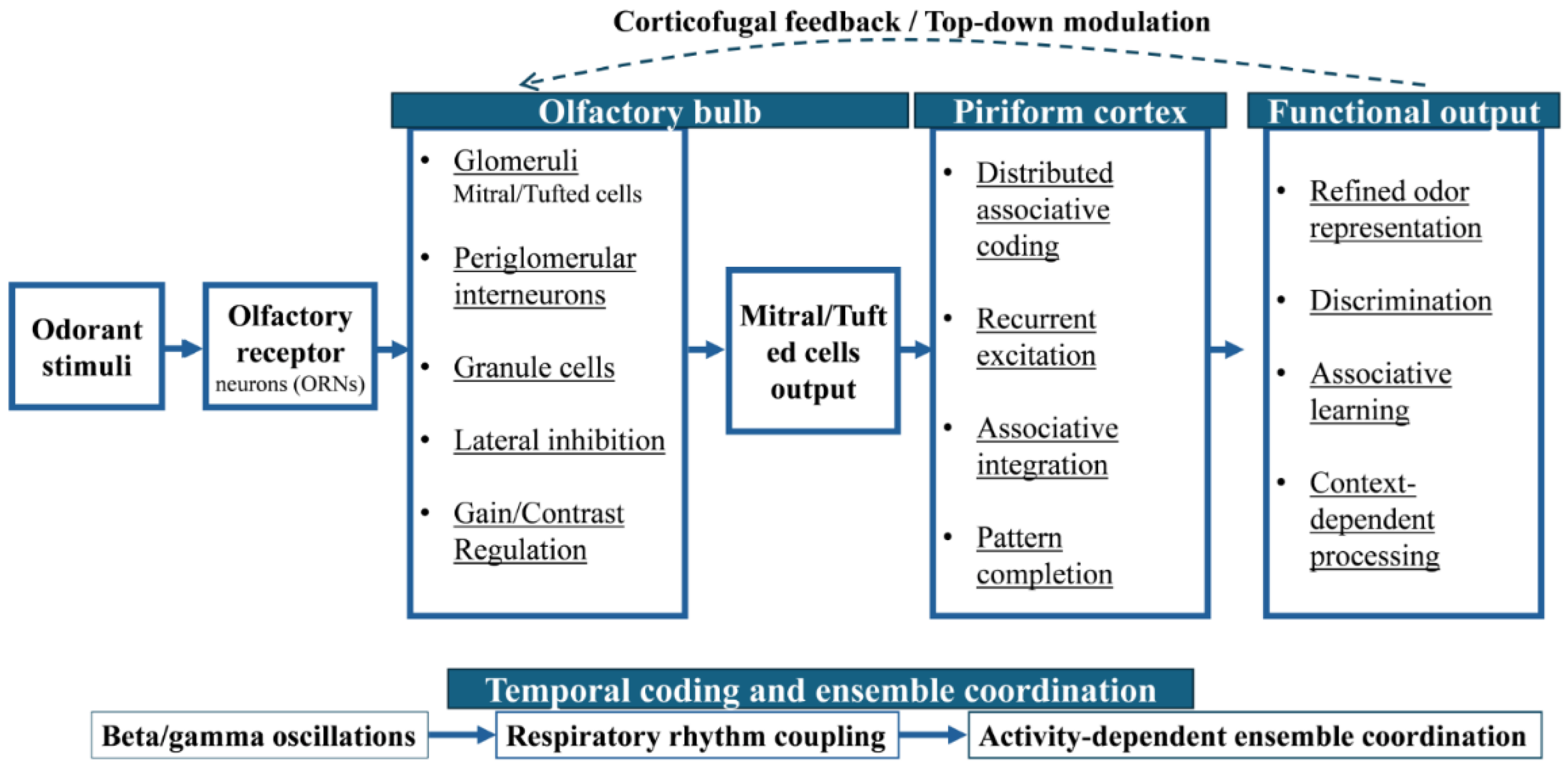
Figure 2.
Glial regulation of chemosensory circuit states. Schematic overview of the complementary roles of astrocytes and microglia in regulating chemosensory circuit function within the olfactory bulb/piriform cortex microcircuit. Astrocytes act at the tripartite synapse through neurotransmitter uptake, gliotransmission, Ca2+-dependent signaling, and metabolic support, whereas microglia contribute through surveillance, complement-mediated tagging, pruning, and cytokine signaling. Both glial populations respond to sensory experience, behavioral state, neuromodulatory context, and cortical feedback. Astrocytic actions primarily support rapid to intermediate regulation, whereas microglial actions contribute more prominently to intermediate to long-term remodeling. Together, these mechanisms shape circuit stability, adaptive remodeling, sensory learning, discrimination, adaptation, and influence structural remodeling and adult neurogenesis.
Figure 2.
Glial regulation of chemosensory circuit states. Schematic overview of the complementary roles of astrocytes and microglia in regulating chemosensory circuit function within the olfactory bulb/piriform cortex microcircuit. Astrocytes act at the tripartite synapse through neurotransmitter uptake, gliotransmission, Ca2+-dependent signaling, and metabolic support, whereas microglia contribute through surveillance, complement-mediated tagging, pruning, and cytokine signaling. Both glial populations respond to sensory experience, behavioral state, neuromodulatory context, and cortical feedback. Astrocytic actions primarily support rapid to intermediate regulation, whereas microglial actions contribute more prominently to intermediate to long-term remodeling. Together, these mechanisms shape circuit stability, adaptive remodeling, sensory learning, discrimination, adaptation, and influence structural remodeling and adult neurogenesis.
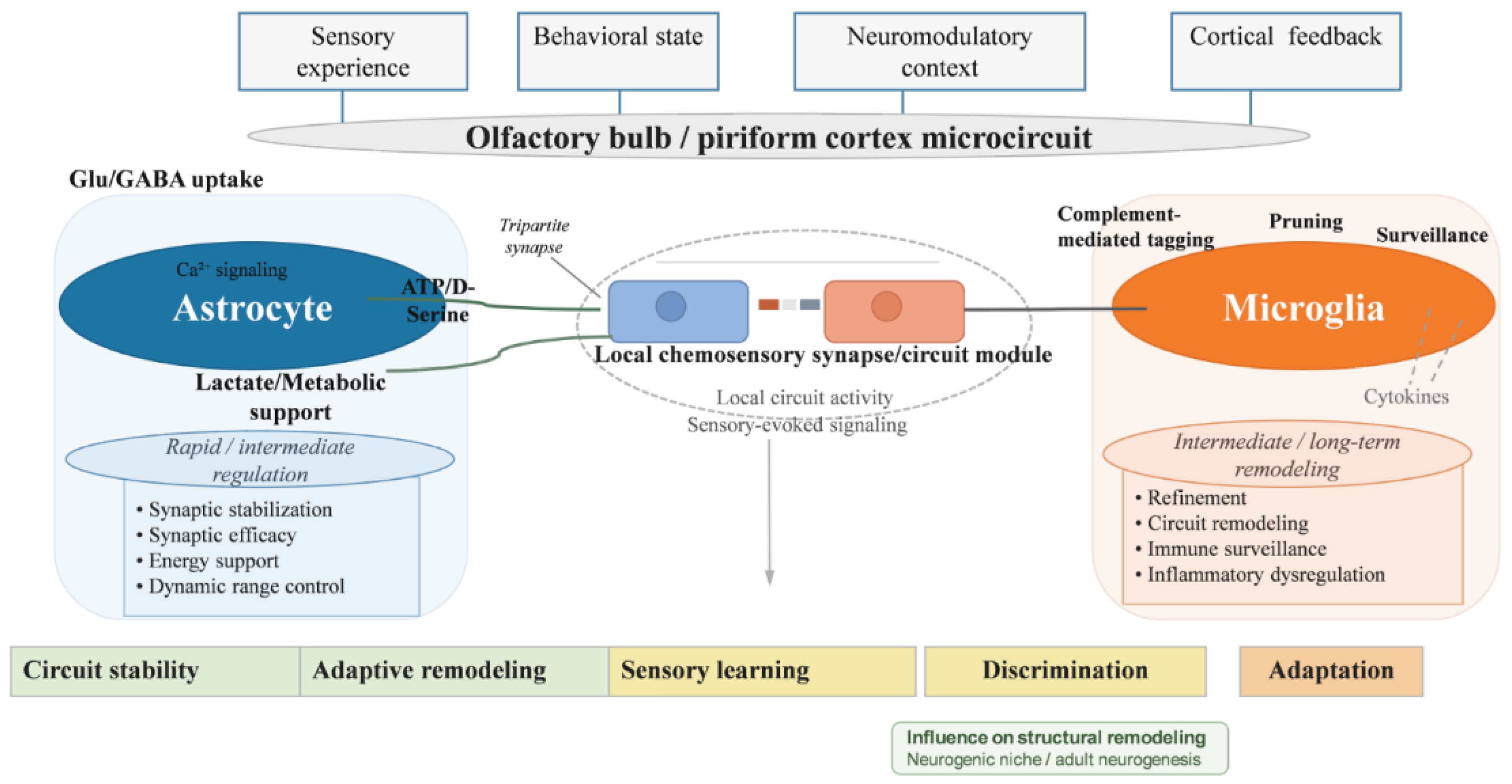
Figure 3.
Circuit control of neural stem cell dynamics and integration of newborn neurons. Schematic overview of the activity-dependent relationship between adult neurogenesis and sensory circuit remodeling in the olfactory system. Neural stem cells in the subventricular zone (SVZ) reside within a niche composed of ependymal, vascular, extracellular matrix, and local glial elements, and are regulated by neurotransmitter, activity-dependent, and cortical/circuit-derived signals. Neuroblasts migrate through the rostral migratory stream (RMS) to the olfactory bulb, where adult-born neurons integrate into local inhibitory circuits, pass through a critical period of heightened plasticity, and undergo selective stabilization and survival. These processes support refined odor coding, pattern separation, odor discrimination, novelty encoding, sensory learning, and adaptive circuit remodeling. Circuit activity regulates neurogenesis, while newly integrated neurons reshape circuit function, establishing a reciprocal circuit-to-niche feedback loop across multiple timescales.
Figure 3.
Circuit control of neural stem cell dynamics and integration of newborn neurons. Schematic overview of the activity-dependent relationship between adult neurogenesis and sensory circuit remodeling in the olfactory system. Neural stem cells in the subventricular zone (SVZ) reside within a niche composed of ependymal, vascular, extracellular matrix, and local glial elements, and are regulated by neurotransmitter, activity-dependent, and cortical/circuit-derived signals. Neuroblasts migrate through the rostral migratory stream (RMS) to the olfactory bulb, where adult-born neurons integrate into local inhibitory circuits, pass through a critical period of heightened plasticity, and undergo selective stabilization and survival. These processes support refined odor coding, pattern separation, odor discrimination, novelty encoding, sensory learning, and adaptive circuit remodeling. Circuit activity regulates neurogenesis, while newly integrated neurons reshape circuit function, establishing a reciprocal circuit-to-niche feedback loop across multiple timescales.
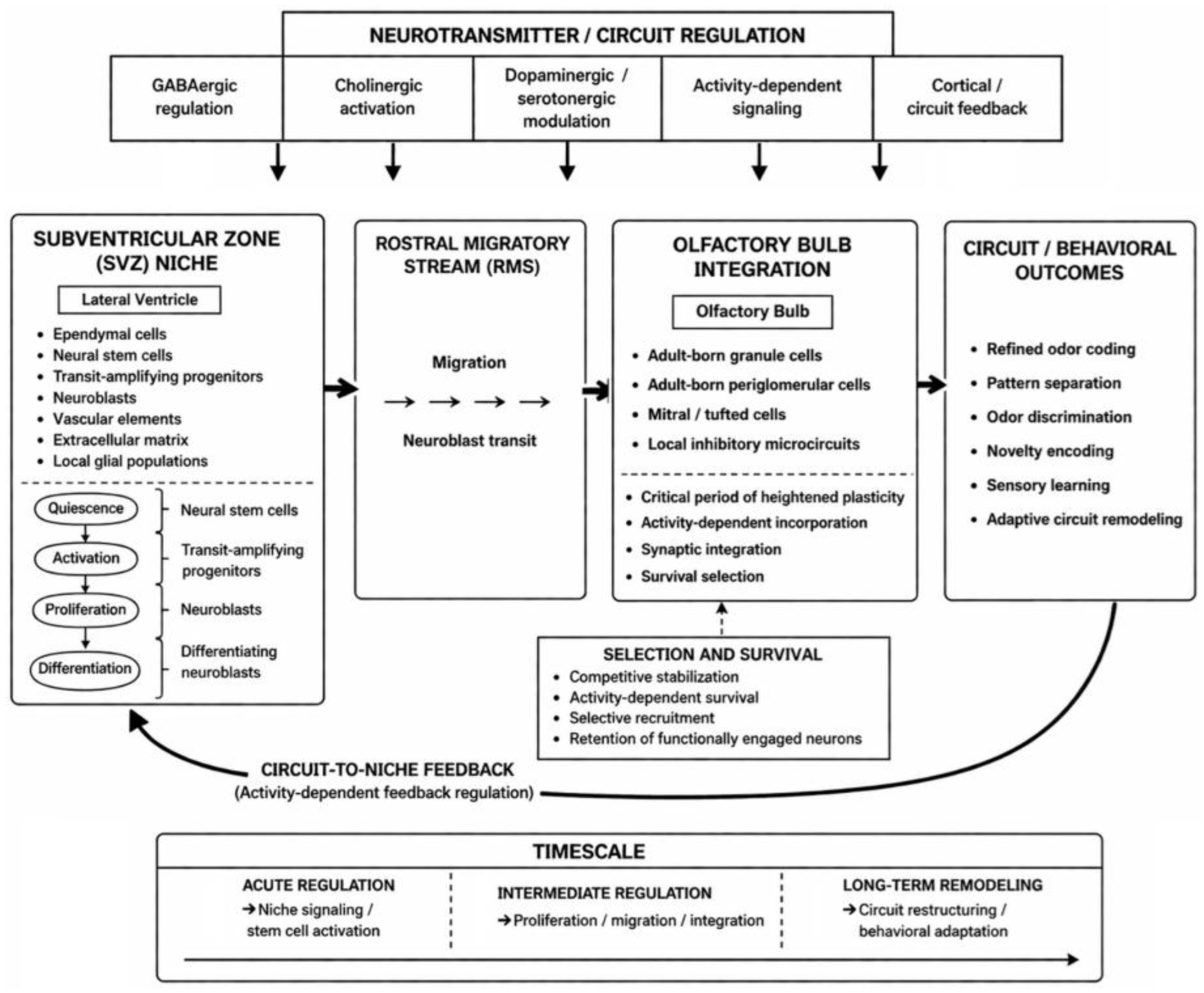

Table 1.
Multiscale mechanisms of chemosensory plasticity.
| Level of plasticity | Primary mechanism | Representative components | Functional outcome |
| Synaptic plasticity | Activity-dependent modification of synaptic strength and efficacy [16,38] | Long-term potentiation, long-term depression, inhibitory–excitatory balance, calcium-dependent signaling [16,39] | Modulates neuronal responsiveness, sensory gain, and associative encoding [16,40] |
| Circuit-level plasticity | Reconfiguration of ensemble activity, recurrent connectivity, temporal coding, and top-down modulation [8,16] | Olfactory bulb microcircuits, piriform cortex networks, corticofugal feedback, beta/gamma oscillations [8,32] | Refines sensory representations, discrimination, and context-dependent processing [8,32] |
| Cellular / glial plasticity | Regulation of synaptic and metabolic environments by non-neuronal cells [41,42] | Astrocytes, microglia, tripartite synapse, gliotransmission, synaptic pruning [41,43] | Stabilizes circuits while permitting adaptive remodeling and sensory learning [41,43] |
| Structural / neurogenic plasticity | Activity-dependent generation and integration of new neurons into existing circuits [38] | Subventricular zone neural stem cells, rostral migratory stream, adult-born olfactory interneurons [38] | Supports long-term circuit remodeling, pattern separation, and sensory adaptation [38,44] |
| Integrated multiscale plasticity | Coordinated interaction of synaptic, circuit, cellular, and structural mechanisms [8,38] | Cortical feedback, glial regulation, neural stem cell dynamics, neuromodulatory signaling [8,41] | Enables adaptive chemosensory function across multiple temporal and organizational scales [8,38] |
Table 2.
Cortical, glial, and neural stem cell contributions to chemosensory plasticity.
| Component | Primary mode of action | Timescale | Effect on plasticity | Interaction with other components |
| Cortical feedback | Top-down modulation of sensory circuits through regulation of excitability, inhibition, temporal coordination, and contextual signaling [8,19] | Rapid to intermediate | Refines sensory representations, supports learning-dependent circuit reconfiguration, and aligns processing with behavioral relevance [6,16] | Shapes local circuit states that influence glial responses and activity-dependent neurogenesis [9,41,112] |
| Astrocytes | Regulation of neurotransmitter uptake, synaptic environment, gliotransmission, and metabolic support [9,41,58] | Intermediate | Stabilizes synaptic function while permitting activity-dependent modulation of circuit responsiveness [9,41,58] | Modulates how cortical and local circuit signals are expressed at synapses and within the neurogenic niche [9,41,112] |
| Microglia | Activity-dependent synaptic remodeling, immune surveillance, and inflammatory signaling [116,117] | Intermediate to long-term | Contributes to pruning, refinement, and restructuring of circuit connectivity [61,116,117] | Responds to circuit activity and influences the structural environment in which neurogenesis and synaptic plasticity occur [61,116,117] |
| Neural stem cells / adult-born neurons | Activity-dependent neurogenesis, neuronal integration, and structural remodeling of olfactory circuits [61,82,115,116,117] | Long-term | Supports sustained circuit adaptation, pattern separation, and updating of sensory representations [38,44,112] | Regulated by circuit activity and glial microenvironment; newly integrated neurons reshape the circuits that influence their generation [41,82,112] |
Table 3.
Chemosensory dysfunction through a multiscale plasticity lens.
| Condition | Circuit-level alterations | Glial / inflammatory features | Neurogenesis / stem cell changes | Functional chemosensory outcome |
| Anosmia / hyposmia | Altered olfactory bulb activity, reduced cortical feedback, disrupted synaptic organization [6,8] | Local inflammatory responses and glial activation may impair circuit stability [7,140] | May be secondarily affected depending on severity and duration of dysfunction [10,123] | Reduced odor detection, impaired discrimination, diminished sensory adaptation [121,122] |
| Post-viral dysfunction / SARS-CoV-2 | Peripheral sensory disruption with possible secondary central alterations in olfactory pathways [122,123] | Prominent inflammatory and cellular disruption involving peripheral and central mechanisms [119,121] | Potential impairment of neurogenic and reparative processes remains under investigation [119,123] | Persistent anosmia, hyposmia, distorted odor perception, delayed sensory recovery [122,141] |
| Aging | Progressive decline in circuit plasticity, altered synaptic regulation, reduced adaptive responsiveness [126,128] | Age-related changes in glial activity and inflammatory tone [61,128] | Reduced neural stem cell activity and diminished integration of adult-born olfactory interneurons [10,93] | Decline in odor sensitivity, discrimination, and adaptation to novel sensory input [126,128,142] |
| Parkinson’s disease | Early alterations in olfactory bulb circuitry and cortical processing; impaired circuit-level plasticity [131,135,137] | Increased microglial and astrocytic activation, neuroinflammatory disruption of local microenvironment [61,132] | Reduced adult neurogenesis and impaired structural remodeling capacity have been reported [124,137] | Early olfactory dysfunction, impaired odor identification and discrimination [137,142] |
| Alzheimer’s disease | Disrupted olfactory pathway connectivity and altered network activity [129,143] | Neuroinflammatory processes involving astrocytic and microglial responses [133,144,145] | Neurogenesis may be altered, though functional significance remains incompletely resolved [144,146] | Early olfactory impairment, reduced odor recognition, progressive sensory decline [126,143] |
| Metabolic / systemic disorders | Altered neuronal excitability and impaired integration of sensory signals [55,147] | Hormonal, metabolic, and inflammatory dysregulation affecting local circuit environment [55,61,147] | Potential disruption of neurogenic niche regulation and adaptive remodeling [10,148] | Altered smell and taste perception, reduced sensory flexibility, impaired adaptive responses [142,147] |
Disclaimer/Publisher’s Note: The statements, opinions and data contained in all publications are solely those of the individual author(s) and contributor(s) and not of MDPI and/or the editor(s). MDPI and/or the editor(s) disclaim responsibility for any injury to people or property resulting from any ideas, methods, instructions or products referred to in the content. |
© 2026 by the authors. Licensee MDPI, Basel, Switzerland. This article is an open access article distributed under the terms and conditions of the Creative Commons Attribution (CC BY) license (http://creativecommons.org/licenses/by/4.0/).
Copyright: This open access article is published under a Creative Commons CC BY 4.0 license, which permit the free download, distribution, and reuse, provided that the author and preprint are cited in any reuse.


