

Submitted:
09 April 2026
Posted:
10 April 2026
You are already at the latest version
Abstract
Avian influenza is a critical zoonotic infection threatening both the poultry industry and global public health. While traditional intramuscular vaccines elicit systemic im-munity, they often fail to provide robust local protection at mucosal surfaces. There is thus significant interest in the development of mucosal avian influenza vaccines administered via the intranasal route. However, in humans, this approach is significantly hampered by the availability of safe and effective adjuvants. This study investigated the immunogenic-ity of a modified recombinant influenza A/H5 hemagglutinin (rHA/H5-modif) formulated with Novochizol, a novel chitosan-derived delivery system, administered intranasally to laboratory animals. Our results demonstrate that mucosal immunization with the rHA/H5-modif/Novochizol complex induces potent humoral (IgG and IgA) and cell-mediated immune responses. Crucially, the formulation provided 100% survival in mice following a lethal challenge with highly pathogenic avian influenza A/H5. These findings position the rHA/H5-modif/Novochizol complex as a promising candidate for next-generation mucosal vaccines, in particular against highly pathogenic avian influen-za A/H5 subtype.
Keywords:
influenza A/H5 virus
; hemagglutinin
; intranasal immunization
; Novochizol
1. Introduction
Avian influenza represents one of the most dangerous zoonotic infections, posing a significant threat to both agriculture and public health. Of particular concern are highly pathogenic avian influenza (HPAI) A/H5 viral strains, which are capable of causing large-scale epizootics among poultry and which possess zoonotic transmission potential [1,2]. In 2021, Russia reported the world’s first documented case of human infection with the A/H5N8 virus in seven poultry farm workers [3].
Vaccination remains the most effective strategy for controlling the spread of viral infections. Traditional vaccines are typically administered intramuscularly, eliciting systemic immunity but often failing to induce effective local mucosal protection. Consequently, there is considerable interest in the development of mucosal avian influenza vaccines that could be administered intranasally [4,5,6,7]. The nasal cavity serves as the primary portal of entry for infection—the initial site of contact for inhaled antigens—where mucosal immune responses are initiated, including IgA secretion. The establishment of local immunity at the respiratory mucosa is critical for the prevention of respiratory viral infections [8,9,10,11,12]. The development of mucosal vaccines capable of inducing both systemic and mucosal immunity represents a pressing challenge not only for respiratory pathogens but also for numerous enteric pathogens, sexually transmitted diseases, and oncogenic viruses that penetrate through mucosal surfaces [9].
Recombinant viral proteins are frequently employed as antigens for mucosal vaccines [13]. Protein antigens offer several substantial advantages compared to inactivated virus preparations. They are safe for individuals with allergies to chicken embryo proteins, contain minimal impurities capable of causing adverse effects, and provide economic efficiency in manufacturing with rapid production timelines. However, a significant limitation exists due to the low immunogenicity of recombinant antigens following intranasal administration. This is attributed to the unique characteristics of the mucosal membrane, which presents an aggressive and yet a tolerogenic environment [11,14]. Furthermore, continuous mucociliary clearance impedes stable drug retention and promotes rapid elimination from the organism [11].
To overcome this obstacle, specialized antigen delivery systems suitable for intranasal application are under active development. The absorption of proteins across mucosal membranes can be enhanced by formulating complexes with mucoadhesive polymers [11,15,16]. One promising and accessible natural biopolymer is chitosan—an aminopolysaccharide derived from chitin obtained from crustaceans and fungi. Chitosan exhibits pronounced mucoadhesive properties, low toxicity, and biodegradability. Several studies have demonstrated the efficacy of chitosan and its derivatives for antigen delivery, including antigens from seasonal influenza virus and H5N1 [17,18,19]. One promising chitosan derivative formulation is Novochizol, produced through intramolecular cross-linking of linear chitosan molecules (www.novochizol.ch).
In this study, we prepared a mucosal vaccine candidate, comprised of recombinant hemagglutinin (HA) protein of influenza A (H5N8) virus as antigen, synthesized in CHO cells and purified by chromatography, and Novochizol, as a vaccine delivery system. The immunogenic properties of this vaccine candidate were investigated in laboratory animals following intranasal administration.
2. Materials and Methods
2.1. Cell Cultures and Viruses
CHO-K1 cells (Cell Culture Collection, State Research Center of Virology and Biotechnology “Vector”, Rospotrebnadzor) were used to generate the recombinant hemagglutinin rHA/H5-modif producer cell line.
The virus neutralization assay was performed using MDCK-SIAT1 cells, kindly provided by the WHO Collaborating Centre for Reference and Research on Influenza at the Francis Crick Institute.
For the virus neutralization assay, influenza A/turkey/Stavropol/320-01/2020 (H5N8) virus (EPI1114749) was used, while the challenge infection was performed with influenza A/Astrakhan/3212/2020 (H5N8) virus (EPI1846961) (State Research Center of Virology and Biotechnology “Vector”, Rospotrebnadzor).
2.2. Generation of Recombinant Hemagglutinin rHA/H5-modif Producer Cell Line
The gene encoding influenza A virus hemagglutinin (H5N8) was synthesized (Evrogen, Russia) using a sequence based on A/turkey/Stavropol/320-01/2020 (H5N8).
The rHA/H5-modif recombinant hemagglutinin producer cell line was generated in CHO-K1 cells using The PhiC31 Integrase System. For this purpose, two plasmid vectors were constructed: a plasmid vector carrying the PhiC31 integrase gene (pPhiC31), and a plasmid vector containing the attB site and the influenza A virus (H5N8) hemagglutinin gene in combination with EMCV-IRES-PuroR (pIntCas-rHA/H5-modif) (Figure 1B).
Subsequently, a stable rHA/H5-modif recombinant hemagglutinin producer cell line was established. One day prior to transfection, CHO-K1 cells were seeded in a 12-well plate at a density of 1×10⁶ cells/well in DMEM/F12 growth medium (Servicebio, China) supplemented with 10% fetal bovine serum (Himedia, India). The following day, transfection was performed using Lipofectamine 3000 (Invitrogen, USA) with the two plasmids (pPhiC31 and pIntCas-rHA/H5-modif) at a ratio of 50:1. Several days post-transfection, the medium was replaced with fresh medium containing the antibiotic puromycin (10 μg/mL), and cells were cultured for 14 days until monolayer formation. The resulting polyclonal culture was then transferred to a T25 culture flask. After the polyclonal CHO-K1-rHA/H5-modif cell culture formed a confluent monolayer, transgene expression was analyzed by Western blot analysis. Following confirmation of transgene expression, the polyclonal culture was used for protein production.
2.3. Production and Purification of Recombinant Hemagglutinin rHA/H5-modif
The CHO-K1-rHA/H5-modif producer cell line was cultured in roller bottles in DMEM/F12 medium (Servicebio, China) supplemented with 10% fetal bovine serum (Himedia, India). Upon completion of cultivation, the culture supernatant was harvested, and recombinant protein was purified by metal-affinity chromatography using IMAC Seplife FF chromatographic resin (Sunresin, China). The purity of the target protein was assessed by SDS-PAGE under denaturing conditions in the presence and absence of reducing agents, followed by Coomassie G250 staining. Fractions containing the target protein were pooled and dialyzed against phosphate-buffered saline (Neofroxx, Germany), then concentrated using a 100 kDa cutoff centrifugal concentrator (Jet Biofil, China). Subsequently, the affinity-purified protein was further purified by size-exclusion chromatography using a Chrom-LinX™ 16/1000 Tiderose GF200 column (Taidu Biotech, China) at a flow rate of 1 mL/min on an FPLC system. Gel Filtration Standard (Bio-Rad, USA) was used as the molecular weight standard. Molecular weight was calculated based using a standard curve generated by plotting the logarithm of molecular weight against elution volume from gel filtration.
2.4. Western Blot Analysis
Western blotting was performed using the SNAP i.d. 2.0 system (Millipore, Burlington, MA, USA) according to the manufacturer’s instructions. As the primary antibody, ferret serum infected with influenza A (H5N8) virus was used (State Research Center of Virology and Biotechnology “Vector”, Rospotrebnadzor). As secondary antibodies, mouse anti-ferret IgG (1:3000) (State Research Center of Virology and Biotechnology “Vector”, Rospotrebnadzor) and goat anti-mouse IgG-alkaline phosphatase (1:5000) (Sigma, USA) were used. The immune complex was visualized by adding 1-Step™ NBT/BCIP substrate (Thermo Fisher Scientific, Waltham, MA, USA).
2.5. Preparation of rHA/H5-modif-Novochizol Protein Complexes
Novochizol™ (registered international trademark Novochizol No. 1540749, US Patent Office No. 6297647) was provided by NOVOCHIZOL SA (Montey, Switzerland). Novochizol solution was prepared by sequential dissolution with ultrasonic agitation using a disperser (UZTA-0.4/22-OM, U-sonic, Biysk, Russia) at maximum power in 0.15 M NaCl containing 0.5% succinic acid and 1% Novochizol. The resulting solution was sterilized by filtration through 0.45 μm apyrogenic cellulose acetate filters (Minisart®, Sartorius Stedim Biotech, Göttingen, Germany). Complexes of recombinant rHA/H5-modif protein with Novochizol were prepared in 0.15 M NaCl by mixing the protein solution with Novochizol at a mass ratio of 1:1. The mixture was vortexed for 10 minutes. The resulting particles were stored at 4 °C.
Characterization of the obtained complexes was performed using dynamic light scattering (DLS) with a Zetasizer Nano ZS Plus (Malvern Instruments, Malvern, UK). DTS1070 cuvettes were used for measurements. Surface charge was analyzed by zeta potential measurement. All measurements were performed in triplicate at 25 °C.
2.6. Immunization of Laboratory Animals
Animal experiments were conducted in accordance with the legislation of the Russian Federation and the bioethical principles of the European Convention for the Protection of Vertebrate Animals Used for Experimental and Other Scientific Purposes (Strasbourg, 1986). All experiments were approved by Bioethical Protocol No. 1 (21.03.2023) issued by the Bioethics Committee of the State Research Center of Virology and Biotechnology “Vector”, Rospotrebnadzor.
Female BALB/c mice (16–18 g) were used for the experiments. Animals were housed under standard laboratory conditions with access to food and water ad libitum. Animals were divided into four groups (n=16 per group) and immunized intranasally twice with a 3-week interval. The first group received 25 μg of purified recombinant hemagglutinin rHA/H5 dissolved in saline in a total volume of 25 μL. The second group received recombinant protein complexed with Novochizol at a 1:1 ratio (25/25 μg) in a total volume of 25 μL. The third group received 25 μg of Novochizol in a total volume of 25 μL. The fourth group consisted of intact (naïve) animals. For animal immobilization, inhalation anesthesia was applied (RWD Life Science, USA) using 2.5% isoflurane solution for 4–5 minutes. Subsequently, 12.5 μL of the preparation was administered into each nostril using an automatic pipette. Blood samples were collected from the retro-orbital sinus 14 days after the first and second immunizations. Blood was incubated for 1 hour at 37 °C and 2 hours at 4 °C, then centrifuged at 7000 × g for 10 minutes, and serum was collected. Serum was inactivated by heating at 56 °C for 30 minutes and stored at -20 °C.
2.7. Enzyme-Linked Immunosorbent Assay (ELISA)
Enzyme-linked immunosorbent assay (ELISA) was performed according to the methodology described by Rudometova et al. [20]. Briefly, purified recombinant rHA/H5-modif protein was used as the antigen. Sera from immunized mice were titrated using a series of two-fold dilutions. IgG and IgA titers were determined using anti-mouse IgA and anti-mouse IgG conjugates (Sigma, USA), respectively.
2.8. Virus Neutralization Assay
The virus neutralization assay was performed as described by Rudometova et al. [20]. Briefly, each standardized virus preparation contained 100 TCID₅₀/100 μL. Two-fold serial dilutions of serum (200 μL) were mixed with 200 μL of standardized influenza virus. The suspensions were incubated for 1 hour at 37 °C, 5% CO₂. Serum from non-immunized mice was used as a negative control. Ferret control serum (State Research Center of Virology and Biotechnology “Vector”, Koltsovo, Russia) was used as a positive control. Subsequently, 200 μL of the suspension was added to wells of culture plates containing MDCK-SIAT1 cells. After 60 minutes, the inoculum was removed, and cells were washed with culture medium. Cells were cultured for 3 days in Opti-MEM I medium supplemented with 1 μg/mL TPCK-trypsin (Sigma-Aldrich, USA) at 37 °C, 5% CO₂. Subsequently, cells were stained with crystal violet solution, washed with water, and analyzed using the Agilent BioTek Cytation 5 multi-mode reader (Thermo Fisher Scientific, USA) for cell visualization. All assays were performed in triplicate. The titer was defined as the serum dilution at which 50% of cells survived. In all negative controls, less than 5% of cells survived.
2.9. Splenocyte Isolation
Following euthanasia, spleens were collected from immunized mice and homogenized through 70 μm and 40 μm cell strainers (Jet BIOFIL, China). Splenocytes were treated with ACK Lysis Buffer (Sigma, USA), washed with RPMI 1640 medium, and resuspended in RPMI 1640 medium supplemented with 10% fetal bovine serum, 2 mM L-glutamine, and 50 μg/mL gentamicin. Viable splenocytes were counted prior to analysis using a TC20™ automated cell counter (Bio-Rad, USA).
2.10. IFN-γ ELISpot Assay
The ELISpot assay was performed using the Mouse IFN-γ (ALP) ELISpot kit (Mabtech, Sweden) according to the manufacturer’s instructions. A 96-well ELISpot plate pre-coated with primary antibodies (anti-IFN-γ monoclonal antibodies) was washed with PBS and blocked with RPMI 1640 medium supplemented with 10% fetal bovine serum for 30 minutes at room temperature. After blocking, 3 × 10⁵ splenocytes were added per well and stimulated with a mixture of peptides specific for the hemagglutinin of influenza A (H5N8) virus (A/turkey/Stavropol/320-01/2020) at a final concentration of 20 μg/mL of each peptide (TYNAELLVL, LYDKVRLQL, SFFRNVVWL, SPYQGAPSF, LYKNPTTYISVGTSTLNQ, VDTIMEKNVTVTHAQDILEK, SSWPNHETSLGVSAASPYQ, MPFHNIHPL, AGWLLGNPM, CYPGSLND, RVPEWSYI, LRNSPLREKRRKRGL, YVKSNKLVL). Peptides were selected for BALB/c mice and recognized by major histocompatibility complex class I (H-2Dᵈ, H-2Kᵈ, H-2Lᵈ) and class II (H-2Iᴬᵈ, H-2Iᴱᵈ) molecules. The peptides were synthesized at AtaGenix Laboratories (Wuhan, China) with a purity of >95%. Cells were incubated for 20 hours at 37 °C in a humidified incubator with 5% CO₂. After incubation, plates were washed with PBS and incubated with biotinylated anti-IFN-γ antibodies for 2 hours at room temperature, followed by incubation with streptavidin-alkaline phosphatase conjugate for 1 hour. Staining was performed using BCIP/NBT-plus substrate for 8–10 minutes, after which the reaction was stopped by rinsing with distilled water. Unstimulated and concanavalin A (Con A, 5 μg/mL)-stimulated splenocytes were used as negative and non-specific positive controls, respectively. Plates were air-dried, and the number of IFN-γ-producing cells was analyzed using a Stemi 2000C optical stereomicroscope (Carl Zeiss, Jena, Germany).
2.11. Intracellular Cytokine Staining (ICS) Assay
Splenocytes isolated from immunized mice were plated in a 96-well plate at a concentration of 1 × 10⁶ cells per well and stimulated for 3 hours with a mixture of specific peptides at a final concentration of 20 μg/mL of each peptide. Brefeldin A (BioLegend, USA) was then added at 1 μg/mL, and incubation was continued for an additional 12 hours at 37 °C in a humidified incubator with 5% CO₂. A cell sample stimulated with 10 ng/mL PMA and 1 μg/mL ionomycin (BioLegend, USA) was used as a positive control to assess non-specific stimulation. After incubation, commercial monoclonal antibodies from BioLegend (USA) were used to stain surface markers: anti-CD3 (clone 500A2), anti-CD4 (clone GK1.5), and anti-CD8 (clone 53-6.7), conjugated with AF700, BV785, and FITC, respectively. To detect intracellular cytokines, monoclonal antibodies against IFN-γ (clone XMG1.2), conjugated with APC, were added to the cells. Cells were treated with a mixture of labeled monoclonal antibodies according to the manufacturer’s instructions. Samples were analyzed using a ZE5 Bio-Rad flow cytometer, and results were processed using Everest software.
2.12. Viral Challenge Study
The protective efficacy study was conducted in accordance with Sanitary Rules and Regulations SanPiN 3.3686-21 of the Russian Federation [21].
Fourteen days after the second immunization, mice were challenged intranasally with influenza A/Astrakhan/3212/2020 (H5N8) virus at a dose of 20 LD₅₀. Twenty LD₅₀ corresponded to 6.65 log₁₀ EID₅₀ (embryonic infectious dose). Challenge was performed under anesthesia using a combination of Zoletil 100 (Delpharm Tours, France) and Xyla (Interchemie, Netherlands).
Following challenge, mice were monitored daily for 14 days, and any manifestations of clinical disease symptoms were recorded, including ruffled fur, decreased body temperature, weight loss, neurological disorders, and mortality. Animals exhibiting severe conditions that could lead to death, such as loss of more than 20% of initial body weight or lethargy, were euthanized by cervical dislocation. Remaining mice were humanely euthanized by the same method at the end of the experiment.
2.13. Statistical Analysis
Statistical analysis was performed using GraphPad Prism 9.0 software (GraphPad Software, Inc., San Diego, CA, USA). Quantitative data were presented as median with range and analyzed using non-parametric tests. The Mann-Whitney U test was used for comparisons between two independent groups. The Kaplan-Meier method was used to generate survival curves. The Mantel-Cox test (log-rank test) was used to compare survival rates between experimental and control groups.
3. Results
3.1. Production, Purification and Characterization of rHA/H5-modif
The recombinant immunogen, designated rHA/H5-modif, was designed based on the A/turkey/Stavropol/320-01/2020 (H5N8) sequence. To enhance stability and trimerization, the sequence was modified by: removing transmembrane and cytoplasmic domains; introducing amino acid substitutions (H26W, H106R, K51I, E103I) in the protease-vulnerable pH-switch region; adding a T4 trimerization domain; adding a poly-His tag to facilitate subsequent purification.
Figure 1a shows a model of rHA/H5-modif obtained using the AlphaFold2 program.
The gene encoding rHA/H5-modif was codon-optimized for expression in mammalian cells and cloned into the plasmid integration vector pIntCas-rHA/H5-modif. The rHA/H5-modif recombinant hemagglutinin producer cell line was generated in CHO-K1 cells using the PhiC31 Integrase System by transfection with both pPhiC31 and pIntCas-rHA/H5-modif plasmids (Figure 1B).
Upon completion of producer cell line cultivation, the culture supernatant was harvested, and recombinant protein purification was performed by metal-affinity chromatography followed by gel filtration. The purified rHA/H5-modif protein preparation was analyzed by SDS-PAGE under reducing (with β-mercaptoethanol) and non-reducing conditions. As shown in Figure 1D, under reducing conditions, the mobility of rHA/H5-modif protein corresponded to the theoretically calculated molecular weight of the monomer (~70 kDa), while under non-reducing conditions, its mobility corresponded to the molecular weight of the trimer (~250 kDa). The molecular weight and oligomeric status of the purified rHA/H5-modif protein were confirmed by size-exclusion chromatography (Figure 1C, Supplementary). The results showed that the majority of the protein in solution existed in trimeric form.
Western blotting demonstrated that both monomers and trimers of rHA/H5-modif were recognized by serum from ferrets infected with influenza A (H5N8) virus, confirming the antigenic properties of the recombinant hemagglutinin (Figure 1E).
3.2. Preparation of Novochizol- Recombinant Protein Complexes
Novochizol is a chitosan derivative, a natural polysaccharide. It has a globular structure due to intramolecular cross-linking of linear chitosan molecules (Novochizol SA).
Complexes of recombinant protein with Novochizol were formed by mixing the recombinant protein with Novochizol in saline at a mass ratio of 1:1 (Figure 2A). The resulting complexes were characterized using dynamic light scattering (DLS), revealing a near-neutral surface charge (zeta potential consist of 1.54 mV) (Figure 2B). The particle size distributions of rHA/H5-modif/Novochizol complexes based on DLS results are shown in Figure 2B.
3.3. Immunogenicity of rHA/H5-modif/Novochizol Complexes
Immunogenic properties were investigated following intranasal immunization of BALB/c mice, as described in the Materials and Methods section. Animals were divided into four groups (n=16 per group) and immunized intranasally twice with a 3-week interval. A 25 μg protein dose per animal was administered each time. The immunization schedule for laboratory animals is presented in Figure 3.
The immunogenicity of the obtained rHA/H5-modif/Novochizol complexes was evaluated through their ability to induce virus-specific antibodies (IgG and IgA) as well as through T-cell responses 14 days after the second immunization.
The rHA/H5-modif/Novochizol complex administered intranasally was found to induce the formation of a specific humoral immune response, including both IgG and IgA antibodies, with median titers of 1:12,000 and 1:400, respectively (Figure 4A and 4B). Furthermore, sera were tested in a virus neutralization assay using the homologous influenza A/Astrakhan/321-05/2020 (H5N8) virus strain and demonstrated the ability to neutralize the virus at mean dilutions of 1:150 (Figure 4C). Antibody titers were at the level of the negative control in animals immunized with rHA/H5-modif protein alone.
3.4. Cellular Immune Response
T-cell responses were evaluated using ELISpot and ICS assays. To determine cytokine-secreting T-cells in immunized mice, splenocytes were obtained. IFN-γ-secreting cells were detected following stimulation of splenocytes with virus-specific peptides selected for high predicted affinity binding to MHC molecules of BALB/c mice. As shown in Figure 5A, the highest median number of spot-forming units (SFU) in the ELISpot assay was observed in mice immunized with the rHA/H5-modif/Novochizol complex (30 SFU). ICS analysis also demonstrated that mice in Group 2 exhibited higher numbers of CD4+ and CD8+ IFN-γ-producing cells compared to Groups 1 and 3 (Figure 5B-C).
3.5. Protection Study
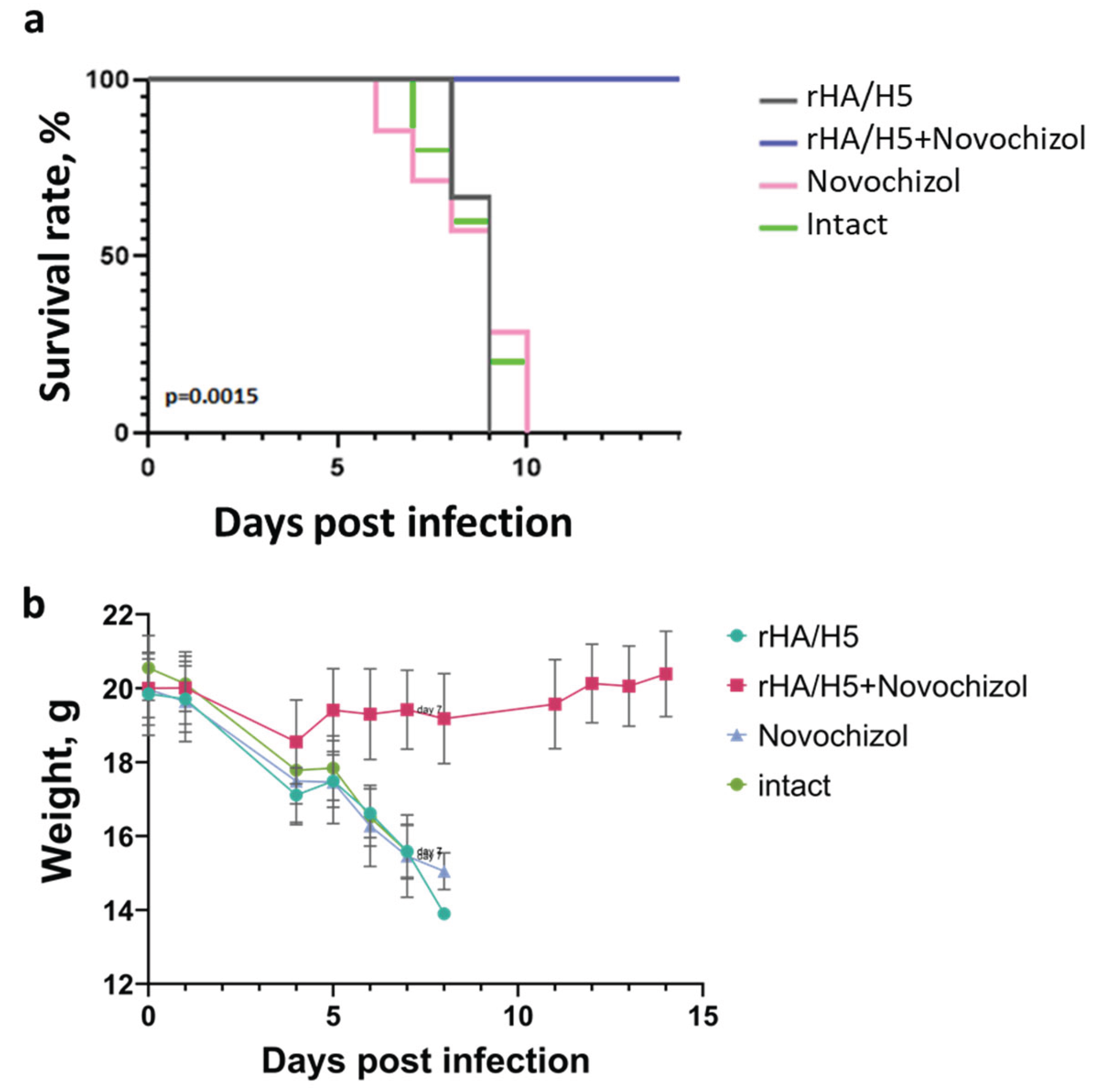
The protection study was conducted by challenging immunized animals with live influenza A/Astrakhan/3212/2020 (H5N8) virus. A 100% survival rate was observed in the group immunized intranasally with recombinant protein complexed with Novochizol. In contrast, animals in all other groups succumbed to the disease (Figure 6а). The weight loss graph is shown in Figure 6b.
4. Discussion
Avian influenza virus, like other respiratory viruses, is capable of entering the organism through the respiratory mucosa. Therefore, to prevent respiratory infectious diseases, it is important to establish local mucosal immunity, which can be achieved through mucosal immunization. Direct delivery of antigens to the respiratory mucosa can induce both systemic and local immune responses. However, insufficient immune response intensity is often observed following mucosal administration of recombinant or inactivated vaccines. Mucosal adjuvants may solve this problem by significantly enhancing antigen immunogenicity and strengthening the immune response [22]. However, the development of human mucosal vaccines remains substantially challenging due to the limited availability of safe and effective adjuvants [23].
In this study, we investigated whether Novochizol, a chitosan derivative and a promising delivery system for various molecules [24,25,26,27,28,29], may act as an effective mucosal adjuvant. Due to its globular structure and high degree of deacetylation, Novochizol has several advantages over linear chitosan: enhanced solubility in aqueous solutions, chemical stability, resistance to biodegradation, high adhesiveness, and tissue penetration capability. These properties enable Novochizol to sorb various substances and slowly release them within tissues. The safety of Novochizol was confirmed during preclinical trials.
As an antigen for mucosal vaccine development, we used recombinant hemagglutinin (HA) protein of influenza A (H5N8) virus. HA is a promising vaccine candidate antigen: it is the major surface protein of influenza virus and serves as the target for virus-neutralizing antibodies. HA is present on the surface of viral particles as a trimer composed of monomers containing a highly variable immunogenic globular head domain (HA1) and a conserved stalk domain (HA2).
In this study, we produced recombinant hemagglutinin (HA) protein of influenza A (H5N8) virus. To obtain a more stable structure, the recombinant HA underwent the following modifications: i, the transmembrane and cytoplasmic domains were deleted from the natural sequence; ii, amino acid substitutions were introduced in the pH-switch region vulnerable to proteases (H26W, H106R, K51I, and E103I), and iii, a T4 trimerization domain was added to the C-terminus to stabilize the trimeric structure. In our previous studies we demonstrated that such modified HA, as part of DNA and mRNA vaccines administered intramuscularly to mice via jet injection, induced neutralizing antibodies and protected against lethal viral challenge [30,31]. rHA/H5-modif was expressed in CHO cells and purified by chromatography. The protein was shown to exist predominantly in trimeric form in solution (Figure 1C). rHA/H5-modif/Novochizol protein complexes were characterized using DLS. The mean particle size was 245±119.5 nm, and the zeta potential consist of 1.54 mV ±1.26.
Immunogenicity evaluation of the rHA/H5-modif/Novochizol complex in mice demonstrated that intranasal administration induced significantly higher titers of virus-specific antibodies, both IgG and IgA (Figure 4A, B), compared to administration of recombinant protein alone. In the virus neutralization assay, sera from animals immunized with the rHA/H5-modif/Novochizol complex exhibited virus-neutralizing activity at 1:150 dilutions (Figure 4C). These data suggest that protein complexes with Novochizol may provide more effective delivery of rHA/H5-modif to immune system cells.
Furthermore, we investigated T-cell immunity in response to complex administration, as accumulating evidence emphasizes the critical role of T-cell-mediated immunity in protection against influenza [32,33,34]. The obtained results showed that ELISpot results correlated with ICS data (Figure 5). The numbers of CD4+ and CD8+ IFN-γ-secreting T-cells in response to stimulation with virus-specific peptides were higher in mice immunized with the rHA/H5-modif/Novochizol complex compared to control groups (Figure 5B, C). The protection study demonstrated that immunization with the rHA/H5-modif/Novochizol complex provided 100% protection of animals against challenge with a lethal dose of avian influenza virus strain A/Astrakhan/3212/2020 (H5N8) (Figure 6).
5. Conclusions
In this study, we have shown that intranasal immunization with the rHA/H5-modif/Novochizol complex induced both specific humoral responses (IgG and IgA antibodies) and cellular immune responses, leading to sterilizing immunity. The efficacy of immunization was confirmed by challenging the animals with a lethal dose of avian influenza virus subtype A/H5, and the 100% protection observed in the immunized groups. The rHA/H5-modif/Novochizol complex appears a promising candidate for the development of an effective vaccine against highly pathogenic avian influenza subtype A/H5. More generally, given its safety profile and ease of production, Novochizol may represent an interesting option for the rapid development of vaccines against emerging highly pathogenic avian influenza viruses.
Author Contributions
Conceptualization, N.B.R., A.P.R., V.V.F., L.I.K.; methodology, N.B.R., A.P.R., D.N.K., L.A.K., M.B.B., L.I.K., V.A.Y., E.V.Y., K.I.I., A.S.G., D.I.V., K.P.M., E.V.S., S.A.P., and V.Y.M.; investigation, N.B.R., A.P.R., V.V.F., D.N.K., M.B.B., L.A.K., V.A.Y., E.V.T., K.I.I., A.S.G., T.N.I., and V.Y.M.; writing—original draft preparation, N.B.R., A.P.R., V.V.F., and L.I.K.; writing—review and editing, N.B.R., A.P.R., V.V.F., D.N.K., L.A.K., T.N.I., and L.I.K. All authors have read and agreed to the published version of the manuscript.
Funding
The work was supported by the Ministry of Science and Higher Education of the Russian. Federation (The Federal Scientific-technical program for genetic technologies development for 2019–2030, Agreement № 075-15-2025-526).
Acknowledgments
The authors would like to express their sincere gratitude to Dr. Ivan Lorokh for discussing the experimental concept, for his valuable comments and suggestions that helped improve this paper, and for his advisory support.
Conflicts of Interest
The authors declare no conflicts of interest.
References
- World Health Organization. Human Infection with Avian Influenza A (H5N8) – the Russian Federation. Disease Out-Break News. Available online: https://www.who.int/emergencies/disease-outbreak-news/item/2021-DON313 (accessed on 25 October 2023).
- Shi, J.; Zeng, X.; Cui, P.; Yan, C.; Chen, H. Alarming situation of emerging H5 and H7 avian influenza and effective control strategies. Emerg. Microbes Infect. 2023, 12, 2155072. [Google Scholar] [CrossRef] [PubMed]
- Pyankova, O.G.; Susloparov, I.M.; Moiseeva, A.A.; Kolosova, N.P.; Onkhonova, G.S.; Danilenko, A.V.; Vakalova, E.V.; Shendo, G.L.; Nekeshina, N.N.; Noskova, L.N.; et al. Isolation of clade 2.3.4.4b A(H5N8), a highly pathogenic avian influenza virus, from a worker during an outbreak on a poultry farm, Russia, December 2020. Eurosurveillance 2021, 26, 2100439. [Google Scholar] [CrossRef] [PubMed]
- Li, M.; Wang, Y.; Sun, Y.; Cui, H.; Zhu, S.J.; Qiu, H.J. Mucosal vaccines: Strategies and challenges. Immunol. Lett. 2020, 217, 116–125. [Google Scholar] [CrossRef]
- Vasilev, K.; Hoxie, I.; Puente-Massaguer, E.; Yueh, J.; Bhavsar, D.; Singh, M.; Mallett, C.P.; Zimmermann, J.; Krammer, F. Immunogenicity and protective efficacy of an intranasal neuraminidase-based influenza vaccine with bacterial cell membrane-derived adjuvants. npj Vaccines 2025, 10, 149. [Google Scholar] [CrossRef]
- Deming, M.E.; Toapanta, F.R.; Pasetti, M.; Golding, H.; Khurana, S.; Hamouda, T.; Fattom, A.; Liang, Y.; Tennant, S.M.; McGilvray, M.F.; et al. An intranasal adjuvanted, recombinant influenza A/H5 vaccine primes against diverse H5N1 clades: a phase I trial. Nat. Commun. 2025, 16, 9321. [Google Scholar] [CrossRef]
- Moriyama, M.; Rodrigues, G.; Wang, J.; Jayewickreme, R.; Hudak, A.; Dong, H.; Homer, R.J.; Ma, S.; Iwasaki, A. Intranasal hemagglutinin protein boosters induce protective mucosal immunity against influenza A viruses in mice. Proc. Natl. Acad. Sci. U.S.A 2025, 122, e2422171122. [Google Scholar] [CrossRef]
- Iwasaki, A.; Pillai, P.S. Innate immunity to influenza virus infection. Nat. Rev. Immunol. 2014, 14, 315–328. [Google Scholar] [CrossRef] [PubMed]
- Lavelle, E.C.; Ward, R.W. Mucosal vaccines – fortifying the frontiers. Nat. Rev. Immunol. 2022, 22, 236–250. [Google Scholar] [CrossRef]
- Anthi, A.K.; Kolderup, A.; Vaage, E.B.; Bern, M.; Benjakul, S.; Tjärnhage, E.; Ruso-Julve, F.; Jensen, K.R.; Lode, H.E.; Vaysburd, M.; et al. An intranasal subunit vaccine induces protective systemic and mucosal antibody immunity against respiratory viruses in mouse models. Nat. Commun. 2025, 16, 3999. [Google Scholar] [CrossRef]
- Kehagia, E.; Papakyriakopoulou, P.; Valsami, G. Advances in intranasal vaccine delivery: A promising non-invasive route of immunization. Vaccine 2023, 41, 3589–3603. [Google Scholar] [CrossRef]
- Song, J.H.; Son, S.E.; Kim, H.W.; Kim, S.J.; An, S.H.; Lee, C.Y.; Kwon, H.J.; Choi, K.S. Intranasally administered whole virion inactivated vaccine against clade 2.3.4.4b H5N1 influenza virus with optimized antigen and increased cross-protection. Virol. J. 2025, 22, 131. [Google Scholar] [CrossRef]
- Dong, C.; Wang, Y.; Gonzalez, G.X.; Ma, Y.; Song, Y.; Wang, S.; Kang, S.; Compans, R.W.; Wang, B. Intranasal vaccination with influenza HA/GO-PEI nanoparticles provides immune protection against homo – and heterologous strains. Proc. Natl. Acad. Sci. U.S.A 2021, 118, e2024998118. [Google Scholar] [CrossRef]
- Woodrow, K.A.; Bennett, K.M.; Lo, D.D. Mucosal vaccine design and delivery. Annu. Rev. Biomed. Eng. 2012, 14, 17–46. [Google Scholar] [CrossRef]
- Elieh-Ali-Komi, D.; Hamblin, M.R. Chitin and Chitosan: Production and Application of Versatile Biomedical Nanomaterials. Int. J. Adv. Res. 2016, 4, 411–427. [Google Scholar]
- Li, D.; Fu, D.; Kang, H.; Rong, G.; Jin, Z.; Wang, X.; Zhao, K. Advances and Potential Applications of Chitosan Nanoparticles as a Delivery Carrier for the Mucosal Immunity of Vaccine. Curr. Drug Deliv. 2017, 14, 27–35. [Google Scholar] [CrossRef]
- Chen, R.; Nie, M.; Jiang, Y.; Wu, S.; Wu, J.; Qiu, D.; Wu, Y.; Yuan, Q.; Wang, S.; Jiang, Y.; Zhang, T. A respiratory mucosal vaccine based on chitosan/aluminum adjuvant induces both mucosal and systemic immune responses. Int. J. Pharm. 2025, 670, 125168. [Google Scholar] [CrossRef]
- Zhang, Z.; Yang, Y.; Huang, L.; Yuan, L.; Huang, S.; Zeng, Z.; Cao, Y.; Wei, X.; Wang, X.; Shi, M.; Zhong, M. Nanotechnology-driven advances in intranasal vaccine delivery systems against infectious diseases. Front. Immunol. 2025, 16, 1573037. [Google Scholar] [CrossRef] [PubMed]
- Masimov, R.; Wasan, E.K. Chitosan non-particulate vaccine delivery systems. J. Pharm. Pharm. Sci. 2024, 27, 12921. [Google Scholar] [CrossRef]
- Rudometova, N.B.; Fando, A.A.; Kisakova, L.A.; Kisakov, D.N.; Borgoyakova, M.B.; Litvinova, V.R.; Yakovlev, V.A.; Tigeeva, E.V.; Vahitov, D.I.; Sharabrin, S.V.; et al. Immunogenic and Protective Properties of Recombinant Hemagglutinin of Influenza A (H5N8) Virus. Vaccines 2024, 12, 143. [Google Scholar] [CrossRef] [PubMed]
- Decree of the Chief State Sanitary Doctor of the Russian Federation of January 28, 2021 N 4 “On Approval of Sanitary Rules and Norms SanPiN 3.3686-21 “Sanitary and Epidemiological Requirements for the Prevention of Infectious Diseases”. Available online: https://www.rospotrebnadzor.ru/files/news/SP_infections_compressed.pdf (accessed on 1 June 2025).
- Miteva, D.; Peshevska-Sekulovska, M.; Snegarova, V.; Batselova, H.; Alexandrova, R.; Velikova, T. Mucosal COVID-19 vaccines: Risks, benefits and control of the pandemic. World J. Virol. 2022, 11, 221–236. [Google Scholar] [CrossRef]
- Zeng, L. Mucosal adjuvants: Opportunities and challenges. Hum. Vaccin. Immunother. 2016, 12, 2456–2458. [Google Scholar] [CrossRef]
- Shcherban, A.B.; Plotnikova, L.Y.; Knaub, V.V.; Skolotneva, E.S.; Fomenko, V.V. Cytophysiological manifestations of wheat’s defense reactions against stem rust induced by the biofungicide Novochizol. Vavilovskii Zhurnal Genet. Sel. 2025, 29, 539–548. [Google Scholar] [CrossRef]
- Lipovka, A.; Kharchenko, A.; Dubovoy, A.; Filipenko, M.; Stupak, V.; Mayorov, A.; Fomenko, V.; Geydt, P.; Parshin, D. The Effect of Adding Modified Chitosan on the Strength Properties of Bacterial Cellulose for Clinical Applications. Polymers 2021, 13, 1995. [Google Scholar] [CrossRef]
- Sergeevichev, D.; Fomenko, V.; Strelnikov, A.; Dokuchaeva, A.; Vasilieva, M.; Chepeleva, E.; Rusakova, Y.; Artemenko, S.; Romanov, A.; Salakhutdinov, N.; et al. Botulinum Toxin-Chitosan Nanoparticles Prevent Arrhythmia in Experimental Rat Models. Mar. Drugs 2020, 18, 410. [Google Scholar] [CrossRef]
- Krasilnikova, A.A.; Sergeevichev, D.S.; Fomenko, V.V.; Korobeynikov, A.A.; Vasilyeva, M.B.; Yunoshev, A.S.; Karaskov, A.M.; Pokushalov, E.A. Globular chitosan treatment of bovine jugular veins: Evidence of anticalcification efficacy in the subcutaneous rat model. Cardiovasc. Pathol. 2018, 32, 1–7. [Google Scholar] [CrossRef] [PubMed]
- Sergeevichev, D.S.; Krasilnikova, A.A.; Strelnikov, A.G.; Fomenko, V.V.; Salakhutdinov, N.F.; Romanov, A.B.; Karaskov, A.M.; Pokushalov, E.A.; Steinberg, J.S. Globular chitosan prolongs the effective duration time and decreases the acute toxicity of botulinum neurotoxin after intramuscular injection in rats. Toxicon 2018, 143, 90–95. [Google Scholar] [CrossRef] [PubMed]
- Romanov, A.; Strelnikov, A.; Sergeevichev, D.; Salakhutdinov, N.; Fomenko, V.; Shabanov, V.; Losik, D.; Mikheenko, I.; Karaskov, A.; Pokushalov, E. The influence of the new pharmaceutical composition containing botulinum toxin on different pharmacological models of heart rhythm disorders. Eur. Heart J. 2017, 38. [Google Scholar] [CrossRef]
- Rudometov, A.P.; Litvinova, V.R.; Gudymo, A.S.; Ivanova, K.I.; Rudometova, N.B.; Kisakov, D.N.; Borgoyakova, M.B.; Kisakova, L.A.; Yakovlev, V.A.; Tigeeva, E.V.; et al. Dose-Dependent Effect of DNA Vaccine pVAX-H5 Encoding a Modified Hemagglutinin of Influenza A (H5N8) and Its Cross-Reactivity Against A (H5N1) Influenza Viruses of Clade 2.3.4.4b. Viruses 2025, 17, 330. [Google Scholar] [CrossRef]
- Yakovlev, V.A.; Litvinova, V.R.; Rudometova, N.B.; Borgoyakova, M.B.; Tigeeva, E.V.; Starostina, E.V.; Ivanova, K.I.; Gudymo, A.S.; Danilchenko, N.V.; Perfilyeva, O.N.; et al. Immunogenic and Protective Properties of mRNA Vaccine Encoding Hemagglutinin of Avian Influenza A/H5N8 Virus, Delivered by Lipid Nanoparticles and Needle-Free Jet Injection. Vaccines 2025, 13, 883. [Google Scholar] [CrossRef]
- Jansen, J.M.; Gerlach, T.; Elbahesh, H.; Rimmelzwaan, G.F.; Saletti, G. Influenza virus-specific CD4+ and CD8+ T cell-mediated immunity induced by infection and vaccination. J. Clin. Virol. 2019, 119, 44–52. [Google Scholar] [CrossRef]
- Sun, J.C.; Bevan, M.J. Defective CD8 T cell memory following acute infection without CD4 T cell help. Science 2003, 300, 339–342. [Google Scholar] [CrossRef] [PubMed]
- Wilkinson, T.M.; Li, C.K.; Chui, C.S.; Huang, A.K.; Perkins, M.; Liebner, J.C.; Lambkin-Williams, R.; Gilbert, A.; Oxford, J.; Nicholas, B.; et al. Preexisting influenza-specific CD4+ T cells correlate with disease protection against influenza challenge in humans. Nat. Med. 2012, 18, 274–280. [Google Scholar] [CrossRef] [PubMed]
Figure 1.
Structure and characterization of purified rHA/H5-modif protein. (a) the trimeric rHA/H5-modif protein model (generated with AlphaFold2); (b) maps of plasmid vectors used for integration, (c) molecular weight determination of rHA/H5-modif by gel filtration, (d) electropherogram of purified rHA/H5-modif protein separation in 7.5% PAGE (protein molecular weight marker Precision Plus Protein Standards (Bio-Rad, USA); 1 – denaturing conditions; 2 – native conditions. (e) Western blot analysis of purified rHA/H5-modif protein using ferret A (H5N8) immune serum: 1 – denaturing conditions; 2 – native conditions.
Figure 1.
Structure and characterization of purified rHA/H5-modif protein. (a) the trimeric rHA/H5-modif protein model (generated with AlphaFold2); (b) maps of plasmid vectors used for integration, (c) molecular weight determination of rHA/H5-modif by gel filtration, (d) electropherogram of purified rHA/H5-modif protein separation in 7.5% PAGE (protein molecular weight marker Precision Plus Protein Standards (Bio-Rad, USA); 1 – denaturing conditions; 2 – native conditions. (e) Western blot analysis of purified rHA/H5-modif protein using ferret A (H5N8) immune serum: 1 – denaturing conditions; 2 – native conditions.
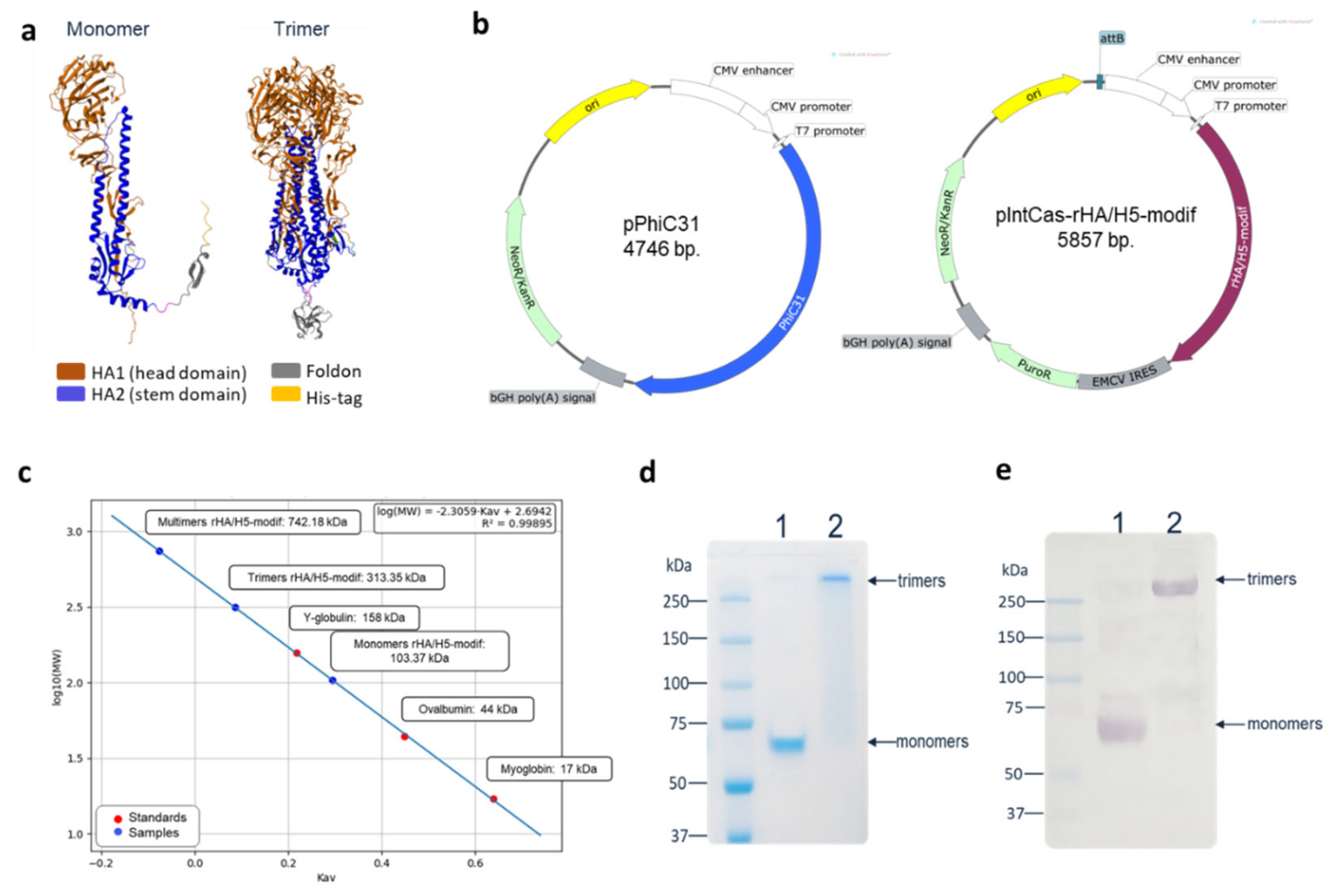
Figure 2.
Preparation and Characterization of Recombinant Hemagglutinin rHA/H5-modif Complexes with Novochizol. (A) Schematic representation of rHA/H5-modif/Novochizol microparticle preparation. (B) Particle size distribution of Novochizol and rHA/H5-modif/Novochizol complexes (DLS measurements).
Figure 2.
Preparation and Characterization of Recombinant Hemagglutinin rHA/H5-modif Complexes with Novochizol. (A) Schematic representation of rHA/H5-modif/Novochizol microparticle preparation. (B) Particle size distribution of Novochizol and rHA/H5-modif/Novochizol complexes (DLS measurements).
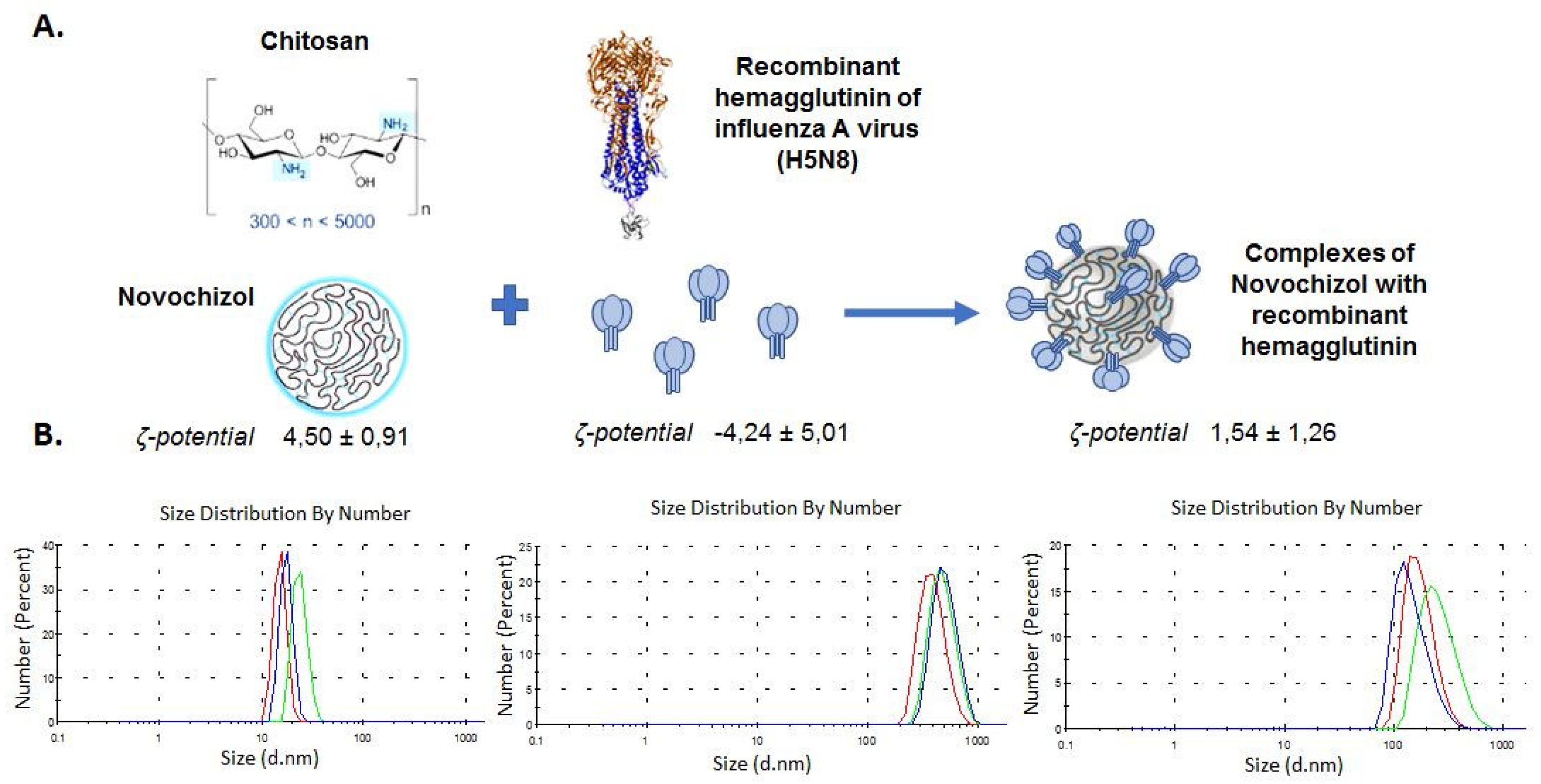
Figure 3.
Schematic Representation of Laboratory Animal Immunization Schedule.
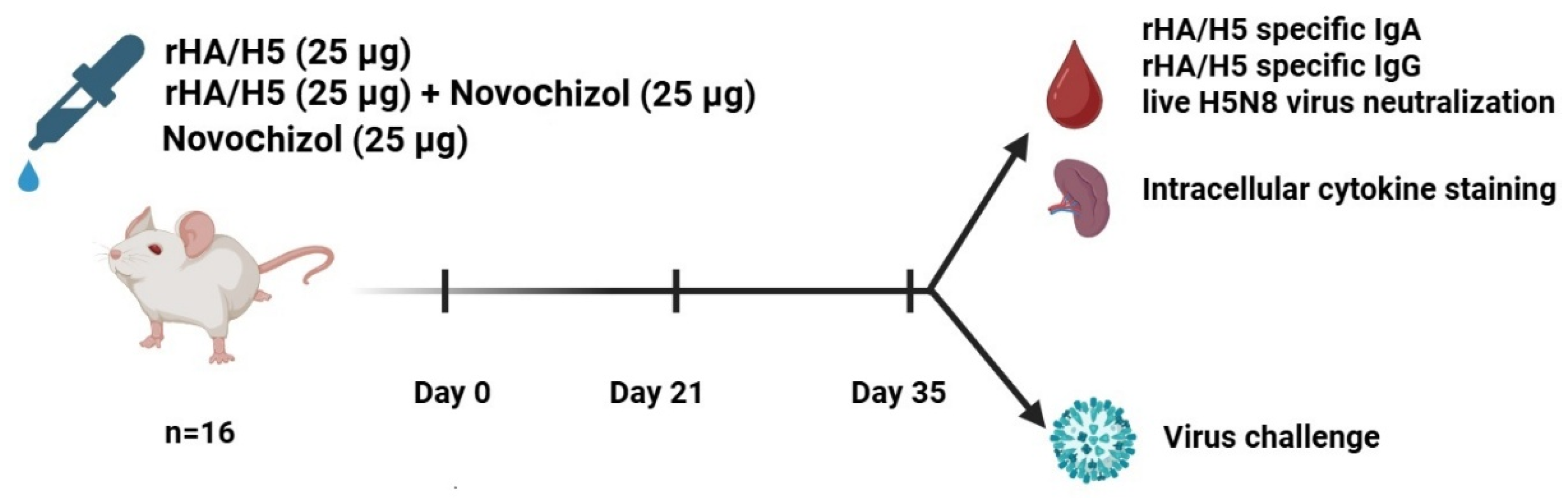
Figure 4.
Analysis of Sera from Immunized Mice by ELISA and Virus Neutralization Assay. (A) Specific IgA antibody titers. (B) Specific IgG antibody titers. (C) Neutralizing antibody titers measured by virus neutralization assay. The neutralization assay was performed on MDCK-SIAT1 cell culture using influenza A/chicken/Astrakhan/321-05/2020 (H5N8) virus strain. Data are presented as median and range. Statistical analysis was performed using GraphPad Prism 8.0.1 software. *p < 0.05, ***p < 0.001, ****p < 0.0001, calculated by non-parametric Mann-Whitney U-test.
Figure 4.
Analysis of Sera from Immunized Mice by ELISA and Virus Neutralization Assay. (A) Specific IgA antibody titers. (B) Specific IgG antibody titers. (C) Neutralizing antibody titers measured by virus neutralization assay. The neutralization assay was performed on MDCK-SIAT1 cell culture using influenza A/chicken/Astrakhan/321-05/2020 (H5N8) virus strain. Data are presented as median and range. Statistical analysis was performed using GraphPad Prism 8.0.1 software. *p < 0.05, ***p < 0.001, ****p < 0.0001, calculated by non-parametric Mann-Whitney U-test.
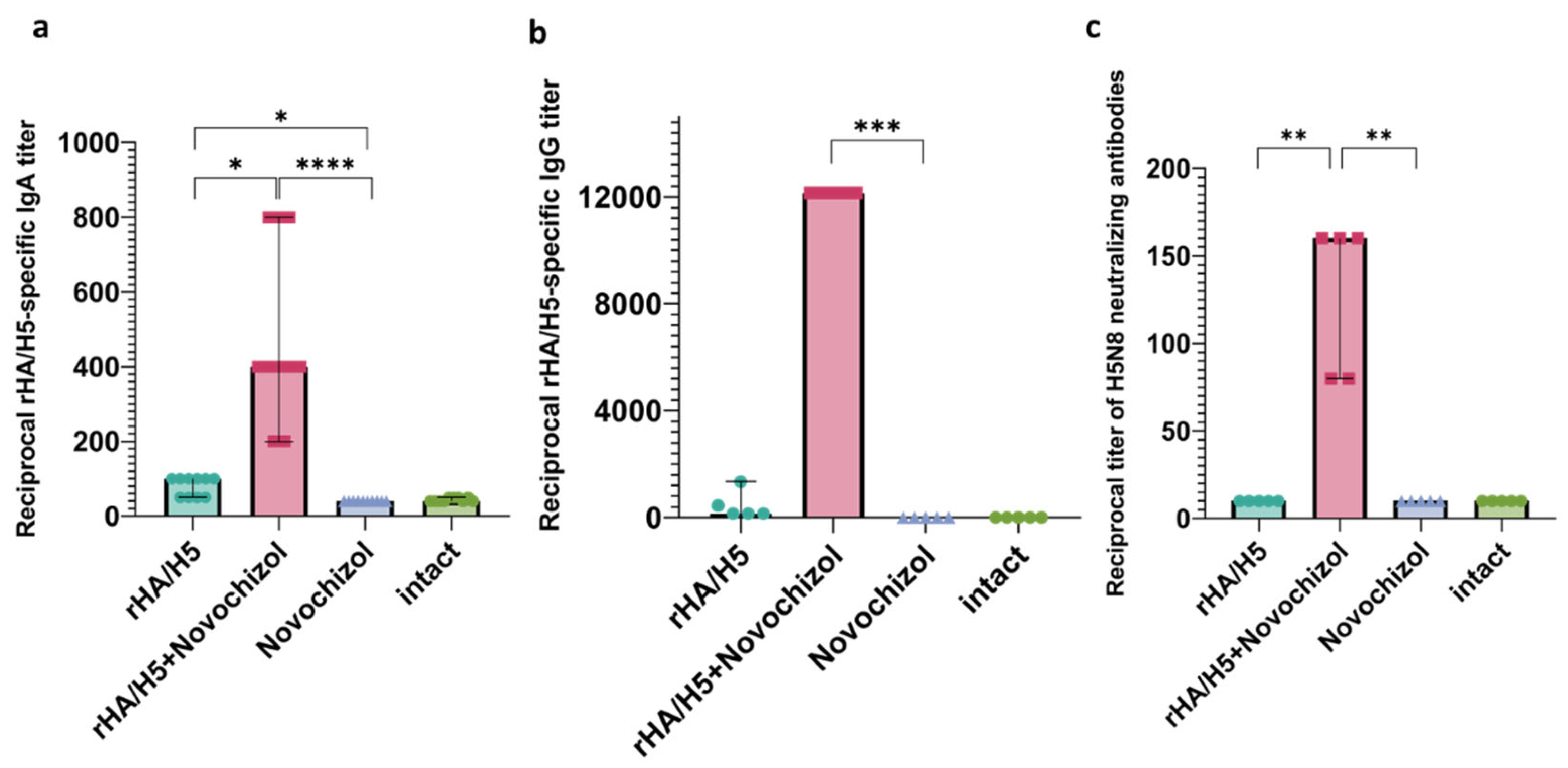
Figure 5.
T-cell Response. (A) Results of ELISpot assay. (B, C) Evaluation of cytokine-producing CD4+ and CD8+ T-cells from spleens of BALB/c mice immunized with rHA/H5-modif/Novochizol complex using intracellular cytokine staining and flow cytometry. Group 1 – mice immunized with recombinant hemagglutinin rHA/H5-modif; Group 2 – mice immunized with rHA/H5-modif/Novochizol complex; Group 3 – mice immunized with Novochizol in saline. Data are presented as median and range. Statistical analysis was performed using GraphPad Prism 9.0 software. *p < 0.05, **p < 0.01, ***p < 0.001, calculated by non-parametric Mann-Whitney U-test.
Figure 5.
T-cell Response. (A) Results of ELISpot assay. (B, C) Evaluation of cytokine-producing CD4+ and CD8+ T-cells from spleens of BALB/c mice immunized with rHA/H5-modif/Novochizol complex using intracellular cytokine staining and flow cytometry. Group 1 – mice immunized with recombinant hemagglutinin rHA/H5-modif; Group 2 – mice immunized with rHA/H5-modif/Novochizol complex; Group 3 – mice immunized with Novochizol in saline. Data are presented as median and range. Statistical analysis was performed using GraphPad Prism 9.0 software. *p < 0.05, **p < 0.01, ***p < 0.001, calculated by non-parametric Mann-Whitney U-test.
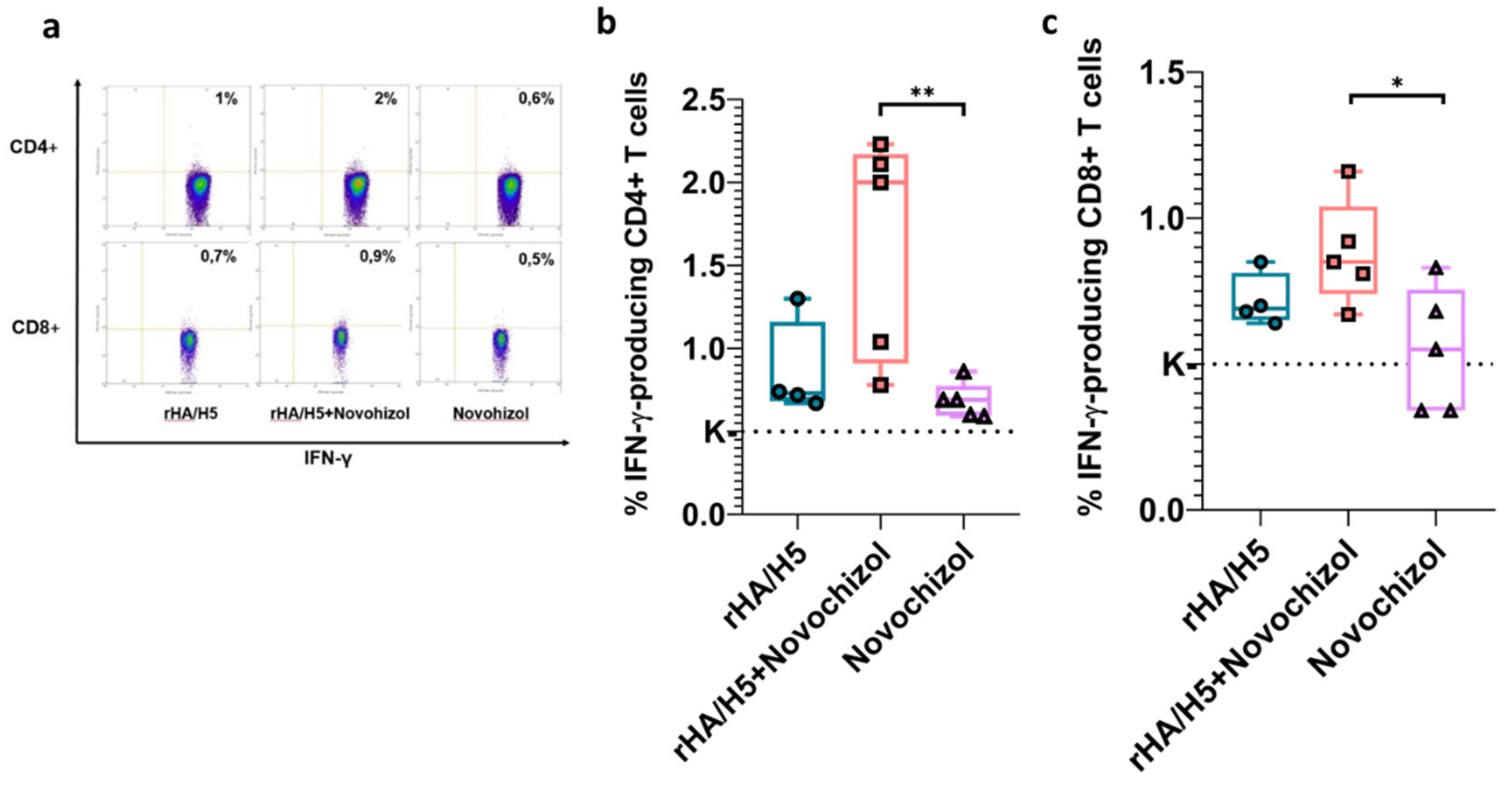
Figure 6.
(А) Survival Curves of Immunized Animals Following Challenge with 20 LD₅₀ of Influenza A/Astrakhan/3212/2020 (H5N8) Virus Strain. Y-axis: percentage of surviving animals. X-axis: days post-challenge. Differences in survival between study groups were statistically significant by Mantel-Cox test (p=0.0015). (B) Graph of weight loss. Y-axis: animal body weight. X-axis: days post-challenge. Data are presented as mean with standard deviation.
Figure 6.
(А) Survival Curves of Immunized Animals Following Challenge with 20 LD₅₀ of Influenza A/Astrakhan/3212/2020 (H5N8) Virus Strain. Y-axis: percentage of surviving animals. X-axis: days post-challenge. Differences in survival between study groups were statistically significant by Mantel-Cox test (p=0.0015). (B) Graph of weight loss. Y-axis: animal body weight. X-axis: days post-challenge. Data are presented as mean with standard deviation.
Disclaimer/Publisher’s Note: The statements, opinions and data contained in all publications are solely those of the individual author(s) and contributor(s) and not of MDPI and/or the editor(s). MDPI and/or the editor(s) disclaim responsibility for any injury to people or property resulting from any ideas, methods, instructions or products referred to in the content. |
© 2026 by the authors. Licensee MDPI, Basel, Switzerland. This article is an open access article distributed under the terms and conditions of the Creative Commons Attribution (CC BY) license (http://creativecommons.org/licenses/by/4.0/).
Copyright: This open access article is published under a Creative Commons CC BY 4.0 license, which permit the free download, distribution, and reuse, provided that the author and preprint are cited in any reuse.


