

Submitted:
09 April 2026
Posted:
10 April 2026
You are already at the latest version
Abstract
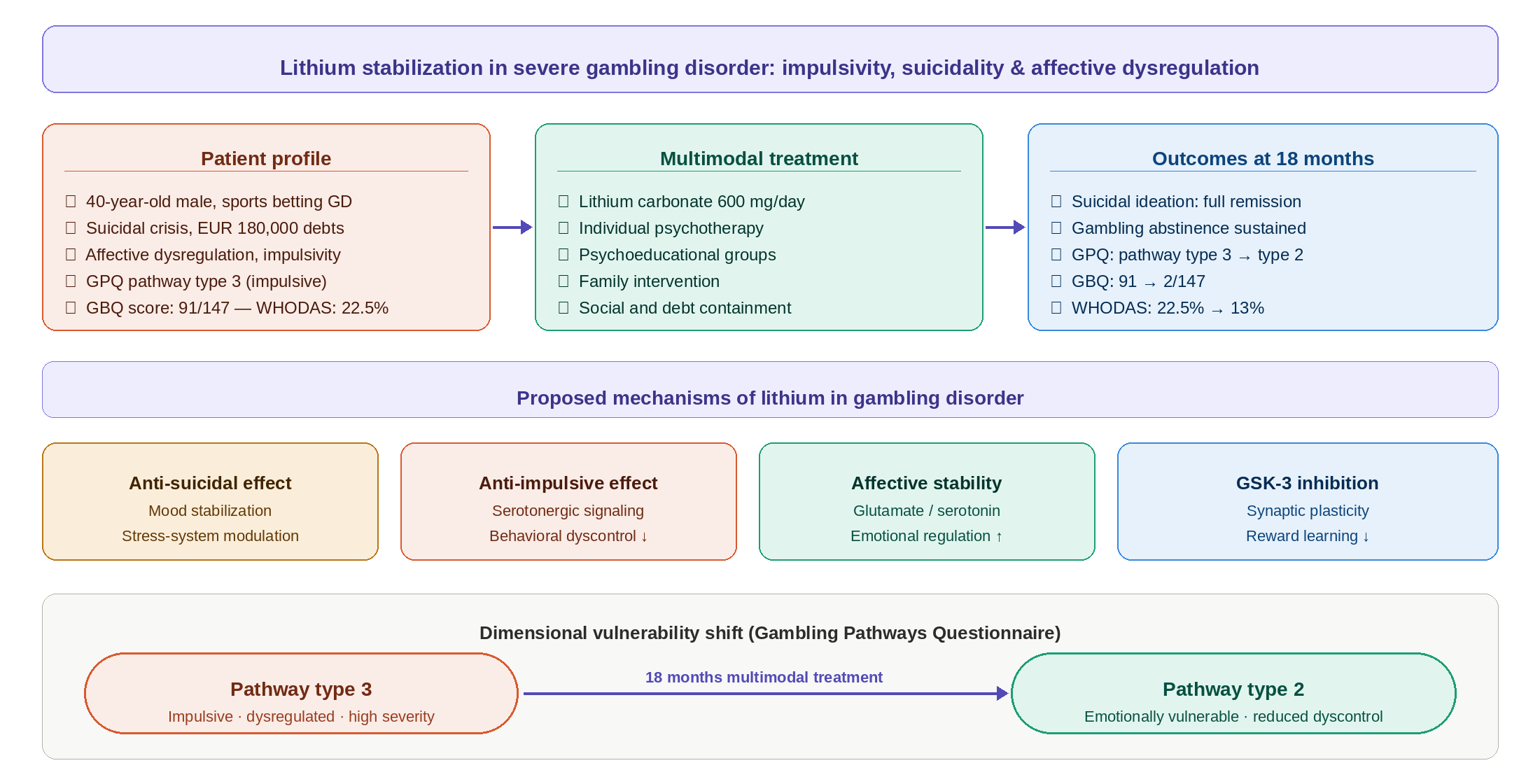
Gambling disorder (GD) is associated with severe psychosocial impairment, impulsive dyscontrol, affective instability, and increased suicidal risk. Pharmacological options remain limited, particularly for patients whose presentation is dominated by transdi-agnostic dimensions such as impulsivity, emotional dysregulation, and suicidal vul-nerability. Lithium may be relevant because of its anti-suicidal properties and potential effects on affective instability and behavioral dyscontrol. We describe a 40-year-old man with sports-betting-related GD who presented after a suicidal crisis in the context of fi-nancial collapse and marital conflict. He entered a structured multimodal program in-cluding psychiatric care, lithium carbonate, individual psychotherapy, psychoeduca-tional and self-help groups, family intervention, and social support. After lithium initi-ation and titration to 600 mg/day, the patient showed progressive affective stabilization, remission of suicidal ideation, reduced gambling urges, and sustained abstinence, with one brief lapse that was rapidly contained. Psychometric reassessment paralleled the clinical course, showing reduced functional impairment, near-complete resolution of gambling-related cognitive distortions, and a shift from a highly impulsive/dysregulated gambling profile toward an emotionally vulnerable pattern. Although causal inference is limited by the single-case design and multimodal treatment context, this case supports the hypothesis that lithium may help stabilize core vulnerability dimensions in selected GD presentations, particularly impulsivity, affective dysregulation, and suicidality.
Keywords:
gambling disorder
; lithium
; impulsivity
; suicidality
; behavioral addiction
; multimodal treatment
Copyright: This open access article is published under a Creative Commons CC BY 4.0 license, which permit the free download, distribution, and reuse, provided that the author and preprint are cited in any reuse.


