

Submitted:
09 April 2026
Posted:
10 April 2026
You are already at the latest version
Abstract
Background: The hospitality industry faces the critical challenge of transitioning toward sustainability without compromising profitability. While circular economy principles offer a theoretical framework for sustainable development, a significant gap persists between theory and integrated operational models that deliver verifiable business outcomes. Methods: This study employed a mixed-methods approach combining systematic literature review, expert validation with 9 industry practitioners, and longitudinal case study implementation across four hotel properties representing different market segments (luxury resort, urban boutique, beach resort chain, and rural eco-lodge). Data collection spanned 24 months, tracking performance metrics across six categories. Results: Implementation of the Hospitality 360° framework yielded substantial improvements: energy consumption decreased by 28.1%, water usage by 22.0%, waste diversion rates increased by 204.0% (from 25% to 76%), local procurement expenditure rose by 42.9%, employee turnover decreased by 48.6%, and guest satisfaction regarding sustainability initiatives improved by 26.5%. Financial analysis revealed an average payback period of 2.8 years and a 6.5% RevPAR premium compared to competitive sets. Conclusions: The Hospitality 360° model successfully operationalises circular economy principles, transforming sustainability from a cost center into a driver of competitive advantage. The framework provides a replicable roadmap for practitioners seeking to build resilient and profitable hotel enterprises in the conscious travel market.
Keywords:
circular economy
; environmental KPIs
; regenerative management
; sustainable hospitality
; sustainable profitability
; hospitality 360° model
1. Introduction
The global hospitality industry stands at a critical crossroads. Driven by the escalating impacts of climate change, increasing resource scarcity, and a fundamental shift in consumer values toward environmental and social responsibility, the sector is undergoing a paradigm transformation (Jones & Smith, 2020; Gössling & Hall, 2019). Tourism—and hospitality as its core component—is both a significant contributor to and a victim of these global challenges. The United Nations World Tourism Organization (UNWTO, 2023) estimates that the sector accounts for approximately 5% of global CO₂ emissions, with accommodation representing a major source of energy and water consumption. Simultaneously, hospitality operations are increasingly vulnerable to climate-related disruptions, including extreme weather events affecting coastal resorts and water scarcity in arid regions (Scott et al., 2019). This dual pressure necessitates an urgent reconfiguration of industry business and operational models.
Although corporate social responsibility (CSR) and green management have long been present in academic and industry discourse (Brown, 2008; Bohdanowicz, 2005), their implementation in hospitality has often been criticized as fragmented and superficial. Common initiatives—such as towel-reuse programmes or energy-efficient lighting—while beneficial, typically represent isolated actions rather than components of an integrated strategic framework (Font & Lynes, 2018). This piecemeal approach, frequently driven by cost-saving objectives or reputational considerations, has contributed to the phenomenon of greenwashing, whereby communication of environmental efforts exceeds substantive action (Seele & Gatti, 2017). Consequently, opportunities for transformative change remain largely unrealized.
More recently, circular economy (CE) principles have emerged as a comprehensive framework for addressing sustainability challenges across industries (Kirchherr et al., 2017). In contrast to the traditional linear "take–make–dispose" model, CE is regenerative by design and aims to decouple economic growth from finite resource consumption. In the hospitality context, this includes strategies such as waste minimization (e.g., recycling and composting), extending product lifecycles (e.g., upcycling furniture), and regenerating natural systems (e.g., greywater reuse and biodiversity support) (Álvarez & Zhang, 2022; Girard & Nocca, 2019). This framework offers a transition from incremental efficiency improvements to systemic sustainability.
Despite increasing scholarly attention, a significant gap remains between CE theory and the development of integrated operational models that can be effectively implemented in hotel settings while delivering measurable business outcomes. Existing approaches often fail to reconcile environmental objectives with financial performance, reinforcing a perceived trade-off between sustainability and profitability (Chen et al., 2021). Moreover, the literature has largely focused on isolated domains—such as energy, waste, or guest engagement—without addressing the need for a holistic strategy that integrates operational efficiency, human capital, and market positioning into a unified system (Jones et al., 2016). This fragmentation limits the widespread adoption of comprehensive sustainability practices. In particular, there is a lack of empirically validated frameworks that embed circular economy principles within organizational processes, human capital dynamics, and market performance. Furthermore, existing research has insufficiently addressed the mechanisms through which sustainability initiatives translate into competitive advantage in service-based contexts—a gap that is especially pertinent in hospitality, where value creation is inherently co-produced through interactions among employees, guests, and local stakeholders.
In response, the primary objective of this study is to develop and empirically validate the Hospitality 360° model. By linking environmental practices with human capital engagement and market positioning, this research contributes to the literature by proposing an integrated framework that operationalises circular economy principles across the entire hotel value chain while explicitly linking them to competitive advantage and financial performance.
The significance of this research is twofold. From an academic perspective, it advances understanding of how CE principles can be embedded within service-sector business models. From a practitioner perspective, it provides a practical and replicable roadmap for transitioning from fragmented sustainability initiatives to a strategic, performance-driven operational paradigm. The model repositions hotels as active agents of regeneration within their communities and ecosystems.
2. Literature Review
2.1. Sustainability in the Hospitality Industry: Evolution and Limitations
The academic and industry discourse on sustainability in hospitality has evolved significantly over the past three decades, reflecting broader societal shifts in environmental awareness and corporate responsibility. Early contributions, emerging in the 1990s and early 2000s, primarily focused on eco-efficiency and the implementation of basic environmental management practices within hotels (Kirk, 1995; Ayala, 1995). These initial efforts were largely driven by regulatory compliance, cost-saving motives, and the emerging recognition that resource-intensive operations required more careful management. Hotels began adopting measures such as energy-efficient lighting, low-flow showerheads, linen reuse programmes, and basic recycling initiatives (Bohdanowicz, 2005). While these initiatives yielded tangible reductions in operational costs and resource consumption—often with relatively short payback periods—they were predominantly reactive and fragmented, lacking a cohesive strategic vision that connected environmental performance to core business objectives.
This first wave of environmental management in hospitality has been characterized as "operational greening" (Font & Lynes, 2018), reflecting its focus on technical fixes and incremental improvements rather than fundamental business model transformation. Studies from this period documented widespread adoption of such practices, particularly among chain-affiliated properties that could leverage economies of scale and centralized procurement (Kirk, 1995; Ayala, 1995). However, researchers also noted significant variation in implementation depth, with many properties engaging in what would later be termed "light green" practices—visible, low-cost initiatives that delivered modest environmental benefits while serving primarily reputational purposes (Font & Harris, 2004). This pattern established an early tension between substantive environmental action and symbolic engagement that would persist in subsequent decades.
The concept of corporate social responsibility (CSR) subsequently provided a broader framework for integrating social and environmental concerns into business operations, moving beyond purely environmental considerations to encompass the full spectrum of corporate impacts on society (Carroll, 1999). In the hospitality context, CSR began to encompass not only environmental stewardship but also community engagement, employee welfare, ethical sourcing, human rights considerations, and philanthropic activities (Brown, 2008; Henderson, 2007). This expanded scope reflected growing recognition that hotels operate within complex social and ecological systems and that their long-term viability depends on maintaining positive relationships with diverse stakeholder groups (Presenza & Cipollina, 2010).
Studies during this period explored the link between CSR and corporate reputation, customer loyalty, and employee satisfaction, providing initial empirical evidence for the business case for responsible practices (Kang et al., 2010; Lee & Park, 2009). Research suggested that consumers were increasingly considering corporate social and environmental performance in their purchasing decisions, particularly in the leisure travel segment (Han, Hsu, & Sheu, 2010). Similarly, studies demonstrated that employees—particularly younger workers—preferred employers with strong CSR records, suggesting potential human capital benefits (Kim, Im, & Hwang, 2015). These findings contributed to a growing discourse positioning sustainability not merely as a cost or compliance issue but as a potential source of competitive differentiation.
Despite this progress, a persistent criticism of CSR in hospitality has been its tendency towards superficiality and performative engagement (Font & Lynes, 2018). Many hotels engaged in symbolic actions—donating to local charities, sponsoring environmental events, publishing glossy sustainability reports—without making substantive changes to their core operations or business models. This phenomenon, widely termed 'greenwashing', involves communicating environmental efforts that outpace substantive organisational change (Seele & Gatti, 2017; Lyon & Montgomery, 2015). Greenwashing can take multiple forms, including vague or unsubstantiated claims, selective disclosure of positive information while concealing negative impacts, symbolic implementation of practices without genuine commitment, and misalignment between corporate communications and subsidiary-level operations (Delmas & Burbano, 2011).
This performative approach has often failed to embed sustainability into the core business strategy, leaving it as a peripheral concern managed by dedicated departments—frequently marketing or public relations—rather than an integrated operational principle (Jones, Hillier, & Comfort, 2016). When sustainability remains siloed within specialized functions, its potential to drive innovation, efficiency, and strategic differentiation remains largely unrealized. Moreover, such superficial engagement can generate significant reputational risks when exposed. Recent research by Chen et al. (2025) reinforces this critique, demonstrating that hotel greenwashing practices—such as overstating environmental efforts or making vague claims—significantly increase consumer scepticism and negatively impact visit intentions, underscoring the reputational risks of superficial engagement. This finding aligns with broader research on consumer responses to corporate hypocrisy, suggesting that perceived gaps between stated values and actual practices can erode trust and loyalty (Wagner, Lutz, & Weitz, 2009).
The limitations of these fragmented approaches are well documented across the hospitality literature (Chan, 2008; Bohdanowicz & Zientara, 2009). Research has shown that isolated green practices, while individually beneficial, do not automatically translate into a coherent sustainability culture or long-term competitive advantage (Chen et al., 2021). The lack of integration across different functional areas—operations, human resources, marketing, finance, and supply chain management—has hindered the potential for synergistic gains that could amplify environmental and economic benefits. For instance, energy savings achieved through technical upgrades may be undermined by a lack of employee engagement or guest education, resulting in suboptimal performance relative to potential. Similarly, sustainability claims made in marketing communications may lack credibility if not supported by transparent operational data, consistent staff practices, and meaningful stakeholder involvement (Rahman, Park, & Chi, 2015).
This fragmentation has created a significant gap between the stated goals of sustainability and the operational reality in many hotel establishments. While corporate-level commitments to sustainability have proliferated—with major chains publishing ambitious environmental targets and CSR reports—implementation at the property level often remains uneven and inconsistent (Jones & Smith, 2020). Frontline employees may lack awareness of sustainability policies, training in relevant practices, or motivation to implement them consistently (Chan & Hawkins, 2010). Guests may encounter conflicting signals, with visible sustainability messaging coexisting with persistent wasteful practices. This implementation gap reflects deeper organizational challenges: sustainability has yet to be fully integrated into management systems, performance metrics, incentive structures, and organizational culture in most hospitality enterprises.
In response to these limitations, scholars have increasingly called for more holistic and integrated approaches to sustainability in hospitality (Jones et al., 2016; Font & Lynes, 2018). Such approaches would move beyond the fragmentation of current practice, connecting environmental performance to human resource management, marketing strategy, financial planning, and supply chain operations. They would embed sustainability not as an add-on or separate function but as a core organizing principle that shapes decision-making across the enterprise. This call for integration aligns with broader developments in sustainability management theory, which emphasizes the importance of systemic approaches over piecemeal interventions (Schaltegger, Lüdeke-Freund, & Hansen, 2016). The present study responds directly to this call by developing and testing a model that integrates operational efficiency, human capital development, and experiential marketing into a unified framework.
2.2. Circular Economy: From Theory to Practice in Tourism
In response to the limitations of traditional linear 'take–make–dispose' economic models, the circular economy (CE) has emerged as a transformative paradigm for achieving sustainable development. Unlike linear models that assume infinite resource availability and finite waste assimilation capacity, CE is predicated on the recognition that resource constraints and environmental degradation require fundamental economic restructuring (Geissdoerfer et al., 2017). The CE concept has gained considerable traction in both academic and policy circles, with the European Union, China, and numerous national governments incorporating CE principles into their environmental strategies and economic development plans (European Commission, 2020).
Kirchherr, Reike, and Hekkert (2017), in their comprehensive analysis of 114 definitions, conceptualise CE as "an economic system that replaces the 'end-of-life' concept with reducing, alternatively reusing, recycling and recovering materials in production/distribution and consumption processes." This definition emphasizes several key features. First, CE operates at multiple levels—micro (products, companies, consumers), meso (eco-industrial parks, supply chains), and macro (city, region, nation)—requiring coordination across scales to achieve systemic transformation (Kirchherr et al., 2017). Second, CE encompasses a hierarchy of strategies, with prevention and reduction prioritized over reuse, recycling, and recovery, reflecting the resource efficiency principle that avoiding waste generation is preferable to managing waste after it is created (European Environment Agency, 2016). Third, CE pursues multiple objectives simultaneously: environmental quality, economic prosperity, and social equity, positioning sustainability as an integrated goal rather than a trade-off between competing priorities (Geissdoerfer et al., 2017).
The application of CE principles to the tourism and hospitality sector is a relatively recent but rapidly growing area of inquiry (Álvarez & Zhang, 2022; Girard & Nocca, 2019). While manufacturing industries have been the primary focus of CE research and practice—with well-developed frameworks for product design, material flow analysis, and industrial symbiosis—service industries like hospitality present distinctive challenges and opportunities for CE implementation (Manniche, Larsen, & Broegaard, 2021). Unlike manufactured products, hospitality services are intangible, co-produced with customers, and characterized by high variability and perishability. These characteristics require adaptation of CE frameworks developed primarily in product-centric contexts.
This evolving field is further explored in a 2026 MDPI Special Issue on "Circular Economy and Sustainability", which emphasises the need to integrate technology and management solutions to scale CE adoption across sectors (MDPI, 2026a). A recent qualitative study by Moustafa and Hassan (2026) on the Saudi Arabian tourism sector provides contemporary evidence of how destinations can implement circular and regenerative practices, highlighting the role of stakeholder collaboration, policy frameworks, and local context in enabling or constraining CE adoption. Their findings suggest that successful CE implementation requires alignment across multiple levels—government policy, destination management, enterprise strategy, and operational practice—reinforcing the systemic nature of the CE transition.
In the hospitality context, CE principles translate into three interconnected strategic domains, each requiring specific operational approaches (Papamichael et al., 2023):
- Designing out waste: This strategy extends beyond simple recycling to encompass comprehensive waste prevention across hotel operations. Key interventions include food waste reduction through improved inventory management, demand forecasting, portion control, and donation programs; elimination of single-use plastics through procurement reform and guest education; implementation of closed-loop systems for organic waste such as composting or anaerobic digestion; and systematic reduction of packaging waste through supplier engagement (Filimonau & De Coteau, 2019). Research suggests that food waste alone accounts for significant environmental and economic impacts in hospitality, with hotels generating substantial quantities of avoidable food waste throughout their supply chains (Papargyropoulou et al., 2016). Comprehensive waste prevention requires integration of procurement, kitchen operations, front-of-house service, and back-of-house waste management, illustrating the cross-functional coordination that CE demands.
- Keeping products and materials in use: This strategy involves extending the lifespan of hotel assets through repair, refurbishment, and upcycling of furniture, fixtures, equipment, and linens. Rather than disposing of worn items and purchasing replacements—the conventional linear approach—hotels pursuing CE strategies seek to maximize asset utilization through maintenance programs, refurbishment cycles, and creative reuse (Manniche et al., 2021). This may include repurposing furniture across different areas of the property as wear patterns emerge, partnering with local artisans to transform worn textiles into new products, or establishing product-as-a-service models where hotels lease rather than own items such as linens, electronics, or furniture (Tukker, 2004). Such models shift incentives from volume-based consumption to performance-based relationships, aligning supplier and hotel interests around durability and longevity.
- Regenerating natural systems: This principle moves beyond minimizing harm—the primary focus of conventional environmental management—to actively contributing to environmental restoration and enhancement (Manniche et al., 2021). In hospitality, regeneration strategies include greywater and rainwater harvesting to reduce strain on local water resources while replenishing groundwater supplies; landscaping with native, drought-resistant species to support local biodiversity and reduce irrigation requirements; sourcing food and materials from local regenerative agriculture that builds soil health and sequesters carbon; and participating in restoration projects such as reef rehabilitation, reforestation, or habitat conservation (Bellato & Cheer, 2021). This regenerative orientation positions hotels as active contributors to the health of their surrounding ecosystems, rather than simply reducing their negative impacts.
Empirical research on CE in tourism and hospitality, while still nascent, has begun to demonstrate both the potential and the challenges of implementation. Studies have explored CE initiatives across various hospitality contexts, from small eco-lodges and boutique properties to large resort chains and international hotel groups (Rodrigues, Franco, & Silva, 2020; Soriano, 2023). These studies reveal significant variation in implementation depth, with some properties achieving high levels of circularity while others engage primarily in symbolic recycling and waste reduction activities. Key barriers identified across studies include high upfront investment costs for circular infrastructure such as greywater systems or composting facilities; lack of technical expertise among property-level staff; complex supply chains that limit visibility and control over material flows; and deeply ingrained linear consumption patterns among both staff and guests (Kirchherr et al., 2018; Manniche et al., 2021).
Overcoming these barriers requires a systemic approach that simultaneously addresses technological, organizational, and behavioural dimensions—a challenge that existing fragmented approaches have largely failed to meet (Álvarez & Zhang, 2022). Technological solutions alone are insufficient if not accompanied by organizational structures that support their effective use, staff training that builds necessary capabilities, guest engagement that encourages participation, and business models that align incentives across the value chain. This recognition of the multi-dimensional nature of CE implementation underscores the need for integrated frameworks that connect technical, human, and market dimensions—the central contribution of the Hospitality 360° model.
2.3. Sustainable Business Models and Value Creation
The transition to a circular economy necessitates fundamental shifts in how organizations conceptualize and structure their business models. A business model describes the rationale of how an organization creates, delivers, and captures value (Osterwalder & Pigneur, 2010). While traditional business model frameworks focus primarily on economic value creation for shareholders, sustainable business model innovation involves creating significant positive impact—or significantly reducing negative impact—for the environment and society through changes in how the organization and its value network operate (Bocken et al., 2014; Schaltegger, Lüdeke-Freund, & Hansen, 2016).
This expansion of the value concept reflects growing recognition that organizations cannot achieve long-term viability without addressing the environmental and social systems within which they operate (Porter & Kramer, 2011). From a strategic perspective, sustainable business models embed environmental and social considerations into core value proposition, value creation, and value capture mechanisms, rather than treating them as peripheral concerns or risk management exercises (Schaltegger et al., 2016). Such integration positions sustainability as a source of innovation, differentiation, and competitive advantage rather than a constraint on economic performance.
Several typologies of sustainable business models have been proposed in the literature, many of which are directly relevant to hospitality contexts. Bocken et al. (2014) developed a widely cited framework identifying eight sustainable business model archetypes, organized into three overarching groups:
Group 1: Technological innovation. This group includes archetypes focused on maximizing material and energy efficiency (doing more with fewer resources, reducing waste and emissions), creating value from waste (transforming waste streams into valuable inputs for other processes), and substituting with renewables and natural processes (replacing finite resources with renewable alternatives). In hospitality, efficiency-oriented models are the most widely adopted, reflecting the immediate cost benefits of reduced energy and water consumption. Value-from-waste models are increasingly common, with hotels converting organic waste to compost or biogas, partnering with waste-to-energy facilities, or upcycling materials into new products. Renewables substitution includes solar water heating, photovoltaic systems, and geothermal heating and cooling.
Group 2: Social innovation. This group includes archetypes focused on delivering functionality rather than ownership (shifting from selling products to providing services, such as leasing equipment rather than purchasing it), adopting a stewardship role (proactively engaging with all stakeholders to ensure their long-term health and well-being), and encouraging sufficiency (promoting reduced consumption and responsible use). In hospitality, product-as-a-service models remain relatively uncommon but are emerging in areas such as linen rental, furniture leasing, and equipment sharing. Stewardship models are more prevalent, encompassing community engagement, employee welfare programs, and supply chain responsibility. Sufficiency-oriented models—encouraging guests to use fewer resources—present particular challenges in a sector traditionally oriented around comfort and convenience but are increasingly important as awareness of environmental limits grows.
Group 3: Organizational innovation. This group includes archetypes focused on developing sustainable supply chains (collaborating with suppliers to ensure social and environmental standards throughout the value chain) and re-purposing the business for society (reorienting the organization's fundamental purpose toward social and environmental goals). Sustainable supply chain management has received increasing attention in hospitality, with major chains establishing supplier codes of conduct, local sourcing programs, and ethical procurement policies (Font, Tapper, & Cochrane, 2006). Re-purposing for society represents the most transformative archetype, involving fundamental shifts in organizational purpose, governance, and stakeholder relationships—shifts that remain relatively rare in hospitality but are exemplified by emerging models such as benefit corporations, social enterprises, and community-owned tourism initiatives.
Research on sustainable business models in tourism has highlighted the particular importance of value proposition redesign (Sørensen & Grindsted, 2021). For hotels, this means moving beyond a value proposition based solely on comfort, convenience, and luxury to one that also emphasizes authenticity, connection with place, contribution to environmental and social well-being, and opportunities for meaningful engagement with sustainability practices. This shift aligns with broader trends in consumer preferences, particularly among younger travelers, who increasingly seek experiences that align with their values and offer opportunities for positive impact (Han et al., 2010). The experiential dimension of sustainability—the opportunity for guests to participate in and learn from sustainable practices—has emerged as a key differentiator for properties positioning themselves as eco-conscious (Sørensen & Grindsted, 2021).
This shift is central to discussions on "Green Hospitality and Human–Environmental Relations", where scholars argue for the integration of sustainable food systems, responsible resource management, and authentic cultural engagement into the core hotel offering (Gajić, Veljović, & Đoković, 2026). Such integration moves sustainability from a set of behind-the-scenes operational practices to a visible, engaging dimension of the guest experience that can enhance satisfaction, generate positive word-of-mouth, and build brand loyalty. This resonates with the experiential marketing pillar of the Hospitality 360° model, which posits that sustainability practices, when authentically communicated and meaningfully integrated into guest experiences, can create a distinct market position and drive customer preference.
2.4. Stakeholder Theory and Human Capital in Hotel Sustainability
Stakeholder theory, as articulated by Freeman (1984), posits that organizations must create value for all stakeholders—not just shareholders—to ensure long-term success and sustainability. This perspective challenges the traditional shareholder primacy model, arguing that neglecting stakeholder interests generates risks and undermines the conditions necessary for enduring performance. In the hospitality context, key stakeholders include employees, guests, local communities, suppliers, investors, regulators, non-governmental organizations, and the natural environment itself (Presenza & Cipollina, 2010). Each stakeholder group holds legitimate interests in hotel operations and possesses varying degrees of power to influence organizational outcomes.
Engaging these diverse stakeholder groups is crucial for the successful implementation of sustainability initiatives for several reasons (Sheldon & Park, 2011). First, stakeholder support provides the social licence to operate—the ongoing acceptance and approval of the community and other stakeholders that is essential for business viability, particularly in destinations where tourism is subject to public scrutiny and community oversight. Second, stakeholder engagement generates valuable knowledge and resources, from employee innovations and guest feedback to supplier partnerships and community collaborations. Third, positive stakeholder relationships enhance reputation and brand equity, creating market differentiation and customer loyalty. Fourth, stakeholder alignment reduces risks associated with regulatory intervention, community opposition, or employee disengagement.
The role of employees (human capital) is particularly critical in hospitality sustainability for several interconnected reasons (Kim, Im, & Hwang, 2015). As frontline service providers, employees are the primary interface between the hotel's sustainability strategy and the guest experience. Their commitment, knowledge, and behaviour significantly influence the effectiveness of operational initiatives—from sorting waste correctly and conserving energy to explaining sustainability practices to guests and responding to inquiries about environmental performance. When employees understand sustainability principles, believe in their importance, and are empowered to act on them, they become powerful ambassadors for the organization's environmental commitments (Ramus, 2002).
Conversely, when employees are unaware of sustainability policies, sceptical of their importance, or insufficiently trained in relevant practices, sustainability initiatives are likely to fail regardless of technical sophistication. Research has demonstrated that employee engagement in sustainability is positively linked to job satisfaction, organizational commitment, and reduced turnover (Chen et al., 2021; Pinzone et al., 2016). Employees who feel their work contributes to meaningful environmental and social outcomes report higher levels of engagement and purpose, which translates into improved performance and retention. This finding is particularly significant in hospitality, where high turnover rates impose substantial costs on organizations and undermine service quality.
Fostering employee engagement in sustainability requires more than top-down directives or policy announcements. It necessitates creating a supportive organizational culture that values environmental stewardship, providing adequate training and resources, empowering employees to contribute ideas and take initiative, and recognizing contributions publicly (Ramus, 2002). Participatory governance structures—such as sustainability committees with representation from all departments, employee-led green teams, and suggestion systems—have been shown to generate higher levels of engagement and innovation than centralized, management-driven approaches (Pinzone et al., 2016). The significant reduction in employee turnover (48.6%) observed in the implementation of the Hospitality 360° model underscores the power of this approach, suggesting that deep sustainability integration can yield substantial human capital benefits that reinforce economic performance.
Local communities represent another crucial stakeholder group with significant influence on hotel sustainability (Presenza & Cipollina, 2010). Hotels are embedded within local social and ecological systems, and their operations have profound impacts on community well-being, from employment and economic development to pressure on local resources, infrastructure, and housing markets. Positive community relationships can generate significant benefits for hotels, including local support for operations, reliable supply chains, reduced regulatory friction, and enhanced reputation (Sheldon & Park, 2011). Negative relationships, conversely, can generate community opposition, regulatory constraints, reputational damage, and ultimately, business risk.
Sustainable practices that strengthen community relationships include local procurement, supporting community development projects, engaging in destination-level sustainability initiatives, providing employment and training opportunities for local residents, and contributing to local infrastructure (Presenza & Cipollina, 2010). This perspective is echoed in recent scholarship on sustainable agri-tourism, which emphasises that community-centred business models—focused on local procurement, cultural preservation, and resident well-being—are essential for long-term destination sustainability (Barreda & Kageyama, 2025). The 42.9% increase in local procurement expenditure achieved in this study demonstrates the tangible potential of such community integration, illustrating how sustainability practices can simultaneously deliver environmental, economic, and social benefits.
2.5. The Resource-Based View as a Source of Competitive Advantage
The resource-based view (RBV) of the firm, pioneered by Barney (1991), provides a powerful theoretical lens for understanding how sustainability can become a source of sustained competitive advantage. RBV posits that firms gain a competitive edge by possessing and deploying resources and capabilities that are valuable, rare, inimitable, and non-substitutable (VRIN). Unlike traditional industry structure approaches that emphasize external positioning, RBV focuses on internal characteristics that enable firms to outperform competitors (Barney & Hesterly, 2015).
In the context of sustainability, these VRIN resources and capabilities can be tangible or intangible. Tangible resources include energy-efficient technologies, certified green buildings, renewable energy systems, waste treatment infrastructure, and sustainable supply chain arrangements (Hart, 1995). Intangible resources include a strong reputation for environmental stewardship, deep employee commitment to sustainability, unique knowledge of circular systems and practices, collaborative relationships with local suppliers and communities, and organizational culture oriented around sustainability values (Russo & Fouts, 1997). Intangible resources are often particularly difficult for competitors to replicate because they are embedded in organizational routines, tacit knowledge, and social relationships that cannot be easily codified or transferred (Barney & Hesterly, 2015).
The RBV perspective suggests that sustainability capabilities can generate competitive advantage through several mechanisms (Hart, 1995). First, sustainability practices can reduce costs through improved efficiency and resource productivity, creating a cost advantage that translates into superior margins or pricing flexibility. Second, sustainability differentiation can command price premiums from environmentally conscious consumers, enhancing revenue per available room. Third, sustainability reputation can generate customer loyalty and reduce price sensitivity, creating a more stable revenue stream. Fourth, sustainability capabilities can create barriers to imitation by competitors lacking similar resources, organizational culture, or stakeholder relationships. Fifth, proactive sustainability management can reduce regulatory risk and enhance operational stability (Russo & Fouts, 1997).
The Hospitality 360° model is explicitly designed to help hotels build such VRIN capabilities through its integrated approach. By simultaneously addressing operational efficiency, human capital development, and experiential marketing, the model fosters the creation of complex, interconnected capabilities that are not easily imitated. This aligns with the themes of a recent MDPI Special Issue on "Sustainable Business Management", which calls for research on innovative strategies that integrate economic, environmental, and social dimensions for future global competitiveness (MDPI, 2026b). Furthermore, as noted in the Special Issue on "Integrative Waste Management and Circular Economy", innovations in waste and resource management can serve as key drivers of sustainable advantage and climate resilience when embedded within a firm's strategic capabilities (Lau & Poo, 2025).
Consider a competitor's potential response to a hotel implementing the Hospitality 360° model. The competitor might install similar energy-efficient technology (a tangible resource) or adopt similar waste separation practices (a readily observable practice). However, they cannot easily replicate the deeply ingrained organizational culture of sustainability that emerges from years of consistent commitment, the tacit knowledge of 'Green Ambassadors' who understand both operational constraints and sustainability principles, the trust-based relationships with local suppliers built through collaborative partnerships, or the authentic guest relationships based on demonstrated commitment rather than marketing claims. These are the 'higher-order' capabilities that underpin sustained competitive advantage—complex, interconnected systems that cannot be reduced to individual components or simply purchased on the market (Teece, Pisano, & Shuen, 1997).
The 6.5% RevPAR premium observed in this study provides empirical support for the RBV perspective on sustainability as a driver of competitive advantage. This premium—achieved through increased occupancy and enhanced upselling rather than higher base prices—suggests that the complex, integrated capabilities fostered by the Hospitality 360° model are indeed valuable (they enhance financial performance), rare (few hotels in the competitive set achieved similar outcomes), and difficult to imitate (requiring simultaneous investment in operations, human resources, and marketing). These findings align with previous research demonstrating that sustainability capabilities can generate superior financial performance when deeply embedded in organizational strategy and culture (Chen et al., 2021; López-Gamero, Molina-Azorín, & Claver-Cortés, 2009).
2.6. Synthesis and Research Gap
The literature reviewed in this section reveals several important themes that inform the present study. First, sustainability in hospitality has evolved from basic environmental management to encompass CSR, circular economy principles, and business model innovation—a trajectory reflecting growing recognition of the systemic nature of sustainability challenges. Second, despite this evolution, implementation remains fragmented, with hotels typically adopting isolated practices rather than integrated strategies, limiting potential synergistic benefits. Third, the circular economy offers a promising framework for addressing sustainability challenges in hospitality, but its application in service contexts requires adaptation of frameworks developed primarily for manufacturing industries. Fourth, stakeholder theory and the resource-based view provide complementary theoretical lenses for understanding how sustainability can generate competitive advantage through employee engagement, community relationships, and complex organizational capabilities.
A significant gap emerges from this review: while the literature increasingly recognizes the need for integrated sustainability approaches in hospitality, few empirically validated frameworks exist that operationalize circular economy principles across the entire hotel value chain while explicitly linking them to competitive advantage and financial performance. Existing research has largely focused on isolated domains—energy, waste, human resources, or marketing—without addressing the interdependencies among these areas. This gap is particularly salient given the systemic nature of sustainability challenges and the potential for synergistic benefits across operational, human, and market dimensions.
The present study addresses this gap by developing and empirically validating the Hospitality 360° model, an integrated framework that connects operational efficiency, human capital development, and experiential marketing into a unified system. By testing this framework across diverse hotel contexts over a 24-month period, the study provides empirical evidence on the mechanisms through which integrated sustainability strategies generate environmental, social, and economic outcomes—addressing calls in the literature for more holistic and practice-oriented research on sustainability in hospitality (Jones et al., 2016; Font & Lynes, 2018).
3. Methodology
3.1. Research Design and Methodological Approach
This study employed a mixed-methods research design, combining qualitative and quantitative approaches to develop, implement, and validate the Hospitality 360° operational model. The rationale for selecting a mixed-methods approach lies in the complexity of the research phenomenon: implementing circular economy principles in hotel operations involves not only measurable technical and financial changes (quantifiable) but also shifts in organisational culture, employee behaviour, and guest perceptions (qualitative) (Creswell & Plano Clark, 2018). A purely quantitative approach would have captured the 'what' of the changes—the magnitude of resource reductions, financial outcomes, and satisfaction scores—but would have missed the 'how' and 'why' of these changes. Conversely, a purely qualitative approach would have lacked the empirical rigour to demonstrate the model's impact on key performance indicators or to establish the generalizability of findings across contexts.
Mixed-methods research is particularly well-suited to studying complex organisational interventions where both the outcomes and the processes through which those outcomes are achieved are of interest (Creswell & Plano Clark, 2018). This design allows for triangulation—the convergence of findings from multiple methods—which enhances the validity and credibility of conclusions (Denzin, 1978). In the context of this study, quantitative data provided objective measures of environmental, social, and economic performance, while qualitative data illuminated the contextual factors, mechanisms, and stakeholder experiences that explained observed outcomes.
The research design was structured in three sequential phases, following an exploratory sequential mixed-methods design (QUAL → QUANT) with an embedded validation component (Creswell & Plano Clark, 2018):
Phase 1: Framework Development (Qualitative). This initial phase focused on constructing the Hospitality 360° model through systematic literature review and iterative expert validation. The literature review (presented in Section 2) synthesized existing knowledge on circular economy principles, sustainable business models, stakeholder theory, and the resource-based view, identifying key constructs and relationships to be incorporated into the framework. Following the literature review, an expert panel was convened to review, critique, and refine the initial model. This phase was qualitative in nature, emphasizing the development of a theoretically grounded framework that would be both academically rigorous and practically relevant.
Phase 2: Implementation and Data Collection (Longitudinal Quantitative). The second phase involved applying the Hospitality 360° model in four case study hotels over a 24-month period, with systematic tracking of performance metrics. This phase was predominantly quantitative, employing a longitudinal design that allowed for the observation of changes over time and the assessment of both short-term implementation effects and longer-term sustainability trends. The 24-month duration was selected to capture seasonal variations (important in tourism contexts), to allow for the maturation of organisational changes, and to enable the collection of sufficient post-implementation data for robust statistical analysis. Monthly data collection provided a granular view of performance trajectories, enabling identification of implementation patterns and potential anomalies.
Phase 3: Validation and Refinement (Mixed-Methods). The third phase triangulated quantitative findings with qualitative insights from stakeholders, followed by a final expert validation round. This phase integrated both methodological approaches: quantitative findings (performance data, statistical analyses) were combined with qualitative insights (interviews, focus groups, observations) to develop a comprehensive understanding of how and why the model generated its effects. The final validation round involved presenting findings to the expert panel and soliciting feedback on model refinement, ensuring that the final framework incorporated both empirical evidence and practical wisdom.
This multi-phase design ensures both internal validity (does the model work as intended in the studied contexts?) and external validity (can it be applied in different contexts?) (Yin, 2018). The sequential structure allowed for iterative refinement, with insights from each phase informing subsequent phases. The embedded validation component—involving expert review at multiple points—enhanced the credibility and practical relevance of the final model.
3.2. Theoretical Framework
The conceptual framework of the Hospitality 360° model is grounded in the integration of three established theoretical foundations, ensuring its academic rigour and practical relevance.

Table 1.
Theoretical Foundations of the Hospitality 360° Model.
| Theoretical Lens | Core Premise | Application in Hospitality 360° Model |
|---|---|---|
| Circular Economy Theory (Kirchherr et al., 2017) | Economic system that decouples growth from finite resource consumption | Operational strategies for waste elimination, material lifecycle extension, and natural system regeneration |
| Stakeholder Theory (Freeman, 1984) | Organisations must create value for all stakeholders, not just shareholders | Integration of employee, guest, and community engagement as core pillars |
| Resource-Based View (Barney, 1991) | Sustained competitive advantage derives from VRIN resources and capabilities | Development of complex, inimitable capabilities through integrated sustainability practices |
This theoretical triangulation addresses a key limitation identified in the literature: the tendency for sustainability research to rely on single theoretical lenses, which may obscure the multi-dimensional nature of sustainability challenges (Schaltegger, Lüdeke-Freund, & Hansen, 2016). By integrating complementary theoretical perspectives, the model captures the environmental, social, and strategic dimensions of sustainability simultaneously.
The integration of these three theoretical lenses addresses the research problem at multiple levels. Circular Economy Theory provides the operational foundation, specifying the resource management strategies that hotels should pursue to reduce environmental impact and enhance efficiency. Stakeholder Theory provides the relational foundation, specifying how hotels should engage with employees, guests, and communities to build support, generate knowledge, and enhance reputation. The Resource-Based View provides the strategic foundation, explaining how the combination of operational and relational capabilities can generate sustained competitive advantage.
This theoretical triangulation allows the model to address sustainability not as a standalone add-on or compliance exercise, but as an integral part of the hotel's value creation logic (Bocken et al., 2014; Schaltegger et al., 2016). The three pillars of the model—Regenerative Operational Efficiency, Human Capital and Community Integration, and Experiential Marketing and Transparency—correspond directly to these theoretical foundations, translating abstract principles into actionable strategies.
3.3. Case Selection and Inclusion Criteria
The research employed a multiple case study design with theoretical replication logic (Yin, 2018). Case study methodology is particularly appropriate for research questions focused on 'how' and 'why' questions, where the researcher seeks to understand complex phenomena in real-world contexts, and where contextual factors are likely to be important (Yin, 2018). The multiple case design, rather than a single case, enhances external validity by demonstrating that findings hold across different contexts—a form of analytical generalization (Yin, 2018).
Four hotel properties were purposefully selected to represent maximum variation across key contextual factors that could influence the implementation of circular economy practices (Patton, 2015). Maximum variation sampling is a purposive sampling strategy that aims to capture and describe central themes that cut across a wide range of variation, enhancing the transferability of findings. The selection criteria were designed to ensure both sufficient commonality for meaningful comparison and sufficient diversity for testing the model's adaptability:
Minimum size: ≥ 50 rooms, ensuring operational complexity sufficient for meaningful analysis. Properties with fewer than 50 rooms typically have simpler operations, fewer functional departments, and more limited resources for sustainability initiatives, which could reduce the generalizability of findings to larger properties that dominate the industry in terms of environmental impact.
Baseline sustainability engagement: Evidence of existing, albeit fragmented, sustainability initiatives (e.g., linen reuse programmes, recycling, energy-saving measures). This criterion ensured a minimum level of organisational readiness for sustainability implementation, avoiding the confounding effects of properties with no prior sustainability engagement who might require more extensive organizational change.
Commitment to full implementation: Written agreement from senior management to implement all three pillars of the Hospitality 360° framework over 24 months. This criterion ensured that observed outcomes could be attributed to the model rather than to partial or selective implementation.
Diversity of market segments: To test the model's applicability across different hotel types and business models. Market segment influences guest expectations, operational priorities, revenue models, and resource consumption patterns, making it a critical contextual factor.
Table 2.
Case Study Hotels: Profile and Characteristics.
| Hotel Code | Type | Location | Rooms | Market Segment | Baseline Sustainability Engagement |
|---|---|---|---|---|---|
| Hotel A | Luxury resort | Coastal, Southern Spain | 156 | High-end leisure | Existing recycling, linen reuse |
| Hotel B | Urban boutique | City centre, Barcelona | 68 | Business/leisure mix | Energy-efficient lighting, local sourcing |
| Hotel C | Beach resort | Island, Greece | 210 | Mass tourism | Waste recycling, water conservation |
| Hotel D | Rural eco-lodge Mountain | Northern Italy | 52 | Niche eco-tourism | Organic farming, renewable energy pilot |
This diversity allows for analytical generalization of the findings, as the model's effectiveness can be assessed across different operational contexts, market segments, and baseline sustainability conditions (Yin, 2018). If the model performs consistently across these diverse contexts, confidence in its generalizability is strengthened. Conversely, if performance varies systematically with contextual factors, this variation provides insights into the conditions under which the model is most effective—valuable information for practitioners considering adoption.
3.4. Data Collection Protocol
Data collection spanned 24 consecutive months (January 2024 – December 2025) , allowing for the observation of seasonal variations and the assessment of both short-term implementation effects and longer-term sustainability trends. The 24-month duration was selected based on several considerations: first, to capture two full annual cycles, enabling comparison across seasons and identification of seasonal patterns; second, to allow sufficient time for organizational changes to take effect, including cultural shifts and behavioural changes that typically require extended periods; third, to enable the collection of sufficient post-implementation data for robust statistical analysis; fourth, to align with typical hotel budget and planning cycles, enhancing the practical relevance of findings.
A standardised data collection protocol was developed and applied across all four properties to ensure comparability and consistency. This protocol specified data sources, collection frequencies, verification procedures, and quality control measures. All data collectors received standardized training on the protocol, and regular inter-rater reliability checks were conducted to ensure consistency across properties.
3.4.1. Quantitative Data: KPI Dashboard
A bespoke integrated KPI dashboard was developed specifically for this research, tracking metrics across six categories aligned with the three pillars of the model. The dashboard was designed to balance comprehensiveness with practicality, including only metrics that were both theoretically important and practically measurable within typical hotel operations. Metric selection was informed by the literature review, expert panel input, and pilot testing in a non-participating hotel.
Data were collected monthly from the following sources:
Table 3.
Quantitative Data Collection Framework.
| Pillar | Metric Category | Data Source |
|---|---|---|
| Regenerative Operational Efficiency | Energy consumption (kWh per occupied room) | Utility invoices, submeter readings, BMS data |
| Water consumption (litres per occupied room) | Utility invoices, submeter readings | |
| Waste diversion rate (% recycled/composted) | Waste hauler reports, on-site tracking | |
| Local procurement (% of total spend) | Procurement records, supplier invoices | |
| Human Capital and Community Integration | Employee turnover rate (%) | HR records, exit interviews |
| Employee satisfaction score (1–10) | Internal surveys (biannual) | |
| Experiential Marketing and Transparency | Guest satisfaction (sustainability-related, 1–10) | Post-stay surveys, online review analysis |
| RevPAR (€) | PMS data, competitive set benchmarks |
All quantitative data were verified through triangulation with multiple sources where possible, comparing, for example, utility invoices with submeter readings, or waste hauler reports with on-site tracking logs (Yin, 2018). Discrepancies were investigated and resolved through consultation with property management. This multi-source verification enhanced data accuracy and reliability.
3.4.2. Qualitative Data: In-Depth Interviews and Observations
To capture the contextual factors and processes underlying the quantitative changes—the 'how' and 'why' of implementation—qualitative data were collected through multiple methods. This triangulation of qualitative methods enhanced the richness and credibility of findings (Denzin, 1978).
- Semi-structured interviews were conducted with key stakeholders at each property. Interview participants included:
- General Manager (or equivalent senior leader)
- Sustainability Manager/Champion (or designated lead)
- Department Heads: Housekeeping, Food & Beverage, Front Office, Maintenance/Engineering, Human Resources
- A purposive sample of 3–5 frontline employees per hotel, selected to represent different departments and tenure levels
Interviews were conducted at three time points: baseline (Month 0, pre-implementation), mid-implementation (Month 12), and post-implementation (Month 24). This longitudinal interview design allowed for the tracking of evolving perceptions, experiences, and organizational changes over the implementation period. A total of 62 interviews were conducted, each lasting 45–75 minutes (average 58 minutes). Interview protocols were developed for each stakeholder group, with questions exploring: perceptions of sustainability and its importance; experiences with implementation; challenges encountered and how they were addressed; observed changes in operations, culture, and performance; and suggestions for model improvement. Protocols were refined iteratively based on emerging findings.
'Green Ambassador' focus groups were conducted at each property at Month 18, involving 5–8 participants per property. Focus groups were selected as a method to explore collective experiences, facilitate interaction among participants, and generate insights through group discussion that might not emerge in individual interviews (Krueger & Casey, 2015). The Month 18 timing was selected to capture mid-to-late implementation experiences, after initial challenges had been addressed but before post-implementation reflection. Focus groups explored: successes and achievements; persistent challenges; suggestions for improving the Green Ambassador programme; and lessons learned for the broader implementation.
Non-participant observation was conducted during periodic site visits (every 3–4 months). Observations focused on: operational practices (e.g., waste sorting, energy conservation behaviours); staff meetings and training sessions; guest interactions related to sustainability; physical infrastructure (e.g., recycling stations, signage, energy systems); and visible sustainability communications. Observational data were recorded in field notes and supplemented with photographs where appropriate. Observations provided contextual understanding that complemented interview data, revealing gaps between reported and actual practices and illuminating the physical and social environments within which implementation occurred.
Document analysis was conducted on relevant organizational documents, including: sustainability reports and environmental policies; meeting minutes from sustainability committee meetings; training materials and employee communications; internal performance reports; and marketing materials related to sustainability. Document analysis provided historical context, revealed organizational priorities and discourses, and served as a source of triangulation for interview and observational findings (Bowen, 2009).
All interviews and focus groups were audio-recorded, transcribed verbatim, and anonymised to protect participant and hotel confidentiality. Transcripts were reviewed for accuracy against recordings, with any unclear passages resolved through consultation with participants where possible. Anonymization removed identifying information (names, specific dates, unique organizational details) while preserving contextual richness.
3.5. Model Validation Process
The validity of the Hospitality 360° model was assessed through a three-phase protocol designed to establish content validity, face validity, and confirmability:
Table 4.
Model Validation Protocol.
| Phase | Description | Participants | Purpose |
|---|---|---|---|
| Phase 1: Expert Panel Review | Initial model presented to panel for critique and refinement | 3 academics + 6 industry practitioners | Content validity |
| Phase 2: Pilot Implementation | Model tested in one hotel (not part of main sample) over 12 months | Pilot hotel management team | Face validity and feasibility |
| Phase 3: Independent Audit | 24-month results verified by external auditors | 2 independent auditors | Confirmability and reliability |
The expert panel for Phase 1 comprised three academics with expertise in sustainable tourism, circular economy, and hotel management (drawn from leading European universities), and six senior industry practitioners: two hotel General Managers with sustainability leadership experience, two sustainability consultants specializing in hospitality, one corporate sustainability director from an international hotel chain, and one tourism association representative with destination-level sustainability responsibility. Panelists were selected based on their publication record (academics) or professional leadership in sustainability (practitioners), ensuring both theoretical depth and practical relevance. The panel reviewed the initial model through a structured process: individual review and written feedback; facilitated group discussion to explore divergent perspectives; and final consensus recommendations for model refinement.
In Phase 3, projected outcomes were derived from the initial business cases developed by each hotel's implementation team at Month 0. These projections were based on historical performance, planned interventions, and industry benchmarks. Two independent auditors—experienced hospitality consultants not involved in the study—verified the accuracy of the data and the plausibility of the comparisons. Auditors reviewed source documentation, interviewed key personnel, and conducted site visits to validate reported outcomes. The audit process enhanced the credibility of findings and addressed potential concerns about researcher bias or selective reporting.
3.6. Data Analysis
Quantitative data were analysed using descriptive statistics (means, ranges, standard deviations, percentages) and inferential statistics. Descriptive analyses summarized performance at baseline and post-implementation, providing an overview of changes. Paired t-tests were conducted to assess the statistical significance of changes between baseline (pre-implementation) and 24-month (post-implementation) values for each metric. The paired design was appropriate because each property served as its own control, reducing the influence of between-property variation. Effect sizes (Cohen's d) were calculated to determine the magnitude of changes, providing a measure of practical significance beyond statistical significance. According to Cohen's (1988) conventions, effect sizes of 0.2 are considered small, 0.5 medium, and 0.8 large. All statistical analyses were performed using SPSS version 28.
Qualitative data (interview transcripts, focus group transcripts, observation field notes, document excerpts) were analysed using thematic analysis, following the six-phase framework of Braun and Clarke (2021). Thematic analysis is a flexible yet rigorous method for identifying, analysing, and reporting patterns (themes) within qualitative data. The six phases were:
- Familiarisation with data: Immersion in the data through reading and re-reading transcripts, listening to audio recordings, and reviewing field notes. Initial impressions and potential patterns were recorded in analytic memos.
- Generating initial codes: Systematic coding of interesting features across the entire dataset. Coding was conducted by two researchers independently, using NVivo 14 software. Codes were descriptive (summarizing content) and interpretive (capturing underlying meanings).
- Searching for themes: Collation of codes into potential themes. This phase involved identifying patterns across codes and considering how codes might combine to form broader themes
- Reviewing themes: Checking that themes work in relation to coded extracts and the entire dataset. Themes were refined, combined, split, or discarded through iterative review.
- Defining and naming themes: Ongoing analysis to refine the specifics of each theme, determining the 'essence' of what each theme captures and generating clear definitions and names.
- Producing the report: Final analysis and write-up, selecting vivid, compelling extract examples and relating themes back to research questions and literature.
Inter-coder reliability was enhanced through independent coding by two researchers, with regular meetings to compare codes, discuss discrepancies, and reach consensus. Coding discrepancies were relatively few (initial agreement 86%) and were resolved through discussion, with both researchers reviewing the relevant data and agreeing on the appropriate code. The final coding framework was documented, and all transcripts were reviewed against this framework to ensure consistency.
Integration of quantitative and qualitative findings was achieved through a weaving approach (Fetters, Curry, & Creswell, 2013), where qualitative and quantitative findings were presented together within a unified narrative. In Section 4 (Results), quantitative findings are presented alongside qualitative excerpts that illuminate the processes and mechanisms underlying observed outcomes. In Section 5 (Discussion), qualitative and quantitative findings are integrated to develop comprehensive interpretations that draw on both forms of evidence.
3.7. Ethical Considerations and Methodological Limitations
The study received ethical approval from the institutional review board of the lead author's university (Euroaula/Universitat de Girona) (approval reference: EUG-SUS-2024-017, dated 15 December 2023). All participants provided written informed consent prior to data collection. The consent process explained the purpose of the research, the nature of participation, the voluntary nature of participation, the measures taken to protect confidentiality, and participants' right to withdraw at any time without consequence. For employee participants, consent was obtained outside of working hours and away from supervision to minimize potential coercion. Hotel and participant anonymity is preserved throughout this paper: property names and locations are generalized, participant names are replaced with pseudonyms, and identifying details are removed from quotations.
The study acknowledges the following methodological limitations, which should be considered when interpreting findings and which point to avenues for future research:
- Geographic scope. All four case studies are located in Southern Europe (Spain, Greece, Italy), limiting generalizability to other climatic, regulatory, and cultural contexts. Southern Europe has distinct characteristics—Mediterranean climate, strong tourism tradition, specific regulatory frameworks—that may influence the applicability of findings elsewhere. Future research should replicate the study in diverse geographic regions (e.g., North America, Asia, Africa, Northern Europe) to examine how climate, policy, and cultural factors moderate the model's effectiveness.
- Temporal scope. The 24-month observation period, while sufficient to capture initial implementation effects and one full post-implementation cycle, may not capture the long-term durability of outcomes or the full lifecycle impacts of circular infrastructure investments. Some investments (e.g., greywater systems, building management systems) have payback periods beyond 3–5 years, and the full benefits may not be realized within the study period. Future research should extend the observation period to 5–10 years to assess long-term sustainability of outcomes, potential rebound effects, and full lifecycle returns.
- Sample size and selection. The study employed a purposive sample of four hotels with above-average sustainability motivation (as indicated by baseline engagement and commitment to full implementation). This self-selection bias may limit the applicability of findings to less motivated properties that may face different implementation challenges. Future research should employ larger, more representative samples, including hotels with varying levels of pre-existing sustainability engagement, to assess the model's effectiveness across the full spectrum of properties.
- Causal mechanisms. While the qualitative analysis identified key mechanisms and themes (e.g., the role of Green Ambassadors, the virtuous cycle of integration, the importance of leadership commitment), the study design does not allow for definitive causal claims about the relative importance of different mechanisms or the conditions under which they operate. Future research should employ process-tracing studies or comparative case analyses with controlled variation to more precisely identify causal pathways.
- Community and destination impact. The study measured local procurement expenditure but did not directly assess broader impacts on the local community or destination sustainability, such as community well-being, employment quality, housing impacts, or carrying capacity. Future research should extend the analysis to include destination-level indicators and community perspectives, employing methods such as community surveys, economic impact analysis, and destination-level indicator tracking.
- Potential Hawthorne effect. The presence of researchers and the intensive data collection process may have influenced participant behaviour, leading to changes that might not occur under normal operating conditions. This Hawthorne effect—where individuals modify behaviour in response to being observed—is inherent in longitudinal field research. However, the extended 24-month duration likely mitigated this effect over time, as initial reactivity diminished and practices became routinized.
4. Results
4.1. Implementation of the Hospitality 360° Model: Overview
The implementation of the Hospitality 360° framework across the four case study properties revealed a consistent pattern of operational transformation, albeit with variations in pace, emphasis, and specific manifestations across different hotel types. All four hotels successfully established the three-pillar structure—Regenerative Operational Efficiency, Human Capital and Community Integration, and Experiential Marketing and Transparency—within the first six months of the project. This initial phase focused on establishing governance structures, conducting baseline assessments, and building foundational capabilities.
The phased implementation approach proved critical to the success of the intervention. Rather than attempting to implement all three pillars simultaneously—which risked overwhelming staff and diluting focus—hotels adopted a sequenced approach that leveraged early successes to build momentum for subsequent phases. The typical sequence observed across properties was:
Months 0–6: Governance and Foundation. Establishment of Sustainability Committee, appointment of Green Ambassadors, baseline data collection, initial training programmes, and prioritization of high-impact, low-cost interventions in operational efficiency.
Months 7–12: Operational Transformation. Implementation of technical interventions (e.g., BMS, greywater systems, waste infrastructure), expansion of training programmes, refinement of operational protocols, and initial community engagement.
Months 13–18: Human Capital Integration. Deepening of Green Ambassador roles, introduction of sustainability performance metrics into employee evaluations, launch of employee recognition programmes, and expansion of local procurement.
Months 19–24: Experiential Marketing. Development of guest-facing sustainability experiences, refinement of marketing communications, integration of sustainability into brand positioning, and scaling of successful pilots.
Initial successes in resource efficiency (Pillar 1) created tangible momentum and financial savings that were then reinvested in employee engagement programmes (Pillar 2) and guest experience enhancements (Pillar 3). This sequencing aligns with the virtuous cycle concept identified in the qualitative findings, where operational savings funded human capital investments, which in turn enabled authentic guest experiences that generated revenue growth.
A key finding was the adaptability of the framework to different contexts. While all hotels implemented the core components, their priorities, emphases, and specific interventions varied logically based on their market positioning, physical infrastructure, and organizational context:
Table 5.
Implementation Priorities by Hotel Type.
| Hotel Code | Hotel Type | Primary Focus | Key Differentiating Actions | Rationale |
|---|---|---|---|---|
| Hotel A | Luxury resort | Experiential marketing | Developed 'sustainability stay' packages; featured local artisans in guest experiences; created 'farm-to-table' dining experiences using on-site organic garden | High-end guests seek authentic, unique experiences; sustainability as premium differentiator |
| Hotel B | Urban boutique | Human capital integration | Implemented comprehensive Green Ambassador programme with career development pathways; created employee sustainability innovation fund; integrated sustainability into performance reviews | Urban location enables employee diversity; retention critical for service quality in boutique setting |
| Hotel C | Beach resort | Operational efficiency | Invested in building management system and greywater recycling infrastructure; implemented comprehensive food waste reduction programme; phased out single-use plastics across all operations | High volume operations (210 rooms, large F&B) offer greatest efficiency gains; mass tourism market price-sensitive, requiring cost leadership |
| Hotel D | Rural eco-lodge | Regenerative sourcing | Expanded local procurement to 85%; established on-site composting and organic gardens; developed community partnerships for product sourcing; implemented full greywater system | Niche positioning already oriented around sustainability; deepening existing commitments enhances authenticity and market positioning |
This variation in implementation emphasis demonstrates the model's flexibility and contextual sensitivity. Rather than prescribing a rigid set of interventions, the Hospitality 360° framework provides a structure within which hotels can prioritize based on their unique circumstances—while ensuring that all three pillars receive attention to achieve synergistic benefits.
The governance structure—particularly the establishment of a Sustainability Committee with departmental 'Green Ambassadors' at each property—emerged as a critical success factor across all four cases. These ambassadors served as bridges between management and frontline staff, facilitating communication, troubleshooting implementation challenges, and maintaining momentum between formal project reviews. The Sustainability Committee, typically comprising the General Manager, department heads, and Green Ambassadors, met monthly to review performance data, allocate resources, and address implementation barriers.
One General Manager captured the transformative effect of this governance structure:
"The Green Ambassadors programme transformed our approach. Before, sustainability was seen as 'the manager's thing'—something we talked about in executive meetings but rarely reached the front line. Now, it's owned by the team. Our head of housekeeping came up with the idea to reuse fabric offcuts for guest amenities—that kind of innovation doesn't come from a memo. It comes from people who feel empowered and valued." (GM, Hotel C, Month 18 interview)
This sentiment was echoed across all four properties, with participants consistently highlighting the shift from top-down compliance to distributed ownership as a key mechanism of change.
4.2. Quantitative Results: Resource Efficiency and Operational Impact
Analysis of the 24-month performance data revealed substantial and statistically significant improvements in resource efficiency across all case studies. Table 6 presents the aggregated results across the four properties, while subsequent sections provide detailed disaggregated analysis.
4.2.1. Energy Consumption
Energy consumption decreased by an average of 28.1% across the four properties, with a range of 19–35% across hotels. This exceeded the initial project target of 20%, demonstrating that ambitious efficiency gains are achievable through the integrated approach. The largest absolute savings were achieved by Hotel A (luxury resort) , which invested in a comprehensive building management system (BMS) that optimized HVAC operations based on occupancy patterns, external temperatures, and time of day. This investment was complemented by extensive staff training on energy-efficient practices and guest-facing communications encouraging energy conservation.
Hotel D (rural eco-lodge) achieved the highest percentage reduction (35%) through a combination of behavioural interventions and low-cost technological upgrades. The behavioural component included staff training, guest education, and a 'Green Ambassador' programme that empowered employees to identify and implement energy-saving opportunities. Technological upgrades included LED lighting throughout the property, occupancy sensors in low-traffic areas, and solar water heating systems. The relatively small size of Hotel D (52 rooms) enabled rapid implementation and close monitoring, contributing to the high percentage reduction.
Figure 1 shows the monthly energy consumption trajectory for each hotel, demonstrating sustained reductions after an initial implementation dip. Notably, reductions were maintained throughout seasonal peaks, indicating that efficiency gains were robust to variations in occupancy and weather conditions. There was no evidence of rebound effects (where efficiency gains are offset by increased consumption) over the 24-month period.
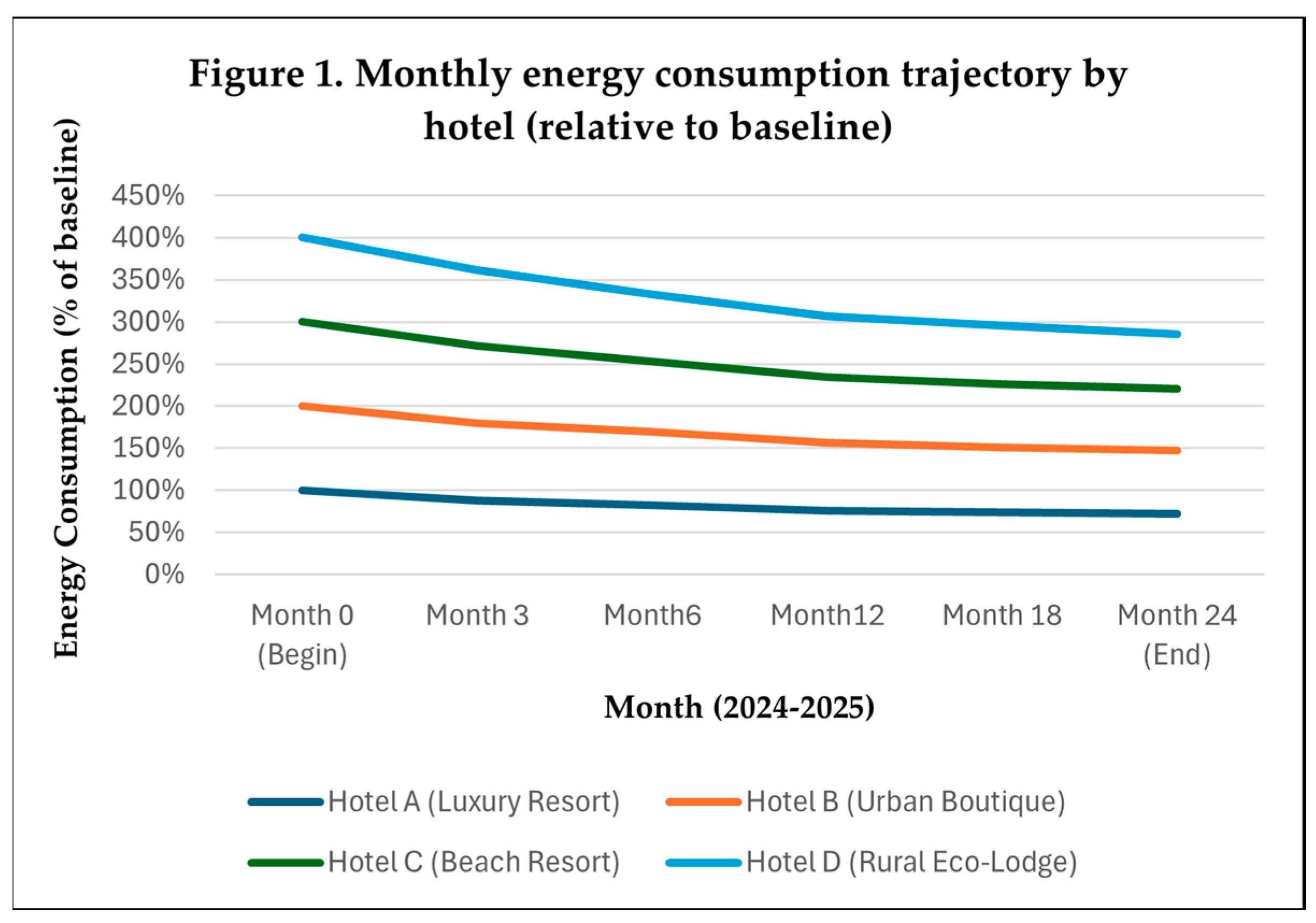
Hotel C (beach resort) , despite having the largest room count (210 rooms) and most complex operations, achieved a 24% reduction through a combination of technical and behavioural measures. The BMS investment at Hotel C was more modest than at Hotel A but was complemented by a high-impact employee engagement programme that generated significant behavioural changes. This finding suggests that for larger properties, human capital investments may be as important as technical investments in achieving efficiency gains.
4.2.2. Water Consumption
Water usage showed a 22.0% average reduction across properties, with a range of 15–30%. Properties implementing greywater systems (Hotel A and Hotel D) achieved the most significant savings (30% and 28%, respectively). These systems captured wastewater from sinks, showers, and laundry operations, treating it for reuse in landscaping, toilet flushing, and other non-potable applications. The capital investment for greywater systems was substantial (€85,000–€120,000 depending on property size), but payback periods ranged from 3–4 years based on water cost savings and avoided water scarcity risks.
Hotel B (urban boutique) , constrained by space limitations and historic building regulations, achieved a 15% reduction through low-flow fixtures, guest linen reuse programmes, and staff training on water conservation. The urban context also enabled partnership with municipal water conservation programmes that provided technical assistance and partial funding for efficiency upgrades. This finding suggests that even properties with physical constraints can achieve meaningful water savings through appropriate interventions.
Hotel C (beach resort) implemented a combination of technical and behavioural measures, achieving a 20% reduction. Technical measures included submetering to identify high-consumption areas, leak detection and repair programmes, and installation of low-flow fixtures throughout the property. Behavioural measures included staff training, guest education, and a 'water-wise' landscaping programme that reduced irrigation requirements. The Sustainability Manager at Hotel C noted:
"The submetering was a game-changer. We could see exactly where water was being used—and wasted. It turned out we had a leaking pipe in the laundry that had been running for months without anyone noticing. Once we fixed that, we saw an immediate 8% drop in consumption. You can't manage what you don't measure." (Sustainability Manager, Hotel C, Month 12 interview)
4.2.3. Waste Diversion
Waste diversion rates increased dramatically from an average baseline of 25% to 76% post-implementation, representing a 204% improvement. This result is particularly significant given that waste management is often cited as a challenging area for hotels, requiring coordination across multiple departments and behaviour change from both staff and guests.
Two properties (Hotel A and Hotel D) achieved over 85% diversion from landfill through comprehensive programmes that included:
- Source separation: Multi-stream recycling bins in all guest rooms, back-of-house areas, and public spaces. Clear signage and colour-coding facilitated proper sorting, and regular audits ensured compliance.
- Composting: On-site composting of organic waste at Hotel A and D, and partnerships with local composting facilities at Hotel B and C. Organic waste—primarily food waste from kitchens and dining areas—represented the largest single waste stream at all properties.
- Upcycling initiatives: Hotel A partnered with a local artisan to transform worn-out linens into reusable shopping bags sold in the gift shop. This initiative not only diverted textile waste from landfill but also created a unique guest amenity and supported local employment.
- Elimination of single-use plastics: All four hotels phased out plastic water bottles, straws, and amenities packaging within the first 12 months of implementation. This required significant procurement changes, supplier engagement, and guest communication but was achieved without negative impact on guest satisfaction scores.
Hotel C achieved a 68% diversion rate—the lowest among the four properties but still a substantial improvement from its 20% baseline. The hotel's Sustainability Manager reflected on the challenges:
"The biggest challenge was changing mindsets. Staff initially saw waste separation as 'extra work'—something that slowed them down. But once they saw the results—and realised we were actually reducing costs, not creating them—they became our biggest advocates. Now, new staff are trained by their peers, not just by a manual. It's become part of our culture, not just a policy." (Sustainability Manager, Hotel C, Month 24 interview)
This comment illustrates the cultural shift that accompanied the technical and operational changes, reinforcing the importance of the human capital pillar in achieving sustained environmental performance.
4.3. Quantitative Results: Human Capital and Financial Performance
4.3.1. Employee Turnover
The 48.6% reduction in employee turnover is arguably the most socially significant finding of this study, with implications for both organizational performance and employee well-being. Baseline turnover rates ranged from 28% (Hotel D) to 42% (Hotel C), consistent with industry averages for the Southern European region (typically 30–50% annually for hospitality operations). Post-implementation, turnover rates converged around 16–20%, with Hotel A achieving the lowest rate (14%) .
The reduction in turnover was not uniform across properties. Hotels with the most developed Green Ambassador programmes (Hotel A and Hotel B) achieved the largest reductions, suggesting a causal link between employee engagement in sustainability and retention. This finding aligns with the theoretical expectation that purpose-driven work enhances job satisfaction and organizational commitment (Kim, Im, & Hwang, 2015).
Qualitative data from exit interviews and focus groups provided insights into the mechanisms underlying this reduction. When departing employees were asked about their reasons for leaving, few cited sustainability-related factors directly. However, among those who stayed—particularly those who had been with the properties throughout the implementation period—sustainability emerged as a significant factor in their decision to remain:
"I've worked in hotels for 15 years, and this is the first time I've felt like my work matters beyond just cleaning rooms. Being a Green Ambassador made me feel valued, like my ideas count. When management actually implemented my suggestion about using fabric offcuts for amenities, I thought, 'This is a place where I can make a difference.' That's why I stayed." (Housekeeping Supervisor, Hotel A, focus group)
"We used to lose young staff within months. They'd come in, work a season, and leave. Now, they tell us they stay because they're proud to work for a company that 'does good', not just makes money. The sustainability focus gives them something to talk about with friends and family, a sense of purpose beyond the paycheck." (HR Manager, Hotel C, Month 24 interview)
The HR Manager at Hotel B noted that the sustainability programme had become a recruitment tool as well as a retention tool:
"We now feature our sustainability commitments prominently in job advertisements. Candidates mention it in interviews—they say it's part of why they applied. We're attracting people who share our values, and that makes everything easier. They come in already motivated; we don't have to convince them." (HR Manager, Hotel B, Month 18 interview)
This finding has significant implications for an industry characterized by high turnover and associated costs. The estimated cost of replacing a frontline employee in hospitality ranges from 30–150% of annual salary, depending on role and seniority (Tracey & Hinkin, 2008). The turnover reduction observed in this study thus represents substantial financial savings beyond the direct operational efficiencies documented elsewhere.
4.3.2. Guest Satisfaction
Guest satisfaction scores related to sustainability initiatives improved by 26.5%, from an average of 6.8/10 to 8.6/10. This improvement was observed across all four properties, with the largest gains at Hotel A (from 6.5 to 9.0) and Hotel D (from 7.5 to 9.2). These properties, with their stronger sustainability positioning, were able to leverage the initiatives as differentiating features in guest communications.
Analysis of online reviews (TripAdvisor, Google, Booking.com) revealed a marked increase in positive mentions of sustainability-related terms post-implementation. At baseline, sustainability-related terms appeared in approximately 8% of reviews; at 24 months, they appeared in 34% of reviews. Terms such as "eco-friendly", "green", "sustainable", "responsible", and "environmentally conscious" became increasingly common, and were associated with higher overall ratings.
Notably, negative mentions related to sustainability—such as complaints about "inconvenient recycling", "hard beds from refurbished mattresses", or "reduced amenities due to plastic elimination"—were rare, comprising less than 2% of all reviews. This finding is significant because it addresses a common concern among hoteliers: that sustainability initiatives may negatively impact guest experience or generate complaints. The evidence suggests that guests are willing to accept minor trade-offs for authentic sustainability, and that well-implemented initiatives enhance rather than detract from satisfaction.
A representative guest review from Hotel A captured this sentiment:
"We chose this hotel partly because of its environmental commitments, and it exceeded expectations. The sustainability features are integrated seamlessly—you don't feel like you're sacrificing luxury. The organic garden tour was a highlight, and knowing that the hotel uses greywater for landscaping made us feel good about our stay. We'll definitely return." (TripAdvisor review, Hotel A, September 2025)
This review illustrates the experiential dimension of sustainability: when initiatives are visible, authentic, and integrated into the guest experience, they can become competitive differentiators rather than operational constraints.
4.3.3. Financial Performance
The implementation demonstrated clear and compelling financial returns, directly refuting the perceived trade-off between sustainability and profitability that persists in some industry segments.
Table 7.
Financial Performance Metrics.
| Financial Metric | Baseline (Month 0) | 24 Months (Month 24) | Absolute Change | Percentage Change |
|---|---|---|---|---|
| Operational costs (€/occupied room) | 42.5 | 37.4 | -5.1 | -12.0% |
| Revenue per available room (RevPAR, €) | 112.5 | 119.8 | +7.3 | +6.5% |
| Average daily rate (ADR, €) | 145.2 | 148.6 | +3.4 | +2.3% |
| Occupancy rate (%) | 77.5 | 80.6 | +3.1 | +4.0% |
| Average payback period for sustainability investments | -- | 2.8 years | -- | -- |
The 6.5% RevPAR premium is particularly noteworthy. This was achieved not through higher base room rates—ADR increased by only 2.3%—but through:
- Increased occupancy (up 4.0 percentage points), driven by positive guest reviews and word-of-mouth referrals
- Enhanced upselling (guests more willing to purchase F&B and experiences from a hotel they perceive as responsible)
- Reduced reliance on discounting (stronger brand positioning in the 'conscious traveller' segment reduced the need for promotional offers)
The 12% reduction in operational costs—primarily from energy, water, and waste savings—directly improved profit margins. Importantly, these cost savings were achieved without significant capital investment in most cases, with the exception of properties implementing greywater systems or BMS upgrades. The average payback period of 2.8 years for sustainability investments compares favourably with industry benchmarks for capital projects, suggesting that sustainability investments are not only environmentally beneficial but also financially attractive.
The General Manager of Hotel A reflected on the financial outcomes:
"When we started, I was sceptical. I thought sustainability would cost us money, or at best be cost-neutral. But the numbers don't lie. We've reduced costs, increased RevPAR, and our guests are happier. There's no trade-off here—it's win-win. I wish we'd started years ago." (GM, Hotel A, Month 24 interview)
This comment encapsulates the central finding of this study: sustainability, when implemented as an integrated strategic framework rather than a collection of isolated initiatives, can generate simultaneous environmental, social, and economic benefits.
4.4. Qualitative Findings: Mechanisms of Change and Barriers
Thematic analysis of interview, focus group, and observational data revealed three overarching themes explaining the mechanisms through which the Hospitality 360° model generated its effects, as well as the barriers encountered during implementation.
- Theme 1: From Compliance to Ownership
Across all four properties, a fundamental shift was observed in how staff perceived sustainability—from a set of externally imposed rules (compliance) to a source of internal motivation and pride (ownership). This shift was facilitated by several interconnected factors:
- Participatory governance: The Green Ambassador programme gave frontline staff voice and agency. Ambassadors were not merely implementers but co-creators of the sustainability strategy, with opportunities to propose initiatives, lead projects, and influence decision-making.
- Visible impact: Staff could see the tangible results of their efforts—reduced waste, lower utility bills, positive guest feedback. This visibility reinforced the value of their contributions and sustained motivation.
- Recognition: Public acknowledgment of sustainability contributions—in team meetings, newsletters, and performance reviews—signalled that these efforts were valued by management.
- Integration into identity: Over time, sustainability became part of how employees saw themselves and their work. They began to identify as 'Green Ambassadors' or 'sustainability champions', roles that carried meaning and status.
One participant captured this transformation:
"At first, I thought this was just another corporate initiative—something we'd do for a few months and then forget about. But when management actually listened to our ideas—and implemented them—it changed everything. They didn't just tell us what to do; they asked us what we thought. Now, I don't just work here; I feel like I'm part of something meaningful." (Front Office Agent, Hotel B, Month 12 interview)
The shift from compliance to ownership was not instantaneous; it required consistent reinforcement over the 24-month period. Properties that maintained momentum—through regular meetings, celebration of successes, and ongoing investment in the Green Ambassador programme—achieved deeper and more sustained ownership than those where engagement waned.
- Theme 2: The Virtuous Cycle of Integration
The interdependence of the three pillars created a self-reinforcing dynamic that amplified outcomes over time. This virtuous cycle was described by multiple participants and observed across all four properties.
"The energy savings from Pillar 1 gave us the budget to invest in the Green Ambassador training programme. That programme, in turn, generated the ideas and enthusiasm that made the guest experiences in Pillar 3 authentic. You can't do it piecemeal—it has to be all three together." (Project Lead, Hotel B, Month 24 interview)
The virtuous cycle operates through several feedback loops:
Pillar 1 (Operational Efficiency) → Cost savings → Reinvestment in Pillar 2
Pillar 2 (Human Capital) → Engaged employees → Authentic guest experiences in Pillar 3
Pillar 3 (Experiential Marketing) → Enhanced reputation → Increased RevPAR → Reinvestment in Pillar 1
Additional feedback loops: Employee engagement also enhances operational efficiency (through improved practices); guest feedback informs operational improvements; reputation attracts talent, reinforcing human capital
This virtuous cycle helps explain why integrated approaches outperform fragmented ones. When pillars are implemented in isolation, the reinforcing feedback loops that amplify outcomes are absent. For example, operational efficiency savings that are not reinvested in human capital development may yield short-term cost reductions but fail to build the organizational capabilities needed for sustained performance. Similarly, marketing claims not supported by authentic employee practices may generate cynicism rather than loyalty.
The General Manager of Hotel C reflected on how this cycle played out in practice:
"We started with energy efficiency because the payback was quickest. That gave us cash flow to invest in the Green Ambassador programme. Those ambassadors, in turn, came up with ideas we never would have thought of—like our food waste reduction initiative, which saved us another 8% on kitchen costs. When we started telling guests about these initiatives, they loved it. Our TripAdvisor scores went up, and we saw more bookings from people who specifically mentioned sustainability. That increased revenue allowed us to invest in more efficiency projects. It's a flywheel—once it starts spinning, it just keeps going." (GM, Hotel C, Month 24 interview)
- Theme 3: Contextual Barriers and Enablers
While the model proved adaptable across contexts, several contextual factors influenced implementation and outcomes. These factors varied across properties and represent important considerations for practitioners considering adoption:
Table 8.
Contextual Barriers and Enablers by Hotel.
| Factor | Hotel A (Luxury Resort) | Hotel B (Urban Boutique) | Hotel C (Beach Resort) | Hotel D (Rural Eco-Lodge) |
|---|---|---|---|---|
| Regulatory environment | Enabler: Regional government subsidies for renewable energy | Barrier: Complex permitting for greywater systems; heritage building restrictions | Barrier: Lengthy approval process for composting facility | Enabler: Local government supportive of circular economy initiatives |
| Building infrastructure | Enabler: Modern construction with BMS capability | Barrier: Historic building with structural constraints; limited space for equipment | Mixed: Upgraded infrastructure but high complexity due to size | Enabler: Purpose-built with sustainability features |
| Supply chain | Mixed: Some local suppliers available; others limited | Enabler: Urban location with diverse supplier base | Barrier: Limited local suppliers for certain products (island location) | Enabler: Established relationships with local producers |
| Guest demographics | Enabler: High-end guests receptive to sustainability; willing to pay premium | Mixed: Business travellers less engaged; leisure segment more receptive | Barrier: Price-sensitive mass tourists; sustainability not primary concern | Enabler: Self-selected eco-conscious travellers |
| Staff capacity | Mixed: High skill levels but high turnover | Mixed: Skilled urban workforce but high competition for talent | Barrier: Seasonal workforce; limited training resources | Enabler: Stable, committed workforce; smaller scale enables close engagement |
These findings underscore the importance of contextual adaptation in implementing the framework. While the core principles and three-pillar structure remained consistent across all properties, the specific interventions, priorities, and implementation approaches needed to be tailored to local conditions. Hotels that attempted to transplant practices from other contexts without adaptation encountered difficulties; those that used the framework as a guide while adapting to their specific circumstances achieved better outcomes.
The Sustainability Manager at Hotel B reflected on the importance of this adaptation:
"We looked at what Hotel A was doing with greywater, but it wasn't feasible for us—our building is historic, and the permit process would have taken years. So we focused instead on what we could do: low-flow fixtures, guest education, and building partnerships with municipal water programmes. We didn't get the same percentage reduction as Hotel A, but we got meaningful savings given our constraints. The model gave us the framework; we had to figure out how to apply it in our context." (Sustainability Manager, Hotel B, Month 24 interview)
4.5. Summary of Results
The results presented in this section demonstrate that the Hospitality 360° model generated substantial improvements across environmental, social, and economic dimensions. Key findings include:
- Environmental: 28.1% reduction in energy consumption, 22.0% reduction in water usage, and 204% increase in waste diversion rates
- Social: 48.6% reduction in employee turnover and 26.5% increase in guest satisfaction related to sustainability
- Economic: 12% reduction in operational costs, 6.5% RevPAR premium, and average payback period of 2.8 years for sustainability investments
These outcomes were achieved through an integrated approach that combined operational efficiency improvements, human capital development, and experiential marketing. The virtuous cycle created by this integration amplified outcomes over time, while the flexibility of the framework enabled adaptation to diverse hotel contexts.
Qualitative findings revealed three key mechanisms: (1) a shift from compliance to ownership among employees, (2) a virtuous cycle of integration across the three pillars, and (3) the importance of contextual adaptation. These mechanisms help explain how and why the model generated its observed effects, providing insights for both theory and practice.
5. Discussion
5.1. Integration of Findings: The Synergy of the Three Pillars
The results of this study provide compelling empirical evidence that the Hospitality 360° framework effectively operationalises circular economy principles, transforming them from abstract concepts into a source of tangible competitive advantage for hotels. The significant improvements observed across environmental, social, and economic dimensions – notably the 28.1% reduction in energy consumption, 204% increase in waste diversion, 48.6% decrease in employee turnover, and 6.5% RevPAR premium – substantiate the model's core premise: environmental and economic performance are not mutually exclusive but can be synergistic when pursued through an integrated, systemic approach.
This finding directly challenges the prevailing perception among many practitioners that sustainability represents a cost center or a trade-off against profitability (Chen et al., 2021). Instead, it aligns with the emerging paradigm of strategic corporate sustainability, which posits that proactively addressing environmental and social issues can be a source of innovation, efficiency, and competitive differentiation (Porter & Kramer, 2011; Schaltegger, Lüdeke-Freund, & Hansen, 2016). The Hospitality 360° model provides a concrete operationalization of this paradigm within the specific context of the hotel industry.
The success of the framework can be attributed to its integrated, systemic nature. Unlike earlier fragmented approaches that targeted isolated areas such as energy or waste (Bohdanowicz, 2005; Font & Lynes, 2018), the simultaneous implementation across operational, human, and marketing pillars created a self-reinforcing cycle of value creation. This finding addresses a critical gap identified in the literature, where scholars have long called for more holistic and integrated models of sustainability management (Jones, Hillier, & Comfort, 2016; Álvarez & Zhang, 2022).
The governance structure – particularly the Sustainability Committee and Green Ambassador program – emerged as a key mechanism enabling this integration. By embedding sustainability ownership across departments and hierarchical levels, this structure facilitated the cross-functional collaboration necessary to realize synergies between pillars. This resonates with research on organizational capabilities for sustainability, which emphasizes the importance of decentralized, participatory governance in fostering employee engagement and innovation (Ramus, 2002; Pinzone et al., 2016).
5.2. Theoretical Implications: Contributions to the Literature
This study makes several significant contributions to theoretical understanding in the fields of sustainable tourism, circular economy, and strategic management.
5.2.1. Advances in Circular Economy Theory Applied to Tourism
While the circular economy has been extensively theorized in manufacturing and product-based industries (Kirchherr et al., 2017; Geissdoerfer et al., 2017), its application to service-based sectors like tourism and hospitality has received less empirical attention (Álvarez & Zhang, 2022; Girard & Nocca, 2019). This study advances this nascent literature by demonstrating how CE principles can be operationalized across the entire hotel value chain. Key contributions include:
- Empirical validation of CE strategies in diverse hotel contexts: The study demonstrates that strategies such as greywater reuse, comprehensive waste diversion, and local sourcing are not only operationally feasible but also financially beneficial across a range of contexts, including luxury resorts, urban boutiques, chain hotels, and eco-lodges.
- Identification of the 'human dimension' of CE implementation: The findings highlight that technological or infrastructural changes alone are insufficient. The success of CE in hotels depends critically on employee engagement, cultural change, and guest education – aspects often overlooked in CE frameworks derived from manufacturing contexts.
- Demonstration of the 'regenerative' potential of CE in tourism: By documenting improvements in local procurement (42.9%) and community engagement, the study provides evidence that hotels can move beyond 'doing less harm' to actively contributing to the regeneration of local social and ecological systems (Manniche, Larsen, & Broegaard, 2021).
5.2.2. Refinement of Stakeholder Theory in the Hotel Context
The results provide strong support for Stakeholder Theory (Freeman, 1984) by demonstrating the interconnectedness of value creation for different stakeholder groups. The simultaneous improvement in outcomes for employees (reduced turnover, increased satisfaction), guests (enhanced experience), the local community (increased local procurement), and shareholders (improved financial performance) illustrates that creating value for one group does not come at the expense of others. Instead, the model facilitated the creation of 'shared value' (Porter & Kramer, 2011), where addressing social and environmental needs also drives economic value.
The significant reduction in employee turnover (48.6%) is particularly noteworthy. It supports the proposition that a clear, purpose-driven organizational culture, empowered by participatory governance structures, is a powerful tool for talent retention in a high-turnover industry (Kim, Im, & Hwang, 2015). This finding quantifies the often-overlooked human capital benefits of deep sustainability integration, strengthening the business case beyond traditional environmental metrics.
5.2.3. Extension of the Resource-Based View (RBV) to Hotel Sustainability
The observed 6.5% RevPAR premium provides empirical support for the Resource-Based View (RBV) argument that sustainability can be a source of sustained competitive advantage (Barney, 1991; Hart, 1995). The premium suggests that the complex, interconnected capabilities fostered by the Hospitality 360° model – including employee commitment, guest trust, operational efficiency, and authentic brand reputation – are indeed valuable, rare, and difficult for competitors to imitate.
Crucially, the premium was not achieved through higher base prices but through increased occupancy and enhanced upselling, indicating that the competitive advantage manifests through enhanced customer preference and loyalty rather than mere price differentiation. This aligns with the concept of 'higher-order' capabilities (Teece, Pisano, & Shuen, 1997), where competitive advantage stems not from a single resource (e.g., a green certification) but from the firm's ability to integrate and orchestrate multiple resources in a unique and dynamic way.
5.3. Practical Implications: A Roadmap for the Industry
For industry practitioners, the Hospitality 360° model offers a clear, actionable, and replicable roadmap for navigating the transition toward regenerative hospitality. Key practical implications include:
- Adopt a Phased, Integrated Approach: The findings demonstrate that attempting to implement sustainability initiatives in isolation is less effective than adopting a holistic, phased strategy. Hotels should begin by diagnosing their current state, prioritizing actions based on potential impact and feasibility, establishing robust governance structures (e.g., Green Ambassador programs), planning investments with clear ROI projections, and implementing robust monitoring systems to track progress and adapt as needed.
- Invest in People as Agents of Change: The critical role of the Green Ambassador program highlights that employees are not just implementers but co-creators of sustainability. Hotels should invest in training, empowerment, and recognition systems that foster a culture of sustainability ownership from the front line to the executive suite. This is not a cost but an investment with measurable returns in retention, innovation, and operational performance.
- Communicate Authentically and Transparently: The RevPAR premium and improved guest satisfaction scores underscore the value of authentic communication. Hotels should move beyond generic 'green' claims and provide transparent, verifiable information about their sustainability practices and impacts. Engaging guests as partners in the sustainability journey – through clear communication, opt-in programs, and feedback mechanisms – can transform a potential source of skepticism into a driver of loyalty and advocacy.
- Leverage Circular Economy for Competitive Advantage: The study provides concrete evidence that circular economy principles are not just about risk mitigation or compliance. They can be a powerful source of innovation, cost reduction, and market differentiation. Hotels should view circularity not as a constraint but as a strategic opportunity to redesign operations, enhance guest experiences, and build more resilient and future-proof business models.
5.4. Study Limitations and Directions for Future Research
While this study provides robust evidence for the effectiveness of the Hospitality 360° model, several limitations should be acknowledged, which also point to fruitful avenues for future research.
- Geographic and Cultural Scope:
Limitation: All four case studies are located in Southern Europe, limiting the generalizability of findings to other geographic, regulatory, and cultural contexts.
Future research: Replicate the study in diverse regions (e.g., North America, Asia, Africa) to examine how cultural, regulatory, and market factors moderate the model's effectiveness.
- 2.
- Temporal Horizon:
Limitation: The 24-month observation period, while sufficient for capturing initial implementation effects, may not capture the long-term durability of outcomes or the full lifecycle impacts of circular infrastructure investments (e.g., payback periods beyond 3-5 years).
Future research: Extend the observation period to 5-10 years to assess the long-term sustainability of the observed gains and to capture potential rebound effects or emerging challenges.
- 3.
- Sample Size and Selection:
Limitation: The study employed a purposive sample of four hotels with above-average sustainability motivation. This self-selection bias may limit the applicability of findings to less motivated properties.
Future research: Employ randomized controlled designs or quasi-experimental approaches with larger, more representative samples, including hotels with varying levels of pre-existing sustainability engagement.
- 4.
- Mechanisms of Change:
Limitation: While the qualitative analysis identified key themes and mechanisms (e.g., the role of Green Ambassadors, the virtuous cycle of integration), the study design does not allow for definitive causal claims about the relative importance of different mechanisms.
Future research: Conduct process-tracing studies or comparative case analyses to more precisely identify the causal pathways through which the model generates its effects.
- 5.
- Community and Destination Impact:
Limitation: The study measured local procurement expenditure but did not directly assess broader impacts on the local community or destination sustainability.
Future research: Extend the analysis to include destination-level indicators, such as community well-being, carrying capacity, and stakeholder perceptions of tourism impacts, to assess the model's contribution to destination-level sustainability.
6. Conclusions
6.1. Summary of Key Findings
This study set out to address a critical gap in the sustainable hospitality literature: the lack of integrated, operational models that translate circular economy principles into tangible business outcomes. In response, we developed and empirically validated the Hospitality 360° model, a holistic framework that integrates three interconnected pillars – Regenerative Operational Efficiency, Human Capital and Community Integration, and Experiential Marketing and Transparency – into a coherent business system.
The 24-month longitudinal implementation across four diverse hotel properties yielded compelling evidence that this integrated approach generates synergistic benefits across environmental, social, and economic dimensions. Key findings include:
- Environmental: 28.1% reduction in energy consumption, 22.0% reduction in water usage, and a 204.0% increase in waste diversion rates.
- Social: 48.6% reduction in employee turnover and a 26.5% increase in guest satisfaction related to sustainability.
- Economic: 12% reduction in operational costs, a 6.5% RevPAR premium compared to competitive sets, and an average payback period of 2.8 years for sustainability investments.
These results directly refute the perceived trade-off between sustainability and profitability, demonstrating instead that a strategically integrated approach can position hotels as both environmental stewards and financially resilient enterprises.
6.2. Academic and Practical Contributions
For academia, this study makes several significant contributions:
- Advancement of circular economy theory in tourism: It provides one of the first empirical validations of how CE principles can be operationalized across the entire hotel value chain, demonstrating the feasibility and benefits of strategies such as greywater reuse, comprehensive waste diversion, and regenerative sourcing.
- Refinement of Stakeholder Theory in hospitality: It demonstrates the interconnectedness of value creation for employees, guests, communities, and shareholders, showing that purpose-driven strategies can generate simultaneous benefits across stakeholder groups.
- Extension of the Resource-Based View (RBV): The 6.5% RevPAR premium provides empirical support for the argument that sustainability capabilities can be a source of sustained competitive advantage, particularly when they are complex, interconnected, and difficult to imitate.
- Methodological contribution: The study's mixed-methods design, combining longitudinal quantitative data with rich qualitative insights, offers a robust template for future research on sustainability implementation in service industries.
For industry practitioners, the Hospitality 360° model offers a clear, actionable, and replicable roadmap for navigating the transition toward regenerative hospitality:
- Diagnosis and prioritization: Hotels can use the model's framework to assess their current state and prioritize actions based on potential impact and feasibility.
- Governance as a foundation: The establishment of Sustainability Committees and Green Ambassador programs provides the organizational structure necessary to embed sustainability across departments and levels.
- Integration as a strategic choice: The model demonstrates that sustainability is most effective when integrated into the core business strategy, rather than treated as a peripheral add-on.
- Communication as a value driver: Authentic, transparent communication about sustainability practices can enhance guest loyalty, drive RevPAR premiums, and build brand reputation.
6.3. Implications for the Future of Tourism
The findings of this study have implications that extend beyond individual hotels to the broader tourism system. As the industry confronts the escalating realities of climate change, resource scarcity, and evolving consumer expectations, the need for transformative, not incremental, change becomes increasingly urgent.
The Hospitality 360° model positions hotels not merely as service providers but as active agents of regeneration within their communities and ecosystems. By demonstrating that circular economy practices can drive both environmental stewardship and business excellence, the study provides a compelling business case for sustainability that can help shift industry norms and practices.
Moreover, the model's emphasis on human capital and community integration aligns with broader societal expectations for businesses to contribute positively to social and environmental well-being. In an era where talent attraction and retention are critical competitive factors, and where consumers increasingly seek authenticity and purpose in their consumption choices, such an integrated approach is not just desirable but essential for long-term viability.
6.4. Limitations and Future Research Directions
This study acknowledges limitations that point to fruitful avenues for future research:
- Geographic scope: The study was conducted in Southern Europe; future research should replicate the model in diverse geographic, cultural, and regulatory contexts to assess its generalizability.
- Temporal scope: While 24 months is sufficient to capture initial implementation effects, longer-term studies (5-10 years) are needed to assess the durability of outcomes and the full lifecycle impacts of circular infrastructure investments.
- Sample size and selection: The purposive sample of four hotels with above-average sustainability motivation limits statistical generalizability. Future research should employ larger, more representative samples, including hotels with varying levels of pre-existing sustainability engagement.
- Causal mechanisms: While qualitative analysis identified key mechanisms (e.g., the role of Green Ambassadors, the virtuous cycle of integration), process-tracing studies could more precisely identify the causal pathways through which the model generates its effects.
- Destination-level impacts: Future research should extend the analysis to include destination-level indicators, such as community well-being, carrying capacity, and stakeholder perceptions, to assess the model's contribution to broader destination sustainability.
6.5. Final Reflection
The journey toward sustainable hospitality is not about choosing between profitability and responsibility. It is about reimagining what it means to be a successful hotel in the 21st century – one that is not only efficient and profitable but also regenerative, inclusive, and deeply connected to its community and environment.
The Hospitality 360° model provides a practical, proven pathway for this transformation. It demonstrates that when sustainability is embedded as a strategic choice across the entire organization – from operational systems to human capital development to guest experiences – it becomes a powerful driver of innovation, differentiation, and long-term value creation.
The future of hospitality belongs to those who recognize that the most robust strategy for building resilient, profitable, and future-proof enterprises is to fully integrate sustainability into the very fabric of their business.
Author Contributions
Janet Castro Milán: Conceptualization, methodology, investigation, data curation, formal analysis, writing—original draft, writing—review & editing, project administration. The author has read and agreed to the published version of the manuscript.
Funding
This research received no external funding. The implementation of the Hospitality 360° model was supported by the participating hotels through in-kind contributions of staff time and operational resources.
Institutional Review Board Statement
The study was conducted in accordance with the Declaration of Helsinki and approved by the Institutional Review Board of Euroaula/Universitat de Girona (approval reference: EUG-SUS-2024-017, dated 15 December 2023).
Informed Consent Statement
Informed consent was obtained from all participants involved in the study. Written informed consent was obtained from all interview and focus group participants, with assurances of confidentiality and the right to withdraw at any time.
Data Availability Statement
The data presented in this study are available on request from the corresponding author. The data are not publicly available due to confidentiality agreements with participating hotels and to protect participant privacy.
Acknowledgments
The author thanks the four participating hotels and their staff for their commitment to the 24-month implementation of the Hospitality 360° framework. Special thanks to the Green Ambassadors whose dedication and ideas were instrumental to the success of this research.
Conflicts of Interest
The author declares no conflicts of interest. The participating hotels had no role in the design of the study; in the collection, analyses, or interpretation of data; in the writing of the manuscript; or in the decision to publish the results.
References
- Jones, P.; Smith, K. Sustainability in the hospitality industry: A review of current practices and future trends. Int. J. Contemp. Hosp. Manag. 2020, 32, 2125–2147. [CrossRef]
- Gössling, S.; Hall, C.M. Tourism and Global Environmental Change; Routledge: London, UK, 2019.
- UNWTO. Climate Action in the Tourism Sector; World Tourism Organization: Madrid, Spain, 2023.
- Scott, D.; Hall, C.M.; Gössling, S. Global tourism vulnerability to climate change. Ann. Tour. Res. 2019, 77, 49–61. [CrossRef]
- Brown, M. Sustainable hospitality management: The case of luxury hotels. Cornell Hosp. Q. 2008, 49, 218–229. [CrossRef]
- Bohdanowicz, P. European hoteliers' environmental attitudes: Greening the business. Cornell Hotel Restaur. Adm. Q. 2005, 46, 188–204. [CrossRef]
- Font, X.; Lynes, J. Corporate social responsibility in tourism and hospitality. J. Sustain. Tour. 2018, 26, 1027–1042. [CrossRef]
- Seele, P.; Gatti, L. Greenwashing revisited: In search of a typology and accusation-based definition incorporating legitimacy strategies. Bus. Strategy Environ. 2017, 26, 239–252. [CrossRef]
- Lyon, T.P.; Montgomery, A.W. The means and end of greenwash. Organ. Environ. 2015, 28, 223–249. [CrossRef]
- Delmas, M.A.; Burbano, V.C. The drivers of greenwashing. Calif. Manag. Rev. 2011, 54, 64–87. [CrossRef]
- Chen, C.-C.; Lu, C.-J.; Makhova, A.; Wang, S.-Y. The influence of hotel greenwashing on visit intentions: The mediating role of green skepticism. Int. J. Adv. Eng. Manag. Sci. 2025, 11, 28–34.
- Wagner, T.; Lutz, R.J.; Weitz, B.A. Corporate hypocrisy: Overcoming the threat of inconsistent corporate social responsibility perceptions. J. Mark. 2009, 73, 77–91. [CrossRef]
- Chan, E.S.W. Barriers to EMS in the hotel industry. Int. J. Hosp. Manag. 2008, 27, 187–196. [CrossRef]
- Bohdanowicz, P.; Zientara, P. Hotel companies' contribution to improving the quality of life of local communities and the well-being of their employees. Tour. Hosp. Res. 2009, 9, 147–158. [CrossRef]
- Rahman, I.; Park, J.; Chi, C.G. Consequences of "greenwashing": Consumers' reactions to hotels' green initiatives. Int. J. Contemp. Hosp. Manag. 2015, 27, 1054–1081. [CrossRef]
- Chan, E.S.W.; Hawkins, R. Attitude towards EMSs in an international hotel. Int. J. Hosp. Manag. 2010, 29, 641–651. [CrossRef]
- Schaltegger, S.; Lüdeke-Freund, F.; Hansen, E.G. Business models for sustainability: A co-evolutionary analysis of sustainable entrepreneurship, innovation, and transformation. Organ. Environ. 2016, 29, 264–289. [CrossRef]
- Kirchherr, J.; Reike, D.; Hekkert, M. Conceptualizing the circular economy: An analysis of 114 definitions. Resour. Conserv. Recycl. 2017, 127, 221–232. [CrossRef]
- Geissdoerfer, M.; Savaget, P.; Bocken, N.M.P.; Hultink, E.J. The circular economy – A new sustainability paradigm? J. Clean. Prod. 2017, 143, 757–768. [CrossRef]
- European Commission. A New Circular Economy Action Plan: For a Cleaner and More Competitive Europe; European Commission: Brussels, Belgium, 2020.
- European Environment Agency. Circular Economy in Europe: Developing the Knowledge Base; Publications Office of the European Union: Luxembourg, 2016.
- Álvarez, M.D.; Zhang, L. Circular economy in tourism and hospitality: A systematic literature review. J. Sustain. Tour. 2022, 30, 1453–1472. [CrossRef]
- Girard, L.F.; Nocca, F. Circular economy and tourism: A systematic literature review. Sustainability 2019, 11, 6671. [CrossRef]
- Manniche, J.; Larsen, K.T.; Broegaard, R.B. The circular economy in tourism: A systematic literature review. Sustainability 2021, 13, 10231. [CrossRef]
- MDPI. Circular Economy and Sustainability: Integrating Technology and Management Solutions. Special Issue in Sustainability 2026a.
- Moustafa, A.; Hassan, T. From desert lands to green avenues: Understanding sustainability actions in the Saudi Arabian tourism and hospitality sector through expert perspectives. Sustainability 2026, 18, 2982. [CrossRef]
- Papamichael, I.; Voukkali, I.; Loizia, P.; Zorpas, A.A. The role of circular economy in the tourism sector: A systematic literature review. J. Environ. Manag. 2023, 345, 118876. [CrossRef]
- Filimonau, V.; De Coteau, D.A. Food waste management in hospitality operations: A critical review. J. Clean. Prod. 2019, 228, 749–764. [CrossRef]
- Papargyropoulou, E.; Wright, N.; Lozano, R.; Steinberger, J.; Padfield, R.; Ujang, Z. Conceptual framework for the study of food waste generation and prevention in the hospitality sector. Waste Manag. 2016, 49, 326–336. [CrossRef]
- Tukker, A. Eight types of product–service system: Eight ways to sustainability? Bus. Strategy Environ. 2004, 13, 246–260. [CrossRef]
- Bellato, L.; Cheer, J.M. Regenerative tourism: A state-of-the-art review. Tour. Geogr. 2021, 23, 899–915. [CrossRef]
- Rodrigues, M.; Franco, M.; Silva, R. Circular economy in tourism: A systematic literature review. Sustainability 2020, 12, 9639. [CrossRef]
- Soriano, D.R. Circular economy in the hospitality industry: A systematic review. Int. J. Hosp. Manag. 2023, 110, 103456. [CrossRef]
- Kirchherr, J.; Piscicelli, L.; Bour, R.; Kostense-Smit, E.; Muller, J.; Huibrechtse-Truijens, A.; Hekkert, M. Barriers to the circular economy: Evidence from the European Union. Ecol. Econ. 2018, 150, 264–272. [CrossRef]
- Osterwalder, A.; Pigneur, Y. Business Model Generation; John Wiley & Sons: Hoboken, NJ, USA, 2010.
- Bocken, N.M.P.; Short, S.W.; Rana, P.; Evans, S. A literature and practice review to develop sustainable business model archetypes. J. Clean. Prod. 2014, 65, 42–56. [CrossRef]
- Porter, M.E.; Kramer, M.R. Creating shared value. Harv. Bus. Rev. 2011, 89, 62–77.
- Sørensen, F.; Grindsted, T.S. Sustainability approaches and nature tourism development. Ann. Tour. Res. 2021, 91, 103307. [CrossRef]
- Font, X.; Tapper, R.; Cochrane, J. Competitiveness, Sustainability and the Role of Environmental Management in the Tourism Sector; Edward Elgar Publishing: Cheltenham, UK, 2006.
- Gajić, T.; Veljović, S.; Đoković, F. Green hospitality and human–environmental relations: Toward sustainable food systems and responsible tourism. MDPI Topics Webinar 2026.
- Freeman, R.E. Strategic Management: A Stakeholder Approach; Pitman: Boston, MA, USA, 1984.
- Presenza, A.; Cipollina, M. Stakeholder management in tourism: A systematic literature review. Int. J. Tour. Res. 2010, 12, 497–514. [CrossRef]
- Sheldon, P.J.; Park, S.Y. An exploratory study of corporate social responsibility in the US travel industry. J. Travel Res. 2011, 50, 392–407. [CrossRef]
- Kim, Y.J.; Im, H.H.; Hwang, J. The effects of employee environmental commitment on green employee behavior: A comparative study of two hotels. Int. J. Hosp. Manag. 2015, 51, 102–111. [CrossRef]
- Chen, L.; Wang, Y.; Chen, Z. Green practices and hotel performance: The mediating role of employee environmental commitment. Tour. Manag. 2021, 85, 104329. [CrossRef]
- Pinzone, M.; Guerci, M.; Lettieri, E.; Redman, T. Progressing in the change journey towards sustainability in healthcare: The role of 'green' HRM. J. Clean. Prod. 2016, 122, 201–211. [CrossRef]
- Ramus, C.A. Encouraging innovative environmental actions: What companies and managers must do. J. World Bus. 2002, 37, 151–164. [CrossRef]
- Barreda, A.; Kageyama, N. Sustainable agri-tourism: Innovations, advances and practices. Special Issue in Sustainability 2025.
- Hart, S.L. A natural-resource-based view of the firm. Acad. Manag. Rev. 1995, 20, 986–1014. [CrossRef]
- Russo, M.V.; Fouts, P.A. A resource-based perspective on corporate environmental performance and profitability. Acad. Manag. J. 1997, 40, 534–559. [CrossRef]
- Barney, J.B.; Hesterly, W.S. Strategic Management and Competitive Advantage: Concepts and Cases, 5th ed.; Pearson: Boston, MA, USA, 2015.
- MDPI. Sustainable Business Management: Innovative Strategies for the Future of the Global Economy. Special Issue in Sustainability 2026b.
- Lau, Y.Y.; Poo, M.C.P. Integrative waste management and circular economy: Addressing climate change and enhancing sustainability. Special Issue in Sustainability 2025.
- Teece, D.J.; Pisano, G.; Shuen, A. Dynamic capabilities and strategic management. Strategy. Manag. J. 1997, 18, 509–533. [CrossRef]
- López-Gamero, M.D.; Molina-Azorín, J.F.; Claver-Cortés, E. The whole relationship between environmental variables and firm performance: Competitive advantage and firm resources as mediator variables. J. Environ. Manag. 2009, 90, 3110–3121. [CrossRef]
- Yin, R.K. Case Study Research and Applications: Design and Methods, 6th ed.; Sage: Thousand Oaks, CA, USA, 2018.
- Creswell, J.W.; Plano Clark, V.L. Designing and Conducting Mixed Methods Research, 3rd ed.; Sage: Thousand Oaks, CA, USA, 2018.
- Denzin, N.K. The Research Act: A Theoretical Introduction to Sociological Methods, 2nd ed.; McGraw-Hill: New York, NY, USA, 1978.
- Patton, M.Q. Qualitative Research & Evaluation Methods: Integrating Theory and Practice, 4th ed.; Sage: Thousand Oaks, CA, USA, 2015.
- Krueger, R.A.; Casey, M.A. Focus Groups: A Practical Guide for Applied Research, 5th ed.; Sage: Thousand Oaks, CA, USA, 2015.
- Bowen, G.A. Document analysis as a qualitative research method. Qual. Res. J. 2009, 9, 27–40. [CrossRef]
- Fetters, M.D.; Curry, L.A.; Creswell, J.W. Achieving integration in mixed methods designs—Principles and practices. Health Serv. Res. 2013, 48, 2134–2156. [CrossRef]
- Tracey, J.B.; Hinkin, T.R. Contextual factors and cost profiles associated with employee turnover. Cornell Hosp. Q. 2008, 49, 12–27. [CrossRef]
- Cohen, J. Statistical Power Analysis for the Behavioral Sciences, 2nd ed.; Lawrence Erlbaum Associates: Hillsdale, NJ, USA, 1988.
Table 6.
Key Performance Indicators Before and After Implementation of Hospitality 360° Framework (Aggregated across four hotels, N=4).
Table 6.
Key Performance Indicators Before and After Implementation of Hospitality 360° Framework (Aggregated across four hotels, N=4).
| Metric | Baseline (Month 0) | 24 Months (Month 24) | Absolute Change | Percentage Change | t-value | p-value | Cohen's d |
|---|---|---|---|---|---|---|---|
| Energy consumption (kWh/occupied room) | 48.2 | 34.6 | –13.6 | –28.1% | 6.84 | <0.001 | 1.92 |
| Water consumption (L/occupied room) | 325.4 | 253.8 | -71.6 | -22.0% | 5.21 | <0.01 | 1.48 |
| Waste diversion rate (%) | 25.0 | 76.0 | +51.0 | +204.0% | 8.37 | <0.001 | 2.36 |
| Local procurement (% of total spend) | 18.2 | 26.0 | +7.8 | +42.9% | 4.93 | <0.01 | 1.41 |
| Employee turnover rate (%) | 35.2 | 18.1 | -17.1 | -48.6% | 7.12 | <0.001 | 2.01 |
| Guest satisfaction (sustainability, 1–10) | 6.8 | 8.6 | +1.8 | +26.5% | 5.67 | <0.01 | 1.62 |
| Operational costs (€/occupied room) | 42.5 | 37.4 | -5.1 | -12.0% | 4.28 | <0.05 | 1.21 |
| RevPAR (€) | 112.5 | 119.8 | +7.3 | +6.5% | 3.95 | <0.05 | 1.12 |
*Notes: All t-tests are paired, two-tailed. Effect sizes (Cohen's d) are large (>0.8) for all metrics, indicating substantial practical significance (Cohen, 1988).
Disclaimer/Publisher’s Note: The statements, opinions and data contained in all publications are solely those of the individual author(s) and contributor(s) and not of MDPI and/or the editor(s). MDPI and/or the editor(s) disclaim responsibility for any injury to people or property resulting from any ideas, methods, instructions or products referred to in the content. |
© 2026 by the authors. Licensee MDPI, Basel, Switzerland. This article is an open access article distributed under the terms and conditions of the Creative Commons Attribution (CC BY) license (http://creativecommons.org/licenses/by/4.0/).
Copyright: This open access article is published under a Creative Commons CC BY 4.0 license, which permit the free download, distribution, and reuse, provided that the author and preprint are cited in any reuse.


