

Submitted:
09 April 2026
Posted:
09 April 2026
You are already at the latest version
Abstract
We describe a decimal–hexadecimal block encoding for primality over a finite stored range. Since every prime greater than 5 must lie in one of the residue classes 1, 3, 7, 9 (mod 10), each decimal block of size ten can be encoded by a 4-bit word indicating which of the candidates 10k + 1, 10k + 3, 10k + 7, and 10k + 9 are prime. This yields a nibble-based storage scheme supporting exact primality queries and exact recovery of the prime-counting function π(x) by cumulative popcount. We then establish a structural theorem arising from the congruence 10 ≡ 1 (mod 3): for k ≡ 0 (mod 3) the candidates 10k + 3 and 10k + 9 are always composite, and for k ≡ 2 (mod 3) the candidates 10k + 1 and 10k + 7 are always composite. This partitions the nibble alphabet into three classes of sizes 4, 16, and 4, reducing the Shannon entropy from 4 bits to 2.42 bits per nibble and yielding a lossless compression of 39.4% over the original encoding with O(1) decode complexity. We present data structures, Python routines, and experimental validation up to 300,000.
Keywords:
prime encoding
; primality storage
; prime database
; prime-counting function
; decimal block encoding
; hexadecimal encoding
; nibble encoding
; modular compression
; ternary constraint
; residue classes modulo 10
; residue classes modulo 3
; lossless compression
; Shannon entropy
; popcount
; wheel-based storage
1. Introduction
This note proposes a compact storage representation for primality based on decimal blocks. The starting point is elementary: every prime satisfies
Therefore, for each decimal block
only the four candidates , , , need to be stored.
The goal is not to introduce a new primality test or a sieve superior to classical methods. Rather, the purpose is to describe a compact block encoding of primality together with direct query algorithms. The resulting structure supports exact recovery, within the stored range, of the primality indicator, the prime-counting function , and the index of a stored prime via .
In Section 2 we define the encoding. Section 3 describes the database structure. Section 4 gives the core Python algorithms. Section 5 establishes the ternary constraint theorem and derives the compressed encoding. Section 6 reports experimental validation. Section 7 compares with traditional representations.
2. Decimal–Hexadecimal Encoding
For each decade , define four indicator bits
where
We encode the block by the nibble
so the bit order is . Thus and can be represented in hexadecimal.
Examples
3. Database Structure
The stored data consists of two components: (1) the base primes , stored explicitly; (2) the sequence of nibbles for the desired range.
For compact storage, two consecutive nibbles are packed into one byte: high nibble = odd-indexed decade, low nibble = even-indexed decade. Hence two decades occupy one byte.
Proposition 1.
Given the explicitly stored primes and the sequence of nibbles over a finite range, the primality indicator is exactly recoverable throughout that range.
Proof.
Every integer is either outside the residue classes , in which case it is automatically composite, or else belongs to a unique decade and to exactly one of the four candidate positions. The corresponding bit of records precisely whether that candidate is prime. Together with the explicit storage of , this determines the primality indicator exactly in the stored range. □
4. Core Algorithms in Python
4.1. Construction of the Database
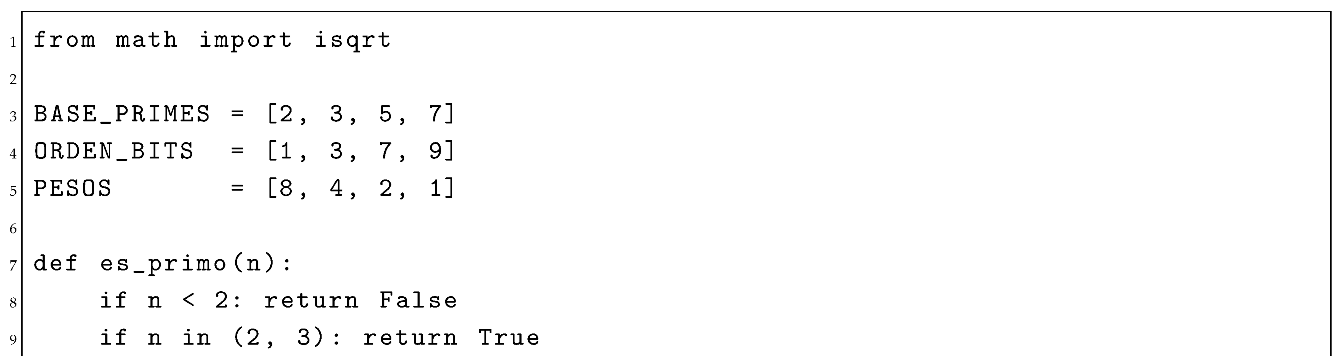
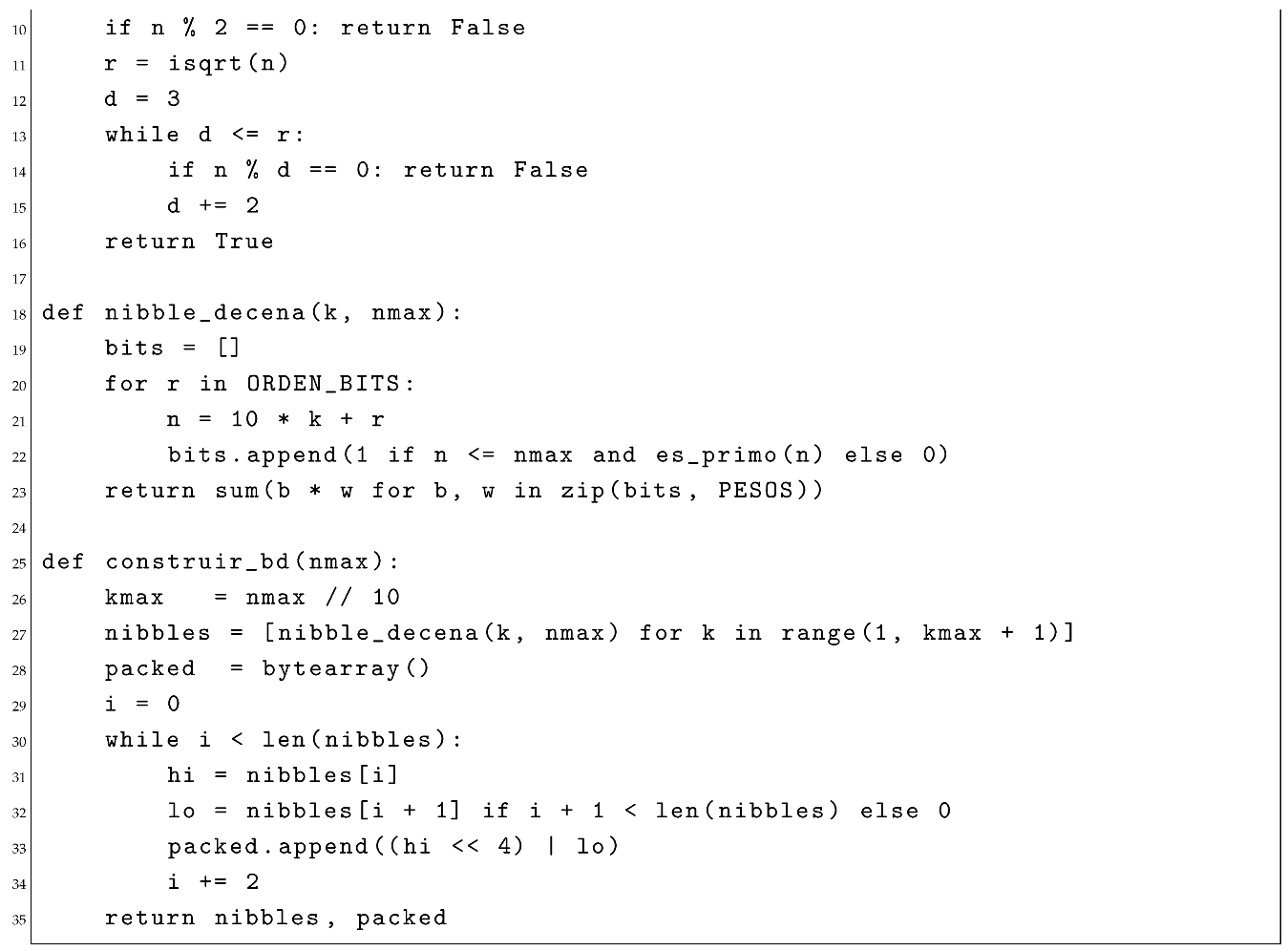
4.2. Direct Primality Query
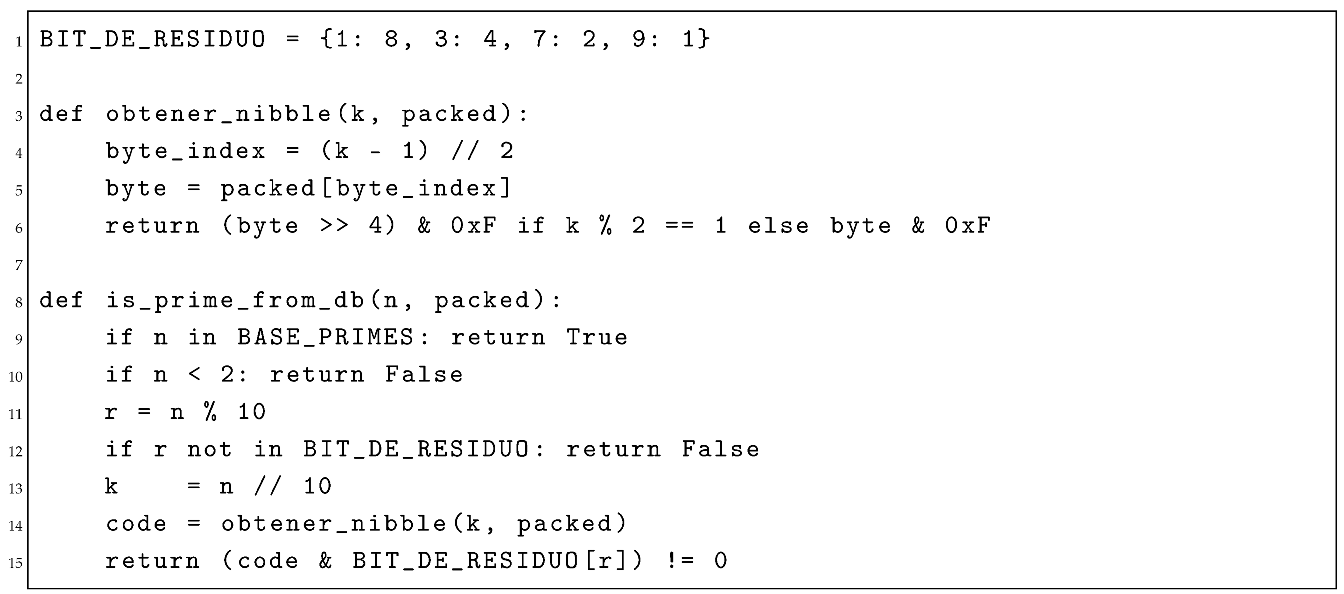
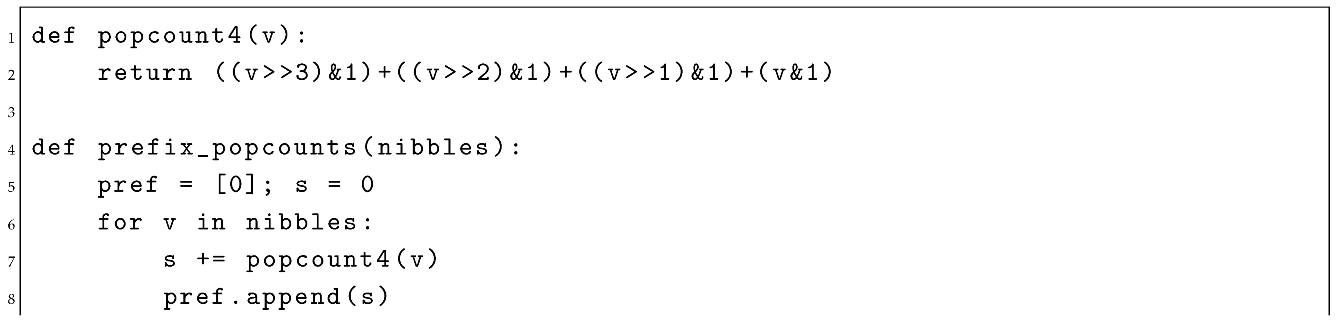
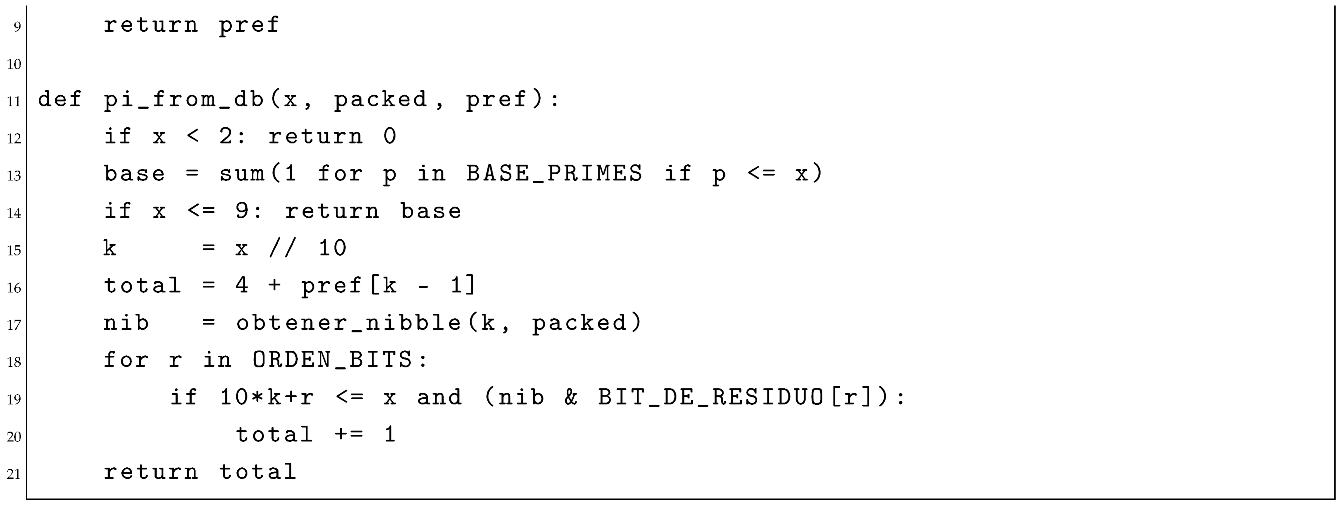
4.3. Recovery of the Prime-Counting Function
Proposition 2.
Within the stored range, is exactly recoverable from the database by cumulative popcount together with the partial contribution of the block containing x.
Proof.
Each encoded decade contributes exactly primes among the four admissible candidates. Summing these popcounts over all complete blocks before the block containing x, and adding the explicit contribution of together with the partial count inside the current block, yields exactly. □
5. The Ternary Constraint and Compressed Encoding
5.1. The Structural Theorem
The congruence implies
Therefore if and only if . Applying this to the four candidates:
Theorem 1
(Ternary Constraint). Let and . Then:
- 1.
- If , then and , so .
- 2.
- If , no candidate is divisible by 3 (beyond the value 3 itself, which is handled in the base set).
- 3.
- If , then and , so .
Proof.
Follows directly from :
- : and .
- : , , , ; none zero.
- : and .
Since all values for , divisibility by 3 implies compositeness. □
5.2. Partition of the Nibble Alphabet
Theorem 1 partitions the 16-symbol nibble alphabet into three disjoint effective alphabets:
| Class | Forced zero bits | Effective alphabet |
| (size 4) | ||
| none | (size 16) | |
| (size 4) |
Corollary 1.
For or , the nibble is determined by exactly 2 bits. For , all 4 bits are unconstrained.
5.3. Shannon Entropy Reduction
Let denote the empirical density of primes among the candidates of residue r in each class. By Dirichlet’s theorem on primes in arithmetic progressions, all four residue classes are asymptotically equiprobable, so the bits within the class are approximately i.i.d. with parameter .
For the restricted classes ( and ), only 2 bits are free, giving a maximum entropy of 2 bits; the observed Shannon entropy is approximately bits due to the unequal probability of the symbol 0 (no primes in the active candidates).
The mean entropy per nibble is therefore
compared to the naive 4 bits, a reduction of .
Experimentally, over decades up to , the measured entropy values are:
| Class | H (bits) | Alphabet size |
| 1.8174 | 4 | |
| 3.6352 | 16 | |
| 1.8198 | 4 | |
| Weighted mean | 2.4241 | — |
5.4. Compressed Encoding Scheme
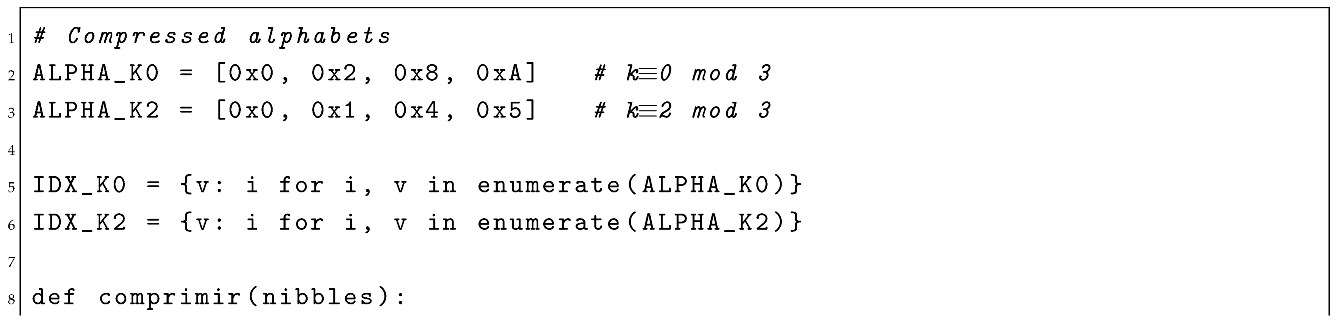
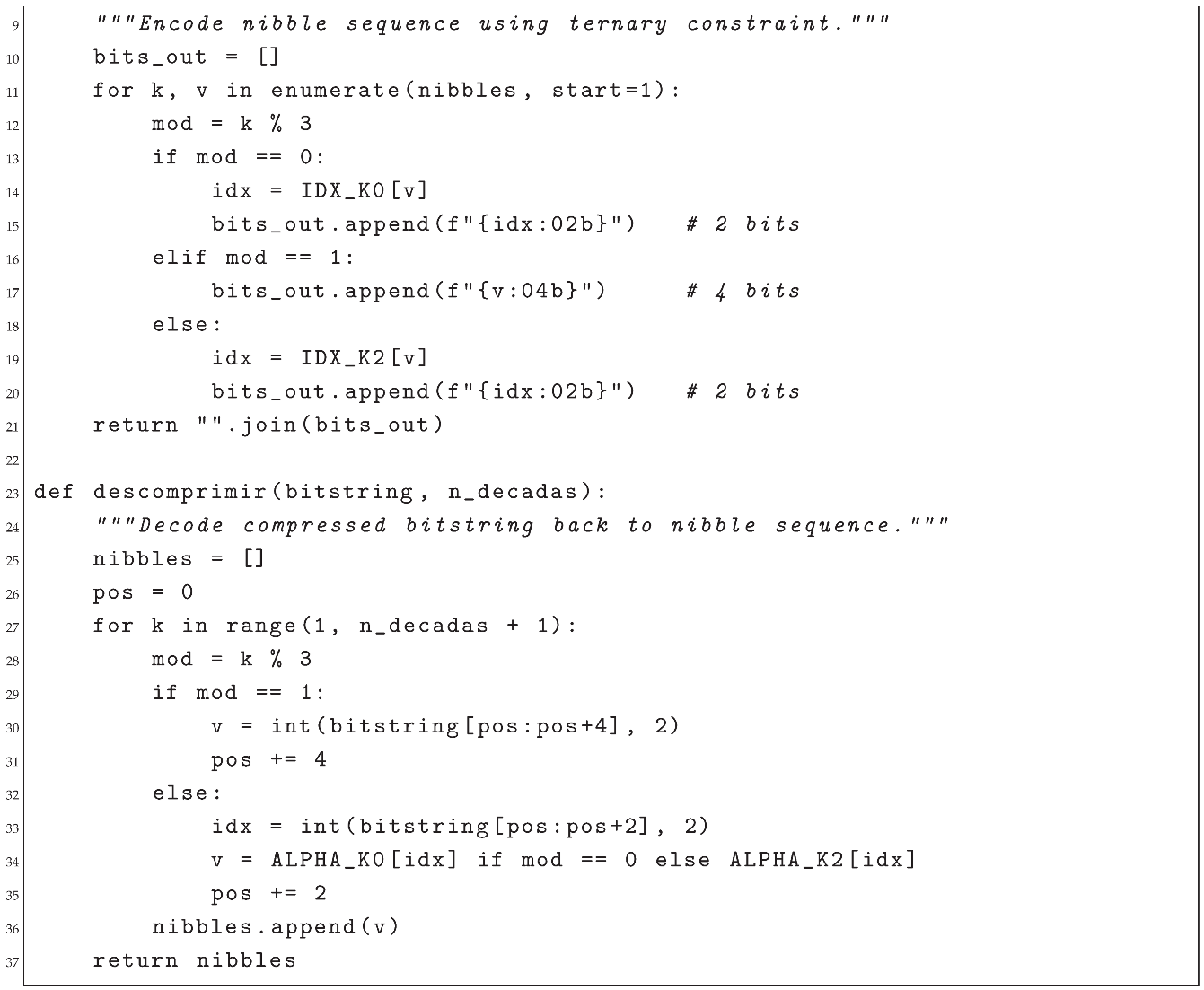
Since the class of k modulo 3 is known implicitly from the position index, no overhead is required to signal which alphabet is in use. The practical encoding assigns:
- : a 2-bit index into .
- : the original 4-bit nibble (or a Huffman code for further gain).
- : a 2-bit index into .
This yields an average of
a lossless compression of in a simple fixed-code scheme, approaching the Shannon limit of if Huffman coding is applied to the class.
Remark 1.
The uniqueness of this compression is a direct consequence of . The prime 3 is the only prime p for which , making it the unique prime that induces an exact periodic partition on the nibble sequence with period 3 and zero overhead. For the primes 5 and 7, the congruence breaks this clean periodicity, and no analogous lossless partition exists at those moduli.
6. Experimental Validation
6.1. Verification of the Ternary Constraint
Over all decades up to , no nibble outside the prescribed alphabet was observed for or :
| Nibble | Violation | |||
| 0 | 4535 | 1914 | 4485 | 0 |
| 1 | 0 | 1036 | 2266 | 0 |
| 2 | 2235 | 1023 | 0 | 0 |
| 3 | 0 | 511 | 0 | 0 |
| 4 | 0 | 1061 | 2255 | 0 |
| 5 | 0 | 472 | 994 | 0 |
| 6 | 0 | 522 | 0 | 0 |
| 7 | 0 | 213 | 0 | 0 |
| 8 | 2214 | 1029 | 0 | 0 |
| 9 | 0 | 502 | 0 | 0 |
| A | 1016 | 506 | 0 | 0 |
| B | 0 | 218 | 0 | 0 |
| C | 0 | 513 | 0 | 0 |
| D | 0 | 206 | 0 | 0 |
| E | 0 | 205 | 0 | 0 |
| F | 0 | 69 | 0 | 0 |
Zero violations confirm Theorem 1 exactly.
6.2. Size Comparison
| Method | Size (bytes) | bits/decade |
| Explicit prime list (32-bit) | 95,148 | — |
| Full bitmap on | 37,500 | — |
| Odd-only bitmap | 18,750 | — |
| Caraccioli original | 15,000 | 4.000 |
| Caraccioli + ternary (fixed 2/4/2 bits) | 9,544 | 2.667 |
| Caraccioli + ternary (Shannon limit) | 9,090 | 2.424 |
7. Comparison with Traditional Representations
A full bitmap stores one bit per integer but wastes storage on even numbers and on decimal residue classes that cannot contain primes. An odd-only bitmap is already a reasonable baseline.
The original Caraccioli encoding reduces to 4 bits per decade by exploiting the residue structure mod 10. The ternary extension reduces this further to bits per decade (fixed scheme) or bits per decade (entropy limit) by additionally exploiting the residue structure mod 3, with no loss of information and encode/decode complexity.
The combined compression ratios relative to the original are:
- over the Caraccioli original (fixed scheme).
- to improvement approaching the Shannon limit with Huffman coding on the class.
- over an odd-only bitmap.
8. Discussion
The ternary constraint is not a heuristic observation: it is a theorem that follows from alone, and it holds for every without exception. Its consequence — that two thirds of all nibble positions are confined to a 4-symbol alphabet — is a direct structural fact about the distribution of primes modulo 30, since the admissible residues mod 30 are exactly those coprime to 30.
The compression gain is genuine and practically implementable. Decoding requires only knowing , which is free from the position index. No auxiliary table beyond the two 4-element alphabets is required.
A natural further extension is the wheel modulo , which would yield 8 admissible residues per block. However, since and , the corresponding constraints do not produce clean periodic partitions of the nibble sequence and require a more involved analysis.
9. Conclusions
We presented a decimal–hexadecimal block encoding for primality (Caraccioli encoding) and established a structural theorem — the Ternary Constraint — that partitions the 16-symbol nibble alphabet into three effective alphabets of sizes 4, 16, and 4 according to .
This partition yields:
- a provable lossless compression of (fixed scheme) to (Shannon limit) over the original encoding,
- encode and decode complexity,
- a combinatorial explanation for the dominant period-3 autocorrelation peak observed in the nibble sequence,
- the observation that is the unique prime inducing this exact periodic structure, by virtue of .
References
- Hardy, G. H.; Wright, E. M. An Introduction to the Theory of Numbers, 6th ed.; Oxford University Press, 2008. [Google Scholar]
- Crandall, R.; Pomerance, C. Prime Numbers: A Computational Perspective, 2nd ed.; Springer, 2005. [Google Scholar]
- Knuth, D. E. The Art of Computer Programming. In Seminumerical Algorithms, 3rd ed.; Addison-Wesley, 1997; Vol. 2. [Google Scholar]
- Cover, T. M.; Thomas, J. A. Elements of Information Theory, 2nd ed.; Wiley, 2006. [Google Scholar]
Disclaimer/Publisher’s Note: The statements, opinions and data contained in all publications are solely those of the individual author(s) and contributor(s) and not of MDPI and/or the editor(s). MDPI and/or the editor(s) disclaim responsibility for any injury to people or property resulting from any ideas, methods, instructions or products referred to in the content. |
© 2026 by the authors. Licensee MDPI, Basel, Switzerland. This article is an open access article distributed under the terms and conditions of the Creative Commons Attribution (CC BY) license (http://creativecommons.org/licenses/by/4.0/).
Copyright: This open access article is published under a Creative Commons CC BY 4.0 license, which permit the free download, distribution, and reuse, provided that the author and preprint are cited in any reuse.


