

Submitted:
08 April 2026
Posted:
09 April 2026
You are already at the latest version
Abstract
Selected organic sunscreens from different chemical families were investigated in the context of their ability to inhibit butyrylcholinesterase using novel Multiple Linear Regression, Artificial Neural Network and Support Vector Regression models based on a set of six independent variables commonly associated with compounds’ absorption and distribution properties. It was established that the descriptors that have a particularly strong, positive influence on the ability of compounds to inhibit BChE expressed as pIC50 are the count of rotatable bonds (nRot) and lipophilicity (log D); pIC50 is negatively correlated with flexibility (Flex), fraction of sp3 carbon atoms (Fsp3), caco-2 permeability (caco2) and plasma protein binding ability (PPB). The sunscreens that are likely to be particularly strong BChE inhibitors are Ethylhexyl Triazone (ET), Diethylhexyl Butamido Triazone (DOBT), Octocrylene (OCR) and Diethylamino Hydroxybenzoyl Hexyl Benzoate (DHHB), although in must be stressed that ET and DOBT are outside the chemical space of the reference compounds.
Keywords:
organic sunscreens
; biological activity
; butyrylcholinesterase inhibition
1. Introduction
Organic sunscreens are used in personal care products to protect skin and hair skin from harmful ultraviolet radiation and in other products (textiles, dyes, household chemistry products) to prevent their photodegradation by conversion of UV radiation into thermal energy upon absorption [1]. It was demonstrated that sunscreens help to prevent sunburn, solar keratosis, and non-melanoma skin cancer [2]. Although organic sunscreens are considered beneficial when used reasonably [3], some compounds from this group are biologically active – they cross biological barriers and are known or suspected endocrine disruptors, i.e. compounds interfering with human and animal hormonal systems and thus likely to impair developmental, reproductive, neurological, and immune functions [4,5]. Several in vitro and in vivo studies (mainly on animal models) demonstrated that organic sunscreens (especially benzophenone-3; according to some studies also benzophenone-2, homosalate, OD-PABA, PABA, 3-benzylidene camphor, 3-(4-methyl-benzylidene) camphor, 2-ethylhexyl 4-methoxy cinnamate, octocrylene) effect the estrogenic signaling, exhibit antiandrogenic and progesterone activity, induce changes in weight and histology of reproductive organs in both sexes and interfere with the hypothalamic–pituitary–thyroid axis [2,6,7,8].
Humans are exposed to organic sunscreens by direct contact (skin absorption, ingestion and inhalation) and by indirect routes (contaminated water, sea food) [5], with detectable levels of organic sunscreens found in urinary samples of the vast majority of the US population [6]. Sunscreens were detected in drinking water supplies in countries such as Spain, Australia, Singapore, and Brazil [9].
Studies indicated that there is a negative correlation between the organic UV filters exposure and adiposity measures in peripubertal boys, but not girls [10]; maternal exposure to organic sunscreen during pregnancy changes the offspring’s birth outcomes [11].
Sunscreens are metabolized mainly in human liver (a detailed report on oxybenzone, avobenzone, octocrylene, octinoxate, octisalate, and homosalate hepatic metabolism was provided in [9]) and other organs, e.g. skin [12]. Metabolic pathways of sunscreens are complex, involving hydrolysis of esters (if applicable), oxidation and covalent binding to glutathione [13]. Some toxic effects of organic sunscreens could also be attributed to their metabolites, which appear to be more reactive electrophiles than the parent compounds. For example, skin metabolism of some sunscreens from the chemical family of benzophenones (benzophenone-3 and dioxybenzone) may lead to potentially phototoxic glucuronide metabolites [14]. Organic sunscreens were also investigated in the context of their possible metabolism- and transporter-based interactions with co-administered drugs; it was found that 4-methylidenecamphor and benzophenone-3 inhibit CYP2C9 and the renal transporters OAT3 and OCT2 in vitro, but their IC50 values exceed the clinically relevant plasma levels [15].
Elevated bioactivity was also reported for synergistically acting mixtures of organic sunscreens, which is a matter of particular concern, since sun protection formulations contain usually more than one UV filter [7,16,17]. However, it must be stressed at this point that some sunscreen mixtures exhibit antagonism – their toxicity is reduced compared to that of single compounds [18,19,20].
Large quantities of organic sunscreens are released to the environment world-wide; the products of their environmental transformations appear to be more dangerous that the parent compounds and some of them are more environmentally persistent [21,22,23].
An undesired biological activity of organic sunscreens was also studied in the context of their possible interactions with the main detoxicating enzymes in the placenta: (i) glutathione-s-transferases, which catalyze the conjugation of reduced glutathione (GSH) to various electrophiles, thus facilitating their excretion; (ii) N-acetyltransferase 2, responsible for acetylation of compounds such as aromatic amines [24].
The cholinergic system is a major neurotransmitter system engaged in learning and memory processes [25]. It encompasses the acetylcholine (Ach) neurotransmitter, the enzyme that synthesizes it: choline O-acyltransferase (ChAT), the muscarinic and nicotinic receptors of the neurotransmitter, and the enzymes which hydrolyze the neurotransmitter: acetylcholinesterase (AChE) and butyrylcholinesterase (BChE) [26]. Cholinergic neurons play an important role in cognitive functions and their degeneration is considered a main factor in the development of dementia [27]. Recently non-neuronal cholinergic systems located in the skin, cardiovascular system and placenta [28,29,30] and the functions of the cholinergic system not directly related to neurotransmission [25,26,31] attract considerable attention. However, the main focus is on the CNS cholinesterase inhibitors in two contexts: (i) therapeutic – cholinesterase inhibitors used to treat symptoms of neurodegenerative diseases [32]; (ii) toxic – irreversible or reversible Ach inhibitors (mainly from the chemical families of organophosphates and carbamates) are used as pesticides (insecticides) [33]; some organophosphates are potent nerve agents [34]. New developments focus mainly on novel or re-purposed drugs against the Alzheimer’s disease [35,36,37,38,39,40,41]; there is also some interest in novel insecticides from the chemical families other than organophosphates or carbamates [42,43].
The Alzheimer’s disease is a multi-factorial neurodegenerative condition, so attention turns often to drugs inhibiting the cholinesterase enzymatic activity and simultaneously interfering with other neurodegenerative pathways: Aβ aggregation, oxidative stress, metal dyshomeostasis, and neuroinflammation - by targeting both catalytic and peripheral domains of ChE’s (dual-site ligands) or acting simultaneously on cholinesterases and other targets (multi-target-directed ligands) [44,45,46].
Another enzyme involved in the cholinergic system is butyrylocholinestarase (BChE). This enzyme has been long underestimated, as it seemed to be involved in no specific physiological processes; both humans and animals deprived of BChE can lead almost normal life although they are likely to suffer from faster weight gain on high-fat diets than the individuals with normal BChE blood levels [47]. At present BChE is being extensively investigated in the context of the pharmacotherapy of dementia [48,49] (many AChE inhibitors interfere also with the activity of BChE [50]). BChE was found to be a bioscavenger that protects AChE in nerve synapses from inhibition by toxic compounds, e.g. nerve agents from the chemical family of organophosphates [51,52]. BChE is also associated with some specific physiological problems, as some studies on animal models revealed that it hydrolyzes ghrelin and controls ghrelin levels in the peripheral circulation, thus effecting the physiological processes in which ghrelin is involved (including insulin release, fat metabolism and adiposity) [47].
The possible interactions of organic sunscreens with biological targets related to the cholinergic system have attracted relatively little attention so far. In this research we wished to fill this gap by investigating the possible interferences of the selected organic sunscreens from different chemical families with the activity of BChE.
2. Results and Discussion
The ability of compounds to inhibit BChE expressed as their half-maximal inhibitory concentration (IC50) or the enzyme inhibitory constant (Ki) can be predicted in silico using the published machine learning, 3D QSAR or SMILES-based QSAR models [48,53,54,55,56]. In this research we attempted to predict pIC50 of the selected organic sunscreens using novel models based on a set of molecular descriptors usually associated with the absorption and distribution of compounds in the organism.
pIC50 = 1.68 (±1.26) + 0.481 (±0.053) nRot - 5.14 (±0.77) Flex - 1.75 (±0.47) Fsp3 + 1.18 (±0.14) log D - 0.847 (±0.195) caco2 - 0.0591 (±0.0113) PPB
(n = 100, R2 = 0.706, R2adj. = 0.687, Q2 = 0.667, F = 37.15, p < 0.001, RMSEpred = 0.59)
(n = 100, R2 = 0.706, R2adj. = 0.687, Q2 = 0.667, F = 37.15, p < 0.001, RMSEpred = 0.59)
Based on the Multiple Linear Regression model (Equation (1), Figure 1) it was concluded that the ability of compounds to inhibit BChE is positively correlated with the rotatable bond count (nRot) and lipophilicity (log D) and negatively correlated with flexibility (Flex), fraction of sp3 carbon atoms (Fsp3), caco-2 permeability (caco2) and plasma protein binding ability (PPB).
The same set of independent variables was employed in models prepared to predict pIC50 based on Artificial Neural Network (ANN) and Supported Vector Regression (SVR) algorithms (Figure 2 and Figure 3, respectively; Table 1). It was observed that the significance of the particular independent variables in the ANN models is different depending on the model, and on average it decreases in the following order: Flex > nRot > log D > Fsp3 > PPB > caco2, with no independent variable scoring 1 or less in Global Sensitivity Analysis.
The values of pIC50 predicted using the MLR, ANN1 and SVR models (Table 2) are in a relatively close agreement (Table 3) and are particularly strongly correlated with nRot and log D.
Based on the predicted pIC50 values it may be suspected that some sunscreens are likely to be relatively strong BChE inhibitors, with the pIC50 values comparable to these of tacrine [57] and some novel BChE inhibitors developed by Sang et al. [58] – or even the very strong BChE inhibitors reported by Kamal [59] or reviewed by Bubley [60]. Two compounds (ET and DOBT) have the mean pIC50 values over 12 (or ca. 10-11, if results from the ANN models 2 to 5 are included), which implies their very high inhibitory activity; DHHB and OCR are also expected to be strong BChE inhibitor (pIC50 between 5 and 6). Three other sunscreens (BMDM, BP-3, PABA) have the predicted pIC50 values between 4 and 5 – they might by as strong inhibitors of BChE as donepezil, rivastigmine or galantamine (pIC50 = 5.26, 5.5 and 4.86, respectively) [61]; the remaining sunscreens are moderate inhibitors with pIC50 between 2 and 4.
The predicted pIC50 values for ET and DOBT imply their extremally strong affinity for BChE; it should be stressed, however, that these compounds (and, to a lesser degree, PABA) are outside the chemical space defined for the group of reference compounds used in this study (Figure 4), so the predictions based on the models described in Sections 3.3 to 3.5 may require further verification.
According to our brief analysis of atomic contributions (Figure 4), the atoms/groups which contribute to the reduction of pIC50 are long aliphatic chains, phenolic OH, NH2 in aromatic amines and SO3H groups; the groups that act opposite are N in benzimidazole rings, triazine rings and NH groups adjacent to it and COOH groups.
3. Materials and Methods
3.1. Reference Compounds
The experimental IC50 (nM) values for 121 compounds used to create QSAR models were taken from [54,62]. The compounds used to generate the MLR and SVR models were randomly assigned to one of the two sets: a training set (n = 100) and a test set (n = 21) using XLSTAT v. 2025.2.0 from Lumivero; in ANN models the training/test/validation sets were randomly selected using Statistica v. 13.3.
3.2. Calculated Molecular Descriptors and Membrane Permeability Data
Physico-chemical and ADMET properties were calculated using ADMETLab3.0 software using SMILES strings generated using ACDLabs ChemSketch v.2023.1.2 as input data. The physico-chemical descriptors considered relevant in this study are: molecular weight (MW); density = MW / Vol (Dense); topological polar surface area (TPSA), count of hydrogen bond acceptors (nHA); the count of hydrogen bond donors (nHD); the count of rotatable bonds (nRot); the count of rings (nRing); the number of atoms in the biggest ring (MaxRing); the count of non-carbon atoms (hydrogens included) (nHet); the count of rigid bonds (nRig); flexibility = nRot / nRig (Flex); the logarithmic aqueous solubility (log S); the logarithmic n-octanol/water partition coefficient (log P); the logarithmic n-octanol/water distribution coefficients at pH=7.4 (log D); the fraction of sp3 hybridized carbon atoms (Fsp3). ADMET properties considered in the study are: calculated permeabilities (caco-2; MDCK; PAMPA); the volume of distribution at steady state (VDss); plasma protein binding, % (PPB); the fraction unbound in plasma, % (Fu). The values of descriptors for the reference compounds and organic sunscreens are given in Supplementary Materials.
3.3. Multiple Linear Regression (MLR) Models
Multiple linear regression models were generated with XLSTAT from Lumivero, using descriptors calculated by ADMETLab3.0, in “best subset selection” mode, with the number of independent variables set to be between 2 and 6 and the tolerance level set at 0.1 (it is assumed that two descriptors are colinear if the tolerance value between them, calculated as (1-R2), is < 0.1 [63]). The MLR models were validated using R2, R2adj. and Q2 metrics for a training set, and RMSEpred (Root Mean Square Error of prediction) for a test set [64,65,66].
3.4. Artificial Neural Network (ANN) Models
Multilayer Perceptron (MLP) artificial neural networks (ANN) were generated using Statistica v. 13.3 (regression, Automated Network Search — ANS module, 500 networks to train, 50 networks to retain), based on the same set of independent variables as used in Section 4.3. The neuron activation functions considered were: identity, logistic, hyperbolic tangent and exponential. The BFGS (Broyden–Fletcher–Goldfarb–Shanno) algorithm was used to train the network. The error function was the sum of squares (SOS). The ANN models were evaluated using correlation coefficients for the training, test and validation sets. The independent variables used in the ANN models the same as used in Section 4.2. The importance of independent variables in the ANN models was evaluated using global sensitivity analysis (GSA), which rates the importance of any input variable in ANN models by computing sums of squared residuals for the model without the particular variable compared to the full model - when an input variable scores 1 or less than 1 in GSA, this network performs better without it. Detailed data on 5 retained networks, including the correlation coefficients and the GSA results are given in Supplementary Materials.
3.5. Support Vector Regression (SVR) Model
Support Vector Regression model was generated using XLSTAT, based on the set of independent variables used previously in Section 4.3 and Section 4.4. The kernel functions considered initially were: linear, quadratic, RBF and sigmoid, with the linear kernel giving the best results: R2, Mean Absolute Error (MAE) and Mean Squared Error (MSE) for the training and the test sets.
3.6. Applicability Domain
The applicability domain of QSAR models was established based on the Principal Component Analysis of key physico-chemical properties of studied compounds (“Sunscreens”) and reference compounds (“Inhibitors”) described in Section 4.1. The Principal Components (PC) were calculated using XLSTAT (see Supplementary Materials). The 1st vs 2nd PC of studied and reference compounds were plotted in the 2D coordinate system and the area covering the chemical space of 99% of the reference compounds were indicated with an ellipse (Figure 4).
3.7. Analysis of Atomic Contributions Influencing pIC50
Hologram QSAR analysis of pIC50 was conducted using ChemMaster v.2 software from CrescentSilico, based on Morgan circular fingerprints, with radius = 2 and the number of bits = 2048, pre-treated with PLS (6 components), with 5-fold cross-validation. 121 reference compounds and the organic sunscreens investigated in this study were randomly assigned to a training set (75%) and a test set (25%). Atomic contributions discovered in the molecules of the organic sunscreens are given in Figure 5.
4. Conclusions
Organic sunscreens have been long known to influence both human and animal health, but so far the main issues studied in the context or organic sunscreens and their behavior in the organism have been related to their absorption through the skin or from the gastrointestinal tract or interfere with the human/animal hormone systems.
In this study the ability of selected sunscreens to inhibit butyrylcholinesterase was investigated using Multiple Linear Regression, Artificial Neural Network and Support Vector Regression models based on the descriptors such as the count of rotatable bonds (nRot) and lipophilicity (log D, flexibility (Flex), fraction of sp3 carbon atoms (Fsp3), caco-2 permeability (caco2) and plasma protein binding ability (PPB).
It was established that some of the studied compounds are likely to inhibit BChE at least as well as the established cholinesterase inhibitors (donepezil, rivastigmine) – or even better. Considering the risks associated with low BChE levels in the organism, such as altered metabolism of drugs, elevated susceptibility to organophosphate poisonings and metabolic issues such as impaired metabolism of fat it was concluded that organic sunscreens should be investigated further in the context of their possible interaction with both the neurotransmission and metabolic functions of the cholinergic system.
Supplementary Materials
The following supporting information can be downloaded at: Preprints.org.
Author Contributions
Conceptualization, A.W.S. and A.M.S; methodology, A.W.S. and EB; validation, A.W.S.; investigation, A.M.S.; resources, A.W.S.; data curation, A.M.S.; writing—original draft preparation, A.W.S. and A.M.S.; funding acquisition, A.W.S. and EB. All authors have read and agreed to the published version of the manuscript.
Funding
This research study was supported by an internal grant of the Medical University of Lodz, no. 503/3-016-03/503-31-001.
Institutional Review Board Statement
Not applicable.
Informed Consent Statement
Not applicable.
Conflicts of Interest
The authors declare no conflicts of interest.
References
- Khobragade, R.; Chaudhary, A.A.; Ali, M.A.M.; Kale, M.; Raut, N.; Ghive, P.; Rudayni, H.A.; Nagpurkar, K.; Umekar, M.; Trivedi, R. Nanotechnology-Enhanced Sunscreens: Balancing Efficacy, Safety, and Environmental Impact. Pharmaceutics 2025, 17, 1080. [Google Scholar] [CrossRef]
- Krause, M.; Klit, A.; Blomberg Jensen, M.; Søeborg, T.; Frederiksen, H.; Schlumpf, M.; Lichtensteiger, W.; Skakkebaek, N.E.; Drzewiecki, K.T. Sunscreens: Are They Beneficial for Health? An Overview of Endocrine Disrupting Properties of UV-Filters. International Journal of Andrology 2012, 35, 424–436. [Google Scholar] [CrossRef]
- Bruzell, E.; Hauger Carlsen, M.; Henriette Caspersen, I.; Marie-Louise Denison, E.; Gulbrandsen Devold, T.; Granum, B.; Haarklou Mathisen, G.; Rundén Pran, E.; Daniel Rasinger, J.; Rohloff, J.; et al. Risk-Benefit Assessemsnt of Sunscreen; Norwegian Scientific Committee for Food and Environment (VKM), Panel on Food Additives, Flavourings, Processing Aids, Materials in Contact with Food, and Cosmetics: Oslo, Norway, 2022. [Google Scholar]
- Birkhauser, M. UV filters and the endocrine system. Gynakologische Endokrynologie 2016, 14, 165–173. [Google Scholar] [CrossRef]
- Maddaleno, A.S.; Guardia-Escote, L.; Vinardell, M.P.; Teixidó, E.; Mitjans, M. Assessment of Endocrine-Disrupting Properties in Cosmetic Ingredients: Focus on UV Filters and Alternative Testing Methods. Cosmetics 2025, 12, 175. [Google Scholar] [CrossRef]
- Matouskova, K.; Jerry, D.J.; Vandenberg, L.N. Exposure to Low Doses of Oxybenzone during Perinatal Development Alters Mammary Gland Morphology in Male and Female Mice. REPRODUCTIVE TOXICOLOGY 2020, 92, 66–77. [Google Scholar] [CrossRef] [PubMed]
- Kunz, P.Y.; Fent, K. Estrogenic Activity of UV Filter Mixtures. Toxicology and Applied Pharmacology 2006, 217, 86–99. [Google Scholar] [CrossRef]
- Yan, S.H.; Liang, M.M.; Chen, R.; Hong, X.S.; Zha, J.M. Reproductive Toxicity and Estrogen Activity in Japanese Medaka (Oryzias Latipes) Exposed to Environmentally Relevant Concentrations of Octocrylene. ENVIRONMENTAL POLLUTION 2020, 261. [Google Scholar] [CrossRef]
- Baviera, G.S.; Poli, V.R.; Oka-Duarte, L.; Santos Barbetta, M.F.; Moraes De Oliveira, A.R. Assessing the Hepatic Metabolism of Six Sunscreen Ultraviolet Filters: In Vitro–in Vivo Extrapolation Approach Using Human Liver Microsomes and Hepatic Parameter Predictions for Exposure Risk Assessment. Biochemical Pharmacology 2026, 244, 117564. [Google Scholar] [CrossRef]
- Wang, P.; Huang, Y.; Zhao, Y.; Zhou, Y.; Wang, H.; Zhang, L.; Shi, H.; Sze-Yin Leung, K.; Zhang, Y. Organic UV Filters Mixture Exposure and Childhood Adiposity: A Prospective Follow-up Study in China. Environment International 2022, 158, 106912. [Google Scholar] [CrossRef]
- Teiri, H.; Samaei, M.R.; Dehghani, M.; Azhdarpoor, A.; Mohammadi, F.; Kelishadi, R.; Hajizadeh, Y. Maternal Exposure to Benzophenone Derivatives and Their Impacts on Offspring’s Birth Outcomes in a Middle Eastern Population. Scientific Reports 2023, 13. [Google Scholar] [CrossRef]
- van Eijl, S.; Zhu, Z.; Cupitt, J.; Gierula, M.; Götz, C.; Fritsche, E.; Edwards, R.J. Elucidation of Xenobiotic Metabolism Pathways in Human Skin and Human Skin Models by Proteomic Profiling. PLOS ONE 2012, 7, e41721. [Google Scholar] [CrossRef] [PubMed]
- Guesmi, A.; Ohlund, L.; Sleno, L. In Vitro Metabolism of Sunscreen Compounds by Liquid Chromatography/High-Resolution Tandem Mass Spectrometry. Rapid Communications in Mass Spectrometry 2020, 34. [Google Scholar] [CrossRef] [PubMed]
- Song, Z.; Lu, Y.; Shi, J.L.; Xu, Y.; Mitch, W.A. Metabolism of Oxybenzone and Dioxybenzone to Phototoxins in Human Skin Cells. Environ. Sci. Technol. 2025, 59, 16324–16331. [Google Scholar] [CrossRef]
- Qusa, M.; Qosa, H.; Volpe, D.A. Evaluation of In Vitro Metabolism- and Transporter-Based Drug Interactions with Sunscreen Active Ingredients. Pharm Res 2024, 41, 1613–1620. [Google Scholar] [CrossRef] [PubMed]
- Jaskulak, M.; Cinkusz, M.; Franchuk, K.; Zorena, K. Endocrine and Reproductive Health Considerations of Sunscreen UV Filters: Insights from a Comprehensive Review 2014–2024. Curr Envir Health Rpt 2025, 12, 28. [Google Scholar] [CrossRef]
- Cahova, J.; Blahova, J.; Plhalova, L.; Svobodova, Z.; Faggio, C. Do Single-Component and Mixtures Selected Organic UV Filters Induce Embryotoxic Effects in Zebrafish (Danio Rerio)? WATER 2021, 13. [Google Scholar] [CrossRef]
- Boyd, A.; Martin, S.; Legge, A.; Blewett, T.A. Are UV Filters Better Together? A Comparison of the Toxicity of Individual Ultraviolet Filters and off-the-Shelf Sunscreens to Daphnia Magna. Environmental Pollution 2024, 362, 124953. [Google Scholar] [CrossRef]
- Park, C.-B.; Jang, J.; Kim, S.; Kim, Y.J. Single- and Mixture Toxicity of Three Organic UV-Filters, Ethylhexyl Methoxycinnamate, Octocrylene, and Avobenzone on Daphnia Magna. Ecotoxicology and Environmental Safety 2017, 137, 57–63. [Google Scholar] [CrossRef]
- Di Poi, C.; Costil, K.; Bouchart, V.; Halm-Lemeille, M.-P. Toxicity Assessment of Five Emerging Pollutants, Alone and in Binary or Ternary Mixtures, towards Three Aquatic Organisms. Environ Sci Pollut Res 2018, 25, 6122–6134. [Google Scholar] [CrossRef]
- Lu, Y.; Chow, M.K.; Sun, J.; Tao, D.; Jin, Q.; Ren, Y.; Wang, W.-X.; He, Y. Identification of Transformation Products of Organic UV Filters by Photooxidation and Their Differential Estrogenicity Assessment. Environ. Sci. Technol. 2023, 57, 17110–17122. [Google Scholar] [CrossRef]
- Beszterda, M.; Frański, R. Endocrine Disruptor Compounds in Environment: As a Danger for Children Health. Pediatr Endocrino Diabetes Metab 2018, 24, 88–95. [Google Scholar] [CrossRef]
- Law, J.C.-F.; Huang, Y.; Chow, C.-H.; Lam, T.-K.; Leung, K.S.-Y. Comparative Physicochemical Properties and Toxicity of Organic UV Filters and Their Photocatalytic Transformation Products. Environmental Pollution 2021, 286, 117551. [Google Scholar] [CrossRef]
- Sobańska, A.W.; Sobański, A.M. Organic Sunscreens — Is Their Placenta Permeability the Only Issue Associated with Exposure During Pregnancy ? In Silico Studies of Sunscreens ’ Placenta Permeability and Interactions with Selected Placental Enzymes. Molecules 2024, 29, 5836. [Google Scholar] [CrossRef]
- Halder, N.; Lal, G. Cholinergic System and Its Therapeutic Importance in Inflammation and Autoimmunity. Front. Immunol. 2021, 12, 660342. [Google Scholar] [CrossRef]
- Villeda-González, J.D.; Gómez-Olivares, J.L.; Baiza-Gutman, L.A. New Paradigms in the Study of the Cholinergic System and Metabolic Diseases: Acetyl-and-Butyrylcholinesterase. Journal of Cellular Physiology 2024, 239, e31274. [Google Scholar] [CrossRef]
- Bekdash, R.A. The Cholinergic System, the Adrenergic System and the Neuropathology of Alzheimer’s Disease. IJMS 2021, 22, 1273. [Google Scholar] [CrossRef]
- Kurzen, H.; Wessler, I.; Kirkpatrick, C.; Kawashima, K.; Grando, S. The Non-Neuronal Cholinergic System of Human Skin. Horm Metab Res 2007, 39, 125–135. [Google Scholar] [CrossRef]
- Sastry, B.V.R. Human Placental Cholinergic System. Biochemical Pharmacology 1997, 53, 1577–1586. [Google Scholar] [CrossRef]
- Dominika, Dingova; Kucera, M.; Hodbod, T.; Fischmeister, R.; Krejci, E.; Hrabovska, A. Cardiac Acetylcholinesterase and Butyrylcholinesterase Have Distinct Localization and Function. American Journal of Physiology-Heart and Circulatory Physiology 2025, 328, H526–H542. [Google Scholar] [CrossRef]
- Das, U.N. Acetylcholinesterase and Butyrylcholinesterase as Markers of Low-Grade Systemic Inflammation. Annals of Hepatology 2012, 11, 409–411. [Google Scholar] [CrossRef]
- Zuliani, G.; Boscolo Bragadin, F.; Romagnoli, T.; Polastri, M.; Cervellati, C.; Dario, F. di P.; Brombo, G.; Zuin, M. Long-Term Effect of Acetylcholinesterase Inhibitors on Behavioral and Psychological Symptoms of Dementia. International Journal of Geriatric Psychiatry 2026, 41, e70195. [Google Scholar] [CrossRef]
- Matar, D.E.A.E. An Overview on Cholinesterase Inhibitor Pesticides. The International Journal of Multiphysics 2024, 18, 2904–2917. [Google Scholar]
- Aroniadou-Anderjaska, V.; Apland, J.P.; Figueiredo, T.H.; De Araujo Furtado, M.; Braga, M.F. Acetylcholinesterase Inhibitors (Nerve Agents) as Weapons of Mass Destruction: History, Mechanisms of Action, and Medical Countermeasures. Neuropharmacology 2020, 181, 108298. [Google Scholar] [CrossRef]
- Hanumanthappa, D.; Kumar, B.S.; Shajan, S.R.O.; Sadashivappa, N.M.; Walikar, S.K.; Hosur Dinesh, B.G.; Ganjipete, S.; Kunjiappan, S.; Theivendren, P.; Chidamabaram, K.; et al. Computational Insights and Experimental Breakthroughs in Identifying Next-Generation Acetylcholinesterase Inhibitors. Sci Rep 2025, 15, 31901. [Google Scholar] [CrossRef]
- Murray, A.P.; Biscussi, B.; Cavallaro, V.; Donozo, M.; Rodriguez, S.A. Naturally Occurring Cholinesterase Inhibitors from Plants, Fungi, Algae,and Animals: A Review of the Most Effective Inhibitors Reported In2012-2022. CN 2024, 22, 1621–1649. [Google Scholar] [CrossRef]
- Ahmad, M.; Uddin, I.; Murad, M.; Maryam, L.; Subhan, Z.; Saleem Khan, M.; Nabi, K.; Nabi, M.; Rahim, F.; Ullah, H.; et al. Cholinesterase Inhibitors for the Treatment of Alzheimer’s Disorder: Synthesis, Biological Analysis and Molecular Modelling Studies of Iso-Quinoline Derivatives. Results in Chemistry 2024, 9, 101661. [Google Scholar] [CrossRef]
- ALNasser, M.N.; Alboraiy, G.M.; Alsowig, E.M.; Alqattan, F.M. Cholinesterase Inhibitors from Plants and Their Potential in Alzheimer’s Treatment: Systematic Review. Brain Sciences 2025, 15, 215. [Google Scholar] [CrossRef]
- Vecchio, I.; Sorrentino, L.; Paoletti, A.; Marra, R.; Arbitrio, M. The State of The Art on Acetylcholinesterase Inhibitors in the Treatment of Alzheimer’s Disease. J Cent Nerv Syst Dis 2021, 13, 11795735211029113. [Google Scholar] [CrossRef]
- Cummings, J.L.; Zhou, Y.; Lee, G.; Zhong, K.; Fonseca, J.; Leisgang-Osse, A.M.; Cheng, F. Alzheimer’s Disease Drug Development Pipeline: 2025. A&D Transl Res & Clin Interv 2025, 11, e70098. [Google Scholar] [CrossRef]
- Sobha, A.; Ganapathy, A.; Mohan, S.; Madhusoodanan, N.; Babysulochana, A.D.; Alaganandan, K.; Somappa, S.B. Novel Small Molecule-Based Acetylcholinesterase (AChE) Inhibitors: From Biological Perspective to Recent Developments. European Journal of Medicinal Chemistry Reports 2024, 12, 100237. [Google Scholar] [CrossRef]
- Sakthivel, S.; Mohideen, H.S.; Raman, C.; Mohamad, S.B. Potential Acetylcholinesterase Inhibitor Acting on the Pesticide Resistant and Susceptible Cotton Pests. ACS Omega 2022, 7, 20515–20527. [Google Scholar] [CrossRef]
- El-Bana, G.G.; Fouad, M.R.; Deeb, A.D.H.; Wahba, A.M.; El-Sayed, A.F.; el-Ghani, G.E.A. Design, Characterization, DFT Studies, and Molecular Docking of New Benzofuran–Pyrazol-Acrylamide Hybrids as Insecticidal Agents against Spodoptera Littoralis and Tribolium Castaneum. Sci Rep 2026, 16, 10344. [Google Scholar] [CrossRef]
- Asim, A.; Jastrzębski, M.K.; Kaczor, A.A. Dual Inhibitors of Acetylcholinesterase and Monoamine Oxidase-B for the Treatment of Alzheimer’s Disease. Molecules 2025, 30, 2975. [Google Scholar] [CrossRef]
- Mehta, N.V.; Kapadia, A.; Khambete, M.; Abhyankar, A. The Evolution of AChE Inhibitors in Alzheimer’s Disease: From Single-Target to Multi-Target Ligands. ChemBioChem 2025, 26, e202500053. [Google Scholar] [CrossRef]
- Grabowska, W.; Bijak, M.; Szelenberger, R.; Gorniak, L.; Podogrocki, M.; Harmata, P.; Cichon, N. Acetylcholinesterase as a Multifunctional Target in Amyloid-Driven Neurodegeneration: From Dual-Site Inhibitors to Anti-Agregation Strategies. IJMS 2025, 26, 8726. [Google Scholar] [CrossRef]
- Brimijoin, S.; Chen, V.P.; Pang, Y.-P.; Geng, L.; Gao, Y. Physiological Roles for Butyrylcholinesterase: A BChE-Ghrelin Axis. Chemico-Biological Interactions 2016, 259, 271–275. [Google Scholar] [CrossRef]
- Latifi, N.; Ahmadi, S.; Lotfi, S.; Kolahi, S.A. SMILES-Based QSAR Analysis of Carbamate Derivatives Targeting Butyrylcholinesterase. Sci Rep 2026, 16, 3910. [Google Scholar] [CrossRef]
- Gambardella, M.D.; Wang, Y.; Pang, J. The Selectivity of Butyrylcholinesterase Inhibitors Revisited. Molecules 2025, 30, 4201. [Google Scholar] [CrossRef]
- Pohanka, M. Inhibitors of Acetylcholinesterase and Butyrylcholinesterase Meet Immunity. IJMS 2014, 15, 9809–9825. [Google Scholar] [CrossRef]
- Lockridge, O.; Norgren, R.B., Jr.; Johnson, R.C.; Blake, T.A. Naturally Occurring Genetic Variants of Human Acetylcholinesterase and Butyrylcholinesterase and Their Potential Impact on the Risk of Toxicity from Cholinesterase Inhibitors. Chem. Res. Toxicol. 2016, 29, 1381–1392. [Google Scholar] [CrossRef]
- Lockridge, O. Review of Human Butyrylcholinesterase Structure, Function, Genetic Variants, History of Use in the Clinic, and Potential Therapeutic Uses. Pharmacology & Therapeutics 2015, 148, 34–46. [Google Scholar] [CrossRef]
- Sharmistha, D.; Prabha, M.; Siva Kiran, R.R.; Ashoka, H. Enhanced in Silico QSAR-Based Screening of Butyrylcholinesterase Inhibitors Using Multi-Feature Selection and Machine Learning. SAR and QSAR in Environmental Research 2025, 36, 79–99. [Google Scholar] [CrossRef]
- Kumar, S.; Manoharan, A.; Jayalakshmi, J.; Abdelgawad, M.A.; Mahdi, W.A.; Alshehri, S.; Ghoneim, M.M.; Pappachen, L.K.; Zachariah, S.M.; Aneesh, T.P.; et al. Exploiting Butyrylcholinesterase Inhibitors through a Combined 3-D Pharmacophore Modeling, QSAR, Molecular Docking, and Molecular Dynamics Investigation. RSC Advances 2023, 13, 9513–9529. [Google Scholar] [CrossRef]
- Pang, X.; Fu, H.; Yang, S.; Wang, L.; Liu, A.L.; Wu, S.; Du, G.H. Evaluation of Novel Dual Acetyl- and Butyrylcholinesterase Inhibitors as Potential Anti-Alzheimer’s Disease Agents Using Pharmacophore, 3D-QSAR, and Molecular Docking Approaches. Molecules 2017, Vol. 22 22, 1254. [Google Scholar] [CrossRef]
- Lin, G.; Chen, G.-H.; Lu, C.-P.; Yeh, S.-C. QSARs for Peripheral Anionic Site of Butyrylcholinesterase with Inhibitions by 4-Acyloxy-Biphenyl-4′-N-Butylcarbamates. QSAR & Combinatorial Science 2005. [Google Scholar] [CrossRef]
- Ahmed, M.; Rocha, J.B.T.; Corrêa, M.; Mazzanti, C.M.; Zanin, R.F.; Morsch, A.L.B.; Morsch, V.M.; Schetinger, M.R.C. Inhibition of Two Different Cholinesterases by Tacrine. Chemico-Biological Interactions 2006, 162, 165–171. [Google Scholar] [CrossRef]
- Sang, Z.; Huang, S.; Tan, W.; Ban, Y.; Wang, K.; Fan, Y.; Chen, H.; Zhang, Q.; Liang, C.; Mi, J.; et al. Discovery of Novel Butyrylcholinesterase Inhibitors for Treating Alzheimer’s Disease. Acta Pharmaceutica Sinica B 2025, 15, 2134–2155. [Google Scholar] [CrossRef]
- Kamal, M.A.; Shakil, S.; Nawaz, M.S.; Yu, Q.; Tweedie, D.; Tan, Y.; Qu, X.; Greig, N.H. Inhibition of Butyrylcholinesterase with Fluorobenzylcymserine, An Experimental Alzheimer’s Drug Candidate: Validation of Enzoinformatics Results by Classical and Innovative Enzyme Kinetic Analyses. CNS Neurol Disord Drug Targets 2017, 16, 820–827. [Google Scholar] [CrossRef]
- Bubley, A.; Erofeev, A.; Gorelkin, P.; Beloglazkina, E.; Majouga, A.; Krasnovskaya, O. Tacrine-Based Hybrids: Past, Present, and Future. International Journal of Molecular Sciences 2023, 24, 1717. [Google Scholar] [CrossRef]
- Vicente-Zurdo, D.; Rosales-Conrado, N.; León-González, M.E.; Brunetti, L.; Piemontese, L.; Pereira-Santos, A.R.; Cardoso, S.M.; Madrid, Y.; Chaves, S.; Santos, M.A. Novel Rivastigmine Derivatives as Promising Multi-Target Compounds for Potential Treatment of Alzheimer’s Disease. Biomedicines 2022, 10, 1510. [Google Scholar] [CrossRef]
- Jabeen, F.; Oliferenko, P.V.; Oliferenko, A.A.; Pillai, G.G.; Ansari, F.L.; Hall, C.D.; Katritzky, A.R. Dual Inhibition of the α-Glucosidase and Butyrylcholinesterase Studied by Molecular Field Topology Analysis. European Journal of Medicinal Chemistry 2014, 80, 228–242. [Google Scholar] [CrossRef] [PubMed]
- Daoud, J.I. Multicollinearity and Regression Analysis. Journal of Physics: Conference Series 2018, 949. [Google Scholar] [CrossRef]
- Golbraikh, A.; Tropsha, A. Beware of Q2! Journal of Molecular Graphics and Modelling 2002, 20, 269–276. [Google Scholar] [CrossRef] [PubMed]
- Tropsha, A. Best Practices For QSAR Model Development, Validation, And Exploitation. Mol. Inf. 2010, 29, 476–488. [Google Scholar] [CrossRef]
- Gramatica, P. On the Development and Validation of QSAR Models. Methods in Molecular Biology 2013, 930, 499–526. [Google Scholar] [CrossRef]
Figure 1.
MLR model of pIC50, predicted vs. experimental values.
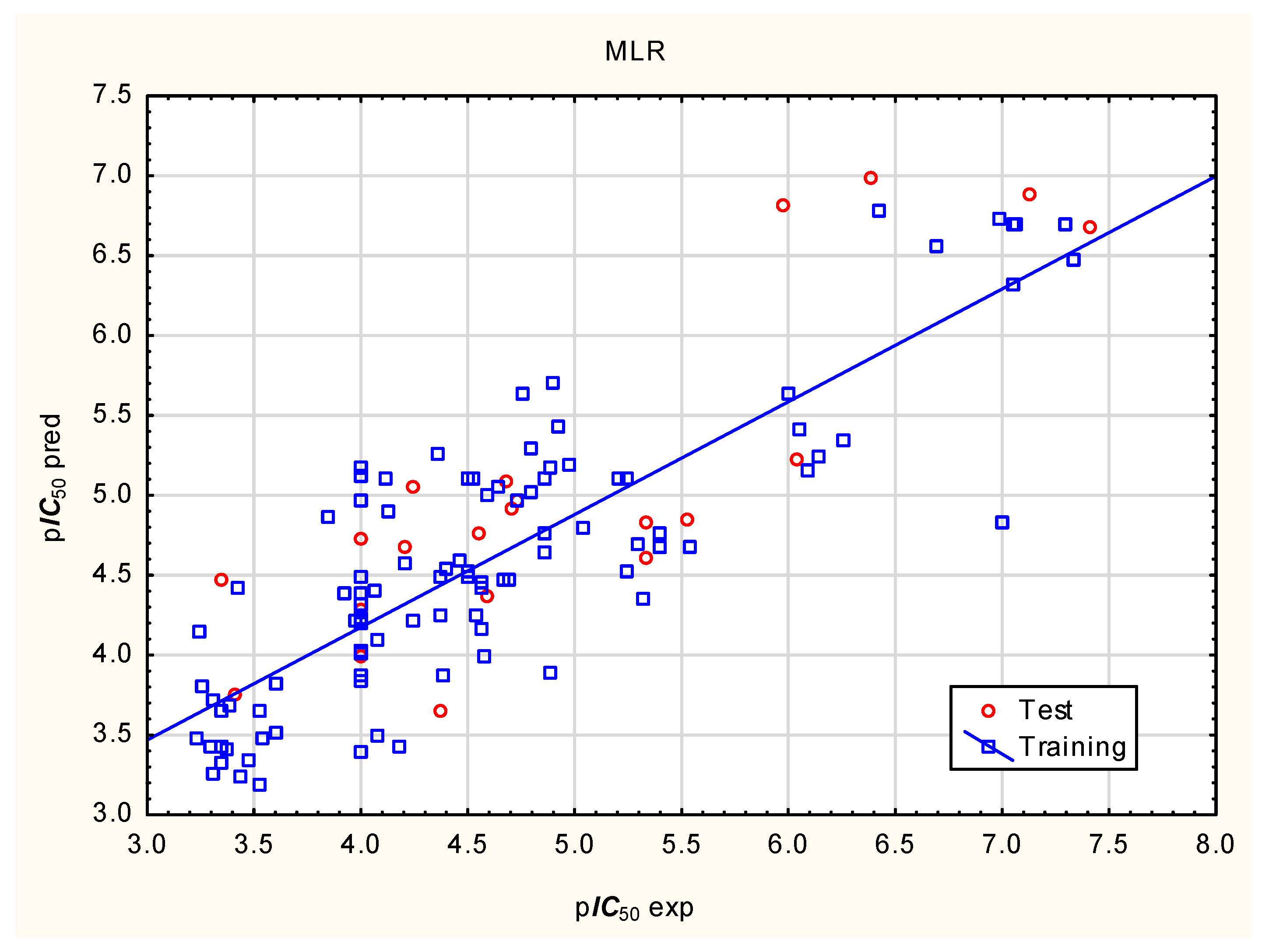
Figure 2.
ANN model of pIC50, predicted vs. experimental values.
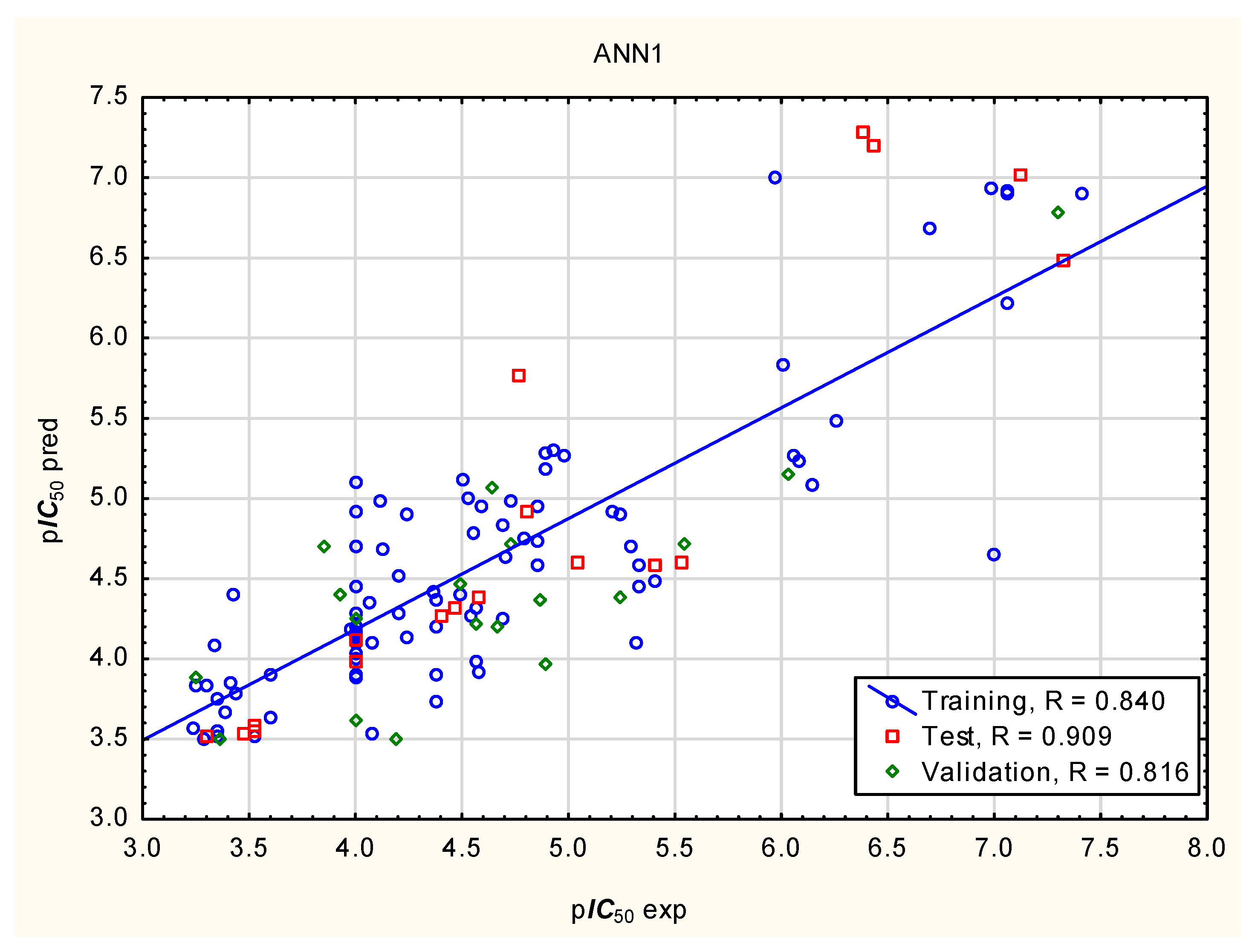
Figure 3.
SVR model of pIC50, predicted vs. experimental values.
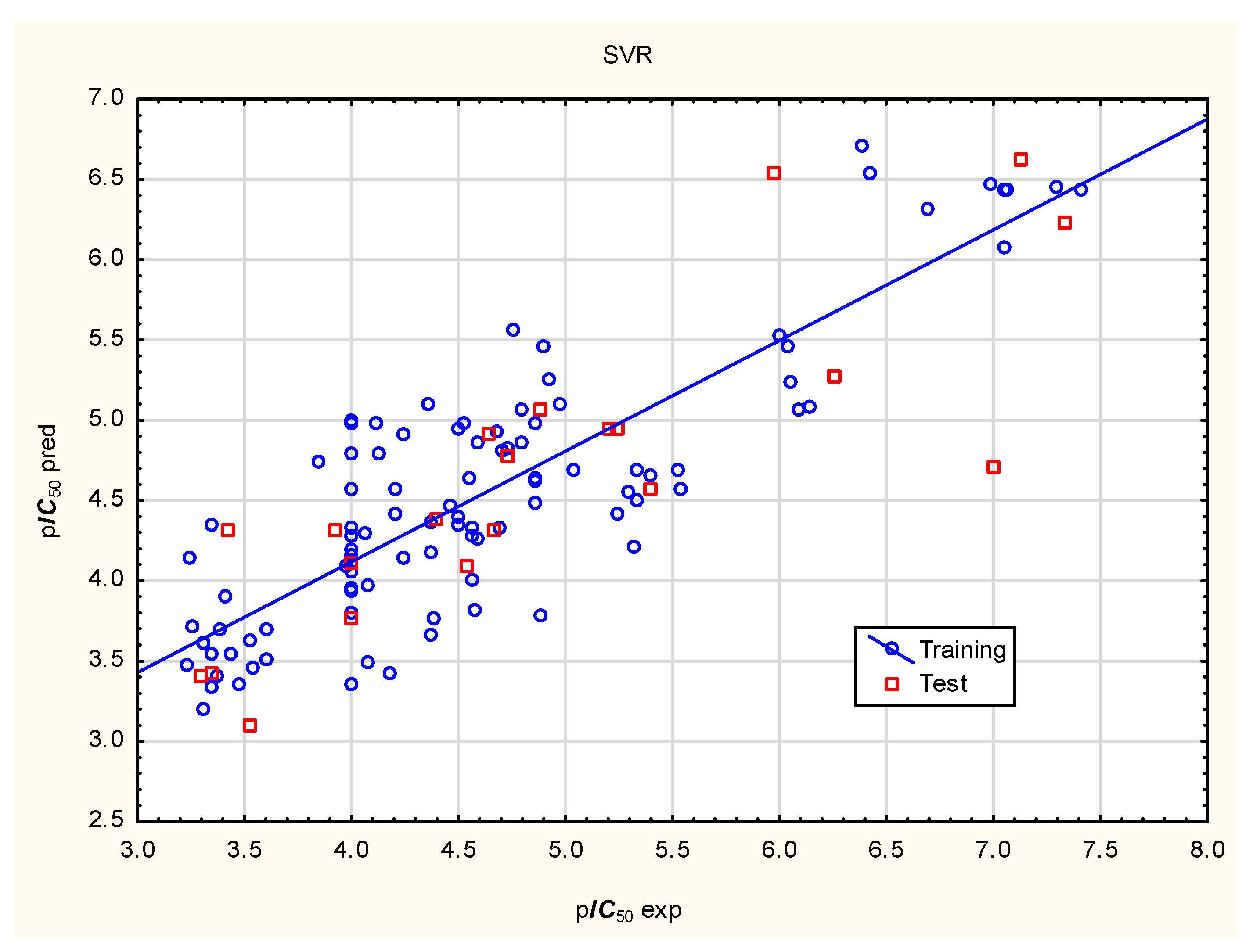
Figure 4.
PC2 vs. PC1 for studied sunscreens and the reference compounds.
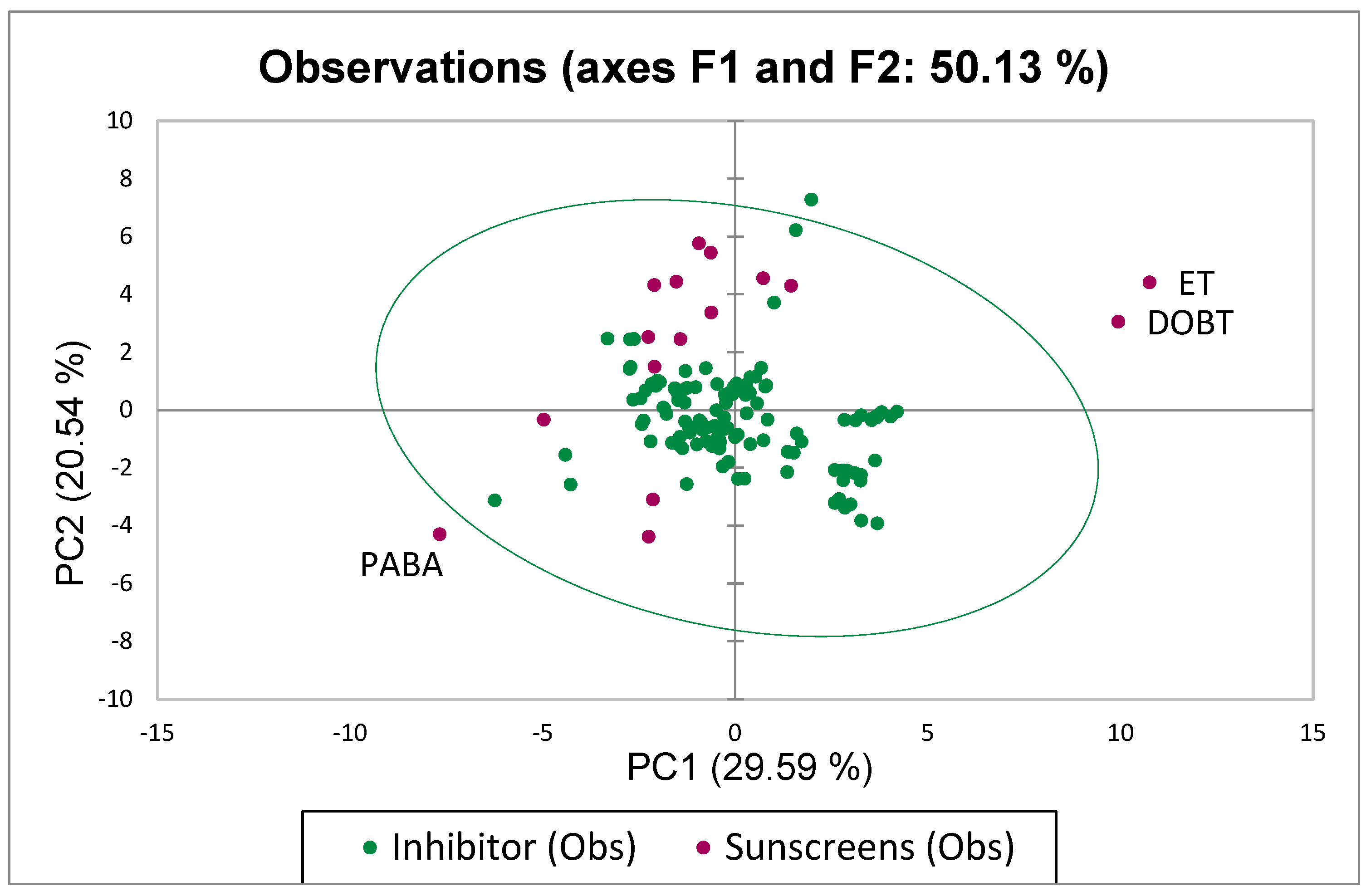
Figure 5.
Atomic contributions to pIC50 – organic sunscreens.
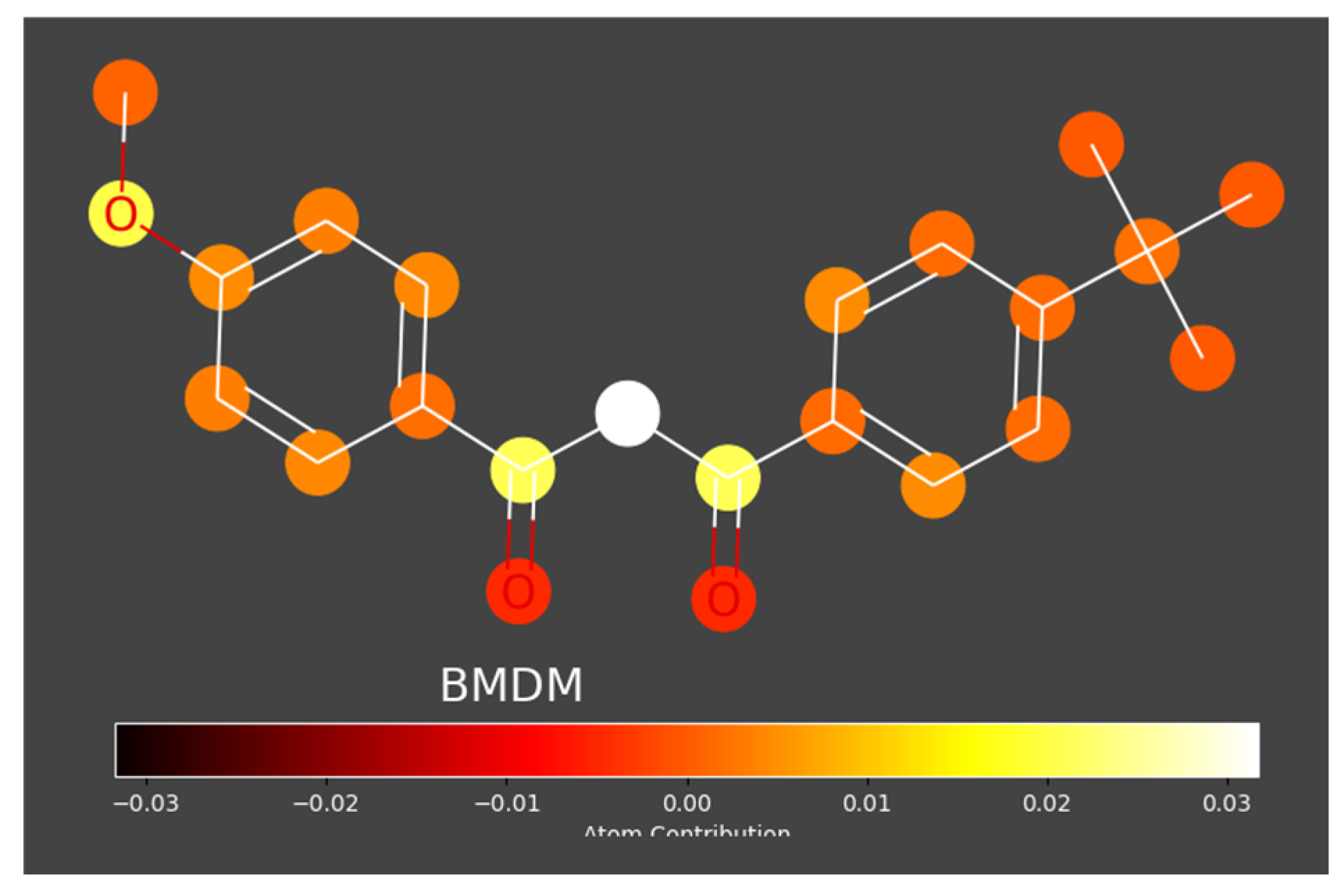
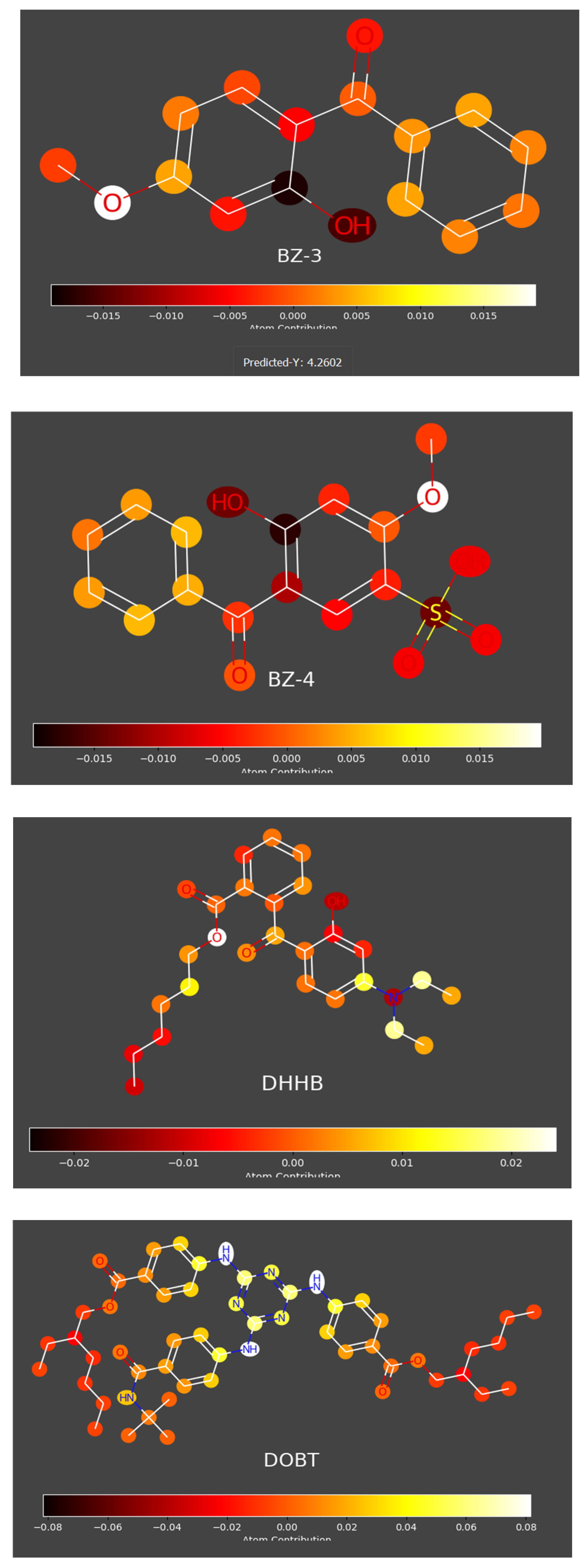
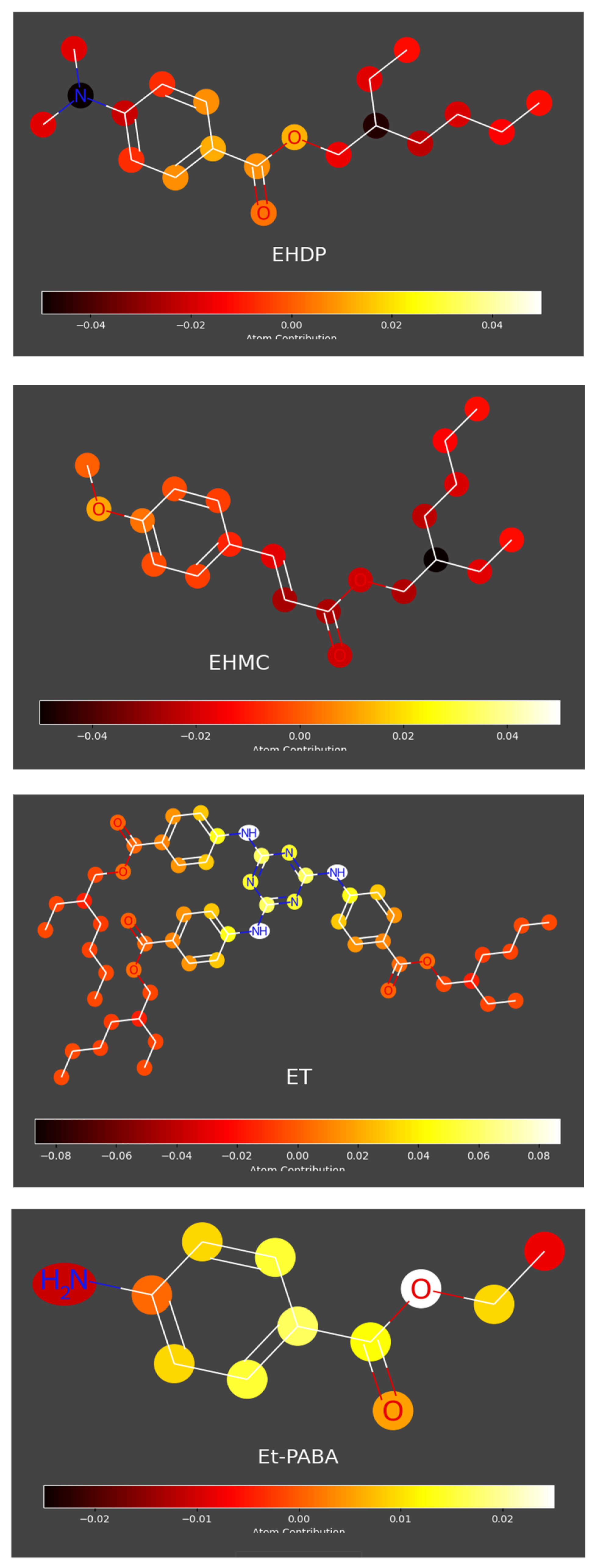
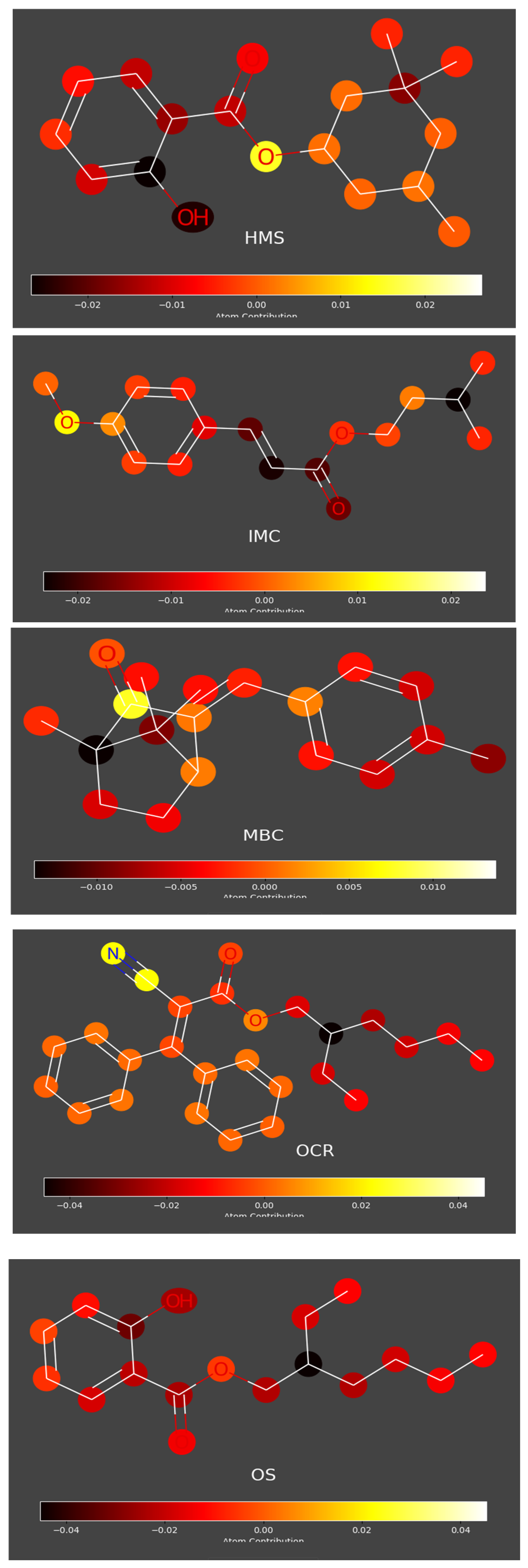
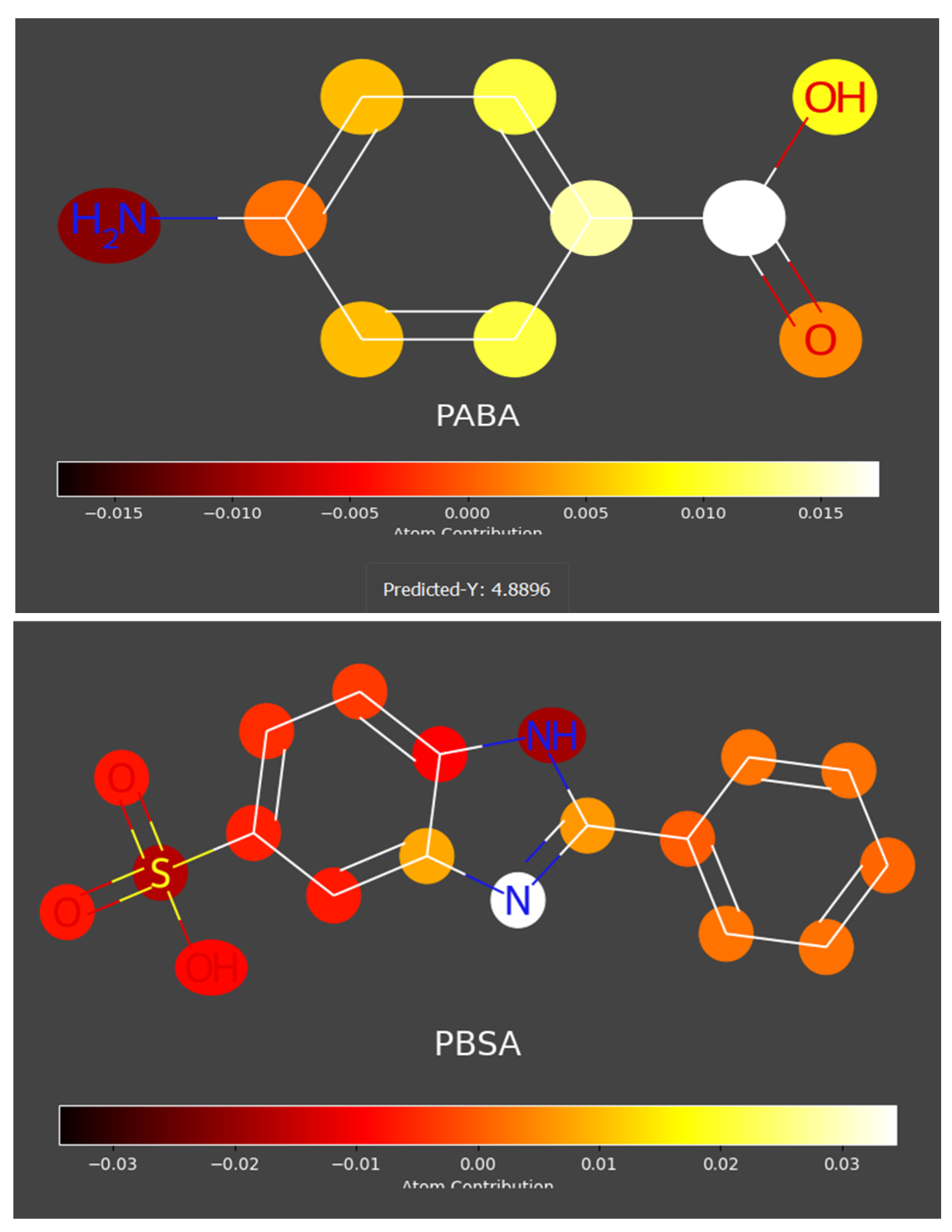

Table 1.
SVR performance metrics (pIC50).
| Statistics | Training set | Validation set |
| MSE | 0.291 | 0.498 |
| R² | 0.710 | 0.661 |
| MAE | 0.432 | 0.495 |
Table 2.
Key descriptors and the pIC50 values calculated using MLR, ANN1 and SVR models (Mean(1) – calculated for MLR, ANN1 and SVR values; Mean(2) – ANN2 do ANN5 values also included).
Table 2.
Key descriptors and the pIC50 values calculated using MLR, ANN1 and SVR models (Mean(1) – calculated for MLR, ANN1 and SVR values; Mean(2) – ANN2 do ANN5 values also included).
| nRot | Flex | Fsp3 | logD | caco2 | PPB | MLR | ANN1 | SVR | Mean(1) | Mean(2) | |
| BMDM | 6 | 0.429 | 0.300 | 4.08 | -4.70 | 96.29 | 4.95 | 4.52 | 4.83 | 4.77 | 4.82 |
| BP-3 | 3 | 0.231 | 0.071 | 3.42 | -4.86 | 97.81 | 4.19 | 4.15 | 4.09 | 4.14 | 4.18 |
| DHHB | 12 | 0.857 | 0.417 | 4.26 | -4.75 | 98.13 | 5.57 | 4.97 | 5.37 | 5.30 | 5.27 |
| PABA | 1 | 0.143 | 0.000 | 1.00 | -5.24 | 43.55 | 4.48 | 5.10 | 4.66 | 4.75 | 4.87 |
| EHDP | 9 | 1.286 | 0.588 | 3.89 | -4.90 | 98.46 | 1.30 | 3.27 | 1.42 | 2.00 | 2.77 |
| Et-PABA | 3 | 0.429 | 0.222 | 1.97 | -5.12 | 74.52 | 2.79 | 3.64 | 2.90 | 3.11 | 3.45 |
| PBSA | 2 | 0.111 | 0.000 | 1.62 | -5.59 | 98.51 | 2.90 | 3.64 | 2.80 | 3.11 | 3.54 |
| MBC | 1 | 0.063 | 0.500 | 3.85 | -4.57 | 95.07 | 3.76 | 3.57 | 3.78 | 3.70 | 3.64 |
| EHMC | 10 | 1.250 | 0.500 | 3.86 | -4.90 | 98.60 | 2.07 | 3.34 | 2.12 | 2.51 | 3.05 |
| IMC | 7 | 0.875 | 0.400 | 3.59 | -4.80 | 96.20 | 2.47 | 3.39 | 2.50 | 2.79 | 3.20 |
| OCR | 10 | 0.667 | 0.333 | 4.52 | -4.94 | 99.28 | 6.13 | 5.78 | 5.91 | 5.94 | 5.96 |
| ET | 30 | 1.111 | 0.500 | 5.09 | -4.99 | 100.70 | 13.82 | 14.82 | 12.94 | 13.86 | 10.70 |
| OS | 8 | 1.143 | 0.533 | 3.53 | -4.89 | 98.07 | 1.24 | 3.27 | 1.34 | 1.95 | 2.75 |
| HMS | 3 | 0.231 | 0.562 | 3.58 | -4.87 | 98.30 | 3.50 | 3.51 | 3.49 | 3.50 | 3.57 |
| DOBT | 25 | 0.926 | 0.455 | 4.72 | -5.06 | 99.40 | 12.14 | 13.28 | 11.40 | 12.27 | 9.90 |
| BZ-4 | 4 | 0.267 | 0.071 | 1.87 | -5.49 | 98.90 | 3.12 | 3.70 | 3.00 | 3.27 | 3.65 |
Table 3.
Proximity matrix (Pearson correlation coef.).
| nRot | Flex | Fsp3 | log D | caco2 | PPB | MLR | ANN1 | SVR | |
| nRot | 1.000 | 0.657 | 0.451 | 0.691 | 0.088 | 0.351 | 0.841 | 0.904 | 0.833 |
| Flex | 0.657 | 1.000 | 0.667 | 0.594 | 0.277 | 0.360 | 0.165 | 0.303 | 0.155 |
| Fsp3 | 0.451 | 0.667 | 1.000 | 0.761 | 0.669 | 0.474 | 0.124 | 0.184 | 0.118 |
| logD | 0.691 | 0.594 | 0.761 | 1.000 | 0.686 | 0.655 | 0.512 | 0.494 | 0.503 |
| caco2 | 0.088 | 0.277 | 0.669 | 0.686 | 1.000 | 0.245 | 0.001 | -0.060 | 0.007 |
| PPB | 0.351 | 0.360 | 0.474 | 0.655 | 0.245 | 1.000 | 0.117 | 0.114 | 0.092 |
| MLR | 0.841 | 0.165 | 0.124 | 0.512 | 0.001 | 0.117 | 1.000 | 0.974 | 1.000 |
| ANN1 | 0.904 | 0.303 | 0.184 | 0.494 | -0.060 | 0.114 | 0.974 | 1.000 | 0.972 |
| SVR | 0.833 | 0.155 | 0.118 | 0.503 | 0.007 | 0.092 | 1.000 | 0.972 | 1.000 |
Disclaimer/Publisher’s Note: The statements, opinions and data contained in all publications are solely those of the individual author(s) and contributor(s) and not of MDPI and/or the editor(s). MDPI and/or the editor(s) disclaim responsibility for any injury to people or property resulting from any ideas, methods, instructions or products referred to in the content. |
© 2026 by the authors. Licensee MDPI, Basel, Switzerland. This article is an open access article distributed under the terms and conditions of the Creative Commons Attribution (CC BY) license (http://creativecommons.org/licenses/by/4.0/).
Copyright: This open access article is published under a Creative Commons CC BY 4.0 license, which permit the free download, distribution, and reuse, provided that the author and preprint are cited in any reuse.


