
Submitted:
09 April 2026
Posted:
09 April 2026
You are already at the latest version
Abstract
G protein-coupled receptors (GPCRs) form the largest family of cell-surface signaling proteins and remain the most exploited drug targets. Their regulation depends on desensitization, the attenuation of receptor responsiveness following sustained or repeated stimulation. The canonical framework, validated for rhodopsin and the β2-adrenergic receptor, describes desensitization as GRK-mediated receptor phosphorylation, arrestin recruitment, and steric occlusion of G protein coupling. This receptor-centric view has been supported primarily by time-course assays of second messenger generation, which capture rapid, reversible attenuation at the plasma membrane. Recent studies, however, reveal a receptor-distal program in which arrestin deubiquitination, regulated by EGFR–Akt–USP33 signaling, converts arrestin into a Gβγ-sequestering state and drives nuclear redistribution of signaling components. This perspective has been advanced through washout–rechallenge assays (pulse‑chase‑pulse), which demonstrate diminished responsiveness upon repeated stimulation even after receptor recovery. Integrating these complementary approaches, we propose a two-level framework for GPCR desensitization. Level 1 (proximal) reflects rapid receptor-core uncoupling, suited to transient stimulation. Level 2 (distal) reflects slower, trafficking-dependent redistribution of signaling machinery, producing more durable attenuation. This layered model reconciles divergent experimental findings, explains receptor subtype diversity, and highlights how desensitization extends beyond receptor blockade to spatial reorganization of signaling components. By linking methodological differences to mechanistic insights, this framework provides a unified view of GPCR desensitization. It informs future directions in biased agonism, acute tolerance, and the design of therapeutics with tailored desensitization profiles.
Keywords:
GPCR desensitization
; arrestin
; Gβγ
; ubiquitination
; USP33
; EGFR transactivation
1. Introduction
G protein-coupled receptors (GPCRs) constitute the largest superfamily of cell-surface signaling receptors in the human genome, with over 800 members that respond to an extraordinary diversity of stimuli, including photons, odorants, hormones, neurotransmitters, lipids, and peptides (Fredriksson et al., 2003; Lagerstrom and Schioth, 2008; Pierce et al., 2002; Rosenbaum et al., 2009; Rosenkilde and Mathiasen, 2023). The canonical signaling cycle is well established: agonist binding induces conformational changes that promote GDP-to-GTP exchange on the Gα subunit of heterotrimeric G proteins, leading to dissociation of Gα-GTP from Gβγ subunits. These components activate downstream effectors, including adenylyl cyclase, phospholipase Cβ, ion channels, and kinases, ultimately generating second messengers such as cAMP, IP3/DAG, and Ca²⁺ that orchestrate diverse biological responses (Gilman, 1987; Weis and Kobilka, 2018).
Because GPCR signaling must remain both precise and adaptable, it requires tightly controlled mechanisms of attenuation. Desensitization represents the most immediate and fundamental form of such control, defined as the rapid and reversible decline in receptor responsiveness during sustained or repeated stimulation (Gainetdinov et al., 2004; Hausdorff et al., 1990). This process is mechanistically distinct from receptor downregulation and internalization, although these processes are often functionally linked. Notably, desensitization typically occurs on a timescale of seconds to minutes and is a conserved feature across essentially all GPCR systems (Ferguson, 2001; Lohse et al., 1990).
For nearly four decades, the field of GPCR desensitization has advanced along two partially disconnected experimental traditions. One tradition, rooted in continuous agonist application and real-time measurement of second messengers, established the classical GRK-arrestin model (Kohout et al., 2001; Mundell et al., 1999; Paing et al., 2002). The other, rooted in washout-rechallenge or pulse-chase-pulse designs, emphasized incomplete functional recovery after removal of agonist and thereby suggested that desensitization could outlast receptor occupancy itself (Cho et al., 2010; Min et al., 2013).
Within the Two-Level Desensitization Framework, these approaches are complementary rather than contradictory. Continuous stimulation preferentially resolves Level 1 because it monitors the decay of signaling while the agonist remains present and while the receptor-proximal machinery dominates the observed kinetics. Pulse-chase-pulse designs, by contrast, interrogate the system after agonist removal and therefore ask a different question: not how rapidly signaling decays during exposure, but how completely signaling competence returns before the next challenge. This distinction is critical. A receptor may recover at the level of phosphorylation state or surface expression and yet remain functionally compromised if signaling components have been redistributed by a distal mechanism.
This review, therefore, proposes a Two-Level Desensitization Framework. Level 1 (Proximal) corresponds to rapid, reversible receptor-core uncoupling at the plasma membrane. Level 2 (Distal) reflects slower, trafficking-dependent redistribution of signaling components, revealed when recovery is explicitly tested. A central feature of Level 2 is arrestin deubiquitination, regulated by EGFR–Akt–USP33 signaling, which converts arrestin into a Gβγ-sequestering state and drives nuclear redistribution of signaling intermediates (Kennedy and Marchese, 2015; Kundu et al., 2024; Min et al., 2023b; Shenoy et al., 2009). Together, these layers reconcile divergent experimental findings and provide a unified account of receptor subtype diversity, transient versus persistent attenuation, and the pharmacological distinction between desensitization and early tolerance.
2. The Canonical GRK/Arrestin Model: Foundations of Level 1 Desensitization
The canonical model of GPCR desensitization posits that receptor phosphorylation by GRKs promotes arrestin recruitment, which sterically occludes G protein coupling (Figure 1). Within our proposed framework, this interaction defines Level 1 (Proximal) desensitization, a membrane-confined process characterized by rapid biochemical attenuation (Benovic et al., 1987; Kohout et al., 2001).
Agonist-induced receptor activation triggers GRK recruitment and phosphorylation of the receptor C-terminal tail and/or intracellular loops. Phosphorylated receptor adopts a high-affinity conformation for arrestin2/3 engagement. Arrestin binding in the active, core-engaged mode sterically occludes the receptor transmembrane cavity that accommodates the Gα α5 helix, preventing productive G protein coupling (uncoupling). Arrestin additionally recruits clathrin and AP-2, targeting the desensitized receptor to clathrin-coated pits for internalization. Class A receptors (e.g., β2AR) form transient receptor–arrestin complexes and recycle rapidly; Class B receptors (e.g., V2R, AT1AR) form stable, core-engaged complexes that traffic to endosomes intact. Structural insets depict the Gα α5 helix (blue) and arrestin finger loop (orange) competing for the TM5-TM6 receptor core interface.
2.1. The GRK Family: Initiators of the Desensitization Program
The GRK family comprises seven mammalian members (GRK1–7) that serve as the primary initiators of the desensitization relay (Pitcher et al., 1998; Premont and Gainetdinov, 2007). GRK2, GRK3, GRK5, and GRK6 are broadly expressed and regulate the majority of non-visual GPCRs. All GRKs share a central kinase domain whose full catalytic activity requires engagement with an agonist-occupied receptor, providing intrinsic selectivity for active signaling units (Lodowski et al., 2006; Tesmer et al., 2005).
Beyond this shared catalytic logic, GRK isoforms exhibit distinct receptor preferences; for instance, GRK2/3 (which possess a PH domain for Gβγ binding) preferentially regulate Gi/o- and Gq-coupled receptors, while GRK5/6 show greater selectivity for Gs-coupled systems (Drube et al., 2022; Inagaki et al., 2015). This isoform-specific selectivity is a major determinant of the initial phosphorylation patterns that trigger Level 1 desensitization.
2.2. Structural Basis of Level 1: Steric Exclusion and Receptor–Arrestin Coupling
The fundamental mechanism of Level 1 desensitization is steric exclusion. High-resolution structures of GPCR–arrestin complexes, beginning with rhodopsin–visual arrestin and expanding to β1AR–arrestin2, have established a conserved structural framework for this interaction (Kang et al., 2015; Huang et al., 2020). A key feature is the formation of an intracellular cavity upon receptor activation, where the outward displacement of transmembrane helix 6 (TM6) creates a binding pocket (Rasmussen et al., 2011).
Structural superposition demonstrates that this pocket accommodates either the α5 helix of Gα or the finger loop of arrestin in a mutually exclusive manner (Figure 1; (Garcia-Nafria et al., 2018; Lee et al., 2020). This competition at the receptor core provides direct evidence that arrestin binding sterically precludes G protein coupling. Consequently, Level 1 is defined by this "receptor-core occlusion," which acts as a rapid biochemical brake at the plasma membrane. The stability of this interaction typically follows Class A or Class B patterns, where clustered phosphorylation sites (Class B, e.g., V2R) promote high-affinity, long-lived complexes compared to the more transient interactions seen in Class A receptors (e.g., β2AR)(Kim et al., 2005; Oakley et al., 2000).
2.3. The Phosphorylation Barcode: The Regulatory Code for Arrestin Recruitment
While steric hindrance is the physical outcome of Level 1, the recruitment and orientation of arrestin are governed by the "phosphorylation barcode." This hypothesis proposes that distinct GRK-dependent phosphorylation patterns stabilize different arrestin conformations, thereby biasing arrestin toward specific functions (Butcher et al., 2011; Nobles et al., 2011).
Structural studies support this model, showing that different receptor phosphopeptides engage the positively charged N-domain of arrestin in distinct ways, thereby "licensing" specific arrestin states (Bous et al., 2022; Staus et al., 2020). Thus, the barcode ensures that Level 1 is not a rigid binary switch but a programmed response where the specific "flavor" of phosphorylation dictates the stability and downstream consequences of the receptor–arrestin complex.
2.4. Functional Diversification: Arrestin as a Multi-State Regulator
Building upon this framework, it is now clear that arrestin activation involves a continuum of conformational states rather than a single "on" state (Gurevich and Gurevich, 2006). These conformations translate the phosphorylation barcode into divergent functional outputs, including G protein uncoupling (desensitization), clathrin-mediated endocytosis (internalization), and arrestin-dependent biased signaling (Shenoy et al., 2006).
The complexity of arrestin regulation is exemplified by receptors that, despite close structural similarity, exhibit markedly different functional outcomes. These differences reflect the ability of distinct receptors to stabilize specific arrestin conformations, thereby biasing signaling toward either receptor uncoupling or endocytic trafficking. Thus, Level 1 interactions are inherently branched, with arrestin functioning as a multi-state regulator rather than a binary switch (see Section II.D for a detailed example in dopamine receptors).
These observations underscore that the Level 1 interactions are inherently branched; a receptor may be biased toward uncoupling or trafficking depending on the specific arrestin conformation it stabilizes. This functional diversification at the plasma membrane sets the stage for the transition to Level 2 regulation, in which the arrestin state is further modified to enable the systemic redistribution of signaling components.
3. Receptor Subtype Diversity in Desensitization
3.1. The β2 Adrenergic Receptor: Paradigm and Complexity
The β2AR has served as the primary model for the mechanistic dissection of GPCR desensitization. Rapid agonist-dependent phosphorylation by GRK2 and GRK3, followed by arrestin recruitment and receptor internalization via clathrin-coated pits, was first described for this receptor (Benovic et al., 1987; Ferguson et al., 1996b; Goodman et al., 1996; Lohse et al., 1990). Quantitative kinetic modeling of cAMP dynamics following β2AR stimulation confirms that desensitization proceeds on a timescale consistent with GRK2-mediated phosphorylation and arrestin binding (Violin et al., 2008). GRK2 translocation to activated β2AR is rapid and can be visualized in real-time using fluorescence approaches (Krasel et al., 2005).
Despite its status as a paradigm, β2AR desensitization reveals complexity when examined under different conditions. β2AR can undergo heterologous desensitization mediated by PKA and PKC, which phosphorylate the receptor at different sites than GRKs and can shift receptor coupling from Gs to Gi, a mechanism with important implications for cardiac β-adrenergic physiology (Daaka et al., 1997; Zamah et al., 2002). Additionally, work by Shenoy and colleagues demonstrated that β2AR ubiquitination and the dynamic deubiquitination of bound arrestin by USP33 regulate the kinetics of receptor trafficking and the distinction between Class A (rapid dissociation) and Class B (sustained arrestin association) behavior (Calebiro et al., 2009; Oakley et al., 2000; Shenoy et al., 2009). The recent observation that EGFR transactivation contributes to β2AR desensitization suggests that even this well-characterized receptor uses multiple mechanisms in parallel (Kundu et al., 2024).
3.2. μ-. Opioid and δ-Opioid Receptors: Tolerance and Phosphorylation Diversity
Opioid receptors provide some of the most clinically important examples of GPCR desensitization, because tolerance and loss of analgesic efficacy remain major obstacles in pain management. At the μ-opioid receptor (MOR), this is exemplified by the contrast between peptide agonists such as DAMGO and alkaloid agonists such as morphine. DAMGO robustly promotes receptor phosphorylation, arrestin recruitment, and efficient receptor internalization, whereas morphine, despite strong analgesic efficacy, induces relatively poor receptor internalization and a more restricted phosphorylation pattern. This agonist-dependent divergence has long suggested that MOR regulation is not governed by a single linear mechanism, but rather by ligand-specific phosphorylation and trafficking programs that shape desensitization and tolerance outcomes (Christie, 2008; Keith et al., 1996; Whistler and von Zastrow, 1998).
Within this framework, DAMGO can be viewed as promoting a relatively class B-like arrestin engagement state at MOR. DAMGO induces multisite phosphorylation of the MOR C-terminal tail, generating a phosphorylation barcode that supports sustained interactions with GRKs and arrestins and thereby facilitates robust internalization and rapid desensitization. By contrast, morphine produces a weaker and more selective phosphorylation pattern, classically associated with prominent Ser375 phosphorylation but limited multisite phosphorylation, and correspondingly weak, less persistent arrestin association. In this sense, morphine favors a more class A-like interaction state, in which receptor internalization is poor and desensitization may proceed in a more context-dependent manner that is not fully coupled to the canonical GRK5/6–arrestin internalization pathway (Connor et al., 2004; Kliewer et al., 2020; Miess et al., 2018; Schulz et al., 2004; Whistler and von Zastrow, 1998).
A related but mechanistically distinct principle is evident at the δ-opioid receptor (DOR), where desensitization is tightly linked to post-endocytic sorting and recycling behavior. In DOR, the stability of receptor–Gβγ complexes influences arrestin3 association, recycling bias, and the potential for acute tolerance, indicating that the composition and persistence of receptor-associated complexes can shape the extent of functional recovery after agonist exposure (Audet et al., 2012). In parallel, DOR trafficking is further regulated by ubiquitination-dependent sorting steps: receptor ubiquitination promotes aspects of lysosomal trafficking and proteolytic processing, while DORs also undergo constitutive and agonist-driven internalization/resensitization cycles that contribute to their complex trafficking itinerary (Hasbi et al., 2000; Henry et al., 2011; Trapaidze et al., 2000).
Taken together, these findings support a broader model in which opioid receptor desensitization is encoded by agonist-specific phosphorylation barcodes and executed through coordinated control of arrestin engagement, receptor–Gβγ complex stability, ubiquitin-dependent sorting, and recycling/resensitization. In MOR, this framework explains why DAMGO and morphine produce markedly different internalization and tolerance phenotypes despite activating the same receptor. In DOR, it emphasizes that trafficking fate itself is a determinant of acute responsiveness and recovery. Thus, opioid receptor desensitization is best understood not as a uniform shutoff mechanism, but as a set of ligand- and receptor-specific trafficking programs that ultimately shape tolerance and therapeutic outcome (Allouche et al., 2014; Lemel et al., 2020; Williams et al., 2013).
3.3. Muscarinic Receptors: GRK Isoform Selectivity and Gq Coupling
The five muscarinic acetylcholine receptor subtypes (M1–M5) illustrate the importance of GRK isoform selectivity in determining desensitization patterns. M2 and M4 receptors, which couple to Gi/o, are preferentially phosphorylated by GRK2 and GRK3 following agonist stimulation (Tsuga et al., 1994). In contrast, M1, M3, and M5, which couple to Gq/11, are substrates for multiple GRK isoforms, including GRK2, GRK3, and GRK5/6, with different contributions to receptor trafficking and signal termination (Haga and Haga, 1992; Willets et al., 2005). For M3R, available evidence suggests that desensitization is mediated by multiple mechanisms, including receptor phosphorylation and GRK-dependent regulation of downstream Gq/PLC signaling. In particular, GRK6 directly regulates M3R phosphorylation and uncoupling, whereas GRK3 appears to dampen signaling through a mechanistically distinct pathway not fully accounted for by receptor phosphorylation alone. Although direct evidence for RH domain-mediated Gαq sequestration comes more clearly from other Gq-coupled receptors such as mGluR1a, these studies collectively support the idea that M3R desensitization contains a non-canonical component in addition to the classical phosphorylation-dependent pathway (Dhami et al., 2004; Willets et al., 2001; Willets et al., 2002; Willets et al., 2003).
3.4. Dopamine Receptors: A Critical Test Case
Dopamine D2-like receptors (D2R, D3R, and D4R) provide an especially instructive subtype comparison because they preserve broad Gi/o coupling while diverging sharply in desensitization behavior. As such, they expose a central limitation of the canonical receptor-proximal model, in which GRK-dependent phosphorylation and arrestin recruitment are treated as sufficient determinants of signal attenuation.
The decisive paradox emerges from the comparison of D2R and D3R. D2R undergoes efficient agonist-dependent phosphorylation, robust arrestin3 translocation, and substantial internalization, yet displays relatively limited functional desensitization. By contrast, D3R shows profound desensitization despite limited receptor phosphorylation and comparatively weak arrestin recruitment (Cho et al., 2010; Cho et al., 2006; Kim et al., 2001; Min et al., 2013; Westrich and Kuzhikandathil, 2007). This mismatch is difficult to reconcile with a model in which phosphorylation-dependent arrestin recruitment directly predicts the depth of desensitization. D4R further underscores the point by demonstrating that closely related receptor subtypes can occupy yet another regulatory regime within the same family.
The pharmacological implications are substantial. Antipsychotic drugs targeting D2-like receptors often produce tolerance, dopamine supersensitivity, or paradoxical sensitization during chronic treatment, phenomena that are not fully explained by receptor abundance changes alone and may instead reflect divergent access to non-canonical desensitization pathways, particularly in D3R-linked contexts (Kim, 2023; Li, 2016; Sokoloff and Le Foll, 2022). Taken together, the D2R/D3R comparison indicates that receptor phosphorylation and arrestin recruitment are necessary but not sufficient; an additional mechanistic layer must determine whether recruited arrestin remains functionally proximal or enters a state competent for Level 2 desensitization. This logic directs attention to arrestin biochemical state as the determinant of Level 2 entry.
3.5. Vasopressin, Angiotensin, and Peptide Receptors
Class B GPCRs, exemplified by the vasopressin V2 receptor (V2R) and the angiotensin II type 1A receptor (AT1R), which exhibits Class B-like arrestin recruitment patterns, are distinguished by the formation of stable, core-engaged receptor–arrestin complexes that persist during receptor internalization. For V2R, arrestin binding is so robust that the receptor–arrestin complex translocates to endosomes intact, enabling sustained arrestin-mediated ERK signaling from intracellular compartments (He et al., 2026; Nguyen et al., 2019). This 'megaplex' behavior, where receptor, arrestin, and G protein can coexist in a single macromolecular assembly, challenges the simplistic model of competitive steric hindrance and suggests that desensitization and signaling can be temporally and spatially decoupled.
In the case of AT1R, arrestin3 interaction is associated with cardioprotective signaling, notably the activation of ERK and Akt, which is mechanistically distinct from Gq-mediated cardiac hypertrophy (Rajagopal et al., 2006; Violin et al., 2014). While arrestins were historically viewed as mere adaptors for receptor desensitization, the conceptual separation of arrestin-mediated signaling from canonical G protein pathways was firmly established by the demonstration that AT1R promotes ERK1/2 activation through independent arrestin- and G protein-dependent routes (Wei et al., 2003). These findings catalyzed the emergence of biased agonism and provided the rationale for developing arrestin-biased ligands like TRV120027. Thus, AT1R illustrates that arrestin-mediated desensitization of G protein signaling and the activation of distinct downstream programs are not mutually exclusive, but rather coordinated facets of receptor regulation. More broadly, this duality is quintessential to Class B systems, where stable receptor–arrestin engagement supports both sustained desensitization and prolonged, compartment-specific signaling.
Taken together, these receptor comparisons show that a purely receptor-proximal view of desensitization is incomplete. If phosphorylation-dependent arrestin recruitment at the plasma membrane were the only mechanism, then receptors with similar coupling properties should behave the same. In reality, they do not: some receptors desensitize strongly even with weak phosphorylation, while others continue signaling despite conditions that should favor uncoupling (Ferguson, 2001; Hausdorff et al., 1990).
This contrast is most evident in the D2R versus D3R comparison. Although structurally similar, they display very different desensitization capacities (Cho et al., 2007; Kim et al., 2001; Westrich and Kuzhikandathil, 2007). These findings suggest that receptor phosphorylation and steric hindrance are necessary but not sufficient to fully explain the strength and persistence of signal attenuation. Instead, an additional mechanistic layer must be considered (Oakley et al., 2000).
Within the Two-Level Framework, this extra layer is defined by the biochemical state of arrestin. Phosphorylation patterns first create diversity at Level 1 by shaping arrestin conformations and outputs at the plasma membrane (Nobles et al., 2011; Staus et al., 2020). Progression beyond this proximal layer, however, requires an additional “license.” Arrestin ubiquitination and its reversal by USP33 provide that license, deciding whether arrestin remains locally engaged or advances into Level 2, where signaling components are redistributed (Min et al., 2023a; Shenoy and Lefkowitz, 2003; Shenoy et al., 2009). The central question that follows is: how is arrestin’s functional identity modified after recruitment?
4. Arrestin Ubiquitination as a Functional State Variable
The key unresolved issue, therefore, is not merely whether arrestin is recruited, but what determines whether recruited arrestin remains confined to receptor-proximal uncoupling or is converted into a distal desensitization effector. One useful way to frame this problem is hierarchically: receptor phosphorylation and conformational selection generate a spectrum of Level 1 arrestin states, but progression to Level 2 appears to require further biochemical editing of that state. Arrestin ubiquitination is well positioned to serve this function. As a dynamic and reversible modification capable of reshaping arrestin interaction networks, it provides a plausible molecular mechanism for licensing the transition from Level 1 to Level 2 desensitization.
4.1. Ubiquitination as a Functional Switch
Arrestins undergo dynamic cycles of ubiquitination and deubiquitination that modulate receptor association and downstream signaling functions (Shenoy and Lefkowitz, 2003). Viewed within the present framework, this cycle is not simply an accessory trafficking note. Rather, it acts as a biochemical state variable that edits arrestin's functional identity after recruitment. Receptor phosphorylation barcodes and arrestin conformational selection generate Level 1 diversity at the plasma membrane, but entry into Level 2 requires an additional license, namely arrestin deubiquitination (Figure 2). In this sense, ubiquitin cycling links conformational selection to systems-level desensitization.
Repeated GPCR stimulation generates cumulative signaling that activates membrane-anchored metalloprotease(s) (ADAMs) to shed EGF-like ligands, leading to the EGFR activation (transactivation). EGFR activation drives Src→PDK1→Akt signaling, which licenses USP33 to deubiquitinate arrestin. Deubiquitinated arrestin–Gβγ complexes are then recognized by importin machinery and undergo active nuclear transport. Nuclear accumulation of Gβγ depletes the membrane-proximal Gβγ pool, preventing G protein heterotrimer reassembly and sustaining signal attenuation beyond what receptor phosphorylation alone can achieve. The diagram illustrates the Level 2 (Distal) desensitization program: EGFR transactivation serves as the obligatory upstream gate licensing USP33-dependent arrestin deubiquitination and subsequent nuclear Gβγ sequestration, constituting the distal spatial arm of the two-level framework.
This formulation helps reconcile why recruited arrestin can support divergent outcomes. Ubiquitinated arrestin is compatible with receptor-associated complex formation, receptor cycling, and continued G protein turnover, consistent with membrane-proximal regulation and selected trafficking or signaling outputs. Deubiquitinated arrestin, by contrast, preferentially supports mechanistically distinct complexes, including the stable, nonproductive arrestin–Gβγ assemblies that divert signaling components from reuse in the receptor–G protein cycle (Min et al., 2023a; Zheng et al., 2020b). Ubiquitinated and deubiquitinated arrestin should therefore be viewed as hierarchically related functional states: the former sustains Level 1-competent receptor-associated modes, whereas the latter licenses transition into Level 2 distal desensitization.
4.2. Mdm2 as a Basal Regulator of Arrestin State
A key component of this licensing system is the E3 ubiquitin ligase Mdm2. Mdm2 ubiquitinates arrestin3 and has classically been linked to stabilization of receptor–arrestin complexes and receptor internalization (Shenoy et al., 2001). In desensitization-competent receptor settings, Mdm2 appears to be preferentially retained in the cytoplasm, where it maintains arrestin3 in a ubiquitinated state under basal conditions (Figure 3) (Min et al., 2017; Zheng et al., 2020a).
Under basal conditions, Mdm2 localizes to the cytoplasm (in desensitization-prone receptor contexts) and constitutively ubiquitinates arrestin3. Ubiquitinated arrestin is compatible with receptor-associated complex formation and productive G protein cycling. Repeated agonist stimulation triggers the nuclear translocation of Mdm2 and the deubiquitinates arrestin3. Deubiquitinated arrestin preferentially associates with free Gβγ in a stable, non-productive complex, sequestering Gβγ from G protein reassembly. The ubiquitination-deubiquitination cycle thus acts as a molecular switch that converts arrestin from a signaling-neutral or signaling-supportive form to a Gβγ-sequestering, desensitization-driving form.
This basal setting seems to be structurally encoded by receptor-specific determinants. In the dopamine receptor system, residues such as C147 in D3R and K149 in D2R correlate with Mdm2 association, cytoplasmic localization, and desensitization susceptibility (Min et al., 2013; Min et al., 2023a; Westrich and Kuzhikandathil, 2007). Receptors that favor cytoplasmic Mdm2 retention would therefore be expected to preserve arrestin in a ubiquitinated state compatible with receptor-associated signaling complexes and ongoing G protein turnover.
Structural observations support this interpretation. A recent analysis showed that inactive arrestin2 binds Mdm2 on the positively charged concave face of its N domain, a surface that overlaps with the binding site for phosphorylated GPCR tails (Yun et al., 2023). This overlap suggests that receptor engagement, Mdm2 association, and arrestin ubiquitination state are mechanistically coupled, even though the precise sequence of exchange remains to be resolved.
4.3. USP33 Converts the License
If Mdm2 maintains the basal ubiquitinated state, USP33 converts it. USP33 removes ubiquitin from arrestin and was initially characterized as a regulator of arrestin recycling from endosomes (Shenoy et al., 2009). In the present framework, however, USP33 assumes a broader role: it converts arrestin from a signaling-permissive or signaling-neutral form into one that promotes Gβγ sequestration and distal desensitization.
The resulting deubiquitinated arrestin−Gβγ complex is functionally distinct from receptor-associated arrestin. Rather than acting at the receptor core, it acts downstream by capturing Gβγ away from the productive receptor–G protein cycle, thereby reducing the effective pool of signaling-competent heterotrimers (Min et al., 2023a; Zheng et al., 2020a; Zheng et al., 2020b). In this sense, the ubiquitination–deubiquitination cycle functions as a molecular switch that determines whether arrestin remains within the Level 1 regime or licenses entry into Level 2.
Importantly, this balance is shaped not only by acute agonist stimulation but also by receptor-associated molecular context. Conditions that favor Mdm2 displacement or redistribution permit arrestin deubiquitination and progression toward distal desensitization, whereas conditions that stabilize cytoplasmic Mdm2 maintain a signaling-permissive basal state. Arrestin ubiquitination state, therefore, operates as a molecular checkpoint for Level 2 engagement.
The critical remaining question is how USP33 is activated in response to repeated receptor stimulation. The evidence points to an upstream kinase relay initiated by EGFR transactivation, which is considered next.
5. The Level 2 Distal Program: Execution and Spatial Consequence
USP33 activity toward arrestin substrates is not constitutive; it requires a post-translational activation signal linked to the history of receptor stimulation, implying the existence of an upstream regulatory kinase. Akt emerges as a plausible candidate. Prior evidence demonstrates that Akt directly interacts with the deubiquitinase USP14 and enhances its enzymatic activity (Xu et al., 2015); given the high sequence homology between USP14 and USP33, and the presence of a canonical Akt phosphorylation motif within USP33 (149KARGLT154; RxRxxS/T)(Blom et al., 2004), USP33 is biochemically positioned as a cognate Akt substrate. Consistent with this rationale, Thr154 phosphorylation has been functionally linked to USP33-dependent deubiquitination of arrestin3 and downstream desensitization (Min et al., 2023; Wang et al., 2021).
Among the multiple upstream inputs that can activate Akt in GPCR-stimulated cells, EGFR transactivation stands out as a primary licensing signal. EGFR is a well-established activator of the Src–PDK1–Akt axis, with activated EGFR recruiting and phosphorylating Src, which in turn drives PDK1-dependent Akt phosphorylation at Thr308 to generate the sustained kinase activity required for USP33 activation (Cantley, 2002; Daub et al., 1996). Importantly, pharmacological inhibition of Akt has been shown to suppress agonist-induced arrestin3 deubiquitination and markedly reduce the desensitization phenotype, supporting the view that Akt functions as a critical node in this cascade rather than a merely permissive factor (Min et al., 2023a; Wang et al., 2021).
Together, these findings support a model in which EGFR transactivation provides the upstream signal that enables Akt-dependent USP33 activation, thereby licensing the transition from receptor-proximal regulation to distal, arrestin-mediated desensitization.
5.1. EGFR Transactivation Defines the Entry Gate
A central question in distal desensitization is how repeated agonist stimulation generates a signal strong and sustained enough to trigger arrestin deubiquitination. While GPCRs can engage PI3K/Akt signaling directly through Gβγ, accumulating evidence indicates that EGFR transactivation amplifies this input to the threshold required for Level 2 engagement (Luttrell et al., 1999; Ohtsu et al., 2006).
GPCR-induced EGFR transactivation can proceed through multiple routes, including metalloprotease-dependent shedding of EGF-like ligands and Src-mediated intracellular activation of EGFR (Daub et al., 1996; Prenzel et al., 1999). In the present context, EGFR is therefore not simply an auxiliary mitogenic pathway or a parallel route to ERK. Rather, it is better understood as a threshold-setting module that enables kinase amplification, promotes USP33-dependent arrestin deubiquitination, and thereby opens the distal desensitization program.
Although EGFR transactivation contributes to desensitization across different GPCRs, including D2-like receptors and β2AR, not all GPCRs engage this pathway equally well. One key determinant is likely to be desensitization competence at the receptor level. Non-desensitizing receptors, D2R, D4R, and the C147K-D3R mutant, failed to form agonist-induced complexes with EGFR and did not transactivate it, even under conditions that readily desensitized competent receptors. In contrast, the gain-of-function mutant K149C-D2R, which acquires desensitization competence, also gained the ability to transactivate EGFR (Kundu et al., 2024). These findings indicate that the ability to engage EGFR transactivation is encoded in receptor structure and likely depends on the same residues that determine desensitization competence, C147 in D3R and K149 in D2R, which also regulate Mdm2 association and basal arrestin ubiquitination (Min et al., 2017).
A second layer of selectivity is imposed by cellular context. In cells with high basal EGFR activity, abundant ADAM metalloproteases, or ample availability of EGF-family ligand precursors, the threshold for GPCR-driven EGFR transactivation is likely to be lower, making this desensitization pathway more effective. By contrast, in cells with low EGFR expression or limited transactivation capacity, desensitization would depend more heavily on the conventional GRK/steric occlusion mechanism. This context dependence may help explain the well-recognized yet poorly understood cell-type-specific differences in GPCR tolerance, particularly between neuronal and non-neuronal tissues with distinct EGFR signaling landscapes.
5.2. A Src–PDK1–Akt–USP33 Relay Converts the Signal
Downstream of EGFR transactivation, a kinase relay involving Src, PDK1, and Akt links receptor activation to conversion of the arrestin license. Src is activated early after GPCR stimulation, partly through Gβγ-dependent mechanisms, and initiates signaling into the EGFR–PI3K axis (Luttrell et al., 1997; Ma et al., 2000; Min et al., 2023a).
Recruitment of PDK1 and subsequent activation of Akt amplify this input, bridging EGFR signals to USP33. PDK1 phosphorylates Akt at Thr308, and inhibition of PDK1 blocks both Akt activation and downstream arrestin deubiquitination (Alessi et al., 1997; Min et al., 2023b). Akt, in turn, interacts with USP33 and is proposed to phosphorylate a regulatory site that enhances USP33 activity toward arrestin substrates (Chan et al., 1999; Xu et al., 2015; Zhang et al., 2012). Consistent with this model, Akt inhibition suppresses arrestin deubiquitination, whereas USP33 knockdown prevents the downstream desensitization phenotype.
This relay introduces an important systems property: threshold dependence. Because multiple kinase steps must be sequentially engaged, a minimal level of signaling flux is required before USP33 becomes active. Weak or transient receptor stimulation may initiate early phosphorylation events but fail to propagate through the entire cascade. By contrast, sustained or repeated stimulation accumulates sufficient signaling strength to cross the threshold, thereby licensing arrestin deubiquitination and progression into Level 2 desensitization. This threshold property provides a plausible mechanistic explanation for why distal desensitization is not an immediate consequence of receptor activation, but instead emerges preferentially under conditions of prolonged or repeated agonist exposure.
5.3. Nuclear Gβγ Sequestration Produces Spatial Irreversibility
A defining feature of the Level 2 program is its spatial character. Once deubiquitinated, arrestin forms a stable complex with free Gβγ that is recognized by the nuclear import machinery and translocated into the nucleus through an importin β1-dependent pathway (Figure 2)(Min et al., 2023a). This step is active and energy dependent, and blockade of importin-dependent transport suppresses nuclear accumulation while preserving receptor responsiveness.
The consequence of this trafficking event is not merely relocalization, but depletion of a limiting signaling component from the membrane-proximal economy. By removing Gβγ from the cytoplasmic pool, nuclear sequestration reduces the availability of the dimer needed for productive heterotrimer reassembly after GTP hydrolysis. Thus, even if receptor phosphorylation is reversed and receptor competence at the plasma membrane is restored, insufficient local Gβγ can render reassembly stoichiometrically inefficient. Attenuation, therefore, persists beyond receptor-proximal uncoupling.
This feature distinguishes Level 2 from classical phosphatase-reversible desensitization. In Level 1, signaling can, in principle, recover once receptor phosphorylation is removed and arrestin dissociates. In Level 2, by contrast, the limiting signaling component has itself been redistributed to another compartment. The result is a form of spatial irreversibility, in which recovery depends not only on receptor state but also on trafficking-based re-equilibration of signaling machinery.
This interpretation is consistent with earlier observations that arrestin can bind Gβγ directly and that Gβγ function is strongly shaped by localization (Bhatnagar et al., 2013; Yang et al., 2009). In this view, desensitization is defined not only by steric uncoupling at the receptor surface, but also by organellar redistribution of signaling competence.
5.4. From Acute Attenuation to Longer-Term Adaptation
A broader implication of nuclear sequestration is that distal desensitization may influence not only the intensity of acute signaling but also the intracellular distribution of signaling competence over longer timescales. By relocating deubiquitinated arrestin and Gβγ from the membrane-proximal pool to the nucleus, the USP33–importin β1 pathway may convert transient receptor regulation into a more persistent shift in cellular state.
6. Non-Canonical Desensitization by GRK2/3-Mediated Signal-Component Sequestration
One of the clearest early examples of desensitization without the canonical receptor phosphorylation–arrestin sequence came from studies of GRK2 and GRK3 (Figure 4).
Left panel: Following Gq activation, free Gαq-GTP is recognized by the GRK2 RH domain. The Gαq-GRK2 interaction competes with PLCβ for Gαq binding, reducing PLC-mediated IP3/DAG production. Kinase-dead GRK2 retains this inhibitory activity, consistent with sequestration rather than catalytic regulation. Right panel: Gβγ released upon receptor activation recruits GRK2/3 to the plasma membrane via PH domain binding. PH domain interaction reduces availability of free Gβγ for downstream effectors including GIRK channels and PLCβ2. Structural basis: crystal structure of Gαq-GRK2-Gβγ ternary complex (Tesmer et al., 2005) shows simultaneous engagement of all three binding surfaces.
Beyond their catalytic activity, these kinases can function as scaffolds that attenuate signaling by limiting the availability of activated signaling components rather than by modifying the receptor itself. In particular, GRK2 binds activated Gαq/11 through its RH domain and Gβγ through its PH domain, allowing assembly of a ternary sequestration complex that can reduce productive coupling of Gαq to downstream effectors such as PLCβ (Carman et al., 1999; Day et al., 2003; Tesmer et al., 2005). Consistent with this model, kinase-dead GRK2 mutants retain substantial inhibitory activity toward Gq-coupled signaling in reconstituted and cellular systems, indicating that signal attenuation can arise from stoichiometric sequestration rather than receptor phosphorylation or catalytic suppression alone (Carman et al., 1999; Dhami et al., 2002; Ferguson et al., 1996a).
GRK2/3 also engage free Gβγ through their PH domains, a well-established interaction that promotes membrane recruitment to activated receptors and links G protein activation to receptor-regulatory machinery (Koch et al., 1993; Pitcher et al., 1992; Touhara et al., 1994). In some contexts, this interaction may additionally compete with downstream Gβγ effectors and thereby contribute directly to attenuation, although the strength and generality of such sequestration appear to be context dependent (Lodowski et al., 2003; Raveh et al., 2010; Smrcka, 2008). Although mechanistically distinct from the arrestin/Gβγ redistribution pathway emphasized in this review, GRK2/3-dependent sequestration provides an important precedent for the broader principle that desensitization can also be implemented by restricting the availability of signaling components themselves.
7. An integrated Two-Level Framework for GPCR Desensitization
GPCR desensitization is best understood not as a single linear process, but as a two-level system organized across distinct mechanistic and spatial layers (Table 1, Figure 5). At the first level, attenuation occurs locally at the receptor through phosphorylation-dependent arrestin engagement and reduced productive coupling to G proteins (Figure 5, Tier 1)(Lefkowitz, 1998; Lohse et al., 1990; Pitcher et al., 1998; Weis and Kobilka, 2018). This proximal mechanism is rapid and often reversible, yet it does not by itself reliably predict the depth or persistence of signaling loss (Cahill et al., 2017; Kang et al., 2015). As developed in the preceding sections, receptor phosphorylation, arrestin recruitment, and even internalization may occur without substantial long-term attenuation, indicating that receptor-proximal events alone are insufficient to define desensitization competence (Cho et al., 2010; Westrich and Kuzhikandathil, 2007).
A second, mechanistically distinct level emerges when signaling is further constrained by the redistribution of essential signaling components (Figure 5, Tier 2b/3). In this distal program, sustained stimulation engages the EGFR–Src–PDK1–Akt–USP33 axis, promoting arrestin deubiquitination and thereby licensing sequestration of Gβγ away from the membrane (Kundu et al., 2024; Luttrell et al., 1997; Min et al., 2023a; Ohtsu et al., 2006; Zheng et al., 2020b). The consequence is not merely receptor uncoupling, but progressive depletion of a locally available component required for repeated productive G-protein cycling (Bhatnagar et al., 2013; Robitaille et al., 2010; Spiegelberg and Hamm, 2005). In this framework, durable desensitization depends not simply on whether arrestin is recruited, but on which arrestin state is stabilized and whether that state is competent to drive distal redistribution of signaling machinery (DeWire et al., 2007; Shenoy et al., 2009; Zheng et al., 2020b). The model therefore predicts that phosphorylation, arrestin translocation, internalization, and functional attenuation can be dissociated across receptor systems, and that persistent desensitization should correlate more closely with arrestin ubiquitin state and Gβγ redistribution than with receptor-proximal readouts alone (Min et al., 2023b; Zheng et al., 2020b).
Schematic summarizing the two-level redistribution framework. Level 1 / Proximal Desensitization (plasma membrane, Tier 1): receptor core occupied by arrestin in the core-engaged conformation, Gα sterically excluded from the TM5–TM6 cavity (Figure 1). Level 2 / Distal Desensitization (cytoplasm to nucleus, Tier 2b/3): USP33-mediated deubiquitination of arrestin3 (licensing event) → stable de-Ub arrestin–Gβγ complex formation → importin β1-dependent nuclear translocation → depletion of membrane-proximal Gβγ pool, preventing heterotrimer reassembly (Figure 2). Upstream gate: EGFR transactivation → Src→PDK1→Akt cascade → USP33 activation licenses the Level 2 program. Auxiliary module (Tier 2a, cytoplasma): GRK2/3 RH-domain Gαq sequestration (Figure 4) operates as a pathway-selective branch restricted to Gq-coupled GPCRs.
8. Biased Agonism and the Desensitization Dimension
Biased agonism, the ability of ligands to preferentially stabilize receptor conformations that favor one downstream pathway over another, has become a major organizing concept in GPCR pharmacology (Kenakin and Christopoulos, 2013; Ma et al., 2025; Rajagopal et al., 2010; Violin and Lefkowitz, 2007). Most discussions of functional selectivity have focused on receptor-proximal signaling outputs, particularly differences in G protein versus arrestin coupling efficiency. The two-level desensitization framework outlined here suggests that biased agonism may also have a desensitization dimension that is not captured fully by these conventional measures.
Viewed in this way, a ligand that efficiently promotes receptor-proximal arrestin recruitment may nevertheless produce limited durable desensitization if it does not effectively engage the upstream events associated with Level 2 (Distal) signaling, including transactivation-dependent and Akt-linked processes. Conversely, a ligand with more modest receptor-proximal arrestin efficacy might still show a greater propensity to enter a distal desensitization program if it more effectively engages signaling pathways that redistribute arrestin/Gβγ-dependent signaling competence. In this sense, the tendency of a ligand to promote persistent functional attenuation during repeated exposure may not be inferred reliably from proximal G protein/arrestin efficacy measurements alone, but may require additional evaluation of receptor-distal pathway engagement.
This distinction may be relevant to ongoing efforts to interpret biased agonism in therapeutic settings. In the opioid field, G protein-biased agonists were developed in part from the expectation that reduced arrestin recruitment would preserve analgesia while limiting certain adverse effects associated with receptor-proximal arrestin signaling. Agents such as oliceridine (TRV130), PZM21, and SR-17018 emerged from this strategy. However, available preclinical and clinical data indicate that reduced arrestin bias does not necessarily correspond to a proportionate reduction in tolerance liability (Gillis et al., 2020; Kliewer et al., 2020). Although opioid tolerance is clearly multifactorial, these observations are consistent with the possibility that receptor-distal desensitization mechanisms may contribute in ways not captured by conventional bias metrics.
From this perspective, a testable mechanistic prediction with potential pharmacological relevance emerges. If persistent tolerance in a given system depends in part on engagement of the Level 2 (Distal) desensitization program, then a more informative intervention may be to target the upstream EGFR–Akt–USP33 licensing axis rather than focusing exclusively on receptor–arrestin3 coupling at Level 1 (Proximal). Within this framework, USP33 inhibition, or pharmacological interruption of EGFR/Akt signaling in combination with a conventional analgesic, would be predicted to attenuate the distal tolerance-generating cascade while sparing at least some receptor-proximal arrestin3 functions that are not intrinsically linked to Level 2 engagement. Although this possibility remains to be tested directly in opioid models, it gives the distal program concrete translational significance by identifying a mechanistically defined and experimentally tractable strategy for dissociating acute analgesic signaling from the processes that promote durable tolerance.
9. Acute Tolerance, Tachyphylaxis, and the Desensitization–Adaptation Continuum
Acute tolerance, operationally defined as the rapid decay of drug responsiveness during a single exposure protocol, is distinguishable from longer-term tolerance that develops during repeated or chronic drug treatment, although the two can be mechanistically linked (Adhikary and Williams, 2022; Rajagopal and Shenoy, 2018). In classic GPCR pharmacology, the rapid component was often attributed primarily to receptor desensitization and, in some systems, receptor trafficking. Within the two-level framework proposed here, however, different phases of signal loss may reflect temporally distinct regulatory processes.
Level 1 (Proximal) mechanisms, such as receptor phosphorylation and arrestin-mediated steric uncoupling, are expected to dominate the earliest phase of signal decay. By contrast, pathway-selective auxiliary module mechanisms involving Gβγ sequestration are predicted to emerge more slowly because they require activation of downstream intermediates such as Src, PDK1, Akt, and USP33. Level 2 (Distal) mechanisms, including nuclear trafficking of Gβγ, would likely be slower still and may contribute preferentially to prolonged or repeated stimulation paradigms.
In this framework, tolerance is best understood not as a single event, but as a progressive process unfolding across multiple timescales. Receptor-proximal desensitization can blunt signaling rapidly, subsequent sequestration of signaling components can deepen the loss of responsiveness, and, under more prolonged or repeated stimulation, nuclear trafficking of these components may stabilize a longer-lasting tolerant state.
10. Pharmacological Implications
The: framework reviewed here broadens the pharmacological landscape of GPCR regulation by suggesting that clinically relevant loss of drug responsiveness may arise not only from receptor-proximal events, but also from downstream processes such as arrestin deubiquitination, EGFR transactivation, and subcellular redistribution of Gβγ. This perspective is potentially important in therapeutic settings where desensitization, tachyphylaxis, or tolerance limits sustained drug efficacy. At present, however, the translational maturity of these candidate intervention points is clearly unequal. Among them, GRK2-directed approaches remain the most developed, particularly in cardiac β-adrenergic signaling, where small-molecule inhibition has provided preclinical proof of principle for therapeutic modulation of receptor regulatory mechanisms (Pilgrim et al., 2021; Thal et al., 2012). By contrast, USP33-, EGFR-, and nuclear trafficking-based strategies are better regarded at present as mechanistically informative than therapeutically validated.
Paroxetine was identified as a direct inhibitor of GRK2, and subsequent studies showed that GRK2 inhibition can improve β-adrenergic signaling and cardiac function in preclinical models, making GRK2 the clearest example of a desensitization-linked node with genuine drug-development traction (Thal et al., 2012). Even here, however, the path to clinical application remains incomplete, and the broader implications of selectively targeting catalytic versus noncatalytic GRK2 functions remain unresolved (Pilgrim et al., 2021).
USP33 occupies a conceptually attractive position because it lies downstream of receptor activation yet upstream of the proposed Gβγ sequestration pathway. Earlier work established that USP33 regulates arrestin-dependent receptor trafficking through reciprocal interactions with the ubiquitination machinery, which makes the more recent desensitization model biologically plausible (Shenoy et al., 2009). Still, the case for USP33 as a pharmacological target remains early-stage, as its role in desensitization control has not yet been broadly validated across receptor systems or therapeutic contexts.
A similar caution applies to EGFR transactivation. Recent work supports the idea that EGFR transactivation can contribute to GPCR desensitization in selected systems, raising the possibility that this pathway might be manipulated to blunt sustained signal loss (Kundu et al., 2024). However, EGFR signaling has broad physiological roles well beyond GPCR cross-talk, making any therapeutic intervention highly context dependent. For that reason, EGFR inhibition is best viewed here as a mechanistically informative intervention rather than a generally actionable anti-desensitization strategy.
The proposed importin-dependent nuclear trafficking pathway is more preliminary still. At present, it remains a mechanistic model with limited direct evidence, and even its pharmacological interrogation requires care. In particular, leptomycin B is a nuclear export inhibitor rather than an inhibitor of nuclear import, whereas importazole is better considered a proof-of-principle probe than a therapeutically realistic lead (Soderholm et al., 2011).
Thus, the main implication of this framework is not the immediate nomination of new drug targets, but a shift in perspective: desensitization itself may be pharmacologically tunable at multiple levels beyond receptor activation alone.
11. Conclusion
This review advances a four-tiered, system-centric framework that reconceptualizes GPCR desensitization not as a receptor-centric process of silencing, but as the spatial redistribution of signaling-competent G protein subunits across three cellular compartments.
The central insight is mechanistic: receptor-proximal steric exclusion (Tier 1) is necessary but not sufficient to account for the full depth of signal attenuation observed in physiological systems. A phosphorylation-independent Gαq sequestration arm (Tier 2a) provides an additional layer, though one restricted to Gq proteins and whose physiological relevance under endogenous expression conditions remains uncertain (Pao and Benovic, 2002).
A key conceptual extension of the model lies in the distal program: cytosolic Gβγ sequestration and its nuclear depletion (Tiers 2b and 3) are conditionally licensed by a stimulus-history integrator, the EGFR→Src→PDK1→Akt→USP33 axis, which reconfigures arrestin toward a state that functions as a Gβγ trap only after a threshold of repeated stimulation has been crossed.
For pharmacology, the implications are significant but should be interpreted with appropriate caution: tolerance and tachyphylaxis to GPCR-targeted drugs are unlikely to arise solely from receptor-core regulatory events and therefore may not be fully addressed by strategies focused exclusively on receptor phosphorylation or arrestin recruitment. The downstream mechanisms reviewed here suggest additional conceptual targets and experimental directions. Realizing the therapeutic potential of this framework will require deeper mechanistic characterization in native physiological systems, direct testing across broader receptor classes, and improved analytical tools for dissecting layered desensitization events in real time.
Funding
This research was supported by the Basic Science Research Program through the National Research Foundation of Korea (NRF) funded by the Ministry of Education (RS-2023-00239943).
Conflicts of Interest
The authors declare no conflicts of interest.
References
- Adhikary, S.; Williams, J.T. Cellular Tolerance Induced by Chronic Opioids in the Central Nervous System. Front Syst Neurosci. 2022, 16, 937126. [Google Scholar] [CrossRef]
- Alessi, D.R.; James, S.R.; Downes, C.P.; Holmes, A.B.; Gaffney, P.R.; Reese, C.B.; Cohen, P. Characterization of a 3-phosphoinositide-dependent protein kinase which phosphorylates and activates protein kinase Balpha. Curr Biol. 1997, 7, 261–269. [Google Scholar] [CrossRef]
- Allouche, S.; Noble, F.; Marie, N. Opioid receptor desensitization: mechanisms and its link to tolerance. Front Pharmacol. 2014, 5, 280. [Google Scholar] [CrossRef]
- Audet, N.; Charfi, I.; Mnie-Filali, O.; Amraei, M.; Chabot-Dore, A.J.; Millecamps, M.; Stone, L.S.; Pineyro, G. Differential association of receptor-Gbetagamma complexes with beta-arrestin2 determines recycling bias and potential for tolerance of delta opioid receptor agonists. J Neurosci. 2012, 32, 4827–4840. [Google Scholar] [CrossRef]
- Benovic, J.L.; Kuhn, H.; Weyand, I.; Codina, J.; Caron, M.G.; Lefkowitz, R.J. Functional desensitization of the isolated beta-adrenergic receptor by the beta-adrenergic receptor kinase: potential role of an analog of the retinal protein arrestin (48-kDa protein). Proc Natl Acad Sci U S A 1987, 84, 8879–8882. [Google Scholar] [CrossRef] [PubMed]
- Bhatnagar, A.; Unal, H.; Jagannathan, R.; Kaveti, S.; Duan, Z.H.; Yong, S.; Vasanji, A.; Kinter, M.; Desnoyer, R.; Karnik, S.S. Interaction of G-protein betagamma complex with chromatin modulates GPCR-dependent gene regulation. PloS one 2013, 8, e52689. [Google Scholar] [CrossRef] [PubMed]
- Blom, N.; Sicheritz-Ponten, T.; Gupta, R.; Gammeltoft, S.; Brunak, S. Prediction of post-translational glycosylation and phosphorylation of proteins from the amino acid sequence. Proteomics 2004, 4, 1633–1649. [Google Scholar] [CrossRef] [PubMed]
- Bous, J.; Fouillen, A.; Orcel, H.; Trapani, S.; Cong, X.; Fontanel, S.; Saint-Paul, J.; Lai-Kee-Him, J.; Urbach, S.; Sibille, N.; Sounier, R.; Granier, S.; Mouillac, B.; Bron, P. Structure of the vasopressin hormone-V2 receptor-beta-arrestin1 ternary complex. Sci Adv. 2022, 8, eabo7761. [Google Scholar] [CrossRef]
- Butcher, A.J.; Prihandoko, R.; Kong, K.C.; McWilliams, P.; Edwards, J.M.; Bottrill, A.; Mistry, S.; Tobin, A.B. Differential G-protein-coupled receptor phosphorylation provides evidence for a signaling bar code. J Biol Chem. 2011, 286, 11506–11518. [Google Scholar] [CrossRef]
- Cahill, T.J., 3rd; Thomsen, A.R.; Tarrasch, J.T.; Plouffe, B.; Nguyen, A.H.; Yang, F.; Huang, L.Y.; Kahsai, A.W.; Bassoni, D.L.; Gavino, B.J.; Lamerdin, J.E.; Triest, S.; Shukla, A.K.; Berger, B.; Little, J.t.; Antar, A.; Blanc, A.; Qu, C.X.; Chen, X.; Kawakami, K.; Inoue, A.; Aoki, J.; Steyaert, J.; Sun, J.P.; Bouvier, M.; Skiniotis, G.; Lefkowitz, R.J. Distinct conformations of GPCR-beta-arrestin complexes mediate desensitization, signaling, and endocytosis. Proc Natl Acad Sci U S A 2017, 114, 2562–2567. [Google Scholar] [CrossRef]
- Calebiro, D.; Nikolaev, V.O.; Gagliani, M.C.; de Filippis, T.; Dees, C.; Tacchetti, C.; Persani, L.; Lohse, M.J. Persistent cAMP-signals triggered by internalized G-protein-coupled receptors. PLoS Biol. 2009, 7, e1000172. [Google Scholar] [CrossRef]
- Cantley, L.C. The phosphoinositide 3-kinase pathway. Science 2002, 296, 1655–1657. [Google Scholar] [CrossRef]
- Carman, C.V.; Parent, J.L.; Day, P.W.; Pronin, A.N.; Sternweis, P.M.; Wedegaertner, P.B.; Gilman, A.G.; Benovic, J.L.; Kozasa, T. Selective regulation of Galpha(q/11) by an RGS domain in the G protein-coupled receptor kinase, GRK2. J Biol Chem. 1999, 274, 34483–34492. [Google Scholar] [CrossRef]
- Chan, T.O.; Rittenhouse, S.E.; Tsichlis, P.N. AKT/PKB and other D3 phosphoinositide-regulated kinases: kinase activation by phosphoinositide-dependent phosphorylation. Annu Rev Biochem. 1999, 68, 965–1014. [Google Scholar] [CrossRef] [PubMed]
- Cho, D.; Zheng, M.; Min, C.; Ma, L.; Kurose, H.; Park, J.H.; Kim, K.M. Agonist-induced endocytosis and receptor phosphorylation mediate resensitization of dopamine D(2) receptors. Mol Endocrinol. 2010, 24, 574–586. [Google Scholar] [CrossRef]
- Cho, D.I.; Beom, S.; Van Tol, H.H.; Caron, M.G.; Kim, K.M. Characterization of the desensitization properties of five dopamine receptor subtypes and alternatively spliced variants of dopamine D2 and D4 receptors. Biochem Biophys Res Commun. 2006, 350, 634–640. [Google Scholar] [CrossRef] [PubMed]
- Cho, E.Y.; Cho, D.I.; Park, J.H.; Kurose, H.; Caron, M.G.; Kim, K.M. Roles of protein kinase C and actin-binding protein 280 in the regulation of intracellular trafficking of dopamine D3 receptor. Mol Endocrinol. 2007, 21, 2242–2254. [Google Scholar] [CrossRef] [PubMed]
- Christie, M.J. Cellular neuroadaptations to chronic opioids: tolerance, withdrawal and addiction. Br J Pharmacol. 2008, 154, 384–396. [Google Scholar] [CrossRef]
- Connor, M.; Osborne, P.B.; Christie, M.J. Mu-opioid receptor desensitization: is morphine different? Br J Pharmacol. 2004, 143, 685–696. [Google Scholar] [CrossRef]
- Daaka, Y.; Luttrell, L.M.; Lefkowitz, R.J. Switching of the coupling of the beta2-adrenergic receptor to different G proteins by protein kinase A. Nature 1997, 390, 88–91. [Google Scholar] [CrossRef]
- Daub, H.; Weiss, F.U.; Wallasch, C.; Ullrich, A. Role of transactivation of the EGF receptor in signalling by G-protein-coupled receptors. Nature 1996, 379, 557–560. [Google Scholar] [CrossRef]
- Day, P.W.; Carman, C.V.; Sterne-Marr, R.; Benovic, J.L.; Wedegaertner, P.B. Differential interaction of GRK2 with members of the G alpha q family. Biochemistry 2003, 42, 9176–9184. [Google Scholar] [CrossRef]
- DeWire, S.M.; Ahn, S.; Lefkowitz, R.J.; Shenoy, S.K. Beta-arrestins and cell signaling. Annu Rev Physiol. 2007, 69, 483–510. [Google Scholar] [CrossRef] [PubMed]
- Dhami, G.K.; Anborgh, P.H.; Dale, L.B.; Sterne-Marr, R.; Ferguson, S.S. Phosphorylation-independent regulation of metabotropic glutamate receptor signaling by G protein-coupled receptor kinase 2. J Biol Chem. 2002, 277, 25266–25272. [Google Scholar] [CrossRef] [PubMed]
- Dhami, G.K.; Dale, L.B.; Anborgh, P.H.; O'Connor-Halligan, K.E.; Sterne-Marr, R.; Ferguson, S.S. G Protein-coupled receptor kinase 2 regulator of G protein signaling homology domain binds to both metabotropic glutamate receptor 1a and Galphaq to attenuate signaling. J Biol Chem. 2004, 279, 16614–16620. [Google Scholar] [CrossRef] [PubMed]
- Drube, J.; Haider, R.S.; Matthees, E.S.F.; Reichel, M.; Zeiner, J.; Fritzwanker, S.; Ziegler, C.; Barz, S.; Klement, L.; Filor, J.; Weitzel, V.; Kliewer, A.; Miess-Tanneberg, E.; Kostenis, E.; Schulz, S.; Hoffmann, C. GPCR kinase knockout cells reveal the impact of individual GRKs on arrestin binding and GPCR regulation. Nat Commun. 2022, 13, 540. [Google Scholar] [CrossRef]
- Ferguson, S.S. Evolving concepts in G protein-coupled receptor endocytosis: the role in receptor desensitization and signaling. Pharmacol Rev. 2001, 53, 1–24. [Google Scholar] [CrossRef]
- Ferguson, S.S.; Barak, L.S.; Zhang, J.; Caron, M.G. G-protein-coupled receptor regulation: role of G-protein-coupled receptor kinases and arrestins. Can J Physiol Pharmacol. 1996a, 74, 1095–1110. [Google Scholar] [CrossRef]
- Ferguson, S.S.; Downey, W.E., 3rd; Colapietro, A.M.; Barak, L.S.; Menard, L.; Caron, M.G. Role of beta-arrestin in mediating agonist-promoted G protein-coupled receptor internalization. Science 1996b, 271, 363–366. [Google Scholar] [CrossRef]
- Fredriksson, R.; Lagerstrom, M.C.; Lundin, L.G.; Schioth, H.B. The G-protein-coupled receptors in the human genome form five main families. Phylogenetic analysis, paralogon groups, and fingerprints. Mol Pharmacol. 2003, 63, 1256–1272. [Google Scholar] [CrossRef]
- Gainetdinov, R.R.; Premont, R.T.; Bohn, L.M.; Lefkowitz, R.J.; Caron, M.G. Desensitization of G protein-coupled receptors and neuronal functions. Annu Rev Neurosci. 2004, 27, 107–144. [Google Scholar] [CrossRef]
- Garcia-Nafria, J.; Lee, Y.; Bai, X.; Carpenter, B.; Tate, C.G. Cryo-EM structure of the adenosine A(2A) receptor coupled to an engineered heterotrimeric G protein. Elife 2018, 7. [Google Scholar] [CrossRef] [PubMed]
- Gillis, A.; Gondin, A.B.; Kliewer, A.; Sanchez, J.; Lim, H.D.; Alamein, C.; Manandhar, P.; Santiago, M.; Fritzwanker, S.; Schmiedel, F.; Katte, T.A.; Reekie, T.; Grimsey, N.L.; Kassiou, M.; Kellam, B.; Krasel, C.; Halls, M.L.; Connor, M.; Lane, J.R.; Schulz, S.; Christie, M.J.; Canals, M. Low intrinsic efficacy for G protein activation can explain the improved side effect profiles of new opioid agonists. Science signaling 2020, 13. [Google Scholar] [CrossRef] [PubMed]
- Gilman, A.G. G proteins: transducers of receptor-generated signals. Annu Rev Biochem. 1987, 56, 615–649. [Google Scholar] [CrossRef] [PubMed]
- Goodman, O.B., Jr.; Krupnick, J.G.; Santini, F.; Gurevich, V.V.; Penn, R.B.; Gagnon, A.W.; Keen, J.H.; Benovic, J.L. Beta-arrestin acts as a clathrin adaptor in endocytosis of the beta2-adrenergic receptor. Nature 1996, 383, 447–450. [Google Scholar] [CrossRef]
- Gurevich, V.V.; Gurevich, E.V. The structural basis of arrestin-mediated regulation of G-protein-coupled receptors. Pharmacology & therapeutics 2006, 110, 465–502. [Google Scholar]
- Haga, K.; Haga, T. Activation by G protein beta gamma subunits of agonist- or light-dependent phosphorylation of muscarinic acetylcholine receptors and rhodopsin. J Biol Chem. 1992, 267, 2222–2227. [Google Scholar] [CrossRef]
- Hasbi, A.; Allouche, S.; Sichel, F.; Stanasila, L.; Massotte, D.; Landemore, G.; Polastron, J.; Jauzac, P. Internalization and recycling of delta-opioid receptor are dependent on a phosphorylation-dephosphorylation mechanism. J Pharmacol Exp Ther. 2000, 293, 237–247. [Google Scholar] [CrossRef]
- Hausdorff, W.P.; Caron, M.G.; Lefkowitz, R.J. Turning off the signal: desensitization of beta-adrenergic receptor function. Faseb J. 1990, 4, 2881–2889. [Google Scholar] [CrossRef]
- He, G.; Sun, Q.; Xu, X.; Kong, F.; Zhang, S.; Ye, K.; Sun, X.; Lin, B.; Chen, X.; Yan, C.; Liu, X. A GPCR-G protein-beta-arrestin megacomplex enabled by a versatile allosteric modulator. Cell. 2026, 189, 1434–1450 e1422. [Google Scholar] [CrossRef]
- Henry, A.G.; White, I.J.; Marsh, M.; von Zastrow, M.; Hislop, J.N. The role of ubiquitination in lysosomal trafficking of delta-opioid receptors. Traffic 2011, 12, 170–184. [Google Scholar] [CrossRef]
- Inagaki, S.; Ghirlando, R.; Vishnivetskiy, S.A.; Homan, K.T.; White, J.F.; Tesmer, J.J.; Gurevich, V.V.; Grisshammer, R. G Protein-Coupled Receptor Kinase 2 (GRK2) and 5 (GRK5) Exhibit Selective Phosphorylation of the Neurotensin Receptor in Vitro. Biochemistry 2015, 54, 4320–4329. [Google Scholar] [CrossRef]
- Kang, Y.; Zhou, X.E.; Gao, X.; He, Y.; Liu, W.; Ishchenko, A.; Barty, A.; White, T.A.; Yefanov, O.; Han, G.W.; Xu, Q.; de Waal, P.W.; Ke, J.; Tan, M.H.; Zhang, C.; Moeller, A.; West, G.M.; Pascal, B.D.; Van Eps, N.; Caro, L.N.; Vishnivetskiy, S.A.; Lee, R.J.; Suino-Powell, K.M.; Gu, X.; Pal, K.; Ma, J.; Zhi, X.; Boutet, S.; Williams, G.J.; Messerschmidt, M.; Gati, C.; Zatsepin, N.A.; Wang, D.; James, D.; Basu, S.; Roy-Chowdhury, S.; Conrad, C.E.; Coe, J.; Liu, H.; Lisova, S.; Kupitz, C.; Grotjohann, I.; Fromme, R.; Jiang, Y.; Tan, M.; Yang, H.; Li, J.; Wang, M.; Zheng, Z.; Li, D.; Howe, N.; Zhao, Y.; Standfuss, J.; Diederichs, K.; Dong, Y.; Potter, C.S.; Carragher, B.; Caffrey, M.; Jiang, H.; Chapman, H.N.; Spence, J.C.; Fromme, P.; Weierstall, U.; Ernst, O.P.; Katritch, V.; Gurevich, V.V.; Griffin, P.R.; Hubbell, W.L.; Stevens, R.C.; Cherezov, V.; Melcher, K.; Xu, H.E. Crystal structure of rhodopsin bound to arrestin by femtosecond X-ray laser. Nature 2015, 523, 561–567. [Google Scholar] [CrossRef]
- Keith, D.E.; Murray, S.R.; Zaki, P.A.; Chu, P.C.; Lissin, D.V.; Kang, L.; Evans, C.J.; von Zastrow, M. Morphine activates opioid receptors without causing their rapid internalization. J Biol Chem. 1996, 271, 19021–19024. [Google Scholar] [CrossRef]
- Kenakin, T.; Christopoulos, A. Signalling bias in new drug discovery: detection, quantification and therapeutic impact. Nat Rev Drug Discov. 2013, 12, 205–216. [Google Scholar] [CrossRef] [PubMed]
- Kennedy, J.E.; Marchese, A. Regulation of GPCR Trafficking by Ubiquitin. Prog Mol Biol Transl Sci. 2015, 132, 15–38. [Google Scholar] [PubMed]
- Kim, J.; Ahn, S.; Ren, X.R.; Whalen, E.J.; Reiter, E.; Wei, H.; Lefkowitz, R.J. Functional antagonism of different G protein-coupled receptor kinases for beta-arrestin-mediated angiotensin II receptor signaling. Proc Natl Acad Sci U S A 2005, 102, 1442–1447. [Google Scholar] [CrossRef]
- Kim, K.M. Unveiling the Differences in Signaling and Regulatory Mechanisms between Dopamine D(2) and D(3) Receptors and Their Impact on Behavioral Sensitization. Int J Mol Sci. 2023, 24. [Google Scholar] [CrossRef]
- Kim, K.M.; Valenzano, K.J.; Robinson, S.R.; Yao, W.D.; Barak, L.S.; Caron, M.G. Differential regulation of the dopamine D2 and D3 receptors by G protein-coupled receptor kinases and beta-arrestins. J Biol Chem. 2001, 276, 37409–37414. [Google Scholar] [CrossRef] [PubMed]
- Kliewer, A.; Gillis, A.; Hill, R.; Schmiedel, F.; Bailey, C.; Kelly, E.; Henderson, G.; Christie, M.J.; Schulz, S. Morphine-induced respiratory depression is independent of beta-arrestin2 signalling. Br J Pharmacol. 2020, 177, 2923–2931. [Google Scholar] [CrossRef]
- Koch, W.J.; Inglese, J.; Stone, W.C.; Lefkowitz, R.J. The binding site for the beta gamma subunits of heterotrimeric G proteins on the beta-adrenergic receptor kinase. J Biol Chem. 1993, 268, 8256–8260. [Google Scholar] [CrossRef] [PubMed]
- Kohout, T.A.; Lin, F.S.; Perry, S.J.; Conner, D.A.; Lefkowitz, R.J. beta-Arrestin 1 and 2 differentially regulate heptahelical receptor signaling and trafficking. Proc Natl Acad Sci U S A 2001, 98, 1601–1606. [Google Scholar] [CrossRef]
- Krasel, C.; Bunemann, M.; Lorenz, K.; Lohse, M.J. Beta-arrestin binding to the beta2-adrenergic receptor requires both receptor phosphorylation and receptor activation. J Biol Chem. 2005, 280, 9528–9535. [Google Scholar] [CrossRef]
- Kundu, D.; Min, X.; Wang, S.; Peng, L.; Tian, X.; Wang, M.; Kim, K.M. Transactivation of the EGF receptor as a novel desensitization mechanism for G protein-coupled receptors, illustrated by dopamine D2-like and beta(2) adrenergic receptors. Cell Mol Biol Lett. 2024, 29, 132. [Google Scholar] [CrossRef]
- Lagerstrom, M.C.; Schioth, H.B. Structural diversity of G protein-coupled receptors and significance for drug discovery. Nat Rev Drug Discov. 2008, 7, 339–357. [Google Scholar] [CrossRef]
- Lee, Y.; Warne, T.; Nehme, R.; Pandey, S.; Dwivedi-Agnihotri, H.; Chaturvedi, M.; Edwards, P.C.; Garcia-Nafria, J.; Leslie, A.G.W.; Shukla, A.K.; Tate, C.G. Molecular basis of beta-arrestin coupling to formoterol-bound beta(1)-adrenoceptor. Nature 2020, 583, 862–866. [Google Scholar] [CrossRef] [PubMed]
- Lefkowitz, R.J. G protein-coupled receptors. III. New roles for receptor kinases and beta-arrestins in receptor signaling and desensitization. J Biol Chem. 1998, 273, 18677–18680. [Google Scholar] [CrossRef]
- Lemel, L.; Lane, J.R.; Canals, M. GRKs as Key Modulators of Opioid Receptor Function. Cells 2020, 9. [Google Scholar] [CrossRef] [PubMed]
- Li, M. Antipsychotic-induced sensitization and tolerance: Behavioral characteristics, developmental impacts, and neurobiological mechanisms. J Psychopharmacol. 2016, 30, 749–770. [Google Scholar] [CrossRef]
- Lodowski, D.T.; Pitcher, J.A.; Capel, W.D.; Lefkowitz, R.J.; Tesmer, J.J. Keeping G proteins at bay: a complex between G protein-coupled receptor kinase 2 and Gbetagamma. Science 2003, 300, 1256–1262. [Google Scholar] [CrossRef]
- Lodowski, D.T.; Tesmer, V.M.; Benovic, J.L.; Tesmer, J.J. The structure of G protein-coupled receptor kinase (GRK)-6 defines a second lineage of GRKs. J Biol Chem. 2006, 281, 16785–16793. [Google Scholar] [CrossRef] [PubMed]
- Lohse, M.J.; Benovic, J.L.; Codina, J.; Caron, M.G.; Lefkowitz, R.J. beta-Arrestin: a protein that regulates beta-adrenergic receptor function. Science 1990, 248, 1547–1550. [Google Scholar] [CrossRef]
- Luttrell, L.M.; Della Rocca, G.J.; van Biesen, T.; Luttrell, D.K.; Lefkowitz, R.J. Gbetagamma subunits mediate Src-dependent phosphorylation of the epidermal growth factor receptor. A scaffold for G protein-coupled receptor-mediated Ras activation. J Biol Chem. 1997, 272, 4637–4644. [Google Scholar] [CrossRef] [PubMed]
- Ma, Y.; Patterson, B.; Zhu, L. Biased signaling in GPCRs: Structural insights and implications for drug development. Pharmacology & therapeutics 2025, 266, 108786. [Google Scholar]
- Ma, Y.C.; Huang, J.; Ali, S.; Lowry, W.; Huang, X.Y. Src tyrosine kinase is a novel direct effector of G proteins. Cell. 2000, 102, 635–646. [Google Scholar] [CrossRef] [PubMed]
- Miess, E.; Gondin, A.B.; Yousuf, A.; Steinborn, R.; Mosslein, N.; Yang, Y.; Goldner, M.; Ruland, J.G.; Bunemann, M.; Krasel, C.; Christie, M.J.; Halls, M.L.; Schulz, S.; Canals, M. Multisite phosphorylation is required for sustained interaction with GRKs and arrestins during rapid mu-opioid receptor desensitization. Science signaling 2018, 11. [Google Scholar] [CrossRef]
- Min, C.; Zhang, X.; Zheng, M.; Sun, N.; Acharya, S.; Zhang, X.; Kim, K.M. Molecular Signature That Determines the Acute Tolerance of G Protein-Coupled Receptors. Biomol Ther (Seoul) 2017, 25, 239–248. [Google Scholar] [CrossRef]
- Min, C.; Zheng, M.; Zhang, X.; Caron, M.G.; Kim, K.M. Novel roles for beta-arrestins in the regulation of pharmacological sequestration to predict agonist-induced desensitization of dopamine D3 receptors. Br J Pharmacol. 2013, 170, 1112–1129. [Google Scholar] [CrossRef]
- Min, X.; Sun, N.; Wang, S.; Zhang, X.; Kim, K.M. Sequestration of Gbetagamma by deubiquitinated arrestins into the nucleus as a novel desensitization mechanism of G protein-coupled receptors. Cell Commun Signal 2023a, 21, 11. [Google Scholar] [CrossRef]
- Min, X.; Wang, S.; Zhang, X.; Sun, N.; Kim, K.M. PKCbetaII activation requires nuclear trafficking for phosphorylation and Mdm2-mediated ubiquitination. Life Sci Alliance 2023b, 6. [Google Scholar] [CrossRef]
- Mundell, S.J.; Loudon, R.P.; Benovic, J.L. Characterization of G protein-coupled receptor regulation in antisense mRNA-expressing cells with reduced arrestin levels. Biochemistry 1999, 38, 8723–8732. [Google Scholar] [CrossRef]
- Nguyen, A.H.; Thomsen, A.R.B.; Cahill, T.J., 3rd; Huang, R.; Huang, L.Y.; Marcink, T.; Clarke, O.B.; Heissel, S.; Masoudi, A.; Ben-Hail, D.; Samaan, F.; Dandey, V.P.; Tan, Y.Z.; Hong, C.; Mahoney, J.P.; Triest, S.; Little, J.t.; Chen, X.; Sunahara, R.; Steyaert, J.; Molina, H.; Yu, Z.; des Georges, A.; Lefkowitz, R.J. Structure of an endosomal signaling GPCR-G protein-beta-arrestin megacomplex. Nat Struct Mol Biol. 2019, 26, 1123–1131. [Google Scholar] [CrossRef] [PubMed]
- Nobles, K.N.; Xiao, K.; Ahn, S.; Shukla, A.K.; Lam, C.M.; Rajagopal, S.; Strachan, R.T.; Huang, T.Y.; Bressler, E.A.; Hara, M.R.; Shenoy, S.K.; Gygi, S.P.; Lefkowitz, R.J. Distinct phosphorylation sites on the beta(2)-adrenergic receptor establish a barcode that encodes differential functions of beta-arrestin. Science signaling 2011, 4, ra51. [Google Scholar] [CrossRef]
- Oakley, R.H.; Laporte, S.A.; Holt, J.A.; Caron, M.G.; Barak, L.S. Differential affinities of visual arrestin, beta arrestin1, and beta arrestin2 for G protein-coupled receptors delineate two major classes of receptors. J Biol Chem. 2000, 275, 17201–17210. [Google Scholar] [CrossRef] [PubMed]
- Ohtsu, H.; Dempsey, P.J.; Eguchi, S. ADAMs as mediators of EGF receptor transactivation by G protein-coupled receptors. Am J Physiol Cell Physiol. 2006, 291, C1–10. [Google Scholar] [CrossRef] [PubMed]
- Paing, M.M.; Stutts, A.B.; Kohout, T.A.; Lefkowitz, R.J.; Trejo, J. beta -Arrestins regulate protease-activated receptor-1 desensitization but not internalization or Down-regulation. J Biol Chem. 2002, 277, 1292–1300. [Google Scholar] [CrossRef]
- Pao, C.S.; Benovic, J.L. Phosphorylation-independent desensitization of G protein-coupled receptors? Sci STKE 2002, PE42. [Google Scholar] [CrossRef]
- Pierce, K.L.; Premont, R.T.; Lefkowitz, R.J. Seven-transmembrane receptors. Nature reviews. Molecular cell biology 2002, 3, 639–650. [Google Scholar] [CrossRef]
- Pilgrim, T.; Vollenbroich, R.; Deckarm, S.; Grani, C.; Dobner, S.; Stark, A.W.; Erne, S.A.; Babongo Bosombo, F.; Fischer, K.; Stortecky, S.; Reusser, N.; Furholz, M.; Siontis, G.C.M.; Heg, D.; Hunziker, L.; Windecker, S.; Lanz, J. Effect of Paroxetine-Mediated G-Protein Receptor Kinase 2 Inhibition vs Placebo in Patients With Anterior Myocardial Infarction: A Randomized Clinical Trial. JAMA Cardiol. 2021, 6, 1171–1176. [Google Scholar] [CrossRef]
- Pitcher, J.A.; Freedman, N.J.; Lefkowitz, R.J. G protein-coupled receptor kinases. Annu Rev Biochem. 1998, 67, 653–692. [Google Scholar] [CrossRef]
- Pitcher, J.A.; Inglese, J.; Higgins, J.B.; Arriza, J.L.; Casey, P.J.; Kim, C.; Benovic, J.L.; Kwatra, M.M.; Caron, M.G.; Lefkowitz, R.J. Role of beta gamma subunits of G proteins in targeting the beta-adrenergic receptor kinase to membrane-bound receptors. Science 1992, 257, 1264–1267. [Google Scholar] [CrossRef]
- Premont, R.T.; Gainetdinov, R.R. Physiological roles of G protein-coupled receptor kinases and arrestins. Annu Rev Physiol. 2007, 69, 511–534. [Google Scholar] [CrossRef] [PubMed]
- Prenzel, N.; Zwick, E.; Daub, H.; Leserer, M.; Abraham, R.; Wallasch, C.; Ullrich, A. EGF receptor transactivation by G-protein-coupled receptors requires metalloproteinase cleavage of proHB-EGF. Nature 1999, 402, 884–888. [Google Scholar] [CrossRef]
- Rajagopal, K.; Whalen, E.J.; Violin, J.D.; Stiber, J.A.; Rosenberg, P.B.; Premont, R.T.; Coffman, T.M.; Rockman, H.A.; Lefkowitz, R.J. Beta-arrestin2-mediated inotropic effects of the angiotensin II type 1A receptor in isolated cardiac myocytes. Proc Natl Acad Sci U S A 2006, 103, 16284–16289. [Google Scholar] [CrossRef]
- Rajagopal, S.; Kim, J.; Ahn, S.; Craig, S.; Lam, C.M.; Gerard, N.P.; Gerard, C.; Lefkowitz, R.J. Beta-arrestin- but not G protein-mediated signaling by the "decoy" receptor CXCR7. Proc Natl Acad Sci U S A 2010, 107, 628–632. [Google Scholar] [CrossRef]
- Rajagopal, S.; Shenoy, S.K. GPCR desensitization: Acute and prolonged phases. Cell Signal. 2018, 41, 9–16. [Google Scholar] [CrossRef]
- Raveh, A.; Cooper, A.; Guy-David, L.; Reuveny, E. Nonenzymatic rapid control of GIRK channel function by a G protein-coupled receptor kinase. Cell. 2010, 143, 750–760. [Google Scholar] [CrossRef]
- Robitaille, M.; Gora, S.; Wang, Y.; Goupil, E.; Petrin, D.; Del Duca, D.; Villeneuve, L.R.; Allen, B.G.; Laporte, S.A.; Bernard, D.J.; Hebert, T.E. Gbetagamma is a negative regulator of AP-1 mediated transcription. Cell Signal. 2010, 22, 1254–1266. [Google Scholar] [CrossRef] [PubMed]
- Rosenbaum, D.M.; Rasmussen, S.G.; Kobilka, B.K. The structure and function of G-protein-coupled receptors. Nature 2009, 459, 356–363. [Google Scholar] [CrossRef]
- Rosenkilde, M.M.; Mathiasen, S. Adhesion G protein-coupled receptor's structure, function and role in biology-Status from the 10(th) adhesion GPCR workshop in Copenhagen, 2022. Basic Clin Pharmacol Toxicol. 2023, 133, 281–285. [Google Scholar] [CrossRef] [PubMed]
- Schulz, S.; Mayer, D.; Pfeiffer, M.; Stumm, R.; Koch, T.; Hollt, V. Morphine induces terminal micro-opioid receptor desensitization by sustained phosphorylation of serine-375. EMBO J. 2004, 23, 3282–3289. [Google Scholar] [CrossRef]
- Shenoy, S.K.; Drake, M.T.; Nelson, C.D.; Houtz, D.A.; Xiao, K.; Madabushi, S.; Reiter, E.; Premont, R.T.; Lichtarge, O.; Lefkowitz, R.J. beta-arrestin-dependent, G protein-independent ERK1/2 activation by the beta2 adrenergic receptor. J Biol Chem. 2006, 281, 1261–1273. [Google Scholar] [CrossRef]
- Shenoy, S.K.; Lefkowitz, R.J. Multifaceted roles of beta-arrestins in the regulation of seven-membrane-spanning receptor trafficking and signalling. Biochem J. 2003, 375, 503–515. [Google Scholar] [CrossRef]
- Shenoy, S.K.; McDonald, P.H.; Kohout, T.A.; Lefkowitz, R.J. Regulation of receptor fate by ubiquitination of activated beta 2-adrenergic receptor and beta-arrestin. Science 2001, 294, 1307–1313. [Google Scholar] [CrossRef]
- Shenoy, S.K.; Modi, A.S.; Shukla, A.K.; Xiao, K.; Berthouze, M.; Ahn, S.; Wilkinson, K.D.; Miller, W.E.; Lefkowitz, R.J. Beta-arrestin-dependent signaling and trafficking of 7-transmembrane receptors is reciprocally regulated by the deubiquitinase USP33 and the E3 ligase Mdm2. Proc Natl Acad Sci U S A 2009, 106, 6650–6655. [Google Scholar] [CrossRef] [PubMed]
- Smrcka, A.V. G protein betagamma subunits: central mediators of G protein-coupled receptor signaling. Cell Mol Life Sci. 2008, 65, 2191–2214. [Google Scholar] [CrossRef] [PubMed]
- Soderholm, J.F.; Bird, S.L.; Kalab, P.; Sampathkumar, Y.; Hasegawa, K.; Uehara-Bingen, M.; Weis, K.; Heald, R. Importazole, a small molecule inhibitor of the transport receptor importin-beta. ACS Chem Biol. 2011, 6, 700–708. [Google Scholar] [CrossRef]
- Sokoloff, P.; Le Foll, B. A Historical Perspective on the Dopamine D3 Receptor. Curr Top Behav Neurosci. 2022. [Google Scholar]
- Spiegelberg, B.D.; Hamm, H.E. G betagamma binds histone deacetylase 5 (HDAC5) and inhibits its transcriptional co-repression activity. J Biol Chem. 2005, 280, 41769–41776. [Google Scholar] [CrossRef]
- Staus, D.P.; Hu, H.; Robertson, M.J.; Kleinhenz, A.L.W.; Wingler, L.M.; Capel, W.D.; Latorraca, N.R.; Lefkowitz, R.J.; Skiniotis, G. Structure of the M2 muscarinic receptor-beta-arrestin complex in a lipid nanodisc. Nature 2020, 579, 297–302. [Google Scholar] [CrossRef]
- Tesmer, V.M.; Kawano, T.; Shankaranarayanan, A.; Kozasa, T.; Tesmer, J.J. Snapshot of activated G proteins at the membrane: the Galphaq-GRK2-Gbetagamma complex. Science 2005, 310, 1686–1690. [Google Scholar] [CrossRef] [PubMed]
- Thal, D.M.; Homan, K.T.; Chen, J.; Wu, E.K.; Hinkle, P.M.; Huang, Z.M.; Chuprun, J.K.; Song, J.; Gao, E.; Cheung, J.Y.; Sklar, L.A.; Koch, W.J.; Tesmer, J.J. Paroxetine is a direct inhibitor of g protein-coupled receptor kinase 2 and increases myocardial contractility. ACS Chem Biol. 2012, 7, 1830–1839. [Google Scholar] [CrossRef]
- Touhara, K.; Inglese, J.; Pitcher, J.A.; Shaw, G.; Lefkowitz, R.J. Binding of G protein beta gamma-subunits to pleckstrin homology domains. J Biol Chem. 1994, 269, 10217–10220. [Google Scholar] [CrossRef] [PubMed]
- Trapaidze, N.; Gomes, I.; Bansinath, M.; Devi, L.A. Recycling and resensitization of delta opioid receptors. DNA Cell Biol. 2000, 19, 195–204. [Google Scholar] [CrossRef]
- Tsuga, H.; Kameyama, K.; Haga, T.; Kurose, H.; Nagao, T. Sequestration of muscarinic acetylcholine receptor m2 subtypes. Facilitation by G protein-coupled receptor kinase (GRK2) and attenuation by a dominant-negative mutant of GRK2. J Biol Chem. 1994, 269, 32522–32527. [Google Scholar] [CrossRef]
- Violin, J.D.; Crombie, A.L.; Soergel, D.G.; Lark, M.W. Biased ligands at G-protein-coupled receptors: promise and progress. Trends Pharmacol Sci. 2014, 35, 308–316. [Google Scholar] [CrossRef]
- Violin, J.D.; DiPilato, L.M.; Yildirim, N.; Elston, T.C.; Zhang, J.; Lefkowitz, R.J. beta2-adrenergic receptor signaling and desensitization elucidated by quantitative modeling of real time cAMP dynamics. J Biol Chem. 2008, 283, 2949–2961. [Google Scholar] [CrossRef]
- Violin, J.D.; Lefkowitz, R.J. Beta-arrestin-biased ligands at seven-transmembrane receptors. Trends Pharmacol Sci. 2007, 28, 416–422. [Google Scholar] [CrossRef]
- Wang, H.; Liu, Z.; Sun, Z.; Zhou, D.; Mao, H.; Deng, G. Ubiquitin specific peptidase 33 promotes cell proliferation and reduces apoptosis through regulation of the SP1/PI3K/AKT pathway in retinoblastoma. Cell Cycle 2021, 20, 2066–2076. [Google Scholar] [CrossRef]
- Wei, H.; Ahn, S.; Shenoy, S.K.; Karnik, S.S.; Hunyady, L.; Luttrell, L.M.; Lefkowitz, R.J. Independent beta-arrestin 2 and G protein-mediated pathways for angiotensin II activation of extracellular signal-regulated kinases 1 and 2. Proc Natl Acad Sci U S A 2003, 100, 10782–10787. [Google Scholar] [CrossRef] [PubMed]
- Weis, W.I.; Kobilka, B.K. The Molecular Basis of G Protein-Coupled Receptor Activation. Annu Rev Biochem. 2018, 87, 897–919. [Google Scholar] [CrossRef]
- Westrich, L.; Kuzhikandathil, E.V. The tolerance property of human D3 dopamine receptor is determined by specific amino acid residues in the second cytoplasmic loop. Biochim Biophys Acta 2007, 1773, 1747–1758. [Google Scholar] [CrossRef]
- Whistler, J.L.; von Zastrow, M. Morphine-activated opioid receptors elude desensitization by beta-arrestin. Proc Natl Acad Sci U S A 1998, 95, 9914–9919. [Google Scholar] [CrossRef]
- Willets, J.M.; Challiss, R.A.; Kelly, E.; Nahorski, S.R. G protein-coupled receptor kinases 3 and 6 use different pathways to desensitize the endogenous M3 muscarinic acetylcholine receptor in human SH-SY5Y cells. Mol Pharmacol. 2001, 60, 321–330. [Google Scholar] [CrossRef] [PubMed]
- Willets, J.M.; Challiss, R.A.; Nahorski, S.R. Endogenous G protein-coupled receptor kinase 6 Regulates M3 muscarinic acetylcholine receptor phosphorylation and desensitization in human SH-SY5Y neuroblastoma cells. J Biol Chem. 2002, 277, 15523–15529. [Google Scholar] [CrossRef]
- Willets, J.M.; Mistry, R.; Nahorski, S.R.; Challiss, R.A. Specificity of g protein-coupled receptor kinase 6-mediated phosphorylation and regulation of single-cell m3 muscarinic acetylcholine receptor signaling. Mol Pharmacol. 2003, 64, 1059–1068. [Google Scholar] [CrossRef]
- Willets, J.M.; Nahorski, S.R.; Challiss, R.A. Roles of phosphorylation-dependent and -independent mechanisms in the regulation of M1 muscarinic acetylcholine receptors by G protein-coupled receptor kinase 2 in hippocampal neurons. J Biol Chem. 2005, 280, 18950–18958. [Google Scholar] [CrossRef]
- Williams, J.T.; Ingram, S.L.; Henderson, G.; Chavkin, C.; von Zastrow, M.; Schulz, S.; Koch, T.; Evans, C.J.; Christie, M.J. Regulation of mu-opioid receptors: desensitization, phosphorylation, internalization, and tolerance. Pharmacol Rev. 2013, 65, 223–254. [Google Scholar] [CrossRef] [PubMed]
- Xu, D.; Shan, B.; Lee, B.H.; Zhu, K.; Zhang, T.; Sun, H.; Liu, M.; Shi, L.; Liang, W.; Qian, L.; Xiao, J.; Wang, L.; Pan, L.; Finley, D.; Yuan, J. Phosphorylation and activation of ubiquitin-specific protease-14 by Akt regulates the ubiquitin-proteasome system. Elife 2015, 4, e10510. [Google Scholar] [CrossRef] [PubMed]
- Yang, M.; He, R.L.; Benovic, J.L.; Ye, R.D. beta-Arrestin1 interacts with the G-protein subunits beta1gamma2 and promotes beta1gamma2-dependent Akt signalling for NF-kappaB activation. Biochem J. 2009, 417, 287–296. [Google Scholar] [CrossRef]
- Yun, Y.; Yoon, H.J.; Jeong, Y.; Choi, Y.; Jang, S.; Chung, K.Y.; Lee, H.H. GPCR targeting of E3 ubiquitin ligase MDM2 by inactive beta-arrestin. Proc Natl Acad Sci U S A 2023, 120, e2301934120. [Google Scholar] [CrossRef]
- Zamah, A.M.; Delahunty, M.; Luttrell, L.M.; Lefkowitz, R.J. Protein kinase A-mediated phosphorylation of the beta 2-adrenergic receptor regulates its coupling to Gs and Gi. Demonstration in a reconstituted system. J Biol Chem. 2002, 277, 31249–31256. [Google Scholar] [CrossRef]
- Zhang, L.; Zhou, F.; Drabsch, Y.; Gao, R.; Snaar-Jagalska, B.E.; Mickanin, C.; Huang, H.; Sheppard, K.A.; Porter, J.A.; Lu, C.X.; ten Dijke, P. USP4 is regulated by AKT phosphorylation and directly deubiquitylates TGF-beta type I receptor. Nat Cell Biol. 2012, 14, 717–726. [Google Scholar] [CrossRef] [PubMed]
- Zheng, M.; Zhang, X.; Min, X.; Sun, N.; Kim, K.M. Cytoplasmic recruitment of Mdm2 as a common characteristic of G protein-coupled receptors that undergo desensitization. Biochem Biophys Res Commun. 2020a, 530, 181–188. [Google Scholar] [CrossRef] [PubMed]
- Zheng, M.; Zhang, X.; Sun, N.; Min, X.; Acharya, S.; Kim, K.M. A novel molecular mechanism responsible for phosphorylation-independent desensitization of G protein-coupled receptors exemplified by the dopamine D3 receptor. Biochem Biophys Res Commun. 2020b. [Google Scholar] [CrossRef] [PubMed]
Figure 1.
The canonical GRK/arrestin-steric hindrance model of GPCR desensitization.
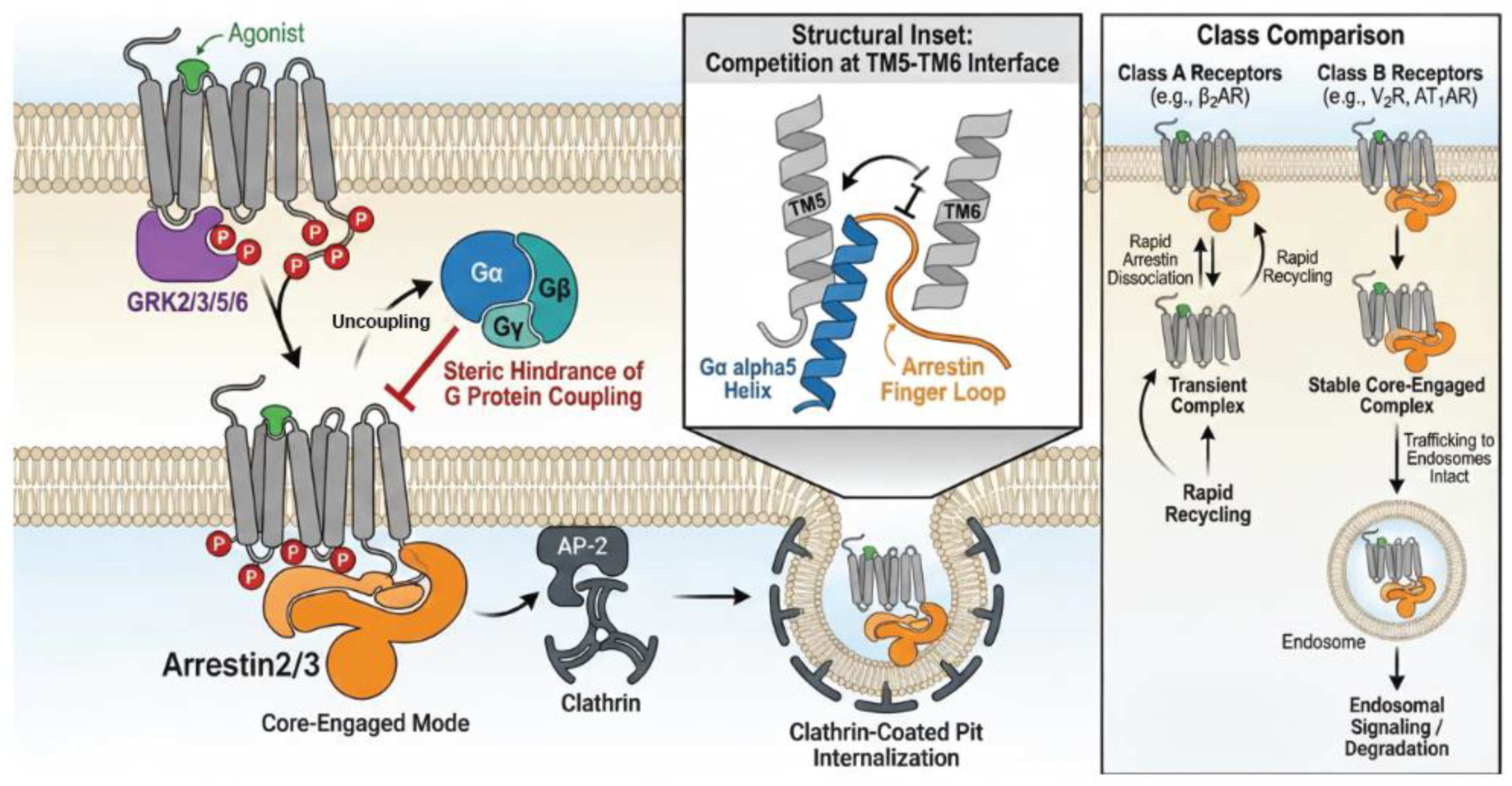
Figure 2.
EGFR transactivation as upstream gatekeeper and nuclear Gβγ trafficking.
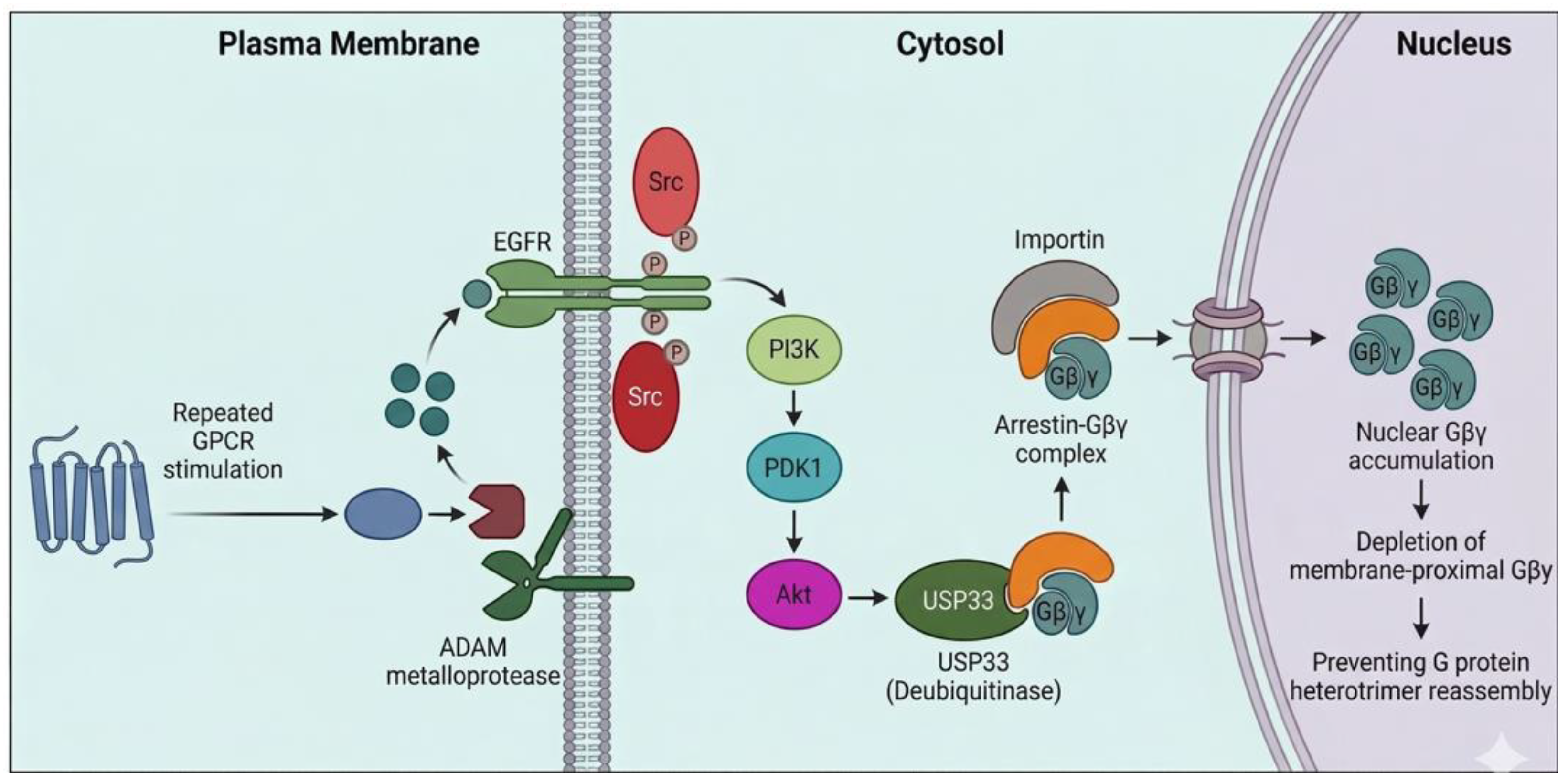
Figure 3.
Arrestin ubiquitination-state switch caused by the nuclear shuttling of Mdm2.
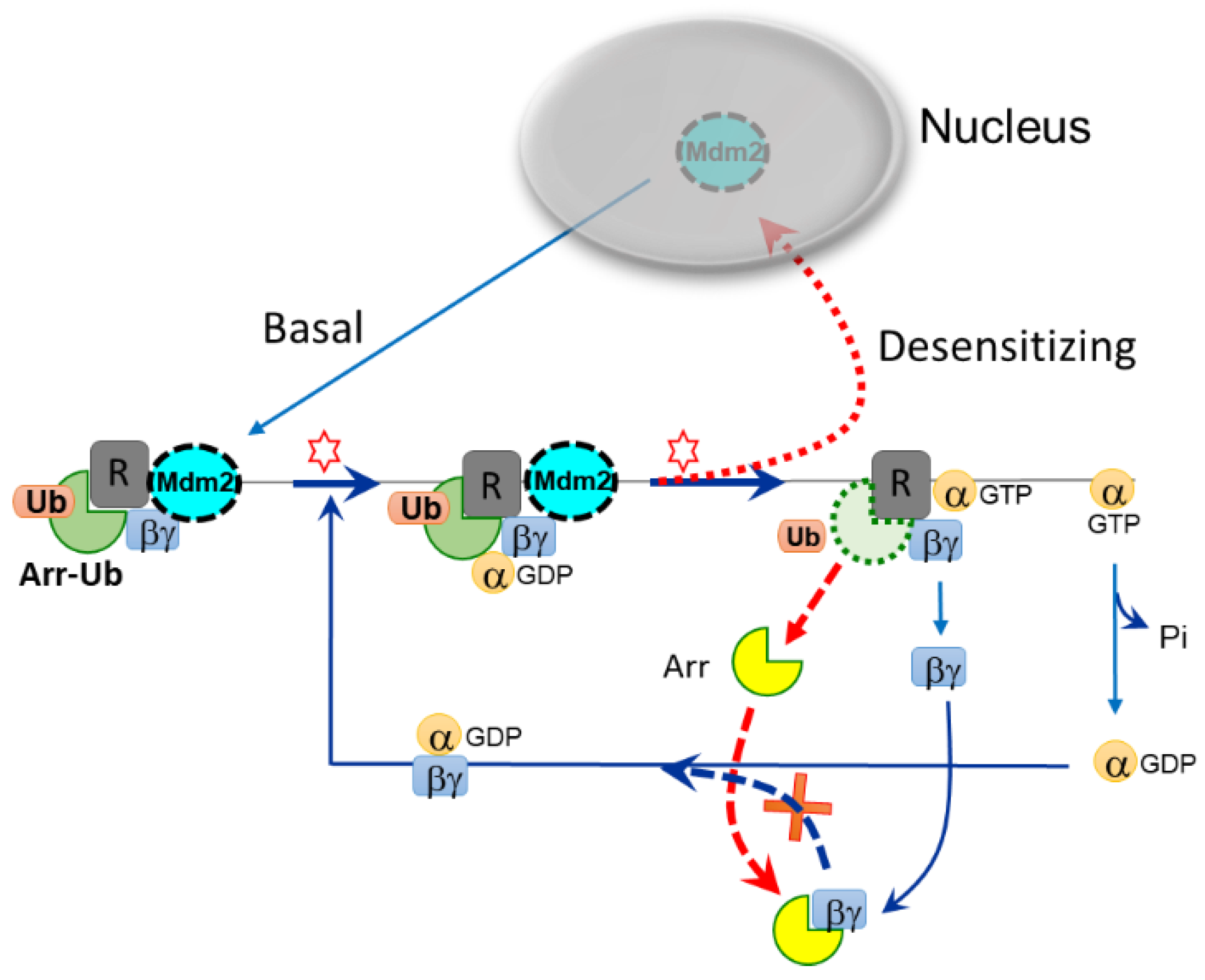
Figure 4.
Non-canonical GRK2/3-mediated Gαq and Gβγ sequestration.
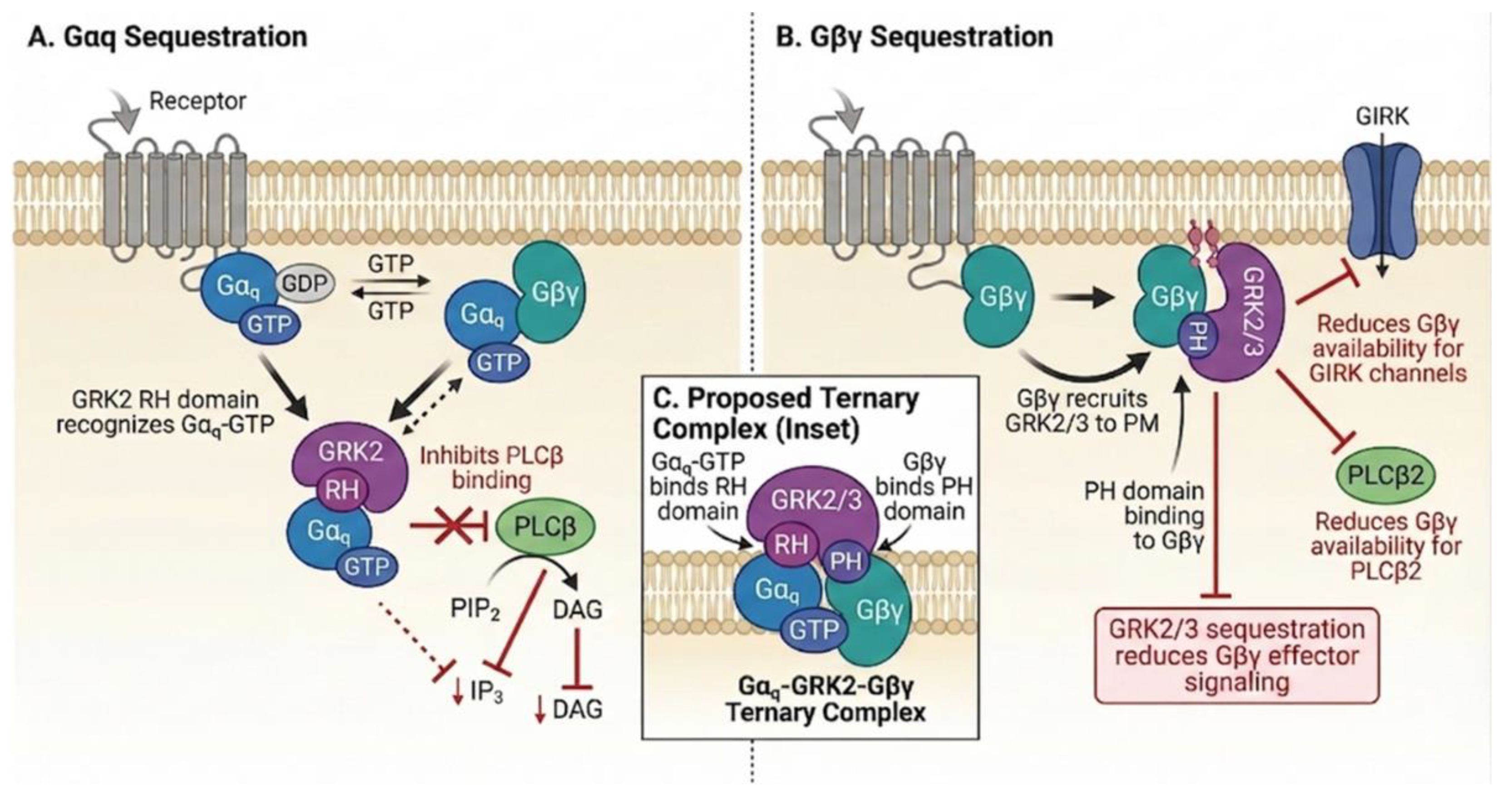
Figure 5.
Integrated model: multi-layered GPCR desensitization as signal-component redistribution.
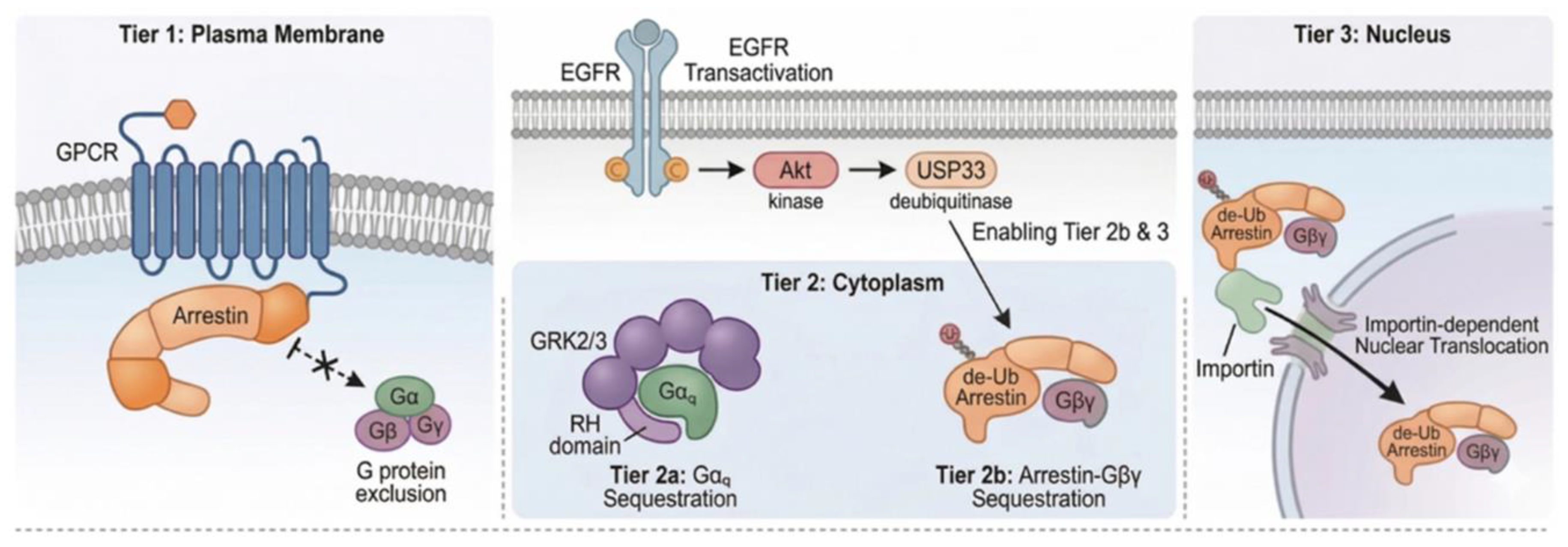

Table 1.
Comparison of Level 1 and Level 2 GPCR desensitization.
| Parameter | Level 1: proximal desensitization | Level 2: distal desensitization |
| Primary site of control | Receptor/plasma membrane | Redistribution of signaling components across compartments |
| Core mechanism | GRK-dependent phosphorylation, arrestin engagement, reduced receptor–G protein coupling | Arrestin deubiquitination-dependent sequestration of Gβγ and component limitation |
| Triggering condition | Acute receptor activation | Sustained stimulation with engagement of EGFR–Src–PDK1–Akt–USP33 relay |
| Temporal profile | Rapid | Delayed/progressive |
| Reversibility | Often readily reversible | More persistent and slower to reset |
| Principal readouts | Receptor phosphorylation, arrestin recruitment, initial uncoupling, internalization | Gβγ redistribution, altered subcellular localization, and durable signaling loss |
| Predictive value for long-term attenuation | Limited | High |
| Conceptual interpretation | Receptor-centered attenuation | Spatial reprogramming of signaling competence |
Disclaimer/Publisher’s Note: The statements, opinions and data contained in all publications are solely those of the individual author(s) and contributor(s) and not of MDPI and/or the editor(s). MDPI and/or the editor(s) disclaim responsibility for any injury to people or property resulting from any ideas, methods, instructions or products referred to in the content. |
© 2026 by the authors. Licensee MDPI, Basel, Switzerland. This article is an open access article distributed under the terms and conditions of the Creative Commons Attribution (CC BY) license (http://creativecommons.org/licenses/by/4.0/).
Copyright: This open access article is published under a Creative Commons CC BY 4.0 license, which permit the free download, distribution, and reuse, provided that the author and preprint are cited in any reuse.


