

Submitted:
08 April 2026
Posted:
09 April 2026
You are already at the latest version
Abstract
Platelet-rich plasma (PRP) is a commonly used intra-articular therapy for knee osteoarthritis (OA), yet substantial heterogeneity in PRP preparation and delivery limits comparability across trials and complicates clinical translation. We conducted a scoping review in accordance with PRISMA and PRISMA-ScR guidance. MEDLINE and Embase were searched from inception to 15 November 2025 for English-language randomized controlled trials comparing PRP with non-regenerative comparators (e.g., hyaluronic acid, corticosteroids, radiofrequency ablation, or saline placebo) in adults with knee OA. Data were charted on study characteristics, OA severity, injection guidance, centrifugation protocols, injected PRP volume and platelet concentration, dosing regimens, follow-up, adverse events, and overall conclusions (superior/non-inferior/inferior). Twenty-one studies (2012–2025) were included, spanning multiple regions and enrolling 21–288 participants per study with follow-up from 12 weeks to 60 months. PRP protocols varied widely, including single- versus double-spin centrifugation, spin rates and durations, injected volumes (approximately 1.4–8 mL), and platelet enrichment (approximately 1.15x to 9.85x baseline when reported). The most common regimen was three injections, typically weekly. Across studies, major adverse events were not reported, and post-injection pain or transient synovitis/effusion were the most frequent events. PRP for knee OA is generally safe and frequently demonstrates comparable or improved outcomes versus standard injectables, but marked protocol heterogeneity persists. Standardized reporting and consensus parameters for PRP preparation and administration are needed to improve reproducibility and guide evidence-based practice.
Keywords:
platelet-rich plasma
; knee osteoarthritis
; heterogeneity
1. Introduction
The role of platelets in the therapeutic and healing process has been thought to be secondary to the vast array of growth factors released in the context of tissue injury. The acquisition of platelet-rich plasma (PRP) furthers the concept of growth factor and cytokines action delivered at supraphysiologic concentrations to directly impact the site of injury, stimulating recovery and regeneration.[1] Its effects have been extensively investigated in the pathology of knee osteoarthritis (OA), with the latter driven by cartilage loss and concurrent synovial inflammation, altering the structural and functional balance of the joint.[2,3,4,5] In the intra-articular environment, PRP has been demonstrated to possess anti-inflammatory and immunomodulatory properties, promoting anabolic activities that mitigate the deterioration of the knee joint.[6] This has been attributed to the platelet alpha-granules releasing an abundance of growth factors, cytokines, and other bioactive molecules.[7] Given the prevalence of knee OA and the excess morbidity associated with the disease across the globe, the minimally invasive technique of intra-articular PRP delivery serves to be an attractive and relevant therapy in the management of this condition.[8,9,10]
At present, several commercially available devices are available to produce the appropriate quality and volume of PRP for clinical application. However, there is significant variation in the manner of preparation and delivery, including the time and speed of centrifugation, the final volume of PRP derived, platelet concentration achieved, the technique of injection, and the frequency of PRP delivery.[11,12] Our scoping review seeks to delineate the most commonly adopted parameters in the production and delivery of PRP knee injections associated with positive therapeutic outcomes without significant adverse events.
2. Methods
The scoping review was conducted in accordance with criteria defined by Preferred Reporting Items for Systematic Reviews and Meta-Analysis (PRISMA). Databases queried included MEDLINE and Embase and the query was performed on 15 November 2025 with time frame of article search set from database inception to 15 November 2025. The definition of search strategy was determined by two authors (QR and CR) and discussed and approved by all authors with necessary amendments made. Article screening and inclusion in the subsequent review were collectively performed by authors QR and CR and, in the event of disagreement, a third author was consulted for opinion. Data charting and summary were then completed in unison on calibrated templates determined prior to article selection. The data points collected included article publication year, country of study completion, patient number, study population age, gender ratio, Kellgren-Lawrence (KL) grade, injection guidance modality, PRP concentration injected, PRP volume injected, injection frequency, centrifuge setting, follow-up durations, complications, and study conclusions. Study conclusions are specifically categorized as superior when PRP outperformed therapeutic alternatives such as corticosteroids, hyaluronic acid (HA), or radiofrequency ablation; non-inferior when PRP was demonstrated to be equivalent in efficacy to alternative therapies; or inferior when PRP was demonstrated to be inferior to alternative therapeutic alternatives or equivalent to research placebos, most commonly saline. Critical appraisal and detailed statistical analyses were not performed in keeping with the delineated checklist published in PRISMA Extension for Scoping Reviews (PRISMA-ScR).[13] No funding was acquired for the study.
2.1. Search Strategy and Selection Criteria
A comprehensive search of PubMed was performed on 15 November 2025 adopting the following strategy: (“platelet rich plasma” OR “autologous conditioned plasma”) AND (“knee”) AND (“osteoarthritis” OR “degeneration” OR “gonarthrosis”). An identical strategy was carried out via query on Embase and the results are displayed in Figure 1.
2.2. Inclusion Criteria
The following inclusion criteria were selected: (1) studies with titles, articles, and abstracts written in the English language; (2) peer-reviewed randomized controlled trials (RCTs) comparing PRP against non-regenerative medicine alternatives; (3) studies including patients ≥ 18 years of age; and (4) studies exclusively investigating PRP effects on knee osteoarthritis.
2.3. Exclusion Criteria
The following exclusion criteria were adopted: (1) articles not written in English; (2) non-human studies; (3) individuals ≤ 18 years of age; (4) studies with multiple regenerative medicine modalities, in addition to PRP, in its treatment arms; (5) review articles, systematic analyses, or meta-analyses; (6) studies investigating pathologies other than knee osteoarthritis.
3. Results
A total of 21 independent articles were identified and incorporated into our review using the databases previously defined (Figure 1).[14,15,16,17,18,19,20,21,22,23,24,25,26,27,28,29,30,31,32,33,34] The articles selected were published between 2012 and 2025, with studies performed across North America, South America, Europe, and Asia. The total number of patients in each study ranged from 21 to 288, with follow-up durations ranging from 12 weeks to 60 months. Hyaluronic acid was used as the alternative injectate in close to half of the studies (n=10/21),[17,22,23,24,25,26,27,30,32,33] with the remaining being corticosteroid [15,21,28,33], radiofrequency ablation,[14,20] and saline placebo.[16,29,31,34] Captured patient population knee osteoarthritis severity ranged widely from Kellgren-Lawrence grades 0 to IV, and all articles reported at least one measurable clinical end point indicating degree of pain control or physical functionality. Twelve studies described the injection modalities adopted for their respective PRP therapies.[14,16,17,19,20,21,27,28,29,30,33,34] Ultrasound [16,19,20,21,30] and the landmark technique [17,27,28,29,34] were utilized in 5 studies each while fluoroscopy [14,33] was engaged in the remaining 2 studies. Article demographics and injection methodologies are summarized and presented in Table 1 and Table 2.
3.1. PRP Centrifugation Regimen
Eighteen studies defined centrifugation settings to attain the desired concentrations of PRP injectate (Table 2). Nine studies [14,16,21,24,28,29,31,33,34] performed a single spin, and the remaining 9 studies [18,19,20,22,23,25,26,30,32] performed a double spin. The lowest rates of the first and second spins were both 1500 revolutions per minute (rpm), while the longest were 3500 and 4000 rpm, respectively.[19,20,29,31] The shortest spin duration was a 5-minute single spin demonstrated in studies performed by Smith et al. [31] and Tschopp et al. [33], and the longest was performed by Dorio et al.[19] for a total of 22 minutes, split into a first spin of 12 minutes and a second spin of 10 minutes. [19]Smith et al.’s short-spin duration protocol achieved improvement in WOMAC score for the PRP group from 2 weeks following injection until study completion at 12 months (p < 0.001), which was statistically significantly superior to the saline group.[31] The long-spin duration protocol adopted by Dorio et al. yielded no difference in overall VAS pain scores between groups which received PRP, plasma, and saline (p = 0.499).[19] This was no different for all secondary measures involving WOMAC, QoL, PGA, ADL and TUGT scores.
3.2. PRP Injection Concentration
A total of 14 studies analyzed published, defined platelet concentrations in their injectates (Table 2). Concentration of platelets utilized for intra-articular injection ranged from a value close to patient’s baseline at 1.15 times of platelet enrichment to 9.85 times of platelet enrichment, demonstrated via the same study.[27] Out of the remaining 26 patients, platelet enrichment was achieved through at least 3.31 times of baseline concentration, and the study revealed equivalent efficacy between injectates containing PRP and HA after the third infiltration (p = 1.0), at 3 months (p = 0.227), and at 6 months (p = 1). Fossati et al. prepared platelets at a much lower concentration at approximately 1.8 times of baseline values for 116 patients, which is at the low end of the platelet concentration spectrum across all analyzed studies.[24] The study similarly demonstrated little difference between treatment groups PRP, HA, and PRP with HA measured via WOMAC (p = 0.45, 0.64), IKDC (p = 0.12, 1), KOOS (p = 0.15, 0.44), and VAS (p = 0.40, 0.65) at 6 and 12 months, respectively. Other included studies described platelet enrichment at magnitudes ranging from 2 to 5 times of patients’ baselines (Table 2).
3.3. PRP Injection Volume
Fifteen studies defined the volume of PRP injected during each treatment with volumes ranging from 1.4 mL to 8 mL (Table 2). Dorio et al. prepared PRP injectate concentrations at 1 x 10⁶ platelets/mm3, attaining PRP volumes ranging from 1.4 mL to 5 mL for each injection. The team compared efficacy of PRP against plasma and saline injections and were unable to elicit statistically significant advantage of PRP over the 2 alternatives, as measured using VAS and WOMAC.[19] The PRP group did demonstrate higher incidence of adverse events (p = 0.025) described as pain of mild or moderate intensity with a mean duration of 2.1 days. Elksniņš-Finogejevs et al. prepared higher volumes of PRP injectate at 8 mL per treatment, evaluating its efficacy against 40 mg triamcinolone acetonide and 5 mL of 2% lidocaine.[21] VAS score at 1 year demonstrated a significantly greater reduction in pain in the PRP group compared to the corticosteroid group (-3.1 ± 2.0 vs − 0.8 ± 1.8, p = 0.0002). Functional improvement of the joints was similar between the 2 groups (p > 0.05). It was noted that 15 patients in the PRP group developed a mild synovitis, which self-resolved without adverse events. Patel et al. similarly performed intra-articular injections with higher PRP volume of 8 mL.[29] The study evaluated efficacy of a single PRP injection versus 2 sequential injections and a third group of placebo saline injection. At every timepoint of follow-up, defined as 6 weeks, 3 months, and 6 months, pain, stiffness, and physical function were all superior in the first 2 groups using PRP injections compared to placebo (p < 0.001 for all categories). Out of the remaining articles, 6 and 4 papers described PRP injection volumes of 5 mL and 3 mL respectively, making them the most frequently injected volumes in our study selection (Table 2).
3.4. PRP Injection Frequency
The most popular therapeutic regimen was 3 PRP injections, with one performed each week (Table 2). Nine articles described this defined regimen, with 3 additional articles reporting 3 injections within the duration of one month and 3 injections spaced 2 weeks and 15 days apart, respectively.[24,25,27] In total, 12 articles described 3 consecutive doses of PRP as part of their therapeutic regimen. Eleven articles demonstrated superiority to saline injection and at least equivalent, if not improved, efficacy in pain control and function compared to alternative therapies, defined as either corticosteroids or HA. Only Bennell et al. failed to demonstrate superiority of PRP injections compared to saline, revealing no difference in pain or measured tibial cartilage volume as part of the primary outcome.[16]
The next most frequent injection regimen was a one-off single PRP injection to the joint described in 7 of the 21 articles. Out of the studies adopting low frequency single PRP injections, 2 failed to demonstrate PRP superiority compared to alternative therapy. Elawamy et al. showed that at 6 (p = 0.01) and 12 months (p = 0.04) that VAS and ISK were both superior in the pulsed radiofrequency ablation group.[20] Similarly Tschopp et al. did not find significant determination of pain and function being attributed to the content of the injectate, whether it is corticosteroid, HA, or PRP.[33]
Patel et al. included 2 groups, with the first being a single injection and the second being 2 injections of PRP spaced 3 weeks apart, incorporating both low frequency and intermediate frequency injection groups.[29] The team subsequently revealed no significant difference in pain score (p = 0.410) during follow-up at 6 months. Cerza et al. adopted the highest frequency of PRP injections, performing weekly injections for a total of 4 times.[17] At 4, 12, and 24 weeks, WOMAC scores were significantly lower in the PRP group compared to the HA group (p< 0.001 for each period).
3.5. Adverse Events
Significant major adverse events were not reported in any of the studies, and the most comprehensive capture of complications were carried out by Patel et al. where the group recorded in detail the incidence of syncope, dizziness, nausea, gastritis, sweating, tachycardia, pain, and stiffness.[29] Many of these were transient, lasting merely 30 minutes, and none led to any clinically-relevant consequences. The study further delineated correlation between total platelet injected and the incidence of event occurrence, noting a positive relationship (p = 0.02). Multiple other studies similarly demonstrated more minor events occurring in groups with PRP intervention, which self-resolved without long-term complications.[16,18,19,21,23,27,30,32]
4. Study Results
Seventeen of the 21 studies demonstrated at least equivalence in efficacy comparing PRP against alternative non-placebo therapy, defined as saline or a sham procedure with no intended therapeutic relevance aside from the placebo effect. Six of the 17 clearly demonstrated a significant therapeutic benefit and are therefore classified as superior (Table 2). In the superior group, Anwar et al. ran the study with the largest group of participants (n = 200), comparing a single PRP injection to genicular nerve ablation under fluoroscopic guidance.[14] Both groups showed a steady decrease in VAS from 2 weeks to 6 months following therapies. However, at 12 and 24 months, the recurrence of pain was significantly quicker in the RFA group, attaining VAS of 4.73 ± 2.63 and 6.06 ± 2.01 compared to PRP’s 2.99 ± 1.78 and 4.05 ± 1.82, respectively, over the same period, both with p values < 0.05.[14]
Eleven studies were considered non-inferior when pitted against alternative therapies of corticosteroids, HA, radiofrequency ablation, and local anesthetic. Chu et al. analyzed a total of 630 participants with 308 in the PRP group and 322 in the sham saline group.[18] The respective injectates were applied for a total of 3 times spaced 1 week apart. Although WOMAC scores were improved in both groups at 3 months, only the PRP group demonstrated sustained benefits at 48 months (p < 0.001). This result was similar when the authors looked at IKDC scores where the improvement remained significantly robust only in the PRP group up to 60 months (p < 0.001). The study also picked up on objective measurables such as TNF-alpha and IL-1B levels in synovial fluid and tibiofemoral cartilage volumes, with both demonstrating superiority in the PRP group (both p < 0.001).[18]
Of the remaining 4 studies considered therapeutically inferior, 3 demonstrated equivalent efficacy to saline while 1 was seen to be inferior to radiofrequency ablation (Table 2). The RESTORE trial randomized a total of 288 subjects to receive either PRP or saline injections for a total of 3 times spaced 1 week apart. At 12 months, despite pain score improvement favoring the PRP group, the difference failed to achieve statistical significance (-2.1, SD 2.7 PRP vs -1.8, SD 2.5 saline).[16] There was also no demonstrable difference between tibial cartilage volume change between the groups. The authors further delineated 12 secondary end points, including but not limited to knee effusion measures, areas of cartilage thinning, meniscus morphology, cartilage defect, and perceived global change. Only perceived global change at 2 (p = 0.02) and 12 months (p = 0.05) statistically favored the PRP group.
5. Discussion
Our scoping review showed the extensive variability present in the preparation and conduction of PRP injections in the management of knee osteoarthritis, ranging from centrifuge settings, PRP injectate volume and concentration, therapeutic frequency of injection, and the image-guidance modality, when adopted, during injection. This trend is perceived despite our extensive efforts in attempting to standardize the articles selected, excluding papers that compared multiple regenerative medicine treatment modalities to acquire discernable clinical outcomes when PRP was pitted against current standards of treatment or placebo. This review is therefore timely in delineating basic practice standards for PRP injection of the knee in attaining therapeutic efficacy while avoiding clinically significant complications.
Therapeutic efficacy of intra-articular knee injections while adopting various image-guidance techniques were explored in multiple studies. Lundstrom et al. explored ultrasound-guided intra-articular knee injection of HA compared to the traditional landmark technique (mostly suprapatellar bursa approach), measuring efficacy via subsequent arthroplasty rates and repeat HA and corticosteroid injections.[35] The authors revealed that knee arthroplasty rates were significantly reduced in the US-guided cohort compared to the pure landmark technique (33.2% vs 45.8%; p< 0.001). Furthermore, significantly fewer patients in the US-guided cohort received subsequent corticosteroid injection compared to the landmark-guided cohort (27.4% vs 34.0%; p< 0.002), suggesting greater accuracy in needle placement when US is adopted for injections.[35] This was corroborated in other studies where image-guidance, defined as US, fluoroscopy, or arthrography, substantially improved injection accuracy (98% accuracy) compared to landmark approaches using superolateral patellar and superomedial patellar techniques (87% and 82%, respectively).[36,37,38] Given repeated demonstration of superiority in efficacy of image-guidance in intra-articular knee injections, it would be prudent to adopt a suitable mode of image-guidance in PRP injections of the knee.
Given that conceptually, the clinical benefits of PRP are derived from growth factors, cytokines, and bioactive platelet molecules stored in platelet alpha granules, one would extrapolate that the concentration of platelets in the injectate would be determinant of therapeutic efficacy.[39] In vitro, it had been postulated that PRP concentration is directly associated with proliferation of certain mesenchymal cell lines, including mesenchymal stem cells, chondrocytes, osteoblasts, and fibroblasts.[40,41,42,43,44,45] Given that the normal human range of platelet concentration is between 150,000 to 450,000 platelets/µL, it was previously suggested that a 4-fold increase of platelets from this baseline could yield more predictable benefits.[46] Bensa et al. performed a sub analysis on platelet concentrations in their meta-analysis, defining low PRP concentration as < 800,000 platelets/µL and high concentration as 1 x 10⁶ ± 2 x 10⁵ platelets/µL.[47] The authors found that when compared against placebo in osteoarthritic knee injections, the high platelet concentration articles demonstrated statistical superiority in both VAS and WOMAC scores at 6 and 12 months. Bansal et al. seemingly corroborated this suggestion of high platelet count in their therapeutic injectate, their protocol attaining a mean platelet concentration of 14.38 ± 1.76 x 10⁵ platelets/µL. The authors further recommended an injection volume of 8 mL, suggesting that this regimen was crucial in achieving sustained chondroprotective effects up to 12 months out from initial treatment. Despite the definitions of concentration cut-offs being arbitrary, there may be value in attempting to achieve a higher platelet count in preparation of PRP injectates.
The frequencies of intra-articular PRP injections adopted in our selection of studies have been highly variable. Tao et al. determined in their meta-analysis that a triple-dose regimen of PRP injections is superior to a single dose in the treatment of osteoarthritic knee pain.[48] This was seen in a significantly lower VAS at 12 months (p < 0.0001) in studies with triple-dose regiments, and the frequency of adverse events registered were not significantly higher in the triple-dose regimen studies (p = 0.23). On the contrary, comparing double and single-dose regimens, neither the VAS (p = 0.50) nor the rate of adverse events (p = 0.28) were different between the single and double-dose regimens. Functionality was also shown to be improved measured using WOMAC and IKDC scores when adopting a multiple-injection regimen (p < 0.01).[49] Interestingly, the same study did not demonstrate an improvement in VAS between the single and multiple dosing groups (p = 0.48). Clinical practice guideline published by American Academy of Orthopedic Surgeons hinted at three intra-articular PRP injection being the standard that appeared to achieve more favorable clinical results.[50]
The safety profile of PRP knee injections has been relatively consistent in our review, with the most frequent complaint being a transient self-limiting localized inflammatory reaction (Table 2). A major clinical concern of intra-articular interventions is the deterioration of cartilage volume with successive therapy over the long run, while PRP in relation to current mainstream treatments of corticosteroids and HA appeared to be protective with respect to morphological cartilage parameters measured via quantitative MRI.[51] Overall, safety attributes of PRP given its autologous nature would continue to be one if its most reassuring features.
6. Limitations
Our study is constrained by its very nature of being a scoping review, and therefore no in-depth statistical analysis was performed. In addition, the immense variability in the manners in which the RCTs were performed made it exceptionally challenging to derive measured recommendations that could be standardized across the board. The individual RCT conclusions drawn, describing clinical outcomes of PRP against placebo, could not be interpreted meaningfully against that of a current standard of care, such as a corticosteroid injectate. These further compounds the difficulty making recommendations that could be implemented across guidelines.
7. Conclusions
PRP as a therapeutic modality in the treatment of knee osteoarthritis has proven itself to be safe and largely efficacious when compared against current standards of treatment involving corticosteroids and HA. While much more work in the future is needed to statistically ascertain the parameters for PRP delivery, a strategy of platelet concentration to 4 times of baseline followed by a total injection frequency of 3 sessions performed under reliable image-guidance would be a prudent one to adopt in the treatment of knee osteoarthritis.
Supplementary Materials
The following supporting information can be downloaded at the website of this paper posted on Preprints.org, Figure S1: title; Table S1: title; Video S1: title.
Author Contributions
QRZ, JJH, and CLR devised, wrote, and revised the manuscript. WL, JMH, VG, KA, DS, CL, RJK, SMF, and CY provided expert review, edited, and revised the manuscript.
Funding
Not applicable.
Institutional Review Board Statement
Not applicable.
Data Availability Statement
No new data were created or analyzed in this study.
Acknowledgments
Not applicable.
Conflicts of Interest
All authors declare no relevant conflicts of interest.
Abbreviations
- ACP — autologous conditioned plasma
- ADL — activities of daily living
- BMLs — bone marrow lesions
- CS — corticosteroids
- GNRFA — genicular nerve radiofrequency ablation
- HA — hyaluronic acid
- IKDC — International Knee Documentation Committee
- IL-1B — interleukin 1 beta
- ISK — Insall–Salvati knee score
- KL — Kellgren–Lawrence
- KOOS — Knee injury and Osteoarthritis Outcome Score
- KQoL-26 — Knee Quality of Life (26-item)
- OA — osteoarthritis
- PA-PRP — photo-activated platelet-rich plasma
- PGA — patient global assessment
- PRISMA — Preferred Reporting Items for Systematic Reviews and Meta-Analysis
- PRISMA-ScR — PRISMA Extension for Scoping Reviews
- PRP — platelet-rich plasma
- QoL — quality of life
- RCT — randomized controlled trial
- RFA — radiofrequency ablation
- rpm — revolutions per minute
- TUGT — Timed Up and Go Test
- TNF-alpha — tumor necrosis factor alpha
- Tx — treatment
- US — ultrasound
- VAS — visual analog scale
- WOMAC — Western Ontario and McMaster Universities Osteoarthritis Index
References
- Cole BJ, Seroyer ST, Filardo G, Bajaj S, Fortier LA. Platelet-rich plasma: Where are we now and where are we going? Sports Health 2010;2:203–10. [CrossRef]
- Bensa A, Previtali D, Sangiorgio A, Boffa A, Salerno M, Filardo G. PRP Injections for the Treatment of Knee Osteoarthritis: The Improvement Is Clinically Significant and Influenced by Platelet Concentration: A Meta-analysis of Randomized Controlled Trials. American Journal of Sports Medicine 2025;53:745–54. [CrossRef]
- Mobasheri A, Rayman MP, Gualillo O, Sellam J, van der Kraan P, Fearon U. The role of metabolism in the pathogenesis of osteoarthritis. Nat Rev Rheumatol 2017;13:302–11. [CrossRef]
- Mobasheri A, Batt M. An update on the pathophysiology of osteoarthritis. Ann Phys Rehabil Med 2016;59:333–9. [CrossRef]
- Jang S, Lee K, Ju JH. Recent Updates of Diagnosis, Pathophysiology, and Treatment on Osteoarthritis of the Knee. Int J Mol Sci 2021;22. [CrossRef]
- Azuma H, Yasuda K, Tohyama H, Sakai T, Majima T, Aoki Y, et al. Timing of administration of transforming growth factor-beta and epidermal growth factor influences the effect on material properties of the in situ frozen-thawed anterior cruciate ligament. J Biomech 2003;36:373–81. [CrossRef]
- Patton SL, Gustafson K, Castinado M, Latif U, Sayed D, Khan TW, et al. Platelet-rich plasma for treatment of knee osteoarthritis: a narrative review. Frontiers in Pain Research (Lausanne, Switzerland) 2026;7:1791542. [CrossRef]
- Cui A, Li H, Wang D, Zhong J, Chen Y, Lu H. Global, regional prevalence, incidence and risk factors of knee osteoarthritis in population-based studies. EClinicalMedicine 2020;29–30:100587. [CrossRef]
- Kan HS, Chan PK, Chiu KY, Yan CH, Yeung SS, Ng YL, et al. Non-surgical treatment of knee osteoarthritis. Hong Kong Med J 2019;25:127–33. [CrossRef]
- Wallace IJ, Worthington S, Felson DT, Jurmain RD, Wren KT, Maijanen H, et al. Knee osteoarthritis has doubled in prevalence since the mid-20th century. Proc Natl Acad Sci U S A 2017;114:9332–6. [CrossRef]
- Creaney L, Hamilton B. Growth factor delivery methods in the management of sports injuries: the state of play. Br J Sports Med 2008;42:314–20. [CrossRef]
- Marx RE. Platelet-rich plasma (PRP): what is PRP and what is not PRP? Implant Dent 2001;10:225–8. [CrossRef]
- Tricco AC, Lillie E, Zarin W, O’Brien KK, Colquhoun H, Levac D, et al. PRISMA Extension for Scoping Reviews (PRISMA-ScR): Checklist and Explanation. Ann Intern Med 2018;169:467–73. [CrossRef]
- Vardhan S, Anwar S, Aggarwal A, Waquar S, Vardhan M, Shoukat GAR, et al. Randomized Clinical Trial Safety and Efficacy of Platelet-Rich Plasma versus Genicular Nerve Radiofrequency Ablation in Knee Osteoarthritis: An Open-Label, Prospective, Randomized, Clinical Trial n.d.
- Bains SS, Swartz GN, Katanbaf R, Nace J, Bennett C, Mont MA, et al. Platelet-Rich Plasma Injections Are Inferior to Corticosteroid Injections for Short-Term Pain Relief: A Prospective, Double-Blinded, Randomized Controlled Trial. Journal of Arthroplasty 2025;40:S59–64. [CrossRef]
- Bennell KL, Paterson KL, Metcalf BR, Duong V, Eyles J, Kasza J, et al. Effect of Intra-Articular Platelet-Rich Plasma vs Placebo Injection on Pain and Medial Tibial Cartilage Volume in Patients with Knee Osteoarthritis: The RESTORE Randomized Clinical Trial. JAMA - Journal of the American Medical Association 2021;326:2021–30. [CrossRef]
- Cerza F, Carnì S, Carcangiu A, Di Vavo I, Schiavilla V, Pecora A, et al. Comparison between hyaluronic acid and platelet-rich plasma, intra-articular infiltration in the treatment of gonarthrosis. American Journal of Sports Medicine 2012;40:2822–7. [CrossRef]
- Chu J, Duan W, Yu Z, Tao T, Xu J, Ma Q, et al. Intra-articular injections of platelet-rich plasma decrease pain and improve functional outcomes than sham saline in patients with knee osteoarthritis. Knee Surgery, Sports Traumatology, Arthroscopy 2022;30:4063–71. [CrossRef]
- Dório M, Pereira RMR, Luz AGB, Deveza LA, de Oliveira RM, Fuller R. Efficacy of platelet-rich plasma and plasma for symptomatic treatment of knee osteoarthritis: a double-blinded placebo-controlled randomized clinical trial. BMC Musculoskelet Disord 2021;22. [CrossRef]
- Kamel EZ, Elawamy A, Kamel Z, Mahran SA, Abdellatif H, Hassanien M. Randomized Clinical Trial Efficacy of Genicular Nerve Radiofrequency Ablation Versus Intra-Articular Platelet Rich Plasma in Chronic Knee Osteoarthritis: A Single-Blind Randomized Clinical Trial From: 1 Anesthesia, ICU and pain management department n.d.
- Elksniņš-Finogejevs A, Vidal L, Peredistijs A. Intra-articular platelet-rich plasma vs corticosteroids in the treatment of moderate knee osteoarthritis: A single-center prospective randomized controlled study with a 1-year follow up. J Orthop Surg Res 2020;15. [CrossRef]
- Filardo G, Di Matteo B, Di Martino A, Merli ML, Cenacchi A, Fornasari P, et al. Platelet-rich plasma intra-articular knee injections show no superiority versus viscosupplementation: A randomized controlled trial. American Journal of Sports Medicine 2015;43:1575–82. [CrossRef]
- Filardo G, Kon E, Di Martino A, Di Matteo B, Merli ML, Cenacchi A, et al. Platelet-rich plasma vs hyaluronic acid to treat knee degenerative pathology: Study design and preliminary results of a randomized controlled trial. BMC Musculoskelet Disord 2012;13. [CrossRef]
- Fossati C, Randelli FMN, Sciancalepore F, Maglione D, Pasqualotto S, Ambrogi F, et al. Efficacy of intra-articular injection of combined platelet-rich-plasma (PRP) and hyaluronic acid (HA) in knee degenerative joint disease: a prospective, randomized, double-blind clinical trial. Arch Orthop Trauma Surg 2024;144:5039–51. [CrossRef]
- Ghorbani O, Mahdibarzi D, Yousefi-Tooddeshki P. Comparison of the short-term effect of intra-articular hyaluronic acid and platelet-rich plasma injections in knee osteoarthritis: a randomized clinical trial. J Prev Med Hyg 2024;65:E214–20. [CrossRef]
- Görmeli G, Görmeli CA, Ataoglu B, Çolak C, Aslantürk O, Ertem K. Multiple PRP injections are more effective than single injections and hyaluronic acid in knees with early osteoarthritis: a randomized, double-blind, placebo-controlled trial. Knee Surgery, Sports Traumatology, Arthroscopy 2017;25:958–65. [CrossRef]
- Montañez-Heredia E, Irízar S, Huertas PJ, Otero E, Del Valle M, Prat I, et al. Intra-articular injections of platelet-rich plasma versus hyaluronic acid in the treatment of osteoarthritic knee pain: A randomized clinical trial in the context of the Spanish national health care system. Int J Mol Sci 2016;17. [CrossRef]
- Nunes-Tamashiro JC, Natour J, Ramuth FM, Toffolo SR, Mendes JG, Rosenfeld A, et al. Intra-articular injection with platelet-rich plasma compared to triamcinolone hexacetonide or saline solution in knee osteoarthritis: A double blinded randomized controlled trial with one year follow-up. Clin Rehabil 2022;36:900–15. [CrossRef]
- Patel S, Dhillon MS, Aggarwal S, Marwaha N, Jain A. Treatment with platelet-rich plasma is more effective than placebo for knee osteoarthritis: A prospective, double-blind, randomized trial. American Journal of Sports Medicine 2013;41:356–64. [CrossRef]
- Paterson KL, Nicholls M, Bennell KL, Bates D. Intra-articular injection of photo-activated platelet-rich plasma in patients with knee osteoarthritis: A double-blind, randomized controlled pilot study. BMC Musculoskelet Disord 2016;17. [CrossRef]
- Smith PA. Intra-articular Autologous Conditioned Plasma Injections Provide Safe and Efficacious Treatment for Knee Osteoarthritis. American Journal of Sports Medicine 2016;44:884–91. [CrossRef]
- Spaková T, Rosocha J, Lacko M, Harvanová D, Gharaibeh A. Treatment of knee joint osteoarthritis with autologous platelet-rich plasma in comparison with hyaluronic acid. Am J Phys Med Rehabil 2012;91:411–7. [CrossRef]
- Tschopp M, Pfirrmann CWA, Fucentese SF, Brunner F, Catanzaro S, Kühne N, et al. A Randomized Trial of Intra-articular Injection Therapy for Knee Osteoarthritis. Invest Radiol 2023;58:355–62. [CrossRef]
- Yoshioka T, Arai N, Sugaya H, Taniguchi Y, Kanamori A, Gosho M, et al. The Effectiveness of Leukocyte-Poor Platelet-Rich Plasma Injections for Symptomatic Mild to Moderate Osteoarthritis of the Knee With Joint Effusion or Bone Marrow Lesions in a Japanese Population: A Randomized, Double-Blind, Placebo-Controlled Clinical Trial. American Journal of Sports Medicine 2024;52:2493–502. [CrossRef]
- Lundstrom ZT, Sytsma TT, Greenlund LS. Rethinking Viscosupplementation: Ultrasound- Versus Landmark-Guided Injection for Knee Osteoarthritis. J Ultrasound Med 2020;39:113–7. [CrossRef]
- Daley EL, Bajaj S, Bisson LJ, Cole BJ. Improving injection accuracy of the elbow, knee, and shoulder: does injection site and imaging make a difference? A systematic review. Am J Sports Med 2011;39:656–62. [CrossRef]
- Maricar N, Parkes MJ, Callaghan MJ, Felson DT, O’Neill TW. Where and how to inject the knee--a systematic review. Semin Arthritis Rheum 2013;43:195–203. [CrossRef]
- Daniels EW, Cole D, Jacobs B, Phillips SF. Existing Evidence on Ultrasound-Guided Injections in Sports Medicine. Orthop J Sports Med 2018;6:2325967118756576. [CrossRef]
- Filardo G, Kon E, Pereira Ruiz MT, Vaccaro F, Guitaldi R, Di Martino A, et al. Platelet-rich plasma intra-articular injections for cartilage degeneration and osteoarthritis: single- versus double-spinning approach. Knee Surg Sports Traumatol Arthrosc 2012;20:2082–91. [CrossRef]
- Gruber R, Karreth F, Kandler B, Fuerst G, Rot A, Fischer MB, et al. Platelet-released supernatants increase migration and proliferation, and decrease osteogenic differentiation of bone marrow-derived mesenchymal progenitor cells under in vitro conditions. Platelets 2004;15:29–35. [CrossRef]
- Han J, Meng HX, Tang JM, Li SL, Tang Y, Chen ZB. The effect of different platelet-rich plasma concentrations on proliferation and differentiation of human periodontal ligament cells in vitro. Cell Prolif 2007;40:241–52. [CrossRef]
- Liu Y, Kalén A, Risto O, Wahlström O. Fibroblast proliferation due to exposure to a platelet concentrate in vitro is pH dependent. Wound Repair Regen 2002;10:336–40. [CrossRef]
- Markopoulou CE, Markopoulos P, Dereka XE, Pepelassi E, Vrotsos IA. Effect of homologous PRP on proliferation of human periodontally affected osteoblasts. In vitro preliminary study. Report of a case. J Musculoskelet Neuronal Interact 2009;9:167–72.
- Mishra A, Tummala P, King A, Lee B, Kraus M, Tse V, et al. Buffered platelet-rich plasma enhances mesenchymal stem cell proliferation and chondrogenic differentiation. Tissue Eng Part C Methods 2009;15:431–5. [CrossRef]
- Slapnicka J, Fassmann A, Strasak L, Augustin P, Vanek J. Effects of activated and nonactivated platelet-rich plasma on proliferation of human osteoblasts in vitro. J Oral Maxillofac Surg 2008;66:297–301. [CrossRef]
- Cole BJ, Seroyer ST, Filardo G, Bajaj S, Fortier LA. Platelet-rich plasma: Where are we now and where are we going? Sports Health 2010;2:203–10. [CrossRef]
- Bensa A, Previtali D, Sangiorgio A, Boffa A, Salerno M, Filardo G. PRP Injections for the Treatment of Knee Osteoarthritis: The Improvement Is Clinically Significant and Influenced by Platelet Concentration: A Meta-analysis of Randomized Controlled Trials. American Journal of Sports Medicine 2025;53:745–54. [CrossRef]
- Tao X, Aw AAL, Leeu JJ, Bin Abd Razak HR. Three Doses of Platelet-Rich Plasma Therapy Are More Effective Than One Dose of Platelet-Rich Plasma in the Treatment of Knee Osteoarthritis: A Systematic Review and Meta-analysis. Arthroscopy 2023;39:2568-2576.e2. [CrossRef]
- Vilchez-Cavazos F, Millán-Alanís JM, Blázquez-Saldaña J, Álvarez-Villalobos N, Peña-Martínez VM, Acosta-Olivo CA, et al. Comparison of the Clinical Effectiveness of Single Versus Multiple Injections of Platelet-Rich Plasma in the Treatment of Knee Osteoarthritis: A Systematic Review and Meta-analysis. Orthop J Sports Med 2019;7. [CrossRef]
- Dubin J, Leucht P, Murray M, Pezold R, Staff of the American Academy of Orthopaedic Surgeons on Behalf of the Platelet-Rich Plasma (PRP) for Knee Osteoarthritis Technology Overview Workgroup and Contributors. American Academy of Orthopaedic Surgeons Technology Overview Summary: Platelet-Rich Plasma (PRP) for Knee Osteoarthritis. J Am Acad Orthop Surg 2024;32:296–301. [CrossRef]
- Tschopp M, Pfirrmann CWA, Brunner F, Fucentese SF, Galley J, Stern C, et al. Morphological and Quantitative Parametric MRI Follow-up of Cartilage Changes Before and After Intra-articular Injection Therapy in Patients With Mild to Moderate Knee Osteoarthritis: A Randomized, Placebo-Controlled Trial. Invest Radiol 2024;59:646–55. [CrossRef]
Figure 1.
PRISMA Flowchart overview of scoping review analysis.
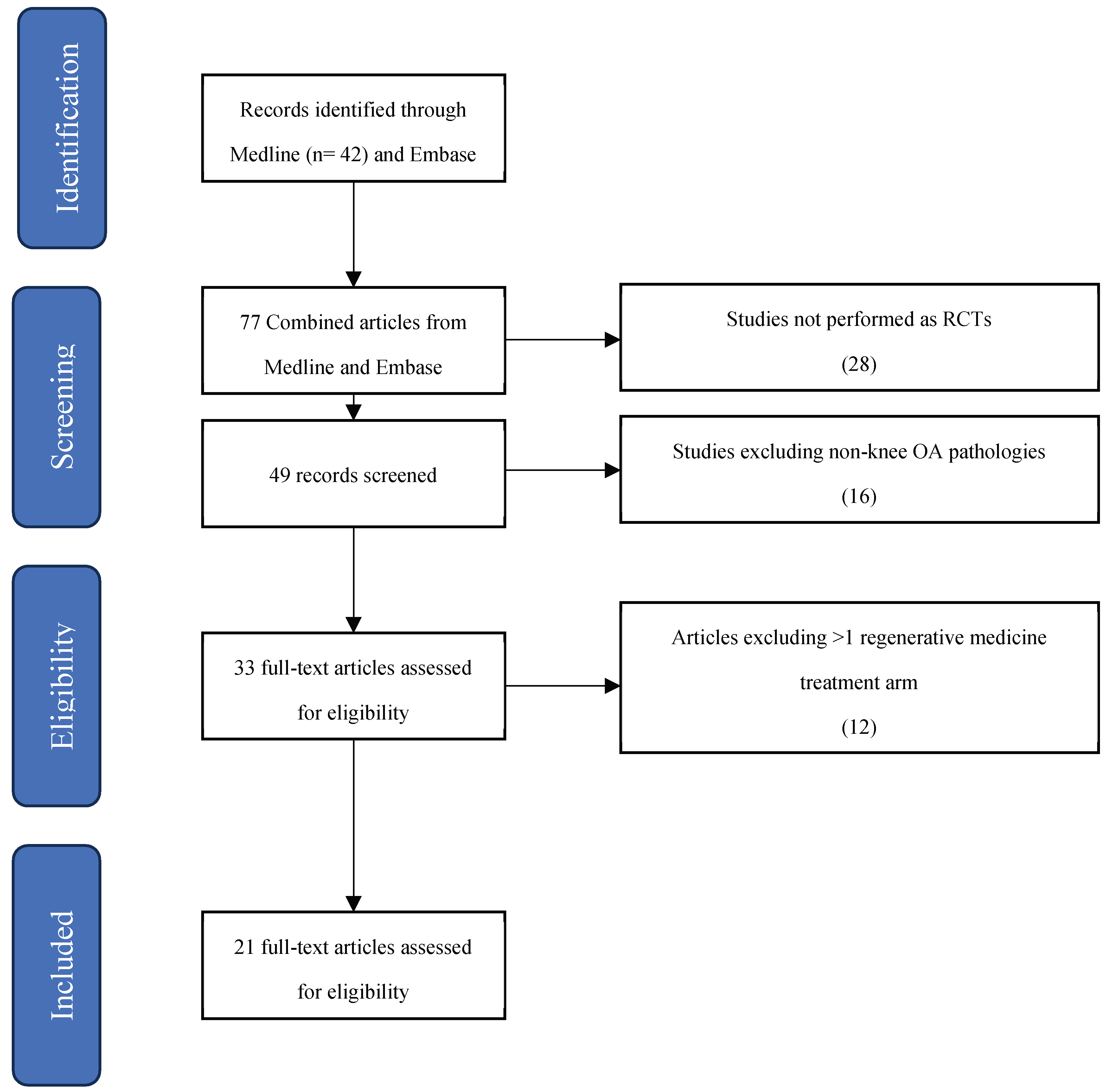

Table 1.
Study demographics, osteoarthritis severity and therapy injection modalities. AB: Ahlback; KL: Kellgren-Lawrence; OA: osteoarthritis; PRP: platelet-rich plasma; SD: standard deviation; Tx: treatment.
Table 1.
Study demographics, osteoarthritis severity and therapy injection modalities. AB: Ahlback; KL: Kellgren-Lawrence; OA: osteoarthritis; PRP: platelet-rich plasma; SD: standard deviation; Tx: treatment.
| Author/ Year | Study Country | Total Patients (n) | Age (PRP vs Alternative) | PRP Gender Ratio (M:F) | Alternative Tx Gender Ratio (M:F) | OA Severity Grade | PRP Injection Modality |
|---|---|---|---|---|---|---|---|
| Anwar et al., 2025 | Pakistan | 200 | 56 ± 5.90 vs 55.63 ± 6.21 | 33:67 | 42:58 | KL II–III | Fluoroscopy |
| Bains et al., 2025 | USA | 52 | 52 ± 15.6 vs 48 ± 15.6 | 5:21 | 7:19 | KL II-III | Undefined |
| Bennell et al., 2021 | Australia | 288 | 62.2 ± 6.3 vs 61.6 ± 6.6 | 59:85 | 60:84 | KL II–III | Ultrasound |
| Cerza et al., 2012 | Italy | 120 | 66.5 ± 11.3 vs 66.2 ± 10.2 | 23:35 | 28:32 | KL I-III | Landmark |
| Chu et al., 2022 | China | 610 | 53.91 ± 5.0 vs 54.51 ± 5.1 | 41:59 | - | Undefined | Undefined |
| Dorio et al., 2021 | Brazil | 62 | 66.4 ± 5.6 vs 66.1 ± 7.5 vs 62.5 ± 8.1 | 1:19 | 2:19 vs 2:19 | KL II-III | Ultrasound |
| Elawamy et al., 2021 | Egypt | 200 | 48.45 ± 7.7 vs 47.78 ± 6.9 | 50:50 | 49:51 | KL III-IV | Ultrasound |
| Elksniņš-Finogejevs 2020 | Latvia | 40 | 66.4 ± 8.4 vs 70.2 ± 9.2 | 17:3 | 15:5 | KL II–III | Ultrasound |
| Filardo 2012 | Italy | 109 | 55 vs 58 | 37:17 | 31:24 | KL 0-III | Undefined |
| Filardo 2015 | Italy | 192 | 53.32 ± 13.2 vs 57.55 ± 11.8 | 60:34 | 52:37 | KL 0–III | Undefined |
| Fossati 2024 | Italy | 173 | 60.37 ± 12.91 vs 60.66 ± 11.19 | 23:34 | 19:39 | KL III and under | Undefined |
| Ghorbani 2024 | Iran | 90 | 60.24 ± 1.97 vs 61.90 ± 2.06 | 15:26 | 18:26 | KL I–III | Undefined |
| Gormeli 2017 | Turkey | 162 | 53.7 ± 13.1 vs 53.8 ± 13.4 vs 53.5 ± 14 vs 52.8 ± 12.8 | 16:23; 19:25 | 17:22; 20:20 | KL 0-IV | Undefined |
| Montañez-Heredia 2016 | Spain | 53 | 66.3 ± 8.3 vs 61.5 ± 8.6 | 12:15 | 9:17 | KL I–III | Landmark |
| Nunes-Tamashiro 2022 | Brazil | 100 | 67.6 ± 7.4 vs 65.8 ± 6.1 vs 68 ± 6.2 | 4:30 | 3:30; 3:30 | KL II–III | Landmark |
| Patel 2013 | India | 156 | 53.11 ± 11.55 vs 51.64 ± 9.22 vs 53.65 ± 8.17 | 11:16; 5:20 | 6:17 | AB I-II | Landmark |
| Paterson 2016 | Canada | 21 | 49.91 ± 13.72 vs 52.70 ± 10.30 | 8:3 | 7:3 | KL II-III | Ultrasound |
| Smith 2016 | USA | 30 | 53.53 ± 8.22 vs 46.60 ± 9.37 | 5:10 | 6:9 | KL II-III | Undefined |
| Spaková 2012 | Slovakia | 120 | 52.80 ± 12.43 vs 53.20 ± 14.53 | 33:27 | 31:29 | KL I–III | Undefined |
| Tschopp 2023 | Switzerland | 120 | 62.00 (56.00, 68.00) vs 64.00 (54.75, 72.00) vs 59.00 (49.00, 65.00) vs 58.00 (54.00, 61.00) | 13:17 | 11:19; 16:14; 12:18 | KL I–III | Fluoroscopy |
| Yoshioka 2024 | Japan | 30 | 65.9 ± 6 8.0 vs 67.9 ± 6 10.7 | 3:12 | 6:9 | KL II–III | Landmark |
Table 2.
Study PRP preparation protocols, conclusions and complications. F/U: follow-up; HA: Hyaluronic acid; PRP: platelet-rich plasma; RPM: revolutions per minute.
Table 2.
Study PRP preparation protocols, conclusions and complications. F/U: follow-up; HA: Hyaluronic acid; PRP: platelet-rich plasma; RPM: revolutions per minute.
| Author/ Year | Mean PRP Concentration | PRP Volume Injected | PRP Injection Regimen | Centrifuge Setting | Comparative Tx Modality | Longest f/u Duration | Study Conclusion | Conclusion Grading | Complications |
|---|---|---|---|---|---|---|---|---|---|
| Anwar et al., 2025 | Undefined | Undefined | Single, x1 | 1000g for 10 mins | RFA | 24 months | PRP superior long-term to GNRFA | Superior | None observed |
| Bains et al., 2025 | Undefined | 3 mL | Single, x1 | Undefined | Steroid: Triamcinolone 1mL + 1% Lidocaine 4mL | 3 months | CS better short-term at 6 weeks; Both improved pain from baseline at 3 months without significant difference in magnitude | Non-inferior | None observed |
| Bennell et al., 2021 | 1.6 - 5x baseline | 5 mL | Weekly, x3 | 1500g 5 mins | Saline placebo | 12 months | Intra-articular injection of PRP, compared with injection of saline placebo, did not result in a significant difference in symptoms or joint structure at 12 months | Inferior | More in the PRP group reported pain, swelling, and stiffness after injections but none severe. |
| Cerza et al., 2012 | Undefined | 5.5 mL | Weekly, x4 | Undefined | HA | 24 weeks | PRP superior to HA at 6 mo with improved WOMAC score | Superior | Not reported |
| Chu et al., 2022 | 4.3x baseline | 5 mL | Weekly, x3 | 3200 rpm 5 mins, 3300 rpm 3 mins | Saline placebo | 60 months | PRP superior to saline up to 5 yrs | Non-inferior | In 3 PRP cases, mild pain was present during the first 1 or 2 days. One case of severe pain spontaneously resolved after 1 week. |
| Dorio et al., 2021 | 3x baseline | 1.4 - 5 mL | Bi-weekly, x2 | 1500 rpm 12 mins, 2300 rpm 10 mins with 10 mins interval | Plasma and saline | 24 weeks | The primary outcome, VAS for overall pain at 24 weeks, demonstrated significant improvement in the 3 groups, without statistical difference between them | Inferior | Adverse effects twice as frequent in PRP group with the most frequent reported being mild to moderate knee pain with a mean duration of 2 days. |
| Elawamy et al., 2021 | >3x baseline | 5-6 mL | Single, x1 | 3500 rpm 10 mins, 4000 rpm 7 mins | RFA | 12 months | Pulsed RF can offer more sustained pain relief and hence better patient satisfaction when compared to intraarticular injection of PRP | Inferior | 2 ablation patients experienced pain that resolved in a week, one patient in the PRP group had joint effusion which resolved with conservative management |
| Elksniņš-Finogejevs 2020 | Undefined | 8 mL | Single, x1 | 1800 rpm 8 mins | Steroid: Triamcinolone 40mg | 12 months | PRP superior to CS by 15 wks | Superior | 15 patients (75%) in the PRP group within the first week after treatment which resolved spontaneously |
| Filardo et al., 2012 | 5x baseline | Undefined | Weekly, x3 | 1480 rpm 6 mins, 3400 rpm 15 mins | HA | 12 months | No significant difference between PRP vs HA | Non-inferior | Significantly higher post-injective pain reaction in PRP group but none major |
| Filardo et al., 2015 | 4.6 ± 1.4x baseline | Undefined | Weekly, x3 | 1480 rpm 6 mins, 3400 rpm 15 mins | HA | 12 months | No superiority of either modality; both improved | Non-inferior | None observed |
| Fossati et al., 2024 | 1.8x baseline | Undefined | Bi-weekly, x3 | 3500 rpm 5 mins | HA | 12 months | No difference among PRP+HA, PRP, HA | Non-inferior | Sixty-four patients reported at least one adverse event, which in 92.3% of cases consisted of increased knee pain or knee swelling. Nonetheless, no significant differences among the three groups were encountered in the adverse events characteristics: throughout the whole duration of the study. No serious adverse events related to any intraarticular injection regimen were reported (Table S13— supplementary materials) |
| Ghorbani et al., 2024 | Undefined | 5 mL | x3 in 1 month | 1600 rpm 15 mins, 2800 rpm 7 mins | HA | 5 months | PRP better than HA in pain control and function | Superior | None observed |
| Gormeli et al., 2017 | 5.2 - 5.2x baseline | 5 mL | Weekly, x1-3 | 1500 rpm 6 mins, 3500 rpm 12 mins | HA | 6 months | For patients with early OA, multiple (3) PRP injections are useful in achieving better clinical results. For patients with advanced OA, multiple injections are unnecessary and do not significantly affect patient knee scores. | Superior | Not reported |
| Montañez-Heredia et al., 2016 | 1.15 - 9.80x baseline | Undefined | q15 days, x3 | Double centrifugation, spin rpm undefined | HA | 6 months | PRP injections proved to be effective in reducing pain and improving patient functionality with an effectiveness pattern comparable to the control treatment (HA) | Non-inferior | Pain related to infiltration in nine of 27 PRP injections and in four of 26 for HA, but only one patient (in PRP group) had transitory swelling that resolved itself |
| Nunes-Tamashiro et al., 2022 | 2.5 - 5x baseline | Undefined | Single, 1x | 1200 rpm 10 mins | Steroid: Triamcinolone; saline | 6 months | The effectiveness of the intra-articular knee injection with Triamcinolone Hexacetonide, Platelet–Rich Plasma or Saline was similar to pain, range of motion, quality of life, and functional tests at 52 weeks of follow-up. | Non-inferior | None observed |
| Patel et al., 2013 | 2–3× baseline | 8 mL | Single vs q3 wkly x2 | 1500 rpm 15 mins | Saline placebo | 6 months | short-term effectiveness of PRP injection over a placebo for relieving pain and stiffness and improving knee functions in early knee OA. There are more benefits in early OA, and in our experience, a single dose of PRP is as effective as a double dose. | Non-inferior | Significantly more adverse effects in PRP groups with symptoms of syncope, dizziness, headache, nausea, gastritis, sweating, tachycardia, pain and stiffness |
| Paterson et al., 2016 | Undefined | 3 mL | Weekly, x3 | 2000 rpm for 5 mins, 3000 rpm for 3 mins | HA | 12 weeks | PA-PRP improves self-reported pain, subscales of the KOOS and KQoL-26, and tests of lower extremity functional ability in knee OA patients, but not more so than HA | Non-inferior | 2 from the PRP group experienced minor pain and swelling which resolved in a week |
| Smith et al., 2016 | Undefined | 4 - 7.1 mL | Weekly, x3 | 1500 rpm 5 mins | Saline placebo | 12 months | ACP is safe and provides quantifiable benefits for pain relief and functional improvement with regard to knee OA. | Non-inferior | 1 patient in the placebo group felt pain in the target leg |
| Spaková et al., 2012 | 4.5x baseline | 3 mL | Weekly, x3 | 3200 rpm 15 mins, 1500prm 10 mins, 3200 rpm for 10 mins | HA | 6 months | PRP superior to HA | Superior | Temporary mild worsening of pain after PRP in six cases, which was spontaneously resolved after 2 days |
| Tschopp et al., 2023 | ~500 x 10^3/ μL | 3mL | Single, x1 | 1500 rpm 5 mins | HA; Steroid; Saline placebo | 24 months | The post hoc contrasts for the effect model showed no significant differences between the effects of placebo or glucocorticoid and the other drugs within the first 6 months after injection | Inferior | One patient experienced facial redness and palpitations immediately after glucocorticoid injection and presented with knee joint swelling with effusion at 3 months, but no signs of infection. The other patient experienced nausea and vomiting immediately after receiving the glucocorticoid. |
| Yoshioka et al., 2024 | 475.4 ± 106.7 x 10^3 /μL | 6 mL | Weekly, x3 | 2100rpm 8 mins | Saline placebo | 24 weeks | PRP superior; BMLs reduced | Non-inferior | Not reported |
Disclaimer/Publisher’s Note: The statements, opinions and data contained in all publications are solely those of the individual author(s) and contributor(s) and not of MDPI and/or the editor(s). MDPI and/or the editor(s) disclaim responsibility for any injury to people or property resulting from any ideas, methods, instructions or products referred to in the content. |
© 2026 by the authors. Licensee MDPI, Basel, Switzerland. This article is an open access article distributed under the terms and conditions of the Creative Commons Attribution (CC BY) license (http://creativecommons.org/licenses/by/4.0/).
Copyright: This open access article is published under a Creative Commons CC BY 4.0 license, which permit the free download, distribution, and reuse, provided that the author and preprint are cited in any reuse.


