

Submitted:
08 April 2026
Posted:
09 April 2026
You are already at the latest version
Abstract
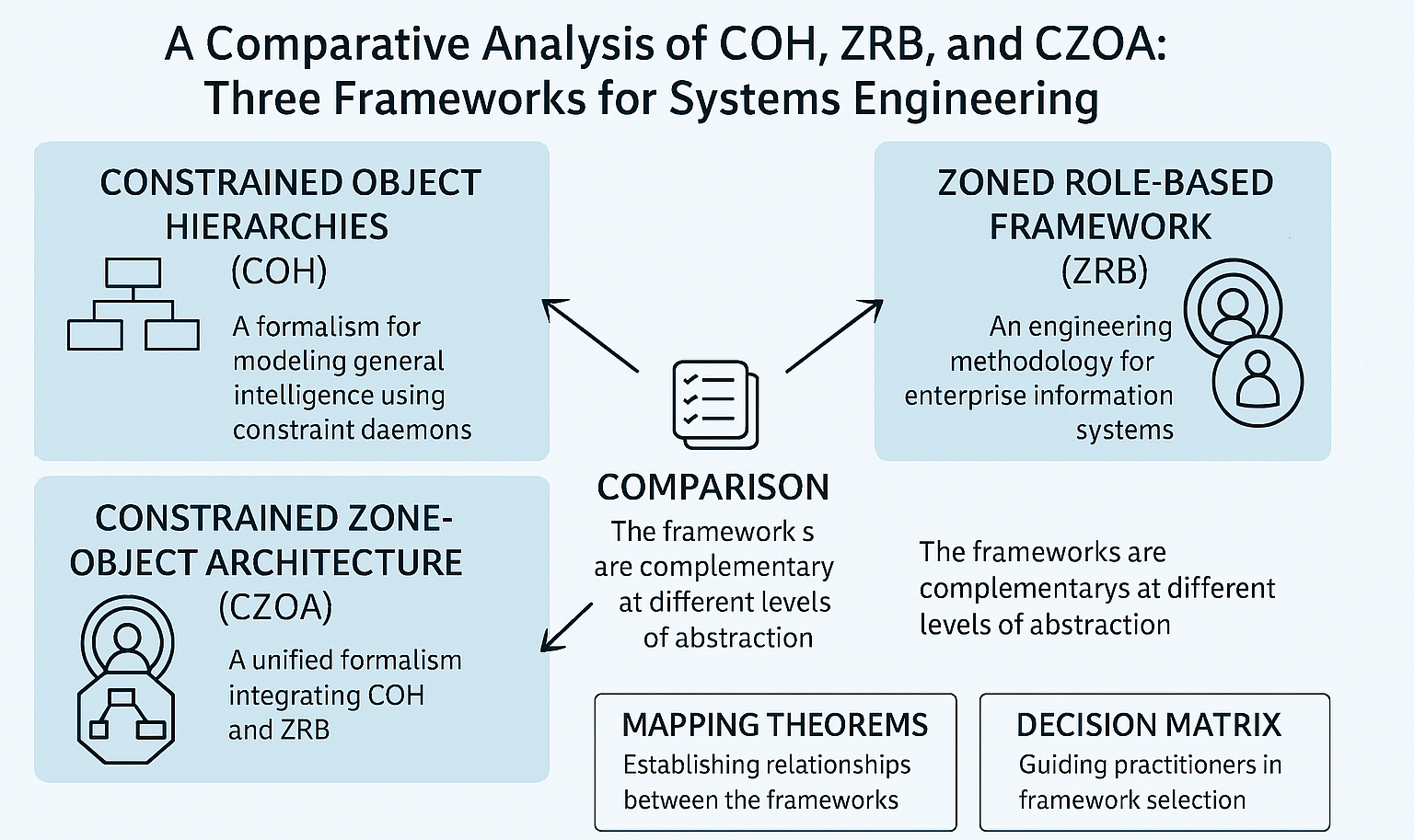
The engineering of complex intelligent systems faces a fundamental challenge: theoretical frameworks for general intelligence and practical methodologies for enterprise system development have evolved along separate trajectories, creating a fragmentation that hinders progress toward unified solutions. This paper presents a comprehensive comparative analysis of three interrelated frameworks developed by the author: the Constrained Object Hierarchies (COH) 9-tuple, a mathematically rigorous formalism for modeling general intelligence; the Zoned Role-Based (ZRB) framework, a methodology for designing, implementing, and maintaining secure enterprise information systems; and the Constrained Zone-Object Architecture (CZOA), a unified formalism that integrates COH and ZRB. Through comparative analysis, we demonstrate that these frameworks are not competing alternatives but complementary tools at different levels of abstraction: COH provides a universal theory of intelligence, ZRB offers an engineering methodology for organizational systems, and CZOA bridges the two by enabling intelligent behavior within zoned enterprise architectures. Formal mapping theorems establish the relationships between frameworks, and a decision matrix guides practitioners in selecting the appropriate framework for their specific needs. We also provide an analytical study of key framework properties, including constraint enforcement mechanisms, to support evidence-based framework selection.
Keywords:
constrained object hierarchies
; zoned role-based architecture
; constrained zone-object architecture
; intelligent systems
; enterprise engineering
; formal methods
; comparative analysis
Copyright: This open access article is published under a Creative Commons CC BY 4.0 license, which permit the free download, distribution, and reuse, provided that the author and preprint are cited in any reuse.


