

Submitted:
06 April 2026
Posted:
09 April 2026
You are already at the latest version
Abstract
The Junggar Basin (NW China) is a polycyclic intracontinental basin formed within the Central Asian Orogenic Belt and characterized by multi-stage tectonic reactivation and composite petroleum systems. This study integrates tectonic evolution, source rock geochemistry, and basin modeling to clarify the spatial–temporal controls on hydro-carbon generation and accumulation. The basin evolved from Late Paleozoic rifting to Carboniferous–Permian collision, followed by Mesozoic thermal subsidence and Ce-nozoic inversion related to the uplift of the Tianshan. Major source rocks include Car-boniferous marine shales (total organic carbon 1.5–5%), Permian lacustrine deposits (up to 10–12% total organic carbon; hydrogen index up to 700 mg HC/g TOC), and Ju-rassic coal-bearing strata. Thermal maturity ranges from 0.6% to >2.0% vitrinite re-flectance, indicating multi-phase oil and gas generation and secondary cracking in deeply buried depocenters. Hydrocarbon accumulation differs across structural zones. Central depressions are dominated by deep gas generation and composite traps, whereas northwestern segments reflect lateral migration from Permian source kitch-ens. Cenozoic inversion significantly reactivated faults and controlled vertical migra-tion pathways. The results highlight that hydrocarbon distribution in the Junggar Ba-sin is governed by the synchronization of tectonic evolution and generation phases, providing predictive insights for exploration in polycyclic inversion basins.
Keywords:
Junggar Basin
; marginal basin
; structural evolution
; source rock
; petroleum system
; hydrocarbon accumulation zone
1. Introduction
Polycyclic intracontinental sedimentary basins formed within ancient accretionary and collisional belts represent some of the most complex objects in petroleum geology. Their evolution is characterized by multi-stage changes in geodynamic regimes – from rift-related extension to collisional compression, subsequent tectonic inversion, and reactivation under the remote influence of major plate collisions [1,2,3,4]. In such basins, the processes of hydrocarbon generation, migration, and accumulation are multi-stage and lead to the formation of composite petroleum systems with spatio-temporal superimposition of source rocks of different ages [5,6,7,8].
Global research experience indicates that repeated tectonic reactivation significantly influences the basin's thermal regime, the maturity of source rock sequences, and the preservation of accumulations [2,4,6,9]. Inverted foreland and intracontinental basins often host multi-level accumulation systems, characterized by multiple charging phases and hydrocarbon redistribution along fault zones [6,7,8]. Similar patterns have been established for basins in Central Asia, including the Tarim Basin and the Ordos Basin [10,11,12,13].
The Junggar Basin is situated between the Altai, Tarbagatai, and Tien Shan mountains and formed in the closure zone of the Paleo-Asian Ocean, followed by intracontinental reactivation of the Eurasian Plate [14,15]. Its tectonic history includes a Late Devonian-Early Carboniferous rifting stage, a Late Carboniferous-Permian collisional foreland stage, a Mesozoic intracontinental depression stage, and Cenozoic reactivation related to the Indo-Asian collision [14,15,16].
This polycyclic evolution resulted in the formation of multiple source rock complexes, differing in their organic matter composition, generative potential, and thermal maturity. Their generalized geochemical parameters are presented in Table 1.
Permian sources are characterized by the highest oil generation potential, confirmed by elevated TOC and HI values [16,17,18]. Carboniferous strata have attained the highest degree of thermal maturity and play a key role in deep gas generation [14,16]. Jurassic and Paleogene sources possess a more limited generation potential and are of local significance [17,18,19].
The thermal evolution of the sources was controlled by burial depth (up to 6–8 km in the central depressions), pulses of Late Paleozoic heat flow, and Cenozoic reactivation [2,15,20]. Multi-stage inversion led to the redistribution of hydrocarbons, the formation of vertical migration pathways, and the superimposition of multiple charging phases.
Despite a considerable volume of research, an integrated basin-scale model that systematically links the changes in geodynamic regimes with phases of oil generation, spatio-temporal hydrocarbon migration, and differentiation of accumulation models in various tectonic zones of the Junggar Basin is still lacking. Most studies examine individual stratigraphic complexes or local segments without analyzing the mechanism of their superimposition under conditions of polycyclic tectonic evolution. This limits predictive capabilities in the search for deep and structurally complex targets.
This study aims to develop a comprehensive tectono-geochemical model for the evolution of the Junggar Basin, integrating data on basin prototypes, the thermal history of source rock sequences, and the structural segmentation of the territory. The work substantiates the spatio-temporal superimposition of four petroleum systems, proposes a typification of accumulation models controlled by thrust structures, fault conductivity, and deep vertical migration, and refines the role of multi-stage tectonic inversion in the redistribution and preservation of hydrocarbons.
Despite the existence of extensive geochemical, stratigraphic, and structural studies dedicated to the Junggar Basin, a unified integrated model that systematically links the succession of geodynamic regimes with the phases of hydrocarbon generation, migration, and accumulation is still absent. Most existing works consider individual source rock complexes or specific structural zones, without analyzing the spatio-temporal superimposition of the Carboniferous, Permian, Jurassic, and Paleogene petroleum systems under conditions of polycyclic tectonic evolution. Consequently, the mechanism of hydrocarbon redistribution during multi-stage inversion, fault reactivation, and changes in the basin's thermal regime remains insufficiently elucidated. Particularly relevant is the assessment of the relationship between the thermal maturity of sources (Ro, Tmax, HI), burial depth, heat flow pulses, and the formation of composite trap charging systems.
The purpose of this study is to develop a comprehensive tectono-geochemical model for the evolution of the Junggar Basin, integrating data on basin prototypes, the thermal history of source rock sequences, and the structural segmentation of the territory. Within the framework of this model, the spatio-temporal superimposition of the four main source rock complexes and their contribution to the formation of five zones of oil and gas accumulation are analyzed.
The scientific novelty of the work consists of substantiating a basin-scale scheme linking the transition from rifting, foreland, sag, and rejuvenated foreland stages to discrete phases of hydrocarbon generation; identifying patterns in the superimposition of the Carboniferous, Permian, Jurassic, and Paleogene petroleum systems; typifying accumulation models (thrust-controlled unidirectional charging, fault-controlled bidirectional replenishment, deep vertical migration along compressional-shear zones); and refining the role of multi-stage tectonic inversion in the redistribution and preservation of hydrocarbons under the polycyclic evolution of an intracontinental basin.
2. Geological Structure and Tectonic Evolution Of The Junggar Basin
The Junggar Basin is a major intracontinental sedimentary basin in Central Asia, formed within the Central Asian Orogenic Belt. It is bounded by the Altai Mountains to the northeast, the Tarbagatai Mountains to the northwest, and the Tien Shan Mountains to the south. The basin covers an area exceeding 130,000 km², and the thickness of its sedimentary fill reaches 10–14 km in the central depressions [21,22,23].
The present-day structure of the basin reflects a complex, polycyclic tectonic evolution associated with the closure of the Paleo-Asian Ocean, Late Paleozoic collision, and Cenozoic reactivation in the context of the Indo-Asian collision [21,24].
Figure 1.
Tectonic map of China showing the location of the Junggar Basin (a); tectonic elements of the Junggar Basin and adjacent areas (b) (adapted from [21,22,23]). 1 - Hongyan Fault Zone; 2 - Shiyintan Uplift; 3 - Sangequan Uplift; 4 - Dibei Uplift; 5 - Xiayan Uplift; 6 - Xixi Uplift; 7 - Dinan Uplift; 8 - Dabasong Uplift; 9 - Zhongguai Uplift; 10 - Mobei Uplift; 11 - Mosuowan Uplift; 12 - Monan Uplift; 13 - Baijiahai Uplift; 14 - Shazhang Uplift; 15 - Huangcaohu Uplift; 16 - Heishan Uplift; 17 - Shaqi Uplift; 18 - Gudong Uplift; 19 - Guxi Uplift; 20 - Beisantai Uplift; 21 - Chepaizi Uplift; 22 - Suosuoquan Depression; 23 - Yinxi Depression; 24 - Sannan Depression; 25 - Dishuiquan Depression; 26 - Mahu Depression; 27 - Pen-1-Wenxi Depression; 28 - Shawan Depression; 29 - Dongdaohaizi Depression; 30 - Fukang Depression; 31 - Wucaiwan Depression; 32 - Shishugou Depression; 33 - Shiqiantan Depression; 34 - Wutongwozi Depression; 35 - Mulei Depression; 36 - Gucheng Depression; 37 - Jimsar Depression; 38 - Xikeshu Depression; 39 - Wuxia Fault Zone; 40 - Kebai Fault Zone; 41 - Hongche Fault Zone; 42 - Ho-Ma-Tu Anticlinal Belt; 43 - Qigu Fault-Fold Zone; 44 - Fukang Fault Zone.
Figure 1.
Tectonic map of China showing the location of the Junggar Basin (a); tectonic elements of the Junggar Basin and adjacent areas (b) (adapted from [21,22,23]). 1 - Hongyan Fault Zone; 2 - Shiyintan Uplift; 3 - Sangequan Uplift; 4 - Dibei Uplift; 5 - Xiayan Uplift; 6 - Xixi Uplift; 7 - Dinan Uplift; 8 - Dabasong Uplift; 9 - Zhongguai Uplift; 10 - Mobei Uplift; 11 - Mosuowan Uplift; 12 - Monan Uplift; 13 - Baijiahai Uplift; 14 - Shazhang Uplift; 15 - Huangcaohu Uplift; 16 - Heishan Uplift; 17 - Shaqi Uplift; 18 - Gudong Uplift; 19 - Guxi Uplift; 20 - Beisantai Uplift; 21 - Chepaizi Uplift; 22 - Suosuoquan Depression; 23 - Yinxi Depression; 24 - Sannan Depression; 25 - Dishuiquan Depression; 26 - Mahu Depression; 27 - Pen-1-Wenxi Depression; 28 - Shawan Depression; 29 - Dongdaohaizi Depression; 30 - Fukang Depression; 31 - Wucaiwan Depression; 32 - Shishugou Depression; 33 - Shiqiantan Depression; 34 - Wutongwozi Depression; 35 - Mulei Depression; 36 - Gucheng Depression; 37 - Jimsar Depression; 38 - Xikeshu Depression; 39 - Wuxia Fault Zone; 40 - Kebai Fault Zone; 41 - Hongche Fault Zone; 42 - Ho-Ma-Tu Anticlinal Belt; 43 - Qigu Fault-Fold Zone; 44 - Fukang Fault Zone.
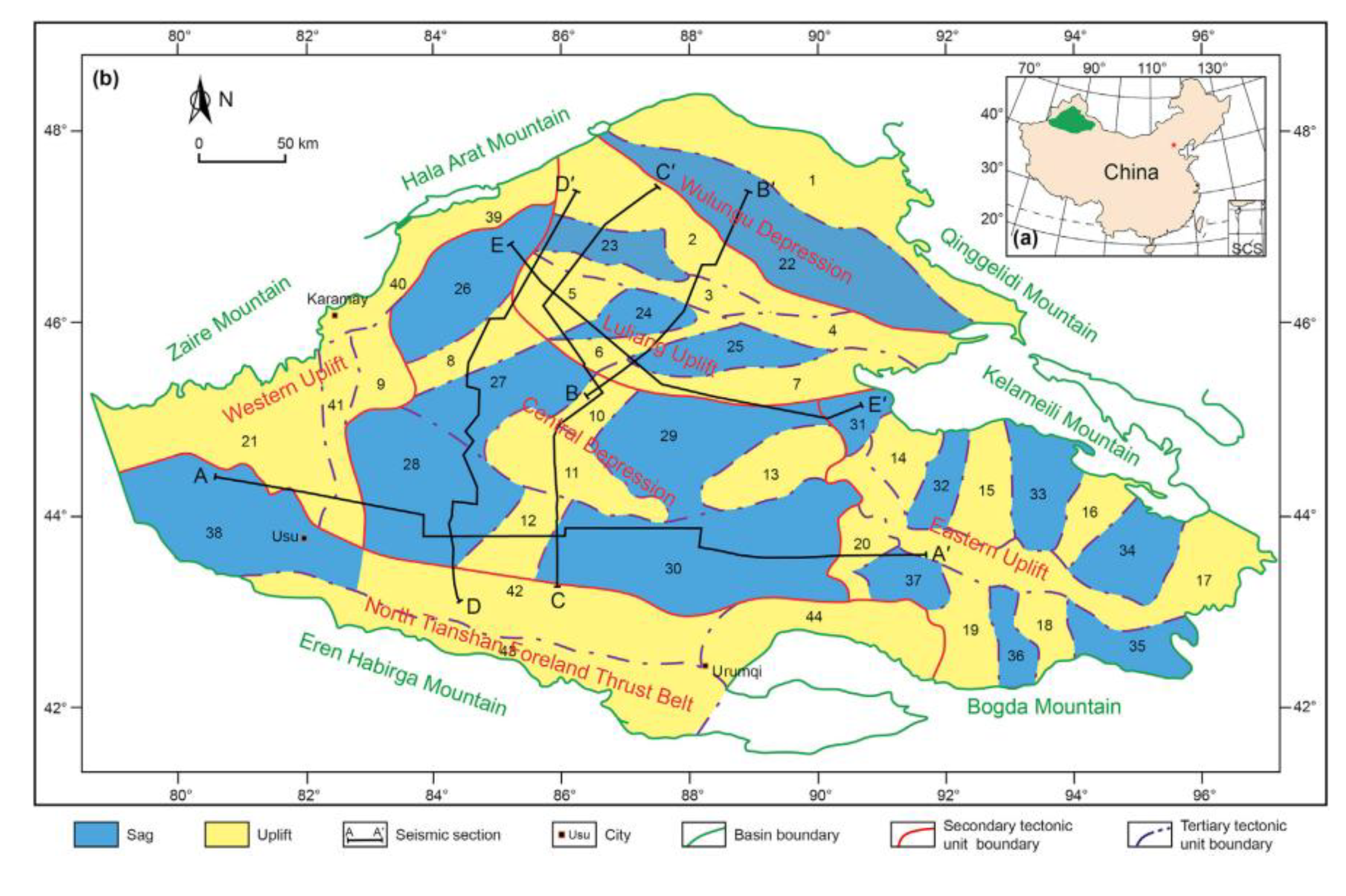
Basement of the basin is represented by Precambrian and Paleozoic igneous and metamorphic complexes of accretionary origin. The sedimentary cover includes deposits from the Devonian to Quaternary. In plan view, the structure is characterized by alternating depression zones and "chessboard"-type uplifts, reflecting a multi-stage history of extension, compression, and inversion [21,25].
The Late Devonian–Early Carboniferous stage of basin development occurred under extensional conditions, accompanied by the formation of a graben system of northwestern strike and manifestations of basaltic magmatism [21]. Elevated heat flow contributed to the formation of subsidence centers where marine and lagoon sediments accumulated, including Carboniferous oil source rocks.
The Late Carboniferous–Permian stage is associated with collisional processes and the development of a foreland system. The formation of thrust structures and foreland depressions led to the accumulation of thick lacustrine complexes in the central and northwestern depressions [24,26]. It was during this period that the Permian Fengcheng and Lucaogou oil source complexes, possessing the greatest generation potential, were formed.
The Triassic–Paleogene is characterized by an intracontinental depression associated with thermal relaxation of the lithosphere [22]. Sedimentation occurred predominantly under continental conditions, with the formation of Jurassic coal-bearing and lacustrine sequences. During this period, active hydrocarbon generation from Permian sources and lateral migration into Mesozoic reservoirs took place [27].
Cenozoic reactivation is caused by the uplift of the Tien Shan as a result of the Indo-Asian collision. A system of thrust faults propagating toward the basin developed, especially along the southern margin [24,28]. Multi-stage inversion led to reactivation of faults and the formation of vertical conduit zones controlling the redistribution of hydrocarbons.
Figure 2.
NW–EW oriented tectonically balanced cross-section E–E′ illustrating the evolution of the Junggar Basin. (adapted from [21,24,26]). Structural style prior to Permian sedimentation (a); structural style before Triassic sedimentation with schematic stress directions (b); structural style before the deposition of the Cretaceous Badaowan Formation (c); structural style before Cretaceous sedimentation with schematic stress directions (d); structural style before the Paleogene stage (e); present-day structural style (f); location of seismic profile E–E′ is shown in (g).
Figure 2.
NW–EW oriented tectonically balanced cross-section E–E′ illustrating the evolution of the Junggar Basin. (adapted from [21,24,26]). Structural style prior to Permian sedimentation (a); structural style before Triassic sedimentation with schematic stress directions (b); structural style before the deposition of the Cretaceous Badaowan Formation (c); structural style before Cretaceous sedimentation with schematic stress directions (d); structural style before the Paleogene stage (e); present-day structural style (f); location of seismic profile E–E′ is shown in (g).
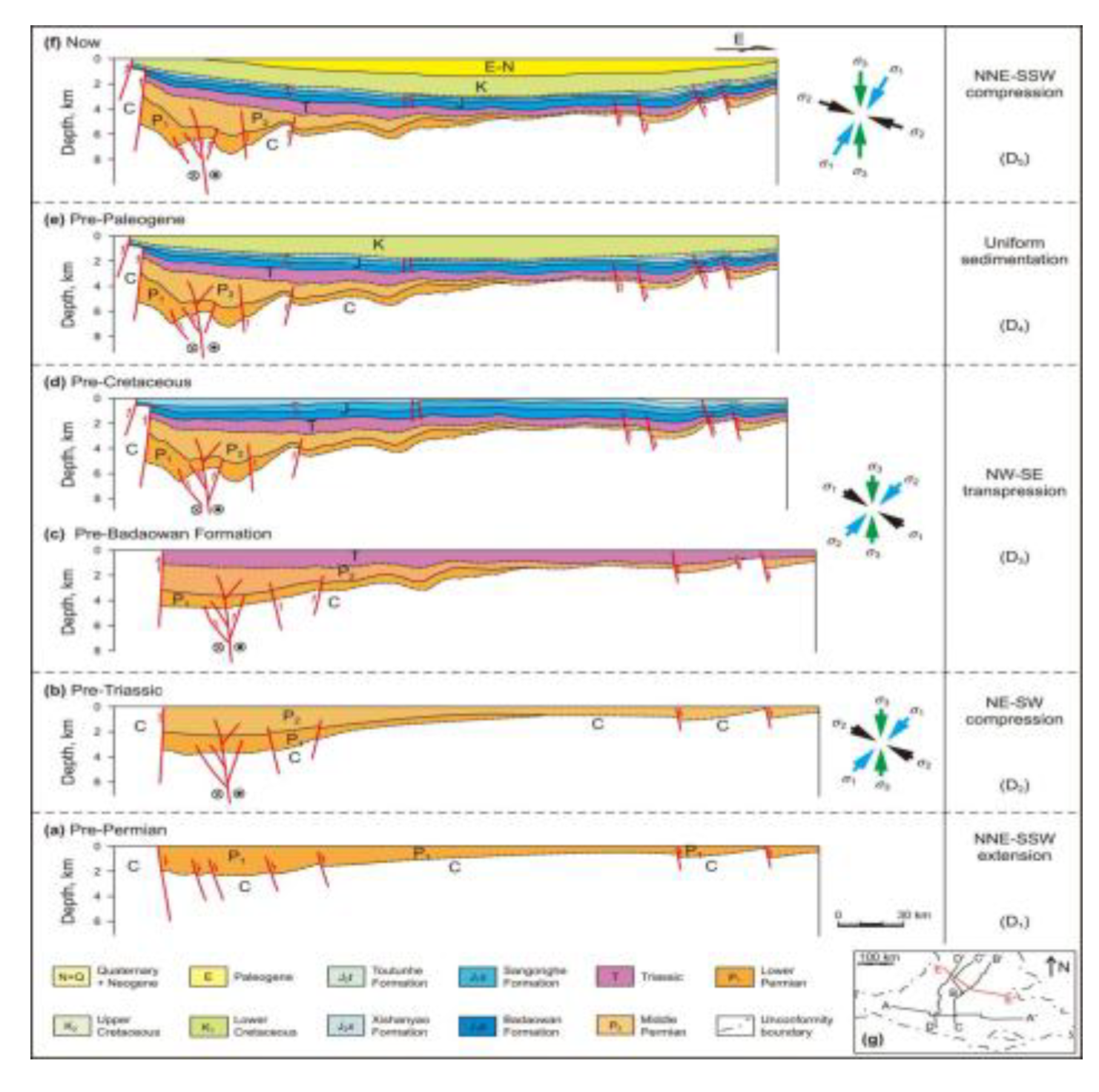
Tectonic evolution was accompanied by changes in the thermal regime. Elevated heat flow values in the Late Paleozoic (60–80 mW/m²) contributed to the early onset of generation from Carboniferous and Permian sources, whereas Cenozoic deformation caused local thermal reactivation in foreland zones [22,29]. The burial depth of source rock sequences in the central depressions reached 6–8 km, leading to the transition of part of the Carboniferous sources into the dry gas stage (Ro >2.0%) and secondary cracking of Permian-derived oil [27,30].

Table 2.
Main tectonic stages of the Junggar Basin development and their influence on hydrocarbon generation.
Table 2.
Main tectonic stages of the Junggar Basin development and their influence on hydrocarbon generation.
| Stage | Age | Geodynamic Regime | Key Processes | Impact on Petroleum System |
|---|---|---|---|---|
| Rifting | D–C | Extension | Formation of grabens | Establishment of Carboniferous sources |
| Foreland | C–P | Compression | Thrusts, depressions | Formation of Permian sources |
| Depression | T–Pg | Thermal relaxation | Continental sedimentation | Active generation and migration |
| Inversion | N–Q | Compression | Fault reactivation | Redistribution and recharging |
Thus, the present-day structural configuration of the Junggar Basin results from the successive superposition of rifting, foreland, depression, and inversion processes. The spatial differentiation of source maturity, burial depth, and deformation patterns has led to the formation of multiple hydrocarbon generation centers and a complex migration pathway system [21,22,23,24,25,26,27,28,29,30]. The polycyclic development has predetermined the superposition of multiple charging phases and the formation of composite petroleum systems, which necessitates an integrated analysis of the basin's tectonic and thermal evolution.
3. Petroleum Systems and Their Spatiotemporal Superposition
The polycyclic tectonic evolution of the Junggar Basin has controlled the development of several independent yet genetically related petroleum systems that differ in source age, generation phases, and migration styles. According to the petroleum system concept [5,6], at least four composite systems can be distinguished within the basin: the Carboniferous, Permian, Jurassic, and Paleogene systems, which exhibit significant spatial and temporal overlap.
The Carboniferous petroleum system is associated with marine and lagoonal clay-rich successions of the Late Devonian–Carboniferous, characterized by moderate organic matter contents (TOC 1.5–5%) and type II–III kerogen. Hydrocarbon generation initiated in the Late Paleozoic and intensified during the Triassic when thermal maturity reached Ro 0.8–1.2%. In the central depressions, burial depths exceeding 6 km resulted in vitrinite reflectance values above 2%, indicating transition to the dry gas stage [31,32]. Migration predominantly occurred along rift-related fault zones and was later controlled by inversion structures.
The Permian petroleum system constitutes the dominant play in the basin. The lacustrine organic-rich mudstones of the Fengcheng and Lucaogou formations exhibit total organic carbon (TOC) contents ranging from 10% to 12%, with Hydrogen Index (HI) values between 300 and 700 mg HC/g TOC. The kerogen is classified as Type I-II, indicating excellent hydrocarbon generation potential. The peak oil generation occurred during the Indosinian Orogeny, while tectonic inversion during the Cenozoic led the source rocks to enter a stage of significant gas generation [33,34]. A key characteristic of this system is the lateral migration of hydrocarbons from the Central Depression towards the Mahu Sag and the northwestern margin thrust belt, leading to the formation of structural-stratigraphic combined traps.
The Jurassic petroleum system is mainly developed in the southern basin. Coal-bearing and mudstone successions containing type III kerogen (TOC 1–4%) reached maturities of 0.6–1.1% Ro, resulting in predominantly gas-prone generation [35,36,37]. This system is largely localized and commonly acts as a secondary contributor relative to the Permian system.
The Paleogene petroleum system remains thermally immature across most areas; however, limited late hydrocarbon generation may occur in piedmont zones subjected to Cenozoic subsidence. Its role is primarily restricted to the formation of local gas occurrences [38].
A key characteristic of the basin is the spatiotemporal superposition of these petroleum systems. Carboniferous sources reached high maturity earlier than Permian ones, whereas Permian sources provided the principal phase of liquid hydrocarbon generation. Jurassic sources operated synchronously with the late migration stages of Permian hydrocarbons. Cenozoic inversion caused hydrocarbon redistribution, destruction of some early accumulations, and the formation of new thrust-related traps [28,39].
Figure 3.
Composite geological maps illustrating the location of the Junggar Basin (A), the position of the study area (B), structural units, thermal maturity of the Fengcheng Formation, and the distribution of oil and gas resources within the study area (C), the stratigraphic column of the western Junggar Basin (D), as well as the stratigraphy and lithology of the volcanic basement and sedimentary successions (E) (adapted from [16,24,27,32]). C — Carboniferous System; P₁j — Permian Jiamuhe Formation; P₁f — Permian Fengcheng Formation; P₂x — Permian Xiazijie Formation; P₂w — Permian Wuerhe Formation; T₁b — Triassic Baikouquan Formation; T₂k — Triassic Karamay Formation; T₃b — Triassic Baijiantan Formation; J₁b — Jurassic Badaowan Formation; J₁s — Jurassic Sangonghe Formation; K — Cretaceous System. PSE — petroleum system elements; SR — source rock; TR — target reservoir.
Figure 3.
Composite geological maps illustrating the location of the Junggar Basin (A), the position of the study area (B), structural units, thermal maturity of the Fengcheng Formation, and the distribution of oil and gas resources within the study area (C), the stratigraphic column of the western Junggar Basin (D), as well as the stratigraphy and lithology of the volcanic basement and sedimentary successions (E) (adapted from [16,24,27,32]). C — Carboniferous System; P₁j — Permian Jiamuhe Formation; P₁f — Permian Fengcheng Formation; P₂x — Permian Xiazijie Formation; P₂w — Permian Wuerhe Formation; T₁b — Triassic Baikouquan Formation; T₂k — Triassic Karamay Formation; T₃b — Triassic Baijiantan Formation; J₁b — Jurassic Badaowan Formation; J₁s — Jurassic Sangonghe Formation; K — Cretaceous System. PSE — petroleum system elements; SR — source rock; TR — target reservoir.
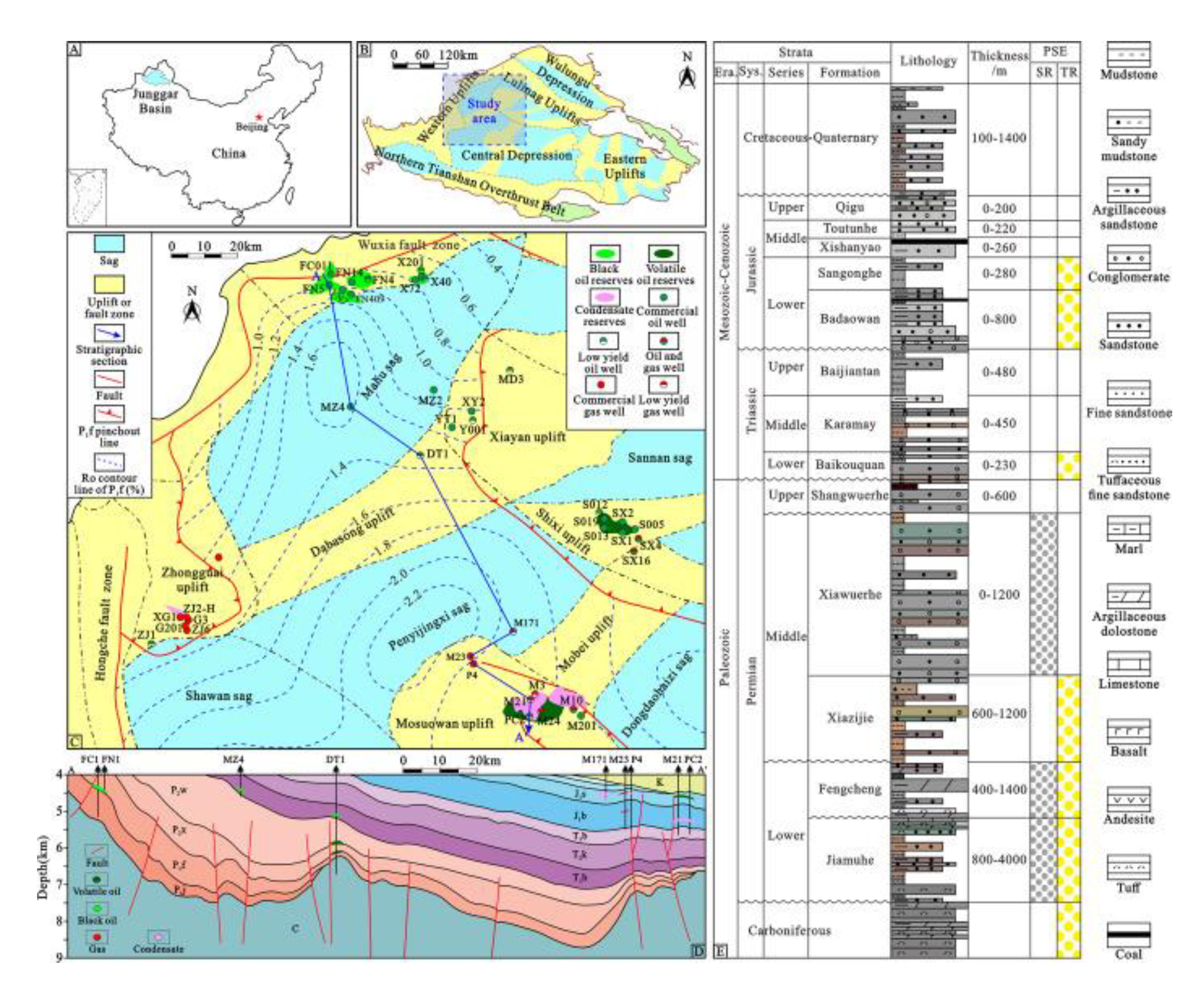
Multistage hydrocarbon generation was accompanied by changes in migration pathways. During the early stages, lateral migration within Permian reservoirs predominated, whereas Cenozoic deformation promoted the development of vertical migration conduits along compressional and strike-slip zones. This resulted in three principal accumulation models: (1) unidirectional thrust-controlled charging, (2) bidirectional fault-assisted charging, and (3) deep vertical migration within transform fault zones [34,40].
Table 3.
Major petroleum systems of the Junggar Basin and their characteristics.
| System | Main source | Generation age | Type of HC | Main traps |
|---|---|---|---|---|
| Carboniferous | Marine clays | P–T | Gas | Fault and inversion |
| Permian | Fengcheng, Lucaogou | T–J | Oil, secondary gas | Structural-stratigraphic |
| Jurassic | Continental clays | J–K | Gas | Anticlinal |
| Paleogene | Lacustrine clays | N (locally) | Oil | Piedmont |
Thus, the petroleum potential of the Junggar Basin is determined not by a single source, but by a system of interconnected sources that functioned during different geodynamic epochs. The superimposition of generation phases, secondary migration, and inversion processes have formed a complex composite architecture of deposits. Understanding the spatiotemporal dynamics of these systems is a key condition for predicting deep-seated and structurally complex targets.
4. Zones Of Oil and Gas Accumulation and Their Tectonic Control
The spatial distribution of deposits within the Junggar Basin is determined by a combination of structural segmentation, the burial depth of source rocks, generation phases, and the nature of fault permeability. As a result of polycyclic evolution, several major zones of oil and gas accumulation have formed, differing in trap type, charging sources, and the phase composition of hydrocarbons [41,42,43].
The Central Depression is characterized by the maximum thickness of the sedimentary cover (up to 12–14 km) and the highest maturity of Carboniferous and Permian sources. Deep generation centers dominate here, providing both an early oil phase and a late gas phase. Traps are predominantly structural-stratigraphic and fault-controlled. Multi-stage migration has led to the formation of composite deposits with evidence of secondary fluid alteration [31,34,41].
The Northwestern Zone (Mahu area) represents an area of lateral migration of Permian hydrocarbons from the central depressions. Anticlinal structures and stratigraphic pinch-outs are developed here, controlled by early rift-related faults and their subsequent inversion [35,42]. The high oil saturation of Permian reservoirs is explained by effective syngenetic sealing and a moderate degree of late deformation.
The Western Thrust Zone was formed under conditions of collisional compression and subsequent Cenozoic reactivation. It is characterized by thrust and strike-slip structures, creating tectonic traps. Vertical migration along compression zones led to the recharging of reservoirs, including older Carboniferous complexes [28,39,43]. In some cases, signs of destruction of early accumulations and their redistribution into younger structural forms are recorded.
The Southern Piedmont Zone, adjacent to the Tien Shan, represents a Cenozoic foredeep. Thrust and fold structures, formed as a result of Neogene inversion, predominate here. Oil and gas accumulation is primarily associated with the gas phase, due to the high maturity of sources and secondary oil cracking [38,44]. Active tectonics caused the development of vertical migration pathways and the formation of traps in molasse deposits.
The Eastern Zone is characterized by a relatively smaller thickness of the sedimentary cover and moderate source maturity. Petroleum potential is predominantly oil-prone and controlled by stratigraphic and lithological factors [45,46]. Paleo-structures inherited from the rift stage play an important role here.
Figure 4.
Main zones of oil and gas accumulation in the Junggar Basin and distribution of major fields (adapted from [41,42,43,44,45]).
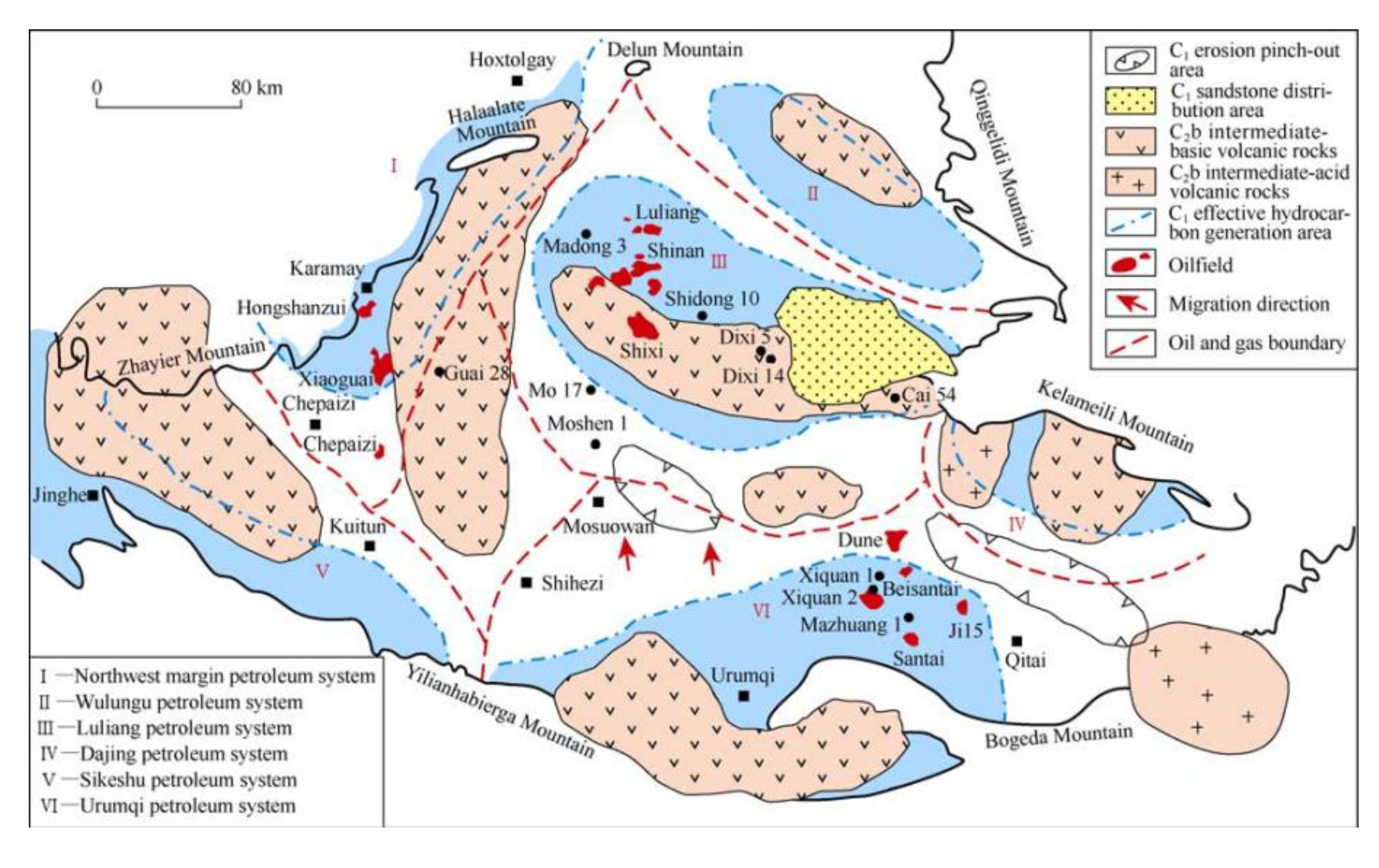
A comparative analysis of the oil and gas accumulation zones shows that the spatial differentiation is controlled by a combination of three key factors: (1) the depth and timing of source generation, (2) the degree of tectonic deformation and fault reactivation, and (3) the effectiveness of regional seals. The central and northwestern segments are characterized by the predominance of lateral migration, whereas the southern and western zones are characterized by vertical migration, caused by inversion and compression [34,43,47].
Table 4.
Characteristics of the oil and gas accumulation zones of the Junggar Basin.
| Zone | Main source | Trap type | HC phase | Tectonic control |
|---|---|---|---|---|
| Central Depression | Permian | Structural-stratigraphic | Oil + gas | Deep centers, inversion |
| Northwestern (Mahu) | Permia | Anticlines, pinch-outs | Oil | Lateral migration |
| Western Thrust | Permian | Thrust | Oil | Cenozoic inversion |
| Southern Piedmont | Jurassic, Permian | Folded, thrust | Gas | Indo-Asian collision |
| Eastern Zone | Carboniferous, Permian | Structural-Lithologic Trap | Oil | Inherited structures |
Thus, the zonation of oil and gas accumulation within the Junggar Basin reflects the polycyclic nature of its tectonic evolution. The superimposition of generation phases, varying degrees of source maturity, and heterogeneity of the structural framework have led to the formation of spatially differentiated petroleum-bearing segments. Accounting for these patterns is of key importance for predicting deep-seated and tectonically complex targets [41,42,43,44,45,46,47].
5. Discussion
The results of the conducted analysis confirm that the petroleum potential of the Junggar Basin is determined not by the isolated generation of a single stratigraphic complex, but by the superimposition of several petroleum systems that functioned during different geodynamic epochs. Such a composite architecture is characteristic of polycyclic intracontinental basins formed within accretionary belts, and has previously been noted in the Tarim Basin and the Ordos Basin [48,49,50].
A key factor in the spatial differentiation of oil and gas accumulation is the synchronization of generation phases with tectonic events. In the Junggar Basin, Carboniferous sources achieved high maturity in the Late Paleozoic and Triassic, whereas Permian lacustrine complexes provided the main phase of oil generation in the Triassic–Jurassic. The Cenozoic inversion, associated with the reactivation of the Tien Shan, led to the recharging of traps and the redistribution of hydrocarbons [39,44,51]. Such a multi-stage charging history is characteristic of foreland and inversion basins, where late deformation plays a decisive role in shaping the final architecture of deposits [52,53].
Comparison with world analogues shows that three scenarios of petroleum system evolution are typical for polycyclic basins: (1) early generation followed by destruction of accumulations during inversion, (2) synchronous generation and trap formation, and (3) late reactivation with secondary migration. The Junggar Basin combines all three scenarios in different structural zones, which explains the spatial heterogeneity of the hydrocarbon phase composition and reserve distribution [48,52,54].
The impact of Cenozoic tectonics on hydrocarbon preservation is particularly significant. In the southern piedmont, intense deformation facilitated the formation of thrust-related traps but also caused partial destruction of early accumulations. Conversely, in the central depressions, moderate late-stage deformation favored the preservation of oil deposits [41,44,55]. Therefore, the extent of tectonic reworking is a critical criterion for evaluating the prospectivity of deep targets.
The thermal evolution of the basin also demonstrates complex polycyclicity. The elevated heat flow of the Late Paleozoic initiated early generation, whereas Cenozoic reactivation could cause local secondary thermal alteration of hydrocarbons [22,47,56]. In this respect, the Junggar Basin is comparable to a number of inversion basins in Europe and the Middle East, where late tectonics played a role in the formation of secondary gas accumulations [52,57].
A fundamentally important conclusion is the dominant role of the Permian lacustrine system in the formation of oil reserves. However, deep gas generation from Carboniferous sources and secondary oil cracking during late subsidence form a significant potential for gas resources, especially in the western and southern parts of the basin [31,33,58]. This indicates the need for a differentiated approach to predicting the phase composition of hydrocarbons in different tectonic segments.
Figure 5.
Integrated model of the evolution of petroleum systems in the Junggar Basin, illustrating the superposition of generation, migration, and inversion phases (adapted from [48,49,50,51,52,53,54]).
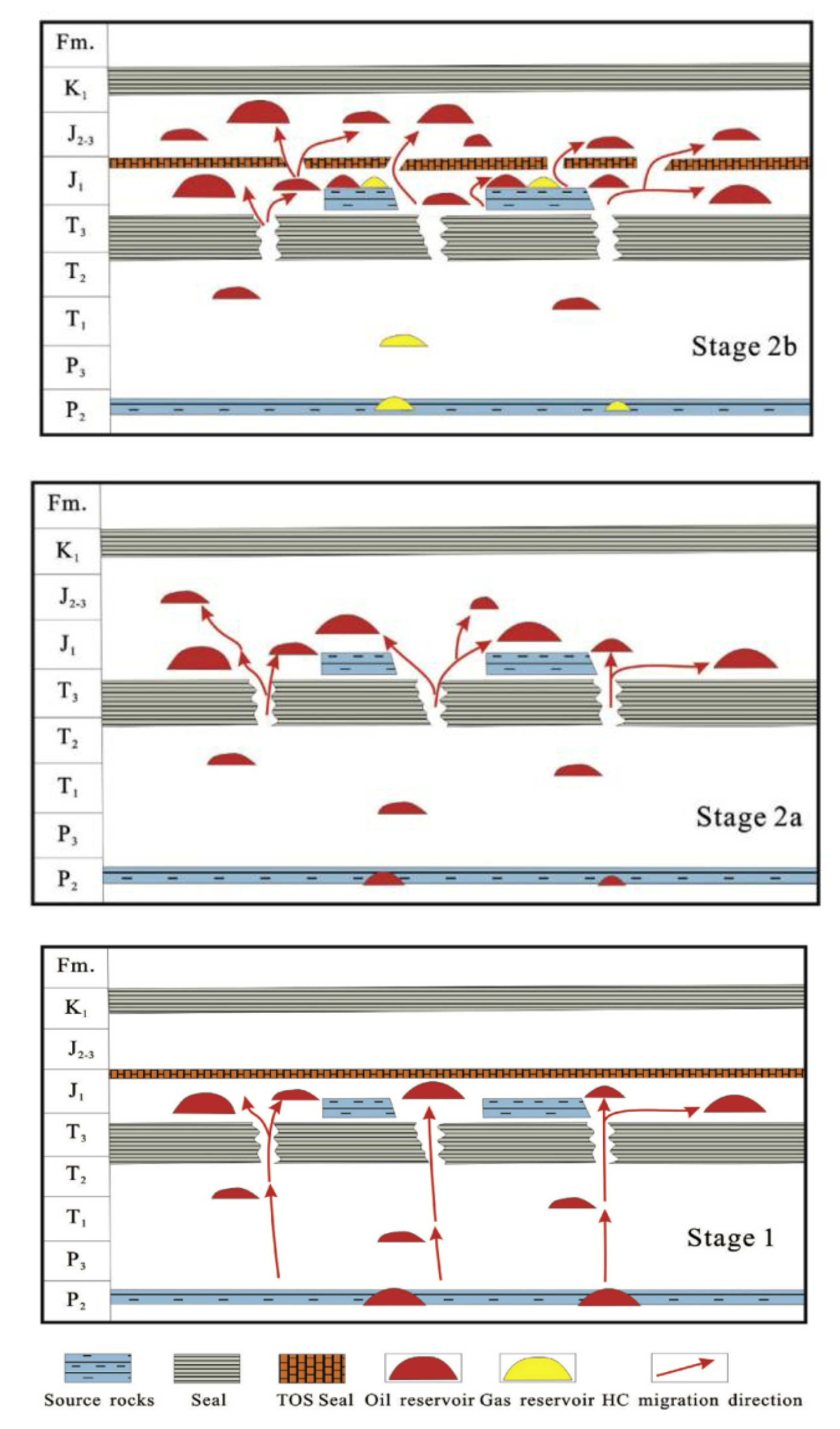
The results have not only regional significance but also broader geodynamic implications. The Junggar Basin demonstrates that, under polycyclic evolution, the spatiotemporal correlation between hydrocarbon generation and trap formation is a decisive factor in reserve accumulation. In inversion segments, vertical migration plays a key role, whereas in depressional areas, lateral charging from deep generation centers predominates. These patterns can inform predictions of deep and tectonically complex targets both within Central Asia and in other accretionary belts [50,53,59,60].
Overall, this discussion confirms that the petroleum potential of the Junggar Basin results from the interplay of geodynamic, thermal, and structural factors over a prolonged polycyclic evolution. Integrating tectonic analysis, geochemical data, and thermal history modeling can significantly enhance the accuracy of hydrocarbon prospectivity assessments.
6. Conclusions
The integrated analysis of tectonic evolution, geochemical characteristics of source-rock complexes, and the spatial distribution of accumulations in the Junggar Basin allows the following key conclusions to be drawn:
- The Junggar Basin is a polycyclic intracontinental system whose evolution was controlled by successive rift, collisional–foreland, sag, and inversion stages. The superposition of these tectonic regimes determined the present-day structural segmentation of the basin.
- Hydrocarbon accumulation is governed by multiple petroleum systems (Carboniferous, Permian, Jurassic, and Paleogene) that exhibit significant spatial and temporal overlap. The lacustrine Permian system plays the dominant role in oil reserve formation.
- Carboniferous source rocks in the Central Depression have reached a high- to over-mature stage, forming a deep gas kitchen. This accounts for the increased proportion of gas resources in the western and southern regions of the basin.
- Cenozoic reactivation associated with Tian Shan uplift played a dual role: it created new thrust-related traps while simultaneously redistributing and partially destroying early accumulations.
- The spatial differentiation of hydrocarbon accumulation zones is controlled by the synchronization of generation and trap formation phases, the degree of tectonic inversion, and the efficiency of regional fluid seals.
- The developed integrated model of petroleum system evolution allows for more precise prediction of deep and tectonically complex targets and can be applied to assess analogous polycyclic basins in Central Asia
In summary, the petroleum potential of the Junggar Basin results from the prolonged interplay of geodynamic, thermal, and structural processes. A comprehensive approach that integrates tectonic analysis, source-rock geochemistry, and thermal history modeling significantly enhances the reliability of hydrocarbon prospectivity assessments.
References
- Allen, P.A.; Allen, J.R. Basin Analysis: Principles and Application to Petroleum Play Assessment, 3rd ed.; Wiley-Blackwell: Oxford, 2013. [Google Scholar]
- Bally, A.W. Tectogeneses of sedimentary basins. In Tectonics of Sedimentary Basins; Bally, A.W., Ed.; Springer: Berlin, 1984; pp. 5–34. [Google Scholar]
- Bosworth, W.; Tari, G. Tectonic evolution of inversion basins and implications for hydrocarbon systems. Marine and Petroleum Geology 2005, 22, 577–593. [Google Scholar] [CrossRef]
- Carroll, A.R.; Graham, S.A.; Hendrix, M.S.; Ying, D.; Zhou, D. Late Paleozoic tectonic amalgamation of northwestern China: sedimentary record of the northern Tarim, northwestern Turpan, and southern Junggar basins. Geological Society of America Bulletin 1995, 107, 571–594. [Google Scholar] [CrossRef]
- Cloetingh, S.; Ziegler, P.A.; Beekman, F.; Andriessen, P.; Matenco, L.; Bada, G.; Garcia-Castellanos, D.; Hardebol, N.; Dezes, P.; Sokoutis, D. Lithospheric memory, basin evolution and hydrocarbon systems. Basin Research 2008, 20, 181–205. [Google Scholar] [CrossRef]
- Dickinson, W.R. Impact of differential tectonic subsidence on foreland basin systems. AAPG Bulletin 2008, 92, 453–478. [Google Scholar] [CrossRef]
- Graham, S.A.; Hendrix, M.S.; Johnson, C.L.; Badarch, G.; Badamgarav, D.; Amory, J.; Porter, M.; Barsbold, R.; Webb, L.E.; Hacker, B.R. Sedimentary record and tectonic evolution of Central Asian basins. Basin Research 2001, 13, 297–320. [Google Scholar]
- He, D.; Zhang, L.; Wu, S.; Li, D. Tectonic evolution and petroleum systems of the Junggar Basin, NW China. Marine and Petroleum Geology 2018, 92, 845–861. [Google Scholar] [CrossRef]
- Hendrix, M.S.; Dumitru, T.A.; Graham, S.A. Late Paleozoic–Mesozoic evolution of the Junggar Basin, Xinjiang, China. Geological Society of America Bulletin 1992, 104, 53–70. [Google Scholar] [CrossRef]
- Hunt, J.M. Petroleum Geochemistry and Geology, 2nd ed.; W.H. Freeman: New York, 1996. [Google Scholar]
- Li, J.; Wang, Z.; Liu, B.; Zhang, Y. Geochemical characteristics and hydrocarbon potential of Permian source rocks in the Junggar Basin. Marine and Petroleum Geology 2016, 75, 363–378. [Google Scholar]
- Liu, B.; Wang, Z.; Li, J.; Zhao, M. Hydrocarbon generation and expulsion history of Permian source rocks in the Junggar Basin. Marine and Petroleum Geology 2017, 82, 1–15. [Google Scholar]
- Magoon, L.B.; Dow, W.G. The Petroleum System—From Source to Trap. In AAPG Memoir 60; American Association of Petroleum Geologists: Tulsa, 1994. [Google Scholar]
- Peters, K.E.; Walters, C.C.; Moldowan, J.M. The Biomarker Guide, 2nd ed.; Cambridge University Press: Cambridge, 2005. [Google Scholar] [CrossRef]
- Sun, Y.; Yang, W.; Jolivet, M. Basin modeling and burial history reconstruction of the Junggar Basin. Journal of Asian Earth Sciences 2014, 80, 25–40. [Google Scholar]
- Wang, Z.; Li, J.; Liu, B.; Zhang, Y. Thermal evolution and hydrocarbon generation of Permian source rocks in the Junggar Basin. Journal of Petroleum Science and Engineering 2018, 165, 628–641. [Google Scholar]
- Yang, W.; Jolivet, M.; Dupont-Nivet, G.; Guo, Z.; Zhang, Z.; Wu, C. Source-to-sink relations and tectono-sedimentary evolution of the Junggar Basin. Journal of Asian Earth Sciences 2013, 80, 1–18. [Google Scholar] [CrossRef]
- Zhang, G.; Jin, L.; Lan, L.; Zhao, Z. Co-control of source and heat in petroleum accumulation. Natural Gas Industry B 2015, 2, 49–76. [Google Scholar] [CrossRef]
- Zhao, M.; Liu, B.; Wang, Z.; Li, J. Organic geochemical characteristics of Permian source rocks in the Junggar Basin. Organic Geochemistry 2015, 83–84, 1–15. [Google Scholar]
- Ziegler, P.A.; Cloetingh, S. Dynamic processes controlling evolution of rifted and inverted basins. Tectonophysics 2004, 388, 1–3. [Google Scholar] [CrossRef]
- Carroll, A.R.; Graham, S.A.; Hendrix, M.S.; Ying, D.; Zhou, D. Late Paleozoic tectonic amalgamation of northwestern China: sedimentary record of the northern Tarim, northwestern Turpan, and southern Junggar basins. Geological Society of America Bulletin 1995, 107, 571–594. [Google Scholar] [CrossRef]
- Cloetingh, S.; Ziegler, P.A.; Beekman, F.; Andriessen, P.; Matenco, L.; Bada, G.; Garcia-Castellanos, D.; Hardebol, N.; Dezes, P.; Sokoutis, D. Lithospheric memory, basin evolution and hydrocarbon systems. Basin Research 2008, 20, 181–205. [Google Scholar] [CrossRef]
- Yang, W.; Jolivet, M.; Dupont-Nivet, G.; Guo, Z.; Zhang, Z.; Wu, C. Source-to-sink relations and tectono-sedimentary evolution of the Junggar Basin, NW China. Journal of Asian Earth Sciences 2013, 80, 1–18. [Google Scholar] [CrossRef]
- He, D.; Zhang, L.; Wu, S.; Li, D. Tectonic evolution and petroleum systems of the Junggar Basin, NW China. Marine and Petroleum Geology 2018, 92, 845–861. [Google Scholar] [CrossRef]
- Hendrix, M.S.; Dumitru, T.A.; Graham, S.A. Late Paleozoic–Mesozoic evolution of the Junggar Basin, Xinjiang, China. Geological Society of America Bulletin 1992, 104, 53–70. [Google Scholar] [CrossRef]
- Carroll, A.R.; Brassell, S.C.; Graham, S.A. Upper Paleozoic petroleum source rocks in northwestern China. AAPG Bulletin 1992, 76, 1674–1689. [Google Scholar]
- Wang, Z.; Li, J.; Liu, B.; Zhang, Y. Thermal evolution and hydrocarbon generation of Permian source rocks in the Junggar Basin, NW China. Journal of Petroleum Science and Engineering 2018, 165, 628–641. [Google Scholar] [CrossRef]
- Tapponnier, P.; Molnar, P. Active faulting and Cenozoic tectonics of the Tianshan. Journal of Geophysical Research 1979, 84, 3425–3459. [Google Scholar] [CrossRef]
- Allen, M.B.; Vincent, S.J.; Wheeler, P.J. Late Cenozoic tectonics of the Tian Shan and foreland basin development. Tectonophysics 1999, 302, 37–54. [Google Scholar] [CrossRef]
- Sun, Y.; Yang, W.; Jolivet, M. Burial history and basin modeling of the Junggar Basin, NW China. Journal of Asian Earth Sciences 2014, 94, 1–17. [Google Scholar] [CrossRef]
- Li, J.; Wang, Z.; Liu, B.; Zhang, Y. Hydrocarbon generation and expulsion characteristics of Carboniferous source rocks in the Junggar Basin, NW China. Marine and Petroleum Geology 2016, 72, 1–15. [Google Scholar] [CrossRef]
- Hendrix, M.S.; Dumitru, T.A.; Graham, S.A. Late Paleozoic–Mesozoic evolution of the Junggar Basin, Xinjiang, China. Geological Society of America Bulletin 1992, 104, 53–70. [Google Scholar] [CrossRef]
- Zhao, M.; Liu, B.; Wang, Z.; Li, J. Organic geochemical characteristics and oil-source correlation of Permian source rocks in the Junggar Basin. Organic Geochemistry 2015, 83–84, 1–15. [Google Scholar] [CrossRef]
- Sun, Y.; Yang, W.; Jolivet, M. Burial history reconstruction and basin modeling of the Junggar Basin, NW China. Journal of Asian Earth Sciences 2014, 94, 1–17. [Google Scholar] [CrossRef]
- Li, Y.; Wang, C.; Zhao, Z. Structural evolution and hydrocarbon accumulation in the Mahu Sag, Junggar Basin. Marine and Petroleum Geology 2019, 103, 288–302. [Google Scholar] [CrossRef]
- Liu, B.; Li, J.; Wang, Z.; Zhao, M. Hydrocarbon accumulation patterns and tectonic controls in the Junggar Basin. Marine and Petroleum Geology 2017, 82, 1–15. [Google Scholar] [CrossRef]
- Wang, Z.; Li, J.; Liu, B.; Zhang, Y. Thermal evolution and hydrocarbon generation of Jurassic source rocks in the Junggar Basin. Journal of Petroleum Science and Engineering 2018, 165, 628–641. [Google Scholar] [CrossRef]
- Allen, M.B.; Vincent, S.J.; Wheeler, P.J. Late Cenozoic tectonics of the Tian Shan and foreland basin development. Tectonophysics 1999, 302, 37–54. [Google Scholar] [CrossRef]
- Tapponnier, P.; Molnar, P. Active faulting and Cenozoic tectonics of the Tianshan. Journal of Geophysical Research 1979, 84, 3425–3459. [Google Scholar] [CrossRef]
- Han, B.F.; He, G.Q.; Wang, X.C.; Guo, Z.J. Late Carboniferous collision between the Tarim and Kazakhstan–Yili terranes. Earth-Science Reviews 2011, 109, 74–93. [Google Scholar] [CrossRef]
- Li, Y.; Wang, C.; Zhao, Z. Structural evolution and hydrocarbon accumulation in the Mahu Sag, Junggar Basin. Marine and Petroleum Geology 2019, 103, 288–302. [Google Scholar] [CrossRef]
- Cao, J.; Lei, D.; Zhang, Y. Geochemical characteristics and petroleum potential of Permian lacustrine source rocks in the Junggar Basin. International Journal of Coal Geology 2017, 180, 1–16. [Google Scholar] [CrossRef]
- Liu, B.; Li, J.; Wang, Z.; Zhao, M. Hydrocarbon accumulation patterns and tectonic controls in the Junggar Basin. Marine and Petroleum Geology 2017, 82, 1–15. [Google Scholar] [CrossRef]
- Allen, M.B.; Vincent, S.J.; Wheeler, P.J. Late Cenozoic tectonics of the Tian Shan and foreland basin development. Tectonophysics 1999, 302, 37–54. [Google Scholar] [CrossRef]
- Wang, Z.; Li, J.; Liu, B.; Zhang, Y. Thermal evolution and hydrocarbon generation of Jurassic source rocks in the Junggar Basin. Journal of Petroleum Science and Engineering 2018, 165, 628–641. [Google Scholar] [CrossRef]
- Zhao, M.; Liu, B.; Wang, Z.; Li, J. Organic geochemical characteristics of Permian source rocks in the Junggar Basin. Organic Geochemistry 2015, 83–84, 1–15. [Google Scholar] [CrossRef]
- Sun, Y.; Yang, W.; Jolivet, M. Burial history and basin modeling of the Junggar Basin. Journal of Asian Earth Sciences 2014, 94, 1–17. [Google Scholar] [CrossRef]
- Carroll, A.R.; Graham, S.A.; Hendrix, M.S.; Ying, D.; Zhou, D. Late Paleozoic tectonic amalgamation of northwestern China: sedimentary record of the northern Tarim, northwestern Turpan, and southern Junggar basins. Geological Society of America Bulletin 1995, 107, 571–594. [Google Scholar] [CrossRef]
- Yang, W.; Jolivet, M.; Dupont-Nivet, G.; Guo, Z.; Zhang, Z.; Wu, C. Source-to-sink relations and tectono-sedimentary evolution of the Junggar Basin, NW China. Journal of Asian Earth Sciences 2013, 80, 1–18. [Google Scholar] [CrossRef]
- Liu, B.; Li, J.; Wang, Z.; Zhao, M. Hydrocarbon accumulation patterns and tectonic controls in the Junggar Basin. Marine and Petroleum Geology 2017, 82, 1–15. [Google Scholar] [CrossRef]
- Allen, M.B.; Vincent, S.J.; Wheeler, P.J. Late Cenozoic tectonics of the Tian Shan and foreland basin development. Tectonophysics 1999, 302, 37–54. [Google Scholar] [CrossRef]
- Bosworth, W.; Tari, G. Tectonic evolution of inversion basins and implications for hydrocarbon systems. Marine and Petroleum Geology 2005, 22, 577–593. [Google Scholar] [CrossRef]
- Cloetingh, S.; Ziegler, P.A.; Beekman, F.; Andriessen, P.; Matenco, L.; Bada, G.; Garcia-Castellanos, D.; Hardebol, N.; Dezes, P.; Sokoutis, D. Lithospheric memory, basin evolution and hydrocarbon systems. Basin Research 2008, 20, 181–205. [Google Scholar] [CrossRef]
- Magoon, L.B.; Dow, W.G. The Petroleum System—From Source to Trap. In AAPG Memoir 60; American Association of Petroleum Geologists: Tulsa, 1994. [Google Scholar]
- He, D.; Zhang, L.; Wu, S.; Li, D. Tectonic evolution and petroleum systems of the Junggar Basin, NW China. Marine and Petroleum Geology 2018, 92, 845–861. [Google Scholar] [CrossRef]
- Sun, Y.; Yang, W.; Jolivet, M. Burial history reconstruction and basin modeling of the Junggar Basin, NW China. Journal of Asian Earth Sciences 2014, 94, 1–17. [Google Scholar] [CrossRef]
- Ziegler, P.A.; Cloetingh, S. Dynamic processes controlling evolution of rifted and inverted basins. Tectonophysics 2004, 388, 1–3. [Google Scholar] [CrossRef]
- Zhao, M.; Liu, B.; Wang, Z.; Li, J. Organic geochemical characteristics and oil-source correlation of Permian source rocks in the Junggar Basin. Organic Geochemistry 2015, 83–84, 1–15. [Google Scholar] [CrossRef]
- Han, B.F.; He, G.Q.; Wang, X.C.; Guo, Z.J. Late Carboniferous collision between the Tarim and Kazakhstan–Yili terranes and implications for the accretion of the southern Altaids. Earth-Science Reviews 2011, 109, 74–93. [Google Scholar] [CrossRef]
- Allen, P.A.; Allen, J.R. Basin Analysis: Principles and Application to Petroleum Play Assessment, 3rd ed.; Wiley-Blackwell: Oxford, 2013. [Google Scholar]
Table 1.
Geochemical parameters of petroleum source rock complexes in the Junggar Basin.
| Complex | Lithology | TOC (%) | HI (mg HC/g TOC) |
Kerogen | Tmax (°C) |
Ro (%) | Generation Potential |
|---|---|---|---|---|---|---|---|
| Carboniferous | Marine and lagoonal clays | 1,5–5,0 (up to 8) | 150–350 | II–III | 430–465 | 0,8–2,2 | Oil → dry gas |
| Permian (Fengcheng Formation, Lucaogou Formation) | Lacustrine organic-rich clays | 2–8 (up to 12) | 300–700 | I–II₁ | 435–455 | 0,7–1,8 | Mainly oil, secondary gas |
| Jurassic | Coal-bearing and continental clays | 1–4 | 100–250 | III | 425–445 | 0,5–1,2 | Gas potential |
| Paleogene | Lacustrine clays | 0,5–2,5 | 80–200 | II–III | <440 | <0,8 | Limited |
Disclaimer/Publisher’s Note: The statements, opinions and data contained in all publications are solely those of the individual author(s) and contributor(s) and not of MDPI and/or the editor(s). MDPI and/or the editor(s) disclaim responsibility for any injury to people or property resulting from any ideas, methods, instructions or products referred to in the content. |
© 2026 by the authors. Licensee MDPI, Basel, Switzerland. This article is an open access article distributed under the terms and conditions of the Creative Commons Attribution (CC BY) license.
Copyright: This open access article is published under a Creative Commons CC BY 4.0 license, which permit the free download, distribution, and reuse, provided that the author and preprint are cited in any reuse.