

Submitted:
07 April 2026
Posted:
08 April 2026
You are already at the latest version
Abstract
Neuroinflammation is increasingly recognized as a key modulator of therapeutic response and adverse events in Alzheimer’s disease (AD), especially during anti-amyloid-β (Aβ) monoclonal antibody (Aβ-mAb) treatment. We applied longitudinal translocator protein (TSPO) positron emission tomography (PET) to evaluate microglial activation in response to chronic Aβ-mAb therapy and its modulation by the PPAR-γ agonist pioglitazone. AppNL-G-F knock-in mice underwent TSPO-PET and Aβ-PET imaging at 5, 7.5, and 10 months of age across four treatment arms: placebo, Aβ-mAb, pioglitazone, and combination therapy. TSPO-PET detected early and progressive neuroinflammatory responses to Aβ-mAb that were attenuated by pioglitazone co-treatment. Both mono- and combination therapy modulated the temporal and spatial dynamics of the TSPO-PET signal. In addition, we derived a microglial desynchronization index from TSPO-PET connectivity, which captured individual neuroimmune responses and correlated with cognitive performance. Together, TSPO-PET and its regional synchronicity can quantify longitudinal, region-specific treatment effects, which may help to differentiate harmful from adaptive neuroinflammatory responses. These findings highlight the potential of TSPO-PET as a stratification biomarker to optimize therapeutic interventions. In summary, TSPO-PET enables in vivo tracking of treatment-associated neuroinflammatory responses during anti-Aβ immunotherapy and provides a non-invasive framework for evaluating combination strategies targeting amyloid pathology and immune regulation in AD.
Keywords:
Alzheimer’s disease
; microglia
; monoclonal antibody
; pioglitazone
; neuroinflammation
; TSPO-PET
; desynchronization index
1. Introduction
Alzheimer’s disease (AD) affects around 416 million people worldwide, or 22% of all people above 50 years old, when preclinical and prodromal stages are included, with the majority belonging to the asymptomatic preclinical stage [1]. Anti-amyloid-β (Aβ) monoclonal antibodies (mAbs) such as aducanumab, lecanemab, and donanemab initiated a new therapeutic era in AD. Aβ-mAbs produce robust plaque clearance as shown by β-amyloid positron emission tomography (Aβ-PET) and result in approximately 30% slowing of cognitive decline [2]; however, they are associated with amyloid-related imaging abnormalities (ARIA) – MRI-visible changes reflecting brain swelling or fluid accumulation (ARIA-E) and small areas of bleeding or iron deposition (ARIA-H) – which are often mild or asymptomatic but can occasionally cause headache, confusion, or focal symptoms and therefore require routine MRI monitoring and, when detected, dose interruption or adjustment [3,4].
Neuroinflammation is now recognized as a crucial modulator of AD pathogenesis [5,6]. Activated microglia can facilitate Aβ-mAb-mediated plaque clearance, but excessive Fc-receptor signaling and complement activation may amplify vascular permeability and precipitate ARIA-E/H [7,8,9], highlighting a narrow therapeutic window between beneficial and harmful neuroinflammation. 18 kDa translocator protein (TSPO) is an outer mitochondrial membrane protein that is strongly upregulated in activated microglia in mice, although TSPO-PET signal may also include astrocytic or vascular contributions [10], and can be monitored using PET. Unlike in humans, rodent TSPO lacks the rs6971 affinity polymorphism, simplifying quantification [11]. Longitudinal TSPO-PET in AD models tracks plaque-associated microgliosis and correlates with histology and cytokines [12], supporting its use for disease staging and pharmacodynamic monitoring [13].
Pioglitazone, a peroxisome-proliferator-activated-receptor-γ (PPAR-γ) agonist approved for type 2 diabetes, switches microglia toward an anti-inflammatory, Aβ-resolving phenotype [14,15]. In AppNL-G-F and PS2APP mice, chronic pioglitazone treatment shifted plaques to a more fibrillar state while improving synaptic density and spatial learning [16]. Notably, the individual response to chronic pioglitazone-induced immunomodulation is influenced by baseline microglial activation and sex, as shown by our longitudinal 18 kDa translocator protein (TSPO) PET study [17].
In this work, we combined an Aβ-mAb with continuous pioglitazone co-therapy in the AppNL-G-F knock-in mouse model and paired TSPO-PET with [18F]FBB Aβ-PET. This dual-tracer design allowed us to assess treatment-induced microglial activation together with changes in the fibrillar amyloid substrate, which is targeted by the antibody but might also be shifted toward higher fibrillarity by pioglitazone. We questioned whether the immunomodulatory profile of pioglitazone can preserve the plaque-clearing efficacy of the Aβ-mAb while mitigating excessive microglial activation. We aimed at providing a preclinical rationale for adjunctive PPAR-γ stimulation as a strategy to widen the therapeutic window of anti-Aβ immunotherapy.
In our previous work [18], we provided the first evidence that microglial activation is regionally synchronized in the healthy brain, but undergoes regional desynchronization with ongoing neurodegenerative disease, and we developed a personalized microglia desynchronization index (DI) that shows the magnitude of deviation of a subject from the microglia synchronicity of a control cohort. We used DI in this work as a complementary PET-based biomarker and correlated it to mouse cognitive performance.
2. Results
2.1. TSPO-PET Signals Are Increased in AppNL-G-F Mice Compared to Wild-Type Mice and Indicate Exploratory Treatment-Related Differences in the AppNL-G-F Mouse Model
To investigate effects of the different treatment arms on neuroinflammation and Aβ plaques in the brain, we analyzed TSPO-PET and Aβ-PET data of AppNL-G-F and wild-type (WT) mice. This analysis aimed to target brain wide effects and TSPO-PET was quantified as %ID to avoid potential bias from pseudo-reference-region assumptions, whereas Aβ-PET was quantified as standardized uptake value ratio (SUVR) using the established periaqueductal gray matter pseudo-reference region for [18F]FBB (as specified in Section 4.6). Figure 1 and Figure S1 present horizontal slices of the voxelwise group average [18F]GE-180 and [18F]FBB images, respectively, generated from all animals within each study cohort at 5, 7.5, and 10 months of age. As expected from previous studies [16], Aβ-PET signals increased in the pioglitazone treatment group due to a shift towards more compact plaques (Figure S1), which was also observed for the combination treatment with the anti-Aβ-mAb. As shown in Figure 1, A-C, TSPO-PET signals were higher in AppNL-G-F mice compared to WT mice at all timepoints. By 10 months of age, the TSPO-PET signal was significantly higher in the entire cohort of AppNL-G-F mice compared to WT mice (Figure 1D, amygdala, p < 10-4, d = 1.0 (+72.5%); Figure 1E, cortex, p < 10-4, d = 1.06 (+67.3%)). The differences between the genotypes were also confirmed by Kruskal-Wallis H-test: amygdala H(5) = 21.3, p = 0.0007; cortex H(5) = 23.6, p = 0.0003.
Treatment-arm-specific global contrasts are shown in Figure 1F and are interpreted descriptively, as these comparisons did not remain significant after false-discovery rate (FDR) correction. Among the AppNL-G-F cohorts, mice that received monotreatment with the anti-Aβ-mAb displayed the highest TSPO-PET signal at all ages, indicative of elevated neuroinflammation, which was most pronounced at 10 months (Figure 1F, amygdala: +56% compared to placebo, p = 0.08, d = 0.89; Figure 1F, cortex: +49% compared to placebo, p = 0.10, d = 0.78). In contrast, mice that received pioglitazone in addition to anti-Aβ-mAb did not show a notable difference in TSPO-PET signals compared to AppNL-G-F controls that received placebo (amygdala: +7.2%, p = 0.71, d = 0.21; cortex: +7.1%, p = 0.71, d = 0.21), consistent with attenuation of the treatment-associated TSPO-PET increase after anti-Aβ-mAb treatment. Similarly, mice treated with pioglitazone alone did not exhibit an increase in TSPO-PET signals compared to placebo (amygdala: −1.7%, p = 0.95, d = -0.05; cortex: −0.1%, p = 1.00, d = 0.00). Notably, the TSPO-PET signal showed a trend towards lower levels in the direct contrast of the dual-treatment group compared to the monotreatment anti-Aβ-mAb group, both in the amygdala (Figure 1F, −31%, p = 0.09, d = −0.90) and in the cortex (Figure 1F, −28%, p = 0.12, d = −0.78).
In summary, we noticed higher global TSPO expression in the brains of mice in the anti-Aβ-mAb monotreatment arm at 10 months of age compared to placebo- and pioglitazone monotreatment, both visually (Figure 1C) and quantitatively (by means of Cohen’s d), which is suggestive of an anti-inflammatory effect of pioglitazone; however, the differences did not reach significance after FDR correction, which can be explained by high individual heterogeneity in global TSPO expression among individual mice. Thus, these contrasts should be considered descriptive rather than confirmatory.
2.2. Treatments with Anti-Aβ-mAb and Pioglitazone Ameliorate Progression of Neuroinflammation in the AppNL-G-F Mouse Model
Whereas the global analysis in Section 2.1 used %ID for descriptive whole-brain comparisons of TSPO-PET signal, the following analyses use SUVR to reduce inter-individual variance and better capture regional and longitudinal treatment effects. SUVR values were calculated by normalizing the TSPO-PET images to the individual uptake in the brain stem, identified via a data-driven approach as the most suitable pseudo-reference region: it showed the smallest genotype-related difference in %ID compared to all other brain regions (Table S1, Figure S2). The resulting SUVR data were then analyzed longitudinally (Figure 2A). Moreover, we investigated a pre-established index of microglia desynchronization (DI) [18] calculated based on the SUVR values as an alternative quantification approach. Both SUVR (Figure S3A) and DI first principal component (PC1) (Figure S3B) values correlated with the original %ID-normalized values.
We assessed the effects of genotype, treatment, and age on the cortical [18F]GE-180 and [18F]FBB uptake via a linear mixed-effects model (LMEM) with random intercepts for individual mice. For [18F]GE-180, a type III ANOVA with Satterthwaite’s method (Table S2) revealed significant main effects of genotype (F1, 59.81 = 115.64, p < 10-14) and timepoint (F2, 89.26 = 19.00, p < 10-6), as well as a genotype × timepoint interaction (F2, 90.59 = 16.79, p < 10-6). For [18F]FBB, we observed significant main effects of genotype (F1, 132.51 = 12.67, p = 0.0005), treatment (F3, 68.58 = 11.66, p < 10-5), and timepoint (F2, 91.48 = 32.32, p < 10-10), as well as a genotype × treatment (F1, 132.51 = 6.04, p = 0.015) and treatment × timepoint (F6, 91.47 = 4.42, p = 0.0006) interaction.
Post-hoc contrasts run on estimated marginal means (Figure 2B, Table S3) of each cohort-timepoint combination demonstrated stable cortical TSPO-PET SUVR over time in both WT treated with placebo (5.0M-7.5M: +0.006 (+0.9%), SE = 0.021, p = 0.76; 5.0M-10M: −0.006 (−0.8%), SE = 0.017, p = 0.76) and WT treated with anti-Aβ-mAb (5.0M-7.5M: −0.018 (−2.5%), SE = 0.017, p = 0.66; 5.0M-10M: −0.008, SE = 0.018, p = 0.66), consistent with the lack of a significant time effect in this genotype regardless of treatment.
Among the AppNL-G-F cohorts, placebo-treated mice showed the largest cortical TSPO-PET SUVR increase over time (5.0M-7.5M: +0.065 (+8.6%), SE = 0.019, p = 0.0011; 5.0M-10M: +0.120 (+15.9%), SE = 0.016, p < 0.0001), which highlights the previously reported strong time-dependent neuroinflammation of AppNL-G-F mice in absence of treatment [17]. Contrary, monotreatment with anti-Aβ-mAb in AppNL-G-F mice demonstrated an ameliorated increase in cortical TSPO-PET SUVR by 10M (+0.056 (+6.9%), SE = 0.015, p = 0.0008), but no change in TSPO-PET signals at 7.5M (+0.030 (+3.7%), SE = 0.019, p = 0.16). Monotreatment with pioglitazone in AppNL-G-F mice resulted in a cortical TSPO-PET signal increase at both 7.5M (+0.052 (+6.8%), SE = 0.017, p = 0.0045) and 10M (+0.086 (+11.2%), SE = 0.014, p < 0.0001) timepoints. Similarly, dual treatment in AppNL-G-Fmice with anti-Aβ-mAb and pioglitazone showed only moderate progression of neuroinflammation over time: +0.030 (+3.9%) by 7.5M (SE = 0.013, p = 0.017) and +0.063 (+8.0%) by 10M (SE = 0.011, p < 0.0001). This suggests that all investigated treatment options (Aβ-mAb/PL, PL/Pio, Aβ-mAb/Pio) reduce the magnitude or delay the timing of the genotype-driven increase in cortical TSPO-PET SUVR compared to placebo. In line, we confirmed ameliorated Aβ and neuroinflammation markers in biochemical validation analysis after the terminal timepoint (Figure S4). Namely, we observed a significant reduction of insoluble Aβ40 (p < 0.01), insoluble Aβ42 (p < 0.0001), and DEA-soluble Aβ42 (p < 0.001) in the double-treatment arm as well as insoluble Aβ42 (p < 0.001) and DEA-soluble Aβ42 (p < 0.01) in the anti-Aβ-mAb monotreatment arm compared to double placebo. Trem2 (both RIPA- and DEA-soluble) concentration was reduced in all treatment arms compared to double placebo (RIPA: Aβ-mAb/PL p < 0.001, PL/Pio p < 0.01, Aβ-mAb/Pio p < 0.0001; DEA: Aβ-mAb/PL p < 0.0001, PL/Pio p < 0.05, Aβ-mAb/Pio p < 0.0001). Additionally, insoluble ApoE concentration was significantly reduced in the double-treatment arm compared to double placebo (p < 0.001).
Placebo-treated AppNL-G-F mice demonstrated only a slight increase of cortical [18F]FBB SUVR by 7.5M (+0.039 (+4.5%), SE = 0.014, p = 0.013). AppNL-G-F mice treated with anti-Aβ-mAb showed no significant increase of this parameter (+0.019 (+2.0%) by 10M, SE = 0.011, p = 0.15) (Figure 2, C and D; Tables S4 and S5). Contrary, monotreatment with pioglitazone and dual treatment resulted in a more substantial increase of cortical [18F]FBB SUVR by 7.5M (PL/Pio: +0.061 (+6.8%), SE = 0.013, p < 0.0001; Aβ-mAb/Pio: +0.061 (+6.7%), SE = 0.010, p < 0.0001), which suggests a shift of Aβ plaques towards higher fibrillarity, as reported in [16].
Additionally, in most of the cohorts, we noticed that lower cortical TSPO-PET SUVR at 5 months of age was associated with higher percentage change in cortical TSPO-PET SUVR from 5.0 to 7.5 months (Figure 2E) and from 5.0 to 10 months (Figure 2F). This negative correlation was, however, reduced by all the treatment options (5M-10M: R2 = 0.69 in AppNL-G-F PL/PL versus R2 = 0.11, R2 = 0.02, and R2 = 0.27 in Aβ-mAb/PL-, PL/Pio-, and Aβ-mAb/Pio-treated AppNL-G-F mice, respectively). This pattern indicates that, in placebo-treated AppNL-G-F mice, baseline cortical TSPO-PET SUVR strongly predicts the subsequent increase in microglial activation, whereas in all treated groups this dependence is markedly attenuated. This weakening of the baseline-change coupling is consistent with a treatment-related modulation of neuroinflammatory progression, although we cannot determine from this analysis alone whether the effect is preferentially expressed in mice with low baseline TSPO levels or reflects a more global reduction in variability. In other words, in untreated AppNL-G-F mice, baseline TSPO-PET SUVR accounts for much of the variance in future TSPO-PET increases, which suggests that early TSPO-PET may serve as an imaging marker of susceptibility to larger subsequent microglial activation. In treated mice, this predictive relationship is largely diminished.
2.3. Pioglitazone Treatment Induced Early Neuroinflammatory Response Against Fibrillary Amyloid in the AppNL-G-F Mouse Model
To investigate the association between Aβ plaque load and neuroinflammation during treatment, we evaluated the relationship between Aβ- and TSPO-PET in AppNL-G-Fmice using z-score images (relative to WT levels). Figure 3 shows correlations between the two tracers, where each point stands for the mean z-score value in one of the 20 investigated brain regions in an individual mouse (see the list of regions in Table S6). At the treatment start (5.0M), only a small correlation was observed between Aβ plaque load and neuroinflammation (R2 = 0.02, p < 0.0001). At 7.5M, all treatment options apart from placebo arm led to a notable association between TSPO- and Aβ-PET signals (PL/PL: R2 = 0.02, p = 0.28; Aβ-mAb/PL: R2 = 0.31, p = 0.0002; PL/Pio: R2 = 0.22, p < 0.0001; Aβ-mAb/Pio: R2 = 0.15, p < 0.0001). At 10M, both monotreatment arms with anti-Aβ-mAb or pioglitazone still showed a moderate regional association between both biomarkers (R2 = 0.14, p < 0.0001; R2 = 0.11, p < 0.0001, respectively), while the dual-treatment arm demonstrated the strongest association between microglia activation and fibrillar amyloidosis (R2 = 0.25, p < 0.0001). Still no association between microglia activation and fibrillar amyloidosis was observed for the placebo treatment (R2 = 0.01, p = 0.13). Thus, both anti-Aβ-mAb and pioglitazone treatments were associated with a stronger regional coupling between TSPO- and Aβ-PET signals than placebo, with the dual-treatment arm indicating the most sustained association at 10 months.
2.4. TSPO-PET Correlates with Behavioral Outcomes in AppNL-G-F Mice Treated with Aβ-mAb
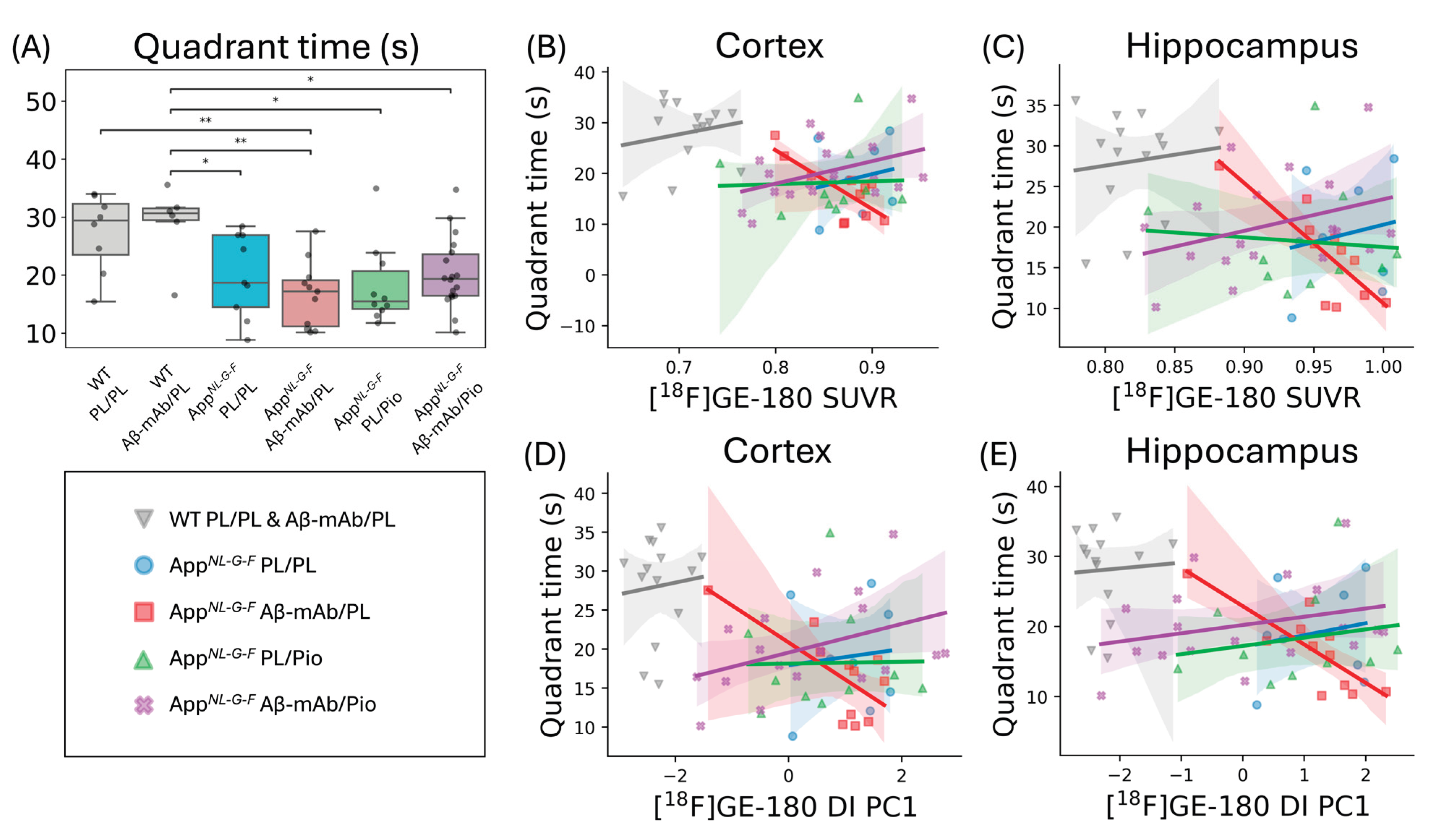
Finally, we questioned how the investigated treatment options influenced the cognitive performance of the mouse cohorts in correlation with PET biomarkers. For this purpose, we performed behavioral testing at 10 months of age using a Morris water maze (MWM). It was shown that AppNL-G-Fmice spent significantly less time in the target quadrant than WT mice (Figure 4A). Moreover, in AppNL-G-Fmice that received monotreatment with anti-Aβ-mAb, there was a negative correlation between quadrant time and both TSPO-PET SUVR (Figure 4B, cortex, R2 = 0.58; Figure 4C, EHA, R2 = 0.65) and TSPO-PET desynchronization (Figure 4D, cortex, R2 = 0.51; Figure 4E, EHA, R2 = 0.65). No notable correlation between TSPO-PET indices and behavior was observed in AppNL-G-Fmice treated with placebo, monotreatment with pioglitazone or dual treatment, indicating that the negative association between TSPO-PET indices and behavioral performance was observed only in the anti-Aβ monotherapy group. This pattern is consistent with, but does not establish, a modifying effect of pioglitazone, as between-group differences in variance or dynamic range may contribute as well.
3. Discussion
Our findings demonstrate that parallel monitoring of neuroinflammation and Aβ plaque load with PET can provide important insights to pathophysiological changes during therapy regimes against AD. In an analysis of global TSPO expression in the mouse brain, we find that pioglitazone might prevent the neuroinflammatory response associated with anti-Aβ-mAb treatment in the AppNL-G-F model, as suggested by the respective treatment-group contrasts; however, these contrasts did not remain significant after FDR correction and thus should only be interpreted as exploratory. This is consistent with the possibility that pioglitazone may mitigate the inflammatory side effects induced by immunotherapeutic Aβ-targeting strategies. These initial global TSPO-PET observations are based on %ID, whereas the treatment-related longitudinal and regional analyses discussed below rely on SUVR-based quantification. Looking at relative TSPO expression by a more robust longitudinal TSPO-PET SUVR analysis, our data showed that monotreatment with anti-Aβ-mAb, and pioglitazone, as well as the combination treatment delayed the increase of cortical microglia activation and reduced the magnitude of neuroinflammation in AppNL-G-F mice. Longitudinal Aβ-PET SUVR analysis demonstrated no significant increase of Aβ-PET signal at both 7.5 and 10 months in the anti-Aβ monotreatment arm. This is consistent with antibodies neutralizing soluble Aβ aggregates and fibrillar Aβ at plaque rims and thus reducing the emergence of new tracer-binding fibrils [19]. Contrary, pioglitazone- and double-treated mice showed a robust increase of cortical fibrillary Aβ by 7.5 months, in line with previous observations of higher plaque compactness after treatment with PPARγ agonists [16]. At the same time, our biochemical analysis showed a reduction in insoluble Aβ38, Aβ40, and Aβ42 in the combination treatment group compared to placebo at 10 months. One possible interpretation is that the antibody reduces the pool of soluble Aβ available for incorporation into plaques, while pioglitazone increases plaque compactness and β-sheet content. As fibrillar, β-sheet-rich plaques have higher Aβ-PET binding affinity, the PET signal per plaque volume increases. However, this explanation remains provisional. Recent preclinical work indicates that the in vivo Aβ-PET signal reflects a composite of fibrillar and non-fibrillar plaque components, rather than fibrillarity alone, and that ligand binding can also vary with plaque molecular architecture and the availability of tracer-binding sites [20]. Accordingly, the increased [18F]FBB signal under pioglitazone may alternatively reflect treatment-related changes in plaque composition or tracer accessibility, rather than simple plaque compaction alone. Notably, [18F]FBB binds to both neuritic and diffuse fibrillar plaques [21]. The observed reduction of insoluble ApoE additionally supports the notion of lowered amount of core plaques since ApoE promotes core deposition [22,23]. Another plausible explanation is redistribution of Aβ toward vascular deposits, since amyloid PET cannot distinguish parenchymal plaque Aβ from vascular Aβ in cerebral amyloid angiopathy (CAA) [24]. This possibility is particularly relevant in the context of anti-Aβ immunotherapy, which has been associated in mouse models with increased vascular amyloid, microhemorrhages, vascular permeability, and altered cerebrovascular structure around vascular amyloid deposits [7,8,9]. An additional driver of the increased [18F]FBB signal could be elevated vascular Aβ and microhemorrhages (ARIA-H) induced as parenchymal plaques are mobilized by Aβ immunotherapy [7]; however, this possible explanation remains speculative, as CAA and vascular pathology were not assessed in this work. Overall, the increased [18F]FBB signal in pioglitazone-treated mice should therefore be interpreted cautiously as compatible with, but not specific for, plaque compaction/higher fibrillarity. Further studies will need histological validation, CAA and plaque-associated microglia readouts to distinguish between these possibilities.
Additionally, we found that mice with low cortical TSPO-PET SUVR at 5 months tended to have a higher percentage increase in microglial activation compared to those with high baseline TSPO-PET. These findings suggest that, in untreated AppNL-G-F mice, baseline TSPO-PET SUVR may predict the magnitude of subsequent microglial activation, suggesting that early TSPO-PET may help to identify individuals at higher risk of an overshooting inflammatory response. All the treatment options reduced this baseline-change coupling, which suggests that treatment reduces the dependence of future microglial activation on baseline TSPO levels. At the same time, the investigated association between regional TSPO-PET and Aβ-PET may indicate that all treatments improve the neuroinflammatory response to fibrillar Aβ and that a dual treatment with anti-Aβ-mAb and pioglitazone leads to sustained immune response. However, this cannot be confirmed without further histological validation of plaque-associated microglia or TSPO colocalization.
In light of our recent research [17], it has become clear that baseline microglial activation is a key determinant for therapeutic outcomes in AD models. Specifically, the level of TSPO-PET signals at therapy onset may predict which mice and, potentially, patients are most likely to benefit from immunomodulatory strategies. The ability of pioglitazone, as suggested by this study, to drive microglia into an anti-inflammatory state, even when administered in combination with Aβ-directed therapies, aligns with broader evidence that modulating inflammation can facilitate cognitive improvement and possibly shift Aβ plaques toward a more fibrillar state [16] that microglia can more readily handle. However, findings on sex-dependent differences [17] underscore the complexity of these pathways, implying that individualized approaches, particularly in designing and interpreting early clinical trials, could be essential.
Methodologically, our study reinforces the value of longitudinal TSPO-PET for tracing progressive neuroinflammatory changes. Coupling these imaging results with both biochemical and behavioral measures demonstrates that TSPO-PET is a robust tool for monitoring microglial activation in vivo. From a translational perspective, however, these findings should be considered hypothesis-generating rather than a direct rationale for immediate clinical combination trials. Although pioglitazone was generally well-tolerated in a small pilot study in nondiabetic patients with AD [25], larger clinical studies have not demonstrated clear efficacy; notably, the phase 3 TOMMORROW trial did not show that low-dose pioglitazone delayed the onset of mild cognitive impairment due to AD [26]. In addition, pioglitazone has known adverse-effect liabilities, including fluid retention and edema, increased incidence of heart failure, weight gain [27], and fracture risk [28], which are particularly relevant in older patients with AD and multimorbidity. Therefore, any future exploration of PPAR-γ agonist co-therapy would require careful patient selection, dose optimization, and prospective safety monitoring, rather than assuming broad clinical suitability. Translational extrapolation is further limited by the fact that the antibody used in this work differs from currently approved anti-Aβ antibodies. Lecanemab and donanemab target different Aβ species and have agent-specific dosing, titration, and adverse-event profiles, including distinct ARIA risk patterns [4,29,30]. More broadly, anti-Aβ antibody-associated risk is influenced by antibody characteristics, dose, and cerebrovascular amyloid burden [31,32]; thus, our results should be interpreted as supporting the general concept that immunomodulation may modify treatment-associated neuroinflammatory responses during anti-Aβ therapy, rather than as directly predicting the efficacy or safety of combining pioglitazone with currently used clinical antibodies in patients.
Most importantly, our data show that exploiting the potential of simultaneous PET monitoring of both Aβ plaque load and neuroinflammation with multi-regional approaches is a powerful approach to understand treatment-related changes in AD pathophysiology. This approach was also successfully translated into human imaging and showed that, although microglial responses to fibrillar Aβ are comparable between sexes, women with AD exhibit a more pronounced Aβ-plaque-independent microglial activation, which may relate to increased tau accumulation [33]. In the current work we observed stronger regional associations between microglia activation and fibrillar amyloidosis during chronic administration of anti-Aβ-mAb or pioglitazone, which may indicate the capability of both treatment strategies to enhance the phagocytic capacity of microglia when amyloid challenges the brain [34,35]. Interestingly, the dual treatment approach showed the most sustained microglia response at 10 months of age, which may suggest beneficial enhancement of microglia function by shifting microglia to an anti-inflammatory phenotype while being primed against Aβ plaques. However, in the absence of immunohistochemistry, TSPO colocalization, and plaque-associated microglia readouts, these results should be interpreted with caution.
Building upon multi-region evaluation of PET imaging, the applied microglia desynchronization index (DI) based on TSPO-PET-connectivity or, more broadly, connectivity deviation score (CDS) has the potential to become a more sensitive biomarker than semi-quantitative PET. Importantly, DI should not be interpreted here as a direct readout of microglial function or network-level microglial dynamics, but rather as a biologically informed covariance-based metric that quantifies the deviation of an individual regional TSPO-PET pattern from the synchronicity of a control cohort. Our previous work [18] provides the main biological rationale for this approach: near-complete pharmacological microglia depletion substantially reduced TSPO-PET interregional correlations, and single-cell radiotracing identified microglia as the dominant cellular contributor to the regionally desynchronized TSPO-PET signal, with increased variability of tracer uptake in plaque-associated microglia in amyloid-rich regions. At the same time, DI is not independent of image scaling, since it is derived from SUVR-based interregional relationships. However, our previous work [18] showed that the loss of TSPO-PET synchronicity after microglia depletion was highly consistent when an alternative myocardium-adjusted scaling approach was used, and that DI had higher discriminative value than conventional SUVR in most investigated mouse cohorts and in all human cohorts. Thus, DI may provide incremental value beyond mean regional uptake by capturing spatial heterogeneity of the TSPO-PET signal, but its interpretation remains complementary rather than definitive. The observed correlation between TSPO-PET desynchronization and individual behavior in the present study should also be interpreted cautiously, since it was observed only in one treatment arm (anti-Aβ-mAb monotreatment). Thus, while DI appears promising as an individualized marker of altered regional TSPO-PET organization, the present dataset does not independently validate its biological basis, and future studies combining DI with histology, cell-specific assays, and external replication will be needed to clarify its robustness and mechanistic interpretation further. CDS of other tracers can provide additional clinical value but are yet to be investigated and their biological interpretation is yet to be clarified. For instance, future studies of Aβ-PET-based CDS and its combination with the TSPO-PET DI can be promising for predicting clinical outcome.
Finally, we attempted to link TSPO-PET endpoints with individual outcomes in behavioral testing. We observed a strong negative correlation between the magnitude of the TSPO-PET indices and quadrant time, a proxy for cognitive performance in mice, in the anti-Aβ monotherapy group. However, this subgroup-specific association should be interpreted cautiously. The absence of comparable correlations in the pioglitazone-containing groups does not by itself demonstrate that pioglitazone prevented detrimental neuroinflammatory effects, since alternative explanations such as reduced variance, ceiling/floor effects, or narrower dynamic range in treated groups are also possible. Formal between-group comparison of regression slopes was not performed in the present study and will be important in future work.
Large parts of this work were conducted shortly before and during the COVID-19 pandemic. Related limitations of the study include the lack of immunohistochemistry due to the missing opportunity of tissue processing, limited datapoints, especially at 7.5 months, condensed wild-type treatment arms, and delay in publication. Thus, the used anti-Aβ-mAb is already outdated by successful phase III trials and market approval of the more specific anti-Aβ-mAbs lecanemab and donanemab, although we anticipate the general mechanism of anti-Aβ-therapy-induced neuroinflammation to be similar. In addition, the main focus of this work relates to neuroinflammation imaging during anti-Aβ-mAb treatment, which was successfully acquired and evaluated. The reduced number of PET datapoints was driven mainly by temporary lockdown-related interruption of preclinical radiochemistry and radiosynthesis, which prevented some planned scans from being performed, rather than by a high rate of failed imaging procedures. In addition, a smaller number of acquired scans was excluded according to predefined technical criteria. A further limitation is that behavioral testing was performed only at the terminal timepoint. We opted for this design because cognitive deficits in AppNL-G-F mice are mild and variably reported at earlier ages, with some studies finding no robust impairment at 6 months [36] and others detecting deficits from 6 months onward [37]. Thus, repeated longitudinal Morris water maze testing might have added burden while masking subtle effects through task familiarity.
The absence of histological and functional follow-up is particularly relevant for interpretation of TSPO-PET, as the signal is not fully microglia-specific and may also include astrocytic or vascular contributions [10]. Moreover, TSPO-PET does not distinguish microglial phenotypes or directly measure phagocytic activity. Accordingly, the present findings should be interpreted as treatment-associated changes in neuroinflammatory signal rather than direct evidence of beneficial or harmful microglial function. The interpretation of increased [18F]FBB signal under pioglitazone as plaque compaction or higher fibrillarity remains provisional.
4. Materials and Methods
4.1. Experimental Design
This study included a total of 72 C57BL/6 mice with two genotypes: AppNL-G-F(APP knock-in [38], n = 56) and wild type (WT, n = 16). Sample size was chosen based on prior experience. WT were split into two treatment arms: double placebo (PL/PL, n = 8) and anti-β-amyloid antibodies (Aβ-mAb/PL, n = 8). AppNL-G-F mice had the same treatment arms (PL/PL, n = 10; Aβ-mAb/PL, n = 14) and two additional ones: pioglitazone (PL/Pio, n = 11) and the combination of β-amyloid antibodies and pioglitazone (Aβ-mAb/Pio, n = 21) (Table S7). The mice were then scanned with TSPO- and Aβ-PET at 5, 7.5, and 10 months of age. We selected 5 months of age as baseline because this stage precedes advanced pathology while already providing a quantifiable in vivo PET signal [12]. To assess Aβ-mAb-induced neuroinflammation in AppNL-G-F mice and to answer the question of whether and how pioglitazone modulates it, we analyzed longitudinal TSPO- and Aβ-PET uptake in the cortex. To assess the effect of different treatment options on fibrillary amyloid deposition in the mouse brain, we correlated TSPO-PET to Aβ-PET uptake in 20 predefined atlas brain regions and estimated the slope of a linear fit, i.e. microglial activation relative to amyloidosis. Finally, we compared behavioral parameters between the treatment arms and correlated these values to TSPO-PET uptake and microglia DI – a personalized parameter reflecting the deviation of individual TSPO uptake pattern from the TSPO-PET connectivity of the control cohort [18].
4.1.1. Randomization
Randomization procedures were implemented throughout the study. Animals were randomly assigned to the treatment groups. Mice assigned to pioglitazone treatment were distributed across multiple cages to enable administration via pioglitazone-containing chow while minimizing potential cage effects. Animals were further randomly scheduled for imaging sessions, randomly positioned in the animal bed (4 mice per scan) during scanning, and randomly scheduled for behavioral assessments.
4.1.2. Blinding
Complete blinding of the primary experimenter could not be maintained in this study, as one experimenter was responsible for treatment administration, imaging, behavioral testing, and initial data processing and was therefore aware of group allocation. To reduce potential bias, randomization procedures were applied throughout the study, and confirmation of data quality and outcome interpretation were performed by an additional blinded investigator and an independent automated analysis pipeline. Manual preprocessing of imaging data was likewise verified by a blinded reviewer and an automated approach.
4.2. Animals
This manuscript is reported in accordance with the ARRIVE 2.0 Essential 10 guidelines for the reporting of animal research. All animal experiments were approved by the local animal care committee of the Government of Upper Bavaria (Regierung von Oberbayern, approval number ROB-55.2-2532.Vet_02-15-210 and ROB-55.2-2532.Vet_02-19-26, approval date 05.09.2019) and were conducted in accordance with applicable national and international regulations, including the German Animal Welfare Act, the U.K. Animals (Scientific Procedures) Act 1986, and EU Directive 2010/63/EU.
Female and male AppNL-G-F mice and C57BL/6 control (WT) mice were used. Animals were group-housed under specific-pathogen-free conditions in a temperature- and humidity-controlled environment with a 12 h/12 h light-dark cycle, with ad libitum access to water and standard chow (Ssniff Ms-H, Ssniff Spezialdiäten GmbH). Each individual mouse constituted one experimental unit. All experimental procedures were performed at the Department of Nuclear Medicine, LMU University Hospital (LMU Munich).
AppNL-G-F mice were generated on a C57BL/6 background, carrying three humanized mutations associated with familial Alzheimer’s disease (Swedish KM670/671NL, Beyreuther/Iberian I716F, and Arctic G mutations). This model closely recapitulates human amyloid pathology, with Aβ deposition detectable from approximately 2 months of age by histological assessment [38] and from around 5 months onward by Aβ-PET [12]. Measurable memory impairments in this model have been reported from approximately 6 months of age, although their onset and magnitude vary across studies [36,37].
4.3. Treatment
At baseline (5 months of age), WT mice were treated with β1 mouse monoclonal IgG2a antibody (Aβ-mAb) [39] (WT Aβ-mAb/PL cohort) or with placebo (PL) (WT PL/PL cohort). In AppNL-G-F mice, the same two groups were studied, as well as two additional treatment options: pioglitazone (Pio, AppNL-G-F PL/Pio cohort) and combination treatment with Aβ-mAb and Pio (AppNL-G-F Aβ-mAb/Pio cohort).
For antibody treatment, the Aβ-mAb was prepared in 90 mM NaCl and 50 mM Tris, pH 7.1, yielding a solution concentration of 2 mg/ml. Each mouse in the Aβ-mAb and Aβ-mAb/Pio cohorts received a weekly intraperitoneal injection of 0.5 mg Aβ-mAb, with an injection volume of approximately 10 ml/kg body weight. The Aβ-mAb was generously provided by Novartis Pharma AG, Basel, Switzerland. The β1 mouse monoclonal IgG2a recognizes amino acids 3-6 of human Aβ and binds a defined linear sequence on the N-terminus of the human Aβ peptide, specifically the tetrapeptide EFRH of human Aβ. Importantly, the Aβ-mAb does not bind the corresponding region in mouse Aβ, where the sequence differs (mouse Aβ shows EFGH in that position), which makes it specific to human Aβ in transgenic mouse models. Control animals received corresponding placebo intraperitoneal injections with NaCl solution.
Pioglitazone was incorporated into the regular mouse chow and administered daily via the mice’s ad libitum diet. Mice assigned to pioglitazone treatment were housed accordingly, distributed across multiple cages, and food intake was monitored by weekly weighing of the pioglitazone-containing chow to ensure comparable consumption across cages. Both the Aβ-mAb and pioglitazone treatments were initiated following the completion of baseline TSPO- and Aβ-PET scans, and continued until all study procedures were completed. Standard mouse chow served as dietary placebo for the control groups.
4.4. Behavioral Testing
Prior to the final scanning timepoint, at 10 months of age, each cohort underwent behavioral assessment using a MWM, with the rationale to avoid influence from anesthesia prior to behavioral testing. MWM was conducted according to a standard protocol, slightly modified based on spatial conditions and prior experience. In brief, a circular pool was filled with water, while this pool contained a platform, which was submerged just below the water surface in one quadrant of the circle, such that the mice could not see the platform immediately. For visual cues, patterns on the walls of the pool were used to help the mice orient themselves and find the platform. The procedure of the behavioral testing was divided into three parts. A Habituation Phase (day 0), during which the mice were first introduced to the pool containing a visible platform, which could be easily found to reduce stress and allow familiarization with the environment. A Training Phase (day 1 to 5), during which the mice were placed into opaque water, made cloudy with non-toxic paint, so they could learn to locate the hidden platform using spatial cues. During the Training Phase, the mice were placed into the pool from different starting points. The third part of the procedure was a Probe Trial (day 6), including removal of the platform to track searching by individual mice. The time spent in the target quadrant where the platform used to be, was tracked as an index of memory retention. In order to keep conditions similar and bearable for each mouse, the water temperature was checked frequently and kept at 24°C at all times.
4.5. Analysis of AD Signature Proteins
After completing the second follow-up scan (FU2), at 10 months of age, mice were transcardially perfused with PBS in order to harvest the brains. The brain was flash-frozen in liquid nitrogen for subsequent biochemical analyses.
To prepare the fractions for biochemical analyses, the PBS-perfused and flash-frozen brains were kept in a -80°C freezer until further processing. The brain homogenates for TREM2, Aβ, and ApoE quantification were essentially prepared as described previously [40]. DEA (0.2 % Diethylamine in 50 mM NaCl, pH 10) and RIPA lysates (20 mM Tris-HCl pH 7.5, 150 mM NaCl, 1 mM Na2EDTA, 1% NP-40, 1% sodium deoxycholate, 2.5 mM sodium pyrophosphate) were prepared from brain hemispheres by ultracentrifugation. The RIPA insoluble material of one hemisphere was homogenized in 400 µl 70% formic acid (FA fraction). The FA fraction was neutralized with 20 x 1 M Tris-HCl buffer at pH 9.5 and used for ApoE and Aβ analysis. The protein extraction protocol schematic is displayed in Figure S5.
ELISA quantification for Aβ and ApoE were performed as described previously [40]. In brief, Aβ contained in DEA and FA fractions was quantified by a sandwich immunoassay using the MESO Scale Aβ Triplex plates and Discovery SECTOR Imager 2400 as described previously [41]. Samples were measured in triplicate. ApoE contained in DEA and FA fractions was quantified by a sandwich immunoassay using the Mesoscale Streptavidin plates and Discovery
SECTOR Imager 2400 with adjusted dilutions using the R-Plex ApoE antibody set F212l. The samples were measured in three technical replicates.
4.6. PET Imaging and Analysis
All small-animal PET (μPET) procedures followed an established standardized protocol for radiochemistry, acquisition, and post-processing [42,43]. PET imaging was performed on a Siemens Inveon DPET (Siemens Healthineers, Erlangen, Germany), followed by a 7-min transmission scan using a rotating [57Co] point source. Briefly, we used [18F]GE-180 TSPO μPET with an emission window of 60-90 min post-injection to measure cerebral microglial activity and [18F]florbetaben ([18F]FBB) Aβ-μPET with an emission window of 30-60 min post-injection to quantify the amount of fibrillary amyloid in the mouse brain. Table S7 provides a detailed description of the number of scans performed in each cohort. All μPET experiments were performed with isoflurane anesthesia (1.5% at time of tracer injection and during imaging; delivery 3.5 L/min). The mice were scanned at 5 (baseline), 7.5, and 10 months of age (both TSPO- and Aβ-μPET, except for WT mice at 5 and 7.5 months, which only received TSPO-PET), resulting in a total of 165 TSPO-PET and 154 Aβ-PET scans. PET data were visually inspected and spatially registered to respective in-house tracer-specific templates [44] using a user-independent automated elastic transformation in PMOD software (Fusion tool, version 3.5, PMOD Technologies, Zurich, Switzerland) to exclude operator bias.
For [18F]GE-180 TSPO-PET, we used different normalization approaches depending on the analysis aim. For global comparisons between genotypes and treatment arms, we quantified TSPO uptake as percentage of injected dose per cubic centimeter (%ID/cc, further referred to as %ID) to avoid potential bias from changes in the pseudo-reference region. For longitudinal and regional analyses, including connectivity and desynchronization metrics, we expressed TSPO uptake as SUVR. A data-driven approach was applied to [18F]GE-180 data to find the best pseudo-reference region for SUVR calculation: the distributions of [18F]GE-180 uptake (%ID) were compared in every VOI of both pooled WT cohorts and pooled AppNL-G-Fcohorts, and the VOI with the smallest effect size (Cohen’s d) was selected. Based on this screening procedure, the brain stem showed the smallest genotype-related difference and was therefore used as a pseudo-reference region (Table S1, Figure S3). Additionally, we generated z-score images using n = 14 10-month-TSPO-PET (SUVR) of WT mice treated with PL/PL or Aβ-mAb/PL as reference. For the [18F]FBB data, we consistently used SUVR with periaqueductal gray matter as the pseudo-reference region [12], and Aβ z-score images were computed from these SUVR maps. Image parcellation was performed using Ma-Benveniste-Mirrione mouse brain atlas [45], with further subdivision of the neocortical target region (visual, auditory, entorhinal, sensorimotor, and somatosensory cortex, all split into left and right). Table S6 provides further description of the VOIs used in the study. Cerebellum, brain stem, and right and left sensorimotor cortex VOIs were manually cropped to correct for signal spill-in from the brain ventricles and Harderian glands. All the processing steps except for the spatial registration were performed using a custom Python script (version 3.12, NiBabel package [46]).
During the COVID-19 pandemic, temporary lockdown-related restrictions and interruptions in preclinical radiochemistry and radiosynthesis limited the acquisition of some planned PET scans, particularly at the 7.5-month timepoint. Thus, not all missing datapoints reflect failed imaging procedures; in many cases, the scans could not be performed as scheduled. For acquired scans, exclusion criteria were predefined and included insufficient tracer uptake (< 10 MBq), paravenous tracer administration, and technical malfunction of the imaging system. When these criteria were met, only the affected scans were excluded from the analysis, while the animals remained in the study. Consequently, the number of animals contributing data varied between timepoints.
4.7. Individual Assessment of Microglia Desynchronization
Using the SUVR images, interregional correlation coefficients (ICCs) were calculated for mice at 10 months of age using a molecular connectivity Python package developed in our department [47] as described in [18]: briefly, Pearson’s correlation coefficient between all VOI pairs was computed, which was followed by the Fisher’s R to Z transformation [48] and bootstrapping by resampling with replacement. Individual connectivity deviation scores (CDS, called desynchronization index [DI] for [18F]GE-180 [18]) were calculated for each VOIiby: (1) estimating bootstrapped linear fit for every VOI pair of the control cohort (pooled WT PL/PL and WT Aβ-mAb/PL cohort to increase robustness, n = 14); (2) for each VOI pair of each study subject, calculating the perpendicular distance from the subject’s pair of values to the corresponding linear fit; (3) summing up the perpendicular distances of all the pairs that include the VOIi. To obtain the DIs of composite VOIs, such as whole cortex and entorhinal-hippocampus-amygdala (EHA) region, PC1 was calculated on the DIs of the constituent VOIs (Table S6), as described in [18] (DI PC1).
4.8. Statistical Analysis
Shapiro-Wilk normality test [49] was performed on all distributions before comparisons. To test for differences in TSPO-PET (%ID), Kruskal-Wallis H-test and Mann-Whitney U (MWU) tests [50] (two-sided, adjusted by FDR [51]) were performed using Pingouin statistical library (Python 3.12). To test for differences in time spent in the target quadrant and the levels of TREM2 (RIPA), Aβ38 (FA), and Aβ42 (DEA) at 10 months, MWU tests (two-sided, adjusted by FDR) were performed using statsannotations statistical library (Python 3.12). To test for differences in the levels of TREM2 (DEA), ApoE, Aβ40 (FA), and Aβ42 (FA), unpaired t-tests (two-tailed, adjusted by FDR) were performed using statsannotations statistical library (Python 3.12).
To compare TSPO-PET SUVR between the genotypes, timepoints, and treatment types, we applied a LMEM with random intercepts for individual mice, type III ANOVA with Satterthwaite's method, and post-hoc contrasts on estimated marginal means (adjusted by FDR). The LMEM was implemented in R (version 4.4.1, lme4 and emmeans libraries). In all statistical tests, p < 0.05 was used as the significance threshold.
5. Conclusions
In conclusion, our study highlights the potential of TSPO-PET to monitor neuroinflammation during Aβ-related treatments in AD. Dual treatment strategies of Aβ targeting antibodies and immunomodulators may mitigate overshooting neuroinflammation, warrant further evaluation with cell-specific and functional validation, and potentially improve side-effect profile of anti-Aβ therapy.
Supplementary Materials
The following supporting information can be downloaded at the website of this paper posted on Preprints.org. Figure S1: representative average Aβ-PET images; Figure S2: microglia activation in WT and AppNL-G-F mice at 10 months of age, demonstrated by TSPO-PET (%ID); Figure S3: [¹⁸F]GE-180 %ID in brain stem of AppNL-G-F and WT mice treated with PL/PL at 10 months of age; Figure S4: correlation between %ID-normalized mean cortical uptake in investigated mice (10 months of age) and corresponding mean SUVR (scaled to brain stem uptake), SUVR-based DI (PC1); Figure S5: Biochemical analyses at 10 months of age; Figure S6: schematic view of the protein extraction protocol used to collect soluble brain proteins (DEA), detergent solubilized homogenates (RIPA) and formic acid extracted aggregates (FA) from mouse brain hemispheres; Table S1: ratio of [¹⁸F]GE-180 %ID mean values in each investigated brain region and Cohen’s d effect size comparing AppNL-G-F and WT mice treated with PL/PL at 10 months of age; Table S2: type III ANOVA results for the longitudinal TSPO-PET SUVR in cortex; Table S3: estimated marginal means (EMMs) for the longitudinal TSPO-PET SUVR in cortex by genotype, treatment, and timepoint; Table S4: type III ANOVA results for the longitudinal Aβ-PET SUVR in cortex; Table S5: estimated marginal means (EMMs) for the longitudinal Aβ-PET SUVR in cortex by genotype, treatment, and timepoint; Table S6: description of VOIs used in the study; Table S7: number of mice in each study cohort.
Author Contributions
conceptualization: KW-M, MB, AZ; methodology: KW-M, MB; software: AZ; validation: KW-M, LHK, AZ; formal analysis: KW-M, AZ; investigation: KW-M, LHK, MW, GP, CG, BN, SL, JSG; resources: GB, FJG, RAW, NF, MB, AZ; data curation: KW-M, AZ; writing - original draft: KW-M, MB, AZ; writing- review & editing: LHK, MW, GP, CG, BN, GB, FJG, SL, RAW, NF, JSG; visualization: KW-M, MW, AZ; supervision: MB, AZ; project administration: MB; funding acquisition: MB, AZ. All authors read and approved the final manuscript.
Funding
This work was supported by the Medical & Clinician Scientist Program (MCSP) of LMU Munich and EXC 2145 SyNergy – ID 390857198.
Institutional Review Board Statement
All experiments have been approved by the local animal care committee of the Government of Upper Bavaria (Regierung von Oberbayern, approval numbers: ROB-55.22532.Vet_02-15-210, ROB-55.2-2532.Vet_02-19-26, approval date: 05.09.2019) and were carried out in compliance with the ARRIVE guidelines as well as in accordance with the U.K. Animals (Scientific Procedures) Act, 1986 and associated guidelines, EU Directive 20210/63/EU for animal experiments.
Data Availability Statement
The datasets used and analyzed during the current study are available from the corresponding author on reasonable request.
Conflicts of Interest
MB is a member of the Neuroimaging Committee of the EANM, has received speaker honoraria from Roche, GE healthcare and Life Molecular Imaging, and is an advisor of Life Molecular Imaging. NF has received consultancy honoraria from MSD and speaker honoraria from LMI. All other authors declare they have no competing interests.
Abbreviations
The following abbreviations are used in this manuscript:
| Aβ | β-amyloid |
| AD | Alzheimer’s disease |
| ANOVA | Analysis of variance |
| ApoE | Apolipoprotein E |
| ARIA | Amyloid-related imaging abnormalities |
| CAA | Cerebral amyloid angiopathy |
| CDS | Connectivity deviation score |
| DEA | Diethylamine buffer |
| DI | Desynchronization index |
| EHA | Entorhinal-hippocampus-amygdala region |
| FA | Formic acid |
| FBB | Florbetaben |
| FDR | False-discovery rate |
| ICC | Interregional correlation coefficient |
| ID | Injected dose |
| IQR | Interquartile range |
| LMEM | Linear mixed-effects model |
| mAb | Monoclonal antibody |
| MWM | Morris water maze |
| MWU | Mann-Whitney U-test |
| PBS | Phosphate-buffered saline |
| PC1 | First principal component |
| PET | Positron emission tomography |
| Pio | Pioglitazone |
| PL | Placebo |
| PPAR-γ | Peroxisome proliferator-activated receptor γ |
| RIPA | Radio-immuno-precipitation assay buffer |
| SUVR | Standardized uptake value ratio |
| TREM2 | Triggering receptor expressed on myeloid cells 2 |
| TSPO | 18 kDa translocator protein |
| VOI | Volume of interest |
| WT | Wild type |
| μPET | Small-animal PET |
References
- Gustavsson, A. Global estimates on the number of persons across the Alzheimer's disease continuum. Alzheimer's & Dementia 2023, 19, 658–670. [Google Scholar]
- Cummings, J. Anti-amyloid monoclonal antibodies for the treatment of Alzheimer’s disease. BioDrugs 2024, 38, 5–22. [Google Scholar] [CrossRef]
- Sperling, R.A. Amyloid-related imaging abnormalities in amyloid-modifying therapeutic trials: recommendations from the Alzheimer’s Association Research Roundtable Workgroup. Alzheimer's & Dementia 2011, 7, 367–385. [Google Scholar]
- Jeong, S.Y. Amyloid-related imaging abnormalities in the era of anti-amyloid beta monoclonal antibodies for Alzheimer’s disease: recent updates on clinical and imaging features and MRI monitoring. Korean Journal of Radiology 2024, 25, 726. [Google Scholar] [CrossRef]
- Zimmer, E.R. Tracking neuroinflammation in Alzheimer’s disease: the role of positron emission tomography imaging. Journal of neuroinflammation 2014, 11, 120. [Google Scholar] [CrossRef]
- Heneka, M.T. Neuroinflammation in Alzheimer's disease. The Lancet Neurology 2015, 14, 388–405. [Google Scholar] [CrossRef]
- Wilcock, D.M. Passive immunotherapy against Aβ in aged APP-transgenic mice reverses cognitive deficits and depletes parenchymal amyloid deposits in spite of increased vascular amyloid and microhemorrhage. Journal of neuroinflammation 2004, 1, 24. [Google Scholar] [CrossRef]
- Wilcock, D.M. Deglycosylated anti-amyloid-β antibodies eliminate cognitive deficits and reduce parenchymal amyloid with minimal vascular consequences in aged amyloid precursor protein transgenic mice. Journal of Neuroscience 2006, 26, 5340–5346. [Google Scholar] [CrossRef]
- Taylor, X. Amyloid-β (Aβ) immunotherapy induced microhemorrhages are associated with activated perivascular macrophages and peripheral monocyte recruitment in Alzheimer’s disease mice. Molecular Neurodegeneration 2023, 18, 59. [Google Scholar] [CrossRef]
- Guilarte, T.R. Imaging neuroinflammation with TSPO: A new perspective on the cellular sources and subcellular localization. Pharmacology & therapeutics 2022, 234, 108048. [Google Scholar]
- Nutma, E. Translocator protein is a marker of activated microglia in rodent models but not human neurodegenerative diseases. Nature Communications 2023, 14, 5247. [Google Scholar] [CrossRef]
- Sacher, C. Longitudinal PET monitoring of amyloidosis and microglial activation in a second-generation amyloid-β mouse model. Journal of Nuclear Medicine 2019, 60, 1787–1793. [Google Scholar] [CrossRef]
- Van Camp, N. TSPO imaging in animal models of brain diseases. European Journal of Nuclear Medicine and Molecular Imaging 2021, 49, 77–109. [Google Scholar] [CrossRef] [PubMed]
- Heneka, M.T. Acute treatment with the PPARγ agonist pioglitazone and ibuprofen reduces glial inflammation and Aβ1–42 levels in APPV717I transgenic mice. Brain 2005, 128, 1442–1453. [Google Scholar] [CrossRef]
- Yamanaka, M. PPARγ/RXRα-induced and CD36-mediated microglial amyloid-β phagocytosis results in cognitive improvement in amyloid precursor protein/presenilin 1 mice. Journal of Neuroscience 2012, 32, 17321–17331. [Google Scholar] [CrossRef] [PubMed]
- Blume, T. Chronic PPARγ stimulation shifts amyloidosis to higher fibrillarity but improves cognition. Frontiers in aging neuroscience 2022, 14, 854031. [Google Scholar] [CrossRef]
- Biechele, G. Pre-therapeutic microglia activation and sex determine therapy effects of chronic immunomodulation. Theranostics 2021, 11, 8964. [Google Scholar] [CrossRef]
- Zatcepin, A. Regional desynchronization of microglial activity is associated with cognitive decline in Alzheimer’s disease. Molecular neurodegeneration 2024, 19, 64. [Google Scholar] [CrossRef] [PubMed]
- Sevigny, J. The antibody aducanumab reduces Aβ plaques in Alzheimer’s disease. Nature 2016, 537, 50–56. [Google Scholar] [CrossRef]
- LeVine, H., III; Walker, L.C. What amyloid ligands can tell us about molecular polymorphism and disease. Neurobiology of aging 2016, 42, 205–212. [Google Scholar] [CrossRef]
- Sabri, O. Florbetaben PET imaging to detect amyloid beta plaques in Alzheimer's disease: phase 3 study. Alzheimer's & dementia 2015, 11, 964–974. [Google Scholar]
- Bales, K.R. Apolipoprotein E is essential for amyloid deposition in the APP V717F transgenic mouse model of Alzheimer's disease. Proceedings of the National Academy of Sciences 1999, 96, 15233–15238. [Google Scholar] [CrossRef]
- Holtzman, D.M. Apolipoprotein E isoform-dependent amyloid deposition and neuritic degeneration in a mouse model of Alzheimer's disease. Proceedings of the National Academy of Sciences 2000, 97, 2892–2897. [Google Scholar] [CrossRef]
- Abrahamson, E.E. Development of a PET radioligand selective for cerebral amyloid angiopathy. Nuclear medicine and biology 2021, 92, 85–96. [Google Scholar] [CrossRef]
- Geldmacher, D.S. A randomized pilot clinical trial of the safety of pioglitazone in treatment of patients with Alzheimer disease. Archives of neurology 2011, 68, 45–50. [Google Scholar] [CrossRef]
- Burns, D.K. Safety and efficacy of pioglitazone for the delay of cognitive impairment in people at risk of Alzheimer's disease (TOMMORROW): a prognostic biomarker study and a phase 3, randomised, double-blind, placebo-controlled trial. The Lancet Neurology 2021, 20, 537–547. [Google Scholar] [CrossRef]
- Lebovitz, H.E. Thiazolidinediones: the forgotten diabetes medications. Current diabetes reports 2019, 19, 151. [Google Scholar] [CrossRef]
- Viscoli, C.M. Pioglitazone and risk for bone fracture: safety data from a randomized clinical trial. The Journal of Clinical Endocrinology & Metabolism 2017, 102, 914–922. [Google Scholar]
- Van Dyck, C.H. Lecanemab in early Alzheimer’s disease. New England Journal of Medicine 2023, 388, 9–21. [Google Scholar] [CrossRef] [PubMed]
- Sims, J.R. Donanemab in early symptomatic Alzheimer disease: the TRAILBLAZER-ALZ 2 randomized clinical trial. Jama 2023, 330, 512–527. [Google Scholar] [CrossRef]
- Golde, T.E. Disease-modifying therapies for Alzheimer's disease: more questions than answers. Neurotherapeutics 2022, 19, 209–227. [Google Scholar] [CrossRef]
- Cummings, J.L. Maximizing the benefit and managing the risk of anti-amyloid monoclonal antibody therapy for Alzheimer's disease: strategies and research directions. Neurotherapeutics 2025, 22, e00570. [Google Scholar] [CrossRef]
- Biechele, G. Associations between sex, body mass index and the individual microglial response in Alzheimer’s disease. Journal of Neuroinflammation 2024, 21, 30. [Google Scholar] [CrossRef]
- Garland, E.F. The microglial translocator protein (TSPO) in Alzheimer’s disease reflects a phagocytic phenotype. Acta Neuropathologica 2024, 148, 62. [Google Scholar] [CrossRef]
- Plowey, E.D. Alzheimer disease neuropathology in a patient previously treated with aducanumab. Acta neuropathologica 2022, 144, 143–153. [Google Scholar] [CrossRef] [PubMed]
- Whyte, L.S. Reduction in open field activity in the absence of memory deficits in the AppNL− G− F knock-in mouse model of Alzheimer’s disease. Behavioural brain research 2018, 336, 177–181. [Google Scholar] [CrossRef]
- Mehla, J. Age-dependent behavioral and biochemical characterization of single APP knock-in mouse (APPNL-GF/NL-GF) model of Alzheimer's disease. Neurobiology of Aging 2019, 75, 25–37. [Google Scholar] [CrossRef] [PubMed]
- Saito, T. Single App knock-in mouse models of Alzheimer's disease. Nature neuroscience 2014, 17, 661–663. [Google Scholar] [CrossRef]
- Paganetti, P.A. Amyloid precursor protein truncated at any of the γ-secretase sites is not cleaved to β-amyloid. Journal of neuroscience research 1996, 46, 283–293. [Google Scholar] [CrossRef]
- Parhizkar, S. Loss of TREM2 function increases amyloid seeding but reduces plaque-associated ApoE. Nat Neurosci Correction in Nat Neurosci 2024, 27, 1858–1859.. 2019, 22, 191–204. [Google Scholar] [CrossRef]
- Page, R.M. Generation of Abeta38 and Abeta42 is independently and differentially affected by familial Alzheimer disease-associated presenilin mutations and gamma-secretase modulation. J Biol Chem 2008, 283, 677–83. [Google Scholar] [CrossRef]
- Brendel, M. Glial activation and glucose metabolism in a transgenic amyloid mouse model: a triple-tracer PET study. Journal of Nuclear Medicine 2016, 57, 954–960. [Google Scholar] [CrossRef]
- Brendel, M. Cross-sectional comparison of small animal [18F]-florbetaben amyloid-PET between transgenic AD mouse models. PloS one 2015, 10, e0116678. [Google Scholar] [CrossRef]
- Overhoff, F. Automated spatial brain normalization and hindbrain white matter reference tissue give improved [18F]-florbetaben PET quantitation in Alzheimer's model mice. Frontiers in neuroscience 2016, 10, 45. [Google Scholar] [CrossRef] [PubMed]
- Ma, Y. A three-dimensional digital atlas database of the adult C57BL/6J mouse brain by magnetic resonance microscopy. Neuroscience 2005, 135, 1203–1215. [Google Scholar] [CrossRef] [PubMed]
- Brett, M. nipy/nibabel: 5.3.1; Zenodo, 2024. [Google Scholar]
- Zatcepin, A. molecular-connectivity. 2025.
- Huber, M. Metabolic correlates of dopaminergic loss in dementia with Lewy bodies. Movement disorders 2020, 35, 595–605. [Google Scholar] [CrossRef]
- Shapiro, S.S.; Wilk, M.B. An analysis of variance test for normality (complete samples). Biometrika 1965, 52, 591–611. [Google Scholar] [CrossRef]
- Mann, H.B.; Whitney, D.R. On a test of whether one of two random variables is stochastically larger than the other. The annals of mathematical statistics 1947, 50–60. [Google Scholar] [CrossRef]
- Benjamini, Y.; Hochberg, Y. Controlling the false discovery rate: a practical and powerful approach to multiple testing. Journal of the Royal statistical society: series B (Methodological) 1995, 57, 289–300. [Google Scholar] [CrossRef]
Figure 1.
(A-C). Voxelwise group average TSPO-PET images (%ID normalization) generated from all animals within each cohort at (A) 5 months, (B) 7.5 months, and (C) 10 months of age. Treatment arms: PL/PL – double placebo, Aβ-mAb/PL – anti-β-amyloid antibodies, PL/Pio – pioglitazone, Aβ-mAb/Pio – combination of anti-β-amyloid antibodies and pioglitazone. WT – wild-type mice, AppNL-G-F – APP knock-in mice. The number of mice in respective cohorts (n) is shown in the bottom left corner. (D-E) TSPO-PET (%ID) at 10 months of age pooled across treatment arms within each genotype (WT, n = 14; AppNL-G-F, n = 48) to illustrate the overall genotype effect in (D) amygdala and (E) cortex. (F) Treatment-arm-specific comparisons indicate highest TSPO-PET signals for anti-Aβ-mAb monotreatment in AppNL-G-F mice, without reaching significance for the contrast against other AppNL-G-F groups after false-discovery-rate correction. Significance annotations (Mann-Whitney U test, post-hoc FDR-adjusted p-values): *p < 0.05, **p < 0.01, ***p < 0.001. Boxes show the interquartile range (IQR) and median; whiskers follow the 1.5×IQR rule.
Figure 1.
(A-C). Voxelwise group average TSPO-PET images (%ID normalization) generated from all animals within each cohort at (A) 5 months, (B) 7.5 months, and (C) 10 months of age. Treatment arms: PL/PL – double placebo, Aβ-mAb/PL – anti-β-amyloid antibodies, PL/Pio – pioglitazone, Aβ-mAb/Pio – combination of anti-β-amyloid antibodies and pioglitazone. WT – wild-type mice, AppNL-G-F – APP knock-in mice. The number of mice in respective cohorts (n) is shown in the bottom left corner. (D-E) TSPO-PET (%ID) at 10 months of age pooled across treatment arms within each genotype (WT, n = 14; AppNL-G-F, n = 48) to illustrate the overall genotype effect in (D) amygdala and (E) cortex. (F) Treatment-arm-specific comparisons indicate highest TSPO-PET signals for anti-Aβ-mAb monotreatment in AppNL-G-F mice, without reaching significance for the contrast against other AppNL-G-F groups after false-discovery-rate correction. Significance annotations (Mann-Whitney U test, post-hoc FDR-adjusted p-values): *p < 0.05, **p < 0.01, ***p < 0.001. Boxes show the interquartile range (IQR) and median; whiskers follow the 1.5×IQR rule.
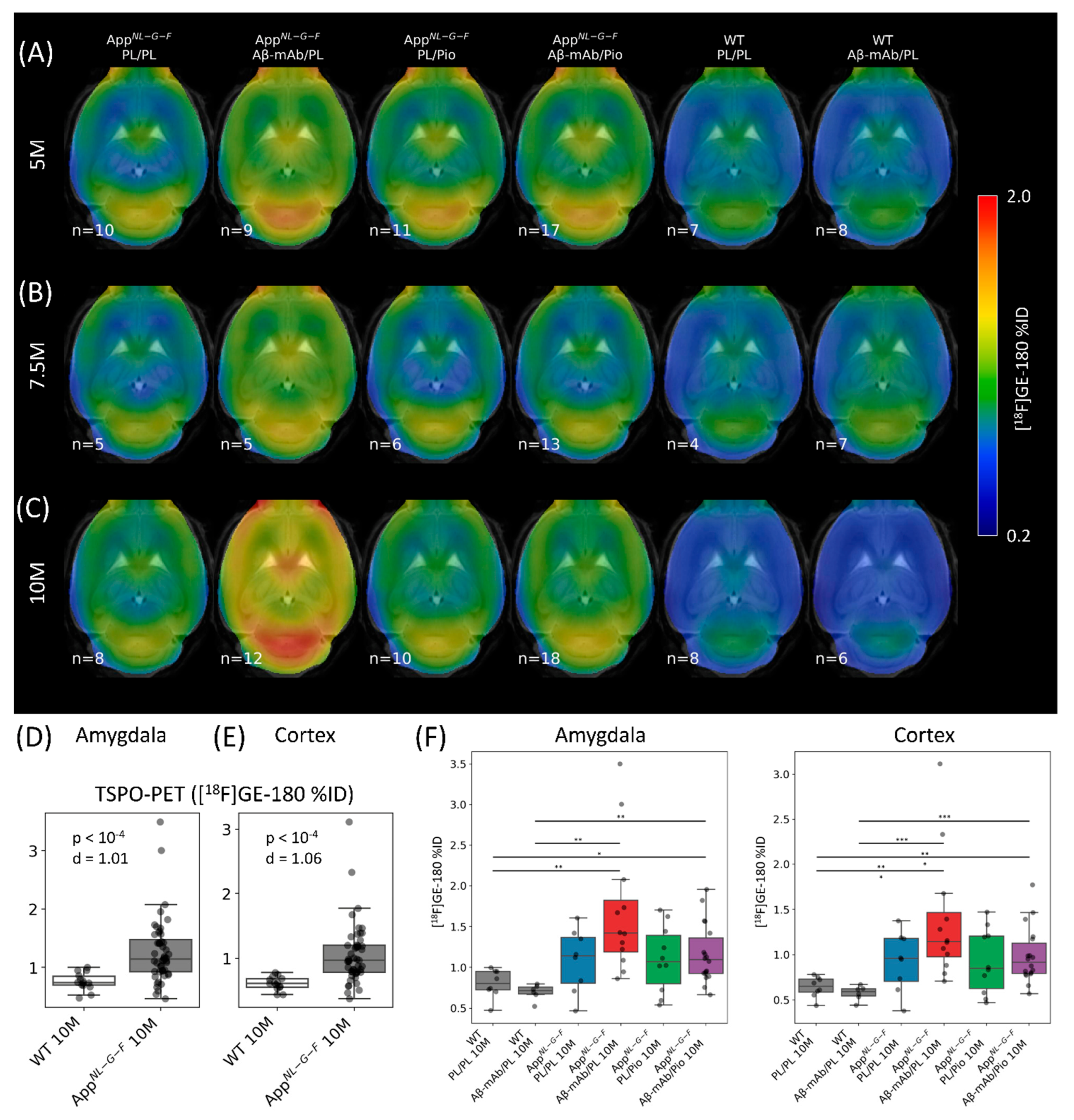
Figure 2.
(A) Cortical TSPO-PET SUVR values (brain stem-scaled) across cohorts and timepoints. (B) LMEM-derived estimated marginal means of cortical TSPO-PET SUVR. (C) Cortical Aβ-PET SUVR values (periaqueductal gray matter-scaled) across cohorts and timepoints. (D) LMEM-derived estimated marginal means of cortical Aβ-PET SUVR. (E-F) Relationship between baseline cortical TSPO-PET SUVR (5 months) and subsequent percentage change in cortical TSPO-PET SUVR from 5 to 7.5 months (E) and from 5 to 10 months (F). Boxes show the IQR and median; whiskers follow the 1.5×IQR rule. Significance annotations (post-hoc FDR-adjusted p-values) are shown only for within-cohort comparisons; *p < 0.05, **p < 0.01, ***p < 0.001, ****p < 0.0001. Error bars show 95% confidence intervals. Sample sizes (n) per cohort at 5, 7.5, and 10 months were as follows: TSPO-PET (A-B): WT PL/PL, 7/4/8; WT Aβ-mAb/PL, 8/7/6; AppNL-G-F PL/PL, 10/5/8; AppNL-G-FAβ-mAb/PL, 9/5/12; AppNL-G-FPL/Pio, 11/6/10; AppNL-G-FAβ-mAb/Pio, 17/13/18. Aβ-PET (C–D): WT PL/PL, 0/0/7; WT Aβ-mAb/PL, 0/0/7; AppNL-G-FPL/PL, 10/7/9; AppNL-G-FAβ-mAb/PL, 14/8/12; AppNL-G-FPL/Pio, 10/9/8; AppNL-G-FAβ-mAb/Pio, 21/13/16. Panels E and F include only mice with data available at both relevant timepoints.
Figure 2.
(A) Cortical TSPO-PET SUVR values (brain stem-scaled) across cohorts and timepoints. (B) LMEM-derived estimated marginal means of cortical TSPO-PET SUVR. (C) Cortical Aβ-PET SUVR values (periaqueductal gray matter-scaled) across cohorts and timepoints. (D) LMEM-derived estimated marginal means of cortical Aβ-PET SUVR. (E-F) Relationship between baseline cortical TSPO-PET SUVR (5 months) and subsequent percentage change in cortical TSPO-PET SUVR from 5 to 7.5 months (E) and from 5 to 10 months (F). Boxes show the IQR and median; whiskers follow the 1.5×IQR rule. Significance annotations (post-hoc FDR-adjusted p-values) are shown only for within-cohort comparisons; *p < 0.05, **p < 0.01, ***p < 0.001, ****p < 0.0001. Error bars show 95% confidence intervals. Sample sizes (n) per cohort at 5, 7.5, and 10 months were as follows: TSPO-PET (A-B): WT PL/PL, 7/4/8; WT Aβ-mAb/PL, 8/7/6; AppNL-G-F PL/PL, 10/5/8; AppNL-G-FAβ-mAb/PL, 9/5/12; AppNL-G-FPL/Pio, 11/6/10; AppNL-G-FAβ-mAb/Pio, 17/13/18. Aβ-PET (C–D): WT PL/PL, 0/0/7; WT Aβ-mAb/PL, 0/0/7; AppNL-G-FPL/PL, 10/7/9; AppNL-G-FAβ-mAb/PL, 14/8/12; AppNL-G-FPL/Pio, 10/9/8; AppNL-G-FAβ-mAb/Pio, 21/13/16. Panels E and F include only mice with data available at both relevant timepoints.
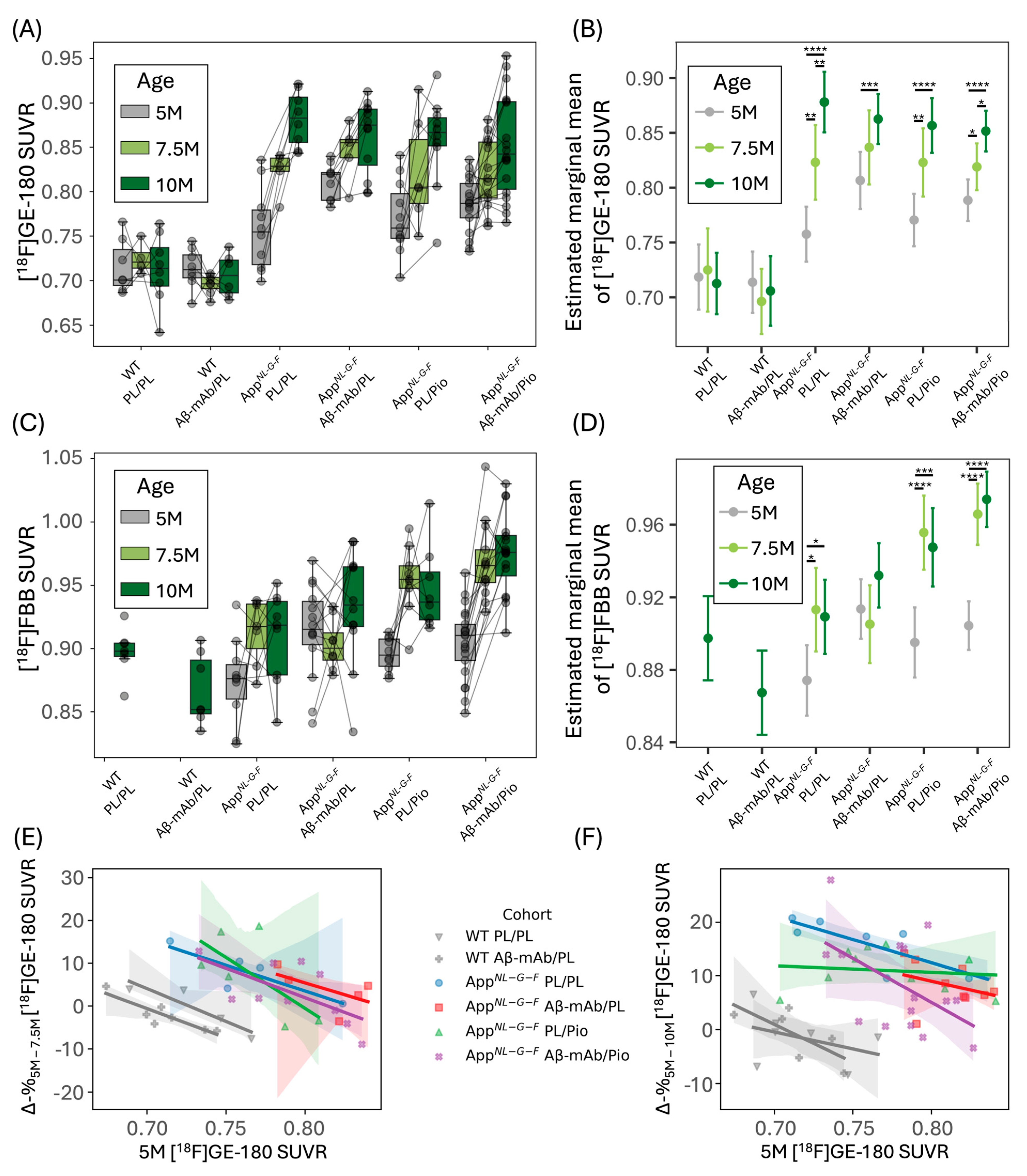
Figure 3.
Correlations between regional mean [18F]FBB and [18F]GE-180 z-scores in AppNL-G-Fmice at 5, 7.5, and 10 months of age in 20 investigated brain regions. Each point represents one brain region in one mouse. Sample sizes (n = mice) per treatment arm at 5, 7.5, and 10 months were as follows: PL/PL, 10/3/8; Aβ-mAb/PL, 9/2/11; PL/Pio, 10/6/8; Aβ-mAb/Pio, 17/7/15.
Figure 3.
Correlations between regional mean [18F]FBB and [18F]GE-180 z-scores in AppNL-G-Fmice at 5, 7.5, and 10 months of age in 20 investigated brain regions. Each point represents one brain region in one mouse. Sample sizes (n = mice) per treatment arm at 5, 7.5, and 10 months were as follows: PL/PL, 10/3/8; Aβ-mAb/PL, 9/2/11; PL/Pio, 10/6/8; Aβ-mAb/Pio, 17/7/15.
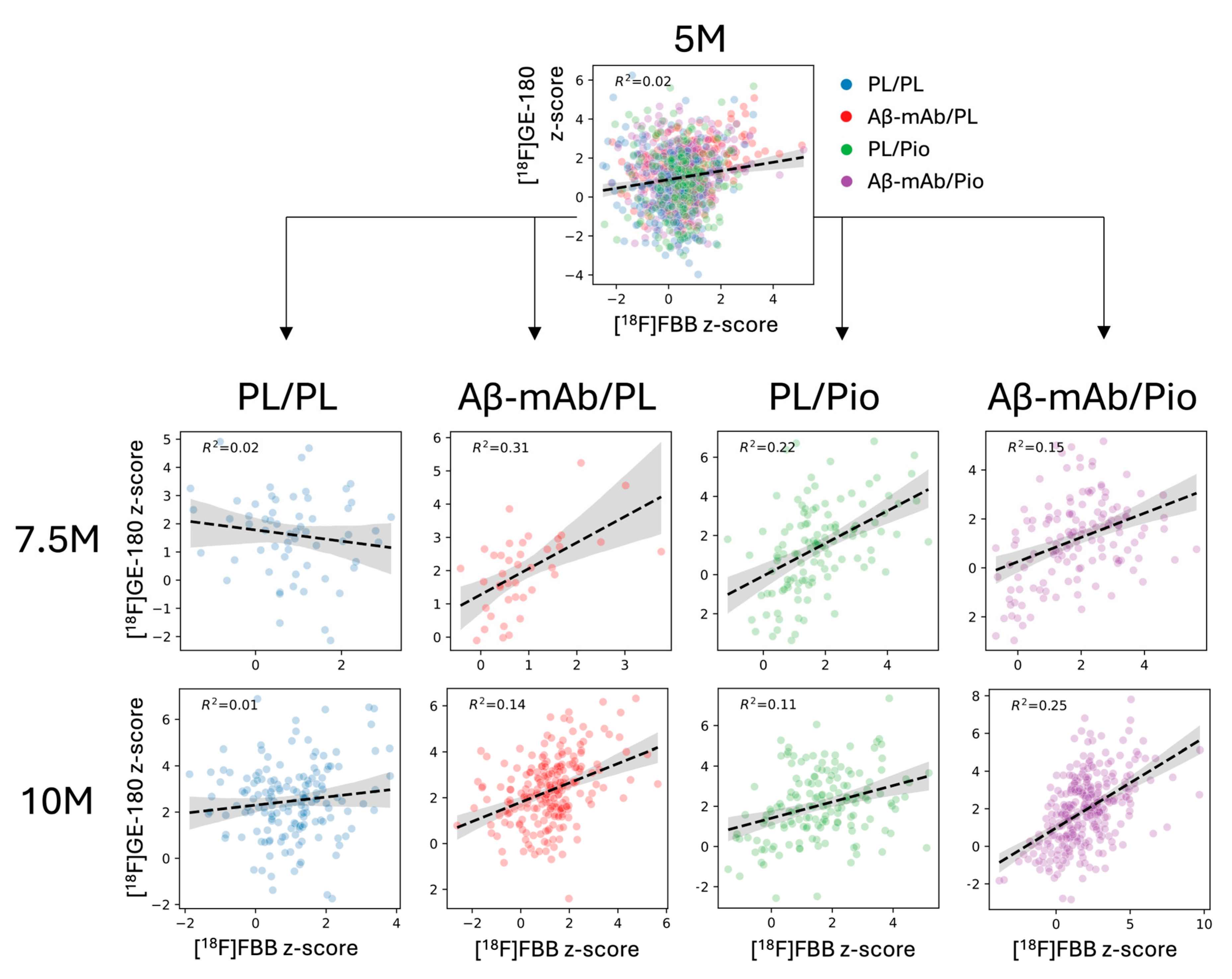
Figure 4.
(A) Morris water maze performance (time spent in the target quadrant) at 10 months of age. (B-E) Associations between TSPO-PET-derived measures and behavioral performance at 10 months in the investigated cohorts: (B) cortical TSPO-PET SUVR, (C) EHA TSPO-PET SUVR, (D) cortical DI PC1, and (E) EHA DI PC1. Boxes show the IQR and median; whiskers follow the 1.5×IQR rule. Statistical significance: *p < 0.05, **p < 0.01. Sample sizes (n) per cohort were as follows: WT PL/PL, 8; WT Aβ-mAb/PL, 6; AppNL-G-F PL/PL, 8; AppNL-G-FAβ-mAb/PL, 12; AppNL-G-FPL/Pio, 10; AppNL-G-FAβ-mAb/Pio, 18.
Figure 4.
(A) Morris water maze performance (time spent in the target quadrant) at 10 months of age. (B-E) Associations between TSPO-PET-derived measures and behavioral performance at 10 months in the investigated cohorts: (B) cortical TSPO-PET SUVR, (C) EHA TSPO-PET SUVR, (D) cortical DI PC1, and (E) EHA DI PC1. Boxes show the IQR and median; whiskers follow the 1.5×IQR rule. Statistical significance: *p < 0.05, **p < 0.01. Sample sizes (n) per cohort were as follows: WT PL/PL, 8; WT Aβ-mAb/PL, 6; AppNL-G-F PL/PL, 8; AppNL-G-FAβ-mAb/PL, 12; AppNL-G-FPL/Pio, 10; AppNL-G-FAβ-mAb/Pio, 18.
Disclaimer/Publisher’s Note: The statements, opinions and data contained in all publications are solely those of the individual author(s) and contributor(s) and not of MDPI and/or the editor(s). MDPI and/or the editor(s) disclaim responsibility for any injury to people or property resulting from any ideas, methods, instructions or products referred to in the content. |
© 2026 by the authors. Licensee MDPI, Basel, Switzerland. This article is an open access article distributed under the terms and conditions of the Creative Commons Attribution (CC BY) license (http://creativecommons.org/licenses/by/4.0/).
Copyright: This open access article is published under a Creative Commons CC BY 4.0 license, which permit the free download, distribution, and reuse, provided that the author and preprint are cited in any reuse.


