
Submitted:
06 April 2026
Posted:
08 April 2026
You are already at the latest version
Abstract
Objective: The objective was to determine whether individuals who received doxycycline had a shorter hospitalization time. Methods: A retrospective, observational, and comparative study was conducted with 64 patients diagnosed with dengue. One group received standard symptomatic treatment, while the other also received doxycycline (initial dose of 200 mg, followed by 100 mg every 12 hours until discharge). Clinical and laboratory variables were compared. Results: Compared to patients who received only the standard treatment, patients treated with doxycycline had a shorter hospitalization time (26.30 ± 13.72 vs 93.18 ± 25.29 h, p<0.0001), hours of fever (13.79 ± 16.18 vs 127.08 ± 51.22, p<0.0001), headache (16.30 ± 19.27 vs 94.59 ± 26.11, p<0.0001), and myalgia (23.94 ± 10.90 vs 120.24 ± 25.20, p<0.0001). Furthermore, the doxycycline group exhibited a higher platelet recovery rate (0.54 ± 0.49 vs 0.23 ± 0.29, p=0.003) than the other group. No adverse effects were reported. Despite limitations (sample size and lack of randomization), the findings suggest that doxycycline would be a promising and useful therapeutic alternative in the management of dengue. Conclusion: The use of doxycycline in dengue treatment was associated with a reduction in hospitalization time, duration of symptoms, and a higher platelet recovery rate.
Keywords:
dengue
; doxycycline
; thrombocytopenia
; hospitalization
; symptoms
1. Introduction
Dengue is an infectious disease caused by the dengue virus (DENV), this systemic viral infection, colloquially termed break-bone fever, is common in tropical and subtropical areas, where 75% of the symptomatic cases that occur each year are found [1]. The principal vectors responsible for transmission are Aedes aegypti and Aedes albopictus mosquitoes [2]. Notably, A. albopictus was not present in South America until recent years, but due to global mobility and climate change, it has now established itself in the region [3]. Consequently, the incidence of dengue has risen substantially, even in temperate cities such as Buenos Aires, where reports went from 14 cases in 2015 [4] to 55,375 in 2024 [5]. Similarly, in Peru, there were 262,287 cases and 252 deaths during the same year [6]. On a global scale, cases reported to the World Health Organization (WHO) have grown dramatically, from 505,430 in 2000 to 5.2 million in 2019, reaching over 14.3 million in 2024 [1].
Previous data suggest that only about one in four persons infected the first time develop symptoms [3]. The true incidence of dengue, therefore, is substantially underestimated due to the high frequency of subclinical and mild self-limiting infections. The disease is mild in more than 90% of cases, with a fatality rate of about one in every 1,000 to 2,000 cases, but when it becomes severe dengue, the fatality rate increases to between 1% and 5% [7]. The symptomatic phase of dengue typically follows an incubation period of 4-10 days and generally persists for 2-7 days. The characteristic clinical presentation often includes high-grade fever, severe cephalgia, retro-orbital pain, myalgia, arthralgia, and variable cutaneous manifestations [1].
Consequently, clinical management is primarily directed at symptomatic relief, with acetaminophen representing the analgesic of choice due to its favorable safety profile. The utilization of non-steroidal anti-inflammatory drugs (NSAIDs) is strictly contraindicated in dengue management due to their potential to exacerbate bleeding diatheses [1,8]. At present, management remains exclusively supportive, focusing on adequate volume replacement and, in patients with bleeding manifestations, the administration of blood products [9]. There are two main vaccines: CYD-TDV (Dengvaxia) is a live-attenuated, tetravalent chimeric vaccine. It utilizes the yellow fever virus 17D strain as a backbone to express the pre-membrane (PrM) and envelope (E) proteins of all four dengue virus (DENV) serotypes [3]. It is recommended for individuals aged 9 to 45 with a history of prior infection [10]. The other vaccine, TAK-003 (commercially known as Qdenga), is a recombinant live-attenuated chimeric vaccine that utilizes a DENV-2 backbone to express the structural proteins of DENV-1, DENV-3, and DENV-4 [3]. Previous research suggests that it reduces hospitalizations by 84% and symptomatic cases by 61% [11]. According to the WHO, the tetravalent dengue vaccine TAK-003 (QDenga) is licensed in several jurisdictions; however, its current indication is restricted to children and adolescents aged 6–16 years residing in high-transmission endemic areas. The development of additional vaccine candidates remains an active area of clinical investigation [1].
Although dengue's case fatality rate is relatively low, it is the most prevalent arthropod-borne viral disease worldwide [12]. Current epidemiological estimates indicate that approximately half of the global population resides in regions at risk of DENV infection [1]. This significant disease burden, coupled with the limitations of current prophylactic options, underscores the critical unmet need for specific antiviral therapies [13]. To this end, several drugs have been investigated for repurposing against dengue [14], though most have demonstrated negligible impact on clinical outcomes. A notable exception is doxycycline, a second-generation tetracycline-class antibiotic. Beyond its established antibacterial mechanism of inhibiting protein synthesis via binding to the 30S ribosomal subunit, evidence suggests it possesses beneficial clinical effects in dengue. Previous studies report that patients receiving doxycycline experienced a faster resolution of symptoms, shorter hospitalization, and improved recovery from thrombocytopenia and leukopenia, alongside reduced mortality [15,16].
Therefore, this study was designed to contribute to this emerging body of evidence by evaluating the clinical and hematological (platelet count dynamics) outcomes through a retrospective analysis of a pre-existing, anonymized patient database. This dataset comprised individuals hospitalized for dengue at a private institution in the coastal city of Trujillo, Peru (34 meters above sea level). The original therapeutic approach for these patients had been determined at the discretion of their attending physicians, which resulted in the formation of two distinct cohorts for comparative analysis: one managed with the internationally recommended standard of supportive care alone, and another that received adjunctive oral doxycycline on a compassionate-use basis.
2. Methods
An observational, retrospective, and comparative study was designed using a cohort of patients treated for dengue at a private hospital in Trujillo, Peru in 2024. All patients were diagnosed according to the guidelines of the Peruvian Ministry of Health (MINSA) [17]. The anonymized database contained records of hospitalized patients who all received standard symptomatic management per MINSA protocol. Within this framework, the attending physicians, on a compassionate-use basis, elected to adjunctively administer doxycycline to a subset of patients. This real-world, non-randomized allocation resulted in the formation of two distinct cohorts for comparison: a control cohort (n=17), comprising patients managed exclusively with standard supportive care, and a doxycycline cohort (n=47). The provided database contained no personally identifiable information.
The primary objective of the study was to determine whether individuals who received doxycycline had a shorter hospitalization time compared to those managed exclusively according to the guidelines of the MINSA. The secondary objectives included assessing the duration of symptoms and platelet count dynamics. We determined, for every patient, the Platelet Recovery Rate, a metric designed to quantify the velocity of hematological recovery. This measure is calculated as the difference between platelet counts at discharge and admission divided by time, providing a standardized tool to assess dynamic platelet improvement (expressed as ×10³/µL · h⁻¹).
The normality of continuous data distributions was assessed using the Shapiro-Wilk test. For variables with a normal distribution (p > 0.05), group comparisons were performed using the independent Student's t-test, reporting mean differences with 95% confidence intervals (CI). For continuous variables violating the normality assumption, the non-parametric Mann-Whitney U test was used; these data are presented as median and interquartile range (IQR). Normally distributed data are presented as mean ± standard deviation (SD). Table 1 provides both measures to ensure a robust description of the data distribution and consistency with prior literature. Effect sizes were calculated using Hedges' g.
Statistical analyses and graphical visualizations were performed using Python (version 3.13) with the Pandas, NumPy, Seaborn, and Matplotlib libraries. Data distributions were visualized using violin plots, generated via kernel density estimation. These plots included an embedded boxplot depicting the median and interquartile range, with overlaid individual data points.
Ethical approval for this retrospective study, which utilized a fully anonymized patient database, was granted by the Institutional Ethics Committee of the Universidad Peruana Cayetano Heredia (Approval Number: 217526, dated April 14, 2025). The requirement for informed consent was waived by the committee due to the study's retrospective design and the use of exclusively anonymized data.
3. Results
The study included 64 patients hospitalized with dengue, comprising 31 women and 33 men, with a mean age of 30.8 years. Among them, 47 patients also received doxycycline (an initial dose of 200 mg, followed by 100 mg every 12 hours until discharge), while the remaining 17 received standard symptomatic care per MINSA guidelines. All patients presented with thrombocytopenia and symptoms of fever, headache, and myalgia upon admission. This analysis is based on data collected until the moment of discharge, with no follow-up information available thereafter.
The analysis of baseline characteristics revealed no significant differences in age and pre-hospitalization fever duration, with 95% confidence intervals (CI) for the mean difference encompassing zero and trivial effect sizes (Hedges' g = -0.15 and -0.07, respectively). However, the doxycycline group had significantly shorter pre-hospitalization headache (mean difference: -22.53 hours; 95% CI: -44.12 to -0.94; g = -0.95) and myalgia (mean difference: -21.79 hours; 95% CI: -32.89 to -10.69; g = -1.12), with moderate-to-large effect sizes. The clinical relevance of these baseline differences is considered in the interpretation of the primary outcomes.
Compared to the standard care group, patients treated with doxycycline experienced markedly better outcomes during hospitalization. They had a significantly shorter hospitalization time (26.30 ± 13.72 vs. 93.18 ± 25.29 hours, p < 0.0001; Δ = -66.88 hours; 95% CI: -82.29 to -51.47; g = -4.29), as well as shorter durations of fever (13.79 ± 16.18 vs. 127.08 ± 51.22 hours, p < 0.0001; Δ = -113.29 hours; 95% CI: -140.52 to -86.06; g = -3.81), headache (16.30 ± 19.27 vs. 94.59 ± 26.11 hours, p < 0.0001; Δ = -78.29 hours; 95% CI: -98.64 to -57.94; g = -3.36), and myalgia (23.94 ± 10.90 vs. 120.24 ± 25.20 hours, p < 0.0001; Δ = -96.30 hours; 95% CI: -109.55 to -83.05; g = -5.99). Furthermore, the doxycycline group exhibited a significantly higher platelet recovery rate (0.54 ± 0.49 vs. 0.23 ± 0.29, ×10³/µL·h⁻¹, p = 0.003; Δ = +0.31 ×10³/µL·h⁻¹; 95% CI: +0.14 to +0.48; g = +0.75). (Table 1) No adverse effects related to the doxycycline treatment were reported.
4. Discussion
The use of doxycycline in dengue treatment was associated with a significant reduction in hospitalization time, duration of key symptoms, and a higher platelet recovery rate. (Table 1). Regarding pre-hospitalization symptoms, the duration of fever, the longest-lasting symptom prior to admission, was comparable between groups (Figure 1 and Figure 2). However, baseline imbalances were observed for pre-hospitalization headache and myalgia, which were approximately one day shorter in the doxycycline group. Despite these differences, the treatment effect during hospitalization was substantially larger. Doxycycline reduced the hospitalization time by approximately 2.8 days and the duration of fever by about 4.7 days. This considerable magnitude of improvement supports the primary attribution of the clinical benefits to the therapeutic intervention. Furthermore, although platelet counts at admission were similar between groups, hematological recovery was accelerated in the doxycycline group. The platelet recovery rate was more than twofold higher in patients receiving doxycycline (0.54 ± 0.49 vs. 0.23 ± 0.29 ×10³/µL·h⁻¹, p = 0.003).
Fredeking et al [16]. reported that in patients with hemorrhagic dengue and plasma leak, those randomly assigned to receive oral doxycycline plus WHO-recommended therapy (n=116) had a 46% lower mortality compared to those receiving standard therapy alone (n=115) (11.2% [13/116] vs. 20.9% [24/115], p=0.05). Furthermore, the doxycycline group showed a significant reduction in TNF and IL-6 levels (p<0.01) during follow-up [16]. Pambhar et al [15]. conducted a clinical study with 120 thrombocytopenic dengue patients. Patients without leukopenia (n=65) received standard WHO therapy, while those with leukopenia (n=55) were stratified by platelet count: those with counts between 50,001-150,000/μL received doxycycline, and those with counts below 50,001/μL received doxycycline combined with Carica papaya leaf extract. The study demonstrated an improvement in both platelet and leukocyte counts on days 4 and 7, showing a graded response: WHO therapy < doxycycline < doxycycline with Carica papaya. Consistently, the mean hospital stay followed the same pattern, being longest in the control group (9.1 days), intermediate with doxycycline alone (8.2 days), and shortest with combination therapy (7.3 days) [15].
Doxycycline inhibits dengue virus replication through two primary mechanisms. First, it prevents viral entry by binding to a key hydrophobic pocket in the viral envelope (E) protein. For successful entry, the DENV E protein must undergo a conformational change from a dimeric to a trimeric state upon contact with the host cell membrane, a process essential for membrane fusion [8,18]. This structural rearrangement is hinged on a hydrophobic pocket in the E protein measuring 481 Å. When this pocket is occupied, as demonstrated experimentally by the detergent n-octyl-β-D-glucoside (BOG), the requisite viral conformational change is sterically hindered, thereby blocking viral entry [8,19,20].
Through virtual screening (VS) using the Generic Evolutionary Method for Molecular Docking (GEMDOCK) applied to the Comprehensive Medicinal Chemistry (CMC) database, doxycycline was identified among 10 top candidates from 5,331 screened molecules. The elements were selected based on structural similarities, docked positions, protein-ligand interactions and commercial availability limitations. Experimentally, doxycycline at 500 µM reduced plaque-forming units by 99%, exhibiting a median inhibitory concentration (IC₅₀) of 55.6 µM. Computational modeling suggests that the binding capacity of tetracycline-class molecules may be informed by structural analogies to the bacterial TetR protein, which has a binding site volume (359–495 Å) comparable to the E protein pocket, though the antiviral mechanism itself involves direct binding to the viral E protein. When doxycycline occupies this pocket, its side chains form hydrogen bonds with residues on opposite walls, creating a steric hindrance that prevents the conformational change required for viral entry. This doxycycline-bound complex is more stable than the analogous structure formed with tetracycline [8].
Second, doxycycline inhibits viral replication within infected cells by targeting the dengue virus serine protease. This protease complex, composed of the NS3 catalytic subunit and its essential NS2B cofactor, is indispensable for processing the viral polyprotein. Doxycycline directly inhibits the DENV2 NS2B-NS3 protease (NS2B-NS3pro) with an IC₅₀ value of 52.3 ± 6.2 µM at 37°C and 26.7 ± 5.3 µM at 40°C, indicating enhanced inhibitory activity at febrile temperatures. This mechanistic finding is corroborated by cell culture evidence, where treatment with 50 µM doxycycline for 72 hours significantly reduced viral copies across all serotypes, with a more pronounced effect observed against DENV2 and DENV4 compared to DENV1 and DENV3 [18].
The superior binding affinity of doxycycline compared to tetracycline, characterized by more stable and numerous hydrogen bonds with the pocket walls [8], may explain its enhanced clinical efficacy. This structural advantage was reflected in a clinical study where doxycycline demonstrated more effective immunomodulatory activity. Castro et al [21]. reported that 45 dengue patients treated with doxycycline showed better modulation of elevated cytokine levels and cytokine receptors/antagonists compared to 35 patients receiving tetracycline. While IL-6, IL-1β, and TNF levels remained elevated or increased further in the 34 untreated patients, both tetracycline groups showed reductions in these inflammatory markers. Furthermore, by days 3 and 7, IL-1RA and TNF-R1 levels had increased significantly from baseline in all three study groups [21].
Several repurposed drugs have been evaluated for dengue treatment with limited success. Chloroquine showed in vitro activity against DENV [22] and provided symptomatic relief by reducing pain in patients, but it did not significantly affect disease duration, symptom intensity, or fever duration in clinical trials [23]. The conflicting evidence regarding its efficacy, with some studies showing no therapeutic benefit [22], highlights the challenges of translating in vitro findings to clinical practice. Interestingly, chloroquine demonstrated prophylactic potential by preventing the development of specific IgG antibodies in infected monkeys [24]. Similarly, ivermectin, which inhibits importin alpha/beta-mediated nuclear import [25], suppresses DENV replication across all four serotypes in vitro. While clinical evidence remains limited, studies have reported effects on NS1 antigen clearance and reduced NS1 persistence at discharge [26,27], suggesting potential antiviral activity that warrants further investigation in rigorous clinical trials.
This study is subject to several limitations. First, the sample size was modest (n=64), and the non-randomized treatment assignment resulted in uneven group sizes (47 vs. 17) and baseline imbalances in headache and myalgia duration, introducing potential for selection bias. Second, the observational design inherently precludes definitive causal inferences. It is a prevalent viewpoint that only randomized controlled trials (RCTs) yield reliable evidence of efficacy. Counterintuitively, Concato et al [28]. demonstrated that well-executed observational studies can produce results comparable to RCTs, sometimes with less heterogeneity in point estimates. They argued that observational studies may not systematically overestimate treatment effects and can offer a broader representation of the at-risk population [28]. Nevertheless, in line with conservative scientific principles, it is recommended that findings from observational studies like ours be primarily considered as hypothesis-generating [29]. Therefore, our promising results should not justify immediate changes in clinical practice until confirmed by RCTs, as premature implementation could potentially worsen outcomes [29]. The consistency of our findings with previous clinical [15,16] and in vitro [22] research, bolstered by a well-defined stereochemical mechanism of action, provides a compelling rationale for such rigorous future trials.
5. Conclusions
In conclusion, the use of doxycycline was associated with a significant reduction in hospitalization time and duration of symptoms, as well a faster recovery from thrombocytopenia, in this cohort of hospitalized dengue patients in coastal Peru.
Author Contributions
Conceptualization, R.A.A.T. and C.E.M.C.; Investigation, R.A.A.T., C.E.M.C., K.J.S.E. and W.J.R.M.; Methodology, R.A.A.T., C.E.M.C., K.J.S.E. and W.J.R.M.; Project administration, R.A.A.T.; Resources, R.A.A.T.; Supervision, R.A.A.T. and C.E.M.C.; Visualization, R.A.A.T., K.J.S.E. and W.J.R.M.; Writing – original draft, R.A.A.T., C.E.M.C., K.J.S.E. and W.J.R.M.; Writing – review & editing, R.A.A.T., K.J.S.E. and W.J.R.M. All authors have read and agreed to the published version of the manuscript.
Funding
This research received no external funding.
Institutional Review Board Statement
The study was conducted in accordance with the Declaration of Helsinki, and approved by the Institutional Ethics Committee of the Universidad Peruana Cayetano Heredia (Approval Number: 217526; April 14, 2025).
Informed Consent Statement
The requirement for informed consent was waived due to the retrospective design and use of anonymized data.
Data Availability Statement
The data presented in this study are available on request from the corresponding author.
Conflicts of Interest
The authors declare no conflicts of interest.
References
- World Health Organization. Dengue and severe dengue [Internet]. 2024. Available online: https://www.who.int/news-room/fact-sheets/detail/dengue-and-severe-dengue.
- Leta, S; Beyene, TJ; De Clercq, EM; Amenu, K; Kraemer, MUG; Revie, CW. Global risk mapping for major diseases transmitted by Aedes aegypti and Aedes albopictus. Int J Infect Dis. 2017, 67, 25–35. [Google Scholar] [CrossRef]
- Ly, H. Dengue fever in the Americas. Virulence 2024, 15(1), 2375551. [Google Scholar] [CrossRef] [PubMed]
- Gerencia Operativa de Epidemiologia; Ministerio de Salud de la CABA. Boletín epidemiológico semanal N° 21, año II, información hasta SE 52/2016 [Internet]. 2024. Available online: https://buenosaires.gob.ar/salud/servicios-de-salud/epidemiologia/boletines-periodicos.
- Gerencia Operativa de Epidemiología; Ministerio de Salud de la CABA. Boletín epidemiológico semanal N° 436, año IX, información hasta SE 52/2016 [Internet]. Buenos Aires Ciudad - Gobierno de la Ciudad Autónoma de Buenos Aires, 2024. Available online: https://buenosaires.gob.ar/salud/servicios-de-salud/epidemiologia/boletines-periodicos.
- Ministerio de Salud del Perú. Sala situacional de enfermedades metaxénicas: Situación del dengue en el Perú [Internet]. 2025. Available online: https://www.dge.gob.pe/portal/index.php/salasituacional.
- Arredondo-García, JL; Mendez-Herrera, A; Medina-Cortina, H. Arbovirus en Latinoamérica. Acta Pediatr Mex. 2016, 37(2), 111–31. Available online: http://www.scielo.org.mx/scielo.php?script=sci_arttext&pid=S0186-23912016000200111&lng=es&nrm=iso. [CrossRef]
- Yang, JM; Chen, YF; Tu, YY; Yen, KR; Yang, YL. Combinatorial computational approaches to identify tetracycline derivatives as flavivirus inhibitors. PLoS One 2007, 2(5), e428. [Google Scholar] [CrossRef] [PubMed]
- Frantchez, V; Fornelli, R; Pérez Sartori, G; Arteta, Z; Cabrera, S; Sosa, L; et al. Dengue en adultos: diagnóstico, tratamiento y abordaje de situaciones especiales. Rev Med Urug. 2016, 32(1), 43–51. Available online: http://www.scielo.edu.uy/scielo.php?script=sci_arttext&pid=S1688-03902016000100006&lng=es&tlng=es.
- Huang, CH; Tsai, YT; Wang, SF; Wang, WH; Chen, YH. Dengue vaccine: An update. Expert Rev Anti Infect Ther 2021, 19(12), 1495–502. [Google Scholar] [CrossRef]
- Tricou, V; Yu, D; Reynales, H; Biswal, S; Saez-Llorens, X; Sirivichayakul, C; et al. Long-term efficacy and safety of a tetravalent dengue vaccine (TAK-003): 4·5-year results from a phase 3, randomised, double-blind, placebo-controlled trial. Lancet Glob Health 2024, 12(2), e257-70. [Google Scholar] [CrossRef]
- Organización Mundial de la Salud. Dengue hemorrágico: Diagnóstico, tratamiento y lucha; OMS: Ginebra, 1987. [Google Scholar]
- Punekar, M; Kasabe, B; Patil, P; Kakade, MB; Parashar, D; Alagarasu, K; et al. A Transcriptomics-Based Bioinformatics Approach for Identification and In Vitro Screening of FDA-Approved Drugs for Repurposing against Dengue Virus-2. Viruses 2022, 14(10), 2150. [Google Scholar] [CrossRef]
- Mercorelli, B; Palú, G; Loregian, A. Drug Repurposing for Viral Infectious Diseases: How Far Are We? Trends Microbiol 2018, 26(10), 865–76. [Google Scholar] [CrossRef]
- Pambhar, V; Mathur, N; Mehta, A; Mathur, M; Kumawat, DC; Mangalia, R; et al. Effect of doxycycline and doxycycline with carica papaya on thrombocytopenia and leucopenia in acute dengue fever patients. J Family Med Prim Care 2022, 11(6), 3270–5. [Google Scholar] [CrossRef]
- Fredeking, TM; Zavala-Castro, JE; González-Martínez, P; Moguel-Rodríguez, W; Sanchez, EC; Foster, MJ; et al. Dengue Patients Treated with Doxycycline Showed Lower Mortality Associated to a Reduction in IL-6 and TNF Levels. Recent Pat Antiinfect Drug Discov. 2015, 10(1), 51–8. [Google Scholar] [CrossRef]
- Ministerio de Salud del Perú. Resolución Ministerial N.º 175-2024-MINSA y NTS 211-DGIESP [Internet]. Ministerio de Salud del Perú: Lima, 14 May 2025; Available online: https://cdn.www.gob.pe/uploads/document/file/6007546/5323501-r-m-175-2024-minsa-y-nts-211-dgiesp.pdf.
- Rothan, HA; Mohamed, Z; Paydar, M; Rahman, NA; Yusof, R. Inhibitory effect of doxycycline against dengue virus replication in vitro. Arch Virol 2014, 159(4), 711–8. [Google Scholar] [CrossRef]
- Modis, Y; Ogata, S; Clements, D; Harrison, SC. Structure of the dengue virus envelope protein after membrane fusion. Nature 2004, 427(6972), 313–9. [Google Scholar] [CrossRef]
- Modis, Y; Ogata, S; Clements, D; Harrison, SC. A ligand-binding pocket in the dengue virus envelope glycoprotein. Proc Natl Acad Sci U S A 2003, 100(12), 6986–91. [Google Scholar] [CrossRef] [PubMed]
- Castro, JE; Vado-Solis, I; Perez-Osorio, C; Fredeking, TM. Modulation of cytokine and cytokine receptor/antagonist by treatment with doxycycline and tetracycline in patients with dengue fever. Clin Dev Immunol. 2011, 2011, 370872. [Google Scholar] [CrossRef]
- Tricou, V; Minh, NN; Van, TP; Lee, SJ; Farrar, J; Wills, B; et al. A randomized controlled trial of chloroquine for the treatment of dengue in Vietnamese adults. PLoS Negl Trop Dis. 2010, 4(8), e785. [Google Scholar] [CrossRef]
- Borges, MC; Castro, LA; Fonseca, BA. Chloroquine use improves dengue-related symptoms. Mem Inst Oswaldo Cruz 2013, 108(5), 596–9. [Google Scholar] [CrossRef]
- Farias, KJ; Machado, PR; Muniz, JA; Imbeloni, AA; da Fonseca, BA. Antiviral activity of chloroquine against dengue virus type 2 replication in Aotus monkeys. Viral Immunol 2015, 28(3), 161–9. [Google Scholar] [CrossRef] [PubMed]
- Wagstaff, KM; Sivakumaran, H; Heaton, SM; Harrich, D; Jans, DA. Ivermectin is a specific inhibitor of importin α/β-mediated nuclear import able to inhibit replication of HIV-1 and dengue virus. Biochem J 2012, 443(3), 851–6. [Google Scholar] [CrossRef] [PubMed]
- Yamasmith, E; Saleh-arong, FA; Avirutnan, P; Angkasekwinai, N; Mairiang, D; Wongsawat, E; et al. Efficacy and Safety of Ivermectin against Dengue Infection: A Phase III, Randomized, Double-blind, Placebo-controlled Trial. The 34th Annual Meeting The Royal College of Physicians of Thailand 'Internal Medicine and One Health', Pattaya, Chonburi, Thailand, 2018 Apr 26-28. [Google Scholar]
- Suputtamongkol, Y; Avirutnan, P; Mairiang, D; Angkasekwinai, N; Niwattayakul, K; Yamasmith, E; et al. Ivermectin Accelerates Circulating Nonstructural Protein 1 (NS1) Clearance in Adult Dengue Patients: A Combined Phase 2/3 Randomized Double-blinded Placebo Controlled Trial. Clin Infect Dis. 2021, 72(10), e586–e593. [Google Scholar] [CrossRef]
- Concato, J; Shah, N; Horwitz, RI. Randomized, controlled trials, observational studies, and the hierarchy of research designs. N Engl J Med. 2000, 342(25), 1887–92. [Google Scholar] [CrossRef] [PubMed]
- Saad, MO. Letter to the editor about "Hydroxychloroquine and azithromycin as a treatment of COVID-19: results of an open-label non-randomized clinical trial. Int J Antimicrob Agents 2021, 57(1), 106171. [Google Scholar] [CrossRef] [PubMed]
Figure 1.
Distribution of hospitalization time according to treatment. Violin plot showing the distribution of hospitalization time in patients treated with doxycycline compared with standard symptomatic treatment. The width of the violins represents kernel density estimation. Embedded boxplots indicate the median and interquartile range, while individual data points represent single patients. (Color online).
Figure 1.
Distribution of hospitalization time according to treatment. Violin plot showing the distribution of hospitalization time in patients treated with doxycycline compared with standard symptomatic treatment. The width of the violins represents kernel density estimation. Embedded boxplots indicate the median and interquartile range, while individual data points represent single patients. (Color online).
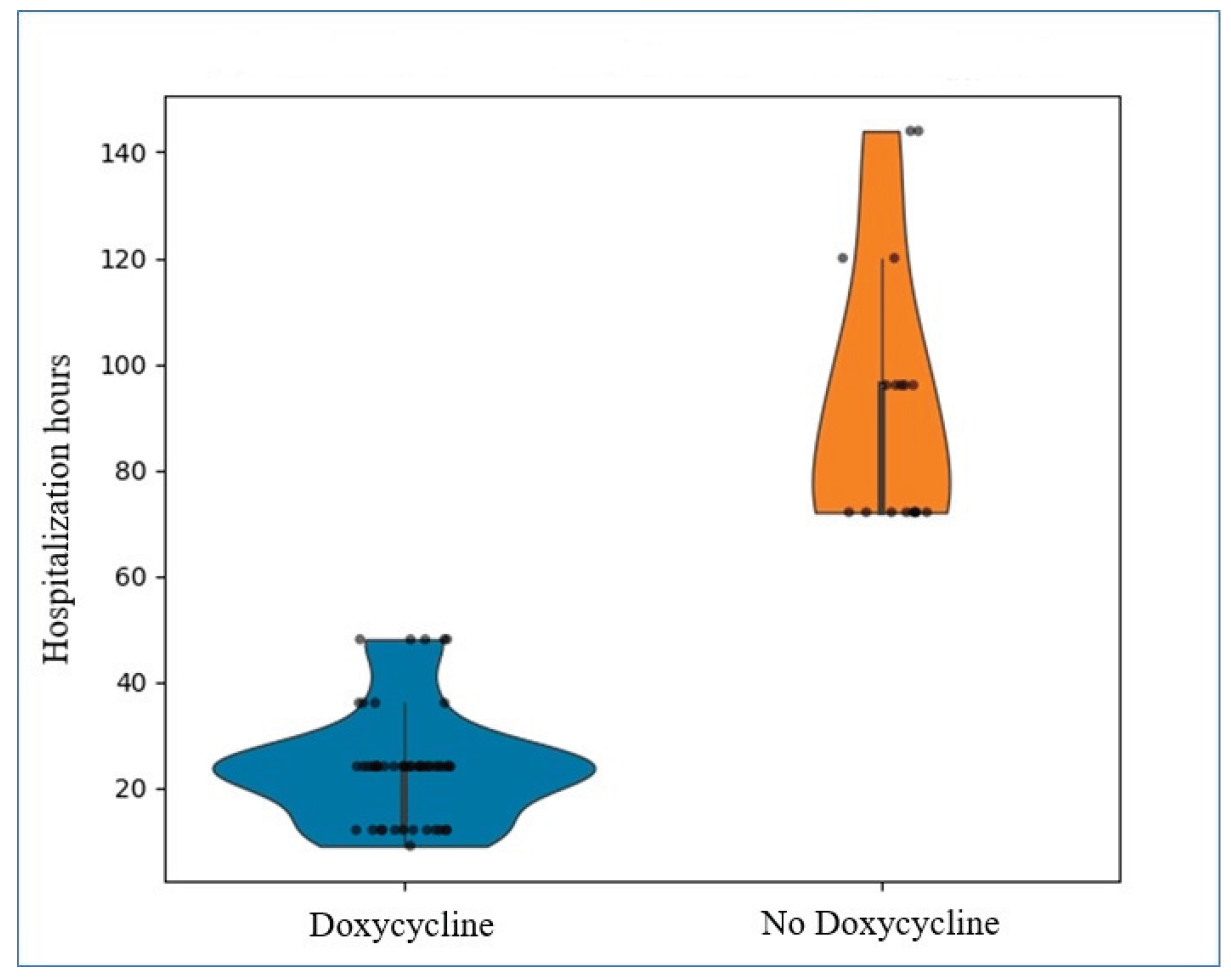
Figure 2.
Distribution of fever duration after intervention. Violin plot showing the distribution of fever duration after intervention according to treatment group. (Color online).
Figure 2.
Distribution of fever duration after intervention. Violin plot showing the distribution of fever duration after intervention according to treatment group. (Color online).
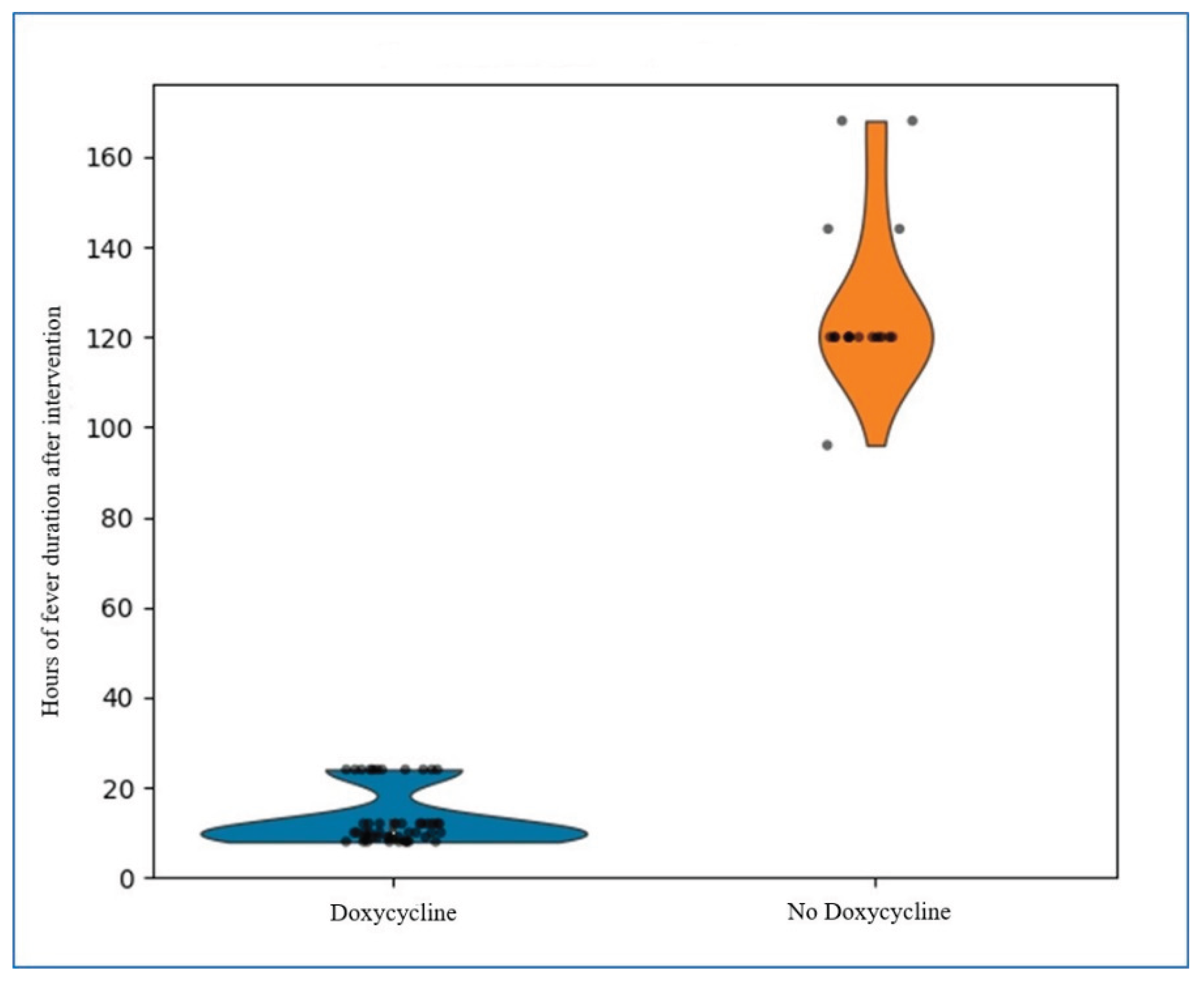

Table 1.
Characteristics and Evolution of Dengue Patients. The data are presented as mean ± standard deviation (SD). Additionally, analyses of median and interquartile range (IQR) were performed, showing results consistent with those reported.
Table 1.
Characteristics and Evolution of Dengue Patients. The data are presented as mean ± standard deviation (SD). Additionally, analyses of median and interquartile range (IQR) were performed, showing results consistent with those reported.
| Variable | Groups |
p value |
Difference (95% CI) | Hedges g | ||
| Doxycycline | No Doxycycline | |||||
| Age (years) | Mean ± SD: 30.32 ± 11.35 Median (IQR): 26 (24, 34) |
Mean ± SD: 32.00 ± 9.56 Median (IQR): 28 (25, 42) |
0.589 | -1.68 (-7.86, 4.50) |
-0.15 | |
| Pre hospitalization | Hours of fever | Mean ± SD: 114.38 ± 82.41 Median (IQR): 120 (96, 144) |
Mean ± SD: 120.00 ± 24.00 Median (IQR): 120 (96, 144) |
0.362 | -5.62 (-31.73, 20.49) |
-0.07 |
| Hours of headache | Mean ± SD: 103.15 ± 26.30 Median (IQR): 96 (72, 120) |
Mean ± SD: 125.68 ± 31.21 Median (IQR): 120 (120, 144) |
0.009 | -22.53 (-44.12, -0.94) |
-0.95 | |
| Hours of myalgia | Mean ± SD: 97.02 ± 19.35 Median (IQR): 96 (72, 120) |
Mean ± SD: 118.81 ± 19.08 Median (IQR): 96 (72, 96) |
0.014 | -21.79 (-32.89, -10.69) |
-1.12 | |
| During hospitalization | Hours of fever | Mean ± SD: 13.79 ± 16.18 Median (IQR): 12 (9, 24) |
Mean ± SD: 127.08 ± 51.22 Median (IQR): 120 (120, 144) |
<0.0001 | -113.29 (-140.52, -86.06) |
-3.81 |
| Hours of headache | Mean ± SD: 16.30 ± 19.27 Median (IQR): 12 (9, 24) |
Mean ± SD: 94.59 ± 26.11 Median (IQR): 96 (72, 144) |
<0.0001 | -78.29 (-98.64, -57.94) |
-3.36 | |
| Hours of myalgia | Mean ± SD: 23.94 ± 10.90 Median (IQR): 24 (12, 24) |
Mean ± SD: 120.24 ± 25.20 Median (IQR): 96 (72, 96) |
<0.0001 | -96.30 (-109.55, -83.05) |
-5.99 | |
| Hours hospitalized | Mean ± SD: 26.30 ± 13.72 Median (IQR): 24 (12, 24) |
Mean ± SD: 93.18 ± 25.29 Median (IQR): 96 (72, 96) |
<0.0001 | -66.88 (-82.29, -51.47) |
-4.29 | |
| Admission platelets count (×10³/µL) | Mean ± SD: 68.53 ± 26.98 Median (IQR): 70 (45, 89) |
Mean ± SD: 65.40 ± 26.60 Median (IQR): 70 (45, 87) |
0.307 | 3.13 (-11.28, 17.54) |
+0.14 | |
| Discharge platelets count (×10³/µL) | Mean ± SD: 95.36 ± 24.22 Median (IQR): 96 (85, 120) |
Mean ± SD: 92.28 ± 26.10 Median (IQR): 90 (80, 110) |
0.307 | 3.08 (-9.02, 15.18) |
+0.15 | |
| Platelet Recovery Rate (×10³/µL · h⁻¹) | Mean ± SD: 0.54 ± 0.49 Median (IQR): 0.54 (0.18, 0.93) |
Mean ± SD: 0.23 ± 0.29 Median (IQR): 0.16 (0.05, 0.34) |
0.003 | 0.31 (0.14, 0.48) |
+0.75 | |
Standard deviation (SD). Interquartile range (IQR).
Disclaimer/Publisher’s Note: The statements, opinions and data contained in all publications are solely those of the individual author(s) and contributor(s) and not of MDPI and/or the editor(s). MDPI and/or the editor(s) disclaim responsibility for any injury to people or property resulting from any ideas, methods, instructions or products referred to in the content. |
© 2026 by the authors. Licensee MDPI, Basel, Switzerland. This article is an open access article distributed under the terms and conditions of the Creative Commons Attribution (CC BY) license (http://creativecommons.org/licenses/by/4.0/).
Copyright: This open access article is published under a Creative Commons CC BY 4.0 license, which permit the free download, distribution, and reuse, provided that the author and preprint are cited in any reuse.