
Submitted:
06 April 2026
Posted:
08 April 2026
You are already at the latest version
Abstract
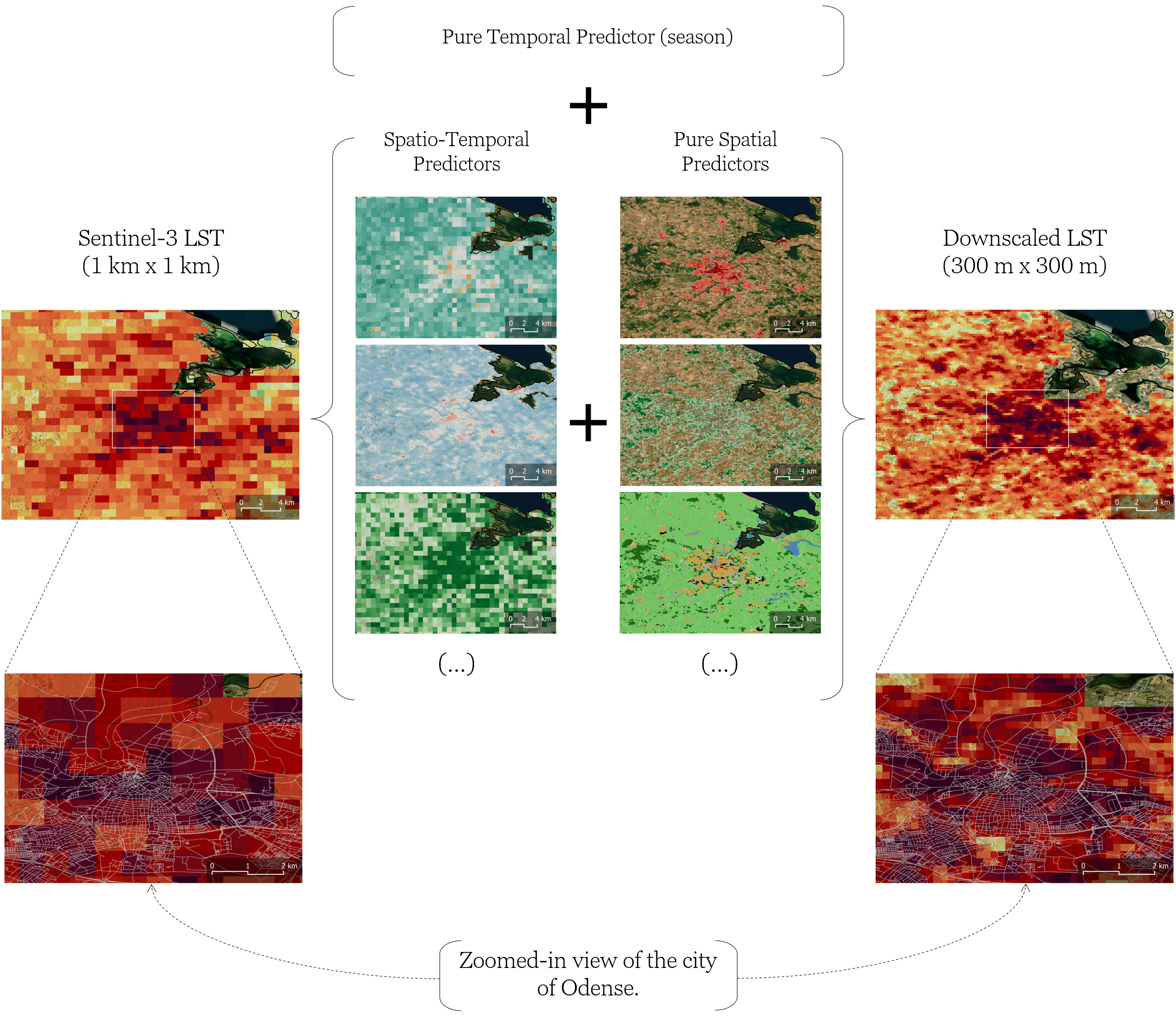
With an ever-growing recognition of Land Surface Temperature (LST) as a key Essential Climate Variable (ECV), it becomes utmost important to have such a variable at both the fine spatial and temporal scales of urban spaces and dynamics. Sentinel-3 provides coarse LST (1 km, daily) based on thermal imagery acquired by its Sea and Land Surface Temperature Radiometer (SLSTR) as well as fine Spectral Directional Reflectances (SDR, 300 m, every two days) synergically inferred from both SLSTR and the optical bands acquired through the Ocean and Land Colour Instrument (OLCI), which gives opportunity for using the latter as predictor in the downscaling of the former. Herein, two scale-invariance-based architectures were developed: a single-timestamp model, trained with the coarse data of the timestamp whose fine target it tries to infer; and a multi-timestamp one, trained with several timestamps and that can infer for any other. While for the case of the multi-timestamp architecture, Machine Learning (ML) models besides Linear Regression (LR) were trained, solely LR was considered for the single-timestamp architecture due to the smaller amount of data available, making it less suitable for hyperparameter tuning. The models were developed over four Danish Functional Urban Areas (FUAs) between 2020 and 2023 using SRD-derived indices, seasonal and geospatial predictors. From 112 Sentinel-3 scenes, 105 were used for training and 7 for validation against Landsat data. While Gradient Boosting (GB) achieved the best coarse-scale performance (test set Root Mean Square Error, RMSE, of 1.56 K), fine-scale predictions showed degraded performance, indicating scale-invariance breakdown. Tree-based models performed poorly due to extrapolation limitations, whereas Neural Net (NN) and LR proved more robust. After residual correction, single-timestamp LR achieved the best fine-scale performance (test set RMSE of 1.40 K), making it the most reliable and operationally recommended architecture.
Keywords:
urban climate
; downscaling
; land surface temperature
; machine learning
; scaleinvariance
; residual correction
; Sentinel-3
; landsat
Copyright: This open access article is published under a Creative Commons CC BY 4.0 license, which permit the free download, distribution, and reuse, provided that the author and preprint are cited in any reuse.


