
Submitted:
07 April 2026
Posted:
08 April 2026
You are already at the latest version
Abstract
Background/Objectives: The spectrum of chronic kidney disease-mineral and bone disorder (CKD-MBD) is changing and adynamic bone disease (ABD) is now believed to constitute the majority of CKD-MBD in the developed world. However, its prevalence and risk factors are poorly described in literature. Its diagnosis requires bone biopsy but biochemical criteria including parathyroid hormone (PTH) levels show good correlation. The aim of this study is to understand the prevalence of ABD in our patients with kidney failure (KF) on hemodialysis (HD), identify the risk factors for its development, and in doing so enable early intervention to modify the risk factors specific to our population. Methods: This is a retrospective cross-sectional study. 201 prevalent adult patients on maintenance HD for at least 3 months were recruited. Patients with previous parathyroidectomy were excluded. Relevant data including clinical and biochemical parameters, prescribed dialysate and medications, and clinical outcomes were collected. ABD was diagnosed if any intact PTH (iPTH) level during the study period was <15pmol/L. Results: Of the 201 patients in the study (median age 64.5 years), 35 (17.4%) patients had ABD. In the multivariable logistic regression model, the adjusted odds ratio (OR) of ABD was higher with higher mean adjusted serum calcium level while concurrent use of non-calcium-based binders was associated with lower odds of ABD. Activated vitamin D use was also associated with lower odds of ABD likely reflecting past occurrence of ABD prompting a pre-emptive discontinuation of activated vitamin D. 17% of patients had had fractures without significant association with ABD. The mean PTH level was in the target range (15-60pmol/L) in 41% of the cohort. Cardiovascular complications were not significantly associated with ABD. Conclusions: Approximately one in every six HD patients in our care have ABD as diagnosed by the iPTH level. Targeting a lower serum calcium level and using non-calcium-based binders may reduce the occurrence of ABD and will need to be tested in prospective studies.
Keywords:
adynamic bone disease
; parathyroid hormone
; renal hyperparathyroidism
1. Introduction
The global burden of patients with kidney failure (KF) is steadily increasing [1,2,3], accompanied by changes in patient demographics which is characterized by an ageing population [1] with a longer survival [4] and a higher prevalence of comorbid conditions [5]. Chronic kidney disease-mineral and bone disorder (CKD-MBD) is a common complication of kidney failure. There has been a change observed in the spectrum of CKD-MBD in recent years with an increasing prevalence of adynamic bone disease (ABD) reported in the dialysis population, likely due to advanced age [6], increased prevalence of diabetes mellitus (DM) [7,8] and more intensive treatment of secondary hyperparathyroidism with more vitamin D analogues or calcimimetics being used [9]. ABD prevalence is estimated to be around 10%-50% [10]. However, the literature on ABD and its determinants is sparse. The gold standard for diagnosis of ABD is from bone biopsy. However, biochemical markers such as intact parathyroid hormone (iPTH) and alkaline phosphatase (ALP) levels show good correlation with ABD diagnosed by bone biopsy. iPTH level of < 15pmol/L gives a sensitivity and specificity of 65 and 66% respectively to discriminate low from non-low turnover bone disease [11].
Risk factors of ABD can be broadly divided into over-suppression of the parathyroid glands and PTH resistance. Apart from calcimimetics therapy and total parathyroidectomy, ABD can occur due to over–suppression of parathyroid glands due to increased calcium burden contributed by the use of calcium-based phosphate binders, higher dialysate calcium bath, and use of vitamin D analogues or calcitriol. Resistance to PTH actions on bone is more likely in patients with DM [9,12,13].
The clinical significance of ABD cannot be over emphasised as it can be associated with a significant risk of vascular calcification [6], fractures [14] and all-cause mortality [15]. We aim to estimate the prevalence of ABD in KF and identify the risk factors associated with ABD, so that interventions can be made to mitigate this risk.
2. Materials and Methods
2.1. Study Design
This is a retrospective analytical cross-sectional study. We identified a cohort of 1100 adult patients on maintenance HD on follow up with the Nephrology services in Tan Tock Seng Hospital, Singapore, between January to July 2024.
The required sample size was determined using Cochran’s formula, assuming a 15% prevalence of ABD, 5% precision level, loss due to missing data projected at about 5% and 5% confidence level, which indicated a minimum of 196 participants. 216 patients were selected using simple random sampling method. 201 patients with complete data and meeting the study criteria were included in the study.
This study was approved by the Ethics Review Board (Domain Specific Review Board of National Healthcare Group, Singapore – Ref 2023/00526).
2.2. Inclusion and Exclusion Criteria
We included all patients with KF who had been on maintenance HD for at least 3 months. Patients who had a prior history of parathyroidectomy or incomplete biochemical data were excluded.
2.3. Data Collection
Data was obtained from electronic health records including blood test results from dialysis centers that are part of the electronic health records uploaded during routine clinic consults at the hospital.
Data collected included patients’ demographics including age, gender, etiology of KF, dialysis vintage, history of DM, and biochemical investigations including serial serum levels of adjusted calcium, phosphate, iPTH, ALP, and albumin, treatment related data including dialysate calcium, use of calcium-based and non-calcium-based phosphate binders, calcitriol or vitamin D analogue and calcimimetics and complications like ischemic heart disease (IHD), stroke, peripheral vascular disease (PVD), fracture and mortality.
For each patient, the two most recent measurements of iPTH, and the three most recent values of serum calcium and phosphate, were obtained. The most recent record of prescribed medications was collected to reflect current therapeutic management. In instances where iPTH levels were found to be below 15 pg/mL at any time point, the corresponding serum calcium and phosphate values, as well as the medication regimen, were aligned specifically with the time of iPTH nadir. This adjustment was made to accurately capture clinical context, acknowledging that iPTH over–suppression often prompts modifications in therapy.
The prevalence of ABD was defined by iPTH level of <15pmol/L at any point. We chose to use iPTH <15pmol/L to diagnose ABD instead of using a mean iPTH <15pmol/L as using mean values may underdiagnose ABD and therefore underestimate the prevalence of ABD.
Missing data was imputed using mean substitution. There were two missing values for ALP, which were imputed using this method.
2.4. Statistical Analysis
Data analyses were conducted using Jamovi2.6.44. Mean with standard deviation (SD) was used for continuous data if they were normally distributed or median with interquartile range (IQR) otherwise. We compared the demographic, laboratory and clinical parameters using T test or Mann Whitney U test for continuous variables where appropriate. Chi-square test or Fisher exact test was used for categorical variables where appropriate. ABD was defined as iPTH <15pmol/L at any point in time. To identify the risk factors for ABD, important covariates based on past literature were incorporated in the multivariable logistic regression model. The variance inflation factor (VIF) was calculated to check for multicollinearity in the multivariable regression model. Statistical significance was defined as p value <0.05.
3. Results
Among the 201 patients, 17.4% (N=35) had ABD (Figure 1). The median age of our study population was 64.5 years, 61.2% (N=123) were males and 61.7% (N=124) had KF with DM closely matching the prevalence of DM in the local HD population. The average dialysis vintage was 41 months (IQR 18, 78) (Table 1).
In the univariable analysis, older age and lower serum ALP were both significantly associated with ABD. Use of non–calcium-based phosphate binders, calcitriol, and vitamin D analogues was also associated with lower odds of ABD. (Table 2).
However, we incorporated other important variables like DM, dialysate calcium, and serum calcium into the multivariable model as these factors, based on previous literature, were found to be significantly associated with the risk of ABD. As all patients on calcimimetics in the cohort (N=22) did not meet the criterion for ABD, calcimimetics use was not included in the multivariable model due to lack of convergence. Variables such as gender, dialysis vintage, etiology of KF, serum phosphate, albumin, and use of calcium-based phosphate binders were not incorporated into the multivariable model as they were not significant in the univariate analysis.
In the multivariable logistic regression analysis, calcitriol or vitamin D analogue therapy and use of non–calcium-based phosphate binders decreased the odds of having ABD while elevated serum calcium levels increased the odds of having ABD (Table 3). Specifically, each 0.1 mmol/L increase in serum calcium was associated with 1.68-fold higher odds of ABD (OR=1.68; 95% CI:1.15–2.45; p=0.007). Patients receiving calcitriol or vitamin D analogues had significantly lower odds of ABD (OR=0.20; 95% CI:0.08–0.50; p<0.001). The use of non–calcium-based phosphate binder use was associated with a markedly reduced risk of ABD (OR=0.05; 95% CI:0.00–0.47; p=0.008). The mean VIF was 1.16, suggesting the absence of significant multicollinearity.
We did not find that the presence of ABD was associated significantly with the risk of IHD, PVD, stroke, fracture and mortality (Table 4).
Abbreviations: HD, hemodialysis; ABD, adynamic bone disease
4. Discussion
The prevalence of ABD in our population was 17.4% by using the criteria of serum iPTH level of < 15pmol/L. This varies from that reported in some previous studies, likely due to variations in diagnostic methodology and iPTH cutoff values used to define ABD [13,16]. While bone biopsy remains the gold standard for diagnosing ABD and has been associated with higher reported prevalence rates [13], its use is limited in routine clinical practice due to the limited availability of experienced operators and interpreters, as well as the procedure’s cost, invasiveness, and potential to cause pain [17]. Other studies have relied on biochemical markers, including iPTH levels [16], but have applied different threshold values for defining ABD, contributing to the difference in prevalence across studies. As the iPTH data were obtained from different laboratories, variations in assay methods may have introduced inter-laboratory variability and potential measurement bias.
We found that high serum calcium was associated with higher odds of developing ABD and the use of non-calcium-based phosphate binders was associated with lower odds of ABD. These findings are consistent with the current standard of care and the KDIGO 2017 CKD-MBD guidelines which is to avoid hypercalcemia and restrict the dose of calcium-based binders. Use of calcitriol and vitamin D analogues was also associated with lower odds of ABD (OR=0.20; 95% CI:0.08-0.50; p<0.001), which could reflect proactive discontinuation of vitamin D when iPTH levels were down trending. The use of dialysate with1.5mmol/L of calcium and the use of calcium-based phosphate binders were not found to be significantly associated with the risk of ABD, which could also reflect a proactive approach of reducing calcium exposure when iPTH is down trending. However, we did not find that the risk of cardiovascular complications or fractures was higher in ABD. This could be explained by the small number of events and being a cross-sectional study with no longitudinal follow up, the complications may have happened after the development of ABD.
This study has several strengths, including the inclusion of a sufficiently large sample size and minimal missing data, which enhance the reliability of the findings. To our knowledge, this is the first study in Singapore and in Asian populations to examine the correlation between ABD and its clinical and biochemical parameters, thereby increasing the relevance and generalizability of the findings to similar regional populations. Moreover, the identification of variables associated with the development of ABD offers valuable evidence that may inform targeted mitigation strategies. However, there are notable limitations. Being a single-centre study, this may limit the external validity of the results. The diagnosis of ABD was based on serum iPTH levels rather than definitive bone biopsy, which remains the gold standard. Furthermore, bone-specific ALP and activated vitamin D levels were not measured, potentially limiting the assessment of bone turnover. The cross-sectional design also introduces temporal ambiguity, preventing causal inferences, and we are limited by the use of retrospective medical records. Finally, the study design does not allow for the evaluation of therapeutic interventions that may influence bone turnover dynamics.
5. Conclusions
Approximately one in every six HD patients in our care has ABD as defined by iPTH < 15pmol/L. Targeting a lower serum calcium level and preferential use of non-calcium-based phosphate binders may reduce the occurrence of ABD. Prospective studies are needed to determine the optimal target serum calcium levels in patients with KF on HD, and to guide the clinical use of phosphate binders, activated vitamin D, calcimimetics, and dialysate calcium concentrations.
Author Contributions
Conceptualization was performed by M.B. Material preparation and data collection were carried out by S.K.S., E.Y.Q.W., Y.K.T., F.C., R.S.L., and M.B. Formal analysis was conducted by M.B. and R.S.L. The first draft of the manuscript was written by R.S.L. and S.K.S., and all authors contributed to reviewing and editing previous versions of the manuscript. All authors have read and agreed to the published version of the manuscript.
Funding
This research received no external funding.
Institutional Review Board Statement
This study was approved by the Ethics Review Board (Domain Specific Review Board of National Healthcare Group, Singapore – Ref 2023/00526).
Informed Consent Statement
For this retrospective study, the requirement for informed consent was waived by the Institutional Ethics Committee (Domain Specific Review Board), as the study used routinely collected clinical data and involved minimal risk to participants. Only data necessary for the study were collected, and all analyses were performed on de-identified datasets. Confidentiality was safeguarded through restricted access to study personnel and linkage coding. The waiver of informed consent did not adversely affect the rights or welfare of the participants.
Data Availability Statement
The datasets generated and/or analyzed during the current study are not publicly accessible due to privacy and confidentiality considerations. However, anonymized data may be made available by the corresponding author (M.B.) upon reasonable request.
Conflicts of Interest
The authors declare no conflicts of interest.
References
- Deng, L.; et al. Global, regional, and national burden of chronic kidney disease and its underlying etiologies from 1990 to 2021: a systematic analysis for the Global Burden of Disease Study 2021. BMC Public Health 2025, 25, 636. [Google Scholar] [CrossRef] [PubMed]
- Li, Y.; et al. Temporal trends in prevalence and mortality for chronic kidney disease in China from 1990 to 2019: an analysis of the Global Burden of Disease Study 2019. Clin Kidney J 2023, 16, 312–321. [Google Scholar] [CrossRef] [PubMed]
- Collaboration, G.B.D.C.K.D., Global, regional, and national burden of chronic kidney disease, 1990-2017: a systematic analysis for the Global Burden of Disease Study 2017. Lancet 2020, 395, 709–733. [CrossRef] [PubMed]
- Huijben, J.A.; et al. Increasing numbers and improved overall survival of patients on kidney replacement therapy over the last decade in Europe: an ERA Registry study. Nephrol Dial Transplant 2023, 38, 1027–1040. [Google Scholar] [CrossRef] [PubMed]
- MacRae, C.; et al. Comorbidity in chronic kidney disease: a large cross-sectional study of prevalence in Scottish primary care. Br J Gen Pract 2021, 71, e243–e249. [Google Scholar] [CrossRef] [PubMed]
- London, G.M.; et al. Arterial calcifications and bone histomorphometry in end-stage renal disease. J Am Soc Nephrol 2004, 15, 1943–51. [Google Scholar] [CrossRef] [PubMed]
- Cheng, H.T.; et al. Worldwide Epidemiology of Diabetes-Related End-Stage Renal Disease, 2000-2015. Diabetes Care 2021, 44, 89–97. [Google Scholar] [CrossRef]
- Sanches, C.P., A.G.D. Vianna, and F.C. Barreto. The impact of type 2 diabetes on bone metabolism. Diabetol Metab Syndr 2017, 9, 85. [CrossRef]
- Goodman, W.G.; et al. Development of adynamic bone in patients with secondary hyperparathyroidism after intermittent calcitriol therapy. Kidney Int 1994, 46, 1160–6. [Google Scholar] [CrossRef]
- Andress, D.L. Adynamic bone in patients with chronic kidney disease. Kidney International 2008, 73, 1345–1354. [Google Scholar] [CrossRef] [PubMed]
- Sprague, S.M.; et al. Diagnostic Accuracy of Bone Turnover Markers and Bone Histology in Patients With CKD Treated by Dialysis. Am J Kidney Dis 2016, 67, 559–66. [Google Scholar] [CrossRef] [PubMed]
- Bover, J.; et al. Adynamic bone disease: from bone to vessels in chronic kidney disease. Semin Nephrol 2014, 34, 626–40. [Google Scholar] [CrossRef] [PubMed]
- Malluche, H.H., H.W. Mawad, and M.C. Monier-Faugere. Renal osteodystrophy in the first decade of the new millennium: analysis of 630 bone biopsies in black and white patients. J Bone Miner Res 2011, 26, 1368–76. [CrossRef] [PubMed]
- Coco, M.; Rush, H. Increased incidence of hip fractures in dialysis patients with low serum parathyroid hormone. Am J Kidney Dis 2000, 36, 1115–21. [Google Scholar] [CrossRef]
- Naves-Diaz, M.; et al. Calcium, phosphorus, PTH and death rates in a large sample of dialysis patients from Latin America. The CORES Study. Nephrol Dial Transplant 2011, 26, 1938–47. [Google Scholar] [CrossRef] [PubMed]
- R Geethanjali, M.G., V Jayaprakash, E Ramprasad, A Manikandan, M Rakchna. Prevalence and biochemical profile of adynamic bone disease in a hemodialysis population. Biomedicine 2023, 43, 582–586. [CrossRef]
- Dalle Carbonare, L.; et al. Bone Biopsy for Histomorphometry in Chronic Kidney Disease (CKD): State-of-the-Art and New Perspectives. J Clin Med 2021, 10. [Google Scholar] [CrossRef] [PubMed]
Figure 1.
Prevalence of adynamic bone disease in our study.
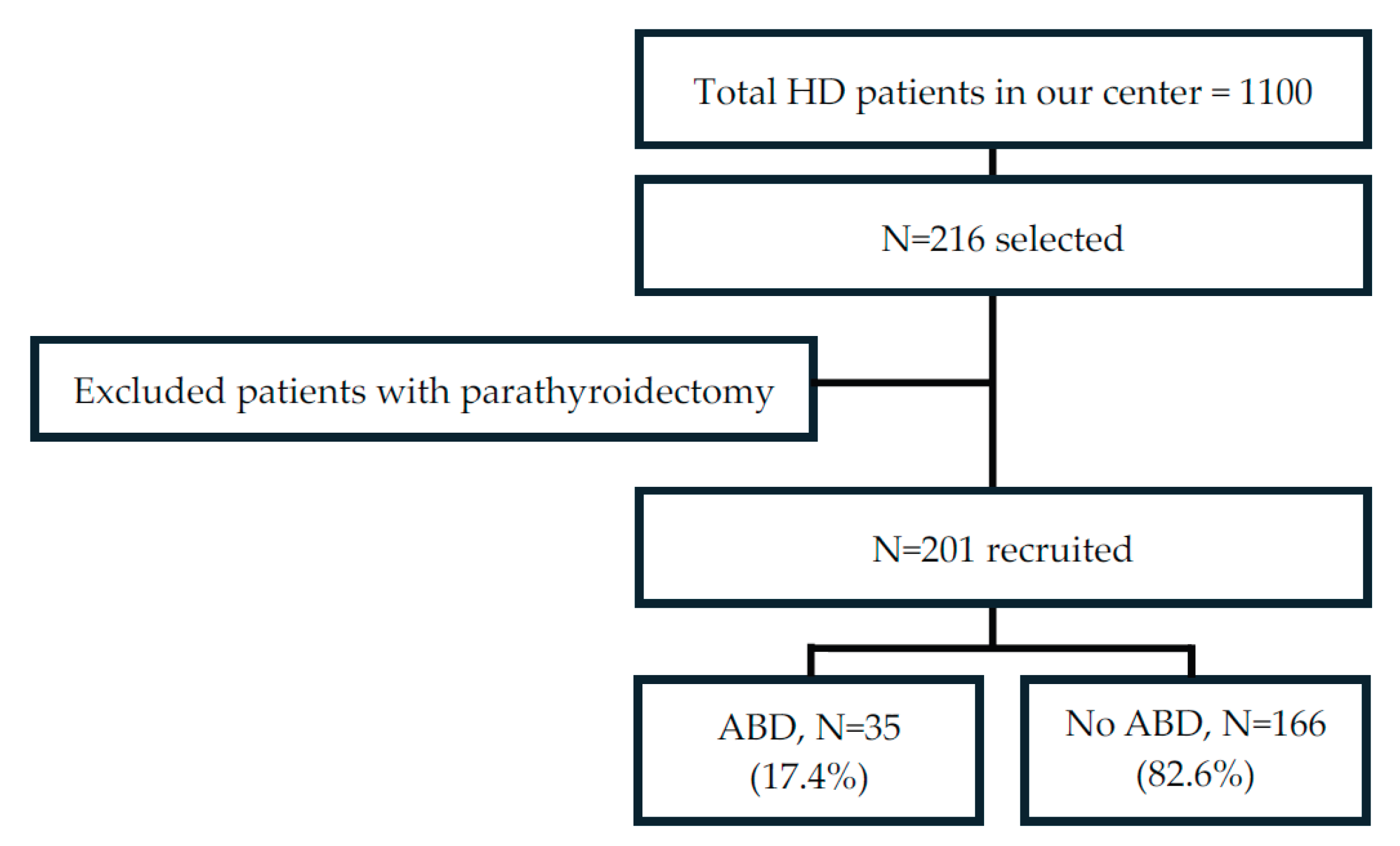

Table 1.
Baseline demographic and laboratory data – Adynamic bone disease vs no adynamic bone disease.
Table 1.
Baseline demographic and laboratory data – Adynamic bone disease vs no adynamic bone disease.
| Variables | Overall (N=201) |
Adynamic bone disease (N = 35) |
No adynamic bone disease (N = 166) |
|
|---|---|---|---|---|
| Age, mean (SD), years | 64.50 (12.50) | 68.70 (12.50) | 63.60 (12.40) | |
| Gender, N (%) | ||||
| Male | 123.00 (61.20) | 21.00 (60.00) | 102.00 (61.40) | |
| Female | 78.00 (38.80) | 14.00 (40.00) | 64.00 (38.60) | |
| Dialysis vintage, median (IQR), months | 54.00 (30, 80) | 41.00 (18, 78) | 56.00 (31, 90) | |
| Etiology of kidney failure, N (%) | ||||
| Diabetes mellitus | 124.00 (61.70) | 25.00 (71.40) | 99.00 (59.60) | |
| Hypertension | 34.00 (16.90) | 5.00 (14.30) | 29.00 (17.50) | |
| Chronic glomerulonephritis | 35.00 (17.40) | 3.00 (8.60) | 32.00 (19.30) | |
| Others | 8.00 (4.00) | 2.00 (5.70) | 6.00 (3.60) | |
| Diabetes mellitus, N (%) | ||||
| Yes | 144.00 (71.60) | 29.00 (82.90) | 115.00 (69.30) | |
| No | 57.00 (28.40) | 6.00 (17.10) | 51.00 (30.70) | |
| Dialysate calcium, N (%), mmol/L | ||||
| Normal (1.5) | 111.00 (55.20) | 22.00 (62.90) | 89.00 (53.60) | |
| Low (1.25) | 90.00 (44.80) | 13.00 (37.10) | 77.00 (46.40) | |
| Serum calcium, mean (SD), mmol/L | 2.27 (0.14) | 2.30 (0.13) | 2.27 (0.14) | |
| Serum phosphate, mean (SD), mmol/L | 1.56 (0.42) | 1.47 (0.37) | 1.57 (0.43) | |
| Serum alkaline phosphatase, mean (SD), U/L | 143.73 (159.33) | 100.90 (113.91) | 152.76 (166.22) | |
| Serum albumin, mean (SD), g/L | 39.25 (4.60) | 38.91 (5.08) | 39.32 (4.50) | |
| Calcium-based phosphate binder use, N (%) | ||||
| Yes | 160.00 (79.6) | 30.00 (85.70) | 130.00 (78.30) | |
| No | 41.00 (20.4) | 5.00 (14.30) | 36.00 (21.70) | |
| Non-calcium-based phosphate binder use, N (%) | ||||
| Yes | 50.00 (24.9) | 1.00 (2.90) | 49.00 (29.50) | |
| No | 151.00 (75.1) | 34.00 (97.10) | 117.00 (70.50) | |
| Calcitriol or vitamin D analogue use, N (%) | ||||
| Yes | 119.00 (59.2) | 10.00 (28.60) | 109.00 (65.70) | |
| No | 82.00 (40.8) | 25.00 (71.40) | 57.00 (34.30) | |
| Calcimimetic use, N (%) | ||||
| Yes | 22.00 (11.00) | 0 (0) | 22.00 (13.30) | |
| No | 179.00 (89.00) | 35.00 (100.00) | 144.00 (86.70) |
Data are N (%) for categorical variables, mean [SD] for normally distributed continuous variables and median [IQR] for non-normally distributed continuous variables. Abbreviations: SD, standard deviation; IQR, interquartile range.
Table 2.
Univariable logistic regression.
| Variables | Univariable model | |
|---|---|---|
| Crude OR (95% CI) | p value* | |
| Age | 1.04 (1.01-1.07) | 0.03 |
| Gender | ||
| Male | 0.94 (0.45-1.98) | 0.87 |
| Female | Reference | |
| Etiology of kidney failure | ||
| Diabetes mellitus | Reference | |
| Hypertension | 0.68 (0.24-1.94) | 0.47 |
| Chronic glomerulonephritis | 0.37 (0.11-1.31) | 0.12 |
| Others | 1.32 (0.25-6.94) | 0.74 |
| Dialysis vintage | 1.00 (0.99-1.01) | 0.55 |
| Diabetes mellitus | ||
| Yes | 2.14 (0.84-5.48) | 0.11 |
| No | Reference | |
| Dialysate calcium, mmol/L | ||
| Normal (1.5) | Reference | |
| Low (1.25) | 0.68 (0.32-1.45) | 0.32 |
| Serum calcium, in 0.1mmol/L | 1.21 (0.93-1.57) | 0.16 |
| Serum phosphate, mmol/L) | 0.54 (0.21-1.37) | 0.19 |
| Serum alkaline phosphatase, U/L | 0.99 (0.98-1.00) | 0.038 |
| Serum albumin, g/L | 0.98 (0.91-1.06) | 0.64 |
| Calcium-based phosphate binder use | ||
| Yes | 1.66 (0.60-4.59) | 0.34 |
| No | Reference | |
| Non-calcium-based phosphate binder use | ||
| Yes | 0.07 (0.00-0.52) | 0.01 |
| No | Reference | |
| Calcitriol or vitamin D analogue use | ||
| Yes | 0.21 (0.09-0.47) | <0.001 |
| No | Reference | |
* Bolded values indicate statistical significance of p < 0.05. Abbreviations: OR, odds ratio; CI, confidence interval.
Table 3.
Multivariable logistic regression.
| Variables | Multivariable model | |
|---|---|---|
| Adjusted OR (95% CI) | p value* | |
| Age | 1.02 (0.99-1.06) | 0.22 |
| Diabetes mellitus | ||
| Yes | 2.32 (0.80-6.69) | 0.12 |
| No | Reference | |
| Dialysate calcium, mmol/L | ||
| Normal (1.5) | Reference | |
| Low (1.25) | 0.55 (0.23-1.33) | 0.18 |
| Serum calcium, in 0.1mmol/L | 1.68 (1.15-2.45) | 0.007 |
| Serum alkaline phosphatase, U/L | 1.00 (0.99-1.00) | 0.40 |
| Non-calcium-based phosphate binder use | ||
| Yes | 0.05 (0.00-0.47) | 0.008 |
| No | Reference | |
| Calcitriol or vitamin D analogue use | ||
| Yes | 0.20 (0.08-0.50) | <0.001 |
| No | Reference | |
* Bolded values indicate statistical significance of p < 0.05. Abbreviations: OR, odds ratio; CI, confidence interval.
Table 4.
Comparison of complications between patients with and without adynamic bone disease.
| Complications | Adynamic bone disease (N = 35) |
No adynamic bone disease (N = 166) |
p value |
|---|---|---|---|
| Ischemic heart disease, N (%) | |||
| Yes | 21.00 (60.00) | 77.00 (46.39) | 0.143 |
| No | 14.00 (40.00) | 89.00 (53.61) | |
| Peripheral vascular disease, N (%) | |||
| Yes | 5.00 (14.29) | 29.00 (17.47) | 0.648 |
| No | 30.00 (85.71) | 137.00 (82.53) | |
| Stroke, N (%) | |||
| Yes | 6.00 (17.14) | 29.00 (17.47) | 0.963 |
| No | 29.00 (82.86) | 137.00 (82.53) | |
| Fracture, N (%) | |||
| Yes | 4.00 (11.43) | 30.00 (18.07) | 0.341 |
| No | 31.00 (88.57) | 136.00 (81.93) | |
| Mortality , N (%) | |||
| Yes | 3.00 (8.57) | 10.00 (6.02) | 0.578 |
| No | 32.00 (91.43) | 156.00 (93.98) |
Disclaimer/Publisher’s Note: The statements, opinions and data contained in all publications are solely those of the individual author(s) and contributor(s) and not of MDPI and/or the editor(s). MDPI and/or the editor(s) disclaim responsibility for any injury to people or property resulting from any ideas, methods, instructions or products referred to in the content. |
© 2026 by the authors. Licensee MDPI, Basel, Switzerland. This article is an open access article distributed under the terms and conditions of the Creative Commons Attribution (CC BY) license (http://creativecommons.org/licenses/by/4.0/).
Copyright: This open access article is published under a Creative Commons CC BY 4.0 license, which permit the free download, distribution, and reuse, provided that the author and preprint are cited in any reuse.


