
Submitted:
03 April 2026
Posted:
08 April 2026
You are already at the latest version
Abstract
Cadmium (Cd) is a heavy metal pollutant to which most people are exposed daily through their diet. This is because it is ubiquitously present in nearly all food types, including potatoes, vegetables, cereals, grains, legumes, shellfish, and organ meat. Cd has no physiological role or nutritional value in the body, and causes toxicity to multiple tissues and organs via oxidative stress and inflammation; as such it is frequently asso-ciated with diseases with high prevalence, notably cancer, osteoporosis, diabetes type 2, and chronic kidney disease (CKD). The consensus on Cd levels, considered to be safe, are limited. The permissible Cd level in rice which is a staple food for over 50% of the world’s population has not been adequately addressed. Using kidneys and bones as critical toxicity targets, current dietary Cd exposure guidelines vary from 0.21 to 0.83 μg/kg bw/d. There is a widespread concern about these guidelines because they were based on excretion of β2-microglobulin (β2M) at a rate of 300 µg/g creatinine as an endpoint. The present review discusses the threshold-based risk assessment that was used to define the no-observed-adverse-effect level (NOAEL) for Cd, when β2M excre-tion was used as endpoint measure with Cd excretion rate of 5.24 µg/g creatinine being a threshold. Arguably, the estimated glomerular filtration rate (eGFR) should be used as a disease outcome of Cd nephrotoxicity. The current view around how Cd uses various transport and channel proteins to enter and induce toxicity to its target cells are dis-cussed, along with the strategies to mitigate Cd cytotoxicity.
Keywords:
cadmium
; bone and kidney targets
; exposure limits
; health risk
; mitigation of toxicity
; reference dose
; tolerable intake level
; toxicological reference value
1. Introduction
Exposure to pollution from environmental cadmium (Cd) has been linked to worldwide rising prevalences of ill-health conditions and malignant and non-malignant diseases [1,2,3]. Hypertension [4] and iron deficiency anemia [5] are the poor health conditions, while osteoporosis [6,7,8], type 2 diabetes [9,10] and chronic kidney disease (CKD) [11,12] are consistently found to be associated with environmental Cd exposure.
CKD is a highly prevalent disease, affecting 8-13% of adult population worldwide, reaching epidemic proportion in many parts of the world [1,2]. It is diagnosed when the estimated glomerular filtration rate (eGFR) falls to one-third of a normal range and/or the presence of albuminuria for at least 3 months [1,2]. A fall of eGFR at a high rate (≥ 3 mL/min/1.73 m2 per year) has been causally linked to environmental Cd exposure in a prospective cohort study from Switzerland [13]. Using the Bradford-Hill Criteria, Hsu et al. presented evidence that strongly supports causal relationships between Cd exposure and the disease of kidneys and bones in the general population [3].
Cd is a cumulative toxicant because of its excretion rate is miniscule, resulting in the long half-life, varying from 7.4 to 30 years [14,15,16]. It preferentially accumulates within the kidney tubular cells, and is released into the urine as tubular cells die from any cause [17]. For this reason, excretion of Cd is used reliably as a quantitative measure of cumulative exposure or the body burden of the metal [17,18]. Cd can cause damage to its target cells via multiple mechanisms, like oxidative stress plus depleting antioxidant defenses [1,2]. It can induce also functional iron (Fe) and zinc (Zn) deficiencies [5,13,19,20].
Concerningly, however, the health risk of Cd exposure has long been underappreciated as the result of using an inappropriate toxic endpoint in health risk estimation. Most frequently, an elevation in β2-microglobulin (β2M) excretion was used for such purposes [21,22]. As another concern, at-risk subpopulations, namely children, women of childbearing age, and those with marginal Zn intake levels and low body Fe stores, have not been considered in computing the Cd health risk. Because of enhanced intestinal absorption of metals and immaturity of the blood brain barrier, neonates, infants, and young children are more susceptible than adults to adverse effects of food-born toxicants [23,24]. Moreover, relative to their body size, an amount of food intake is typically larger than that of adults; consequently, they are exposed to a higher dose of ingested toxicants [25,26].
Through the interference with mother-to-fetus Zn transport, maternal Cd exposure has been associated with infant low-birth weight and neurodevelopment deficits even though the passage of Cd from mother to fetus is minimal [27,28,29,30]. The ability of Cd to inhibit calcium (Ca) secretion by mammary glands has also been observed [31] along with the secretion of Cd into breast milk [31,32,33], raising concern about the potential for an early life Cd exposure, which can impact disease risk in adulthood [34,35,36] (Figure 1).
At present, around 15% of the world’s cultivation soils is contaminated with toxic metals, especially Cd, which is particularly prevalent in south and east Asia and parts of the Middle East and Africa [37]. Hence, there is a widespread concern that dietary Cd exposure in the population will gradually be rising because Cd, being non-biodegradable, can persist indefinitely in the soils, facilitating their entry into the human food chain and their ubiquitous presence in our diet, especially staple foods. As the Cd soil-to-plant transference continues as does human exposure to the metal in the diet, the prevalence of Cd-related diseases will eventually reach an epidemic proportion.
The present review provides information relevant to public health policy regarding “safe’ Cd exposure levels that are much lower than previously estimated. It argues strongly for a paradigm shift of the criteria on which toxicity of Cd is based. It highlights the inadequacy of existing food standards and exposure guidelines and underscores a conceptual flaw in using the β2M excretion in toxicological risk assessment practice.
A special emphasis is given to the use of advanced benchmark dose (BMD) modeling [38,39,40], especially in determining the BMD limit (BMDL) values, using eGFR decline as an endpoint [3,41,42]. Cd-induced eGFR loss reliably indicates CKD and its progression toward kidney failure. The advanced BMD modeling overcomes some shortcomings of the conventional toxicological risk assessment, involving identification a point of departure (POD), from a dose-response curve [43,44].
Additionally, mechanism-based mitigation for Cd toxicity to its target cells, involving exogenous heme oxygenase -1 (HO-1) inducers is explored as potential strategies to delay CKD progression.
2. Cadmium Exposure Limits and Toxicity Thresholds
In this Section, environmental standards for Cd are highlighted along with a summary of toxicological risk assessment methodology that was used to define “safe” exposure level. Presumably, intake of Cd from drinking water was insignificant, given that Cd levels in most portable water is below standard by Australia/New Zealand at 2 µg/L and US EPA and WHO at 5 µg/L [43]. Therefore, exposure limits were determined based on its existence in the human diet, a principal source of Cd for most people. For workers, exposure limits were determined based on inhaled Cd that can enter the circulation from the lungs [43]. Figure 2 depicts pathways for Cd in food to its targets, e.g., bones and the proximal tubular cells of kidneys.
2.1. Food and Environmental Safety Standards
Cd is present in most foodstuffs; as such foods that are frequently consumed in large quantities are the major sources of dietary Cd [1,2]. The cumulative feature of Cd means that a safe exposure level may not exist; consequently, Cd levels in food crops and feeds should thus be set at the lowest level achievable e.g., 0.05-0.10 mg/kg for rice, potatoes, and wheats. However, the permissible maximum level (ML) of Cd in rice set by the Codex Alimentarius was as high as 0.4 mg/kg dry grain weight [53], while European Food Safety Authority (EFSA) set the ML for Cd in rice at 0.2 mg/kg [54].
Potatoes contributed most to Cd intake by 1- and 2-year-old Dutch children [55]. In Portugal, bread was identified as the main dietary source of Cd [56]. Rice contributed up to 90% of Cd exposure in an area of Vietnam with Cd contamination [57]. Rice and its products contributed 40-50% to dietary Cd exposure among women living in Cd-contaminated areas of Japan [58].
Data from the Chinese National Diet and Nutrition Survey and the National Food Contamination Monitoring Program supported the ML for rice below 0.2 mg/kg [59]. Severe damage to kidneys and bones as those in Itai-Itai disease patients may have occurred following ingestion of rice with Cd content of 0.27 mg/kg [60].
2.1. Toxicity Threshold Definition
A toxicity threshold is referred to as the highest dose that does not produce an adverse effect in the organ most sensitive to a health hazardous substance of concern [43,44]. Thus, for a food contaminant, like Cd, that impacts multiple organs, a health-protective exposure guideline must be based on the most sensitive endpoint.
2.2. Official Dietary Exposure Guidelines
“Safe” dietary Cd exposure levels were derived by various international agencies, including the Food and Agriculture Organization and World Health Organization (FAO/WHO) Joint Expert Committee on Food Additives and Contaminants (JECFA) [61,62], EFSA [63], the US Food and Drug Administration (US FDA) [64] and the Agency for Toxic Substances and Disease Registry (ATSDR) [43].
Notably, however, different terms were used to describe the acceptable dietary exposure levels of Cd; nevertheless, most countries have adopted JECFA’s tolerable daily intake (TDI) and a threshold at urinary Cd excretion rate of 5.24 μg/g creatinine (Table 1).
2.2.1. JECFA/TDI
JEFCA described exposure guideline for any food contaminant as a provisional tolerable weekly intake (PTWI), meaning an estimate of the amount of a chemical with no intended function that can be ingested weekly over a lifetime without appreciable health risk [61,62]. Original JECFA’s PTWI for Cd was 400–500 µg/person/wk, revised to 7 µg/kg bw/wk [53] before being 25 µg/kg bw/m (TMI), equivalent to 0.83 μg/kg bw/d(TDI) [62]. The PTWI, TMI, and TDI values for Cd were based on a permissible lifetime intake of 2 g of Cd, and β2M excretion rate at 300 µg/g creatinine as a cut-off value for departure from normalcy.
Food Safety Commission of Japan has adopted the TWI for Cd at 7 µg/kg bw/wk (doi: 10.14252/foodsafetyfscj.D-24-00011) for the reason that an estimate of dietary Cd intake in Japan in 2022 was 2.03 μg/kg bw/wk, 29% of a regulatory level at 7 μg/kg bw/wk.
The JECFA’s assumption of “safe” lifetime intake level of Cd of 2 g was challenged by a prospective cohort study showing that a lifetime Cd intake of 1 g may have caused a 49% increase in mortality from kidney failure among women, who were residents of Cd-contaminated area of Japan [65]. This finding was adjusted for potential confounders.
The proportion of Portugal population, 18-74 years of age with Cd exposure levels higher than JECFA’s TDI was 5.4% even though mean dietary Cd intake was low (0.19 µg/ kg b.w./d) [56]. In comparison, mean dietary Cd intake in Chinese adult population was 34.3 µg/day (range: 22.6-54 μg/d) of which 15.4% had dietary Cd exposure levels exceeding JECFA’s TDI [66]. Fungi and algae had the highest Cd contents, followed by aquatic foods, nuts, cereals, beans, vegetables, meats, eggs, milk, and fruits.
Like Cd, lead (Pb) is another ubiquitous food contaminant for which PTWI was derived as 25 μg/kg bw/wk [61]. However, this guideline was withdrawn because no toxicity threshold level was identified for the neurotoxicity endpoint; consequently, no intake amount of Pb carries a negligible health risk [62].
2.2.2. EFSA/RfD
EFSA considered the kidneys to be the critical Cd toxicity target, and used β2M excretion at a rate of 300 µg/g creatinine as a cut-off point, similar to the JECFA PTWI model. However, EFSA designated Cd excretion at a rate of 1 μg/g creatinine as a threshold level after an uncertainty factor (a safety margin) was included in a model to compensate for the variation in dietary Cd exposure levels among people [63]. EFSA designated dietary exposure to Cd at 0.36 μg/kg bw/d for 50 years as an acceptable dietary Cd exposure level and described it as a reference dose (RfD) [63].
2.2.3. US FDA/TRV
Dietary Cd exposure limits derived by US FDA ranged between 0.21 and 0.36 μg/kg bw/d, assuming Cd excretion at a rate of 0.5 μg/g creatinine as a threshold level for both bone and kidney targets [64]. These US FDA’s acceptable exposure levels for Cd were called toxicological reference values (TRV), obtained through reverse dosimetry methodology with the physiologically-based pharmacokinetics model [64]
Among US children aged 1–6 years, the food groups contributing most to Cd exposure were grains/baking, dairy and fruit and grains/baking and vegetables [67]. Respective mean value and 90th-percentile level for dietary Cd exposures were 0.43 and 0.71 μg/kg bw/d, both were higher than US FDA’s TRV but were within the JECFA’s TDI.
Because a threshold could not be determined for Pb neurotoxicity, discussed earlier, US FDA has proposed a dietary Pb intake level of 12.5 μg/d as an interim dietary exposure guideline for the general population of adults [68]. This Pb exposure rate corresponds to a blood Pb concentration of 0.5 μg/dL, which has not been found to be associated with an adverse effect in adults in any epidemiologic studies [69].
2.2.4. ATSDR/MRL
ATSDR derived Cd exposure guidelines, known as minimal risk levels (MRL) using data from experimental animal dosing regimens [43]. With the bone target, an MRL of 0.5 µg/kg bw/d was obtained for oral Cd exposure in an intermediate exposure duration (15-365 d). Data were from Wistar rats exposed to Cd as CdCl2 in drinking water at 0, 1, 5, or 50 mg/L for 6, 9, or 12 months [70,71,72].
2.3. Other Exposure Limits and Thresholds Derived for Oral Cd
Reported Cd exposure limits and thresholds are abundant and they are highly variable, depending on methodology, demographic characteristic of study populations, toxicity targets and endpoint measures. A few studies are summarized below.
Sweden: Using data from 794 Swedish women, aged 53-64 years, Suwazona et al. identified urinary Cd excretion rate of 1 µg/g creatinine as a threshold for a disease (osteoporosis) endpoint [74]. This Cd excretion rate is the same as EFSA’s threshold for kidney effects (β2M endpoint) [63].
France: Leconte et al. derived oral Cd of 0.35 μg/kg bw/d as an exposure limit figure for French population with Cd excretion at a rate of 0.5 μg/g creatinine being a threshold for adverse bone effects [75].
China: Qing et al. derive dietary Cd exposure limits, using Chinese population data with average Cd exposure of 30.6 μg/d. For bone target, they identified Cd exposure of 0.64 μg/kg bw/d as TDI and Cd excretion of rate 1.71 μg/g creatinine as a threshold [76]. For kidney target, Cd exposure of 0.28 μg/kg bw/d (16.8 µg/d for a 60 kg person) as TDI figure and Cd excretion rates of 3.07 and 2.93 μg/g creatinine were threshold levels for the β2M and NAG endpoints, respectively [77].
Experimentation: Wu et al. derived human TDI value for oral Cd exposure of 0.2 μg/kg bw/d [78], using data from inbred pigs, exposed to varying amounts of Cd at 0, 0.5, 2, 8, or 32 mg Cd/kg of feed for 100 d. This TDI was obtained after inclusion of an uncertainty factor of 100 to extrapolate data from pigs to humans. In this empirical study, excretion of several biomarkers of kidney effects were quantified along with β2M. Unexpectedly, abnormal β2M excretion occurred at the highest Cd feeding dose, while abnormal excretion of retinal binding protein (RBP) was observed at the lowest Cd-dose level. The oral Cd dose levels resulting in abnormality in excretion rate of RBP, N-acetyl-β-D-glucosaminidase (NAG), Cd complexed with metallothionein (CdMT), and β2M were 0.67, 0.88, 1.00, and 3.08 mg/kg feed, respectively. Thus, an increase in β2M excretion was least sensitive to Cd, compared to RBP and NAG, casting considerable doubts in its use as a basis to derive Cd exposure limits.
2.4. Cadmium Inhalational Exposure Limits for Workers
Similarly, the kidney target and β2M endpoint are used in assessment of health risk from workplace exposure, which involves mostly an inhalational route [79]. As revealed by studies from Japan [80,81] and Korea [82], workers’ exposure limits at blood Cd concentration of 5 µg/L, and Cd excretion at a rate of 5 μg/g creatinine did not provide sufficient protection against the Cd toxicity to kidneys. The authors concluded that current workers’ Cd exposure limits should be lowered, while monitoring and management of exposures among workers remain to be necessary [80,81].
Nogawa et al. [80] used data from 326 male and 114 female Japanese workers and they estimated the BMDL value for a 40-year cumulative inhalational exposure to Cd to be 17.7 µg/m3. In addition, they found warning blood Cd concentration to be between 1.8 and 2.0 µg/L, less than half of current exposure limit of 5 µg/L [80]. Hoshino et al. analyzed data from 238 workers of two nickel-Cd battery plants in Japan; they observed that the risk for abnormal β2M excretion was increased 17% even though the geometric mean for blood Cd among workers was 1.97 μg/L [81]. This blood Cd level associated with abnormal β2M excretion in workers was like those reported by Nogawa et al. [80].
Choi et al. analyzed data from Korean workers of a small-scale silver soldering company who were exposed to air Cd concentrations of 6-15 µg/m3 [82]. They observed alarmingly high Cd excretion rates [mean (range) of 22.15 (3.23-62.97) μg/g creatinine] together with elevated urinary concentrations of β2M and total protein [82]
In a case report, an Indian jewelry male worker developed hypophosphatemic osteomalacia following exposure to a high dose of Cd in fumes [83,84]. His blood Cd level was 6 times higher than the permissible workplace exposure level at 5 µg/L, while his 24 h urinary Cd excretion was 51 µg [83]. He also had hypochromic microcytic anemia, most likely from Cd-induced functional iron deficiency [5,20,85] plus an elevation in circulating levels of the bone derived hormone, fibroblast growth factor 23 (FGF23), which suppresses erythropoietin synthesis in the kidneys, while reducing kidney tubular reabsorption of phosphate [86,87].
2.5. Summary on Official Cd Exposure Limits
Current practice to evaluate adverse effects of environmental Cd exposure employed bone mineral density and β2M excretion rate as toxicity endpoints for respective bone and kidney targets. Accordingly, official dietary Cd exposure guidelines vary from 0.21 to 0.83 μg/kg bw/d, with toxicity threshold levels of Cd excretion ranging between 0.5 and 5.24 µg/g creatinine. Data from metal workers [80,81,82] and an empirical feeding study [78] have questioned the utility of β2M excretion to define exposure limit for Cd.
Risk of osteoporosis in postmenopausal women rose 1.95-fold and 1.99-fold, respectively, comparing Cd excretion ≥ 0.5 μg/g creatinine versus < 0.5 μg/g, and ≥ 5 μg/g creatinine versus < 5 μg/g, respectively [88]. A nearly two-fold increase in risk of having osteoporosis in both low- and high-Cd exposure groups means that a threshold for bone toxicity of Cd may not exist.
Woo et al. analyzed data from 13 publications that reported Cd excretion threshold levels to be 4.88, 3.13, and 1.9 μg/g creatinine, depending on the β2M excretion cut-off values [89]. Excretion rate of Cd of 1.9 μg/g creatinine was a threshold level at β2M excretion rate as high as 400 µg/g creatinine [89]. These data challenge the JECFA’s threshold figure for Cd at 5.24 µg/g creatinine which was based on a cut-off value of β2M excretion at 300 µg/g creatinine.
Another notable result from a dose-response study in pigs is that Cd excretion itself, can, indeed, reflect its nephrotoxicity [78]. Urinary Cd complexed with MT, denoted as CdMT emanated from the proximal tubular cells (PTCs) of the kidneys following cell death from any cause, including Cd-induced ferroptosis [17]. Urinary CdMT was misinterpreted as the filtered CdMT, which was not reabsorbed by PTCs; and consequently, it is excreted in urine. Such misconception and its consequences are discussed in publication by Thévenod and Lee along with the cutting-edge knowledge on Cd nephrotoxicity [90].
3. Cd Excretion Threshold Levels Based on Disease Endpoints
Data from studies on Cd exposure and adverse health effects in the general populations and metal workers (Section 2) have repeatedly indicated the inadequacy of existing food standards and official exposure guidelines to protect populations’ health.
In this section, derivation of the critical exposure level/thresholds, known as benchmark dose (BMD) limit (BMDL) is discussed, focusing on kidney disease manifestation of Cd exposure in comparison to nephrotoxicity indicators, like β2M, NAG and RBP.
3.1. Excretion of Low-Molecular Weight Proteins: Tubular Proteinuria
Excretion of β2M and other low-molecular-weight proteins, namely α1-microglobulin (α1M), and RBP, have been used to indicate nephrotoxicity of Cd [1,2]. These proteins with the molecular weight <20 kDa, readily pass through the glomerular membrane into tubular lumen, and is reabsorbed, and degraded within kidney proximal tubular cells [91].
In theory, the excretion rate of any of these proteins is a function of its synthesis, glomerular filtration rate, kidney tubular reabsorption, and degradation. Thus, a rise in its production for any reason, a fall of eGFR due to nephron loss, defective tubular reabsorption or degradation all can lead to an increase in its excretion (Figure 3).
A close examination of the parameters influencing β2M homeostasis in Thai subjects, exposed to low levels of Cd, has revealed that β2M excretion could not be used as a measure of tubular dysfunction [92]. The variation among people in the influx of β2M from cells into plasma is so large that β2M excretion is minimally related to its reabsorption and degradation by kidney tubules. There is no basis to estimate permissible dietary Cd exposure levels using the β2M excretion at a rate as high as 300 µg/g cr.
In Cd feeding trials [78], elevated excretion levels of RBP, NAG and Cd were observed at Cd at 0.67, 0.88, 1.00, and 3.08 mg/kg feed, respectively. Thus, the Cd-dose levels, causing β2M excretion to rise were 4.6-, 3.5- and 3.1-fold higher, compared to the dose levels inducing the increment in excretion rates of RBP, NAG and Cd, respectively. Increased excretion rates of RBP, NAG and Cd all appear to occur at the Cd body burden lower than those induced an increase in β2M excretion, thereby casting considerable doubt on TDI, RfD and TRV figures, derived from the β2M endpoints. The mean dietary Cd exposure among Australian children, aged 8 years, was 60% of JEFCA’s TDI, while exceeding the RfD for Cd exposure derived by EFSA [93].
3.2. From NOAEL to BMDL
The practice of toxicological risk assessment involves determining from a dose-response curve, a point of departure (POD), which represents the dose at which a specific adverse effect is first observed, or at which a response deviates from a baseline or control [43,44]. POD servs as a starting point to evaluate the potential health impact of exposure to a health hazardous substance.
Typically, the POD figure is determined from a dose-response curve, constructed from experimental dosing, which often involves daily administration of 4-5 different doses for 90 days or longer [94,95,96]. From a dose-response curve, a POD may be established from the lower bound “no-observed-adverse-effect level” (NOAEL) and the upper bound “lowest-observed-adverse-effect level” (LOAEL).
The NOAEL value is referred to as the highest dose tested that produces an insignificant effect, compared to controls. To convert NOAEL to the BMD lower limit (BMDL), the NOAEL is divided by an uncertainty factor which accounts for species differences and human variability [43,44]. The use of uncertainty factor of 100 in the extrapolation of data from pig dosing experimentation obtained Cd exposure limit of 4-time lower than the JECFA’s figure [78] (Section 2.2.5).
A clear dose-response relationship is prerequisite to estimate the NOAEL(BMDL) figure for exposure to any health hazardous substance. However, reliance on a single mathematical dose–response model (equation), such as Hill model, can lead to erroneous estimates of the NOAEL(BMDL) values of Cd excretion as is the use of cut-off values to define abnormal excretion rates of nephrotoxicity biomarkers.
3.3. Multiple Mathematic Dose-Response Models: The Akaike Information Criterion (AIC)
Advanced BMD method involves fitting an entire exposure–effect dataset to multiple mathematical dose–response models, in which a specific effect size, termed benchmark response (BMR), is pre-defined [43,44,96]. In the PROAST BMD software, four mathematical dose–response (MDR) models and ten MDR models are used for fitting continuous dose-effect data and dichotomous data, respectively [38,39,40,96].
The Akaike information criterion (AIC) is used to evaluate how well each individual dose–response model fits the data [96]. The AIC assesses both goodness of fit and the model complexity; as such each model is weighted relative to an amount of information lost; the higher the weight, the better data fitting. The shape and steepness of the slope provide additional insight into exposure-effect pairs [38,39,40].
The BMDL value of any exposure indicator is defined as the lower 95% confidence bound of the BMD, computed at a 5% BMR. The BMDL value derived in this manner has replaced NOAEL, which can be the representative of a critical exposure level [44,96].
The difference between the lower bound (BMDL) and upper bound (BMDU) of the 95% confidence interval (CI) of the BMD reflects the statistical uncertainties in the BMD estimates. A narrow difference indicates a high degree of certainty of the estimated BMD figures. Conversely, a wide difference, e.g., a BMDU/BMDL ratio ≥ 100, indicate unreliable BMD estimates [44,96].
3.3.1. Comparing Cd excretion benchmarks for the β2M and other endpoints
A population of people, exposed to a wide range of Cd doses is ideal to establish a clear dose–response relationship, from which benchmark Cd excretion levels can be identified with certainty from various nephrotoxicity endpoints. The Mae Sot District in western Thailand is a geographic area with endemic environmental Cd pollution [97] that has provided a well-circumscribed population of people with the same level of exposure that would enable one to discern the health impact of excessive dietary Cd exposure.
The Cd concentration of the paddy soil samples from the Mae Sot District exceeded the Thailand standard of 0.15 mg/kg, and the rice samples collected from household storage contained four times the amount of Thailand permissible Cd level of 0.1 mg/kg [98]. An inverse association was observed between excretion of β2M and eGFR only in those with eGFR values within the CKD signified range, and risk of CKD rose 4.7-fold as β2M excretion rose from 100 to 300 μg/g cr [99]. Thus, an elevation of β2M excretion could be indicative of nephron loss which caused a fall in eGFR [99]. In a dose–response analysis, CKD risk rose 4.7-fold, 6.2-fold, and 10.5-fold at β2M excretion rates of 100–299, 300–999, and ≥ 1000 μg/g cr, respectively [100].
To reassess the Cd excretion threshold based on β2M excretion, in comparison with the eGFR reduction, Satarug et al. employed data from 799 Thai nationals, 18–87 years of age, selected from a cohort (n = 1189) to which both residents of low-exposure areas and moderate-to-high exposure locations of the Mae Sot District were enrolled [101].
Cd excretion rates among cohort participant ranged between 0.03 and 106 µg/g creatinine (geometric mean 2.15 µg/g creatinine). Age and BMI distributions conformed to a normal distribution [42].
The dose-response curves and behcmark Cd excretion rates using β2M and eGFR as endpoints are providded in Figure 4 and Figure 5, respectively.
Cd excretion benchmark could not be reliably determined, when a 5% increase in β2M excretion was an endpoint, evident from the BMDU/BMDL ratio > 100 (Figure 4). In comparison, the benchmark Cd excretion rate of 0.17 µg/g creatinine was obtained, when a 5% reduction in eGFR is used as an endpoint measure (Figure 5). The BMDU/BMDL ratio of the benchmark Cd excretion was 16.9, meaning a high degree of certainty in the estimates. The use of the eGFR endpoint is recommended for future deriving health-protective exposure limits for C because eGFR decline at a high rate signifies kidney disease.
3.3.2. Comparing Benchmark Cd Excretion Rates Derived from Human Population Data
Table 2 provides Cd excretion rates identified as Cd exposure benchmarks for the general Chinese, Japanese and Thai population.
Conventional BMD: Wang et al. employed a conventional BMD method to identify the BMDL values of Cd excretion at 5% and 10% prevalences of abnormal excretion of RBP, NAG and β2M [102]. They used data were from 934 (469 men, 465 women), aged 10–71 years who were residents of Jiangshan City, Zhejiang, China [102]. For men, BMDL5 (BMDL10) values of Cd excretion were 0.89 (1.59), 0.62 (1.30), 0.49 (1.04) μg/g creatinine for the RBP, β2M, and NAG, respectively. Corresponding benchmark Cd excretion rates in women were 0.76 (1.53), 0.64 (1.34), 0.65 (1.37) μg/g creatinine.
Suwazono et al. identified Cd excretion rates of 0.6–1.2 and 0.6–2.3 µg g creatinine as BMD values for abnormal β2M excretion in men and women, respectively [103]. They used data from 410 men and 418 women, aged 40–59 years, who lived in the areas of Japan without Cd pollution [103]. The lower BMD estimates for abnormal β2M excretion in Japanese men and Japanese women were close to BMDL5 values of Cd excretion in Chinese study [102].
Advanced BMD: Satarug et al. used advanced BMD method to determine Cd excretion benchmarks with NAG excretion increase by 5% [104]. They used data from 734 Thai nationals (289 men and 445 women), 18-87 years of age (mean 48.1 years). Cd excretion benchmarks with 5% increase in NAG excretion in men and women were 0.060 and 0.069 µg/g cr, respectively.
Using β2M excretion rates ≥ 300 μg/g creatinine to define abnormality, the BMDL10 values of Cd excretion were 0.469 and 0.733 µg/g creatinine in men and women, respectively. A higher Cd excretion benchmark in women was a result of their universally smaller muscle mass than men; consequently, they have lower creatinine excretion rates than men. The Thai BMDL10 values of Cd excretion for β2M endpoint were 36-55% lower, compared to a Chinese study, reporting the BMDL10 values of 1.30 and 1.34 µg/g cr in men and women, respectively [103]. This may be due to differences in age profiles of target population and the cut-off value to define an abnormal β2M excretion in additional to shortcomings of reliance on a single dose-response model in conventional BMD practice [106,107].
Advantage of using seven dose-response models to determine BMDL5, BMDL10 values from dichotomous/disease prevalence data is illustrated in Figure 7.
Satarug et al. used advanced BMD method to determine Cd excretion benchmarks at 5% prevalence of proteinuria and 5% prevalence of CKD [105]. They used data from 405 Thai subjects (197 men and 208 women), aged 19-87 years (mean 44.6 years). Protein excretion rate of 100 mg/g cr. was a cut-off figure to define proteinuria, while eGFR value ≤ 60 mL/min/1.73 m2 was a cut-off value to designate CKD development. The BMDL5 value of Cd excretion at 5% prevalence of proteinuria was 1.86 µg/g creatinine while the BMDL5 of Cd excretion at 5% prevalence of CKD was 1.19 µg/g creatinine.
The BMDL value of Cd excretion at 5% CKD prevalence was 36% lower, compared to the figure for 5% proteinuria prevalence. Apparently, a falling eGFR was a more sensitive indicator of Cd effects than proteinuria. Even a slight increase in Cd excretion (a body burden indicator of Cd) can induce a large drop in eGFR because of the relationship between eGFR and Cd excretion was exponential (Figure 7D). This finding is consistent with a prospective cohort study from Switzerland that causally linked a fall of eGFR at high rate (≥3 mL/min/1.73 m2/y) to Cd exposure [108].
Because proteinuria predicts continued eGFR deterioration [109,110,111], its clinical relevance is apparent. A health survey reported the prevalence of severe proteinuria (excretion of protein ≥ 200 mg/g cr) among residents of Mae Sot district to be as high as 24.1% with 66.7% of them had Cd excretion rates ≥ 2 µg/g cr [97].
The prevalence of proteinuria rose from 5% to 10% as Cd excretion rates rose from 1.86 to 4.47 µg/g creatinine. In comparison, the prevalence of low eGFR rose from 5% to 10% as Cd excretion rates increased from 1.19 to 1.35 µg/g creatinine; a 1.13-fold increase in Cd exposure resulted in 5% more people with CKD. In effect, the prevalence of CKD (low eGFR) was a more sensitive marker for Cd nephrotoxicity than proteinuria.
Collectively, benchmark Cd excretion data suggested that Cd-induced nephron destruction that causes eGFR to fall occurred at Cd body burden lower than those induced an increase in protein excretion to a rate of ≥100 mg/g cr and a rise in β2M excretion rate above 300 µg/g cr.
3.4. Summary on Cd Toxicity Thresholds for the Kidney Target
Because the cytotoxicity of Cd involves the same basic biochemical mechanism, an amount of Cd causing such toxicity can be expected to be similar across human populations. Accordingly, the BMDL (NOAEL equivalent) values of Cd excretion rate, estimated for various populations, using the same endpoint, in theory, should be comparable.
As enlisted in Table 2, for the nephrotoxicity endpoint, the lowest BMDL5 value of Cd excretion rate in a Chinese study using the NAG endpoint was 0.49 µg/g cr. In a Thai study using the NAG excretion ≥ 4 U/g cr as a cut-off value, the lowest BMDL10 of Cd excretion was 0.469 µg/g cr. The lowest Cd excretion benchmark identified in a Japanese study from the β2M endpoint was 0.6 µg/g cr. These Cd excretion benchmarks are approximately 9-12% of the JECFA’s threshold.
Using a 5% decrease in the eGFR, a clinical measure of kidney function as an endpoint, the benchmark Cd excretion was 0.17 µg/g cr. The benchmark Cd excretion at 5% increases in protein excretion was 0.054 µg/g cr. In contrast, the Cd excretion benchmark could not be reliably determined, when 5% increase in β2M excretion was used as an endpoint. Hence, the eGFR/CKD endpoint provides a logical basis to derive new exposure guidelines for dietary Cd exposure. In addition, consideration (safety margin) should be given to also to factors influencing internal doses (blood Cd concentrations), and thus toxic manifestation of Cd [112,113,114].
4. Mechanism-Based Strategies to Mitigate Cd Toxicity
In this Section, the current view around how Cd reaches the kidney proximal tubular cells and mitochondrial target is highlighted, while accentuating the potential role for albumin in delivery of Cd to kidney tubules. A summary of the results from recent investigations advancing our knowledge on how Cd induces tubular cell death in chronic low-dose exposure conditions in humans together with the strategies that can be developed to mitigate its toxic manifestations.
4.1. Why Most Acquired Cadmium Accumulates in the Proximal Tubules?
As depicted in Figure 2, Cd is absorbed by enterocytes via several transport proteins for Fe, Zn, Ca, and Cu. Similarly, Cd enters osteoblasts via multiple metal transport proteins and voltage-gated Ca2+ channels [115].
In distinction from enterocytes and osteoblasts, the kidney tubular cells are well equipped with the mechanisms to reabsorb proteins, namely receptor-mediated endocytosis (RME) [116,117,118], additional to those for metals, glucose, amino acids and all other nutrients. Evidence that tubular internalization of proteins other than Cd/MT provides an additional entry route for Cd is increasingly recognized [90,119,120].
Using mice exposed to Cd in drinking water for 1, 2, or 4 months, Fujishiro et al. observed a preferential accumulation of Cd in the kidney cortex, while noting MT was more abundant in the proximal tubules than in the distal tubules [121], similar to a study using human kidney sections [122]. Given that MT expression is induced by Cd, the high abundance of MT in proximal tubules than the distal tubules can thus be expected if PTCs absorbed most of Cd.
4.2. Cd-Induced Albuminuria: Glomerular or Tubular Cause
With a large molecular weight (66 kDa) and negative charges, albumin is not filtered by glomeruli [1234,124]. In normal health, 1–10 g of albumin, (40-50 g of plasma protein) may reach the tubular lumen each day by means of transcytosis through endothelial cells and podocyte foot processes [125,126]. A small fraction of albumin reaching tubular lumen is reabsorbed through RME, while most albumin in the ultrafiltrate is reabsorbed and returned to blood circulation by fluid-phase endocytosis and transcytosis [123,124].
Glomerular Membrane Permeability: A 4-fold increase in the glomerular filtration of albumin was noted in female Sprague-Dawley rats, exposed to Cd in drinking water for up to 18 months [127,128]. This glomerular membrane effect of Cd appeared to occur before GFR and tubular effects, evident from the excretion of enzymes, NAG, alanine aminopeptidase and lactate dehydrogenase [127]. Apparently, the glomerular membrane was particularly sensitive to Cd toxicity resulting in increased membrane permeability to albumin. A non-cytotoxic concentration of Cd (1 µM) increased the permeability of human renal glomerular endothelial cells in monolayers and caused the redistribution of the adherens junction proteins vascular endothelial-cadherin and β-catenin [129,130].
Megalin/Cubilin RME: In a study using data from 519 Thai subjects with moderate-to-high Cd exposure, it was estimated that Cd may reduce fractional reabsorption of albumin and β2M by 18 and 21%, assuming the glomerular sieving coefficients of 10−4 and 10−2 for albumin and β2M, respectively [131]. Because RME of β2M requires megalin but not cubilin; RME of albumin requires both proteins, it can be inferred that Cd had disrupted megalin-mediated endocytosis of both proteins by a single “shared” mechanism. Cd reduced expression levels of CUBN (cubilin) and LRP2 (megalin) in the kidney tubular cells was observed in another study using Sprague Dawley male rats were given Cd in drinking water at 0, 50, or 75 mg/L CdCl2 for 1 and 6 months [132].
In summary, filtered albumin not subjected to transcytosis in the S1 segment of the proximal tubule is processed identically to β2M (Figure 8).
Because the excreted Cd is primarily in MT-bound form, which is a detoxified storage form of the metal [133,134], the Cd released from lysosomal degradation of reabsorbed albumin (Figure 8), is retained within PTC as MT-bound. The binding of Cd to MT in this manner is viewed as a detoxification mechanism. Notably, however, as the influx of Cd into PTCs continues, the metal binding sites of MT become saturated [17,135], leaving the metal in free ionic form (Cd2+) that can reach various cell organelles, especially the mitochondrion which is characteristically abundant in PTCs [17,136].
Because of the large number of mitochondria, the homeostasis and survival of PTCs rely heavily on autophagy [137,138,139]. As demonstrated in Cd intoxicated rats, inhibition of autophagy and interference with the function of lysosomes by Cd resulted in acute kidney injury [140], while kidney fibrosis has been linked to impairment in tubular protein endocytosis [109,110,111].
4.3. Albuminuria/Proteinuria and CKD
Albuminuria, defined as albumin-to-creatinine ratio (ACR) of 20 mg/g cr in men and 30 mg/g cr in women, like eGFR, is a diagnostic criterion for CKD. However, its utility in CKD diagnosis is based mostly on circumstantial evidence; albumin excretion at a rate of 7 mg/g creatinine predicted incident CKD within 10 years [141].
The overall impact of Cd on tubular reabsorption of albumin and β2M was assessed using data from 519 Thai subjects with moderate-to-high Cd exposure [131] (Table 3).
Table 3 provide estimated amounts of albumin and β2M that are reabsorbed through RME and subjected to lysosomal degradation, assuming glomerular sieving coefficients for albumin (GSCalb) and β2M (GSCβ2M) to be 0.01 and 1, respectively. Up to 3 g of albumin enters PTCs daily through meglin/cubilin RME.
Recently, the role for oxidized albumin in causing kidney tubular cell death through ferroptosis has been demonstrated [142]. Prior to this observation, using a cell culture model of PTC, Fels et al. have demonstrated unambiguously the cytotoxicity of Cd complexed with albumin [118]. These findings underscore the significance of meglin/cubilin RME that mediates the internalization of Cd-albumin complexes/oxidized albumin by PTCs (Figure 8 and Figure 9) [90,119,142], thereby providing additional evidence that links impaired tubular protein endocytosis and/or impaired lysosomal protein degradation to albuminuria/proteinuria and kidney fibrosis [143].
Kidney fibrosis after chronic exposure to a low-dose Cd has been demonstratable in experimental studies [144,145]. Evidence from the synchrotron imaging of metals in human kidney tissue samples is in line with Cd-induced kidney fibrosis [146]. The degree of tubular atrophy correlated with Cd accumulation levels in a histopathological examination of kidney biopsies from healthy kidney transplant donors [147].
Notably, however, studies deriving BMDL values using disease markers such as albuminuria/ proteinuria are limited [107,148.149]. Most reported BMDL figures of Cd excretion were based on nephrotoxicity biomarkers (Section 2), which were not indicative of Cd early effects nor were clinically relevant.
4.4. CKD and Its Progression Toward Kidney Failure
CKD is a major public health problem worldwide because it causes high morbidity and mortality, especially from cardiovascular disease [150,151], and kidney failure, signified by a fall of eGFR to 15 mL/min/1.73 m2 or below. This ailment has now reached epidemic proportions in many parts of the world, and it is projected to be the fifth leading cause of years of life lost by 2040 [152,153]. The cost associated with treatment involving dialysis and kidney transplant is escalating.
Indisputably, exposure to Cd pollution has contributed to the development of CKD in a significant proportion of adult population worldwide [11,12], while the Bradford-Hill Criteria provide evidence that strengthens a causal relationship between CKD and Cd exposure [3].
Concerningly, there is no theoretical reason to believe that a falling eGFR due to nephron destruction by Cd is reversible nor is an effective chelation therapy to reduce the kidney Cd burden. Hence, developing strategies to prevent CKD development and to mitigate its nephrotoxicity is of great public health significance.
4.5. Cd and Cellular Stress Responses
Hijacking transport proteins for essential metals, Cd can enter any cell and reaches its organelles, and subcellular structures [136]. Thus, Cd can impact the function of nearly all cell types in the body [1,2], including erythrocytes [154]. Through MT and transport proteins for Ca and Fe, i.e., the metal coupling unit (MCU) and DMT1, Cd reaches the inner membrane of mitochondria [155]. There, it reduces the synthesis of adenosine triphosphate (ATP), suppresses the electron transport chain, and promotes the formation of reactive oxygen species (ROS) [136,156]. Accordingly, the most frequently identified sign of Cd toxicity is related to oxidative stress damage to lipids and proteins such as oxidized low-density lipoprotein, oxidized albumin, discussed in Section 4.3.
In addition to mitochondrial source, ROS can be produced, normally in the peroxisomes, and the endoplasmic reticulum [157]. To maintain cellular redox states and cell function as well as to protect against potential damage from excessive ROS formation many mechanisms have been evolved. Herein, antioxidant defenses involving the upregulation of the MT gene and the heme oxygenase-1 (HO-1) gene by cells in response to Cd are highlighted (Figure 9).
4.5.1. Cd-Induced Upregulation of the MT Gene
Upregulation of the MT gene by PTCs in response to Cd is a detoxification mechanism because sequestering of Cd in MT (Cd-MT complexes) prevents acute toxicity due to “free” Cd2+ ion which is the chemically reactive form of the metal. Each MT molecule can carry up to 7 atoms of Cd2+, 7 atoms of Zn2+ or 12 atoms of Cu2+, and the metal-MT complexes are denoted as Cd7MT, Zn7MT, and Cu12MT [158]. Complexes of mixed metals such as Cd3Cu3ZnMT, Cd4CuZn2MT, and Cd6CuMT, are formed in vivo [158].
There are at least 16 MT isoforms, and they belong to four major families, MT-1–MT-4 [159]. MT-1 and MT-2 are ubiquitously expressed by most cells including leucocytes and kidney tubular cells [122,160,161]. MT-3 has a particularly high binding affinity for Cu, and high levels of MT-3 isoform are found kidneys and neurons [134,162,163]. Because free Cu ion is redox active, Cu-MT-3 complexes may account for the nephrotoxicity and neurotoxicity of Cd [163].
A study from Taiwan (n = 2447, mean age 55.1 yrs) [164], noted that subjects with proteinuria had mean urinary Cd concentration 27.3% higher than those without and that risk of proteinuria was increased 2.67-fold and 1.94-fold in those with elevated urinary Cd and Cu levels, respectively [164]. Proteinuria in Taiwanese subjects was detected at a low exposure level, reflected by the mean urinary Cd in subjects with proteinuria of 1.1 μg/L. This exposure level was in line with the BMDL value of Cd excretion, determined for proteinuria endpoint.
A direct correlation between 24-hour proteinuria and urinary copper levels was observed together with an inverse correlation of eGFR and serum Cu in study that included 313 kidney disease patients and 19 healthy controls [165]. Cd exposure was not investigated in this study; nonetheless, it explains a connection between Cu and proteinuria observed in the Taiwanese study [164].
Because absorbed Cd reaches liver first, Cd-MT complexes formed in the liver presumably contain oral Cd, while those synthesized in lungs contain inhaled Cd. Liver and lungs serve as endogenous reservoirs from which Cd-MT complexes are released as cells die. Cd-MT complexes are redistributed to kidneys that are equipped with protein internalization capability. There is little evidence that the complex of Cd-MT is reabsorbed by megalin/cubilin RME in the proximal tubule [90]. However, it could be retrieved in the distal tubule and collecting duct by NGAL/lipocalin 2 REM [118,120]; consequently, filtered Cd-MT complexes all are absorbed and retained within those regions of nephrons.
Sequestering Cd by MT prevents acute cytotoxicity; however, it may increase the risk of long-term toxicity because Cd2+ ions can be released under certain conditions, leading to an increased synthesis of nitric oxide (NO) that liberates the Cd and Cu previously bound to MT [166,167,168]. Moreover, upregulation of MT in response to Cd can impact cellular redox state, vital to maintaining normal protein structures, intermediary metabolism, and cell function [169,170,171]. For example, increased sequestration of Zn and Cu in MT could lead to a reduction in the activity of the antioxidant enzyme superoxide dismutase 1 (SOD1) that requires Zn and Cu as cofactors [172].
4.5.2. Cd-Induced Upregulation of the HO-1 Gene
In response to any stressor, the HO-1 gene is upregulated [176]; unexpectedly, however, the HO-1 gene activation by Cd appeared to be different from physiological HO-1 activators, notably prostaglandin D2 (PGD2) [173]; as such, induction of HO-1 expression by Cd did not result in a concomitant increase in bilirubin synthesis [174]. The reason for this phenomenon remains unclear.
Using a cell culture model of human retinal epithelial cells, Sataug et al. have shown that PGD2 activated the HO-1 gene through the D-prostanoid 2 (DP2) receptor [173]. In contrast, Cd activated the HO-1 gene via two enhancers; the Cd response element (CdRE, TGCTAGATTTT) and Maf recognition antioxidant response element (MARE, GCTGAGTRTGACNNNGC), also known as stress response element (StRE) [175]. Moreover, it suppressed the lysosomal degradation of Nrf2 [176] and caused nuclear export of the repressor Bach1, thereby allowing the transactivation of the HO-1 gene by the Nrf2/small Maf complex [177].
Table 4 provide data on the potency of various metals to induce HO-1 gene expression in various human cell lines, determined by the ARE reporter gene assay [178].
Through the enhancers, CdRE and ARE, Cd can induce a massive increase in HO-1 enzyme activity, resulting in anthe degradation of heme from which Fe is released and carbon monoxide is generated. Nonetheless, there is a little change in bilirubin concentrations in cells treated with Cd [174]. Bilirubin by virtue of its lipophilic properties, protects lipids from oxidation more effectively than the water-soluble antioxidants, such as glutathione and vitamin C [179]. As the consequence, induction of HO-1 gene expression by Cd leads to loss of PTCs through ferroptosis [180,181,182].
4.6. Can Exogenous HO-1 Inducers Mitigate Cd-Induced Oxidative Stress?
As discussed above, Cd appears to cause oxidative stress through lowering levels of endogenous antioxidants, especially bilirubin. This raises the possibility to replete such insufficient bilirubin by exogenous HO-1 inducers. A wide range of antioxidants from plant foods, such as curcumin, quercetin, tert-butylhydroquinone, and caffeic acid phenethyl ester, are known to be HO-1 inducers, as are catechin (in green tea), α-lipoic acid (in broccoli, spinach), resveratrol (in red wine, grapes), carnosol, sulforaphane (cruciferous vegetable), coffee diterpenes cafestol, and kahweol [183]. Beneficial effects of consumption of these plant antioxidants could thus be mediated in part through the induction of HO-1 expression.
Diet high in anti-oxidative and anti-inflammatory nutrients was associated with increased serum bilirubin levels and reduced oxidative stress and systemic inflammation associated with Cd exposure [184]. Furthermore, consumption of plant-based diets may provide a viable option to prevent and manage CKD that continues to rise worldwide [185,186,187]. The investigation into the potency of plant-derived compounds to activate the HO-1 gene using the ARE reporter gene assay or similar constructs should be encouraged [188].
5. Conclusions
Current dietary Cd exposure guidelines vary fourfold, ranging from 0.21 to 0.83 μg/kg bw/d with a tenfold difference in threshold levels of Cd excretion, varying between 0.5 and 5.24 µg/g cr. These exposure guidelines derived by JECFA, EFSA, US FDA and ATSDR, respectively described as TDI, RfD, TRV and MRL all were based on the premise that there is a critical exposure level below which adverse effects of Cd on bone/and or kidney target are discernable. Notably, however, the NOAEL/BMDL values of Cd excretion derived for the kidney target were based on nephrotoxicity indicators, not kidney disease, which is diagnosed when eGFR falls to a third of normal value or ACR rises to 20 mg/g cr in men and 30 mg/g cr in women for at least 3 months.
The benchmark Cd excretion at 5% drop in the eGFR, identified from Thai population data was 0.17 µg/g cr, while the benchmark Cd excretion at 5% increase in protein excretion was as little as 0.054 µg/g cr. In comparison, the Cd excretion benchmark could not be reliably determined, when 5% increase in β2M excretion was used as an endpoint. Thus, there is no basis for using β2M excretion in computing the health risk due to Cd.
Supporting the threshold for Cd excretion at a rate below 0.17 μg/g cr is the BMDL5/BMDL10) values of 0.198 (0.365) μg/g cr, determined by Shi et al., using data from 4530 US adults and diabetes as a disease endpoint [189].
Funding
This research received no external funding.
Institutional Review Board Statement
Not applicable.
Informed Consent Statement
Not applicable.
Data Availability Statement
No new data were created or analyzed in this study.
Acknowledgments
This review is dedicated to the late Michael R. Moore, who was Director of the National Research Centre for Environmental Toxicology (EnTox), University of Queensland, between 1994 and 2009. He was instrumental in establishing toxicology research on heavy metals in Australia, and he was an inspiration to all who worked in this field. The author thanks Shigeki Shibahara for his guidance on HO-1 and HO-2 research undertaken by the author at Tohoku University, Sendai, Japan with support from the Japan Society for the Promotion of Science (JSPS). This work was supported with resources from the Centre for Kidney Disease Research, Translational Research Institute, and the Department of Kidney and Transplant Services, Princess Alexandra Hospital, QLD, Australia.
Conflicts of Interest
The author declares no conflicts of interest.
References
- Satarug, S.; Phelps, K.R. Cadmium Exposure and Toxicity. In Metal Toxicology Handbook, Ch 14; Bagchi, D., Bagchi, M., Eds.; CRC Press: New York, NY, USA, 2020; pp. 219–272. [Google Scholar]
- Satarug, S.; Vesey, D.A.; Gobe, G.C.; Phelps, K.R. Estimation of health risks associated with dietary cadmium exposure. Arch. Toxicol. 2023, 97, 329–358. [Google Scholar] [CrossRef]
- Hsu, P.; Gamlat, C.J.; Felicia Wu, F. Assessing Causal Evidence Beyond Correlation: Linking Cadmium Exposure to Disease, Using Bradford Hill Framework. Expos. Health 2026, 18, 19. [Google Scholar] [CrossRef]
- Satarug, S. Hypertension in People Exposed to Environmental Cadmium: Roles for 20-Hydroxyeicosatetraenoic Acid in the Kidney. J. Xenobiot. 2025, 15, 122. [Google Scholar] [CrossRef] [PubMed]
- Lichtler, R.; Cowley, M. Environmental Contaminants, Iron Deficiency, and Iron-Deficiency Anemia: A Review of the Liter-ature. Scientifica 2025, 2025, 5007983. [Google Scholar] [CrossRef] [PubMed]
- Li, D.; Lin, H.; Zhang, M.; Meng, J.; Hu, L.; Yu, B. Urine Cadmium as a Risk Factor for Osteoporosis and Osteopenia: A Meta-Analysis. Front. Med. 2021, 8, 648902. [Google Scholar] [CrossRef] [PubMed]
- Ougier, E.; Fiore, K.; Rousselle, C.; Assunção, R.; Martins, C.; Buekers, J. Burden of osteoporosis and costs associated with human biomonitored cadmium exposure in three European countries: France, Spain and Belgium. Int. J. Hyg. Environ. Health 2021, 234, 113747. [Google Scholar] [CrossRef]
- Pouillot, R.; Santillana Farakos, S.; Van Doren, J.M. Modeling the risk of low bone mass and osteoporosis as a function of urinary cadmium in U.S adults aged 50–79 years. Environ. Res. 2022, 212, 113315. [Google Scholar] [CrossRef]
- Filippini, T.; Wise, L.A.; Vinceti, M. Cadmium exposure and risk of diabetes and prediabetes: A systematic review and dose-response meta-analysis. Environ. Int. 2022, 158, 106920. [Google Scholar] [CrossRef]
- Satarug, S. Is Environmental Cadmium Exposure Causally Related to Diabetes and Obesity? Cells 2024, 13, 83. [Google Scholar] [CrossRef]
- Doccioli, C.; Sera, F.; Francavilla, A.; Cupisti, A.; Biggeri, A. Association of cadmium environmental exposure with chronic kidney disease: A systematic review and meta-analysis. Sci. Total Environ. 2024, 906, 167165. [Google Scholar] [CrossRef]
- Satarug, S. Is Chronic Kidney Disease Due to Cadmium Exposure Inevitable and Can It Be Reversed? Biomedicines 2024, 12, 718. [Google Scholar] [CrossRef] [PubMed]
- Xie, S.; Perrais, M.; Golshayan, D.; Wuerzner, G.; Vaucher, J.; Thomas, A.; Marques-Vidal, P. Association between urinary heavy metal/trace element concentrations and kidney function: A prospective study. Clin. Kidney J. 2024, 18, sfae378. [Google Scholar] [CrossRef] [PubMed]
- Elinder, C.G.; Lind, B.; Kjellström, T.; Linnman, L.; Friberg, L. Cadmium in kidney cortex, liver, and pancreas from Swedish autopsies. Estimation of biological half time in kidney cortex, considering calorie intake and smoking habits. Arch. Environ. Health 1976, 31, 292–302. [Google Scholar] [CrossRef] [PubMed]
- Suwazono, Y.; Kido, T.; Nakagawa, H.; Nishijo, M.; Honda, R.; Kobayashi, E.; Dochi, M.; Nogawa, K. Biological half-life of cadmium in the urine of inhabitants after cessation of cadmium exposure. Biomarkers 2009, 14, 77–81. [Google Scholar] [CrossRef]
- Ishizaki, M.; Suwazono, Y.; Kido, T.; Nishijo, M.; Honda, R.; Kobayashi, E.; Nogawa, K.; Nakagawa, H. Estimation of biological half-life of urinary cadmium in inhabitants after cessation of environmental cadmium pollution using a mixed linear model. Food Addit. Contam. Part A Chem. Anal. Control Expo. Risk Assess. 2015, 32, 1273–1276. [Google Scholar] [CrossRef]
- Satarug, S.; Vesey, D.A.; Ruangyuttikarn, W.; Nishijo, M.; Gobe, G.C.; Phelps, K.R. The Source and Pathophysiologic Significance of Excreted Cadmium. Toxics 2019, 7, 55. [Google Scholar] [CrossRef]
- Akerstrom, M.; Barregard, L.; Lundh, T.; Sallsten, G. The relationship between cadmium in kidney and cadmium in urine and blood in an environmentally exposed population. Toxicol. Appl. Pharmacol. 2013, 268, 286–293. [Google Scholar] [CrossRef]
- Satarug, S. Antioxidative Function of Zinc and Its Protection Against the Onset and Progression of Kidney Disease Due to Cadmium. Biomolecules 2025, 15, 183. [Google Scholar] [CrossRef]
- Cirovic, A.; Milovanovic, P.; Satarug, S. Cadmium, Iron Deficiency Anemia and Hypophosphatemic Osteomalacia Due to Intravenous Iron Supplementation. Biomedicines 2026, 14, 292. [Google Scholar] [CrossRef]
- Wong, C.; Roberts, S.M.; Saab, I.N. Review of regulatory reference values and background levels for heavy metals in the human diet. Regul. Toxicol. Pharmacol. 2022, 130, 105122. [Google Scholar] [CrossRef]
- Satarug, S. Challenges in Toxicological Risk Assessment of Environmental Cadmium Exposure. Toxics 2025, 13, 404. [Google Scholar] [CrossRef] [PubMed]
- Costa, L.G.; Aschner, M.; Vitalone, A.; Syversen, T.; Soldin, O.P. Developmental neuropathology of environmental agents. Annu. Rev. Pharmacol. Toxicol. 2004, 44, 87–110. [Google Scholar] [CrossRef] [PubMed]
- Hauptman, M.; Woolf, A.D. Childhood Ingestions of Environmental Toxins: What Are the Risks? Pediatr. Ann. 2017, 46, e466–e471. [Google Scholar] [CrossRef] [PubMed]
- Vogt, R.; Bennett, D.; Cassady, D.; Frost, J.; Ritz, B.; Hertz-Picciotto, I. Cancer and non-cancer health effects from food con-taminant exposures for children and adults in California: A risk assessment. Environ. Health 2012, 11, 83. [Google Scholar] [CrossRef]
- Flannery, B.M.; Schaefer, H.R.; Middleton, K.B. A scoping review of infant and children health effects associated with cadmium exposure. Regul. Toxicol. Pharmacol. 2022, 131, 105155. [Google Scholar] [CrossRef]
- Chen, Z; Myers, R; Wei, T; Bind, E; Kassim, P; Wang, G; Ji, Y; Hong, X; Caruso, D; Bartell, T; Gong, Y; Strickland, P; Navas-Acien, A; Guallar, E; Wang, X. Placental transfer and concentrations of cadmium, mercury, lead, and selenium in mothers, newborns, and young children. J. Expo. Sci. Environ. Epidemiol. 2014, 24, 537–544. [Google Scholar] [CrossRef]
- Kippler, M.; Hoque, A.M.; Raqib, R.; Ohrvik, H.; Ekström, E.C.; Vahter, M. Accumulation of cadmium in human placenta interacts with the transport of micronutrients to the fetus. Toxicol. Lett. 2010, 192, 162–168. [Google Scholar] [CrossRef]
- Huang, S.; Kuang, J.; Zhou, F.; Jia, Q.; Lu, Q.; Feng, C.; Yang, W.; Fan, G. The association between prenatal cadmium exposure and birth weight: A systematic review and meta-analysis of available evidence. Environ. Pollut. 2019, 251, 699–707. [Google Scholar] [CrossRef]
- Amegah, A.K.; Sewor, C.; Jaakkola, J.J.K. Cadmium exposure and risk of adverse pregnancy and birth outcomes: a systematic review and dose-response meta-analysis of cohort and cohort-based case-control studies. J. Expo. Sci. Environ. Epidemiol. 2021, 31, 299–317. [Google Scholar] [CrossRef]
- Kippler, M.; Lönnerdal, B.; Goessler, W.; Ekström, E.C.; Arifeen, S.E.; Vahter, M. Cadmium interacts with the transport of essential micronutrients in the mammary gland—A study in rural Bangladeshi women. Toxicology 2009, 257, 64–69. [Google Scholar] [CrossRef]
- Olszowski, T.; Baranowska-Bosiacka, I.; Rębacz-Maron, E.; Gutowska, I.; Jamioł, D.; Prokopowicz, A.; Goschorska, M.; Chlubek, D. Cadmium Concentration in Mother’s Blood, Milk, and Newborn’s Blood and Its Correlation with Fatty Acids, Anthropometric Characteristics, and Mother’s Smoking Status. Biol. Trace. Elem. Res. 2016, 174, 8–20. [Google Scholar] [CrossRef]
- Rebelo, F.M.; Caldas, E.D. Arsenic, lead, mercury and cadmium: Toxicity, levels in breast milk and the risks for breastfed infants. Environ. Res. 2016, 151, 671–688. [Google Scholar] [CrossRef] [PubMed]
- Kippler, M.; Hossain, M.B.; Lindh, C.; Moore, S.E.; Kabir, I.; Vahter, M.; Broberg, K. Early life low-level cadmium exposure is positively associated with increased oxidative stress. Environ. Res. 2012, 112, 164–170. [Google Scholar] [CrossRef] [PubMed]
- Gustin, K.; Tofail, F.; Vahter, M.; Kippler, M. Cadmium exposure and cognitive abilities and behavior at 10 years of age: A prospective cohort study. Environ. Int. 2018, 113, 259–268. [Google Scholar] [CrossRef] [PubMed]
- Ma, C.; Iwai-Shimada, M.; Nakayama, S.F.; Isobe, T.; Kobayashi, Y.; Tatsuta, N.; Taniguchi, Y.; Sekiyama, M.; Michikawa, T.; Yamazaki, S.; et al. Association of prenatal exposure to cadmium with neurodevelopment in children at 2 years of age: The Japan Environment and Children’s Study. Environ Int. 2021, 156, 106762. [Google Scholar] [CrossRef]
- Hou, D.; Jia, X.; Wang, L.; McGrath, S.P.; Zhu, Y.G.; Hu, Q.; Zhao, F.J.; Bank, M.S.; O’Connor, D.; Nriagu, J. Global soil pollution by toxic metals threatens agriculture and human health. Science 2025, 388, 316–321. [Google Scholar] [CrossRef]
- Slob, W.; Moerbeek, M.; Rauniomaa, E.; Piersma, A.H. A statistical evaluation of toxicity study designs for the estimation of the benchmark dose in continuous endpoints. Toxicol. Sci. 2005, 84, 167–185. [Google Scholar] [CrossRef]
- Slob, W.; Setzer, R.W. Shape and steepness of toxicological dose-response relationships of continuous endpoints. Crit. Rev. Toxicol. 2014, 44, 270–297. [Google Scholar] [CrossRef]
- Slob, W. A general theory of effect size, and its consequences for defining the benchmark response (BMR) for continuous endpoints. Crit. Rev. Toxicol. 2017, 47, 342–351. [Google Scholar] [CrossRef]
- Satarug, S. Benchmark dose modeling to define permissible exposure levels for environmental cadmium. J. Environ. Expo. Assess. 2025, 4, 28. [Google Scholar] [CrossRef]
- Satarug, S.; Vesey, D.A.; Buha Đorđević, A. Use of Urinary β2-Microglobulin in the Assessment of the Health Risk from Environmental Cadmium Exposure. Appl. Sci. 2025, 15, 11757. [Google Scholar] [CrossRef]
- Faroon, O.; Keith, S.; Mumtaz, M.; Ruiz, P. Minimal Risk Level Derivation for Cadmium: Acute and Intermediate Duration Exposures. J. Exp. Clin. Toxicol. 2017, 1, 1–12. [Google Scholar] [CrossRef] [PubMed]
- Moffett, D.B.; Mumtaz, M.M.; Sullivan, D.W., Jr.; Whittaker, M.H. Chapter 13, General Considerations of Dose-Effect and Dose-Response Relationships. In Handbook on the Toxicology of Metals;Volume I: General Considerations, 5th ed.; Nordberg, G., Costa, M., Eds.; Academic Press: Cambridge, MA, USA, 2022; pp. 299–317. [Google Scholar]
- Park, J.D.; Cherrington, N.J.; Klaassen, C.D. Intestinal absorption of cadmium is associated with divalent metal transporter 1 in rats. Toxicol. Sci. 2002, 68, 288–294. [Google Scholar] [CrossRef] [PubMed]
- Aydemir, T.B.; Cousins, R.J. The multiple faces of the metal transporter ZIP14 (SLC39A14). J. Nutr. 2018, 148, 174–184. [Google Scholar] [CrossRef]
- Nebert, D.W. Comparing gene expression during cadmium uptake and distribution: Untreated versus oral Cd-treated wild-type and ZIP14 knockout mice. Toxicol. Sci. 2015, 143, 26–35. [Google Scholar] [CrossRef] [PubMed]
- Ohta, H.; Ohba, K. Involvement of metal transporters in the intestinal uptake of cadmium. J. Toxicol. Sci. 2020, 45, 539–548. [Google Scholar] [CrossRef]
- Kovacs, G.; Danko, T.; Bergeron, M.J.; Balazs, B.; Suzuki, Y.; Zsembery, A.; Hediger, M.A. Heavy metal cations permeate the TRPV6 epithelial cation channel. Cell Calcium 2011, 49, 43–55. [Google Scholar] [CrossRef]
- Kovacs, G.; Montalbetti, N.; Franz, M.C.; Graeter, S.; Simonin, A.; Hediger, M.A. Human TRPV5 and TRPV6: Key players in cadmium and zinc toxicity. Cell Calcium 2013, 54, 276–286. [Google Scholar] [CrossRef]
- Fujita, Y.; el Belbasi, H.I.; Min, K.S.; Onosaka, S.; Okada, Y.; Matsumoto, Y.; Mutoh, N.; Tanaka, K. Fate of cadmium bound to phytochelatin in rats. Res. Commun. Chem. Pathol. Pharmacol. 1993, 82, 357–365. [Google Scholar]
- Langelueddecke, C.; Lee, W.K.; Thévenod, F. Differential transcytosis and toxicity of the hNGAL receptor ligands cadmium-metallothionein and cadmium-phytochelatin in colon-like Caco-2 cells: Implications for in vivo cadmium toxicity. Toxicol. Lett. 2014, 226, 228–235. [Google Scholar] [CrossRef]
- Codex Alimentarius, CODEX STAN 193–1995, General Standard for Contaminants and Toxins in Food and Feed. Available online: http://www.fao.org/fileadmin/user_upload/livestockgov/documents/1_CXS_193e.pdf (accessed on 17 March 2026).
- European Food Safety Authority (EFSA). Scientific opinion: Cadmium in food. 2009. Available online: https://efsa.onlinelibrary.wiley.com/doi/pdf/10.2903/j.efsa.2009.980 (accessed on 17 March 2026).
- Boon, P.E.; Pustjens, A.M.; Te Biesebeek, J.D.; Brust, G.M.H.; Castenmiller, J.J.M. Dietary intake and risk assessment of elements for 1- and 2-year-old children in the Netherlands. Food Chem. Toxicol. 2022, 161, 112810. [Google Scholar] [CrossRef]
- Vasco, E.; Dias, M.G.; Oliveira, L. The first harmonised total diet study in Portugal: Arsenic, cadmium and lead exposure assessment. Chemosphere 2025, 372, 144003. [Google Scholar] [CrossRef] [PubMed]
- Minh, N.G.; Hough, R.L.; Thuy, L.T.; Nyberg, Y.; Mai, L.B.; Vinh, N.C.; Khai, N.M.; Oborn, I. Assessing dietary exposure to cadmium in a metal recycling community in Vietnam: age and gender aspects. Sci. Total Environ. 2012, 416, 164–171. [Google Scholar] [CrossRef]
- Horiguchi, H.; Oguma, E.; Sasaki, S.; Miyamoto, K.; Hosoi, Y.; Ono, A.; Kayama, F. Exposure Assessment of Cadmium in Female Farmers in Cadmium-Polluted Areas in Northern Japan. Toxics 2020, 8, 44. [Google Scholar] [CrossRef] [PubMed]
- Liu, P.; Zhang, Y.; Su, J.; Bai, Z.; Li, T.; Wu, Y. Maximum cadmium limits establishment strategy based on the dietary exposure estimation: an example from Chinese populations and subgroups. Environ. Sci. Pollut. Res. Int. 2018, 25, 18762–18771. [Google Scholar] [CrossRef] [PubMed]
- Nogawa, K.; Sakurai, M.; Ishizaki, M.; Kido, T.; Nakagawa, H.; Suwazono, Y. Threshold limit values of the cadmium concentration in rice in the development of itai-itai disease using benchmark dose analysis. J. Appl. Toxicol. 2017, 37, 962–966. [Google Scholar] [CrossRef]
- Joint FAO/WHO Expert Committee on Food Additives. Evaluation of Certain Food Additives and Contaminants (Forty-First Report of the Joint FAO/WHO Expert Committee on Food Additives); WHO Technical Report Series No. 837; World Health Organization: Geneva, Switzerland, 1993; Available online: https://www.who.int/publications/i/item/9241208376. (accessed on 17 March 2026).
- Joint FAO/WHO Expert Committee on Food Additives. Meeting. 73th & World Health Organization (2011). Safety evaluation of certain food additives and contaminants: prepared by the Seventy-third meeting of the Joint FAO/WHO Expert Committee on Food Additives (JECFA); World Health Organization. World Health Organization; Available online: https://iris.who.int/handle/10665/44521 (accessed on 17 March 2026).
- European Food Safety Authority (EFSA). Scientific opinion: Statement on tolerable weekly intake for cadmium. 2011. Available online: https://efsa.onlinelibrary.wiley.com/doi/pdf/10.2903/j.efsa.2011.1975 (accessed on 17 March 2026).
- Schaefer, H.R.; Flannery, B.M.; Crosby, L.M.; Pouillot, R.; Farakos, S.M.S.; Van Doren, J.M.; Dennis, S.; Fitzpatrick, S.; Mid-dleton, K. Reassessment of the cadmium toxicological reference value for use in human health assessments of foods. Regul. Toxicol. Pharmacol. 2023, 144, 105487. [Google Scholar] [CrossRef]
- Nishijo, M.; Nogawa, K.; Suwazono, Y.; Kido, T.; Sakurai, M.; Nakagawa, H. Lifetime Cadmium Exposure and Mortality for Renal Diseases in Residents of the Cadmium-Polluted Kakehashi River Basin in Japan. Toxics 2020, 8, 81. [Google Scholar] [CrossRef]
- Qing, Y.; Li, Y.; Cai, X.; He, W.; Liu, S.; Ji, Y.; Jiang, M.; Yang, L.; Wang, J.; Ping, S.; Chen, Y.; Luo, Y.; Li, Y. Assessment of cadmium concentrations in foodstuffs and dietary exposure risk across China: a metadata analysis. Expos. Health 2023, 15, 951–61. [Google Scholar] [CrossRef]
- Hoffman-Pennesi, D.; Winfield, S.; Gavelek, A.; Santillana Farakos, S.M.; Spungen, J. Infants’ and young children’s dietary exposures to lead and cadmium: FDA total diet study 2018-2020. Food Addit. Contam. Part A Chem. Anal. Control Expo. Risk Assess. 2024, 41, 1454–1479. [Google Scholar] [CrossRef]
- Flannery, B.M.; Dolan, L.C.; Hoffman-Pennesi, D.; Gavelek, A.; Jones, O.E.; Kanwal, R.; Wolpert, B.; Gensheimer, K.; Dennis, S.; Fitzpatrick, S.U.S. U.S. Food and Drug Administration’s interim reference levels for dietary lead exposure in children and women of childbearing age. Regul. Toxicol. Pharmacol. 2020, 110, 104516. [Google Scholar] [CrossRef] [PubMed]
- Dolan, L.C.; Flannery, B.M.; Hoffman-Pennesi, D.; Gavelek, A.; Jones, O.E.; Kanwal, R.; Wolpert, B.; Gensheimer, K.; Dennis, S.; Fitzpatrick, S. A review of the evidence to support interim reference level for dietary lead exposure in adults. Regul. Toxicol. Pharmacol. 2020, 111, 104579. [Google Scholar] [CrossRef] [PubMed]
- Brzóska, M. M.; Moniuszko-Jakoniuk, J. Disorders in bone metabolism of female rats chronically exposed to cadmium. Toxicol. Appl. Pharmacol. 2005, 202, 68–83. [Google Scholar] [CrossRef] [PubMed]
- Brzóska, M. M.; Moniuszko-Jakoniuk, J. Bone metabolism of male rats chronically exposed to cadmium. Toxicol. Appl. Pharmacol. 2005, 207, 195–211. [Google Scholar] [CrossRef]
- Brzóska, M. M.; Moniuszko-Jakoniuk, J. Effect of low-level lifetime exposure to cadmium on calciotropic hormones in aged female rats. Arch. Toxicol. 2005, 79, 636–46. [Google Scholar] [CrossRef]
- U.S. Department of Health and Human Services; National Institutes of Health. NTP, NIH Publication 95–3388: NTP Technical Report on Toxicity Studies of Cadmium Oxide (CAS No. 1306–19-0) Administered by Inhalation to F344/N Rats and B6C3F1 Mice. National Toxicology Program: Research Triangle Park, NC, USA, 1995.
- Suwazono, Y.; Sand, S.; Vahter, M.; Skerfving, S.; Lidfeldt, J.; Akesson, A. Benchmark dose for cadmium-induced osteoporosis in women. Toxicol Lett. 2010, 197, 123–127. [Google Scholar] [CrossRef]
- Leconte, S.; Rousselle, C.; Bodin, L.; Clinard, F.; Carne, G. Refinement of health-based guidance values for cadmium in the French population based on modelling. Toxicol. Lett. 2021, 340, 43–51. [Google Scholar] [CrossRef]
- Qing, Y.; Yang, J.; Chen, Y.; Shi, C.; Zhang, Q.; Ning, Z.; Yu, Y.; Li, Y. Urinary cadmium in relation to bone damage: Cadmium exposure threshold dose and health-based guidance value estimation. Ecotoxicol. Environ. Saf. 2021, 226, 112824. [Google Scholar] [CrossRef]
- Qing, Y.; Yang, J.; Zhu, Y.; Li, Y.; Zheng, W.; Wu, M.; He, G. Dose-response evaluation of urinary cadmium and kidney injury biomarkers in Chinese residents and dietary limit standards. Environ. Health 2021, 20, 75. [Google Scholar] [CrossRef]
- Wu, X.; Wei, S.; Wei, Y.; Guo, B.; Yang, M.; Zhao, D.; Liu, X.; Cai, X. The reference dose for subchronic exposure of pigs to cadmium leading to early renal damage by benchmark dose method. Toxicol. Sci. 2012, 128, 524–531. [Google Scholar] [CrossRef]
- Committee for Recommendation of Occupational Exposure Limits; Japan Society for Occupational Health. Occupational exposure limits for acetaldehyde, 2-bromopropane, glyphosate, manganese and inorganic manganese compounds, and zinc oxide nanoparticle, and the biological exposure indices for cadmium and cadmium compounds and ethylbenzene, and carcinogenicity, occupational sensitizer, and reproductive toxicant classifications. J. Occup. Health 2021, 63, e12294. [Google Scholar]
- Nogawa, K.; Suwazono, Y.; Watanabe, Y.; Elinder, C. G. Estimation of benchmark dose of cumulative cadmium exposure for renal tubular effect. Int. J. Environ. Res. Publ. Health 2021, 18, 5177. [Google Scholar] [CrossRef] [PubMed]
- Hoshino, K.; Iwasawa, S.; Yoshioka, N.; Suzuki, S.; Hashimoto, I.; Ukita, S.; Toshima, G.; Nagashima, K.; Takebayashi, T.; Tsunoda, M. Increased risk of proximal tubular dysfunction due to occupational cadmium exposure: a survival analysis study. J. Occup. Health 2025, 67, uiaf016. [Google Scholar] [CrossRef] [PubMed]
- Choi, W. J.; Kang, S. K.; Ham, S.; Chung, W.; Kim, A. J.; Kang, M. Chronic cadmium intoxication and renal injury among workers of a small-scale silver soldering company. Saf. Health. Work. 2020, 11, 235–40. [Google Scholar] [CrossRef] [PubMed]
- Roy, A.; Saha, T.; Sahoo, J.; Das, A. Hypophosphatemic osteomalacia due to cadmium toxicity in silverware industry: A curious case of aches and pains. J. Fam. Med. Prim. Care 2024, 13, 2516–2519. [Google Scholar] [CrossRef] [PubMed]
- Giri, S.; Roy, A.; Kumar, A.; Ghosh, S.; Bhunia, A.; Patra, S. Cadmium toxicity-related metabolic bone disease: A clinical conundrum of five cases. Osteoporos. Int. 2025; Online ahead of print. [Google Scholar] [CrossRef]
- Akin, I.; Yazihan, N. Can cadmium toxicity be a driving force for iron deficiency anemia—a systematic review and meta-analysis. Rev. Environ. Health 2026. [Google Scholar] [CrossRef]
- Kido, S.; Fujihara, M.; Nomura, K.; Sasaki, S.; Mukai, R.; Ohnishi, R.; Kaneko, I.; Segawa, H.; Tatsumi, S.; Izumi, H.; et al. Molecular mechanisms of cadmium-induced fibroblast growth factor 23 upregulation in osteoblast-like cells. Toxicol. Sci. 2014, 139, 301–316. [Google Scholar] [CrossRef]
- Aranami, F.; Segawa, H.; Furutani, J.; Kuwahara, S.; Tominaga, R.; Hanabusa, E.; Tatsumi, S.; Kido, S.; Ito, M.; Miyamoto, K. Fibroblast growth factor 23 mediates the phosphaturic actions of cadmium. J. Med. Investig. 2010, 57, 95–108. [Google Scholar] [CrossRef]
- Kunioka, C.T.; Manso, M.C.; Carvalho, M. Association between Environmental Cadmium Exposure and Osteoporosis Risk in Postmenopausal Women: A Systematic Review and Meta-Analysis. Int. J. Environ. Res. Public Health 2022, 20, 485. [Google Scholar] [CrossRef]
- Woo, H. D.; Chiu, W. A.; Jo, S.; Kim, J. Benchmark dose for urinary cadmium based on a marker of renal dysfunction: a meta-analysis. PLoS One 2015, 10, e0126680. [Google Scholar] [CrossRef]
- Thévenod, F.; Lee, W.K. Challenging the current dogma of chronic Cd nephrotoxicity: myths and facts. Arch. Toxicol. 2026. [Google Scholar] [CrossRef] [PubMed]
- Argyropoulos, C.P.; Chen, S.S.; Ng, Y.-H.; Roumelioti, M.-E.; Shaffi, K.; Singh, P.P.; Tzamaloukas, A.H. Rediscovering Beta-2 Microglobulin As a Biomarker across the Spectrum of Kidney Diseases. Front. Med. 2017, 4, 73. [Google Scholar] [CrossRef]
- Phelps, K. R.; Yimthiang, S.; Pouyfung, P.; Khamphaya, T.; Vesey, D. A.; Satarug, S. Homeostasis of β2-microglobulin in diabetics and non-diabetics with modest cadmium intoxication. J. Environ. Expo. Assess. 2025, 4, 23. [Google Scholar] [CrossRef]
- Callan, A.; Hinwood, A.; Devine, A. Metals in commonly eaten groceries in Western Australia: A market basket survey and dietary assessment. Food Addit. Contam. Part. A Chem. Anal. Control Expo. Risk Assess. 2014, 31, 1968–1981. [Google Scholar] [CrossRef] [PubMed]
- Crump, K.S. A new method for determining allowable daily intakes. Fundam. Appl. Toxicol. 1984, 4, 854–871. [Google Scholar] [CrossRef]
- Gaylor, D.; Ryan, L.; Krewski, D.; Zhu, Y. Procedures for calculating benchmark doses for health risk assessment. Regul. Toxicol. Pharmacol. 1998, 28, 150–164. [Google Scholar] [CrossRef]
- EFSA Scientific Committee. Update: Use of the benchmark dose approach in risk assessment. EFSA J. 2017, 15, 4658. [Google Scholar] [CrossRef]
- Swaddiwudhipong, W.; Nguntra, P.; Kaewnate, Y.; Mahasakpan, P.; Limpatanachote, P.; Aunjai, T.; Jeekeeree, W.; Punta, B.; Funkhiew, T.; Phopueng, I. Human health effects from cadmium exposure: Comparison between persons living in cadmium-contaminated and non-contaminated areas in northwestern Thailand. Southeast Asian J. Trop. Med. Public Health 2015, 46, 133–142. [Google Scholar]
- Suwatvitayakorn, P.; Ko, M.S.; Kim, K.W.; Chanpiwat, P. Human health risk assessment of cadmium exposure through rice consumption in cadmium-contaminated areas of the Mae Tao sub-district, Tak, Thailand. Environ. Geochem. Health 2020, 42, 2331–2344. [Google Scholar] [CrossRef]
- Satarug, S.; Vesey, D.A.; Nishijo, M.; Ruangyuttikarn, W.; Gobe, G.C. The inverse association of glomerular function and urinary β2-MG excretion and its implications for cadmium health risk assessment. Environ. Res. 2019, 173, 40–47. [Google Scholar] [CrossRef]
- Satarug, S.; Ruangyuttikarn, W.; Nishijo, M.; Ruiz, P. Urinary Cadmium Threshold to Prevent Kidney Disease Development. Toxics 2018, 6, 26. [Google Scholar] [CrossRef]
- Satarug, S.; Đorđević, A.B.; Yimthiang, S.; Vesey, D.A.; Gobe, G.C. The NOAEL Equivalent of Environmental Cadmium Exposure Associated with GFR Reduction and Chronic Kidney Disease. Toxics 2022, 10, 614. [Google Scholar] [CrossRef]
- Wang, X.; Wang, Y.; Feng, L.; Tong, Y.; Chen, Z.; Ying, S.; Chen, T.; Li, T.; Xia, H.; Jiang, Z.; et al. Application of the benchmark dose (BMD) method to identify thresholds of cadmium-induced renal effects in non-polluted areas in China. PLoS ONE 2016, 11, e0161240. [Google Scholar] [CrossRef]
- Suwazono, Y.; Nogawa, K.; Uetani, M.; Miura, K.; Sakata, K.; Okayama, A.; Ueshima, H.; Stamler, J.; Nakagawa, H. Application of hybrid approach for estimating the benchmark dose of urinary cadmium for adverse renal effects in the general population of Japan. J. Appl. Toxicol. 2011, 31, 89–93. [Google Scholar] [CrossRef] [PubMed]
- Satarug, S.; Vesey, D.A.; Gobe, G.C.; Đorđević, A.B. The Validity of Benchmark Dose Limit Analysis for Estimating Permissible Accumulation of Cadmium. Int. J. Environ. Res. Public Health 2022, 19, 15697. [Google Scholar] [CrossRef] [PubMed]
- Sand, S.; Filipsson, A.F.; Victorin, K. Evaluation of the benchmark dose method for dichotomous data: Model dependence and model selection. Regul. Toxicol. Pharmacol. 2002, 36, 184–197. [Google Scholar] [CrossRef] [PubMed]
- Filipsson, A. F.; Sand, S.; Nilsson, J.; Victorin, K. The benchmark dose method—review of available models, and recommendations for application in health risk assessment. Crit. Rev. Toxicol. 2003, 33, 505–42. [Google Scholar] [CrossRef]
- Satarug, S.; Vesey, D.A.; Đorđević, A.B. The NOAEL equivalent for the cumulative body burden of cadmium: Focus on proteinuria as an endpoint. J. Environ. Expo. Assess. 2024, 3, 26. [Google Scholar] [CrossRef]
- Xie, S.; Perrais, M.; Golshayan, D.; Wuerzner, G.; Vaucher, J.; Thomas, A.; Marques-Vidal, P. Association between urinary heavy metal/trace element concentrations and kidney function: A prospective study. Clin. Kidney J. 2024, 18, sfae378. [Google Scholar] [CrossRef]
- Makhammajanov, Z.; Gaipov, A.; Myngbay, A.; Bukasov, R.; Aljofan, M.; Kanbay, M. Tubular toxicity of proteinuria and the progression of chronic kidney disease. Nephrol. Dial. Transplant. 2024, 39, 589–599. [Google Scholar] [CrossRef]
- Liu, D.; Lv, L.L. New Understanding on the Role of Proteinuria in Progression of Chronic Kidney Disease. Adv. Exp. Med. Biol. 2019, 1165, 487–500. [Google Scholar]
- Sharma, S.; Smyth, B. From Proteinuria to Fibrosis: An Update on Pathophysiology and Treatment Options. Kidney Blood Press. Res. 2021, 46, 411–420. [Google Scholar] [CrossRef] [PubMed]
- Cirovic, A.; Denic, A.; Clarke, B.L.; Vassallo, R.; Cirovic, A.; Landry, G.M. A hypoxia-driven occurrence of chronic kidney disease and osteoporosis in COPD individuals: New insights into environmental cadmium exposure. Toxicol. 2022, 482, 153355. [Google Scholar] [CrossRef]
- Cirovic, A.; Cirovic, A. Factors moderating cadmium bioavailability: Key considerations for comparing blood cadmium levels between groups. Food Chem. Toxicol. 2024, 191, 114865. [Google Scholar] [CrossRef] [PubMed]
- Cirovic, A.; Milovanovic, P. Can adjustment for iron, zinc, and calcium levels clarify the relationship between blood cadmium and bone mineral density? Osteoporos. Int. 2025, 36, 1489–1490. [Google Scholar] [CrossRef] [PubMed]
- Fujishiro, H.; Ikeue, Y.; Himeno, S.; Sumi, D. Cadmium Uptake into Rat Osteoblast UMR-106 Cells is Mediated via Multiple Pathways. Biol. Trace Elem. Res. 2025; Online ahead of print. [Google Scholar] [CrossRef]
- Nielsen, R.; Christensen, E.I.; Birn, H. Megalin and cubilin in proximal tubule protein reabsorption: From experimental models to human disease. Kidney Int. 2016, 89, 58–67. [Google Scholar] [CrossRef]
- Smith, C.P.; Lee, W.K.; Haley, M.; Poulsen, S.B.; Thévenod, F.; Fenton, R.A. Proximal tubule transferrin uptake is modulated by cellular iron and mediated by apical membrane megalin-cubilin complex and transferrin receptor 1. J Biol Chem. 2019, 294, 7025–7036. [Google Scholar] [CrossRef]
- Thévenod, F.; Herbrechter, R.; Schlabs, C.; Pethe, A.; Lee, W.K.; Wolff, N.A.; Roussa, E. Role of the SLC22A17/lipocalin-2 receptor in renal endocytosis of proteins/metalloproteins: a focus on iron- and cadmium-binding proteins. Am. J. Physiol. Renal Physiol. 2023, 325, F564–F577. [Google Scholar] [CrossRef]
- Fels, J.; Scharner, B.; Zarbock, R.; Zavala Guevara, I.P.; Lee, W.-K.; Barbier, O.C.; Thévenod, F. Cadmium Complexed with β2-Microglubulin, Albumin and Lipocalin-2 rather than Metallothionein Cause Megalin:Cubilin Dependent Toxicity of the Renal Proximal Tubule. Int. J. Mol. Sci. 2019, 20, 2379. [Google Scholar] [CrossRef]
- Zavala-Guevara, I.P.; Ortega-Romero, M.S.; Narváez-Morales, J.; Jacobo-Estrada, T.L.; Lee, W.-K.; Arreola-Mendoza, L.; Thévenod, F.; Barbier, O.C. Increased Endocytosis of Cadmium-Metallothionein through the 24p3 Receptor in an In Vivo Model with Reduced Proximal Tubular Activity. Int. J. Mol. Sci. 2021, 22, 7262. [Google Scholar] [CrossRef]
- Fujishiro, H.; Sumino, M.; Sumi, D.; Umemoto, H.; Tsuneyama, K.; Matsukawa, T.; Yokoyama, K.; Himeno, S. Spatial localization of cadmium and metallothionein in the kidneys of mice at the early phase of cadmium accumulation. J. Toxicol. Sci. 2022, 47, 507–517. [Google Scholar] [CrossRef]
- Boonprasert, K.; Satarug, S.; Morais, C.; Gobe, G.C.; Johnson, D.W.; Na-Bangchang, K.; Vesey, D.A. The stress response of human proximal tubule cells to cadmium involves up-regulation of haemoxygenase 1 and metallothionein but not cytochrome P450 enzymes. Toxicol. Lett. 2016, 249, 5–14. [Google Scholar] [CrossRef] [PubMed]
- Molitoris, B.A.; Sandoval, R.M.; Yadav, S.P.S.; Wagner, M.C. Albumin uptake and processing by the proximal tubule: Physiological, pathological, and therapeutic implications. Physiol. Rev. 2022, 102, 1625–1667. [Google Scholar] [CrossRef] [PubMed]
- Comper, W.D.; Vuchkova, J.; McCarthy, K.J. New insights into proteinuria/albuminuria. Front. Physiol. 2022, 13, 991756. [Google Scholar] [CrossRef] [PubMed]
- Castrop, H.; Schießl, I.M. Novel routes of albumin passage across the glomerular filtration barrier. Acta Physiol. 2017, 219, 544–553. [Google Scholar] [CrossRef]
- Gburek, J.; Konopska, B.; Gołąb, K. Renal handling of albumin-from early findings to current concepts. Int. J. Mol. Sci. 2021, 22, 5809. [Google Scholar] [CrossRef]
- Bernard, A.; Lauwerys, R.; Ouled Amor, A. Loss of glomerular polyanion correlated with albuminuria in experimental cadmium nephropathy. Arch. Toxicol. 1992, 66, 272–278. [Google Scholar] [CrossRef]
- Cardenas, A.; Bernard, A.M.; Lauwerys, R.R. Disturbance of sialic acid metabolism by chronic cadmium exposure and its relation to proteinuria. Toxicol. Appl. Pharmacol. 1991, 108, 547–558. [Google Scholar] [CrossRef]
- Li, L.; Dong, F.; Xu, D.; Du, L.; Yan, S.; Hu, H.; Lobe, C.G.; Yi, F.; Kapron, C.M.; Liu, J. Short-term, low-dose cadmium exposure induces hyperpermeability in human renal glomerular endothelial cells. J. Appl. Toxicol. 2016, 36, 257–265. [Google Scholar] [CrossRef]
- Li, Z.; Jiang, L.; Tao, T.; Su, W.; Guo, Y.; Yu, H.; Qin, J. Assessment of cadmium-induced nephrotoxicity using a kidney-on-a-chip device. Toxicol. Res. 2017, 6, 372–380. [Google Scholar] [CrossRef]
- Satarug, S.; Vesey, D.A.; Gobe, G.C.; Phelps, K.R. The pathogenesis of albuminuria in cadmium nephropathy. Curr. Res. Toxicol. 2023, 6, 100140. [Google Scholar] [CrossRef]
- Zhang, K.; Long, M.; Dong, W.; Li, J.; Wang, X.; Liu, W.; Huang, Q.; Ping, Y.; Zou, H.; Song, R.; et al. Cadmium Induces Kidney Iron Deficiency and Chronic Kidney Injury by Interfering with the Iron Metabolism in Rats. Int. J. Mol. Sci. 2024, 25, 763. [Google Scholar] [CrossRef] [PubMed]
- Wolf, C.; Strenziok, R.; Kyriakopoulos, A. Elevated metallothionein-bound cadmium concentrations in urine from bladder carcinoma patients, investigated by size exclusion chromatography-inductively coupled plasma mass spectrometry. Anal. Chim. Acta 2009, 631, 218–222. [Google Scholar] [CrossRef] [PubMed]
- Sabolić, I.; Škarica, M.; Ljubojević, M.; Breljak, D.; Herak-Kramberger, C.M.; Crljen, V.; Ljubešić, N. Expression and immunolocalization of metallothioneins MT1, MT2 and MT3 in rat nephron. J. Trace Elem. Med. Biol. 2018, 46, 62–75. [Google Scholar] [CrossRef] [PubMed]
- Lee, W.K.; Probst, S.; Scharner, B.; Deba, T.; Dahdouh, F.; Thévenod, F. Distinct concentration-dependent oxidative stress profiles by cadmium in a rat kidney proximal tubule cell line. Arch. Toxicol. 2024, 98, 1043–1059. [Google Scholar] [CrossRef]
- Lee, W.K.; Thévenod, F. Cell organelles as targets of mammalian cadmium toxicity. Arch. Toxicol. 2020, 94, 1017–1049. [Google Scholar] [CrossRef]
- Fujiwara, Y.; Lee, J.Y.; Tokumoto, M.; Satoh, M. Cadmium renal toxicity via apoptotic pathways. Biol. Pharm. Bull. 2012, 35, 1892–1897. [Google Scholar] [CrossRef]
- Lenoir, O.; Tharaux, P.L.; Huber, T.B. Autophagy in kidney disease and aging: Lessons from rodent models. Kidney Int. 2016, 90, 950–964. [Google Scholar] [CrossRef]
- Liang, S.; Wu, Y.S.; Li, D.Y.; Tang, J.X.; Liu, H.F. Autophagy and Renal Fibrosis. Aging Dis. 2022, 13, 712–731. [Google Scholar] [CrossRef]
- Dong, P.F.; Liu, T.B.; Chen, K.; Li, D.; Li, Y.; Lian, C.Y.; Wang, Z.Y.; Wang, L. Cadmium targeting transcription factor EB to inhibit autophagy-lysosome function contributes to acute kidney injury. J. Adv. Res. 2025, 72, 653–669. [Google Scholar] [CrossRef]
- Okubo, A.; Nakashima, A.; Doi, S.; Doi, T.; Ueno, T.; Maeda, K.; Tamura, R.; Yamane, K.; Masaki, T. High-normal albuminuria is strongly associated with incident chronic kidney disease in a nondiabetic population with normal range of albuminuria and normal kidney function. Clin. Exp. Nephrol. 2020, 24, 435–443. [Google Scholar] [CrossRef] [PubMed]
- Zhang, Y.; Jiang, R.; Shi, Z.; Sui, Y.; Cheng, J.; Suda, M.; Niimi, M.; Gao, K.; Fan, J.; Yao, J. Oxidized Albumin Induces Renal Tubular Cell Death and Promotes the Progression of Renal Diseases Through Ferroptosis. Int. J. Mol. Sci. 2025, 26, 5924. [Google Scholar] [CrossRef] [PubMed]
- Chen, M.; Gu, X. Emerging roles of proximal tubular endocytosis in renal fibrosis. Front. Cell Dev. Biol. 2023, 11, 1235716. [Google Scholar] [CrossRef] [PubMed]
- Thijssen, S.; Lambrichts, I.; Maringwa, J.; Van Kerkhove, E. Changes in expression of fibrotic markers and histopathological alterations in kidneys of mice chronically exposed to low and high Cd doses. Toxicol. 2007, 238, 200–210. [Google Scholar] [CrossRef]
- Liang, L.; Huang, K.; Yuan, W.; Liu, L.; Zou, F.; Wang, G. Dysregulations of miR-503-5p and Wnt/β-catenin pathway coordinate in mediating cadmium-induced kidney fibrosis. Ecotoxicol. Environ. Saf. 2021, 224, 112667. [Google Scholar] [CrossRef]
- Gobe, G.C.; Mott, S.A.; de Jonge, M.; Hoy, W.E. Heavy metal imaging in fibrotic human kidney tissue using the synchrotron X-ray fluorescence microprobe. Transl. Androl. Urol. 2019, 8, S184–S191. [Google Scholar] [CrossRef]
- Barregard, L.; Sallsten, G.; Lundh, T.; Mölne, J. Low-level exposure to lead, cadmium and mercury, and histopathological findings in kidney biopsies. Environ. Res. 2022, 211, 113119. [Google Scholar] [CrossRef]
- Satarug, S.; Vesey, D.A.; Gobe, G.C.; Yimthiang, S.; Buha Đorđević, A. Health Risk in a Geographic Area of Thailand with Endemic Cadmium Contamination: Focus on Albuminuria. Toxics 2023, 11, 68. [Google Scholar] [CrossRef]
- Satarug, S.; Vesey, D.A.; Gobe, G.C. Cadmium-Induced Proteinuria: Mechanistic Insights from Dose–Effect Analyses. Int. J. Mol. Sci. 2023, 24, 1893. [Google Scholar] [CrossRef]
- Cirovic, A.; Cirovic, A. Iron deficiency as a promoter of cadmium-induced cardiotoxicity. Eur. Heart J. 2023, 44, 2639–2640. [Google Scholar] [CrossRef]
- Cirovic, A.; Starcevic, A.; Ivanovski, A.; Bogicevic, D.; Orisakwe, O.E.; Cirovic, A. Mechanisms Underlying Iron Deficiency-Induced Cardiac Disorders: Implications for Treatment. Discov. Med. 2025, 37, 31–41. [Google Scholar] [CrossRef] [PubMed]
- Foreman, K.J.; Marquez, N.; Dolgert, A.; Fukutaki, K.; Fullman, N.; McGaughey, M.; Pletcher, M.A.; Smith, A.E.; Tang, K.; Yuan, C.W.; et al. Forecasting life expectancy, years of life lost, and all-cause and cause-specific mortality for 250 causes of death: Reference and alternative scenarios for 2016-40 for 195 countries and territories. Lancet 2018, 392, 2052–2090. [Google Scholar] [CrossRef] [PubMed]
- GBD 2021 Forecasting Collaborators. Burden of disease scenarios for 204 countries and territories, 2022–2050: A forecasting analysis for the Global Burden of Disease Study 2021. Lancet 2024, 403, 2204–2256. [Google Scholar] [CrossRef] [PubMed]
- Demchenkov, E.L.; Nagdalian, A.A.; Budkevich, R.O.; Oboturova, N.P.; Okolelova, A.I. Usage of atomic force microscopy for detection of the damaging effect of CdCl2 on red blood cells membrane. Ecotoxicol. Environ. Saf. 2021, 208, 111683. [Google Scholar] [CrossRef]
- Thévenod, F.; Lee, W.K.; Garrick, M.D. Iron and cadmium entry into renal mitochondria: Physiological and toxicological implications. Front. Cell Dev. Biol. 2020, 8, 848. [Google Scholar] [CrossRef]
- Branca, J.J.V.; Pacini, A.; Gulisano, M.; Taddei, N.; Fiorillo, C.; Becatti, M. Cadmium-induced cytotoxicity: Effects on mitochondrial electron transport chain. Front. Cell Dev. Biol. 2020, 8, 604377. [Google Scholar] [CrossRef]
- Tavakolpournegari, A.; Moosavi, S.S.; Matinahmadi, A.; Zayani, Z.; Bidooki, S.H. Exploring How Reactive Oxygen Species Contribute to Cancer via Oxidative Stress. Stresses 2025, 5, 69. [Google Scholar] [CrossRef]
- Krężel, A.; Maret, W. The functions of metamorphic metallothioneins in zinc and copper metabolism. Int. J. Mol. Sci. 2017, 18, 1237. [Google Scholar] [CrossRef]
- Krężel, A.; Maret, W. The bioinorganic chemistry of mammalian metallothioneins. Chem. Rev. 2021, 121, 14594–14648. [Google Scholar] [CrossRef]
- Boonprasert, K.; Ruengweerayut, R.; Aunpad, R.; Satarug, S.; Na-Bangchang, K. Expression of metallothionein isoforms in peripheral blood leukocytes from Thai population residing in cadmium-contaminated areas. Environ. Toxicol. Pharmacol. 2012, 34, 935–940. [Google Scholar] [CrossRef]
- Hennigar, S.R.; Kelley, A.M.; McClung, J.P. Metallothionein and zinc transporter expression in circulating human blood cells as biomarkers of zinc status: A systematic review. Adv. Nutr. 2016, 7, 735–746. [Google Scholar] [CrossRef] [PubMed]
- Garrett, S.H.; Sens, M.A.; Todd, J.H.; Somji, S.; Sens, D.A. Expression of MT-3 protein in the human kidney. Toxicol. Lett. 1999, 105, 207–214. [Google Scholar] [CrossRef] [PubMed]
- Vašák, M.; Meloni, G. Mammalian metallothionein-3: New functional and structural insights. Int. J. Mol. Sci. 2017, 18, 1117. [Google Scholar] [CrossRef] [PubMed]
- Tsai, H.-J.; Hung, C.-H.; Wang, C.-W.; Tu, H.-P.; Li, C.-H.; Tsai, C.-C.; Lin, W.-Y.; Chen, S.-C.; Kuo, C.-H. Associations among Heavy Metals and Proteinuria and Chronic Kidney Disease. Diagnostics 2021, 11, 282. [Google Scholar] [CrossRef]
- Sun, D.Q.; Zhong, M.Y.; Zhang, J.H.; Tang, H.; Hu, B.; Shen, J.Q.; Yan, F.; Xu, X.Y.; Chen, K.; Targher, G.; et al. Oxidized-LDL aggravates renal injury via tubular cuproptosis. Cell Signal. 2025, 132, 111839. [Google Scholar] [CrossRef]
- Misra, R.R.; Hochadel, J.F.; Smith, G.T.; Cook, J.C.; Waalkes, M.P.; Wink, D.A. Evidence that nitric oxide enhances cadmium toxicity by displacing the metal from metallothionein. Chem. Res. Toxicol. 1996, 9, 326–332. [Google Scholar] [CrossRef]
- Satarug, S.; Baker, J.R.; Reilly, P.E.; Esumi, H.; Moore, M.R. Evidence for a synergistic interaction between cadmium and endotoxin toxicity and for nitric oxide and cadmium displacement of metals in the kidney. Nitric Oxide 2000, 4, 431–440. [Google Scholar] [CrossRef]
- Zhu, J.; Meeusen, J.; Krezoski, S.; Petering, D.H. Reactivity of Zn-, Cd-, and apo-metallothionein with nitric oxide compounds: In vitro and cellular comparison. Chem. Res. Toxicol. 2010, 23, 422–431. [Google Scholar] [CrossRef]
- Petering, D.H. Reactions of the Zn proteome with Cd2+ and other xenobiotics: Trafficking and toxicity. Chem. Res. Toxicol. 2017, 30, 189–202. [Google Scholar] [CrossRef]
- Petering, D.H.; Mahim, A. Proteomic High Affinity Zn2+ Trafficking: Where Does Metallothionein Fit in? Int. J. Mol. Sci. 2017, 18, 1289. [Google Scholar] [CrossRef]
- Hübner, C.; Haase, H. Interactions of zinc- and redox-signaling pathways. Redox Biol. 2021, 41, 101916. [Google Scholar] [CrossRef]
- Polykretis, P.; Cencetti, F.; Donati, C.; Luchinat, E.; Banci, L. Cadmium effects on superoxide dismutase 1 in human cells revealed by NMR. Redox Biol. 2019, 21, 101102. [Google Scholar] [CrossRef]
- Satarug, S.; Wisedpanichkij, R.; Takeda, K.; Li, B.; Na-Bangchang, K.; Moore, M.R.; Shibahara, S. Prostaglandin D2 induces heme oxygenase-1 mRNA expression through the DP2 receptor. Biochem. Biophys. Res. Commun. 2008, 377, 878–883. [Google Scholar] [CrossRef]
- Takeda, T.A.; Mu, A.; Tai, T.T.; Kitajima, S.; Taketani, S. Continuous de novo biosynthesis of haem and its rapid turnover to bilirubin are necessary for cytoprotection against cell damage. Sci. Rep. 2015, 5, 10488. [Google Scholar] [CrossRef] [PubMed]
- Takeda, K.; Ishizawa, S.; Sato, M.; Yoshida, T.; Shibahara, S. Identification of a cis-acting element that is responsible for cadmium-mediated induction of the human heme oxygenase gene. J. Biol. Chem. 1994, 269, 22858–22867. [Google Scholar] [CrossRef] [PubMed]
- Stewart, D.; Killeen, E.; Naquin, R.; Alam, S.; Alam, J. Degradation of transcription factor Nrf2 via the ubiquitin-proteasome pathway and stabilization by cadmium. J. Biol. Chem. 2003, 278, 2396–2402. [Google Scholar] [CrossRef] [PubMed]
- Suzuki, H.; Tashiro, S.; Sun, J.; Doi, H.; Satomi, S.; Igarashi, K. Cadmium induces nuclear export of Bach1, a transcriptional repressor of heme oxygenase-1 gene. J. Biol. Chem. 2003, 278, 49246–49253. [Google Scholar] [CrossRef]
- Simmons, S.O.; Fan, C.Y.; Yeoman, K.; Wakefield, J.; Ramabhadran, R. NRF2 Oxidative Stress Induced by Heavy Metals is Cell Type Dependent. Curr. Chem. Genomics 2011, 5, 1–12. [Google Scholar] [CrossRef]
- Lin, J.P.; Vitek, L.; Schwertner, H.A. Serum bilirubin and genes controlling bilirubin concentrations as biomarkers for cardiovascular disease. Clin. Chem. 2010, 56, 1535–1543. [Google Scholar] [CrossRef]
- Zhao, C.; Yu, D.; He, Z.; Bao, L.; Feng, L.; Chen, L.; Liu, Z.; Hu, X.; Zhang, N.; Wang, T.; et al. Endoplasmic reticulum stress-mediated autophagy activation is involved in cadmium-induced ferroptosis of renal tubular epithelial cells. Free Radic. Biol. Med. 2021, 175, 236–248. [Google Scholar] [CrossRef]
- Deng, P.; Li, J.; Lu, Y.; Hao, R.; He, M.; Li, M.; Tan, M.; Gao, P.; Wang, L.; Hong, H.; et al. Chronic cadmium exposure triggered ferroptosis by perturbing the STEAP3-mediated glutathione redox balance linked to altered metabolomic signatures in humans. Sci. Total Environ. 2023, 905, 167039. [Google Scholar] [CrossRef] [PubMed]
- Lv, Y.T.; Liu, T.B.; Li, Y.; Wang, Z.Y.; Lian, C.Y.; Wang, L. HO-1 activation contributes to cadmium-induced ferroptosis in renal tubular epithelial cells via increasing the labile iron pool and promoting mitochondrial ROS generation. Chem. Biol. Interact. 2024, 399, 111152. [Google Scholar] [CrossRef] [PubMed]
- Hahn, D.; Shin, S.H.; Bae, J.S. Natural antioxidant and anti-inflammatory compounds in foodstuff or medicinal herbs inducing heme oxygenase-1 expression. Antioxidants 2020, 9, 1191. [Google Scholar] [CrossRef] [PubMed]
- Colacino, J.A.; Arthur, A.E.; Ferguson, K.K.; Rozek, L.S. Dietary antioxidant and anti-inflammatory intake modifies the effect of cadmium exposure on markers of systemic inflammation and oxidative stress. Environ. Res. 2014, 131, 6–12. [Google Scholar] [CrossRef]
- Joshi, S.; Hashmi, S.; Shah, S.; Kalantar-Zadeh, K. Plant-based diets for prevention and management of chronic kidney disease. Curr. Opin. Nephrol. Hypertens. 2020, 29, 16–21. [Google Scholar] [CrossRef]
- Joshi, S; McMacken, M; Kalantar-Zadeh, K. Plant-Based Diets for Kidney Disease: A Guide for Clinicians. Am. J. Kidney Dis. 2021, 77, 287–296. [Google Scholar] [CrossRef]
- Kim, H.; Rebholz, C.M. Plant-based diets for kidney disease prevention and treatment. Curr. Opin. Nephrol. Hypertens. 2024, 33, 593–602. [Google Scholar] [CrossRef]
- Tamaru, E.; Kokubu, D.; Ushida, Y.; Itoh, K. Nrf2 induction potency of plant-derived compounds determined using an antioxidant response element luciferase reporter and conventional NAD(P)H-quinone acceptor oxidoreductase 1 activity assay. BMC Res Notes 2024, 17, 373. [Google Scholar] [CrossRef]
- Shi, P.; Yan, H.; Fan, X.; Xi, S. A benchmark dose analysis for urinary cadmium and type 2 diabetes mellitus. Environ. Pollut. 2021, 273, 116519. [Google Scholar] [CrossRef]
Figure 1.
Sup-population groups with increased susceptibility to the toxicity of cadmium. The passage of Cd from mother to fetus is negligible because the placental barrier [27]. No comparable barrier exists in the mammary glands; consequently, Cd is secreted in breast milk [31,32,33].
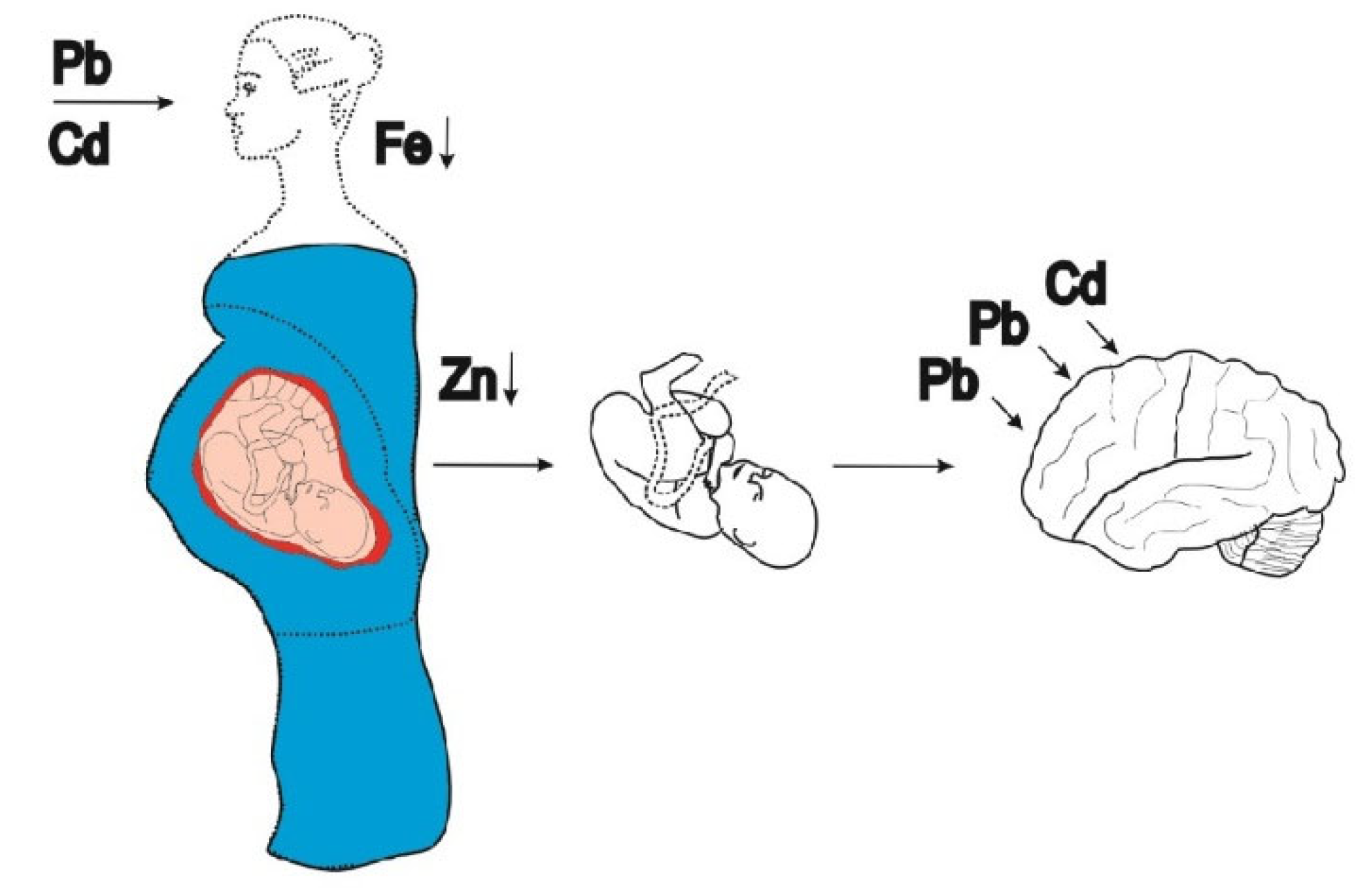
Figure 2.
The pathways for cadmium from foods to bone and kidney targets. Multiple metal transport proteins are involved in Cd absorption, including those for Fe (DMT1) [45], Zn (ZIP14) [46,47], copper (ATP7A) [48]and calcium (TRPV6) [49,50]. The human neutrophil gelatinase-associated lipocalin (hNGAL)/lipocalin 2 receptor facilitates the assimilation of Cd complexed with metallothionein (MT) and the plant metal-binding ligand phytochelatin (PC), denoted as CdMT and CdPC, respectively [51,52]. Thus, Cd is absorbed at a rate higher than that of Fe, Zn, and Ca, which can be enhanced further in those with low body iron stores, more prevalent in women than men, as well as in children than adults [1,2].
Figure 2.
The pathways for cadmium from foods to bone and kidney targets. Multiple metal transport proteins are involved in Cd absorption, including those for Fe (DMT1) [45], Zn (ZIP14) [46,47], copper (ATP7A) [48]and calcium (TRPV6) [49,50]. The human neutrophil gelatinase-associated lipocalin (hNGAL)/lipocalin 2 receptor facilitates the assimilation of Cd complexed with metallothionein (MT) and the plant metal-binding ligand phytochelatin (PC), denoted as CdMT and CdPC, respectively [51,52]. Thus, Cd is absorbed at a rate higher than that of Fe, Zn, and Ca, which can be enhanced further in those with low body iron stores, more prevalent in women than men, as well as in children than adults [1,2].
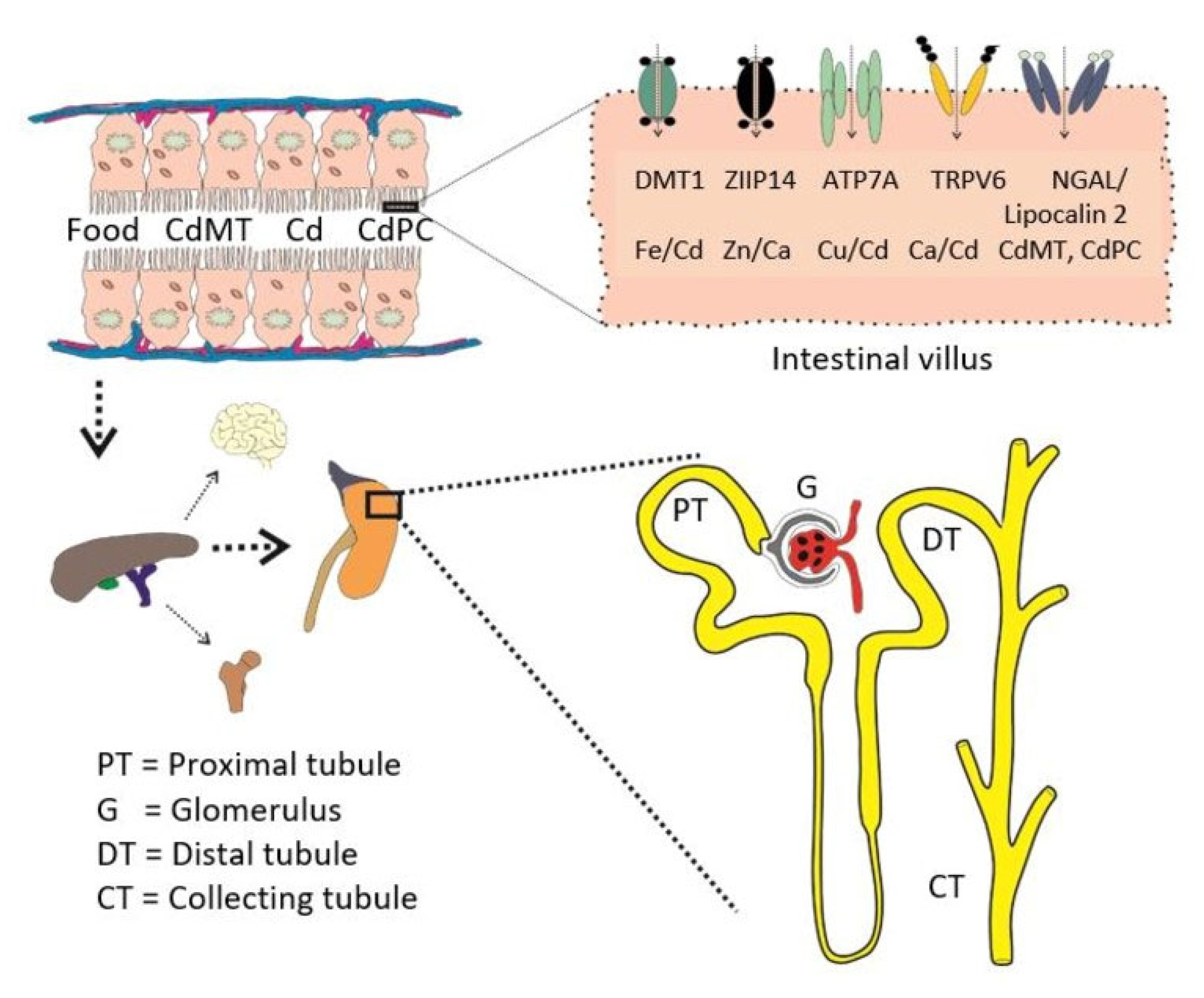
Figure 3.
Biosynthesis and the catabolism of β2-microglobulin. The protein β2M is released into bloodstream from the surface of most nucleated cells, including white blood cells [12,91]. With the low molecular weight of 11.8 kDa, β2M is filtered by the glomeruli, retrieved by the proximal tubular cells (PTCs), and degraded in lysosome. An increased β2M excretion can be due to enhanced synthesis, impaired reabsorption/catabolism, or nephron loss. This Figure is from Phelps et al. https://dx.doi.org/10.20517/jeea.2025.09 (accessed on 17 March 2026) [92].
Figure 3.
Biosynthesis and the catabolism of β2-microglobulin. The protein β2M is released into bloodstream from the surface of most nucleated cells, including white blood cells [12,91]. With the low molecular weight of 11.8 kDa, β2M is filtered by the glomeruli, retrieved by the proximal tubular cells (PTCs), and degraded in lysosome. An increased β2M excretion can be due to enhanced synthesis, impaired reabsorption/catabolism, or nephron loss. This Figure is from Phelps et al. https://dx.doi.org/10.20517/jeea.2025.09 (accessed on 17 March 2026) [92].
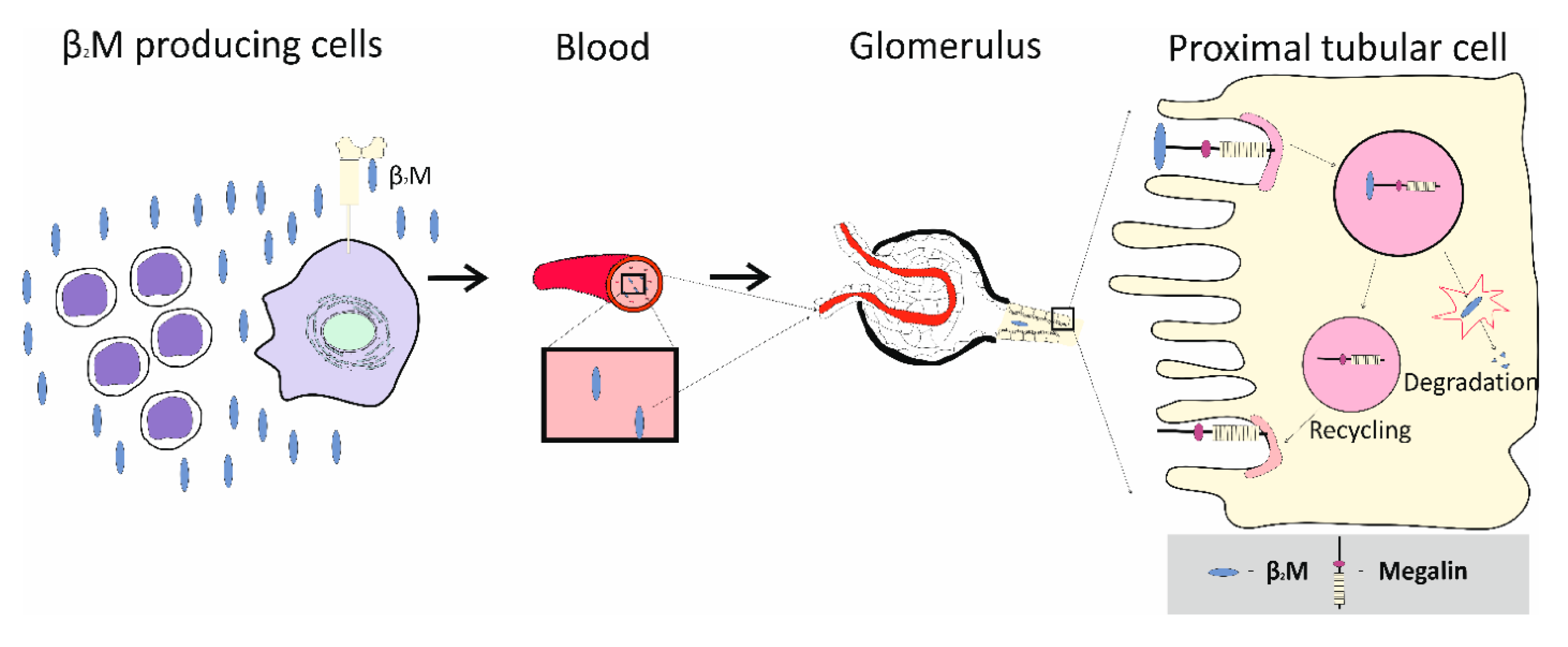
Figure 4.
Benchmark Cd excretion for the β2M endpoint. Bootstrap averaging of ECd/Eβ2M dose-response models (A); Model weights (B), and BMDL/BMDU values for Cd excretion rates (C). × and △ represent male and female participants, respectively. β2M: β2-microglobulin; Eβ2M: excreted β2M; Cd: cadmium; ECd: excreted Cd; Ecr: creatinine excretion; BMDL: benchmark dose limit; BMDU: upper 95% confidence bound of BMD.
Figure 4.
Benchmark Cd excretion for the β2M endpoint. Bootstrap averaging of ECd/Eβ2M dose-response models (A); Model weights (B), and BMDL/BMDU values for Cd excretion rates (C). × and △ represent male and female participants, respectively. β2M: β2-microglobulin; Eβ2M: excreted β2M; Cd: cadmium; ECd: excreted Cd; Ecr: creatinine excretion; BMDL: benchmark dose limit; BMDU: upper 95% confidence bound of BMD.
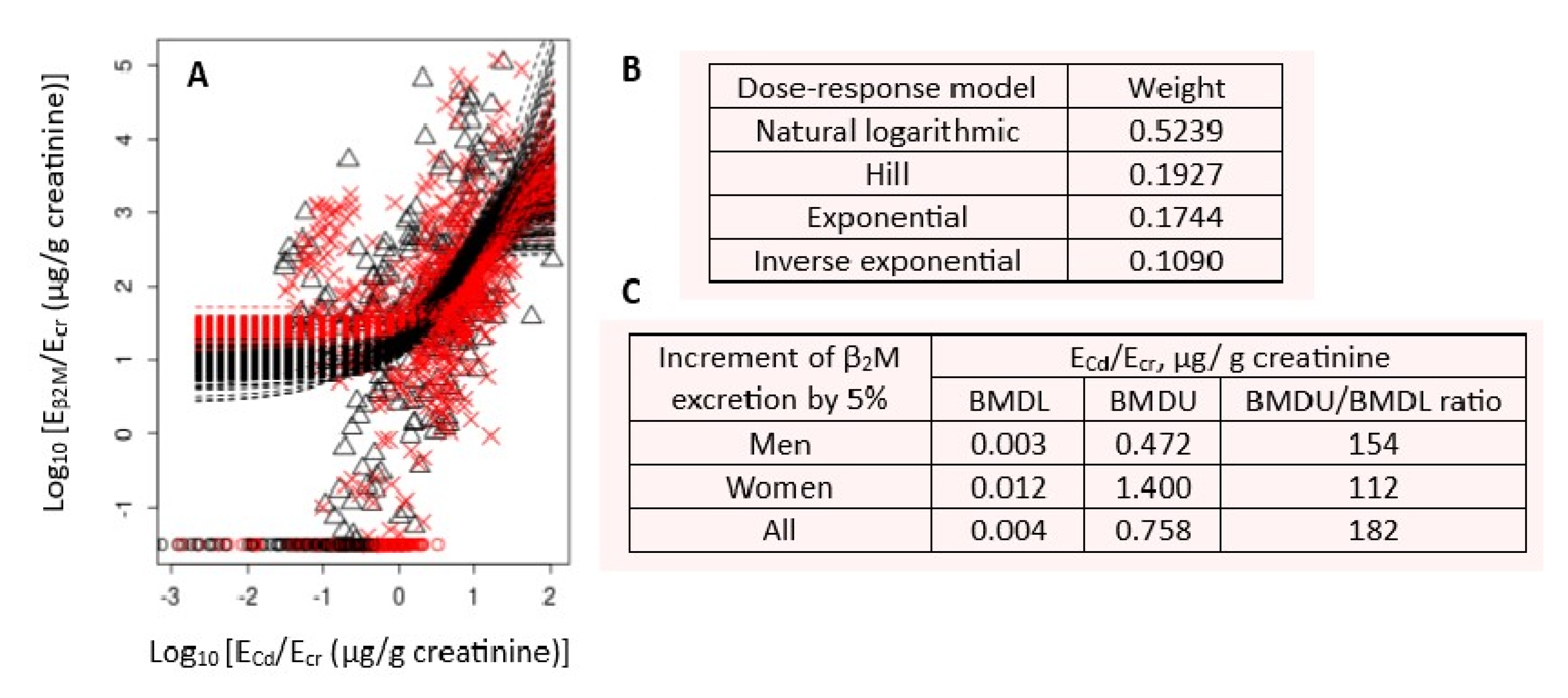
Figure 5.
Benchmark Cd excretion for the eGFR endpoint. Bootstrap averaging of ECd/eGFR dose-response models (A); Model weights (B), and BMDL/BMDU values for Cd excretion rates (C). × and △ represent male and female participants, respectively. eGFR: glomerular filtration rate; Cd: cadmium; ECd: excreted Cd; Ecr: creatinine excretion; BMDL: benchmark dose limit; BMDU: upper 95% confidence bound of BMD.
Figure 5.
Benchmark Cd excretion for the eGFR endpoint. Bootstrap averaging of ECd/eGFR dose-response models (A); Model weights (B), and BMDL/BMDU values for Cd excretion rates (C). × and △ represent male and female participants, respectively. eGFR: glomerular filtration rate; Cd: cadmium; ECd: excreted Cd; Ecr: creatinine excretion; BMDL: benchmark dose limit; BMDU: upper 95% confidence bound of BMD.
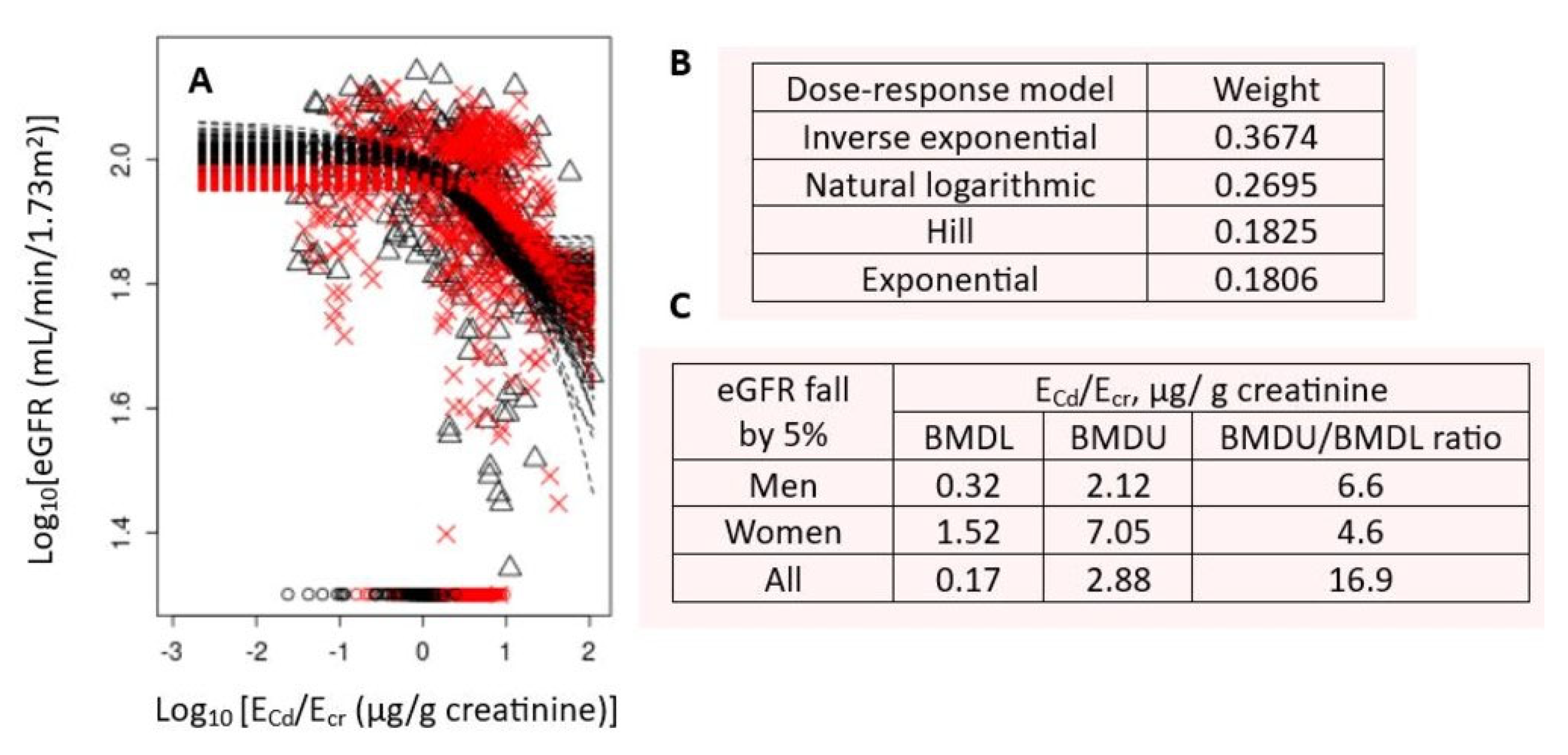
Figure 7.
Benchmark Cd excretion for the proteinuria and kidney disease endpoints. Bootstrap averaging of dose-response models for ECd and prevalences of proteinuria (A) and CKD (B); Model weights (C, D), and BMDL/BMDU values for Cd excretion rates (E,F). Cd: cadmium; ECd: excreted Cd; Ecr: creatinine excretion; CKD, chronic kidney disease; BMDL: benchmark dose limit; BMDU: upper 95% confidence bound of BMD.
Figure 7.
Benchmark Cd excretion for the proteinuria and kidney disease endpoints. Bootstrap averaging of dose-response models for ECd and prevalences of proteinuria (A) and CKD (B); Model weights (C, D), and BMDL/BMDU values for Cd excretion rates (E,F). Cd: cadmium; ECd: excreted Cd; Ecr: creatinine excretion; CKD, chronic kidney disease; BMDL: benchmark dose limit; BMDU: upper 95% confidence bound of BMD.
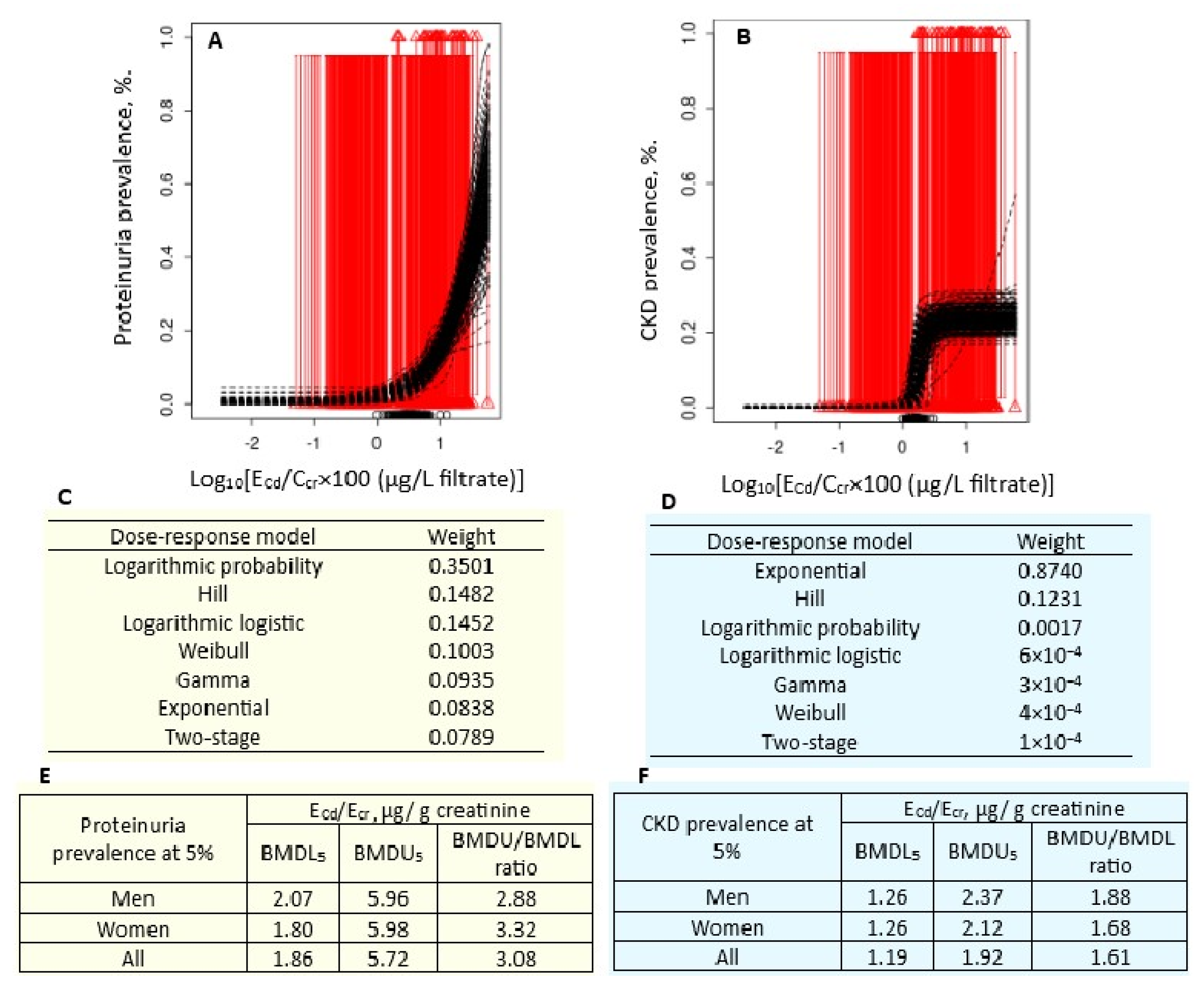
Figure 8.
Reabsorption of β2M and albumin by the proximal tubular cell. Filtered β2M is reabsorbed totally via REM, followed by lysosomal degradation [91]. Only a small fraction of albumin is reabsorbed through RME, subsequently degraded in lysosome from which Cd is released and bound to MT as a detoxified storage form of the metal [90].
Figure 8.
Reabsorption of β2M and albumin by the proximal tubular cell. Filtered β2M is reabsorbed totally via REM, followed by lysosomal degradation [91]. Only a small fraction of albumin is reabsorbed through RME, subsequently degraded in lysosome from which Cd is released and bound to MT as a detoxified storage form of the metal [90].
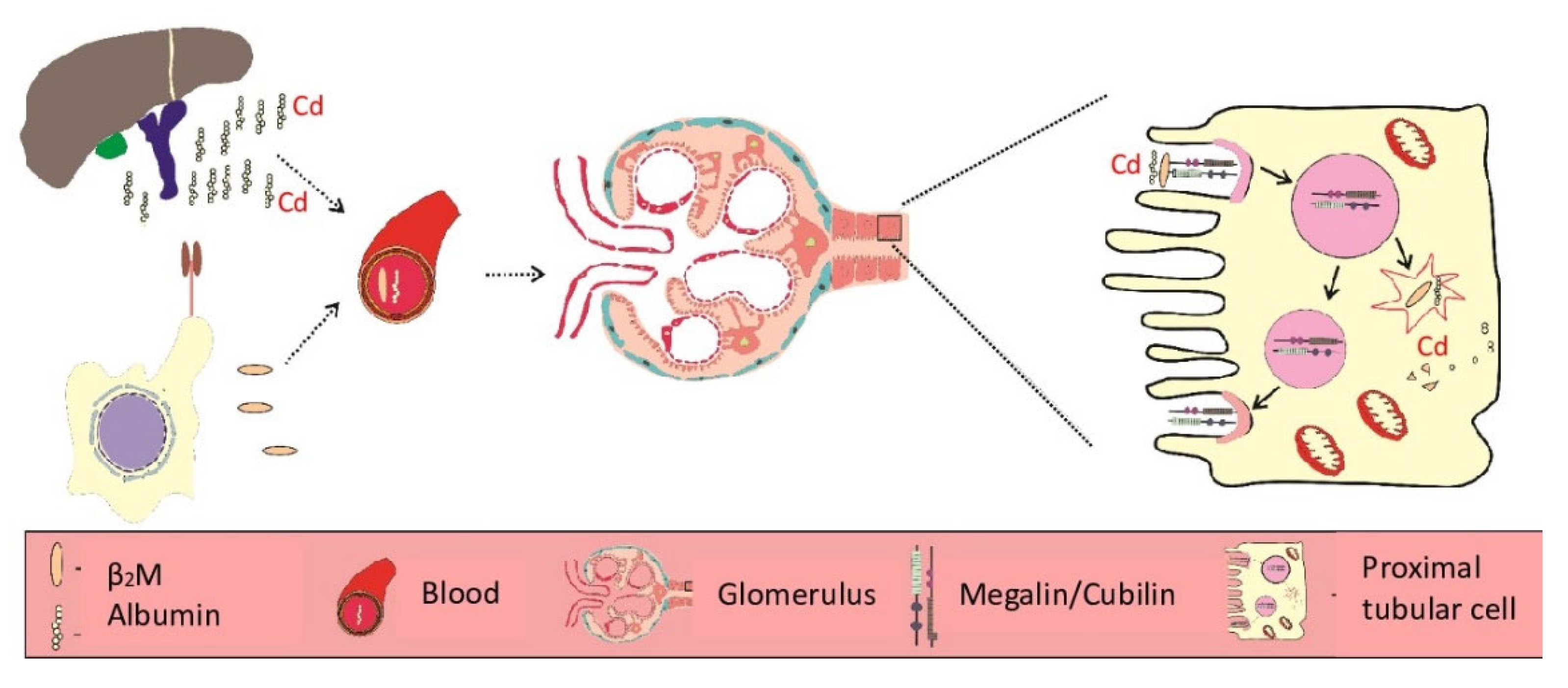
Figure 9.
The proximal tubular cell as a principal target of cadmium toxicity. To retrieve all nutrients, i.e., glucose, amino acids, metals and filtered proteins from filtrate, the proximal tubular cells (PTCs) are well equipped with many specialized transport proteins that included receptor-mediated endocytosis (RME) involving megalin/cubilin, responsible for internalization of β2M, albumin [118,119]. Reabsorption of Cd-bound metallothionein (Cd-MT complexes) occurs in the distal and collecting ducts, involving NGAL/lipocalin 2 receptor [120]. There is little evidence that Cd-MT is reabsorbed by megalin/cubilin RME [91].
Figure 9.
The proximal tubular cell as a principal target of cadmium toxicity. To retrieve all nutrients, i.e., glucose, amino acids, metals and filtered proteins from filtrate, the proximal tubular cells (PTCs) are well equipped with many specialized transport proteins that included receptor-mediated endocytosis (RME) involving megalin/cubilin, responsible for internalization of β2M, albumin [118,119]. Reabsorption of Cd-bound metallothionein (Cd-MT complexes) occurs in the distal and collecting ducts, involving NGAL/lipocalin 2 receptor [120]. There is little evidence that Cd-MT is reabsorbed by megalin/cubilin RME [91].
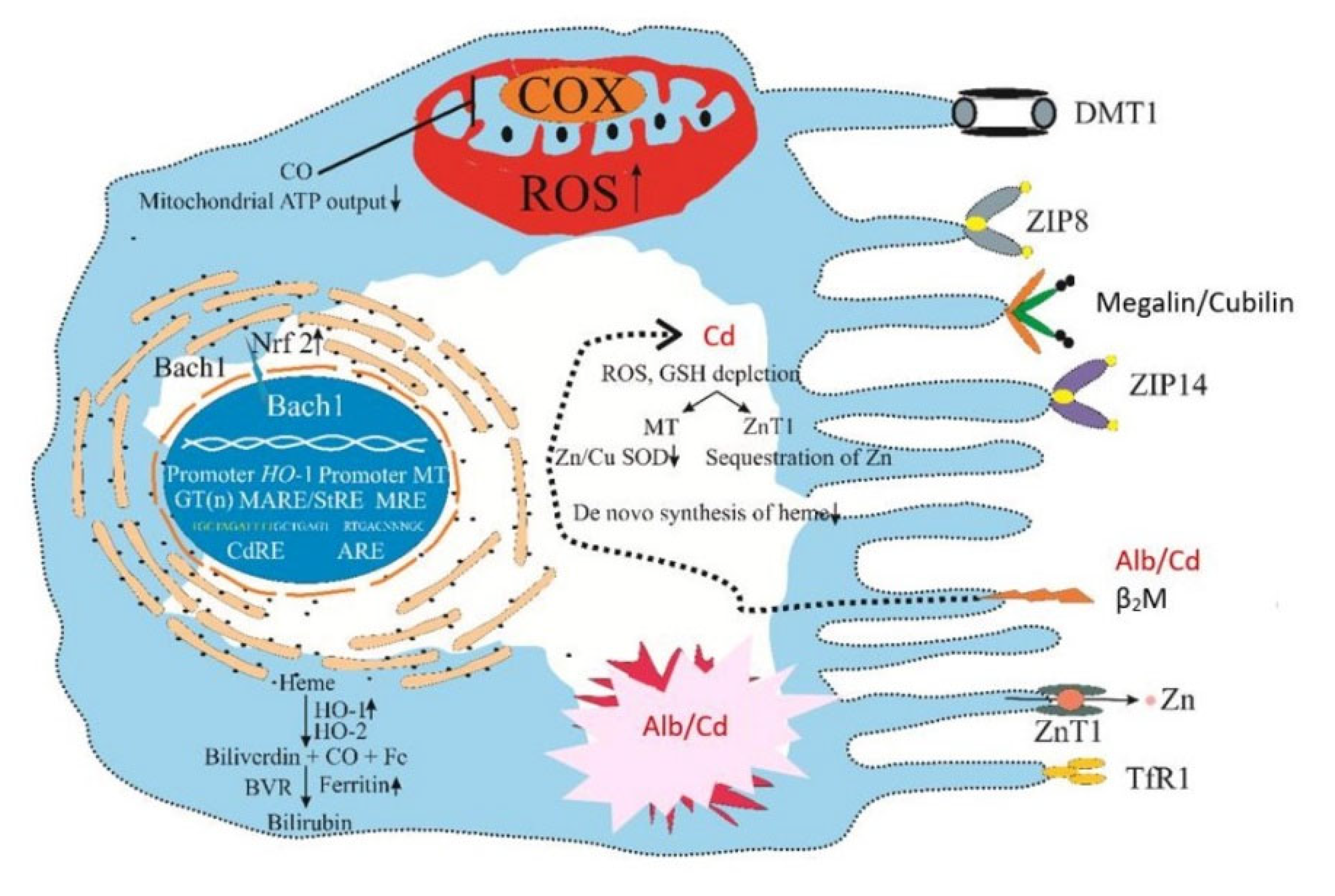

Table 1.
Cadmium “safe” exposure guidelines and thresholds for its toxicity.
| Toxicity target/Endpoint | Exposure limit/Threshold | Reference |
|---|---|---|
| Kidneys/β2M excretion ≥ 300 µg/g creatinine | TDI of 0.83 μg/kg b.w./d/ 5.24 μg/g creatinine |
JECFA [61,62] |
| Kidneys/β2M excretion ≥ 300 µg/g creatinine. | RfD of 0.36 μg/kg b.w./d 1 μg/g creatinine |
EFSA [63] |
| Kidneys and bones/ β2M excretion and bone mineral density |
TRV of 0.21−0.36 μg/kg b.w./d 0.5 μg/g creatinine |
US FDA [64] |
| Bones/Bone mineral density | MRLof 0.5 µg/kg b.w./day for an intermediate exposure duration (15−365 days) | ATSDR [43] |
| Lungs/Alveolar histiocytic infiltration and focal inflammation in alveolar septa | MRLof 0.03 μg CdO/m3 for an acute exposure duration between 1 and 14 days | ATSDR [43] |
β2M, β2-microglobulin; TDI, tolerable daily intake; RfD, reference dose; TRV, toxicological reference value; MRL, minimal risk level; CdO, cadmium oxide.
Table 2.
Benchmark cadmium excretion rates for the nephrotoxicity and CKD development.
| Method/Endpoint | Cd excretion benchmark | Country/ Reference |
|---|---|---|
| Conventional BMD RBP, β2M, and NAG |
For men, BMDL5 (BMDL10) values for Cd excretion rates with abnormal excretion of RBP, β2M, and NAG were 0.89 (1.59), 0.62 (1.30), 0.49 (1.04) μg/g cr., respectively Corresponding BMDL5 (BMDL10) values for Cd excretion rates in women were 0.76 (1.53), 0.64 (1.34), 0.65 (1.37) μg/g cr. |
China, Wang et al. [102]. |
| Conventional BMD β2M |
Respective BMD values of Cd excretion rates with abnormal β2M excretion in men and women were 0.6–1.2 and 0.6–2.3 µg g cr. [102]. | Japan, Suwazono et al. [103] |
| Advanced BMD β2M, NAG |
Cd excretion benchmarks at 5% increase in NAG excretion in men and women were 0.060 and 0.069 µg/g cr., respectively. BMDL10 value of Cd excretion rate at 10% prevalence of β2M excretion rates ≥ 300 μg/g cr. were 0.469 and 0.733 µg/g cr. in men and women, respectively. |
Thailand, Satarug et al. [104] |
| Advanced BMD Total protein, eGFR |
Cd excretion benchmark at 5% (10%) increase in protein excretion was 0.054 (0.114) µg/g cr. BMDL5 (BMD10) value of Cd excretion at 5% (10%) prevalence of CKD was 1.19 (1.35) µg/g cr. BMDL5 (BMDL10) value of Cd excretion at 5% prevalence of proteinuria was 1.86 (4.47) µg/g cr. |
Thailand, Satarug et al. [105] |
RBP, β2M, β2-microglobulin; NAG, N-acetyl-β-D-glucosaminidase; cr, creatinine; eGFR, estimated glomerular filtration rate. CKD was defined as eGFR values ≤ .60mL/min/1.73 m2. Proteinuria was defined as excretion of protein rates ≥ 100 mg/g cr.
Table 3.
Representative rates of filtration, excretion, catabolism and transcytosis in normal and Cd-intoxicated PTCs.
Table 3.
Representative rates of filtration, excretion, catabolism and transcytosis in normal and Cd-intoxicated PTCs.
| PTC Status | Protein | Filtration Rate |
Excretion Rate |
Catabolic Rate |
Transcytosis Rate |
|---|---|---|---|---|---|
| Normal | Albumin | 60 g/d | 20 mg/d | 2.980 g/d | 57 g/d |
| β2M | 300 mg/d | 100 μg/d | 299.9 mg/d | 0 | |
| Cd-intoxicated | Albumin | 60 g/d | 50 g/d | 2.950 g/d | 57 g/d |
| β2M | 300 mg/d | 1000 μg/d | 299 mg/d | 0 |
Assumptions: plasma albumin is 40 g/L; plasma β2M is 2.0 mg/L; GFR is 150 L/d; the glomerular sieving coefficient for albumin (GSCalb) is 0.01; and GSCβ2M is 1 [131].
Table 4.
The potency of Cd to induce the HO-1 gene upregulation by ARE reporter assay.
| Metal | Kidney (HEK293T) |
Liver (HepG2) |
Breast (MCF7) |
Brain (A172) |
Lung (A549) |
|---|---|---|---|---|---|
| Cd | 0.907 | 0.954 | 11 | 6.03 | 54.7 |
| As | 1.88 | 16.5 | 9.05 | 15.9 | 207 |
| Hg | 2.82 | 19.5 | 6.35 | 6.18 | NR |
| Pb | # | 426 | # | # | NR |
| Ag | 11.8 | 2.52 | 4.73 | 5.54 | NR |
| Au | 76.1 | 169 7 | 40 | 146 | NR |
| Zn | 84.8 | 249 | 256 | 100 | NR |
| Cu | 281 | 455 | 295 | 136 | 392 |
| Co | 484 | 185 | 532 | NR | NR |
| Fe | # | # | NR | 239 | NR |
ARE, antioxidant response element; NR, no response. Numbers are µM concentrations of individual metals that induce an increase in the HO-1 gene expression.
Disclaimer/Publisher’s Note: The statements, opinions and data contained in all publications are solely those of the individual author(s) and contributor(s) and not of MDPI and/or the editor(s). MDPI and/or the editor(s) disclaim responsibility for any injury to people or property resulting from any ideas, methods, instructions or products referred to in the content. |
© 2026 by the author. Licensee MDPI, Basel, Switzerland. This article is an open access article distributed under the terms and conditions of the Creative Commons Attribution (CC BY) license.
Copyright: This open access article is published under a Creative Commons CC BY 4.0 license, which permit the free download, distribution, and reuse, provided that the author and preprint are cited in any reuse.


