
Submitted:
04 April 2026
Posted:
08 April 2026
You are already at the latest version
Abstract
This study investigates the impact of jointly modeling jumps in asset prices and mortality rates on the valuation of insurance guarantees. Mortality dynamics are specified using two extended frameworks based on the classical Lee–Carter model, with and without the inclusion of jump components. Financial asset returns are modeled using Merton jump–diffusion processes. In the proposed specification, asset prices evolve according to a two–regime Merton model, where the regimes correspond to pandemic and non–pandemic market conditions. Using historical mortality data for the U.S. population and financial market data from the S&P 500 index, we evaluate the pricing implications for a Guaranteed Minimum Death Benefit (GMDB) rider. Contract values and Greeks are computed across multiple issue ages and policy maturities. The empirical results highlight the importance of accounting for simultaneous mortality and market jumps, and demonstrate that their interaction has a material effect on the valuation of GMDB products.
Keywords:
valuation
; dependent simultaneous jumps
; Lee Carter model
; guaranteed minimum death benefit
; regime switching
1. Introduction
Modeling mortality with jumps is a critical aspect of risk management within the insurance industry. While numerous research papers focus on mortality forecasting, and a subset of these consider the presence of jumps in mortality rates, it remains challenging to identify comprehensive research endeavors that simultaneously integrate both mortality jumps and jumps in assets value.
The integration of mortality jumps and asset price jumps represents a unique and intricate facet of risk assessment and management. Despite the significance of these two interrelated factors in the financial and insurance sectors, the scholarly literature often treats them as separate domains. As such, there is a notable gap in research where the coexistence of mortality jumps and stock price jumps is explored comprehensively.
The convergence of these two phenomena warrants attention due to their potential interconnectedness in financial markets and insurance portfolios. A holistic approach to modeling that encompasses both mortality and stock price jumps can offer a more accurate and realistic representation of risk profiles for insurance companies, facilitating better-informed decision-making and improved risk mitigation strategies.
Therefore, bridging this gap in research by simultaneously considering jumps in mortality and stock prices is essential for a more comprehensive understanding of risk dynamics and ultimately enhancing the risk management practices of insurance companies.
Pandemics often cause an unusual increase in death rates. According to [1] and also World Health Organization Website (www.who.int), the following pandemics given in Table 1 in the recent century account for more than 90 millions deaths.
In mortality forecasting domain, the famous paper by Lee and Carter, [2] and its extension such as [3] are the basic models for mortality forecasting. There are many papers that have focused on mortality forecasting without considering jumps. For a review of available approaches to forecast mortality, see [4]. Forecasting mortality assuming jumps have received less attention. In the following we will mention some. [5] extends to the Lee Carter (LC) model by adding jumps through the mortality index. In [6] a jump process is simply added to Lee Carter model which is separated from the time index process and the results are used for pricing catastrophic mortality bonds. [7] uses a renewal process to capture the jumps in mortality rates. In [8], a two population model is used to capture dependent jumps of mortality rates in two populations. [8,9,10,11,12,13,14] are among those research works that have considered the jumps in mortality rates.
Pandemics such as Covid–19 materially impact life insurance products and riders like Guaranteed Minimum Death Benefits (GMDB) through both mortality and market–related channels. The pandemic increased GMDB costs by sharply elevating mortality rates; for example, [15] reports actual–to–expected (A/E) mortality ratios exceeding 100% across many life insurance blocks. At the same time, pandemic–induced equity market volatility increased the value of the embedded death–triggered put option, as falling account values and heightened option Greeks stressed hedging programs. Persistently low interest rates further raised the present value of liabilities, while reduced lapse rates amplified anti–selection, collectively driving higher reserve and capital requirements under regulatory frameworks such as VM–21 and Solvency II.
Modelling simultaneous jumps in mortality and assets is a very recent focused subject. In [16] the dependence between mortality rates, short term interest rate and asset price models have been considered. While the results are based on simulation data, the buyout’s of a fully funded defined benefits pension is measured under different scenarios. The study found that while there is a notable difference in buyout prices between scenarios with and without jumps, the assumption of independence between factors is not as critical as previously believed. The discrepancies in buyout prices when considering independent shocks versus simultaneous shocks are relatively small, as long as the jump intensities are similar. Furthermore, changes in buyout prices, when considering the relationship between mortality and short rates, are primarily driven by uncertainty in mortality rates. In [17], jumps in the assets were considered, where the mixed fractional Brownian motion is used to capture jumps in assets. The results are used to valuation of a the Variable Annuity product. Our work extended [17] to a case where we use the phase-type (PH) mortality model to capture jumps in mortality.
This paper contributes by developing a framework for modeling dependent jumps in mortality and equity markets. The framework incorporates a regime-switching mechanism in the stock market that is triggered by a transition to a pandemic state. Although the underlying asset dynamics are modeled using a Merton jump–diffusion framework, the proposed approach is sufficiently flexible to be applied to alternative asset-pricing models.
The remainder of the paper is structured as follows: Section 2 compares the extended LC model with the traditional LC in modelling the USA mortality rates. Section 3 introduces the model used to describe asset dynamics. Section 4 calculates the GMDB based on the proposed models and finally Section 5 concludes the paper.
2. Mortality Modelling
Figure 1 illustrates the evolution of the average U.S. mortality rate over the period 1950–2023, based on total mortality data obtained from www.mortality.org. The average mortality rate is computed as the ratio of total deaths to total exposures aggregated across all ages. The long-term pattern shows a steady decline in mortality from the 1950s through the early 2000s, reflecting sustained improvements in medical care, living conditions, and public health. Around 2010, this downward trend slows and subsequently reverses, largely attributable to population aging. The most striking feature, however, is the pronounced spike observed during the Covid-19 period (2020–2021), highlighted in the figure, which corresponds to an unprecedented short-term surge in national mortality. Although mortality declines after 2022, it remains elevated relative to pre-pandemic levels. In the following two models are used model the age-specific dynamics of mortality.
We model mortality LC framework [2] and its jump-diffusion extension proposed by Chen and Cox [5], which accounts for rare but severe mortality shocks through a stochastic jump component. Note that although mortality data covering the Spanish Flu period are available, to ensure consistency between the asset and mortality data, we only use mortality rates after 1950.
2.1. Baseline Lee–Carter Model
To model mortality dynamics, let denote the central death rate at age x in calendar year t. The baseline mortality dynamics are specified as
where represents the average age-specific mortality pattern, measures the sensitivity of mortality at age x to changes in the time index, captures the overall mortality trend over time, and is the error term of the model.
The parameters are estimated using U.S. mortality data for ages 20–110 over the pre-Covid 19 period 1950–2019. The time index is assumed to follow a random walk with drift,
where and are estimated from first differences of the fitted series. The rates of 2020 and 2021 are identified as outliers in the model.
As seen in Figure 2, the estimated Lee–Carter components exhibit intuitive patterns. The age-specific intercept , in Figure 2a, increases monotonically with age, reflecting the well-known exponential rise in baseline mortality risk across the adult life span. The sensitivity parameter , presented in Figure 2b is positive for most working and retirement ages, indicating that improvements in the mortality index translate into proportional mortality reductions across these age groups, while the decline and sign change at the oldest ages suggest weaker or heterogeneous responsiveness to period effects among the very old. Finally, the time index in Figure 2b displays a strong downward trend from 1950 to 2019, capturing the long-run improvement in mortality conditions in the United States over the postwar period, with short-term fluctuations reflecting cyclical and cohort-related influences. Together, these components confirm that the LC model effectively separates age structure, period-driven mortality improvement, and sensitivity patterns across ages.
Table 2 reports the average mortality rates for the US population aged 20–110 across the pre-Covid, Covid, and post-Covid periods. The results indicate a pronounced increase in mortality during the pandemic years (2020–2021) relative to the long-term pre-Covid baseline, followed by a partial reversion toward pre-pandemic levels in the post-Covid period. It is important to note that age-specific mortality rates exhibit substantially greater variation than the aggregate mortality index, as changes in the population age structure and the effects of population aging influence the behavior of average mortality rates over time.
We need to use a model that captures the mortality shocks. The models is explained in the following.
2.2. Modelling Mortality Shocks
In our implementation, the Chen–Cox model [5] is formulated as a jump–augmented extension of the Lee–Carter framework, while preserving the same age structure. The mortality surface is specified as in (1). The difference from Lee–Carter arises in the stochastic dynamics assigned to . Let and introduce a latent jump level process . We assume
so that changes in are driven by a Gaussian diffusion term and by changes in the jump level. The jump level is modeled as
where indicates whether a jump occurs at time t, and gives the jump magnitude when a jump occurs. The parameters are estimated from the empirical increments by classifying large moves (beyond a threshold) as jumps and using the non–jump and jump subsets to infer the diffusion volatility and jump distribution. This specification leaves the historical fit unchanged relative to the Lee–Carter model, but alters the forecast distribution of by explicitly incorporating rare, potentially large mortality shocks.
Figure 3 presents the estimated Chen–Cox mortality model parameters for the USA over the period 1950–2020. The left panel shows the baseline age component , which increases monotonically with age, reflecting the strong age gradient in log-mortality rates. The middle panel displays the age-specific sensitivity parameter , indicating that middle and older ages exhibit higher responsiveness to changes in the mortality time index, while extreme old ages show a decline in sensitivity. The right panel depicts the estimated time index , capturing the long-term downward trend in mortality improvements, with highlighted jump years corresponding to abrupt mortality shocks, most notably during pandemic-related periods. Together, these components illustrate both the structural age pattern and the dynamic temporal behavior embedded in the Chen–Cox framework.
To compare the models’ out-of-sample performance measure of Mean Absolute Error (MAE) and Root Mean Squared Error (RMSE) have been used. Let denote the model-based forecast central death rate at age x in calendar year t. Because mortality models are estimated on the logarithmic scale, forecast errors are evaluated using . For an evaluation sample containing N age–year observations, the MAE and RMSE are defined as
Here, x indexes age (from 20 to 110 in our empirical application), t denotes calendar year (2021–2023 for the out-of-sample evaluation period), and N represents the total number of forecast evaluation points, equal to the number of age–year combinations included in the test sample. For example, when forecasting three calendar years over 91 ages, .
The MAE measures the average absolute forecast deviation and provides a robust summary of typical prediction error. The RMSE assigns greater weight to large forecast errors due to the quadratic loss function and is therefore more sensitive to extreme deviations.
Table 3 reports year-by-year out-of-sample forecast accuracy for the period 2021–2023. In 2021, which corresponds to the peak post-pandemic mortality shock, the Chen–Cox model substantially outperforms the Lee–Carter model, achieving lower RMSE (0.2139 vs. 0.2724) and MAE (0.1546 vs. 0.2060). This indicates that explicitly modeling jump components improves the ability to capture abrupt mortality deviations immediately following extreme events.
In 2022, during the recovery phase, the Chen–Cox specification continues to deliver superior forecast performance, with reductions in RMSE and MAE of approximately 20% relative to the Lee–Carter benchmark. This suggests that the jump–diffusion structure not only improves shock detection but also enhances short-term transitional dynamics as mortality gradually reverts toward long-term trends.
By 2023, forecast accuracy improves for both models as mortality volatility stabilizes. While Chen–Cox maintains a lower RMSE (0.1438 vs. 0.1609), the Lee–Carter model achieves a slightly lower MAE (0.1168 vs. 0.1253). This indicates that when mortality dynamics return to smoother patterns, the advantage of incorporating jump components diminishes and traditional trend-based models regain competitiveness for typical forecast errors.
Aggregating across the full evaluation period, the Chen–Cox model consistently outperforms Lee–Carter, with lower overall RMSE (0.1740 vs. 0.2147) and MAE (0.1309 vs. 0.1520). The identification of two jump years and an estimated jump intensity of provide empirical support for the presence of rare but impactful mortality shocks. Overall, these results demonstrate that incorporating jump risk yields meaningful gains in predictive accuracy during periods characterized by structural breaks, while maintaining comparable performance during stable mortality regimes.
Figure 4 compares observed and forecast age-specific mortality rates for the USA across the years 2021, 2022, 2023, and the long-term projection year 2030. For the evaluation period 2021–2023, both models successfully reproduce the characteristic exponential increase in mortality with age, while the Chen–Cox forecasts generally track the observed age profiles more closely, particularly at middle and older ages where pandemic-related distortions are most pronounced. In 2021, corresponding to the immediate post-shock period, Lee–Carter slightly underestimates mortality at several adult age groups, whereas the Chen–Cox specification provides improved alignment due to its ability to accommodate abrupt shifts in the mortality index. During the recovery phase in 2022 and 2023, forecast discrepancies narrow for both models, indicating a gradual return to smoother mortality dynamics. The 2030 projection panel illustrates diverging long-term trends, with Chen–Cox producing moderately higher mortality rates at older ages relative to Lee–Carter, reflecting the persistent effect of jump-adjusted dynamics embedded in the model. Overall, the figure highlights the advantage of incorporating jump risk for short-term post-crisis forecasting while preserving realistic age-gradient behavior in long-horizon projections.
Table 4 compares observed and model-based period life expectancy at age 20 for the years 2021–2023, together with long-term projections for 2030. The observed values indicate a strong post-pandemic recovery in longevity, with increasing from 57.2 in 2021 to 59.4 in 2023. This pattern reflects the gradual normalization of mortality conditions following the Covid-19 shock.
Both mortality models systematically overestimate life expectancy in the immediate post-shock period. In 2021, the Lee–Carter model produces the largest upward bias (59.4 versus the observed 57.2), while the Chen–Cox estimate (58.2) remains closer to the realized outcome. This suggests that incorporating jump dynamics improves the model’s ability to capture short-term mortality disruptions.
During the recovery phase in 2022 and 2023, forecast discrepancies narrow for both models. Nevertheless, the Chen–Cox specification consistently generates more conservative longevity estimates than Lee–Carter, reflecting the persistent effect of jump-adjusted mortality dynamics. This behavior may be advantageous for applications involving longevity risk management and solvency assessment, where underestimation of mortality shocks can lead to capital shortfalls.
For the long-term horizon, both models predict continued longevity improvements by 2030, with projected life expectancy reaching 60.5 under Lee–Carter and 59.1 under Chen–Cox. The persistent gap between the two projections highlights the long-run impact of incorporating mortality jump risk and demonstrates how model choice materially influences forward-looking survival expectations. The next section presents the proposed financial model.
3. Proposed Financial Model
Although a substantial body of research has focused on modeling jumps in mortality and asset returns separately, there is limited literature that directly models mortality jumps as causal drivers of financial market jumps. Empirical calibration and co-integration of mortality shocks and asset return dynamics remain relatively underexplored. This presents opportunities for the development of copula-based models, common shock frameworks, or latent factor approaches that integrate mortality and equity market dynamics. [18] deploys a model-based, asset–liability simulation to examine how a joint financial and mortality shock, calibrated to real-world data from the first year of the Covid-19 pandemic, can affect a life insurer’s risk exposure. [19] found that the financial impact of Covid-19 on life insurance premiums was modest, especially for term products and annuities. [20] presents a semi-parametric model for real-time monitoring of portfolio mortality levels that accounts for sudden shocks and delays in death reporting and [21] investigates how mortality shocks like Covid-19 affect actuarial modeling and insurance valuation, highlighting the need for models that can adapt to abrupt, short-term deviations in mortality trends
3.1. Dependence Structure
To motivate the relevance of our model, we plot the S&P 500 weekly return series from 2000 to 2026. Figure 5 illustrates the dynamics of weekly log returns and time-varying volatility of the S&P 500 index over the period 2000–2026, with the Covid-19 crisis highlighted by the shaded region. Weekly returns (blue bars) fluctuate around zero, exhibiting pronounced spikes during periods of market stress, notably during the global financial crisis of 2008–2009 and the Covid-19 outbreak in early 2020. The 26-week rolling volatility (red line) displays clear volatility clustering, with elevated and persistent levels following major shocks, consistent with well-documented stylized facts of financial time series. In particular, the Covid period is characterized by a sharp surge in volatility accompanied by extreme negative and positive return realizations, reflecting heightened uncertainty and rapid market adjustments. Overall, the plot highlights the strong co-movement between extreme returns and volatility regimes, providing visual motivation for regime-switching and jump-diffusion modeling frameworks in capturing crisis-driven market dynamics.
Table 5 summarizes the downside risk and jump behavior of S&P 500 weekly returns across the three subperiods. The Covid period exhibits the highest level of market turbulence, with the largest average annualized volatility (26%) and the highest jump intensity (2.2 jumps per year), indicating a substantial increase in extreme negative return events. Although the pre-Covid period contains the single worst observed weekly return (), its overall volatility and jump frequency remain lower than those observed during the Covid regime. In the post-Covid period, risk conditions partially normalize, as reflected by lower volatility and jump intensity relative to the Covid period, while remaining elevated compared to the pre-Covid regime.
Although market shocks affect both the volatility and returns of the S&P 500, products such as GMDBs are particularly sensitive to the simultaneous occurrence of elevated mortality and severe financial market downturns. During the pandemic, higher death rates increased the frequency of benefit claims, while declining equity markets reduced account values, thereby widening the gap between fund balances and guaranteed benefit bases. This combined mortality–market stress generated pronounced tail dependence between biometric and financial risks, resulting in higher realized GMDB payouts and increased guarantee costs. These dynamics highlight the limitations of traditional independence assumptions and emphasize the need for integrated modeling frameworks that jointly capture mortality and financial risk in variable annuity products.
Mortality among variable annuity policyholders increased significantly during the Covid-19 pandemic, with excess mortality estimated at approximately 11% relative to pre-pandemic assumptions, leading to higher-than-expected guaranteed minimum death benefit (GMDB) claim frequencies [22].
Empirical evidence further indicates that insurers with significant exposure to variable annuity guarantees experienced substantial financial stress during the Covid-19 crisis, reflecting the increased valuation and hedging costs of minimum benefit riders [23]. All of these facts suggest imposing a dependence structure between mortality and stock market.
To model the dependence between jumps in the stock market and shocks in mortality, in this section, we propose a parsimonious model designed to capture the dependence structure between mortality and asset price jumps. Our approach differs from that of [24] in several key respects: we adopt an alternative mortality modeling framework, assume a constant discount rate, and calibrate both the mortality and asset components using real-world data rather than relying solely on simulation-based methods.
To capture the dependence between mortality and the market shocks, we model the asset price process using a two–state regime–switching jump–diffusion framework. The regimes of the market depend on the state in mortality. If the mortality is in pandemic state, the assets dynamic switches to regime 2. During non-pandemic the asset market stays in regime 1. Let in (3) denote the regime indicator where represents normal market conditions (non–pandemic, regime 1) and represents pandemic-induced financial stress or regime 2. In this setting, the onset of a pandemic is interpreted as a shock that switches from the normal regime 1 to the pandemic regime 2.
Conditional on the regime state , the asset return process is specified with regime–dependent parameters. In this paper, we assume, letting denote the one-period log return follows the Merton model with jumps, i.e.,
where , denotes the number of jumps over period in regime i, and are i.i.d. jump sizes (e.g., normally distributed) in regime i. In the pandemic regime, both volatility and jump intensity are permitted to increase reflecting heightened uncertainty and more frequent extreme downside moves.
Moreover, the discrete-time regime indicator provides a natural mechanism to incorporate dependence between mortality and financial markets by allowing the same pandemic-driven regime state to affect both the asset dynamics and mortality intensities. This structure captures the joint tail behavior observed during systemic health shocks and provides a coherent basis for pricing, reserving, and risk management of GMDB guarantees under correlated biometric and financial risks. Following section provides the model calibration.
3.2. Financial Model Calibration
In this section, a two regime–model has been calibrated by the S&P 500 weekly data and compared with a single regime–model. Table 6 reports the estimated parameters of the single-regime and two-regime Merton jump–diffusion models calibrated using weekly S&P 500 log-returns over the period from 1950 to 2024. The single-regime specification produces an average annual drift estimate of with annual volatility , and an estimated jump intensity of jumps per year. The negative jump mean () indicates that jumps are predominantly downward, while the jump volatility reflects moderate jump magnitude variability.
The two-regime model reveals substantial heterogeneity between the Non-Covid and Covid periods. During the Non-Covid regime, volatility remains moderate at and jump intensity is slightly lower at jumps per year. In contrast, the Covid regime exhibits markedly higher market turbulence, with volatility increasing to and jump intensity rising to jumps per year. Moreover, jump magnitudes become more severe during the Covid period, as reflected by a larger negative jump mean () and a substantially higher jump volatility (). These results are consistent with the presence of extreme market dislocations and elevated tail risk during the pandemic.
From a model fit perspective, the two-regime specification achieves a higher log-likelihood value of and a lower Akaike Information Criterion (AIC) of compared to the single-regime model (log-likelihood , AIC ), indicating superior explanatory power despite the increased model complexity. The likelihood ratio test strongly rejects the null hypothesis of a single-regime model in favor of the two-regime alternative, with a test statistic of and a corresponding p-value of . This provides overwhelming statistical evidence in support of regime-dependent dynamics.
Overall, the results highlight the importance of incorporating structural breaks and regime-switching behavior in asset return modeling, particularly during periods of systemic stress such as the Covid-19 pandemic. The two-regime Merton framework captures both elevated diffusion volatility and intensified jump risk during crisis periods, making it especially suitable for applications in risk management, derivative pricing, portfolio stress-testing, and actuarial solvency analysis.
4. GMDB Contract, Risk-Neutral Pricing, and Model Specification
Consider a variable annuity with a guaranteed minimum death benefit (GMDB) issued at age x with maturity T (in years) and initial account value . The guarantee is a roll-up benefit of the form
where is the guaranteed roll-up rate. Let denote the future lifetime (time-to-death) of the insured issued at age x. A standard GMDB paid at the time of death (if death occurs before maturity) is
where is the policy account value (linked to the market) and . Assuming a constant risk-free rate , the no-arbitrage (risk-neutral) price at issue is
Equivalently, conditioning on survival/death and integrating over time yields
where is the density of under the mortality model. If independence between mortality and market holds, then
Using the Ito’s Lemma applied to (6), it is not hard to see that under the risk-neutral measure , the account value follows a Merton jump–diffusion:
with Poisson intensity , jump size , and
We use the superscript “s” to denote association with S, distinguishing it from in (2). In the following the GMDB values and vega are calculated for the proposed model and the results are compared to the baseline model. In the baseline specification (Model 1), mortality is projected using the Lee–Carter framework, i.e., Equations (1) and (2), and is assumed to be independent of the market process . The corresponding parameter values are reported in the Single-Regime column of Table 6. Pricing is then performed according to (10).
Our proposed model (Model 2) introduces mortality shocks (e.g., pandemic-type jumps). The mortality shocks, occur with an annual probability p and trigger the Covid market regime. Operationally, one may define a shock indicator and set the market regime as
The parameter of the financial side of Model 2 are given in columns Two-Regime (Non-Covid) and Two-Regime (Covid) of Table 6.
4.1. Monte Carlo Pricing
For a given issue age x and term T, simulate M joint paths:
on a chosen time grid . For each path, compute the discounted payoff
and estimate the GMDB price by
Table 7 reports GMDB prices under the independent model (M1) and the regime-dependent mortality–market model (M2) for different combinations of mortality jump probability p and guarantee growth rate g. Prices are scaled by 100, and each cell displays M1/M2 followed by the relative premium in parentheses.
Across all specifications, M2 consistently produces higher prices than M1, indicating a positive regime-dependent premium induced by joint mortality–market shocks. The magnitude of this premium increases with maturity T, highlighting the long-horizon amplification of tail dependence effects.
For issue age 30 (Panel A), the percentage difference ranges from approximately 7%–14% for , increases to 9%–16% for , and reaches 18%–26% for . The effect is particularly pronounced when both the mortality jump probability p and the guarantee growth rate g are high, reflecting convexity of the GMDB payoff.
For issue age 50 (Panel B), the regime premium is uniformly larger, reaching up to 25% for long maturities. This pattern reflects the higher baseline mortality intensity at older ages, which increases the probability that adverse mortality shocks coincide with unfavorable market regimes.
Table 8 reports the GMDB Vega (scaled by 100) for two pricing models. Several patterns emerge. First, Vega increases substantially with duration, reflecting the growing sensitivity of long-maturity guarantees to volatility. Second, Vega is markedly larger for issue age 50 than for age 30, indicating that contracts issued at older ages exhibit stronger exposure to volatility risk due to higher mortality intensity and greater probability of early claim.
Third, Model 2 consistently produces higher Vega than Model 1 across all parameter combinations. The percentage increase generally ranges from approximately 7% to 18% for age 30 and from about 12% to 16% for age 50, with larger relative differences observed at longer maturities. This indicates that incorporating regime dependence and mortality shocks amplifies volatility sensitivity, particularly for long-duration guarantees.
Overall, the results demonstrate that ignoring dependence between mortality shocks and financial market regimes leads to systematic underpricing and mis-hedging with the mispricing and vega growing in maturity, jump intensity, and guarantee growth rate.
5. Conclusions
This study examines how the valuation of Guaranteed Minimum Death Benefit (GMDB) riders is affected when mortality shocks and equity–market jumps are modeled jointly. On the biometric side, we compare a baseline Lee–Carter model with a jump-augmented Chen–Cox specification calibrated to U.S. mortality data. Out-of-sample evidence for 2021–2023 shows that incorporating mortality jumps improves forecast accuracy during and immediately following extreme mortality events, while maintaining comparable performance in more stable periods. On the financial side, we calibrate a Merton jump–diffusion model to S&P 500 returns and document clear regime heterogeneity between Covid and non-Covid periods, characterized by higher diffusion volatility, greater jump intensity, and more severe jump magnitudes during the pandemic regime.
Motivated by these empirical findings, we propose a parsimonious dependence structure in which mortality shocks trigger a transition to a stressed market regime. This one-way linkage induces tail dependence between elevated mortality and market downturns—a feature that is particularly relevant for GMDB contracts, as benefit payments are more likely to occur when account values are depressed. Monte Carlo pricing results demonstrate that assuming independence between mortality and markets leads to systematic underpricing and underestimation of hedging sensitivities. Across issue ages (30 and 50), maturities (5, 10, and 20), mortality-jump probabilities, and guarantee growth rates, the dependent specification consistently produces higher GMDB values and higher Vega. The relative differences generally increase with maturity and with parameters that enhance the option-like convexity of the payoff. The impact is more pronounced for older issue ages due to higher baseline mortality intensity, which raises the probability that adverse mortality and market states coincide.
From a practical perspective, the findings underscore that pandemic-type shocks are not solely mortality events but also balance-sheet events: they simultaneously increase claim incidence and deteriorate financial conditions that determine account values and hedging effectiveness. Incorporating dependence between biometric and financial jumps therefore provides a more realistic foundation for pricing, reserving, and risk management of variable annuity guarantees.
Several avenues for future research remain. The dependence mechanism could be extended beyond a regime-trigger framework to common-shock or latent-factor models, and potential bidirectional feedback between markets and mortality could be explored. Richer financial dynamics—such as stochastic volatility, stochastic interest rates, or alternative jump specifications—may further refine hedging implications. Finally, incorporating multi-population mortality and portfolio heterogeneity would allow for an assessment of basis risk and capital impacts at the insurer level. Overall, the evidence suggests that simultaneous mortality and market jumps materially influence GMDB values and Greeks, highlighting the importance of integrated modeling frameworks for robust insurance guarantee valuation under systemic health shocks.
References
- Bedenham, G.; Kirk, A.; Luhano, U.; Shields, A. The importance of biodiversity risks: Link to zoonotic diseases. British Actuarial Journal 2022, 27, e10. [Google Scholar] [CrossRef]
- Lee, R.D.; Carter, L.R. Modeling and forecasting US mortality. Journal of the American statistical association 1992, 87, 659–671. [Google Scholar]
- Renshaw, A.E.; Haberman, S. A cohort-based extension to the Lee–Carter model for mortality reduction factors. Insurance: Mathematics and economics 2006, 38, 556–570. [Google Scholar] [CrossRef]
- Booth, H.; Tickle, L. Mortality modelling and forecasting: A review of methods. Annals of actuarial science 2008, 3, 3–43. [Google Scholar] [CrossRef]
- Chen, H.; Cox, S.H. Modeling mortality with jumps: Applications to mortality securitization. Journal of Risk and Insurance 2009, 76, 727–751. [Google Scholar] [CrossRef]
- Liu, Y.; Li, J.S.H. The age pattern of transitory mortality jumps and its impact on the pricing of catastrophic mortality bonds. Insurance: Mathematics and Economics 2015, 64, 135–150. [Google Scholar] [CrossRef]
- Özen, S.; Şahin, Ş. Transitory mortality jump modeling with renewal process and its impact on pricing of catastrophic bonds. Journal of Computational and Applied Mathematics 2020, 376, 112829. [Google Scholar] [CrossRef]
- Zhou, R.; Li, J.S.H.; Tan, K.S. Pricing Standardized Mortality Securitizations: A Two-Population Model With Transitory Jump Effects. Journal of Risk and Insurance 2013, 80, 733–774. [Google Scholar] [CrossRef]
- Cox, S.H.; Lin, Y.; Wang, S. Multivariate exponential tilting and pricing implications for mortality securitization. Journal of Risk and Insurance 2006, 73, 719–736. [Google Scholar] [CrossRef]
- Lin, Y.; Cox, S.H. Securitization of catastrophe mortality risks. Insurance: Mathematics and Economics 2008, 42, 628–637. [Google Scholar] [CrossRef]
- Huang, H.; Milevsky, M.A.; Wang, J. Portfolio choice and life insurance: The CRRA case. Journal of Risk and Insurance 2008, 75, 847–872. [Google Scholar] [CrossRef]
- Chen, H. A family of mortality jump models applied to US data. Asia-Pacific Journal of Risk and Insurance 2013, 8, 105–121. [Google Scholar] [CrossRef]
- Lin, Y.; Liu, S.; Yu, J. Pricing mortality securities with correlated mortality indexes. Journal of Risk and Insurance 2013, 80, 921–948. [Google Scholar] [CrossRef]
- Deng, Y.; Brockett, P.L.; MacMinn, R.D. Longevity/mortality risk modeling and securities pricing. Journal of Risk and Insurance 2012, 79, 697–721. [Google Scholar] [CrossRef]
- U.S. Individual Life COVID-19 Mortality Experience Study, through December 31, 2022. Technical report, Society of Actuaries Research Institute, 2023. Experience study of COVID-19 excess mortality in U.S. individual life portfolios.
- Arık, A.; Uğur, Ö.; Kleinow, T. The impact of simultaneous shocks to financial markets and mortality on pension buy-out prices. ASTIN Bulletin: The Journal of the IAA 2023, 53, 392–417. [Google Scholar] [CrossRef]
- Sharma, N.; Selvamuthu, D.; Natarajan, S. Variable annuities valuation under a mixed fractional Brownian motion environment with jumps considering mortality risk. Applied Stochastic Models in Business and Industry 2022, 38, 1019–1038. [Google Scholar] [CrossRef]
- Richards, S.; Jones, A.; Veprauskas, A.; et al. A COVID-19 stress test for life insurance: insights into the effectiveness of different risk mitigation strategies. Annals of Actuarial Science 2022, 16, S30–S51.
- Carannante, M.; D’Amato, V.; Haberman, S. COVID19 accelerated mortality shocks and the impact on life insurance: the Italian situation. Annals of Actuarial Science 2022, 16, 478–497. [Google Scholar] [CrossRef]
- Richards, S.J. Real-time measurement of portfolio mortality levels in the presence of shocks and reporting delays. Annals of Actuarial Science 2022. [Google Scholar] [CrossRef]
- Schnürch, S.; Kleinow, T.; Korn, R.; Wagner, A. The impact of mortality shocks on modelling and insurance valuation as exemplified by COVID-19. Annals of Actuarial Science 2021. [Google Scholar] [CrossRef]
- Timothy, P. 2021 Milliman Variable Annuity Mortality Study. https://frm.milliman.com/insight/2021-Milliman-Variable-Annuity-Mortality-Study, 2022. Reports elevated mortality experience among variable annuity policyholders during COVID-19.
- Koijen, R.S.J.; Yogo, M. Variable Annuity Insurer Fragility. Journal of Finance. 2021. Documents insurer stress during crisis periods including COVID-19.
- Arık, A.; Uğur, Ö.; Kleinow, T. The impact of simultaneous shocks to financial markets and mortality on pension buy-out prices. ASTIN Bulletin: The Journal of the International Actuarial Association 2023, 53, 392–417. [Google Scholar] [CrossRef]
Figure 1.
Average mortality rate in the USA (ages 20–110), 1950–2023. The period 2020–2021 is highlighted to indicate the Covid-19 years.
Figure 1.
Average mortality rate in the USA (ages 20–110), 1950–2023. The period 2020–2021 is highlighted to indicate the Covid-19 years.
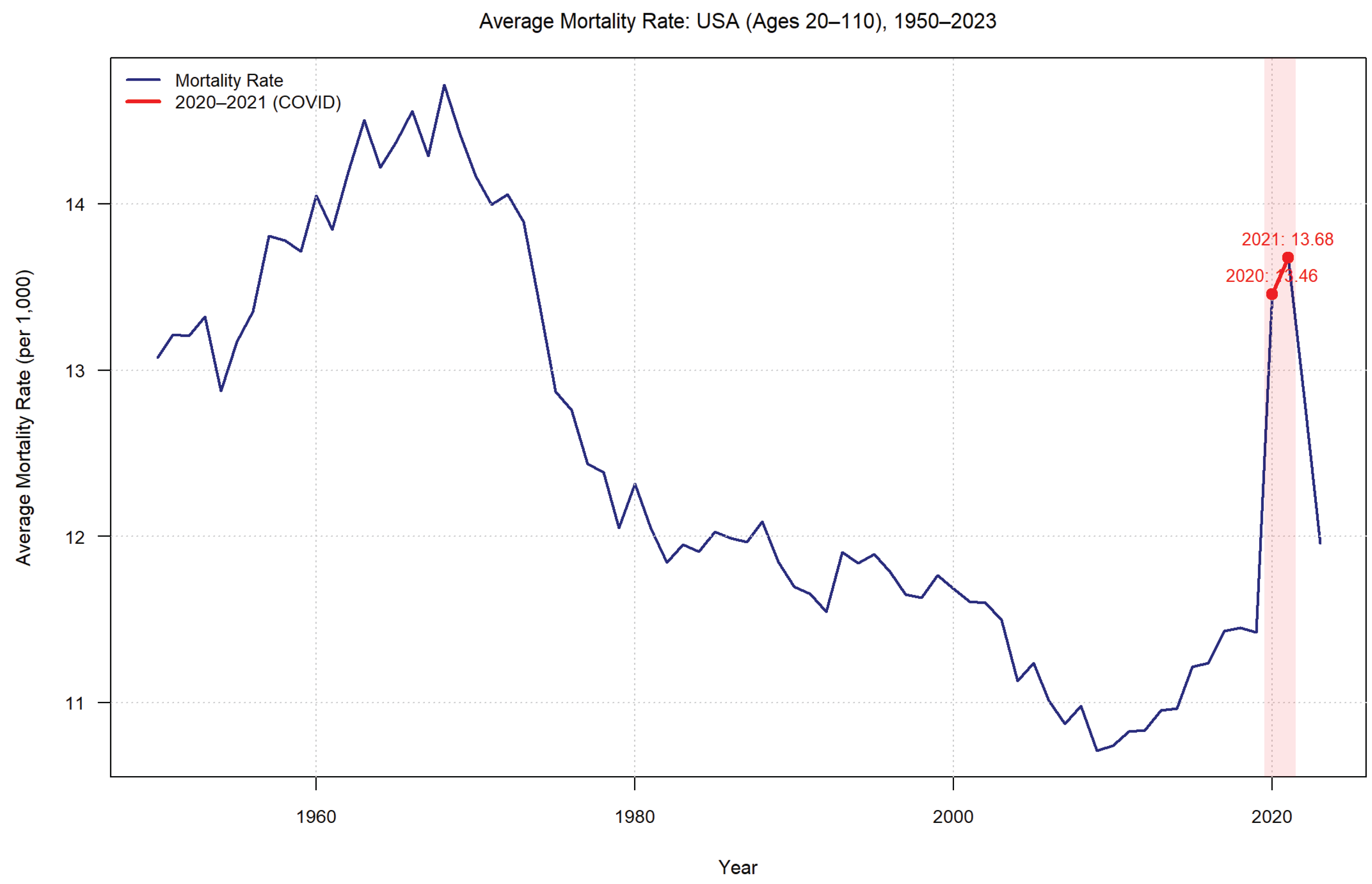
Figure 2.
Estimated Lee–Carter model parameters for the USA mortality data (ages 20–110, calibration period 1950–2019). Panel (a) shows the age-specific average mortality component , panel (b) displays the sensitivity parameter , and panel (c) presents the estimated mortality index .
Figure 2.
Estimated Lee–Carter model parameters for the USA mortality data (ages 20–110, calibration period 1950–2019). Panel (a) shows the age-specific average mortality component , panel (b) displays the sensitivity parameter , and panel (c) presents the estimated mortality index .
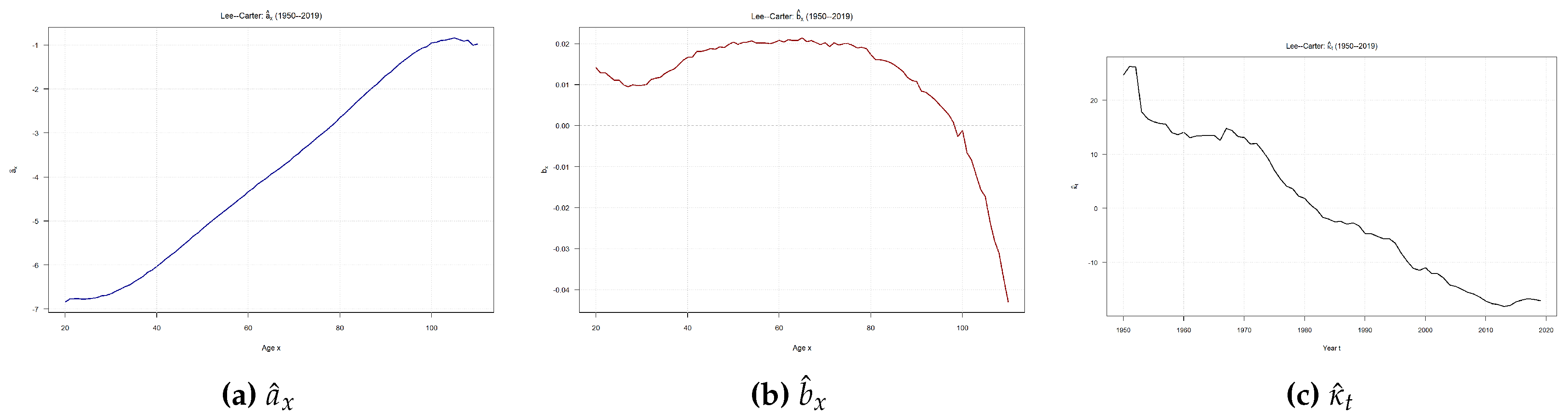
Figure 3.
Estimated Chen–Cox mortality model parameters for the USA (1950–2020). Left panel: age-specific baseline component . Middle panel: age-specific sensitivity component . Right panel: time index with detected jump years highlighted.
Figure 3.
Estimated Chen–Cox mortality model parameters for the USA (1950–2020). Left panel: age-specific baseline component . Middle panel: age-specific sensitivity component . Right panel: time index with detected jump years highlighted.
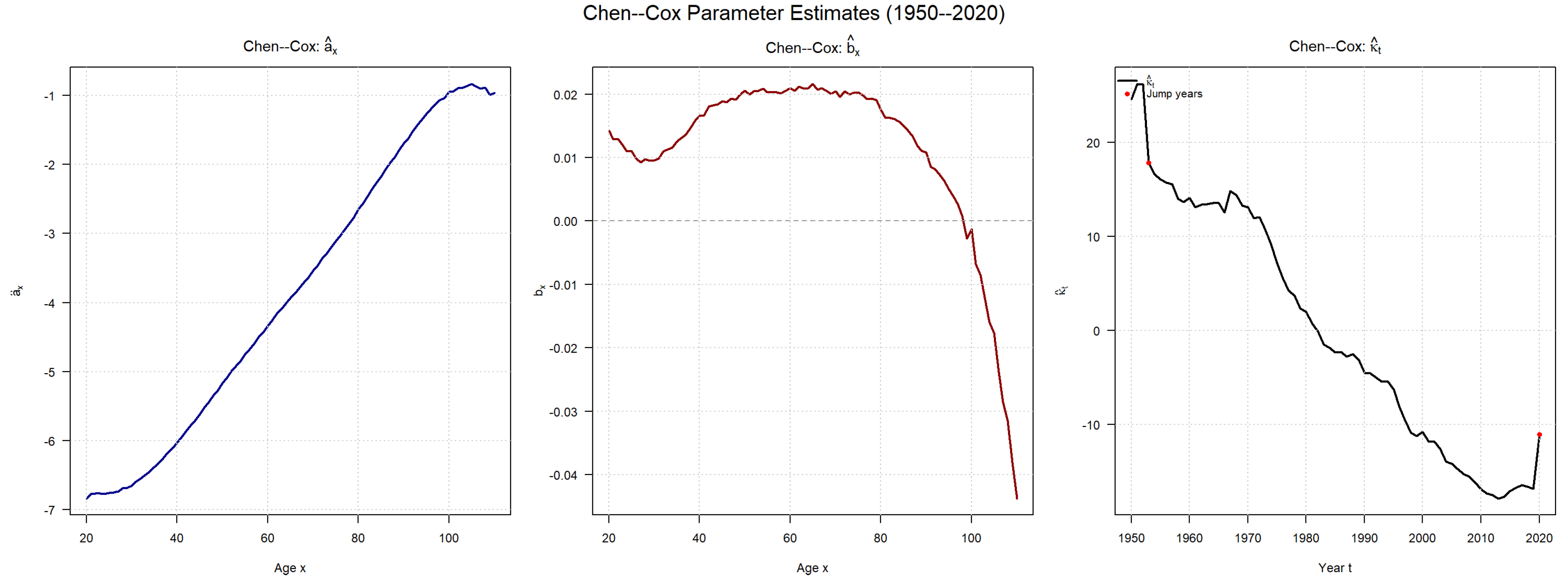
Figure 4.
Observed and forecast age-specific mortality rates for the USA (ages 20–110). Panels correspond to calendar years 2021, 2022, 2023, and 2030. Solid black lines represent Lee–Carter forecasts, red lines denote Chen–Cox forecasts, and green lines indicate observed mortality rates (available for 2021–2023). The vertical axis is displayed on a logarithmic scale to highlight age-related mortality gradients.
Figure 4.
Observed and forecast age-specific mortality rates for the USA (ages 20–110). Panels correspond to calendar years 2021, 2022, 2023, and 2030. Solid black lines represent Lee–Carter forecasts, red lines denote Chen–Cox forecasts, and green lines indicate observed mortality rates (available for 2021–2023). The vertical axis is displayed on a logarithmic scale to highlight age-related mortality gradients.
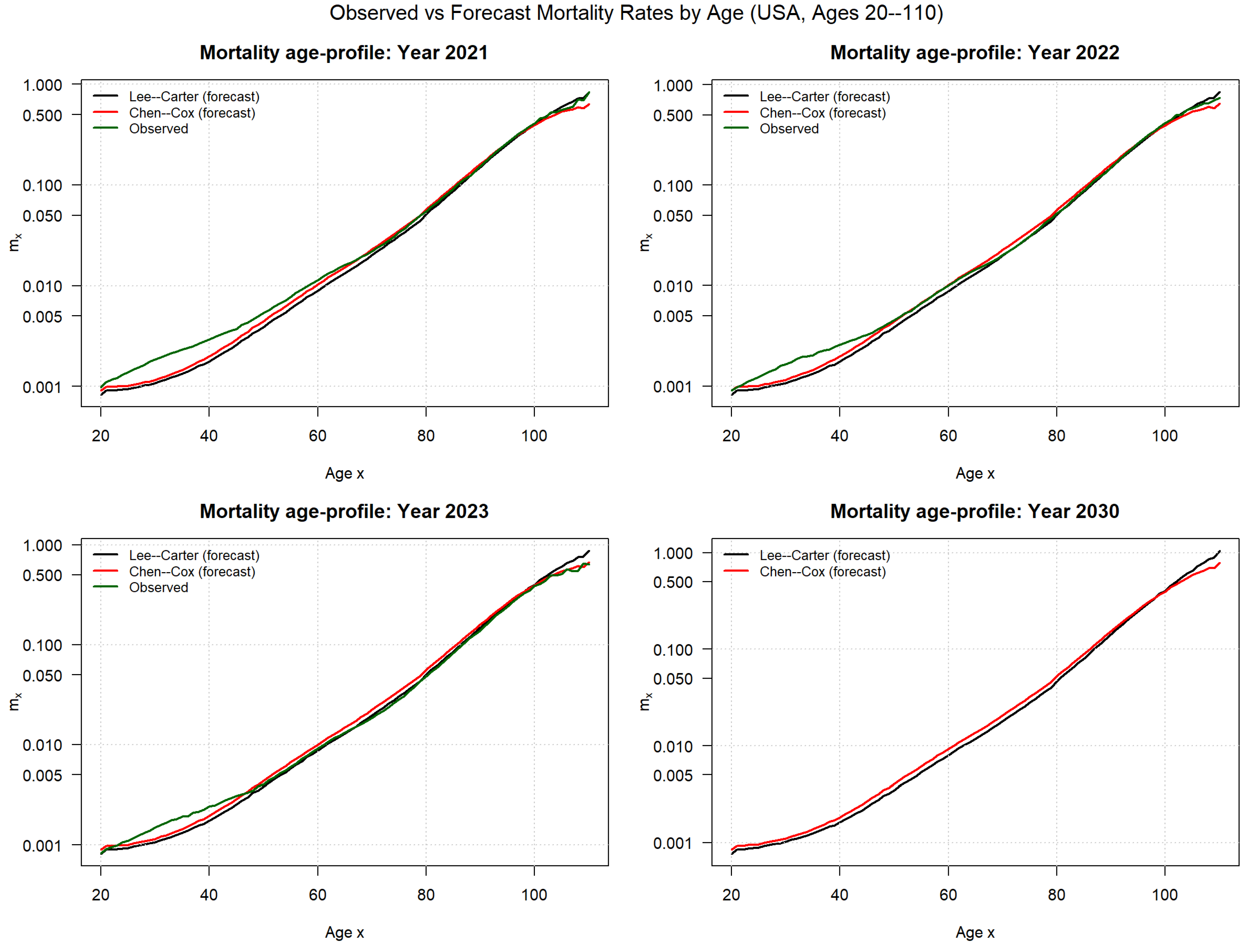
Figure 5.
S&P 500 weekly log returns and 26-week rolling volatility (2000–2026). The shaded area highlights the Covid-19 market stress period. Weekly returns are shown as bars, while the volatility series is overlaid as a line using a secondary axis.
Figure 5.
S&P 500 weekly log returns and 26-week rolling volatility (2000–2026). The shaded area highlights the Covid-19 market stress period. Weekly returns are shown as bars, while the volatility series is overlaid as a line using a secondary axis.
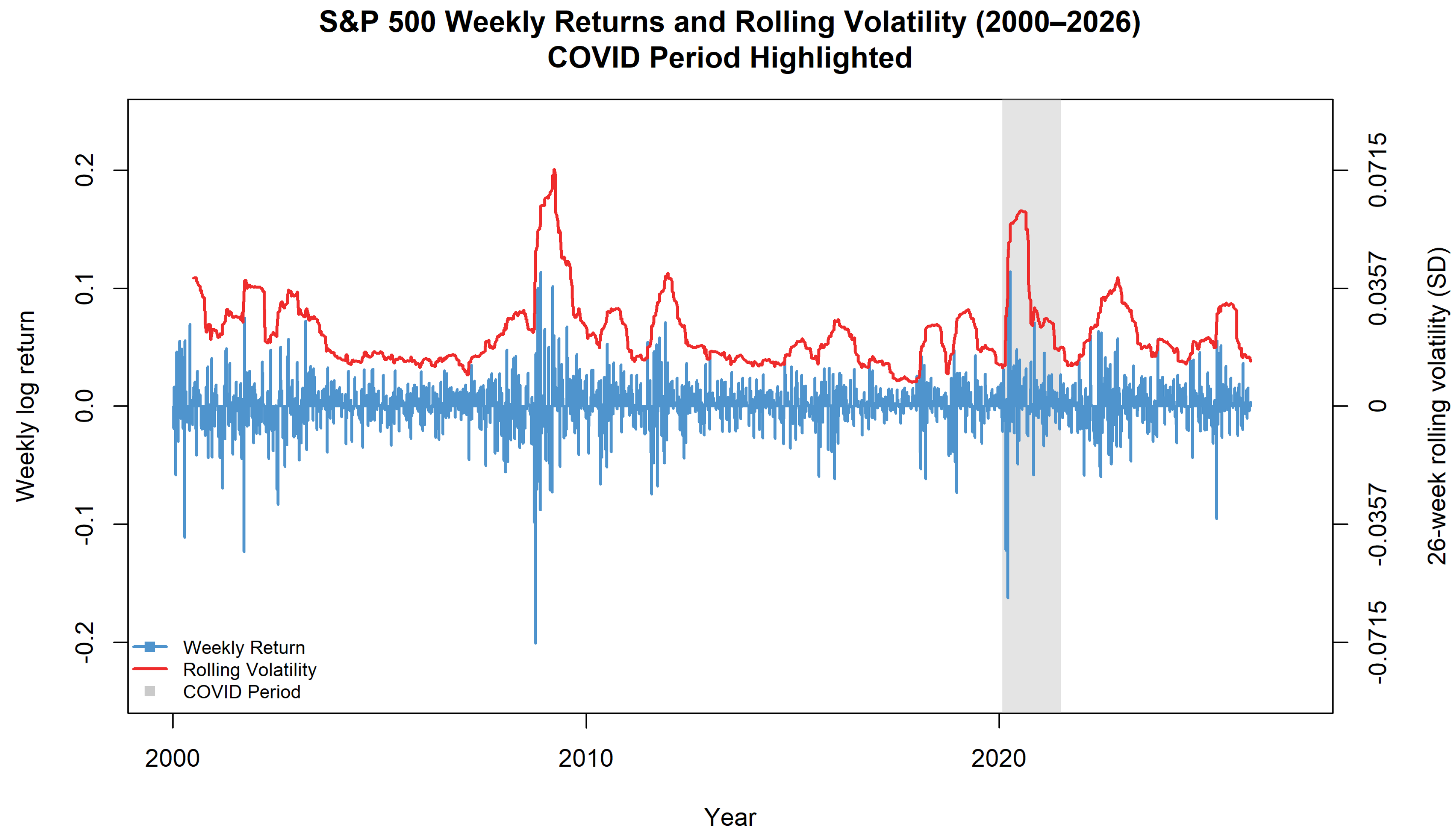

Table 1.
Pandemics in the Last Century.
| Pandemic | Estimated Deaths |
|---|---|
| Spanish Flu (1918-1919) | 50 million |
| Asian Flu (1957-1958) | 1 million |
| Hong Kong Flu (1968-1969) | 1 million |
| HIV/AIDS pandemic (ongoing) | Over 36 million (as of 2022) |
| H1N1 Influenza Pandemic (2009-2010) | 151,700 - 575,400 |
| Covid-19 (2019-2022) | more than 7.1 million as of Feb 2026 |
Table 2.
Average annual mortality rate USA 1950-2023.
| Period | mortality rate (multiplied by 1000) |
|---|---|
| Pre-Covid (1950–2020) | 12.4 |
| COVID period (2020–2021) | 13.6 |
| Post-Covid (2022–2023) | 12.4 |
Table 3.
Year-by-year out-of-sample forecast comparison between Lee–Carter and Chen–Cox models (USA ages 20–110).
Table 3.
Year-by-year out-of-sample forecast comparison between Lee–Carter and Chen–Cox models (USA ages 20–110).
| Measure | Lee–Carter | Chen–Cox |
|---|---|---|
| RMSE 2021 | 0.2724 | 0.2139 |
| MAE 2021 | 0.2060 | 0.1546 |
| RMSE 2022 | 0.1954 | 0.1563 |
| MAE 2022 | 0.1333 | 0.1126 |
| RMSE 2023 | 0.1609 | 0.1438 |
| MAE 2023 | 0.1168 | 0.1253 |
Table 4.
Observed and model-based period life expectancy at age 20 () for the USA (ages 20–110).
| Year | Observed | Lee–Carter | Chen–Cox |
|---|---|---|---|
| 2021 | 57.2 | 59.4 | 58.2 |
| 2022 | 58.4 | 59.6 | 58.3 |
| 2023 | 59.4 | 59.7 | 58.4 |
| 2030 | 60.5 | 59.1 |
Table 5.
Risk and Jump Characteristics of S&P 500 Weekly Returns Across Covid Periods.
| Period | Min Weekly Return (%) |
Avg Annualized Volatility (%) |
Jump Intensity per Year |
|---|---|---|---|
| Pre-Covid: | -20 | 16 | 1.5 |
| Covid Period: | -16 | 26 | 2.2 |
| Post-Covid: | -10 | 16 | 1.8 |
Table 6.
Annualized Merton Jump–Diffusion Parameter Estimates (S&P 500 Weekly Data, 1950–2024)
| Parameter | Single-Regime | Two-Regime (Non-Covid) | Two-Regime (Covid) |
|---|---|---|---|
| (%) | 9.67 | 10.48 | 13.25 |
| (%) | 14.70 | 14.43 | 21.11 |
| 1.9596 | 1.9150 | 2.1638 | |
| -0.0091 | -0.0138 | -0.0181 | |
| 0.0281 | 0.0223 | 0.0625 | |
| Log-likelihood | 9668.35 | 9705.56 | |
| AIC | -19326.69 | -19391.11 | |
Notes. Drift () and diffusion volatility () are reported in annualized percentage terms. Jump intensity is measured in expected jumps per year. Jump size parameters and are reported in log-return units. The two-regime model separates the sample into Non-Covid and Covid periods. Likelihood ratio test comparing the two-regime and single-regime specifications yields with , indicating that the two-regime model provides a statistically significant improvement in fit.
Table 7.
GMDB prices (scaled by 100) over mortality jump probability p and guarantee growth rate g. Cell = M1/M2 (percentage difference).
Table 7.
GMDB prices (scaled by 100) over mortality jump probability p and guarantee growth rate g. Cell = M1/M2 (percentage difference).
| Panel A: Issue Age 30 | ||||
|---|---|---|---|---|
| p | g | |||
| 3% | 4% | 6.9/7.7 (+11.6%) | 22.3/25.3 (+13.5%) | 96.1/116.1 (+20.8%) |
| 3% | 5% | 8.1/8.7 (+7.4%) | 27.8/30.3 (+9.0%) | 132.7/156.7 (+18.1%) |
| 3% | 6% | 9.3/10.2 (+9.7%) | 33.6/38.4 (+14.3%) | 178.2/211.8 (+18.9%) |
| 4% | 4% | 6.9/7.6 (+10.1%) | 22.2/25.7 (+15.8%) | 96.2/119.4 (+24.1%) |
| 4% | 5% | 8.1/8.9 (+9.9%) | 27.6/31.2 (+13.0%) | 132.6/160.9 (+21.3%) |
| 4% | 6% | 9.3/10.1 (+8.6%) | 33.8/37.8 (+11.8%) | 178.4/213.1 (+19.4%) |
| 5% | 4% | 7.0/7.6 (+8.6%) | 22.2/25.8 (+16.2%) | 95.5/120.5 (+26.2%) |
| 5% | 5% | 8.0/9.1 (+13.8%) | 27.7/31.6 (+14.1%) | 132.9/165.0 (+24.2%) |
| 5% | 6% | 9.3/10.2 (+9.7%) | 33.8/38.2 (+13.0%) | 178.5/215.1 (+20.5%) |
| Panel A: Issue Age 30 | ||||
| p | g | |||
| 3% | 4% | 27.4/31.0 (+13.1%) | 96.1/113.4 (+18.0%) | 435.0/531.6 (+22.2%) |
| 3% | 5% | 32.0/36.4 (+13.8%) | 118.9/139.5 (+17.3%) | 597.7/719.6 (+20.4%) |
| 3% | 6% | 36.6/41.8 (+14.2%) | 145.7/169.7 (+16.5%) | 807.1/961.7 (+19.2%) |
| 4% | 4% | 27.5/31.9 (+16.0%) | 95.7/113.7 (+18.8%) | 432.4/536.7 (+24.1%) |
| 4% | 5% | 32.0/37.1 (+15.9%) | 119.2/142.0 (+19.1%) | 598.7/736.0 (+23.0%) |
| 4% | 6% | 37.2/41.9 (+12.6%) | 146.2/171.0 (+17.0%) | 806.2/965.4 (+19.8%) |
| 5% | 4% | 27.2/32.3 (+18.8%) | 95.6/116.8 (+22.2%) | 433.7/542.0 (+25.0%) |
| 5% | 5% | 31.9/36.9 (+15.7%) | 119.8/142.6 (+19.0%) | 601.2/744.9 (+23.9%) |
| 5% | 6% | 36.8/42.8 (+16.3%) | 146.3/171.1 (+17.0%) | 807.7/979.4 (+21.3%) |
Table 8.
GMDB Vega (scaled by 100). Cell shows Model 1 / Model 2 followed by the percentage increase .
Table 8.
GMDB Vega (scaled by 100). Cell shows Model 1 / Model 2 followed by the percentage increase .
| Panel A: Issue Age 30 | ||||
|---|---|---|---|---|
| T | p | |||
| 5 | 3% | 37.5/40.5 (8.0%) | 37.5/41.0 (9.3%) | 36.6/39.3 (7.4%) |
| 4% | 38.0/40.6 (6.8%) | 37.2/40.4 (8.6%) | 36.6/39.9 (9.0%) | |
| 5% | 38.0/40.9 (7.6%) | 37.1/40.0 (7.8%) | 36.9/39.7 (7.6%) | |
| 10 | 3% | 113.7/125.9 (10.7%) | 112.4/123.6 (10.0%) | 108.0/118.9 (10.1%) |
| 4% | 112.4/124.4 (10.7%) | 112.7/123.0 (9.2%) | 108.3/119.1 (10.0%) | |
| 5% | 113.9/124.0 (8.9%) | 112.1/123.5 (10.2%) | 108.3/118.1 (9.1%) | |
| 20 | 3% | 436.5/493.6 (13.1%) | 431.0/482.5 (11.9%) | 397.5/455.4 (14.6%) |
| 4% | 438.1/491.3 (12.2%) | 426.9/487.0 (14.1%) | 396.7/455.4 (14.8%) | |
| 5% | 439.0/479.8 (9.3%) | 427.3/481.7 (12.7%) | 396.6/466.2 (17.5%) | |
| Panel B: Issue Age 50 | ||||
| T | p | |||
| 5 | 3% | 149.1/169.5 (13.7%) | 147.1/169.6 (15.3%) | 144.9/167.5 (15.6%) |
| 4% | 149.1/172.6 (15.8%) | 148.1/169.0 (14.1%) | 146.5/166.5 (13.7%) | |
| 5% | 148.1/168.1 (13.5%) | 147.7/167.4 (13.3%) | 145.5/164.8 (13.3%) | |
| 10 | 3% | 491.5/558.8 (13.7%) | 483.2/551.0 (14.0%) | 468.4/529.3 (13.0%) |
| 4% | 487.2/555.1 (14.0%) | 482.4/555.9 (15.2%) | 467.5/530.8 (13.5%) | |
| 5% | 485.2/554.8 (14.4%) | 481.3/544.2 (13.1%) | 464.2/532.1 (14.6%) | |
| 20 | 3% | 1968.6/2239.2 (13.7%) | 1928.9/2215.1 (14.8%) | 1791.0/2065.5 (15.3%) |
| 4% | 1965.7/2219.1 (12.9%) | 1932.3/2178.0 (12.7%) | 1792.0/2044.5 (14.1%) | |
| 5% | 1967.7/2197.9 (11.7%) | 1922.1/2199.5 (14.4%) | 1794.1/2052.0 (14.4%) | |
Disclaimer/Publisher’s Note: The statements, opinions and data contained in all publications are solely those of the individual author(s) and contributor(s) and not of MDPI and/or the editor(s). MDPI and/or the editor(s) disclaim responsibility for any injury to people or property resulting from any ideas, methods, instructions or products referred to in the content. |
© 2026 by the authors. Licensee MDPI, Basel, Switzerland. This article is an open access article distributed under the terms and conditions of the Creative Commons Attribution (CC BY) license (http://creativecommons.org/licenses/by/4.0/).
Copyright: This open access article is published under a Creative Commons CC BY 4.0 license, which permit the free download, distribution, and reuse, provided that the author and preprint are cited in any reuse.


