

Submitted:
07 April 2026
Posted:
07 April 2026
You are already at the latest version
Abstract
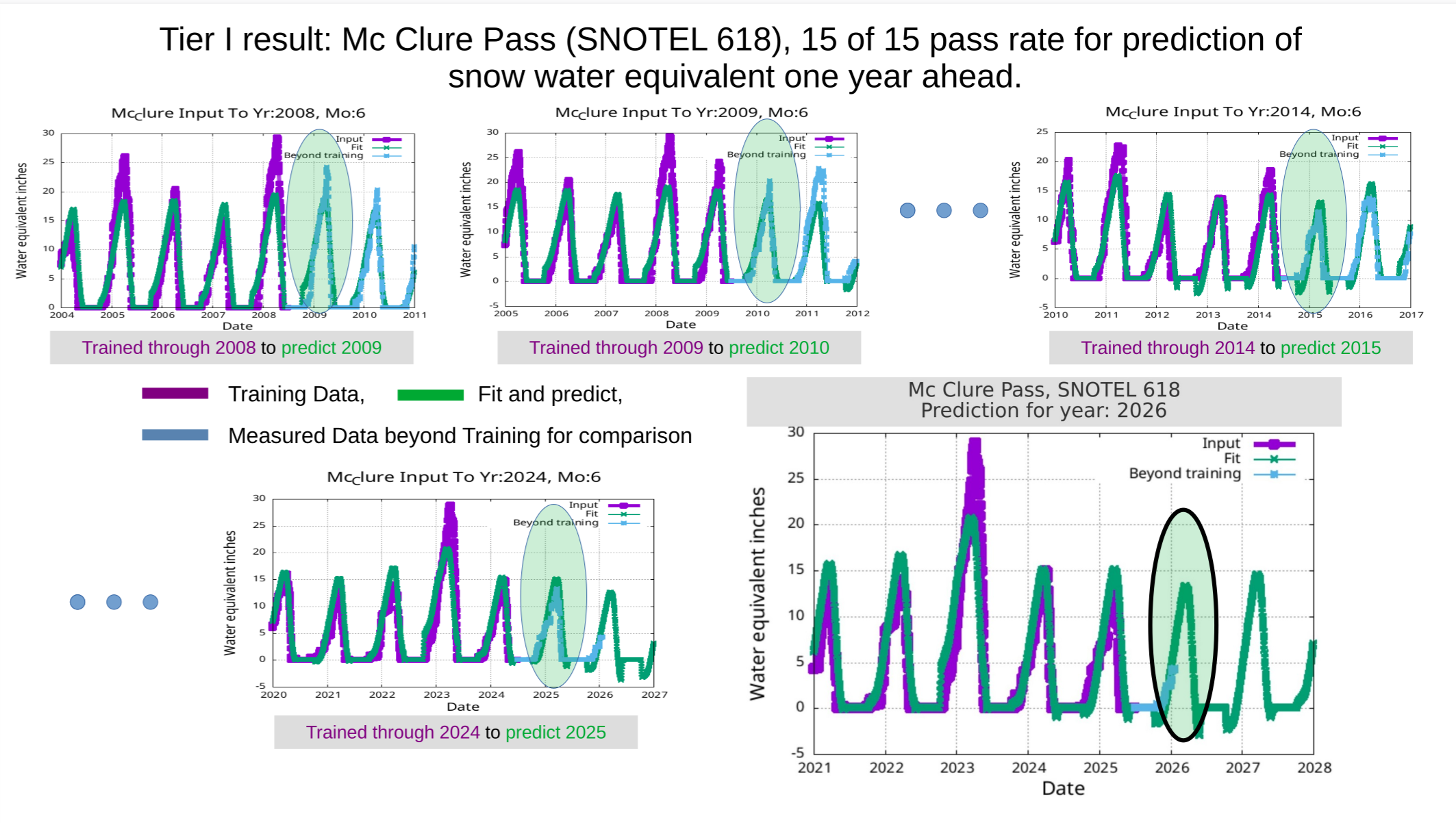
We describe a harmonic analysis system for predicting annual peak snow water equivalent (SWE) at SNOTEL monitoring stations operated by the Natural Resources Conservation Service (NRCS) across the western United States. The algorithm, frqsrchX, performs greedy harmonic regression on historical SWE records, identifying persistent periodic climate signals and superimposing volcanic impulse functions to account for episodic radiative forcing from major eruptions. A rigorous five-phase characterization pipeline applies distinct band-limited search strategies per site, and a two-winner selection system identifies optimal configurations by both maximum pass rate and a reliability score that balances accuracy with period stability. Validation uses out-of-sample holdout testing across 15–18 years (2008–2025), graded by an asymmetric scale that penalizes over-prediction more harshly than under-prediction. We report results for 771 SNOTEL and SNOW SENSOR stations across eight western states. Average pass rates range from 88.4% (Montana, 94 sites) to 49.3% (California, 122 sites, including 87 SNOW SENSOR stations). The three commercially targeted states—Colorado (113 sites), Montana (94 sites), and Wyoming (87 sites)—achieve average pass rates of 86.4%, 88.4%, and 84.2% respectively, with 84–90% of sites meeting the ≥80% operational pass-rate threshold using identical universal parameter search procedures and no state-specific tuning. Idaho (85 sites) and Washington (76 sites) show strong intermediate performance at 83.3% and 81.5%. Utah and Oregon show mixed results, while California falls well below operational thresholds. Period stability analysis indicates that 55–62% of qualifying sites in the five strongest states achieve stable signal detection, demonstrating consistent identification of physical climate periodicities. These results demonstrate that periodic climate signals—principally in the ENSO band (2,700–2,900 mY), a mid-range band (~6,000–7,500 mY), and an extended long-period band (10,500–17,000 mY)—carry actionable predictive information about annual peak snowpack at individual station scale.
Keywords:
snowpack forecasting
; SNOTEL
; SNOW SENSOR
; harmonic analysis
; ENSO
; snow water equivalent
; volcanic forcing
; holdout validation
Copyright: This open access article is published under a Creative Commons CC BY 4.0 license, which permit the free download, distribution, and reuse, provided that the author and preprint are cited in any reuse.


