

Submitted:
05 April 2026
Posted:
06 April 2026
You are already at the latest version
Abstract
The evaluation of peripheral pulmonary lesions (PPLs) represents a persistent clinical challenge, particularly in the context of rapidly expanding lung cancer screening programs generating unprecedented volumes of screen-detected nodules requiring tissue evaluation. Conventional bronchoscopic techniques and earlier navigation platforms, including electromagnetic navigation bronchoscopy (ENB), improved access to peripheral airways but demonstrated variable and generally suboptimal diagnostic performance—historically plateauing at 60–70%—attributable principally to CT-to-body divergence and the diagnostic drop-off phenomenon. Robotic-assisted bronchoscopy (RAB) has emerged as a significant advancement integrating robotic catheter control, shape-sensing or electromagnetic navigation, and adjunctive intraprocedural imaging—principally cone-beam computed tomography (CBCT)—to improve lesion localization and procedural stability. Available evidence suggests that RAB achieves improved diagnostic yields compared with conventional bronchoscopic techniques, particularly when combined with real-time CBCT-guided tool-in-lesion confirmation and multimodal biopsy strategies including transbronchial cryobiopsy. Reported diagnostic yields generally range from 70% to 87% across pooled meta-analytic datasets, with higher yields described in centers employing CBCT and cryobiopsy. A favorable safety profile—with pooled pneumothorax rates of approximately 2%, substantially below the 20–25% associated with CT-guided transthoracic needle biopsy—represents a clinically important differentiator, particularly in patients with emphysema, coagulopathy, or contralateral lung compromise [1,3]. RAB additionally enables procedural capabilities beyond peripheral lesion biopsy, including simultaneous mediastinal lymph node staging, bilateral same-session lesion sampling, fiducial marker placement for stereotactic body radiotherapy, and investigational therapeutic applications. However, current evidence is largely derived from observational studies and single-arm prospective cohorts, with limited randomized data directly comparing RAB with transthoracic biopsy approaches. Outcomes are meaningfully influenced by lesion characteristics, operator experience, institutional volume, and availability of advanced imaging infrastructure. This review summarizes current evidence on RAB platforms, procedural optimization, diagnostic performance, safety, molecular tissue adequacy, and emerging applications, while explicitly addressing limitations, controversies, and areas requiring further investigation. This review was conducted and reported in accordance with PRISMA 2020 guidelines adapted for narrative reviews (SANRA framework).
Keywords:
robotic-assisted bronchoscopy
; peripheral pulmonary lesions
; lung nodule
; Ion endoluminal system
; Monarch platform
; Galaxy System
; cone-beam CT
; diagnostic yield
; cryobiopsy
; CT-to-body divergence
; navigational bronchoscopy
; lung cancer screening
; transbronchial ablation
; molecular profiling
; interventional pulmonology
1. Introduction
Robotic-assisted bronchoscopy (RAB) has emerged as an important advancement in the diagnostic evaluation of peripheral pulmonary lesions (PPLs), addressing fundamental limitations of conventional bronchoscopy and earlier navigational platforms. The timely and accurate tissue diagnosis of PPLs is central to lung cancer management, particularly following the 2021 U.S. Preventive Services Task Force expansion of low-dose CT screening eligibility—which lowered the age threshold to 50 years and qualifying smoking history to 20 pack-years, increasing the estimated eligible screening population by approximately 54%. However, outcomes remain variable and depend on lesion characteristics, operator expertise, and the use of adjunct imaging..[5,37,38]
Historically, the diagnostic evaluation of peripheral lung nodules relied on two primary modalities: CT-guided transthoracic needle biopsy (TTNB), which achieves diagnostic yields of 80–90% for accessible peripheral lesions but carries pneumothorax rates of 20–25% and chest tube requirements of 7–8%; and conventional flexible bronchoscopy, which offers a favorable safety profile but achieves only 30% yield for lesions smaller than 2 cm and approximately 63% overall as demonstrated by the AQuIRE registry. Electromagnetic navigation bronchoscopy (ENB) improved peripheral navigational access, yet real-world data from the NAVIGATE trial demonstrated a diagnostic yield of only 67.8% at 24 months—a ceiling attributed primarily to CT-to-body divergence: the systematic displacement of lesion position between the static pre-procedural CT scan and the dynamic intraoperative pulmonary environment.[27,37,38]
RAB integrates robotic catheter control with advanced navigation technologies—shape-sensing fiber-optic localization or electromagnetic guidance—and compatibility with intraprocedural imaging adjuncts, principally cone-beam computed tomography (CBCT), to improve lesion localization and procedural stability. Early prospective studies and meta-analyses suggest improved diagnostic performance compared with conventional bronchoscopic techniques, and a favorable safety profile compared with transthoracic approaches—particularly in patients at elevated pneumothorax risk. However, outcomes vary meaningfully depending on lesion characteristics, operator experience, institutional volume, and availability of adjunctive imaging infrastructure. Rigorous interpretation of the available evidence requires careful attention to diagnostic yield definitions, study design, and procedural heterogeneity.[1,2,3]
This review provides a comprehensive, evidence-based synthesis of RAB encompassing platform technology, preprocedural planning, diagnostic performance, adjunctive imaging strategies, biopsy optimization, safety, comparative effectiveness, advanced applications, training, cost-effectiveness, and future directions. The literature search strategy, inclusion criteria, and narrative synthesis methodology are described in the Methods section (Section 2) in accordance with PRISMA 2020 reporting standards.
As lung cancer screening expands, optimizing minimally invasive diagnostic strategies for peripheral lesions remains a priority.
2. Methods: Literature Search Strategy and Study Selection
This narrative review was conducted in accordance with the SANRA framework and reported in alignment with PRISMA 2020 guidance where applicable.. No protocol registration was performed, as this is a narrative rather than a systematic review; however, the search strategy, inclusion criteria, and synthesis approach were pre-specified by the author prior to literature retrieval.
2.1. Search Strategy
A systematic literature search was conducted across four electronic databases — PubMed/MEDLINE, Embase, Web of Science, and the Cochrane Library — for articles published from January 2018 (coinciding with FDA clearance of the first robotic-assisted bronchoscopy (RAB) platform) through March 2026. The following MeSH terms and free-text keywords were used in Boolean combination: primary terms included “robotic bronchoscopy,” “robotic-assisted bronchoscopy,” “Ion endoluminal system,” “Monarch platform,” “Galaxy system,” “navigational bronchoscopy,” and “shape-sensing bronchoscopy.” These were combined in Boolean AND/OR combinations with secondary terms: “peripheral pulmonary lesion,” “pulmonary nodule,” “diagnostic yield,” “cone-beam CT,” “CBCT,” “CT-to-body divergence,” “cryobiopsy,” “transbronchial cryobiopsy,” “next-generation sequencing,” “molecular profiling,” “lung cancer screening,” “transbronchial ablation,” “learning curve,” and “cost-effectiveness.” A supplementary search of ClinicalTrials.gov and the WHO International Clinical Trials Registry Platform (ICTRP) identified ongoing and recently completed trials. Conference abstracts and presentations from the American Thoracic Society (ATS; 2022–2025), CHEST (2022–2024), the European Respiratory Society (ERS; 2022–2025), and the American Association for Bronchology and Interventional Pulmonology (AABIP; 2022–2024) were manually screened to capture high-impact data available only in abstract form, including the ERS 2025 randomized controlled trial by Steinack, Gaisl, and colleagues and the October 2025 FDA clearance of the Ion artificial intelligence navigational system.
2.2. Inclusion and Exclusion Criteria
Studies were included if they: (1) evaluated robotic-assisted bronchoscopy platforms (Ion, Monarch, or Galaxy) in human subjects; (2) reported diagnostic yield, safety outcomes, molecular tissue adequacy, or clinical effectiveness endpoints; or (3) were presented as peer-reviewed conference abstracts at major society meetings where no full-text publication was available but the data materially contributed to the evidence synthesis. Historical context regarding the evolution of navigational bronchoscopy (ENB, R-EBUS, conventional bronchoscopy) was drawn from landmark studies, meta-analyses, and registry datasets without restriction to the 2018–2026 window. Studies were excluded if they were: (1) preclinical animal or cadaveric studies cited only for background context; (2) case reports with fewer than five subjects, unless the reported application was novel with no other available human data; or (3) editorials or letters without original data.
2.3. Study Selection and Data Synthesis
Literature screening was performed by the author in a two-stage process: title and abstract screening followed by full-text review of all potentially eligible articles. A narrative synthesis approach was adopted rather than formal meta-analytic pooling; quantitative data from published meta-analyses are cited and synthesized within the text, with heterogeneity and methodological limitations explicitly discussed. A total of 38 primary references are cited in this review, encompassing 3 major meta-analyses, 6 prospective multicenter trials, 2 randomized controlled trials, 4 registry datasets, 8 retrospective cohort studies, 5 high-impact conference abstracts, 4 clinical practice guidelines or consensus statements, and 6 review articles or expert commentaries. This narrative review was prepared and is reported in accordance with PRISMA 2020 guidelines adapted for narrative reviews.
3. Historical Context: The Evolution of Peripheral Bronchoscopy
Early bronchoscopy, pioneered by Gustav Killian in 1897 for foreign body retrieval, utilized rigid instruments providing central airway access only. The development of flexible fiberoptic bronchoscopy by Shigeto Ikeda in 1966 expanded reach into segmental and subsegmental airways, enabling bronchial washings, brushings, and transbronchial forceps biopsies. However, diagnostic yield for subcentimeter or peripheral lesions remained severely limited by inability to navigate beyond the bronchoscopist's direct field of view.
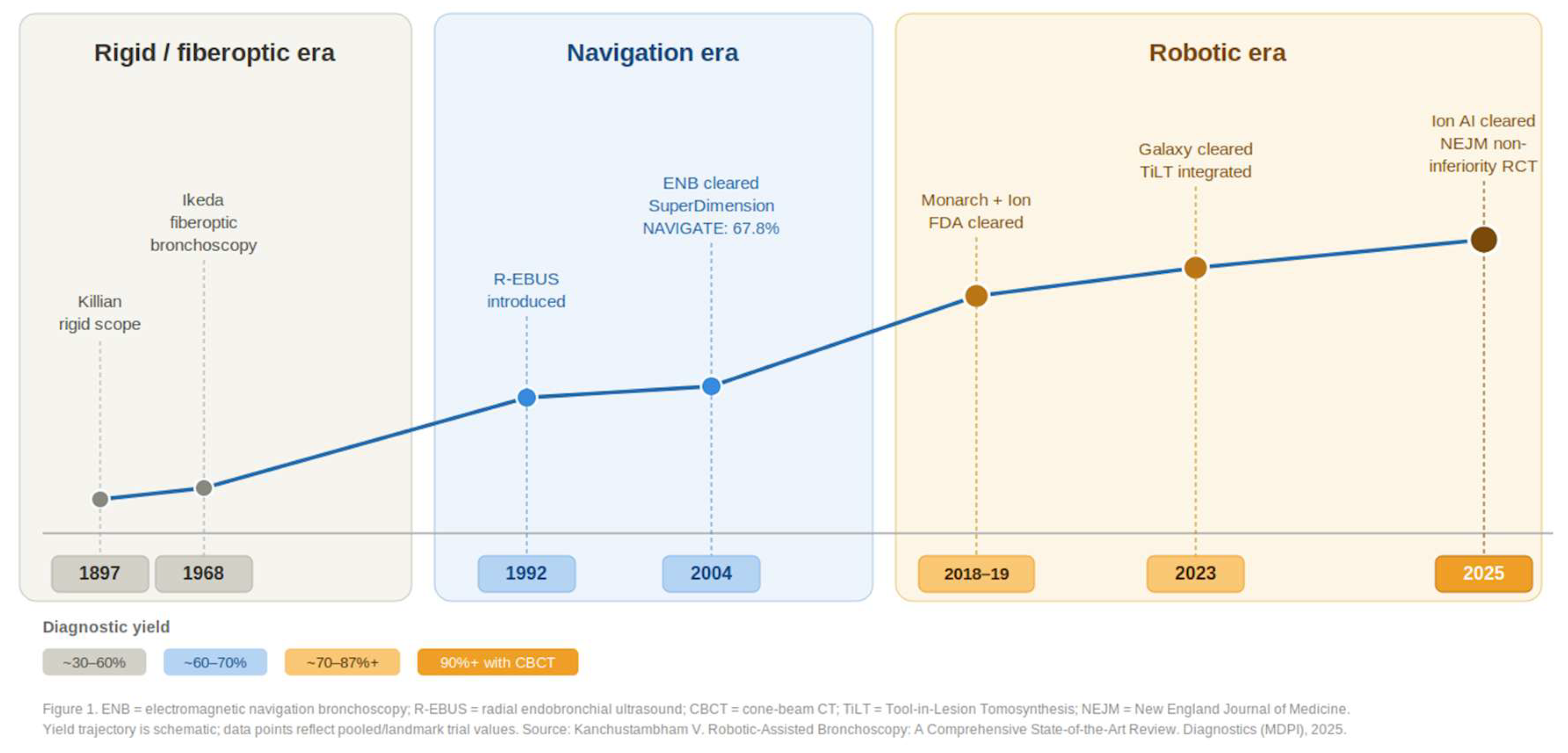
Figure 1.
Timeline of bronchoscopy technological evolution: from Killian's 1897 rigid bronchoscopy through fiberoptic bronchoscopy (Ikeda, 1968), R-EBUS (1992), virtual bronchoscopy and ENB (2004), to FDA clearance of Monarch and Ion (2018–2019), Galaxy System (2023), and AI integration (2025). Each advance represents incremental improvement in peripheral reach and diagnostic precision, with RAB+CBCT representing the current state-of-the-art.
Figure 1.
Timeline of bronchoscopy technological evolution: from Killian's 1897 rigid bronchoscopy through fiberoptic bronchoscopy (Ikeda, 1968), R-EBUS (1992), virtual bronchoscopy and ENB (2004), to FDA clearance of Monarch and Ion (2018–2019), Galaxy System (2023), and AI integration (2025). Each advance represents incremental improvement in peripheral reach and diagnostic precision, with RAB+CBCT representing the current state-of-the-art.
Fluoroscopy-guided transbronchial biopsy was the first attempt to extend diagnostic bronchoscopy to radiographically visible but endoscopically inaccessible lesions. Systematic reviews demonstrated reasonable sensitivity (~88%) for central lesions but only ~34% yield for peripheral lesions under 2 cm. [5] Radial endobronchial ultrasound (R-EBUS), first described in the 1990s, added real-time probe position confirmation within or adjacent to peripheral lesions, improving pooled yields modestly to 71–73% across meta-analyses—still short of the clinical threshold needed for widespread adoption in screening populations.[5]
Electromagnetic navigation bronchoscopy (ENB), commercialized by the SuperDimension platform in 2004, was the watershed technology bringing navigation-assisted peripheral bronchoscopy into mainstream practice. ENB uses an electromagnetic field generator to track a sensor probe within a registered CT-derived airway map. Real-world performance was constrained by CTBD: Pritchett and colleagues characterized this displacement as typically 5–15 mm—sufficient to cause the navigation system to confirm position within the lesion on its virtual map while the biopsy tool is displaced from the actual lesion in real space. [26,27] The NAVIGATE trial, enrolling 1,215 patients across 37 centers, reported a 24-month diagnostic yield of only 67.8%. [4,37]
Ultrathin bronchoscopes (outer diameter 2.8 mm) improved access to more distal airways but did not address CTBD. The field recognized that a step-change was needed—one providing structural stability, precise distal articulation, real-time lesion localization beyond navigation mapping alone, and reliable tissue acquisition. This recognition set the stage for the introduction of robotic platforms in the late 2010s.
4. Robotic-Assisted Bronchoscopy Platforms: Technology and Engineering
Three robotic-assisted bronchoscopy systems are currently FDA-cleared and in clinical use (Table 1). While all three share the overarching goal of improving navigational precision and catheter stability for PPL biopsy, they differ substantially in technical architecture, navigation methodology, scope design, and imaging integration.
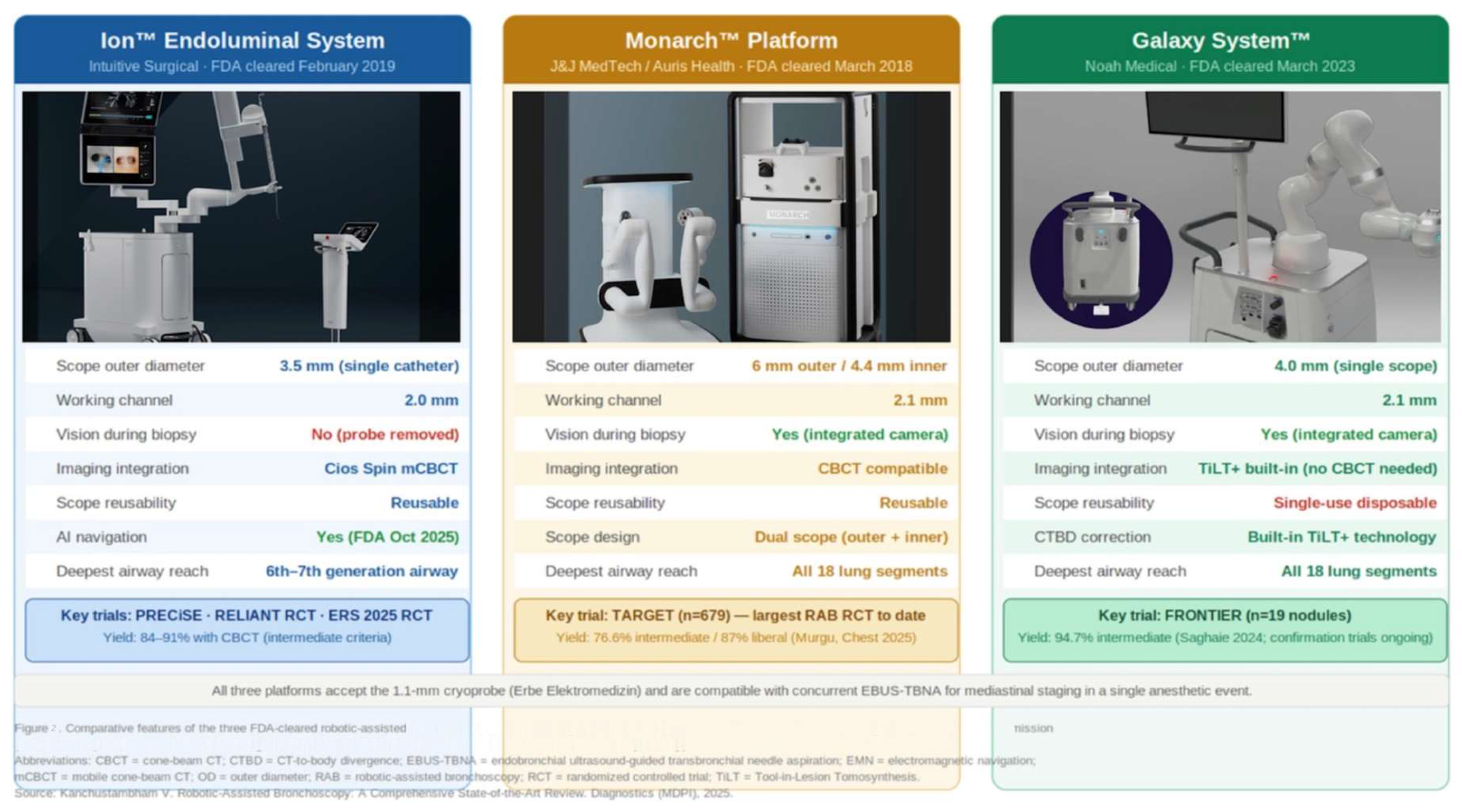
Figure 2.
The three FDA-cleared robotic assisted bronchoscopy platforms. Left: Ion Endoluminal System (Intuitive Surgical) — ultrathin 3.5 mm shape-sensing catheter with Cios Spin mCBCT integration. Center: Monarch Platform (Johnson & Johnson / Auris Health) — dual outer/inner scope with integrated camera and electromagnetic navigation. Right: Galaxy System (Noah Medical) — single 4.0 mm scope with integrated TiLT digital tomosynthesis and electromagnetic navigation. All three platforms share preprocedural CT-based path planning and robotic actuation via proprietary control systems.
Figure 2.
The three FDA-cleared robotic assisted bronchoscopy platforms. Left: Ion Endoluminal System (Intuitive Surgical) — ultrathin 3.5 mm shape-sensing catheter with Cios Spin mCBCT integration. Center: Monarch Platform (Johnson & Johnson / Auris Health) — dual outer/inner scope with integrated camera and electromagnetic navigation. Right: Galaxy System (Noah Medical) — single 4.0 mm scope with integrated TiLT digital tomosynthesis and electromagnetic navigation. All three platforms share preprocedural CT-based path planning and robotic actuation via proprietary control systems.
3.1. Ion™ Endoluminal System (Intuitive Surgical)
The Ion Endoluminal System, FDA-cleared in February 2019, is the most widely deployed RAB platform worldwide. [9] As of mid-2025, more than 900 Ion systems are operational across 10 countries, widely adopted across U.S. centers, with substantial growth in utilization over recent years. Ion's most distinctive feature is its proprietary shape-sensing technology: a fiber-optic network with Bragg gratings embedded within the catheter wall that measures the catheter's three-dimensional shape and precise position hundreds of times per second, enabling real-time location awareness entirely independent of electromagnetic fields. This eliminates interference from metallic equipment and obviates the need for external electromagnetic field generators—a significant practical advantage in modern bronchoscopy suites.[33]
The Ion catheter has a 3.5 mm outer diameter, enabling navigation to the 6th or 7th generation airway in most patients—deeper than any competing platform. The fully articulating distal tip provides 180-degree deflection in any plane. Pre-procedural planning uses PlanPoint software, which automatically segments the target nodule from CT imaging and generates navigation pathways with vascular proxies defining anatomic danger zones. In October 2025, Intuitive received FDA clearance for AI integration across Ion's complete navigational workflow—the first AI-embedded bronchoscopy navigation system—a development expected to further reduce learning curve variability. [20]
3.2. Monarch™ Platform (Johnson & Johnson / Auris Health)
The Monarch Platform, FDA-cleared in March 2018, was the first RAB system to achieve commercial availability. [10] Monarch uses electromagnetic navigation via the CASE guidance system and a distinctive dual-scope design: an outer guiding sheath (6 mm OD) and an inner steerable bronchoscope (4.4 mm OD) with built-in camera, enabling continuous white-light visualization of the peripheral airway during navigation and biopsy—a key differentiator from Ion. The BENEFIT feasibility study (n=54) established 96.2% lesion localization success. [10] The landmark TARGET trial (n=679, median lesion size 1.85 cm)—the largest prospective multicenter trial of any single RAB platform—reported diagnostic yields of 63.8% (strict), 76.6% (intermediate), and 87% (liberal), with malignancy sensitivity >81% and adverse event rate 3.8%. [10]
3.3. Galaxy System™ (Noah Medical)
The Galaxy System, FDA-cleared March 2023, is the newest entrant and incorporates several distinctive innovations. [8] Its most notable feature is integrated Tool-in-Lesion Technology (TiLT+)—a proprietary digital tomosynthesis system that provides intraoperative three-dimensional imaging for real-time biopsy tool confirmation within the target lesion, directly addressing CTBD without requiring a separate CBCT unit. Galaxy uses electromagnetic navigation to navigate to within approximately 2 cm of the lesion, then activates TiLT for precise final localization with augmented fluoroscopy overlay. The Galaxy bronchoscope is single-use disposable, eliminating reprocessing logistics but increasing per-case consumable cost. The FRONTIER study—first-in-human trial (n=19; mean lesion size 2.0 cm)—reported 100% TiLT-based tool-in-lesion localization with diagnostic yields of 89.5% (strict) and 94.7% (intermediate). [8] Multicenter trials (NCT06056128) are ongoing.[8]
5. Preprocedural Planning, Patient Selection, and Procedural Setup
4.1. CT Imaging Requirements
Optimal RAB outcomes require high-quality thin-slice (≤1 mm collimation) chest CT in breath-hold. Thicker reconstructions significantly impair automated airway segmentation accuracy. The CT is imported into platform-specific planning software (PlanPoint for Ion; Monarch Planning Software; Galaxy Planning Software), which segments the bronchial tree from trachea through sub-subsegmental airways. Key planning parameters include: depth of airway pathway (generations to target), bronchus sign presence, lesion-to-pleura distance, vascular proximity, and anticipated need for CBCT adjunct. The bronchus sign—defined as a bronchus leading directly into or through the lesion on CT—remains an important predictor of diagnostic success, though its impact is attenuated by CBCT-guided tool-in-lesion confirmation.[1,2]
4.2. Patient Selection
Patient selection for RAB should be individualized based on lesion characteristics, patient risk profile, availability of institutional expertise, and whether the clinical question requires tissue for diagnosis, molecular profiling, or both. Table 3 summarizes evidence-based indications, preferred scenarios, and contraindications in full detail. The following provides a structured clinical framework.
Primary Indications
RAB is indicated for: (1) peripheral pulmonary lesions (PPLs) in the outer two-thirds of the lung where conventional flexible bronchoscopy has diagnostic yield less than 30–60% (14% for peripheral lesions <2 cm; 31% for inner two-thirds lesions [Baaklini 2000]); (2) intermediate- to high-probability pulmonary nodules per Lung-RADS 4A/4B classification or Mayo/Brock model intermediate–high malignancy probability (≥5–65%) requiring tissue diagnosis per ACCP and NCCN guidelines; [Gould 2013; NCCN NSCLC 2024] (3) suspected or confirmed NSCLC where comprehensive molecular profiling — NGS panel, PD-L1 immunohistochemistry, ALK/ROS1 FISH, and TMB — is required, particularly when liquid biopsy is insufficient or tissue architecture is essential for IHC interpretation [Connolly 2023; Oberg 2022]; and (4) peripheral lesions with concurrent FDG-avid mediastinal or hilar lymphadenopathy where combined peripheral biopsy and EBUS-TBNA mediastinal staging in a single procedure is clinically appropriate per ACCP/NCCN guidelines. [NCCN NSCLC 2024,4,17]
Preferred Over CT-Guided Transthoracic Needle Biopsy
RAB is specifically preferred over CT-TTNB in patients where the transthoracic approach carries elevated risk or is technically limited: (1) emphysema or bullous lung disease where CT-TTNB pneumothorax risk is 20–25% overall and substantially higher with emphysematous parenchyma overlying the biopsy path — RAB avoids pleural traversal entirely, with pooled pneumothorax rate of 2.0% [Li 2025; Ali 2023]; (2) single functional lung or severely impaired contralateral pulmonary reserve where any pneumothorax constitutes a surgical emergency; (3) thrombocytopenia (platelets <50,000), coagulopathy (INR >1.5), or therapeutic anticoagulation where TTNB hemorrhage risk is unacceptable [Li 2025]; (4) deep-seated lesions requiring long parenchymal traversal (>3 cm), vascular proximity, or prior ipsilateral pleurodesis limiting lung mobility [Heerink 2017; DiBardino 2015]; and (5) bilateral synchronous nodules requiring same-session evaluation — impossible with CT-TTNB due to bilateral pneumothorax risk. [Chrissian 2025; Fernandez-Bussy 2025,3]
Lung Cancer Screening Population
LDCT-detected nodules classified as Lung-RADS 4A or 4B in lung cancer screening program participants represent a growing and distinct indication for RAB. The 2021 USPSTF expansion of screening eligibility to age 50 and 20 pack-years increased the estimated eligible population by approximately 54%, generating an unprecedented volume of screen-detected nodules requiring risk stratification and, in many cases, tissue evaluation. RAB diagnostic yield is approximately 78% for lesions <2 cm — the size range of most LDCT-detected lesions [Zhang 2024] — with a favorable safety profile that is particularly advantageous in this predominantly current or former smoker population with frequent underlying emphysema.[2,5]
Relative and Absolute Contraindications
Relative contraindications include: very small lesions (<6–8 mm) where tissue yield may be insufficient regardless of navigation success and where biopsy result would not change clinical management (i.e., continued surveillance is planned regardless of histology); pure ground-glass opacities where Fleischner Society guidelines recommend initial CT surveillance — noting that RAB+CBCT achieved 84.6% yield even in a cohort with 27.6% pure GGOs in the ERS 2025 RCT [Steinack/Gaisl 2025]; and inability to tolerate general anesthesia, where moderate sedation may be considered for select favorable-anatomy cases at experienced centers. Absolute contraindications include active bronchospasm or status asthmaticus, hemodynamic instability or acute respiratory failure requiring escalating support, and uncorrectable severe coagulopathy (platelets <20,000 or INR >3.0) where cryobiopsy is planned — noting that standard FNA or forceps biopsy may remain feasible with moderate coagulopathy correction.
4.3. Anesthetic and Ventilatory Optimization
RAB is universally performed under general anesthesia with endotracheal intubation and neuromuscular blockade at high-volume centers—distinguishing it fundamentally from conventional bronchoscopy under moderate sedation. General anesthesia is essential for: (1) complete airway control and absence of patient movement required for precise navigation; (2) controlled ventilation enabling PEEP application to reduce intraoperative atelectasis; and (3) procedural duration (typically 45–90 minutes for complex cases) requiring a secured airway. [28] The I-LOCATE trial established that significant atelectasis develops as early as 30 minutes post-intubation—a critical time benchmark for procedural planning. [35,see Table 4] Comprehensive ventilatory strategies to optimize RAB outcomes are detailed in Table 4.
6. Diagnostic Yield: Evidence Base and Key Determinants
Diagnostic yield is the primary outcome metric for evaluating bronchoscopic technologies for peripheral pulmonary lesions. Historically, guided bronchoscopic approaches achieved yields of approximately 60–70%, a limitation attributed principally to CT-to-body divergence (CTBD) and the diagnostic drop-off phenomenon — wherein successful catheter navigation to the lesion vicinity did not reliably translate into diagnostic tissue acquisition, particularly for eccentric or extra-airway lesions. The landmark Wang Memoli meta-analysis (2012) pooled data across ENB, R-EBUS, virtual bronchoscopy, and ultrathin bronchoscopes, demonstrating a remarkably consistent ~70% yield ceiling regardless of technology employed. [5] The NAVIGATE trial (n=1,215; 37 centers) reported a 24-month diagnostic yield of 67.8%, and the AQuIRE registry demonstrated 63.7% for real-world nonguided bronchoscopy. [4,5,37,38]
6.1. Meta-Analytic Evidence for RAB
Recent studies evaluating RAB report improved diagnostic yields compared with conventional navigational bronchoscopy, generally ranging from 70% to 87% depending on the yield definition applied (strict vs. intermediate criteria) and study design. Three major meta-analyses form the current evidence base. Ali and colleagues [1] (Ann Am Thorac Soc, 2023; 20 studies; 1,779 lesions) reported a pooled intermediate diagnostic yield of 84.3% (95% CI 81.1–87.2%), with significant heterogeneity (I²=65.6%) driven by differences in study design, procedural protocols, and adjunctive imaging use. Zhang and colleagues [1,2] (Thorac Cancer, 2024; 10 studies; 725 lesions) reported a pooled yield of 80.4%, with studies employing cryobiopsy achieving 90.0% versus 79.0% for non-cryobiopsy approaches (p<0.01). The most comprehensive meta-analysis to date, Li and colleagues [2,3]] (Int J Surg, 2025; 27 cohort studies), reported pooled yields of 69.6% (strict; 95% CI 61.8–76.8%) and 86.6% (intermediate; 95% CI 83.7–89.2%), with pooled pneumothorax rate 2.0% and chest tube placement 0.5%. Importantly, higher yields approaching 90% have been reported primarily in high-volume centers utilizing adjunctive CBCT and multimodal sampling strategies, and these figures should not be assumed to be generalizable across all practice settings.[3]
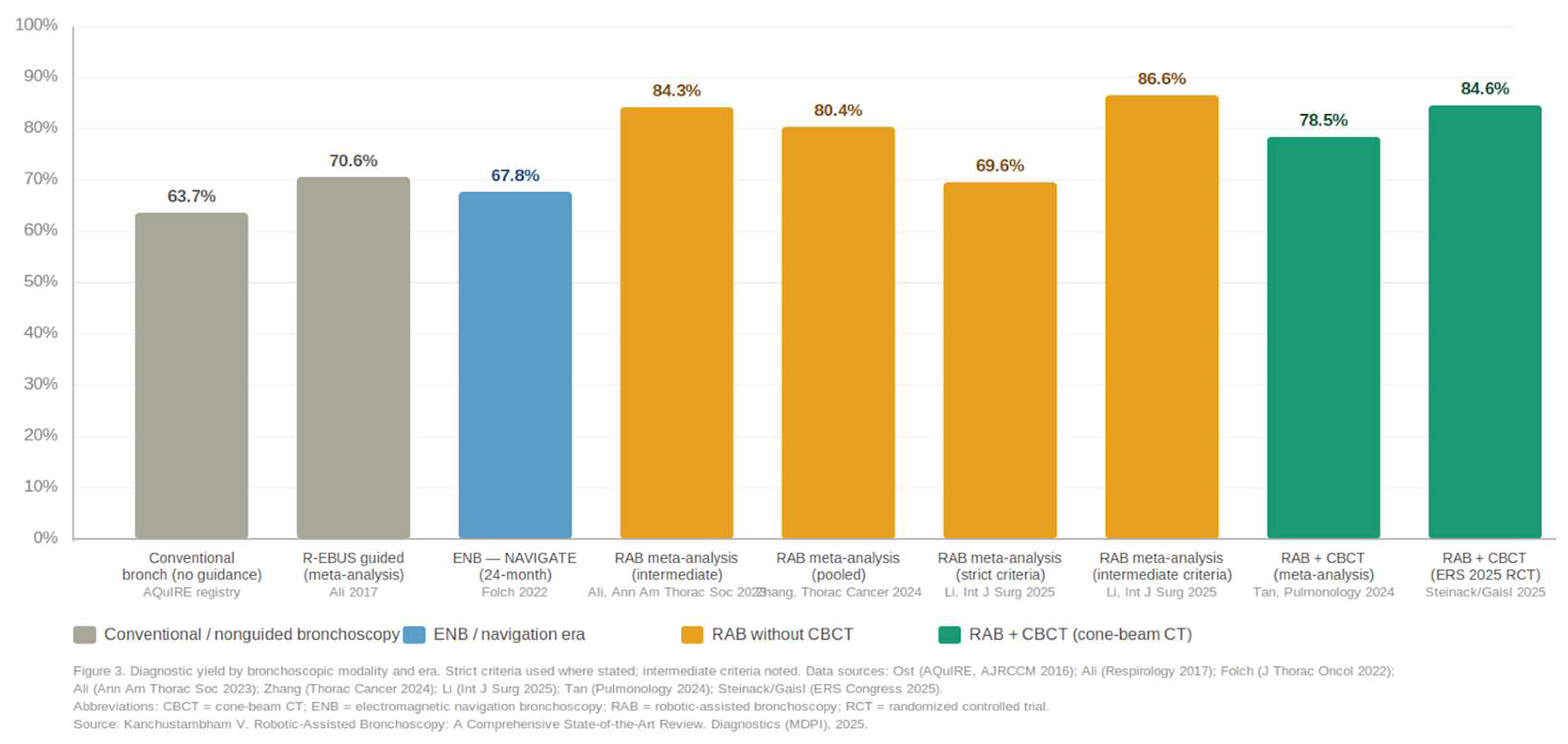
Figure 4.
Diagnostic yield by bronchoscopic modality and era: conventional bronchoscopy, ENB, and RAB (with and without CBCT) across key meta-analyses and randomized trials.Diagnostic yields are not directly comparable across studies due to heterogeneity in study design, lesion characteristics, and yield definitions.
Figure 4.
Diagnostic yield by bronchoscopic modality and era: conventional bronchoscopy, ENB, and RAB (with and without CBCT) across key meta-analyses and randomized trials.Diagnostic yields are not directly comparable across studies due to heterogeneity in study design, lesion characteristics, and yield definitions.
Table 2: Landmark clinical trials and key studies in robotic-assisted bronchoscopy (2018–2025), including all major prospective trials, randomized controlled trials, and meta-analyses cited in this review.
6.2. Pivotal Prospective Trials
Among platform-specific prospective data, the TARGET trial [10] — the largest prospective multicenter trial of any single RAB platform (Monarch; n=679; median lesion size 1.85 cm) — reported yields of 63.8% (strict), 76.6% (intermediate), and 87% (liberal), with malignancy sensitivity >81% and adverse event rate 3.8%. The magnitude of difference between strict and liberal definitions (23 percentage points) illustrates how profoundly yield estimates depend on definitional approach. A recent randomized controlled trial (Paez et al., RELIANT; [6] AJRCCM 2025) compared RAB directly with ENB, confirming RAB superiority, particularly for smaller lesions and those without a CT bronchus sign. A landmark New England Journal of Medicine study (Lentz et al., 2025) [7]established that navigational bronchoscopy — a category encompassing RAB — is non-inferior to CT-guided transthoracic needle biopsy for diagnostic yield with a substantially more favorable safety profile, providing the highest-quality evidence to date that bronchoscopic-first strategies are guideline-appropriate for suitable peripheral lesions.
A randomized controlled trial presented at the European Respiratory Society Congress 2025 reported significantly higher diagnostic yield with RAB combined with CBCT compared with conventional bronchoscopy, particularly in small lesions and those without a bronchus sign; these findings remain pending peer-reviewed publication.[13]
6.3. Diagnostic Yield Definitions: ATS/ACCP 2024 Consensus
Standardization of yield definitions is essential to enable meaningful cross-study comparisons. The 2024 ATS/ACCP Research Statement by Gonzalez, Silvestri, and Korevaar [4]established Delphi consensus definitions: (1) strict — tissue-confirmed histopathologic or microbiologic diagnosis from the bronchoscopic sample alone; (2) intermediate — strict plus non-diagnostic benign findings that are clinically acted upon with no further invasive workup; and (3) liberal — any informative result managed non-surgically. Vachani and colleagues demonstrated that applying these three definitions to the same dataset produces estimates varying by up to 20 percentage points. All future RAB studies should uniformly adopt ATS 2024 consensus criteria, and readers should apply caution when comparing yields across studies published prior to this consensus. The TARGET trial [10] data — 63.8% strict versus 87% liberal from the same patient cohort — is the most vivid published illustration of this methodological challenge.
6.4. Key Predictors of Diagnostic Success
Consistent predictors of higher RAB diagnostic yield identified across multiple studies and meta-analyses include: lesion size greater than 20 mm (associated with approximately 15–20% higher yield vs. sub-centimeter lesions across most series); presence of a CT bronchus sign; concentric radial EBUS view confirming tool position within the lesion; CBCT-confirmed tool-in-lesion; and center or operator experience. [1,2,3] Predictors of lower yield include pure ground-glass or subsolid density (lower tumor cellularity per biopsy pass), absence of a bronchus sign, upper lobe location, lesion depth beyond the sixth airway generation, and lesion size below 10 mm. Of note, RAB has substantially narrowed the size-dependent yield gap compared with ENB: CBCT-assisted Ion studies report yields of 66.6% for lesions 10 mm or smaller — substantially superior to ENB performance in this challenging category.
7. Adjunctive Imaging: Overcoming CT-to-Body Divergence
CT-to-body divergence (CTBD) represents a fundamental limitation of navigation-based bronchoscopy, reflecting the spatial discrepancy between pre-procedural CT imaging — acquired in a breath-holding, awake, supine patient — and intraoperative lung anatomy under general anesthesia with controlled mechanical ventilation. Factors contributing to CTBD include atelectasis onset (significant atelectasis develops within approximately 30 minutes of intubation per the I-LOCATE trial [35]), gravitational redistribution of lung tissue, altered lung volumes under positive pressure ventilation, and diaphragmatic displacement. Resulting lesion displacement is typically 5–15 mm in magnitude per Pritchett and colleagues, [27] sufficient to cause systematic biopsy of peritumoral or atelectatic tissue while the actual lesion remains unsampled, even when the navigation system confirms apparent tool-in-lesion on the virtual map. CTBD is the primary explanatory variable for the persistent gap between navigational success rates (often >95%) and actual diagnostic tissue acquisition in ENB and early RAB series.
7.1. Cone-Beam CT: Fixed and Mobile Systems
CBCT provides intraoperative three-dimensional volumetric imaging enabling real-time visualization of biopsy tool position relative to the target lesion, independent of the pre-procedural CT-derived navigation map. Both fixed CBCT suites and mobile CBCT systems (most prominently the Siemens Cios Spin) have been evaluated in observational studies. The landmark prospective study by Bashour, Casal, and colleagues [11] (MD Anderson; n=67; lesions 0.9–3.0 cm) demonstrated that tool-in-lesion confirmation was achieved in only 34.3% of procedures with RAB alone, rising to 98.6% with mobile CBCT addition (absolute improvement 64.3 percentage points; p<0.0001). A pooled meta-analysis of CBCT-assisted bronchoscopy (Tan et al., Pulmonology 2024; 15 studies; 1,540 lesions) found that CBCT significantly improved both navigational success rate (97.0% vs. 81.6%; OR 5.12) and diagnostic yield (78.5% vs. 55.7%; OR 2.51) compared with non-CBCT guided bronchoscopy. However, CBCT availability varies considerably across healthcare settings, and its integration into routine practice may be limited by capital cost ($250,000–$350,000 for mobile systems), workflow complexity, radiation exposure considerations, and the need for purpose-built hybrid bronchoscopy suite infrastructure.[9,11]
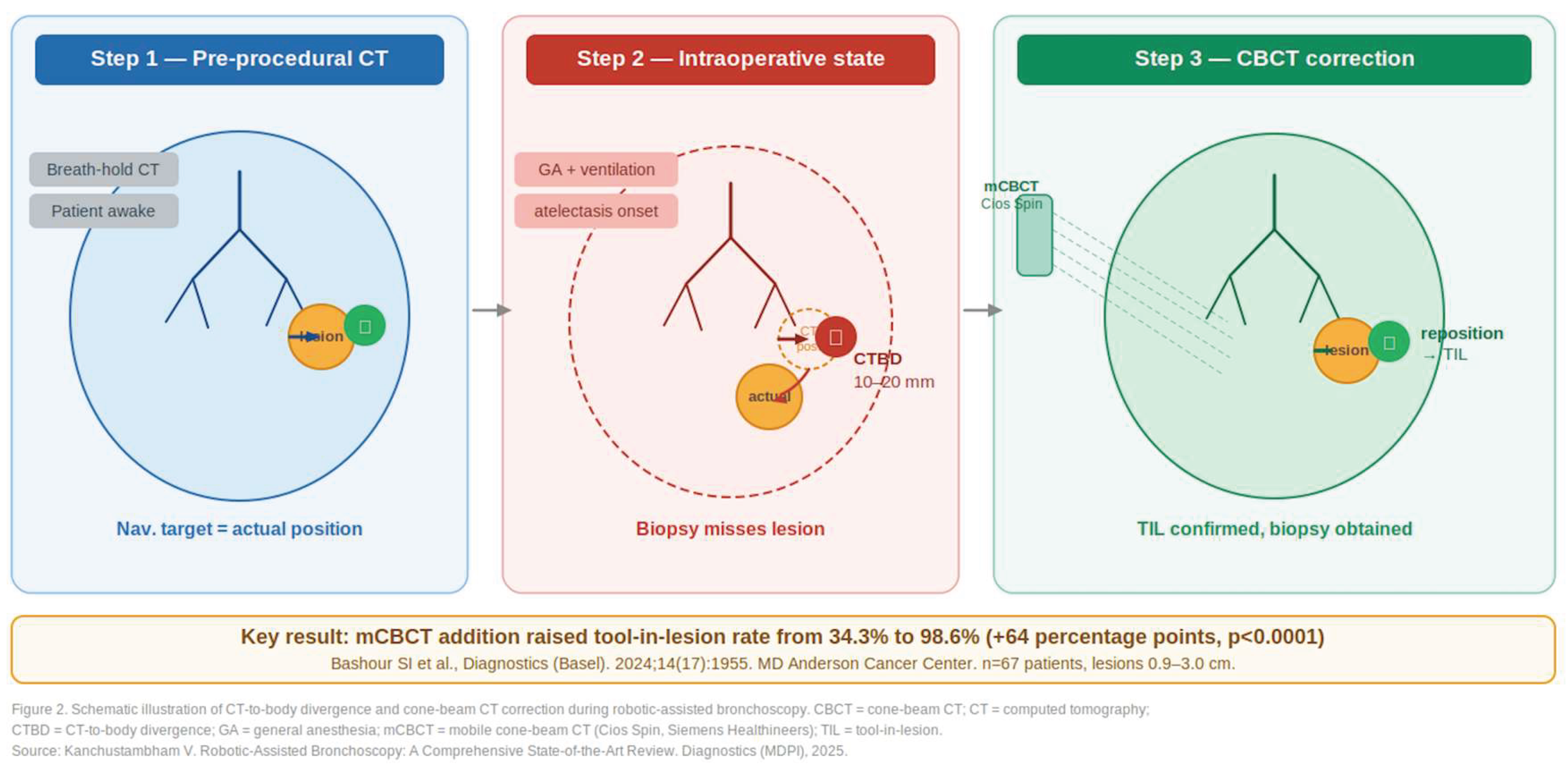
Figure 3.
Schematic illustration of CT-to-body divergence mechanism and mobile cone-beam CT correction during robotic-assisted bronchoscopy. Key result: mCBCT addition raised tool-in-lesion confirmation from 34.3% to 98.6% (Bashour et al., Diagnostics 2024).
Figure 3.
Schematic illustration of CT-to-body divergence mechanism and mobile cone-beam CT correction during robotic-assisted bronchoscopy. Key result: mCBCT addition raised tool-in-lesion confirmation from 34.3% to 98.6% (Bashour et al., Diagnostics 2024).
7.2. Randomized Evidence for RAB + CBCT
The most rigorous evidence for the RAB+CBCT combination was presented at the 2025 ERS Congress by Steinack, Gaisl, and colleagues. [13,14] In the first randomized controlled trial directly comparing RAB+CBCT versus conventional bronchoscopy (n=78 patients; 127 PPLs; median size 11 mm), diagnostic yield was 84.6% for RAB+CBCT versus 23.1% for conventional bronchoscopy (absolute difference 61.5%; 95% CI 44.1–78.9%; p<0.001). Notably, 85% of lesions in this trial had no CT bronchus sign and 27.6% were pure ground-glass opacities — a particularly challenging cohort in which this performance level is clinically meaningful. While these results are important, they derive from a single-center trial at an experienced academic center, and broader validation across diverse practice settings — including community centers without dedicated CBCT infrastructure — is needed before this performance can be assumed to be generalizable.
7.3. Radial EBUS, Digital Tomosynthesis, and Augmented Fluoroscopy
Radial EBUS (R-EBUS) remains the most widely available intraoperative lesion localization adjunct, providing real-time 360-degree cross-sectional ultrasound confirmation that the probe is within or adjacent to the target lesion. Concentric R-EBUS view is consistently associated with higher diagnostic yield across multiple studies and meta-analyses. [1,2] Digital tomosynthesis (TiLT+ technology, Galaxy System; Illumisite, Medtronic) offers an alternative approach to CTBD correction using standard C-arm fluoroscopic data, without the infrastructure requirements of CBCT — a potential advantage for settings where CBCT is unavailable. Augmented fluoroscopy, derived from CBCT or tomosynthesis data, overlays the lesion’s actual intraoperative position onto real-time fluoroscopy, enabling real-time tool repositioning. Taken together, a multimodal approach incorporating RAB with R-EBUS and CBCT or tomosynthesis — where available — currently represents the strategy associated with the highest published diagnostic yields.
8. Biopsy Technique Optimization and Molecular Adequacy
7.1. Rationale for Cryobiopsy
Traditional biopsy tools through the Ion 2.0 mm working channel—21/22-gauge FNA needles and standard forceps—have inherent limitations: FNA yields small, often crushed cytological specimens lacking architectural detail; forceps biopsies provide tissue cores susceptible to crush artifact and inadequately sample eccentric lesions adjacent to but not within the airway lumen. The diagnostic drop-off is substantially attributable to these tool limitations. Cryobiopsy exploits the Joule-Thomson effect: rapid expansion of compressed CO₂ or N₂O gas at the distal catheter tip cools to −79°C, freezing surrounding tissue within milliseconds. Unlike forceps, the 1.1-mm cryoprobe acquires tissue in a 360-degree radial pattern—particularly advantageous for eccentric lesions that abut but do not enclose the airway, which describes the majority of peripheral malignancies.

Table 5.
Biopsy Modalities and Sampling Techniques in Robotic-Assisted Bronchoscopy.
| Tool | Diagnostic Yield | NGS Adequacy | Architecture Preserved | 360° Acquisition | Best Use Case |
| FNA Needle (21–22G) | 31.5–86.6% (variable) | ~49% for NGS (smear); 14% cell block | No (crush artifact common) | No (single-plane aspiration) | ROSE-compatible; rapid cytology; first-pass tool |
| Forceps Biopsy (standard) | 54–86.9% | ~29% for NGS; 63% for PD-L1 | Partial (some crush) | No (unidirectional bite) | Endobronchial lesions; concentric rEBUS lesions |
| 1.1-mm Cryoprobe (TBCB) | 75–97.2% (RAB series) | 100% (all cryo specimens in Oberg series) | Yes (preserved architecture) | YES — freezes circumferentially | Eccentric/adjacent lesions; subcentimeter nodules; GGO; molecular profiling priority |
| Bronchial Brushing | 47–54% | Variable; lower than biopsy | No | No | Supplemental; combination with FNA |
| iNod System (rEBUS-guided TBNA) | ~70% (pilot, large solid lesions) | Not yet established | No | No | Real-time ultrasound TBNA; investigational; requires 2.0 mm WC |
| Multimodal (FNA + Forceps + Cryo) | ~90% (Oberg et al., n=120) | ~100% for cryo component | Yes (cryo component) | Yes (cryo component) | Recommended strategy at high-volume centers; maximum diagnostic and molecular adequacy |
Table 5. ROSE = rapid on-site cytologic evaluation; NGS = next-generation sequencing; GGO = ground-glass opacity; TBCB = transbronchial cryobiopsy; rEBUS = radial endobronchial ultrasound; WC = working channel. Yield ranges reflect pooled data from multiple RAB series.
7.2. Clinical Evidence
The seminal study by Oberg, Folch, Oh, and colleagues (UCLA) [16] retrospectively analyzed 112 patients with 120 PPLs biopsied via Ion RAB using a sequential multimodal approach (FNA + forceps + 1.1-mm cryoprobe). Overall diagnostic yield was 90%, with 18% of final diagnoses made exclusively from cryobiopsy. Molecular analysis was adequate on 100% of cryobiopsy samples sent. Digital imaging confirmed significantly greater tissue quantity and quality from cryobiopsy vs. FNA and forceps. The 2024 retrospective cohort by Abia-Trujillo and colleagues [17] compared cryoprobe vs. FNA for RAB in 256 patients with nodules <20 mm: cryobiopsy demonstrated superior performance for nodules <15 mm, a subgroup where FNA showed significantly reduced diagnostic odds, while cryobiopsy was unaffected by nodule size. A separate multicenter study combining RAB cryobiopsy found a diagnostic rate of 97.2% for TBCB with 100% molecular adequacy—substantially outperforming FNA (31.5%) and forceps (77.8%). [16,18]
7.3. Molecular Adequacy for Next-Generation Sequencing
The contemporary management of lung adenocarcinoma requires not merely a tissue diagnosis but comprehensive molecular profiling via broad-panel NGS, PD-L1 immunohistochemistry, and companion diagnostic assays. Inadequate tissue quantity or quality deprives patients of potentially life-extending targeted therapies. The AABIP-IASLC Clinical Practice Guideline [22] (JTO 2025) concluded that guided bronchoscopy achieves tissue adequacy for comprehensive biomarker testing comparable to percutaneous CT-guided approaches (80–100% for bronchoscopy vs. 72.3–96% for percutaneous), with the expectation that RAB+CBCT+cryobiopsy will further improve these figures.
The Mayo Clinic study by Yu Lee-Mateus and Reisenauer [19](Clin Lung Cancer, 2024): 72% of 78 RAB samples met preanalytic criteria for molecular/PD-L1 testing (smear 48.6%, touch prep 61.4%, biopsy 29.2% for NGS). The Memorial Sloan Kettering series by Connolly and colleagues [25] (J Thorac Cardiovasc Surg, 2023): 84% of 128 RAB samples adequate for molecular testing; hybrid-capture NGS success 96% (25/26); PCR-based testing success 94% (49/52); PD-L1 IHC success 91%. A multimodal sampling strategy—combining FNA needles, forceps biopsies, and cryobiopsy—alongside ROSE cytopathology represents the current recommended approach to maximize both diagnostic yield and molecular adequacy per procedure.
9. Safety Profile and Complication Management
Table 6: Safety profile of robotic-assisted bronchoscopy versus competing modalities: pneumothorax, chest tube, hemorrhage, and overall complication rates across key studies and meta-analyses.
RAB's safety profile is one of its defining clinical advantages and a critical differentiator from CT-guided TTNB. [1,3,10,13] Across all meta-analyses, pooled pneumothorax rate is 2.0–2.3% with chest tube placement in only 0.5–1.2%—compared to 20–25% pneumothorax and 7–10% chest tube requirement for TTNB. The overall pooled complication rate across the most comprehensive 2025 meta-analysis (27 studies) was 3.0%. [3] The TARGET trial, with 679 patients undergoing Monarch bronchoscopy, confirmed 3.8% adverse events, no procedure-related deaths, and no serious adverse events requiring prolonged hospitalization in the majority of cases. [10]
Pneumothorax risk is increased by emphysematous lung parenchyma, upper lobe location, pleural proximity, multiple biopsy passes, and periprocedural movement. In patients with severe emphysema—precisely those at highest TTNB risk—RAB provides a compelling alternative enabling tissue acquisition with acceptable complication probability. Emerging literature suggests CT-guided TTNB may carry a risk of pleural track tumor seeding in confirmed malignancies—a theoretical risk not associated with airway-based bronchoscopic approaches.
Radiation exposure from CBCT addition is moderate and within acceptable clinical limits for a suspected malignancy population. Kalchiem-Dekel and colleagues confirmed that mCBCT-guided RAB radiation exposure is acceptable, with dose optimization protocols increasingly standardized at high-volume centers. CBCT spins should be minimized to those needed for TIL confirmation and repositioning. [13,34]
10. Comparative Effectiveness: RAB Versus Competing Modalities
10.1. RAB vs. CT-Guided Transthoracic Needle Biopsy
CT-guided TTNB achieves diagnostic yields of 80–90% for accessible peripheral lesions but carries pneumothorax rates of 20–25% and chest tube requirements of 7–8% across large registry datasets. The landmark New England Journal of Medicine study by Lentz and colleagues [7] (2025), which compared navigational bronchoscopy to CT-guided TTNB in a randomized non-inferiority design, established that navigational bronchoscopy — a category inclusive of RAB — is non-inferior to CT-guided biopsy for diagnostic yield, with a substantially more favorable safety profile. This trial provides the highest-quality evidence to date that bronchoscopic-first approaches are clinically appropriate alternatives to TTNB in suitable patients. A propensity score-matched study by Abia-Trujillo and colleagues [29] (148 patients per group) found that RAB patients were significantly more likely to receive an early-stage lung cancer diagnosis compared with TTNB (OR 3.02; 95% CI 1.83–5.04; p<0.001), reflecting the stage-at-diagnosis shift attributable to RAB’s expanded use in the screening population.
10.3. Clinical Integration and Modality Selection
Selection of the appropriate diagnostic modality for peripheral pulmonary lesions should be individualized based on lesion characteristics, patient risk profile, and institutional resources and expertise. CT-guided TTNB remains an effective and appropriate option for pleural-based or easily accessible peripheral lesions, particularly in settings where advanced bronchoscopic technologies are not available or where patient anatomy renders bronchoscopic access impractical.
Bronchoscopic approaches including RAB are generally preferred when: (1) concurrent mediastinal lymph node staging is indicated (enabling diagnosis and staging in a single procedure per ACCP/NCCN guidelines [17]); (2) CT-guided biopsy carries elevated pneumothorax risk due to overlying emphysema, bullous disease, or deep parenchymal traversal; (3) bilateral synchronous nodules require same-session evaluation (impossible with CT-guided biopsy due to bilateral pneumothorax risk); (4) coagulopathy contraindicates the transthoracic approach; or (5) combined diagnosis-and-resection in a single anesthetic event is being considered. [14,29]
In practice, a multimodal approach incorporating RAB with radial EBUS, CBCT where available, and complementary sequential biopsy tools (FNA for ROSE, forceps for histology, cryoprobe for architecture and molecular adequacy) represents the strategy associated with the highest published diagnostic yields and molecular tissue adequacy rates. However, this optimal combination requires significant infrastructure and expertise, and practitioners should calibrate their procedural approach to what is technically available and reproducibly achievable at their institution.
11. Advanced and Emerging Applications
10.1. Bilateral Same-Session Procedures
RAB enables bilateral same-session lung nodule sampling—accessing lesions in both lungs within a single anesthetic event—a capability impossible with TTNB due to bilateral pneumothorax risk. [12,13] Chrissian and colleagues [12] (J Bronchology, 2025) documented the diagnostic utility of sampling multiple synchronous nodules during same-session RAB. Fernandez-Bussy and colleagues [13](Respiration, 2025) reported streamlining of lung cancer diagnosis through one-procedure multi-site biopsy using RAB. At the author's institution (Sanford Health, Fargo, ND), bilateral same-session RAB with integrated EBUS-guided mediastinal staging has been implemented, enabling comprehensive thoracic oncologic evaluation—peripheral nodule biopsy from both lungs plus lymph node staging—in a single anesthetic event, with particular value for geographically isolated patients.
10.2. Aortopulmonary Window and Extended Mediastinal Access
Ion's fully articulating distal tip enables navigation into left upper lobe subsegmental bronchi from which TBNA into the aortopulmonary window (station 5) can be performed under CBCT guidance—a station highly relevant to left-sided lung cancer staging but typically unreachable by standard linear EBUS needle trajectory given aortic arch interposition. This technique, which the author has published as a novel case report in Respirology Case Reports (mediastinal lipoma), expands the staging reach of bronchoscopic procedures without surgical mediastinoscopy and represents an important innovation in the non-surgical nodal staging armamentarium.
10.3. Single Anesthetic Diagnosis and Resection
The single-anesthetic bronchoscopy and resection (SABR) paradigm—in which RAB biopsy with intraoperative frozen pathology confirmation is immediately followed by robotic-assisted thoracoscopic resection in the same anesthetic event—has compelling time-to-treatment and cost implications. Weiser and colleagues [14] (Ann Thorac Surg Short Rep, 2025) compared 40 SABR patients to 30 staggered-procedure controls: significant reduction in time from clinic to operating room, lower total costs, and comparable intraoperative and postoperative outcomes. This model eliminates the diagnostic-to-resection delay that adversely affects lung cancer survival and is particularly attractive for patients with small peripheral nodules at high clinical probability for early-stage malignancy.
10.4. Fiducial Marker Placement and Preoperative Localization
RAB provides a highly precise platform for intrapulmonary fiducial marker deployment to guide SBRT targeting or surgical localization. Benn and colleagues [31] (Chest Pulmonary, 2025) described indocyanine green-soaked fiducial marker deployment via RAB prior to VATS for nodule localization—demonstrating precise and reliable airway-based marker placement with pneumothorax risk substantially below CT-guided percutaneous fiducial placement.
10.5. Transbronchial Ablation: Therapeutic Horizons
The convergence of precise robotic navigation with miniaturized energy delivery enables bronchoscopic therapeutic ablation of early-stage peripheral malignancies. Microwave ablation (MWA) via bronchoscopic delivery is most advanced in investigation. De Leon and colleagues [30]demonstrated safety of bronchoscopic MWA in swine peripheral lung using RAB; ongoing clinical trials evaluate this for curative-intent treatment of stage IA lung cancer in patients ineligible for surgery or SBRT, as well as bridging therapy. Diffusing alpha-emitter radiation therapy (DaRT), cryoablation, and vapor thermal ablation are additional modalities in early bronchoscopic therapeutic investigation. If validated, RAB could transform from a diagnostic tool into a comprehensive one-stop interventional hub for early-stage lung cancer.
12. Learning Curve, Training, and Competency
Skills acquisition in RAB is variable but more rapid than many clinicians anticipate. The most comprehensive learning curve analysis—Bott, Kalchiem-Dekel, and colleagues from Memorial Sloan Kettering [23] (J Thorac Cardiovasc Surg, 2025)—analyzed RAB procedures by 9 proceduralists (interventional pulmonologists and thoracic surgeons) over their first 50 cases each. Median procedure time decreased from 62 minutes during the first 10 cases to 39 minutes after case 40 (p<0.001). Approximately half of proceduralists achieved technical facility within 25 lesions—substantially shorter than the ENB learning curve—and operators increasingly targeted more challenging lesions after surpassing the initial phase.
The author's experience at Sanford Health (Fargo, ND)—North Dakota's first and only fellowship-trained interventional pulmonology-led Ion program, from inaugural case October 2023 to >363 procedures with 91% diagnostic yield and a 71-to-35-day reduction in time-to-treatment—demonstrates the transformative institutional impact achievable even at a geographically isolated community-academic health system. In October 2025, Intuitive's FDA clearance for AI-integrated navigation [20] is expected to further reduce learning curve variability by providing real-time navigational decision support—a development that may democratize RAB proficiency beyond high-volume academic centers. The AABIP has published guidance on RAB credentialing and quality benchmarking, recommending minimum case volume thresholds and ongoing quality monitoring including diagnostic yield, molecular adequacy, complication rates, and time-to-treatment tracking.
13. Cost-Effectiveness and Healthcare Value
A decision-analytic model [24] (Ost et al., Ann Am Thorac Soc, 2024) quantified the economic value of improved bronchoscopy sensitivity for malignancy, demonstrating that each percentage-point increase in diagnostic sensitivity generates substantial downstream health and cost savings by reducing non-diagnostic procedures, repeat invasive testing, and delayed treatment initiation—supporting the economic case for RAB even at higher per-procedure cost.
The comparative cost-effectiveness of RAB vs. TTNB is particularly favorable when accounting for downstream costs of pneumothorax management (disproportionately high in emphysematous patients), repeat procedures following non-diagnostic TTNB, and the system cost of delayed diagnosis and later-stage treatment. The SABR paradigm generates additional savings by eliminating a separate diagnostic admission and compressing the pre-treatment diagnostic interval. [14] Reimbursement under Medicare and most commercial payers is available under navigational bronchoscopy CPT codes when clinical indications are met. The downstream revenue generated by RAB programs—through medical oncology, thoracic surgery, radiation oncology, and molecular diagnostic referrals—substantially exceeds procedural reimbursement alone and should be incorporated into institutional business case analyses.
14. Future Directions and Emerging Technologies
13.1. Artificial Intelligence Integration
AI is poised to transform multiple RAB workflow facets. In October 2025, Intuitive received FDA clearance for AI integration across Ion's complete navigational workflow—the first AI-embedded bronchoscopy navigation system. [20] A randomized controlled trial by Agbontaen and colleagues [26] (Crit Care Med, 2025) demonstrated AI-guided bronchoscopy instruction superior to expert human instruction for critical care physicians—illustrating AI's potential to reduce learning curve variability and democratize RAB training broadly. Future applications include automated CT airway segmentation, AI-assisted nodule risk stratification, real-time AI-guided navigation path optimization, intraoperative machine learning-based endobronchial lesion detection, and AI-augmented ROSE cytology interpretation.
13.2. Optical Biopsy: Needle-Based Confocal Laser Endomicroscopy
Needle-based confocal laser endomicroscopy (nCLE) represents an emerging optical biopsy technology providing real-time histologic information via fluorescence-based needle probes during RAB. Manley and colleagues [21]] (Respirology, 2023) demonstrated that nCLE during RAB could identify diagnostic optical patterns correlating with malignancy, potentially enabling rapid on-site optical characterization before formal tissue sampling—a 'real-time virtual biopsy' capability that may further reduce non-diagnostic procedure rates.
13.3. Next-Generation Platform Development
Ongoing platform development targets: sub-3 mm outer diameter catheters for deeper airway access; integrated real-time CBCT without separate units; closed-loop robotic feedback for automated biopsy tool advancement; single-use disposable designs reducing per-case cost and sterilization logistics; and expanded therapeutic capabilities including miniaturized ablation systems, brachytherapy seed placement, and direct intratumoral immunotherapy delivery. The Galaxy System's integrated TiLT represents a first step toward self-contained CTBD correction without separate CBCT infrastructure—democratizing high-yield robotic assisted bronchoscopy beyond major academic centers.
13.4. Geographic Access and Equity
Realizing RAB's full population-level impact requires addressing geographic access inequities. Currently concentrated at tertiary academic centers and large community cancer programs in metropolitan areas, RAB is unavailable to many rural and geographically isolated populations. The Bonn University Group's first 50-case Ion series [32, (Diagnostics, 2025) and rapid adoption across European and Asian centers reflect global appetite for this technology. Telemedicine-integrated remote proctoring, regional center-of-excellence credentialing, and structured outreach programs represent potential strategies to extend RAB benefits to underserved populations.
15. Integration with Lung Cancer Screening Programs
The rapid expansion of LDCT screening is generating an unprecedented volume of PPLs requiring risk stratification and tissue evaluation. Lung-RADS v1.1 provides a standardized framework for screening-detected nodule management. RAB is uniquely positioned to address the diagnostic bottleneck anticipated as screening programs expand: traditional TTNB infrastructure would be overwhelmed by the volume of Lung-RADS 4A and 4B nodules in fully implemented screening populations.[38]
RAB's combination of high diagnostic yield (approaching 90% with CBCT for 1.5–2.0 cm lesions—the most common LDCT-detected size range), favorable safety profile, ability to perform simultaneous mediastinal staging, potential for SABR workflows, and bilateral same-session capability makes it the natural procedural modality of choice for screening-detected peripheral lesions requiring pathologic evaluation. Practical implementation barriers include capital equipment cost (~$500,000–$700,000), workforce considerations (shortage of fellowship-trained interventional pulmonologists with RAB expertise), geographic access inequities, and evolving reimbursement. Comprehensive cancer centers investing in RAB must implement robust quality monitoring programs tracking diagnostic yield, molecular adequacy, complication rates, and time-to-treatment metrics.[2,3]
16. Limitations, Controversies, and Evidence Gaps
Despite the compelling advances documented throughout this review, several important limitations must be considered when interpreting the current evidence on robotic-assisted bronchoscopy, and these should inform both clinical decision-making and the design of future research.Additionally, many studies originate from high-volume centers with access to advanced imaging, which may limit generalizability to broader practice settings
16.1. Study Design and Evidence Quality
The majority of available RAB data are derived from observational studies, single-arm prospective cohorts, and retrospective series, with relatively few large randomized controlled trials directly comparing RAB with CT-guided transthoracic needle biopsy or electromagnetic navigation bronchoscopy. The landmark NEJM 2025 trial by Lentz and colleagues established non-inferiority of navigational bronchoscopy to CT-guided biopsy — a critically important contribution — but enrolled patients across the broader category of navigational bronchoscopy, not exclusively robotic platforms. The RELIANT trial (2025) represents the first head-to-head randomized comparison of RAB versus ENB, and the ERS 2025 RCT provides the first randomized data specifically for RAB+CBCT versus conventional bronchoscopy; however, these trials are single-center or early-phase and require multicenter confirmation. No large randomized trial has yet compared RAB+CBCT+cryobiopsy — the current high-yield multimodal strategy — against CT-guided biopsy as co-primary comparator with molecular adequacy as a co-primary endpoint.[6,7,13]
16.2. Heterogeneity in Diagnostic Yield Reporting
Substantial heterogeneity exists across RAB studies in diagnostic yield definitions, procedural techniques, patient populations, and use of adjunctive imaging modalities. The wide range of reported yields — from 63.8% (TARGET trial, strict criteria) to 97.2% (robotic cryobiopsy series) — reflects not merely platform differences but profound methodological variance. The ATS/ACCP 2024 consensus definitions (strict, intermediate, liberal) represent an essential step toward standardization; however, many published studies predate this consensus, and even among post-2024 publications, adherence is incomplete. The I² statistic of 65.6% in the Ali 2023 meta-analysis underscores the degree of heterogeneity that limits definitive cross-study comparisons and pooled effect estimates. Until large, multicenter, protocol-standardized prospective trials uniformly apply ATS 2024 definitions and specify CBCT use and biopsy tool strategy as pre-specified variables, interpreting aggregate yield data requires considerable caution.[1,4]
16.3. Operator Experience, Institutional Volume, and Generalizability
RAB outcomes are significantly influenced by operator experience and institutional procedural volume, raising important concerns about generalizability of academic center data to community and lower-volume settings. The learning curve analysis by Bott and Kalchiem-Dekel demonstrated that approximately half of proceduralists achieve proficiency within 25 lesions and that overall diagnostic yield ranged from 58% to 83% across operators at a high-volume academic center — a 25 percentage point range reflecting substantial individual variability even within an experienced team. Real-world multicenter community-setting data (Khan et al., BMC Pulm Med 2023) confirm that community-based RAB yields are generally lower than those reported in academic center publications, suggesting that selection bias and center expertise substantially inflate published yield estimates. This has direct implications for health technology assessments and coverage decisions based on academic center performance data.[17,23]
16.4. Infrastructure Requirements and Access Inequity
The requirement for general anesthesia with endotracheal intubation and neuromuscular blockade, advanced bronchoscopy suite infrastructure, and — critically — cone-beam CT imaging capability creates substantial access barriers that are unevenly distributed across healthcare systems. Fixed CBCT suites require significant capital investment in purpose-built hybrid interventional rooms; mobile CBCT systems (Cios Spin) reduce this barrier but still require approximately $250,000–$350,000 in additional capital beyond the robotic platform itself ($500,000–$700,000). Rural and geographically isolated health systems — precisely those with the greatest unmet need for minimally invasive diagnostic capability — face the greatest access barriers. The evidence that RAB+CBCT approaches 85%+ diagnostic yield may therefore not be replicable in resource-limited settings that can access only the robotic platform without CBCT integration.
16.5. Emerging Technologies: Limited Evidence Base
While cryobiopsy and AI-assisted navigation represent compelling emerging applications, the current evidence base for each remains limited. The robotic cryobiopsy evidence derives primarily from retrospective single-center series, with the landmark Oberg 2022 study (n=120) representing the largest available dataset. No randomized trial has yet compared multimodal RAB+CBCT+cryobiopsy versus RAB+CBCT alone with diagnostic yield and molecular adequacy as co-primary endpoints. AI integration into the Ion navigational workflow received FDA clearance in October 2025, but no peer-reviewed clinical outcome data from the AI-assisted system have yet been published; the performance advantage of AI navigation over standard shape-sensing remains to be quantified in prospective studies. Similarly, transbronchial ablation for early-stage lung cancer remains entirely pre-clinical or early feasibility in human subjects, with no controlled efficacy or safety data available to support clinical use outside of investigational protocols.
16.6. Cost-Effectiveness Data Gaps
Formal cost-effectiveness analyses comparing RAB to competing modalities remain limited and largely institution-specific. The decision-analytic model by Ost and colleagues (2024) provides a useful framework but relies on assumptions about diagnostic sensitivity improvements that may not be universally reproducible. The SABR paradigm cost data from Weiser and colleagues (2025) are derived from a small single-center series and require multicenter validation before influencing institutional program investment decisions. Reimbursement for RAB under current CPT coding does not yet differentiate between RAB with versus without CBCT integration, creating a financial disincentive for the higher-capital, higher-yield approach and potentially incentivizing lower-cost but lower-yield procedural strategies.[14,24]
17. Conclusions
Robotic-assisted bronchoscopy represents an important advancement in the diagnostic evaluation of peripheral pulmonary lesions, offering improved navigational precision, enhanced procedural stability, and the potential for meaningful gains in diagnostic yield when combined with adjunctive imaging and optimized multimodal biopsy strategies. The integration of CBCT for real-time tool-in-lesion confirmation and the 1.1-mm cryoprobe for tissue acquisition that is both diagnostically adequate and molecularly sufficient for comprehensive next-generation sequencing represents the current highest-evidence combination strategy.
Current meta-analytic evidence suggests pooled intermediate diagnostic yields of approximately 84–87% with a favorable safety profile — pneumothorax rates of approximately 2%, substantially below the 20–25% associated with CT-guided transthoracic biopsy. [1,2,3] The non-inferiority of navigational bronchoscopy to CT-guided biopsy, established in a randomized design by Lentz and colleagues [7] (NEJM 2025), provides guideline-level evidence that bronchoscopic-first diagnostic strategies are clinically appropriate for suitable peripheral lesions, particularly in patients at elevated pneumothorax risk.
However, outcomes remain meaningfully dependent on lesion characteristics, operator experience, institutional procedural volume, and access to advanced imaging infrastructure. The evidence base is predominantly observational, with limited large-scale randomized data, and reported yields from high-volume academic centers may not be directly reproducible in community or resource-limited settings. Standardization of diagnostic yield reporting per ATS/ACCP 2024 consensus definitions [4] is essential to enable meaningful cross-study and cross-platform comparisons.
Beyond diagnosis, RAB is expanding the bronchoscopic frontier into same-session bilateral sampling, combined peripheral biopsy and mediastinal staging, fiducial marker placement, single-anesthetic biopsy-and-resection workflows, and investigational transbronchial therapeutic ablation. Robotic-assisted bronchoscopy is likely to play an increasing role within multidisciplinary lung cancer pathways as evidence continues to evolve.
Supplementary Materials
The following supporting information can be downloaded at the website of this paper posted on Preprints.org.
Funding
This research received no external funding.
Institutional Review Board Statement
Not applicable.
Informed Consent Statement
Not applicable.
Data Availability Statement
No new data were created or analyzed in this study.
Conflicts of Interest
The author declares no conflict of interest.
References
- Ali, MS; Ghori, UK; Wayne, MT; Shostak, E; De Cardenas, J. Diagnostic Performance and Safety Profile of Robotic-Assisted Bronchoscopy: A Systematic Review and Meta-Analysis. Ann Am Thorac Soc. 2023, 20(12), 1801–1812. [Google Scholar] [CrossRef] [PubMed]
- Zhang, C; Xie, F; Li, R; Cui, N; Herth, FJF; Sun, J. Robotic-assisted bronchoscopy for the diagnosis of peripheral pulmonary lesions: A systematic review and meta-analysis. Thorac Cancer 2024, 15, 505–512. [Google Scholar] [CrossRef]
- Li, X; Bai, J; Zhou, X; et al. Diagnostic performance and safety for robotic-assisted bronchoscopy in pulmonary nodules: A systematic review and meta-analysis. Int J Surg. 2025, 111(6), 4020–4032. [Google Scholar] [CrossRef]
- Gonzalez, AV; Silvestri, GA; Korevaar, DA; et al. Assessment of Advanced Diagnostic Bronchoscopy Outcomes for Peripheral Lung Lesions: An Official ATS/ACCP Research Statement. Am J Respir Crit Care Med. 2024, 209(5), 634–646. [Google Scholar] [CrossRef]
- Wang Memoli, JS; Nietert, PJ; Silvestri, GA. Meta-analysis of guided bronchoscopy for the evaluation of the pulmonary nodule. Chest 2012, 142(2), 385–393. [Google Scholar] [CrossRef]
- Paez, R; Lentz, RJ; Duke, JD; et al. Robotic versus Electromagnetic Bronchoscopy for Peripheral Pulmonary Lesions: A Randomized Trial (RELIANT). Am J Respir Crit Care Med. 2025, 211(12), 1644–1651. [Google Scholar] [CrossRef]
- Lentz, RJ; Frederick-Dyer, K; Planz, VB; et al. Navigational bronchoscopy or transthoracic needle biopsy for lung nodules. N Engl J Med 2025. [Google Scholar] [CrossRef]
- Saghaie, T; Williamson, J; Philips, M; et al. FRONTIER Study: First human trial of Galaxy System with integrated TiLT technology. J Bronchology Interv Pulmonol. 2024, 31(4), e01025. [Google Scholar]
- Balasubramanian, P; Abia-Trujillo, D; Barrios-Ruiz, A; et al. Diagnostic yield and safety of diagnostic techniques for pulmonary lesions: systematic review, meta-analysis and network meta-analysis. Eur Respir Rev. 2024, 33(173), 240046. [Google Scholar] [CrossRef]
- Murgu, S; Chen, AC; Gilbert, CR; et al. A Prospective, Multicenter Evaluation of Safety and Diagnostic Outcomes with Robotic-Assisted Bronchoscopy: Results of the TARGET Trial. Chest 2025, 168(1), 539–555. [Google Scholar] [CrossRef] [PubMed]
- Bashour, SI; Khan, A; Song, J; et al. Improving shape-sensing robotic-assisted bronchoscopy outcomes with mobile cone-beam computed tomography guidance. Diagnostics (Basel) 2024, 14(17), 1955. [Google Scholar] [CrossRef]
- Chrissian, AA; Khosa, J; Daher, N; et al. Diagnostic Utility of Sampling Multiple Synchronous Pulmonary Nodules During Same-Session Robotic-Assisted Bronchoscopy. J Bronchology Interv Pulmonol. 2025, 32(4), e1029. [Google Scholar] [CrossRef]
- Steinack, C; Ruschoff, JH; Roeder, M; et al. Robotic-assisted bronchoscopy with integrated cone-beam CT vs. conventional bronchoscopy for diagnosing peripheral pulmonary lesions: an open-label randomized controlled trial. Eur Respir J. 2025, 66 (Suppl 69), OA1178. [Google Scholar]
- Weiser, L; Perez, C; Watson, JJ; et al. Combining robotic navigational bronchoscopy and lung resection into a single anesthetic event: cost-effectiveness, wait times, and outcomes. Ann Thorac Surg Short Rep. 2025, 3, 324–328. [Google Scholar] [CrossRef] [PubMed]
- McNierney, D; Chen, J; Zein, JG; et al. Comparing Monarch versus Ion Robotic-Assisted Bronchoscopy Platforms: A Propensity Score-Matched Analysis. J Bronchol Interv Pulmonol. 2025, 32, e01019. [Google Scholar] [CrossRef] [PubMed]
- Oberg, CLLR; Folch, EE; He, T; et al. Novel Robotic-Assisted Cryobiopsy for Peripheral Pulmonary Lesions. Lung 2022, 200(6), 737–745. [Google Scholar] [CrossRef]
- Abia-Trujillo, D; Funes-Ferrada, R; Yu Lee-Mateus, A; et al. Cryobiopsy versus fine-needle aspiration for shape-sensing robotic-assisted sampling of small lung nodules. Lung Cancer 2024, 196, 107967. [Google Scholar] [CrossRef] [PubMed]
- Zhang, Xiao-Bin; Hogarth, DK. Multimodal innovations and clinical applications of robotic-assisted bronchoscopy in pulmonary nodule diagnosis: a review of recent advances. BMC Pulm Med. 2026, 26, 56. [Google Scholar] [CrossRef]
- Yu Lee-Mateus, A; Sawal, N; Hartley, C; et al. Efficacy of robotic bronchoscopy for molecular marker analysis in primary lung cancer. Clin Lung Cancer 2024, 25(1), e11–e17. [Google Scholar] [CrossRef]
- Surgical, Intuitive. FDA clearance for AI-integrated Ion navigational workflow. In Globe Newswire; 8 October 2025. [Google Scholar]
- Manley, CJ; Kramer, T; Kumar, R; et al. Robotic bronchoscopic needle-based confocal laser endomicroscopy to diagnose peripheral lung nodules. Respirology 2023, 28, 475–483. [Google Scholar] [CrossRef]
- Murgu, SD; Egressy, K; Laxmanan, B; et al. Safety and sample adequacy for comprehensive biomarker testing of bronchoscopic biopsies: AABIP-IASLC Clinical Practice Guideline. J Thorac Oncol. 2025. [Google Scholar] [CrossRef]
- Bott, MJ; Toumbacaris, N; Tan, KS; et al. Characterizing a learning curve for robotic-assisted bronchoscopy: analysis of skills acquisition in a high-volume academic center. J Thorac Cardiovasc Surg. 2025, 169(1), 269–278. [Google Scholar] [CrossRef] [PubMed]
- Ost, DE; Morice, RC; Jimenez, CA; et al. Economic value of bronchoscopy technologies that improves sensitivity for malignancy for peripheral pulmonary lesions. Ann Am Thorac Soc. 2024, 21(12), 1759–1769. [Google Scholar] [CrossRef]
- Connolly, JG; Kalchiem-Dekel, O; Flomen, L; et al. Feasibility of shape-sensing robotic-assisted bronchoscopy for biomarker identification in thoracic malignancies. J Thorac Cardiovasc Surg. 2023, 166(1), 231–240. [Google Scholar] [CrossRef]
- Agbontaen, KO; Cold, KM; Woods, D; et al. Artificial Intelligence-Guided Bronchoscopy is Superior to Human Expert Instruction: A Randomized Controlled Trial. Crit Care Med. 2025, 53, e1105. [Google Scholar] [CrossRef]
- Pritchett, MA; Bhadra, K; Calcutt, M; Folch, E. Virtual or reality: Divergence between preprocedural CT scans and lung anatomy during guided bronchoscopy. J Thorac Dis. 2020, 12, 1595–1611. [Google Scholar] [CrossRef]
- Salahuddin, M; Bashour, SI; Khan, A; et al. Ventilatory strategy to prevent atelectasis during bronchoscopy under general anesthesia (VESPA): a multicenter randomized controlled trial. Chest 2022, 162(6), 1393–1401. [Google Scholar] [CrossRef]
- Yu Lee-Mateus, A; Reisenauer, J; Garcia-Saucedo, JC; et al. Robotic-assisted bronchoscopy versus CT-guided transthoracic biopsy for diagnosis of pulmonary nodules. Respirology 2023, 28(1), 66–73. [Google Scholar] [CrossRef]
- De Leon, H; Royalty, K; Mingione, L; et al. Device safety assessment of bronchoscopic microwave ablation of normal swine peripheral lung using robotic-assisted bronchoscopy. J Bronchology Interv Pulmonol. 2024. [Google Scholar] [CrossRef]
- Benn, BS; Bawaadam, H; Colwell, EM; et al. Spot on: indocyanine green-soaked fiducial markers for lung nodules prior to thoracic surgery. Chest Pulmonary 2025, 3, 100131. [Google Scholar] [CrossRef]
- Hernandez Lopez, HE; Bonn University Group. First 50 Cases with the ION Robotic-Assisted Navigational Bronchoscopy System in Routine Clinical Use in Germany: The Bonn Experience. Diagnostics (Basel) 2025. [Google Scholar]
- Simoff, MJ; Pritchett, MA; Reisenauer, JS; et al. Shape-sensing robotic-assisted bronchoscopy for pulmonary nodules: initial multicenter experience using the Ion Endoluminal System. BMC Pulm Med. 2021, 21(1), 322. [Google Scholar] [CrossRef] [PubMed]
- Kalchiem-Dekel, O; Connolly, JG; Lin, IH; et al. Shape-Sensing Robotic-Assisted Bronchoscopy in the Diagnosis of Pulmonary Parenchymal Lesions. Chest 2022, 161(2), 572–582. [Google Scholar] [CrossRef]
- Sagar, AES; Sabath, BF; Eapen, GA; et al. Incidence and location of atelectasis developed during bronchoscopy under general anesthesia: the I-LOCATE trial. Chest 2020, 158(6), 2658–2666. [Google Scholar] [CrossRef]
- Chang, ATC; Chan, JWY; Siu, ICH; et al. Robotic-assisted bronchoscopy: advancing lung cancer management. Front Surg. 2025, 12, 1566902. [Google Scholar] [CrossRef]
- Folch, EE; Bowling, MR; Pritchett, MA; et al. NAVIGATE 24-month results: electromagnetic navigation bronchoscopy for pulmonary lesions at 37 centers. J Thorac Oncol. 2022, 17(4), 519–531. [Google Scholar] [CrossRef] [PubMed]
- Ost, DE; Ernst, A; Lei, X; et al. Diagnostic yield and complications of bronchoscopy for peripheral lung lesions: results of the AQuIRE registry. Am J Respir Crit Care Med. 2016, 193(1), 68–77. [Google Scholar] [CrossRef] [PubMed]
Table 1.
Comparative Features of FDA-Cleared Robotic-Assisted Bronchoscopy Platforms.
| Feature | Ion™ (Intuitive Surgical) | Monarch™ (J&J / Auris) | Galaxy System™ (Noah Medical) | Clinical Implication |
| FDA Clearance | February 2019 | March 2018 | March 2023 | Ion/Monarch: 6+ yrs evidence; Galaxy: emerging |
| Navigation | Shape-sensing (fiber-optic Bragg gratings) | Electromagnetic navigation (CASE system) | Electromagnetic + integrated TiLT tomosynthesis | Shape-sensing: no metal interference; TiLT: self-contained CTBD correction |
| Scope OD | 3.5 mm single catheter | Outer: 6 mm; Inner: 4.4 mm (dual scope) | 4.0 mm single scope | Ion: greatest distal reach (6–7th gen airway) |
| Working Channel | 2.0 mm | 2.1 mm (inner scope) | 2.1 mm | All accept 1.1-mm cryoprobe; Ion accepts PeriView FLEX needle |
| Vision During Biopsy | No (vision probe removed) | Yes (integrated camera) | Yes (integrated camera) | Monarch/Galaxy allow real-time visual confirmation during sampling |
| Imaging Integration | Cios Spin mCBCT (Siemens); fixed CBCT compatible | Compatible with fluoroscopy and CBCT; no integrated system | Integrated TiLT+ digital tomosynthesis + augmented fluoroscopy | Ion+CBCT: highest evidence base; Galaxy: self-contained CTBD solution |
| Scope Reuse | Reusable (manufacturer reprocessed) | Reusable (manufacturer reprocessed) | Single-use disposable | Galaxy: eliminates reprocessing risk; increases per-case cost |
| AI Integration | FDA-cleared AI navigation (Oct 2025) | None announced | None announced | Ion: first AI-embedded bronchoscopy navigation system |
| Key Trial | PRECiSE, RELIANT | BENEFIT, TARGET (n=679) | FRONTIER (n=19) | TARGET: largest RAB RCT; FRONTIER: highest early yield (94.7%) |
| Pooled Yield (intermediate) | ~84–91% with CBCT | 63.8–87% (strict to liberal) | 94.7% (FRONTIER, n=19) | Yields depend heavily on CBCT use and cryobiopsy |
Table 1. All three platforms share preprocedural CT-based path planning, robotic actuation, and compatibility with standard biopsy tools. CBCT = cone-beam CT; CTBD = CT-to-body divergence; OD = outer diameter; TiLT = Tool-in-Lesion Tomosynthesis.
Table 3.
Clinical Factors Influencing Patient Selection for Robotic-Assisted Bronchoscopy.
| Category | Clinical Scenario for RAB | Evidence Base / Rationale | Guideline / Recommendation Strength |
| PRIMARY INDICATION PPL location and access | Peripheral pulmonary lesion (PPL) in the outer two-thirds of the lung where conventional flexible bronchoscopy has diagnostic yield <30–60% | Conventional bronchoscopy yield: 14% for peripheral <2 cm lesions; 31% for inner two-thirds lesions [Baaklini 2000]. RAB accesses 6th–7th generation airways with navigation success >95% [Simoff 2021; Kalchiem-Dekel 2022]. ACCP/NCCN guidelines: prefer least invasive approach enabling simultaneous diagnosis + staging. | Strong — Primary indication supported by multiple prospective trials; ACCP/NCCN recommend bronchoscopic-first approach when feasible |
| PRIMARY INDICATION Nodule malignancy risk | Intermediate- to high-probability pulmonary nodules (Lung-RADS 4A/4B; Mayo/Brock model intermediate–high risk; ≥5–65% probability) requiring tissue diagnosis | ACCP guidelines: intermediate-risk nodules (5–65% malignancy probability per Mayo model; 10–70% per Brock/Herder model) warrant tissue sampling [Gould 2013]. Lung-RADS 4A (6–7 mm new solid; ≥3 mm new/growing sub-solid): PET and/or tissue preferred. Lung-RADS 4B (≥15 mm solid or sub-solid; growing): tissue sampling recommended. | Strong — ACCP/NCCN/ACR Lung-RADS consensus; intermediate and high-risk nodules require tissue; RAB preferred over TTNB when bronchoscopic-first approach appropriate |
| PRIMARY INDICATION Molecular profiling requirement | Suspected or known NSCLC requiring tissue for comprehensive molecular profiling: NGS panel, PD-L1 IHC, ALK/ROS1 FISH, TMB — particularly when liquid biopsy is insufficient or tissue confirmation of driver mutation needed | ACCP/NCCN: obtain genomic alterations and PD-L1 status at diagnosis; re-biopsy at disease progression [NCCN NSCLC 2024]. ssRAB cryobiopsy yields 100% molecular adequacy in Oberg series; NGS success 96% in MSK series [Connolly 2023]. Tissue architecture preserved with cryoprobe — essential for IHC interpretation. | Strong — ACCP/NCCN mandate molecular profiling with all NSCLC diagnoses; RAB+cryobiopsy achieves molecular adequacy comparable to surgical resection specimens |
| PRIMARY INDICATION Simultaneous mediastinal staging | Peripheral lesion with FDG-avid mediastinal/hilar lymphadenopathy on PET-CT or enlarged nodes on CT where combined peripheral biopsy + mediastinal EBUS-TBNA in a single procedure is clinically appropriate | ACCP/NCCN: diagnose primary lesion + stage in single procedure when feasible [NCCN NSCLC 2024]. RAB enables same-session EBUS-TBNA + peripheral biopsy. Access to aortopulmonary window (station 5) via shape-sensing navigation (Ion) without surgical mediastinoscopy. Chrissian 2025; Fernandez-Bussy 2025: bilateral and multi-site same-session RAB feasibility established. | Strong — ACCP/NCCN recommended single-procedure diagnosis+staging; RAB uniquely enables combined PPL biopsy + mediastinal staging + bilateral sampling in one anesthetic event |
| PREFERRED OVER CT-TTNB Elevated pneumothorax risk | Patients with emphysema, bullous lung disease, or hyperinflated lungs (COPD with FEV1/FVC <0.7 or significant air trapping on CT) where CT-guided TTNB carries prohibitive pneumothorax risk | CT-TTNB pneumothorax rate 20–25%; tube thoracostomy 7–10% overall; risk substantially higher with emphysematous parenchyma overlying biopsy path [Heerink 2017]. RAB: pooled PTX 2.0%; tube 0.5% [Li 2025]. RAB transbronchial approach avoids traversal of emphysematous parenchyma and visceral pleura entirely. | Strong — Evidence-based safety advantage of RAB over TTNB in emphysema; fundamental rationale for RAB program establishment |
| PREFERRED OVER CT-TTNB Contralateral lung compromise | Patients with single functional lung, severe contralateral lung disease, or severely reduced pulmonary reserve where a pneumothorax would be immediately life-threatening | TTNB pneumothorax rate 20–25%; in single-lung patients, any pneumothorax is a surgical emergency. RAB PTX rate 2.0% and almost always small/clinically insignificant [Li 2025; Ali 2023]. RAB represents the only safe bronchoscopic alternative to surgical biopsy in this scenario. | Strong — Expert consensus and safety data; RAB is the indicated first-line biopsy modality in this scenario |
| PREFERRED OVER CT-TTNB Coagulopathy or anticoagulation | Patients with thrombocytopenia (platelets <50,000), coagulopathy (INR >1.5), or therapeutic anticoagulation where TTNB hemorrhage risk is elevated and cannot be safely interrupted | TTNB hemorrhage rates 2–5% at baseline; substantially higher with uncorrectable coagulopathy. RAB hemorrhage rate <0.5% pooled [Li 2025]; transbronchial approach avoids major pleural vessel injury. Note: cryobiopsy may have slightly higher endobronchial bleeding risk; balloon blocker precautions recommended. | Strong — Safety advantage for RAB in anticoagulated/coagulopathic patients; TTNB contraindicated when coagulopathy cannot be corrected |
| PREFERRED OVER CT-TTNB Lesion characteristics limiting TTNB | Deep-seated lesions requiring long parenchymal traversal (>3 cm depth from pleural surface); lesions adjacent to major vascular structures on CT; prior ipsilateral pleurodesis limiting lung mobility; post-pneumonectomy with contralateral lesion | TTNB complication risk correlates with traversal path length, vascular proximity, and pleural adhesions [Heerink 2017; DiBardino 2015]. RAB not affected by pleural factors; navigates intraluminally regardless of parenchymal depth or pleural status. | Strong — Anatomic rationale well established; RAB preferred in these specific scenarios where TTNB is technically hazardous or impossible |
| SPECIALIZED INDICATION Bilateral synchronous nodules | Patients with bilateral pulmonary nodules requiring tissue evaluation from both lungs in a single session (e.g., synchronous primaries, screening-detected multifocal nodules, suspected metastatic evaluation from prior extrathoracic malignancy) | TTNB cannot safely be performed bilaterally due to bilateral pneumothorax risk. RAB enables bilateral same-session sampling in single anesthetic event [Chrissian 2025; Fernandez-Bussy 2025; Yu Lee-Mateus 2023 bilateral series]. Reduces anesthetic events, time-to-diagnosis, and patient travel burden — particularly relevant in geographically isolated populations. | Strong — Unique advantage of RAB over all competing modalities; not possible with CT-TTNB |
| SPECIALIZED INDICATION Lung cancer screening population | LDCT-detected pulmonary nodules in lung cancer screening program participants with Lung-RADS 4A or 4B classification where tissue sampling is indicated per ACR/ACCP/NCCN guidelines | 2021 USPSTF expansion: 50–80 years, ≥20 pack-years; estimated 8–10 million eligible annually. RAB diagnostic yield ~78% for lesions <2 cm [Zhang 2024] — size range of most LDCT-detected lesions. Lung-RADS 4B (≥15 mm or growing): tissue sampling recommended. RAB integrates naturally into screening-to-diagnosis pathway with favorable safety profile. | Strong — USPSTF/ACR/ACCP/NCCN consensus for tissue evaluation of Lung-RADS 4 nodules; RAB preferred modality in centers with RAB capability |
| RELATIVE CONTRAINDICATION Lesion size <8 mm | Very small lesions (<6–8 mm) where tissue yield may be inadequate regardless of navigation success, and clinical management would not change based on histologic results (i.e., continued surveillance planned per Fleischner/Lung-RADS regardless of biopsy result) | Meta-analyses confirm size >20 mm strongly predicts higher yield; lesions <10 mm: yield 66.6% even with CBCT [CBCT studies 2024]. However, Galaxy FRONTIER achieved high yields for small lesions; mCBCT substantially improves small lesion yield. Clinical decision: if biopsy result will not change management, procedure not indicated regardless of technical feasibility. | Conditional — Not absolute contraindication; clinical decision depends on whether histologic result will change management vs. continued surveillance |
| RELATIVE CONTRAINDICATION Pure ground-glass opacity (GGO) | Pure GGOs on CT without a solid component where clinical management is likely surveillance per Fleischner/Lung-RADS guidance, or where tissue yield may be insufficient due to low tumor cell density | Pure GGOs: lower diagnostic yield due to low cellularity per biopsy pass. ERS 2025 RCT included 27.6% pure GGOs and still achieved 84.6% yield with RAB+CBCT — not an absolute contraindication. However, Fleischner Society: pure GGOs <6 mm require no follow-up; 6–10 mm: optional CT surveillance; >10 mm: CT at 3–6 months, then PET or biopsy if persistent. | Conditional — Management algorithm-dependent; if Fleischner/Lung-RADS indicates biopsy, RAB is appropriate; cryobiopsy preferred for GGO sampling (360° acquisition, architecture preservation) |
| RELATIVE CONTRAINDICATION Inability to tolerate general anesthesia | Patients with severe cardiovascular or pulmonary comorbidities where general anesthesia and neuromuscular blockade are deemed prohibitively high risk by anesthesia evaluation | RAB requires general anesthesia with endotracheal intubation and NMB at high-volume centers for optimal CTBD minimization and CBCT integration [VESPA RCT 2022; I-LOCATE 2020]. Moderate sedation is practiced at select centers for straightforward larger lesions (>2 cm, bronchus sign present) but substantially increases CTBD. If GA not safely feasible: CT-guided TTNB under monitored sedation, or multidisciplinary discussion regarding risk-benefit. | Conditional — Not an absolute contraindication; moderate sedation may be appropriate for select favorable-anatomy cases; multidisciplinary risk-benefit assessment recommended |
| ABSOLUTE CONTRAINDICATION Active bronchospasm or severe uncontrolled asthma | Active bronchospasm, status asthmaticus, or severe uncontrolled reactive airways disease precluding safe bronchoscopy with general anesthesia and positive pressure ventilation | Standard bronchoscopy contraindication applies regardless of platform; active bronchospasm significantly increases complication risk under GA with positive pressure ventilation and PEEP. Procedure should be deferred until airway disease is optimally managed. | Absolute — Standard bronchoscopy contraindication; defer procedure until bronchospasm resolved |
| ABSOLUTE CONTRAINDICATION Hemodynamic instability or acute respiratory failure | Hemodynamically unstable patients, those requiring escalating vasopressor support, or patients in acute respiratory failure dependent on mechanical ventilation or high-flow oxygen support | Standard bronchoscopy/anesthesia absolute contraindication. RAB is an elective diagnostic procedure; should not be performed in acutely ill unstable patients regardless of clinical urgency of tissue diagnosis. | Absolute — Standard contraindication applies; stabilization required before elective diagnostic bronchoscopy |
| ABSOLUTE CONTRAINDICATION Uncorrectable severe coagulopathy for cryobiopsy | Uncorrectable severe coagulopathy (platelets <20,000 or INR >3.0) if cryobiopsy is planned; standard forceps/FNA biopsy may still be feasible with moderate coagulopathy | Cryobiopsy: larger-core specimen with theoretical higher endobronchial hemorrhage risk. Balloon blocker recommended by some operators for peripheral cryobiopsy. Severe uncorrectable coagulopathy: avoid cryobiopsy; FNA/forceps biopsy with coagulopathy correction is acceptable for standard RAB biopsy. | Conditional for cryobiopsy / Absolute for severe uncorrectable coagulopathy — FNA/forceps acceptable with moderate coagulopathy correction |
Abbreviations: ACCP = American College of Chest Physicians; ACR = American College of Radiology; ALK = anaplastic lymphoma kinase; CBCT = cone-beam CT; COPD = chronic obstructive pulmonary disease; CTBD = CT-to-body divergence; EBUS-TBNA = endobronchial ultrasound-guided transbronchial needle aspiration; FDG = fluorodeoxyglucose; FEV1 = forced expiratory volume in 1 second; FISH = fluorescence in situ hybridization; FNA = fine needle aspiration; FVC = forced vital capacity; GA = general anesthesia; GGO = ground-glass opacity; IHC = immunohistochemistry; INR = international normalized ratio; LDCT = low-dose computed tomography; Lung-RADS = Lung Imaging Reporting and Data System; NCCN = National Comprehensive Cancer Network; NGS = next-generation sequencing; NMB = neuromuscular blockade; NSCLC = non-small cell lung cancer; PD-L1 = programmed death-ligand 1; PET-CT = positron emission tomography — CT; PPL = peripheral pulmonary lesion; PTX = pneumothorax; RAB = robotic-assisted bronchoscopy; ROS1 = ROS proto-oncogene 1; ssRAB = shape-sensing RAB; TIL = tool-in-lesion; TMB = tu.
Table 4.
Anesthetic and Ventilatory Strategies to Optimize Procedural Success in Robotic-Assisted Bronchoscopy.
Table 4.
Anesthetic and Ventilatory Strategies to Optimize Procedural Success in Robotic-Assisted Bronchoscopy.
| Strategy | Mechanism / Protocol | Evidence / Trial | Recommendation Level |
| General Anesthesia with ETT + NMB | Full neuromuscular blockade eliminates respiratory motion artifact during navigation and CBCT; enables controlled PEEP application | Universally adopted at high-volume centers; supported by TARGET, PRECiSE protocols | Strong — Standard of Care |
| PEEP 10–12 cmH₂O | Prevents absorption atelectasis; maintains functional residual capacity; reduces CTBD by stabilizing lung volume | Pritchett et al. (J Bronchol 2022); Bhadra et al. lung navigation protocol | Strong — Supported by multiple series |
| VESPA Protocol (Ventilatory Strategy to Prevent Atelectasis)[28] | Standardized lung-protective ventilation: PEEP 8–10, TV 6–8 mL/kg IBW, FiO₂ ≤50%, breath-hold during CBCT spin | VESPA multicenter RCT (Salahuddin et al., Chest 2022): reduced intraoperative atelectasis vs. standard vent | Strong — Level 1 evidence (RCT) |
| Low FiO₂ (≤50%) | Reduces absorptive atelectasis by preventing nitrogen washout in dependent lung zones | I-LOCATE trial (Sagar et al., Chest 2020): atelectasis onset at ~30 min; FiO₂ reduction attenuates this | Moderate — Supported by I-LOCATE |
| I-LOCATE Protocol (time to atelectasis) | Intubation-to-biopsy completion target <30 min; expeditious scope introduction and navigation minimizes atelectasis accumulation | I-LOCATE trial: significant atelectasis develops by 30 min post-intubation under GA | Moderate — Informs procedural timing |
| Recruitment Maneuvers Pre-CBCT | Sustained inflation (30 cmH₂O for 30 sec) prior to CBCT spin redistributes atelectatic lung; improves lesion visualization and TIL | Supported by Pritchett, Bhadra protocols; not yet RCT-tested in isolation | Moderate — Expert consensus |
| Breath-Hold During CBCT Spin | Paralysis + brief apnea (5–10 sec) during CBCT acquisition reduces motion artifact; improves 3D reconstruction quality | Standard technique in hybrid suite CBCT bronchoscopy protocols; Reisenauer et al. (Mayo Clin Proc 2022) | Strong — Widely adopted standard |
| Lateral Decubitus Positioning (selected cases) | Gravitational redistribution shifts atelectasis away from target lobe during CBCT; may improve lesion conspicuity for upper lobe targets | Emerging practice; theoretical basis; limited prospective data | Weak — Emerging / center-specific |
| Avoid Excess Suction | Prevents mucus plug redistribution and small airway collapse that exacerbates CTBD post-navigation | Expert recommendation (Pritchett & Bhadra review, J Thorac Dis 2020) | Moderate — Expert consensus |
| Moderate Sedation (selected cases) | For straightforward, larger lesions with favorable anatomy; reduces resource utilization; increases CTBD risk | Some high-volume centers; not recommended for CBCT-dependent cases | Conditional — Lesion/anatomy dependent |
Table 4. CBCT = cone-beam CT; CTBD = CT-to-body divergence; ETT = endotracheal tube; FiO₂ = fraction of inspired oxygen; GA = general anesthesia; IBW = ideal body weight; NMB = neuromuscular blockade; PEEP = positive end-expiratory pressure; TIL = tool-in-lesion; TV = tidal volume.
Table 2.
Key Clinical Trials Evaluating Robotic-Assisted Bronchoscopy for Peripheral Pulmonary Lesions(2018–2025).
Table 2.
Key Clinical Trials Evaluating Robotic-Assisted Bronchoscopy for Peripheral Pulmonary Lesions(2018–2025).
| Trial / Study (Year, Journal) | Platform | N (patients/lesions) | Median lesion size | Navigation success | Diagnostic yield | Key findings and clinical significance |
| NAVIGATE 24-month [Folch, J Thorac Oncol 2022] | ENB (SuperDimension) | 1,215 pts; 37 centers | 2.5 cm | ~80% | 67.8% strict | Largest prospective ENB cohort; established the 70% diagnostic yield ceiling; CTBD identified as primary mechanism of navigational failure; all RAB studies use this as the key historical comparator |
| AQuIRE Registry [Ost, AJRCCM 2016] | Conventional nonguided bronchoscopy | ~1,000 pts | Variable | N/A | 63.7% | Multicenter real-world nonguided bronchoscopy registry; establishes fundamental baseline diagnostic yield prior to navigational era; direct evidence for need for navigation-assisted approaches |
| PRECISION-1 Cadaveric [Yarmus, Chest 2020] | Ion vs. ENB vs. conventional bronch | Cadaveric model | — | Ion: 100% | Ion: 80% (vs. ENB 58%, Conv. 45%) | First prospective head-to-head: RAB vs. ENB vs. conventional bronchoscopy; Ion +35 pp over conventional; established cadaveric proof-of-concept for shape-sensing navigation superiority |
| ACCESS Cadaveric [Chen, Respiration 2020] | Monarch | Cadaveric model | — | — | TBNA 94%, TBBx 97% | Cadaveric feasibility; high yields reflect controlled model; validated Monarch platform design prior to human clinical trials |
| BENEFIT Feasibility RCT [Chen, Chest 2021] | Monarch | 54 patients | 2.0 cm | 96.2% | 74% intermediate | First prospective multicenter human Monarch feasibility trial; pneumothorax 3.7%; established human clinical viability of EM navigation RAB; key reference for AE comparisons |
| PRECiSE Multicenter [Simoff, BMC Pulm Med 2021] | Ion (ssRAB) | ~78 patients | 1.48 cm | ~95% | 88.9% intermediate | Prospective multicenter Ion feasibility; notably high yield for small median lesion size (1.48 cm); cornerstone early Ion human study; supports Ion for subcentimeter-range lesions |
| TARGET Trial [Murgu, Chest 2025] | Monarch | 679 patients | 1.85 cm (IQR 13.5–26.5 mm) | 97.5% | 63.8% strict / 76.6% intermediate / 87% liberal | LARGEST prospective RAB RCT to date; sensitivity for malignancy >81%; AE rate 3.8%; illustrates critical impact of yield definition (strict vs. liberal = 23 pp gap); no procedure-related deaths |
| FRONTIER First-in-Human [Saghaie, J Bronchol 2024] | Galaxy System (TiLT integrated) | 19 nodules | 2.0 cm (avg) | 100% TiLT-confirmed TIL | 89.5% strict / 94.7% intermediate | First-in-human Galaxy trial; 100% tool-in-lesion localization via integrated TiLT technology; highest early yield of any RAB platform; small sample — multicenter trial NCT06056128 ongoing for confirmation |
| RELIANT RCT [Paez, AJRCCM 2025] | Ion (ssRAB) vs. ENB | Powered RCT | ~2 cm | RAB > ENB | RAB significantly superior to ENB (2025 publication) | FIRST randomized trial: RAB vs. ENB head-to-head; confirms RAB superiority particularly for smaller lesions and those without CT bronchus sign; landmark comparative effectiveness data |
| Navigational Bronch vs. TTNB [Lentz, NEJM 2025] | ENB (applicable to RAB class) | Powered RCT | — | — | Non-inferior to CT-guided TTNB; superior safety | LANDMARK: navigational bronchoscopy (category including RAB) non-inferior to CT-guided TTNB with substantially lower complication rates; repositions bronchoscopy as first-line diagnostic modality per evidence-based guidelines |
| mCBCT + Ion (MD Anderson) [Bashour, Diagnostics 2024] | Ion + Cios Spin mCBCT | 67 patients | 1.7 cm (range 0.9–3.0) | TIL: 34.3% RAB alone → 98.6% with mCBCT (p<0.0001) | mCBCT group yield significantly higher | Key CTBD correction study; 64 pp improvement in TIL rate with mCBCT addition; demonstrates that shape-sensing navigation alone is severely limited by CTBD; mCBCT essential for optimal Ion performance |
| RAB+CBCT vs. Conv. Bronch RCT [Steinack/Gaisl, ERS 2025] | Ion + Cios Spin vs. ultrathin CB + 2D fluoro | 78 patients; 127 PPLs | 11 mm [IQR 9–16] | — | 84.6% RAB+CBCT vs. 23.1% conv. bronch (p<0.001; absolute diff. 61.5%) | ERS 2025 RCT: most challenging cohort studied to date (85%+ no bronchus sign; 27.6% pure GGOs; median lesion 11 mm); 92.9% of non-diagnostic CB cases subsequently diagnosed by RAB+CBCT; definitional shift for standard of care |
| Meta-Analysis [Ali, Ann Am Thorac Soc 2023] | Ion + Monarch | 1,779 lesions; 20 studies | — | — | 84.3% (95%CI 81.1–87.2%); I²=65.6% | Predictors of higher yield: lesion >2 cm, CT bronchus sign, concentric rEBUS view; PTX 2.3%, chest tube 1.2%, hemorrhage 0.5%; heterogeneity driven by study design and protocol differences |
| Meta-Analysis [Zhang, Thorac Cancer 2024] | Ion + Monarch | 725 lesions; 10 studies | — | — | 80.4% pooled; cryo studies 90.0% vs. non-cryo 79.0% (p<0.01) | First meta-analysis to quantify cryobiopsy advantage (+11 pp vs. non-cryo, p<0.01); yield 78% for lesions <2 cm; establishes cryoprobe as standard-of-care adjunct for small lesions |
| Meta-Analysis [Li, Int J Surg 2025] | Ion + Monarch | 27 cohort studies; >2,000 lesions | — | — | 69.6% strict (95%CI 61.8–76.8%) / 86.6% intermediate (95%CI 83.7–89.2%) | Most comprehensive meta-analysis to date (through Nov 2024); malignancy sensitivity 85.4%; pooled PTX 2.0%, tube 0.5%; wide strict/intermediate gap reinforces need for ATS 2024 consensus definitions |
| Single-Anesthetic Biopsy+Resection [Weiser, Ann Thorac Surg Short Rep 2025] | Ion (ssRAB) | 40 SABR vs. 30 staged controls | — | — | Surgical outcomes (not diagnostic yield) | Reduced time clinic → OR; significantly lower total cost; comparable intraoperative and postoperative outcomes; establishes SABR paradigm as safe and cost-effective for high-probability malignancy cases |
| Learning Curve Analysis [Bott/Kalchiem-Dekel, J Thorac Cardiovasc Surg 2025] | Ion (ssRAB) | 9 operators; 442 patients; 551 lesions | 1.9 cm (IQR 1.33–2.80) | N/A | Overall 72% (range 58–83% by operator) | Procedure time: 62 min (first 10 cases) → 39 min (after case 40); ~50% of proceduralists proficient within 25 lesions; shorter learning curve than ENB; important for credentialing program design |
| Molecular Adequacy [Connolly, J Thorac Cardiovasc Surg 2023] | Ion (ssRAB) | 128 samples (104 primary lung CA + 24 mets) | — | N/A | 84% adequate for molecular testing; NGS success 96% (25/26); PCR 94% (49/52); PD-L1 IHC 91% | Largest ssRAB molecular adequacy study; demonstrates bronchoscopic samples are suitable for comprehensive precision oncology workup including comprehensive NGS panels when cryobiopsy is combined |
Abbreviations: AE = adverse event; CBCT = cone-beam CT; CB = conventional bronchoscopy; CTBD = CT-to-body divergence; ENB = electromagnetic navigation bronchoscopy; GGO = ground-glass opacity; IHC = immunohistochemistry; mCBCT = mobile CBCT; N/A = not applicable; NGS = next-generation sequencing; PCR = polymerase chain reaction; PPL = peripheral pulmonary lesion; PTX = pneumothorax; RAB = robotic-assisted bronchoscopy; RCT = randomized controlled trial; SABR = single-anesthetic biopsy and resection; ssRAB = shape-sensing RAB; TBBx = transbronchial forceps biopsy; TBNA = transbronchial needle aspiration; TIL = tool-in-lesion; TTNB = transthoracic needle biopsy. Numbers in brackets correspond to the main manuscript reference list.
Table 6.
Complications and Safety Profile of Robotic-Assisted Bronchoscopy.
| Modality | Overall Pneumothorax | Chest Tube Required | Significant Hemorrhage | Overall Complication Rate |
| CT-guided TTNB (historical benchmark) | 20–25% | 7–10% | 2–5% | ~25–30% |
| Conventional / ENB bronchoscopy | 1–2% | <1% | <1% | 1–3% |
| RAB (pooled meta-analytic data, 2025) [3] | 2.0% | 0.5% | <0.5% | 3.0% |
| RAB + mCBCT (MD Anderson, n=67) [11] | 1.5% | 0% | 0% | 1.5% |
| RAB + CBCT RCT (ERS 2025) [13] | ~2% | <1% | <0.5% | ~3–4% |
| TARGET Trial — Monarch (n=679) [10] | ~2% | <1% | <0.5% | 3.8% |
| Robotic Cryobiopsy (Oberg et al., n=120) [16] | 5.4% | Not reported | 0% | ~5% |
| AABIP-IASLC Guideline 2025 [22] — Bronchoscopy vs. Percutaneous | 1–2% vs. 23% | <1% vs. 7% | Comparable | ~3% vs. ~27% |
Table 6. Numbers in brackets refer to reference list. TTNB = transthoracic needle biopsy; CBCT = cone-beam CT; mCBCT = mobile CBCT; RAB = robotic-assisted bronchoscopy. Cryobiopsy pneumothorax rates in peripheral lesion series are higher than standard RAB but still below TTNB benchmarks.
Disclaimer/Publisher’s Note: The statements, opinions and data contained in all publications are solely those of the individual author(s) and contributor(s) and not of MDPI and/or the editor(s). MDPI and/or the editor(s) disclaim responsibility for any injury to people or property resulting from any ideas, methods, instructions or products referred to in the content. |
© 2026 by the authors. Licensee MDPI, Basel, Switzerland. This article is an open access article distributed under the terms and conditions of the Creative Commons Attribution (CC BY) license (http://creativecommons.org/licenses/by/4.0/).
Copyright: This open access article is published under a Creative Commons CC BY 4.0 license, which permit the free download, distribution, and reuse, provided that the author and preprint are cited in any reuse.